Once in a blue moon, one really good thing leads to another and another; so here is Max, the second good thing to flow from The Dog Quilt I was commissioned to stitch him when his owner saw the big quilt and the portrait of Dougal as shown in the previous post.


Starting any new commissions, regardless of subject is always exciting, for me and hopefully my clients. Sometimes it is a leap and sometimes a swim into the unknown for both of us. I always ask for any information that the client thinks is important for me to hear, plus lots of their favourite pictures of the subject even if I am visiting to photograph things for myself. Now I am learning that those favourite pictures often span years…


So looking at these 4 images above, which version of Max am I going to portray? they make me feel that Max is somewhat vulnerable and very wary, then I learnt that he is a rescue-dog from a far flung country in the Indian Ocean.
I started by actually drawing into the photoshopped images in order to edit Max into a middle aged dog after some discussion with the owner. I sent these first images to him for comment and hopefully approval.


Here are some of my drawings with samples of materials and stitching technique, based on one of the dogs in the Dog Quilt.
The Dog Quilt portraits now serve me as a sampler for a myriad stitching and embroidery techniques. Below is the pencil drawing I eventually used as the scaled up working drawing for the hand embroidered portrait. It has very precise broken lines to describe stitch directions but most importantly it depicts his gaze.

I sent these images to my client for feedback and he said to go ahead, with no time deadline and no extra requests. What follows are a just a few of the many stages of building up the portrait. First an outline tracing from the design drawing, then the coloured base drawing using Derwent Ink Tense pigment pencils that act as a guide for the blended colours of the coat and a useful dyed background. From the start of this process Max looked me straight in the eye, it was wonderful to see him emerge.


Using stranded cotton threads I stitched a basic undercoat to give me the directional stitching of the hair


Then the ‘top coat’ stitched in single strands of pure silk following the direction of the coat


Now the contours the face emerge (I have always thought that if I can faithfully describe the surface, what lies beneath will become visible) To get the quality of the blended colours, I ply 2 dark and light strands together – a Japanese technique I learnt years ago on a travel scholarship to study kimono (another story)


Nearing completion and time to tackle the eyes: it is so important to keep the gaze focussed on the observer – who wants a picture of their pet looking away?

Here I compare and contrast the early research samples with the finished and stretched embroidery below

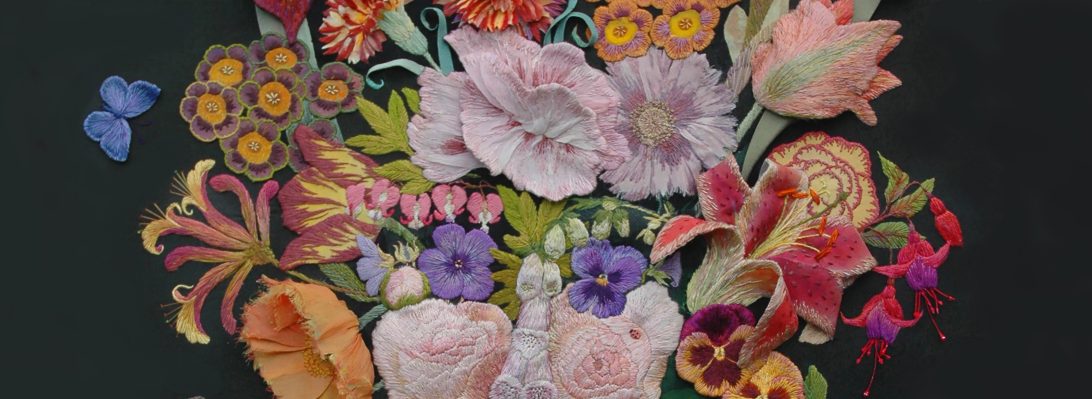
Lately my private commissions have started up again. I always prefer to work like this, in direct contact with the people who have chosen me. This post shows the ways in which I develop my small stitched portraits – not just dogs, but gardens, vases of flowers and even, at the beginning of my career, whole families.
Discover more from JANET HAIGH: HER WORK
Subscribe to get the latest posts sent to your email.