
Subscribe to continue reading
Subscribe to get access to the rest of this post and other subscriber-only content.
Subscribe to get access to the rest of this post and other subscriber-only content.

Once in a blue moon, one really good thing leads to another and another; so here is Max, the second good thing to flow from The Dog Quilt I was commissioned to stitch him when his owner saw the big quilt and the portrait of Dougal as shown in the previous post.


Starting any new commissions, regardless of subject is always exciting, for me and hopefully my clients. Sometimes it is a leap and sometimes a swim into the unknown for both of us. I always ask for any information that the client thinks is important for me to hear, plus lots of their favourite pictures of the subject even if I am visiting to photograph things for myself. Now I am learning that those favourite pictures often span years…


So looking at these 4 images above, which version of Max am I going to portray? they make me feel that Max is somewhat vulnerable and very wary, then I learnt that he is a rescue-dog from a far flung country in the Indian Ocean.
I started by actually drawing into the photoshopped images in order to edit Max into a middle aged dog after some discussion with the owner. I sent these first images to him for comment and hopefully approval.


Here are some of my drawings with samples of materials and stitching technique, based on one of the dogs in the Dog Quilt.
The Dog Quilt portraits now serve me as a sampler for a myriad stitching and embroidery techniques. Below is the pencil drawing I eventually used as the scaled up working drawing for the hand embroidered portrait. It has very precise broken lines to describe stitch directions but most importantly it depicts his gaze.

I sent these images to my client for feedback and he said to go ahead, with no time deadline and no extra requests. What follows are a just a few of the many stages of building up the portrait. First an outline tracing from the design drawing, then the coloured base drawing using Derwent Ink Tense pigment pencils that act as a guide for the blended colours of the coat and a useful dyed background. From the start of this process Max looked me straight in the eye, it was wonderful to see him emerge.


Using stranded cotton threads I stitched a basic undercoat to give me the directional stitching of the hair


Then the ‘top coat’ stitched in single strands of pure silk following the direction of the coat


Now the contours the face emerge (I have always thought that if I can faithfully describe the surface, what lies beneath will become visible) To get the quality of the blended colours, I ply 2 dark and light strands together – a Japanese technique I learnt years ago on a travel scholarship to study kimono (another story)


Nearing completion and time to tackle the eyes: it is so important to keep the gaze focussed on the observer – who wants a picture of their pet looking away?

Here I compare and contrast the early research samples with the finished and stretched embroidery below

Lately my private commissions have started up again. I always prefer to work like this, in direct contact with the people who have chosen me. This post shows the ways in which I develop my small stitched portraits – not just dogs, but gardens, vases of flowers and even, at the beginning of my career, whole families.

The classic 17th century Dutch paintings of fabulous flowers, but this arrangement probably did not really exist. The modest bunch above, features early spring Daffodils, with mid to late spring Tulips and Irises, and yes they can all grow in the same season, but the give away is the fully formed damask rose seen only in mid summer. It demonstrates how the artists worked: each flower was a sample of horticultural expertise, painted when it came into season, then there was a wait for the next bloom to come to perfection.
So last year when I was commissioned to embroider ” a vase of colourful tulips” during my Hidcote exhibition, and I realised that tulips would not be in season in October when I could start working on it. I decided to find tulips within my own work and remembered a very old sketch book with a vase of drooping purple tulips ( circa 1980). Always keep your sketch books!

Above is the inspiration behind my latest commission. Below shows my studio wall with earlier flowers against stitched Kantha skies…with a sample of different fabrics to act as the background


Now I needed to choose some colourful tulips to put in a vase. I started with my sketch, below, of some striped tulips that I have used many times for different projects. It was at this point that I sent images of ideas and sampled fabrics to the buyer – for any feedback then with her agreement I went ahead and started on the actual panel. But with the stipulation of no other sighting until the piece is finished !!!!!!!!

Here is the drawing used again for the front cover of one of my embroidery books, and on a detail of Tulipomania now used for a print in my shop,


Below, designs for counted thread canvas work woollen embroideries – a good drawing goes a long way!


Now to flower arrangement – I am not good at arranging flowers and I really have to work hard at this aspect of my flower embroideries. I edited the tulips from the original early drawing as I did not have the time or space to stitch 10 flower heads in different colours and shapes. Below are 2 of many early drawings graphed for transference to the stitched ground.


And to colour, the tulips need to work with the sky, and the sky is all organised, tacked ready for quilting between stitching the tulips.


To enable me to gauge the placement of colours against the already glowing sky, I wrapped some silk ribbons to act as flower heads, found the silk threads to match them and took colour notifications – if only things work out so simply in reality – but I was starting this bouquet from scratch.
Drawing, redrawing, sampling and stitching one by one each tulip head is made,


Below show older drawings in my current sketch book; plus my friend Lizzie Butler’s birthday card to me – I just copied it straight onto silk organza – with her permission of course!


When enough heads are made I start to arrange them on the background….and then the leaves. I just love to draw tulip leaves and their colours are so soft and gentle. I start with cut linen shapes from my original drawing in order to stitch over them to give definition; getting there.


And last the vase – which is another story – believe me!

I truly enjoyed this work, creating spring flowers in the depth of winter, but it was a challenge as you can see. It is now safely framed and given straight into the hands of the son of the person who commissioned me; he had seen my work at the exhibition and talked about it…..and he has promised to send me a photo of the framed work in situ in the new house.
The last week of my exhibition Inspired to Stitch at Hidcote Gardens and this week ,taking stock of the whole experience, I find myself reflecting on, amongst other things, what sells and why. My small prints of the Birds in Skirts are still selling well and in a few weeks will be winging (sorry) their way to their new owners.


But it is often the case that the works I have most affection for (or would like to keep for myself) often do not sell immediately. I am particularly fond of the 2 larger A3 prints with the crazy patchwork skirts. I designed and made these fabrics for my first ever book, Crazy Patchwork, published by Collins and Brown in 1998. These 2 pieces were made into lampshades – yes that’s right, I made crazy lampshades – so I unpicked them from the shade shapes and used the still pristine patchworks for the large skirts.


IF I was buying from this collection, I would choose the lovely old white fabric designs chosen from my collection of vintage fabrics; strips of hand embroidered tape lace, Broderie Anglaise and crochet braids and ribbons that I have lovingly hand stitched together. But not one has been ordered – hey ho! obviously have been overlooked by the more colourful iterations or maybe it is the lack of the pastel skies?


But the Beribboned birds, below, made with the more modern and beautiful coloured ribbons by Renaissance Ribbons are still available….so what do I know?


And my very first versions of designing and stitching the complicated Jacobean embroidery techniques, that took so long to research and develop, have still to find a new home – Hey Ho! But does any designer ever know what will be the most desirable objects of all their creations?


And here is my latest version of the birds, it does not appear in the exhibition but is the result of a swift video made for instagram showing how I made this woven version….maybe there will be more to come as I have recently accepted a commission for one as a special birthday present…..
I gasped when I first saw these 2 topiary birds when visiting Hidcote to discuss my exhibition “Inspired to Stitch” for the Manor House gallery in 2025, where were the large bases of yew that they had perched upon for over 100 years?


It was explained that the loss is in part due to necessary pruning( after the covid closures) needed to maintain access to the steps to the pool. Now they sit on top of bare but beautifully dappled trunks. I immediately thought “I can mend them”, visually of course! My idea was to create 2 wide ‘skirts’ of different fabrics – but when I started to think about making skirts my mind started to race with ideas. I quickly scribbled some down onto the only scrap of paper I had to hand…..


I decided to make small drawings of the 2 birds and then I could dress them both in a fabric skirt. Now how make this look feasible in reality. Using Inktense pigment crayons A4 sketchbook paper I roughed out the basic hedge shapes, but I had so many different ideas when I looked at my vintage fabrics scraps, that I decided to make a 2 sets of giclee prints, in order to illustrate all my ideas.


Above, the 2 giclee prints developed from the original drawings from my photographs, the first design was for a lattice or Jacobean Laid Work (see below the samples on the rough drawings).


The first skirt sample was stitched straight into a bird print, using a fine twisted cotton thread. When beginning any new project, I always attempt a challenging piece of ‘inspirational’ work, by which I mean it will make me want to carry on with all my new ideas.


Above is the first design I completed for a whole set of 22 ‘Birds in Skirts” and I made them especially to sell at my ‘Inspired to Stitch’ exhibition This is an unusual step for me as I very seldom sell my stitched works. So now they have all been mounted, framed and glazed ready to be delivered to the buyers after the Exhibition closes.

There will be more posts about these stitched prints, as this is a new and exciting way for me to work. It combines my love of drawing and stitching and opportunities to develop many variations using my collection of vintage fabrics. I am now conducting new classes to cover some of the ideas and new-to-me techniques that I developed for creating the Birds in Skirts edition

Invited to exhibit my embroideries at Hidcote Manor, a National Trust Garden, in April 2025, I immediately thought of my first visit in the 1970’s; I had just started to embroider, and the effect that it has had on my stitched work ever since. Above is a small selection of my first-ever embroideries that were inspired by my delight and fascination with gardens and flowers.


I stared with basic canvas work and enjoyed the restrictions imposed by the strict stitching and its filling-in-until-you-finish discipline. I was designing pictures in order to learn to embroider my ideas.

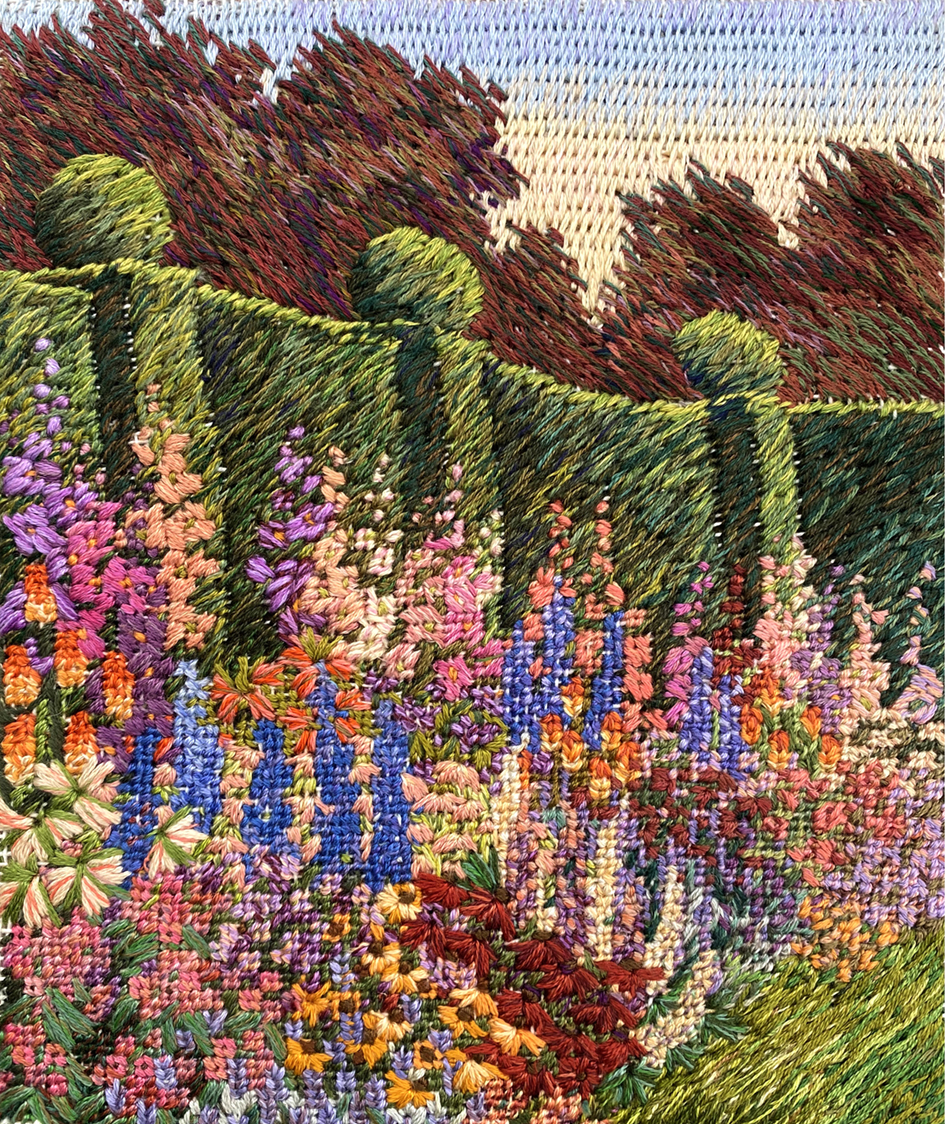
It was after visiting Hidcote that I started to draw gardens, mostly details of planting and of course, topiary. I took photographs and scribbled down notes to remember colour planting and topiary shapes to develop into embroideries. Now I realise that this was the time when I found my own way of stitching by using blended colours and really just stitching my drawings. I always scribbled drawings, took too many photographs and made notes ready to be tranformed into working drawings, and this is how start my work now, almost 50 years later.

Above a rather creased poster from my first one person show at Francis Kyle Gallery in 1979, showing my small scale canvas embroideries. My early fascination with topiary is evident.
Oddly I do not actually like the idea of strictly clipped hedges, specially when trimmed into animal and bird shapes, but this feeling completely disappears when I actually see it for real. I find this ambivalence really useful and for me it provokes new ideas; why bother to make anything that holds no meaning, mystery or is simply a puzzle for you to try to solve? But mostly I am delighted by the sheer absurdity of it. Why do we tether bird-shaped hedges to heavy domes of yew – to stop them flying off?


And I have continued to embroider the topiary figures that are often seen in grand gardens. Above is ‘Great Dixter’ a small silk embroidery circa 1980, that was very inspirational in making new pieces for this exhibition. Right is ‘Lytes Carey’, another National Trust garden, this is made mainly with simple large running stitches in woollen yarns onto a wool ground for a big woollen panel, in 2001. I always enjoy seeing the dense green walls of hedges surrounding an abundance of flowers, as seen below on my several visits to Hidcote in 2024.


Insired to make new works for the exhibition, back in the studio I combined different drawings, prints and photograps of several aspects of the garden’s abundance and used some old stencils and wonky photocopies that had been over-printed with my embroidered flower images. From this I developed a collage from shoji paper and stitched silk. Then found an old photograph of the birds as I can remember them with their crowns as peacocks.


The abundance of planting in the garden beds reminded me of Gustav Klimt’s flowery lanscapes, I began to imagine the plants at Hidcote developed into a wall of flowers. I had bought a packet of paper napkins patterned with a Klimt garden for presents to friends, from a museum in Vienna, but had kept them myself. I took one and pinned it to my studio wall, with the other half formed ideas.


Stages in the inspiration: designing, drawing, dyeing and stitching my homage to Gustav Klimt. I stitched a bird in twisted silk thread on a fine silk ground, then painted dye onto another silk ground adding many of the flowers and leaves, found in my photographs, to make the flower wall. Eventually I stitched the finished bird into postion.

The finished ‘Vintage Topiary Bird’ has become the front cover of the picture book/catalogue that I have produced specially for this exhibition. It has just been delivered to the publishers in time to be printed and for sale at the start of the exhibition Inspired to Stitch: Hidcote Revisited.
The new season’s exhibitions at Jen Jones’ The Welsh Quilt Centre, Lampeter opened a week ago today where I am exhibiting a small show of personal work – work that I make and keep for myself.

On my first visit early in 2023, when I took actual work to show Jen Jones, she offered me a small gallery for an exhibition and I decided on ‘The Flora’ embroideries. However on my second visit to the, now empty, room I immediately realised it would need far more works than I had imagined. I decided to add a more unusual collection of my textiles combining vitreous enamel and based on Mending. It features broken hearts and how to mend them, so Hearts and Flowers: starting at the begining and going round the room: this is the story of putting up the exhibition


In the first week of March I took all my works and with the help of the whole team at the centre the exhibition was in place in a day(apart from a few extra tweaks before the opening)The first wall of work was The Flora. The exhibition curator/editor, Sarah James, remained focussed when I had lost mine.

The Flora flowers give way to a group of ‘Flowers For Our Times’ my most recent hand embroideries..but they continue the themes found in Flora. On the left is a stitched appliqued drawing.


The flower walls give way to hearts (and eyes) so here are my minimally quilted fabric patchworks. This took quite a lot of preparation, pressing on my behalf and for Charles (and Russell) the gallery’s invaluable exhibition men, constantly measuring and sometimes just waiting, but colour co-ordinated!


The large Comfort (Hearts)and Security (Quotes) Blankets and Safety Curtain ( Eyes) had been draped over my bannisters for weeks (above right) but a 3 hour car journey had creased them; I am always relieved to be able press my work before it goes on display.

Moving round next are the metal and vitreous enamel hearts – all broken, discarded, damaged but saved in some way.

The works above are made of metal and glass enamel, they are stitched and embroidered with drawn thread work in copper wires on metal fabrics and copper plate. Patterned by sifting white enamels through Lace and Broderie Anglaise stencils, except for the red sampler that is darned in silk on vellum


The bed in the centre of the gallery is Sarah James’ idea, she thought it would perfectly show off the bedding of Make it Through the Night and she was right! People are really curious and stop to ‘read’ the symbols and it makes sense when teamed with the Bolster.

Eventually we get back to entrance with patchworked and embroidered and flowers but outside in a vestibule there is still something else to see, Russell putting up my framed giclee prints, unframed for sale in the shop with many more flower pieces. And the large ‘Lytes Cary Manor’ woollen wall hanging taken from my studio wall where it has lived since 2001.


The very last picture I took was at the end of the Private View. A group of staff and on the left Jenni of Jenni Smith Sews talking to Hazel (who appears to organise just about everything around the Centre) waiting to hear how to get through the wild Welsh countryside to the restaurant for us to celebrate all the exhibitions and videos on display throughout this amazing place.
PS. my work is not for sale but my new giclee prints of embroidered flowers are available to buy in the fascinating vintage textile and bricabrac shop attached to the centre.
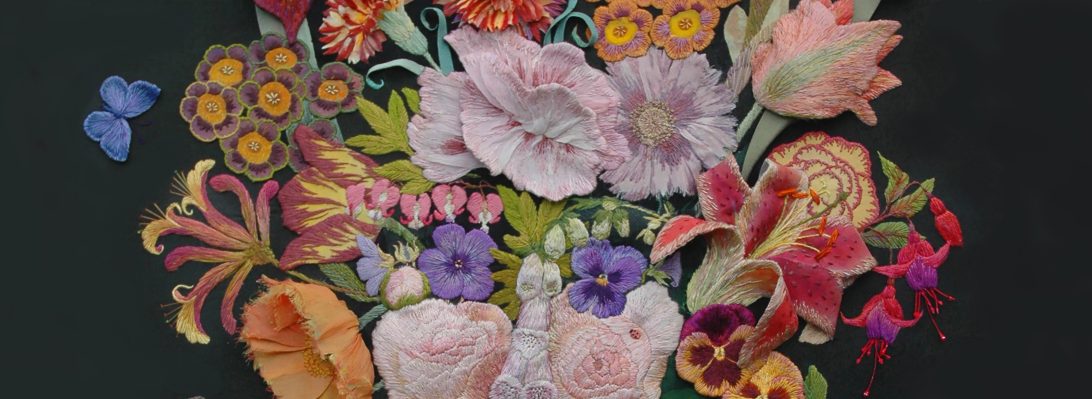
Over the past few years I have been intending to start selling giclee printed versions of my personal stitched work. The latest pigment prints available are unbelievably faithful in reproducing my finely stitched work…but where to start? Flowers – where else? I determined to develop some new flower embroideries for this venture.


Following on from revisiting my old research books and past work, I decided incorporate the flower embroideries with the Kantha stitched skies as in After Winifred. I took a beautiful bunch of dahlias and held them against a large scale Kantha Stitched sky in progress on my studio wall. I had been brought the flowers by Helen Reed, who owns Court House Farm and runs a seasonal cutting garden amongst other ventures. And where I hold drawing sessions in the summer months.


I also eventually started to work on an idea taken from a rare photograph of my garden Hellebores in a vase and in front of my scarf design of Hellebore flower heads. What is odd is that while Hellebores are one of my most favourite flowers, am not keen on Dahlias and did find myself reluctantly stitching them onto a small version of the Kantha sky. Below are the first 2 prints in the series Flowers For Our Times, on the left is Dahlias, on right, Hellebores


Reflecting on the Dahlias and Hellebore pieces (made between winter 2021 to early 2022) I felt as if I had made a definite link between my old and new work in order to make the really vivid giclee prints, available soon at Heart Space Editions. But although technically demanding, using the new Inktense dyes from Derwent, I decided that this was not the way forward that I had imagined it would be.


I returned again to my early flower work and re-read the catalogue of my exhibition of Flora’s Legacy, held in Bath in 2000 ( yes – so many years ago!!!!!) and realised exactly what was missing – symbolism – or the half hidden messages often contained within these earlier works.The centre-piece from the exhibition, Flora – the Roman goddess of flowers, had what was missing from my new works…the hidden meanings and humour – here some blackish, bawdy humour.
Turning to the many and various dictionaries of symbols I keep in the studio library I thought I would invent a bunch of flowers instead. The meanings of plants and flowers are universal and every culture has its own beliefs, sometimes conflicting – sometimes they are entirely in agreement: a poisonous plant is a poisonous plant. Out of curiosity I checked what the 2 bunches meant adding, the meanings to my original studies…..


I must admit that I was shocked, relieved, delighted and then excited to find that I had embroidered War, Scandal, Uncertainty, Instability and Sickness within 2 pretty bunches of flowers. But everyone else around me was spooked. So – they asked – where did I get this information from? Well in my books of symbolism, the most curious and confusing is The Language of Flowers – but oh the possibilities that it offers for mixed messages and hidden warnings amuse me enough to keep going with this theme.


Using just my old folders and Victorian books of flower meanings lead me to a brand new fully comprehensive dictionary by S. Theresa Dietz – published by Wellfleet Press, and the here I discovered far more arcane information than I had gleaned from my all my original sources.
So now what to do next – can you guess?


check the gallery section to see more outcomes of this ongoing project

I want to show how my stitched work progresses; here is a very heavily edited set of images taken over the last 2 months – from July through to the end of August 2022. Not shown is the unpicking, pulling apart already stitched fabrics and rearranging that leads to frustration and doubt but mixed with delight, calm contemplation and my eventual recognition that, having captured my original vision of this ominous sky, I can stop working on it. The drawing above took less than 1 hour, the piece shown below, more than 8 weeks…..
Week 1


The first stages were quite tricky to lay out using strips of silk georgette onto a pale cotton ground, that had to be kept scrupulously clear of stray threads while building the applique ground.
Week 2


By the end of the second week I had managed to cut the clouds and baste them all into position, then I checked them against my original drawing. The tiny sample of energetic Kantha quilting inspired the way I attempted to stitch the cloud.
Week 3


I started the running stitches in rows of single silk threads to create an undulating rippled surface. After a few unhappy days I stopped stitching, undid as little as i could get away with and inserted more pieces of rust coloured silk organza to give the cloud ‘depth’. The chalk drawing, above right, shows the paths I need to stitch along; I think stitching rhythms into cloth by using the Kantha technique is a bit like patting your head and rubbing your tummy at the same time – tricky!
Weeks 4 & 5


I was determined to use this piece of work to try to find a way of controlling the outer edges of the appliqued fabrics; usually when I make very large drifting Kantha Stitched Skies I leave them to be contained and wrapped out of sight when stretching the finished work. But here the view is much smaller as this black cloud did not extend the whole length of the estuary – it faded out just beyond my window frame. I looked at Georges Seurat (who is a great influence on the way I have developed the colour mixing within my stitched work) and adapted his painted canvas frames – his dots are my stitches ). And eventually the marsh starts to emerge, using large straight slanting stitches
Weeks 6 & 7


However as the stitching progresses the different tensions start to exert itself onto the fabric – where the stitches are close together the fabric width starts to shrink, which is to be encouraged as this gives the curious patterns that I feel are so like air currents…. So the side borders are unpicked and the the whole embroidery is squared up. When I had almost finished stitching I outlined the whole piece using a machine stitch to give me a better guide for the dozens of running stitched lines for the frame.
