Everyone loves children’s art – either drawings or paintings; the pictures always have such energy and capture the spirit of the thing depicted – real or imagined. So when a visitor, Nadia Lanman, came to Heart Space Studios, to view my exhibition of ‘Mending Mottoes’ and asked if I would be interested in a commission to stitch one of her daughter’s drawings, I accepted at once – thinking “this is a challenge”
I asked to see several paintings and drawings so that we could make a decision which to depict, and really to see how difficult a challenge it would be. The price was also considered at this initial point as this was a thank-you and leaving present for the nursery school that 4-year-old Lola was leaving to go onto her primary school. Nadia brought in several, some simple line drawings and some full-on paintings. It became clear that Nadia really liked the rainbow painting (at the top of the post), water-colour paint on sugar paper…so typical of all children’s art – this was going to be a real challenge! It is one thing to stitch drawings but poster paint loaded on with energy ?
When we discussed pricing the piece I advised Nadia to go and buy a frame to keep the costs down; framing is really important but can be extremely costly, so I suggested choosing an A4 size as this was roughly the scale of the drawing papers that she had shown me – and an A size frame is easy to access; I promised her I would customise the frame if necessary.
Meanwhile I set about sampling the way to achieve the full-on colour.
first colour samples on shot pink silk
The first thing to research was the background colour, I found a yellow and pink shot silk fabric, that was about the same colour but slightly brighter than the sugar paper, this would save me having to dye the fabric – but how to get some background colour onto it first before I stitched it? i tried fabric paints but when dry it was like stitching hard leather. I needed the rainbow coloured in so I would not have to completely cover the ground with hand stitches – too time consuming, too expensive.
iron-on fabric dyes in pastel form
selecting thread colours to match paint
The next thing was to choose the threads. I had decided to stitch the whole piece in running stitches, this is the first stitch everyone ever learns to sew and it always looks both simple and innocent, so is a fitting choice for embroidering children’s art. Also I have used it a lot in my recent work, particularly when embroidering writing. I did think at this stage that machine embroidery would have been quicker to achieve the impression of saturated colour, but I am not a happy machine stitcher and felt that the mechanical aspect wasn’t in keeping with the subject; simple hand stitching was really the perfect technique to choose
I tried several yarns, silk and cotton and cottons and eventually chose a mixture of both, whatever would suit the paint colours.
directional stitching sample for rainbow and writing
I had photocopied the drawing and reduced the scale, to fit the frame, and to keep my fee as low as possible. I then drew onto this the direction of the paint brush, actually showing how Lola had swept the paint onto the paper, the lines would become running stitches, but first I had to sort out the message that Nadia wanted to send to the teachers on Lola’s behalf. “thankyou for my wings love Lola xx”
cut out photocopy and writing placement for the working drawing.
I had asked Nadia to get Lola to write it on a separate sheet of paper and then I traced it into position onto the photocopy – previously I had cut out the photocopy to gauge where to put the writing – a copy of this became my working drawing…..I have my own arcane ways of getting there!
I found this stitching really interesting, it had to be kept simple but needed to show the rhythm of the painted bands. Sadly the pastel once that it had been ironed to fix it was a bit too dull – but hey ho – it helped things go smoothly and quickly. What also helped was to draw the directional lines straight onto the dyed areas with a water-soluble pen to keep a track of the flow, they can be seen on the yellow band above. The last thing to do was to stitch the message again in running stitches, then wash and stretch the work and mount it in the frame.
finished and stretched embroidery
I so enjoyed this relatively simple stitched commission ( in comparison to the recent Thangka) that I thought it would be a good idea to run a class and now that I have sorted out how to express the rhythms and colours of paintings I think that I can show other people how to embroider their own children’s drawings – they would make great presents for anyone in the family. And when I told Nadia how her commission had inspired me to develop a new class, she immediately signed up for it!
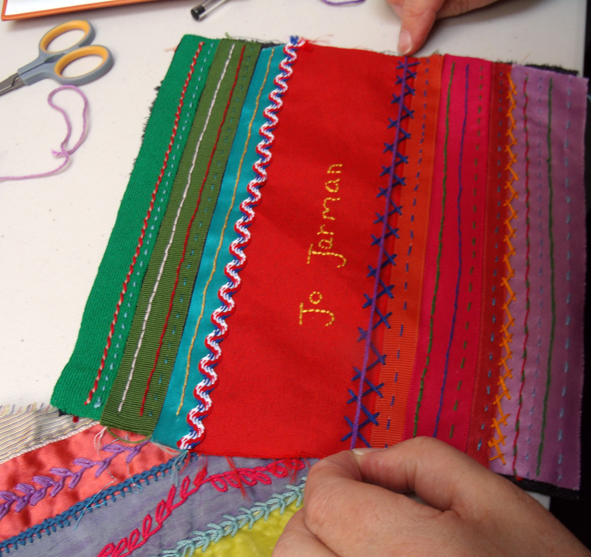
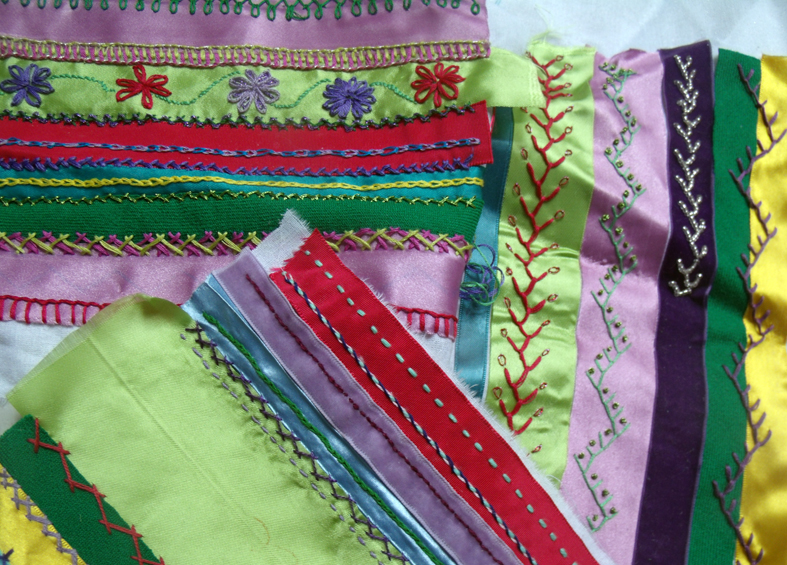
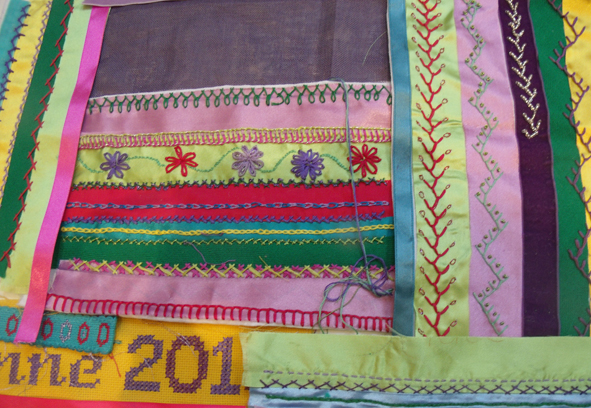
Crazy stitching on a Crazy Patchwork by Naomi Clarke from a recent workshop at Heart Space Studios
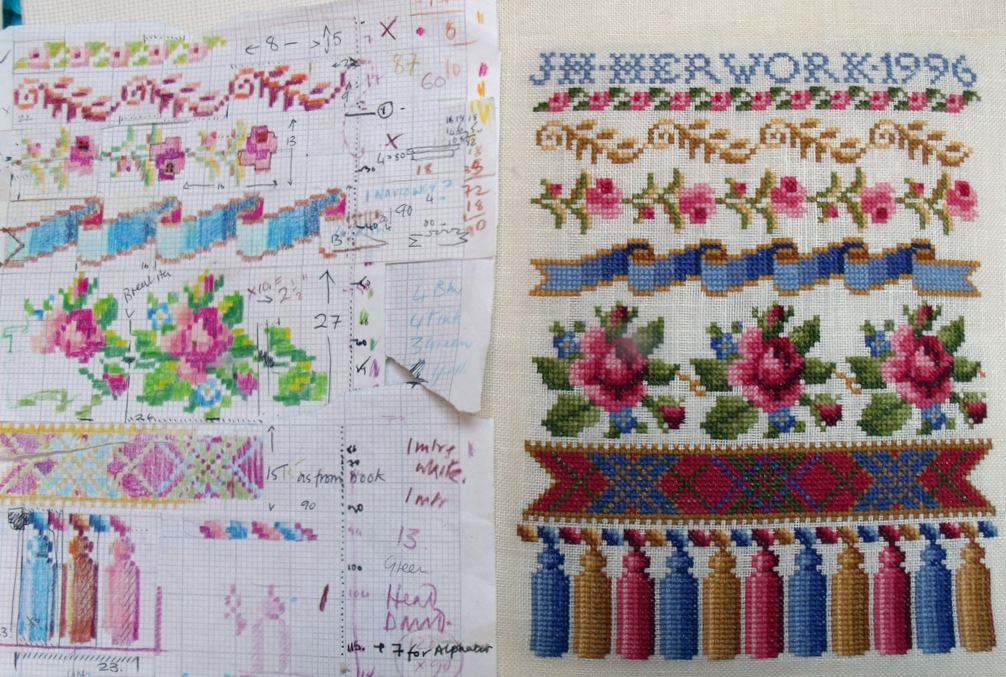
Crazy Patchwork classes have always been popular at Heart Space Studios and several people asked me to teach them more hand embroidery stitches, so I started a course called Crazy Patchwork Sampler. The course is built around the sampler that I made for my book, Crazy Patchwork, published in 1998 by Collins and Brown – it seems what goes around comes around……
my book of Crazy Patchwork ideas and designs.
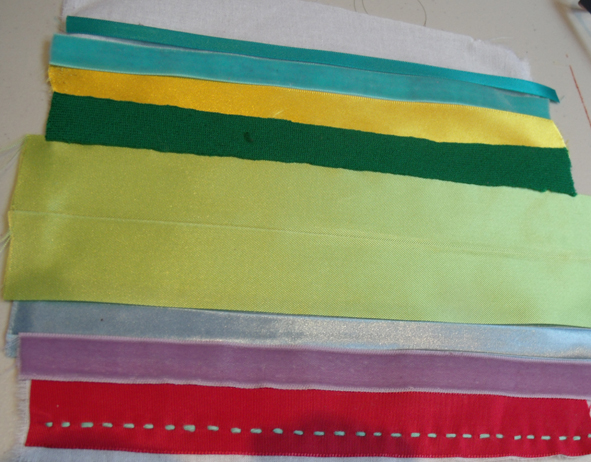
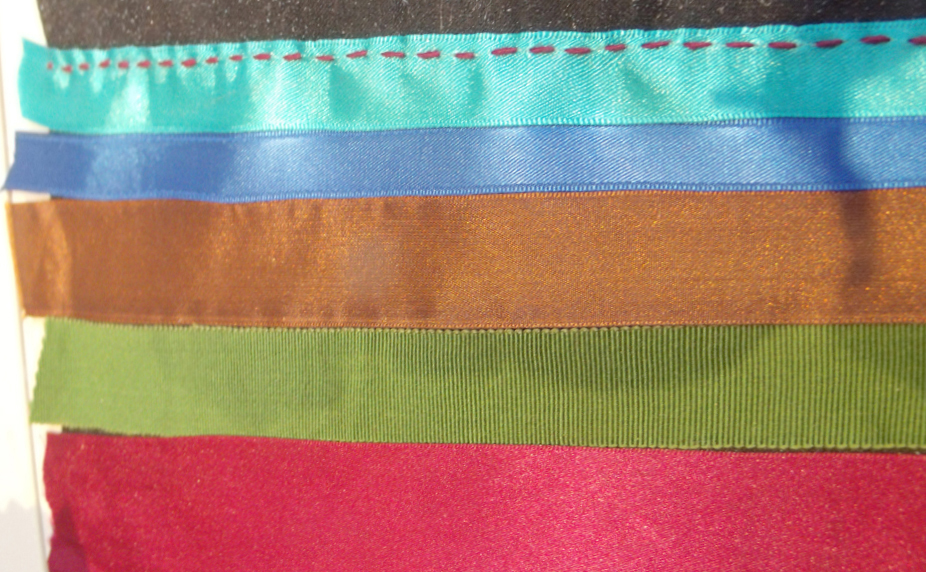
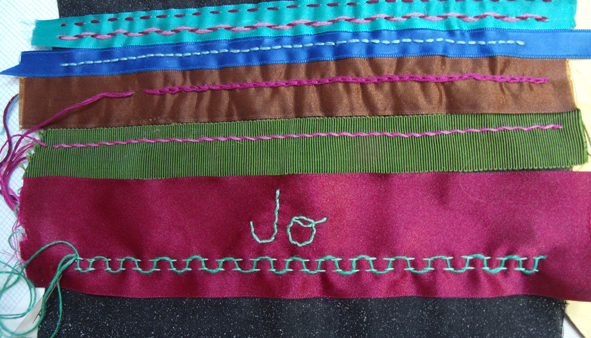
For the FIRST WORKSHOP I started off with the absolute basics, first we chose the colour scheme – I supplied various ribbons and fabrics for people to choose a small group of their favourite colours: this takes longer than anyone imagines it can and causes a lot of negative ideas to flow as people are usually very nervous about using colour, but I have learnt that this choosing is really important as eventually by using the same set of colours in various patterns and proportions the finished piece can be made harmonious.
strips of ribbon ironed on to backing fabric
first chosen coloured ribbons
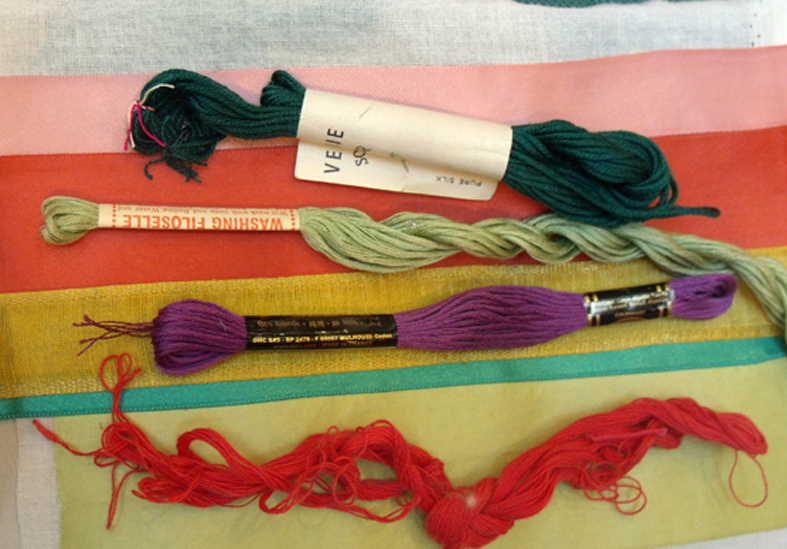
Most people, to their own surprise, choose colours similar to what they are wearing. The next choice to be made is the threads – I ask them to choose similar colours to the fabrics but to stitch in complementary coloured threads – so that the stitching will show up.
choosing complementary coloured threads
The first sampled stitches are the straight ones – running, back and all the variations, easy does it….but it also includes writing a name…very simple but very effective for the first workshop. There are various methods of writing onto fabric so that it can be embroidered and we start with the simplest by using a water-soluble pen or the old-fashioned transfer paper still used by dressmakers.
the maker’s name worked in back-stitch over water-soluble pen.
The SECOND WORKSHOPsession was cross stitch, counted and herringbone – which is the main stitch I use for joining the patches together. The group was still concerned about colours, but I assured everyone that we had a long way to go and plenty of opportunity to make the whole sampler work in harmony – I was delighted that they had all done ‘homework’ and had finished the first workshop’s ‘patch’ and found more variations to add to the straight stitches.
finished patch from first week being decorated with herringbone stitch
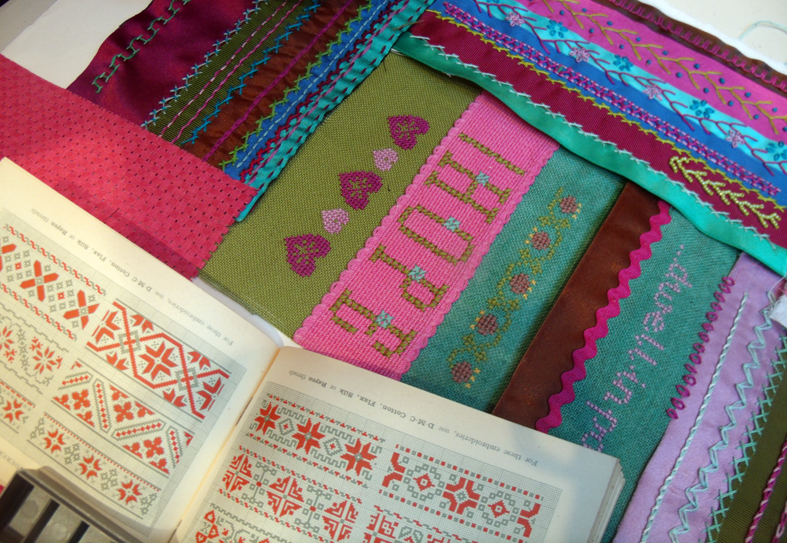
Counted cross stitch is another way of embroidering letters and numerals……
my working chart of cross stitch motifs for the accompanying sampler
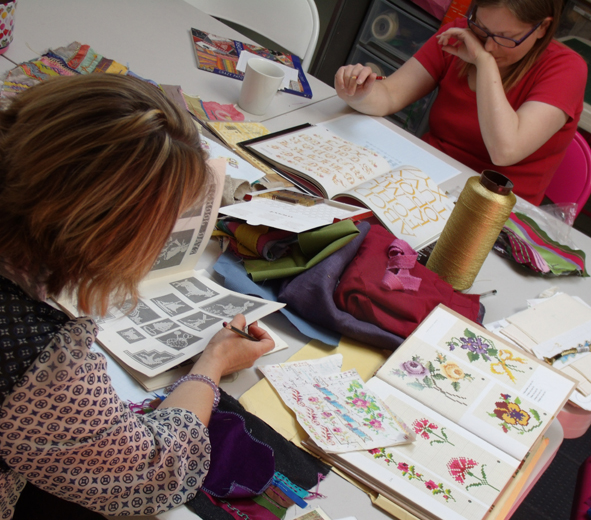
There is a whole world of cross stitch motifs and I like using the traditional ones – to illustrate the technique of charting for cross stitch I showed them some old work of mine that was designed from vintage needlework manuals. I still work as a freelance designer for a canvas embroidery company, Ehrman Tapestry, where I sometimes use similar charting for some of my designs, even though the stitch for tapestry is tent or half crass stitch. So I have lots of reference material and the group spent an hour of the 3 hour session looking at all my books and notes before they began charting their own designs.
Jo and Helen choosing cross stitch motifs and alphabets from my reference book
The task for this second session was to chart a name and date as well as a small multi-coloured motif and to stitch it onto the counted thread fabrics.
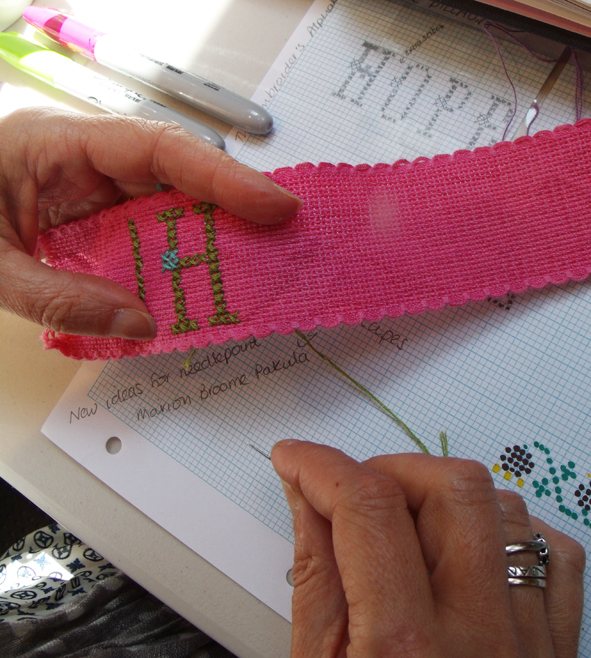
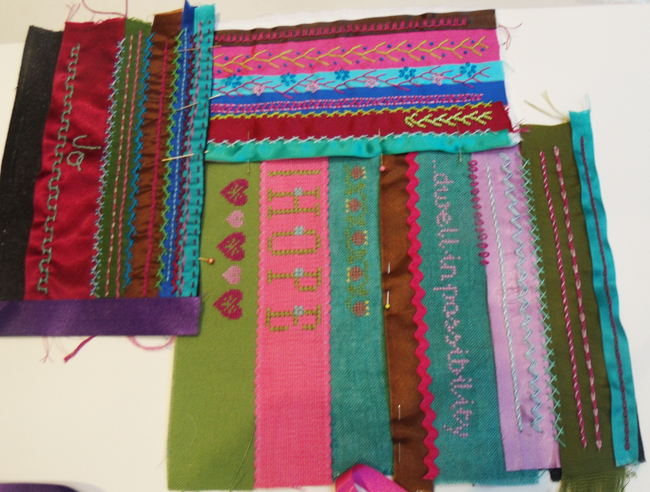
Jo decides to chart and stitch HOPE – she s going for an aspirational crazy sampler.
choosing the colours from a limited range of counted thread fabrics involves creative use of colour
Helen uses a shaded red thread creatively to harmonise her cross stitch samples with her first straight stitch patch
it is interesting how the maker’s character soon emerges from their choice of colour and letter forms, above Helen’s looks strong and directional while Sophie has chosen elegant letter forms and motifs ; the colour combinations are similar but the proportions are very different
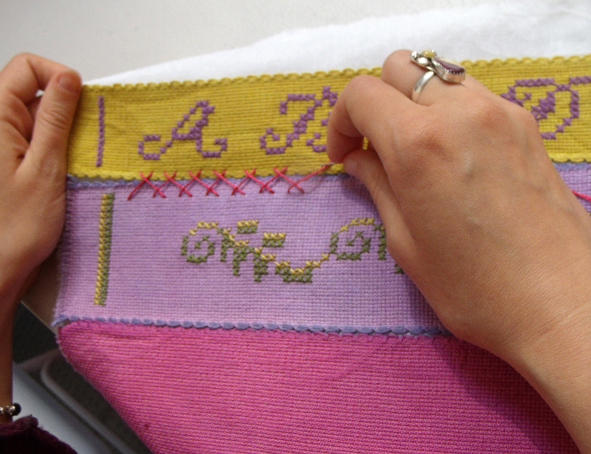
cross stitched bands being cross stitched together
By the THIRD WORKSHOP the patchworks are starting to look very rich and there is less uncertainty about colour choices, everyone seems to be enthralled by this process and are bringing in finished pieces that they have developed at home alone….everyone comments on how good it is to just stop for a time and concentrate on their stitching.
2 finished ribbon patches with 3rd ready to be embroidered
The third week is supposed to be looped stitches – chains and lazy daisies and feather, but we have to spend some time catching up on herringbone as the counted cross stitch took up most of the last class at the studio.
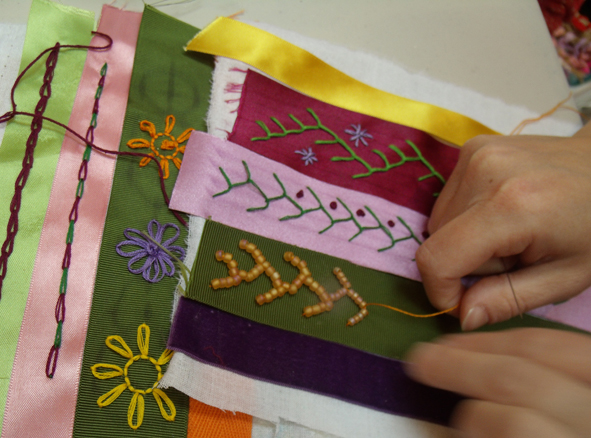
looped stitch patch of chain, lazy – daisies with feather variation being worked in beads
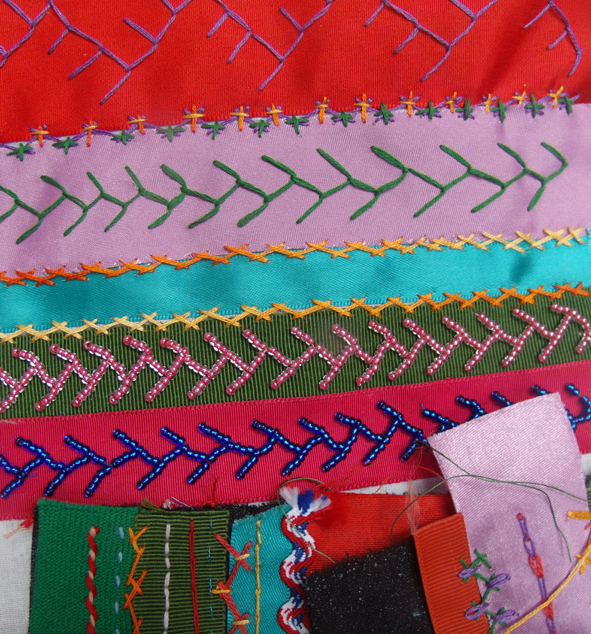
The patches are now starting to harmonise together by careful use of colour; everyone really enjoys the frivolity of stitching with multi-coloured threads to make up the herringbone variations
herringbone stitch variations plus feather stitch rows that are beaded
By the LAST WORKSHOP we have got a small range of patches ready to be worked into a whole square.
Anne’s collection of patches ready to stitch together.
The piecing together of the patches for the last class was easier because of the colour co-ordination of the embroideries, but the strict oblong patches made for geometric patterns for the final piece. Maybe for the next session of this class I will give each person a triangle as well as oblongs and squares of fabrics to apply the embroidered ribbons on.
geometric patterned patchwork for final piecing
I just didn’t have the heart to ask them to cut up their embroideries to look like a more authentic crazy, even so each person had completely different patchworks –
the inspirational crazy patchwork sampler is pinned together
This group of students want to learn more stitches and techniques so I am running an advanced course for them – and other more experienced embroiderers can drop in for single sessions. Considering that this group had only 5 classes for 3 hours each they have really advanced their practice in many ways and not just by learning how to stitch. I think that they have caught my bug – the embroidery bug – and are now developing their own libraries and stashes of materials ready to try out new techniques and new ways of expressing themselves.
vintage DMC book of counted cross stitches bought by Jo after seeing my old battered version with her almost completed Crazy Sampler
my sentiments about the Mending at the Museum exhibition
The exhibition ‘Mending at the Museum’ has finally been launched at The Bristol City Museum and Art Gallery – and it runs until April 2013….which sounds simple enough but it is the culmination of at least 3 years collaborative practice based research between academics and professional makers and artists. The ‘Stitching and Thinking’ research group, which I facilitated in my post as a senior research fellow, evolved the exhibition via a series of mixed media workshops, visits to the museum’s mended collections, many meetings, discussions, conference papers and a small sample-stage exhibition; and it also caps off my academic career which started in 1973 and finished last year in 2011….. So no pressure then.
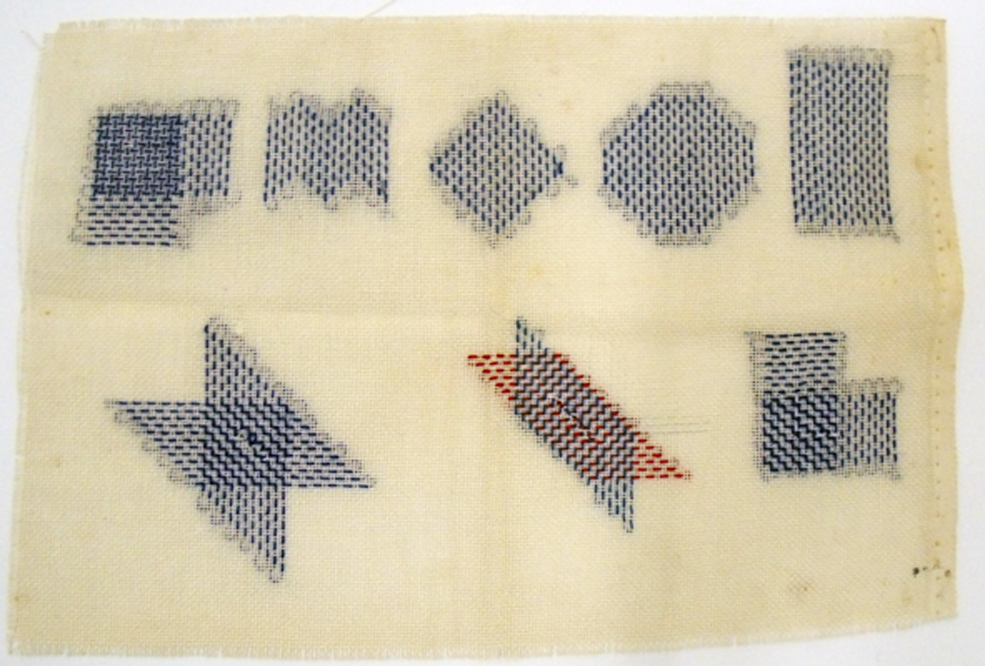
mending Sampler from the Bristol Museum collection
I co-curated the exhibition with Dawn Mason, currently the award leader of Drawing and Applied Arts at U.W.E. Bristol, and my long-term academic colleague and collaborator in all things stitched. In the museum we worked with Karin Walton, the Curator of Applied Arts at Bristol Museum, and who holds the secrets and the keys to the museum’s sampler collection, the mending samplers were the main inspiration for the work that has finally been exhibited.
school’s sampler from the museum’s collection
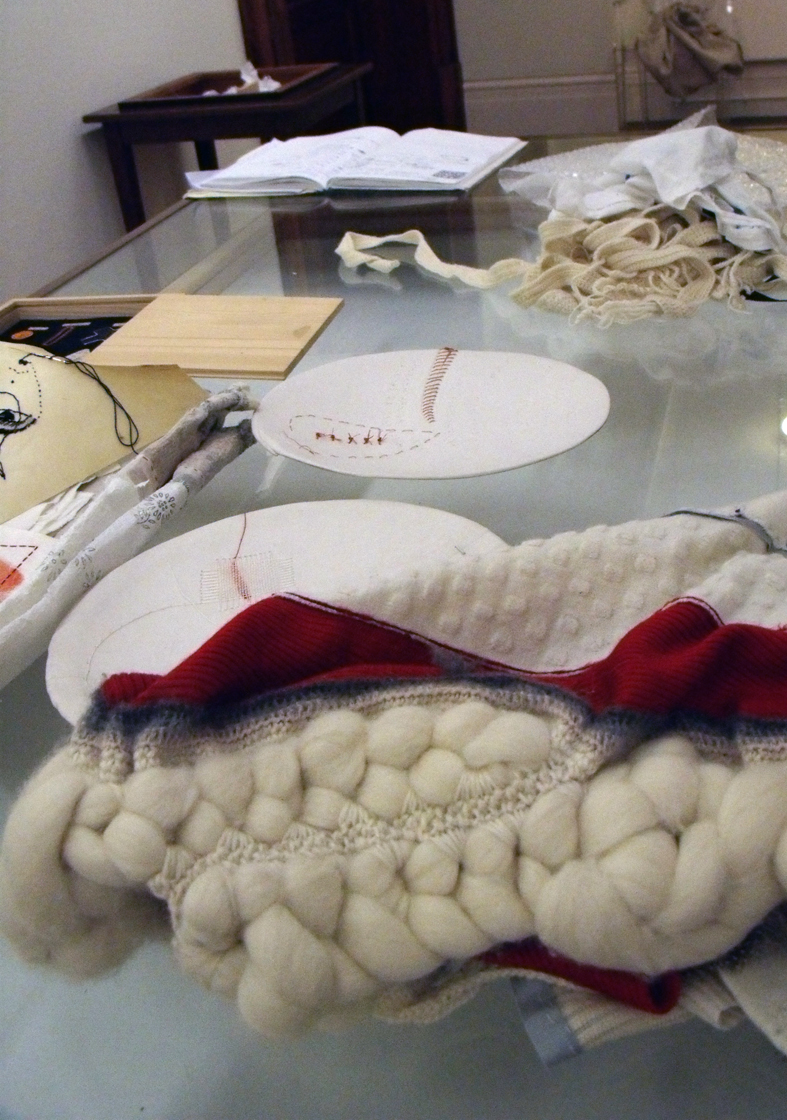
table of samples and exhibits
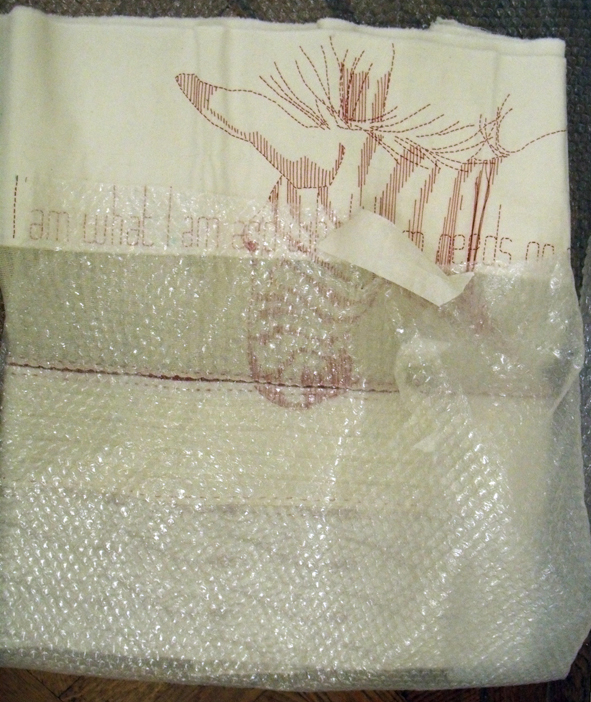
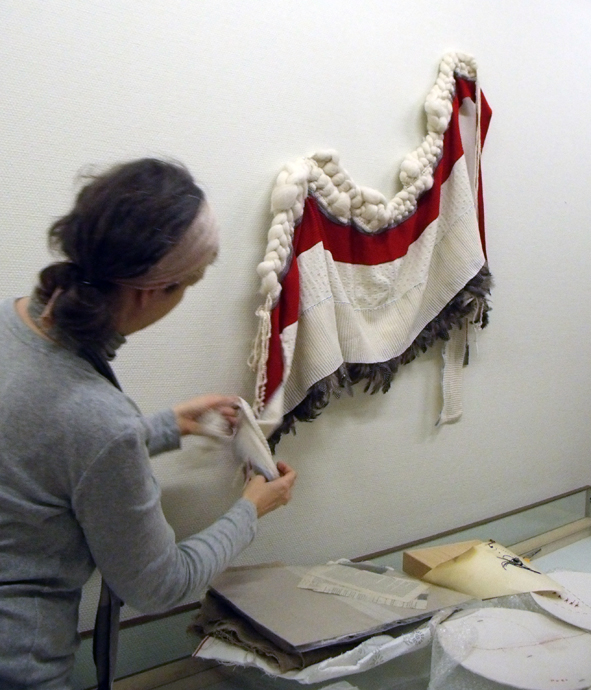
Steph Wooster’s wrapped work
When I arrived on the first morning to hang the work, Dawn and Karin had already placed the exhibits, still in their wrappings, on the floor below the wall space allotted to them, but there were piles of extraneous pieces, scattered over tables and chairs, it became my task to sort these out.
The idea of the exhibition is partly to show how ideas evolve during the making process – Dawn and I have written and spoken many times of the necessity of makers to have time for reflection; making work worthy of contemplation requires as much time for the thinking as it does for the making process. It is a constant making and thinking about what you made, re-making, re-thinking until somehow the pieces resolve themselves and you wonder how they could ever have become anything other than what they are.
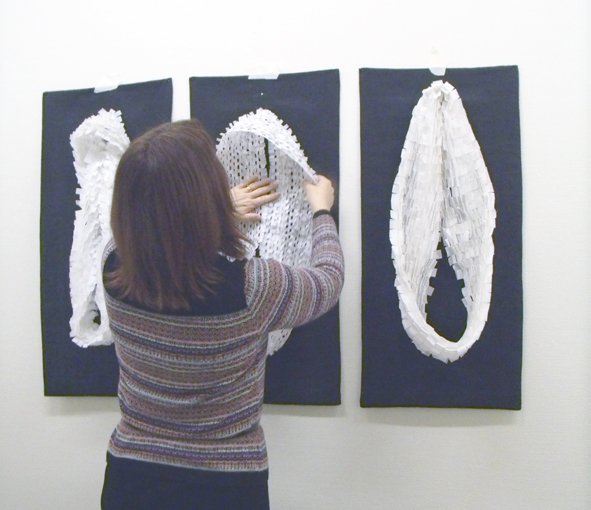
Each exhibitor was responsible for physically putting their own work on the wall, this saves so much argument later….but with only 7 exhibitors who know one another well we each respected one another’s’ space – well most of the time. So during the next 2 days each member of the group came and sorted their own work out meanwhile just looking at all the unwrapped pieces was really fascinating as work seen only at the sample stage 4 weeks before, now appeared ready for the wall. Work can made or marred by the way it is hung and also what it is hung next to. We were all acutely aware of how the whole exhibition must work together. It comprises 3 different elements; some of the museum’s mending samplers, our own samplers of work made throughout the research period, and the pieces made specially for exhibition.
Steph Wooster draping her knitted shawl
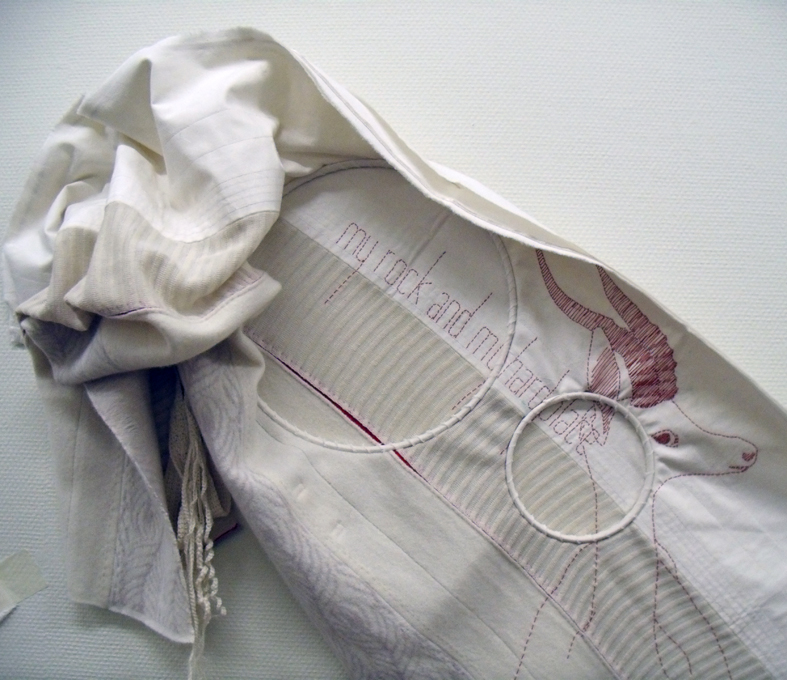
Steph Wooster’s knitted and pieced work looked different when it was stretched over some embroidery hoops that acted almost as magnifying mirrors – drawing the eye to the details of her messages. She writes of museums being ‘houses of high culture; they show the best of us’. Finding evidence of mending within the museum’s exhibits she delights in glimpses of ‘everyday life’ . Her work, influenced by the written messages on samplers, ‘celebrates the ordinary’ by using simple fabrics with ubiquitous machine knitting.
one of Steph Wooster’s knitted and stitched wraps “you are my rock and my hard place”
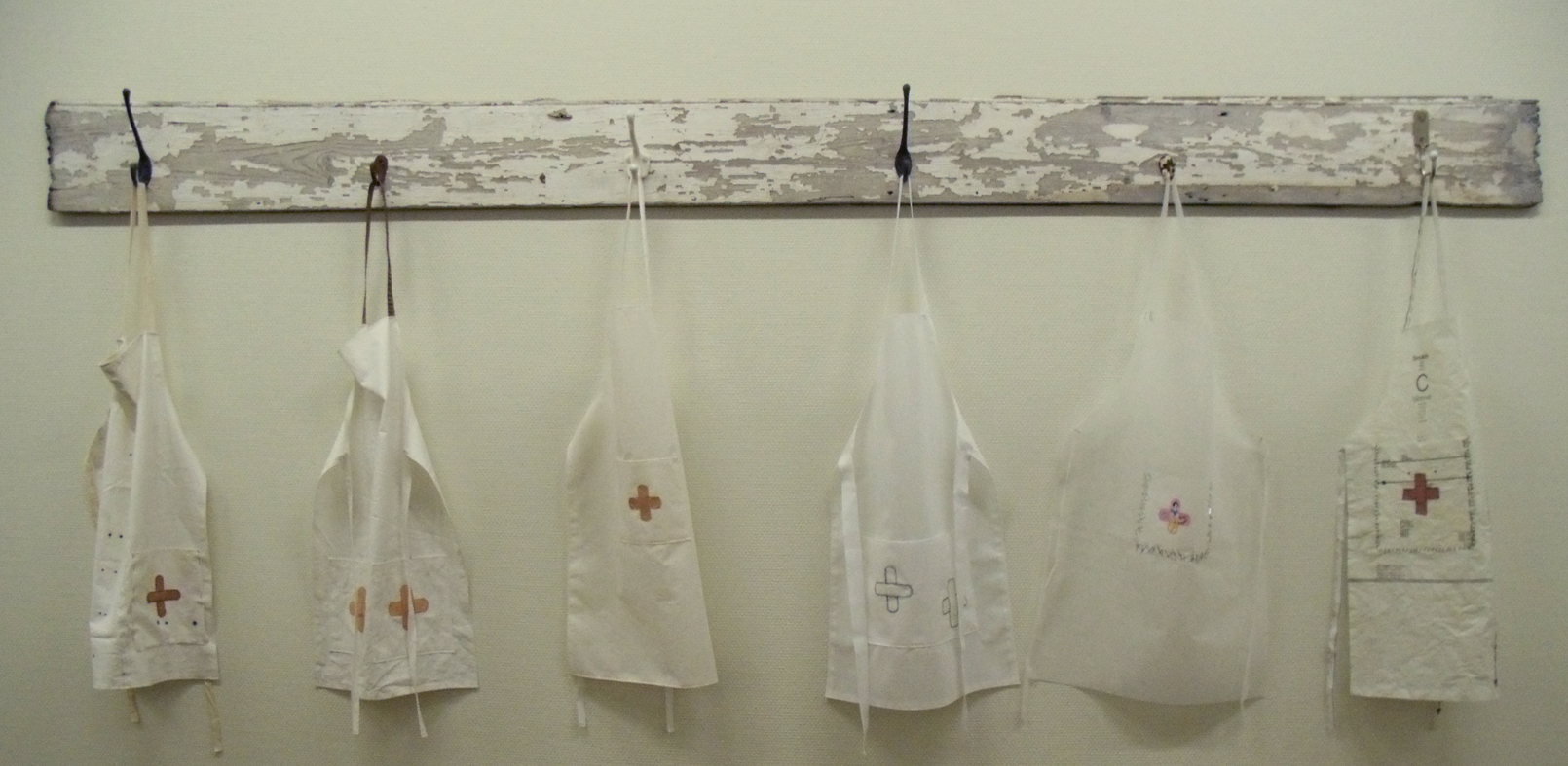
Jilly Morris‘ children’s aprons came neatly laid one on top of the other with a Fragile label printed on the cardboard wrapper – a comment, I felt, not about the fact that the contents could be damaged but of the fragility of what was inside and already ‘ damaged’ .
Jilly Morris’ stack of children’s aprons
The title of the work produced is ‘Mending Takes Time’ and refers to the functional stitching that was traditionally taught as part of their general education to girls, as transferable skills in an era when fabrics were ‘treated with regard’ and material was frequently mended to preserve a precious commodity – so at odds with our easy access to all types of fabric from all over the world.
Mending Takes Time – Jilly Morris
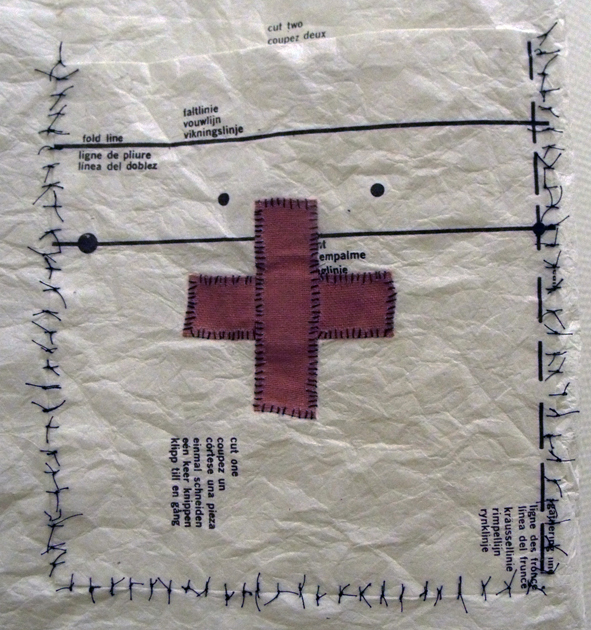
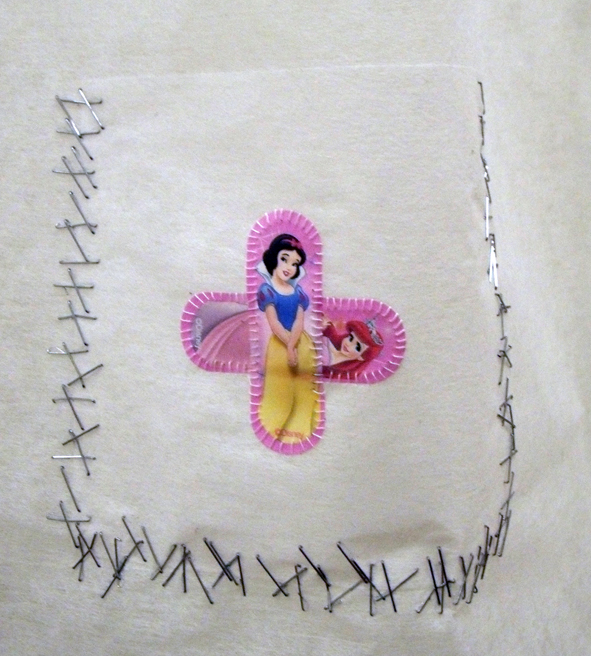
The cross shape made by various commercial medical dressings recall the basic shape of most darns seen on the samplers; when executed in ready-made modern plasters she references the ‘quick fix mentality and disposable culture’ of the present day.
Jillt Morris, child’s apron with first aid pocket – paper
Jilly Morris, Child’s apron pocket with commercial first aid plasters and staples
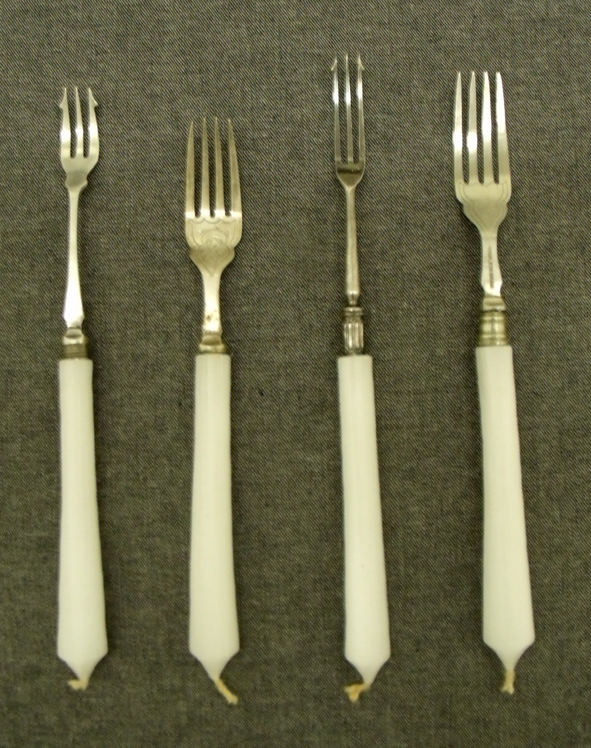
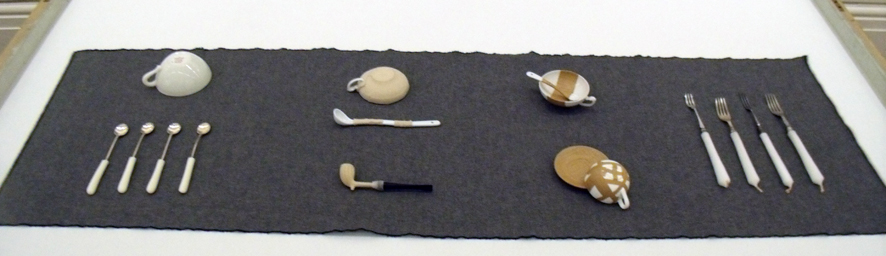
Jess Turrell came in with a box of assorted table-wear cups, saucers and a range of metal components such as spoon bowls, fork tines, knife blades and their specially made handles – which she made up before she placed them in a large vitrine.
Jess Turrell making her Fork Handles
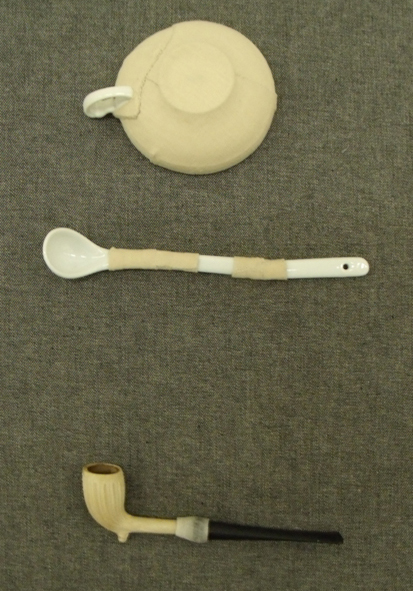
Jess Turrell first aid plaster wrapped ceramics
Her work is called “Inappropriate Mendings” and she is having some fun at the idea of making aesthetically elegant mending that is really useless for any practical purposes, fork handles are whittled from wax candles (gedditt?) cups are mended with calico, and spoon handles wrapped in plasters from the first aid tin.
Jess Turrell, Fork Handles
Jess Turrell – vitrine of inappropriate mendings
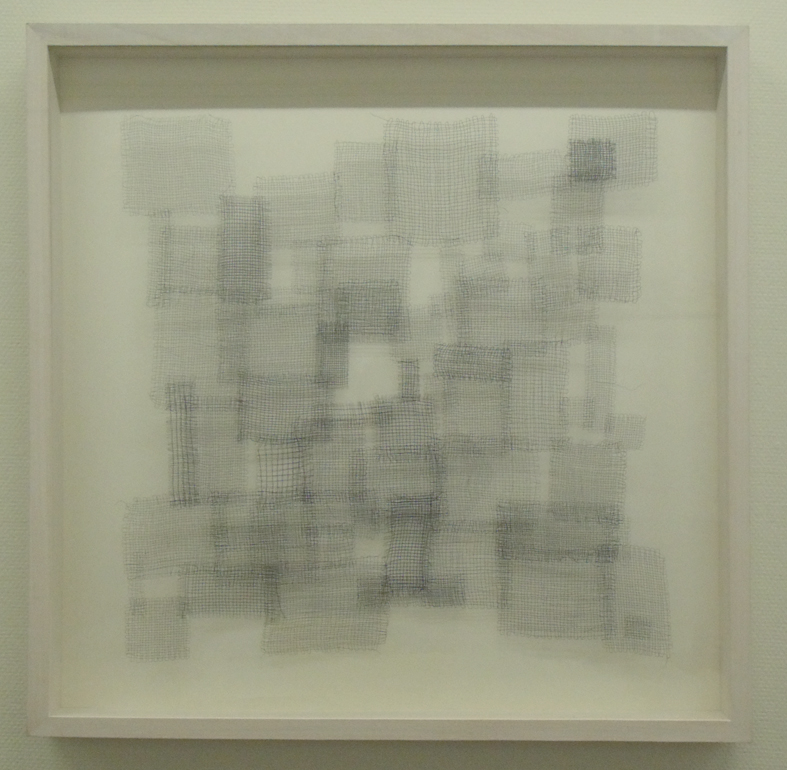
Dail Behennah brought in a fragile darned wire piece, mercifully it was framed and so this was the easiest to hang…the piece is simple and refined and references a particular black darning sampler in the collection, which is placed in a vitrine opposite her work.
Dail Behennah – Holding it Together, copper wire and thread.
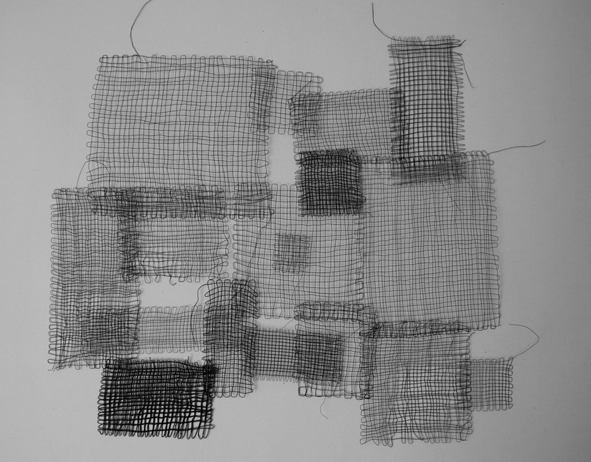
Dail reflects that the darning in an old garment are often stronger than the fabric that they hold together, she has taken this to ‘absurd lengths’ by making a piece of metal fabric entirely compose of darns. The shimmering quality of the image is created by the shadows set up by the work being suspended in a box frame, below is the darning fabric in the making
Dail Behennah, darned fabric detail.
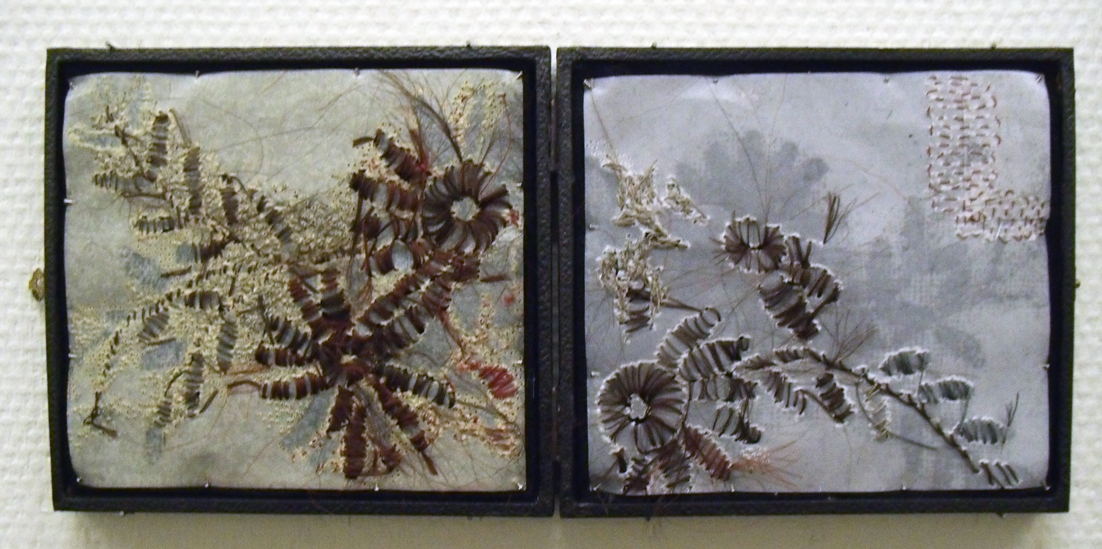
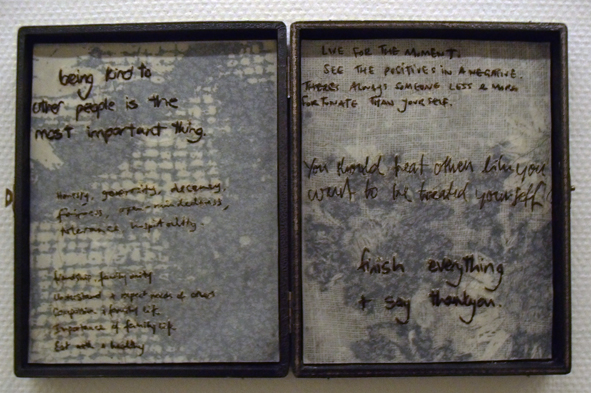
Dawn Mason exhibited a series of different responses to the mending samples, called Face to Face her work reflects the reverse side of the samplers, some how when we look at the ‘wrong’ side of a piece f stitched work it seems much more immediate, the involvement of the maker is more apparent because here we see the comings and goings or the threads and often the struggle the maker has had is left as evidence where on the front of the work all is perfectly presented and correct. (I know that given the opportunity people usually will look at the back of any stitched work – maybe searching for signs of the maker’s involvement )
Dawn Mason, hanging her newest pieces – cotton organdie
The work she showed was made over the entire duration of the project and shows the progression of her own personal work…
Dawn Mason – early stitched and darned work – printed polished paper and thread
Dawn Mason, stitched texts on printed polished paper and thread
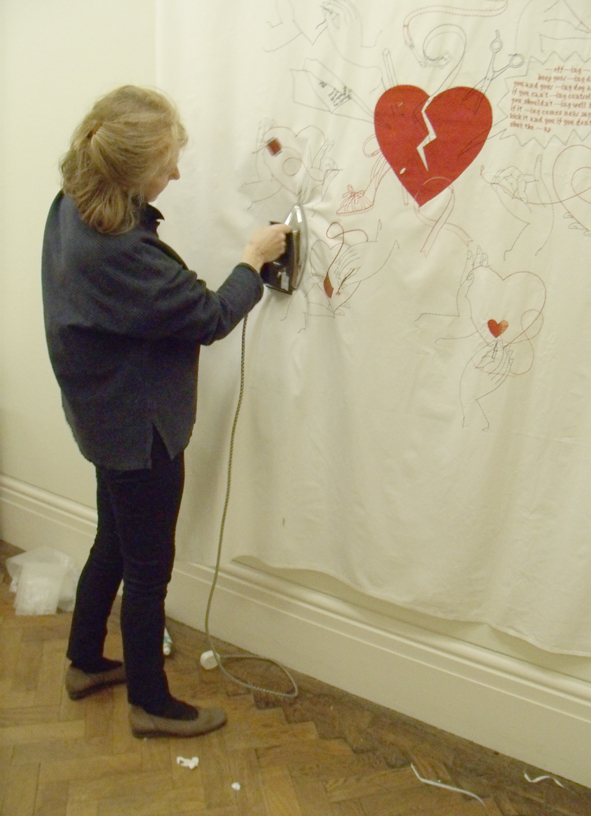
Like Dawn’s exhibited pieces, my own work forms part of an ongoing series of stitched work, that has been a direct consequence of our involvement in this project. “Make it through the Night” includes many references to mending as mending broken hearts has been the major inspiration to my personal work for several years now – as this blog illustrates – there are many postings around the ideas and practice of mending, and the first ever post was about my mended clothes………
a rare photograph of me in action – here pressing ‘Counterpane – Counterpain” on the museum’s walls
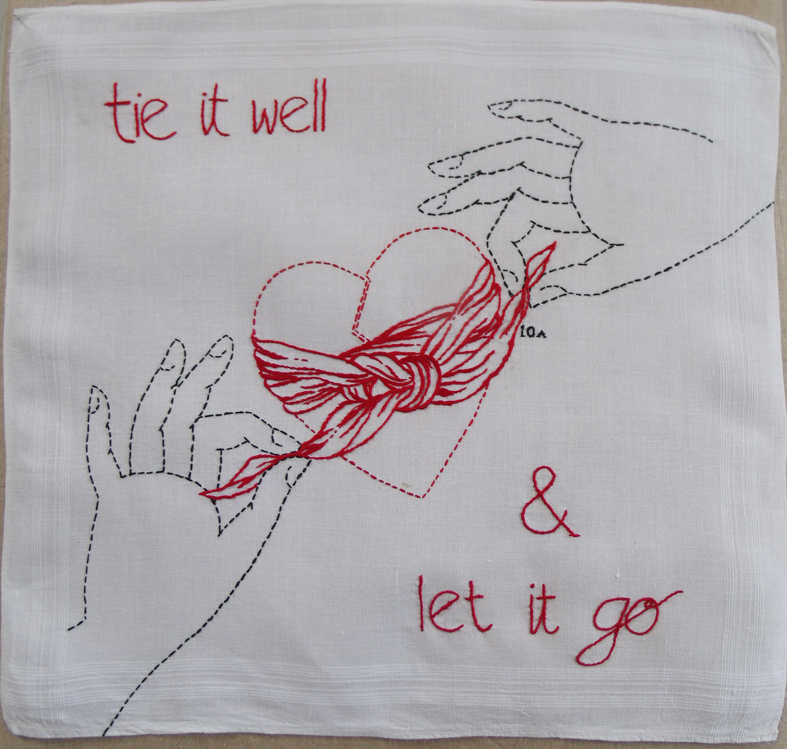
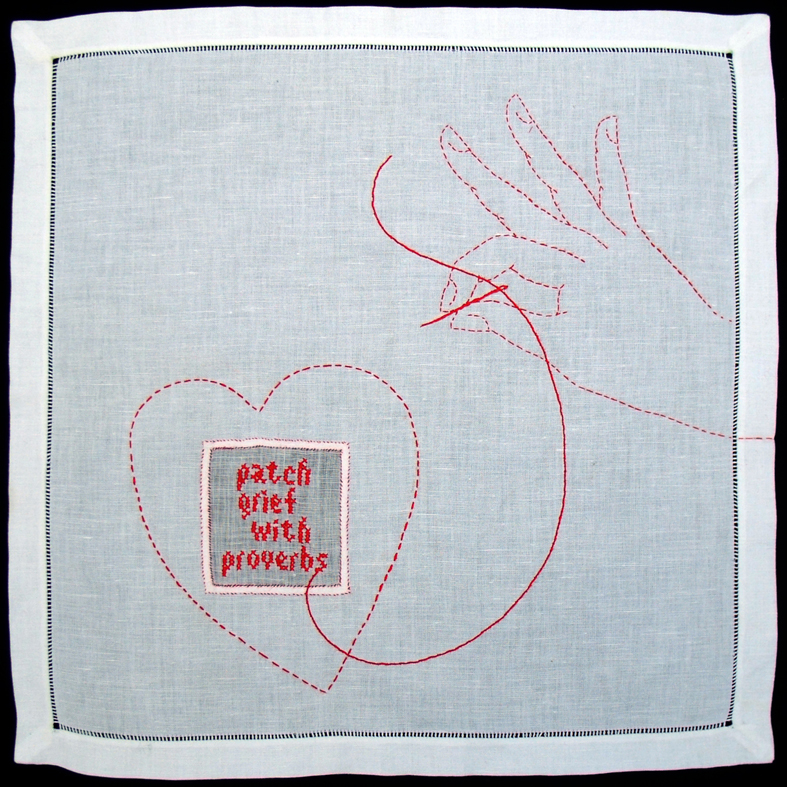
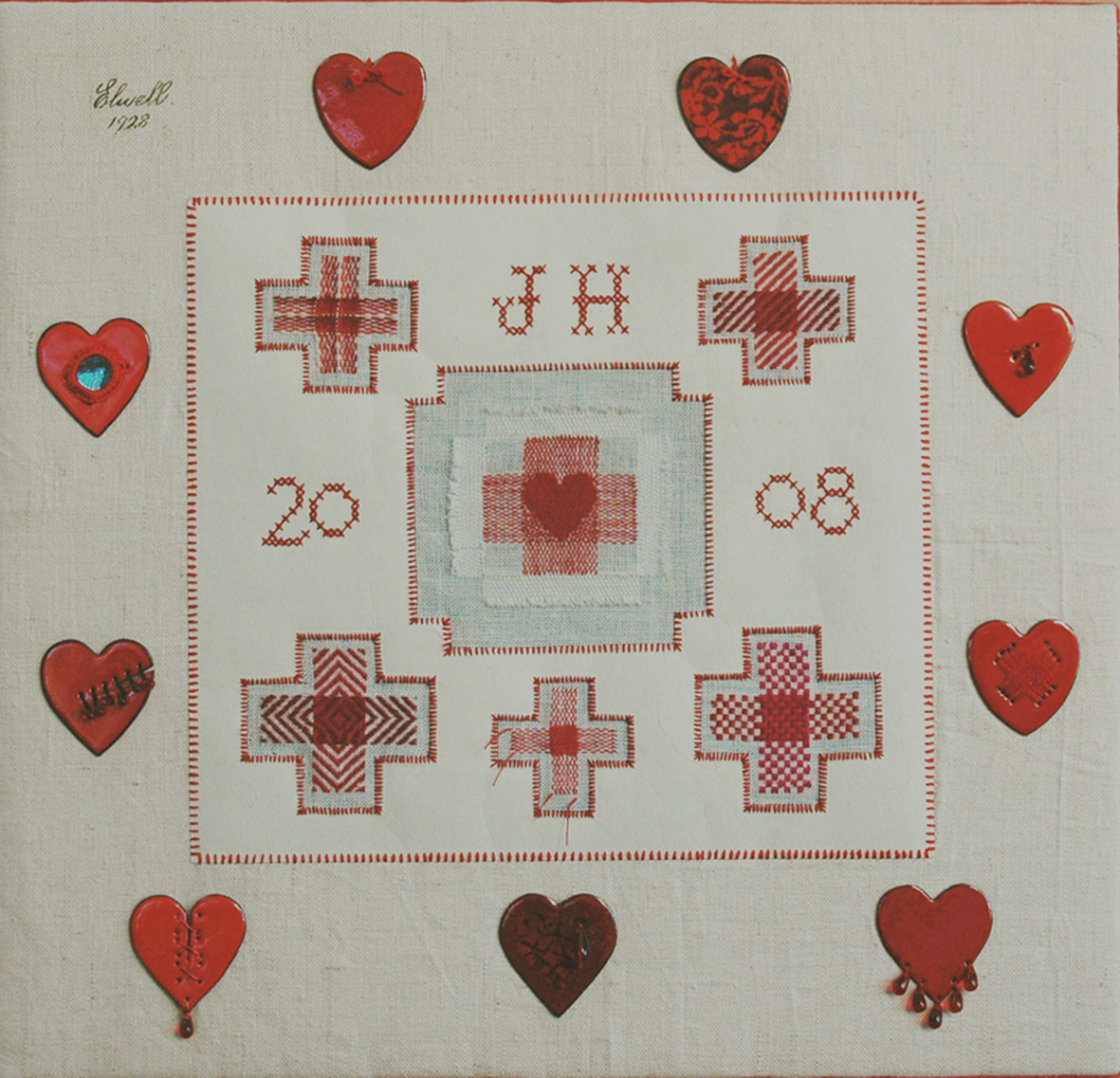
I have made a whole series of embroidered handkerchiefs, let’s face it some nights we have all needed a handkerchief if only to hold on to. So I have embroidered them with positive mending mottoes and other words of wisdom – the set is called ‘ Patch Grief with Proverbs’ a sentiment that rings true to me. How often we just find ourselves reciting platitudes in response to grief?
Janet Haigh embroidered linen handkerchief with linen voile patch.
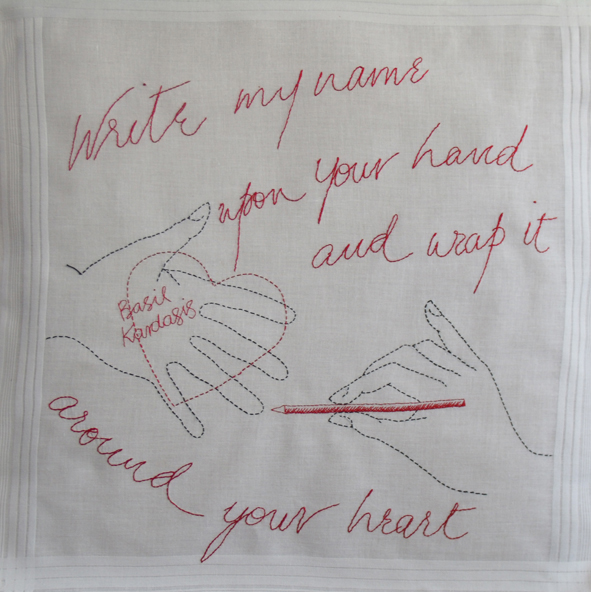
Greek proverb, cotton handkerchief and thread
I made 21 embroideries all with their own distinctive darns and patches to reflect the written proverb, they took quite a time to get onto the wall…..I had to search many different sources to find enough texts to make a wall full – but one lovely Greek proverb was given to me by Basil Kardasis and this was the last piece I embroidered – an a very large-scale cotton handkerchief I had to purchase new – the rest were all on vintage linen.
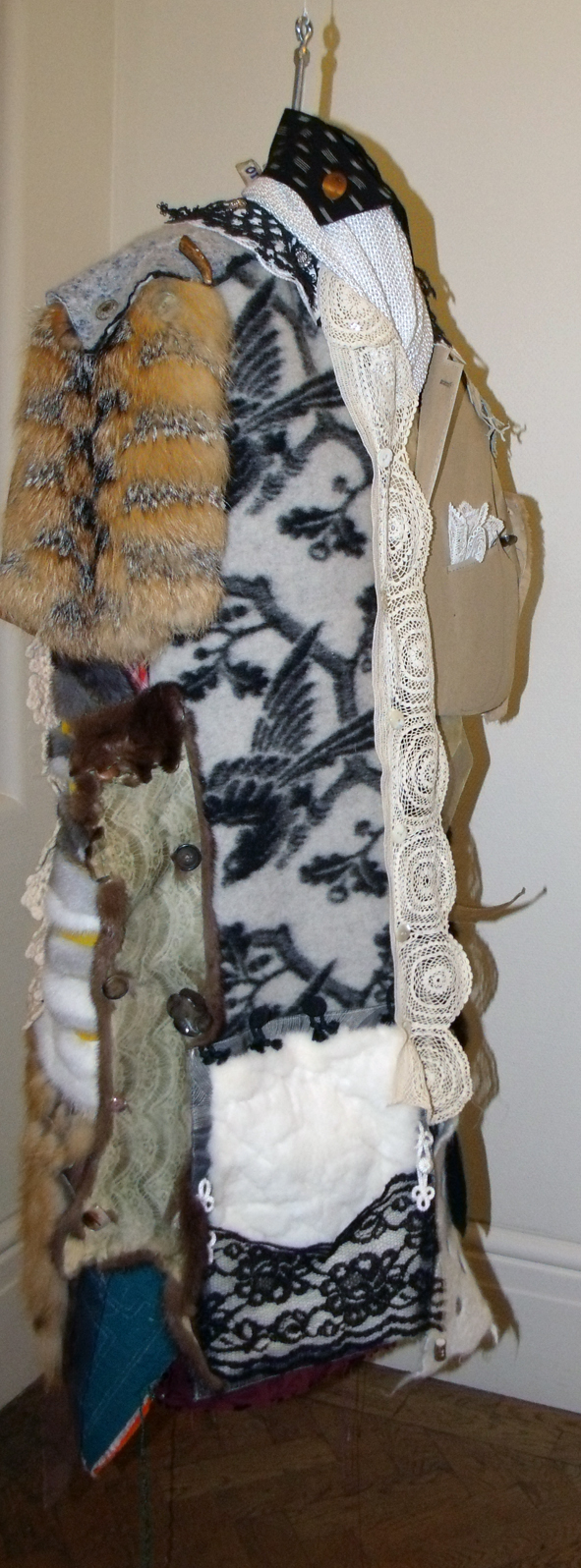
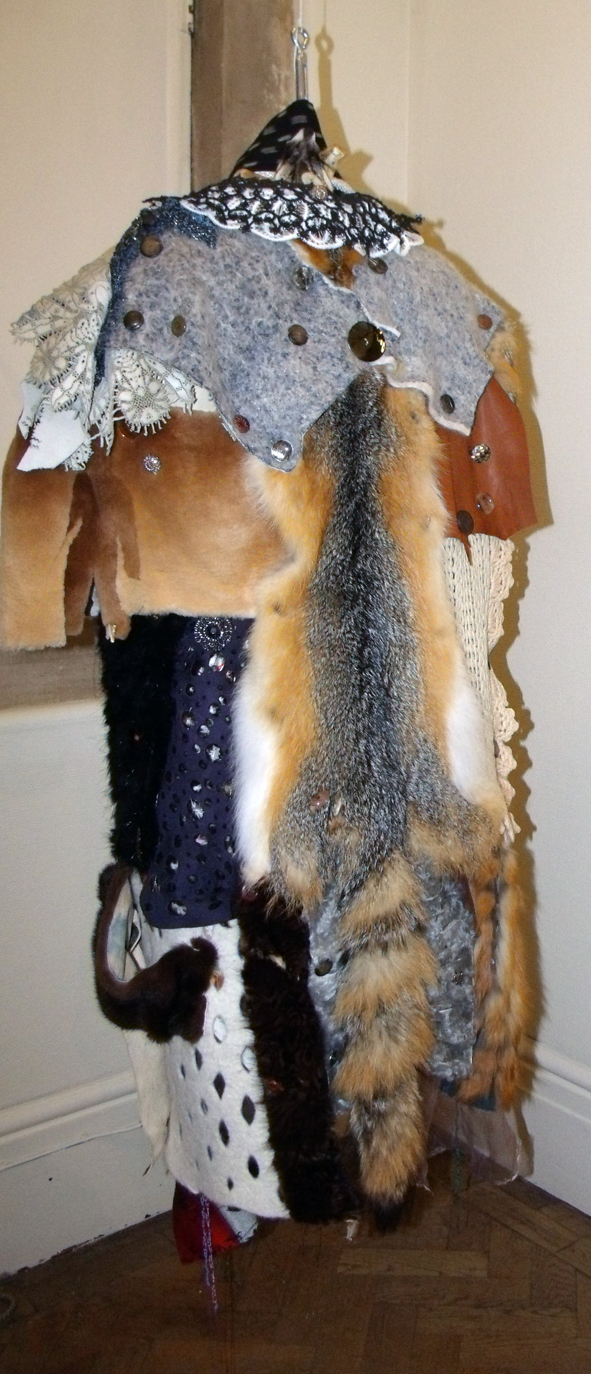
Which brings me neatly to the last exhibitor, Basil Kardasis, his exhibit is called ‘The Buttonhole’, and he collected from his family and friends ( we all had to contribute) ” treasured, revered materials…that may represent them ” and also a button; then , with the help of his sister Ella, spent may months button-holing all the pieces together so that they made a “protective cloak” for his son.
Many different materials and articles appear in the cloak, which has a very colourful interior as well, the range of fabrics perfectly reflect his wide-ranging experiencing as a designer and educator world-wide, students and colleagues and friends from practically every aspect of his life gave him wonderful and rare pieces of cloth for this coat, my favourite is a piece of lasered leather in a lace pattern – now this I could really get working on – it only I had much more of it…..
lasered lace calf skin
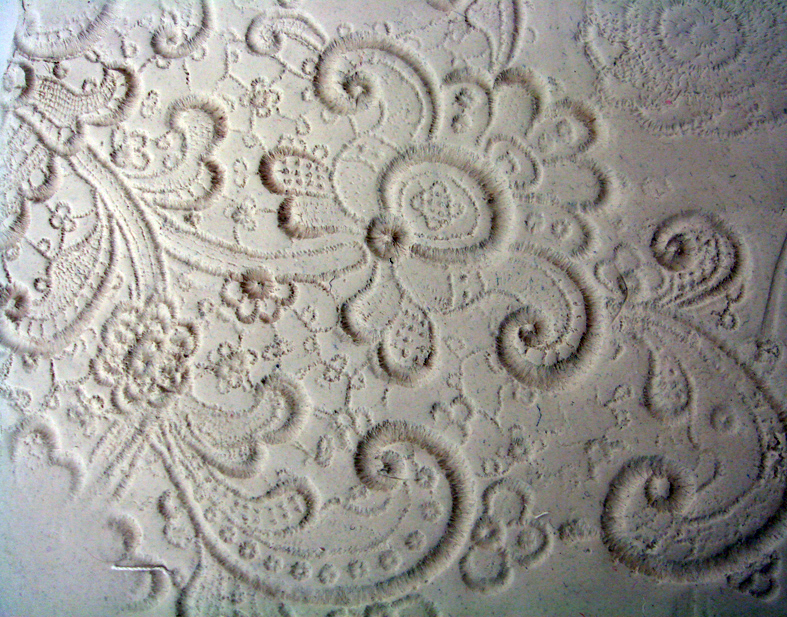
Looking at the image now of this lasered work I am reminded of the joint piece of work that had to be abandoned for inclusion in this exhibition, due to personal reasons by my making partner Hanne Rysgaard. We were making a porcelain hanging from impressed lace fragments but sadly this was shelved until we can both find the space in our very busy lives to get together again and make it. Now I am thinking that these 2 disparate materials may somehow work together…leather and porcelain – Basil where did that lasered skin come from and is there any more?
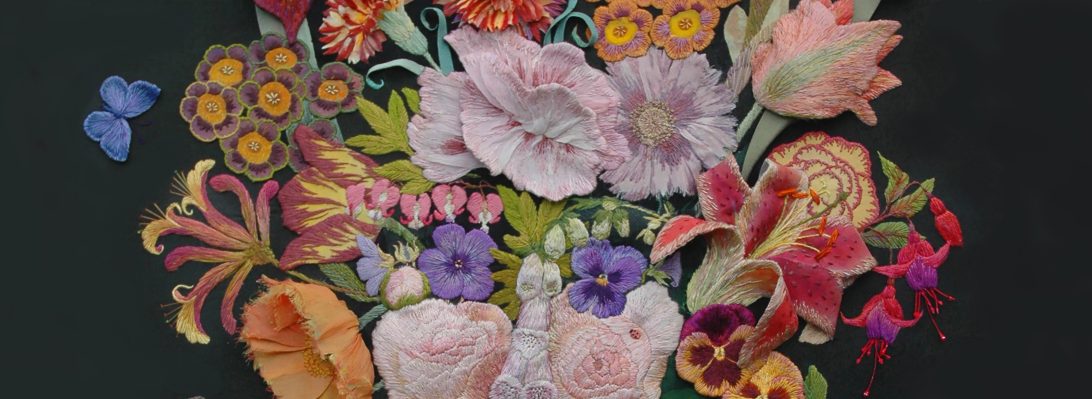
Stitching 3 dimensional flowers is a strange mix of observational drawing, refined stitching and alchemy; the transition of the flat stitched petals freed from their background and applied to form a flower is slightly surreal. I developed this particular skill while making the Flora Embroideries, using the pansy to metamorphose into different forms to develop faces.
winter flowering pansies
I had been asked by a regular Heart Space Studio student and volunteer, Libby Butler, to teach her to stitch a 3 dimensional pansy – her favourite flower, and knowing that she was a skilled embroiderer I agreed. What I did not know was if she could draw the flowers from life; this is the first essential stage as learning to select the colours and study the growth lines of the petals is most important to develop natural petal patterns – and looking really carefully to draw each petal really concentrates the mind for the stitching that follows.
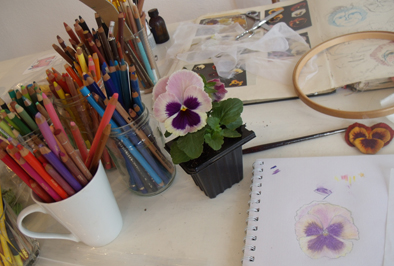
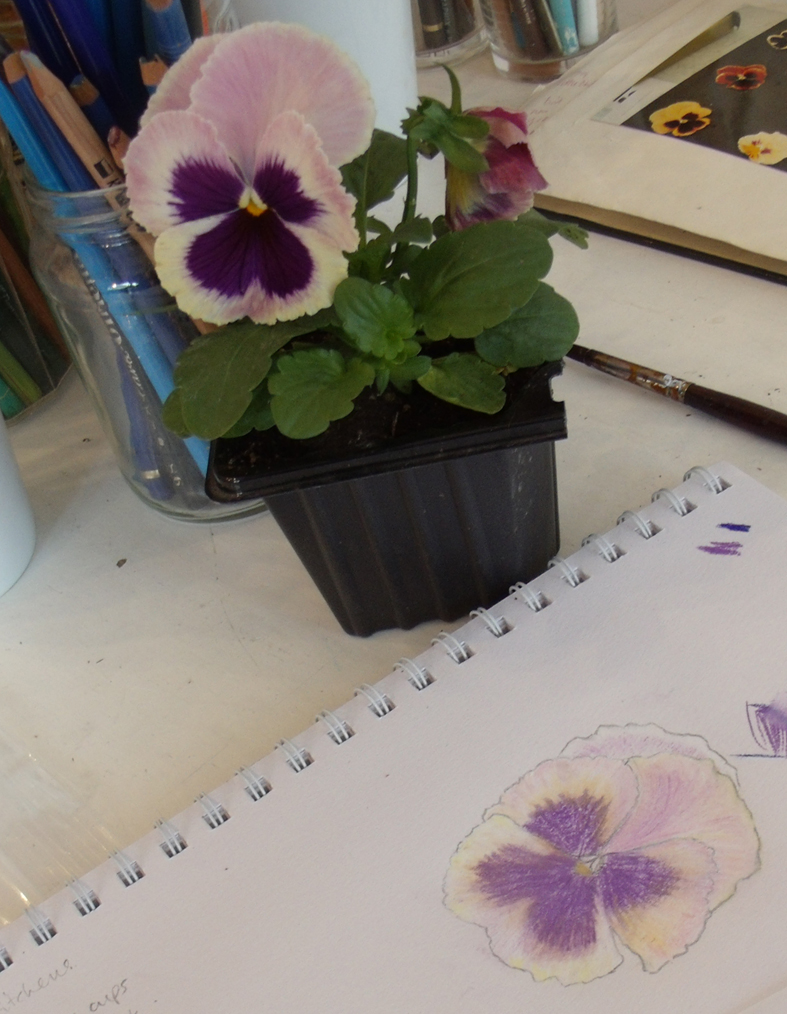
selected pansy and the drawing equipment
Libby looked a little nervous when I handed her the jars of crayons after selecting her pansy – however after a nervous start she achieved a simple working drawing from which we could establish petal shapes and colourings, now to move to the fabrics….
simple drawing of the Pansy face
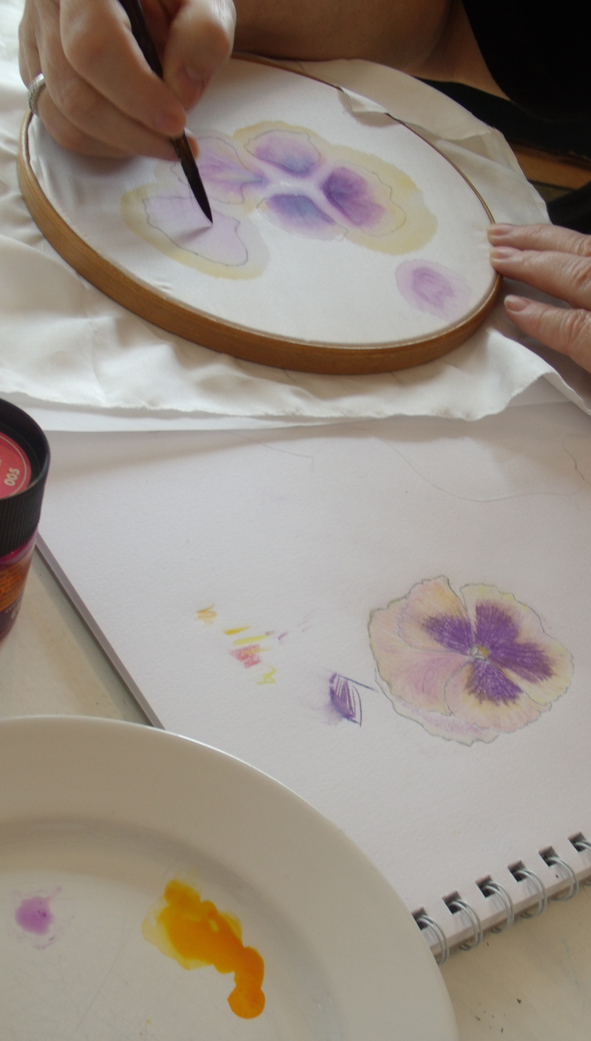
Now to the fabrics – first a thin silk fabric was selected and the individual petals from the drawing were traced onto it in pencil, a light dye was then applied with a paintbrush to give a background colour.
dyeing the background fabric for the petals
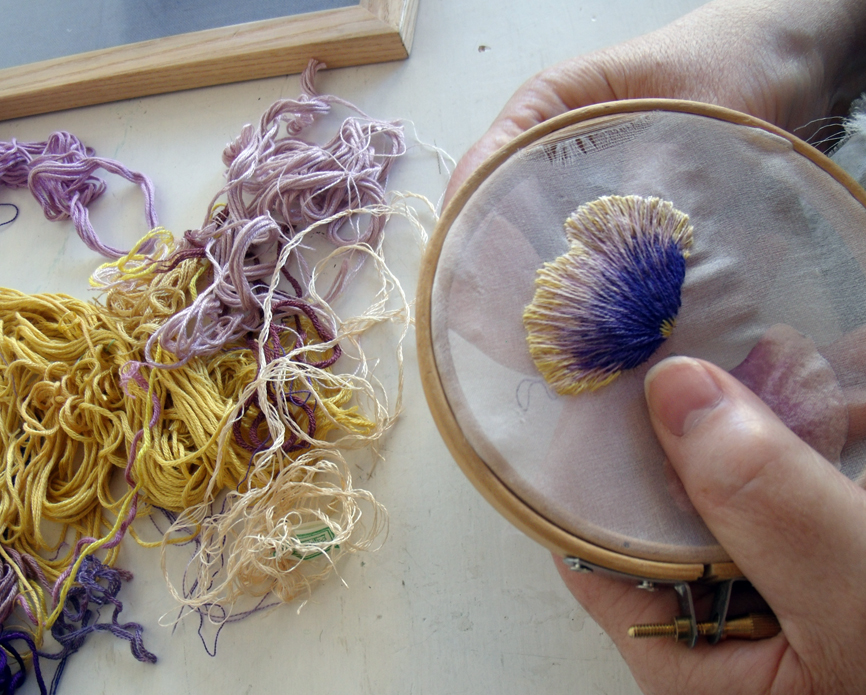
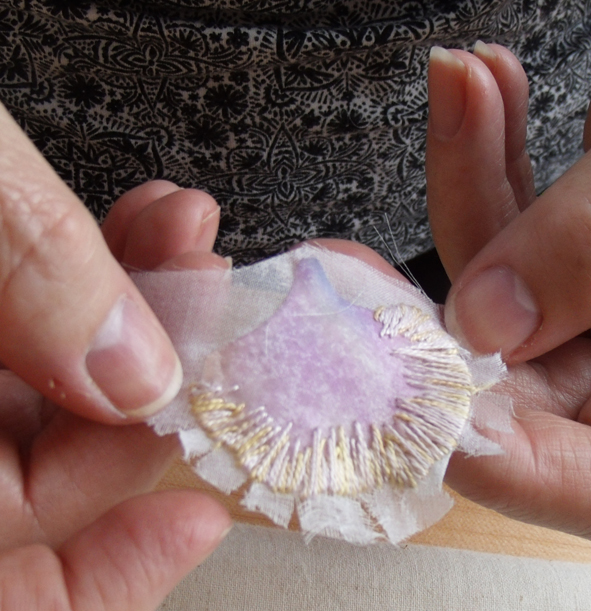
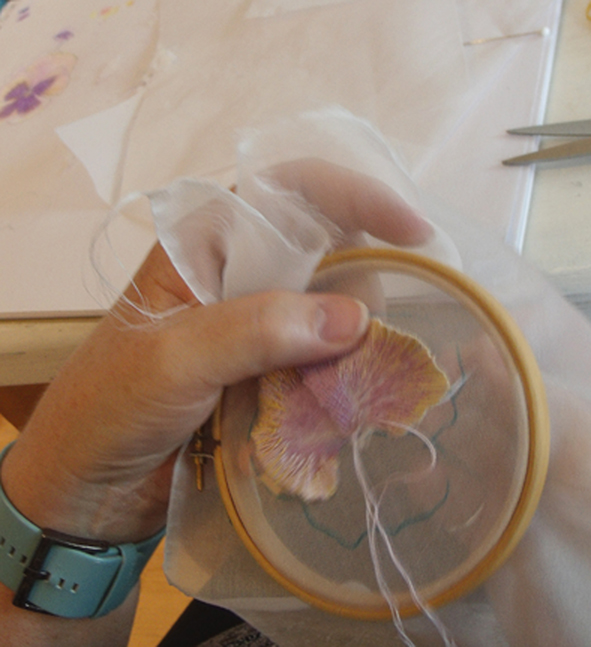
When the dye was dry, a heat transfer fabric adhesive was ironed onto the back of the fabric and each petal was cut out and ironed onto a very fine silk gauze and placed in a small embroidery hoops ready for embroidery – the edge of the silk petal means that the stitches have very strong definition which will be needed later for cuttung out. The silks were matched to the drawing colours and using one strand only, the embroidery was started…
embroidering the individual painted silk petals
Libby worked one whole petal (see above) by the end of the first day of the 2 day workshop, she then had 1 week to complete the rest of the petals…..she took the drawing home to work from – the drawing is what she is following not the real flower – this is why the drawing needs to be really carefully observed
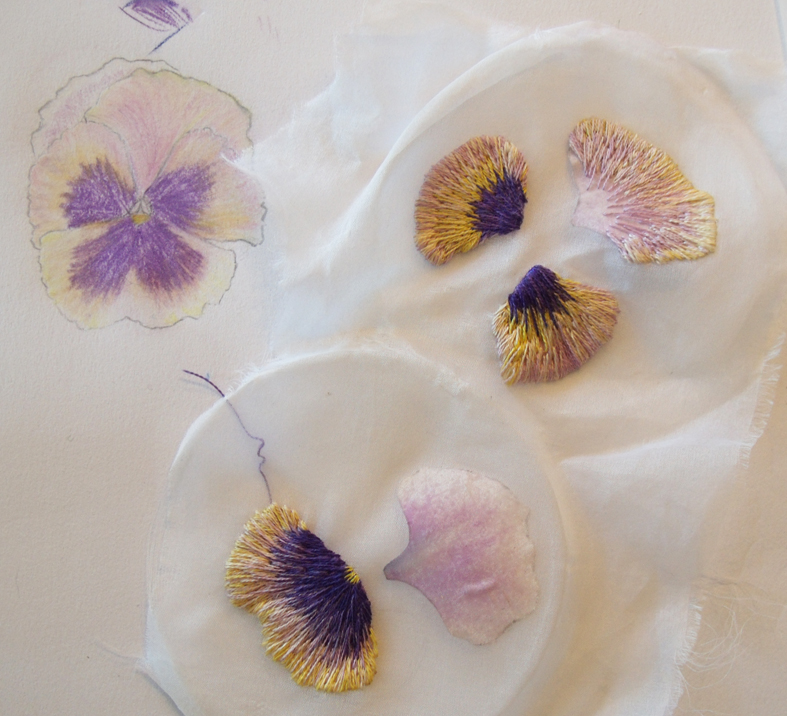
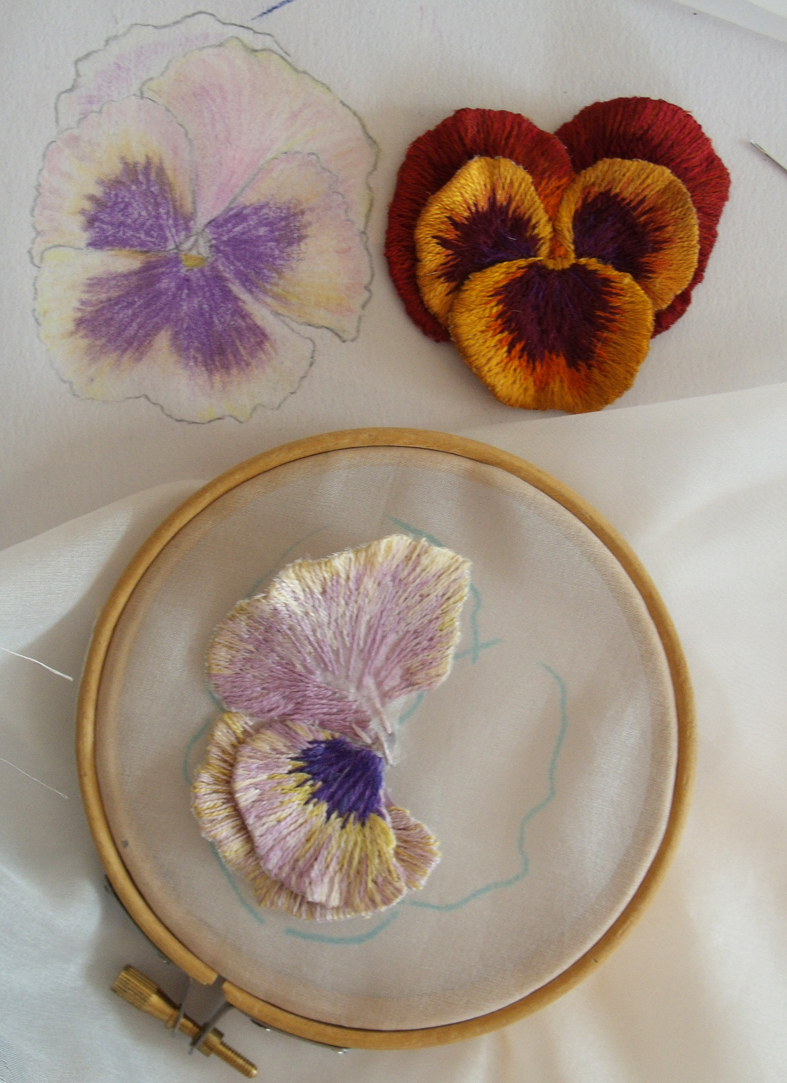
stitched work brought in to the second session
On her return I found that she needed to work a fine blending thread over the transition between the dark purple and light yellow of the pansy to make it look natural but this was quickly achieved – attention needs to be given for the direction of all the stitches so that they follow the lines of growth of the petal – but it is easy to see in bi-coloured pansies.
the embroidered petals are cut out
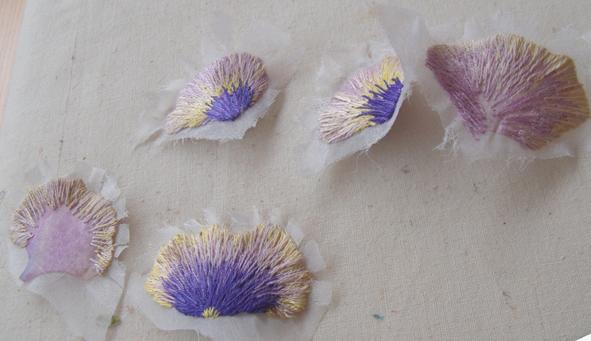
Once the embroidery was complete, the back of the fabrics was once again bonded with heat transfer adhesive and each petal cut out leaving a small area of surrounding silk. Each petal was then pressed from the back while being stretched around the its edge, this sets the stitches and gives a very life – like undulation to the petal edge – but the stitching needs to be very dense to allow this to happen…..then taking courage in both hands the extra fabric is VERY carefully cut away – the bonding keeps the threads in place.
holding the back petal snipped and waiting to be pressed.
Now the flower formation can begin. On a fresh and final background fabric the original drawing was traced using a water-soluble pen, then each petal is embroidered into position starting from the back, only the middle area needs to be attached – the petals must be left free from the ground
attaching the petals to form the flower
The actual assembly does not take very long but it must be carefully structured so that each petal overlaps the one below it, the original drawing is again of vital importance to this process.
work in progress with an old embroidered sample we used as a stitching guide
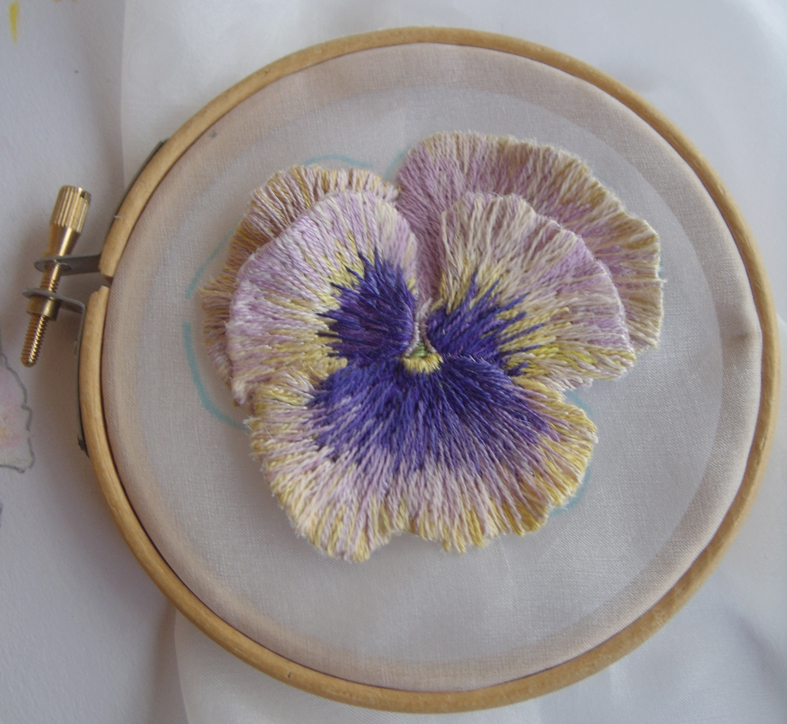
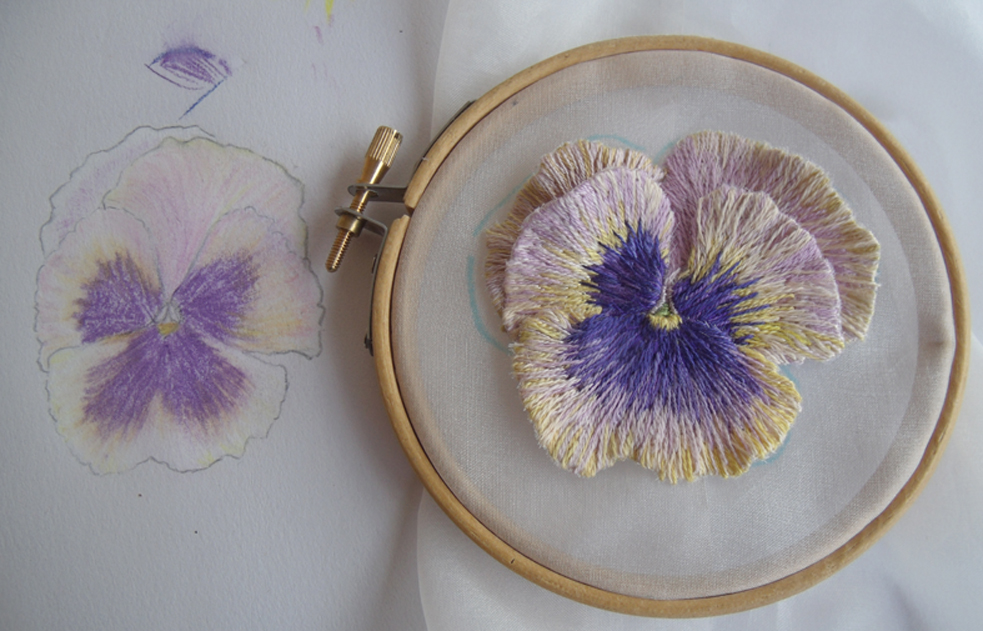
Eventually each petal is placed and the inside edges of the of the petals are is built up and over-sewn and a single central stitch finishes it – Da Da!
the final flower seen against the original drawing
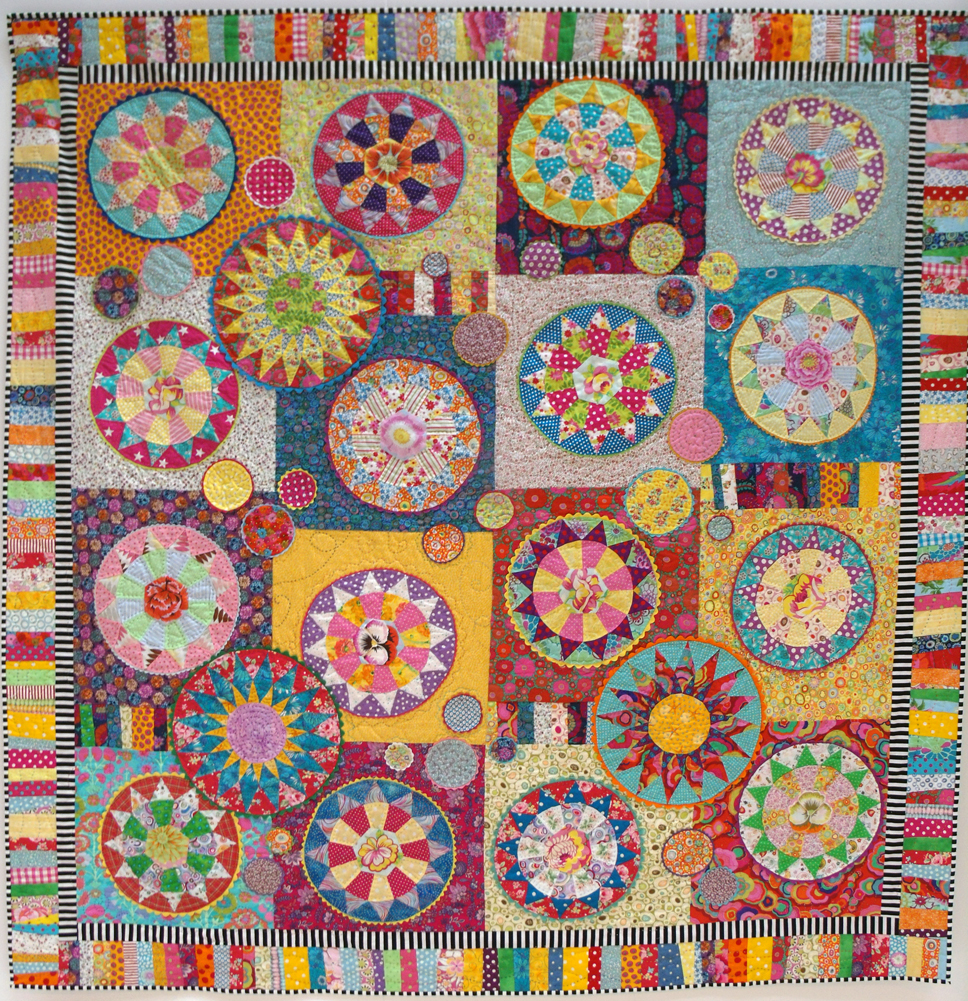
I saw so may quilts, the good, the bad and the ugly, at the recent Festival of Quilts in Birmingham, that I have been at a loss to know what to write and how to show all the wonderful things on show and for sale. So to start at the beginning I am simply posting the quilts that I felt jealous of not having made myself. First off is the quilt above, no names on the general exhibits and I didn’t get many titles either – so treat this as a visual feast.
But wow, this is how to use all those purpose designed and brilliantly coloured quilting fabrics – just go for it. I recognised many of these fabrics as Kaffe Fasset designs so I was delighted to see a design that was as exhuberant and playful as the original fabrics themselves.
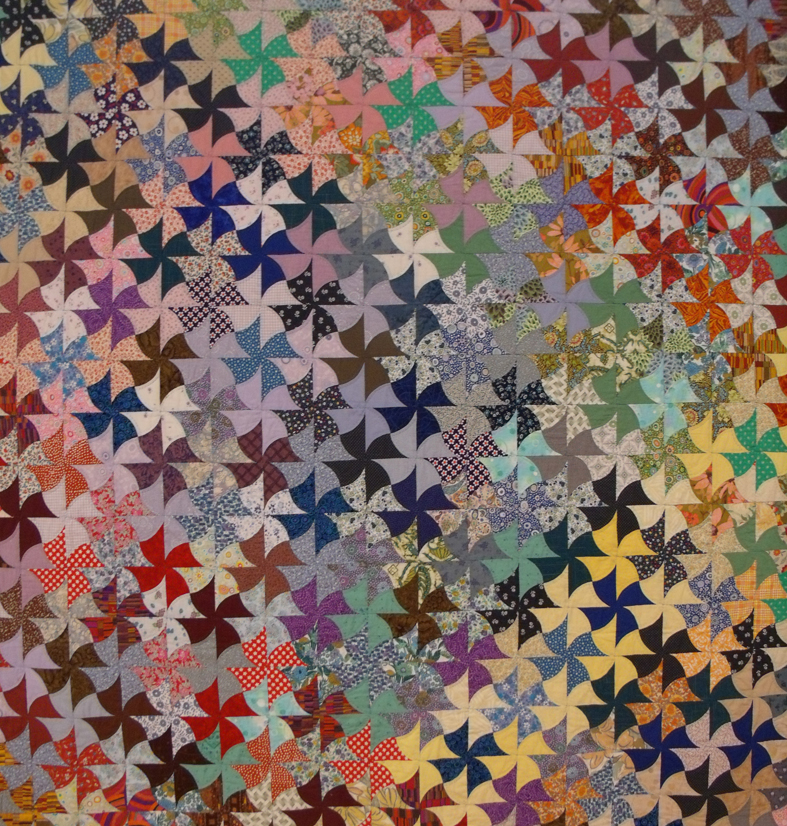
The Kaffe Fassett fabrics were included in many other exhibits, this amazing quilt made me dizzy standing next to it, I felt I was falling over as the twist of the star design was very strong close up.
“dizzy windmill” patchwork
I now realise how little I know of the names of the patchwork designs – however I often give them names myself, this is Dizzy Windmill.
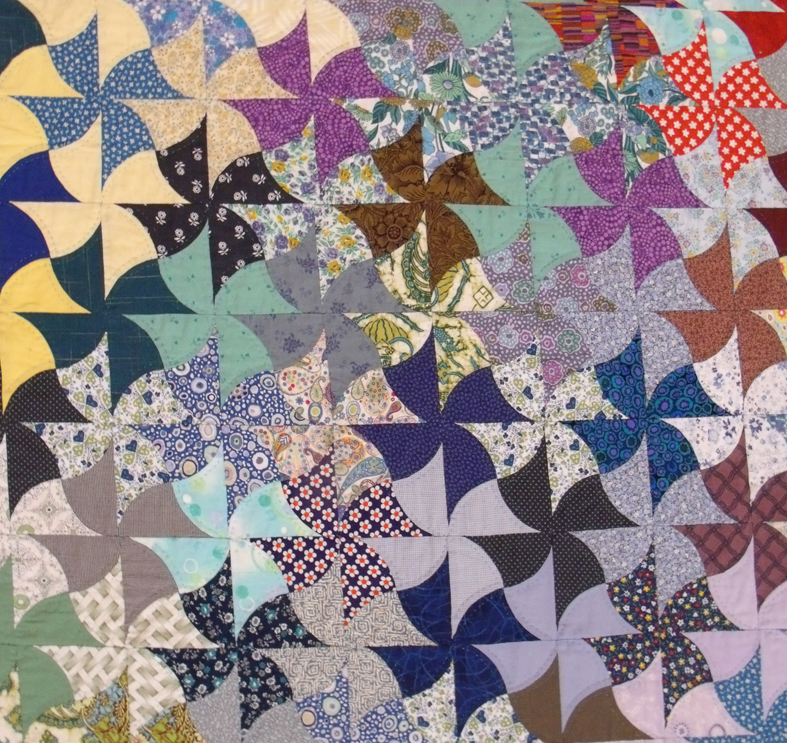
Dizzy Windmill detail.
What I did discover is that the quilts that I enjoyed the most used good quality fabrics in a strong traditional design, which is a bit boring of me really! But you can spend ages, close up and personal enjoying the variety of fabric.
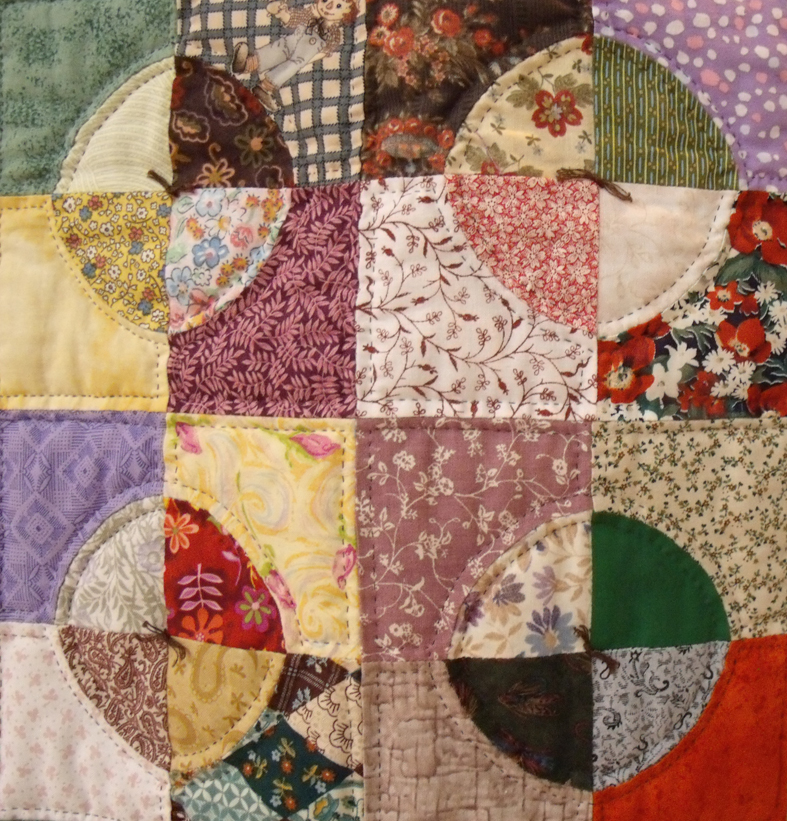
the detail here shows all sorts of small prints that are hand stitched and quilted together then tied with thread in the centres – I do like ties in quilts.
florals, ditzies and geometric prints.
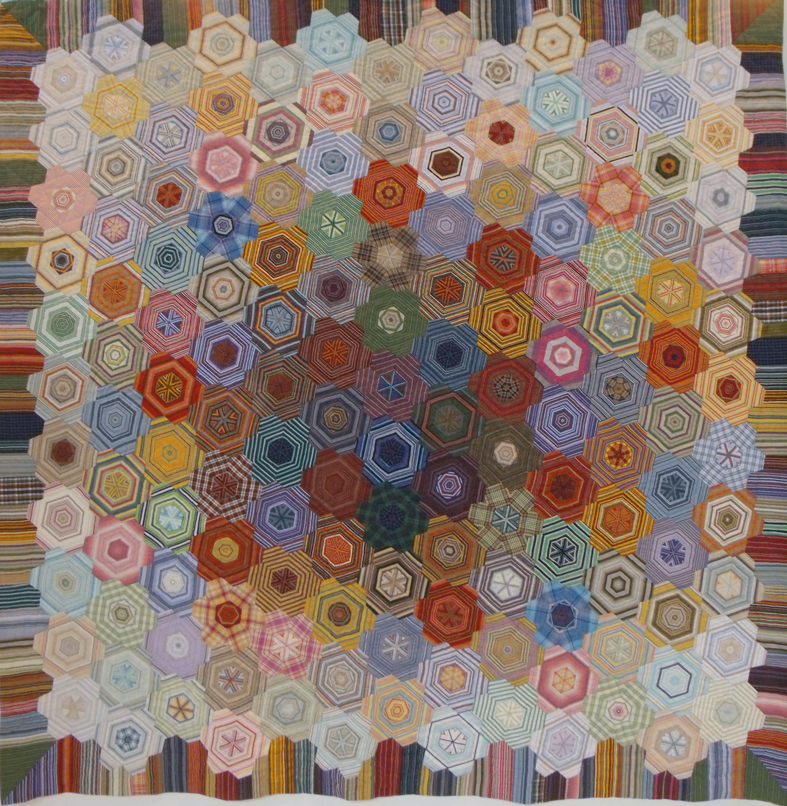
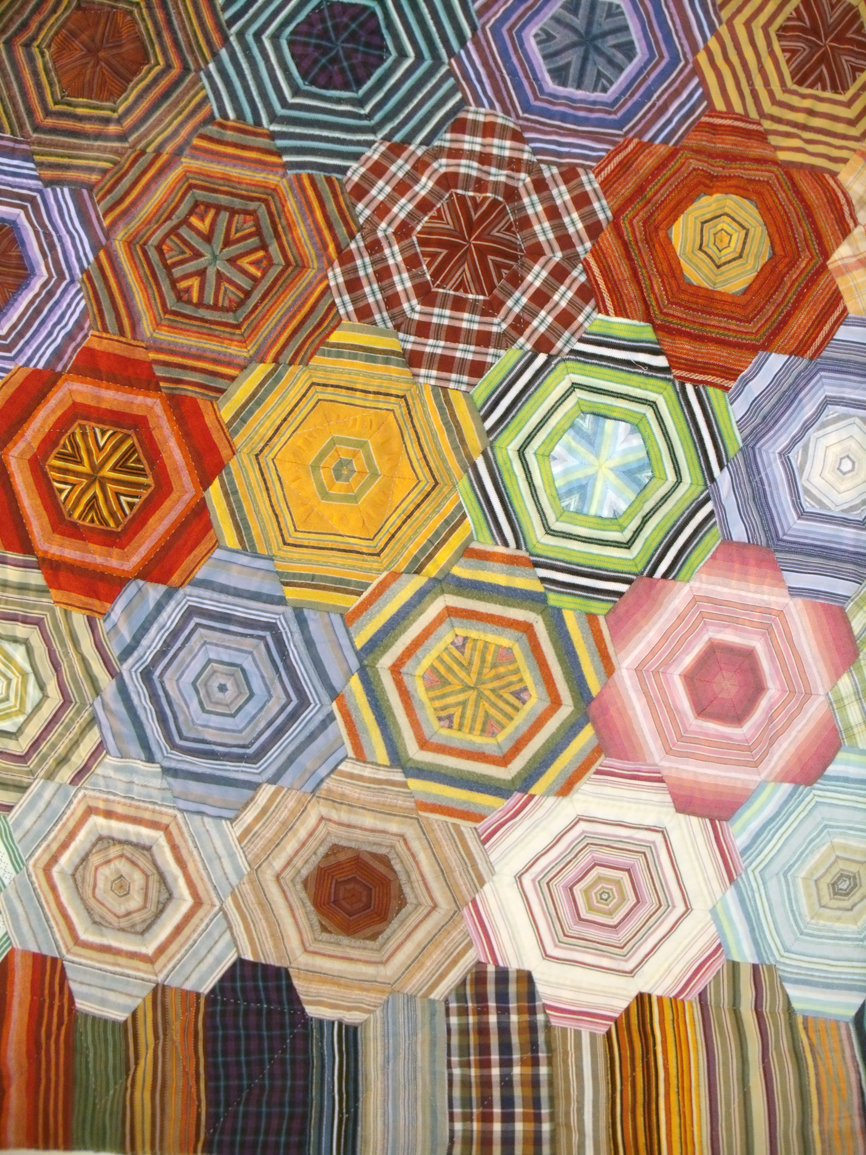
How about this for perfect use of stripes and geometrics – how fantastic is this? the glowing centre and the striped border makes this a quilt seem to be imploding.
Striped Hexagons like a star imploding.
Brilliant use of striped fabrics for traditional hexagon patchwork.
Hand stitched hexagon patchwork with a perfect border.
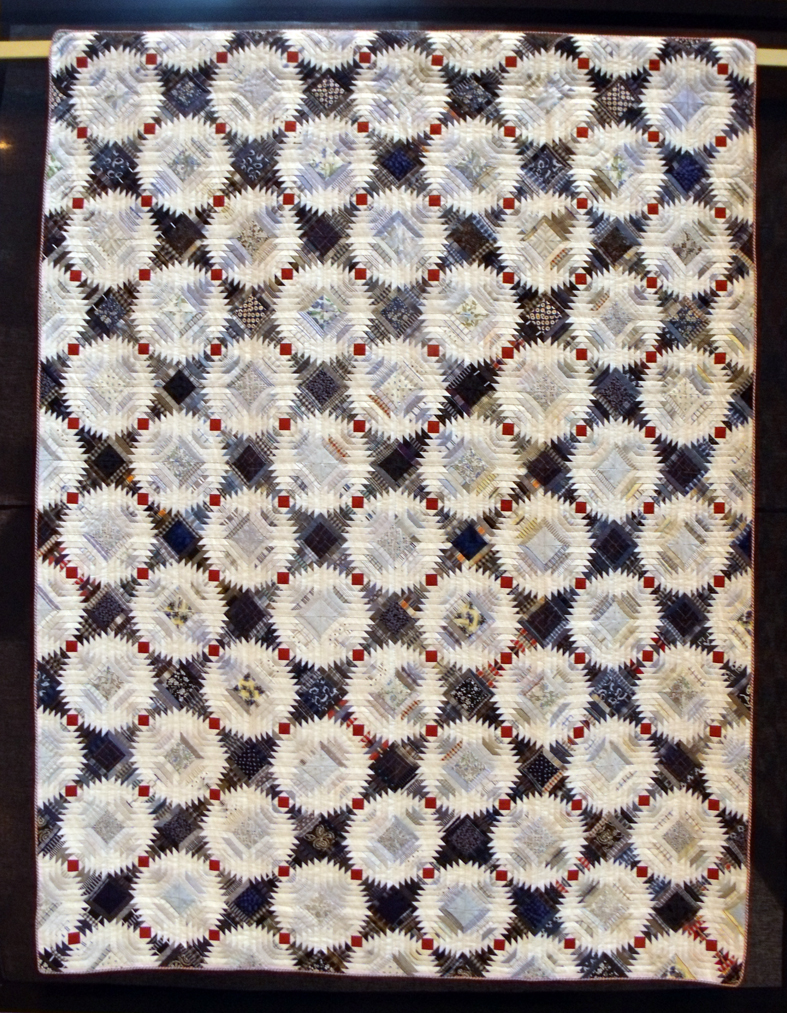
Striped fabrics have also been used for this quilt below, quieter and very desirable, this I the one quilt that I really wanted to take home to bed.
Intricate Log Cabin format for red white and blue patchwork.
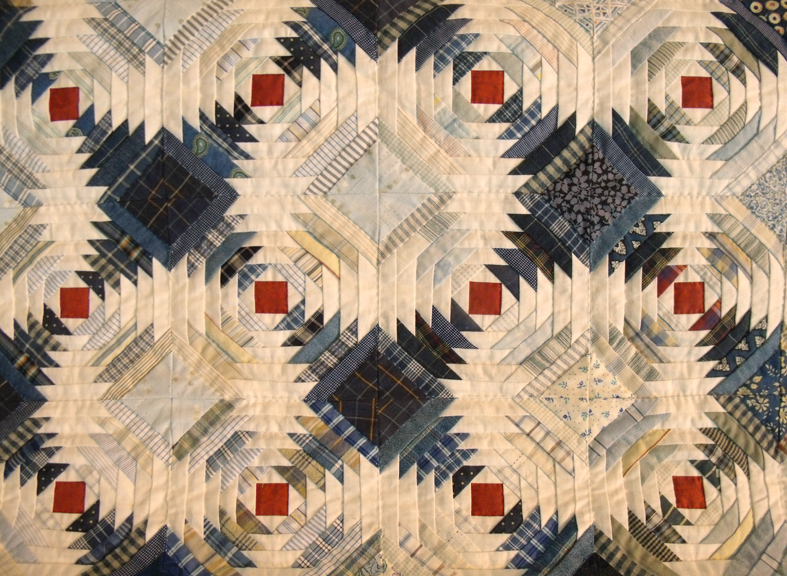
the detail shows how the simple contrasting fabrics used to such stunning effect. although I recognised several fabrics in this quilt as being newly bought it did look more like a quilt made of recycled fabrics, I do prefer the idea of using recycled fabrics …..just a thought.
contrasting light and dark refined and subdued fabrics
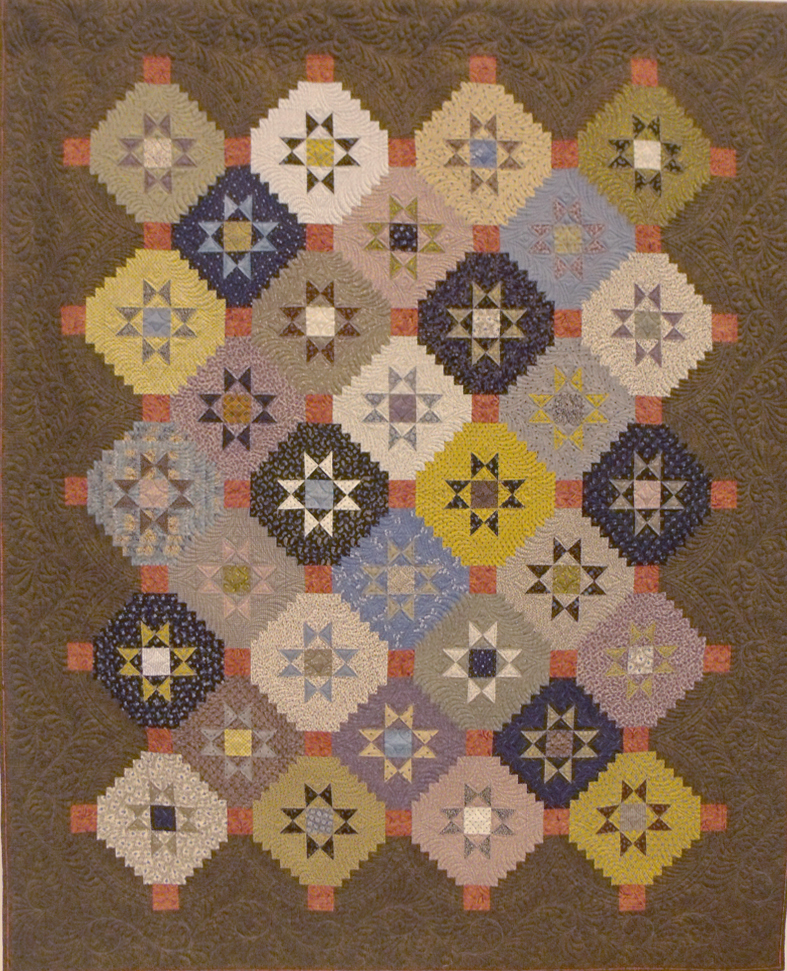
At the entrance of the show there was a ‘Winners’ Wall’ of quilts and 2 quilts were constantly being scrutinised and photographed, there were constant queues to view them…one was a 2 person quilt – pieced by one person and quilted by another, the overall effect was rich, muted and sumptuous.
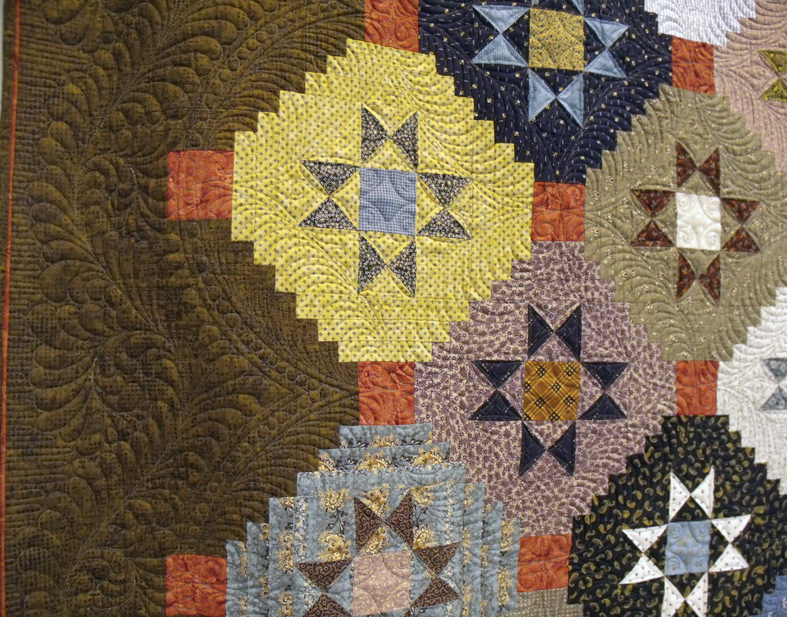
The quilting was by machine and was an undulating design of feathers that perfectly contrasted with the star and diamond geometric patchwork.
feather design for machine quilting
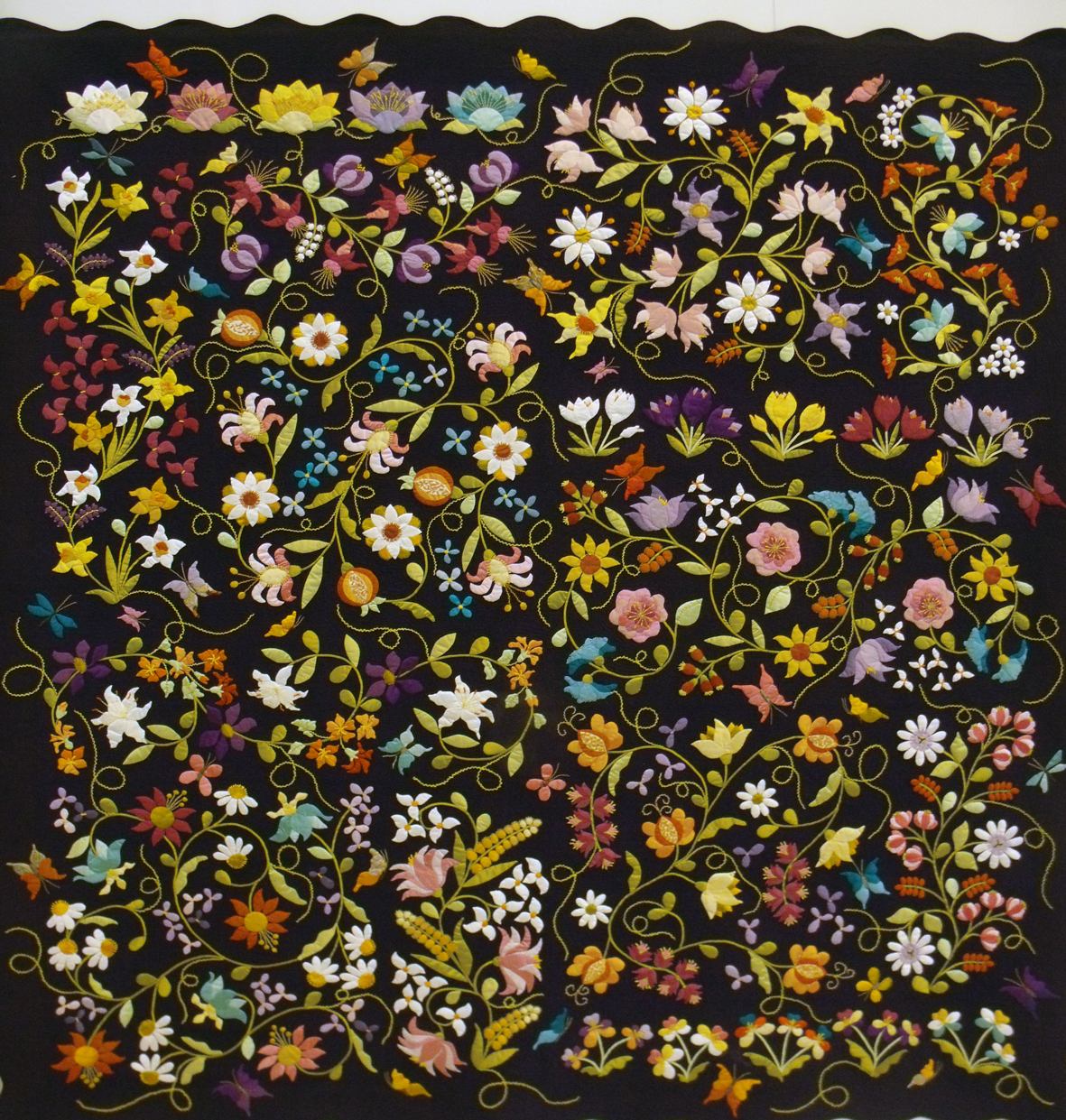
The other quilt, which was next to this was entirely different, it was in fact an applique, it looked like a glowing flowering silk carpet.
traditional applique quilt
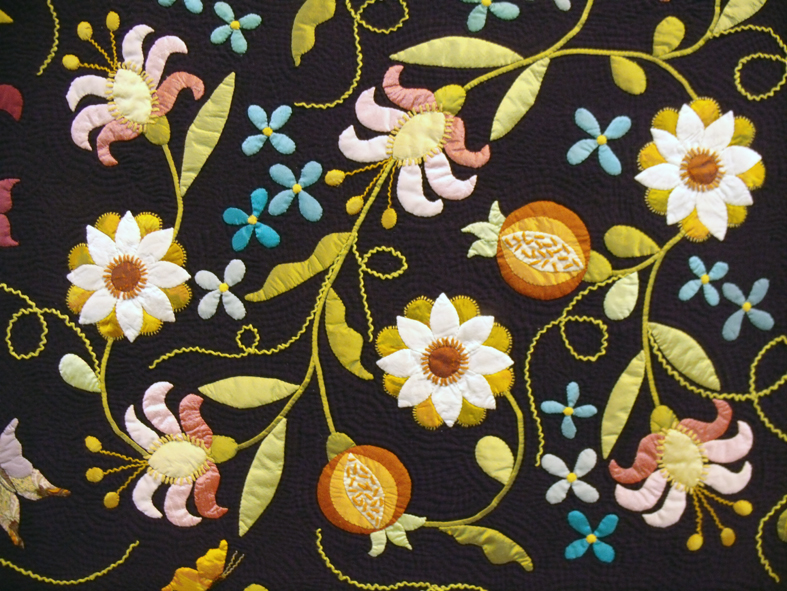
Here are hand stitched applied flowers in traditional designs, very beautifully controlled and as playful as they are elegant. It is reminiscent of 17th century embroidered bed covers.
hand applique and stitched winner’s quilt – detail
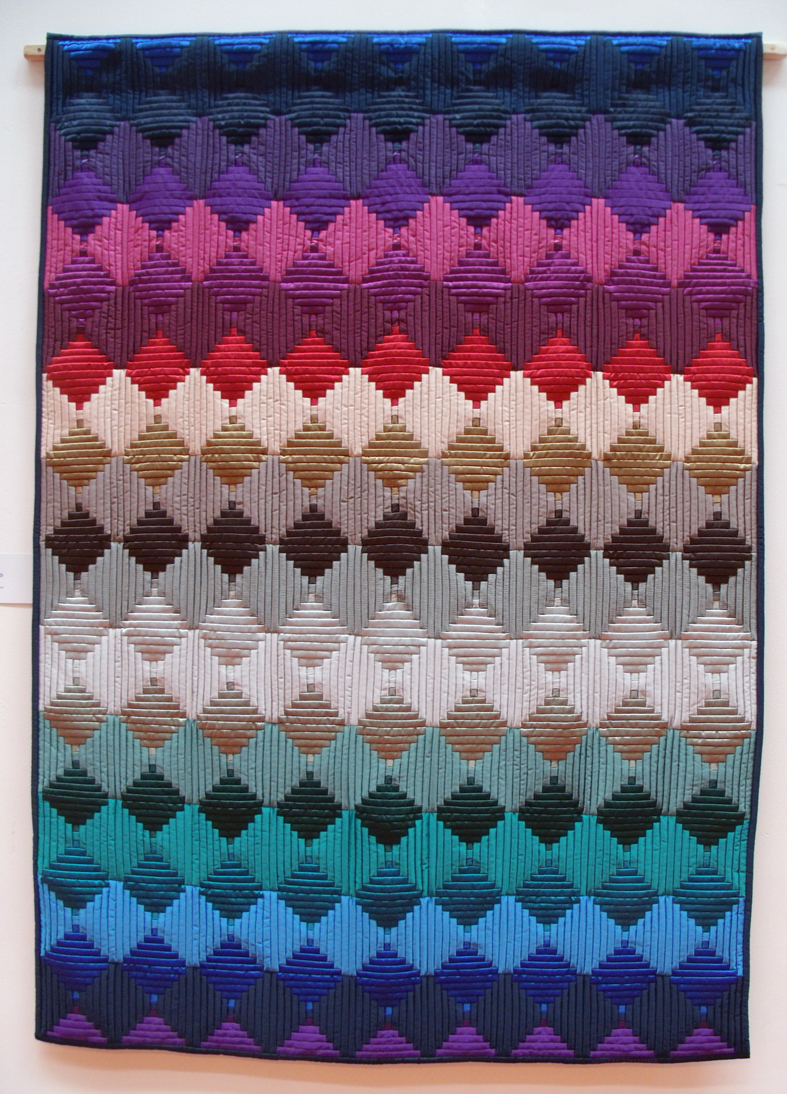
There were so many quilts that were beautiful that I got exhausted trying to photograph them to make a post out of them, the exhibition was really too big for 1 day’s visit but I want to show a few more that worked on pure colour – a very simple silk folded piece.
Brigitte Morgenroth silk quilt
And a very glamorous and modern haphazard piece that must have been inspired in some way by the Gees Bend quilts ?
wonderful coloured abstract pieced quilt
At the end of the day my head and eyes were hurting – not to say my feet; it is such an amazing festival if a tad too large and unedited. The one area of calm I found was this stand of Turkey red and white quilts from the Quilt Museum and Gallery of York. I shouldn’t have taken this picture but I just had to show a stunning striking space – as empty as you needed it to be after an exhausting day – and I haven’t mentioned the sales area yet have I?
Turkey Red quilts form the York Quilt Museum and Gallery
Kari Furre, tiny sculpture of fish scales, vellum and feathers
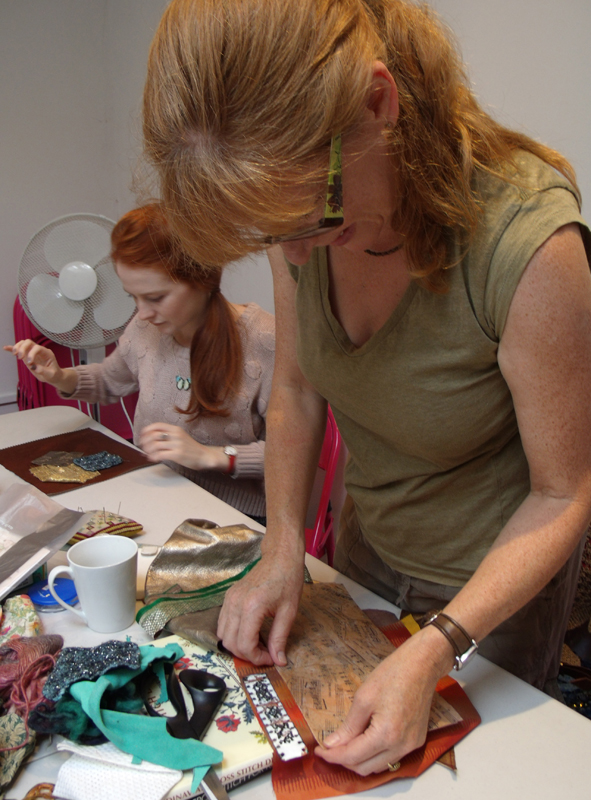
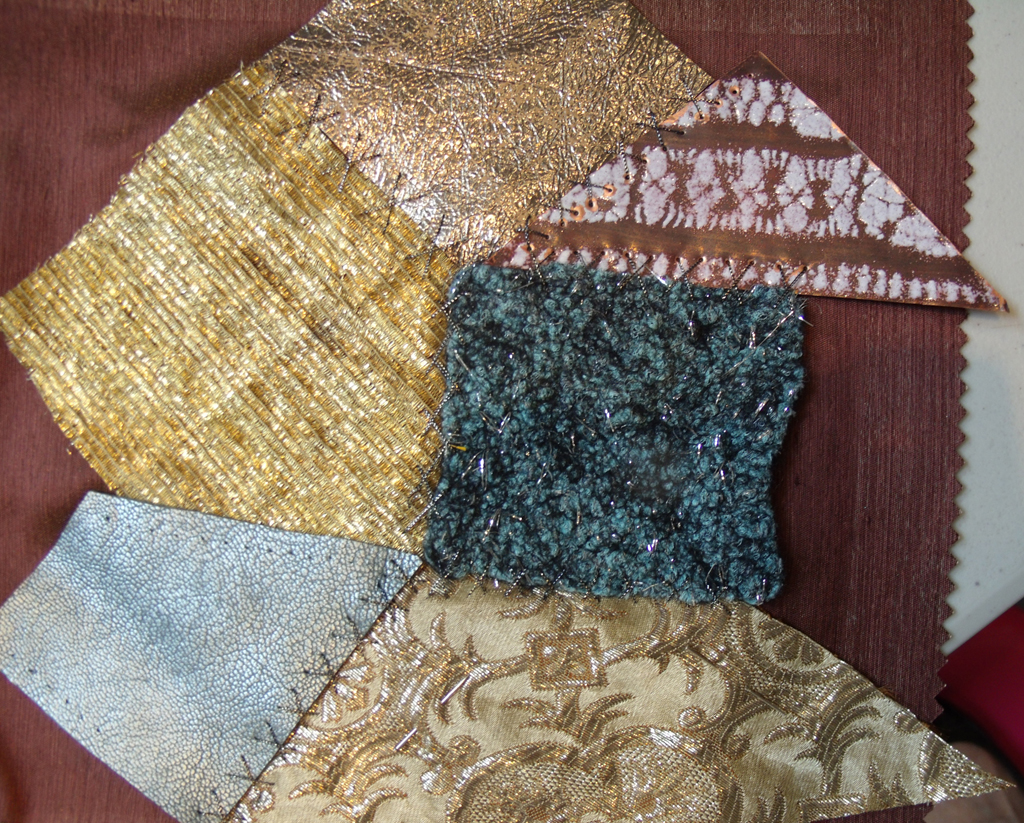
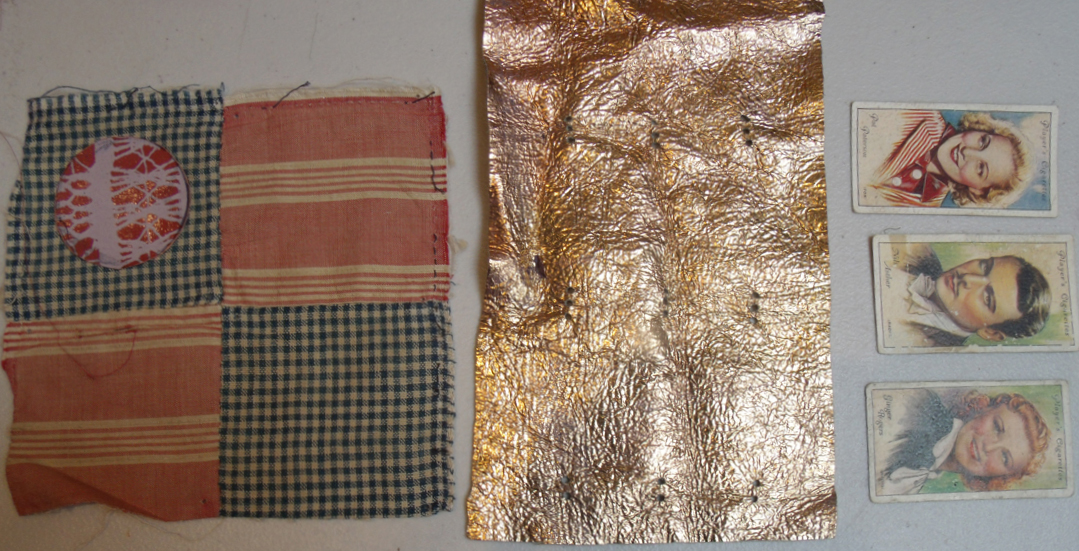
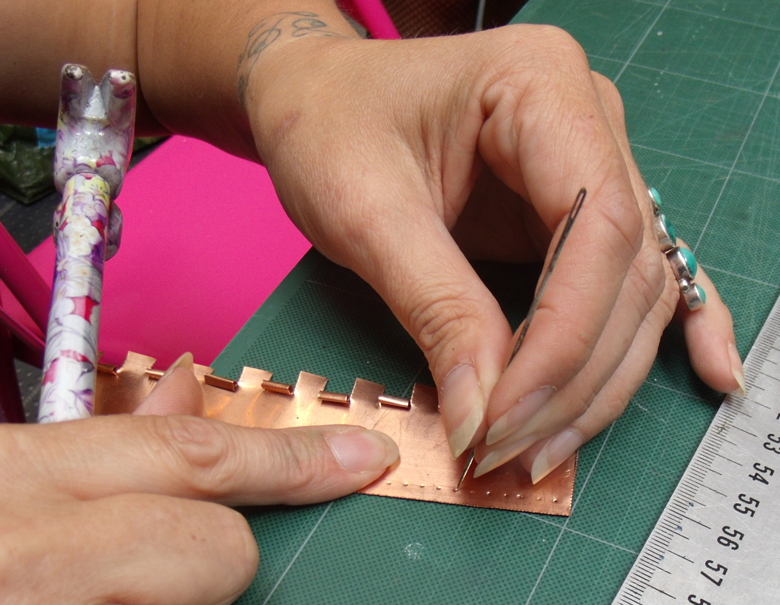
The strange tiny sculpture, shown above combines all 3 elements of the Surf Turf & Sky master class recently run by Basil Kardasis for Heart Space Studios in Bristol. In fact looking through all my 120+ images taken throughout the 2 days, this is the only piece of work that uses the 3 materials together. The participants came from several disciplines, but whether, professional or amateur makers, all were highly skilled makers in their chosen craft. They were tasked with creating 3 samples using any of the materials on offer, in order to develop them further to enable them to be exhibited at a later date.
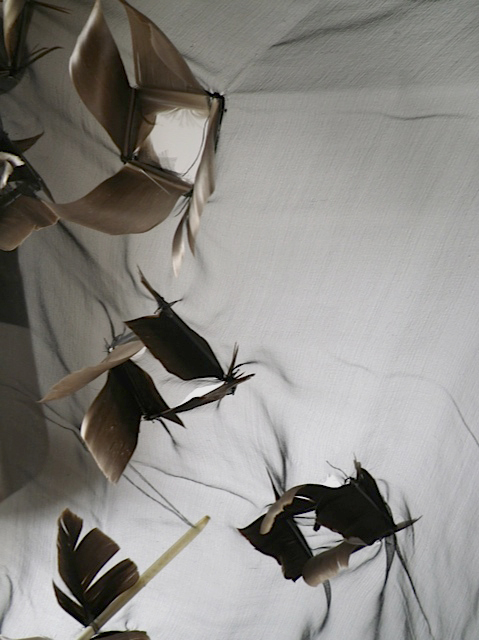
Kari Furre’s black chiffon and feather fabric.
On her web site, Kari Furre describes herself as a sculptor and metal-smith, but took to making textiles readily; the results of her research in the workshop look decidedly sculptural and incorporate 3 dimensions even in her initial fabric based work
I know from my own, hard won, experience that when faced with strange and challenging materials the mature maker will often instinctively return to the core of their own experience and utilise familiar techniques to explore the new materials…resulting in imaginative samples and ideas. This is the main reason why I wanted to develop master classes for Heart Space Studios, to introduce new ways of thinking to mature makers through unfamiliar materials ( rather than the more usual workshops that teach new techniques). And Kari certainly made completely different fabrics and samples for the group to wonder at.
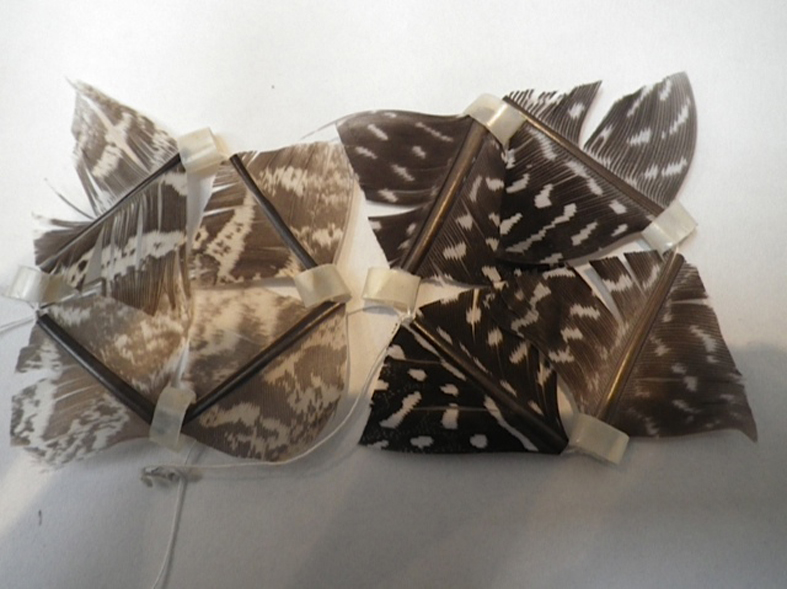
Kari Furre – cut and jointed feather pieces
The same behaviour can be seen in Ann Rippin’s embroidered collage of silk, beads and, as far as I can see, anything but leather, fish and feathers for her first day’s efforts. To see and read a more insightful record of her experience, click here Ann Rippin’s blog. But even though Ann didn’t use much of the unusual material provided by the workshop she certainly became inspired to develop wonderful work from things she had stashed away not knowing how to develop them.
Ann Rippin – scrunched, pleated linen silk and beaded sampler
On the second morning Ann came in with a half made sample which she had unearthed with ideas for its development very late the night before….
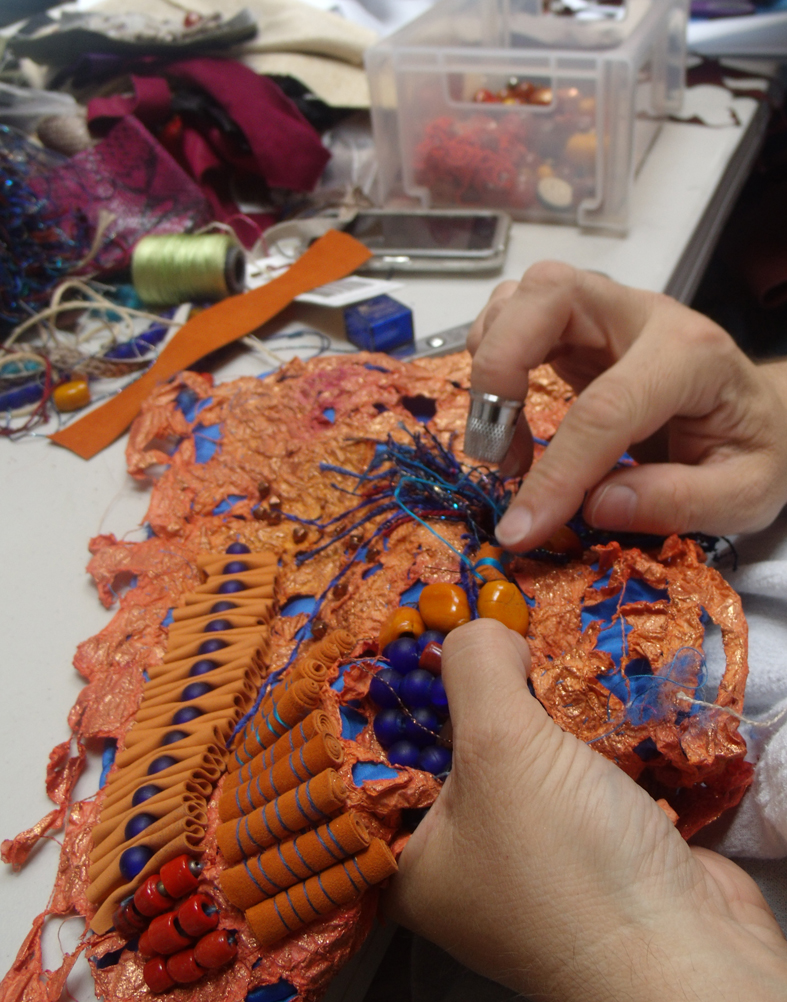
Ann Rippin – making and stitching beads to resurrect an old piece of work
She became fascinated by making leather and thread beads after seeing one of the research books I had brought in for everyone to delve into. What is interesting is Ann is primarily a quilter , or patch-worker, but here she has made and applied 3D objects to her work, perhaps a new way to develop? She spoke of her work being “excessive” and a good exampler of how to escape the atmosphere of parsimony engendered in the present economic situation – a wonderful reason for making any work.
inventive rolled leather beads to augment the ethnic ceramics for a new piece of work
Another stitcher, Sally Sparks, found a way back to hand stitching after experiencing several years working with other materials and techniques, and said her first day was “a disaster”; she has recently been developing much of her textile work from her own inspirational photographs of rust…. but now her work was pale and subtle in its colouring as she rediscovered some of her old materials. She was very nervous of using the fish skin, like everyone else she found that the very preciousness of the material was a barrier to experimenting with it. Realising this in advance Basil and I offered card and other fine leathers for people to work with.
Sally Sparks – leather and chenille applique sample on her own hand made paper.
Another textile maker Debbie Bird , felt “out of her comfort zone” because of the preciousness of the materials – she she decided to try sampling all the materials systematically on a small scale as she didn’t want to waste anything – but one of my my making mottoes is “you have to break eggs to make cakes” ……
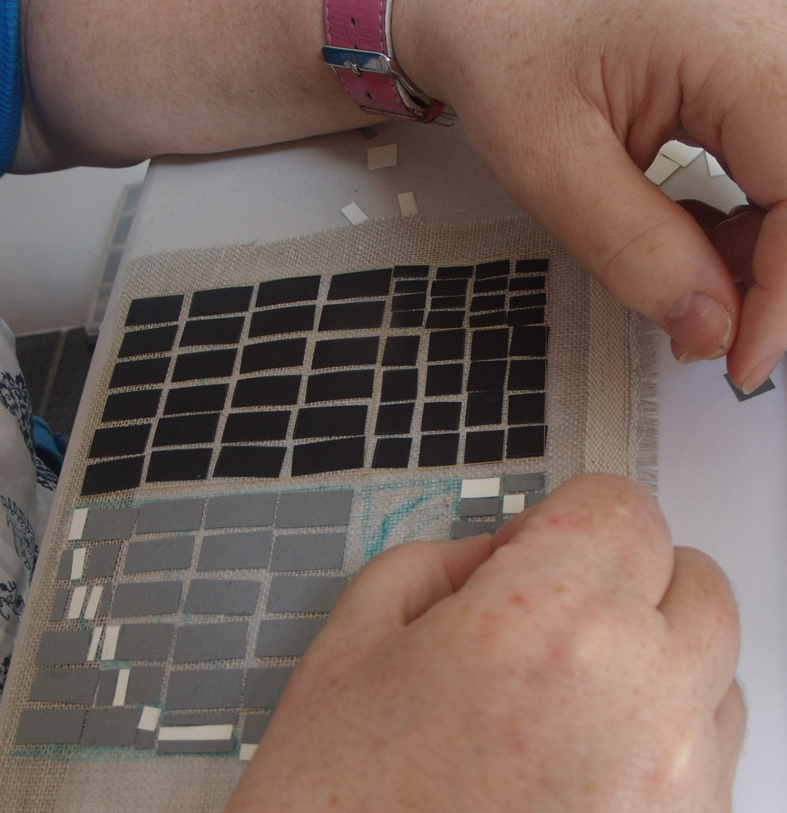
Debbie Bird makes tiny leather mosaics pieces with a reverse of feathers
nevertheless Debbie made several interesting samples that she can develop further when she has had time to assimilate all the ideas offered by the experience.
more small scale samples of feathers and leather
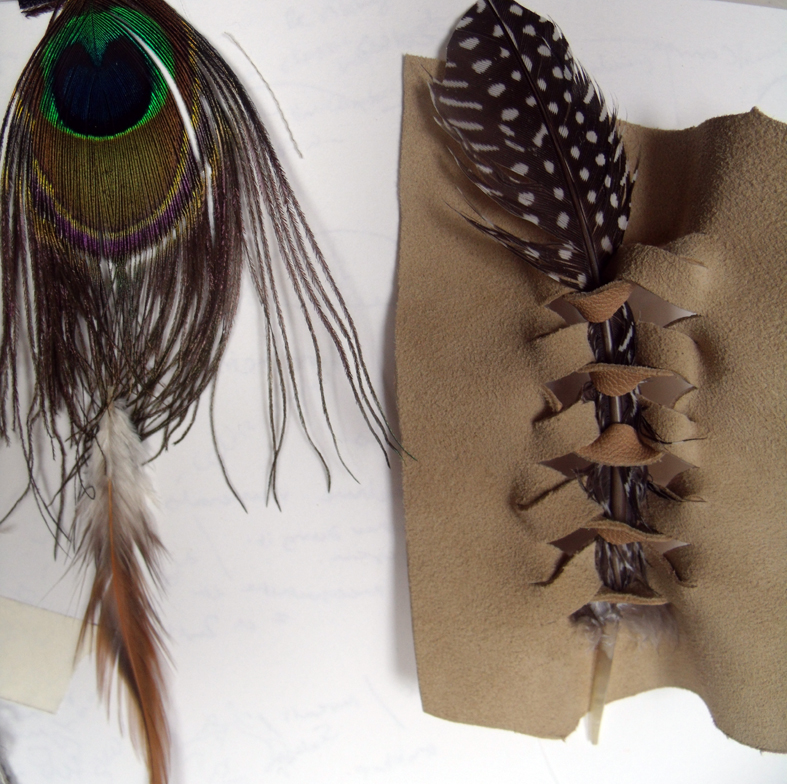
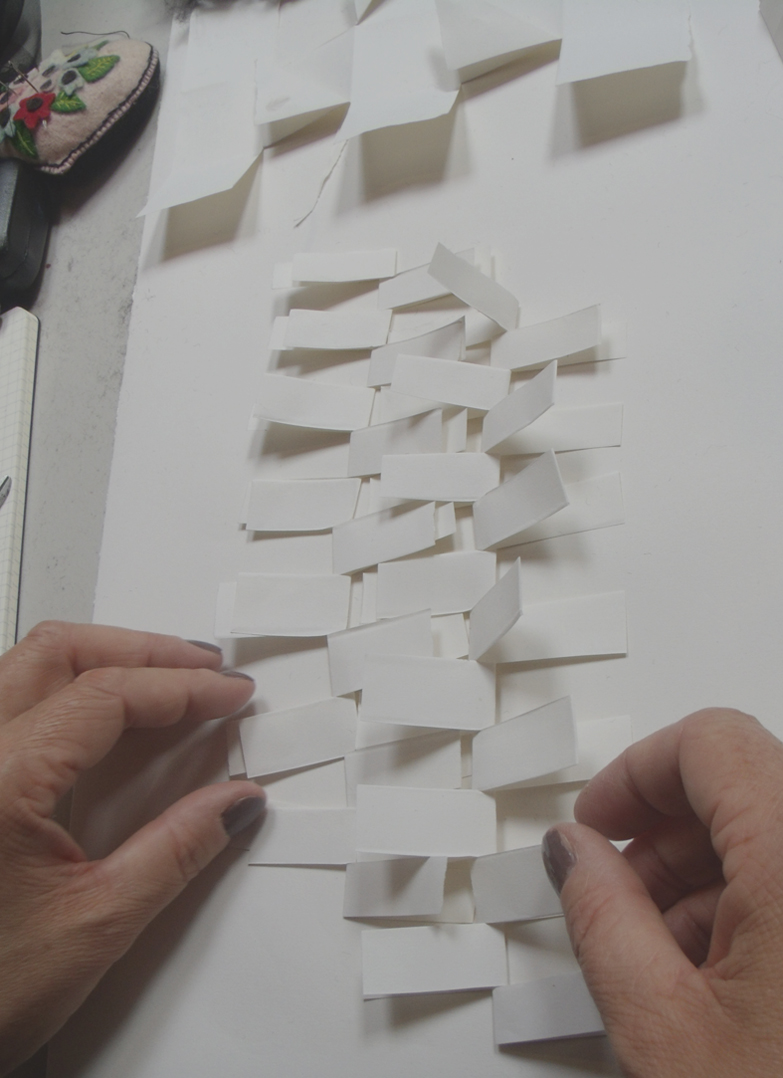
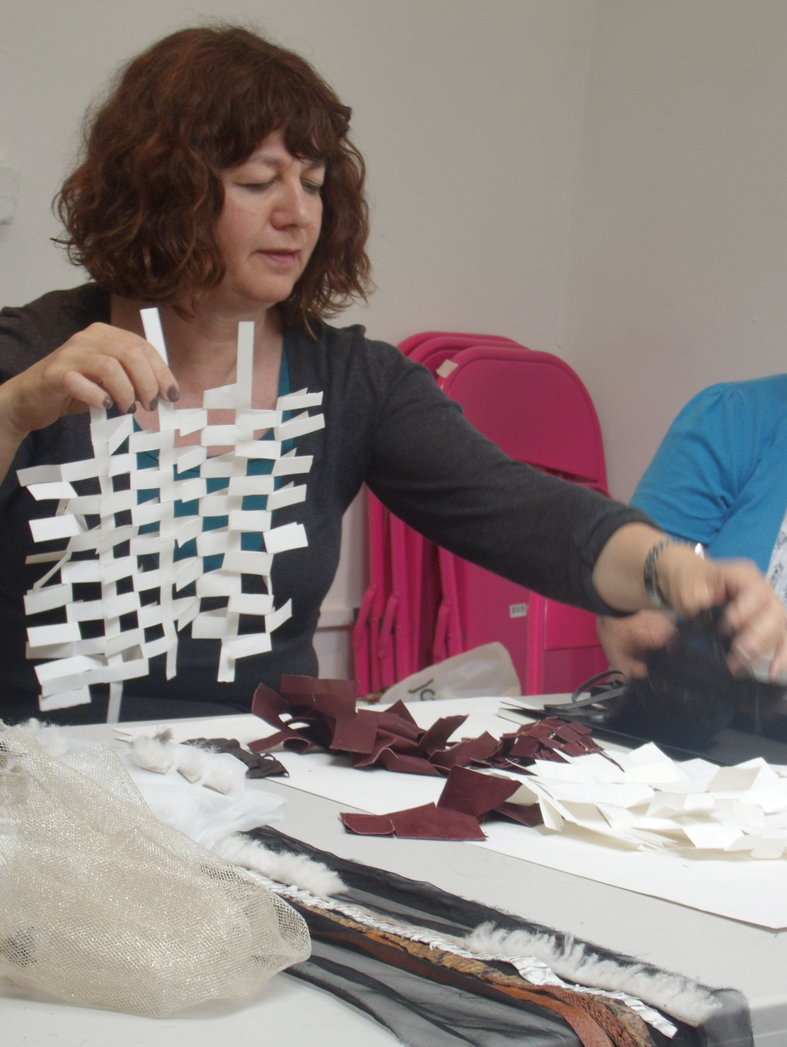
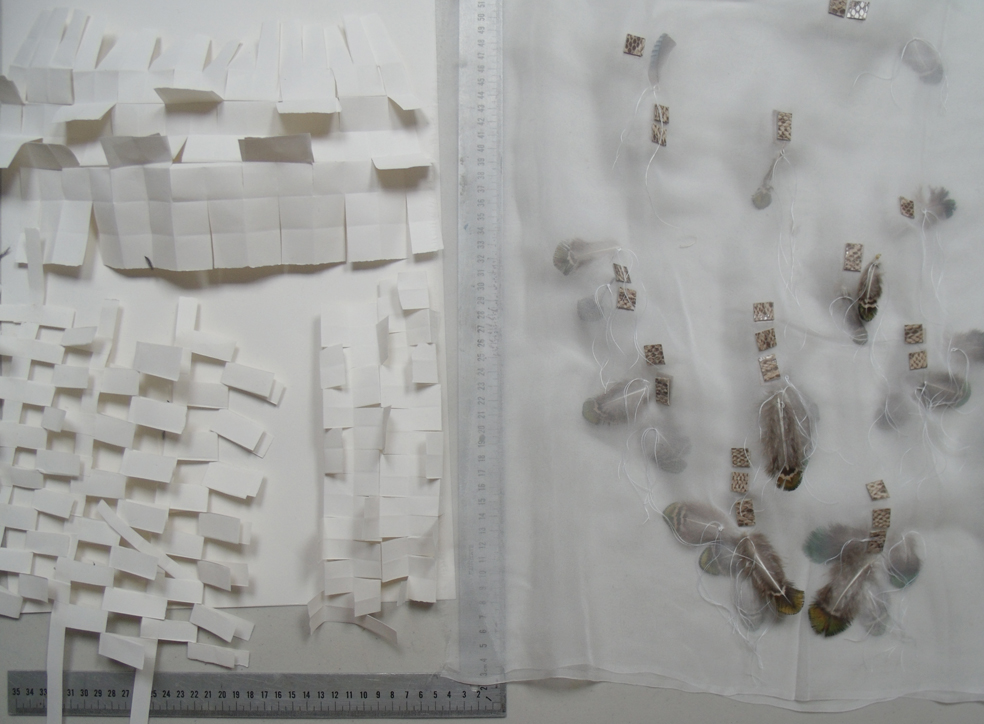
Several people became immersed in weaving and folding card to develop leather and skin fabrics, Sue James, a technical lecturer at Glamorgan university began a fascinating small scale interwoven series of samples using card, as did her colleague, Tom Clulee, the Award Leader in Fashion at Glamorgan, who made a good start with developing an interlocking star shape in cardboard like Islamic patterns…unfortunately he was called way from the class after the first day so Basil and I sent a “care package’ to him to help develop his ideas in his own time, we can catch up with him on a later post.
Susan James woven paper samples
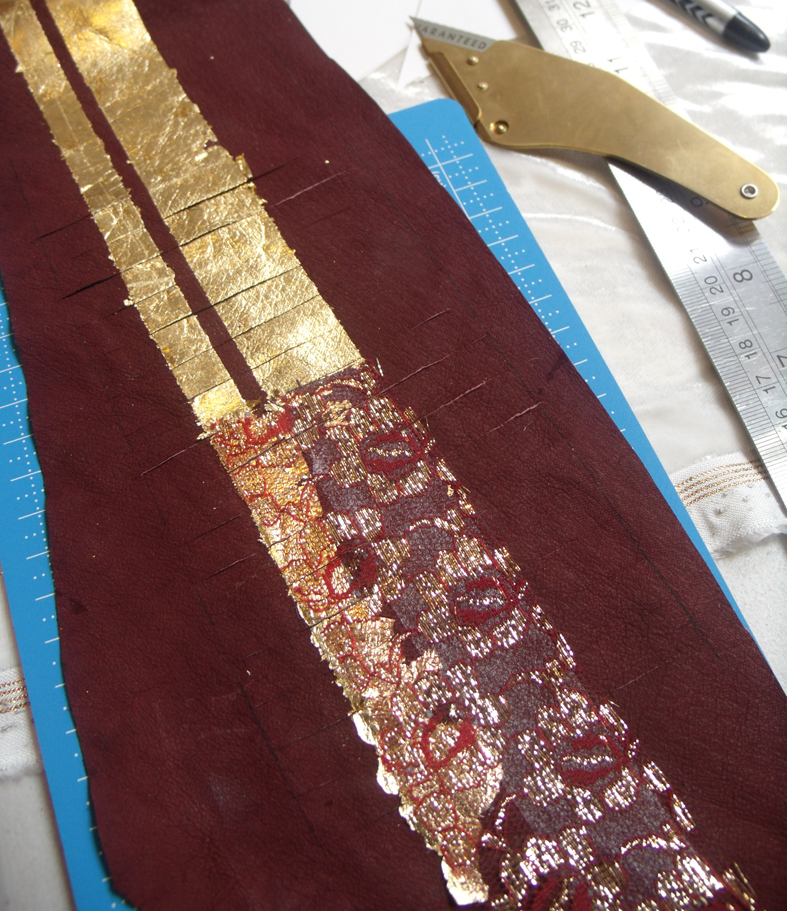
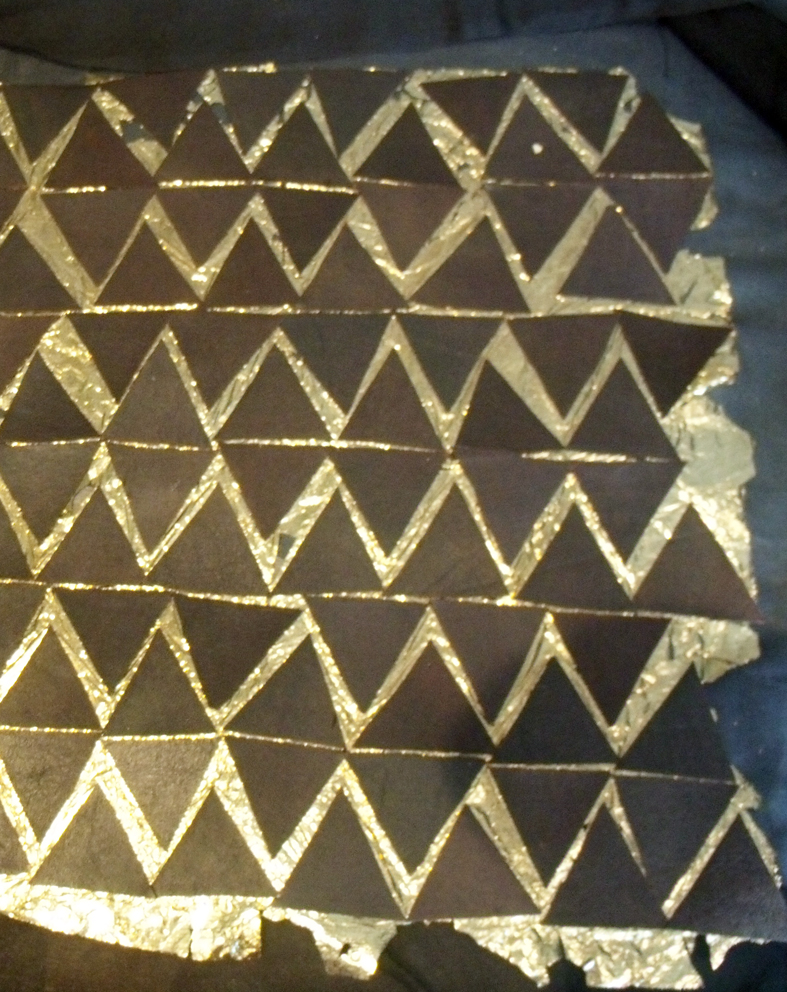
But Sue persevered in finding ways to make sheets of viable leather ‘fabric’, the beauty of which lies is the fact that each side has a different pattern, especially when gilded..
Susan James snakeskin and leather samples showing the same pattern on the reverse of a fish skin with gilding.
Her main aim now is to make a fabric that will be molded to ‘sit’ on the body as a garment without it being cut and stitched in the usual manner – so her technical expertise has come to aid her development for these unusual materials.
Dawn Mason makes a complicated folded and woven piece
Dawn Mason, who is the Award Leader of the Drawing and Applied Art programme at UWE, Bristol is a textile maker currently working with hand stitched papers who also decided to weave card to develop new ideas. She worked by referencing traditional fur cutting techniques that Basil had shown in his introduction; several samples of cut and woven leather were shown at the end of the session and she is now intrigued by the articulation achieved – she also stated that she had made a determined effort to change the way she usually waoked and to just experiment with “something that feels alien” .
Dawn Mason showing her samples and experiments at the end of the workshop.
Sitting next to Dawn and dealing with alien ways of working was Jules Tenebrae of Lux Tenebrae and if you go to her fascinating website you will see how far she travelled from her daily working life ..
side by side: Dawn Mason’s woven paper and Jules Tenebrae’s feathered chiffon
Well maybe not, we are still in the realm of fantasy and femininity.
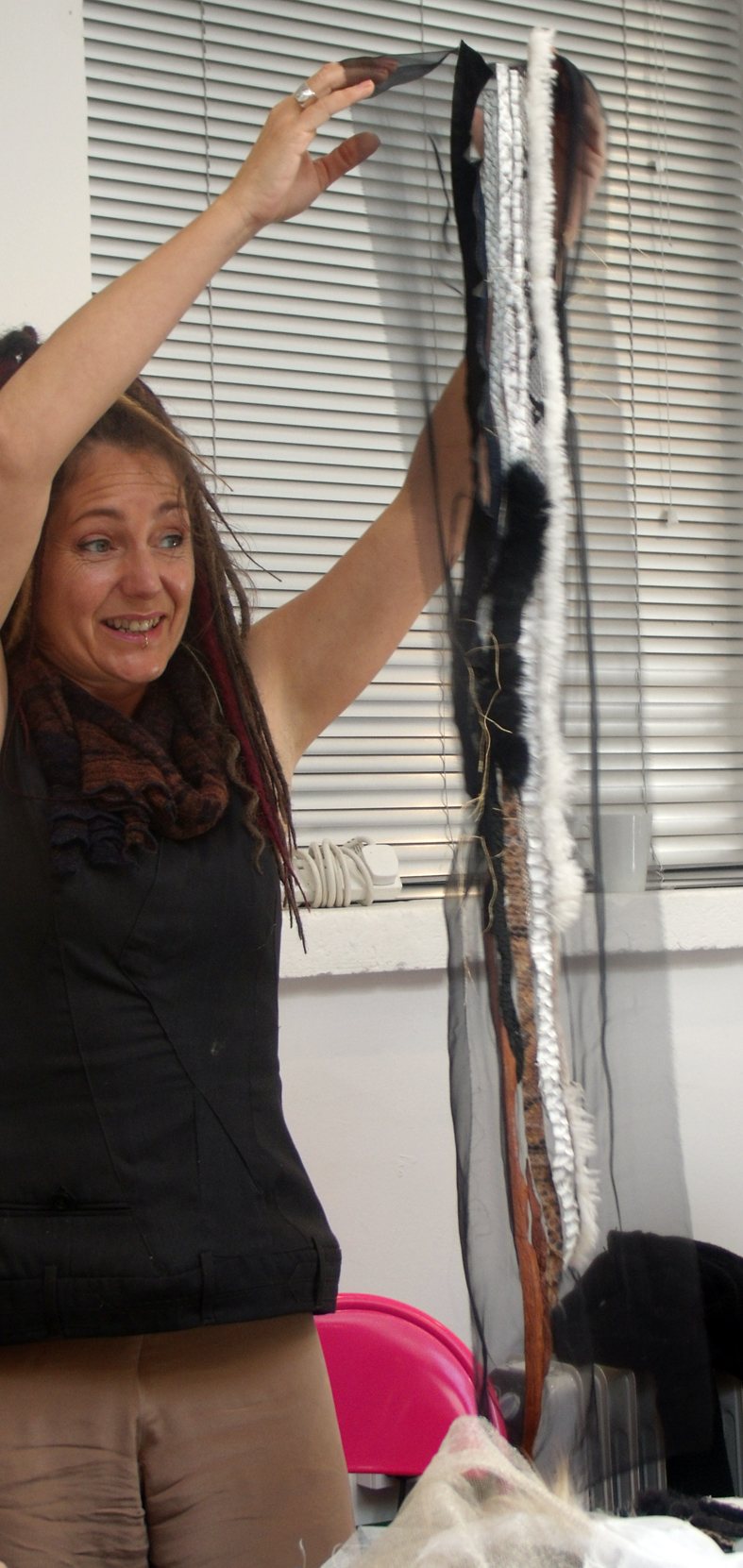
Jules, a corsetier, made the most diaphanous fabrics, weaving and stitching soft feathers and leathers together, and she also gifted the class with extra snake-skins, leathers and seudes from her own workrooms for the second day. She said that she felt liberated as we were not “allowed to produce a product” and this was initially very difficult( I agree, once a designer always a designer). She worked from the idea of ‘Treasures on the Beach’ and started a long wavy piece of work that flowed and undulated when she hung it up, in fact all her fabric samples where very floaty and at the same time organic, at complete variance to the usual rigid corseted and structured leather clothes she sells. And now I look at her final sample I see that she also has incorporated the 3 materials, she has strips of snake and fish skins, fur, leather strips stitched with feathers onto silk chiffon.
And next to Jules was another corsetier, Lisa Keating – a Heart Space tutor with her own designer business Bespoke Bridal Lisa immediately designed 5 fabric samples and embarked on trying to make them – a tall order but she really was inspired by the gilded leather…
Lisa Keating prepares leather with metal leaf and lace.
split and turned gilded leather
and the small chiffon fish skin piece from Swedish students, which really was inspirational for many of the other people in the group. Lisa made a simple and delicate spotted fabric using the iridescent fish skins like sequins.
Lisa Keating -appliqued discs of fish skins to silk chiffon
It is a seemingly simple technique but requires a great deal of precision and patience. The cutting and sticking of the fish-skins to the front and back of the material is really labour intensive. Libby Butler, a textile maker who makes truly for the love of it – became interested in working with the Fibonacci spiral and came on the second day with a storyboard from which to work a series of samples.
Libby Butler – storyboard of the Fibonacci spiral
she set to work knowing that she is in for a long time consuming period of developing this intricate idea into a viable fabric.
Libby Butler making her first card on linen sample collage for the spiral pieces
Meanwhile, textile maker Anne Harrington tried to simplify the making process by gilding the back of the leather using adhesive that could be permeate through the chiffon.
Anne Harrington …gilding the back of the leather mosaic at the same time as adhering it to the silk chiffon ground
with really interesting results that beg to be developed further…..
showing the successful finished gilded sample back
These experiments are the first samples in an ongoing process to an exhibition in London later in the year; we aim to help the makers develop new works inspired by and exploiting the qualities of these unusual materials….for Basil Kardasis’ next class he is working with Vellum .
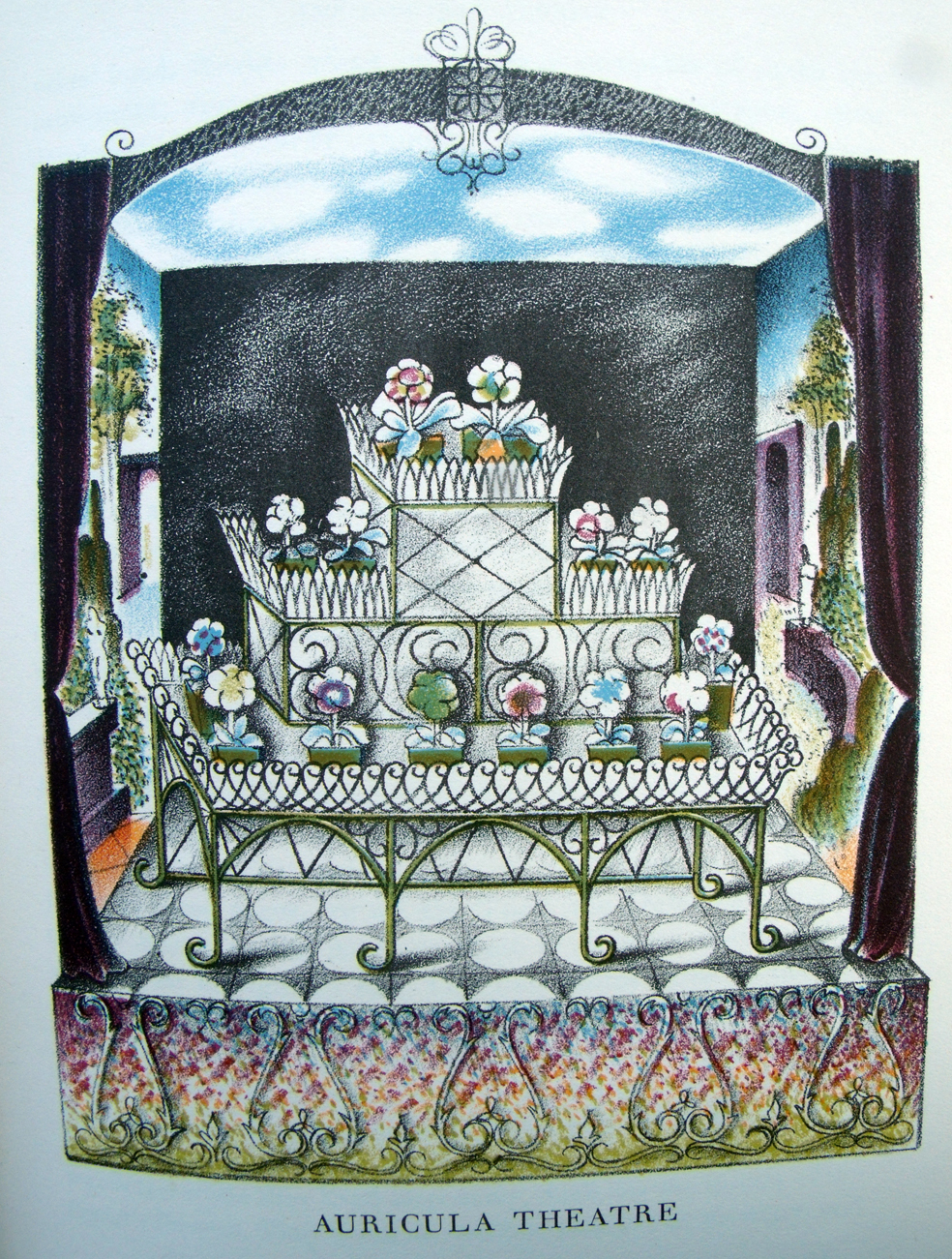
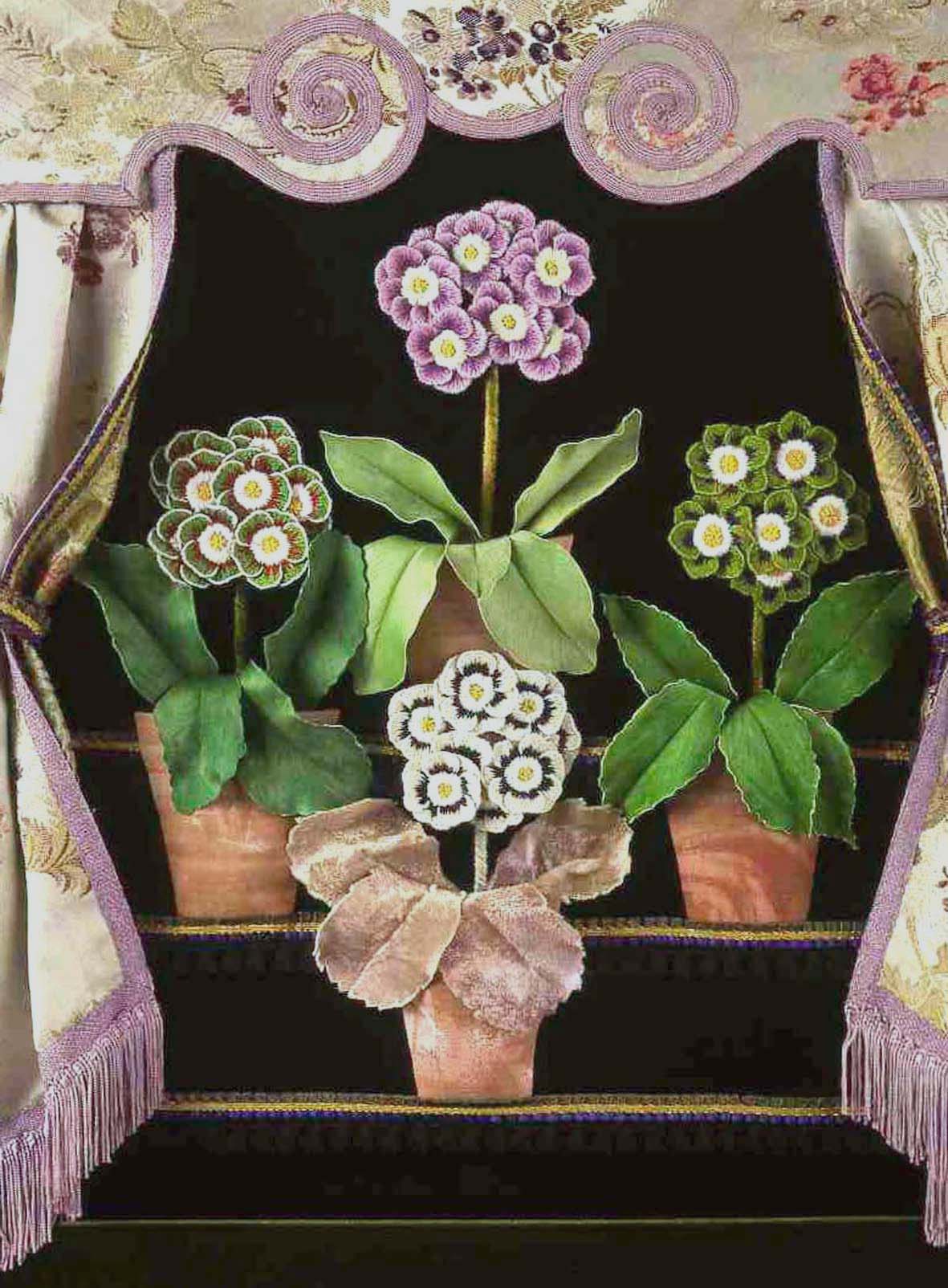
In an effort to be topical with the spring here at last, I am posting another of my Flora Embroideries, the Auricula Theatre. A strange idea to display flowers in such an artificial setting, I just had to embroider it – but needed quite a bit of help. In fact after the initial sampling I left the embroidery of all the dozens of tiny petals to my then assistant, Debbie Cripps, and a beautiful job she made of them. All I had to do was design and assemble the whole edifice.
Auricula Theatre illustration by John Farleigh
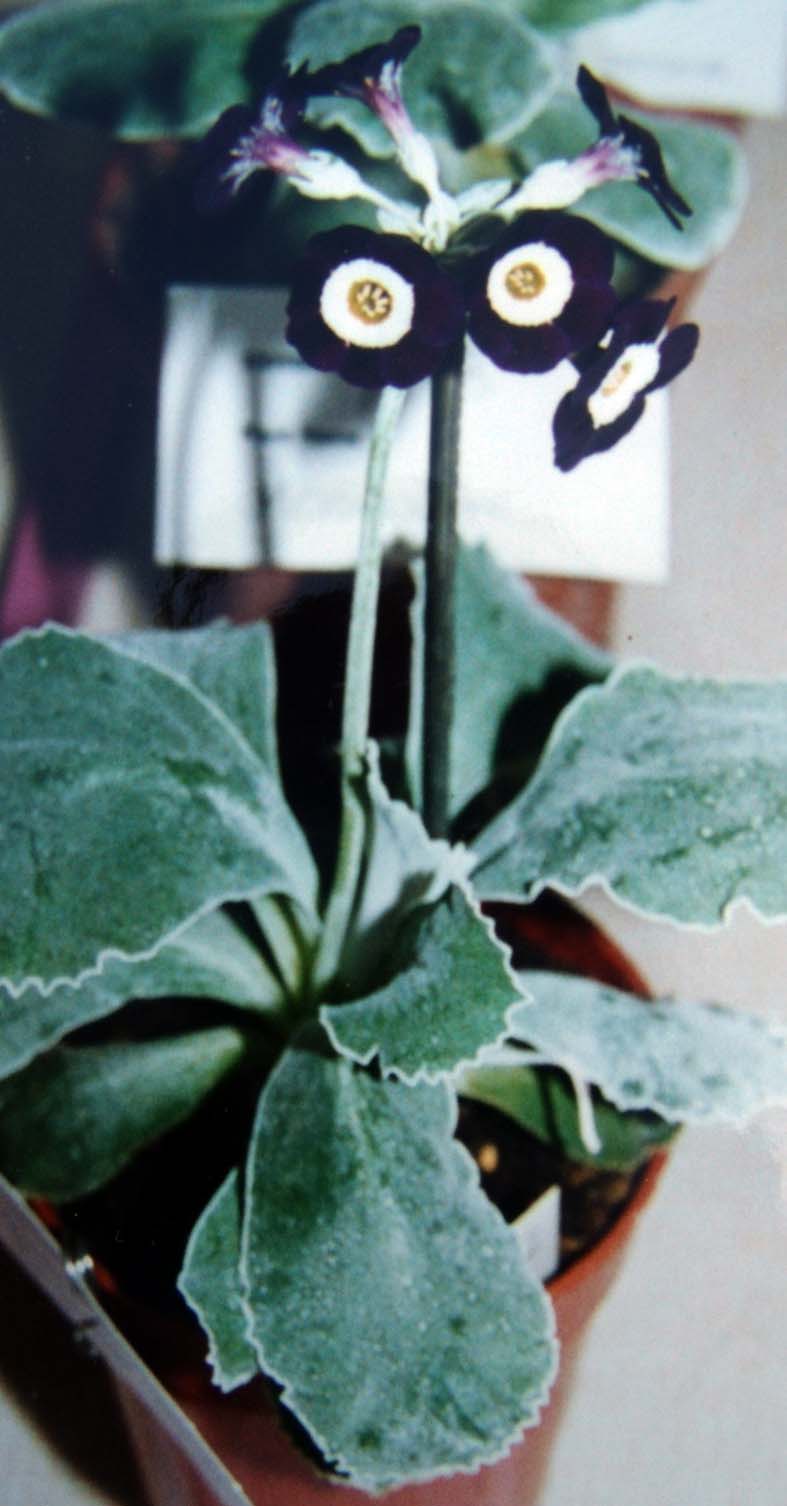
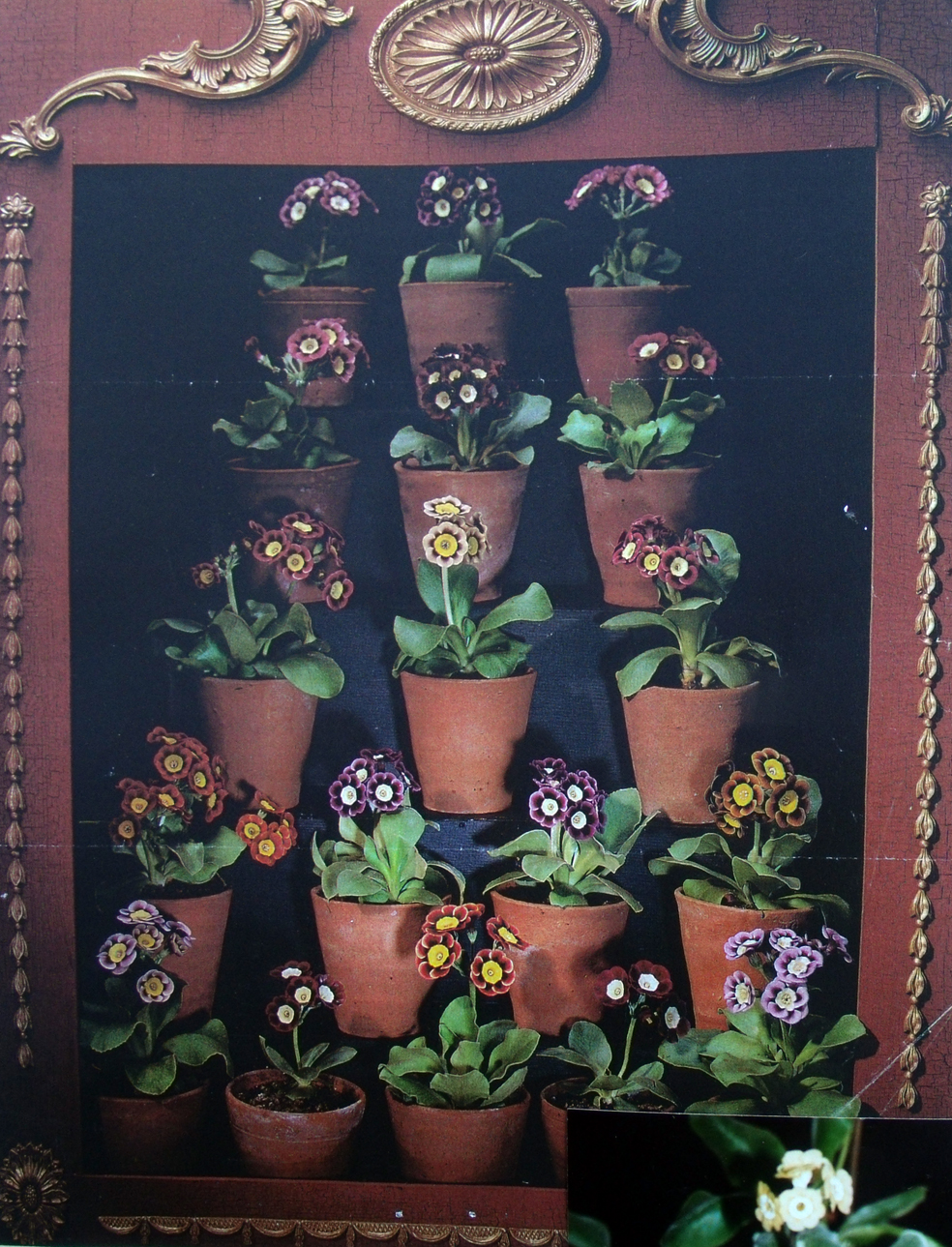
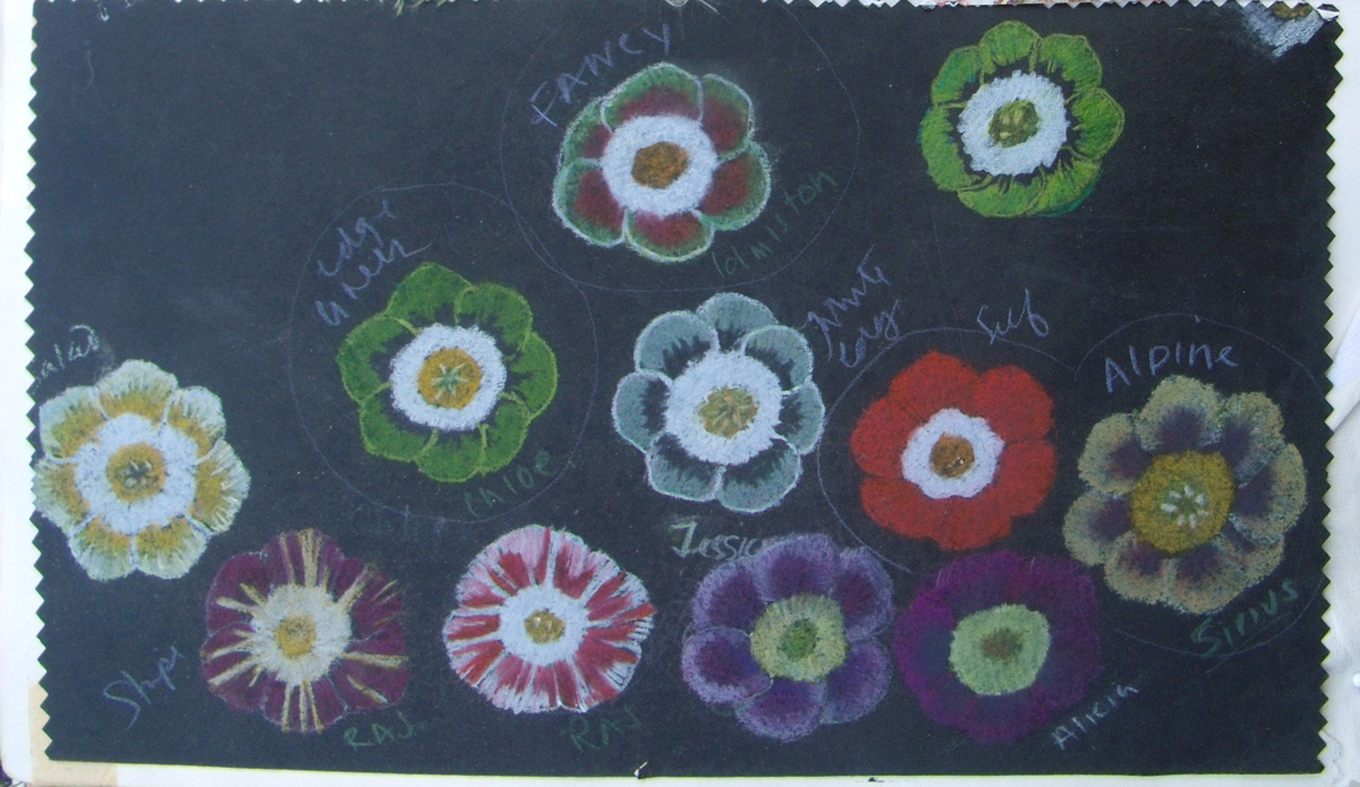
The theatres actually did exist and originally for a purpose other than display, the curious colours of some of the flowers is due to a farina or flour like substance that coats the leaves and petals giving them a white or silvery appearance and it can be washed away by rain – so the earliest flowers were often placed under protective coverings. I became intrigued by the auriculas having seen them at spring flower shows – not in theatres but in simple plant pots; even in local church halls they really attract attention – they just don’t look real, they look like someone has painted them in strange colours with stripes and edgings of greens and white and yellows, they look like a child’s drawing of a flower.
black and white auricula at a local flower show
And when they are displayed in modern theatres their various markings can be truly appreciated
modern Auricula theatre
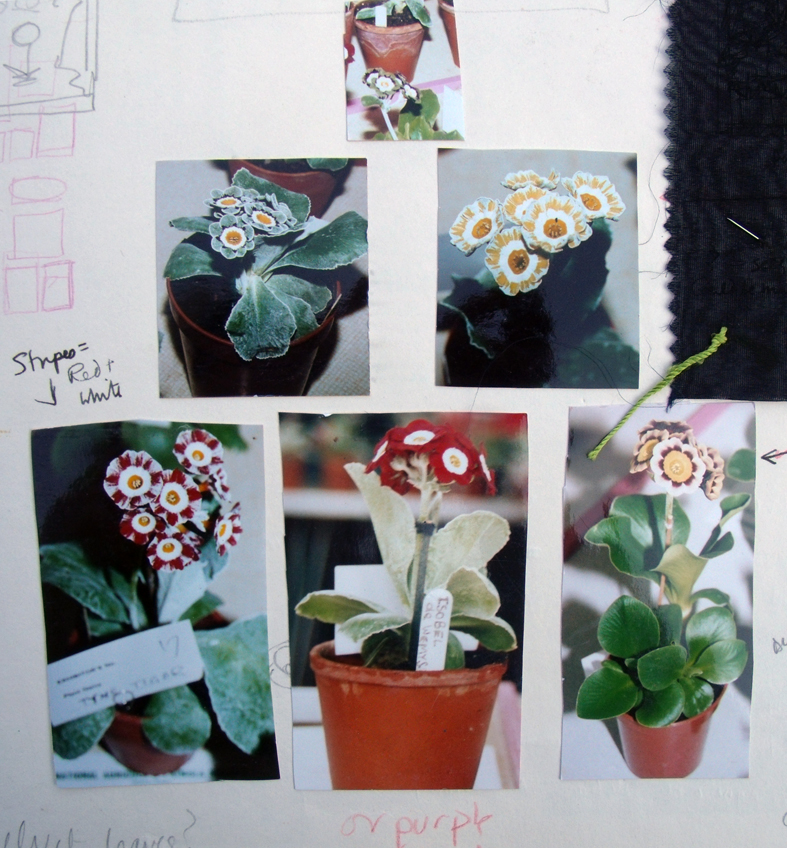
So I set about making one for myself, to become a permanent display. I arranged several of my photographs form the various shows I attended into a staged setting, then set about trying to embroider them.
.
show photographs arranged as theatre display
first I needed to draw them before I could start to stitch them.
first pastel drawings of flower heads
at first I tried to paint in the backgrounds, really to make things easier and quicker….
painted dye on linen ground with embroidered edgings
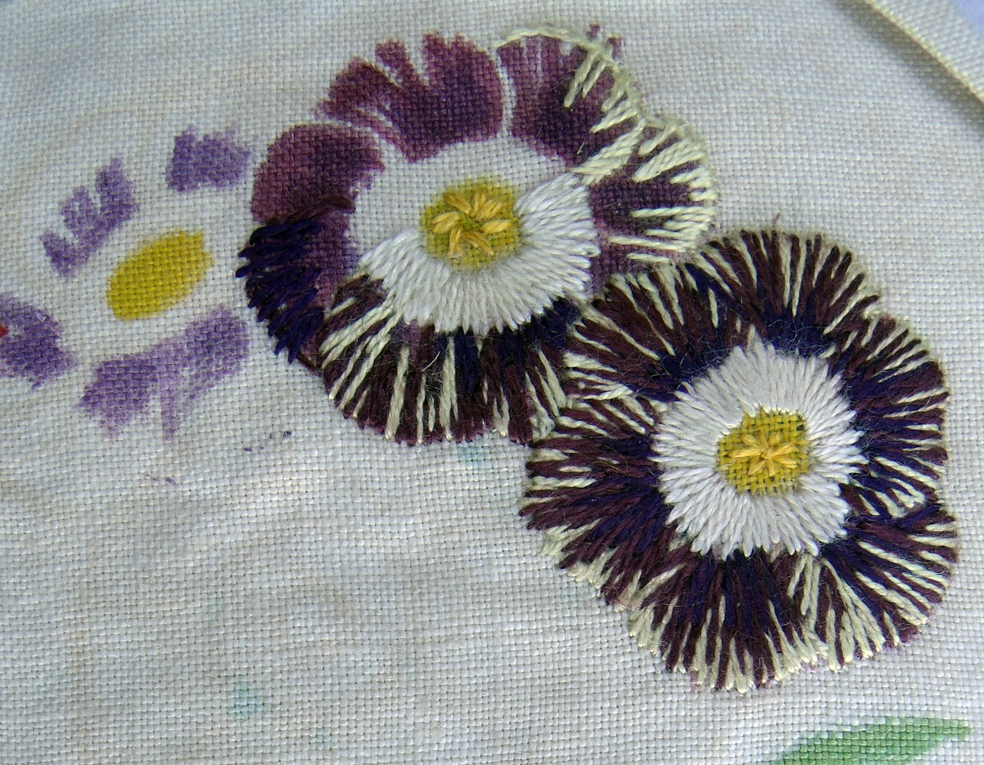
They looked OK but didn’t really have the intensity that the real things had, show auriculas look like imploded flowers so intense is their colouring and perfectly symmetrical their form. I realised that I had to make similar intense embroideries. I started by embroidering individual petals..
my hand stitched samples of individual petals
I decided to try coloured grounds to make life a little easier.
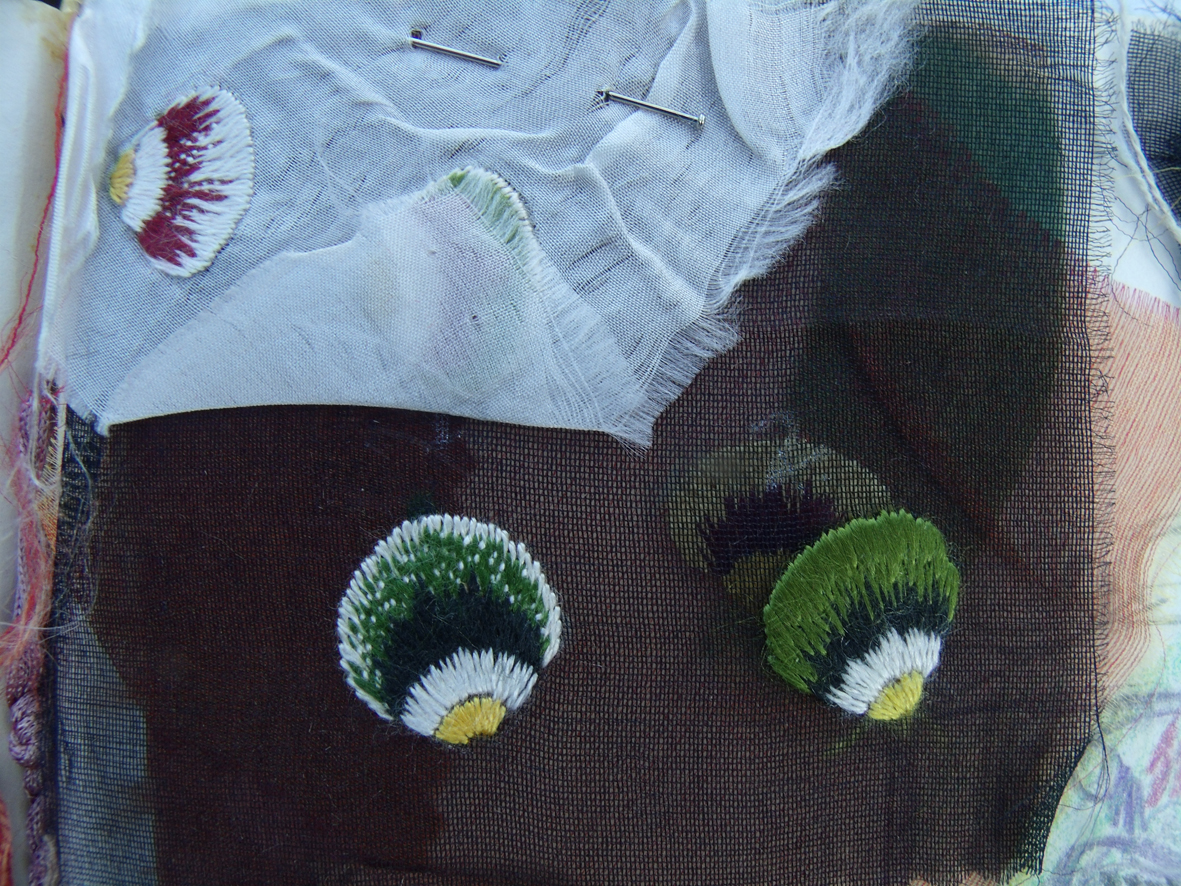
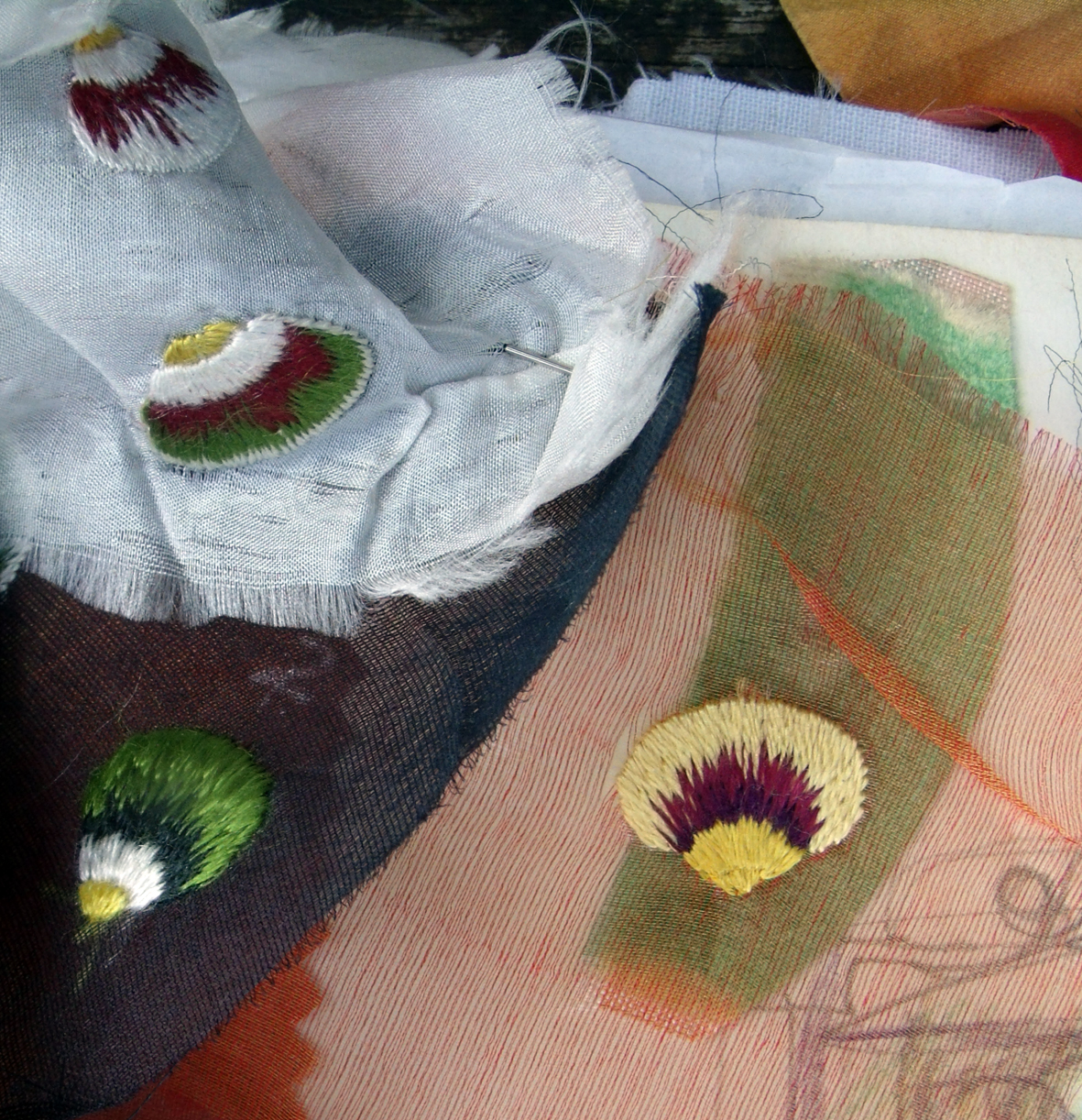
different ground fabric samples
I used gauzes and fine silk grounds so that the made up flowers would not be too heavy but it was a bit of an awesome task even with help with the stitching.
after giving the fabrics and my working samples to my assistant I set to work to develop the theatre.
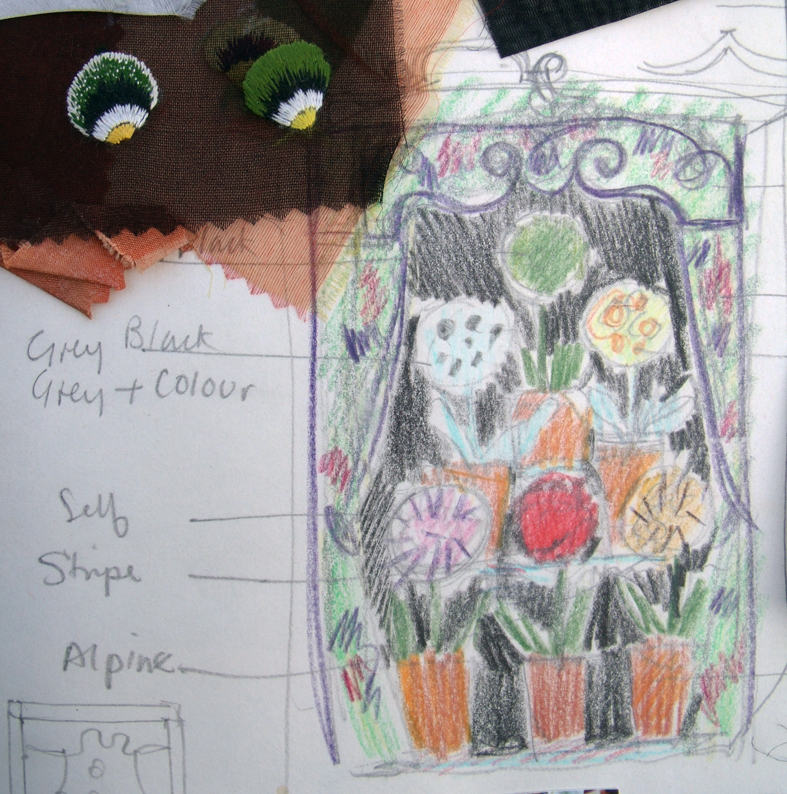
initial drawing for the embroidered theatre
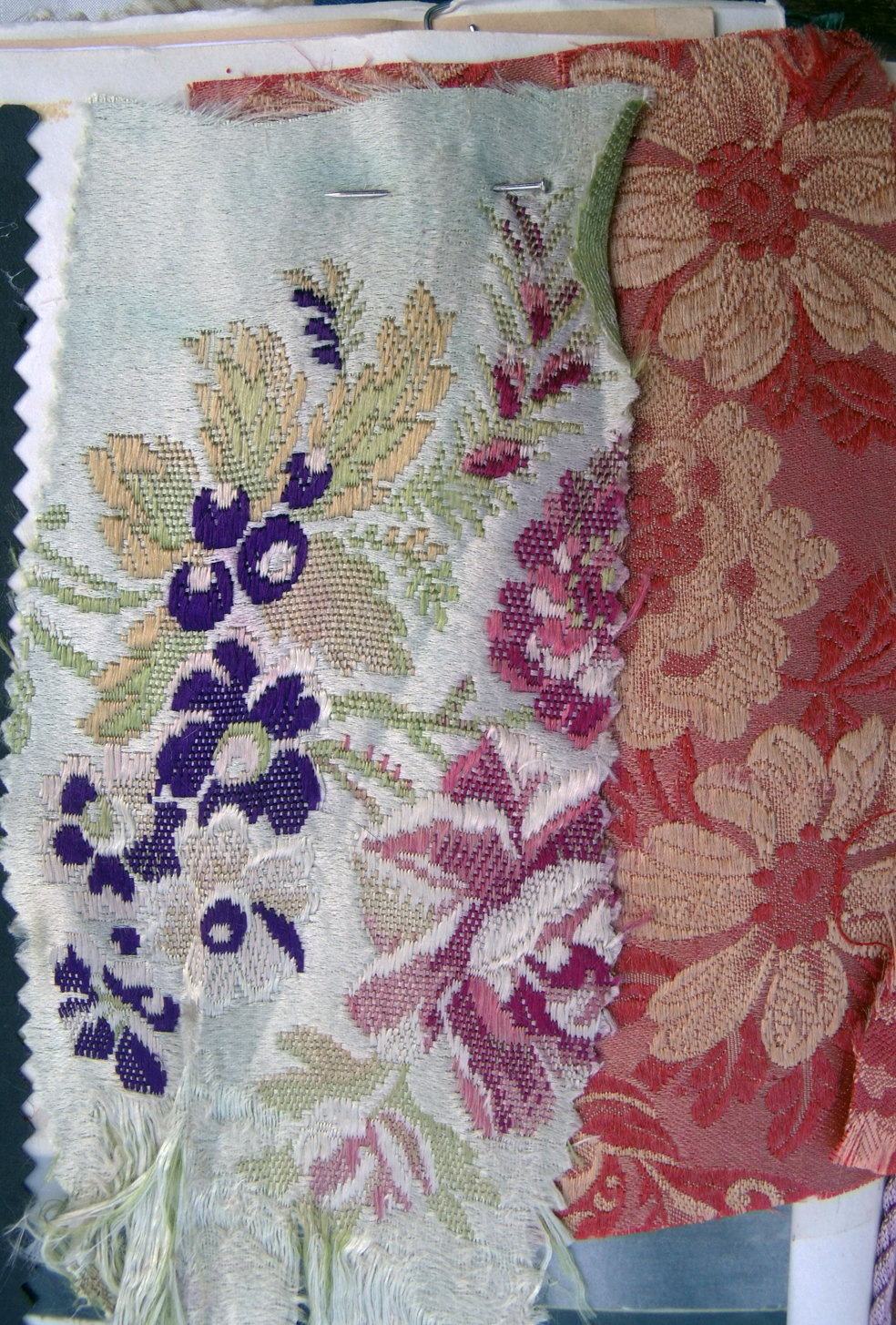
I know that this drawing is really simple and childlike but it was enough to get me started – I soon realised I had to make a 3D embroidery, so the curtains were lined and draped and the canopy was held above and projected out beyond the flowers, it was ribbon worked exactly as 17th century embroidered bed hangings. The earliest auricuals were grown by Flemish silk weavers and eventually shown in special competitions were prizes were awarded, usually a silver cup or spoon. The Flemish silk weavers introduced them into England as early as the 17th century – so I decided to have curtains made from woven silk brocade that features auriculas ( you can’t say I am not thorough in my research)!
pure silk brocade featuring auricula flowers
The finished embroidery is very 3 dimensional and is densely stitched and draped, it is the one piece of work that everyone wants to buy, probably because it featured on the poster for the exhibition at the Holburne museum in Bath where the whole set of Flora embroideries were first shown in this country. This was in 2000 so this is really old work now – but making this piece made me decide that I needed to start to develop new types of work using different media or techniques or both, this heavy stitched surface is too time-consuming and therefore too costly to sell except to a committed collector or dare I say it – museum? and I have decided not to separate the pieces because they tell a story of how, through trying to perfect nature we can go horribly wrong. I had stitched myself into a corner but I still had quite a few more pieces to complete The Flora set of work.
This is a first for me and I want to share it with you – I am, from today, exhibiting in America. I have 2 pieces of work in an exhibition called Mending = Art showing at the Gershman Gallery in Philadelphia and this evening I should be at the private view, but instead I have just returned from Heart Space Studios having run a birthday party, making beaded brooches with ten 9 years olds – and very enjoyable it was too. But how I would love to be seeing my work in an international exhibition at such an amazing event as the Philadelphia biennial textile art festival FiberPhiladelphia 2012.
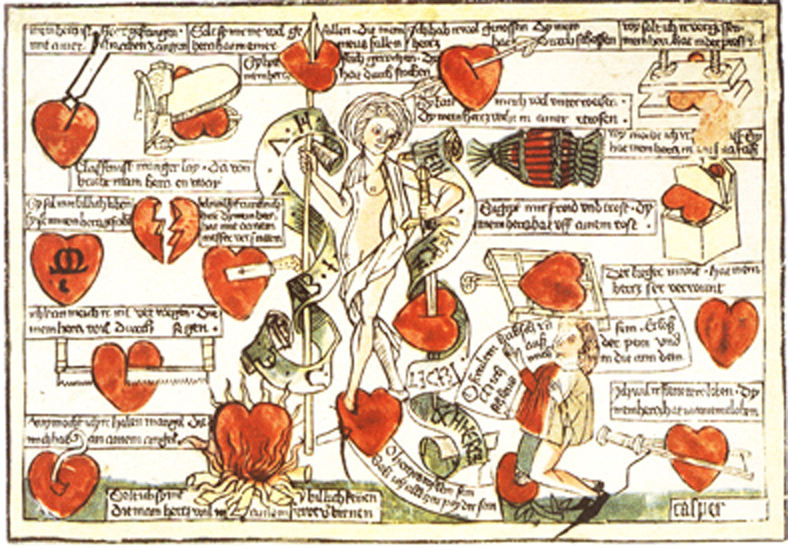
the inspirational wood cut from the Berlin Museum- Frau Minne’s way with Mens’ hearts
The call out came early last year, from American textile artist( she of the wonderful brilliant red website) Diane Savona, for textiles made around the theme of Mending…this must have been the universe answering my call. I had several things on offer, as looking at the ‘ Ongoing Work” section of this blog will show you. But unusually she also asked me to send her an image of the inspirational early woodcut that has inspired at least 10 years of textile and enamel work, and mending was the subject of my first post in this blog.
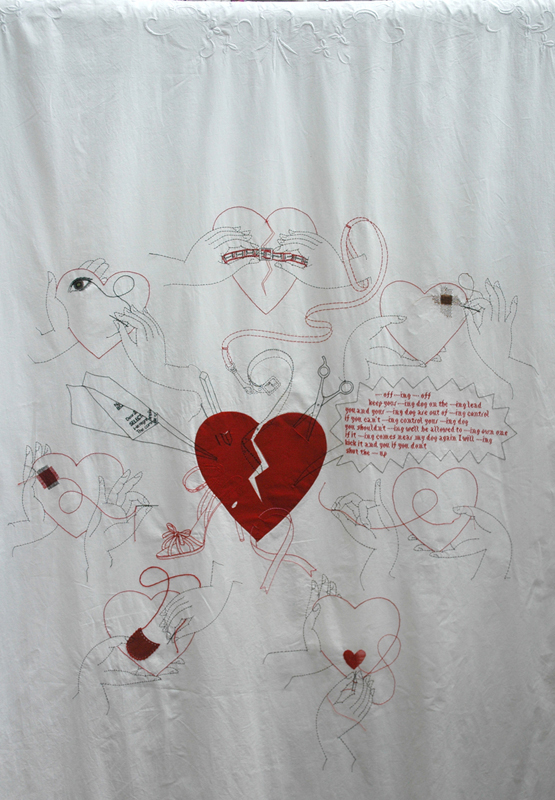
counterpane/counter-pain – vintage cotton and cotton thread
and above is the other work that Diane chose to represent my mending embroideries, a real heart-felt cry now that I look back on it, I can remember every stab that contributed to this image but then yoga certainly reaches the parts the needle can’t.
So this is the shorted post I have ever written, but now I am off to celebrate with a glass of something chilled and pink and fizzy……
OK so it’s the day after the night before day and here are the pictures from the exhibition sent today from Diane Savona.
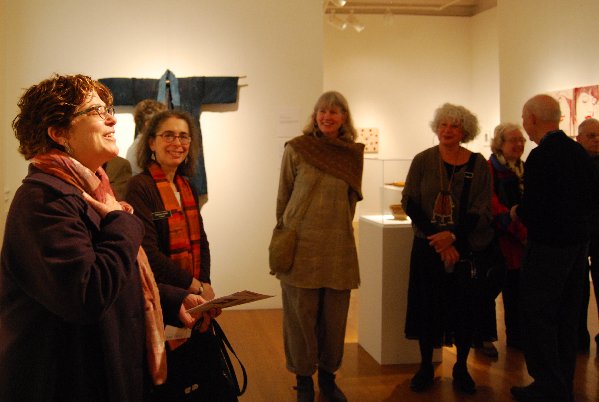
from left: Amy Orr (organizer of FiberPhiladelphia) Miriam Shapiro (curator at the Gershman) Dorothy Caldwell and Libbie Soffer, as Amy says a few words in front of the Japanese boro from the Liao Collection.
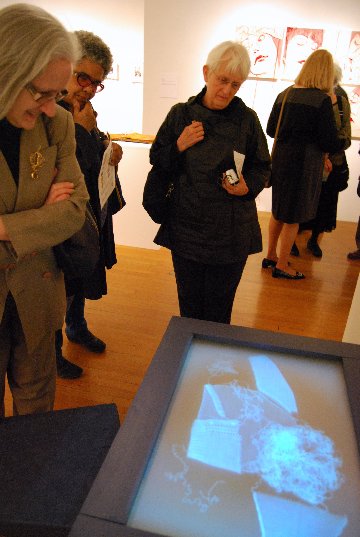
and very glad to see a video work from one of my colleagues Amy Houghton,
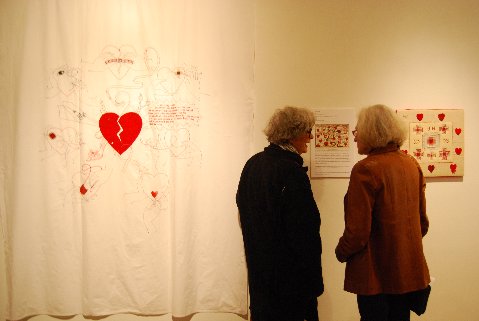
then there is my work hung together with Frau Minne keeping count in the middle of it all….
mine all mine!
something tells me that that red and white is the new black, white and grey of studio art textiles…..
Ilaria Margutti in front of her work
and again….
Wolfie Rawk in front of her work
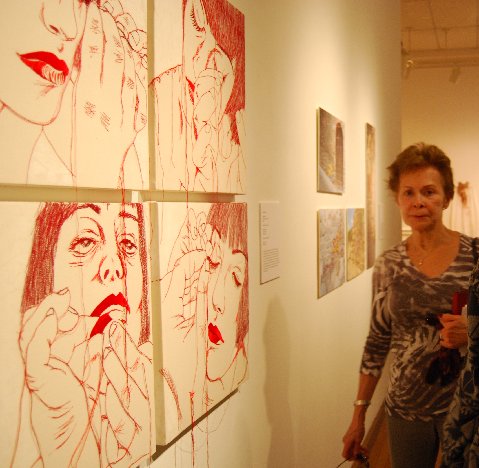
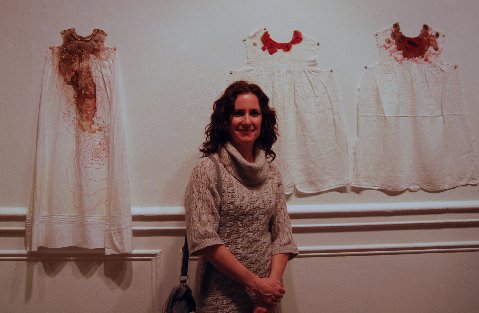
and yet again…..well mending seems to = blood red for a whole lot of women.
It takes a lot of lovely textiles to make a good wedding! Think about it ….. the dress – obviously, the veil, the bridesmaids’ frocks ( it’s rare to see a good bridesmaid’s frock – Pippa Middleton’s proved the rule)! But there are also the garters, the waistcoats, the ties or cravats, the suits, then the the napiery, and the flowers -so think silk ribbons…..
hand embroidered silk flowers
Well yes of course you thought I meant the bouquet and I do, eventually; but just for now I have embroidered some silk flowers onto a cupped corset for a wedding gown that has made me realise that we can develop all kinds of different products perfect for sumptuous weddings and everlasting memories, not forgetting the Hen Party.
ribbon embroidered bridal corset with Catherine Keating, Lisa's youngest daughter, peeking out
I have been working with Lisa Keating, who conducts out very popular corset making courses, and together we have invented new designs for the ultimate romantic wedding that you can make yourself at Heart Space Studios– or maybe send someone else to make it for you. The ribbon embroidered wedding corset and skirt are made to measure – this is the ultimate in hand – made retro chic.
We showed the dress at the latest Vintage Wedding show held in Bristol last weekend.
back view of corset modelled at the Vintage Wedding Fair in Clifton Bristol
Heart Space tutors had made several accessories that we can teach people how to make in short classes ..small beaded hearts and hair accessories, buttonholes and party favours.
wedding gifts and favours made at Heart Space Studios: shoes by Lisa Keating
We feel that is is a good way for a Bride’s family and friends to get involved in making a bespoke wedding, and much of it can be made with recycled and vintage materials. Debbie Bird came up with a lovely idea for making bouquets made from old love letters…well who writes those these days? But it will still work using a romantic novel or a book of love poetry – I recommend John Donne for the most unashamed ideas on what it is like to be in love .
recycled paper bouquet using pages from a love story, by Debbie Bird
At the venue after I had set out the samples of what people can make with us with Heart Space, I took a good look around the rest of the stands, absolutely fascinating, so many really desirable things…starting with the cakes…..
Chocolate Delores makes chocolate look like fabrics
I was delighted to find the Chocolate Delores stand with wedding cakes that all looked like they were made from fabrics – and they were made from chocolate…how fabulous is that? those swirls of white chocolate just look like tulle and look at the sprigged rosebud pink print on the wrapped cake.
Other stands were more conventional using real lace, beads and silks, there were so many good ideas for textile jewellry that I wanted to get the makers to come and do workshops for us at Heart Space, some may come and teach with us in the future.
the Lilygrace stand with lovely romantic sentimental fabric jewellry
the Lilygrace stand was full of hand made fabrics beaded and embellished by the maker, Hazel Mathiot was actually stitching pieces at the fair. I particularly liked her very richly beaded wrist band, a case of the “more is more” school of design.
embroidered wrist band by Lilygrace
There were lots of lovely embroidered lace accessories throughout the whole show, mostly head dresses with embroidered lace stitched onto Alice bands, Bridezillas were particularly stunning
in fact their stand was mesmerizing so many lovely desirable things, really all this vintage wedding stuff brings out the hidden girly in everyone….