Alexander Palace – the Knitting & Stitching Show entrance
And so to Ally Pally for the annual Knitting & Stitching show, attentive readers of this blog will realise that this is where Heart Space Studios headed to advertise our new book at the invitation of The Cotton Patch, the home of all things patchwork and quilting in Birmingham. For a week I worked at this amazing show – and looking at textiles for so long, I now feel well able to select my personal ‘ Best in Show’ awards to several outstanding exhibitions and commercial stands.
Kate’s Place blackboard
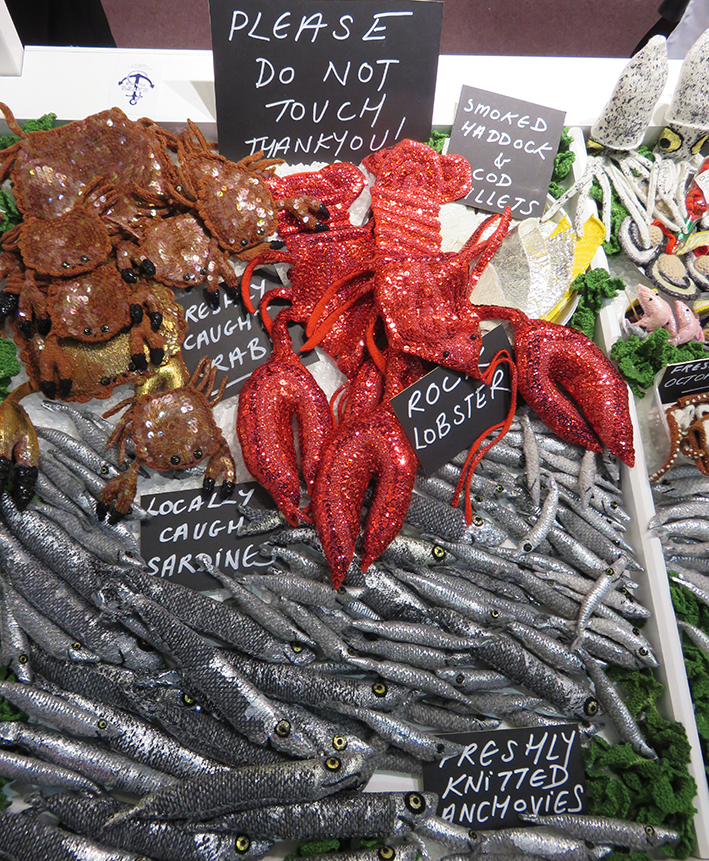
In no particular order – ” Kate’s Plaice the Stitchmongers’ ” was by far the most amusing, the concept or rather – to use a literary term – “the conceit” was completely thought through, it was highly technically proficient and the most entertaining piece of textile work that I have ever seen at this event.
the fish stall
The installation was designed specially for the Knitting and Stitching show by Kate Jenkins, Everything on the stand was completely in keeping with the joke…from the dressed shop assistants that like all good fishmongers knew their subject inside out and wanted to share their delight and knowledge with you, to the stunning array of ‘ seafood’ on offer…
detail of the central fish counter
below are the details of the counter of fish, the use of material and the shapes and colour are perfectly chosen – you really did want to order and eat what was on offer…..
For those, like me, who prefer their fish cooked and served, rather than making the dish themselves, the fish platters definitely looked good enough to eat.
fish and seafood supper
tabasco and oysters
the hand written sign below, perfectly in keeping with the whole fish shop ethic, was written to deter a fellow exhibitor, an embroiderer, who pawed the little sequined morsels as they were being arranged, and was extremely rude when he was asked to stop! This is such an unusual occurance – stall holders being rude to anyone, let alone one another that I feel it deserves reporting.
thee sparkly lobster and the necessary notice!
Among the exhibition, chosen from recent graduates by the Embroiderer’s Guild, was this enigmatic large photographic hand embroidered panel by Susana Borobia, part of an small body of work called ” Awaken Threads…this spoke ro me on lots of levels – it reminds me of my own work developed through a fascination with White Work techniques and the difficult transition from cloth or fibre to other materials…here is it managed elegantly and artlessly.
stitched photographic print by Susana Borobia
Detail of the stitched white work on the photograph
Ihave to admit that I chose to ignore the notice not to take photographs; it was early in the morning, I couldn’t find the student to ask and thought that she may prefer it to appear on this blog than me to ignore her work. I have had this problem of no photography before …but it is a odd embargo now in the age of instant imagery and social media and who can possibly copy this ??????…that’s my excuse anyway.
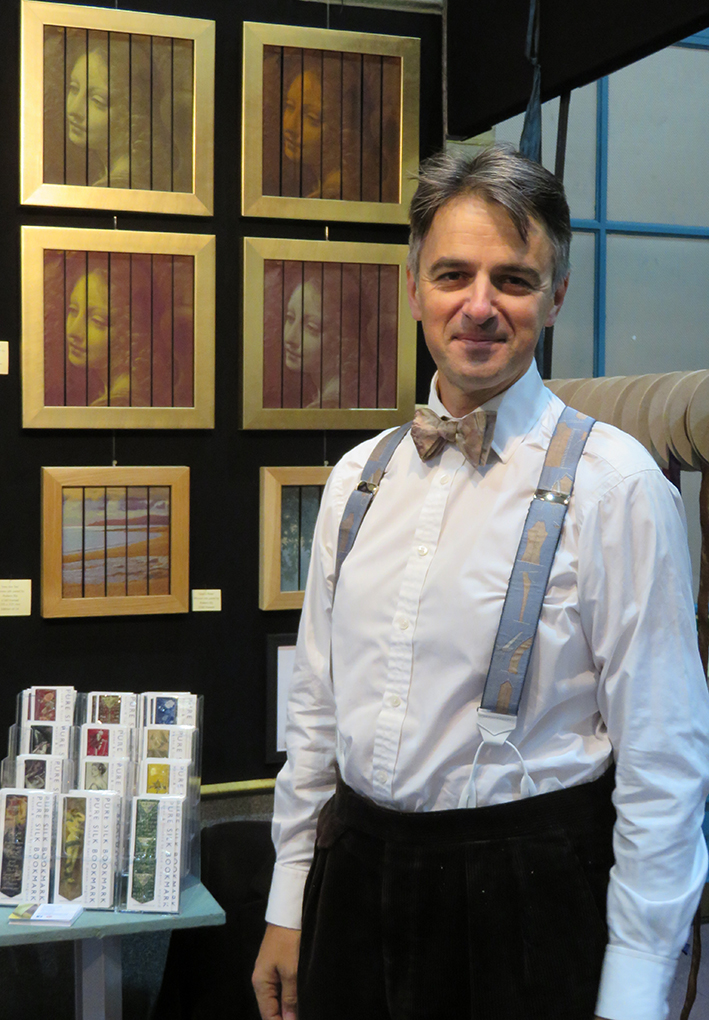
Robert G Ely, the perfect example of ‘ if you’ve got it flaunt it ‘ wearing his woven silk braces and bow tie
It is difficult to show a range of different work in such a small space as a booth in the fair – but here Robert Ely has managed to do exactly that – he shows his woven ribbon design work, such as braces and book marks with his more art based weavings of sea and landscapes – the ribbon dimensions are shared but the colour depth and small scale pointilism is also evident in both sets of work – seen below are the 2 types of work on display
woven ribbon seascape – by Robert G Elybelow are the 2 types of woven work that Robert was exhibiting
braces, book marks and other finely woven sauciness.
the seascapes exhibited made me think that he must live near me on the Severn Estuary, in fact these images are taken from much further down the estuary at Devon, Start Point.
this image I mistook for my local headland and lighthouse, Battery Point in Portishead, Somerset in fact it is form further down the estuary in Devon
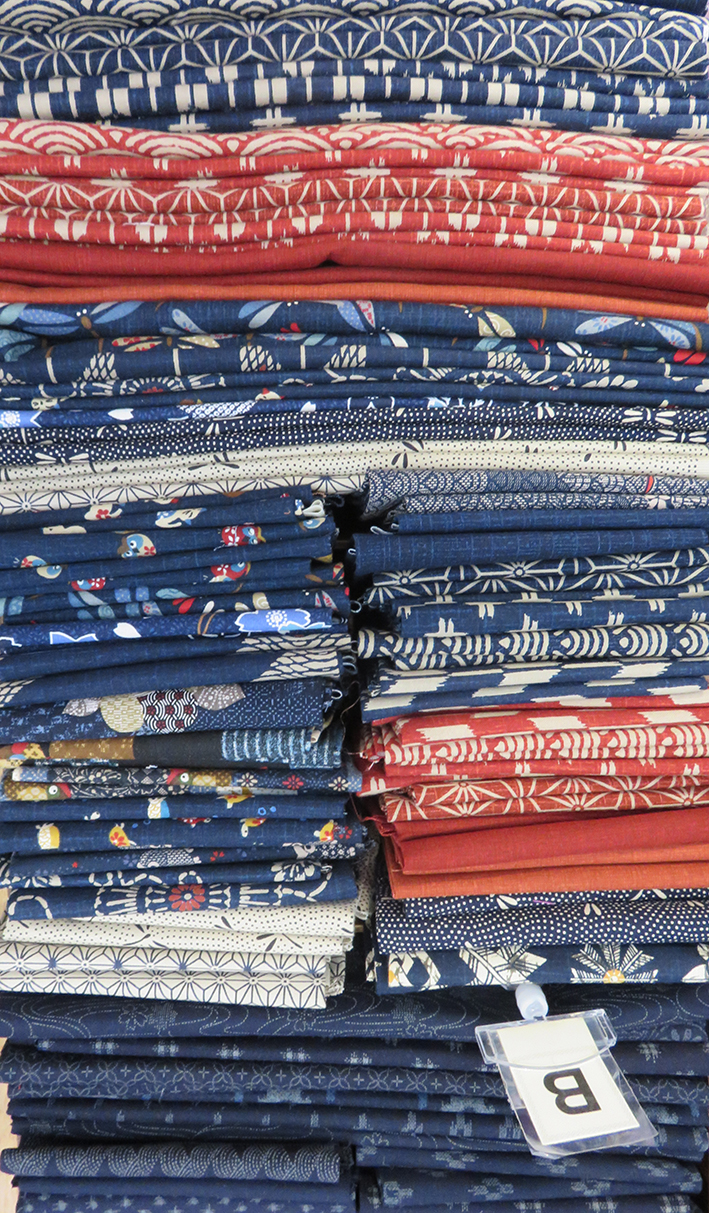
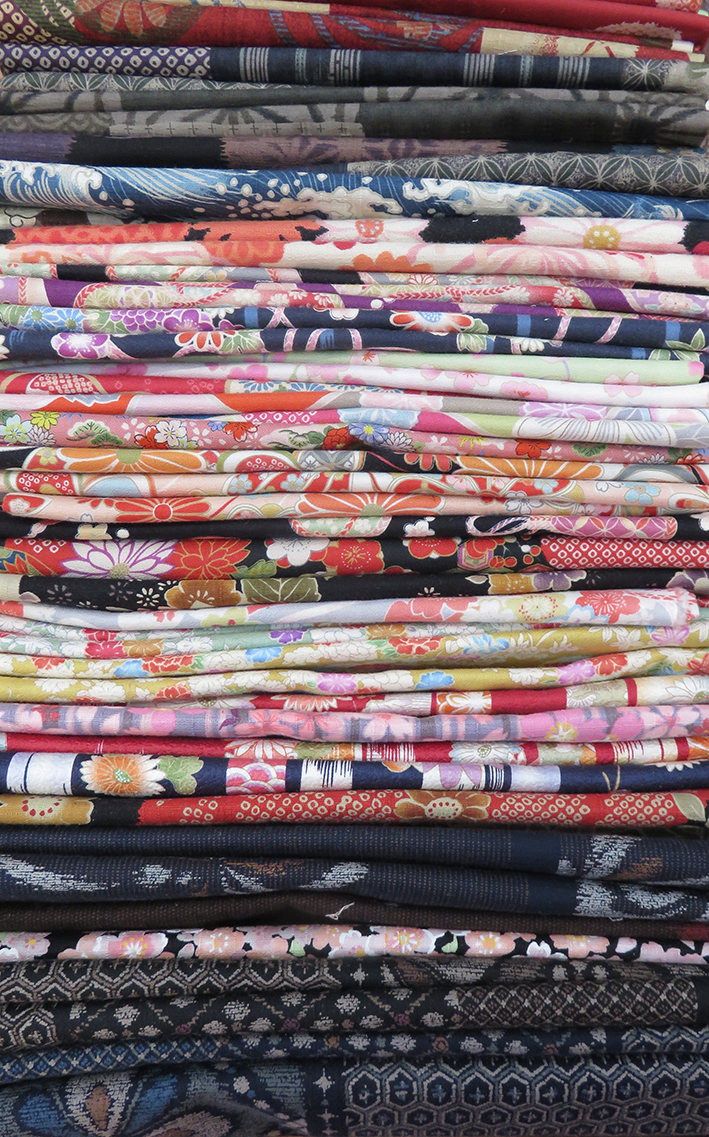
what everyone goes to these fairs of is to stock up their stash! So 2 specialists who always show wonderful collection of the real things…first my old favourite importer of real Japanese fabrics, Euro Japan Links, a Japanese husband and English wife team who have been in business for years- long before their was a fashion in Japanese fabrics; their pieces of fabric neatly folded into colour co-ordinated ranges never fail to fascinate me.
Japanese patchwork cottons
Japanese kimono prints
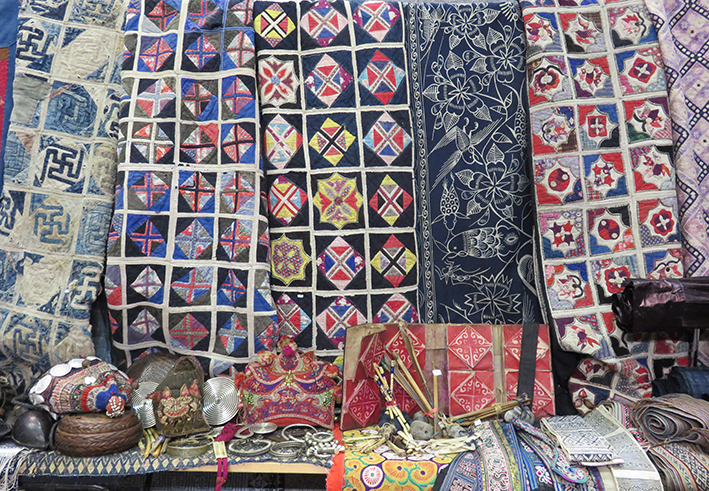
My other favourite company exhibiting and selling mainly tribal Chinese fabrics and clothing is Slow Loris. I have written about this marvelous collection for sale before but do so again as Martin Conlon the owner is a fund of knowledge and is really enthusiastic to tell you the stories behind the garments. There always new things to see – well old new things.
The Slow Loris stand of ethnic Chinese /Tibetan textiles
The other exhibition I liked for its sense of space and calm and truly sumptuous colour was ‘The Other’ coloured work by Vivienne Prideaux paired with the white and neutral work of Amanda J Clayton. They made a handsome area of beautiful controlled textile hangings and panels. I thought that these these glowing panels by Vivienne Prideaux were just so desirable, the depth of texture and range of nuanced colour that this artist builds up with her various tie dyed and gilded grounds is so inspiring – makes me yearn to return to my own studio again.
small dyed panel by Vivien Prodeaux
shibori dyed and gilded panel – Vivienne Prideaux
the neutral and range of white fabrics shown by Amanda J Clayton were perfect partners
Shifting sheets of fabrics installation in “The Other” exhibition.
So enough of what I like – what about my exhibit…i was given a space on The Cotton Patch stand, to show and sell my new book, Little Ribbon Patchwork and Applique – comprising designs based on Kaffe Fassett’s ribbon collection for Renaissance Ribbons
several people helped me to set up and run the stand during the week …
Setting up the stand with Cotton Patch ‘s Nik Sewell sorting out the Kaffe Fassett books and Jane- Matie Mahy organising the Heart Space section
several people helped to run the stand with me for the 5 days of the show….
Ilaria Padovani form Heart Space Studios demonstrating how to make a ribbon yo yo on the stand
Susan Berry who had the idea of the book in the first place
The Ribbon beads have proved to be most popular things we show how to make in the book, see the next post down!
Stuart from the Sewing Bee programme and Jane- Marie Mahy with the ribbon beads – sort of says it all really!
One wonderful wrapped ribbon beaded bead by Debbie Cripps
And so to Bath, to launch the Heart Space Studio book, ‘Little Ribbon Patchwork and Applique’ at the American Museum, with a workshop in the morning to show how to make ribbon beads. I made these originally as a way of using up all the small ends of Jaquard ribbons made by the American company Renaissance Ribbons left over from the other projects in the book – but also to show off the wonderful floating threads that form on the backs of the ribbons.
contents of a ribbon pack given to each student for the workshop
As the workshop was conducted for just the morning before the launch, we had only 3 hours to make beads, and knowing that choosing the ribbons and felts takes a long time, decision decisions….we had made packs of small pieces of ribbon and the felt strips – enough for 12 beads, added tiny glass beads for embellishing and some gold thread for wrapping and stitching, plus a small wooden skewer on which to assemble the beads. Each student was first asked to choose a package.
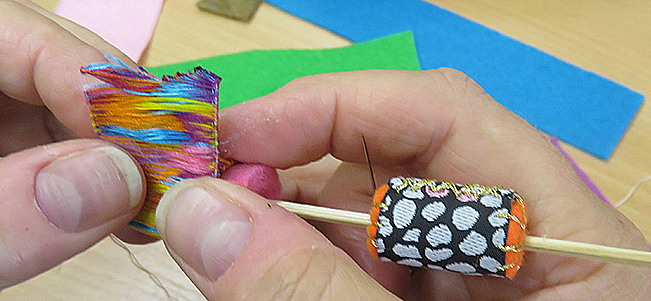
wrapping the scrap of Jaquard Ribbon wrong side outermost around the felt.
wrapping the felt to make the bead base
constructing the beads is easy peasy – if you can stitch neatly, I showed how to make 3 simple beads with variations.
three beads wrapped and stitched in gold thread and different ribbons
everyone quickly got wrapping and sewing and inventing different colours and patterns, fascinating to watch so many variations happen at the first ever class I have given in this technique.
colour co-ordinating beads with clothes
stitching the ribbons to the felted bead – a blur of activity!
just simple plain coloured thread cross stitch when repeated looks lovely..
embroidered bead by Naomi Clarke
when all the ribbon beads are strung together with glass beads onto an elastic cord the effect is simply lovely.
the finished necklace by Naomi Clarke
After this came the launch party, so we all made our way to the Gallery.
Earlier in the week, we had designed and re-packaged the basic Renaissance Ribbon packs that the gallery had in stock to sell with the books,
in the heart space studio making fresh sets of ribbon packs
we were really pleased with the effect….
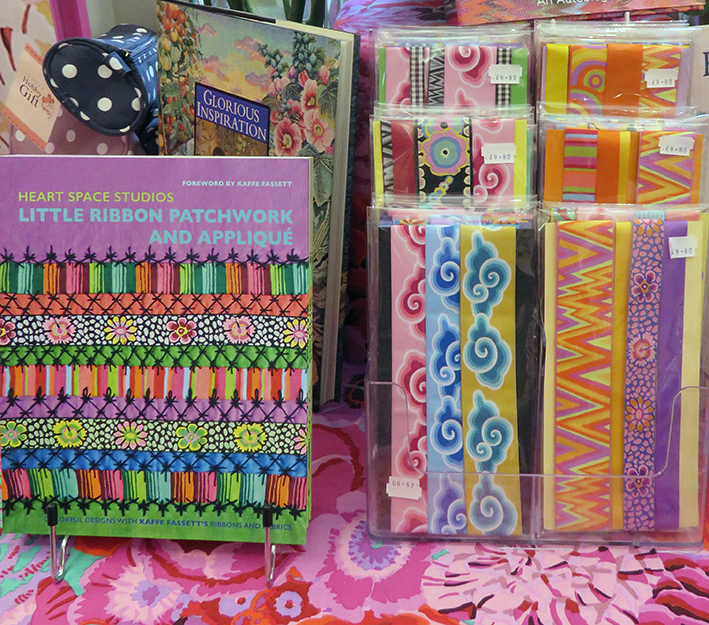
our packs of ribbons displayed next to the new book in the gallery shop
lots of other people joined us for the launch…the heart Space tutors and friends all enjoyed a good time together
rare picture of me with my friends – I’m the one with the ribbon bead necklace
colourful Heart Space gals busy chatting together
All in all it was a good day, and lots of other guests have blogged it as well, most notably, Rosemary Murphy on one of her blogs for September 2015 http://storiesinwood.blogspot.co.uk/–
So that’s the Launch sorted, what next?
new ribbon version of front cover embroidery for Knitting and Stitching Show
new design for Cotton Patch stand F27, at Knitting & Stitching show at the Ally Pally, London
I have been invited to the Knitting and Stitching show in London by Nik Sewell the owner of The Cotton Patch to demonstrate how to make several simple projects from the book on their stand, F27. And to sell the books as well as lots of Renaissance Ribbons and Kaffe Fassett’s lovely shot cottons that are used throughout the book. So I am now busy developing new combinations as shown above.
opening the package of the advance copied of Heart Space Studios’ first book
Here it is, my very first look at the proper printed books – Heart Space Studios’ Little Ribbon Patchwork and Applique, inspired by and featuring Kaffe Fassett’s wonderful ribbons. And this is the English edition, and it is published by Heart Space Studios…But oh the hopes and fears were in equal measure when I saw that neat white package of the first 10 advanced copies of the book…
all the angst and problems of getting the UK cover perfectly coloured have paid off
Originally the book was commissioned by the American publishers, Taunton Press ( and uses American terms and measurement – bliss – I was educated using inches and yards) and then I was offered the opportunity of producing a small UK edition and this is it. And as a consequence I have spent a large proportion of the last 9 months working on this and other publications involving Kaffe Fassett’s ribbons and fabrics……
the 5 original reels of ribbon I designed with
I was first asked, by Susan Berry, a book producer concentrating on textile crafts (whom I have worked with for many years) if I had any design ideas for using the beautiful Jacquard ribbons designed by of Kaffe Fassett and produced by Renaissance Ribbons. Susan advised me to see them at his exhibition at the American Museum in Britain, that took place in 2014. Then I was sent a few reels of ribbons to ‘play’ with and this is what I came up with in the first few days….
single and double ribbon yo-yos
I have a vintage – quilt hanging on my studio door and I immediately thought that this system may translate to the ribbons; so I just cut some random lengths and using running stitch gathered them up to form these pretty circles…some worked and some didn’t – see above; but it is a designers task to make them all work beautifully – so lots of samples later I made this, below, which I intended to grow into a huge throw or curtain.
yo-yo hanging – sadly this failed to make it into the book – it proved too complicated to show how to stitch together simply….
Then of course I thought of crazy patchwork, and this eventually became the heart-shaped cushion on the back of the UK edition cover
crazy patchwork with ribbons hand embroidered into position between the patches of shot cottons
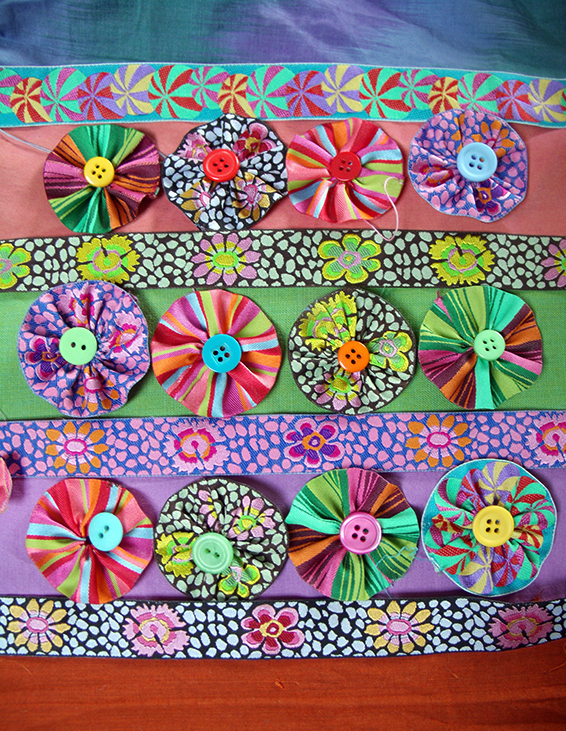
of ribbon with the loose yo yo’s, easy -peasy as these ribbons have been designed to work together – a rich mix but what else would you expect from Kaffe Fassett?
ribbon and yo-yo strips – first ideas
I just took lots of photographs as I researched, and sent them off with rough ideas for a book of small patchworks made of ribbon and plain fabrics – but the journey from playing with ideas to a finished book has been long and let’s say problematical – ideas are always easy for me to come up with, making them work for inclusion into a “how to do it” book is not easy at all.
new ribbon combinations
getting the new ribbons into colour combinations – here are the brights
The first thing I realised was that I needed to put some other ribbons and fabrics with these intensely patterned Jaquard ribbons. So I included the Grosgrains, or Petershams, fine ribbed ribbons that come in many sizes and colours, Renaissance Ribbons have many different versions – and they duly sent me some and more of the new ribbons from their Kaffe Fassett range; and then I needed a ribbon that could be used to tone with the 2 brights – I chose my old favourites – tartans. Tartan ribbons are universally available now on-line, and they conform to the clan colours so I felt sure that most buyers of the book could get hold of them easily. But then which fabrics to use for the patchworks particularly the crazies?
my stash of shot cottons selected to tone with the ribbons toning ribbons
I am a fabric hoarder, like most textile designers, and I found some small pieces of ‘shot’ cottons – the warp and the weft of the fabrics are different shades or even different colours from one another so the woven fabrics are subtle colours and so more easily used with other materials; and by chance who were these shot cottons designed by? Kaffe Fassett. So that was an easy decision as well and I sent off to The Cotton Patch, (who have the best user – friendly, on-line ordering fabrics service) for more samples of these lovely fabrics. I started designing approximately 20 different samples of ribbon patchworks and appliques.
But I fist made myself some new fabrics – out of the ribbons themselves….
designing ribbon combinations for ribbon fabric
trying out different ribbon fabrics for crazy patchworks
what I needed to realise is that when you are making your own ideas for a book, it is important to be able to demonstrate by using photographs, drawings, diagrams and words how someone else, who has not got your knowledge and may even be a complete beginner, can easily follow the instructions …a lot of lovely ideas and more complicated designs got thrown out in this process.
But here are some examples of 20 samples that made it, from first ideas, through to illustrations of the steps involved and finally the 20 projects that I made with the samples. There are 4 types of patchwork and applique techniques in the boon, strips – see below, crazy, squares and yo-yo’s.
putting several ribbons together onto my work top, trying to make up a new ribbon fabric
designing another variation of ribbon stripes for a heart shape applique
from the work table to the finished book in one bound!
illustration to make the ribbon fabrics
page from the book to show the heart shaped applique
and eventually this design turns up on the contents page as well….
content page of finished book completed with the same Ribbon Fabric
the yo yo designs quick and fun to make and design with, within the book they come single, embroidered….
hat band yo yo with button stitching ribbons
embroidered double yo yo square patchwork
halved and giant.
half yo yo bands
and one very very big yo yo.
in fact I could have written another book about making and decorating with yo-yos
project section of the book – with lots of different things to make
I could write for days about the book and all that it contains – but then why would anyone buy it? As I write I am waiting for the large consignment of books to arrive from the printers….it is a small edition but I have plans to advertise it, it is being launched on September 15th at the American Museum in Britain, well it is full of the American Kaffe Fassett’s ribbon designs… and for this I am giving a special bead – making workshop. ( more of which in a later post )Then the book is being sold with special packs of ribbons and fabrics on the Cotton Patch stand at the Knitting and Stitching Show in October; but meanwhile we have a lovely display in the shop window of Heart Space Studios, devised by our style guru, Jane- Marie Mahy, please see below and I have devised a whole set of classes to complement the book – go to http://www.heartspacestudios.co.uk/workshops/ribbon-patchwork-hearts-half-day-class/. for more information. And eventually we will be selling the new book on our website – watch this space
Heart Space Studio window display by Jane-Marie Mahy
Indian modern Kantha fabric – from Liz Hewitt’s collection – wonderful patterns to start us all stitching
New to Heart Space Studios – Kantha Club; started as so many people who have been to our day classes, tutored by Susi Bancroft, have become fascinated by this simple method of hand quilting. We have 3 trial sessions being held once a month – each meeting is 3 hours long – enough to get re-acquainted with the technique and start something to take home to develop further.
3 different Kantha pieces from Susi s collection demonstrating the different types of fabrics, colours and patterns afforded by this technique
Susi, had brought lots of different pieces from her own work, the most interesting for me are the tiny patches of patterned fabrics all held together with simple rows of running stitches and by allowing frayed and ripped fabrics to be caught in place, dense and rich cloths have been developed.
One of the things that I find interesting in Kantha is that each side of the cloth looks different depending on the choice of fabrics – so a simple ground will show up the stitches but a patterned ground is given another layer of pattern – the fabric below shows this very clearly.
Kantha strip showing back and front of the stitching – intriguing
Several people had brought in their own samples, some from earlier classes that they now wanted to develop….others already used the technique for their own practice and just wanted to meet up and develop and discuss the work with other people – we are hoping that the new textile clubs we are planning at Heart Space, will enable like-minded people to develop new work together….the 2 pieces below are by makers who has studied Kantha previously, Kay Swancutt, and Liz Hewitt ,
beautifully simple stitching by Kay Swancutt
detail of Liz Hewitt’s densely stitched Kantha hanging
but some people although used to stitching, came along for a new experience – they brought other types of things – the different types of work were really interesting, I am looking forward to seeing how everyone develops in the coming months.
small perfectly stitched quilted heart – but enough to get a maker to the next stage of developing new ideas and techniques
beautiful etheral embroidered and lacy fabrics combined with Kantha stitches by Nicky
After the introductions we all started to work on our own projects
the club gets down to real stitching, and Nicky is stitching the piece above right
I have joined the club as well as I want to develop new work using this technique – I have played with this way of setting up rhythms across fine fabrics and I brought in several pieces of old work to demonstrate how I wanted the work to develop – I want to make a stitched sea/sky/land scape – very large using images from my photographs of the views of sunrise and sunsets from my windows at home.
series of my sky photographs from over the Bristol Channel
my first attempt at putting the sky fabrics together
I am layering transparent fabrics so that many subtle colours are made to represent the sky, then held held in place by rows of running stitches. As my home view includes a stretch of the Severn Estuary and the Welsh hills, the textures and rhythms of the water, mud flats and tidal salt marsh in front of the house, could successfully be rendered using this technique, we will see…
the layers of transparent fabrics are eventually held in place by massive tacking stitches
when everyone got to working Susi provided us with background fabrics and a wonderful array of her own threads, as well as books and a variety of other materials to help us help ourselves.
Susi’s own stash of threads; and just visible my “kantha bible” The Techniques of Indian Embroidery by Anne Morrell
Several people started developing different motifs as samplers, using the books that Susi provided..
continuing older work using new inspiration
working a sampler directly from the books provided
So we ended the first week with everyone having a piece of work to develop (or not!) for the next meeting…there were a few surprises in store.Some people had started new pieces and developed different techniques….
embellishing a ready printed fabric is a really good way to get started…
some really adventurous samplers have been started..
Vibrant Kantha motif sampler on hand dyed base – Naomi Clarke
then there was this perfectly ordered piece of quilting on top of a traditional Indian fabric heart
Heart Kantha by Jo Hurst
Others continued to develop their own work – I do like the ancient next to the modern in the image below – traditional stork embroidery scissors, hand made pin cushion and mobile phone!
continuing to develop the first colourful sampler – Jo Hurst
The motifs seem to be very popular but, like me Anne is trying some new colour background fabrics strips – really looking forward to seeing this develop
strong coloured ground strips for experimental work by Anne Harrington
I hope she has more luck than I did! Eventually I want to make a large piece of work – at least 1 metre wide – so I had started off using wide strips – but found that the rhythms of the stitches started to develop a mind of their own, which I couldn’t get to grips with – so I chopped my original work into smaller segments and really let the running stitches go where they would – it is very exciting to work with…..but where do I go from here?
my tiny but wayward stitched sampler of sky and sea kantha
Well – where else but back to the third Kantha club meeting to see how everyone else has developed and if they all feel that they want to carry this experimental approach forward into a functioning club, with membership, regular meetings, guest speakers, exhibitions and all the other benefits joining a club entails….watch this space.
folded book of flowers and butterflies – Ilaria Padovani
The world is full of surprises. You invite a group of people to develop ideas together in a studio in order to make work for a themed exhibition over a period of 6 weeks, then they go away and come back 3 weeks later with something completely different – Hey Ho! BUT sometimes the things they bring back are so different and you realise that they have taken a new direction because of the theme – what could be a better result?
folded book with moths- Ilaria Padovani
So when Ilaria Padovani, who is a volunteer at Heart Space Studios, arrived the day before the deadline with 4 folded and paper sculpted books, I could only gaze in amazement (she was making a flight of patchwork butterflies last time we spoke)! I had asked everyone to write a few sentences about why they had done the work, knowing from experience that most people engage more easily and trust the words they read, rather than the images they view – I have the opposite point of view but that’s anther story!
‘VERBA VOLANT, SCRIPTA MANENT…Spoken words fly away, written words remain…’
“This was my big sister’s reply to a letter I had written to her pontificating on how to raise her child. Although my intentions were good I had been arrogant and hurtful to someone I love dearly.After her phone call, I stayed up all night thinking of a way to show her how deeply sorry I was for my inconsiderate missive. I had wished the words I had written could have flown away from the page like a flutter of butterflies.
I started folding the pages of a book she used to read to me as a child. I folded a kaleidoscope of butterflies and arranged them soaring out of the pages. The making was cathartic to me and so was her forgiveness on receiving the book”.
stitched and printed air mail letter – Steph Wooster
Writing was a theme for many of the pieces in this mixed media exhibition. Steph Wooster, was researching ideas about carrier pigeons, doves and messages of peace, so this old airmail letter has been printed and then embroidered in cross stitch with a the one thing that you can’t give up when waiting for news. Steph’s images are truly mixed media, she prints, knits and embroiders onto papers and fabrics of different densities – layering the multiple sheets of images and text together.
multi-media layered image of pigeons and laurel branches – Steph Wooster
multi-media Hope dove – Steph Wooster
” I have an ongoing interest in mixing media, materials and processes. Attending workshops at Heart Space has introduced me to paper-cutting and patching processes that I have explored further with my knitting, stitching, printing and sketching. Making work for Things with Wings I immediately thought of pigeons. I love pigeons, grey, common, mundane and overlooked. Their invisibility and homing instinct led me to layering maps, graphs, envelopes, knitting, photographs, feathers and tracing paper. I wanted to show the humble pigeon as cousin of the dove who brought Noah the olive branch, embodying hope for the future.”
Mary Bishop has used her own hand-writing to inscribe poems and rhymes that have been illustrated by embroidering into papers and fabrics. I always recite this rhyme when I see any magpies – its an old English saying. Mary has condensed and enriched her first sample idea that she was working on in the studios to make these encrusted applique and collaged pieces.
Magpie’s nest – Mary Bishop
My inspiration for this piece was my workroom which is like a magpie’s nest, full of bits that glitter and are pretty, things that cry out to be reused. I really enjoyed reflecting it in this nest
ladybird, Ladybird – Mary Bishop
I love ladybirds, so pretty and attracted to colour, I was really inspired by my many colours of threads to build up this flower bed and the cobweb to illustrate this lovely poem.
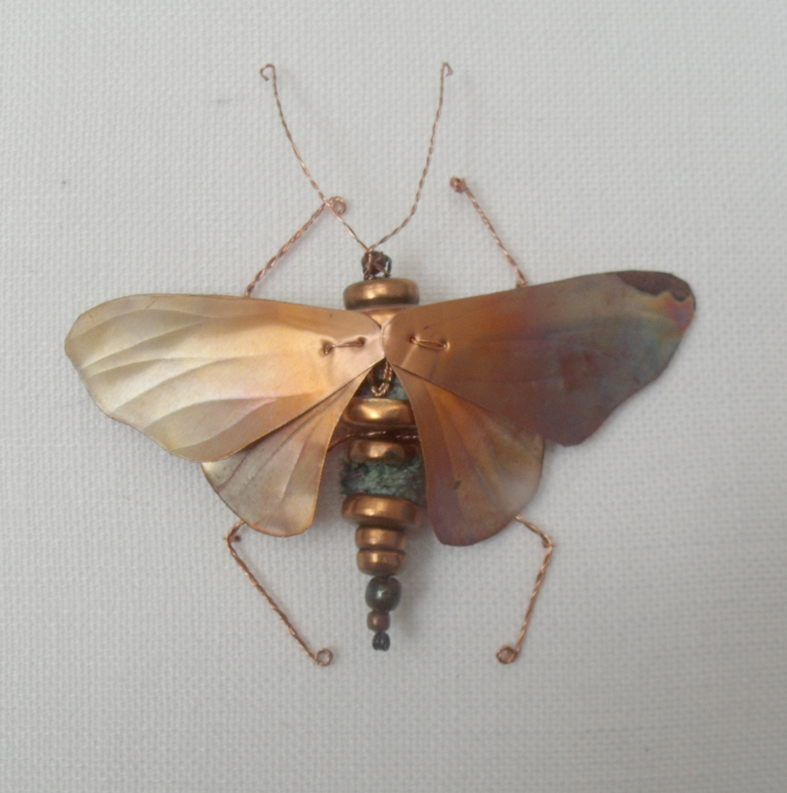
Keeping with framed pictures, Debby Bird made some really popular (and fast selling) beetle things, some with wings but the main interest for all the viewers was the materials she used, interference foil that distorts the light rays into rainbows of different hues being the most fascinating. The free machine-stitched insect boxes illustrate her idea that many insects are as precious and beautiful as jewellry displays.
Things With Wings – Debby Bird
Flying and Crawling Jewels – Debby Bird
“Despite being overlooked and under-loved , Insects are the most successful of the worlds’ species . They are so varied and often more beautiful than the most precious gems, yet they can take off and disappear before you get a proper look.
My free-stitched specimen boxes are representing the energy of live bugs just gathered for a quick inspection before they fly home!
There are classes is this technique by Debby in the new Heart Space Studios Autumn programme of workshops
Sarah Dennis cuts paper by hand and the results are stunning, she conducts her very popular workshops, both day and evening sessions, for Heart Space Studios. The 2 large pieces of work attracted a lot of admiration, people can’t believe that they are looking at a hand made piece of such simple means. I like her simple explanation for the genesis of her things with wings…..
Deep Blue – papercut – Sarah Dennis
I love nature; these pieces were inspired by watching a David Attenborough documentary.
Deep Blue was created after watching a scene where the ocean and the sky met together – watching a bird dive from the sky and the whale swam around the surface of the ocean in a circular motion, the fishes sprung out of the waves into the sky. I wanted to capture the movement and life of that moment in paper.
Flamingoes, paper cut – Sarah Dennis
Flamingos is a response to how astounded I always am by the incredible journeys that animals make to survive. I try to exemplify the beauty of nature through the delicate detail of paper.
Some people are really good with the words that they use to describe how they developed their imagery – Sophie Bristol, our administrator – studied History of Art for her BA hons. degree at the Courtauld Institute, so I was not surprised by her eloquence when she wrote about the piece that, at first glance, looks to be just a highly decorative triptych.
gilded triptych – Sophie Bristol
One of my greatest past-times is exploring flea markets, making chance discoveries of overlooked gems, which might not be particularly valuable, but are lovely none-the-less.
I recently stumbled across a pack of playing cards at a market, and was drawn to the gilded image of a bird on the reverse. The picture fascinated me because it was both beautiful and slightly sinister. I decided to incorporate the cards into a piece for the Wings and Things exhibition, using hand-embroidery skills, beading, and mixed-media techniques to continue to explore the tension between the beautiful and the macabre.”
Alas, my own framed pieces are very conventional – I had to make them relatively quickly at home in any spare time I could find, so relying heavily on my stitching skills, I made what I hope are amusing images of the ends of things….
“One of the daily tasks of running Heart Space Studios is sweeping the studio floor. Things found on the floor though, are often lovely – scraps of silk, ravels of multi-coloured threads and scatterings of beads; but as they are so small and dusty they usually get binned.
the Apotheosis of the Embroidery Thread Ends – Janet Haigh silk hand embroidery
Buttons are another matter, they get used here for eyes and noses for toys made at children’s parties; but after a few months only the brown and beige buttons are left in the tins. I suspect that most homes harbour a tin of odd brown and beige buttons….
the Apotheosis of the Beige Buttons – Janet Haigh, silk hand embroidery
I got to thinking “Ideally, what would happen to the beige buttons that no-one wants, or the teeny scraps of ragged fabric and threads? Where would they go, what would they become”?
the Apotheosis of the Fabric Scraps – janet Haigh, silk applique and patchwork
So now we get to the things out of the frames – I feel that out of the frame is perhaps a better way to develop work like this – so we had a flight of dragonflies from Susi Bancroft, rather difficult to photograph, so here is just one; he looks kind of menacing – but as Susi says……
One imaginary winged creature – Susi Bancroft. wire and beads
“ inspired by my delight in watching dragonflies in flight whilst walking by the river. From pale green delicate ethereal things, to flashes of bright iridescent colours skimming the water, I caught my breath watching them. These creatures are an interpretation, a play on ideas. My mind wandered around the real as well as imaginary – the beauty of nature and the fantasy of invented things with wings – from fairies to surreal stinging insects! These may hang indoors or outdoors – catching light and breeze and hopefully raising a smile!
Made on the sewing machine from wire wrapped in glittery metallic thread with seed beads I pre-threaded on the wire – a somewhat exciting technique which requires some nerve!
But where are the things without wings? Well for a start there are lovey simple feathered heart shaped hangings form Jane- Marie Mahy, our display manager.
Feathered Beaded Heart – Jane-Marie Mahy
” I was inspired by the work I have done in the past for Heart Space Studios simply decorating willow hearts which are rustic in texture against different found objects – lovely old beads, buttons and lately clock faces. Feathers were the obvious things to add to the hearts for this project and making them into these angelic hearts”.And unusual beaded necklaces made by Ilsa Fatt, who teaches beaded jewellry making and often using her own lamp- worked beads as inspiration..
black and white necklace _ Ilsa Fatt
Re Necklace – Ilsa Fatt
“The seed for the idea of Spirit-Bird necklaces came not from a bird, but a beetle. I was thinking about the sacred Egyptian scarab beetle, which led me to thoughts on the strange Egyptian bird-headed gods. These were in my mind when I first started making glass beads for the Heart Space exhibition.
As I worked, I became more and more drawn to the idea of the bird totems of the Pacific North West coast, such as the thunderbird that can shape-shift into human form. The little glass birds that finally emerged are things-without-wings, but for me they embody the idea of wings, and of the power of imagination’s flight.
And now for both things with and without wings from Kirsten Hill-Nixon, who works with us teaching felt-making but has many other skills to be developed. she really took flight (sorry) with her imagination for this project.
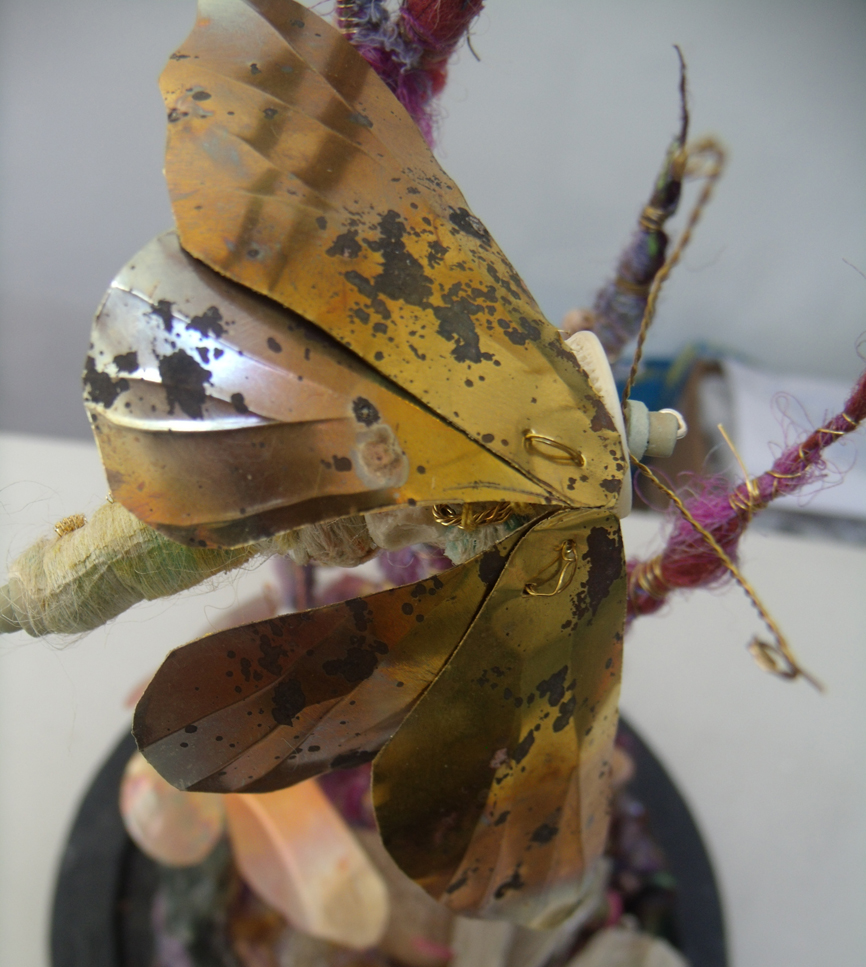
The image below does not do justice to this piece – it lives under a vintage glass dome so is very hard to see with reflections everywhere – It is made up from some dyed and embellished real chrysalis – and the strange beings that have escaped from them…the twig is felted wool but everything else is metal and glass, with found objects like large beads and parts of domestic plumbing as well.
Curious Chrysalis – Kirsten Hill-Nixon
“What a Great Title – ‘Wings and Things’ – ‘Things’ could be literally anything! And with winged shoes, aeroplanes, sycamore seeds and half the animal kingdom to choose from – what should I do? I spread out all my shiny objects, threads and fabrics on a large table, things I have been hoarding for years waiting for an opportunity to use them – and here it is.
detail – Dragonfly, embellished chrysalis, tin foil, wire and beads – Kirsten Hill Nixon
There is always a moment of great excitement finding a shiny beetle in the garden; that unexpected flash of sparkling wing on the dragonfly – so Bugs it had to be. Small and precious like jewels, my winged things would need the protection of a glass dome just like the exotic specimens in a Victorian museum collection
I spread out all my shiny objects, threads and fabrics on a large table, things I have been hoarding for years waiting for an opportunity to use them – and here it is.
sheer invention – Bugs – Kirsten hill-Nixon
and just one more from this set of Things with Wings
I seldom feel that my work fits easily into contemporary textile exhibitions – it often looks too colourful, or too decorative, or even too old fashioned in its simply stitched narratives…but recently I have work exhibited in a group exhibition that feels like I belong. “Construct – eight textile artists explore identity” is showing at the Ruthin Craft Centre in North Wales. Much of the work is expressed in the form of stitched domestic textiles: tablecloths, curtains, quilts and some clothes, and so my own embroidered counterpanes, bolsters and pillow cases of dreams feel very much at home.
Hand embroidered Dream Pillow from my ‘Make it Through the Night’ series
I was invited to submit work earlier this year by Dr. Melanie Miller whom I met when we both gave presentations at the Textile Society’s annual conference, Embroidering the Truth in 2013. Melanie’s presentation was an up to the minute resume of textiles by recent graduates from MA courses; mine was an overview of my embroidered narrative commissioned works over the past 40 years. Melanie worked with June Hill to quickly bring a focused exhibition together and also developed with Lisa Rostron, at Lawn Creative, an excellent and beautifully produced catalogue – well worth buying for a stand alone document even if you don’t catch the exhibition.
printed patchwork bed cover – Caren Garfen
Walking into the exhibition space the large and airy gallery looks fresh and the work on the walls looks clean and tidy – it also looks resolved. I often feel that much modern art textiles look like work in progress, like they have just been snatched out of the hands of the maker – full of possibilities and open to suggestion… but here is a varied range of ideas on identity, simply expressed with a rare degree of intent.
Don’t Make a Meal of It detail. Caren Garfen
The work of Caren Garfen has many overlapping concerns with my own; she uses popular phrases and she employs a sly humour to subvert. Caren meticulously hand stitches screen printed images with messages found in advertising aimed at women to conform as thin glamorous domestic goddesses
Wafer Thin – a study on the role of fat – Caren Garfen
Several of her pieces depict ranges of domestic tasks that usually fall to women to manage; the relentless repetition of her imagery, whether patched, printed or embroidered, echoes the repetitious nature of all domestic work, after all – a woman’s work is never done. The roll of fabric printed and hand embroidered for ‘Wafer Thin’ is 10 metres long!
Sarah Puts her Lipstick on – detail Naomi Ryder
Repetition is also a device used by Naomi Ryder – she records a daily task for many women – putting on make-up; for some a chore (me), for others a delight. By repeating the same but slightly varied image over a length of fabric she shows the time and energy spent on getting our public ‘identity’ in order before we go outdoors.The continuous daily tasks that women are expected to devote their time to – cleaning, ironing, shopping – she depicts by machine embroidering acutely observed small-scale line drawings onto lengths of sheer fabrics that recall net curtains.
detail of Katherine’s Day, Naomi Ryder
Women’s work undertaken to construct an acceptable public identity is a subject shared by these 2 makers – but what of the men? Interestingly Nigel Hurlstone, I know, takes extreme care over his own personal presentation but as yet has never chosen to reflect on this in his work.
Nigel’s powerful group of stitched photographic portraits of men who have been very carefully costumed, create an ambivalent atmosphere – half jolly japes and half menace. The 9 pieces of work shown are based on a set of portraits of young men, taken between 1918 and 1950, in what could be construed as ‘fancy dress’ but presumably dressed up , or down, for the sexual delight of the photographer.
machine embroidered photographic imagery – What Pleasure by Nigel Hurlstone
The men were dressed either as street urchins or soldiers and they were apparently picked up on the streets and then posed to conform to a sexual identity desired by the photographer…to my mind they look to be highly amused by the proceedings…..
However – the tight rows of machine stitching make the fabrics look like moire or water-marked and obscure the almost life-sized photographic images. I think this makes them initially more easily accessible to the viewer as we aren’t exactly sure of what we are seeing. The actual fabric is compelling, you can’t ‘read’ it easily and this allows the viewer an excuse for deeper scrutiny – close up and personal. The original subject matter was never meant to be for the public gaze, at first glance the men look happy though not exactly innocent, but somehow when we are closer we are aware of an undertow of sleaze or is it menace?
Curtains to Independence – Women’s Auxiliary Service uniform made from vintage curtain material – Val Jackson
War and its effect on women’s change of identity is clearly a personal issue for Val Jackson. Her work deals with reflections upon her mother’s life – the uneasy transition from performing vital and fascinating war work in contrast to the traditional role of wife and mother. Inheriting her mother’s effects, including her correspondence during the war, made it clear to Val that this transition had been difficult. The arresting burnt -orange curtain fabric uniform very neatly combines the 2, opposing? halves of a woman’s working life – the professional and the private.
fabric figures ready for stop motion animation by Linda Barlow
From my own observations of friends and colleagues, the pull between motherhood and making your own work as an artist is a major modern predicament. Linda Barlow uses humour and cartoon representations to depict the complexities of managing this situation. Based on interviews with 8 such women she has made a short animated film – ‘Artist Mothers: a series of observations regarding the frustrations of being an artist and a mother”. It does what it says on the tin – refreshing not to have a punning title – I am guilty of the over use of puns myself…note for later.
Women artists often choose to who work within a community – I always think that this is half way between being a social worker and an artist and a really decent thing to pursue. Two such people have this type of work exhibited; Deidre Nelson,who has chosen to work around the world, using textiles as a means of defining the social history of an area, often working with local groups of people, and Lyn Setterington – who makes quilts based on the Kantha technique.
Signature quilt – Lynn Setterington
Lyn also works on textile based projects within communities; quilt making is historically a community based production, so her own interest in the history of her chosen medium makes a natural lead to this activity. She has recently become fascinated by Signature Quilts and I share this interest – Crazy Quilts – which fascinate me, often contain signatures and messages and they do make the mind start the journey to who exactly made this. There is at present, in artists’ textiles, a fascination with writing as evidenced here – and as part of the education programme at Ruthin Craft Centre I have undertaken to teach 2 workshops for different styles of hand stitched writing while the exhibition is still showing in July.
family names quilt detail- Lyn Setterington
Lynn sees the signature quilts as a form of social networking, as she brings groups of people together to make to celebrate their local community. A richly embroidered quilt stood out in the exhibition, the Streepur Quilt
I enjoyed the wealth of embroidery that was evident on the quilts. Rich in many different stitches they are a testament that decorative embroidery is alive and well somewhere in the world. I can see pattern darning, running stitch, chain stitch, back stitch and coral knot just in these 4 samples as well as crochet and Broidery Anglaise even if machine made. I also like the change in “taste” that this quilt brought to the exhibition, they had so much energy and joyfulness – but maybe that is just a reflection of my identity as an embroiderer at heart.
research workshop materials -printed paper butterflies
‘Wings and Things’ is the working title for an exhibition being developed for the local community’s annual “Westbury Park Festival”.…last year we hosted a drop-in making felt flowers – this year we are show-casing the talents of the staff and tutors at Heart Space Studios – so no pressure!
research workshop materials – feathers
Each of the 11 people who opted to work towards the theme have committed themselves to attending up to 3 research sessions when we all work together to make a mixed media exhibition – by mixed media I really mean any materials that can be connected to textiles, either physically or metaphorically. ‘Things with Wings’ was an idea proffered by Debby Bird (who else?) who is a busy tutor at the studios and a major force for developing new ideas for classes. We are working together to make an unusual and hopefully amusing exhibition
selection of glass beads for workshop materials
It is always fascinating to see how each person responds to any given the brief: we had asked for any ideas and drawings/ samples of work ready to be discussed on the day – we wanted everyone to participate in helping one another develop ideas, otherwise working in a group can be really distracting.
Step Wooster brought the real thing
teeny tiny drawing book of ideas with pigeon coloured materials – Steph Wooster
Steph Wooster brought several real birds wings that she had been given by a local game butcher, plus some tiny drawings in the goes-everywhere-with-her-sketchbook. She placed the book open at a pigeon drawing next to a bag of – to my mind – Pigeon Coloured materials….
Ilaria Padovani’s grandmother’s patchwork design re-sampled for the project
Ilaria Padovani, brought a couple of samples specially prepared for the day – one a pair of collaged wings which was bright and busy, but another patchwork made from a pattern that her grandmother had made for her as a child it was her favourite winged thing – the dragonfly – and it is full of flight!
We immediately advised her to just make lots and lots of them in all sorts of different colours and to exhibit them flying randomly across the walls. I had brought in several frames to establish various sizes of each piece – Debby and I needed to have an easy hanging session prior to the exhibition opening. It was decided to wrap the dragonfly patches around small stretched canvasses and so keep them light and airy.
Mary Bishop – appliqued and embroidered birds
Many textile artists, regardless of name, work with bird imagery; Mary Bishop has made several pieces of bird related embroideries and so she brought a few of her early samples and an open mind, as it was her first tutor’s making group attendance. She is really taken with the idea of Magpies – after all they do like bright shiny objects and we always have lost of those at Heart Space.
glamorous feathers placed on top of a vintage bird book I had brought to the workshop – a really good idea for further collages here.
beads and feathers for Magpie’s stash
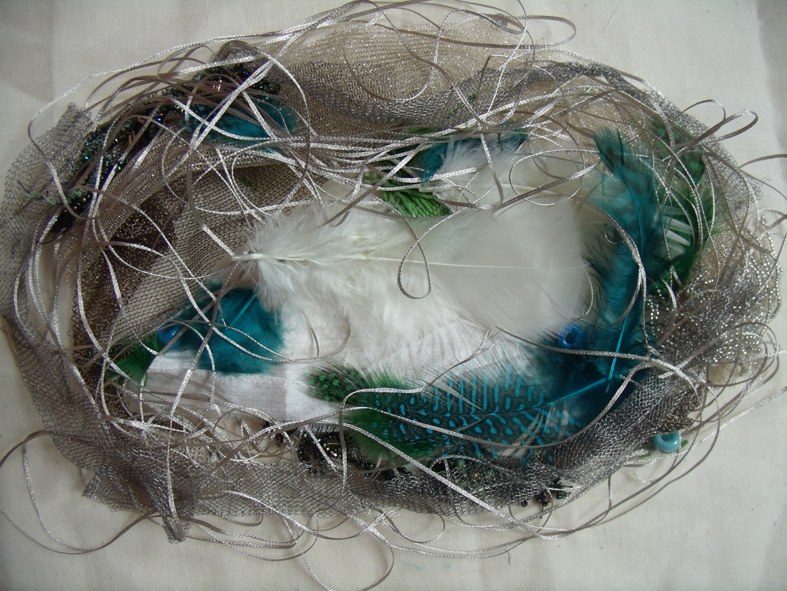
I thought she should start with the nest – I mean she can easily do the birds at home alone – but the nest and it’s contents could be found in the studio stash….I asked her to just find lovely things a magpie might steal from us and then to make a nest from them, later she can choose to use parts of it as a sort of grounding for the birds or develop other ones from other materials….the ideas are endless here.
starting to make the Magpie’s first nest – Mary Bishop
Some people had already started making flying things from textiles, Sophie Bristol has carefully cut wings from a length of vintage lace..the ways ahead were obvious, lots of different wings from different laces just needs to sort out the bodies – rich ground for playing with all sorts of media. However……
beginning of a cut lace butterfly – Sophie Bristol
striped of silk fabrics to make into a 3D bird cage….a really innovative idea and a lot of interesting work to develop.
during the introduction when everyone had to show and talk about their own ideas she liked the idea of making a cage from a sample made in an earlier workshop.
She set about making a prototype in card and tape to ascertain the sizes and shapes required – but what will the cage contain?
cylindrical cardboard sample for Sophie Bristol’s birdcage
One way to use a themed exhibition is to try something new or an idea that has been on the’ back-burner’. I think Kirsten Hill-Nixon thought this way. She arrived with lots of well organised materials, books and ideas – lots of drawings in her research book and a firm grasp of what she wanted to achieve…it’s a tall order!
like a cabinet of curiosities – Kirsten Hill-Nixon’s research materials
Kirsten wants to make a series of exhibits of ‘natural’ objects trapped under glass domes…she is making different types of what look like fungi and cast off chrysalis shells. She is making them out of all types of fabrics, waxed and “preserved” – I found these curious things near a batik kettle – where are the winged things that maybe emerged form them?
waxed casts and wrapped objects for Kirsten Hill-Nixon’s curious collections of post-flight litter?
Ilsa Fatt had already designed and made several beads that were based on hearts with wings but the general consensus was that she should make bigger beaded wings –
Hearts with Wings glass beads – plus some wriggly beaded ‘things’ – Ilsa Fatt
twisted beaded wire winged thing – Ilsa Fatt
Debby Bird had made lots of tiny wings and insects using twisted silver wire and she suggested Ilsa make some and by the end of the session when the red beaded winged thing emerged we all wanted to wear it, either as a brooch or worked into a necklace.
Silver wire shapes with opalescent threads ready for sampling – Debby Bird
Debby Bird always has lots of different media to develop into new and desirable objects and images…she excels in hunting out amazing new products and manages to incorporate them into her work…unlike the rest of us! She had made several different samples prior to the session but the thing she settled down to was an idea from her paper cutting experiments.
perforated paper dragonfly design – Debby Bird
the results of a long time piercing the paper with a needle was ethereal and beautifully nuanced when see against the skylight. I am looking forward to seeing how this essentially simple idea is developed into further work….all sports of light fitments and holders could be made – I must give her some vellum to sample.
new research tools for our latest volunteer, Ceema McDowell
Sitting next to Debby, who by piercing paper was working with one of the most primitive way of making a mark, was Ceema McDowell, busily using the most modern of research tools to develop her peacock design…the strands of random dyed woollen yarn is reassuringly traditional.
Threads found when sweeping Heart Space Studios workshop floor
And to me – what did I get to do? well not a lot on the day but I have had a frivolous idea for this project – it is not at all what I usually concern myself with, but it would not go away….so I told the group to see how they would react – they laughed but said it could be really interesting.
One of the daily chores of running a workshop -based studio is sweeping the floor before and after every workshop – and there always seem to be tumbleweeds of threads and fabrics under the tables and in the corners…
left over fabric scraps from my own studio floor
as well as spilled beads or left over buttons…….it was the buttons that made me ponder: why are there always masses of Beige Buttons left unused in any button collection?
Beige buttons fly to button heaven with silk embroidered wings: sample idea by Janet Haigh
I started to imagine where all the unused beige buttons will eventually go; will they fly off to a beige button heaven? Will they then become pearl buttons when they were beatified? I also thought of the threads and the fabric scraps…what would become of them if they flew to heaven – how would their wings look and what’s more – what would their eventual version of heaven look like?
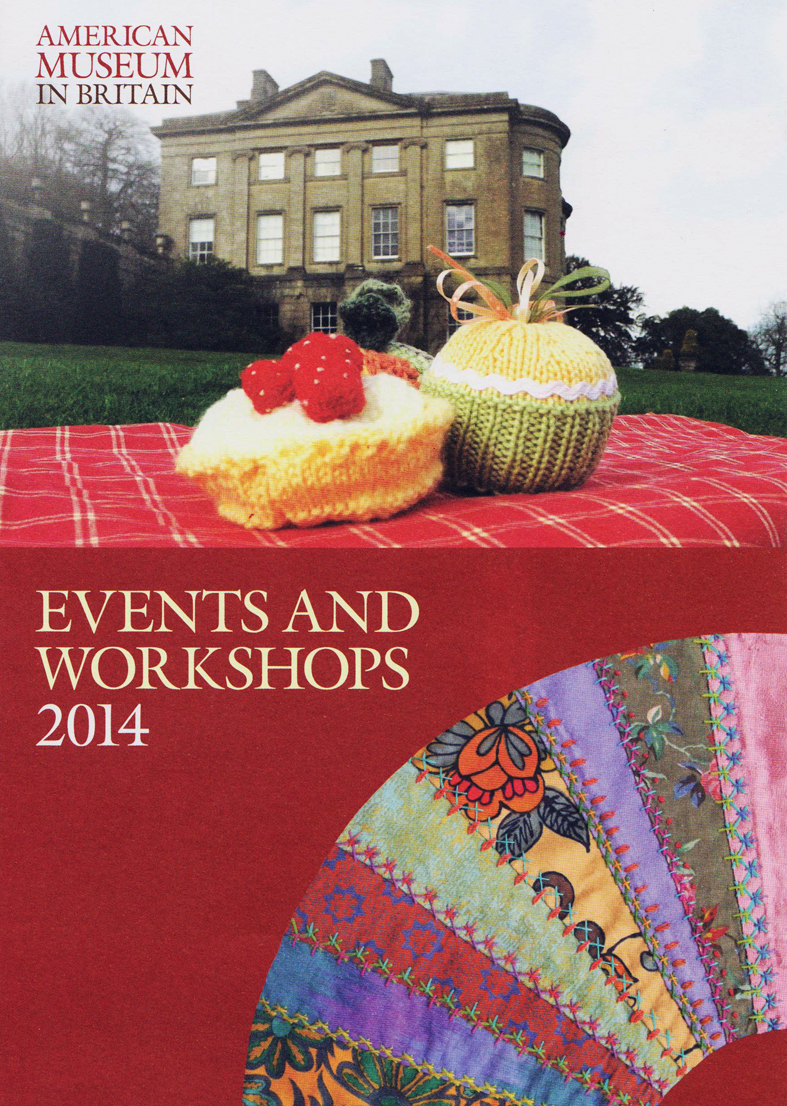
My Crazy Patchwork fan design on the cover of this season’s events catalogue at the American Museum.
I have been getting out and about recently and have been taking a workshop at the American Museum in Britain, which is situated just outside Bath. I have been asked to deliver 2 day long workshops by their education officer, Zoe Dennington (who found me via this blog). Zoe asked me to use Crazy Patchwork techniques for classes to run at the same time as the current vibrant Kaffe Fassett exhibition being held at the museum for several months.The second class is in October to make a crazy patched and beaded heart.
the range of fabrics that I took for use in the workshop
Luckily I was given a batch of cotton samples of fabrics designed by Kaffe Fassett to use in my workshop by a friend, Susan Berry ( who produces his very popular patchwork and knitting books) and they certainly livened up my Heart Space Studios fabric stash….I had designed a special project for this session, a simple design of a fan and one of the most popular motifs used in traditional of Crazy Patchworks.
the original crazy fan design used for the programme cover
I reasoned that if I provided patterns for the patches then things might go quickly and everyone would finish – well that was the idea! We started off by choosing the fabrics for each fan – there are 7 sections in the design that I had created for the class, which means less embroidery than my sample.
this range was chosen from the fabrics brought by me to the workshop
subtle and softly coloured fabrics brought by a student to the class
I had also asked people to bring whatever they liked of their own materials as well. The fabrics chosen were quickly organised into many different striped bands – I explained about balance of pattern to plain fabrics and crucially for a small colour scheme, to separate a few colours from the patterned fabrics and use them as plains or solids to show up the patterns. And not to worry too much about getting the colours perfect at this point as later the coloured stitching over the seams would help with the colour co-ordination of the whole piece.
vibrant fabrics for chosen for the fan design
Red white and blue – always a good clean colour combination
organising the fan sections is much easier and quicker than for usual odd shapes of crazy patches. The sections were laid over one another and then pinned and using running stitches held section by section till the fan was complete. The complete arrangement was then pressed onto the special heat activated fabric backing
Brilliant colour for the start of stitching the fan into its finished position
. Once the fan had been pressed and trimmed the next task was to find the coloured ground to applique it onto…I find that this is quite a good way to get people to appreciate the difference that different coloured grounds can make to the overall piece.
a rare shot of me teaching – explaining how to deal with coloured ground fabrics using a soft and subtle piece of patchwork.
Sometimes soft colours can be made bolder if placed on very dark grounds and brilliant colours more muted if placed on a toning ground. It is also a chance to reassess the colours prior to embroidering the seams which also fix the fan to the background
the fan shape against a black ground
same fan against a brilliant blue ground – note a new patch on the left hand side to make a more balanced fan
Now to start embroidering – I had chosen to demonstrate 1 basic row of herringbone stitch and then show how to add extra stitches or I should say decorations…it is my favourite decorative embroidery stitch as it can be developed so that it looks almost like a braid. But to begin just a couple of well spaced rows…and then the extra colours can be added.
this vibrant fan design is made even more brilliant by contrasting colours
I like to use contrasting coloured stitches on the seams – they are very obvious but then I do not think it worth doing any decorative hand embroidery if it isn’t to be noticed!
the brighter the contrasts the richer the decoration here the colours sing out
although up close and personal the colours are very vibrant the more colours added to each row of stitching the softer the colours will appear more subtle
the addition of yellow running stitch to the bright pink herringbone stitch makes it less vibrant
when soft colours are used to not much affect then the herringbone variations allow for extra emphasis – this is why I really like this particular stitch – it gives a lot of opportunity for invention
the addition of French knots and detached chain stitches enliven this row of muted herringbone
At the end of the session we put all the unfinished patchworks together on a table to assess them for further additions…. you can now see the affect that the Kaffe Fassett fabrics had on the works – but you would not think by looking at this picture of some of the group around the table that they actually liked what they are looking at !
Crazy critical assessment!
. Everyone faithfully promised me that they would finish the fans and send me photographed results – watch this space…….
‘Crazy Berlin’ one of my early commercial designs for ‘counted thread’ canvas embroidery
I have had a few problems getting to grips – literally – with hand embroidering again (not to mention eating with fully functioning knife and fork ). So in order to get back to my normal working life of designing, stitching and teaching, and not being given any specific physiotherapy for my now fully mended broken wrist, I decided to return to the very beginning of my stitching career – Canvas Work.
My first embroidered picture – Dog with Wings and Radiator 1971
I had lost almost all of my strength and most of my dexterity when the plaster finally came off my right wrist, and although the drawings were OK the stitching wasn’t. The main thing about canvas work is that it is worked on an open mesh ( that has to be completely covered) so the needle can be easily inserted into the square hole instead of having to push it in and pull it out. It is easy and repetitive move which is what I needed to get some strength back.
the view through my London flat’s window into a neighbour’s window -1973
So I got all my old canvas work embroideries off the walls in the house and realised that they were all pictures of things – either real things like the window above (where I could see past the plants to a large American patchwork quilt hung on the wall) or completely imagined scenes like the brown angel dog in a landscape – cruel friends mocked my early design and stitching techniques for the stream, by calling it Dog with Radiator! But mocked or not, I had found a new and exciting way of working – hand embroidery – and one that I intuitively knew was to be a very long-lived fascination.
one of a series of seasonal canvas embroideries with leaded light window
I enjoyed the tension between trying to make things look natural but realising them within a strict structure; window frames were a perfect subject to further “contain” my scenes and formal garden design became a real passion – accessed through old gardening books and visits to some famous English Gardens. Topiary became an enduring passion as it seems almost childish in its simplicity of form but very sophisticated in its visual impact, I find the larger specimens often intimidating – specially the animal and bird forms.
very formal lace curtain and geraniums window, developed from drawing while on holiday in France
I started to design many of these embroideries and my first exhibition of embroideries was called Canvas Work at The Francis Kyle Gallery in London. Most of the pictures were sold, but I still retain enough to show my progress. In the early pieces there is an interest in the repeating patterns that can be stitched using the regular grids alongside the more descriptive stitching in tent stitch. But eventually the random stitches asserted themselves as I became fascinated by atmospheric colour and started to blend my threads to make new colour combinations.
Cornish window, here the the frame has become a victim of my random stitching which distorts the canvas.
My last canvas embroidery of gardens shows how far I had strayed from the rigours of the canvas weave.
my last canvas work of gardens, an imagined rendition of a Gertrude Jekyll planting plan.
So returning to canvas work gave me a real sense of returning to my embroidery roots. I didn’t want to get involved in designing a scene, I was more interested in just getting the use of a precise stitch and a stronger grip, so I opted to make a counted thread design. I remembered seeing and photographing a tiny wool canvas work purse that belonged to a student at Heart Space Studios.
tiny wool counted thread embroidered purse
I set about making a small square of canvas embroidery based on Crazy Patchwork – my favourite embroidery design system at the present time. I drew a random set of shapes in waterproof ink onto a 12 holes to the inch canvas – big enough to become either a case for my glasses or mobile phone.
drawing round an old glasses case for a pattern
embroidering zig zag stitch onto the canvas
I decided on a colour range and selected stranded cotton threads and stated to stitch working from an old needlework book for all the different patterns. The patterns are lovely and have wonderful names, my favourite name is “Encroaching Gobelin” I can just imagine something out of a fairy tale, I use this stitch for blending colours but didn’t need it for this design.
developing the coloured stripes using an old needlework book for reference
I decided to use a series of striped lines of stitches to make up the crazy patch shapes, usually counted canvas is worked in solid colour blocks – like the cushion at the head of the post.
the work progresses – very slowly due to changing my mind on the colour combinations
The work was extremely slow to make – it took me the better part of 2 months to complete, mostly because at first it was very painful and tiring to keep the my hand stitching, but also because I kept changing my mind on the colours. Usually I work to a design or colour swatch that I have designed before I start , but this wasn’t really work, this was therapy!
finished canvas work – unstretched
the finished work is often mis-shapen due to the pull of the directional stitching, but this type of canvas is sized, meaning it has a weak glue in it that can be activated by dampening allowing the work to be stretched back into shape,
the dampened canvas is pinned and stretched into a square format and left to dry naturally
I had initially thought to develop a day workshop at Heart Space Studios to make a similar design, this type of embroidery is not often seen these days so it would be good to resurrect it, and the use of the striped and lively colours makes it look very zingy…but I would need to make a series of workshops to develop it – more like 6 sessions… so maybe I will reconsider this at a later date.
















![photo 3[1] copy](https://i0.wp.com/janethaighherwork.com/wp-content/uploads/2025/06/bd41e-photo-31-copy.jpg?ssl=1)