first page of my reborn Flora research/sketchbook – Flowers Again!
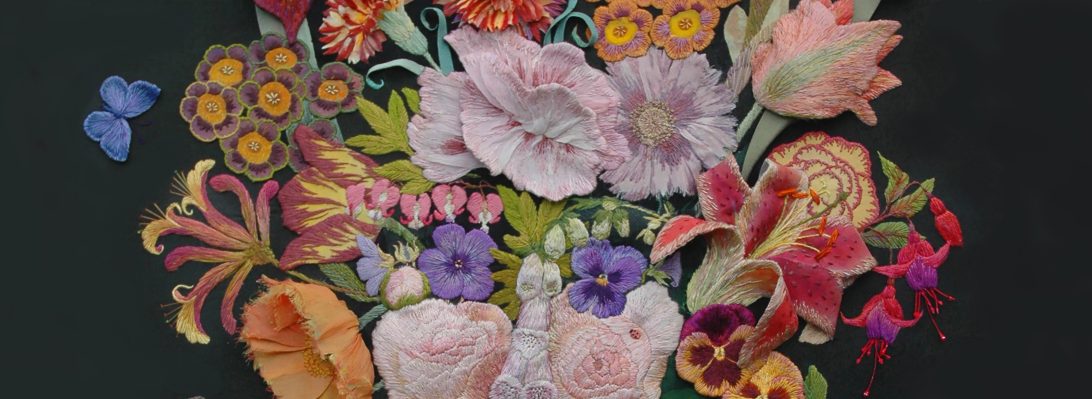
Recently, the “After Winifred” embroidery has inspired me to develop work to use as Giclee prints in order to add a fresh way of getting my work ‘out there’. I turned to my old Flora workbook, some 20+years old – but still alive for me as a source of inspiration.
last last pages of drawings circa 2000 in Flora workbook .
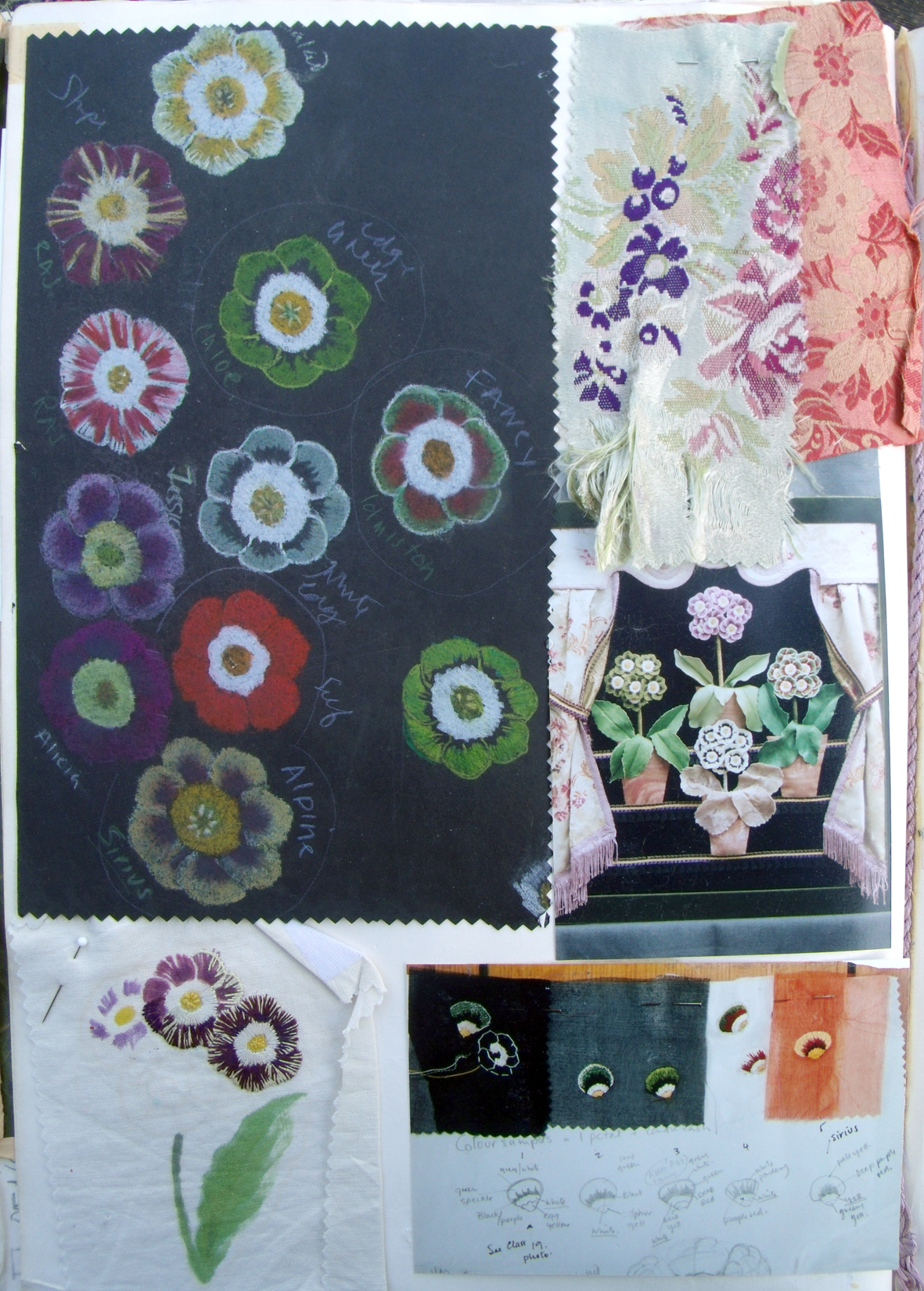
drawings and stitching samples for Auricular Theatre 1998
painted studies of garden Iris circa 2000
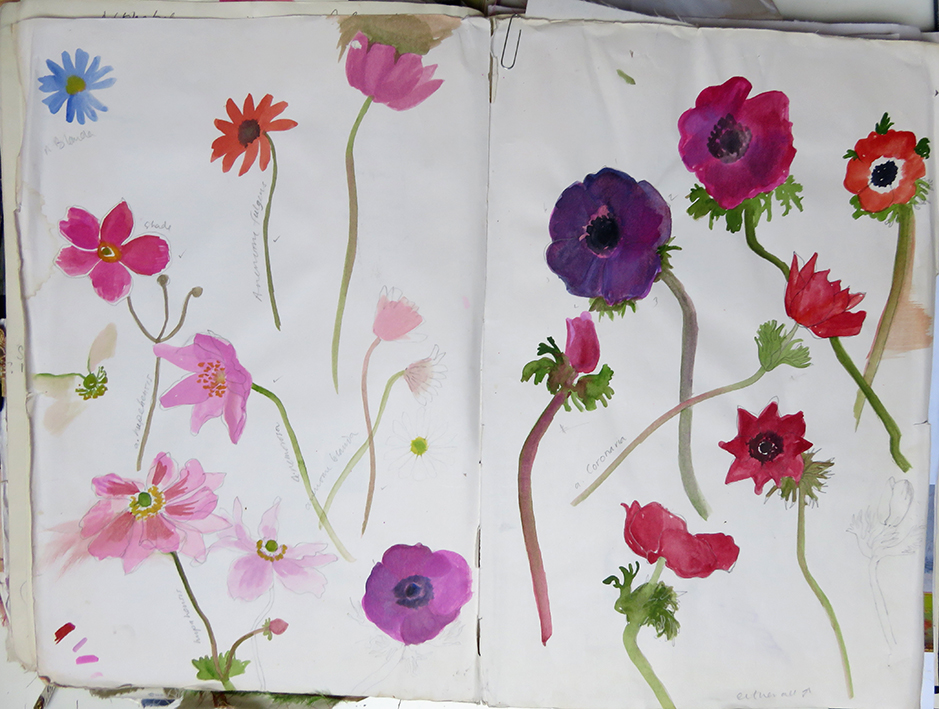
most used pages -Anemonies painted from life and photos.
I found some empty pages at the end of the old book and started to collate recent samples and drawings of bunches of flowers grown and made up at Court House Farm, where I conduct drawing workshops, using the cutting garden as inspiration.
second page of the book – old samples and magazine cuttings for colour a small bunch of dahliasobvious inspiration from Winifred Nicholson flower paintingmy initial research fixed now into book showing early samples of new-to-me Inktense pencils – as dyed ground for stitching
looking back at my Flora work, which is 3 dimensional and very heavily embroidery, I now want a freer drawn imagery to stitch into. So I bought some Derwent Inktense pencils that basically act as dyes when wetted and left to dry – I did many samples but found my drawings had too much information in them – I needed to loosen up further. Ha ha – the story of my working life!
first inkjet pencil drawing second freer drawing sample hand stitchingdesign page using a very old photograph of my own collection of hellebores against a silk ribbon applique.
To enable me to play easily with the new ink crayons I chose an old set of drawing research and photographs to work with. The colours of the crayons are very brilliant and I needed to find ways of making more subtle colours, so stippling, cross hatching and dotting colours one over another made for rich but softer ground colours – these techniques are still a work in progress. Below are 2 studies of the under drawings using pencil dyes ready to be stitched
Meanwhile I have been looking at all my old flowery finished works and their drawings to use as reference and then reframing/remounting stitched pieces ready for the printers.
original drawing for this older Hellebore embroidery right early Hellebores silk embroidery
the little Hellebore image above is my first Giclee print and the smallest at 30cms/12inches square.
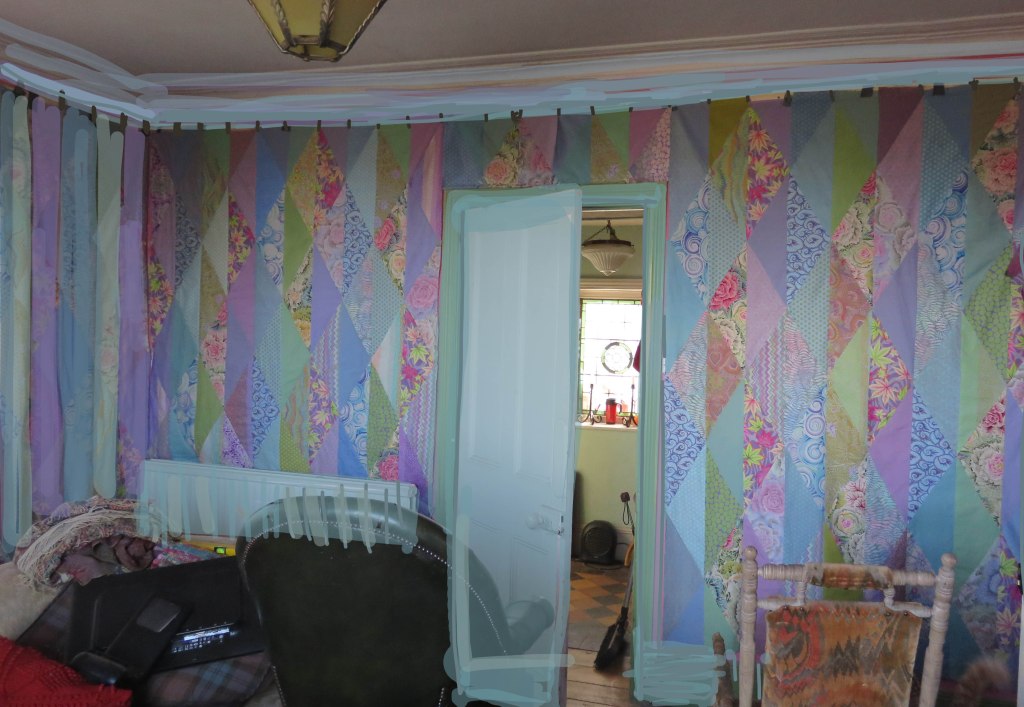
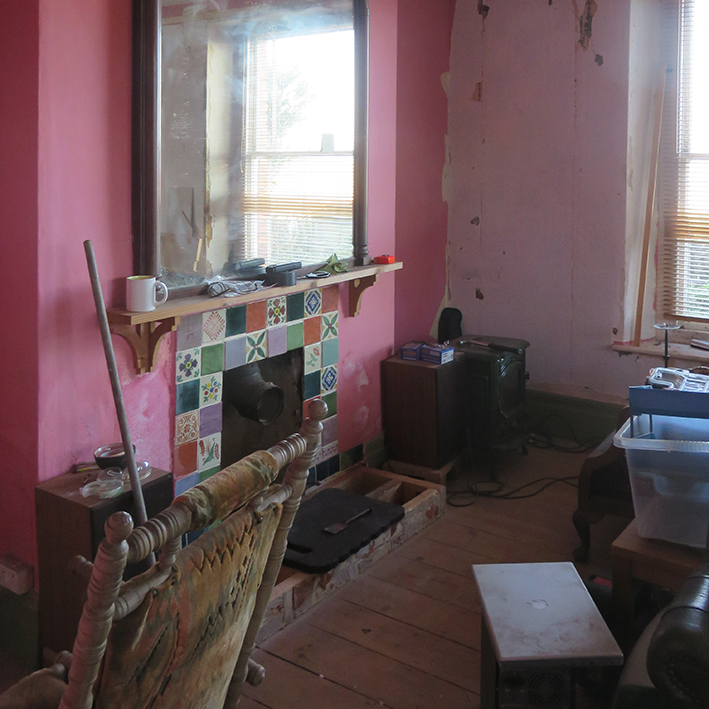
Here is the open door into my completed ( well just a few more pictures to put up) patch-work room, using fabrics from the Kaffe Fassett Collective. It has taken 6 months to achieve. I started 2020 during the last Covid 19 lockdown in England and we are still not entirely unlocked mid way through 2021.
I aim to take you around the room to see how it all has come together, here the door from the porch has a vitreous enamelled finger plate – now I want to make more of these for inside the room…the enamelled fireplace can be seen with our old furniture and carpets safely back into place.
turning left is the view into the small panelled room, our 2 Irish Terriers and the enamelled fire surround – see previous post for making this….luckily my much loved vintage Deco glass shade tones perfectly…now how did that happen?
Above are 3 views of the chimney corner with 2 different totally different Flag representations. the row of flags at the sea side is an old painting by Stephen Jacobson next to a ghostly silk organza flag by Nigel Hurlstone. this piece of work proved pivotal for me to see how the room could hang together using cooler colours
Once we had started to put the room back together our 2 Irish terriers, Maeve and Murphy took a particular if very relaxed interest in it.
I found on Ebay a beautiful discounted Zoffany silk striped fabric and bought enough to make 4 very large padded curtains for the big Victorian windows in the room. The fabric cost me about 4 times the amount I had spent on the rest of the room…but they work well once I had trimmed them with some vintage woven ribbon that I over – dyed to suit the colour of the paintwork – as you do! And then I found these mazing brass tie backs on-line at my favourite store for just about everything decorative, Anthropology.
Continuing around the room…
In the the corner between the windows hangs an old (and much loved by me) painting by my husband, Stephen Jacobson, of my father’s greenhouse that he built in my family’s garden on the Wirral in north west of England.
From the photographs I have posted so far it is hard to see that the patchworks are all padded and quilted, but it is evident that my ‘in the ditch’ sewing notbetter placed than my hammering in the copper tacks that fasten the fabric to the battens. On the tiled table is a flowery flower vase by Tean Kirby.
the opposite end of the room to the fireplace with the bay window looking out on the overgrown garden
one of a pair of window seats with an old canvas work cushion sample and the luxurious silk curtains and brass tie backs. Then to the other new thing I bought for the room – the glamorous mauve velvet mini chaise – from a TK Maxx sale!!!!!! Well I had to balance the spend on the curtains.
Coming Into Port – Stephen Jacobson
Above is ‘ Coming Into Port’ – I leapt on this for the room when it came back early from a “closed for Covid” exhibition and it fitted perfectly. Basically our house serves as a venue for our joint work. I made the large cushion especially – it uses all the major colours of the room, and in fact the whole house, in my wonky version of Flame Stitch; and I have been commissioned to make a design from this by Ehrman Tapestry so look out for it next year if you stitch canvas cushions.
So here we are at the porch door again – and the gingers are waiting for us – well actually for Stephen with the biscuits to get them to pose….
and that is it – at last after so long – finished enough for people to see it – with the doors and windows open and only 4 visitors at a time!
So, by the beginning of March I had at last finished stitching all the patchwork panels, and between long bouts of quilting them, I managed to paint all the woodwork and window reveals in the sitting room.
Sunday 7th April : Upstairs studio
I had decided to make a strippy quilt for the chimney wall, partly to save time but really to overcome the problem of awkward door frames and lots of corners. I calculated the width of the strips on each wall, even taking into account my inexact machine sewing I managed to get them fairly evenly spaced. Well 4 cans of spray starch and a hot iron helped.
1 calculating design measurements on the chimney breast
2 stitched strips on studio quilt wall
3 starting at the centre the quilted panel is stapled just to the top and bottom wooden battens
4 stretching and stapling the patchwork to the skirting battens
5 going clockwise onto the next panel in the alcove
I seem to be a lot better at stretching the panels than I am at machine sewing them. We decided to work around the room from the least visible area. I wanted the walls to look like a total piece of fabric or a massive quilt that is just wrapped around the walls like a cocoon – but I had to make some adjustments to the finishing as things progressed….we sort of started with a vague plan trusting to nouse to see us through…..Things were beginning to take shape but I soon hit a construction problem, my errant stitching had made some of the panels far too big and they needed to be trimmed after stretching and folding, securing them neatly was difficult now that they were padded.
Above, the edges of the panels are secured with iron-on fusible web tape and staples to vertical battens before stretching across the entire wall. Then the diamond corners are further secured to horizontal battens with copper tacks.
The large window wall panel was joined to the alcove panel to assist tight and neat stretching into the corner- making it up as we go along!
Having negotiated the large wall panel I now assessed the look of what we had covered so far but was still concerned about the strength of pattern overwhelming everything else in the room ( we have very faded vintage furniture, carpets and fabrics in the house and I did not want to start making new covers and buying more carpets). I tried to think of ways to make the patterns less brilliant… I remembered a patchwork organza flag made by my old colleague and friend, Nigel Hurlstone. It was in a massive pale oak frame, sadly too wide for this alcove, I removed the flag and held it in front of the bright wall, the central stripe was the same size as the strips – it was meant to be.
I asked his permission for showing this de-framed (but as he gave this to me as a present for helping him decorate his first flat about 15 years ago) I thought he may agree and he did. The thing is that the addition of this piece of work suddenly changed the atmosphere of the room, it became more relaxed and so did I!
Over the next 2 weeks we worked our way around the whole room stretching, stapling, tapping copper tacks, while dealing with light switches and plugs using a combination of glues, bondaweb strips, an iron and spray starch.
finally the room is covered, just one last strip to join it all together – under the window. Now to start finishing, covering the staples with wooden picture rails and skirting boards and quadrant in the corners. BUT before we finally put the mirror back into position I write this dedication on the chimney breast -I am hoping it will be many many years before this house is sold and some one else uncovers it!
and here I am again before sorting out the rest of the room – flag in place and now to make tiles for the fireplace and then there are the curtains……possibly one more post ?
It is the last day of February and have been working for 2 months making my patchwork wall coverings. When I started this blog I vowed to show the journey of the work that I design and make – to explain the problems and possibly the solutions……but this latest project has been keeping me awake and I am still not certain that I will get it sorted and onto the sitting room walls. I am suffering a severe case of Cold Feet!
3 variations of possible stripes seen on the quilt wall – left, the original choice: centre, just playing with ideas: right, the chosen 3 colour system – yes I know that they all look the same…………………………………………………………………………
After I had stitched a wall full of the original design I kept feeling that there was just too much going on – all those colours and stripes and collisions of patterns (all the things I normally love) just looked like porridge – multi coloured porridge – something had to go….What went was the yellow stripes – leaving me with Mauve, Blue and Green strips – this took quite a lot of grief and several days ( and nights) to decide to change things – somehow the well-honed critical faculty I use for all projects, professional as well as personal, has deserted me during lockdown. But once I had pulled apart the original piece and made another wall-full, things started to look possible. I made another design chart this time with repeating patterns built in – once a textile designer…….
the new highly coloured “working drawings” for the main sitting room walls
Things get back on track by mid January – the first panel is on the studio wall padded and quilted using the new walking-foot on my favourite old Bernina sewing machine.
By Februarythe work gets properly underway – a whole stitched wall – full – but still very uncertain about this entire idea.
I try these first panels around the room seeing how the whole thing will look – trying to imagine it without those brilliant pink walls is hard…and how will it look behind all our pictures – yikes – it really needs to accommodate paintings and other art works that cover every other wall of this house…I start to realise that what it needs is more GREEN.
Trying the panels on other sitting room walls – it needs more GREENto reflect the garden
back to photoshop to play with a version of favourite “Green Blue” or is it Blue Green” by Farrow and Ball which is used throughout the house
I decide that if all else fails the patchworks will look lovely in one of the bedrooms. But this still leaves us the problem of the damp disfigured walls and meanwhile the rest of room is being demolished …. did I mention we are cutting and making verdigris copper tiles for the fireplace?
Determined to make the most of the new year 2021 winter lockdown in the UK, I decided to cover my damp (although supposedly cured) and now ruined sitting room walls…….with patchwork!
sitting room new year 2020
same cosy corner new year 2021!
And with real fabric. the left-overs from my work organising quilt making in the UK for Kaffe Fassett‘s books of patchwork and quilting designs. Below are 2 of my favourite quilts from previous books that I have worked on and which I referenced for both colour and patten.
2 of my favourite quilts from Quilts in Ireland, by Kaffe Fassett and Liza Lucy
Patchwork is part of my professional textile practice and I have always used it for all types of furnishings, from wall papers for Heart Space Studios to my old but still glamorous dining room curtains.
Now I chose fabrics that reflected the colours in the rest of the house: basically turquoisey blues, buttery yellows, mauves and greens – I like colours to blend through the rooms. I had painted the hot pink walls for a New Year’s Day party 2 years ago….as you do!
I really loved the first fat version on my studio quilt wall above, but seeing it in situ was another thing. I wanted to cover the whole room and suddenly I felt totally overwhelmed by colour and pattern – the photoshopped version confirmed my misgivings…..it just hit me in the face and made me feel hot and sticky!!!!!
photoshopped version of sitting room walls!!!!!
The larger size of the fabric pieces, 21inches in length, made the patterns fight one another; in the smaller pieces used for quilts the patterns meld together as the eye sees so many at once AND there is only 1 quilt per room. Here there will be at least 6 large quilt sized pieces from floor to ceiling on all walls. Back to the studio.
And back to the oldest and simplest way of softening and unifying coloured fabrics – dip them in brewed tea. Above see the different shades to be had using: top = 1 bag, middle = 2 bags, lower = 2 bags boiled. It is a shame to kill the brilliant singing colours of the Kaffe Fassett Collective’s fabrics but hey ho! These wall coverings will take months to make and mount on the walls and then we have to live with them for ever…….I am not doing this again!
Back in my studio sorting out newer softer colours. Meanwhile the Kaffe Fassett Studios had kindly sent me lots more fabric strips based on my original sample….dipping a few of them in week tea I placed them on top of the quilt wall – wow this looks like a mad Japanese kimono design! Should I introduce stripes?
I am now 3 weeks into this sampling phase, I am still uncertain about the design on the wall. My Christmas star light reigns over chaos.
Time to get a grip! sort out the separately coloured triangles and tidy up
the whole 4 sets of coloured triangle patches, mauves, greens, yellows and blues, cut, pressed and ready to stitch.
I set them all out on the table ready to start work – tomorrow. Looking at the fabrics the next day they appeared to look so calm totally unlike the design on the wall. Maybe it is the Covid experience of the last 10 months but now I seem to want calm from my colours. I looked at the table and my eyes just glided over the strips of colours – back to the quilt wall again – to organise the diamonds into stripes.
Final Photoshop version of the striped diamond patchwork
Now my eyes tend to glide up and down rather than dotting about to see other diamond combinations. But that is as far as I can take this designing phase: there comes a time to every project when you just have to commit, and we are now into the first week of the new year. So I am simply sewing one single coloured strip at a time, and when I have finished them I can start to play with the design again – it should see me through until I get vaccinated.
Pastel drawing of dramatic cloud hanging over the Welsh coast seen at dawn one Sunday in February 2020…Something wicked this way comes?
I want to show how my stitched work progresses; here is a very heavily edited set of images taken over the last 2 months – from July through to the end of August 2022. Not shown is the unpicking, pulling apart already stitched fabrics and rearranging that leads to frustration and doubt but mixed with delight, calm contemplation and my eventual recognition that, having captured my original vision of this ominous sky, I can stop working on it. The drawing above took less than 1 hour, the piece shown below, more than 8 weeks…..
Week 1
The first stages were quite tricky to lay out using strips of silk georgette onto a pale cotton ground, that had to be kept scrupulously clear of stray threads while building the applique ground.
Week 2
By the end of the second week I had managed to cut the clouds and baste them all into position, then I checked them against my original drawing. The tiny sample of energetic Kantha quilting inspired the way I attempted to stitch the cloud.
Week 3
I started the running stitches in rows of single silk threads to create an undulating rippled surface. After a few unhappy days I stopped stitching, undid as little as i could get away with and inserted more pieces of rust coloured silk organza to give the cloud ‘depth’. The chalk drawing, above right, shows the paths I need to stitch along; I think stitching rhythms into cloth by using the Kantha technique is a bit like patting your head and rubbing your tummy at the same time – tricky!
Weeks 4 & 5
I was determined to use this piece of work to try to find a way of controlling the outer edges of the appliqued fabrics; usually when I make very large drifting Kantha Stitched Skies I leave them to be contained and wrapped out of sight when stretching the finished work. But here the view is much smaller as this black cloud did not extend the whole length of the estuary – it faded out just beyond my window frame. I looked at Georges Seurat (who is a great influence on the way I have developed the colour mixing within my stitched work) and adapted his painted canvas frames – his dots are my stitches ). And eventually the marsh starts to emerge, using large straight slanting stitches
Weeks 6 & 7
However as the stitching progresses the different tensions start to exert itself onto the fabric – where the stitches are close together the fabric width starts to shrink, which is to be encouraged as this gives the curious patterns that I feel are so like air currents…. So the side borders are unpicked and the the whole embroidery is squared up. When I had almost finished stitching I outlined the whole piece using a machine stitch to give me a better guide for the dozens of running stitched lines for the frame.
The finished work “The Dark Cloud” approx.18in ( 45cm) square
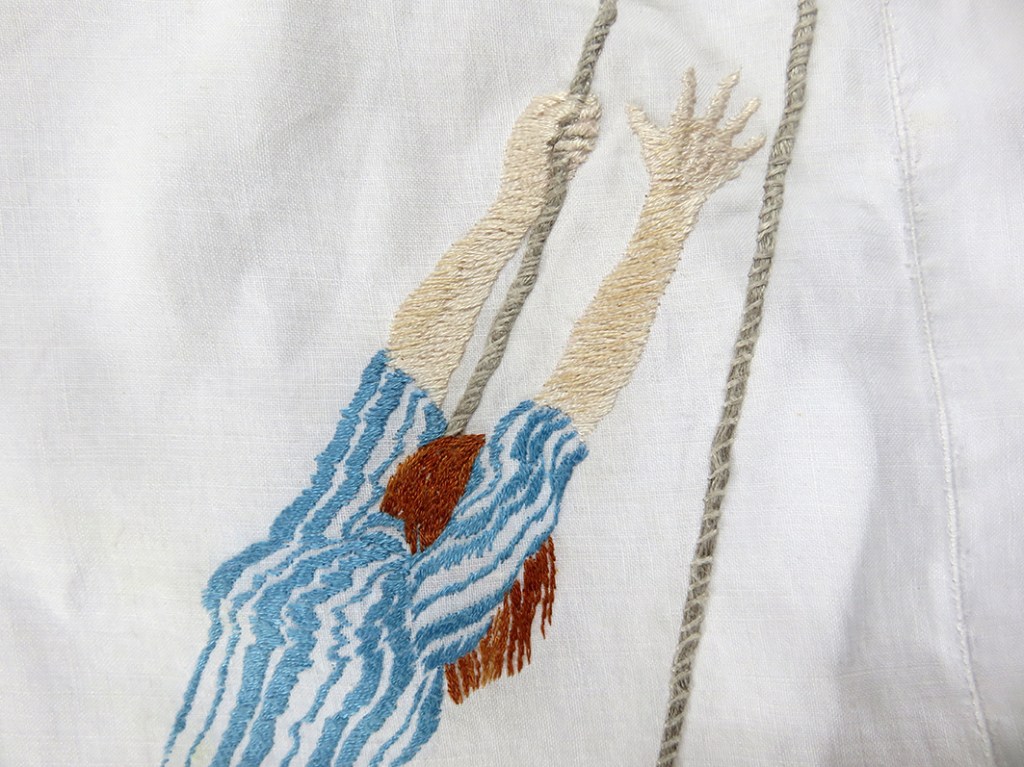
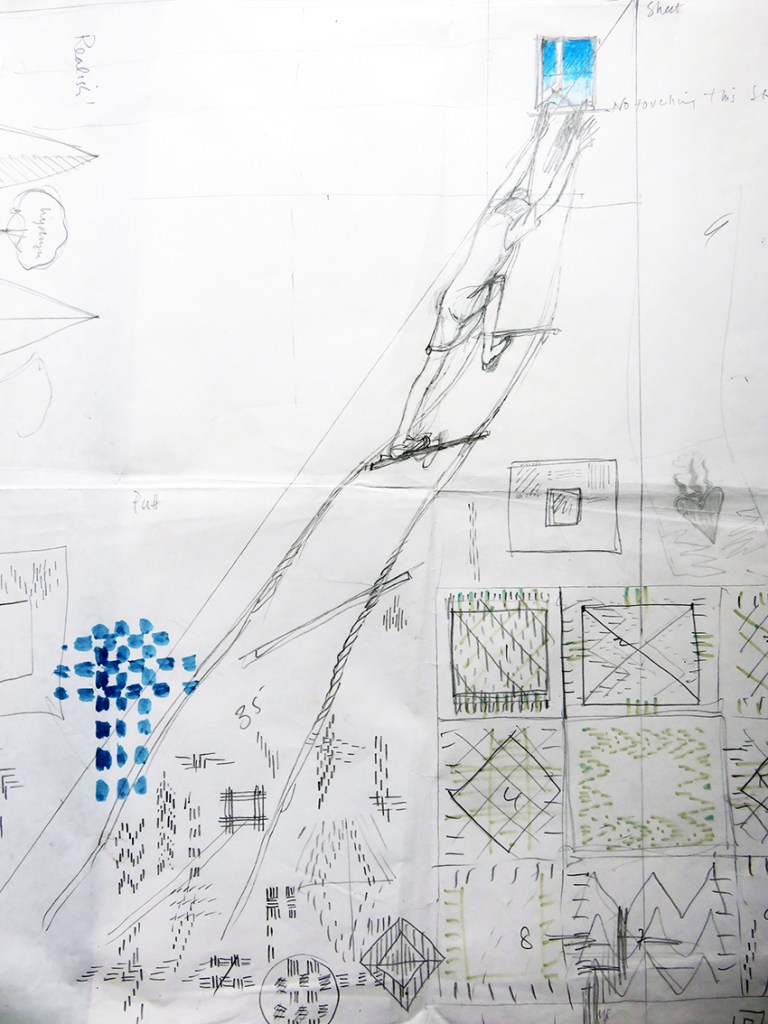
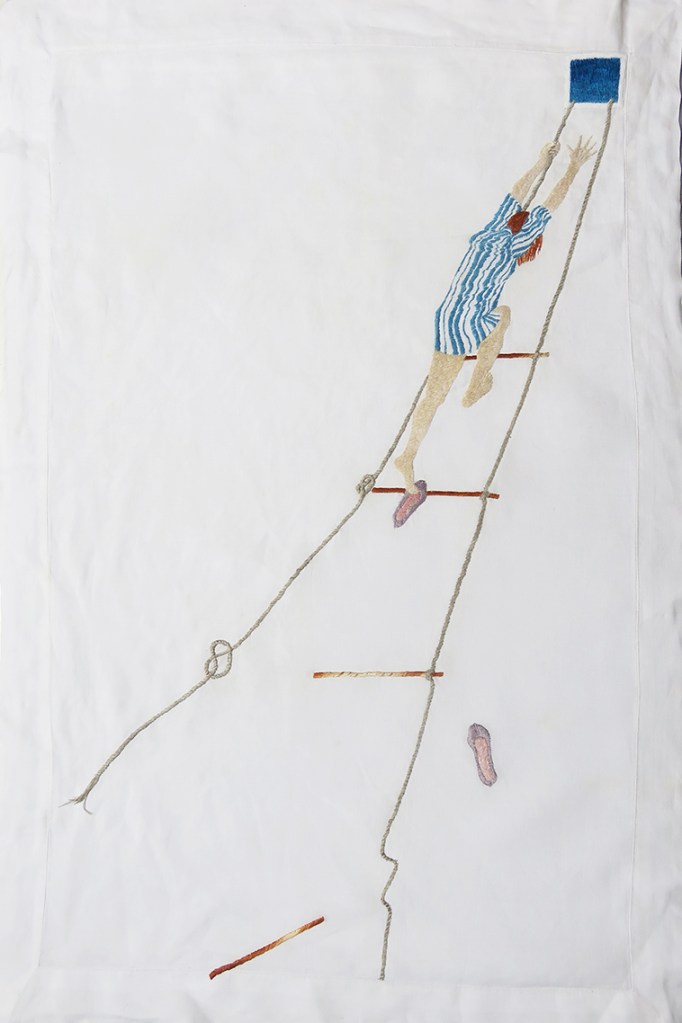
These rapid drawings below are early attempts to express one of my most vivid dreams lest I ever forget it…. But the dream was not ready to be forgotten, it has reoccured often in one form or another – evidently I have not learned its message; the loosening ladder rungs and the tiny impossible blue window never change
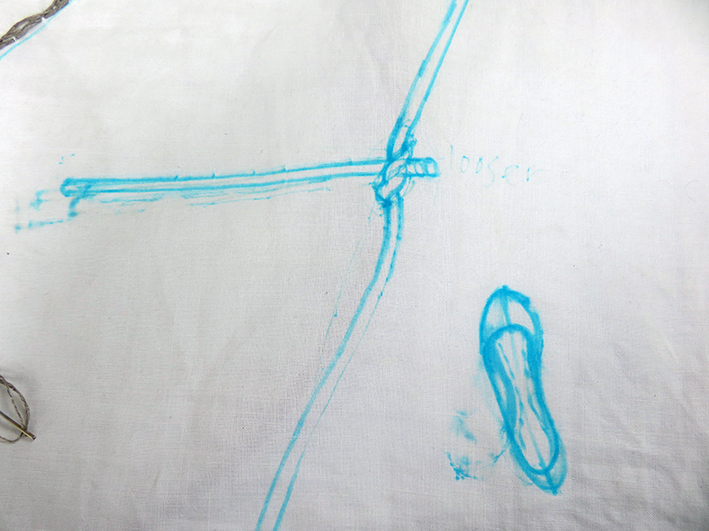
the earliest drawing above on the left has some written comments that I was interested in using for the embroidery also I seem to have both shoes on; the one on the right is scaled up for embroidering on a sheet! What was I thinking?
Here I am again some years later ( the shoes are getting looser) climbing out of the chaos of my scribbled darning designs for a book that eventually never got published!!!!! with a burning heart to the right and no way back down that ladder. Circa 1998.
So I recently decided to embroider it as a pillow for my ongoing project Make it Through the Night . It is a simple idea and my friends who saw the drawing were highly amused by me in my nightdress losing my shoes…but I started this piece just before the lockdown and now I see it in a very different light.
The most recent drawing I made using a photograph of me in my nightshirt climbing on a chair.
drawing now traced straight onto the pillowcase in water soluble pen – all the drawings alongside
The interpretations of dream referring to ladders are many and varied depending if you are climbing up or down, and a broken rung (just the one) means “you will never achieve your greatest ambitions” while “to lose a shoe is indicative that you have forgotten something important ” or “finding your direction in life difficult” – and as to the lack of underclothes whilst climbing a very high wall in your nightshirt……
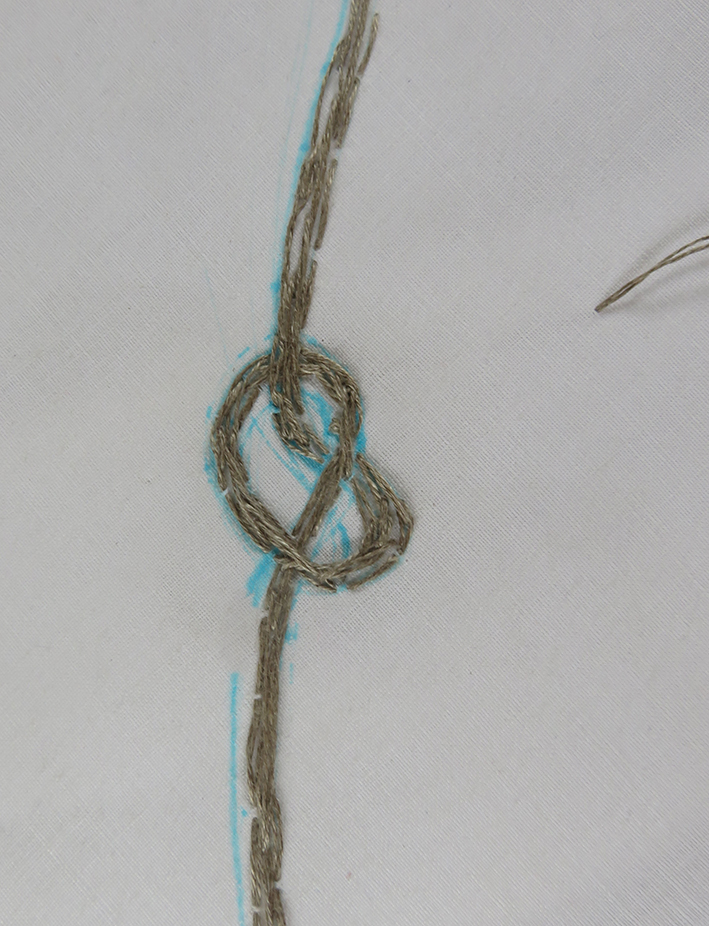
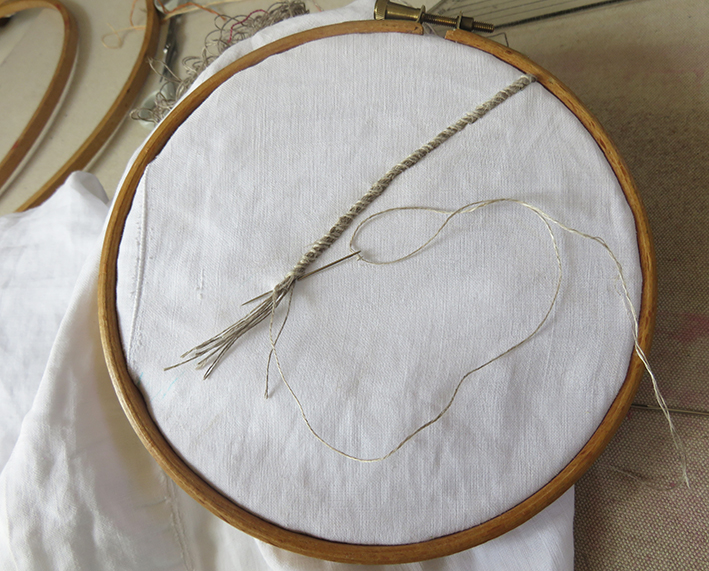
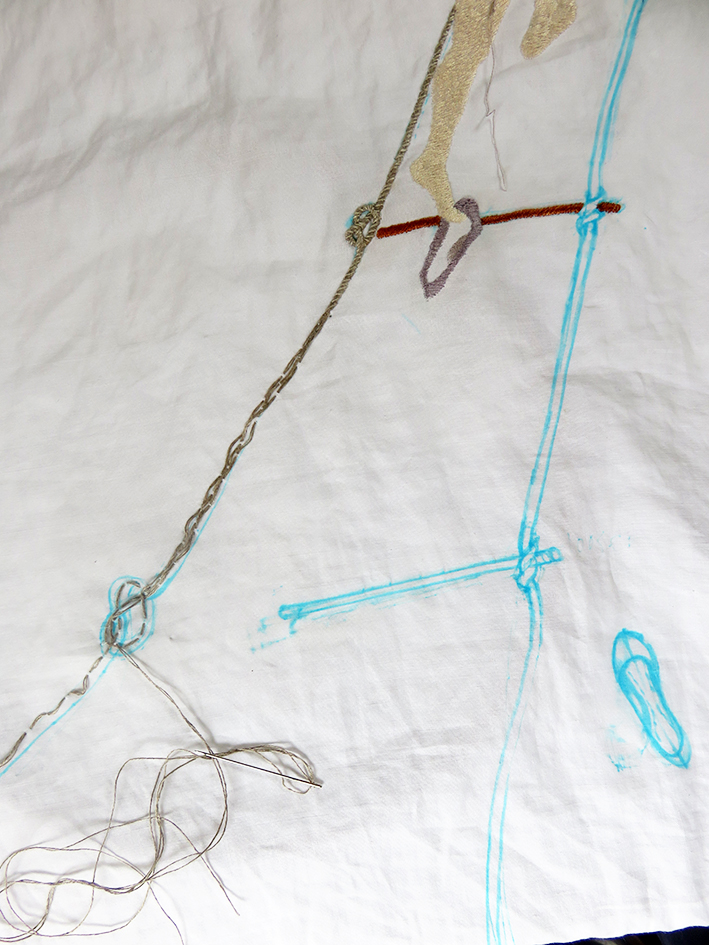
I found stitching the ladder the most challenging piece of work, a vintage pillow has only a limited space for inserting embroidery hoops and working straight onto fine linen needs stretching. I preferred to use some natural linen yarns and whip them into position making a more fluid line – finding knots and drawing them became a fascination.
above are the various ways I managed to stitch the ladder into position, with and without a stretcher.
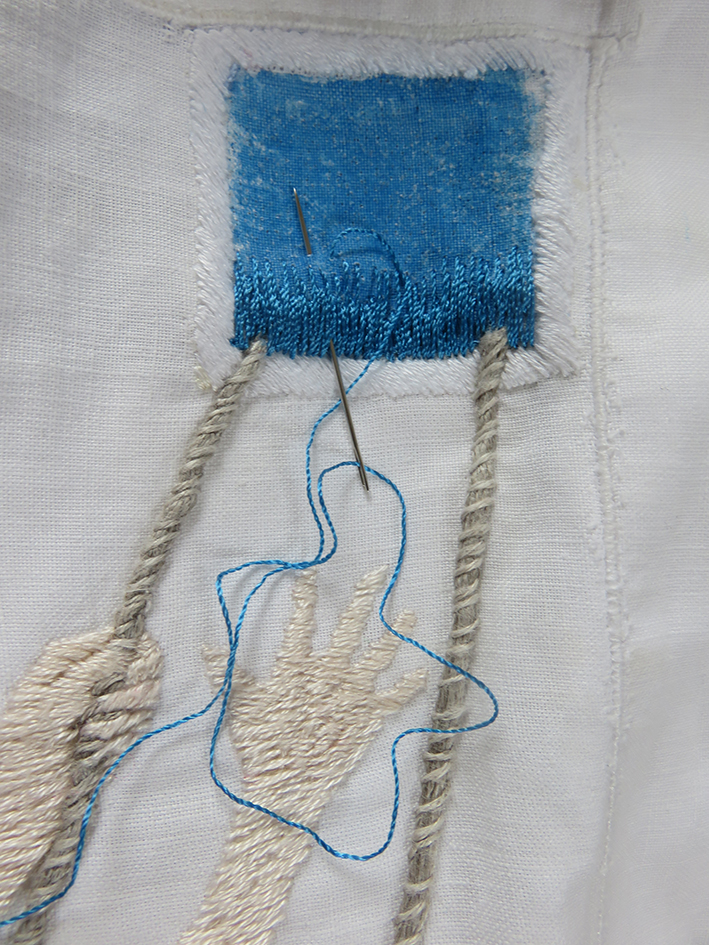
Now to the window: in some dreams it is impossibly teeny tiny, in others I get to go through it – only to find a steep and shaky descent on the other side into more blueness, the one thing always in common is that it is always a brilliant and shining deep blue
the background of the sky is painted with cotton dye, then embroidered in silk threads, it is high up in the farthest corner of the pillow case
and here it is finished – washed, starched and pressed as a proper piece of Household Linen
I feel now that it makes its own statement without the added words; and why should it balance? I mean, what am I describing?
AND it is only after finishing this that I see this is a perfect portrait of how I feel right now – just coming out of the strictest lockdown period….uncanny!
However, we were well into the current lockdown before I had found the impetus to finish this work. And while stitching I realised that I just wanted to stop this whole project that excavates very personal ideas, dreams, mottoes, and observations….I did have more ideas that I planned to stitch, but now I no longer want to make them. It has taken me over 10 years, off and on, to get here.
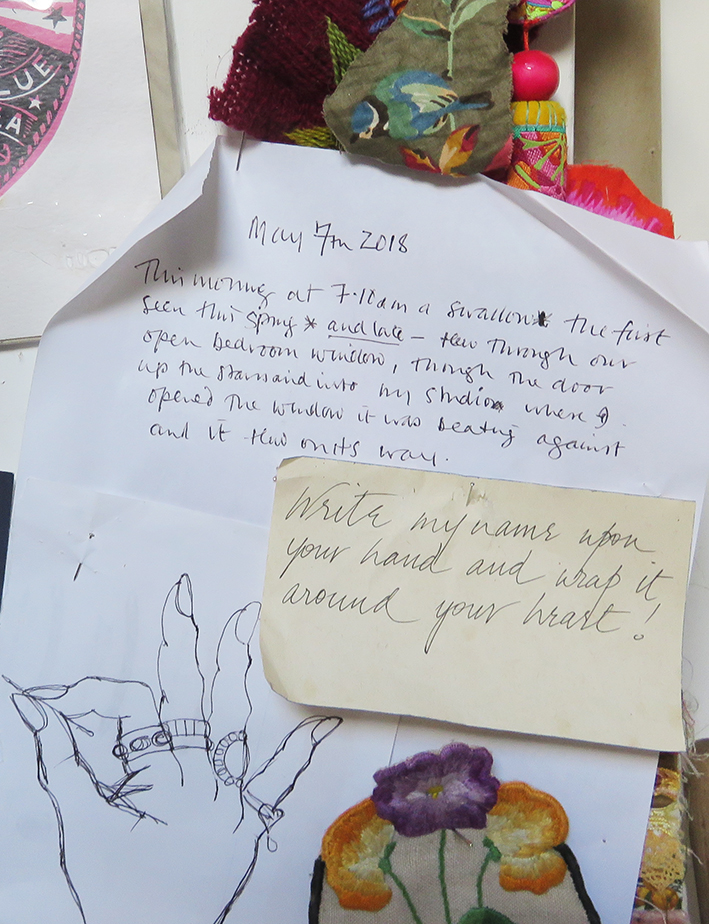
Affirmative sayings seem to be the philosophy of our times, the be-in-the-here-and-now mindfulness movement. But I have been collecting and pasting all sorts of sayings and mottoes in my work books and on my studio walls for years. Quotations, overheard remarks or messages and even poems from friends sometimes develop into pieces of work, but most often they just serve to enable me to grin and bear with it – see above!
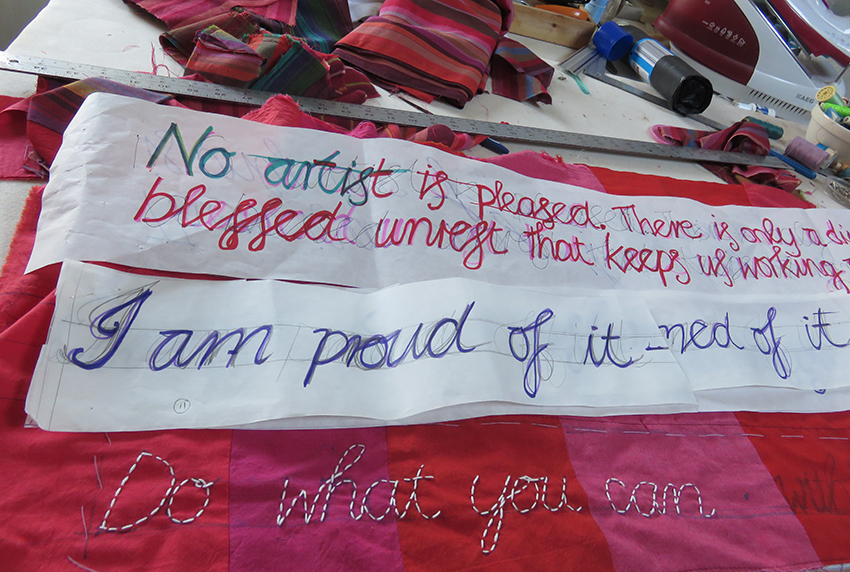
A current favourite was heard when I was mid-way through making the ‘Butterfly Dream Pillow’ – “I am proud of it and I am ashamed of it” immediately struck me as the perfect expression for how I feel about the work I do. I wrote it down on my work-top with the first thing that came to hand – an indelible pink marker! I have read it out to other artists and makers, and they smile and nod in recognition.
A quote from an interview heard on Radio 4 by a musician having just heard his own work played, my heart goes out to him.
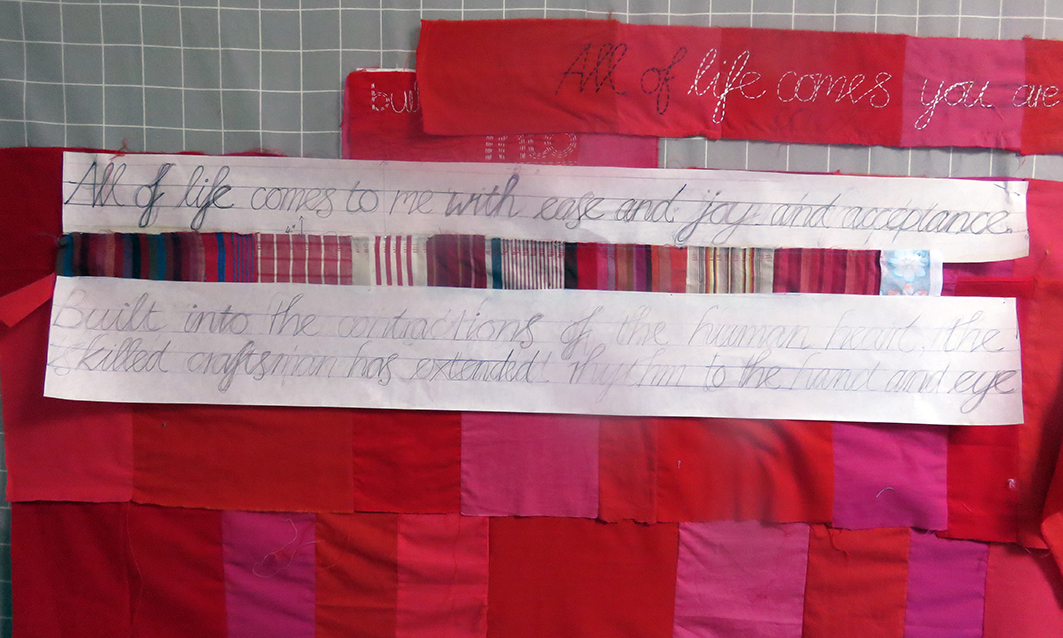
It almost made it onto my own Security Blanket, which is part of my ongoing work project, Make it Through the Night..and I did write it out along with the ones that have stood the test of time. I wrote all of them onto large scale graph paper so that my own handwriting could be resized, with the idea of stitching them easily. I have had this ‘affirmative sayings’ idea for several years, and for several different media, even as a vitreous enamel patchwork, but never had the time or energy to face making it. In between some commercial projects, late last year I started to make it – piece-meal.
the first attempt at designing the blanket as a strippy quilt with inspiration from an American quilt
Above show the first attempts to design the ‘blanket’ idea as a quilt; the inspirational Strippy Quilt above right is an American design, I love the wobbly lively stripes, like a flying flag. Initially I had considered stitching a vintage woollen blanket, then I realised that heaving around such a large piece of fabric would not be easy for a lot of hand embroidery. I remembered a Strippy Quilt in Unconventional & Unexpected: American Quilts Below the Radar” by Roderick Kiracoffe, it inspired me to change tack, this way I could stitch the sayings piece-meal and patch them all together at the end; it also meant I didn’t have to decide the order of the quotations immediately.
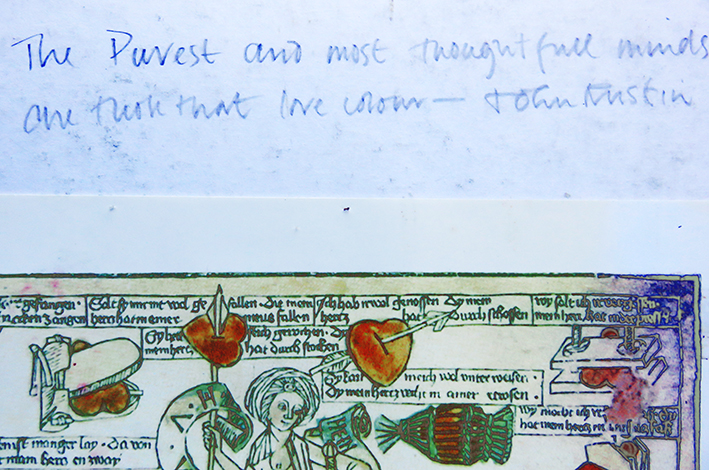
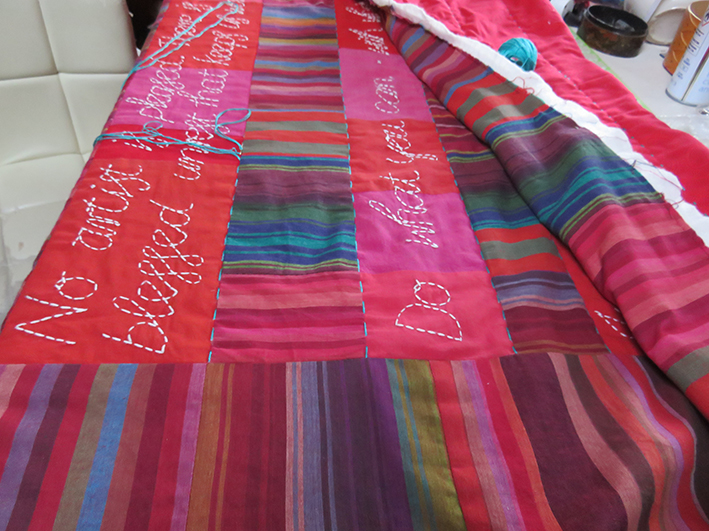
I started by using some scraps of vintage striped deckchair fabrics, but they were too hard to hand stitch into. I turned to my stash of scrap fabrics, Kaffe Fassett Studio’s lovely subtle shot cottons and woven stripes left over from various quilts that my team have made for his Patchwork and Quilting books were perfect. Very colourful and here very RED, and “the purest and most noble minds are those that love colour”. But not having enough of any one fabric for the background I cut my stripes into strips and joined the clashing shot cotton colours together as a background.
I have a saying that lives with me – a mantra that I recite during my sleepless hours of most nights; it has subtly changed over the years I have used it to still my thoughts, and I can chart my state of mind by what I have decided.
My subtly changed mantra is stitched onto the same set of fabrics, ready to be cut up and placed in the telling positions….
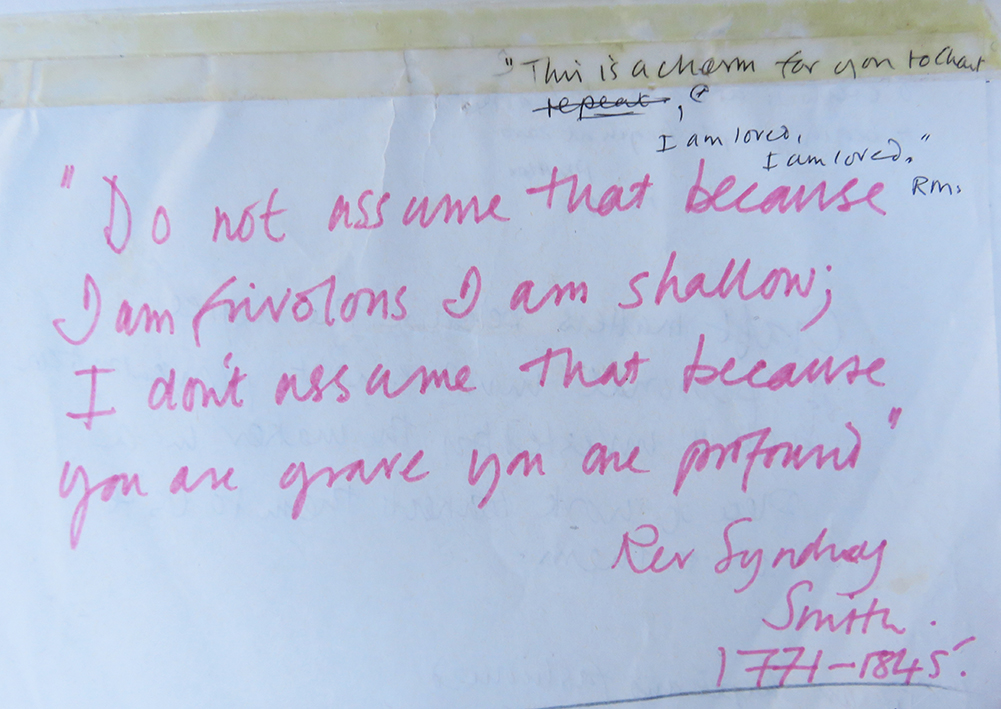
slowly the ‘blanket’ collects more words and becomes unnervingly personal for me; The Reverend Sydney Smith’s sublime epithet for not judging a book by its cover is really barbed, and oooh how many times have I wanted to say this out loud!!!!!
The finalised order pinned together on the quilt wall, tells a story about my working life over the last decade and more……hard to display – but here I am.
Eventually I got them all into order, some sayings were dropped or the blanket would be enormously long I would need to re-design, others were added as they described more succinctly what I wanted to express about how I feel about the work I do. The quotations are all by individuals who have used their life to express themselves, teachers and critics, a bon vivant, a dancer – and me. They are in order from the top, The Rev. Sydney Smith, John Ruskin, Richard Sennett and the last 2 (heavily edited) are by the American dancer Martha Graham. The succinct “Do what you can, with what you have, where you are”. sums up my husband’s philosophy for living…
Now to the ‘quilting’ or just a system of large straight stitches ‘in the ditch’ of the seams, to hold the the layers together. The finished piece is a tad wobbly, due to my inexpert ‘quilting’. Hey Ho, you can’t do it all!
Each quotation has its owner’s name and dates stitched onto the back of the quilt to be in line with the quotation
The finished piece pinned to my studio wall, waiting to be blocked and pressed;
And ” I am proud of it and I am ashamed of it” – go figure!
It is almost 20 years since I had this disturbingly beautiful dream but I have NEVER forgotten it. Re-visiting my sketch books archive, I found the original drawing that was hastily scribbled down when I thankfully I woke up.
Now, I have decided to complete my long standing/stitching on-going work project “Make it Through the Night“, after not working on it for more than 5 years. I have determined to complete the project to a degree where I can hopefully resolve it but so as not have it in my brain as frustrating “unfinished business”. I just can’t ignore it any more…. too much of me resides in it; and as the composer Gustav Holtz puts it ” Compose nothing unless the not composing of it becomes a positive nuisance”
The initial drawing , above left, is dated 28th July 03; the second drawing is another later version when I was trying to make a composition for a stand-alone embroidery….. now I have decided to add it to the ‘dream pillows‘ and I need a different composition. Recently looking very carefully at the 2 drawings I realised I had completely forgotten that the butterfly had a face – YIKES!
In the actual dream it was a giant butterfly several yards/metres wide, dying and lying on some grass underneath a tree, the remnants of wings scattered round it. People were picking up the large technicoloured pieces of shattered wing and I really wanted some as well – but I thought I would get it something to drink first, then decided to pick it up and take it to a nearby puddle, the result was my butterfly covered hands…I abruptly woke up.
I started to research the ways on which I could have held the massive butterfly. I looked at many different British butterflies and chose the Peacock mainly because it was so colourful but it has eyes as well – one of the major symbols I use in my work. Every year we get smaller butterflies over-wintering in the house but these beauties are rare here.
I had my own hand prints on silk, from an earlier area of research and I liked the way the lines of the palm were voided. I now transferred the palm lines to the outlines of my hands so that they would interrupt the wing pattern.
moving around with the photocopied cut out hand shapes to find interesting enlarged wing patterns to embroider.
I enlarged the first peacock butterfly image and cut out my hand shapes…next I had to add the patterns to enable me to stitch the whole hands……the original working drawings below with a a technical sample that I would use for the very complicated patterned hands. I decided to paint dye onto the ground first to give me guidance for the colour blending and to assess the amount of work I would have to manage.
the separate hand drawings with a very crude but vital painted dye and stitching sample.
Next I had to imagine the shattered butterfly – I tried many variations; the shape had to show a degree of violence and some direct connection in the shapes left after my hands had devastated it, because it shows the terrible result for the insect…
3 of many versions of the lay-outs for the pillow, the hand writing is in water soluble pen
I drew the hand outlines and running stitched them, then drew my palmistry lines on each hand and painted dye within the lines and fixed it securely – all of this before I could start stitching, which I was itching to do …..
2 images above show the first and last day’s stitching of the hands. I started this project in early August and now it was late September – I needed to move onto the butterfly now…
working from my research drawings, I drew and embroidered the main area of the butterfly and then placed paper shapes to act as the shattered wings to make some connection to my hands.
research materials and dyed butterfly with the embroidered version with paper shapes in place for the broken wings.
It was at this point that something strange started to happen….I found a trapped Peacock butterfly in the window of my studio, I was delighted, I had never seen one of these in the house; the weather was still warm, so I let him go….
But then more and more Peacocks came into the studio, and in different areas of the house… in all we had 11 different Peacocks visit us. SPOOKY WOOKY……
the 3 photographs are of just some of the 11 different butterflies that came into the house over the last 3 months while finishing the embroidery. The image of the butterfly lying in my palm was taken on 25th December – amazingly it died with it’s wings folded back to show the eyes, I take this as a rare and wonderful Christmas present.
Sadly some of them died indoors and I keep them in m studio – they are all in different conditions; some very tattered wings and faded colour but others still beautiful.
my small collection of some of the autumn visitors I think there is another embroidery here……
so I eventually finished the pillow, completed the writing in running stitch and it is ready to join the Make it Through the Night project.