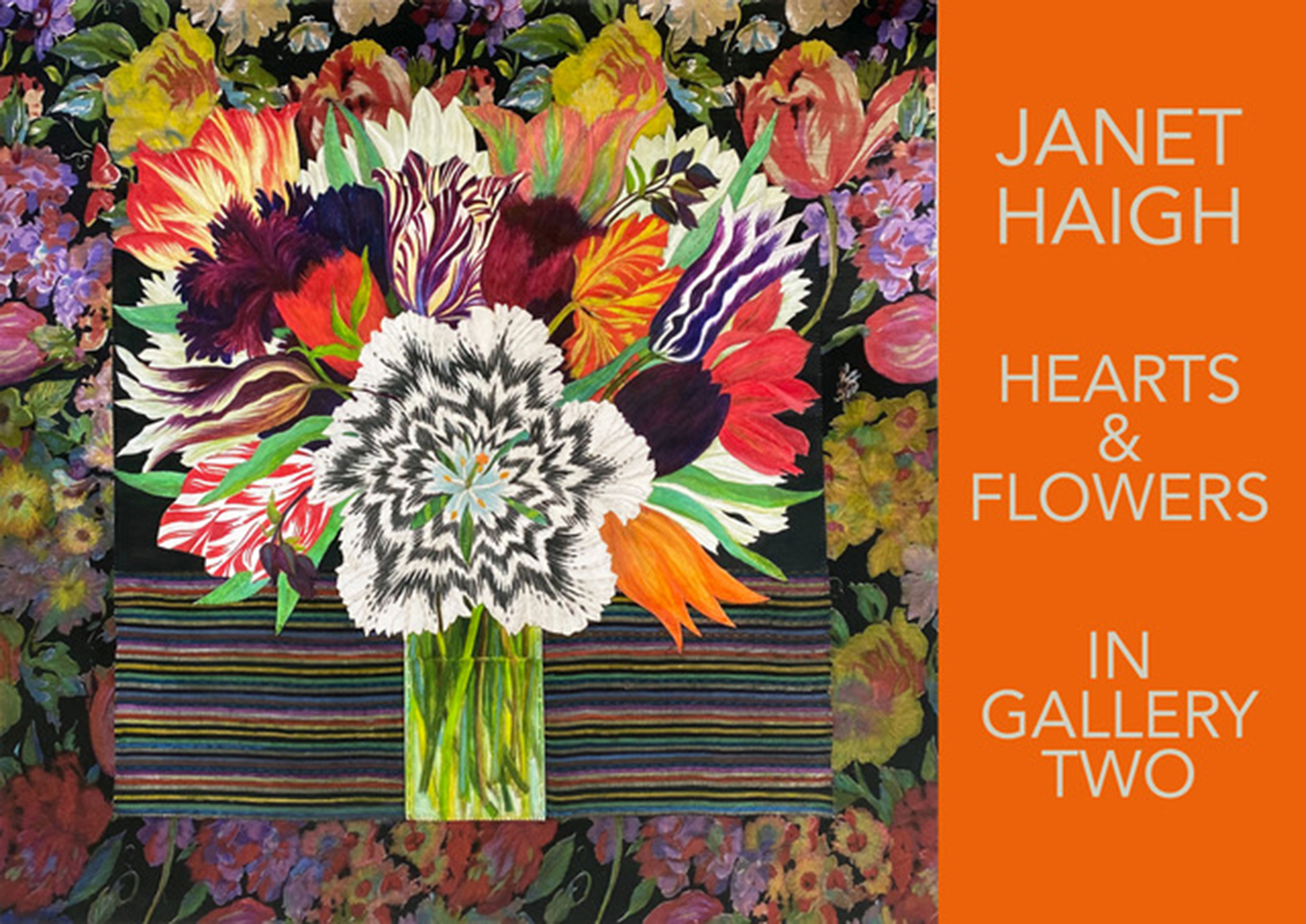
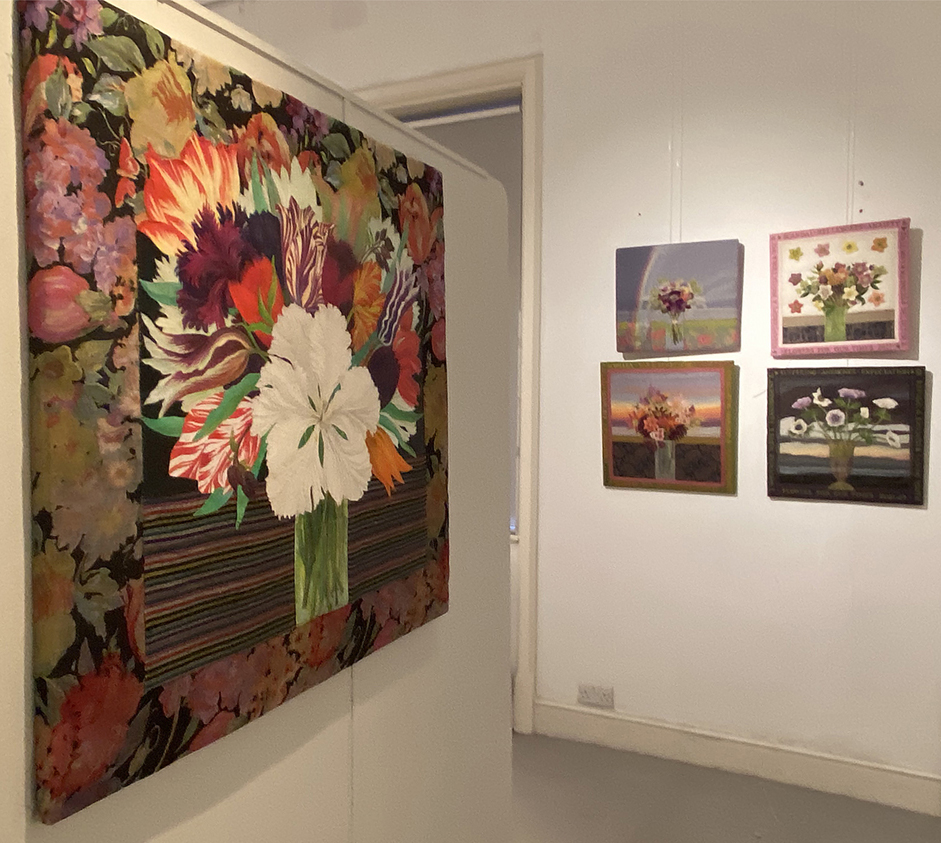
The new season’s exhibitions at Jen Jones’ The Welsh Quilt Centre, Lampeter opened a week ago today where I am exhibiting a small show of personal work – work that I make and keep for myself.
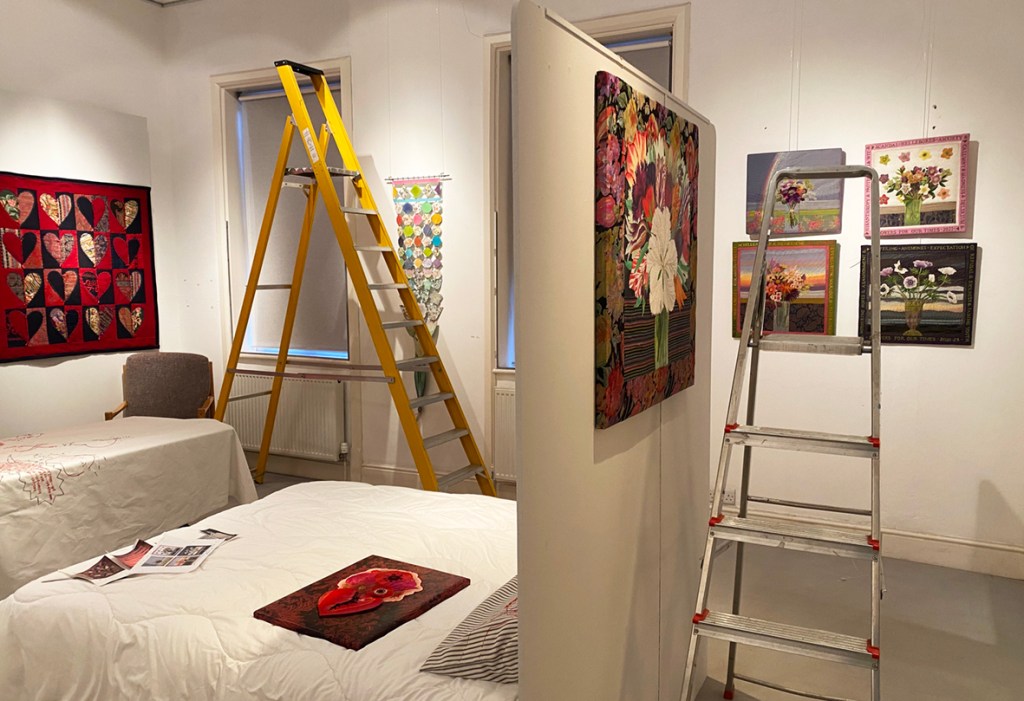
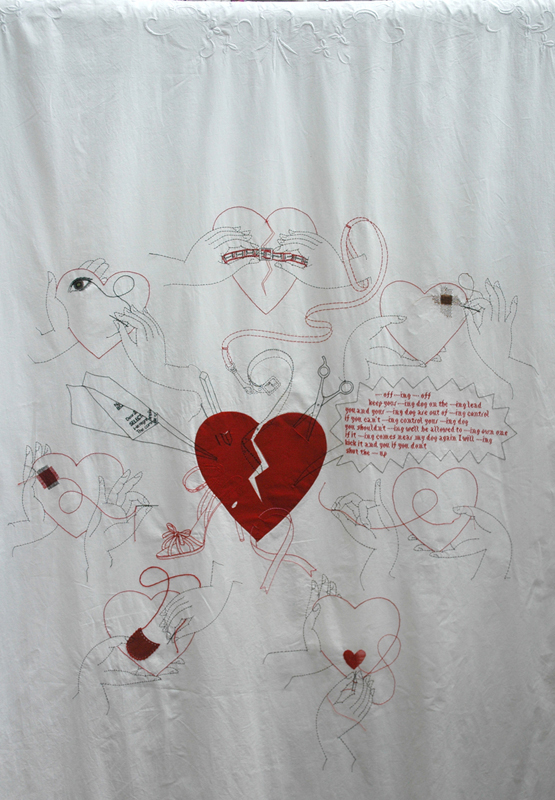
On my first visit early in 2023, when I took actual work to show Jen Jones, she offered me a small gallery for an exhibition and I decided on ‘The Flora’ embroideries. However on my second visit to the, now empty, room I immediately realised it would need far more works than I had imagined. I decided to add a more unusual collection of my textiles combining vitreous enamel and based on Mending. It features broken hearts and how to mend them, so Hearts and Flowers: starting at the begining and going round the room: this is the story of putting up the exhibition
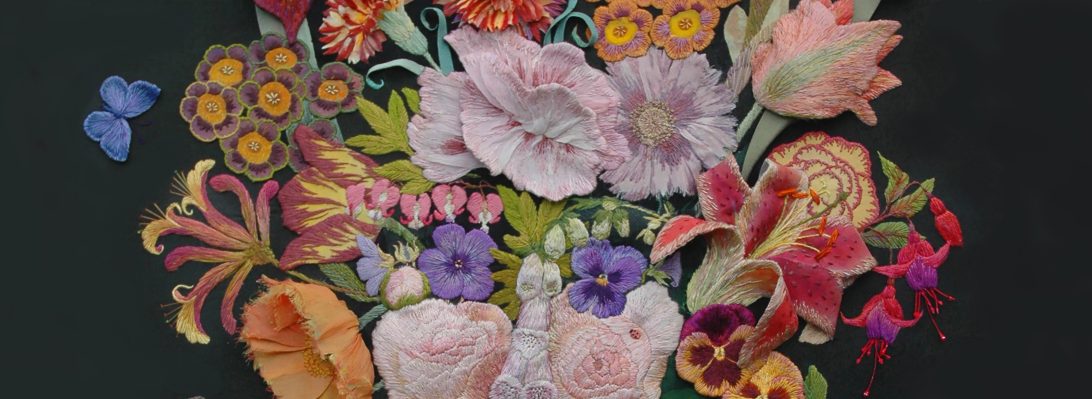
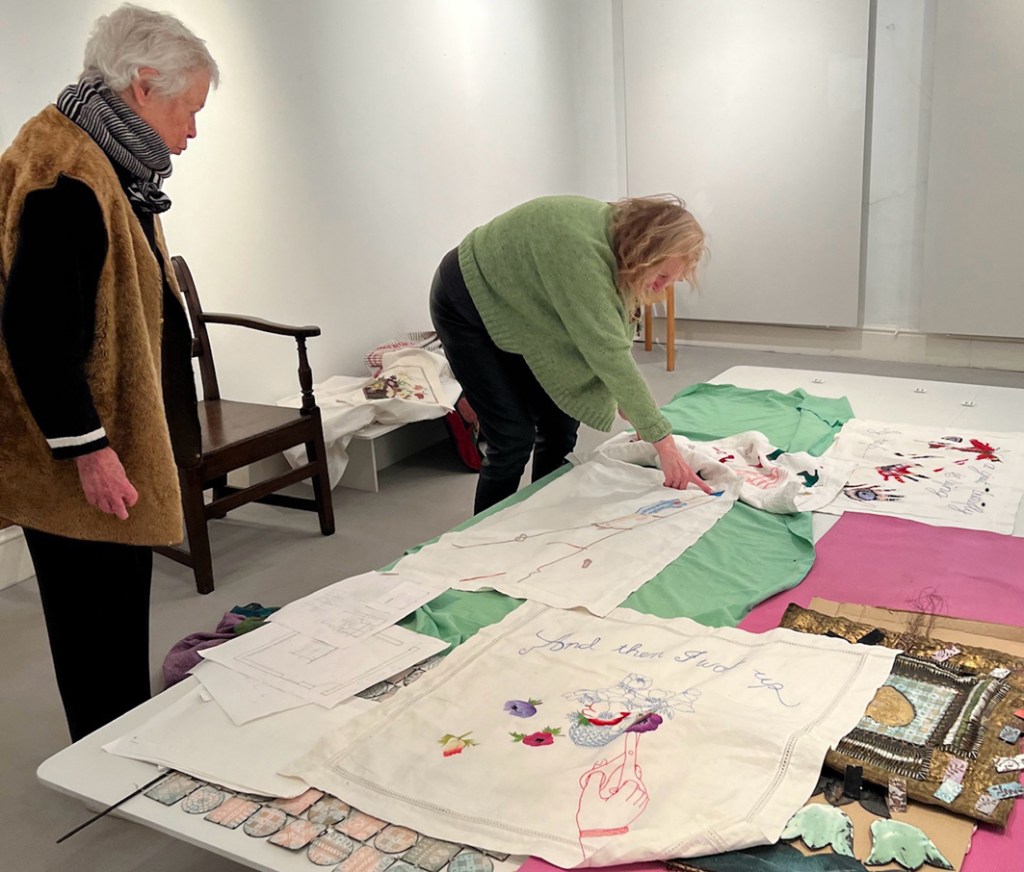
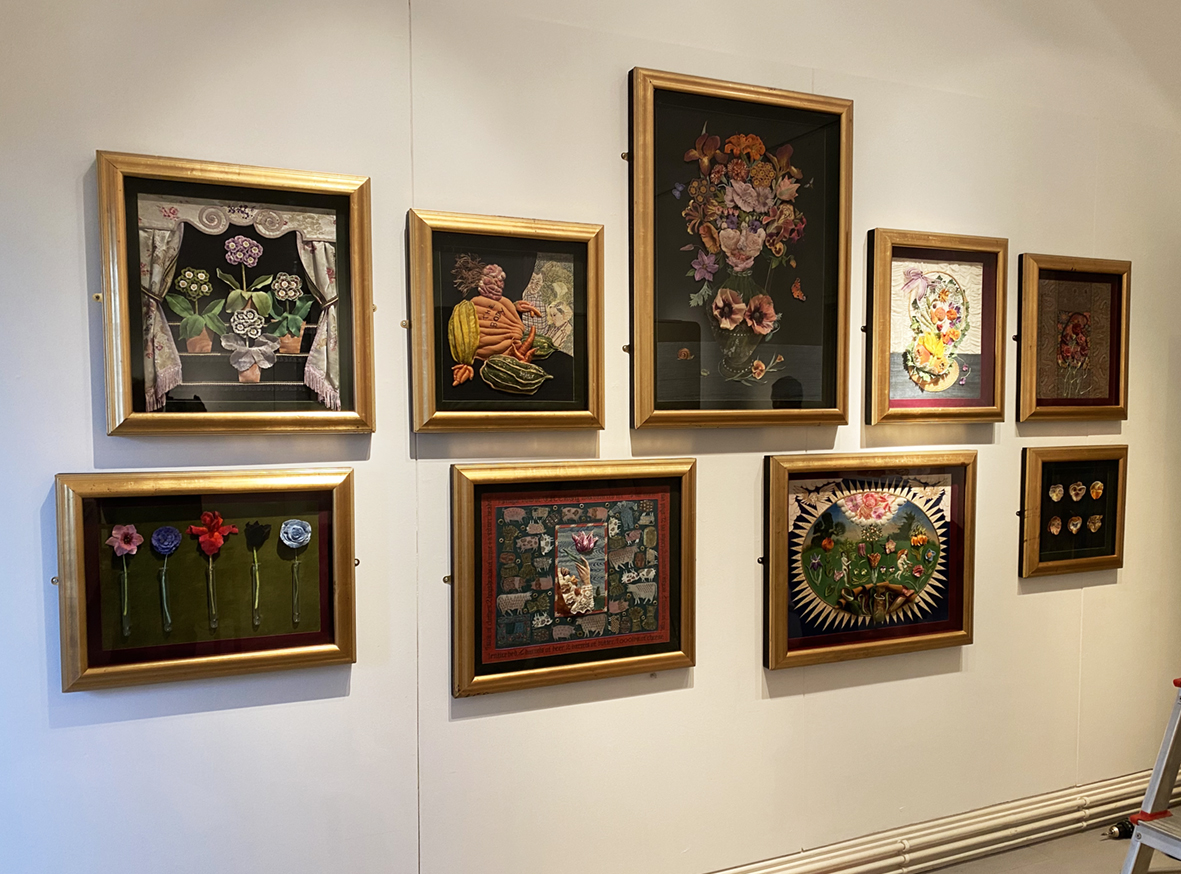
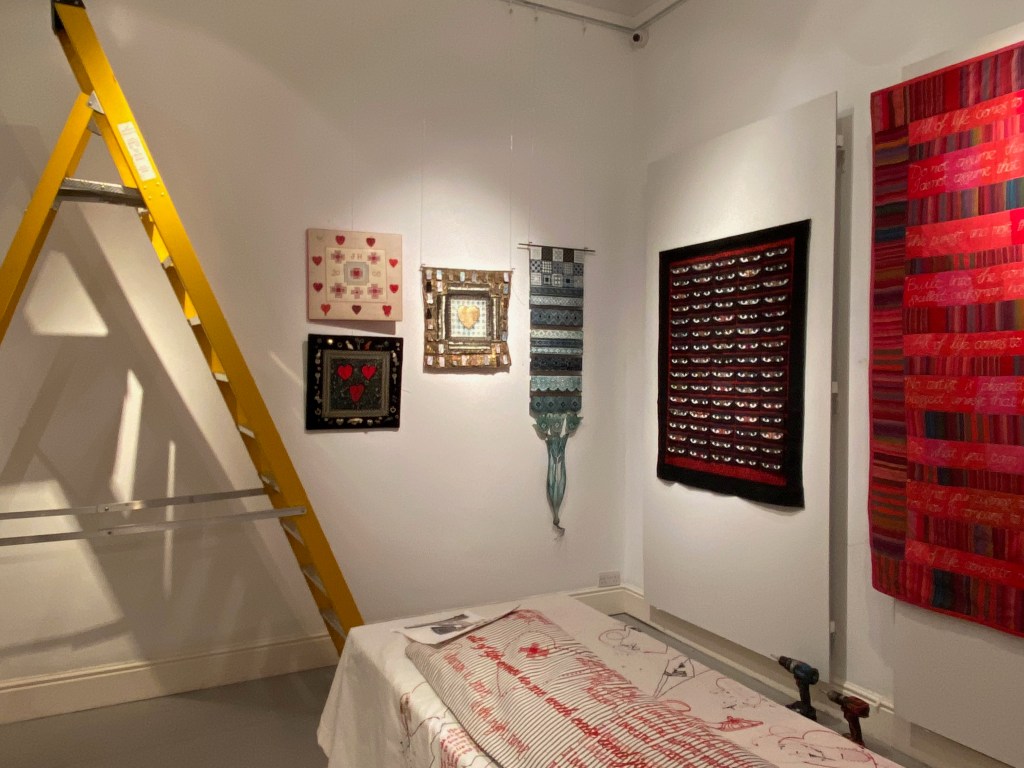
In the first week of March I took all my works and with the help of the whole team at the centre the exhibition was in place in a day(apart from a few extra tweaks before the opening)The first wall of work was The Flora. The exhibition curator/editor, Sarah James, remained focussed when I had lost mine.
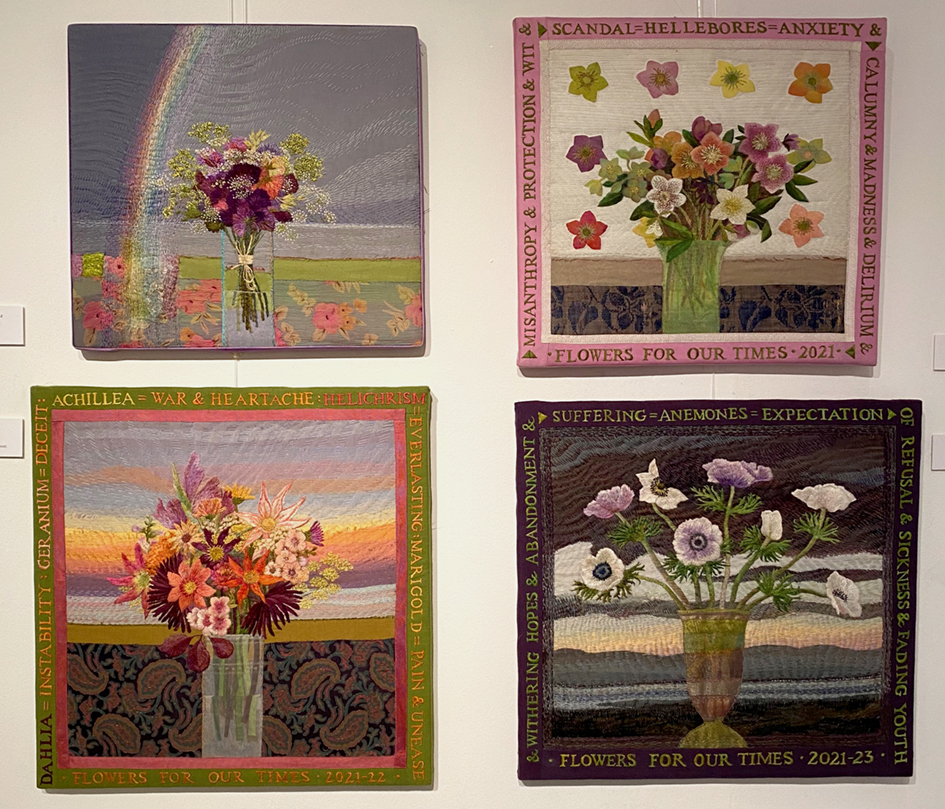
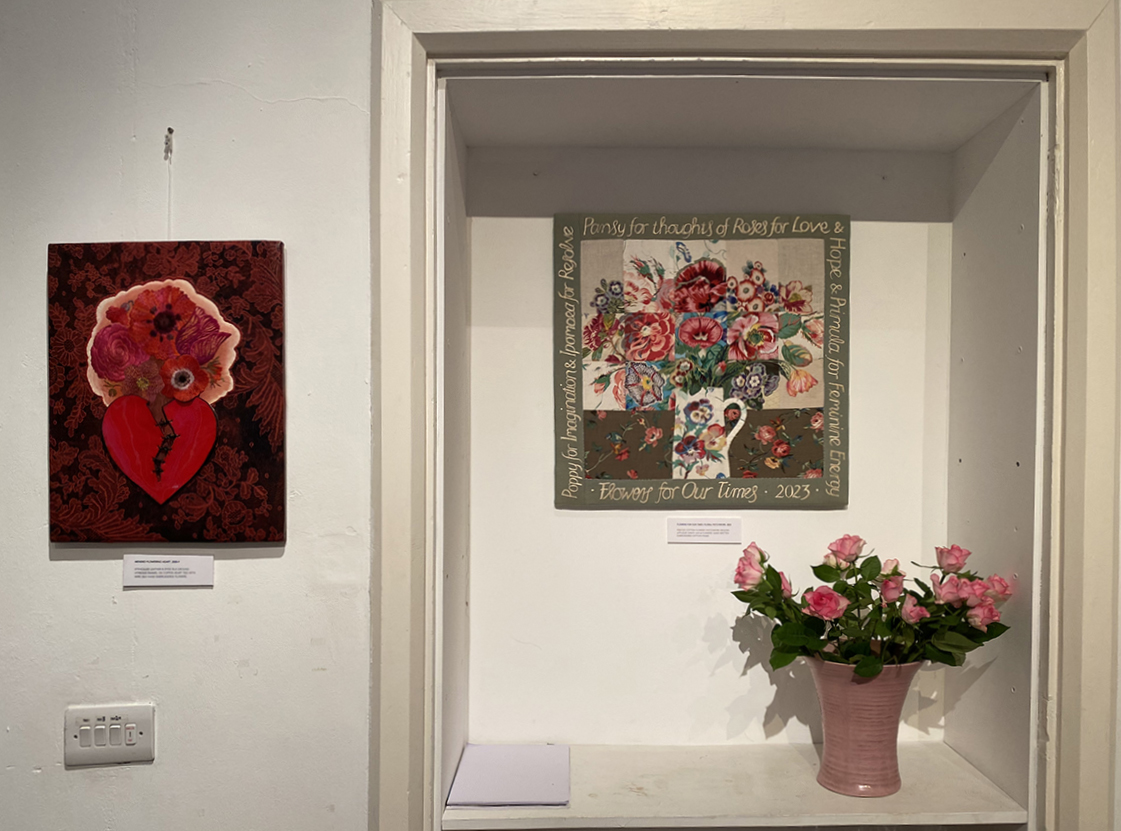
The Flora flowers give way to a group of ‘Flowers For Our Times’ my most recent hand embroideries..but they continue the themes found in Flora. On the left is a stitched appliqued drawing.
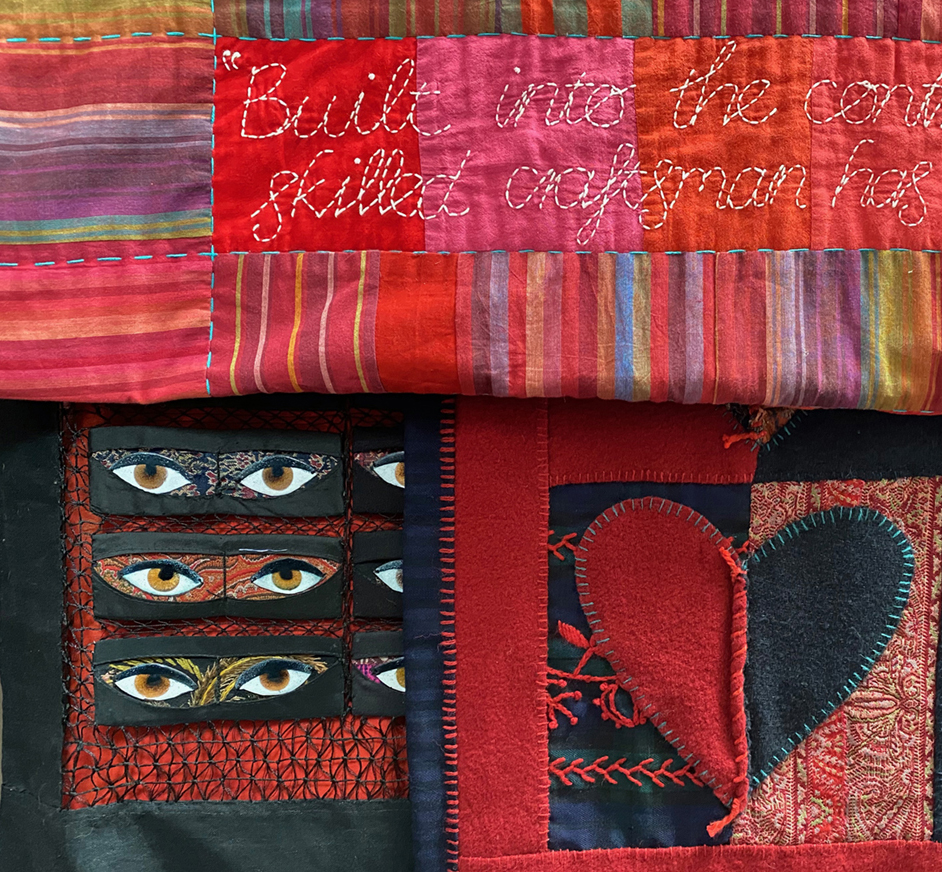
The flower walls give way to hearts (and eyes) so here are my minimally quilted fabric patchworks. This took quite a lot of preparation, pressing on my behalf and for Charles (and Russell) the gallery’s invaluable exhibition men, constantly measuring and sometimes just waiting, but colour co-ordinated!
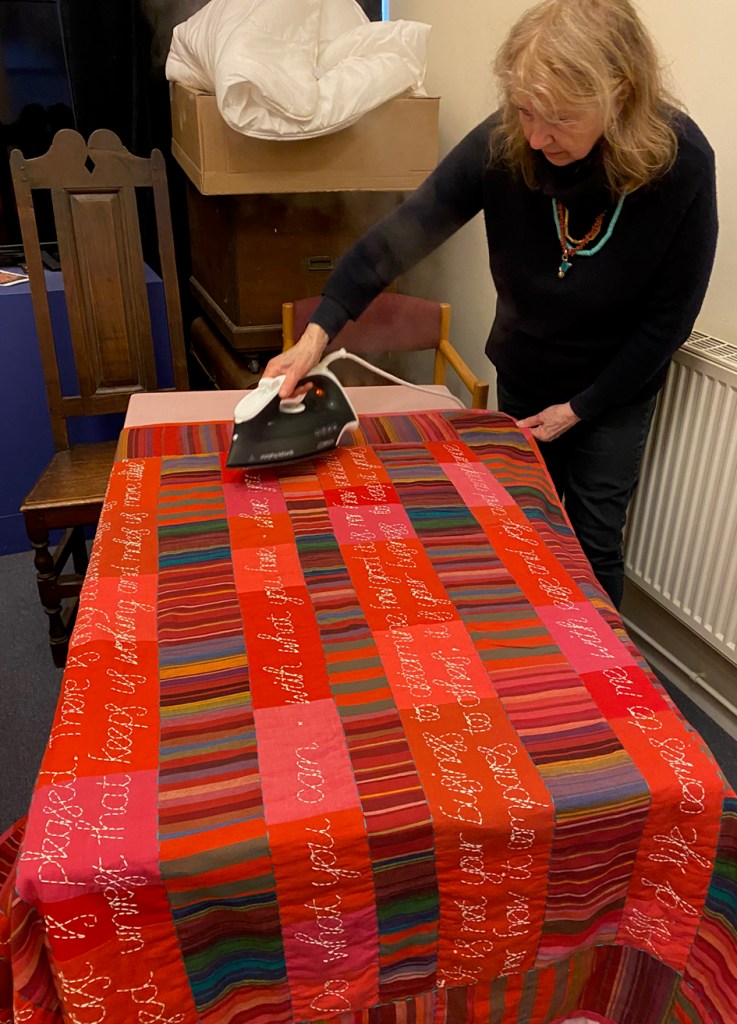
The large Comfort (Hearts)and Security (Quotes) Blankets and Safety Curtain ( Eyes) had been draped over my bannisters for weeks (above right) but a 3 hour car journey had creased them; I am always relieved to be able press my work before it goes on display.
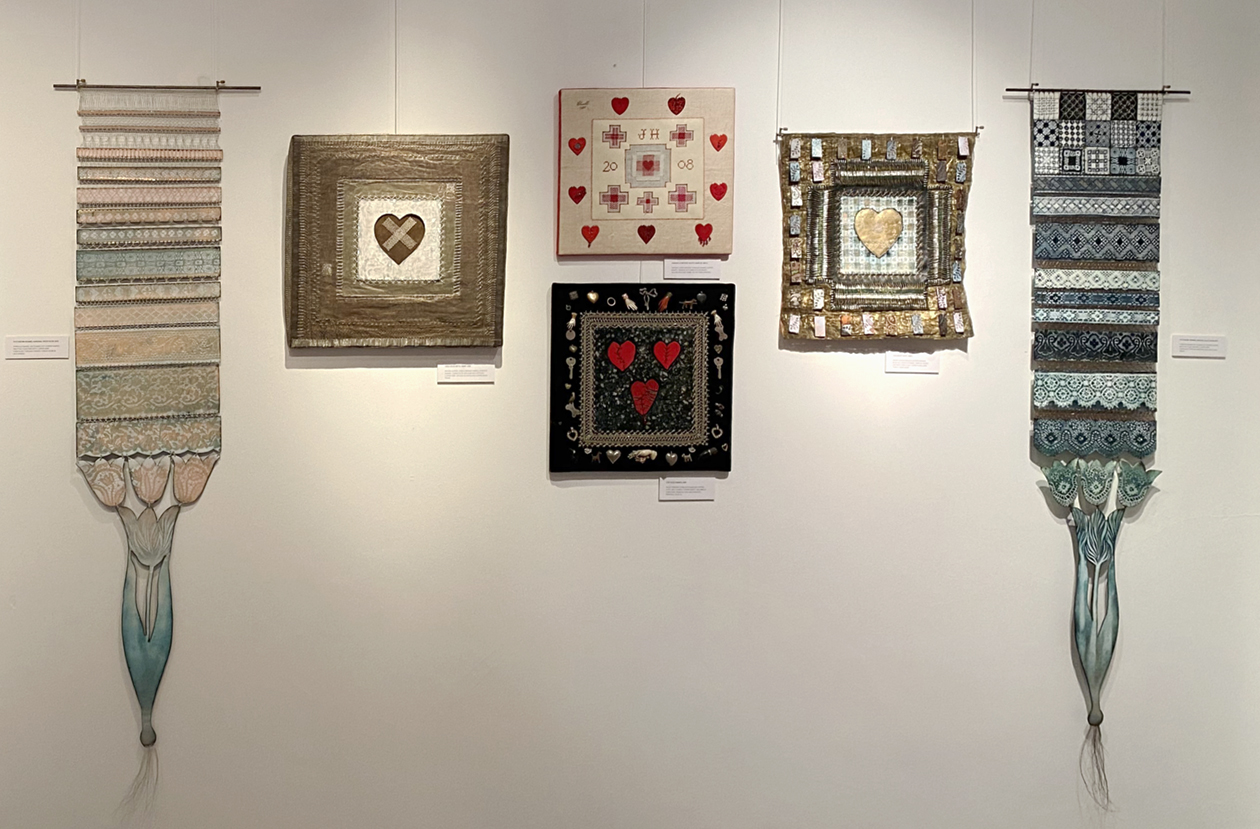
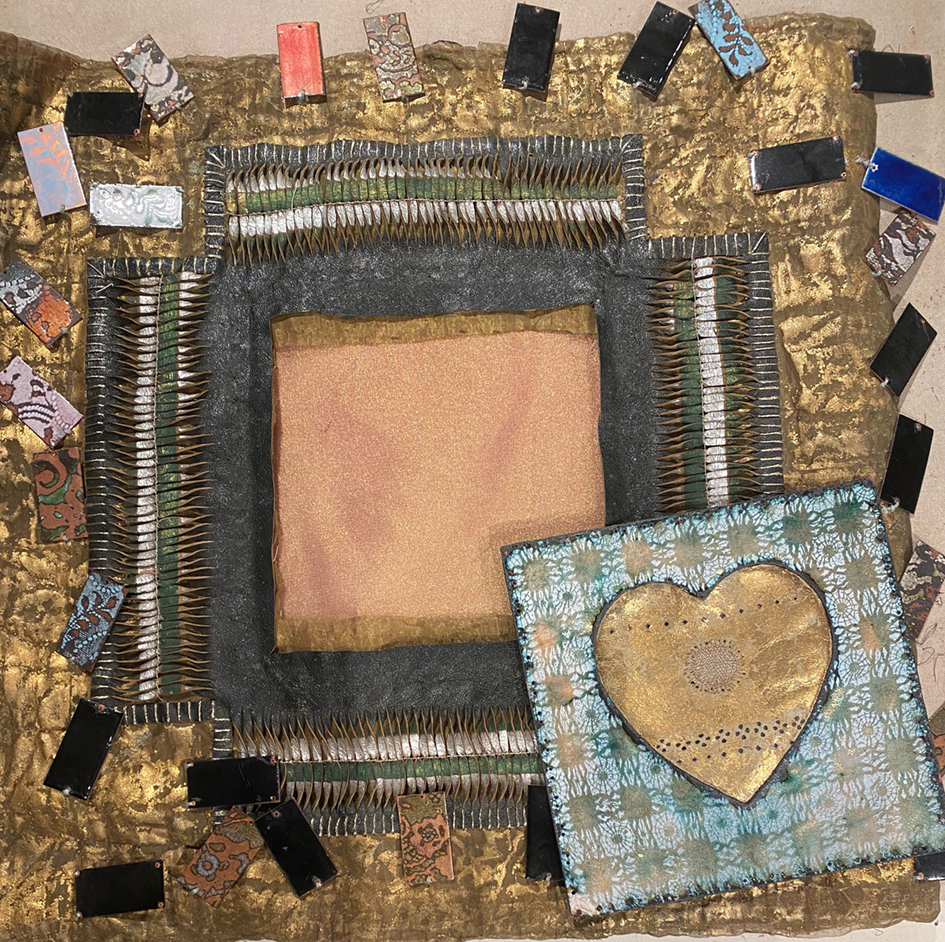
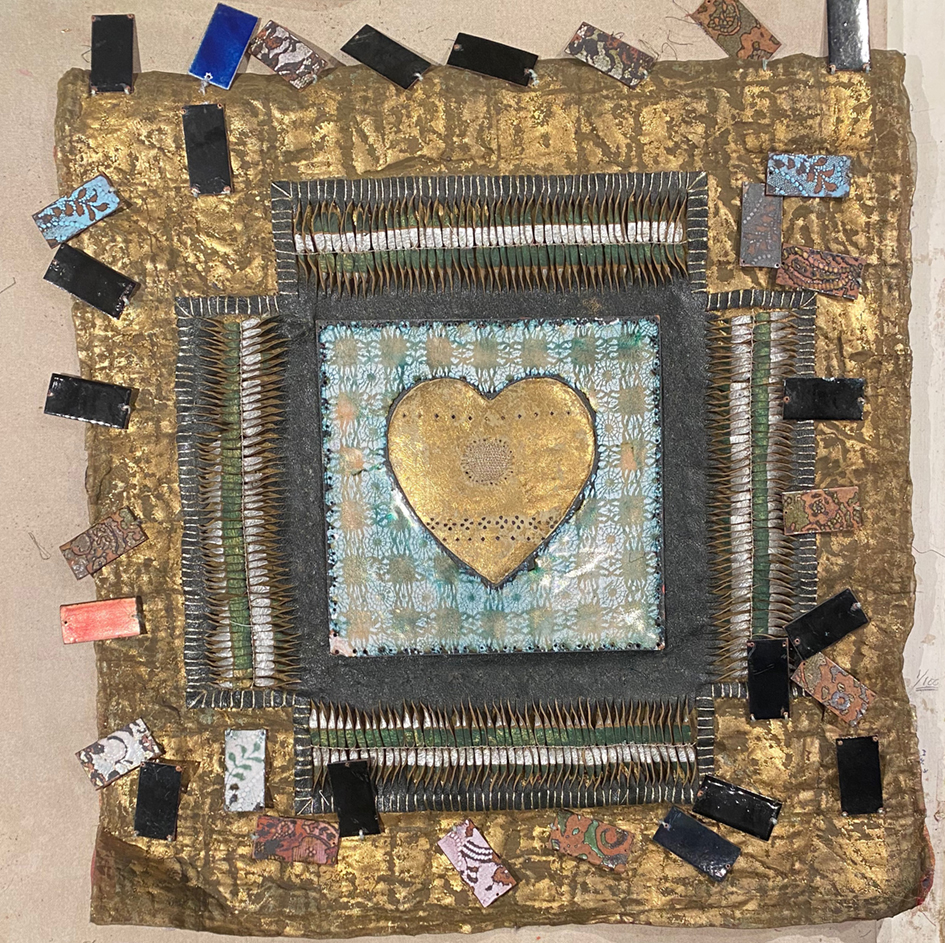
Moving round next are the metal and vitreous enamel hearts – all broken, discarded, damaged but saved in some way.
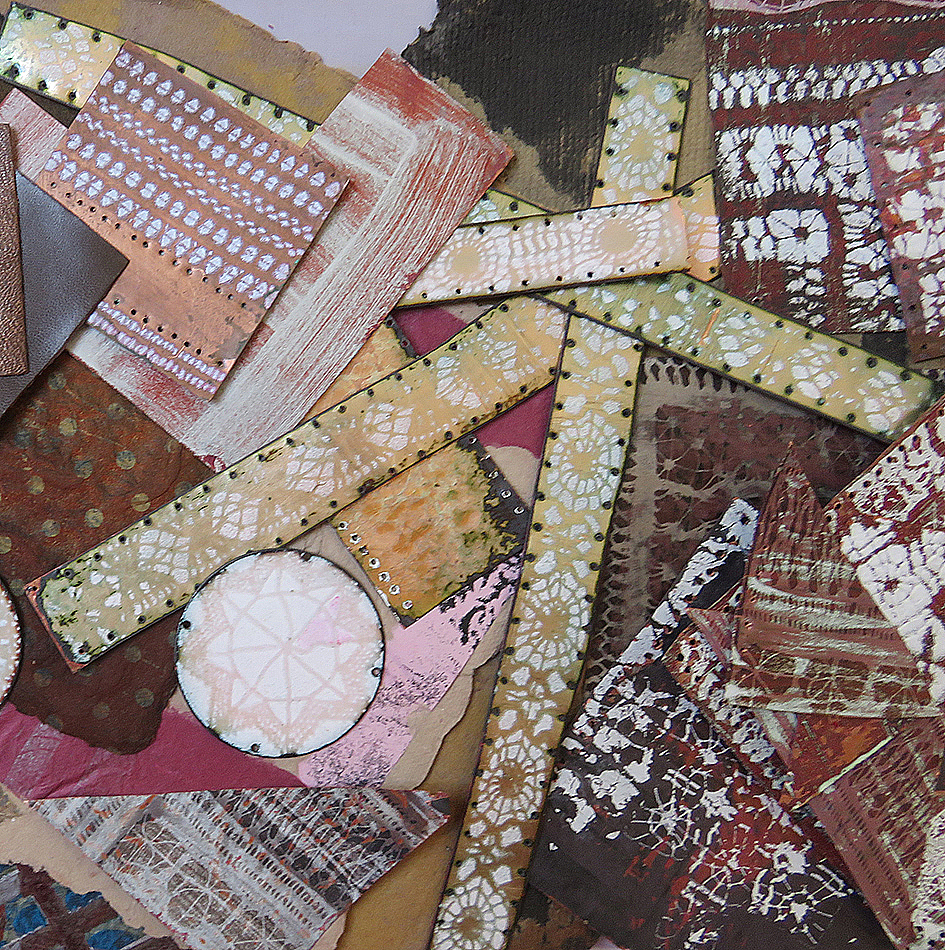
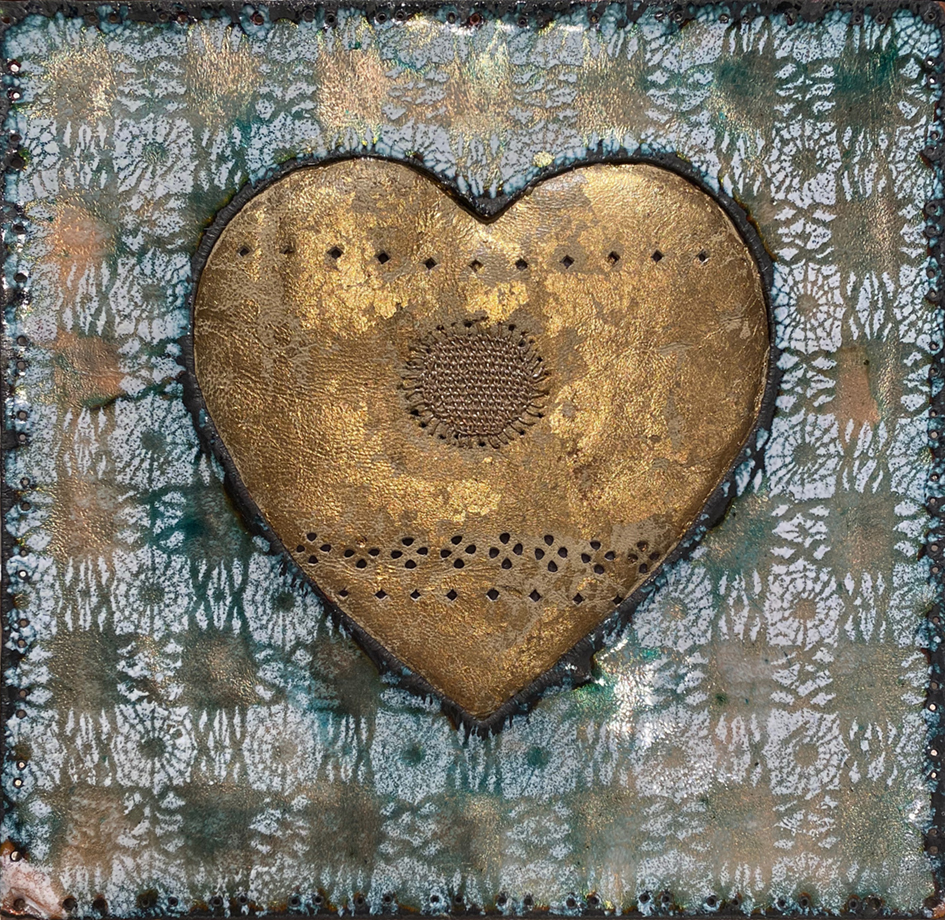
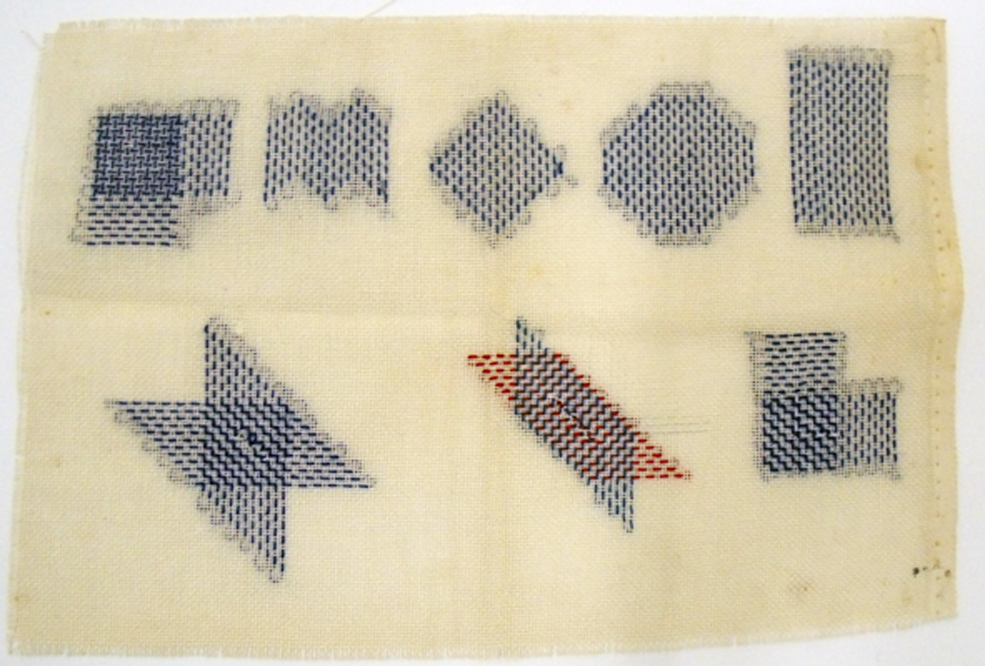
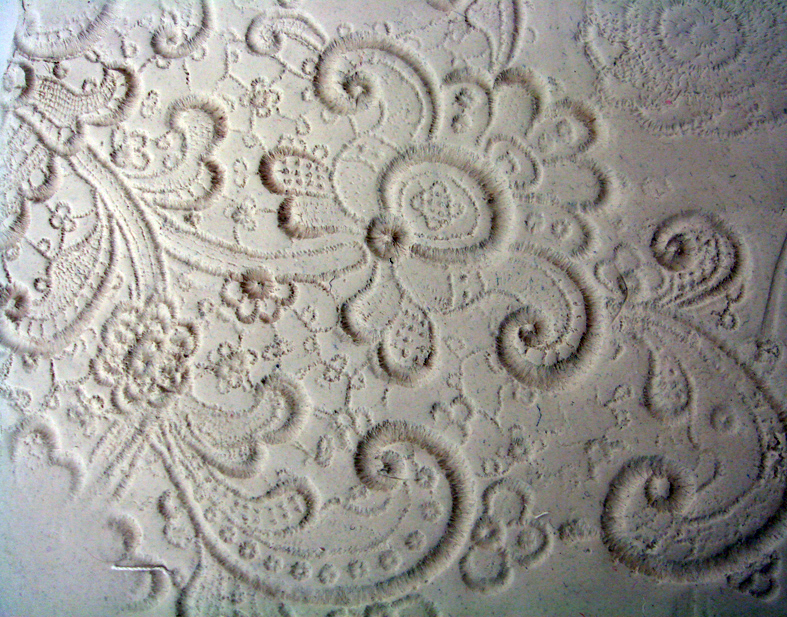
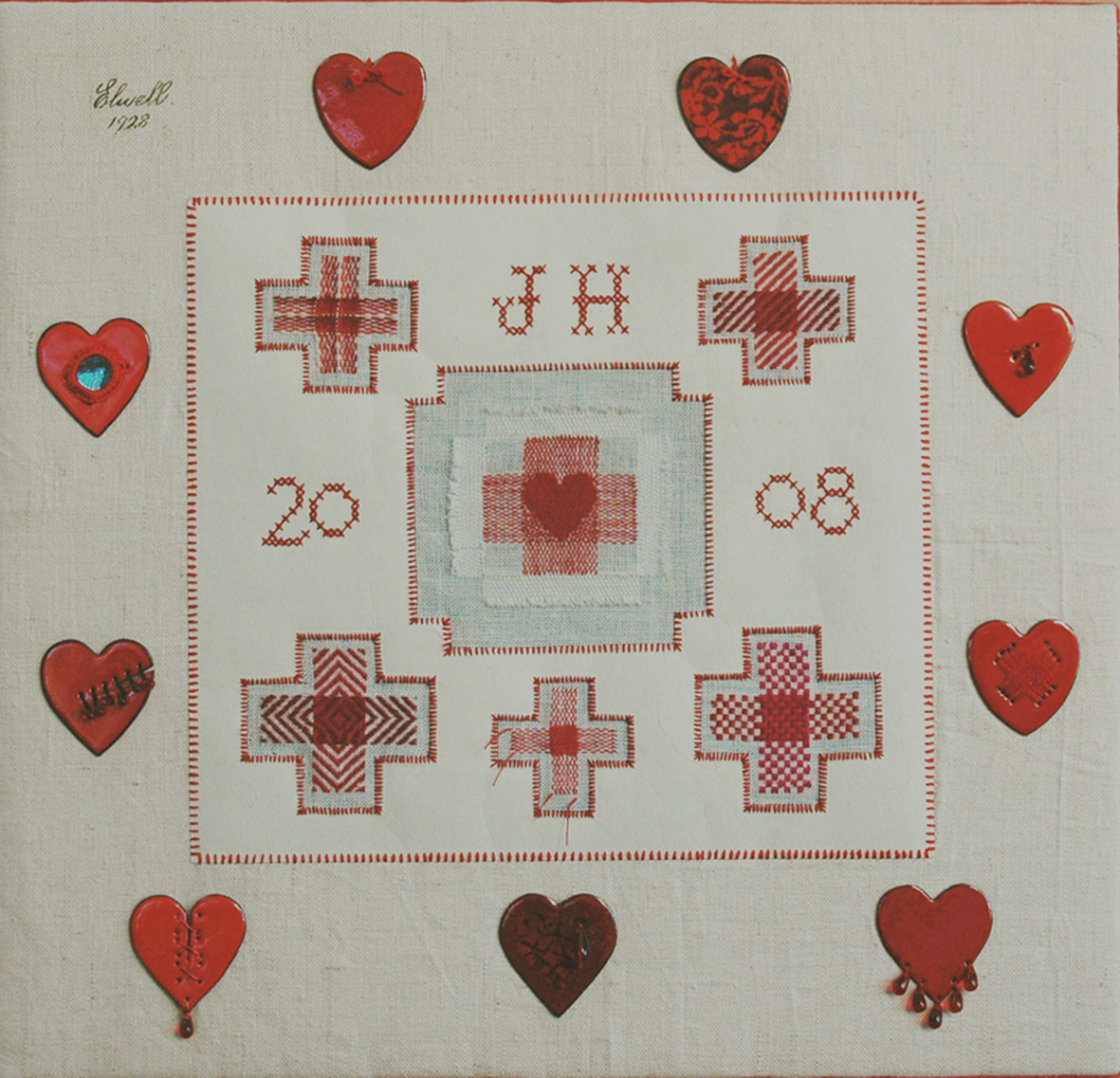
The works above are made of metal and glass enamel, they are stitched and embroidered with drawn thread work in copper wires on metal fabrics and copper plate. Patterned by sifting white enamels through Lace and Broderie Anglaise stencils, except for the red sampler that is darned in silk on vellum
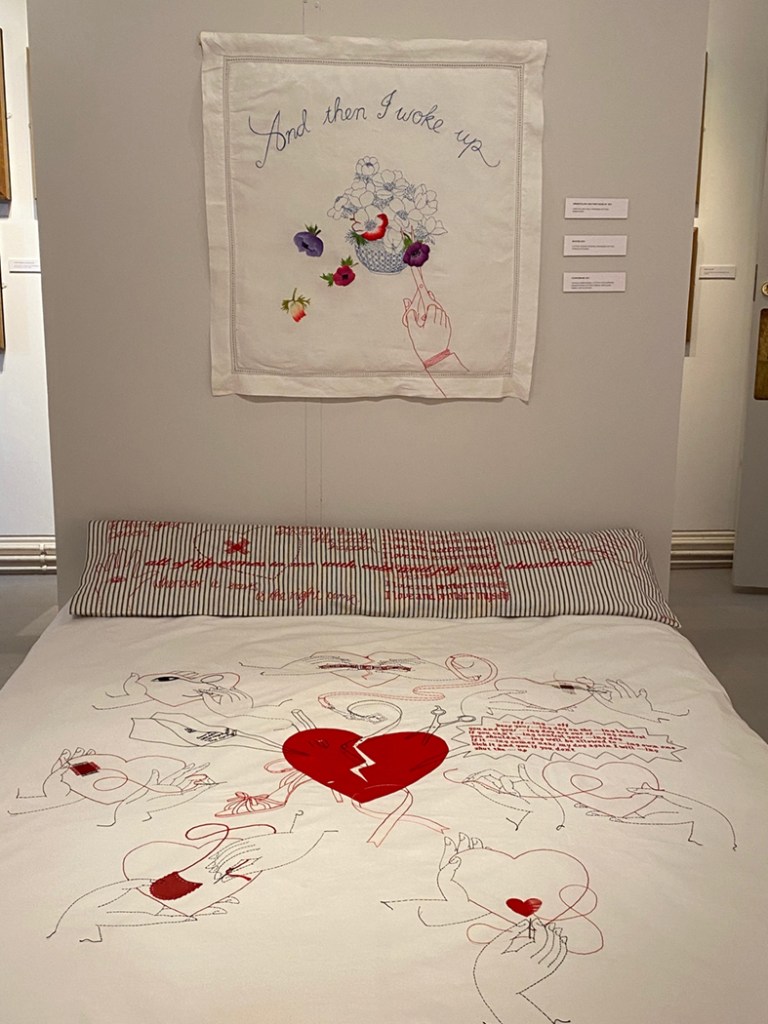
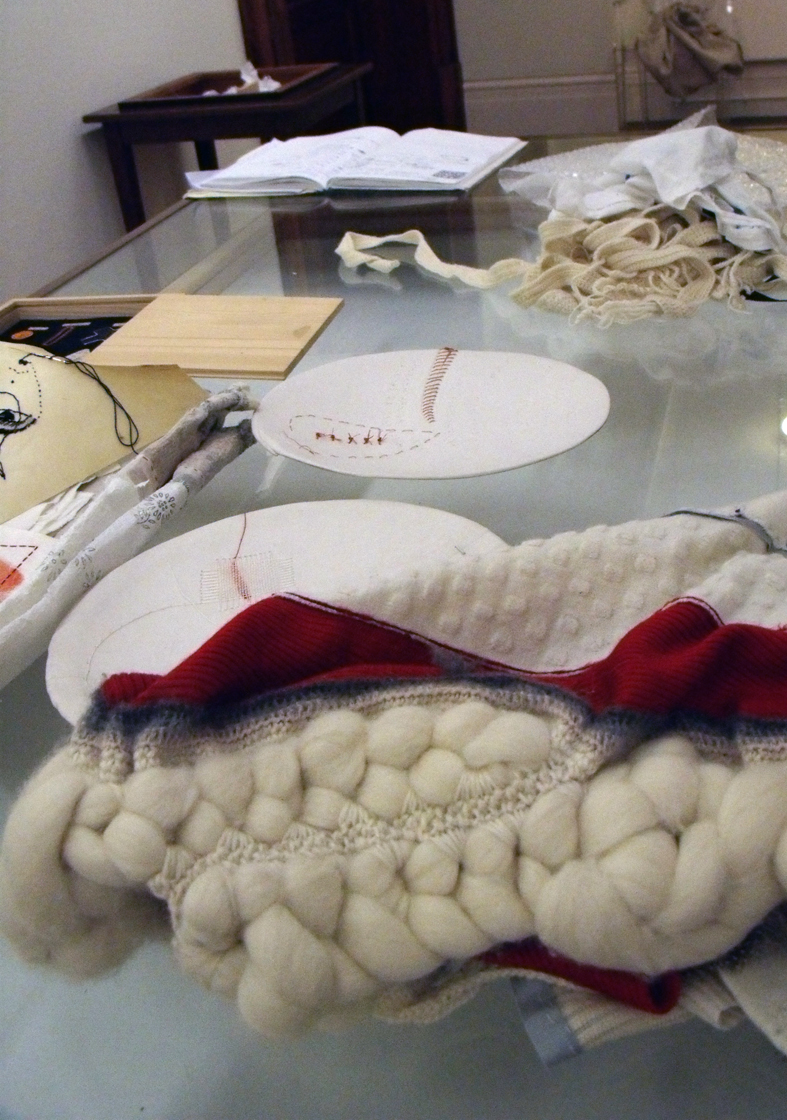
The bed in the centre of the gallery is Sarah James’ idea, she thought it would perfectly show off the bedding of Make it Through the Night and she was right! People are really curious and stop to ‘read’ the symbols and it makes sense when teamed with the Bolster.
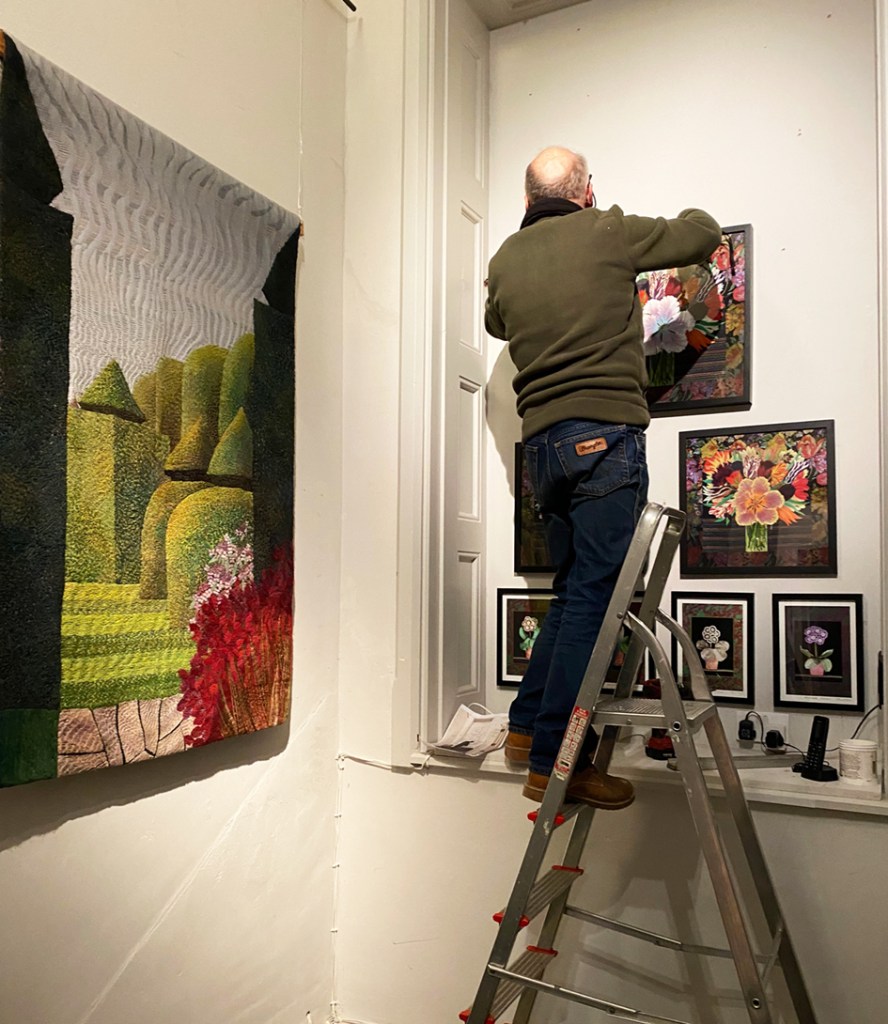
Eventually we get back to entrance with patchworked and embroidered and flowers but outside in a vestibule there is still something else to see, Russell putting up my framed giclee prints, unframed for sale in the shop with many more flower pieces. And the large ‘Lytes Cary Manor’ woollen wall hanging taken from my studio wall where it has lived since 2001.
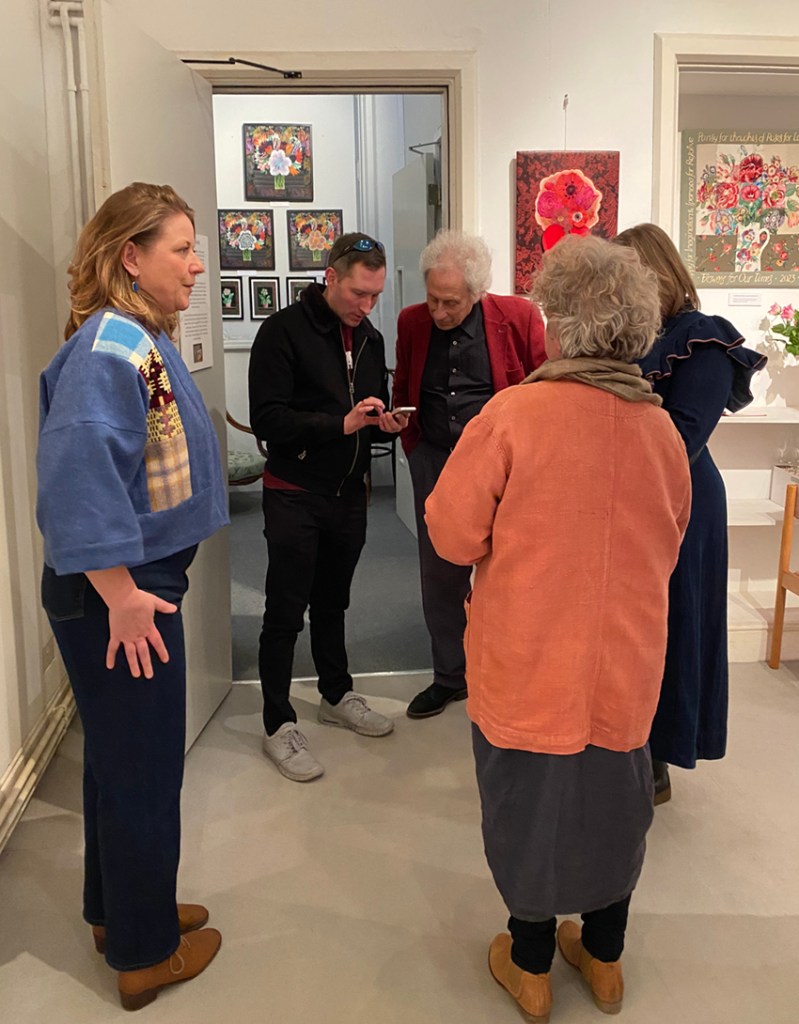
The very last picture I took was at the end of the Private View. A group of staff and on the left Jenni of Jenni Smith Sews talking to Hazel (who appears to organise just about everything around the Centre) waiting to hear how to get through the wild Welsh countryside to the restaurant for us to celebrate all the exhibitions and videos on display throughout this amazing place.
PS. my work is not for sale but my new giclee prints of embroidered flowers are available to buy in the fascinating vintage textile and bricabrac shop attached to the centre.
It is not without irony that I am posting the mending my old ‘mended hearts’ metal embroideries.
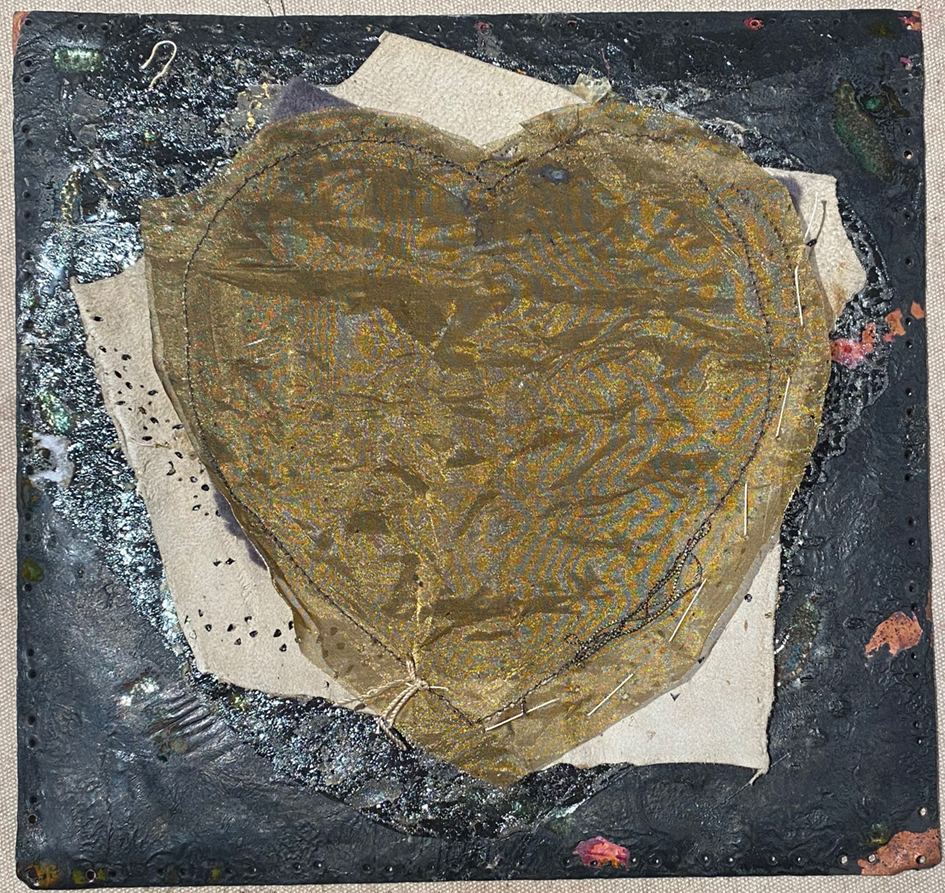
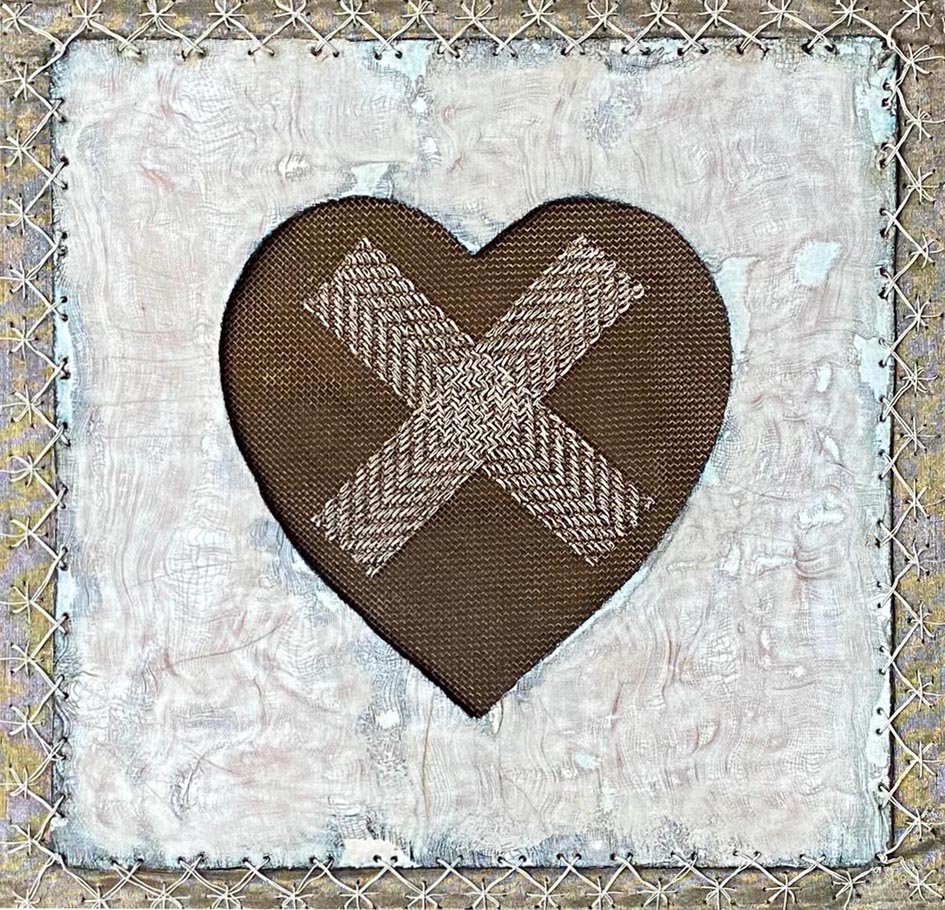
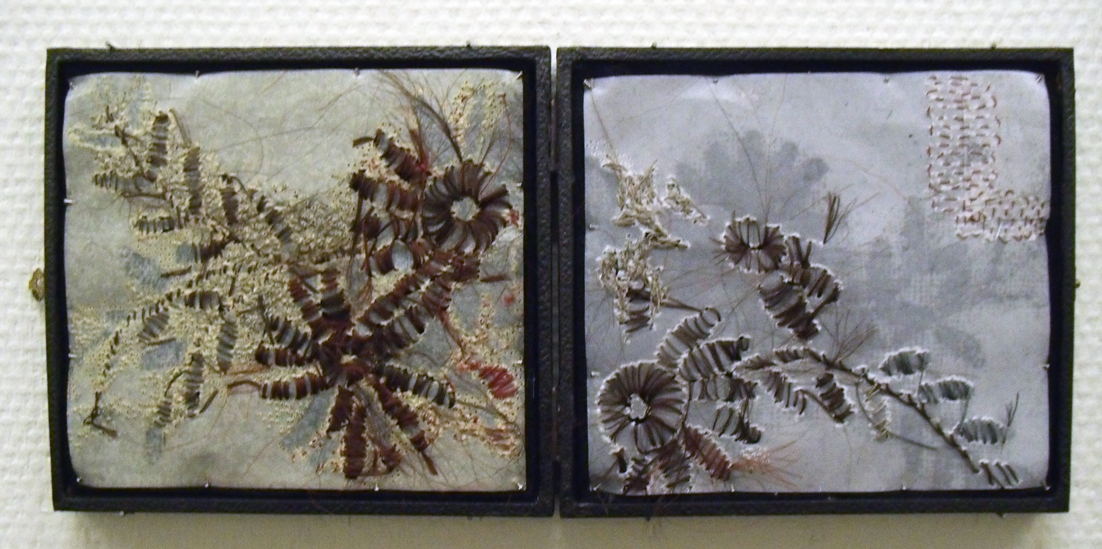
Above are the original images of 2 pieces of old work (circa 2010), left is Discarded Heart, and right Crossed Heart. They are just 2 of the outcomes of much experiment with some challenging materials – I was interested that these metal fabrics would last for a long time – far longer than the natural fabrics that I usually use…..how wrong I was!
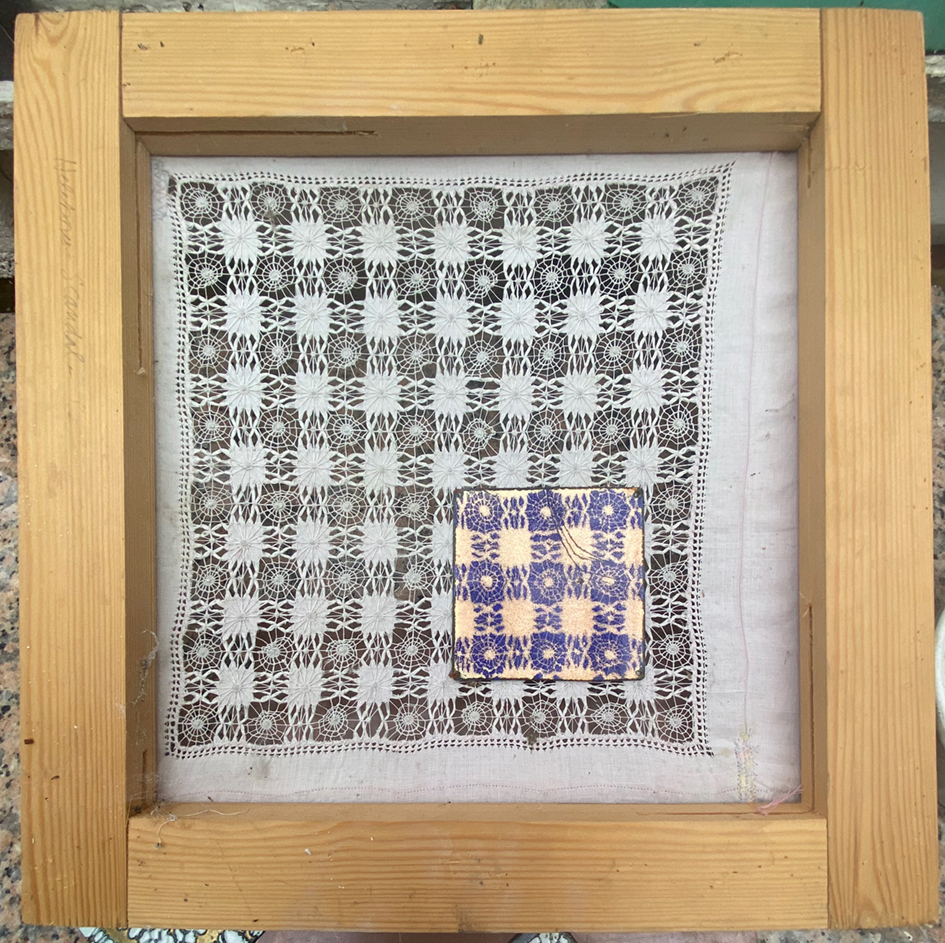
Searching in my studio I found a drawer full of old ‘fabric enamel‘ samples, that I had made use of for Discarded Heart. I had often used drawn thread-work as stencils and amazingly found the original stencil fabric , stretched and ready for use.
The most difficult thing I had to do was to repair the cracked enamel square. I wasn’t sure I could do this as it needed to be re-enamelled in exactly the same place as the original – fat chance! I carefully removed the gilded and stitched leather heart and re-gilded it. SO taking courage in both hands I re-stencilled it using a strong white enamel, then fired it at a very high heat and this made both the pattern very feint, and the cracks filled up – result!
Back of centre panel with leather and bronze fabric cut to free heart for repairs
Front of re-placed re-enammelled heart
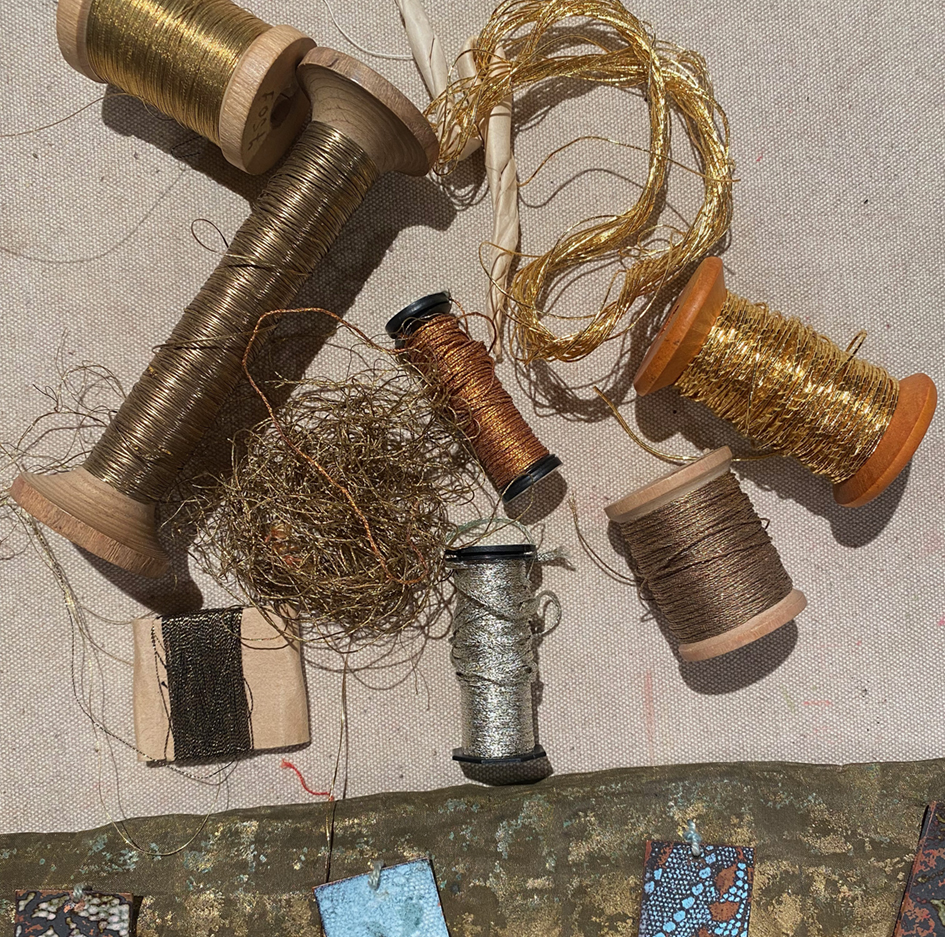
To get it back into postition I had to re-excavate and re-drill the stitching holes, so that I could painstakingly stitch the whole square by hand using real metal threads, ( trying hard to stick to my intention of NOT buying new materials but recycle anything I already own). I had several real Japanese gold and some copper wrapped threads to choose from, but this thread had to be strong and resilient for stitching through metal and leather.
After several half days of really awkward stitching, I managed to herringbone a wrapped copper thread all around the square.
Relief, as I had already offered the Discarded Heart (as it was it was originally made from lots of my. unsuccessful samples ) to the Welsh Quilt Centre as part of my 6 months exhibition called Hearts and Flowers in 2024.
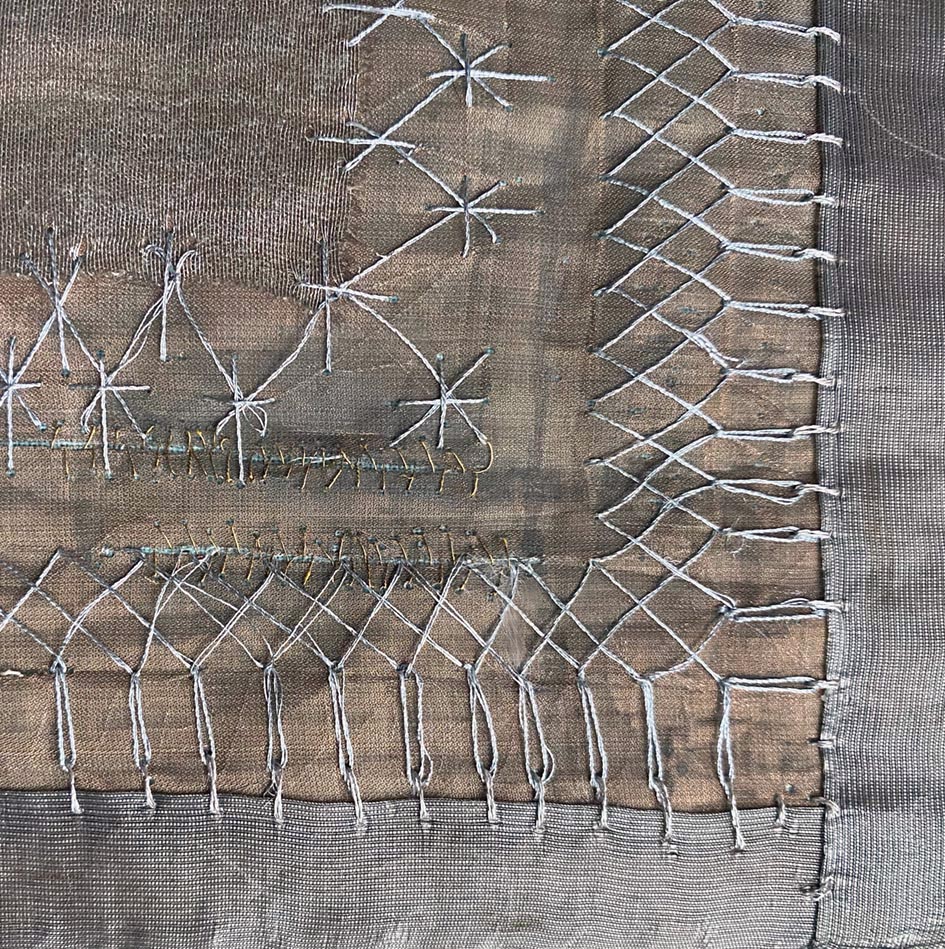
So far so good, but the next piece, “Crossed Heart” was really badly damaged – mostly by fading but seemingly anything it had been in contact with over the last 10 years….including my hands while working it! Everything seems to mark these refined woven metal fabrics (and I suspect Boysie, an ex fox terrier stud dog). And I thought that these fabrics would be as hard wearing as they are tough to stitch! I didn’t offer this piece for exhibition as I was not at all sure if I could make it look worthy of being exhibited again.
The only area not stained, faded or split was the centre panel of a decorative cross darn in white wire into a heavy copper mesh I had copied from a Darning Sampler in the Bristol City Museum and Art Gallery which has one of the most famous Sampler collections in the world. I kept this, but now had decide just what to keep as signs of legitimate wear and what I just couldn’t aesthetically live with!
The whole sorry embroidery put onto my worktable and pinned into place – the metal fabrics have a tendency to roll up on themselves when left alone; a metal memory even after 10+ years of being stretched on a fame. The staining is plain to see with the general fading and tarnishing, but what you can’t see are the splits on the background fabrics underneath the rows of herringbone stitches.
The first area I felt confident to work was a rip and I cut away the fraying fabric – a mistake – but hey ho, nothing ventured…and started to darn the gap in the metal and nylon woven fabric with 1 thread from a stranded silver hank of 6 strand….very tricky – I may yet go back and rework this!
I was not very confident to continue, but I had started and I am of the sign of the crab…..very tenacious. Here are various ruined areas of the work, with different mends : a proper running stitch strengthener over a pulled thread area, sewing an extra border in a nylon and probably lurex woven fabric (once a very glamorous skirt worn to a 1 very glamorous occasion)to hide the worst of the staining on the outermost edge of the piece ( Boysie?) and then surrepticious stitches to draw the edges of the split fabric together. The herringbone stitches had started to unravel – and by this time so had I.
but eventually they are finished enough for safely re-stretching and possibly have their place in the lay-out for the gallery as part of a group of stitched metal mended hearts…
I have been invited to exhibit my work at The Welsh Quilt Centre, when they re- open for next year. So I have been carefully choosing pieces to make a cohesive exhibition of the recent Flowers For Our Time, the related Flora embroideries with the collection of bedding, Make it Through the Night.
I realised that the work chosen fell into 2 distinct groups – there are always cross currents and references in any body of work sustained over long periods of time and some of these embroideries are 20 years old! I wanted to make links between them, and decided on a new piece that encompassed the mending broken hearts themes of the bedding with the perennial flower themes.
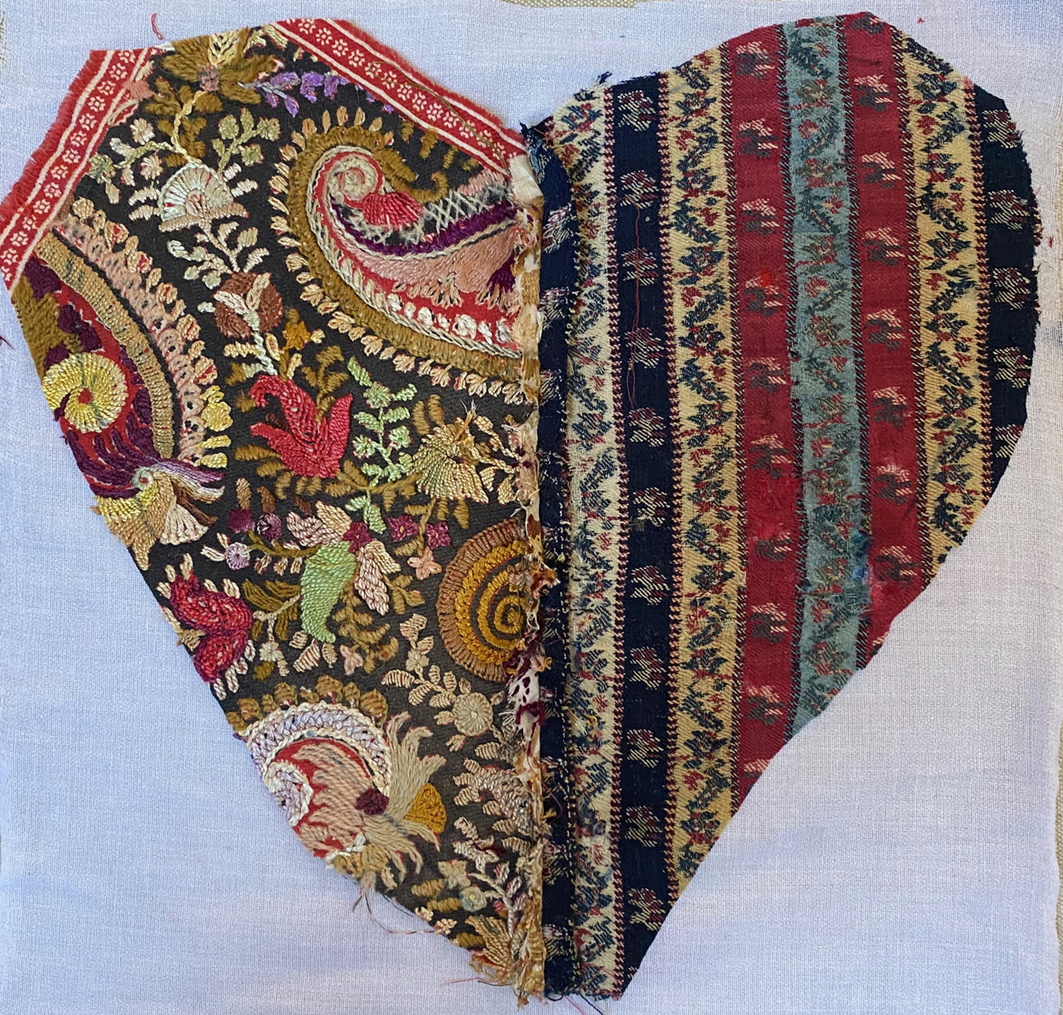
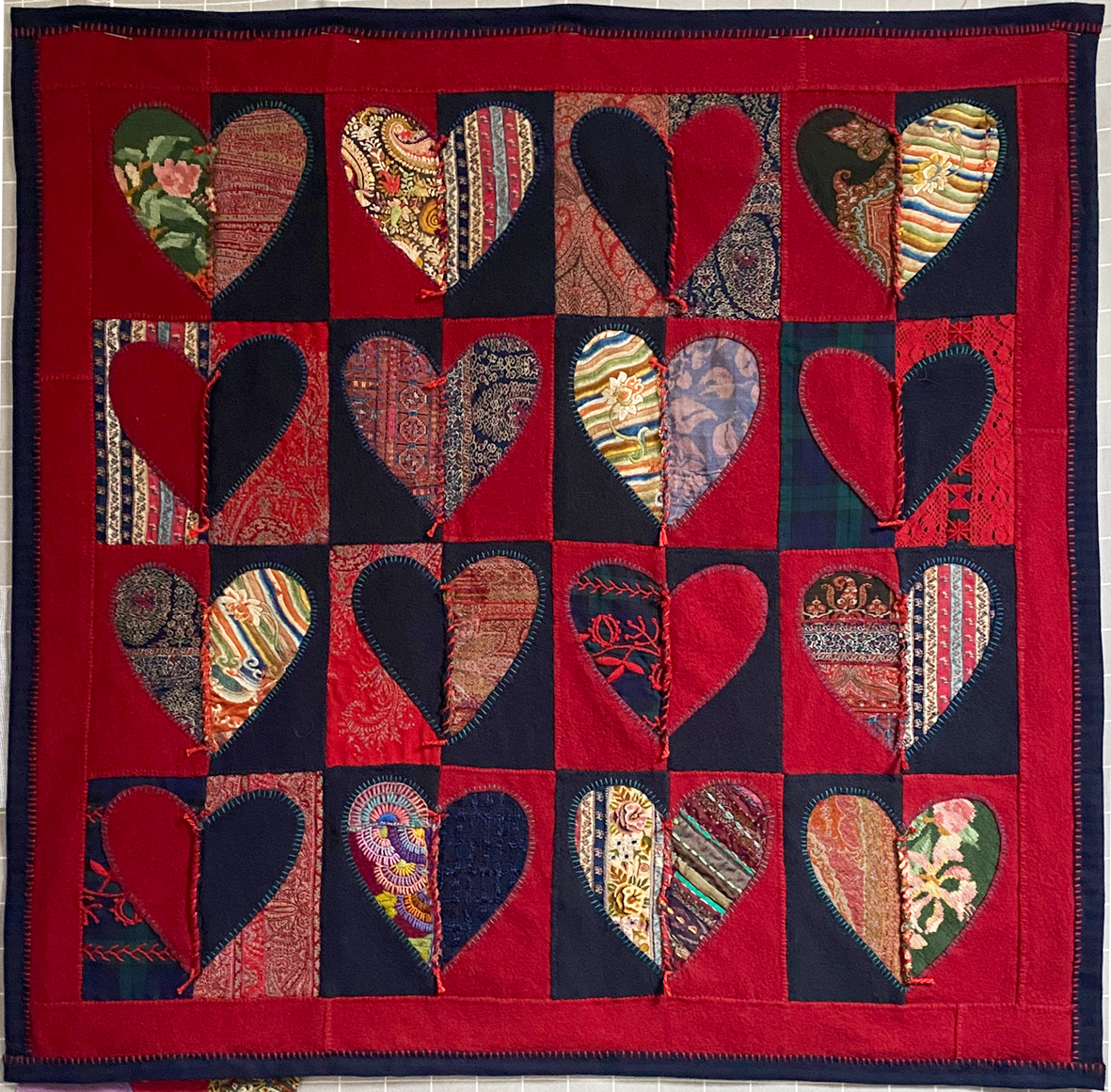
My sacrificed jacket fabrics reconstructed as a heart – the opening page in my sample/sketch book for “My Badly Stitched Blanket”.
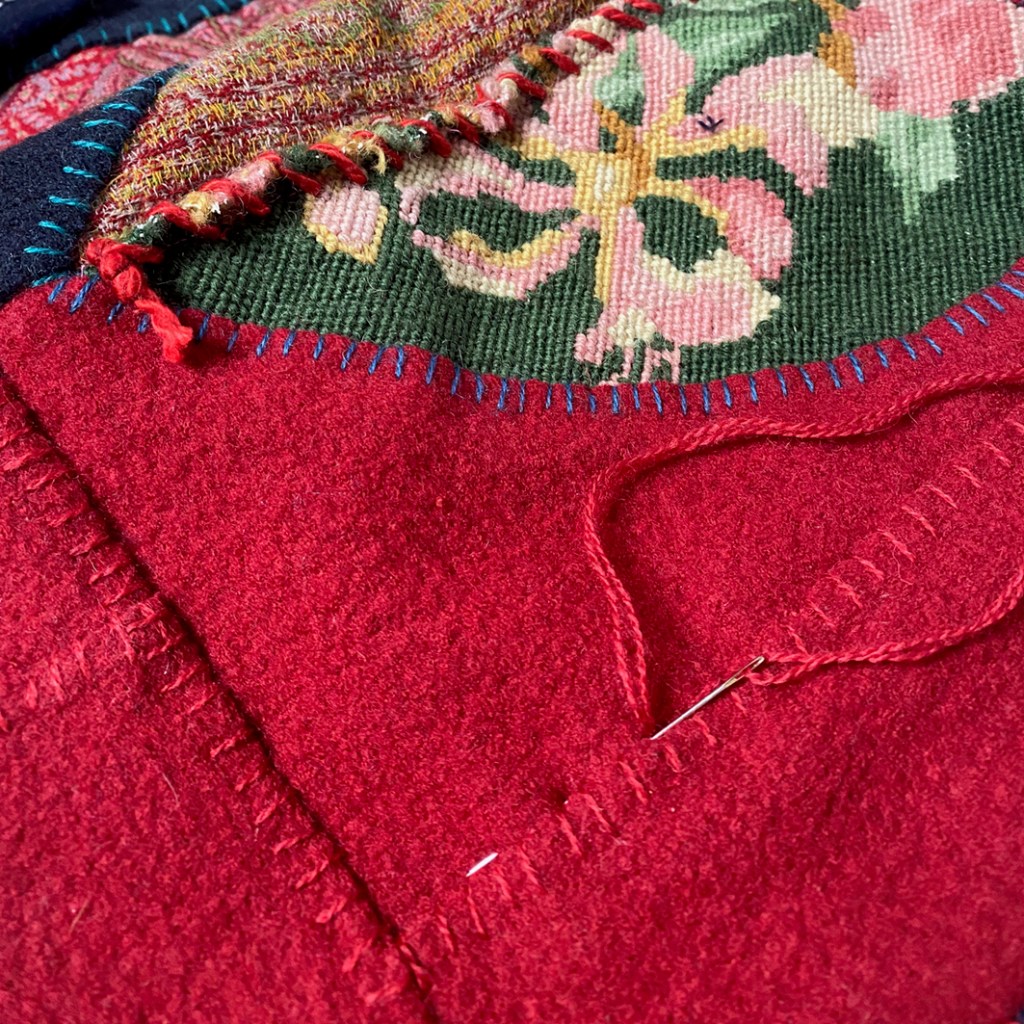
I looked at my studio wall and saw a small group of pinned samples for designs for Ehrman Tapestry company – the rows of split hearts and some fabric scraps that I had wanted to work into new designs. I also thought that it was time to use some of my most beautiful vintage embroidery scraps that I had hoarded for years… I had an idea to make a blanket – a comfort blanket.
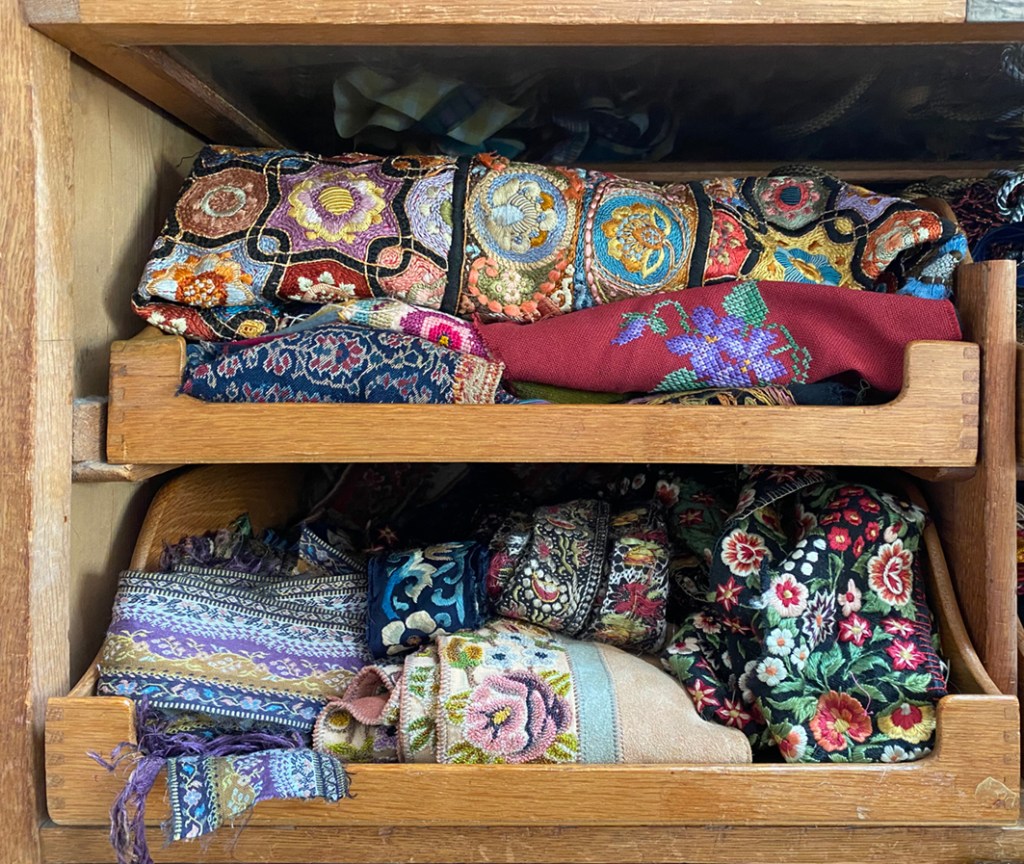
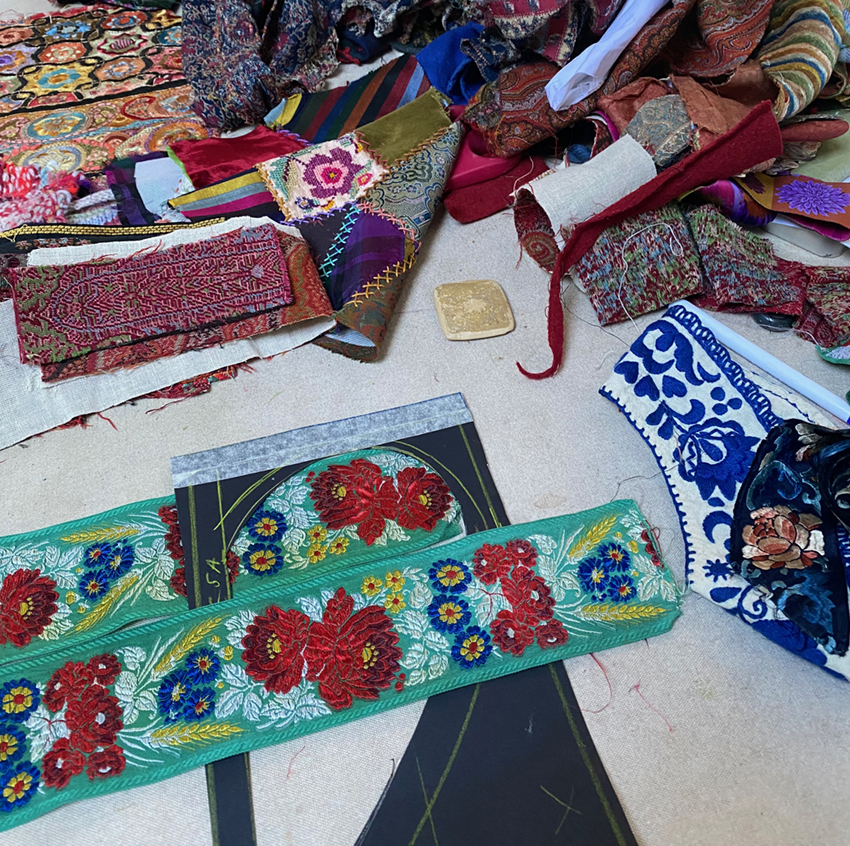
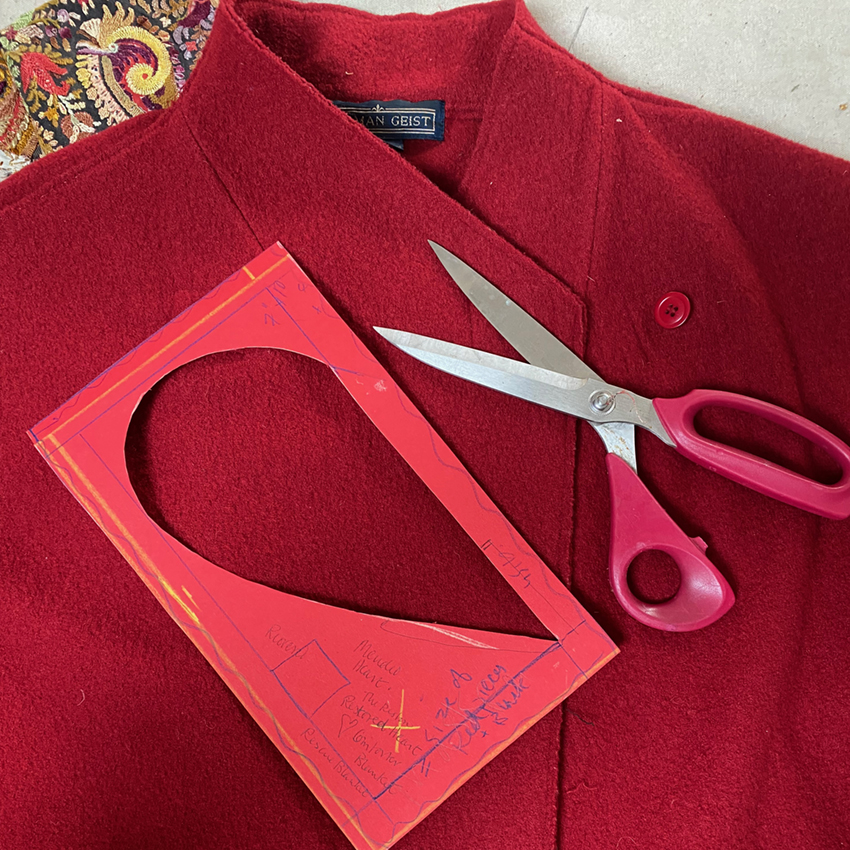
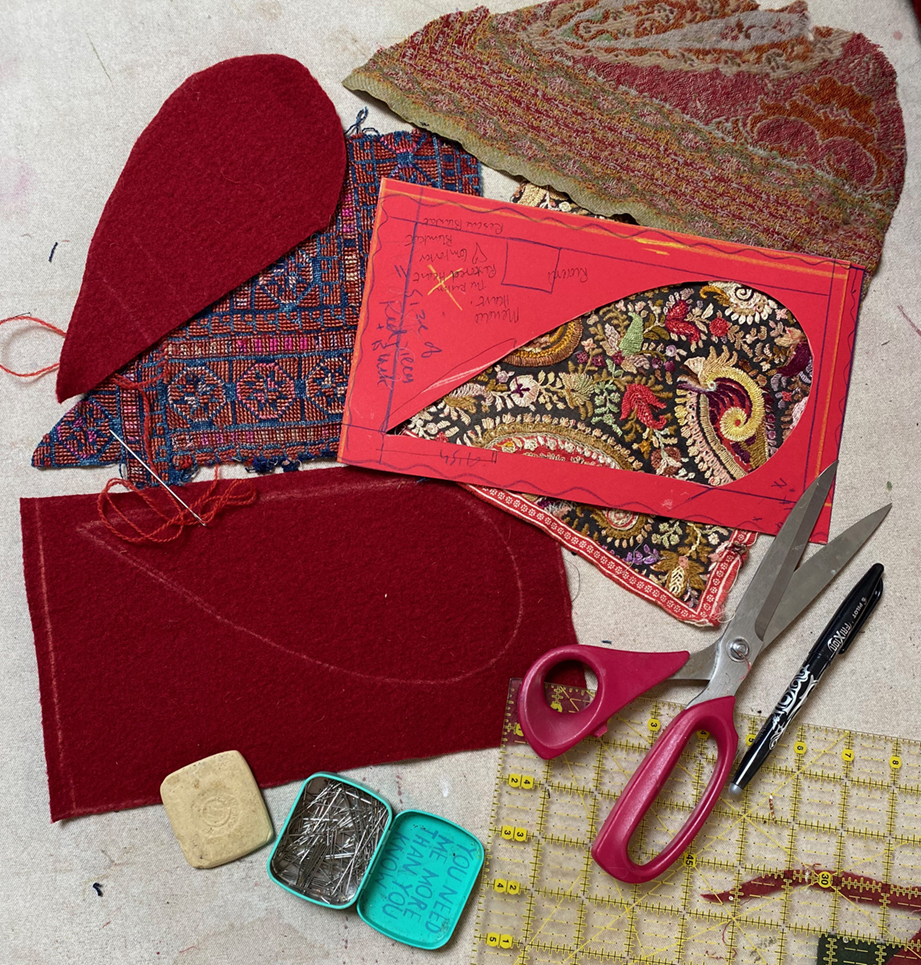
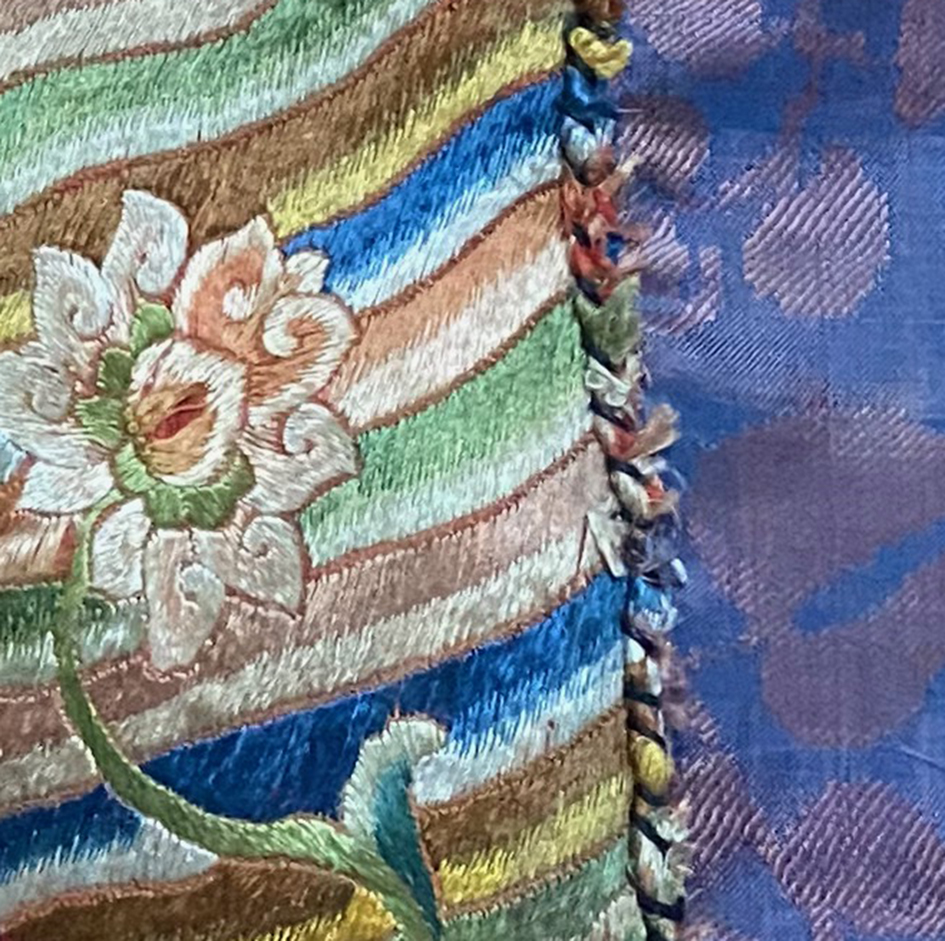
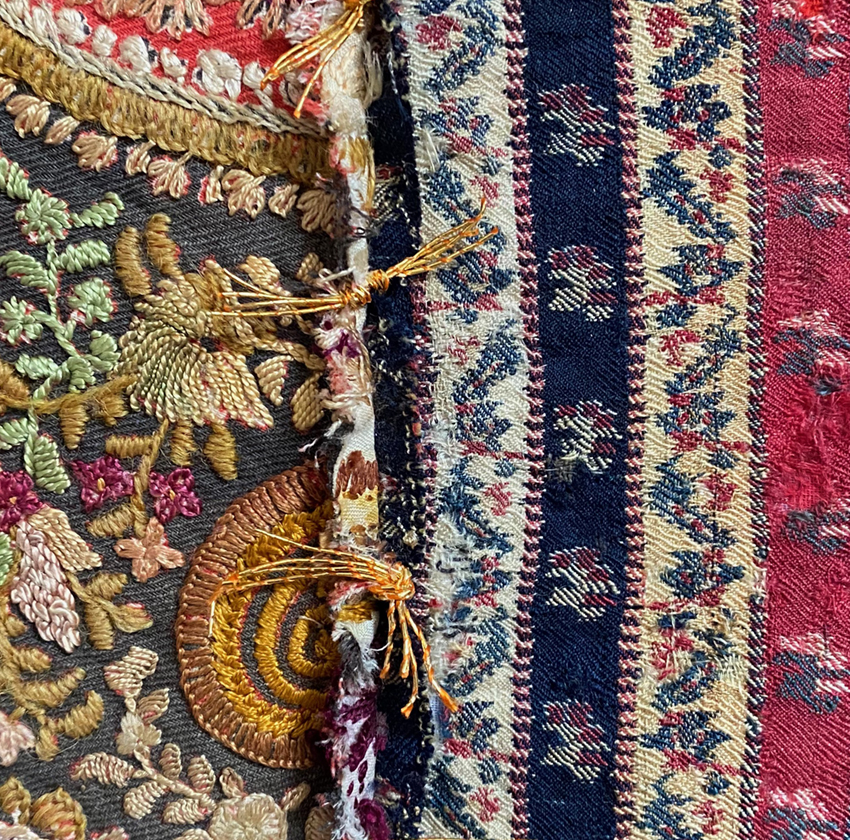
I cut a card template and started to place it over the treasured collected fragments of fine hand woven woollen shawls, silk Chinese robes and European woven ribbons and embroideries. I found my own old un-sold fabric design samples (from when I was a free-lance designer for an international fashion fabrics company). I thought I could use all of them all together – more is more!
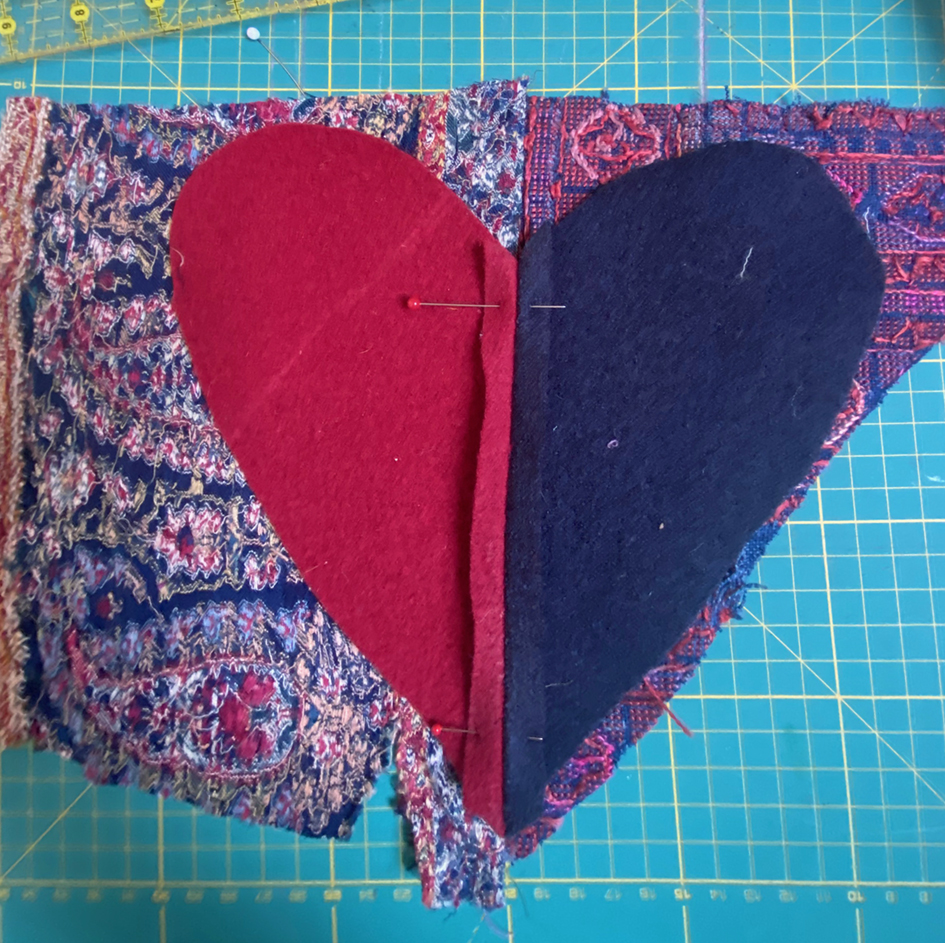
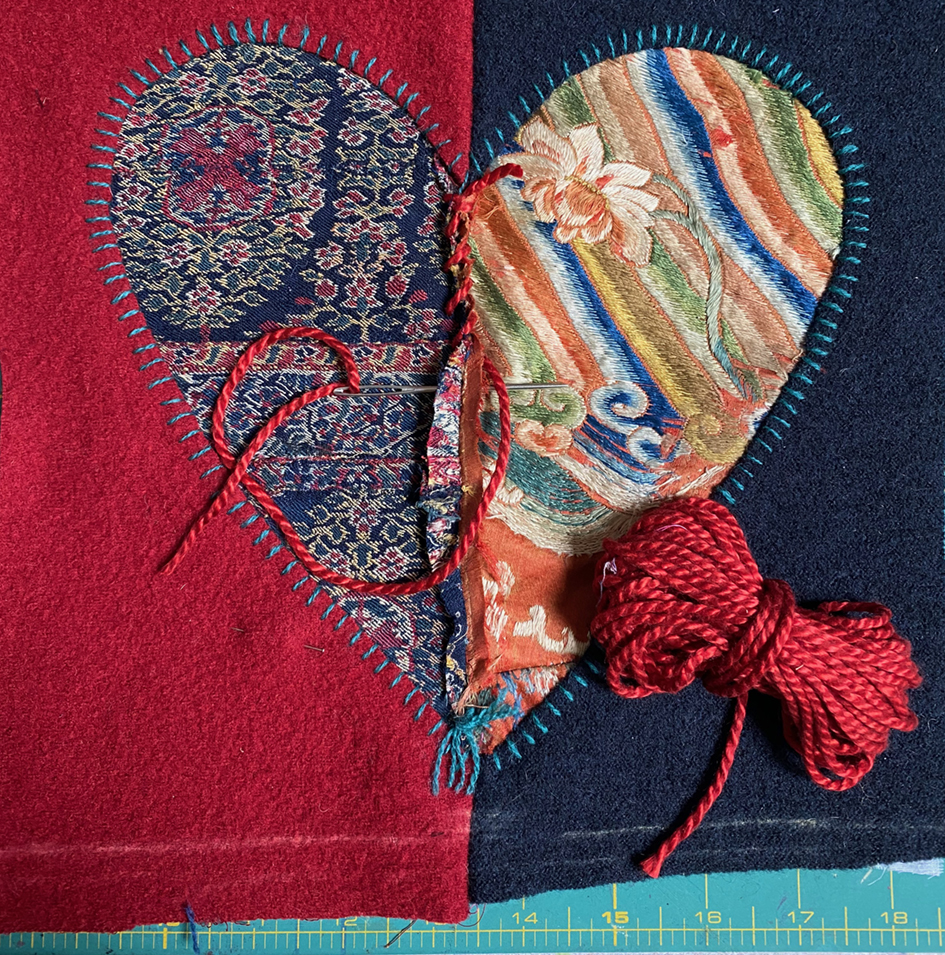
Choosing from my truly delicious and damaged fabrics, I cut out an oversized heart shape, and quickly realised that my original idea would look like patterned porridge. I needed to add some strong plain contrasts. And this is where the difficult part of this design process really started. I had very 3 old and well loved boiled wool jackets that I didn’t wear anymore I have to admit that I am very attached to my clothes and keep them for years. But the colours were perfect…….
Cutting up the red one was not so bad, it only got used lately for occasional dog walks, and it had suffered from moth. Somehow the idea of setting my treasured vintage and antique fabrics, in new cloth just didn’t seem right. With a heavy heart, and after a few days consideration, I reluctantly unpicked it and started to cut it up for the blocks. This was to be a hand-made quilt and this decision made me consider the work beyond its original purpose by provoking me to consider what it meant for me. It became deep down and personal.
I now wanted to show that this work was a part of my broken and mended hearts theme, which is predominantly red and black embroidery on white bedding, but this was supposed to be a celebration of colour and pattern. Now I was mending, recovering, recycling and rescuing my treasured fabrics and clothes as I had admitted to myself that I was never going to wear or find a better use for them. I couldn’t bring myself to photograph the cutting up of the navy blue Oscar jacket (I have kept half for a pattern – someday).
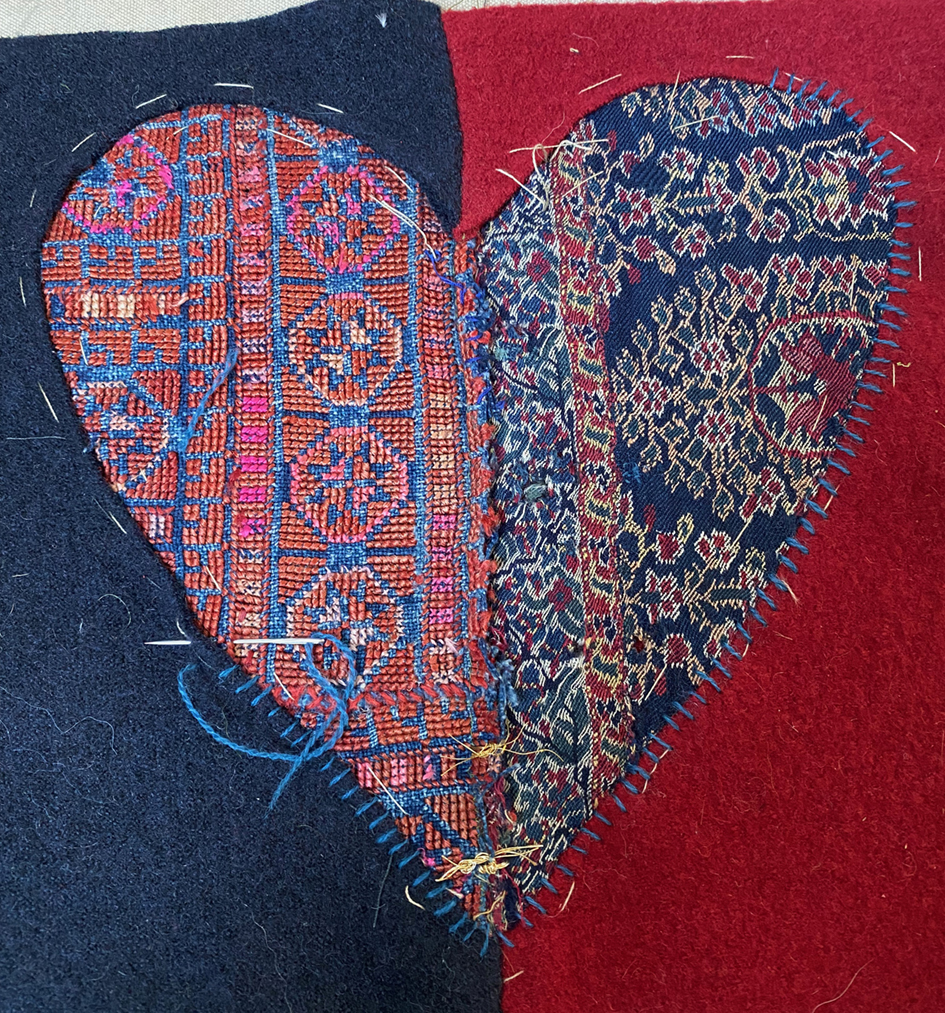
now the central join of the split heart was to be fully in evidence and the more jagged the join the better…completely at odds with my normal practice of (over) controlled stitching. I decided to use the Surgeons’ Knots on the outer seam and leave it un-neatened, like a scar. I tried various threads; above left an oversewn waxed thread and I thought about gold as still I have real gold threads bought in Japan years ago – totally perfect until I saw a hair conditioner advert featuring gold filling on a dreary vase – suddenly all forms of value has been taken away from this ancient mending symbol for me for now. Then I found the too-heavy-to-sew red silk.
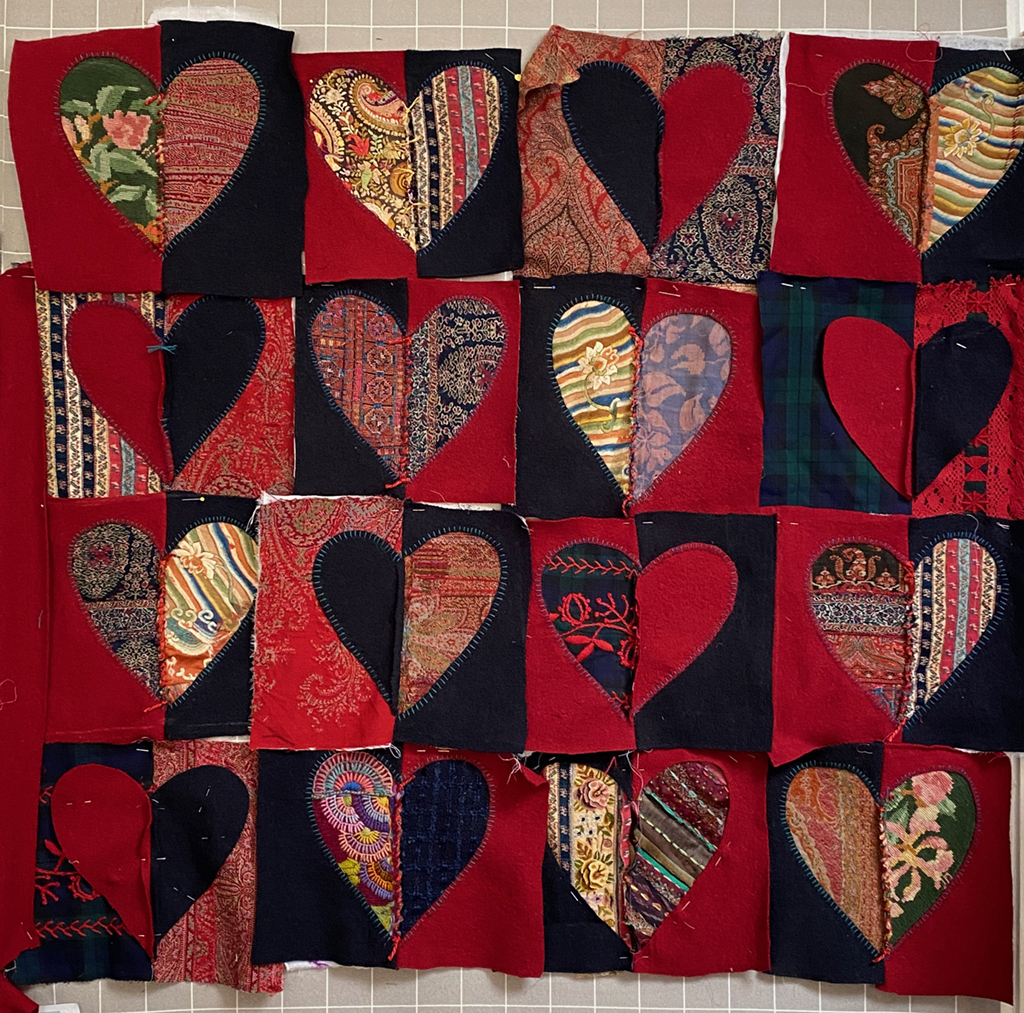
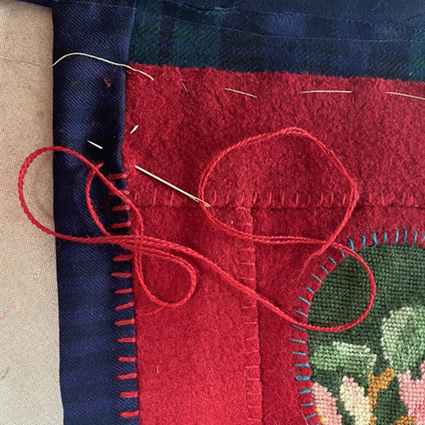
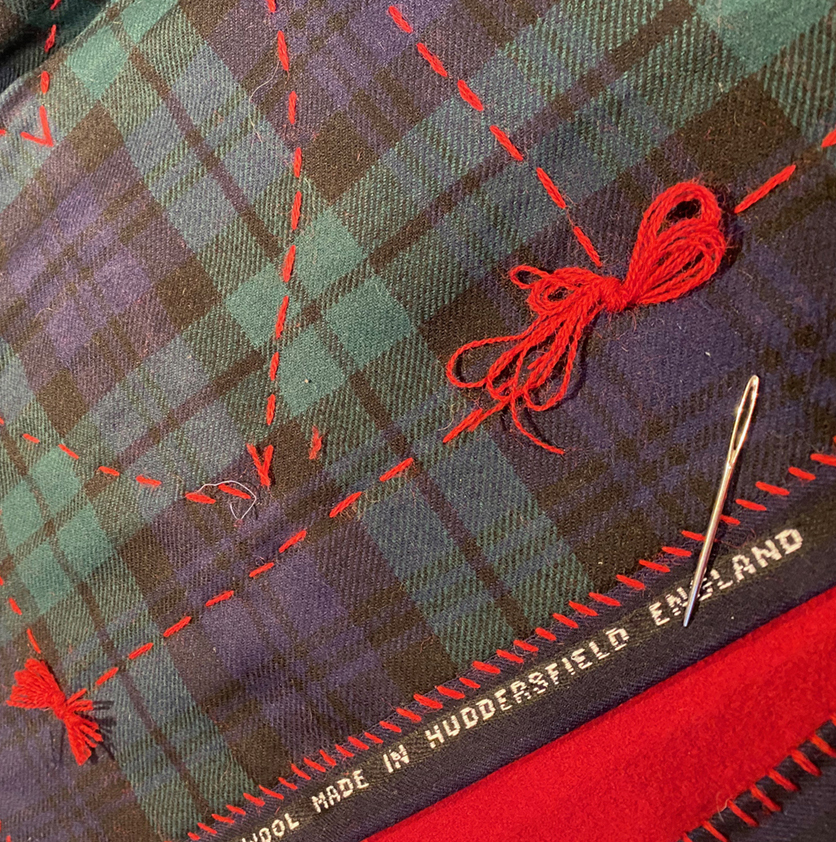
And this is where the title of the quilt arose – there is no way that I could control stitching this yarn and coupled with the slightly wonky sewing in the hearts I think it is a perfect title. Eventually I rescued enough fabrics to make 16 blocks to arrange on the quilt wall ready for sewing together by hand onto a large sample of tartan wool as a backing!
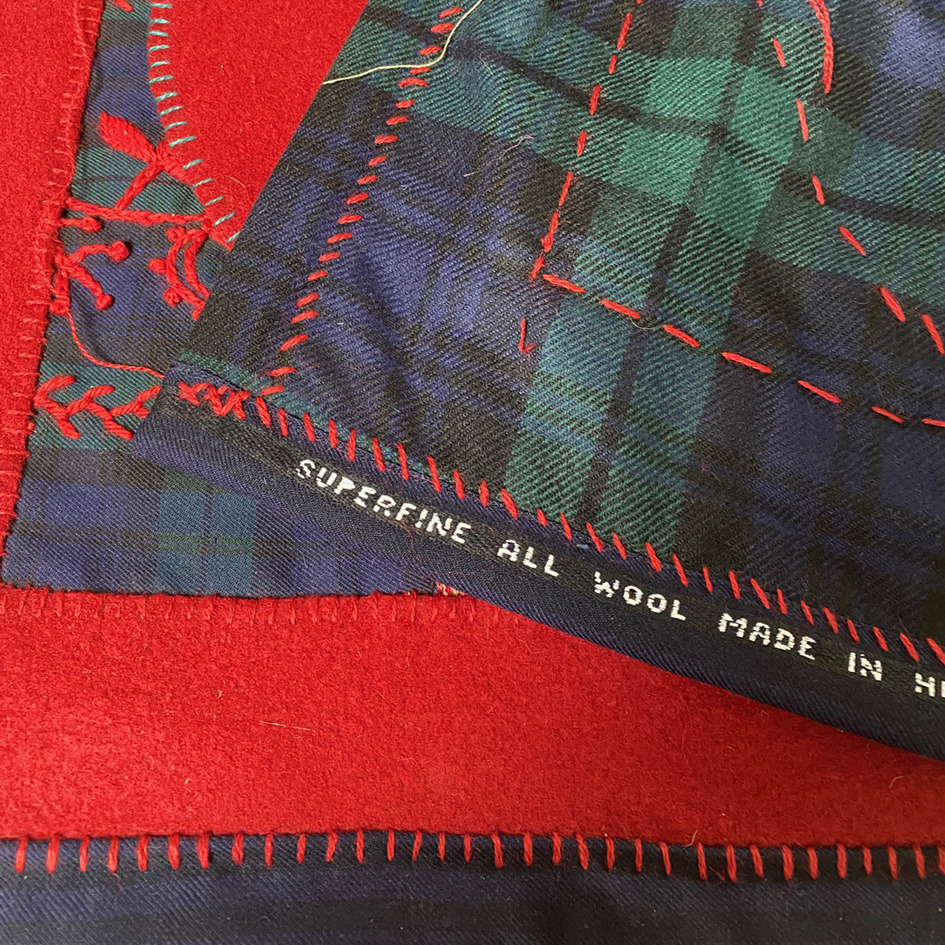
This was plain sailing after all the the decision making – but as I had oversewn the hearts into the blocks in fine wool yarn, I now felt I had to continue with the borders in the same way but the lack of having to rule a stitching line and unpick when necessary made this 2 weeks of work rather than 2days!
I kept the beautifully woven selvedge of the last border fabric as a testament to the quality of “Superfine” British wool and weaving traditions. And here it all is pinned to the wall this morning.
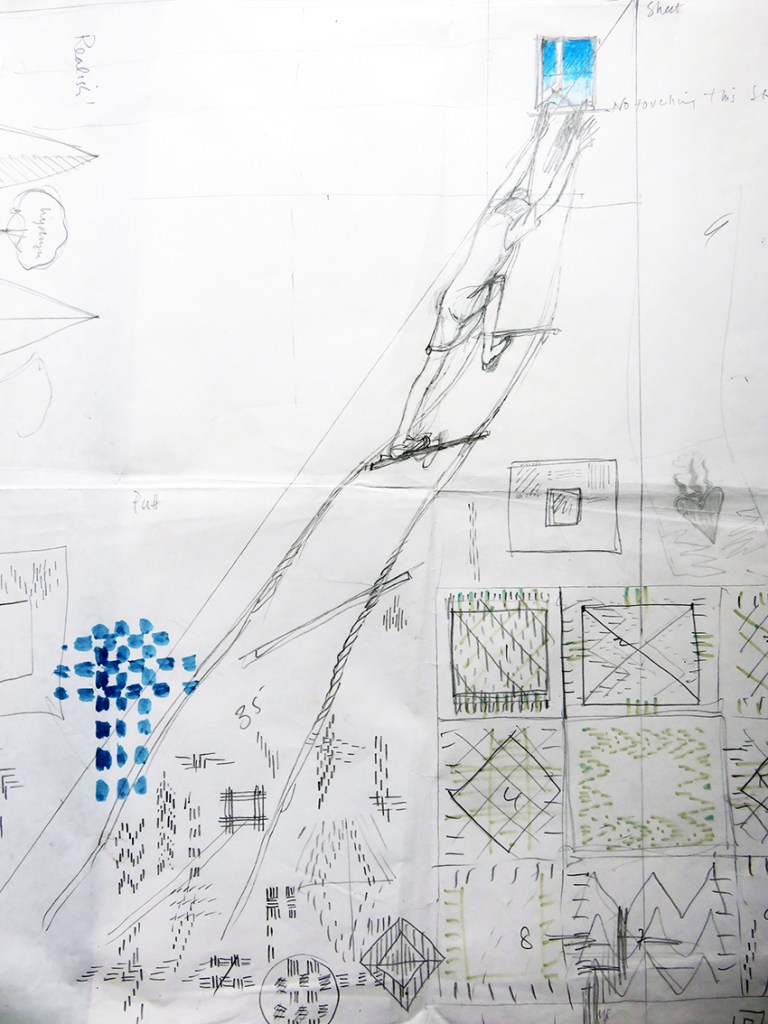
These rapid drawings below are early attempts to express one of my most vivid dreams lest I ever forget it…. But the dream was not ready to be forgotten, it has reoccured often in one form or another – evidently I have not learned its message; the loosening ladder rungs and the tiny impossible blue window never change
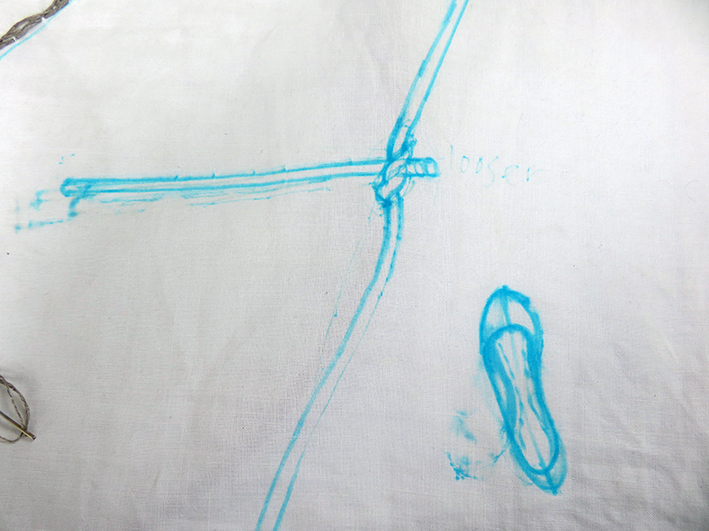
the earliest drawing above on the left has some written comments that I was interested in using for the embroidery also I seem to have both shoes on; the one on the right is scaled up for embroidering on a sheet! What was I thinking?
Here I am again some years later ( the shoes are getting looser) climbing out of the chaos of my scribbled darning designs for a book that eventually never got published!!!!! with a burning heart to the right and no way back down that ladder. Circa 1998.
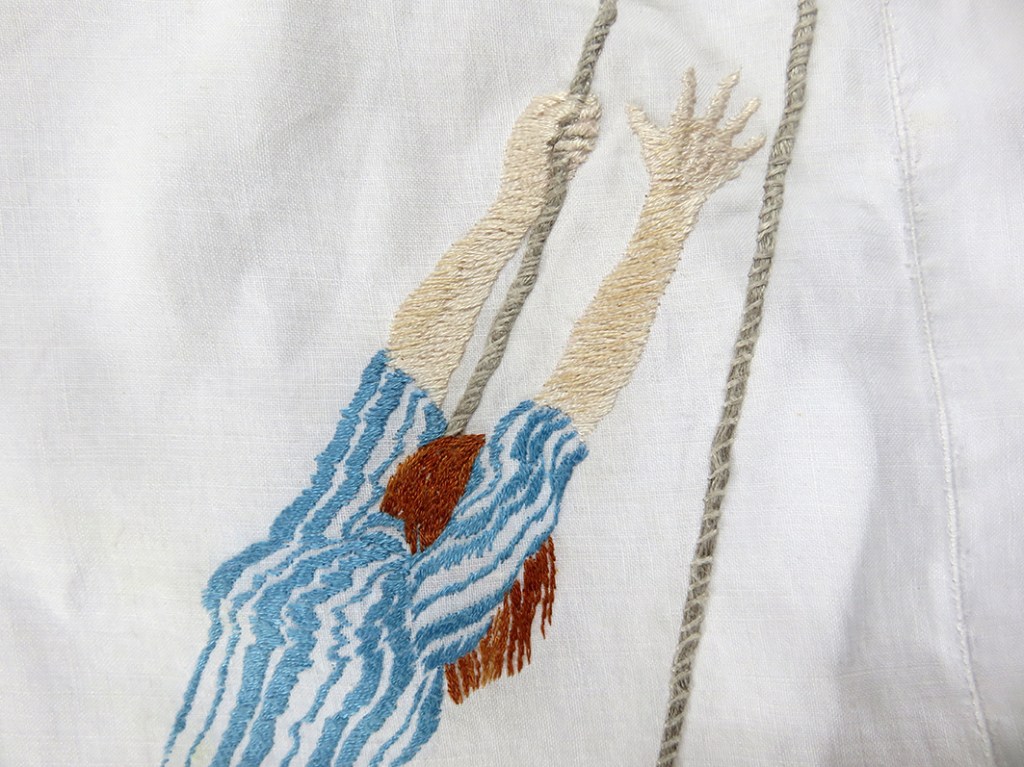
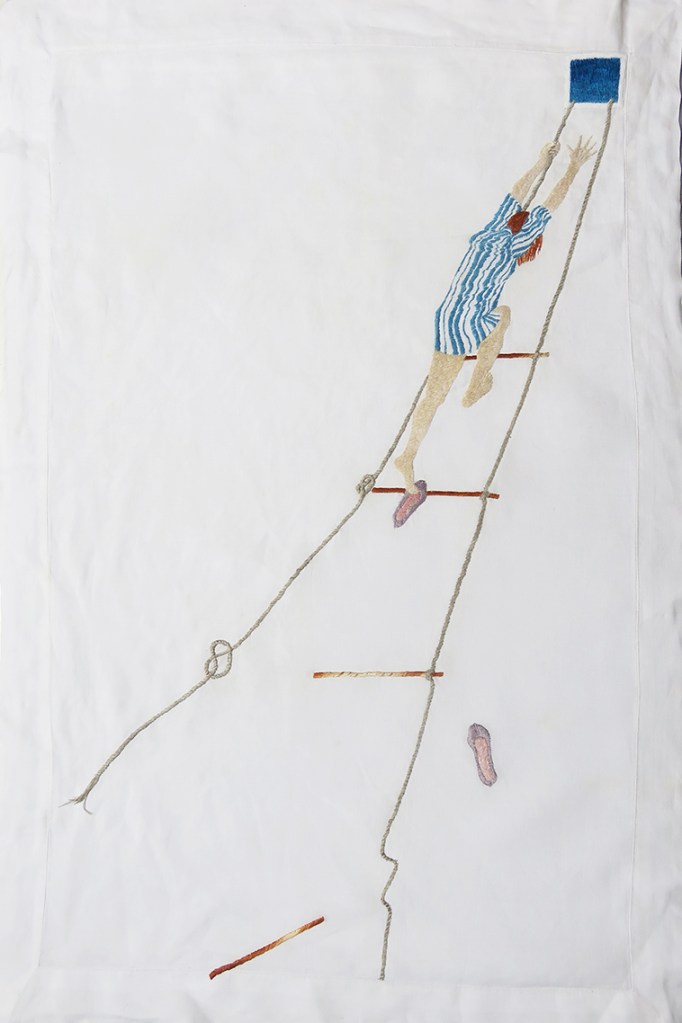
So I recently decided to embroider it as a pillow for my ongoing project Make it Through the Night . It is a simple idea and my friends who saw the drawing were highly amused by me in my nightdress losing my shoes…but I started this piece just before the lockdown and now I see it in a very different light.
The most recent drawing I made using a photograph of me in my nightshirt climbing on a chair.
drawing now traced straight onto the pillowcase in water soluble pen – all the drawings alongside
The interpretations of dream referring to ladders are many and varied depending if you are climbing up or down, and a broken rung (just the one) means “you will never achieve your greatest ambitions” while “to lose a shoe is indicative that you have forgotten something important ” or “finding your direction in life difficult” – and as to the lack of underclothes whilst climbing a very high wall in your nightshirt……
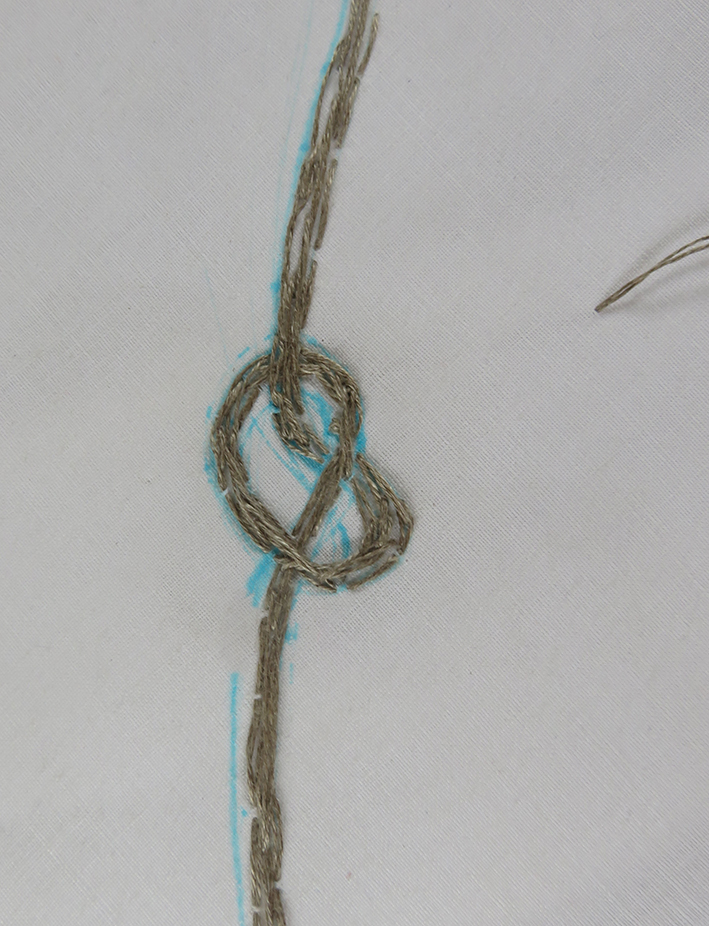
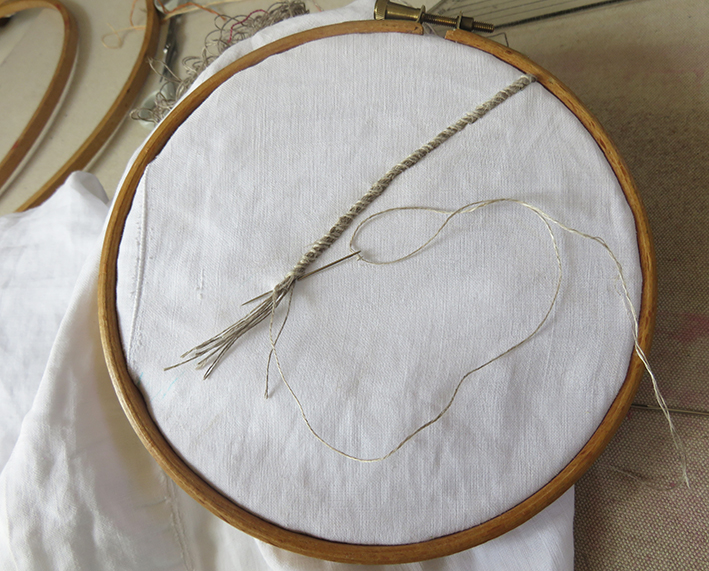
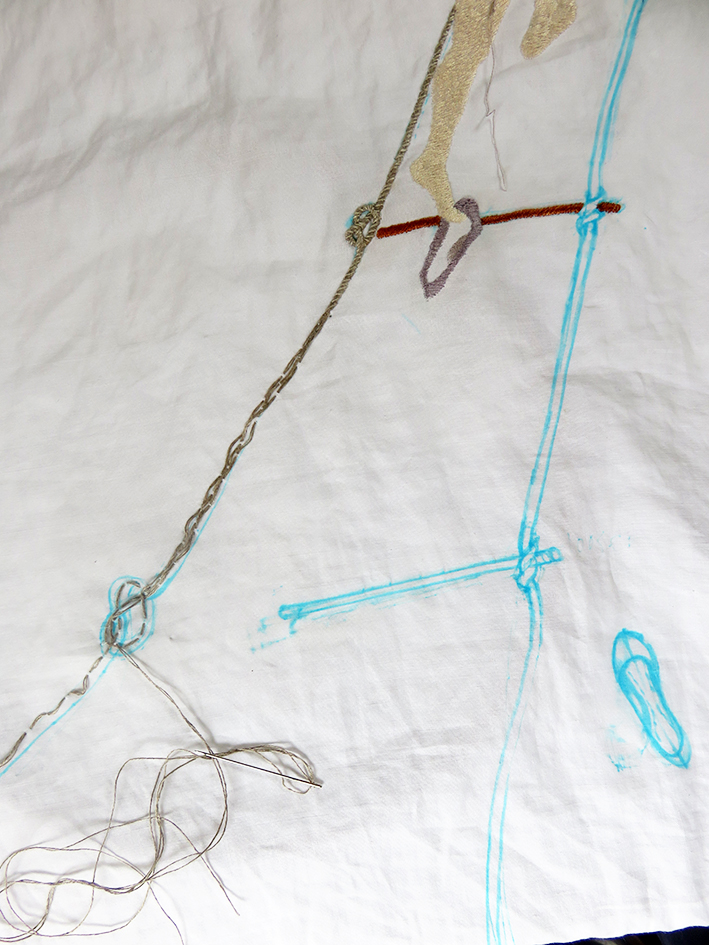
I found stitching the ladder the most challenging piece of work, a vintage pillow has only a limited space for inserting embroidery hoops and working straight onto fine linen needs stretching. I preferred to use some natural linen yarns and whip them into position making a more fluid line – finding knots and drawing them became a fascination.
above are the various ways I managed to stitch the ladder into position, with and without a stretcher.
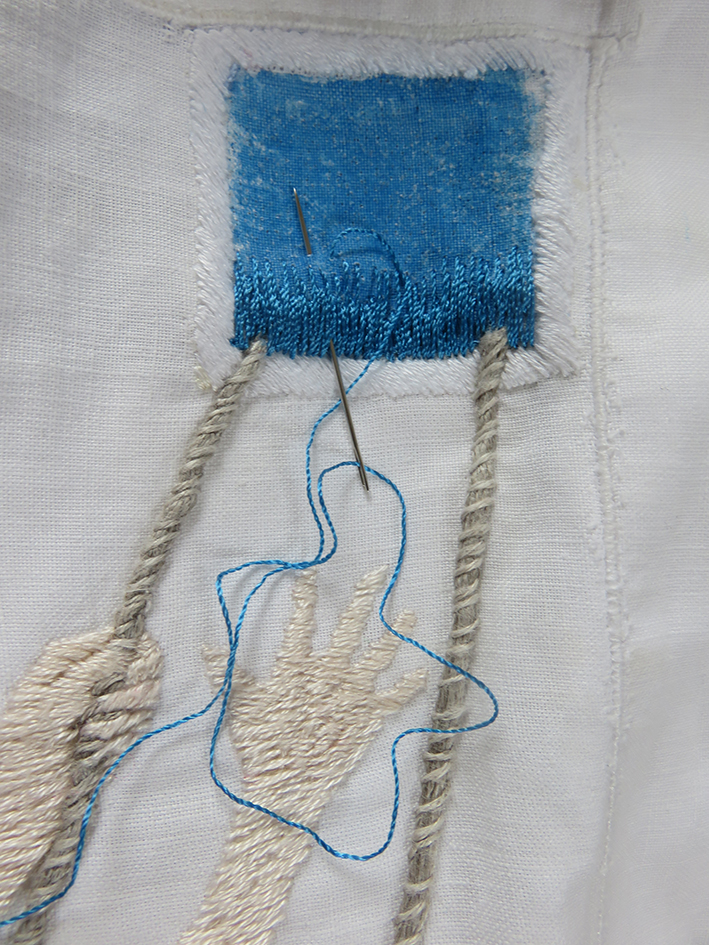
Now to the window: in some dreams it is impossibly teeny tiny, in others I get to go through it – only to find a steep and shaky descent on the other side into more blueness, the one thing always in common is that it is always a brilliant and shining deep blue
the background of the sky is painted with cotton dye, then embroidered in silk threads, it is high up in the farthest corner of the pillow case
and here it is finished – washed, starched and pressed as a proper piece of Household Linen
I feel now that it makes its own statement without the added words; and why should it balance? I mean, what am I describing?
AND it is only after finishing this that I see this is a perfect portrait of how I feel right now – just coming out of the strictest lockdown period….uncanny!
However, we were well into the current lockdown before I had found the impetus to finish this work. And while stitching I realised that I just wanted to stop this whole project that excavates very personal ideas, dreams, mottoes, and observations….I did have more ideas that I planned to stitch, but now I no longer want to make them. It has taken me over 10 years, off and on, to get here.
I use drawing to express myself to myself. I feel that Drawing is the language closest to my heart; my second and most used language after English, followed by the most difficult to have mastered, Stitching. It is the foundation of my chosen discipline of hand-made stitched textiles and almost all my work starts with a drawing, sometimes just a scribble or as a written note, but it will be expressed as a drawing with enough information for me to proceed.
Scribbled thoughts are put down as lists for skies I see when waking up, and on whatever is to hand. The imagery is enough to lead me to another drawing…..
the first annotated drawing left, was made in pencil in my bedroom in the dark as I saw the setting moon. The second later that day in my studio in order to make the full colour version that became my working drawing for the Kantha stitched embroidery
The working drawing stays with me though-out the stitching process; left the first attempt to translate colours to fabrics and later the stitch patterns were added to the original drawing to help me to understand how I am going to hand stitch the fabrics
Very occasionally when I work from photographs, I will start an embroidery without a drawing – and it always leads to difficulties as I am torn between the ‘real’ thing as recorded by the camera and my initial vision of it. Basically the drawing is the first edit of the image, it concentrates me on what was important when I first took the photograph, but the camera sees everything and I get seduced too easily by captured colour, and sometimes the colour isn’t the same as my memory.
Below are various single pages from individual sketchbooks – the top 2 are observational drawings taken directly from life, the red in pen and ink is a detail from of my garden, the iris was from a friends garden. The the others are all working /design/ research drawings, (with added photographs of finished brooches)
I keep all my working drawings in a series of books that go back some 40 years! The types of drawings collected in them range from a scribble on the nearest available paper, as above, through to straightforward observational drawings that then get re-arranged or even collaged together
above are the collages design drawing and the finished embroidery of the great garden designer Gertrude Jekyll.
then eventually the detailed working drawings are assembled and kept together, and accompanied by any other research materials.
The images above are open pages of my own research books from different long term projects, they really show the way my mind works, both visually and mechanically.
The 2 pages below are anemone flower drawings made from photographs in a garden magazine many years ago for my Flora embroideries, they have inspired many many different pieces of work in a variety of materials; good drawings have their own energy and life.
a few of the many different works that have been generated directly by the drawings above.
The images above are of vitreous enamel dishes and a silk applique with a machine stitched drawing that plays with the idea of anemones, another name is windflower.
Occasionally I do make finished drawings ready for exhibition.
but somehow the stitching seems always to get in on the act.
Sanderlings flight postcard: paper, crayon, silk.
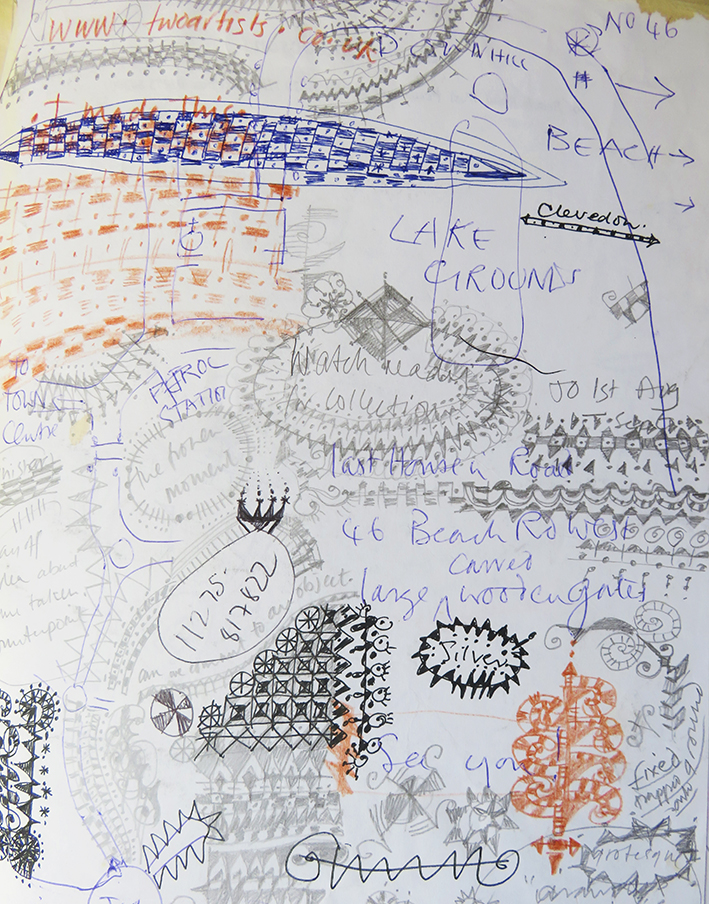
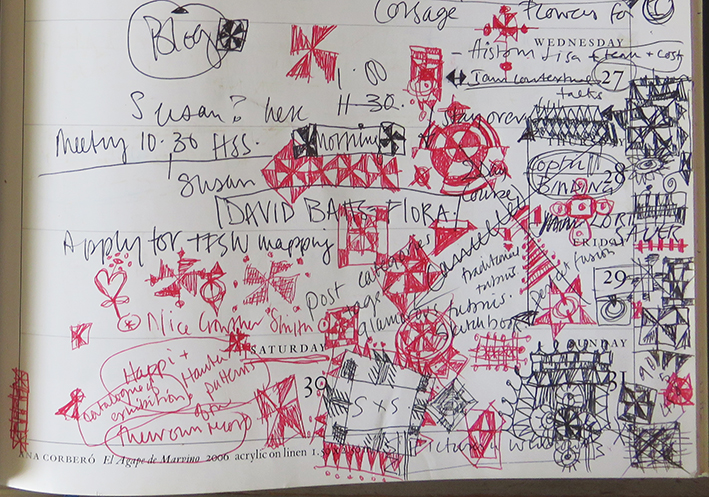
and here are I suppose my most personal drawings ( sad isn’t it) that just arrive onto any page near me, usually when I am talking on the phone to friends and colleagues, and sometimes prospective clients but always when i am fully engaged, they do not arise out of boredom. What is very strange is they have never changed over all the years I have been making them…
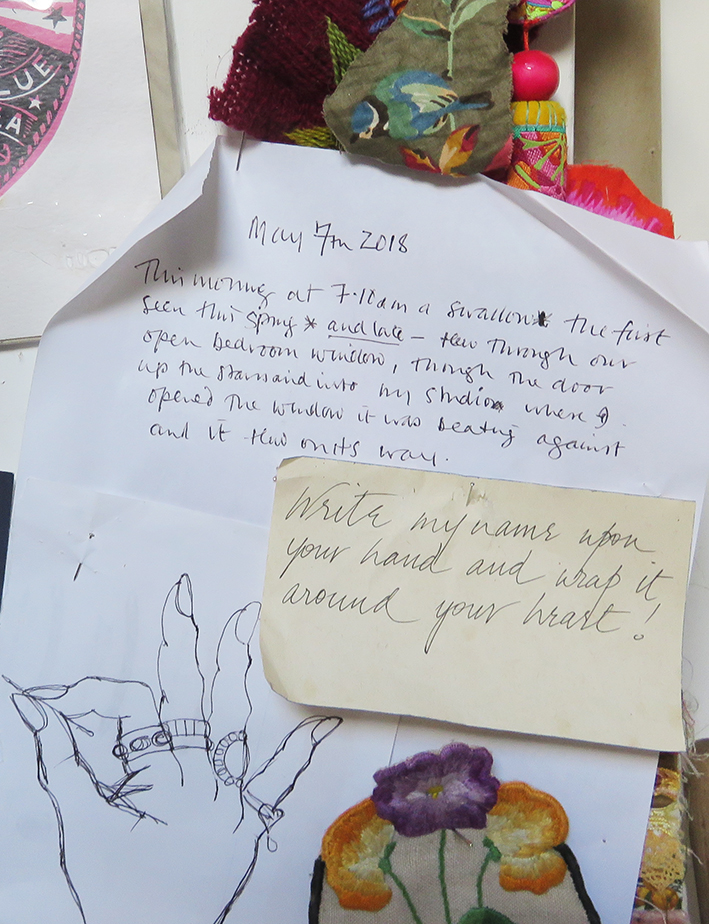
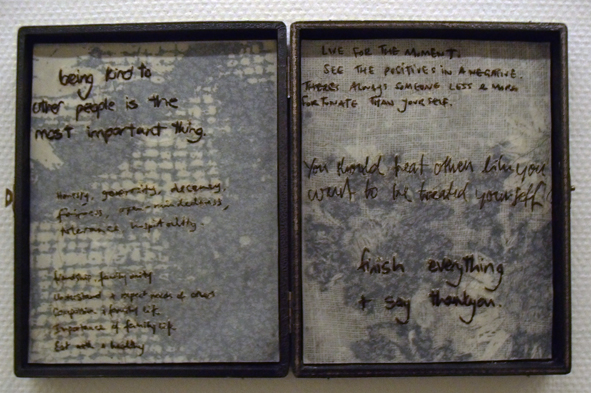
Affirmative sayings seem to be the philosophy of our times, the be-in-the-here-and-now mindfulness movement. But I have been collecting and pasting all sorts of sayings and mottoes in my work books and on my studio walls for years. Quotations, overheard remarks or messages and even poems from friends sometimes develop into pieces of work, but most often they just serve to enable me to grin and bear with it – see above!
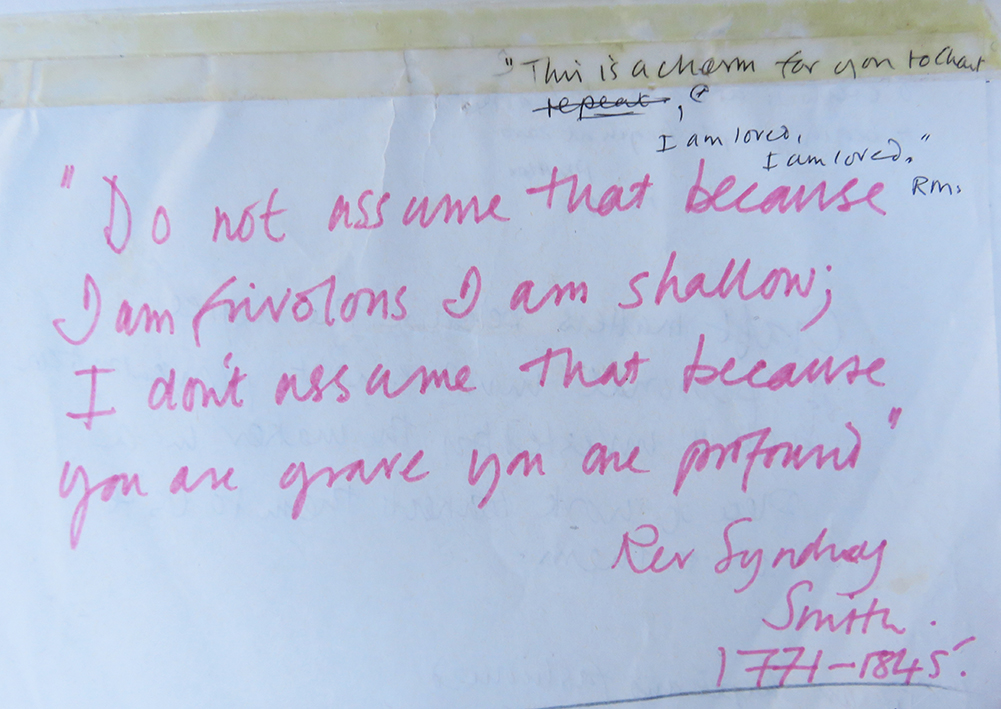
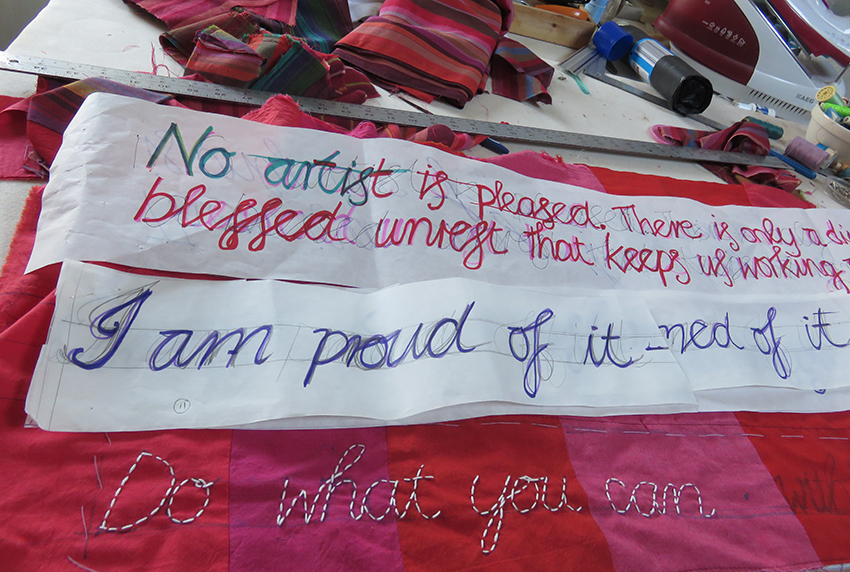
A current favourite was heard when I was mid-way through making the ‘Butterfly Dream Pillow’ – “I am proud of it and I am ashamed of it” immediately struck me as the perfect expression for how I feel about the work I do. I wrote it down on my work-top with the first thing that came to hand – an indelible pink marker! I have read it out to other artists and makers, and they smile and nod in recognition.
A quote from an interview heard on Radio 4 by a musician having just heard his own work played, my heart goes out to him.
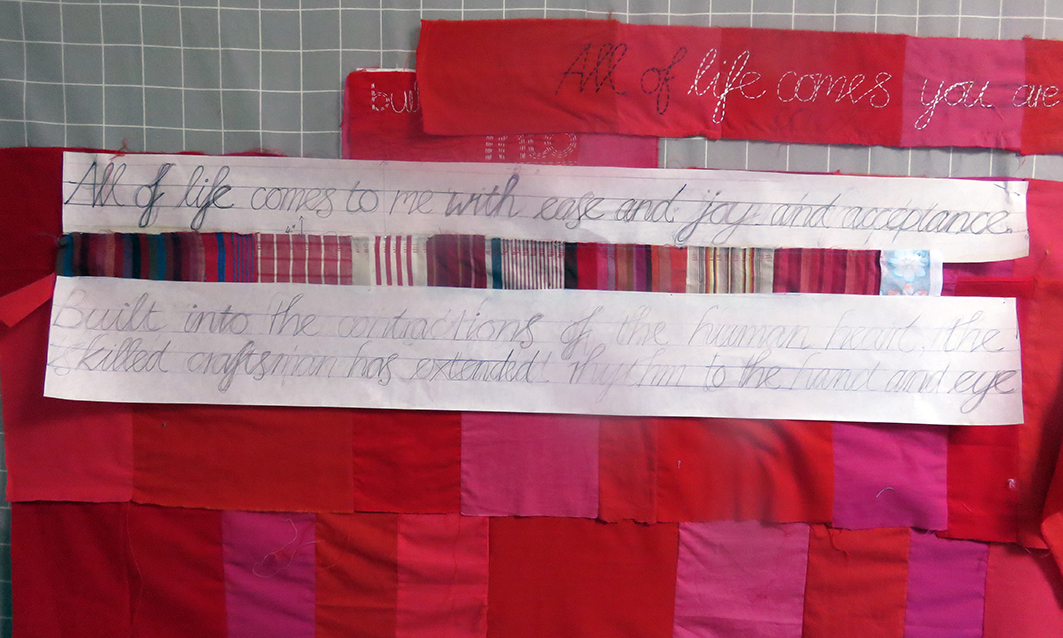
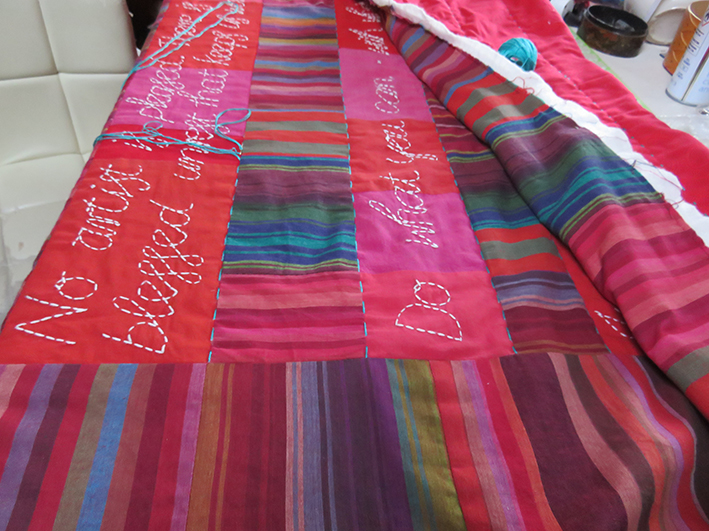
It almost made it onto my own Security Blanket, which is part of my ongoing work project, Make it Through the Night..and I did write it out along with the ones that have stood the test of time. I wrote all of them onto large scale graph paper so that my own handwriting could be resized, with the idea of stitching them easily. I have had this ‘affirmative sayings’ idea for several years, and for several different media, even as a vitreous enamel patchwork, but never had the time or energy to face making it. In between some commercial projects, late last year I started to make it – piece-meal.
the first attempt at designing the blanket as a strippy quilt with inspiration from an American quilt
Above show the first attempts to design the ‘blanket’ idea as a quilt; the inspirational Strippy Quilt above right is an American design, I love the wobbly lively stripes, like a flying flag. Initially I had considered stitching a vintage woollen blanket, then I realised that heaving around such a large piece of fabric would not be easy for a lot of hand embroidery. I remembered a Strippy Quilt in Unconventional & Unexpected: American Quilts Below the Radar” by Roderick Kiracoffe, it inspired me to change tack, this way I could stitch the sayings piece-meal and patch them all together at the end; it also meant I didn’t have to decide the order of the quotations immediately.
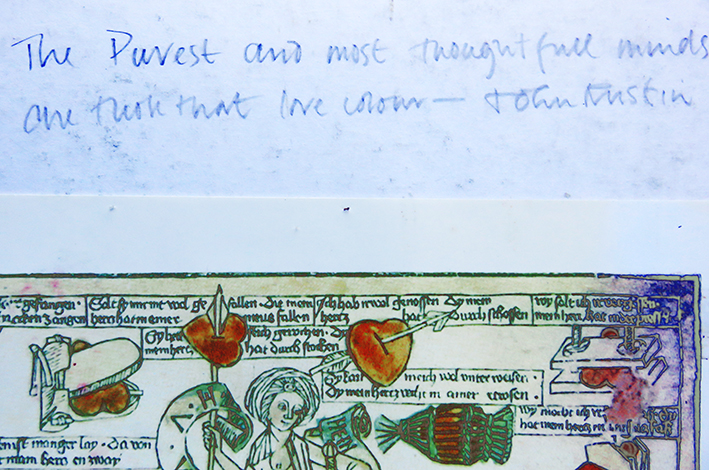
I started by using some scraps of vintage striped deckchair fabrics, but they were too hard to hand stitch into. I turned to my stash of scrap fabrics, Kaffe Fassett Studio’s lovely subtle shot cottons and woven stripes left over from various quilts that my team have made for his Patchwork and Quilting books were perfect. Very colourful and here very RED, and “the purest and most noble minds are those that love colour”. But not having enough of any one fabric for the background I cut my stripes into strips and joined the clashing shot cotton colours together as a background.
I have a saying that lives with me – a mantra that I recite during my sleepless hours of most nights; it has subtly changed over the years I have used it to still my thoughts, and I can chart my state of mind by what I have decided.
My subtly changed mantra is stitched onto the same set of fabrics, ready to be cut up and placed in the telling positions….
slowly the ‘blanket’ collects more words and becomes unnervingly personal for me; The Reverend Sydney Smith’s sublime epithet for not judging a book by its cover is really barbed, and oooh how many times have I wanted to say this out loud!!!!!
The finalised order pinned together on the quilt wall, tells a story about my working life over the last decade and more……hard to display – but here I am.
Eventually I got them all into order, some sayings were dropped or the blanket would be enormously long I would need to re-design, others were added as they described more succinctly what I wanted to express about how I feel about the work I do. The quotations are all by individuals who have used their life to express themselves, teachers and critics, a bon vivant, a dancer – and me. They are in order from the top, The Rev. Sydney Smith, John Ruskin, Richard Sennett and the last 2 (heavily edited) are by the American dancer Martha Graham. The succinct “Do what you can, with what you have, where you are”. sums up my husband’s philosophy for living…
Now to the ‘quilting’ or just a system of large straight stitches ‘in the ditch’ of the seams, to hold the the layers together. The finished piece is a tad wobbly, due to my inexpert ‘quilting’. Hey Ho, you can’t do it all!
Each quotation has its owner’s name and dates stitched onto the back of the quilt to be in line with the quotation
The finished piece pinned to my studio wall, waiting to be blocked and pressed;
And ” I am proud of it and I am ashamed of it” – go figure!
It is almost 20 years since I had this disturbingly beautiful dream but I have NEVER forgotten it. Re-visiting my sketch books archive, I found the original drawing that was hastily scribbled down when I thankfully I woke up.
Now, I have decided to complete my long standing/stitching on-going work project “Make it Through the Night“, after not working on it for more than 5 years. I have determined to complete the project to a degree where I can hopefully resolve it but so as not have it in my brain as frustrating “unfinished business”. I just can’t ignore it any more…. too much of me resides in it; and as the composer Gustav Holtz puts it ” Compose nothing unless the not composing of it becomes a positive nuisance”
The initial drawing , above left, is dated 28th July 03; the second drawing is another later version when I was trying to make a composition for a stand-alone embroidery….. now I have decided to add it to the ‘dream pillows‘ and I need a different composition. Recently looking very carefully at the 2 drawings I realised I had completely forgotten that the butterfly had a face – YIKES!
In the actual dream it was a giant butterfly several yards/metres wide, dying and lying on some grass underneath a tree, the remnants of wings scattered round it. People were picking up the large technicoloured pieces of shattered wing and I really wanted some as well – but I thought I would get it something to drink first, then decided to pick it up and take it to a nearby puddle, the result was my butterfly covered hands…I abruptly woke up.
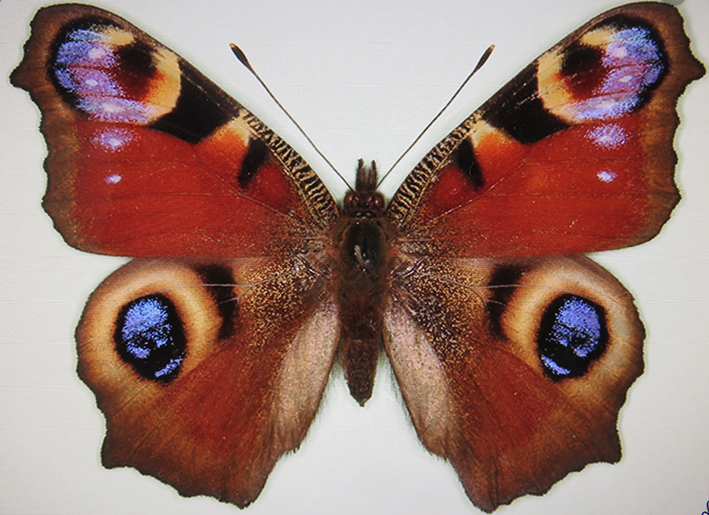
I started to research the ways on which I could have held the massive butterfly. I looked at many different British butterflies and chose the Peacock mainly because it was so colourful but it has eyes as well – one of the major symbols I use in my work. Every year we get smaller butterflies over-wintering in the house but these beauties are rare here.
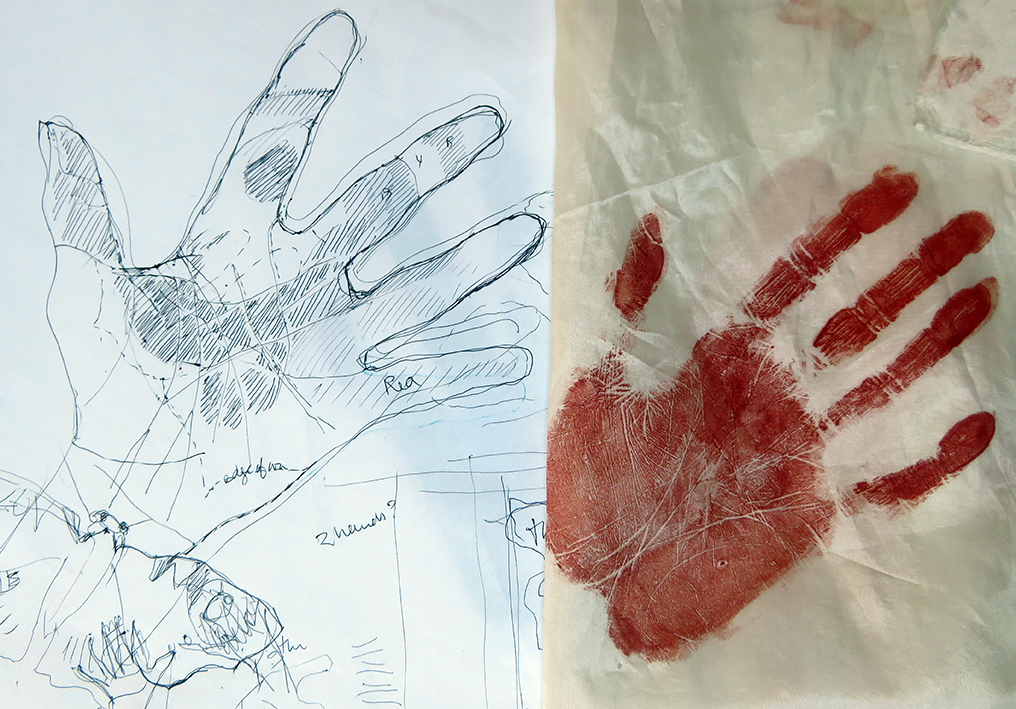
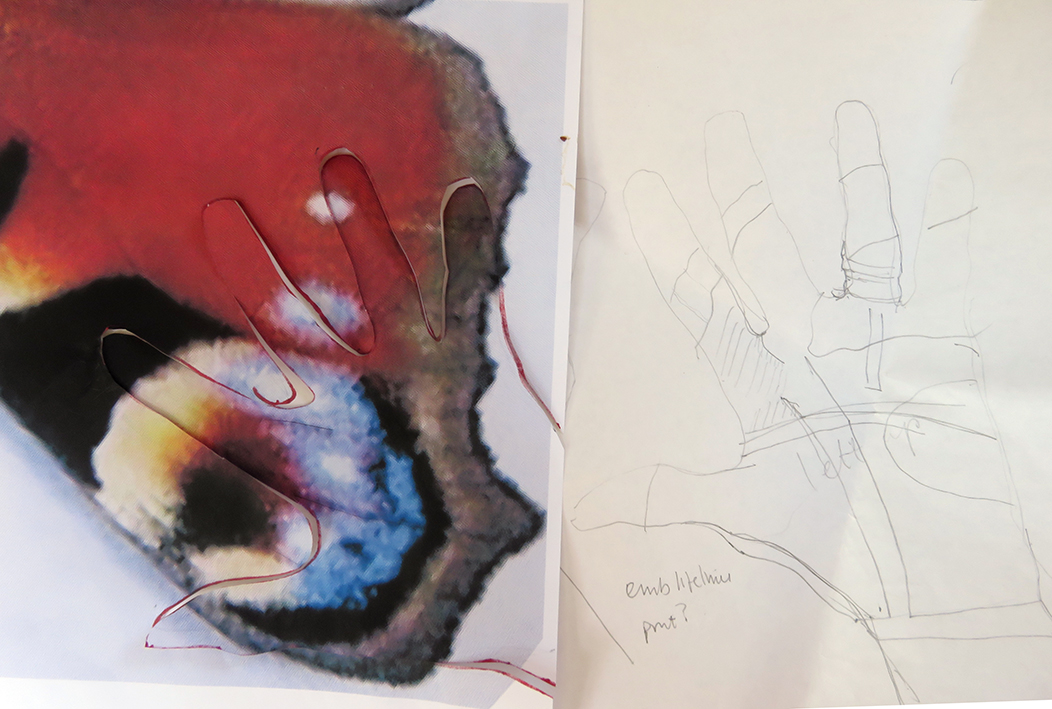
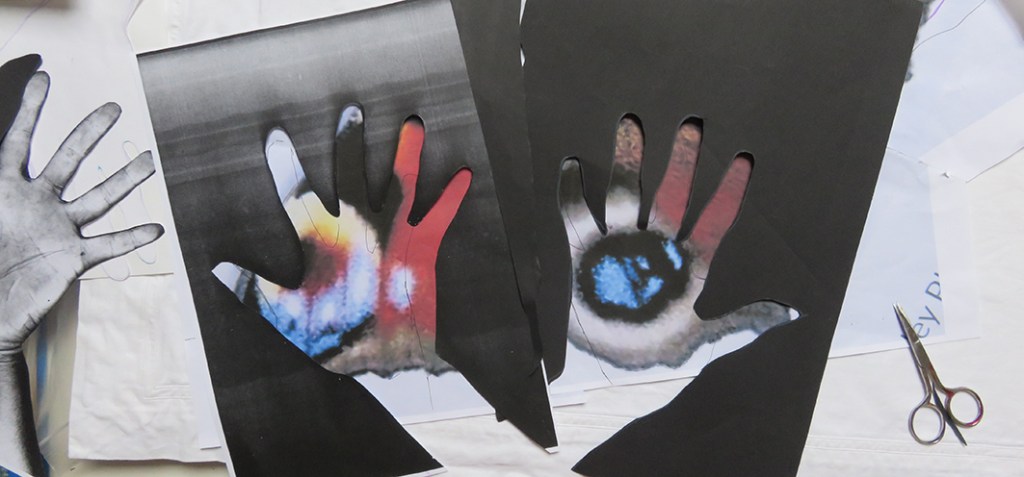
I had my own hand prints on silk, from an earlier area of research and I liked the way the lines of the palm were voided. I now transferred the palm lines to the outlines of my hands so that they would interrupt the wing pattern.
moving around with the photocopied cut out hand shapes to find interesting enlarged wing patterns to embroider.
I enlarged the first peacock butterfly image and cut out my hand shapes…next I had to add the patterns to enable me to stitch the whole hands……the original working drawings below with a a technical sample that I would use for the very complicated patterned hands. I decided to paint dye onto the ground first to give me guidance for the colour blending and to assess the amount of work I would have to manage.
the separate hand drawings with a very crude but vital painted dye and stitching sample.
Next I had to imagine the shattered butterfly – I tried many variations; the shape had to show a degree of violence and some direct connection in the shapes left after my hands had devastated it, because it shows the terrible result for the insect…
3 of many versions of the lay-outs for the pillow, the hand writing is in water soluble pen
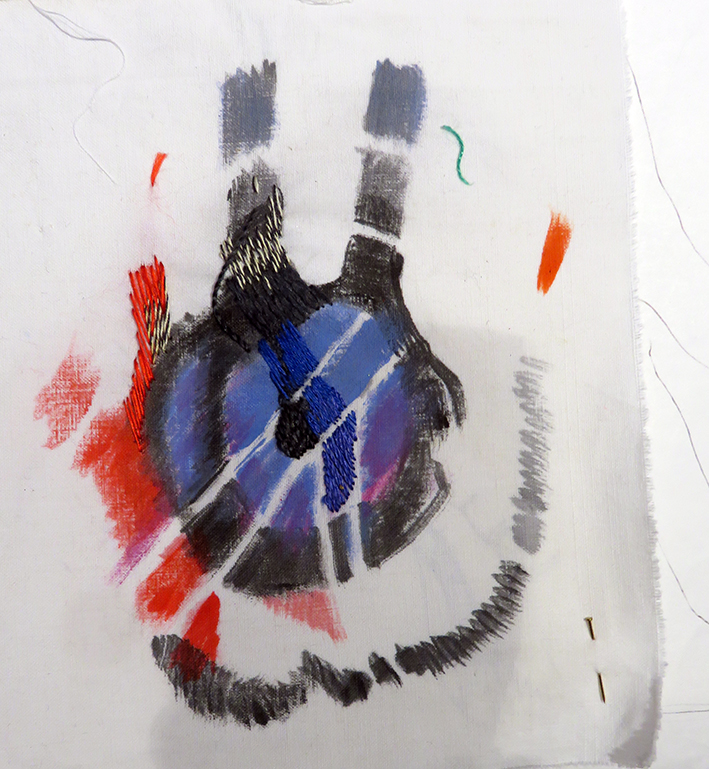
I drew the hand outlines and running stitched them, then drew my palmistry lines on each hand and painted dye within the lines and fixed it securely – all of this before I could start stitching, which I was itching to do …..
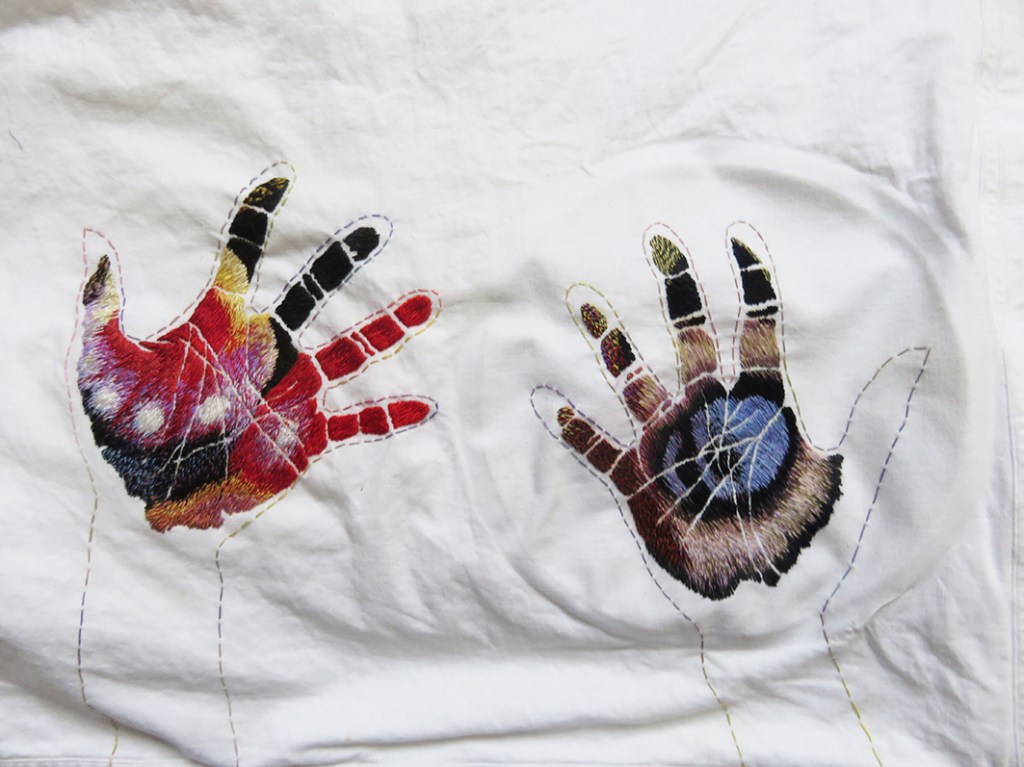
2 images above show the first and last day’s stitching of the hands. I started this project in early August and now it was late September – I needed to move onto the butterfly now…
working from my research drawings, I drew and embroidered the main area of the butterfly and then placed paper shapes to act as the shattered wings to make some connection to my hands.
research materials and dyed butterfly with the embroidered version with paper shapes in place for the broken wings.
It was at this point that something strange started to happen….I found a trapped Peacock butterfly in the window of my studio, I was delighted, I had never seen one of these in the house; the weather was still warm, so I let him go….
But then more and more Peacocks came into the studio, and in different areas of the house… in all we had 11 different Peacocks visit us. SPOOKY WOOKY……
the 3 photographs are of just some of the 11 different butterflies that came into the house over the last 3 months while finishing the embroidery. The image of the butterfly lying in my palm was taken on 25th December – amazingly it died with it’s wings folded back to show the eyes, I take this as a rare and wonderful Christmas present.
Sadly some of them died indoors and I keep them in m studio – they are all in different conditions; some very tattered wings and faded colour but others still beautiful.
my small collection of some of the autumn visitors I think there is another embroidery here……
so I eventually finished the pillow, completed the writing in running stitch and it is ready to join the Make it Through the Night project.
my sentiments about the Mending at the Museum exhibition
The exhibition ‘Mending at the Museum’ has finally been launched at The Bristol City Museum and Art Gallery – and it runs until April 2013….which sounds simple enough but it is the culmination of at least 3 years collaborative practice based research between academics and professional makers and artists. The ‘Stitching and Thinking’ research group, which I facilitated in my post as a senior research fellow, evolved the exhibition via a series of mixed media workshops, visits to the museum’s mended collections, many meetings, discussions, conference papers and a small sample-stage exhibition; and it also caps off my academic career which started in 1973 and finished last year in 2011….. So no pressure then.
mending Sampler from the Bristol Museum collection
I co-curated the exhibition with Dawn Mason, currently the award leader of Drawing and Applied Arts at U.W.E. Bristol, and my long-term academic colleague and collaborator in all things stitched. In the museum we worked with Karin Walton, the Curator of Applied Arts at Bristol Museum, and who holds the secrets and the keys to the museum’s sampler collection, the mending samplers were the main inspiration for the work that has finally been exhibited.
school’s sampler from the museum’s collection
table of samples and exhibits
Steph Wooster’s wrapped work
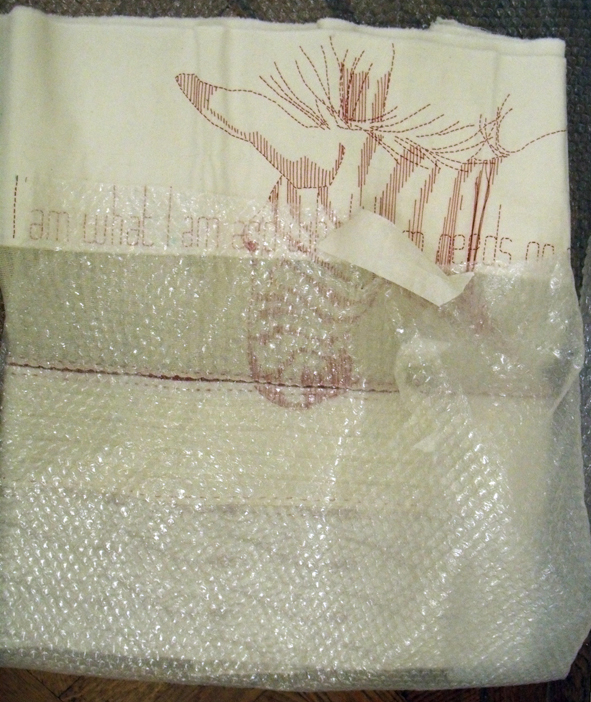
When I arrived on the first morning to hang the work, Dawn and Karin had already placed the exhibits, still in their wrappings, on the floor below the wall space allotted to them, but there were piles of extraneous pieces, scattered over tables and chairs, it became my task to sort these out.
The idea of the exhibition is partly to show how ideas evolve during the making process – Dawn and I have written and spoken many times of the necessity of makers to have time for reflection; making work worthy of contemplation requires as much time for the thinking as it does for the making process. It is a constant making and thinking about what you made, re-making, re-thinking until somehow the pieces resolve themselves and you wonder how they could ever have become anything other than what they are.
Each exhibitor was responsible for physically putting their own work on the wall, this saves so much argument later….but with only 7 exhibitors who know one another well we each respected one another’s’ space – well most of the time. So during the next 2 days each member of the group came and sorted their own work out meanwhile just looking at all the unwrapped pieces was really fascinating as work seen only at the sample stage 4 weeks before, now appeared ready for the wall. Work can made or marred by the way it is hung and also what it is hung next to. We were all acutely aware of how the whole exhibition must work together. It comprises 3 different elements; some of the museum’s mending samplers, our own samplers of work made throughout the research period, and the pieces made specially for exhibition.
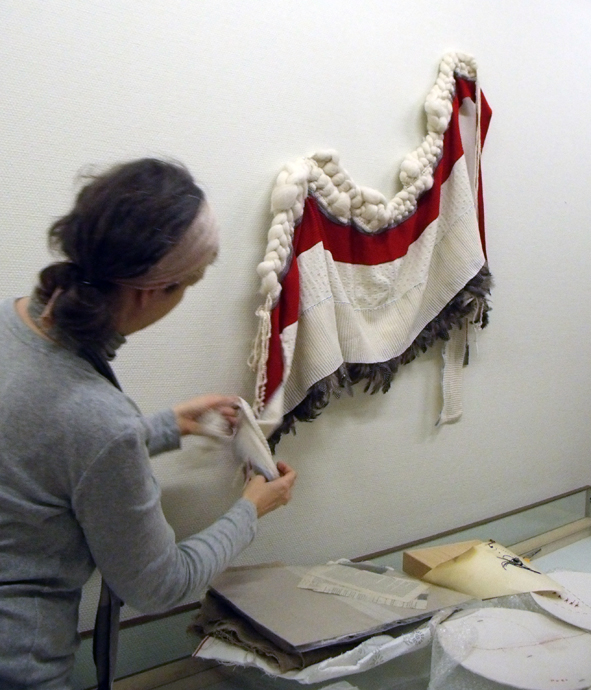
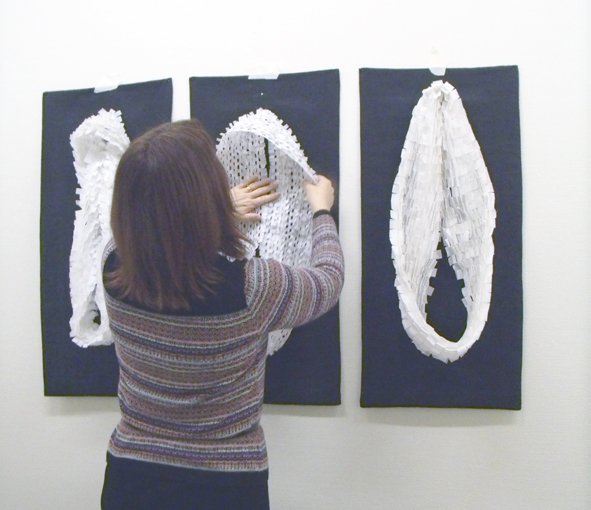
Steph Wooster draping her knitted shawl
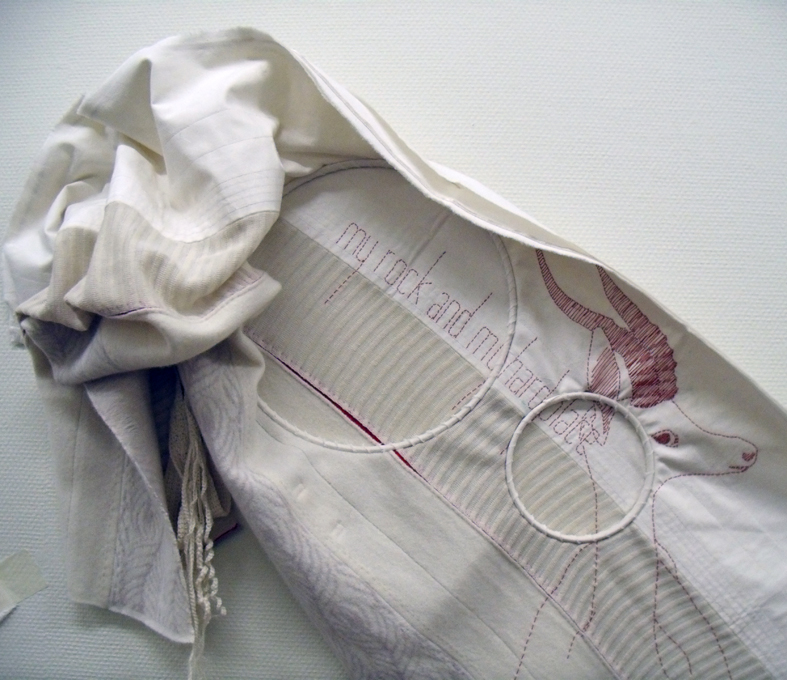
Steph Wooster’s knitted and pieced work looked different when it was stretched over some embroidery hoops that acted almost as magnifying mirrors – drawing the eye to the details of her messages. She writes of museums being ‘houses of high culture; they show the best of us’. Finding evidence of mending within the museum’s exhibits she delights in glimpses of ‘everyday life’ . Her work, influenced by the written messages on samplers, ‘celebrates the ordinary’ by using simple fabrics with ubiquitous machine knitting.
one of Steph Wooster’s knitted and stitched wraps “you are my rock and my hard place”
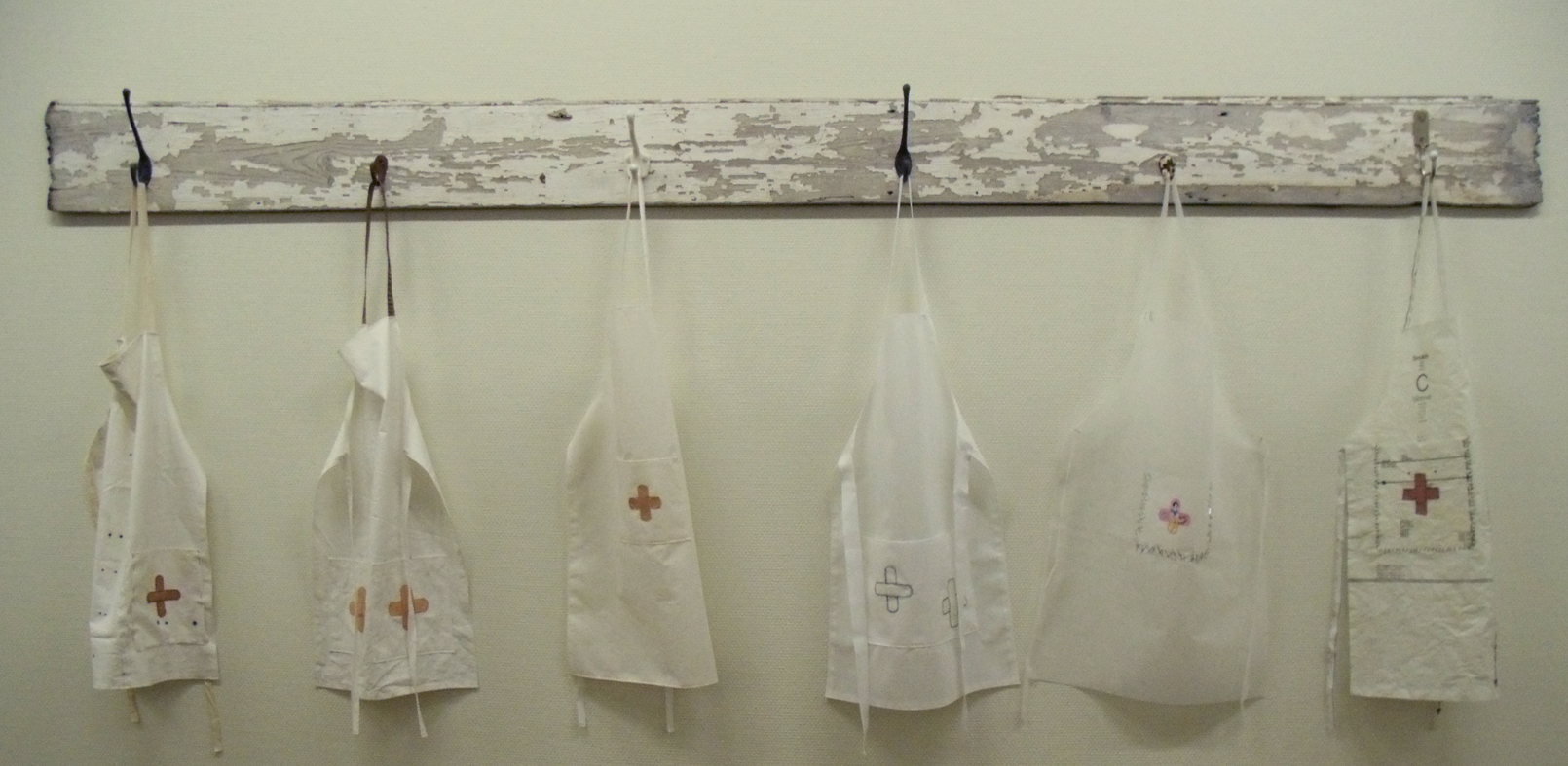
Jilly Morris‘ children’s aprons came neatly laid one on top of the other with a Fragile label printed on the cardboard wrapper – a comment, I felt, not about the fact that the contents could be damaged but of the fragility of what was inside and already ‘ damaged’ .
Jilly Morris’ stack of children’s aprons
The title of the work produced is ‘Mending Takes Time’ and refers to the functional stitching that was traditionally taught as part of their general education to girls, as transferable skills in an era when fabrics were ‘treated with regard’ and material was frequently mended to preserve a precious commodity – so at odds with our easy access to all types of fabric from all over the world.
Mending Takes Time – Jilly Morris
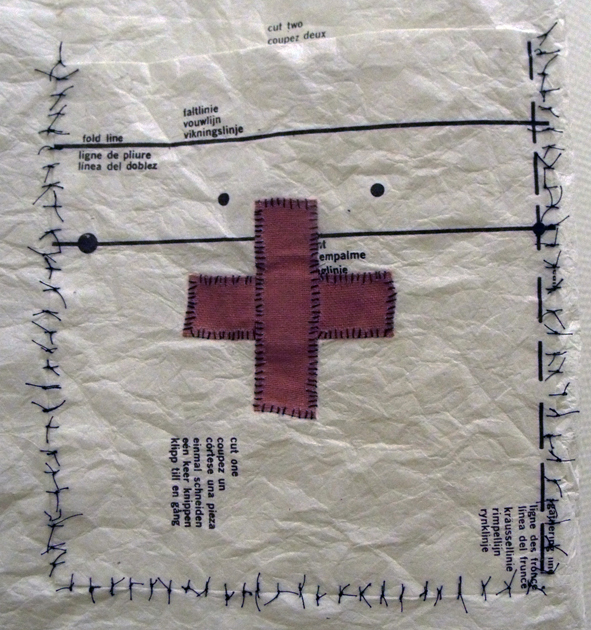
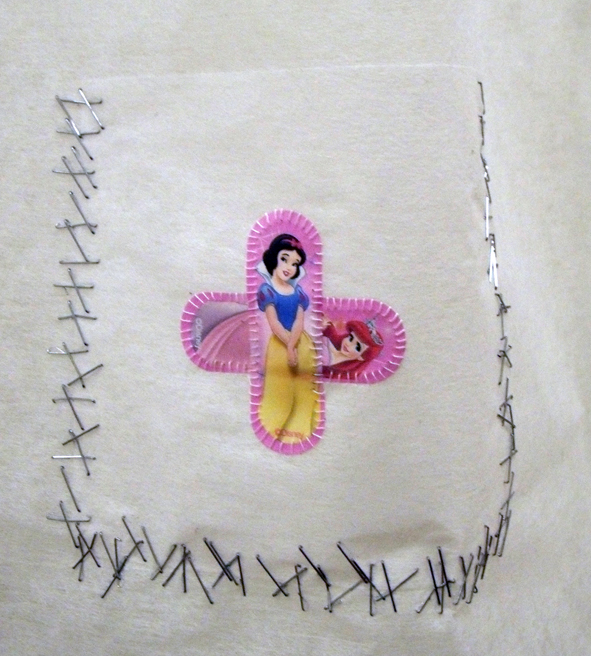
The cross shape made by various commercial medical dressings recall the basic shape of most darns seen on the samplers; when executed in ready-made modern plasters she references the ‘quick fix mentality and disposable culture’ of the present day.
Jillt Morris, child’s apron with first aid pocket – paper
Jilly Morris, Child’s apron pocket with commercial first aid plasters and staples
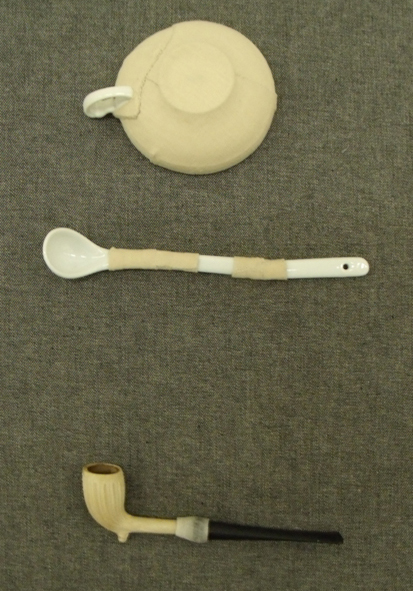
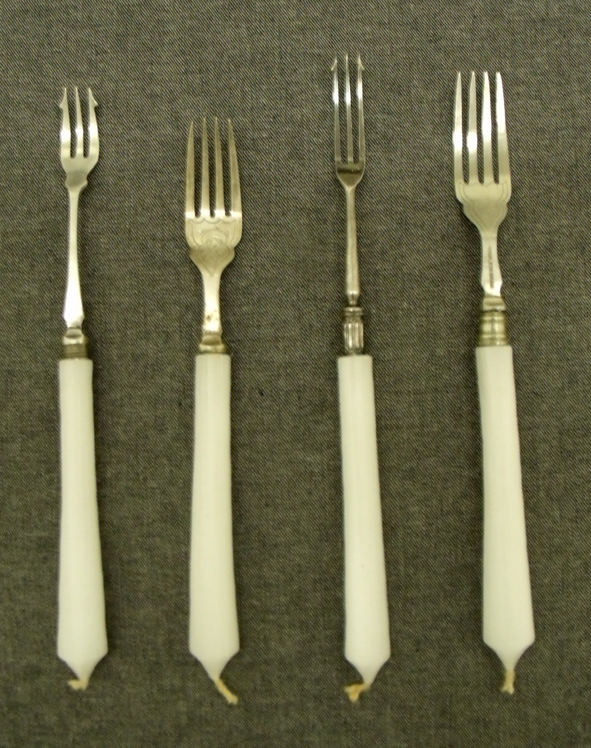
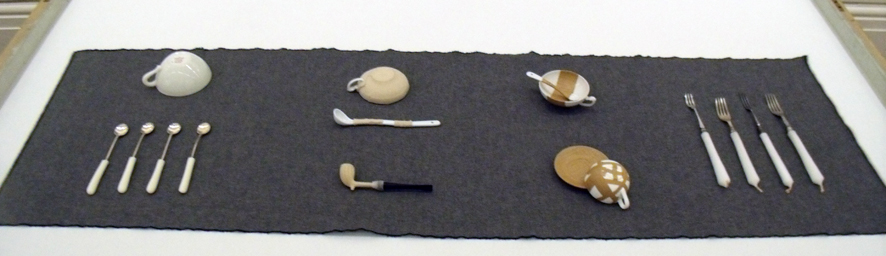
Jess Turrell came in with a box of assorted table-wear cups, saucers and a range of metal components such as spoon bowls, fork tines, knife blades and their specially made handles – which she made up before she placed them in a large vitrine.
Jess Turrell making her Fork Handles
Jess Turrell first aid plaster wrapped ceramics
Her work is called “Inappropriate Mendings” and she is having some fun at the idea of making aesthetically elegant mending that is really useless for any practical purposes, fork handles are whittled from wax candles (gedditt?) cups are mended with calico, and spoon handles wrapped in plasters from the first aid tin.
Jess Turrell, Fork Handles
Jess Turrell – vitrine of inappropriate mendings
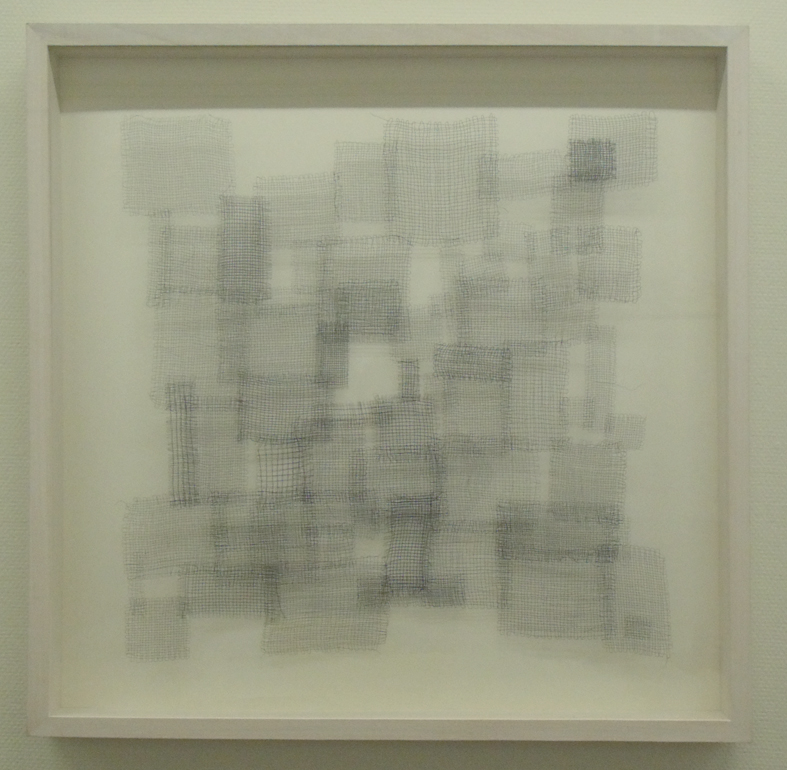
Dail Behennah brought in a fragile darned wire piece, mercifully it was framed and so this was the easiest to hang…the piece is simple and refined and references a particular black darning sampler in the collection, which is placed in a vitrine opposite her work.
Dail Behennah – Holding it Together, copper wire and thread.
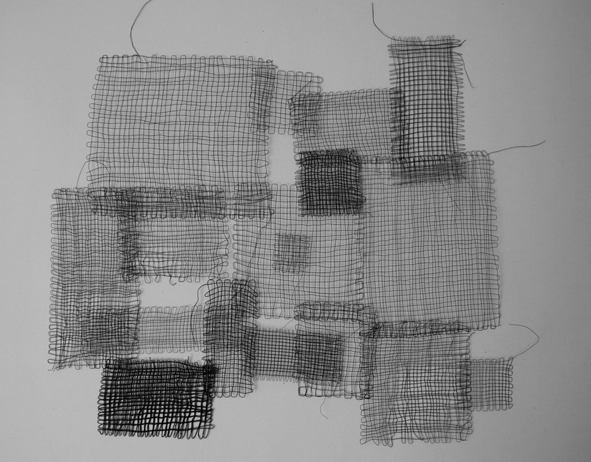
Dail reflects that the darning in an old garment are often stronger than the fabric that they hold together, she has taken this to ‘absurd lengths’ by making a piece of metal fabric entirely compose of darns. The shimmering quality of the image is created by the shadows set up by the work being suspended in a box frame, below is the darning fabric in the making
Dail Behennah, darned fabric detail.
Dawn Mason exhibited a series of different responses to the mending samples, called Face to Face her work reflects the reverse side of the samplers, some how when we look at the ‘wrong’ side of a piece f stitched work it seems much more immediate, the involvement of the maker is more apparent because here we see the comings and goings or the threads and often the struggle the maker has had is left as evidence where on the front of the work all is perfectly presented and correct. (I know that given the opportunity people usually will look at the back of any stitched work – maybe searching for signs of the maker’s involvement )
Dawn Mason, hanging her newest pieces – cotton organdie
The work she showed was made over the entire duration of the project and shows the progression of her own personal work…
Dawn Mason – early stitched and darned work – printed polished paper and thread
Dawn Mason, stitched texts on printed polished paper and thread
Like Dawn’s exhibited pieces, my own work forms part of an ongoing series of stitched work, that has been a direct consequence of our involvement in this project. “Make it through the Night” includes many references to mending as mending broken hearts has been the major inspiration to my personal work for several years now – as this blog illustrates – there are many postings around the ideas and practice of mending, and the first ever post was about my mended clothes………
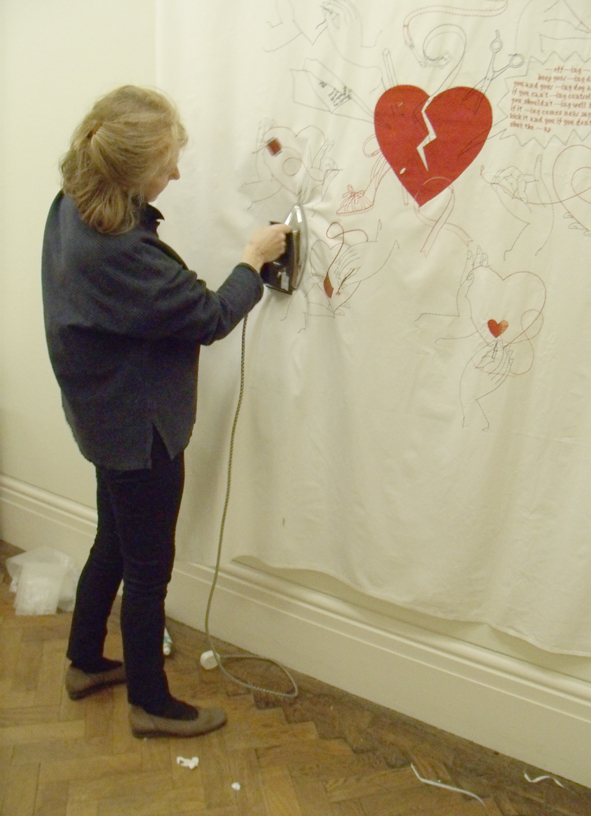
a rare photograph of me in action – here pressing ‘Counterpane – Counterpain” on the museum’s walls
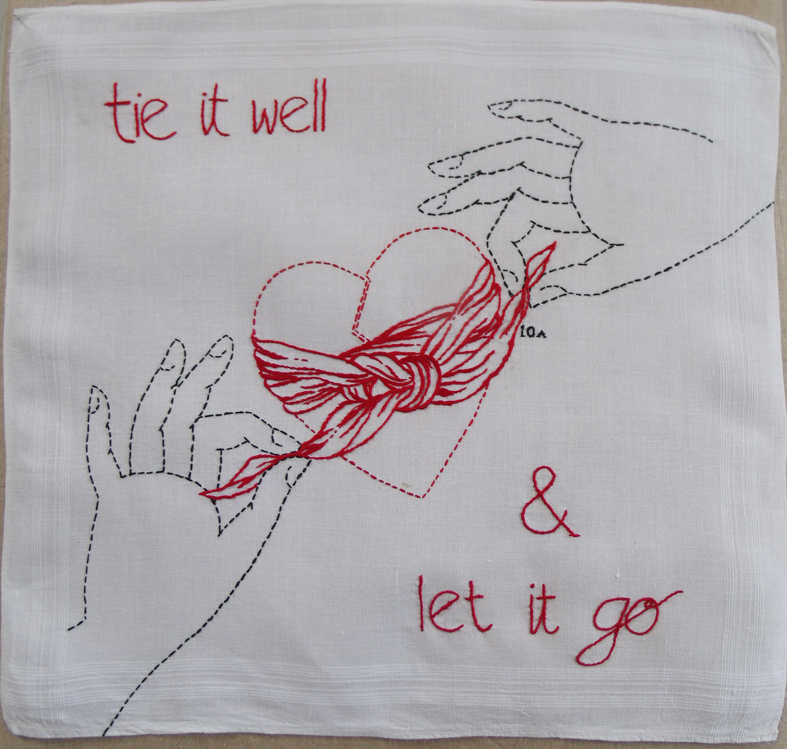
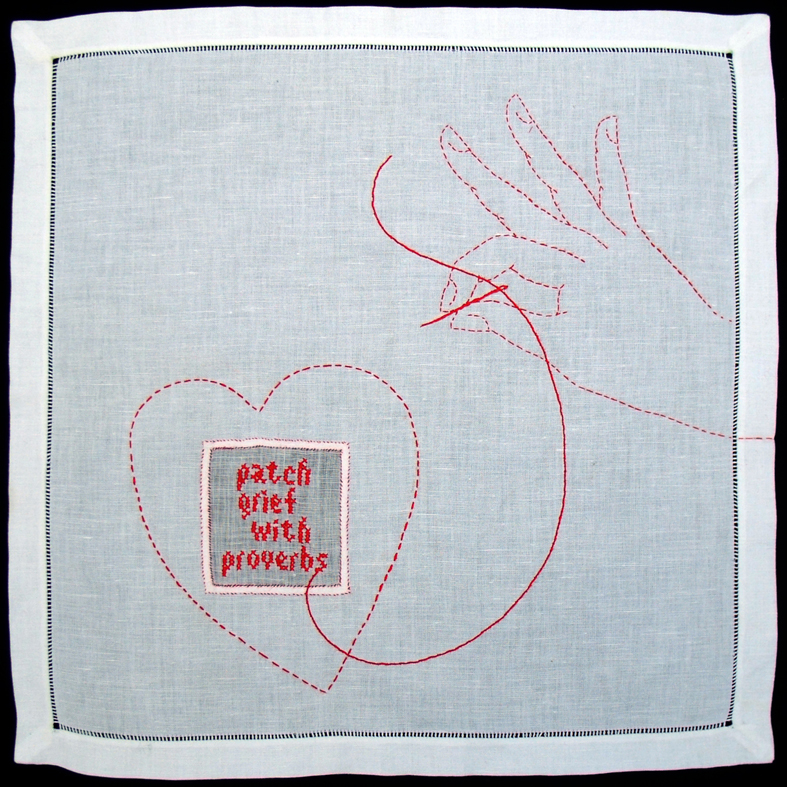
I have made a whole series of embroidered handkerchiefs, let’s face it some nights we have all needed a handkerchief if only to hold on to. So I have embroidered them with positive mending mottoes and other words of wisdom – the set is called ‘ Patch Grief with Proverbs’ a sentiment that rings true to me. How often we just find ourselves reciting platitudes in response to grief?
Janet Haigh embroidered linen handkerchief with linen voile patch.
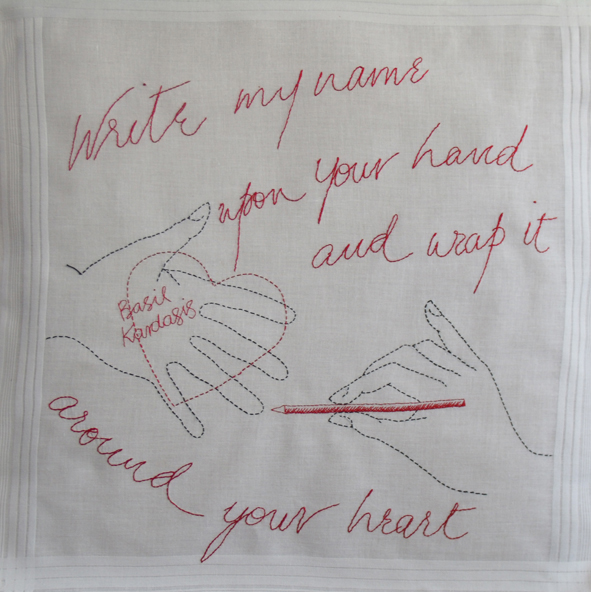
Greek proverb, cotton handkerchief and thread
I made 21 embroideries all with their own distinctive darns and patches to reflect the written proverb, they took quite a time to get onto the wall…..I had to search many different sources to find enough texts to make a wall full – but one lovely Greek proverb was given to me by Basil Kardasis and this was the last piece I embroidered – an a very large-scale cotton handkerchief I had to purchase new – the rest were all on vintage linen.
Which brings me neatly to the last exhibitor, Basil Kardasis, his exhibit is called ‘The Buttonhole’, and he collected from his family and friends ( we all had to contribute) ” treasured, revered materials…that may represent them ” and also a button; then , with the help of his sister Ella, spent may months button-holing all the pieces together so that they made a “protective cloak” for his son.
Many different materials and articles appear in the cloak, which has a very colourful interior as well, the range of fabrics perfectly reflect his wide-ranging experiencing as a designer and educator world-wide, students and colleagues and friends from practically every aspect of his life gave him wonderful and rare pieces of cloth for this coat, my favourite is a piece of lasered leather in a lace pattern – now this I could really get working on – it only I had much more of it…..
lasered lace calf skin
Looking at the image now of this lasered work I am reminded of the joint piece of work that had to be abandoned for inclusion in this exhibition, due to personal reasons by my making partner Hanne Rysgaard. We were making a porcelain hanging from impressed lace fragments but sadly this was shelved until we can both find the space in our very busy lives to get together again and make it. Now I am thinking that these 2 disparate materials may somehow work together…leather and porcelain – Basil where did that lasered skin come from and is there any more?
This is a first for me and I want to share it with you – I am, from today, exhibiting in America. I have 2 pieces of work in an exhibition called Mending = Art showing at the Gershman Gallery in Philadelphia and this evening I should be at the private view, but instead I have just returned from Heart Space Studios having run a birthday party, making beaded brooches with ten 9 years olds – and very enjoyable it was too. But how I would love to be seeing my work in an international exhibition at such an amazing event as the Philadelphia biennial textile art festival FiberPhiladelphia 2012.
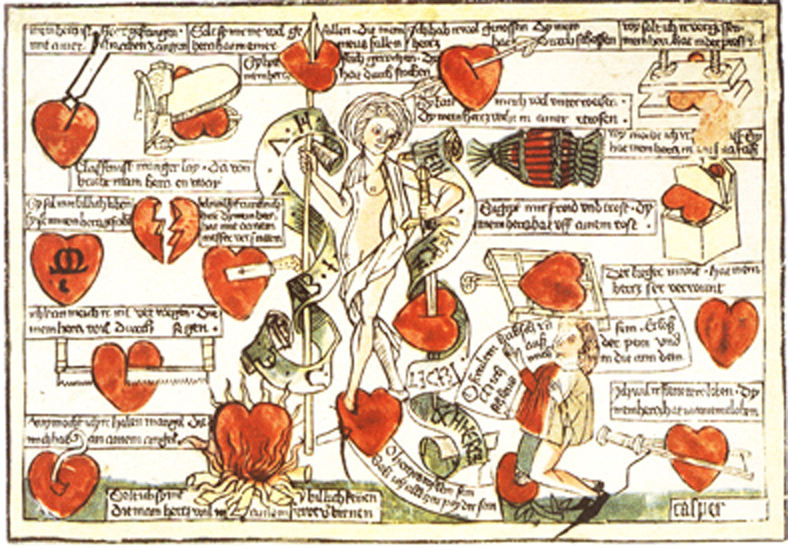
the inspirational wood cut from the Berlin Museum- Frau Minne’s way with Mens’ hearts
The call out came early last year, from American textile artist( she of the wonderful brilliant red website) Diane Savona, for textiles made around the theme of Mending…this must have been the universe answering my call. I had several things on offer, as looking at the ‘ Ongoing Work” section of this blog will show you. But unusually she also asked me to send her an image of the inspirational early woodcut that has inspired at least 10 years of textile and enamel work, and mending was the subject of my first post in this blog.
counterpane/counter-pain – vintage cotton and cotton thread
and above is the other work that Diane chose to represent my mending embroideries, a real heart-felt cry now that I look back on it, I can remember every stab that contributed to this image but then yoga certainly reaches the parts the needle can’t.
So this is the shorted post I have ever written, but now I am off to celebrate with a glass of something chilled and pink and fizzy……
OK so it’s the day after the night before day and here are the pictures from the exhibition sent today from Diane Savona.
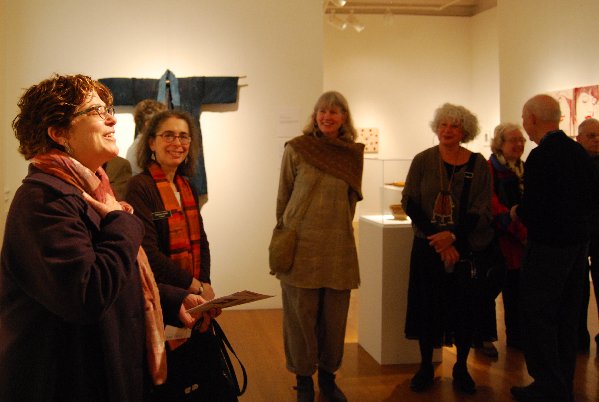
from left: Amy Orr (organizer of FiberPhiladelphia) Miriam Shapiro (curator at the Gershman) Dorothy Caldwell and Libbie Soffer, as Amy says a few words in front of the Japanese boro from the Liao Collection.
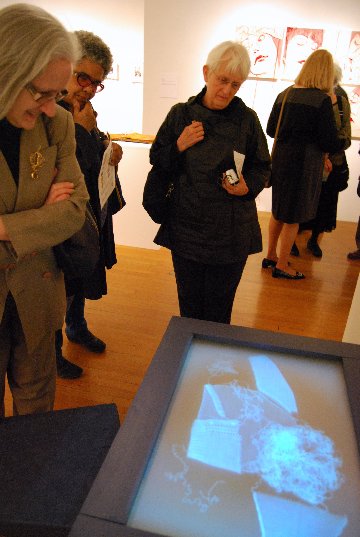
and very glad to see a video work from one of my colleagues Amy Houghton,
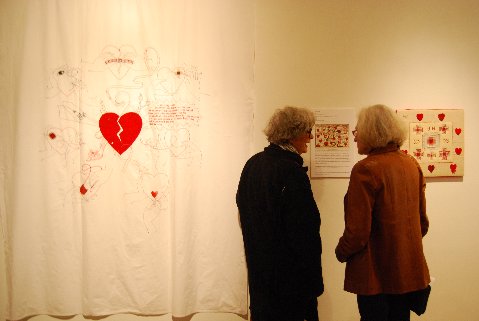
then there is my work hung together with Frau Minne keeping count in the middle of it all….
mine all mine!
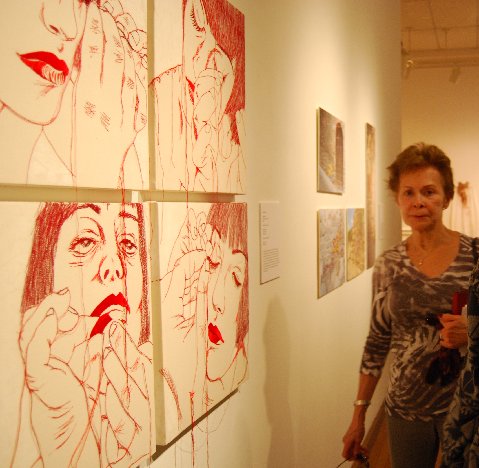
something tells me that that red and white is the new black, white and grey of studio art textiles…..
Ilaria Margutti in front of her work
and again….
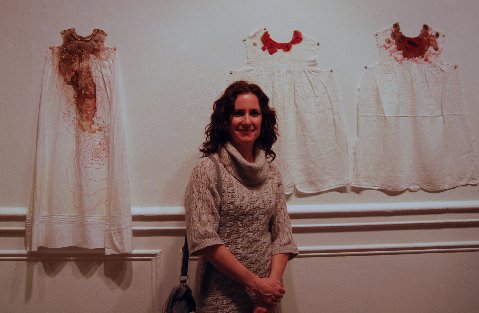
Wolfie Rawk in front of her work
and yet again…..well mending seems to = blood red for a whole lot of women.