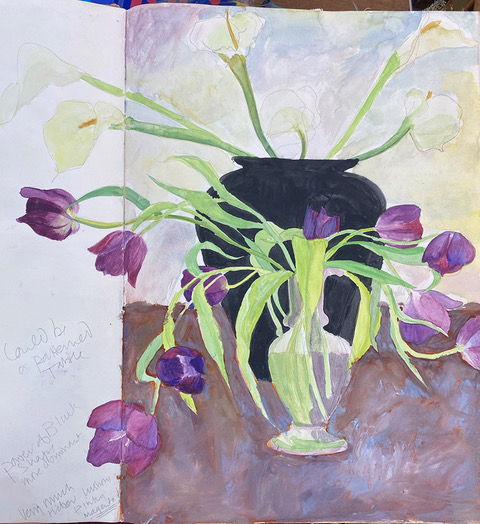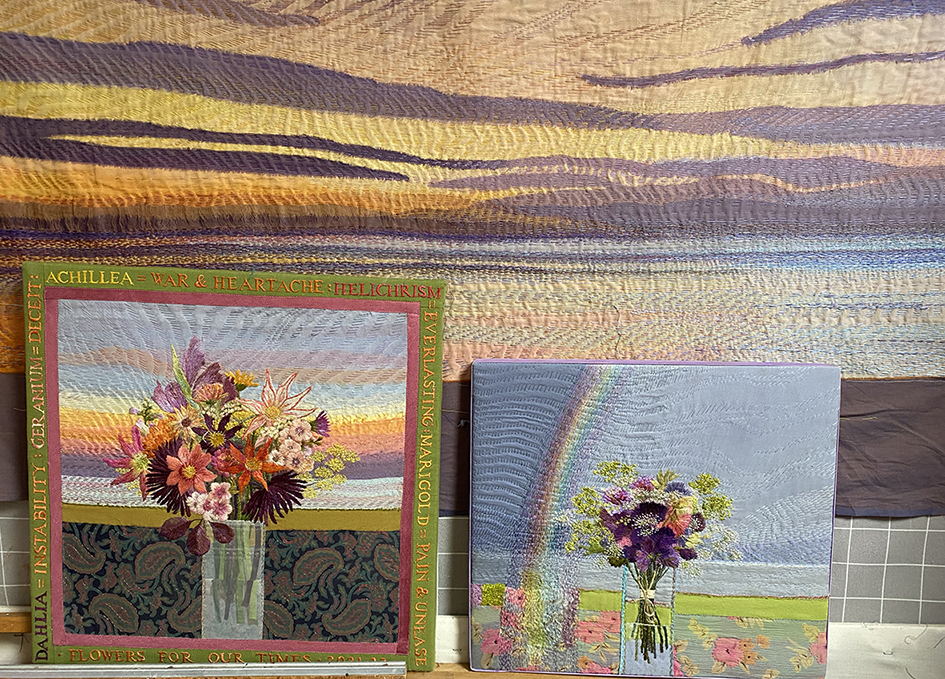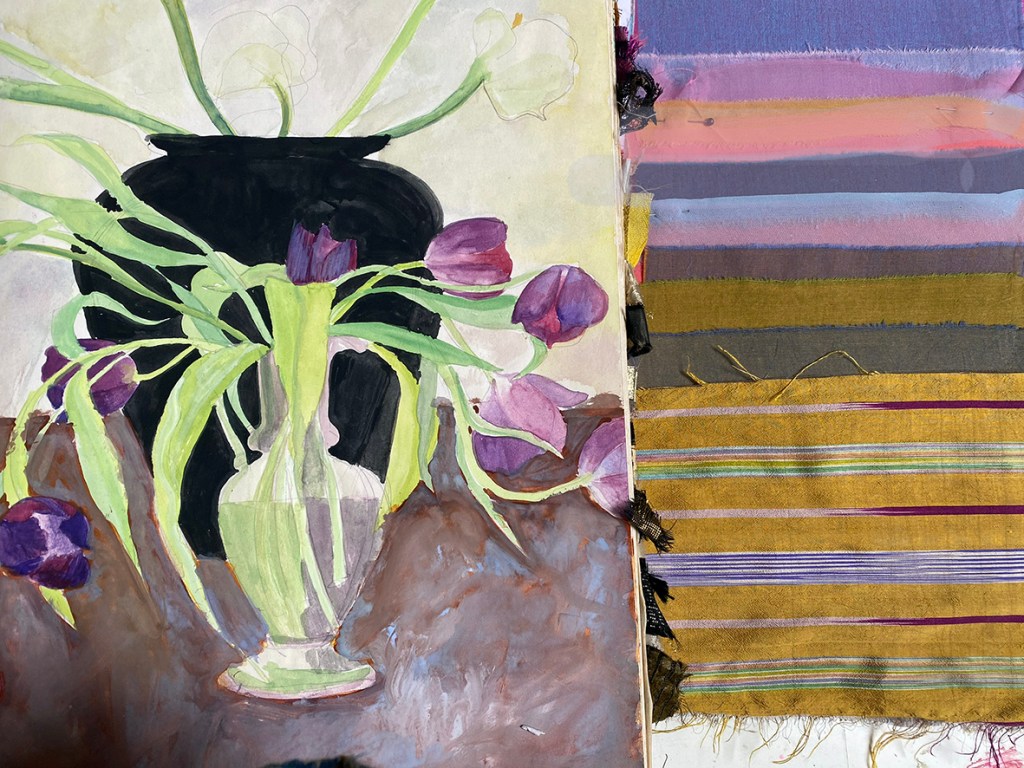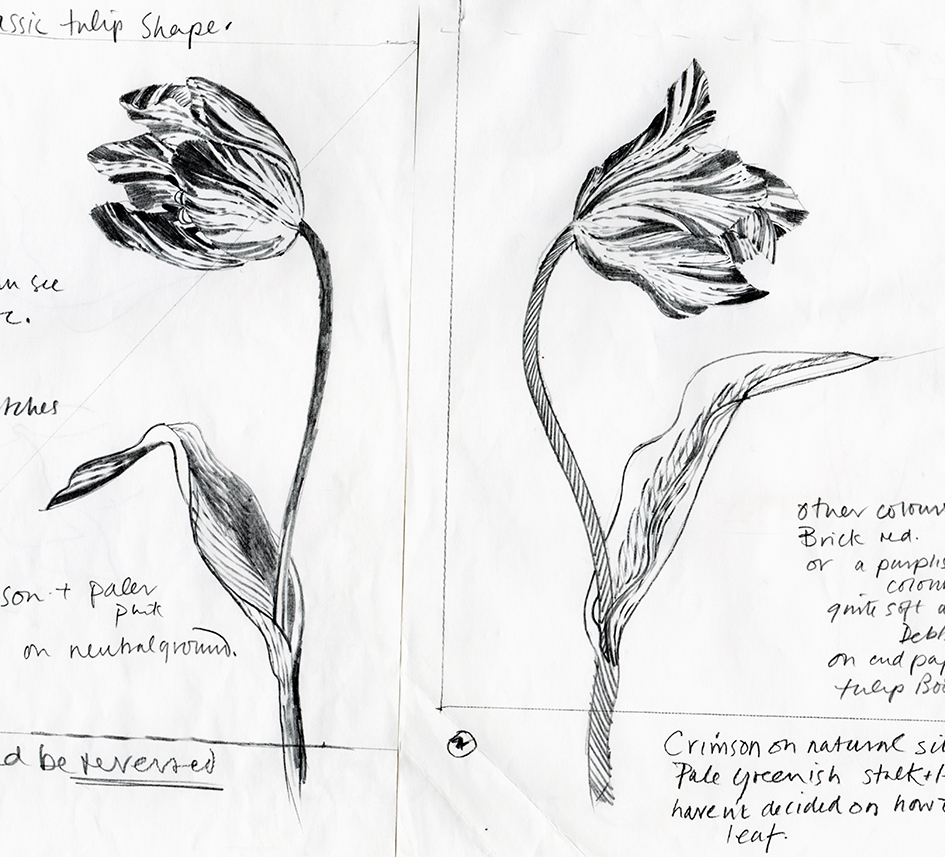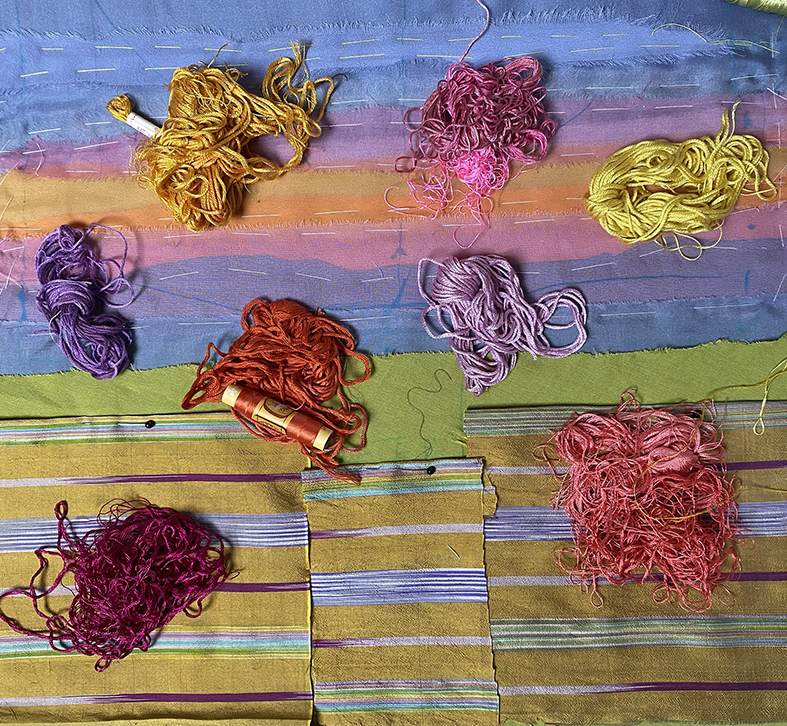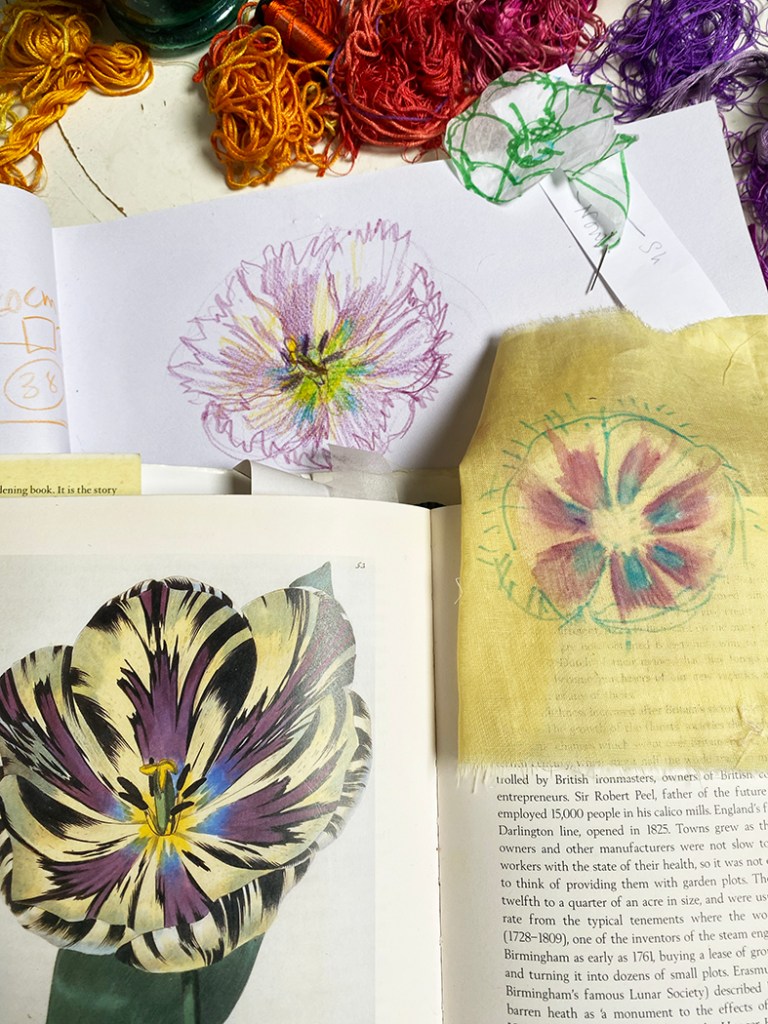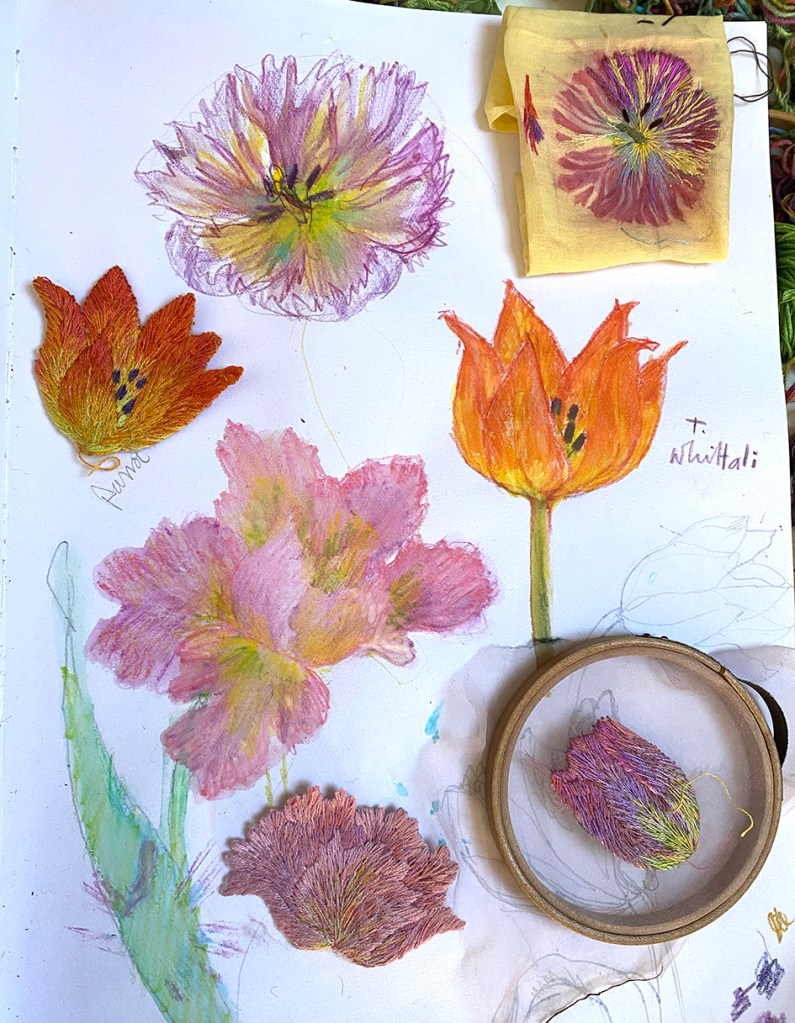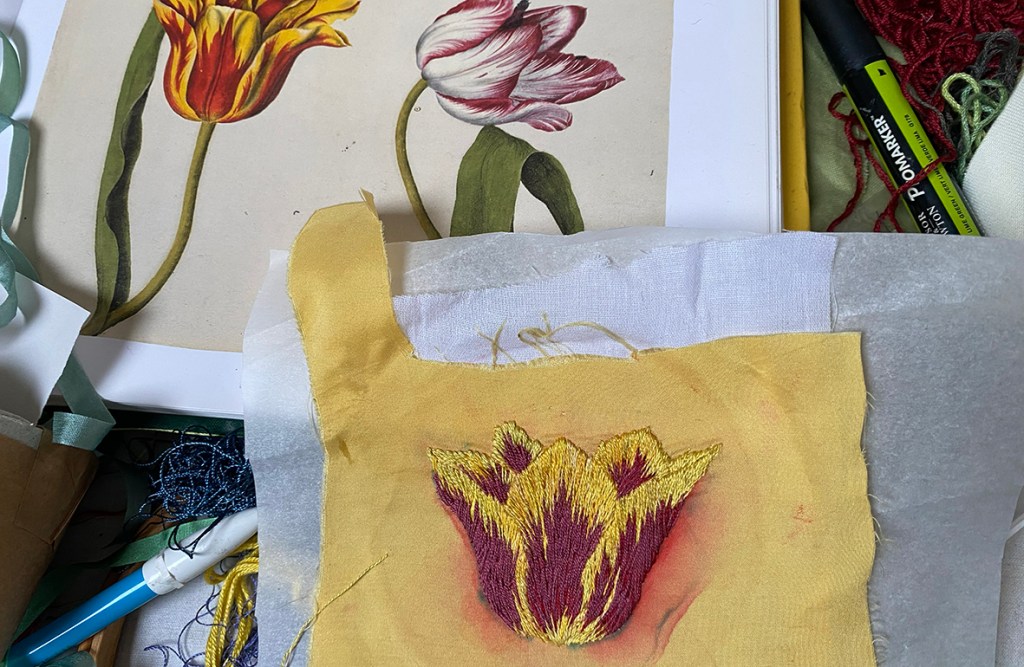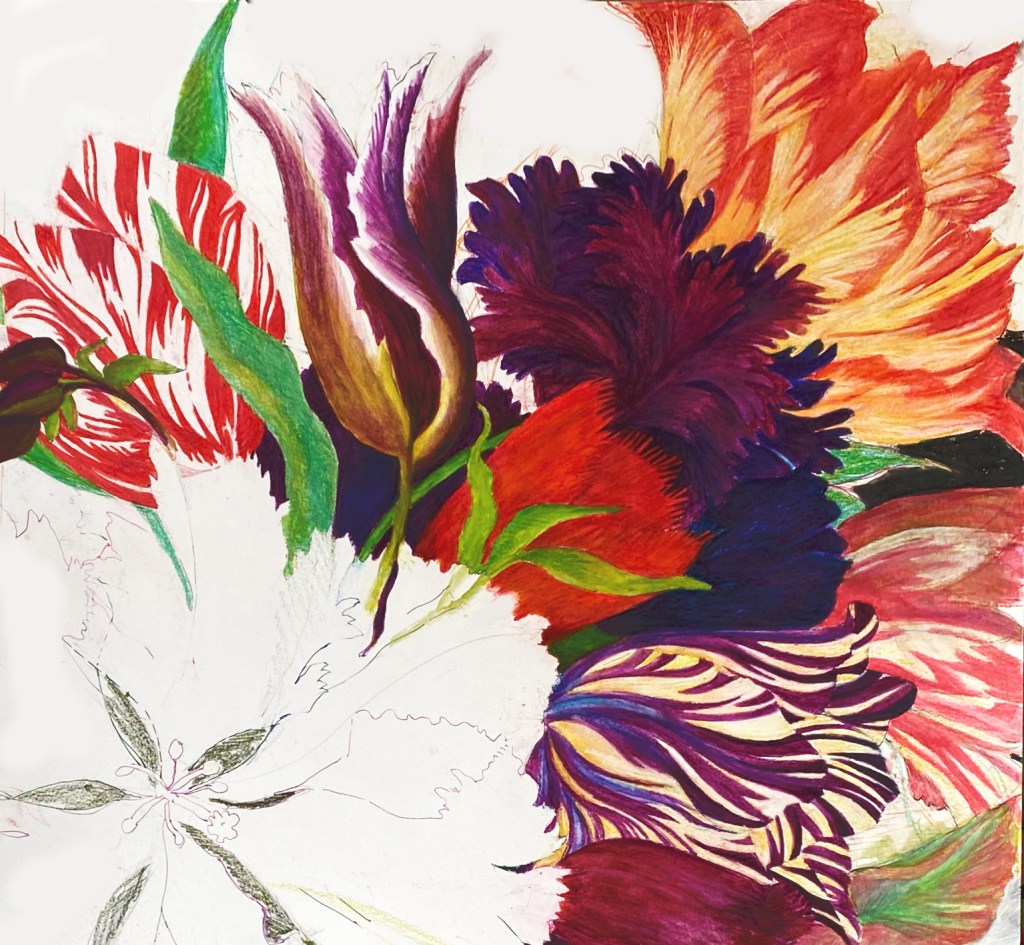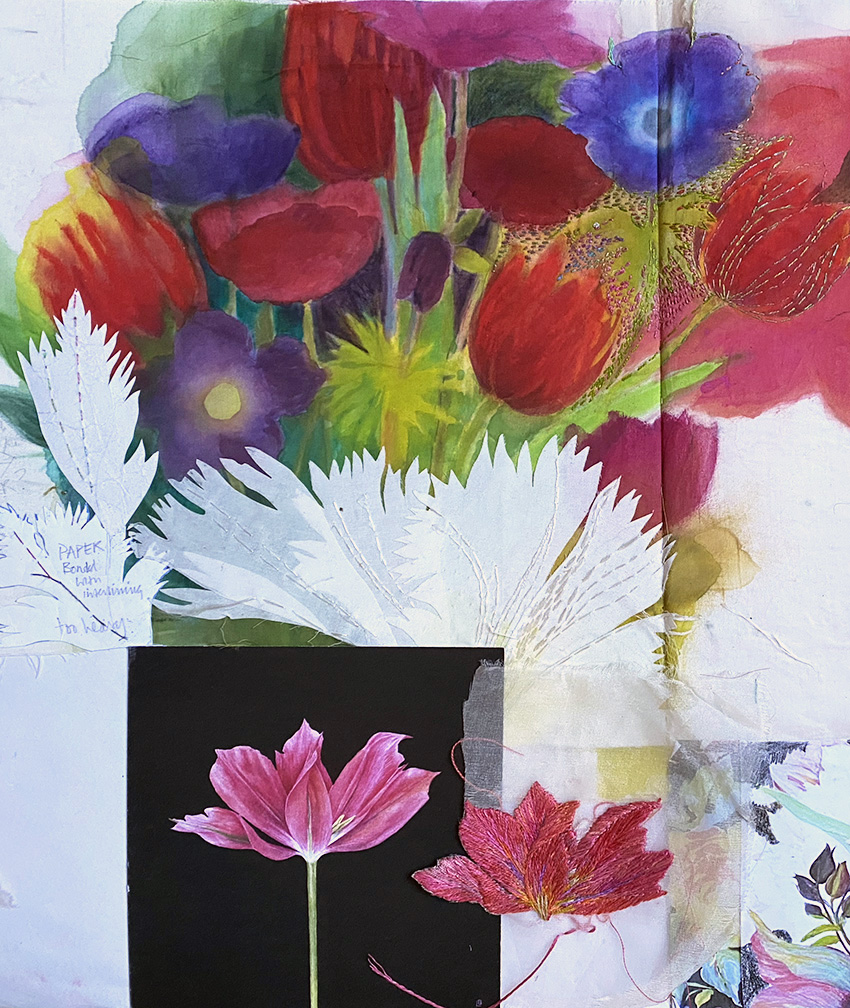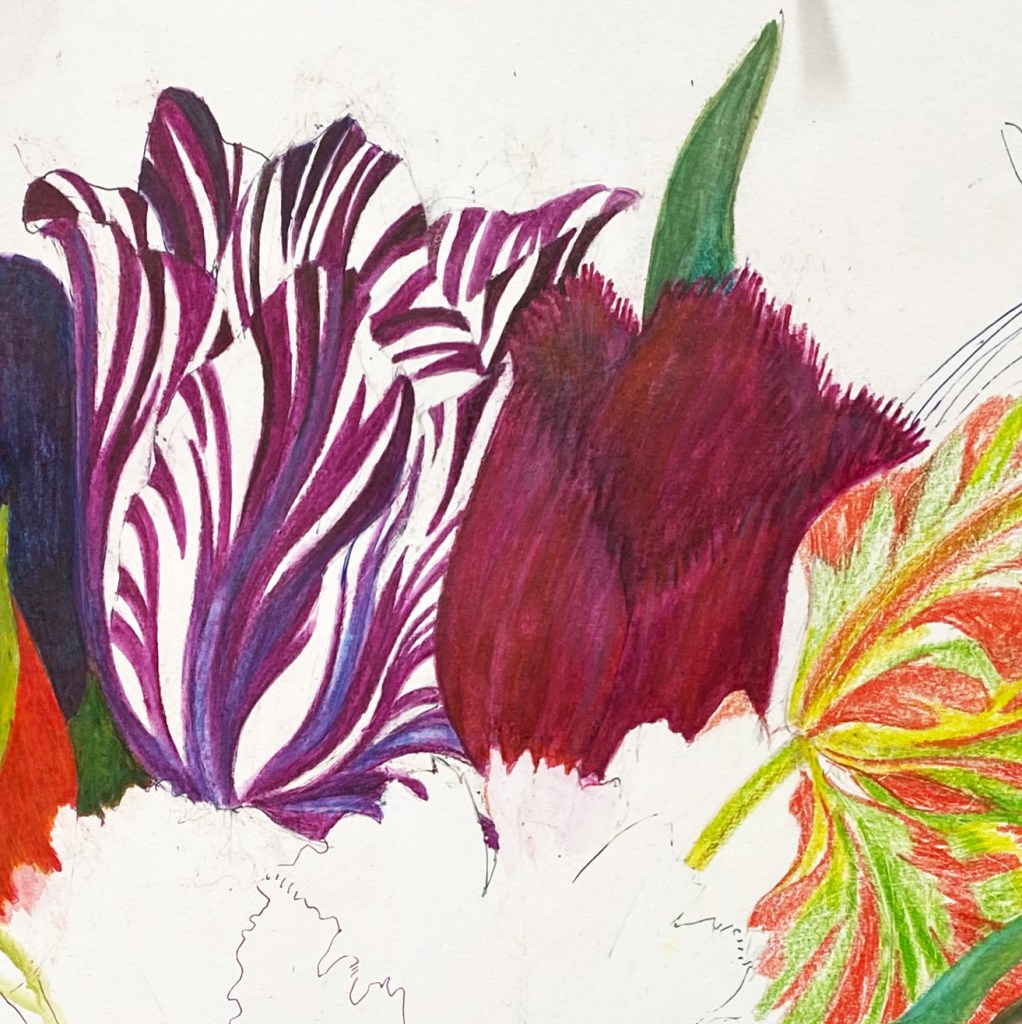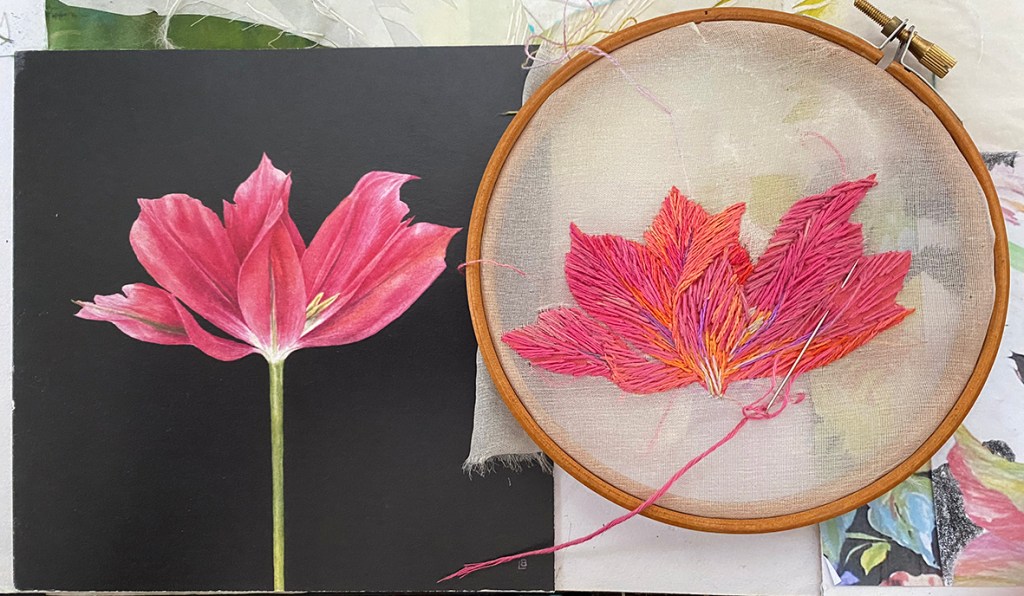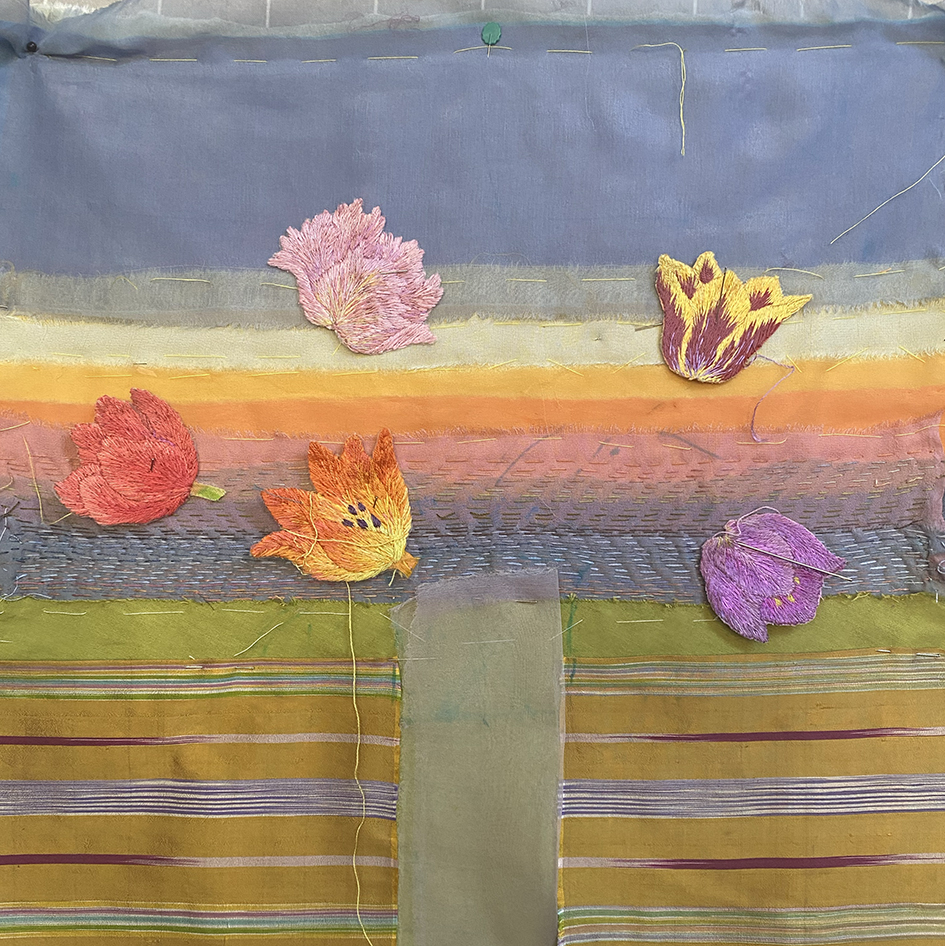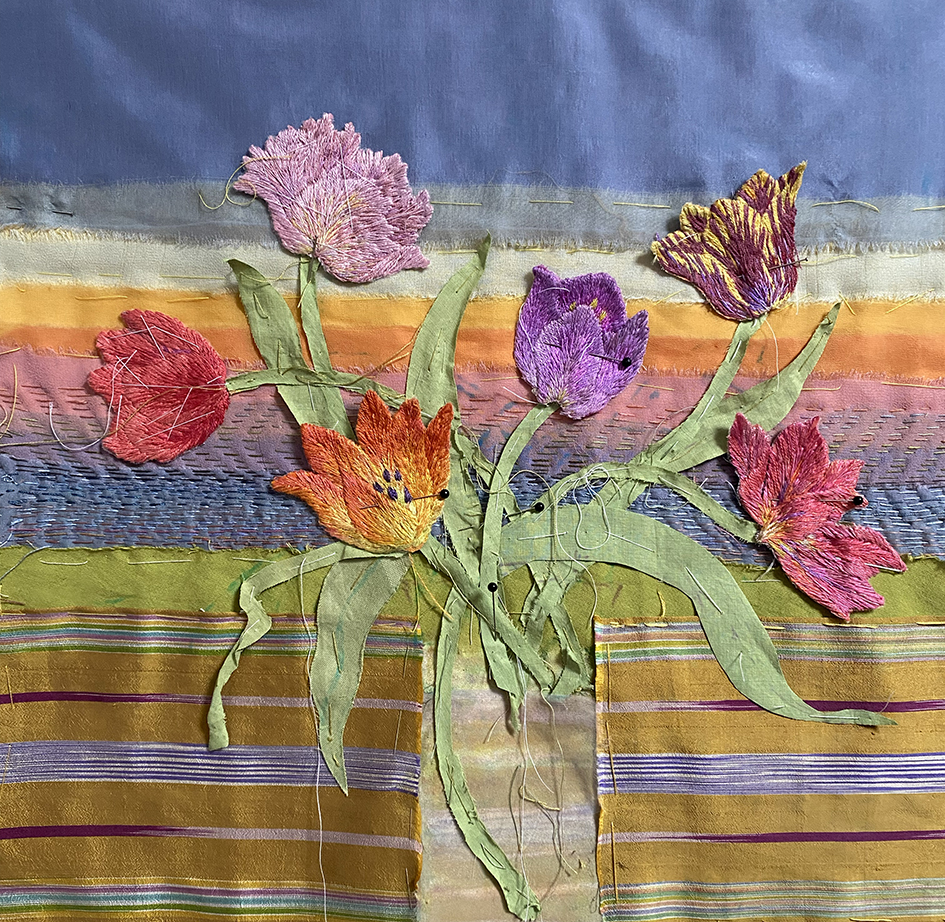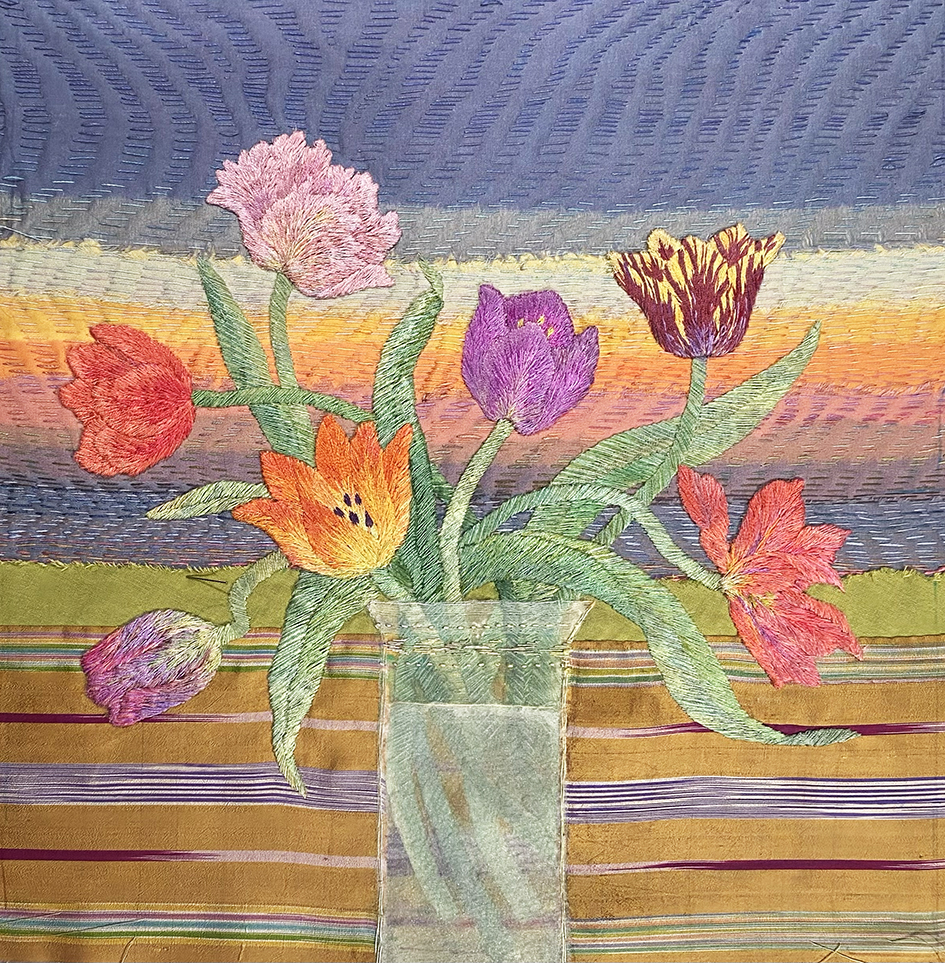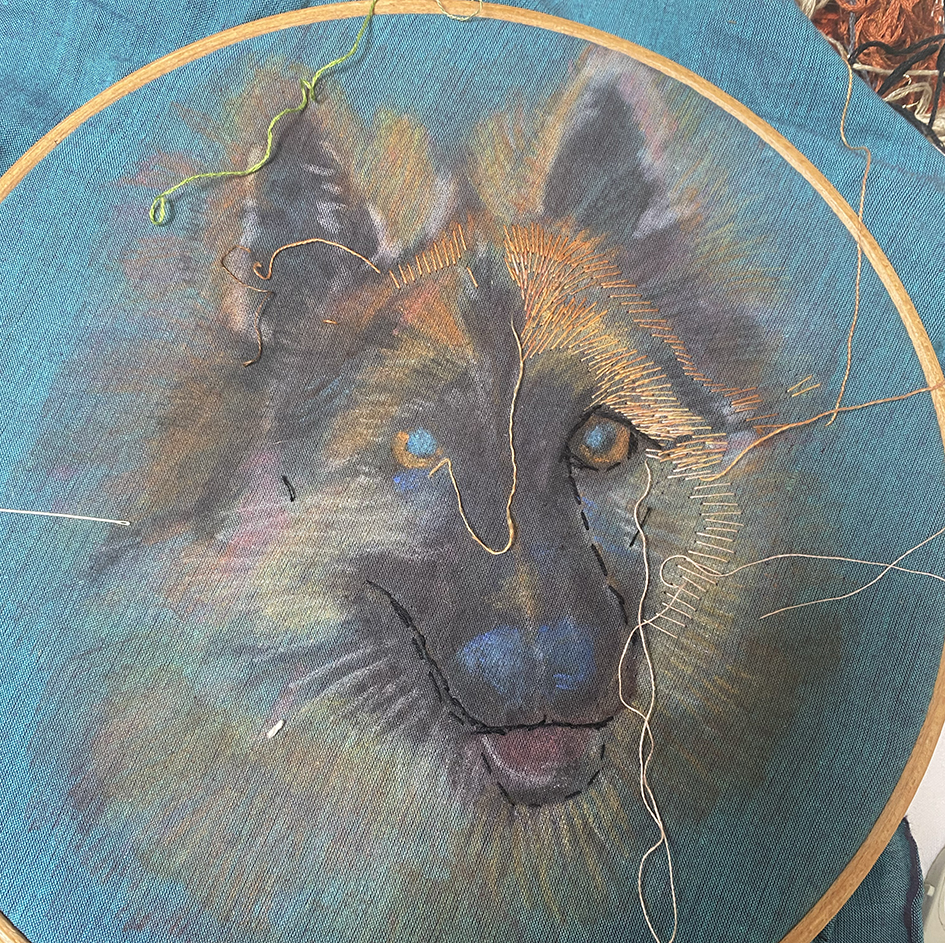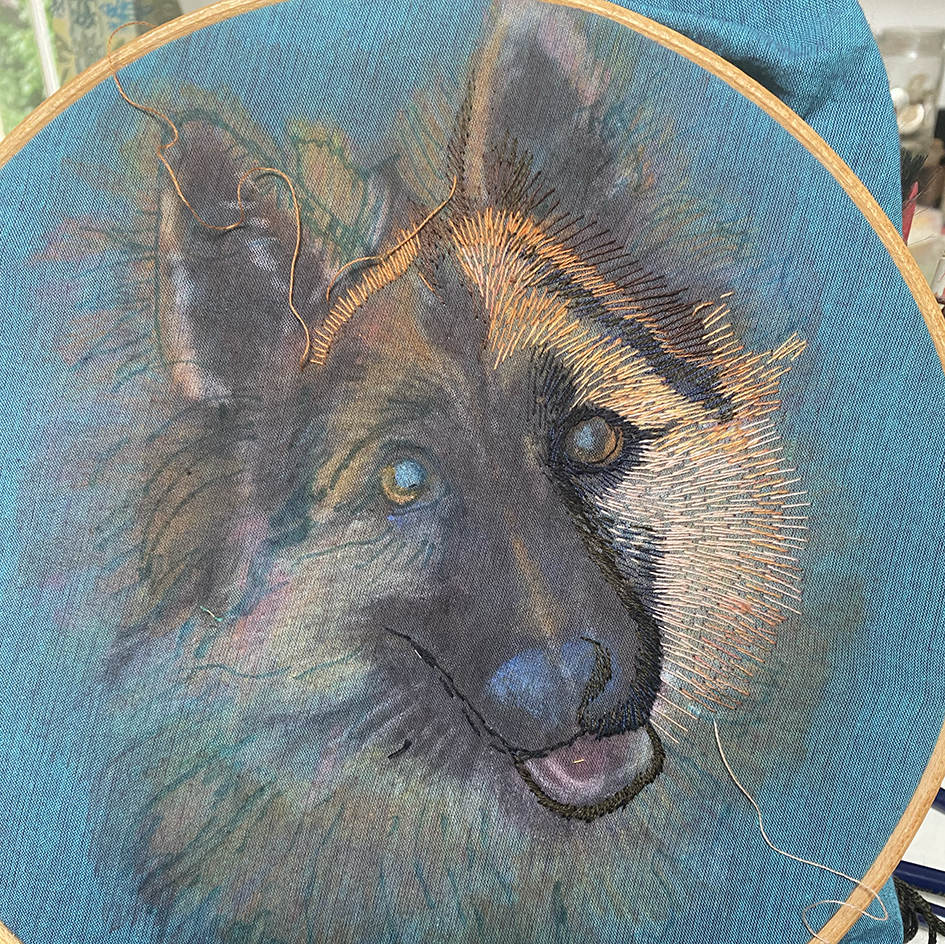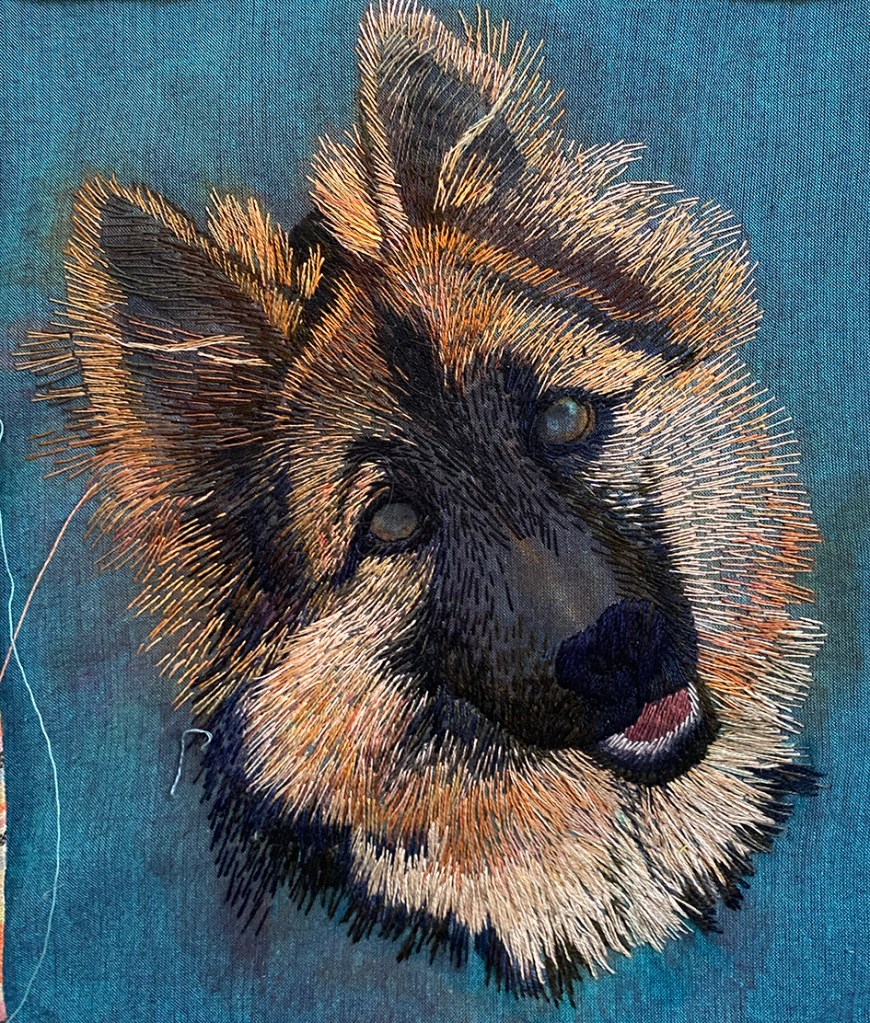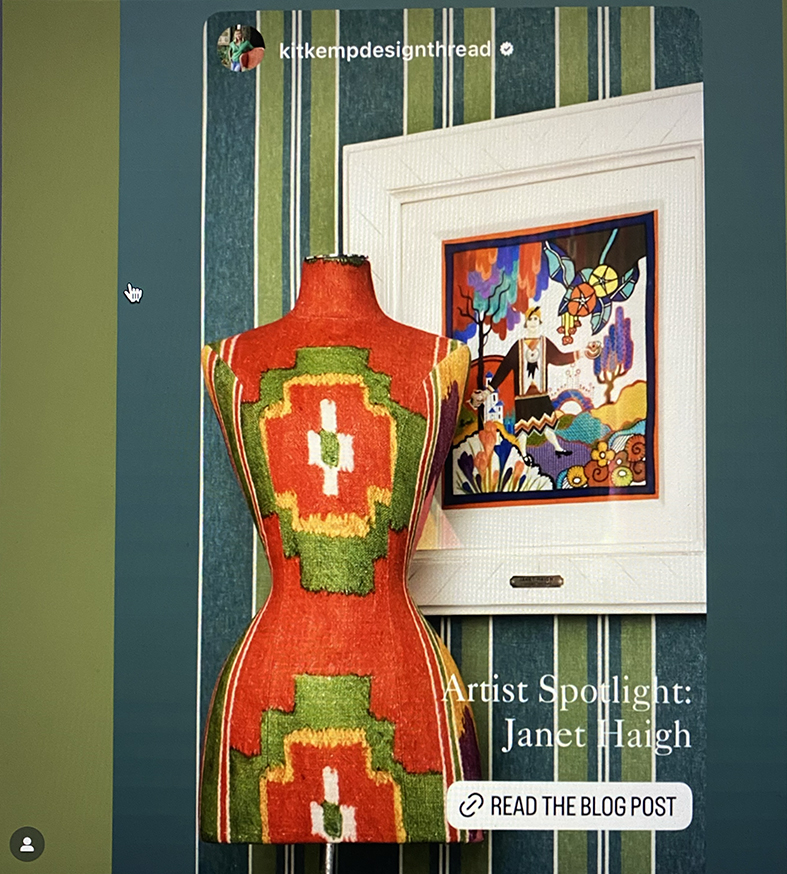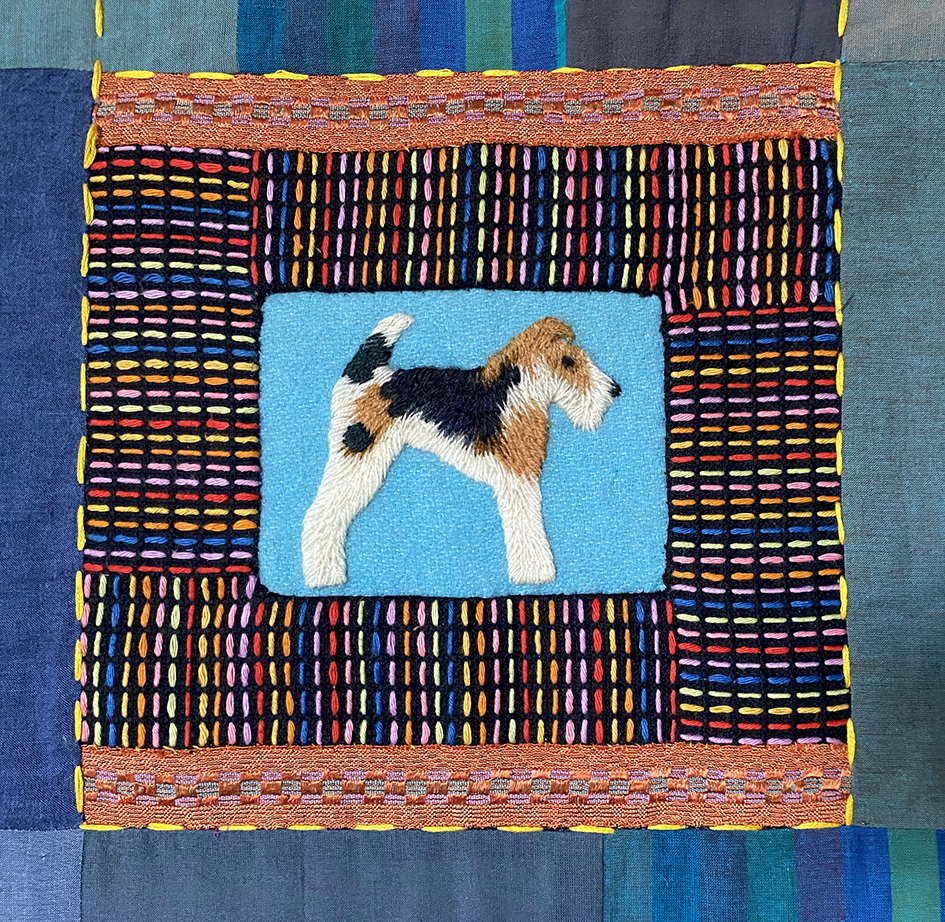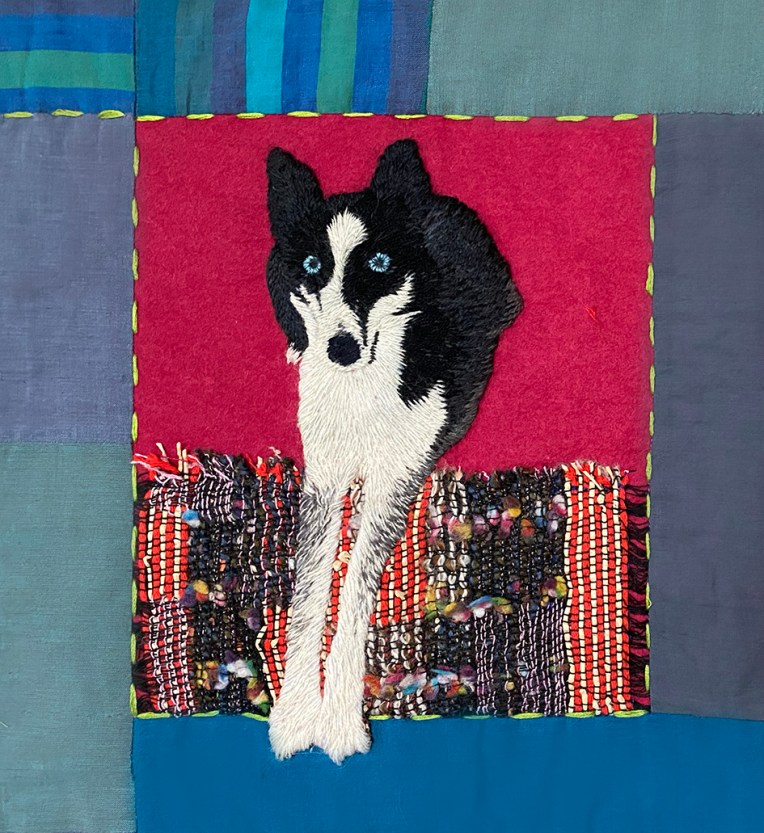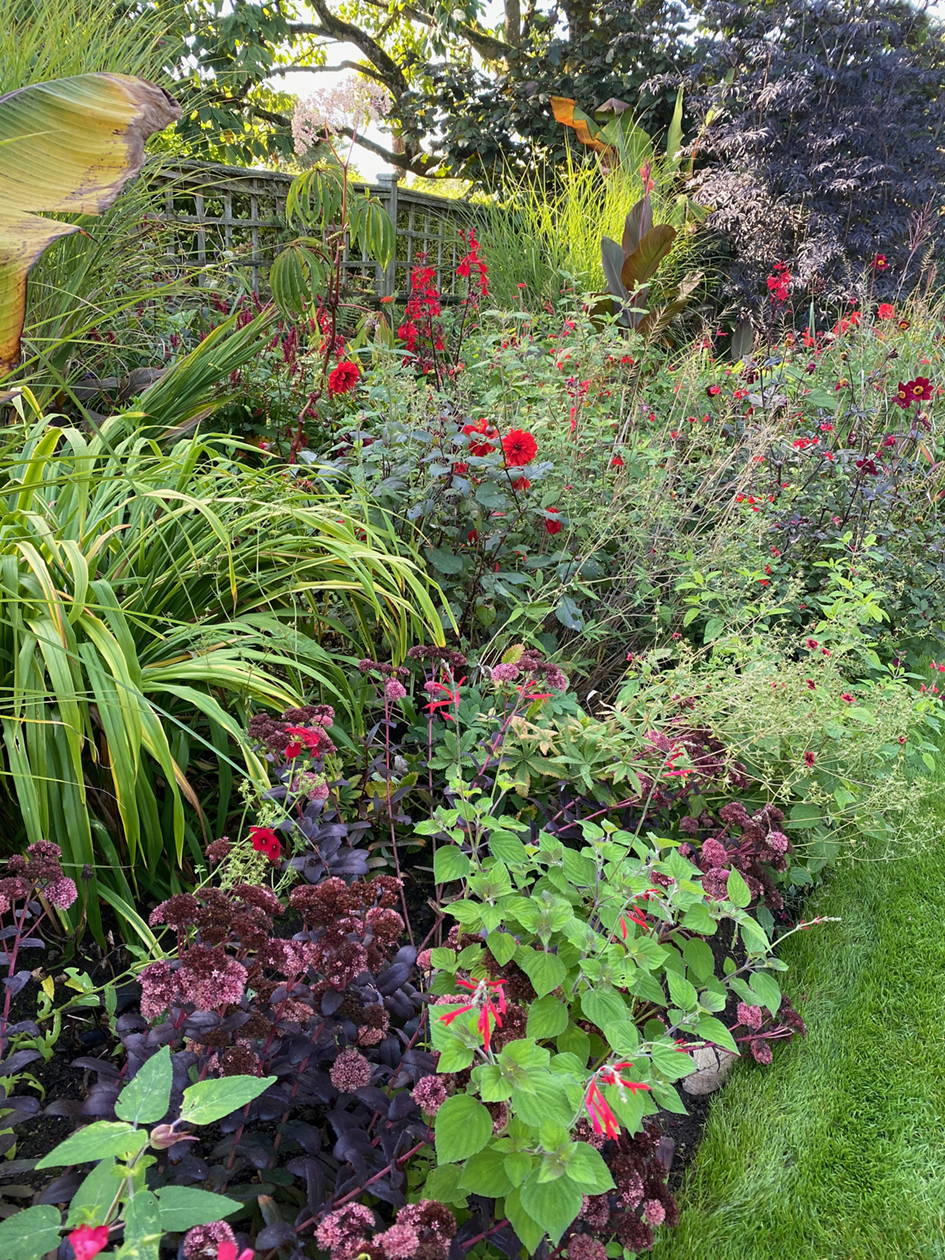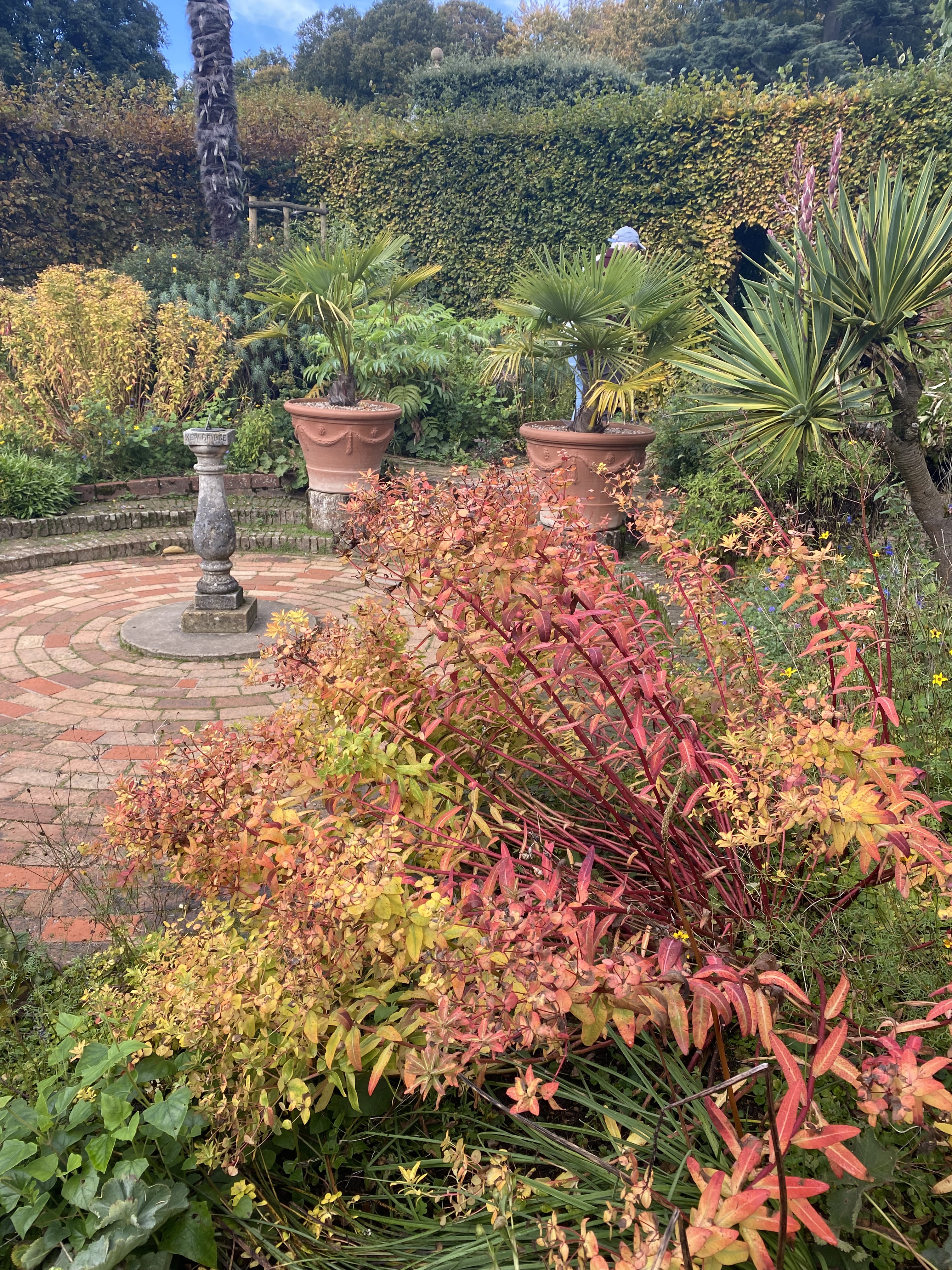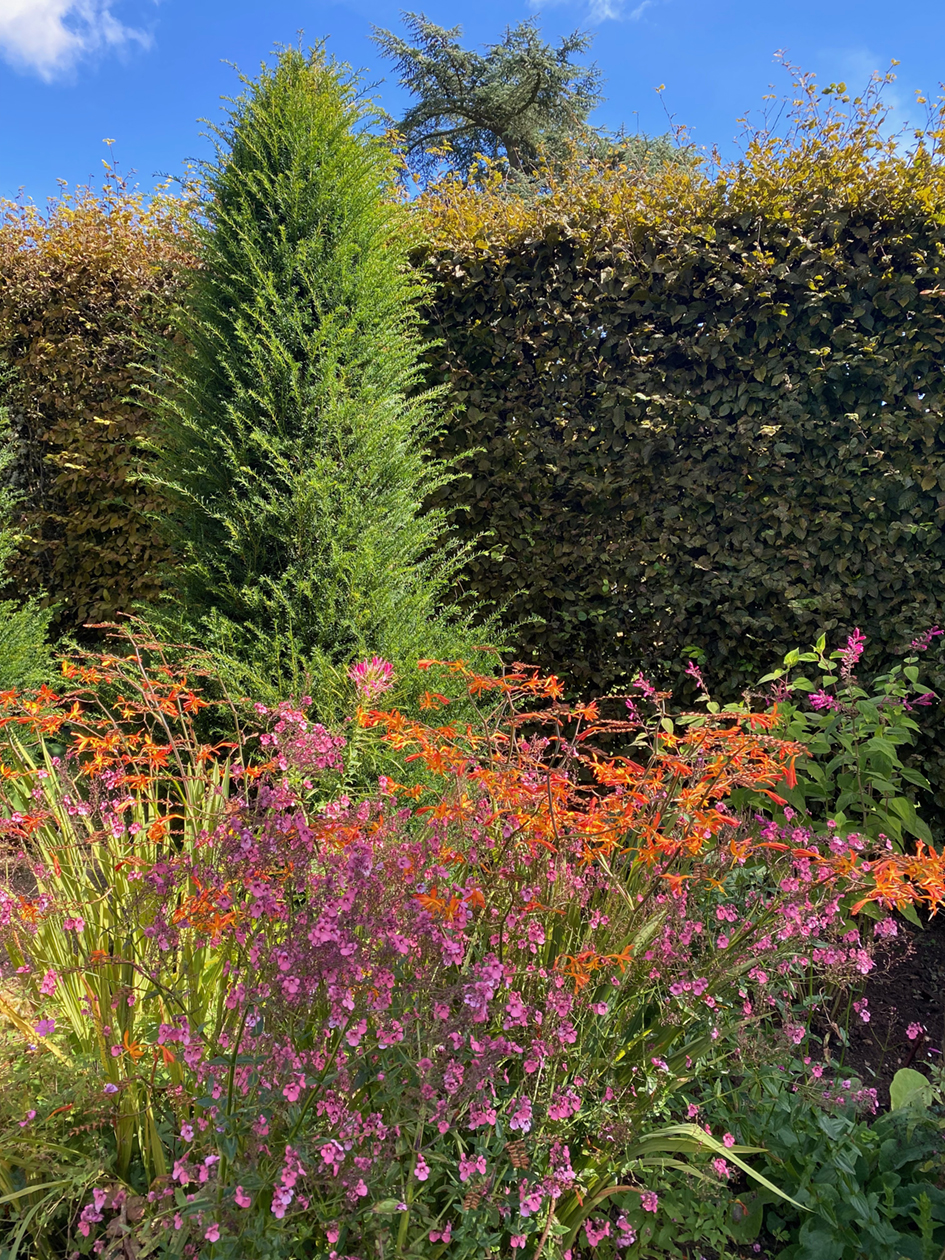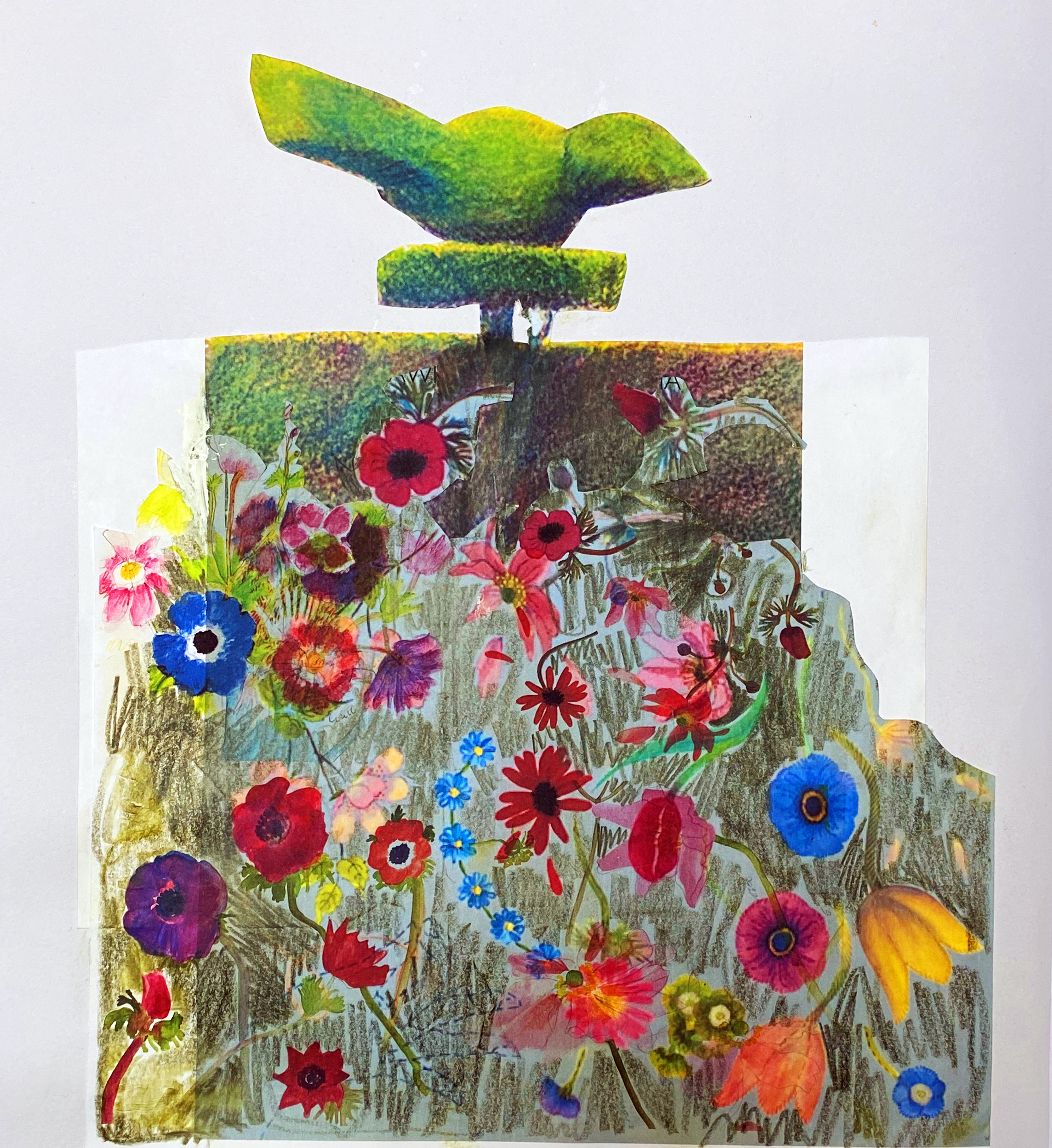
Strange how sometimes things come together: I was contacted, out of the blue, by Marcus Wells at Havilland Designs to see if I undertook commissions? He had framed some of my earlier work (embroidered portraits of women designers) for one of his clients, the interior designer Kit Kemp, who, to my amazement, had spotlighted my work on her blog, showing the perfectly placed Clarice Cliff portrait and lots more. Now read on……
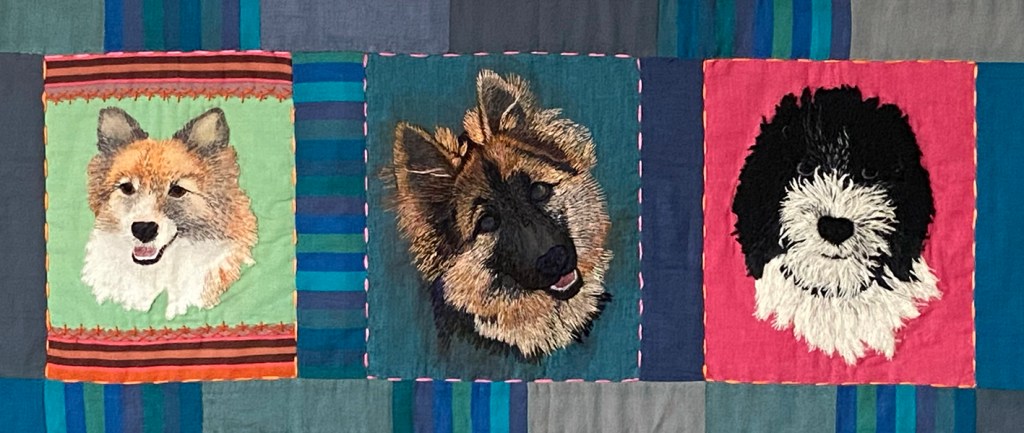
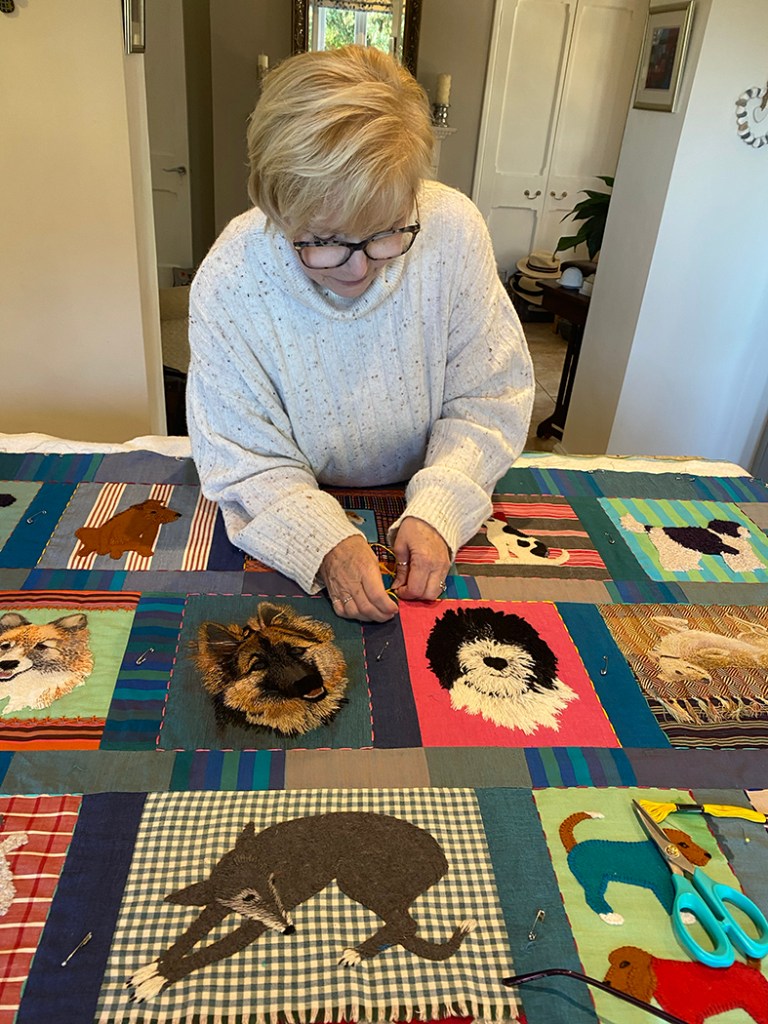
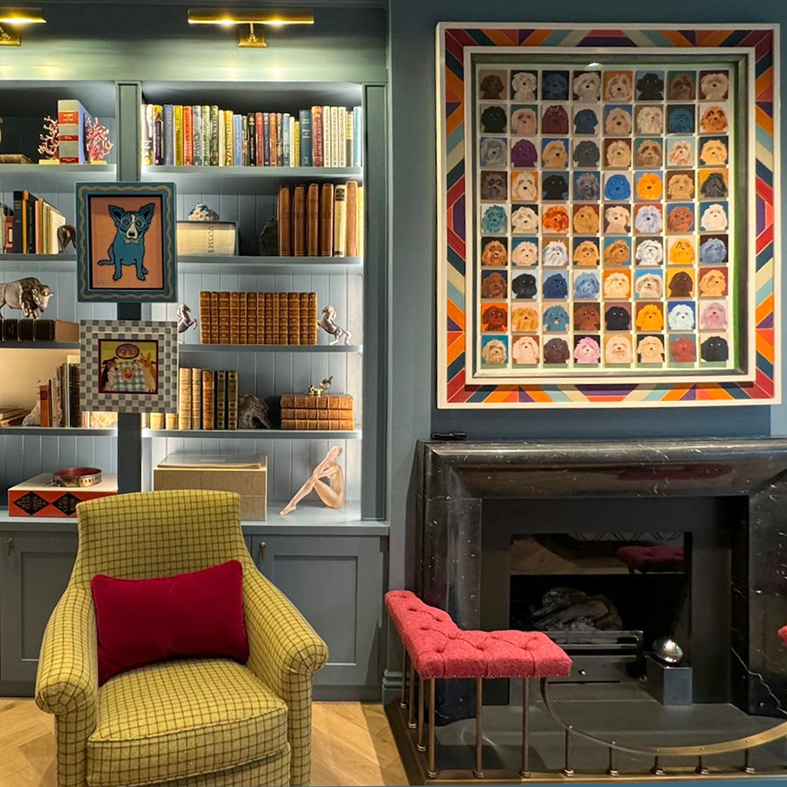
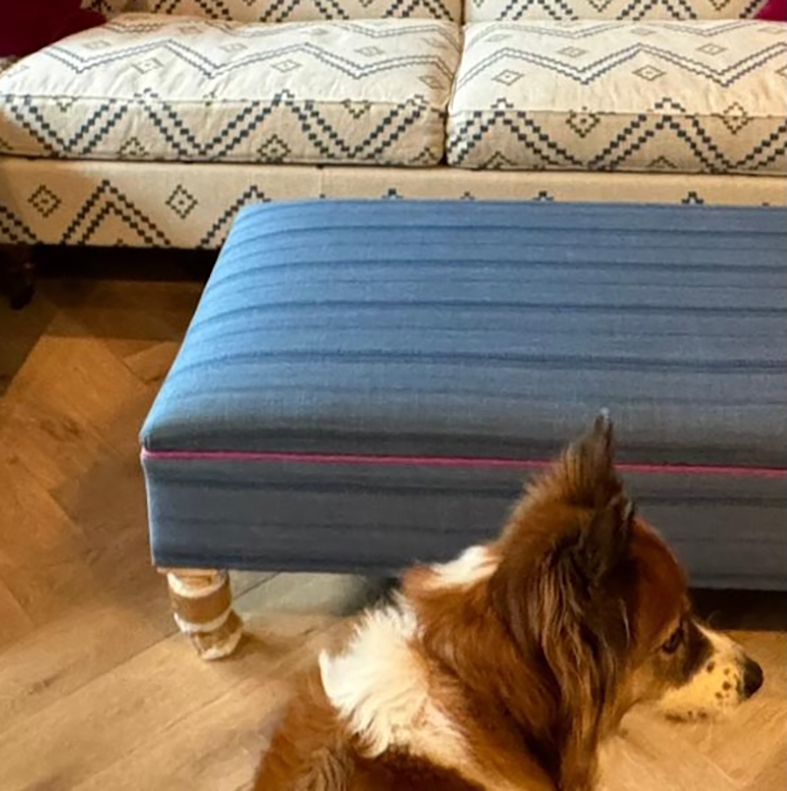
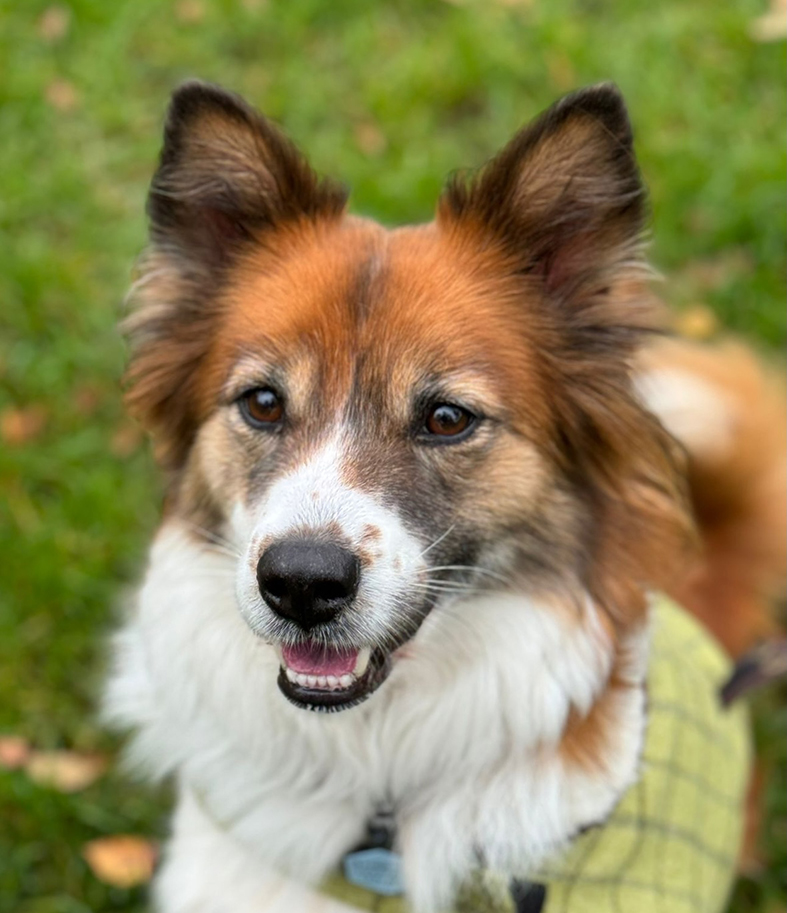
Marcus had a client who wanted a quilt depicting dogs. I am not a quilt maker but I was intrigued and asked him to send me details, sizes, preferred imagery etc. and an overview of the space where the quilt would hang. It was to be framed by Marcus and – no pressure – his client was another interior designer….He sent several images of the room that the quilt was to be hung in and I noticed a small dog’s head on one of them, I asked for pictures of any other dogs belonging to the client.
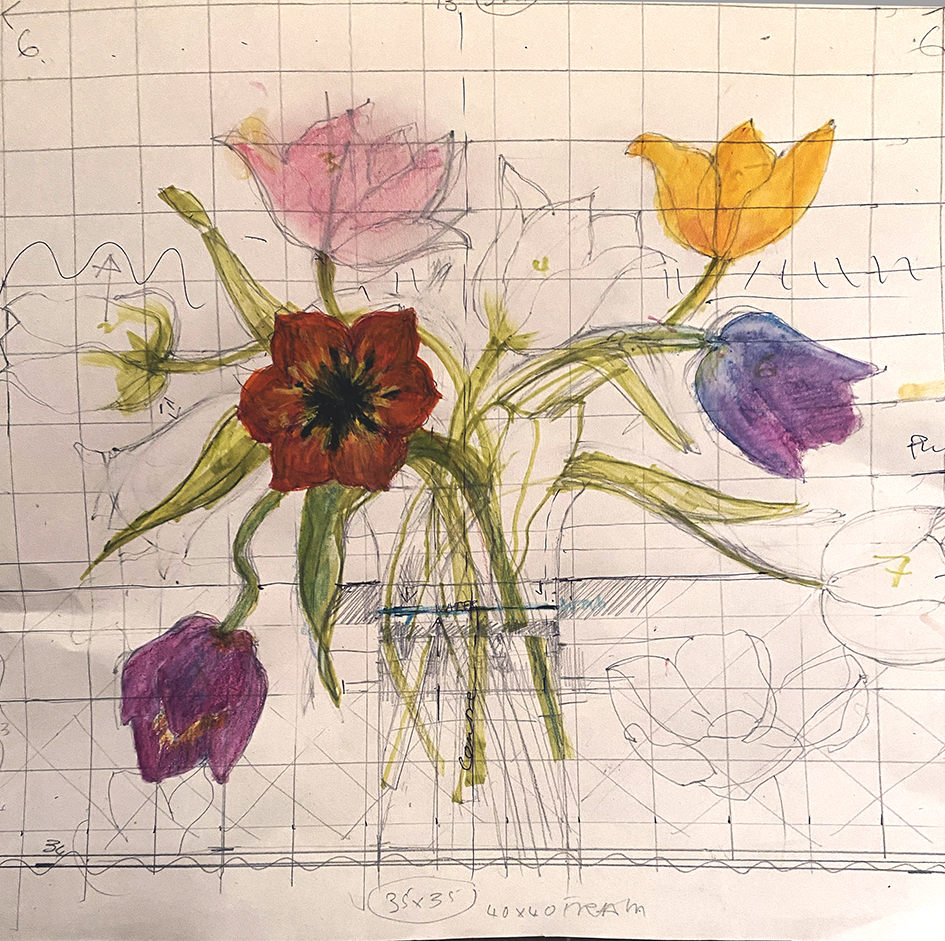
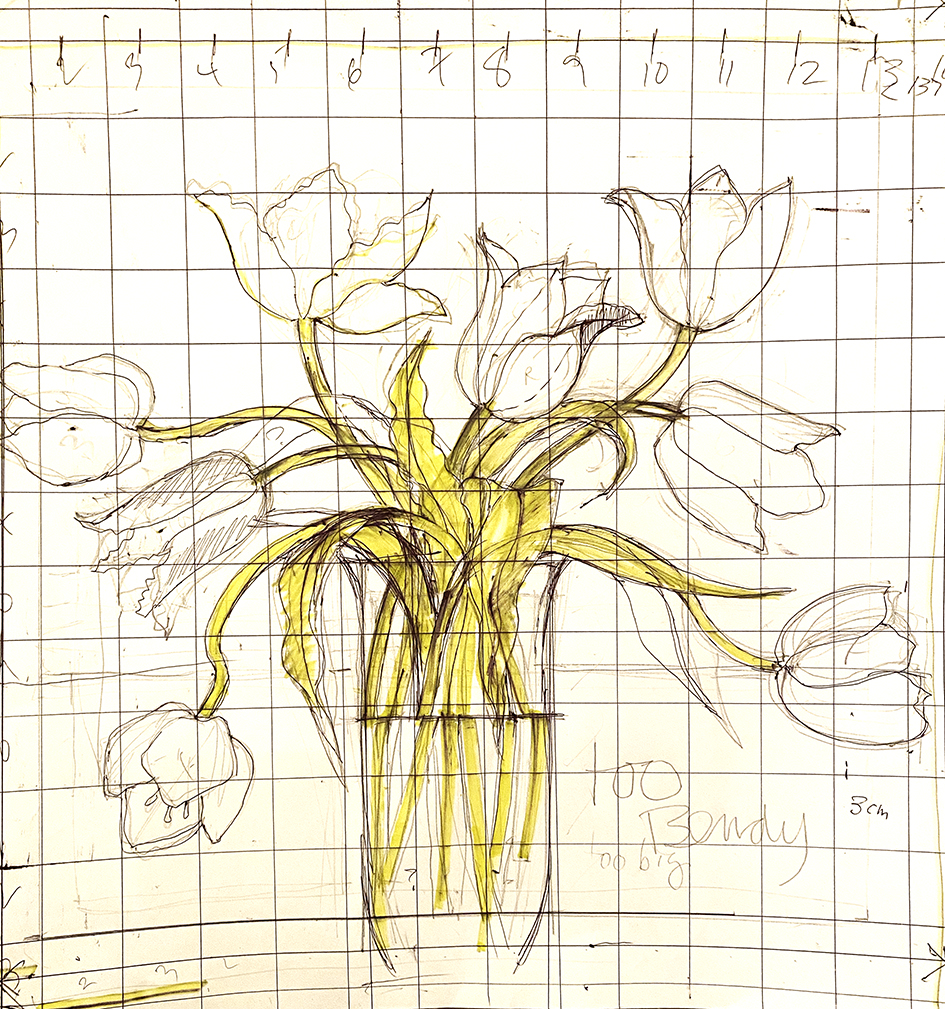
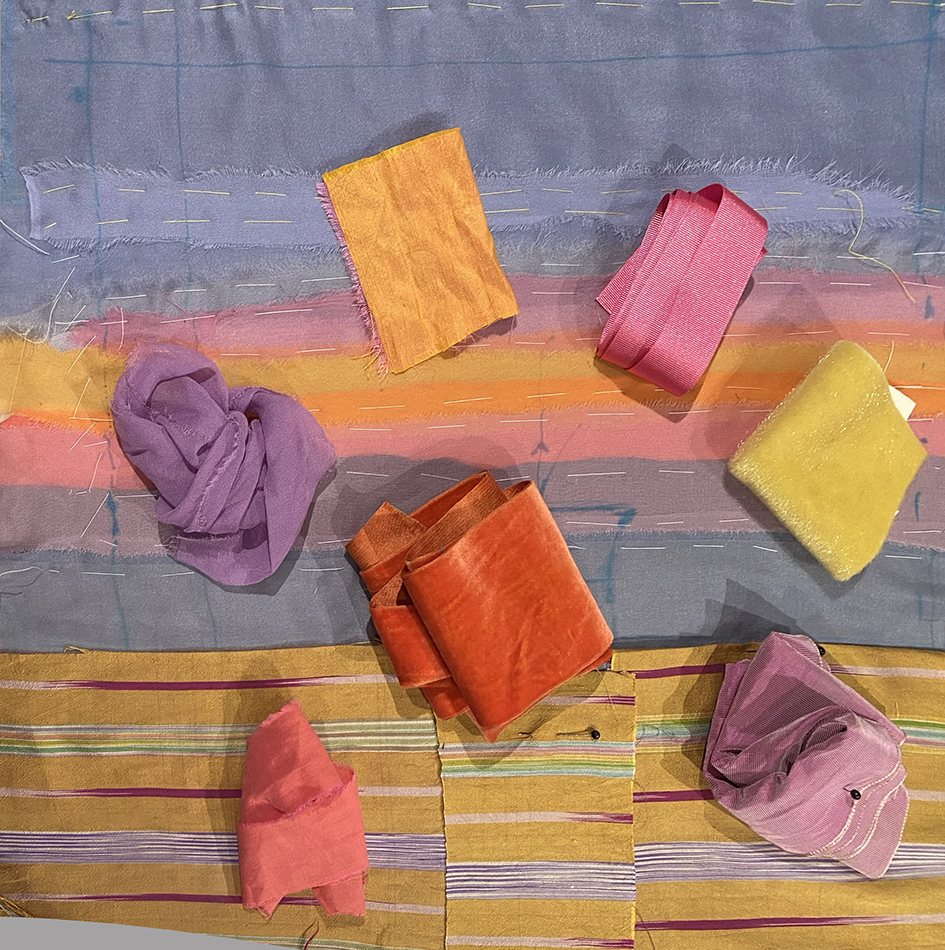
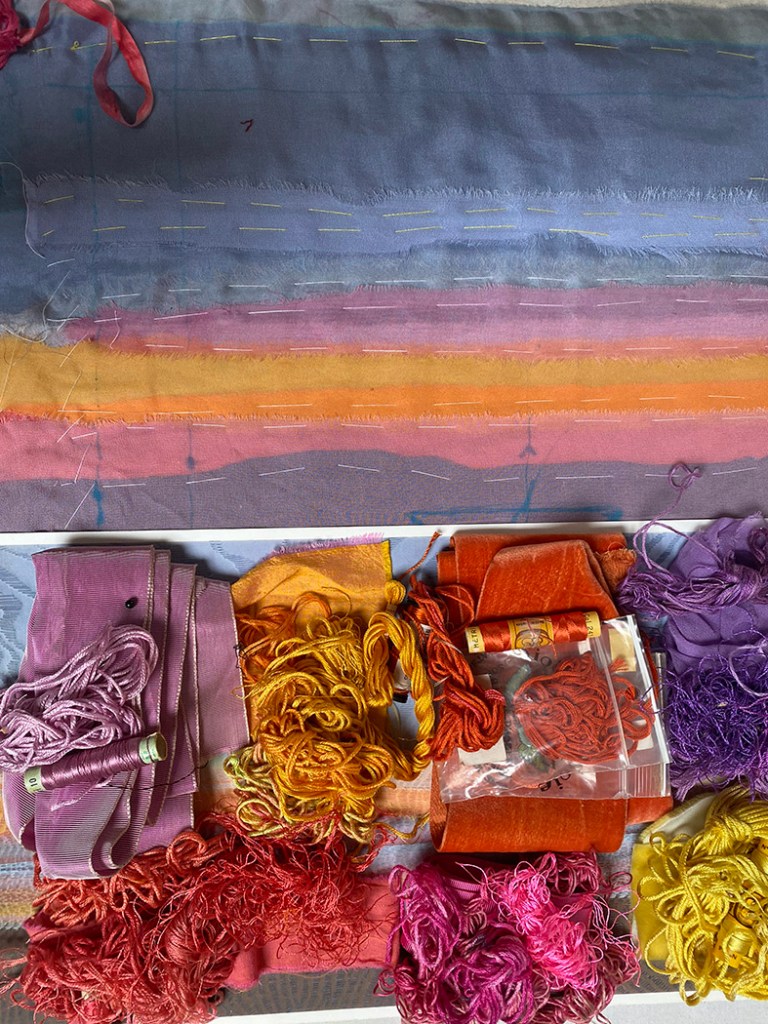
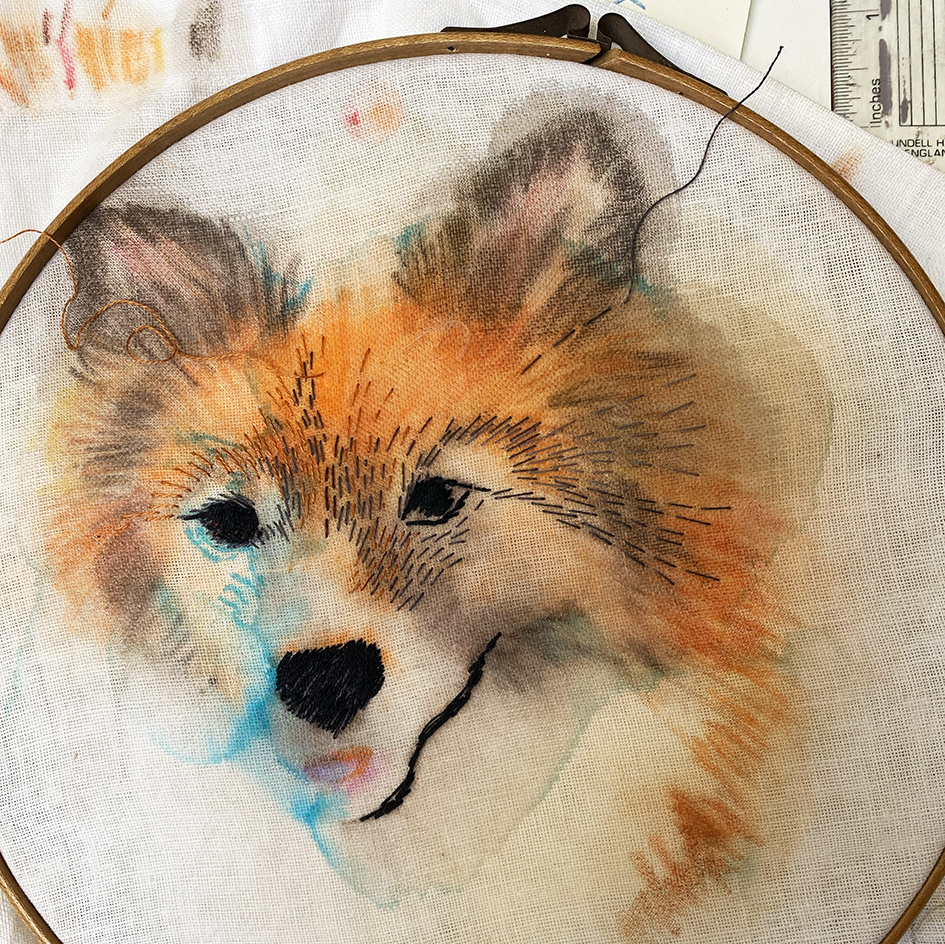
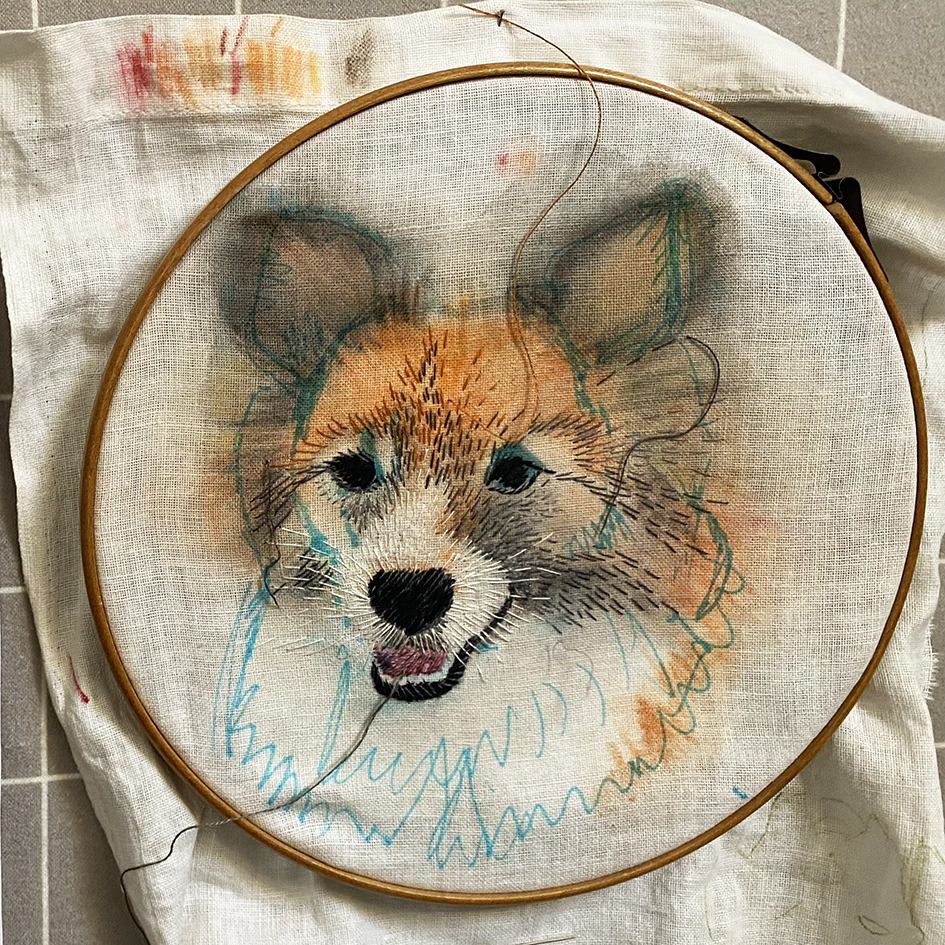
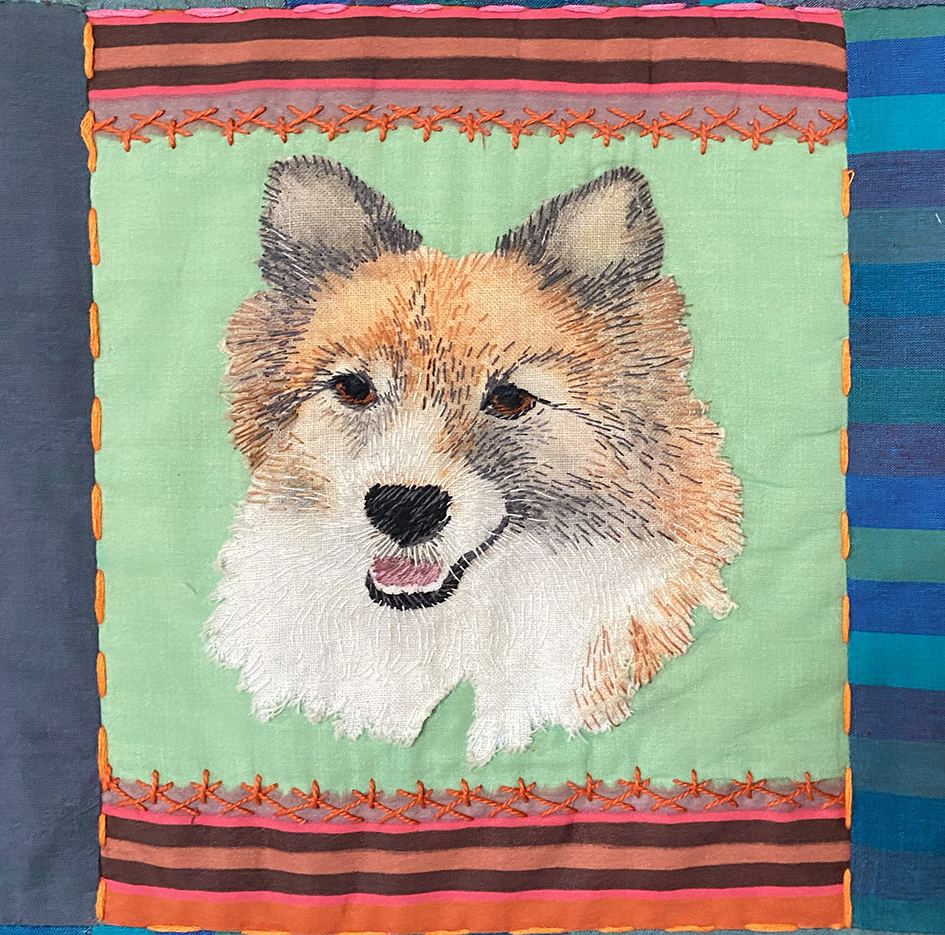
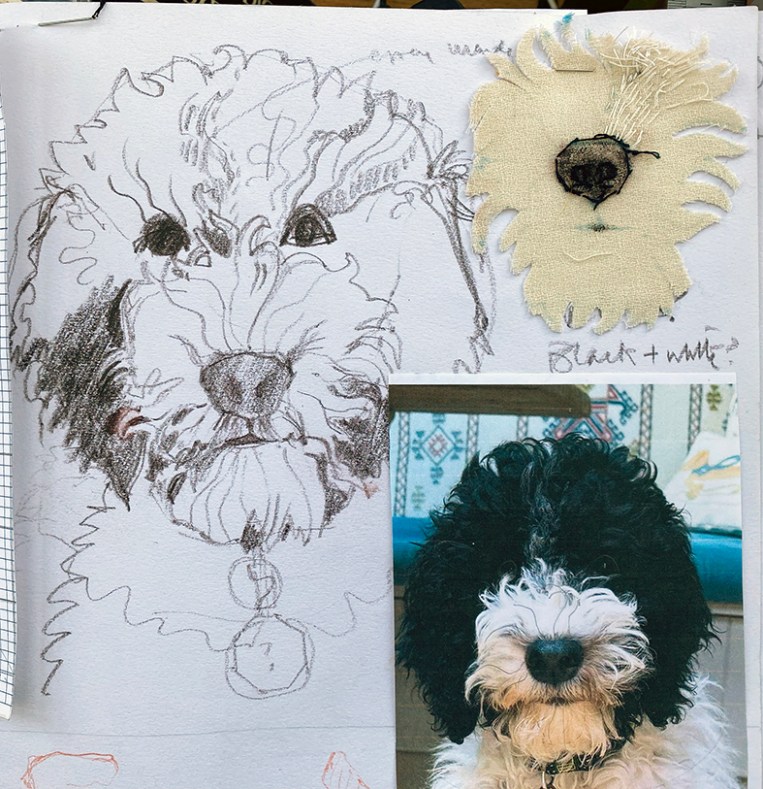
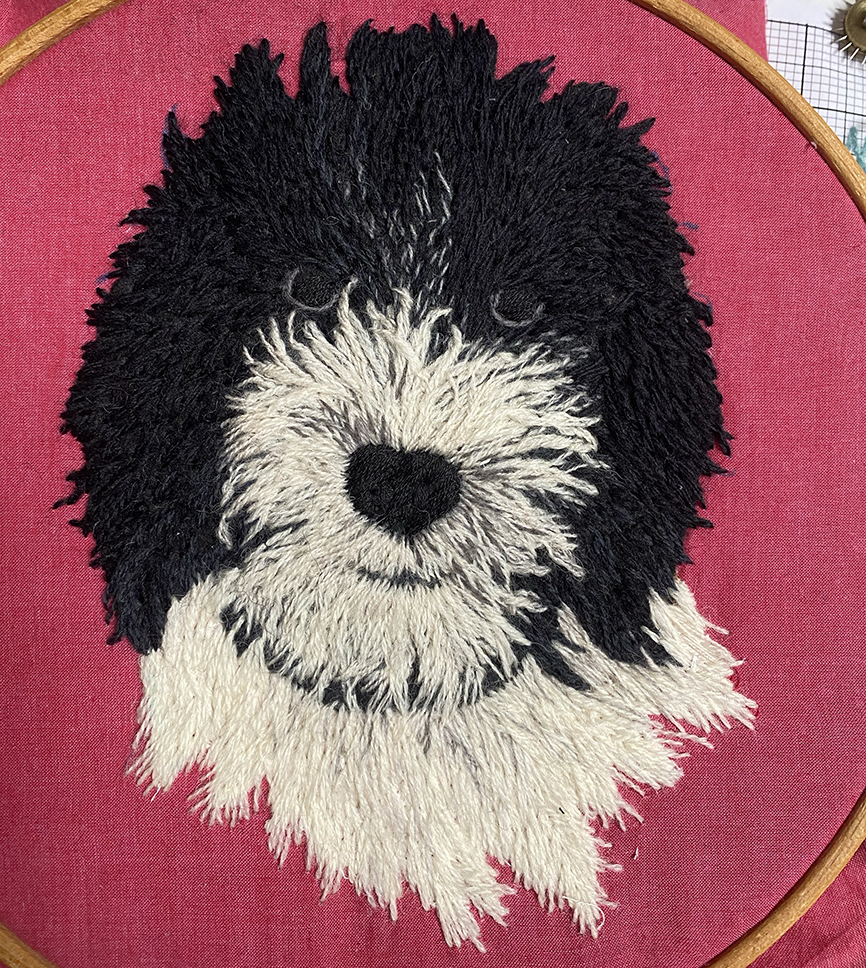
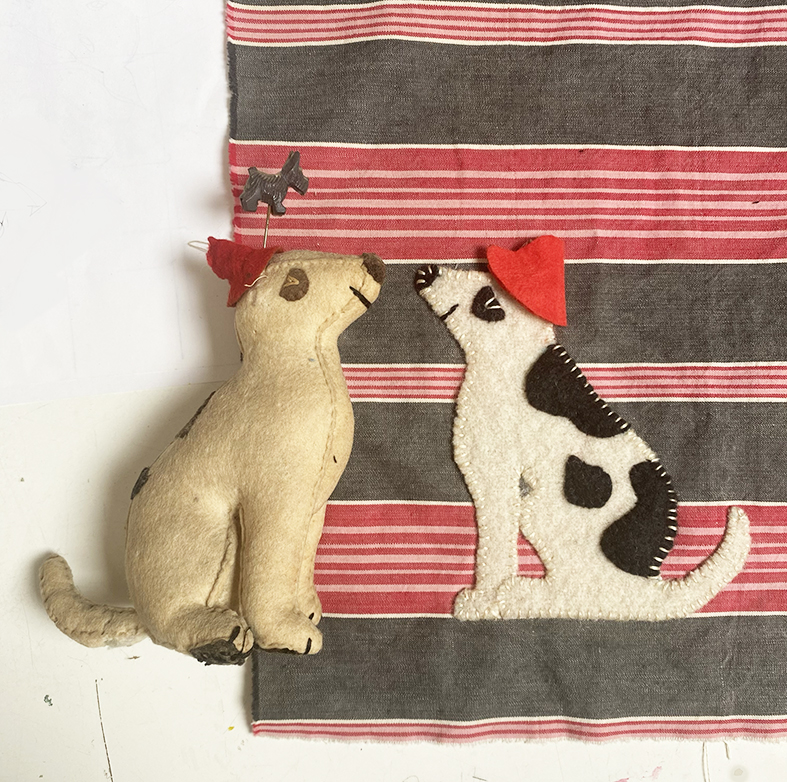
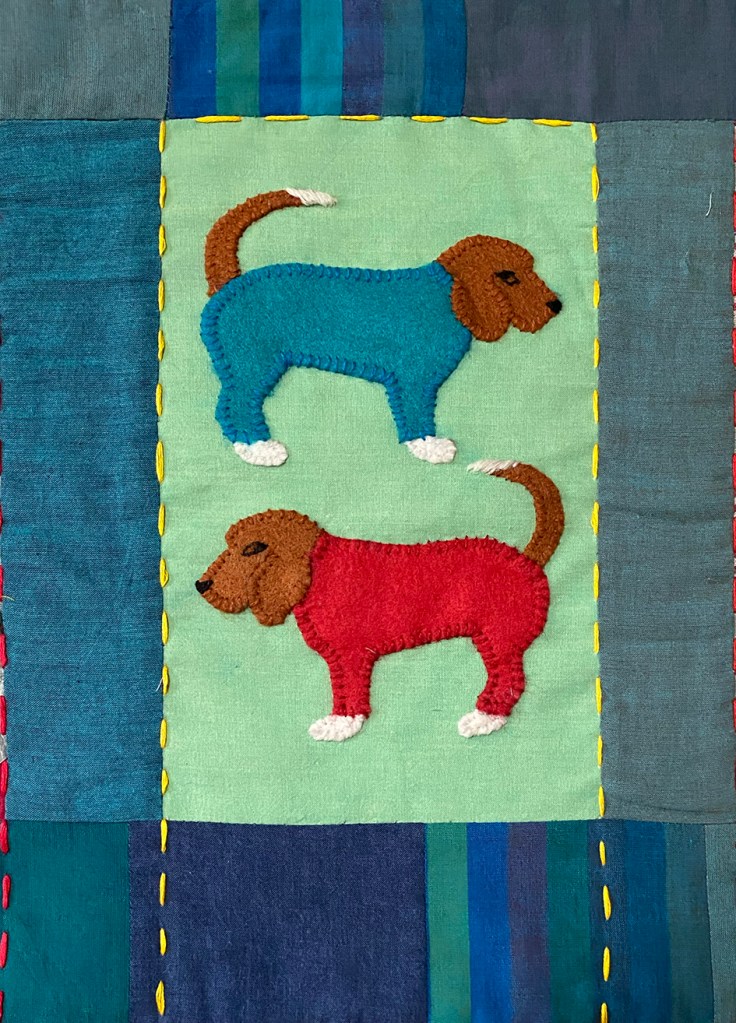
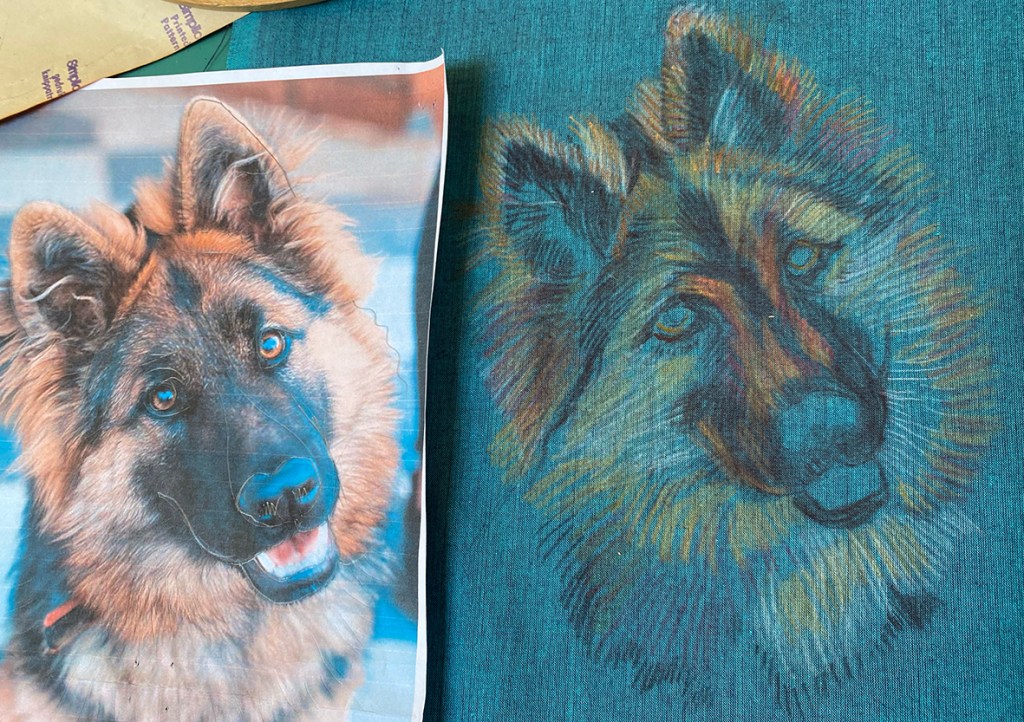
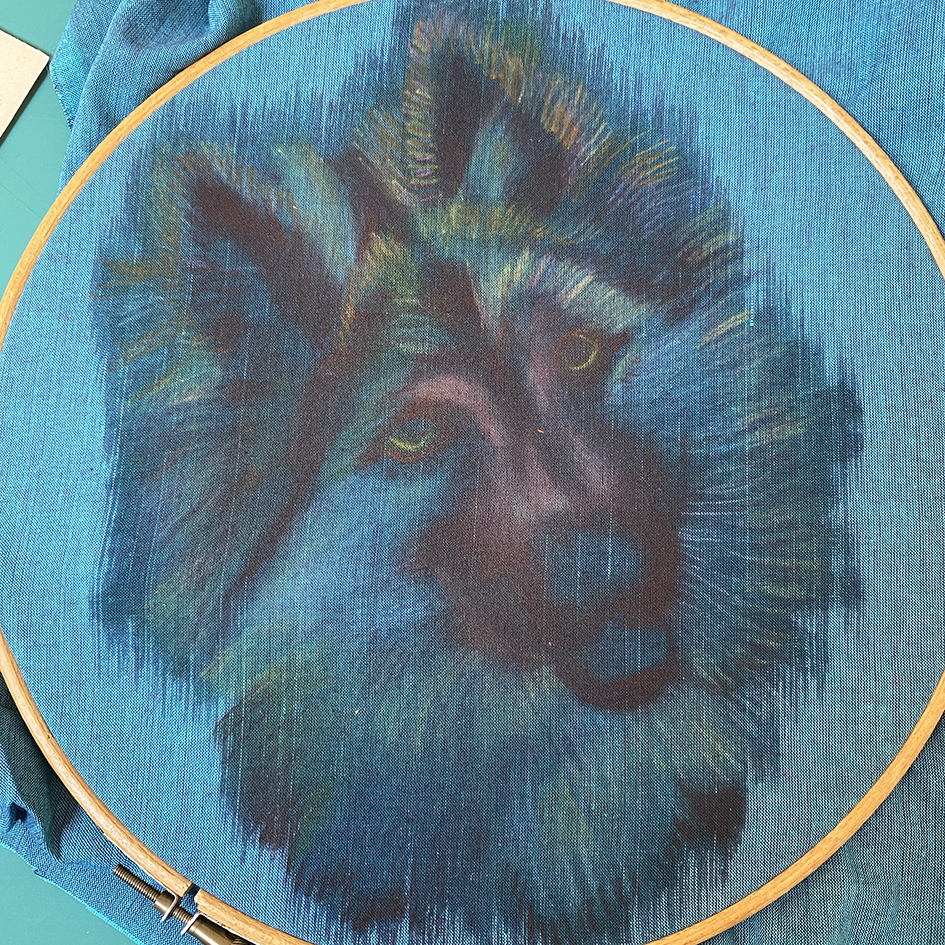
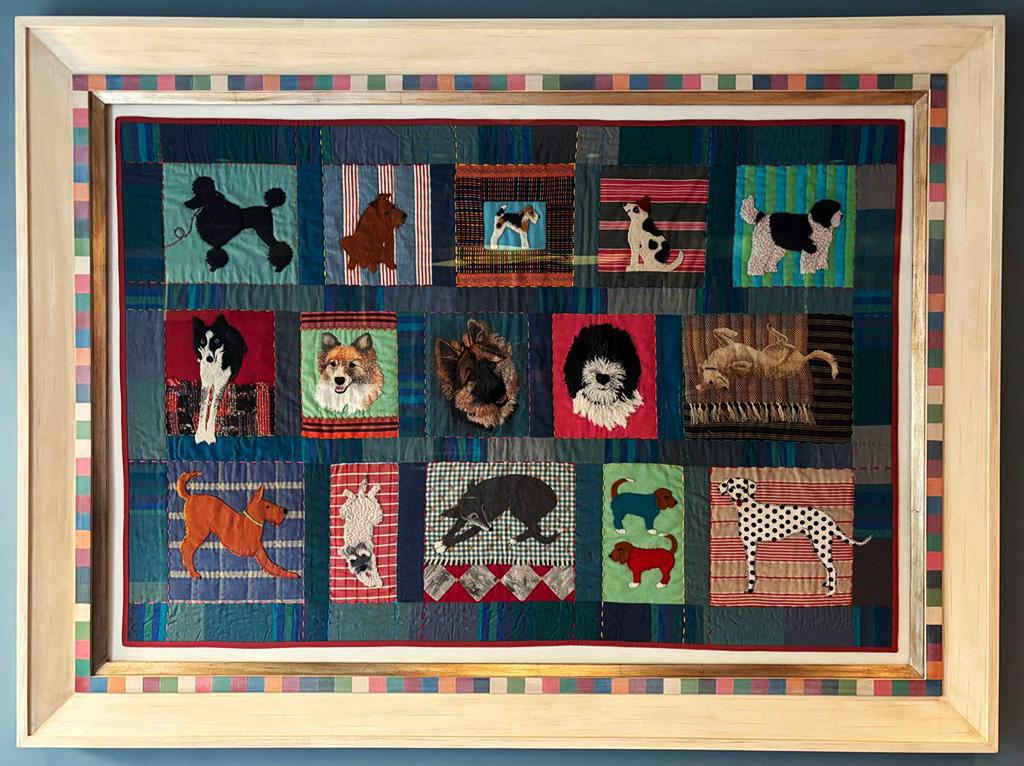
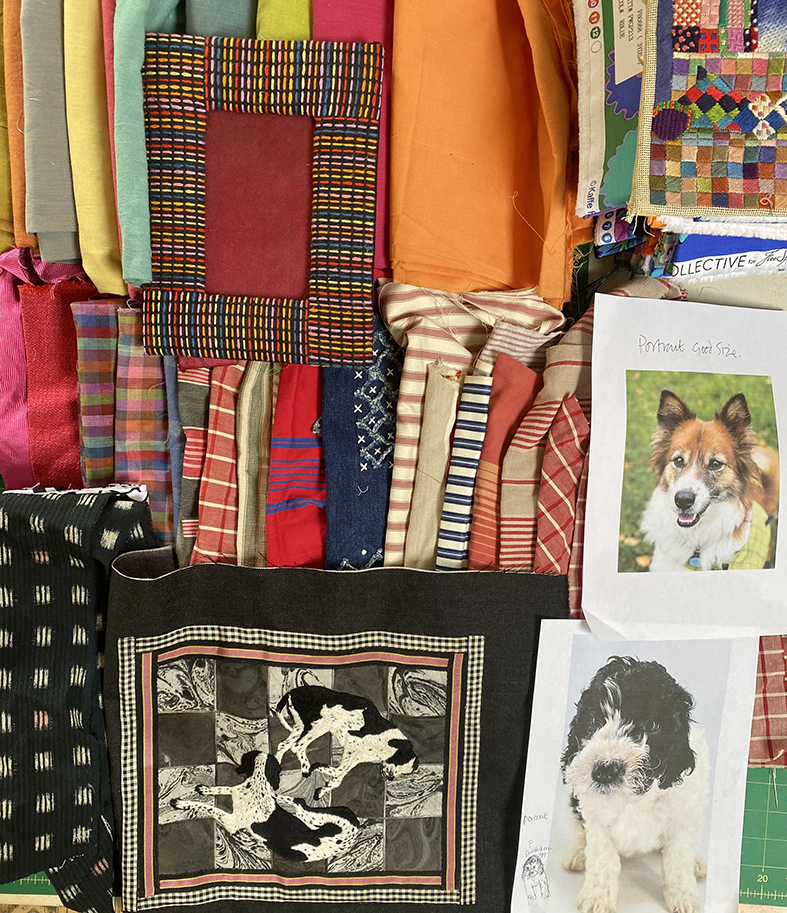
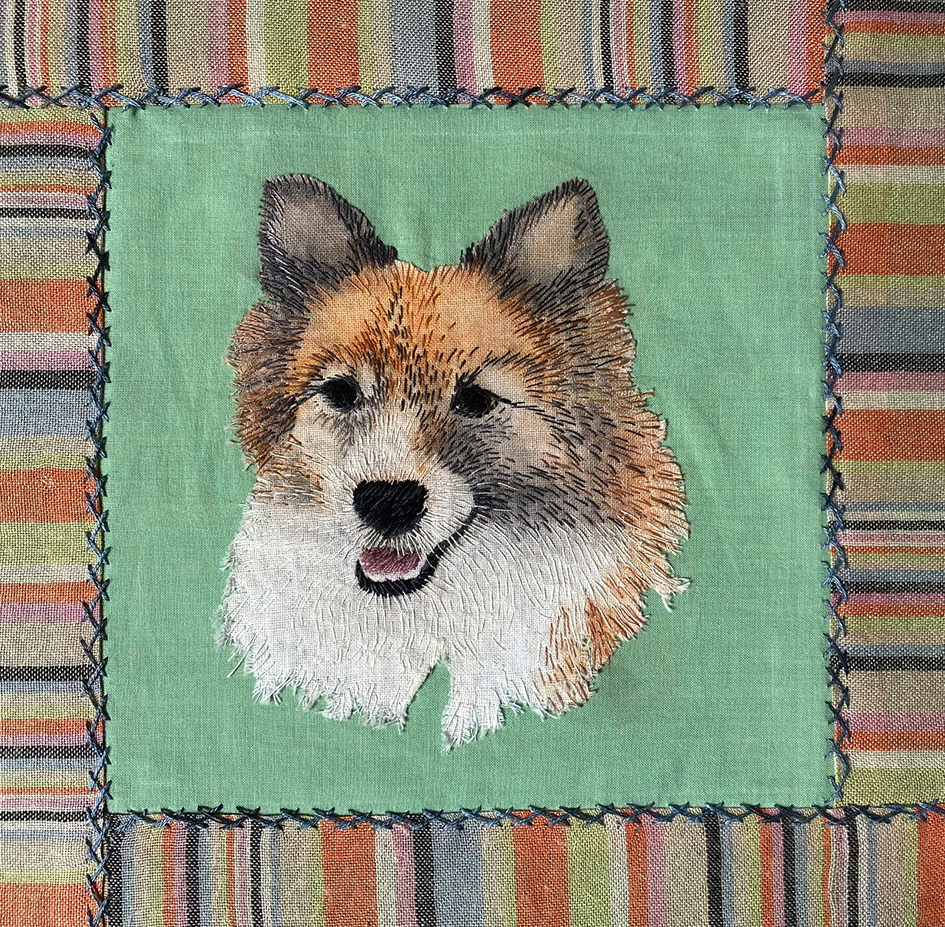
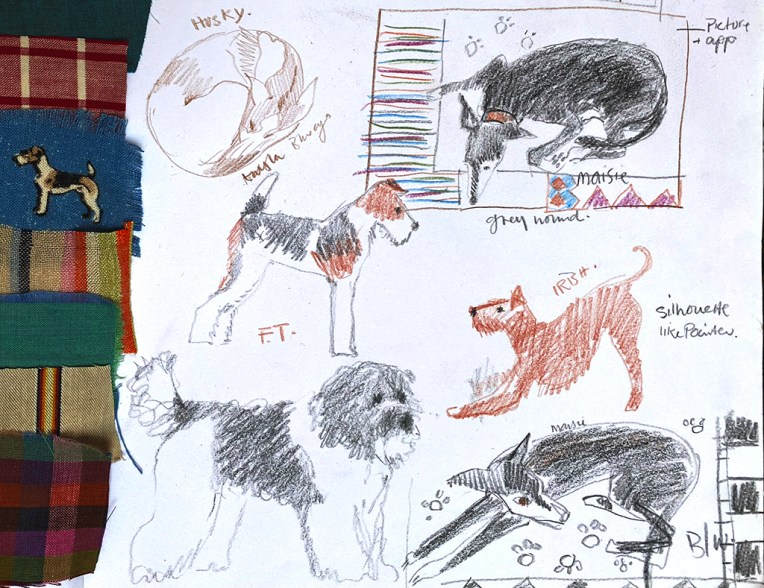
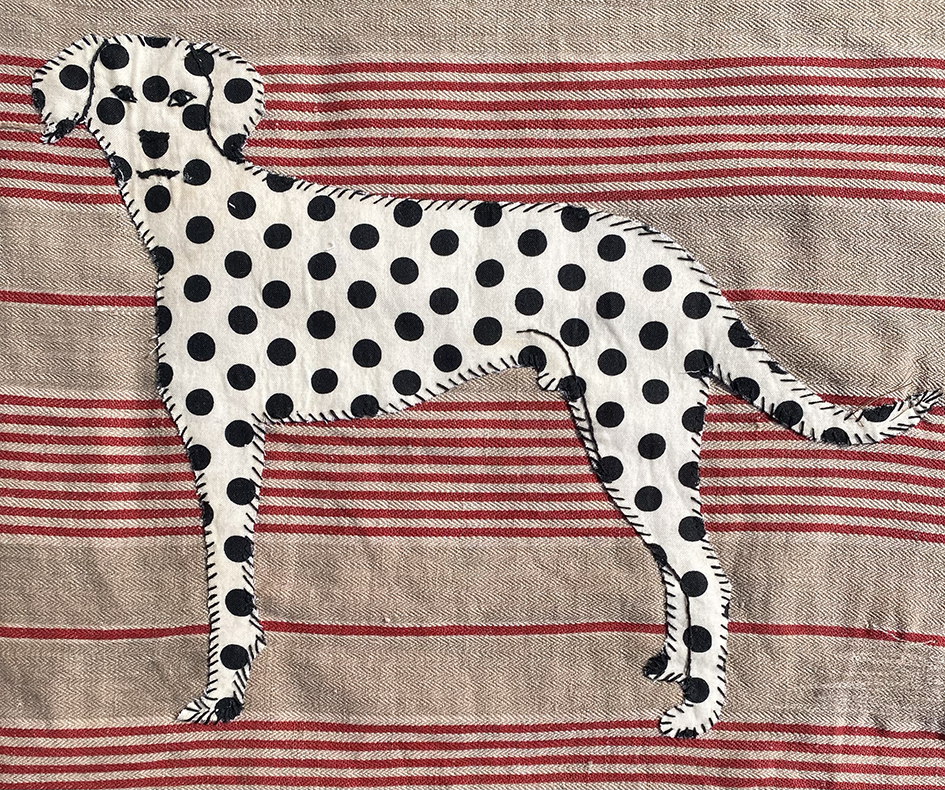
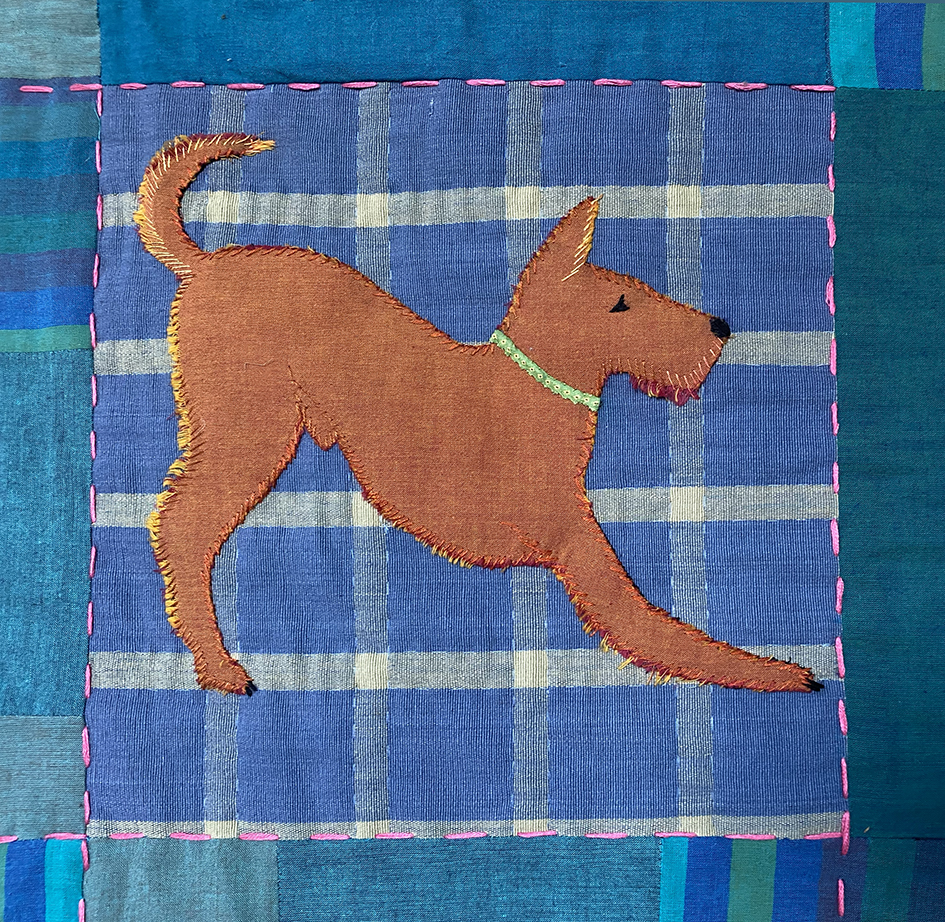
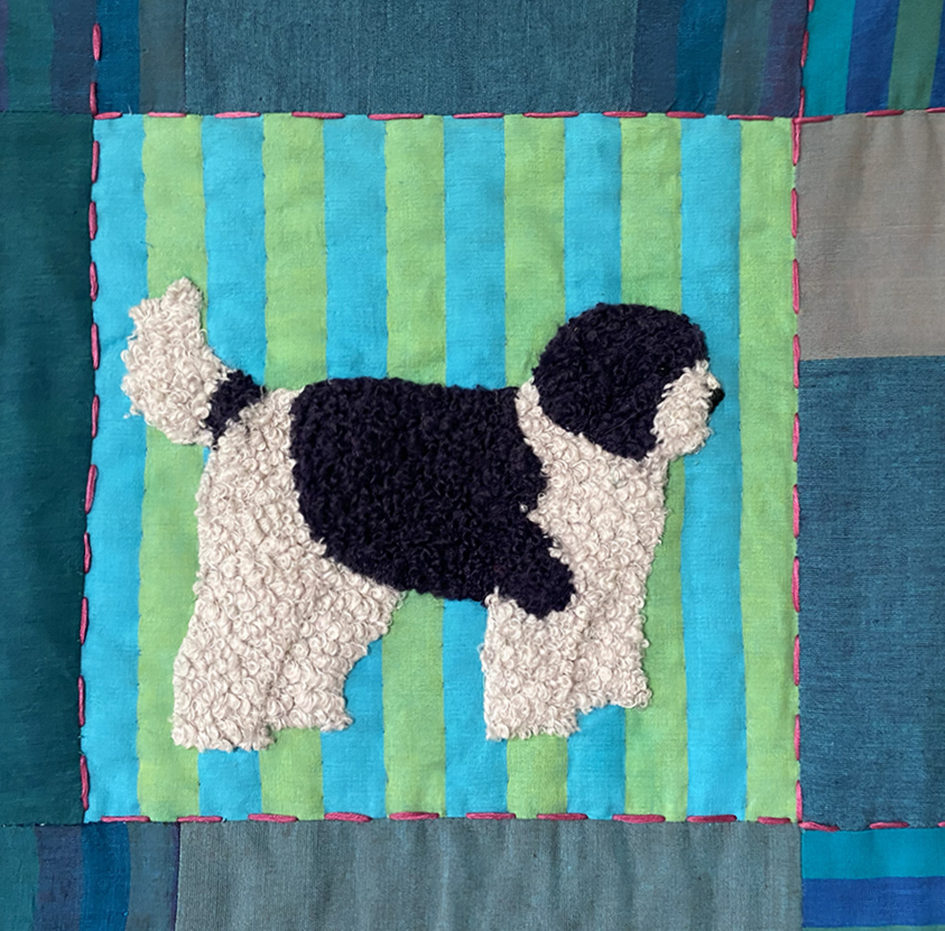
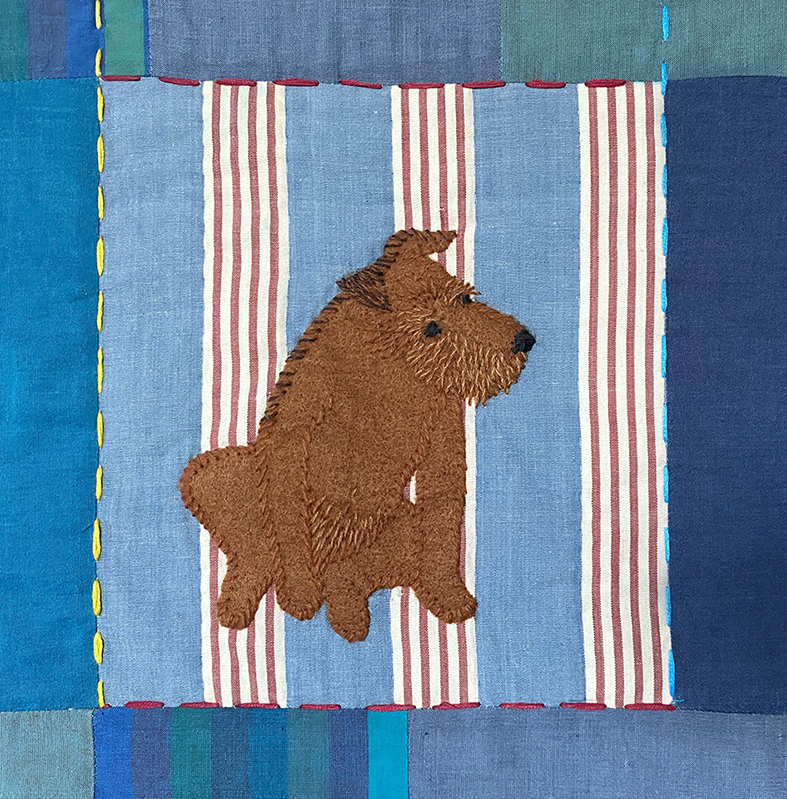
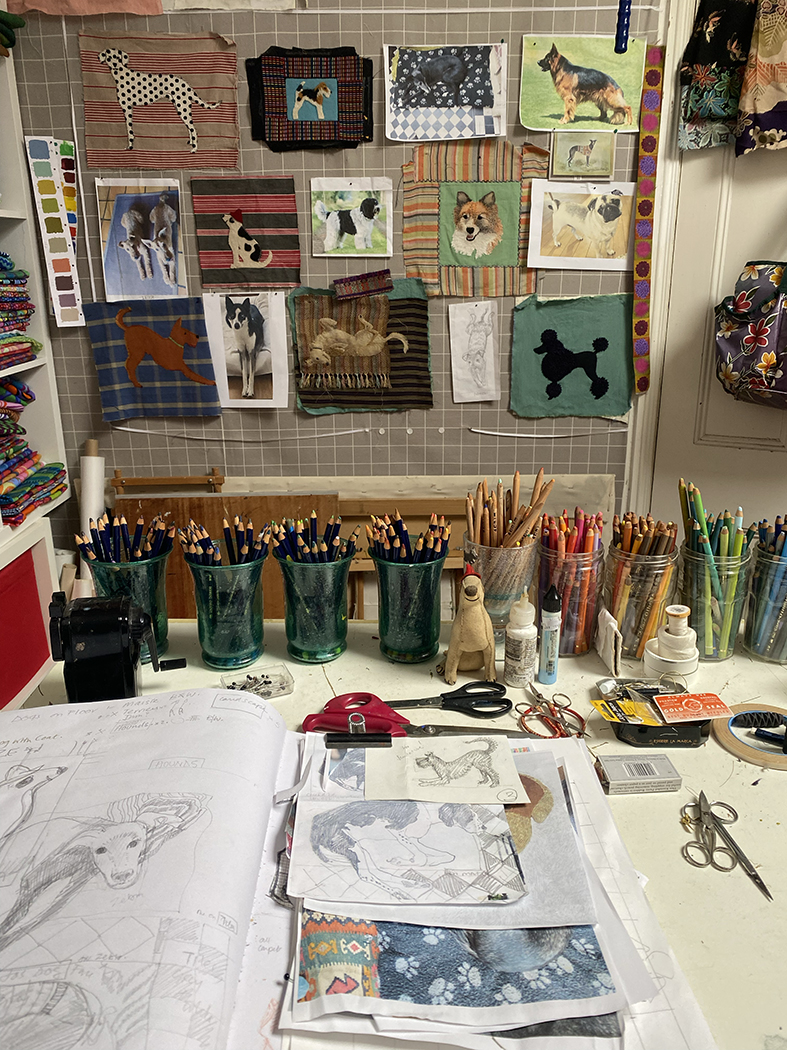
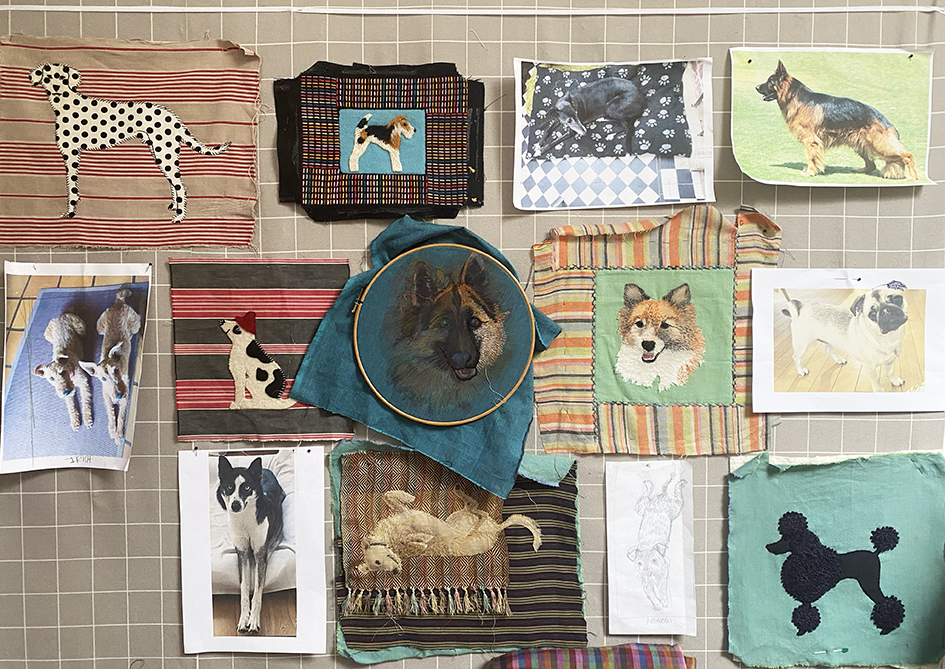
I then made several design sheets for a colour scheme and fabrication, with drawings and 2 embroidered samples using of a range of techniques that I could offer: from the simplest applique design for a spotty Dalmation to a hand-stitched portrait of the small dog in the original photograph. I was given the commission:- a quilted hanging with patchwork blocks of stitched dogs using the different techniques.
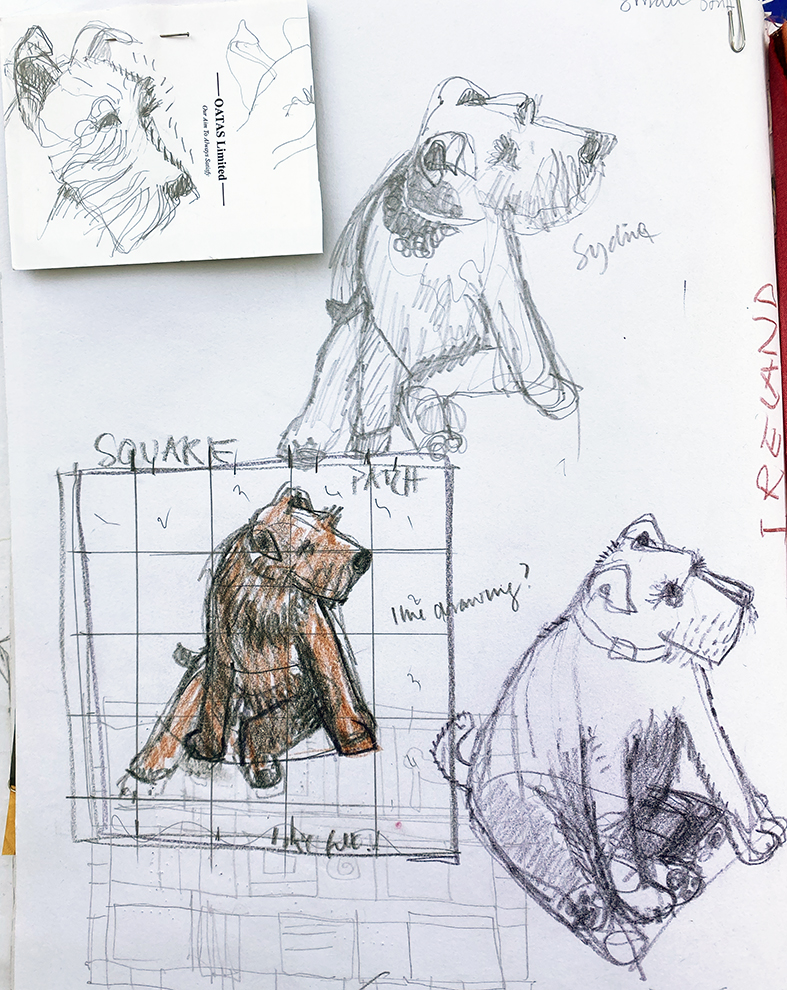
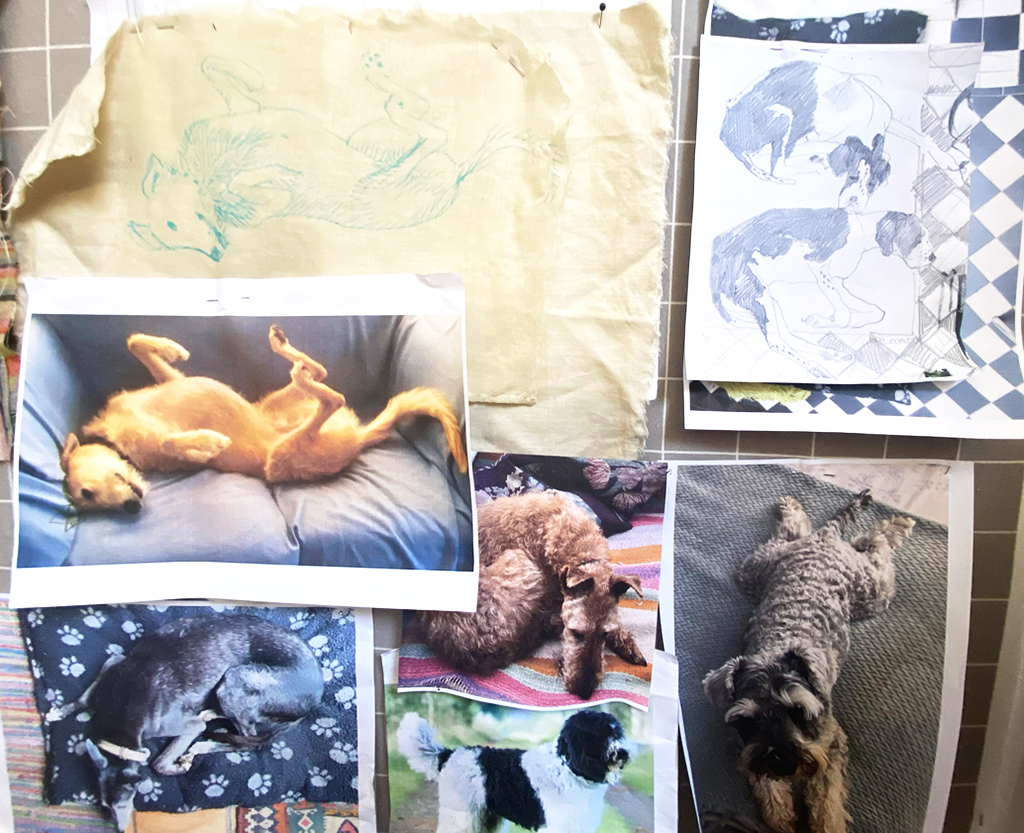
So now to find the extra dogs; my first set of drawings showed typical positions taken by each breed above. I do love dogs and am fascinated by their shapes, specially when totally relaxed. I had started with basic stance like the Dalmation, and just had to include a French poodle and terriers, so an Irish terrier, a Fox terrier and a Border terrier. And hounds, a Schnauzer Leo and even a Siberian husky Twyla, all in easy reach as they belong to friends, family and the local dog-walkers.
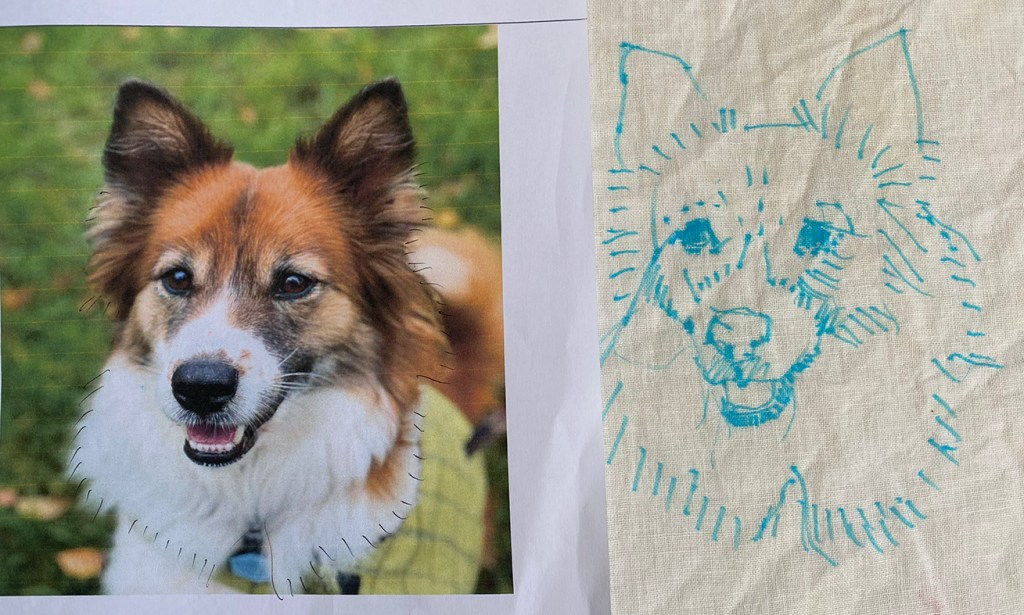
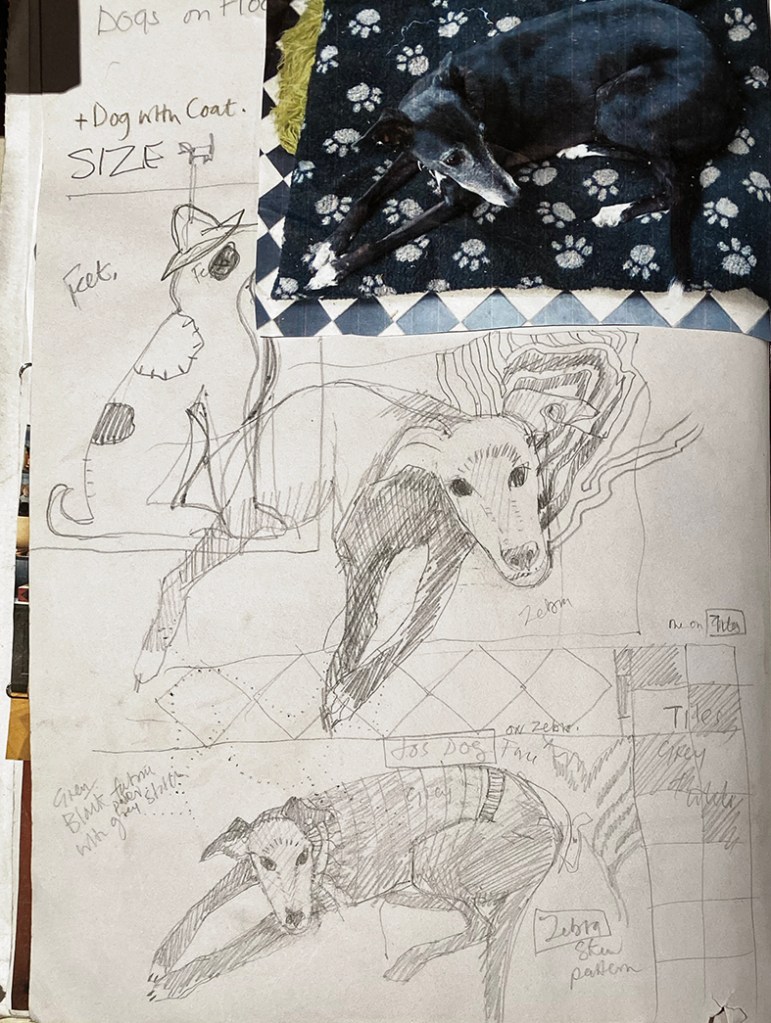
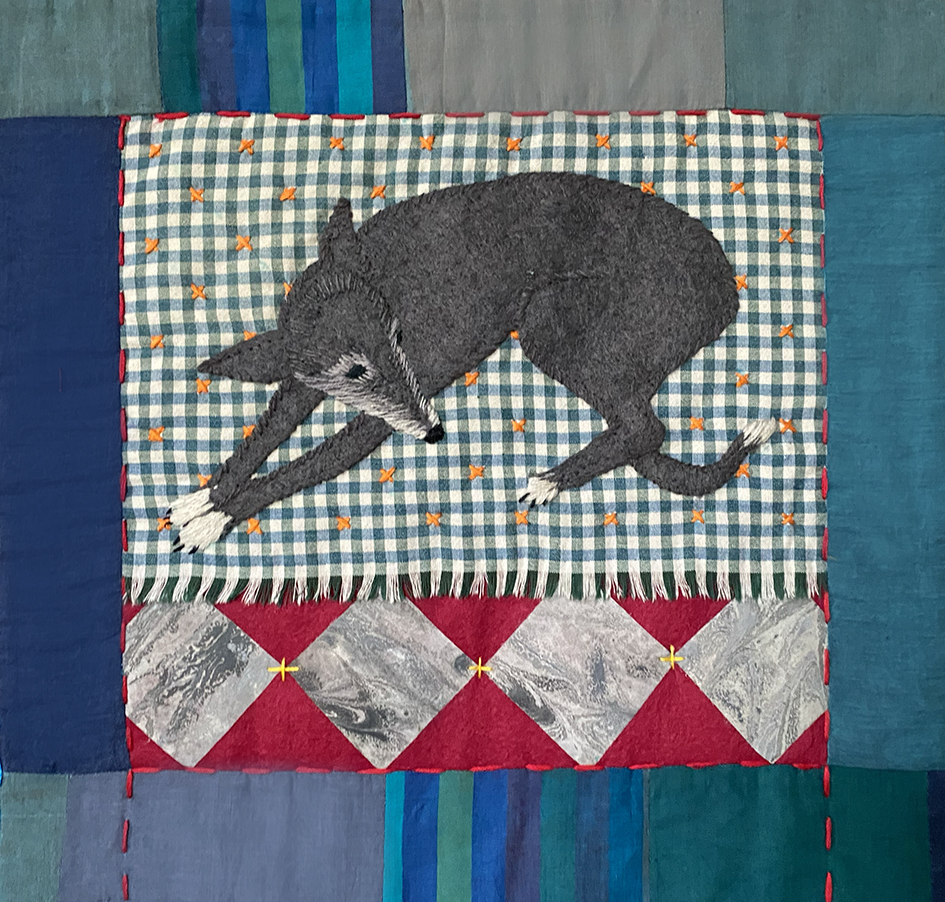
For most of the embroideries I drew the dogs to scale from photographs sent to me by the various owners, to decide which technique used for each dog but sometimes I just copied the photograph! Below are working drawings for the relaxed hound Rodney, and the oh-so-tired Sydney.
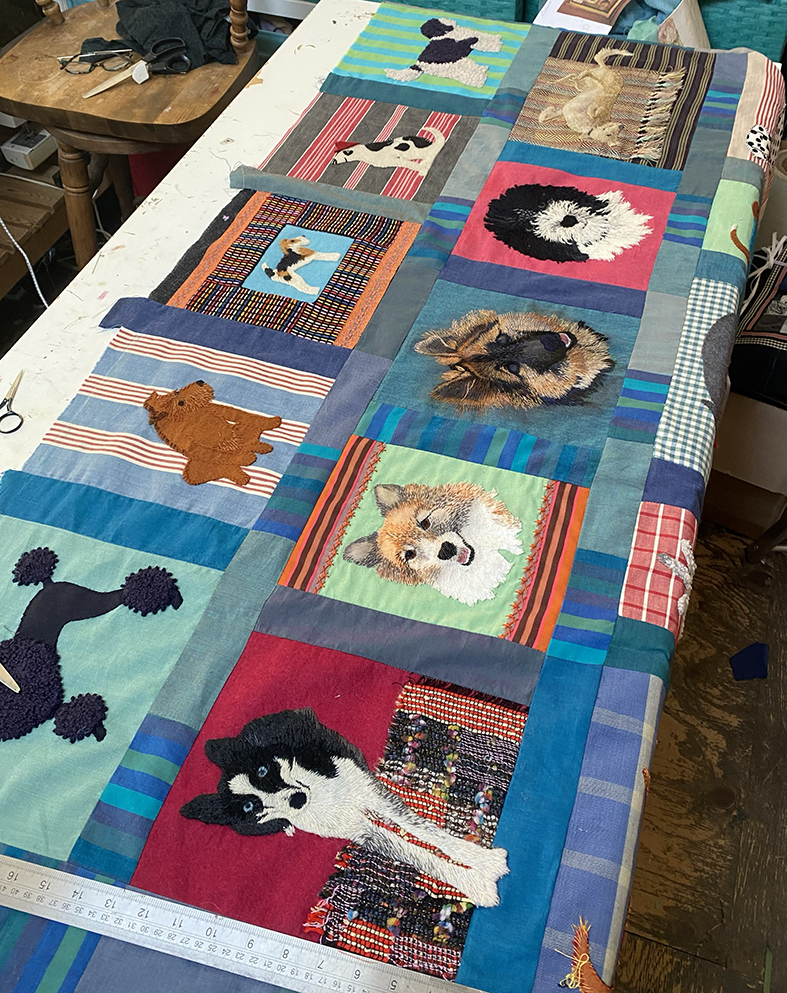
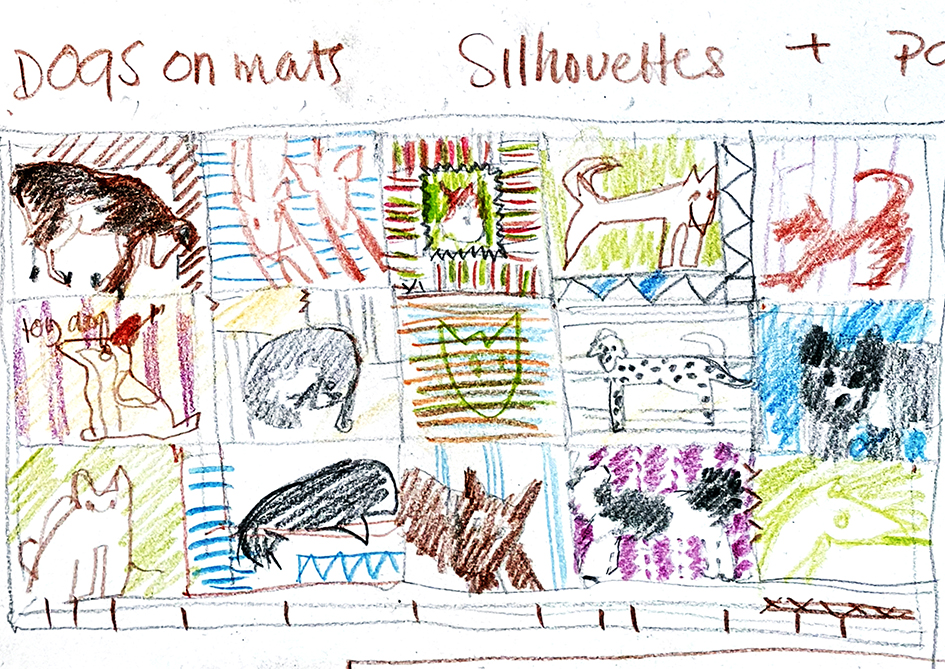
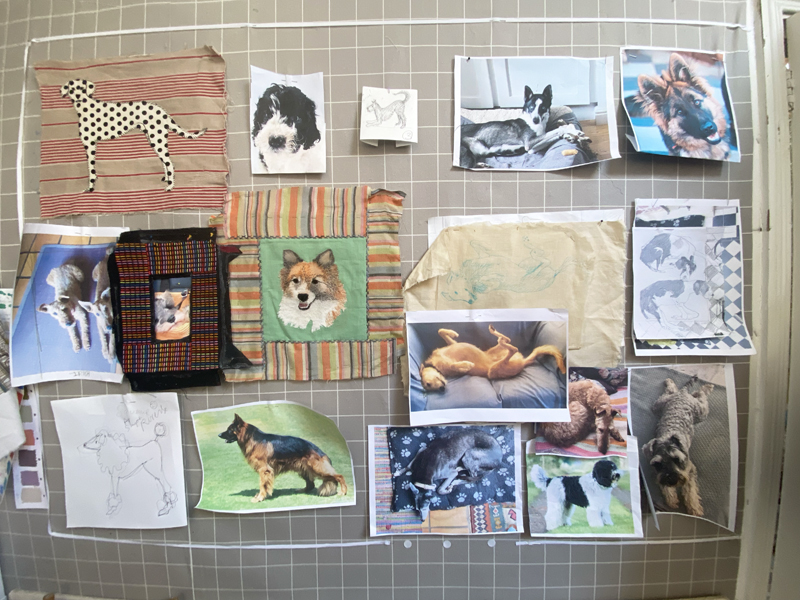
But how to assemble them into a quilt? I had been putting everything onto the quilt wall in my studio as I made it – constantly adjusting the arrangement to fit within the required measurement. Not how quilts are usually made I know, but this was created by the love of dogs, not the discipline of the patchwork quilt. The first scribbled design for the quilt shown below and the reality that surrounds it….
The design chops and changes as each new embroidery is completed and not every dog makes the final cut, but a design finally emerges. There were a few more dogs needed to complete the design, but how to highlight the family dogs (which are actual portraits) and stitch it together as a proper quilt…is the next instalment.
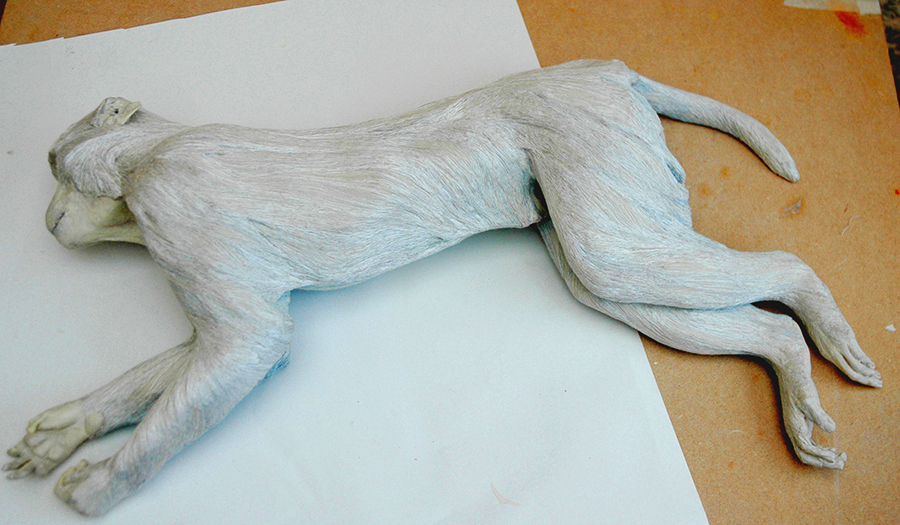
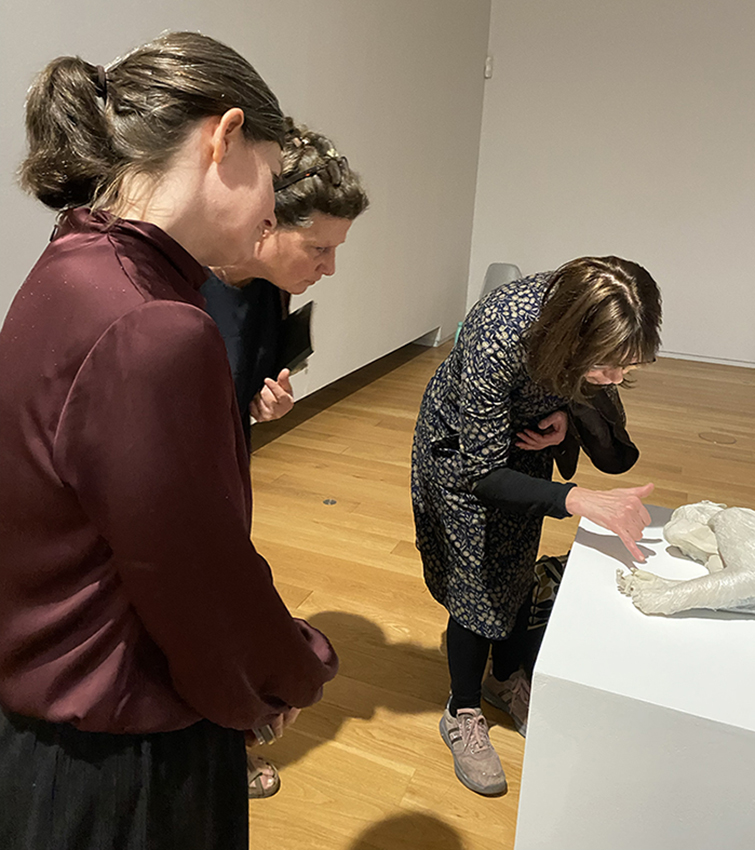
I was invited to the Hugh Lane Gallery in Dublin recently, to discuss the making of the stitched silk covering for the sculpture “Primate”( above) by Daphne Wright. The gallery had recently acquired the sculpture for its permanent collection, and Jessica O’Donnell, the head of the Education and Outreach department, had asked Daphne, who had commissioned me to make this in 2009, if I would be willing to talk to the conservation department to give them any insights into the process. I was so delighted to be asked for this because, I not only could explain the ways of making it, I had kept all the materials and stitching samples, and there is a blog that explains the whole 3 month long process.
We all first viewed Primate in the gallery where he was lying alone in the middle of a large darkened room within a spotlight. Daphne spoke about the difficulties of obtaining the cast and I later talked with her about various ideas and conversations we had about aspects of our collaboration – it had been intense. However, I have seen this work in various circumstances from busy National Trust properties, in commercial art galleries, and our own studios and now here in pure isolation…un-nerving.
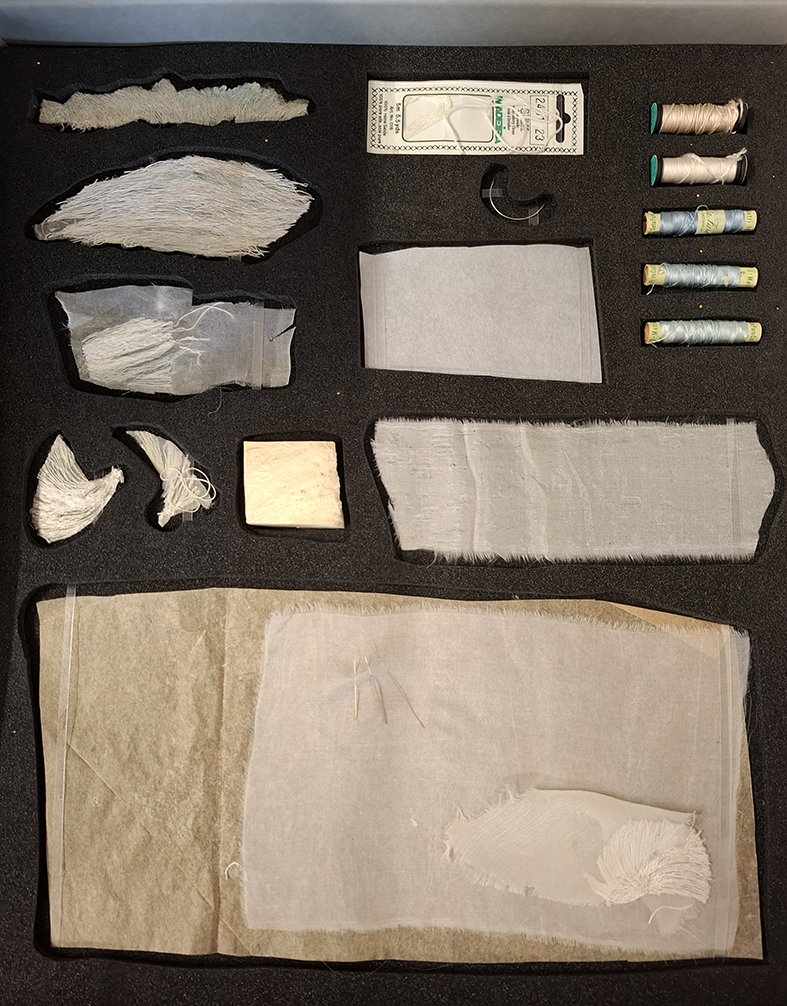
Next we went behind the scenes of the museum and I showed the small set of samples (below left) that I had kept: silk organza and different backing materials, paper backed adhesives, silk threads, needles, and the cut out and discarded stitched pieces, even a sample block of the marble resin; all kept in my research stash to explain my journey. Below right shows the way the gallery has now laid them out for viewing in the education department – so perfectly neat and simple.
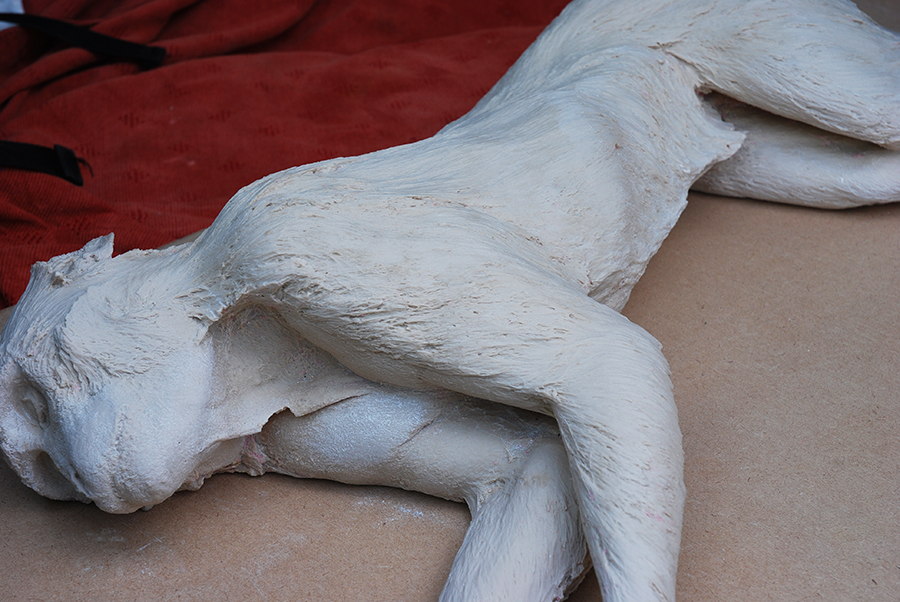
Below the basic and flawed resin and marble-dust cast of the Rhesus monkey, and the stitch development at about the 3/4 way stage, on my studio table.
And here is the gallery where the Primate was introduced to the public as a new acquisition to the Museum’s collection. When I saw this space for the first time it felt like entering a tomb, or at least a place of veneration and it still makes me feel bereft every time I look at this image.
This commission has had a considerable effect upon my stitched works, even up the present day. For further insights and my stitching this work please go to my post in COMMISSIONS: Primate.
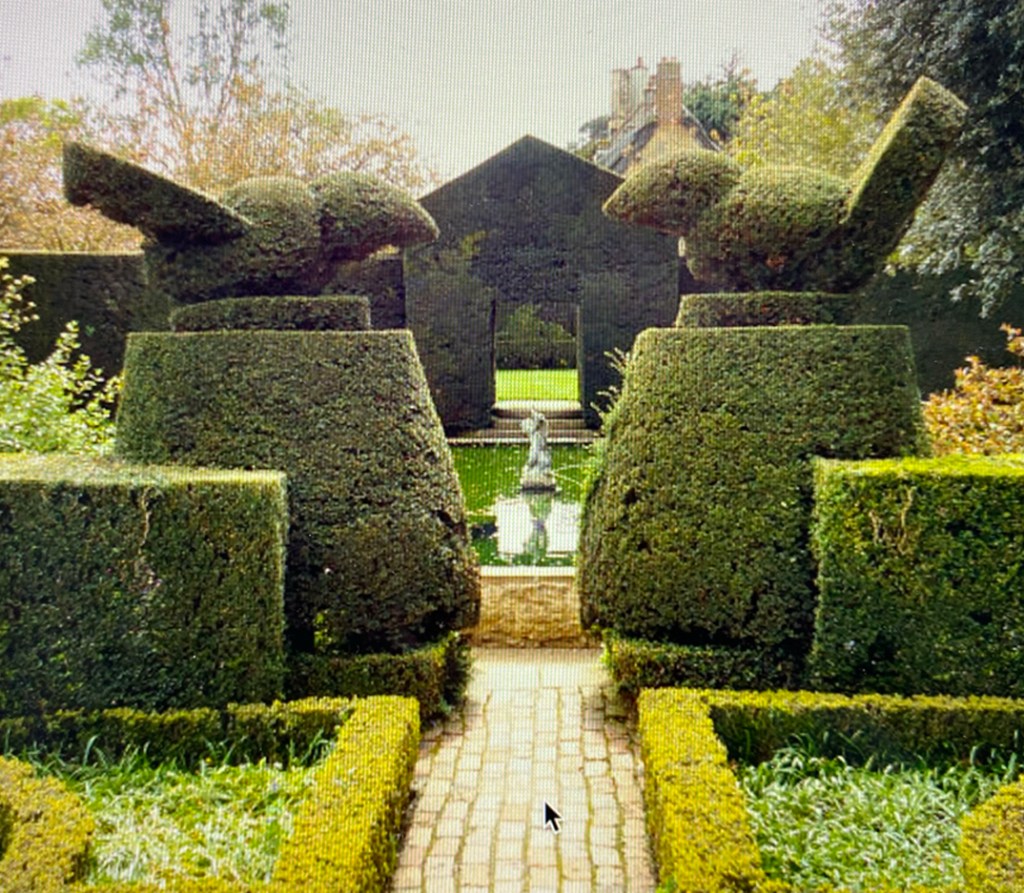
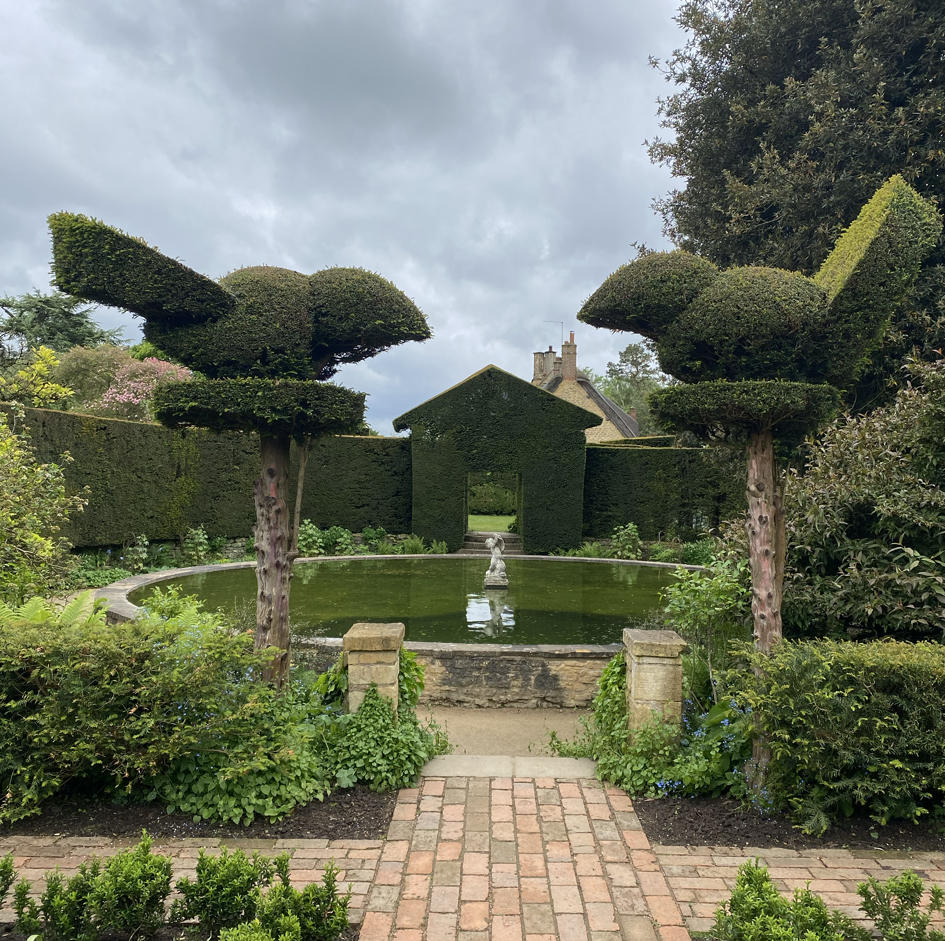
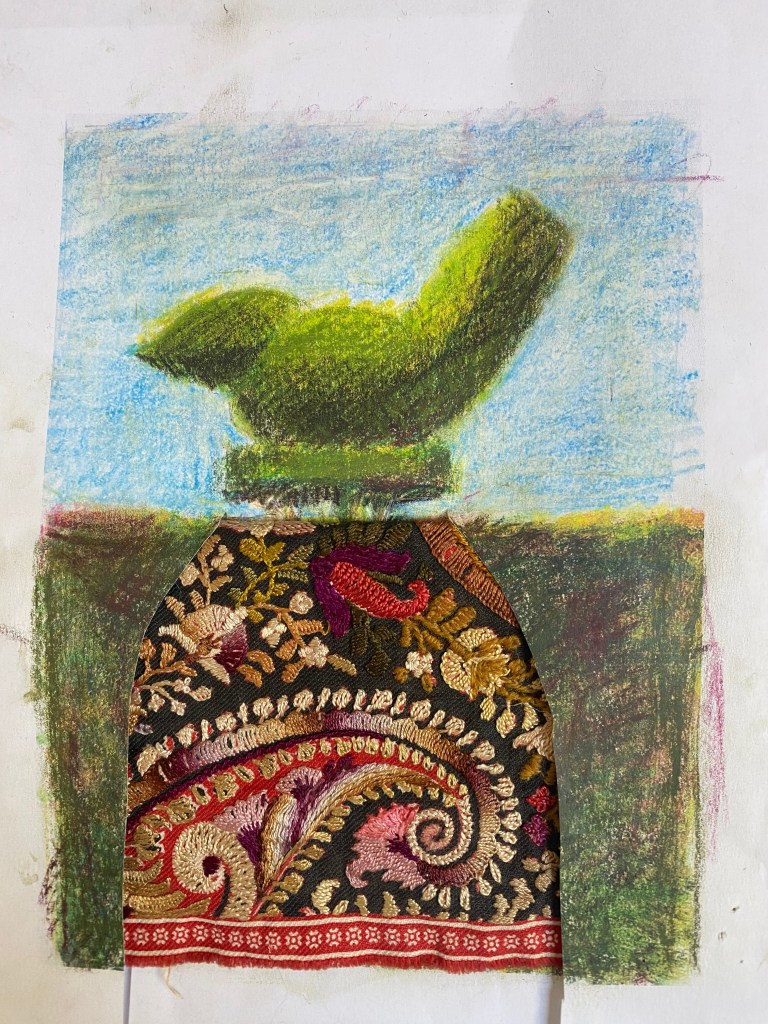
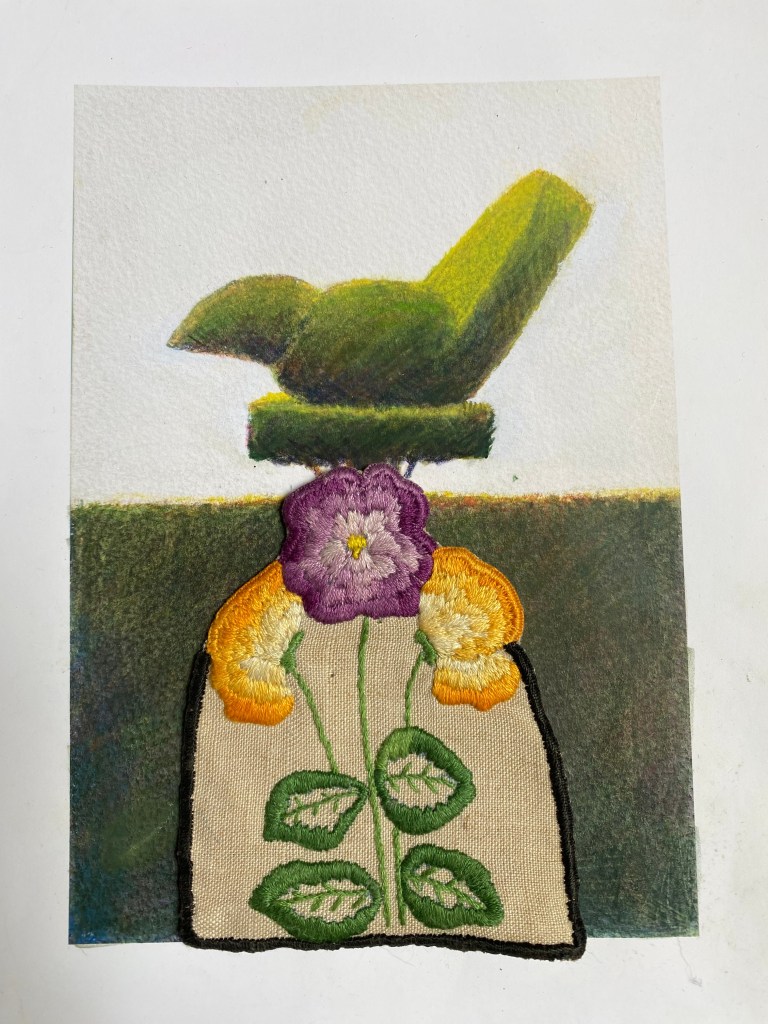
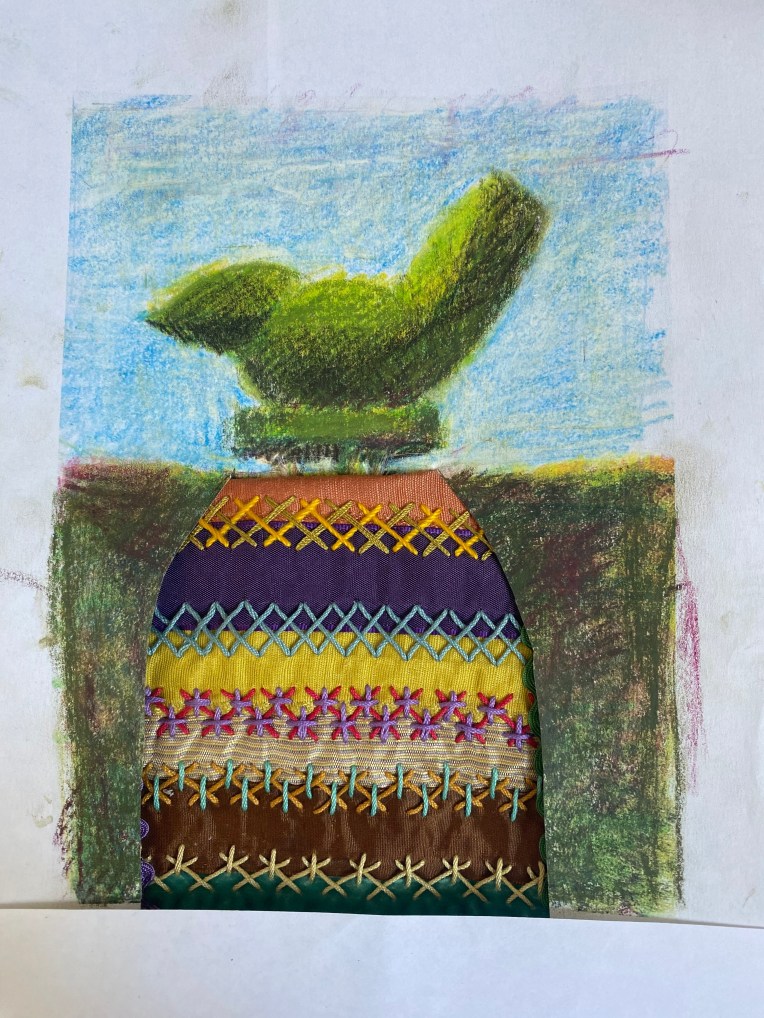
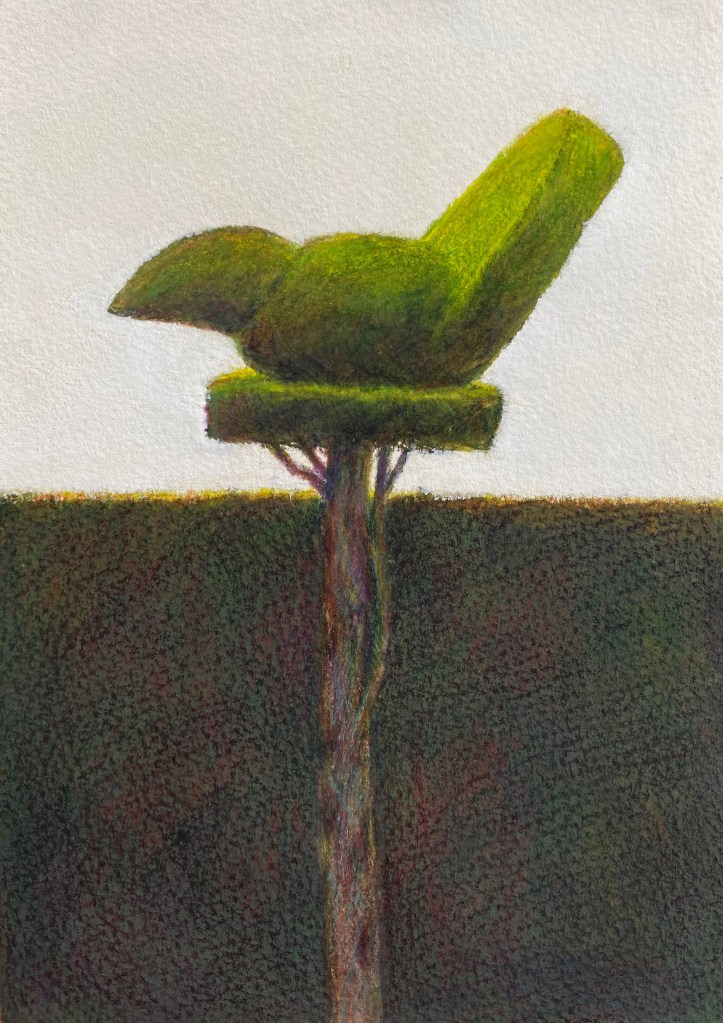
I gasped when I first saw these 2 topiary birds when visiting Hidcote to discuss my exhibition “Inspired to Stitch” for the Manor House gallery in 2025, where were the large bases of yew that they had perched upon for over 100 years?
Hidcote then Hidcote Now
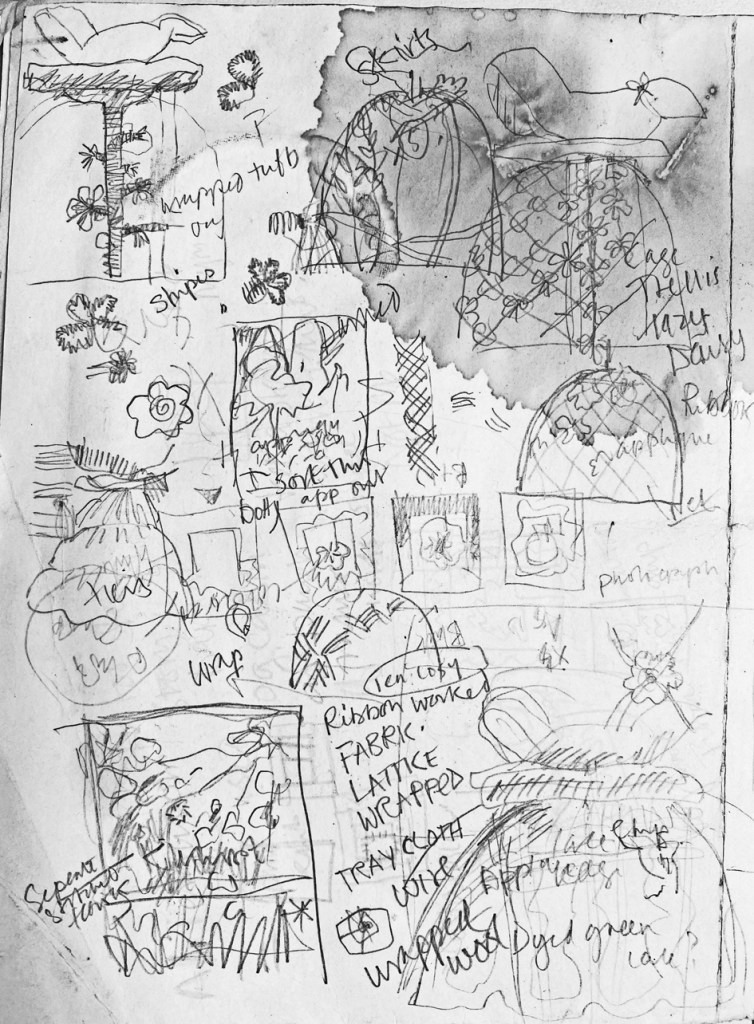
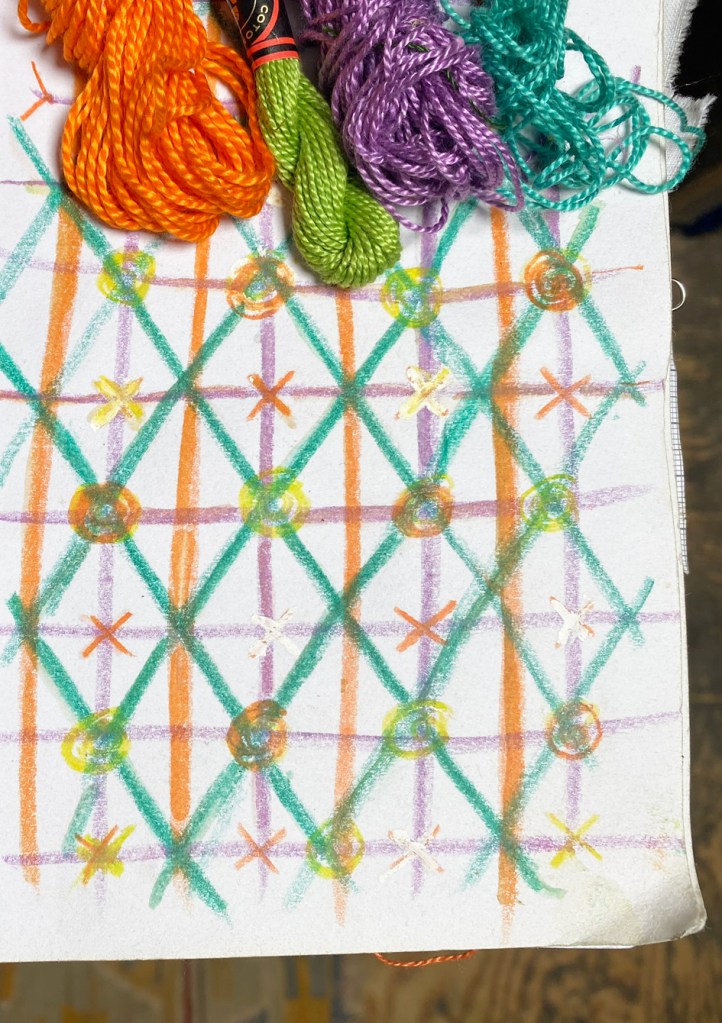
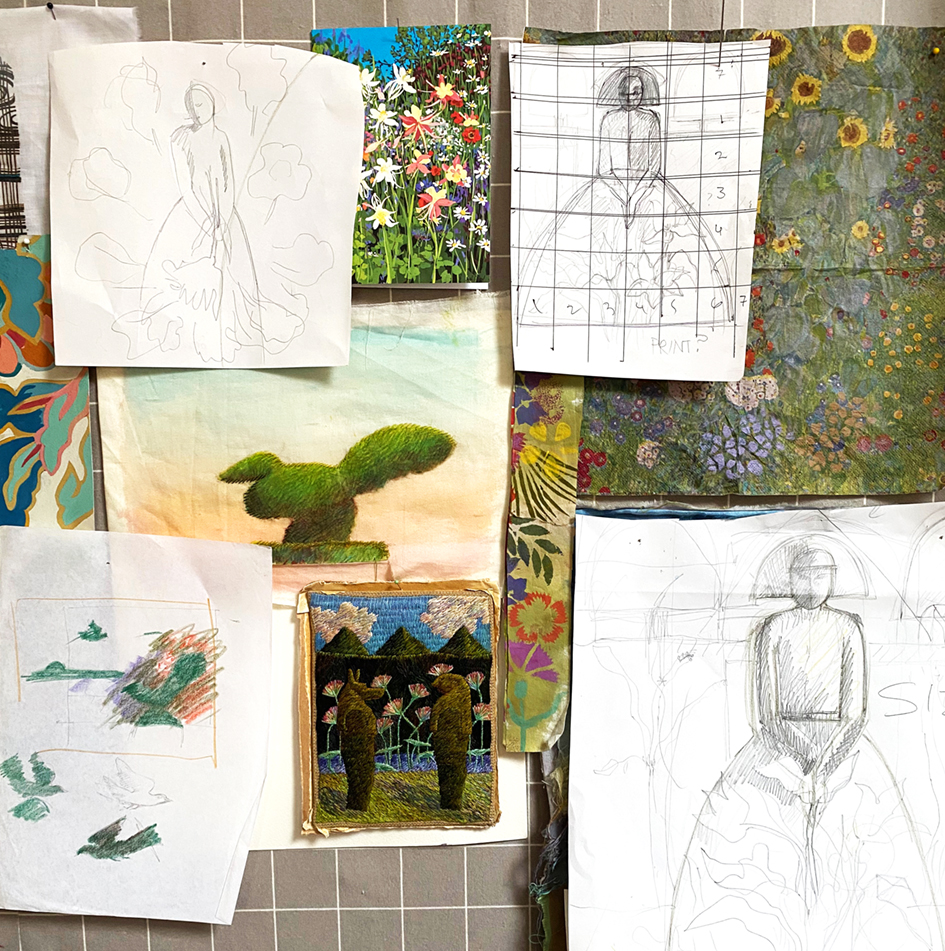
It was explained that the loss is in part due to necessary pruning( after the covid closures) needed to maintain access to the steps to the pool. Now they sit on top of bare but beautifully dappled trunks. I immediately thought “I can mend them”, visually of course! My idea was to create 2 wide ‘skirts’ of different fabrics – but when I started to think about making skirts my mind started to race with ideas. I quickly scribbled some down onto the only scrap of paper I had to hand…..
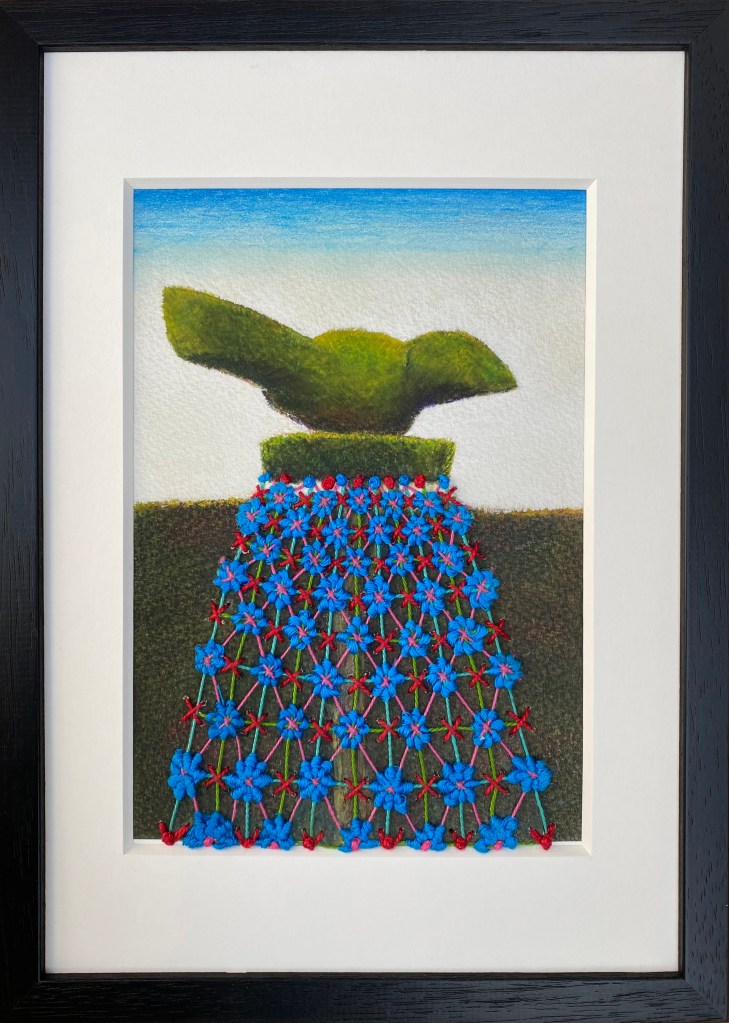
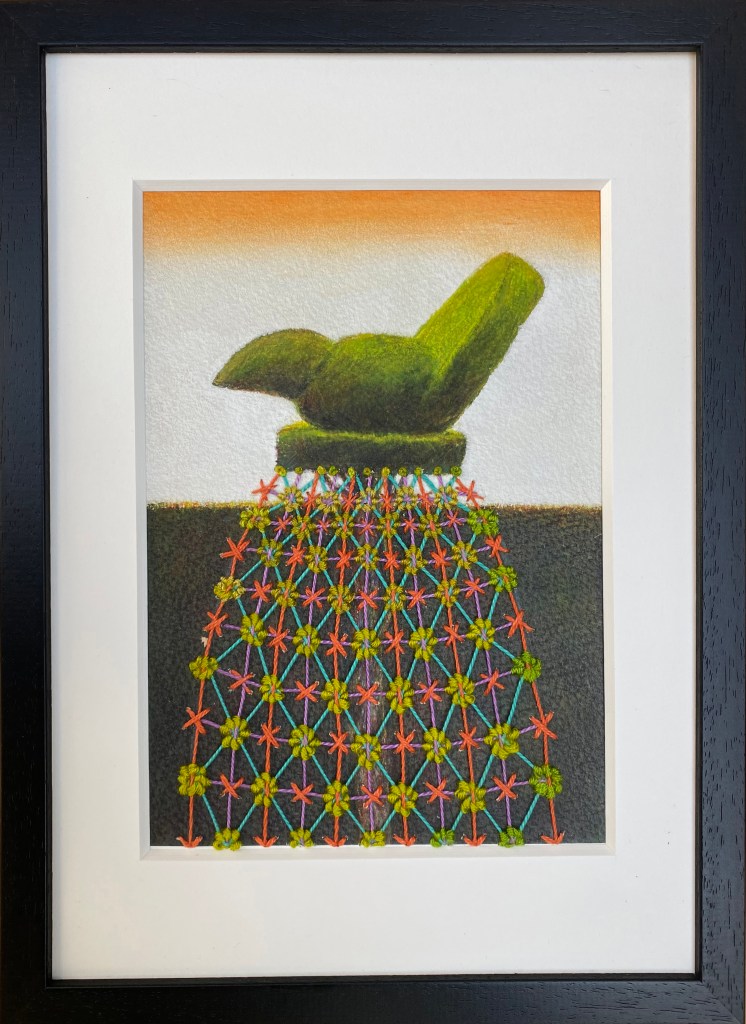
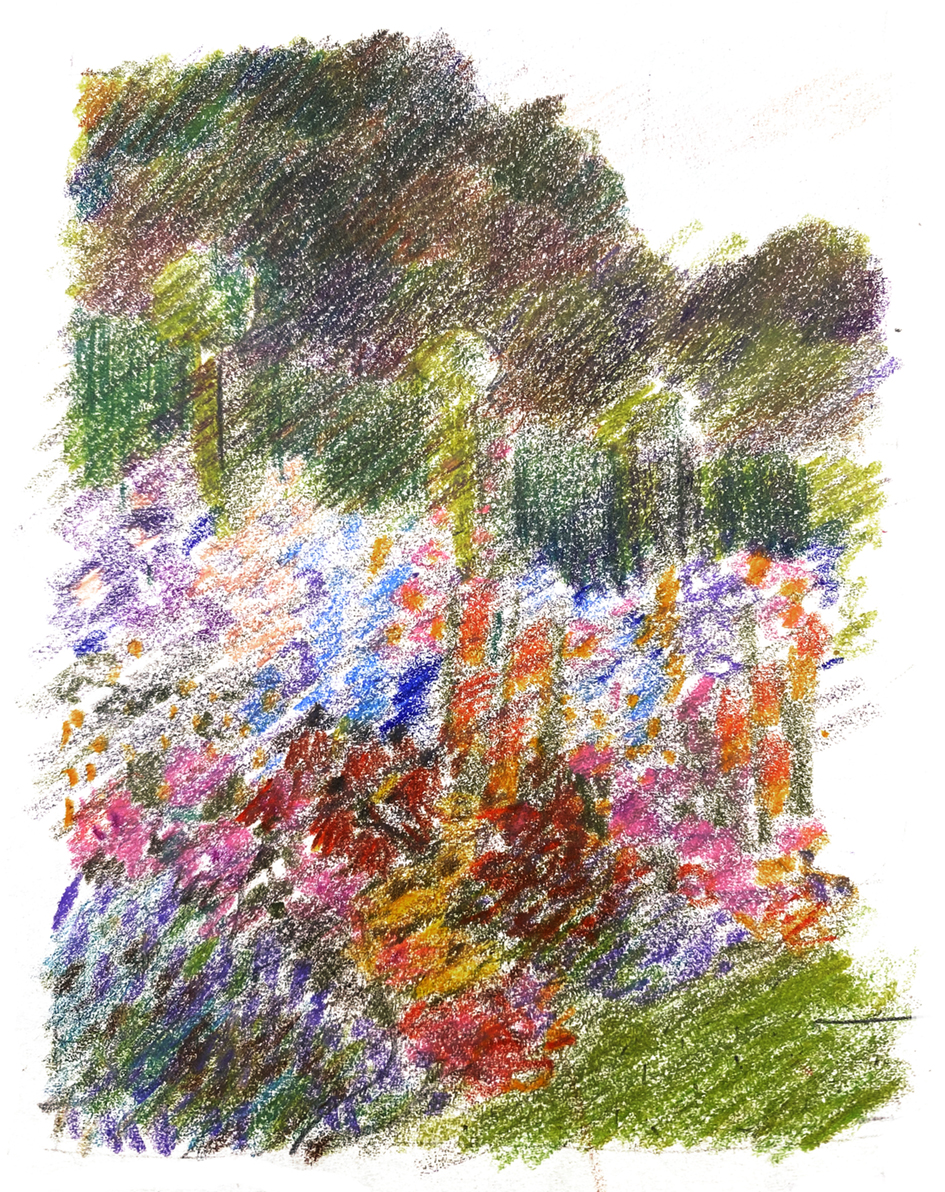
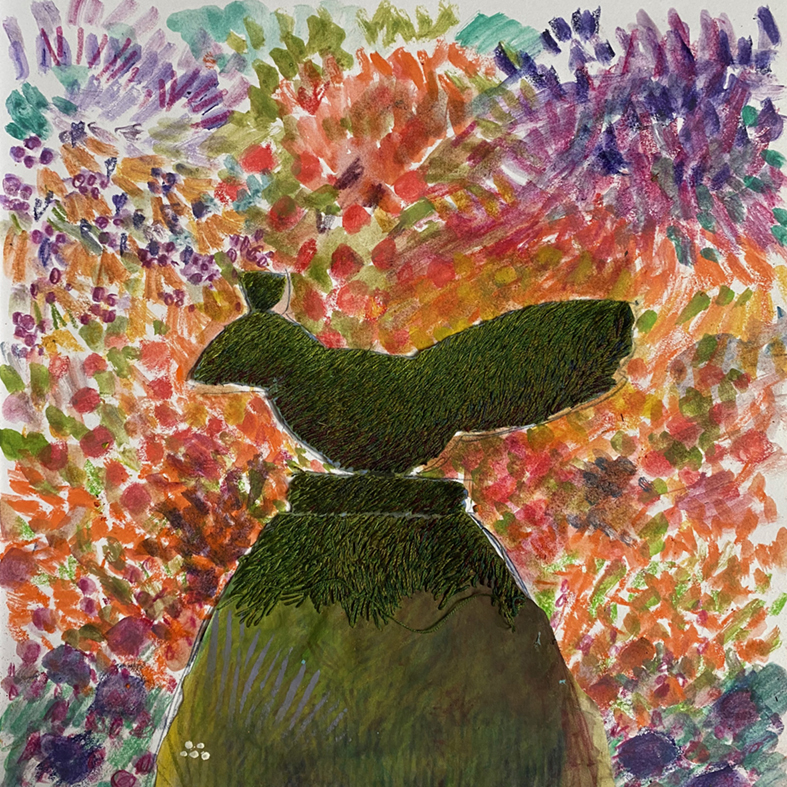
I decided to make small drawings of the 2 birds and then I could dress them both in a fabric skirt. Now how make this look feasible in reality. Using Inktense pigment crayons A4 sketchbook paper I roughed out the basic hedge shapes, but I had so many different ideas when I looked at my vintage fabrics scraps, that I decided to make a 2 sets of giclee prints, in order to illustrate all my ideas.
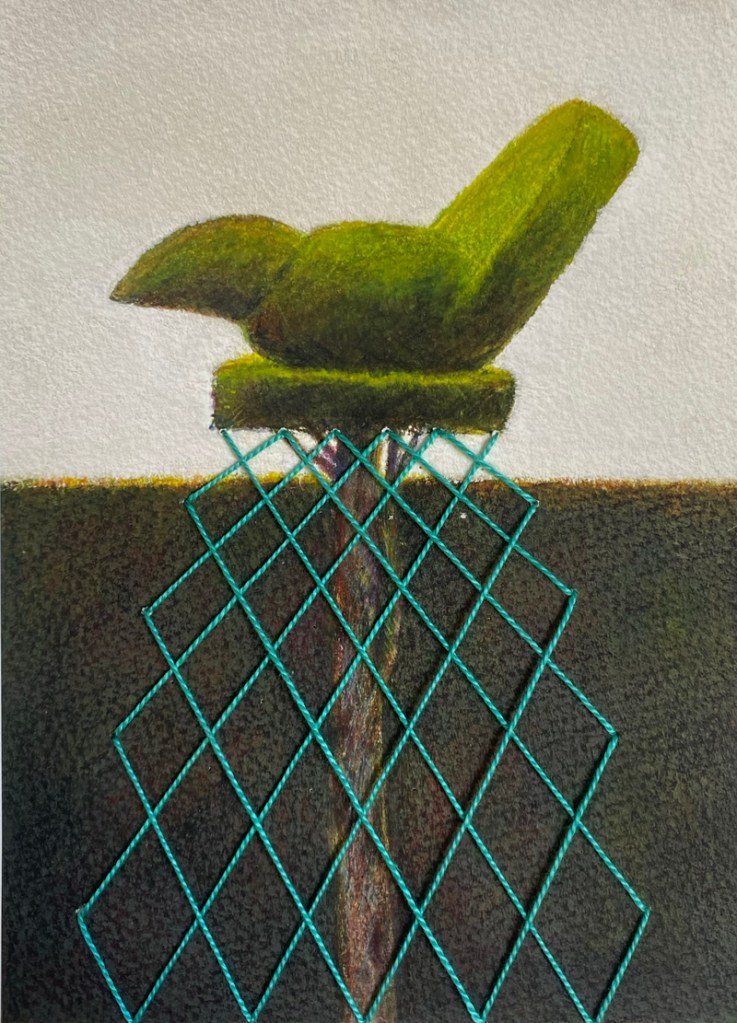
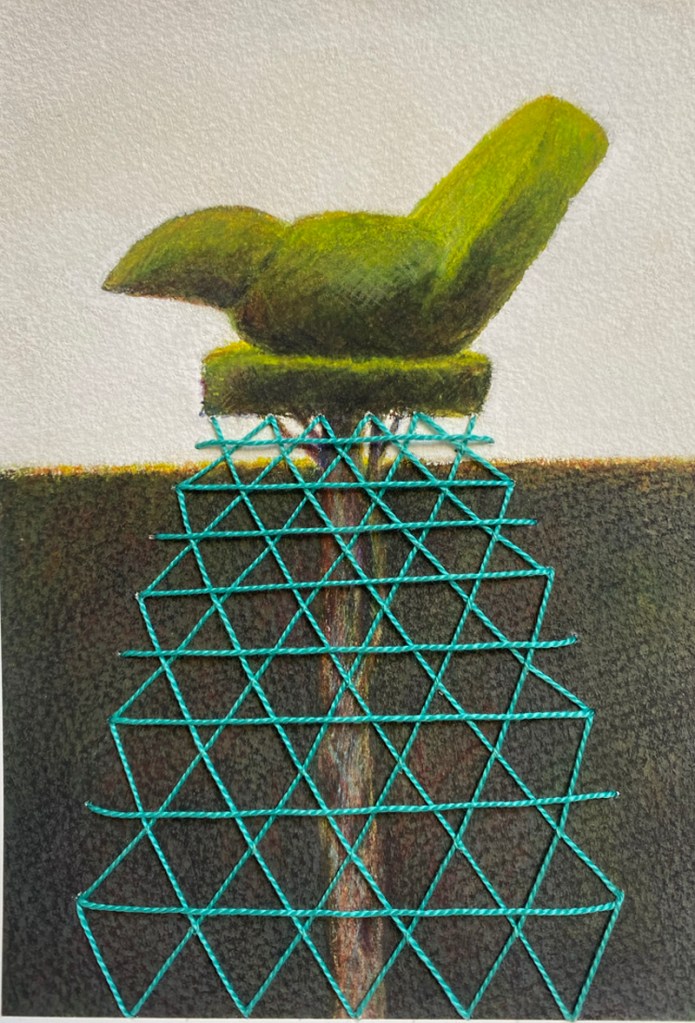
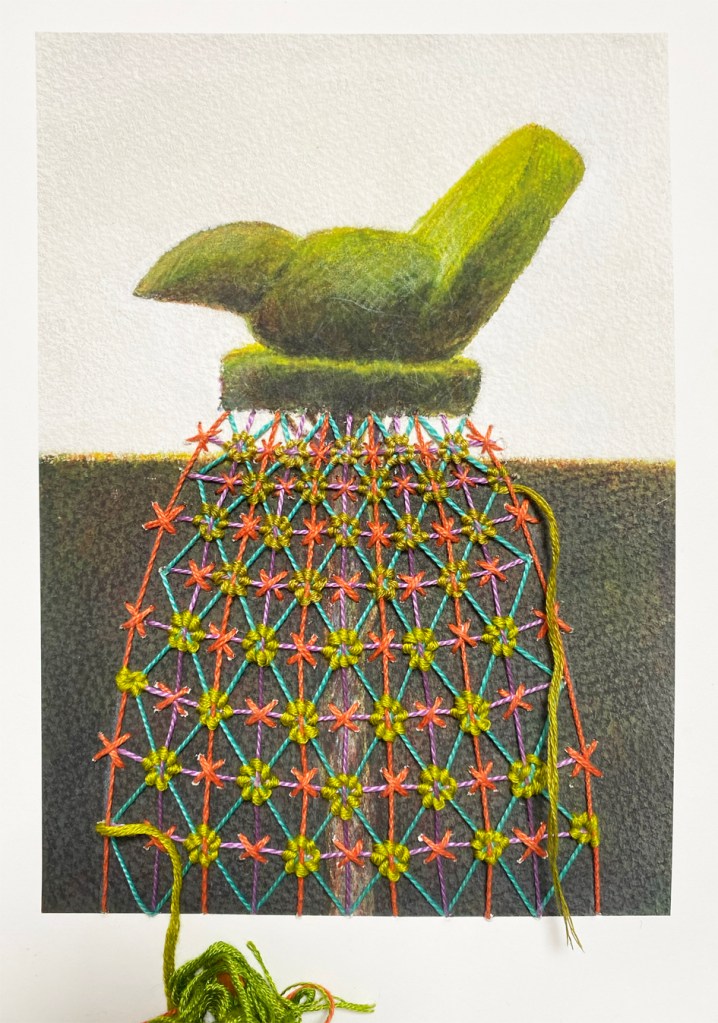
Above, the 2 giclee prints developed from the original drawings from my photographs, the first design was for a lattice or Jacobean Laid Work (see below the samples on the rough drawings).
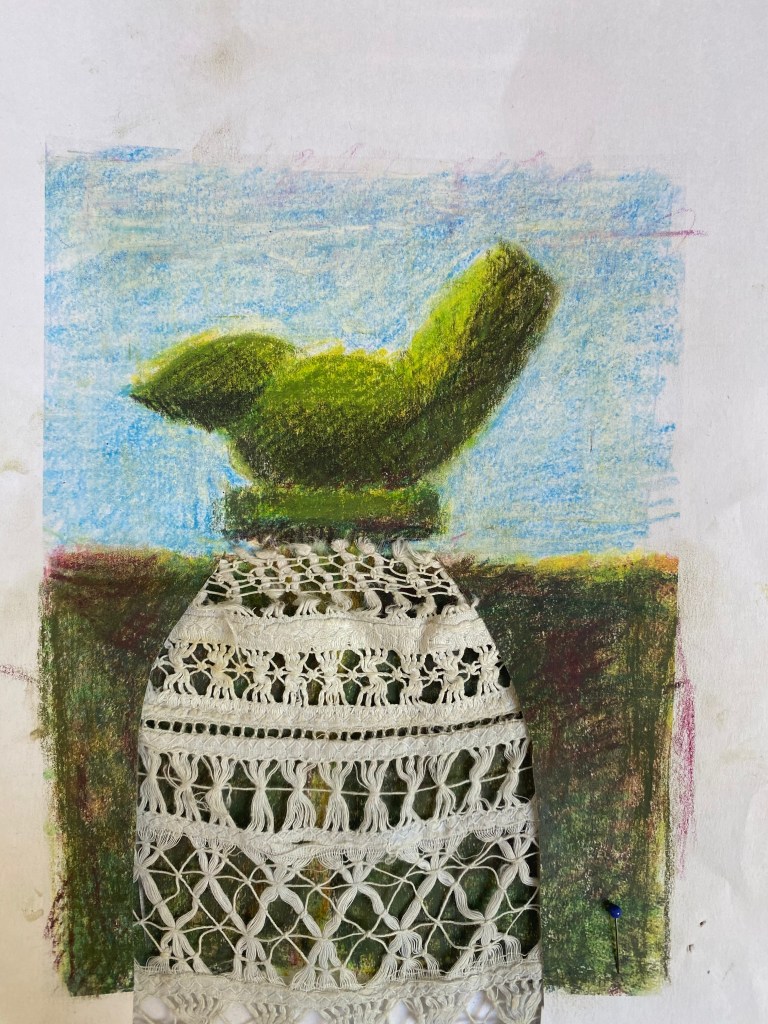
The first skirt sample was stitched straight into a bird print, using a fine twisted cotton thread. When beginning any new project, I always attempt a challenging piece of ‘inspirational’ work, by which I mean it will make me want to carry on with all my new ideas.
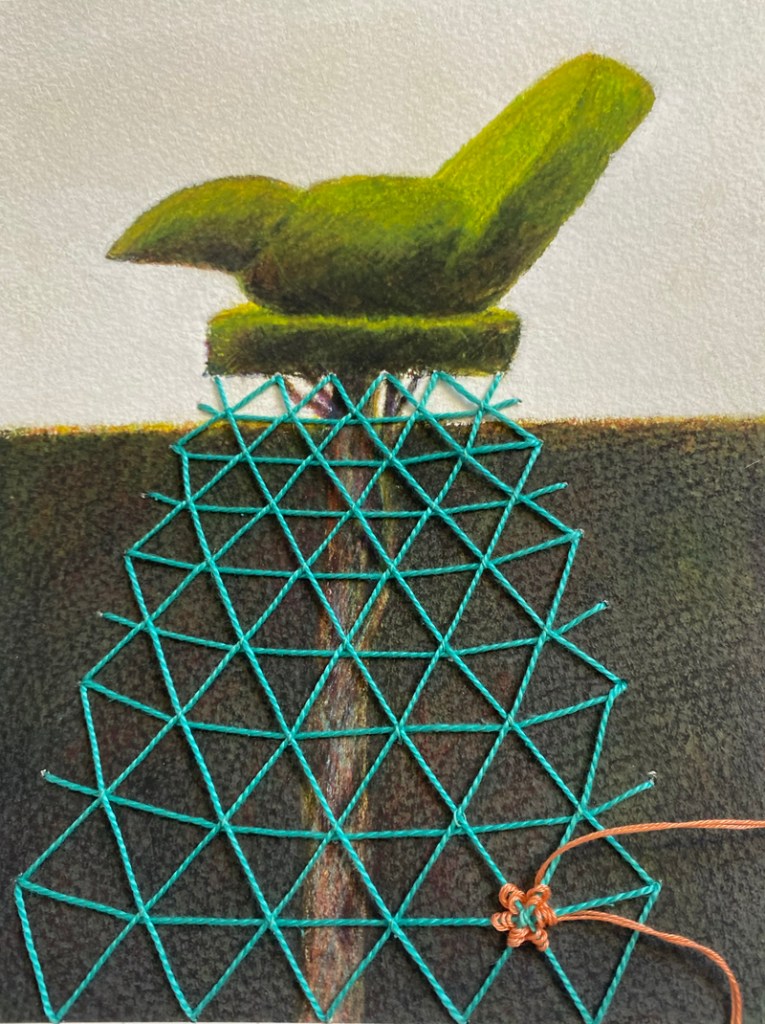
Above is the first design I completed for a whole set of 22 ‘Birds in Skirts” and I made them especially to sell at my ‘Inspired to Stitch’ exhibition This is an unusual step for me as I very seldom sell my stitched works. So now they have all been mounted, framed and glazed ready to be delivered to the buyers after the Exhibition closes.
There will be more posts about these stitched prints, as this is a new and exciting way for me to work. It combines my love of drawing and stitching and opportunities to develop many variations using my collection of vintage fabrics. I am now conducting new classes to cover some of the ideas and new-to-me techniques that I developed for creating the Birds in Skirts edition
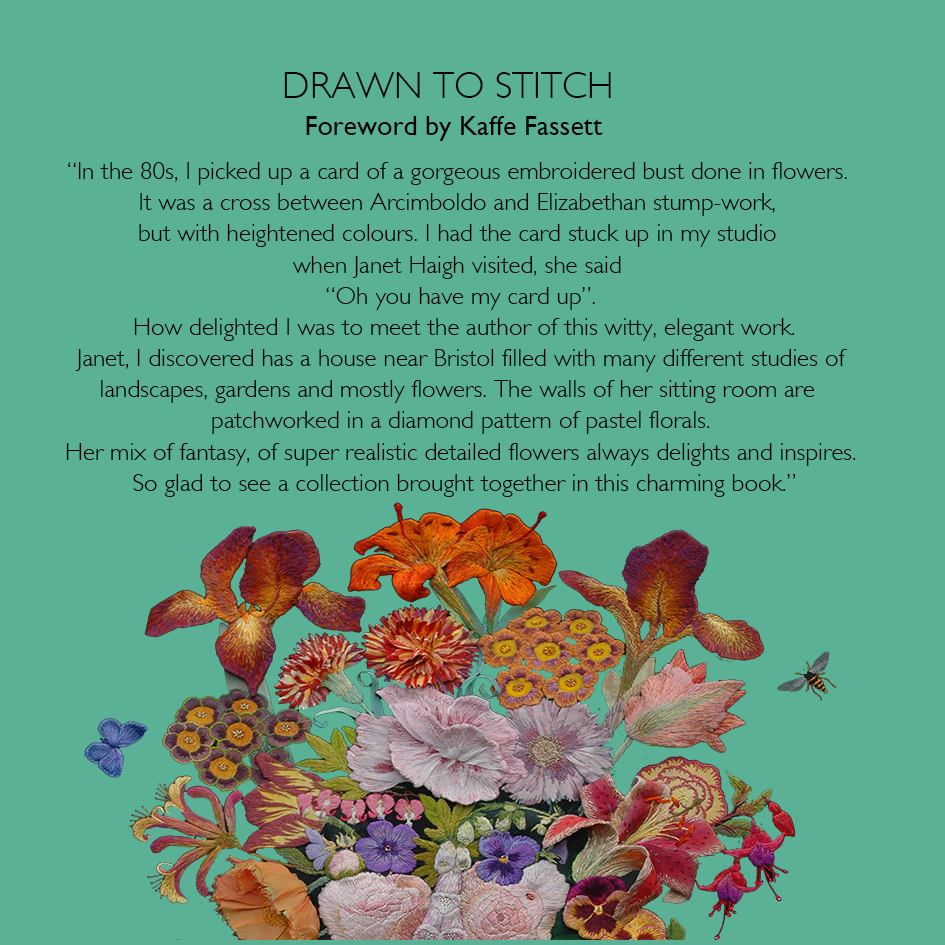
This is the foreword, kindly composed by Kaffe Fassett, for the first page of my latest book I made as a catalogue/ picturebook to accompany my latest exhibition Inspired to Stitch: Hidcote Revisited. at Hidcote gardens in Gloucestershire.
It illustrates part of the story of my career in stitched textiles, from my first ever embroidered picture above, made out of the sheer frustration of working in the fast-track commercial fashion industry in London, after I left Liverpool Art College in 1970. And it is an imagined garden.
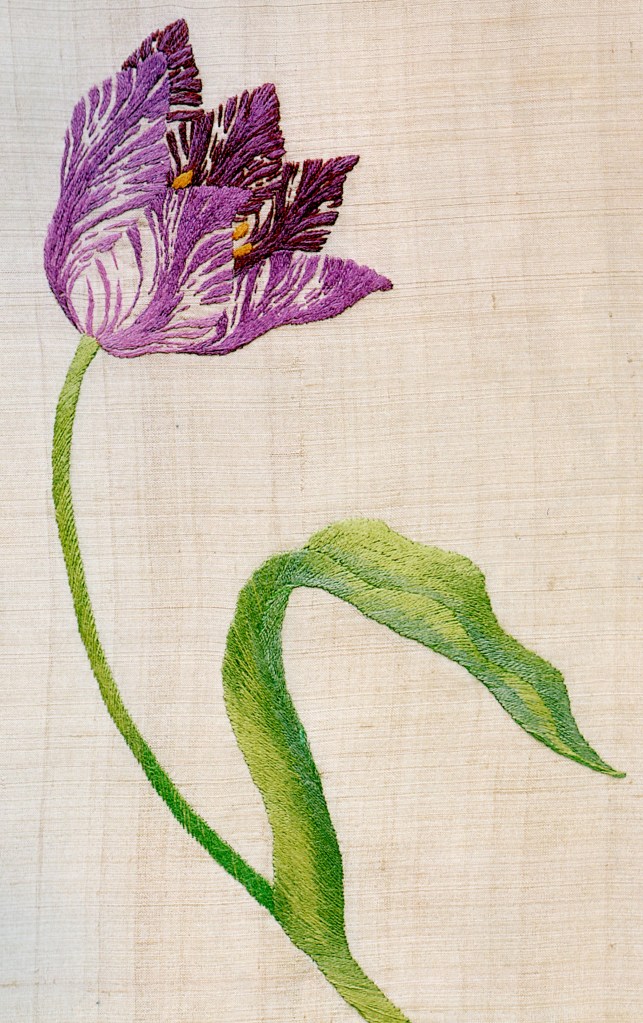
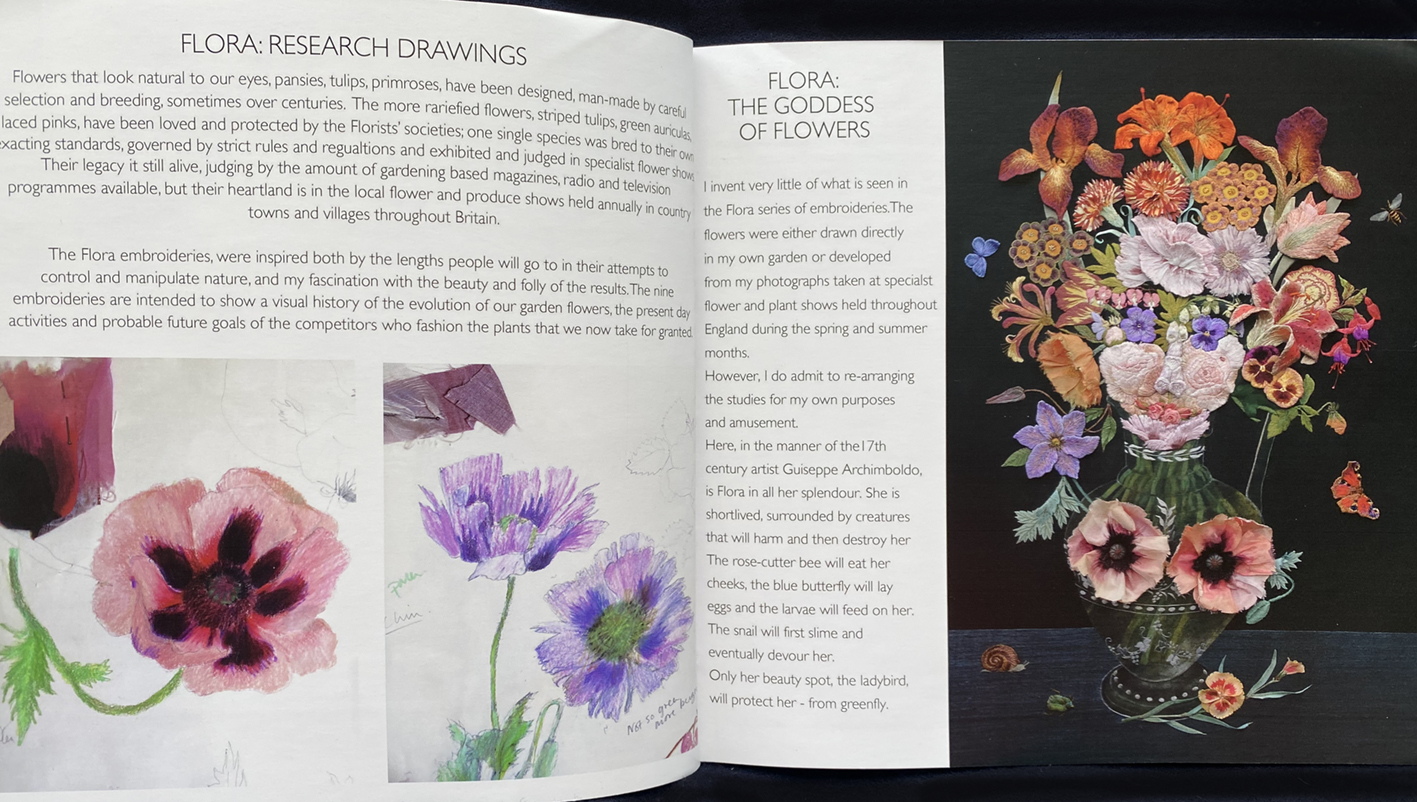
Fast forward several years to 1992 (you will have to buy the book for more information)and I am totally committed to all things flowers, gardens and topiary! Here are several pages from the book to whet your appetite and first here is Flora, the Roman goddess of Flowers.
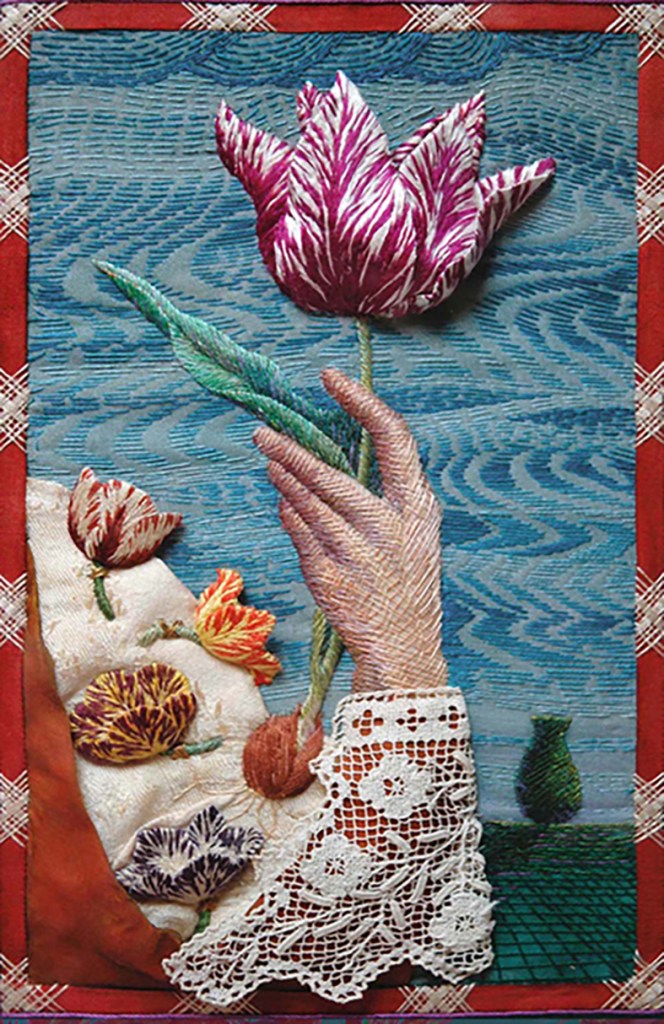
Flora is the central image of 9 embroideries called ‘The Flora’ that tells a visual history of the development of, what I now think of as, “designer flowers”.
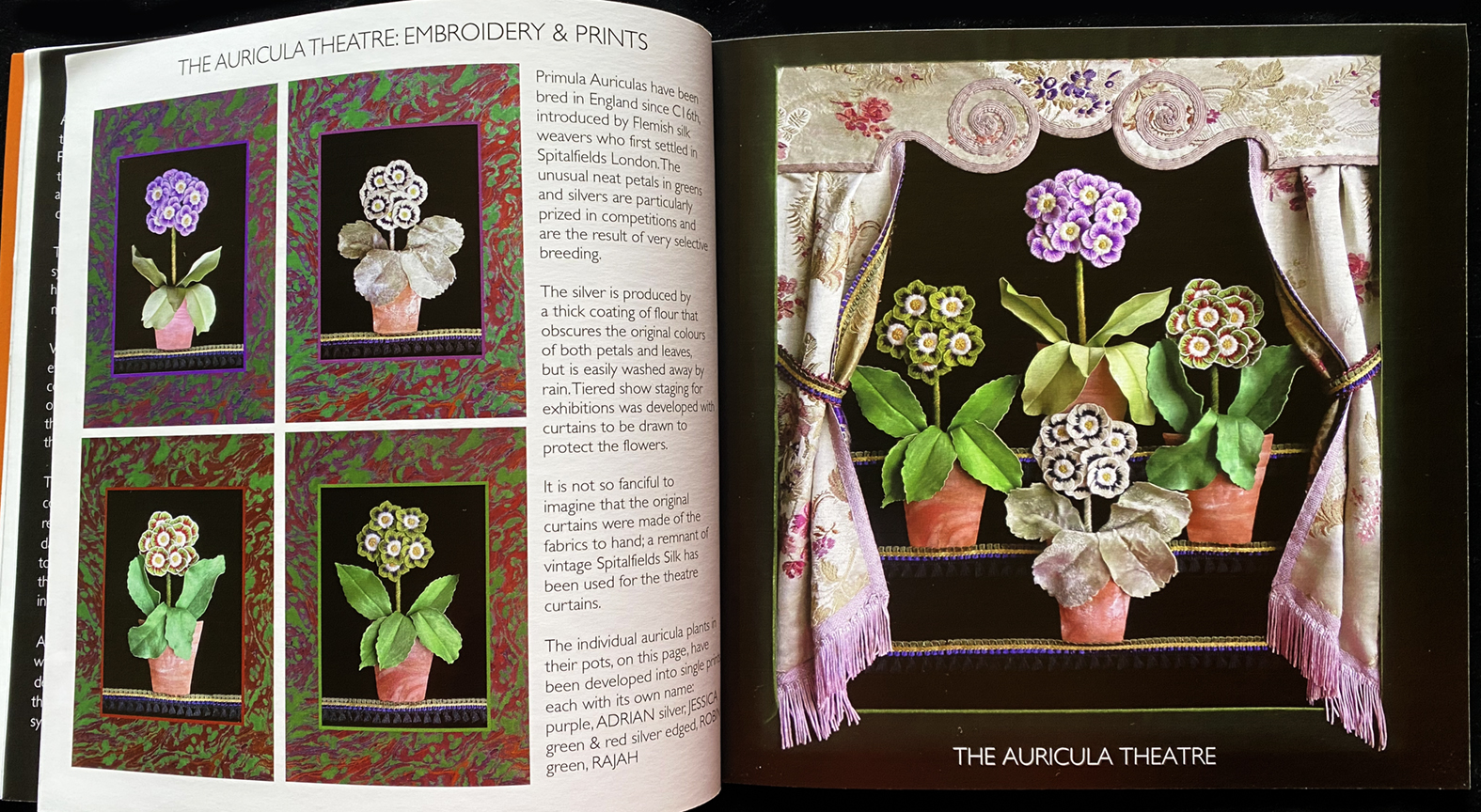
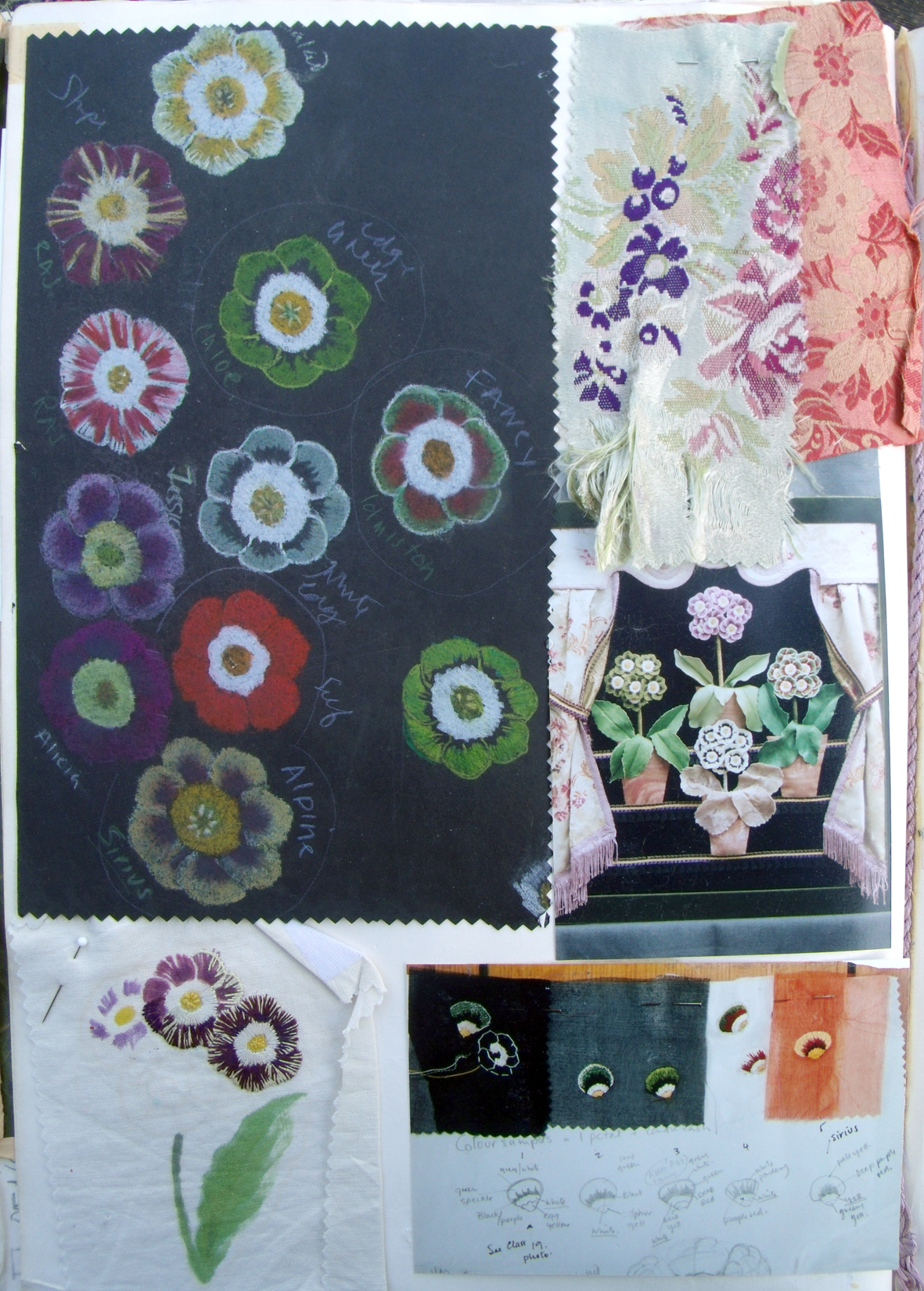
The Auricula Theatre above, with a series of small giclee prints I developed from the original silk embroidery. The protective curtains are made from a piece of vintage Spitalfields silk.
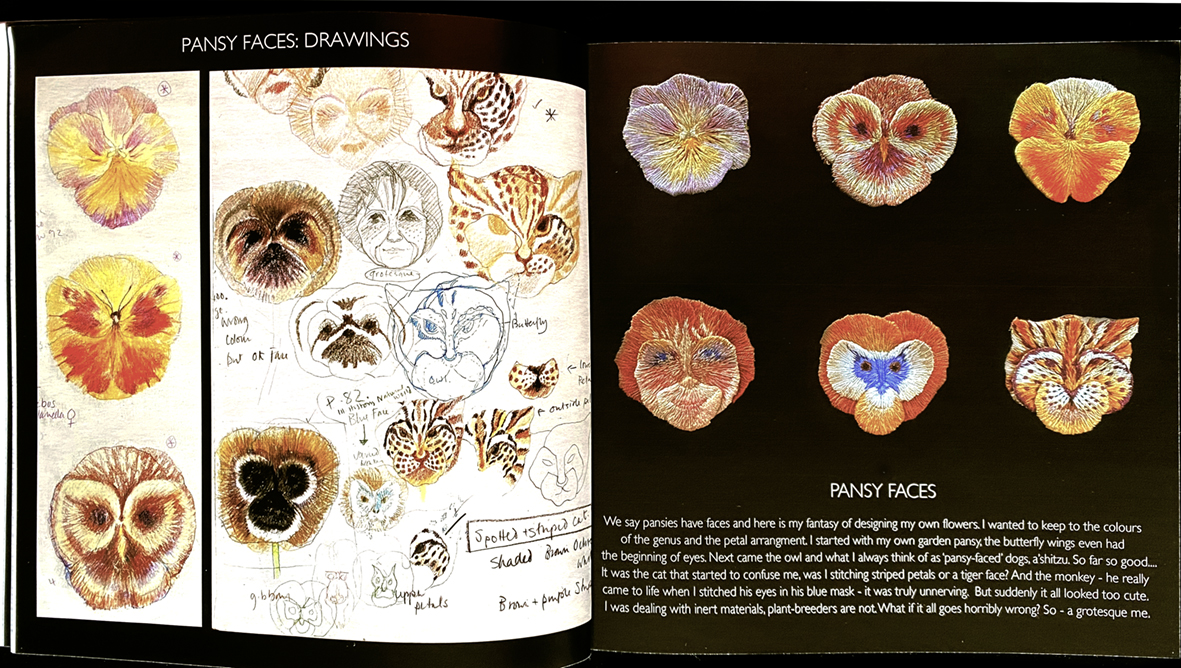
Pansy Faces and my drawings for the inventions I imagined as my exhibit in our town’s annual flower show.
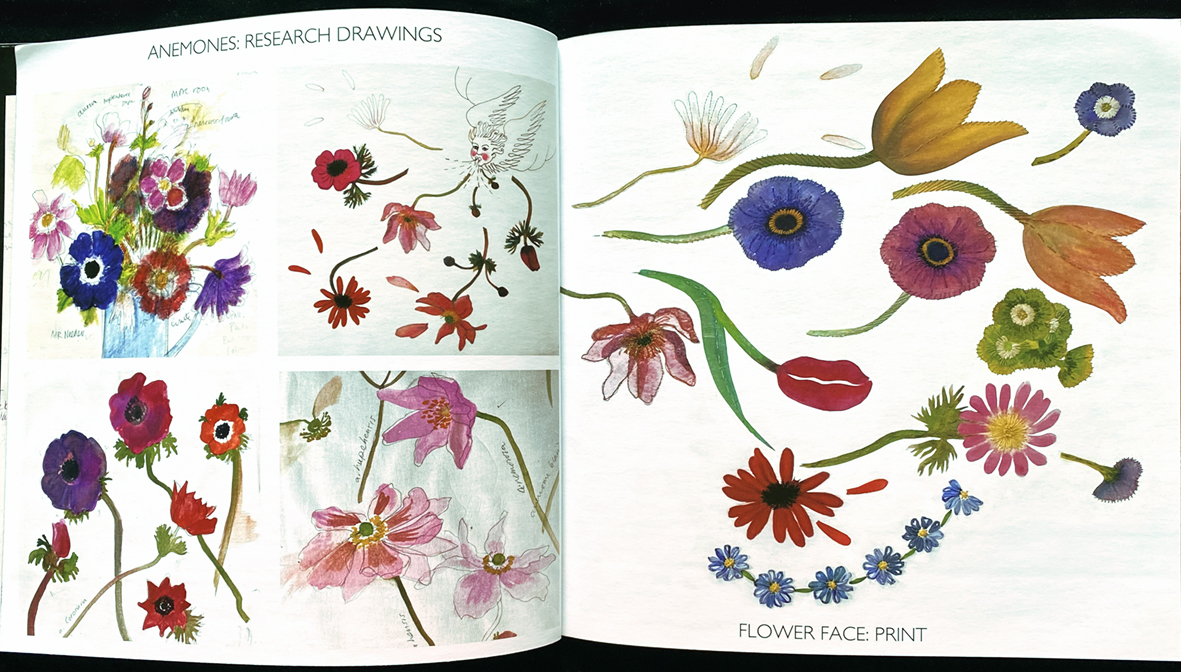
A personification of Blodeuwedd, or “Flower Face” from Welsh folk lore; this is a giclee print of the original stitched silk collage on paper, that I developed from my old drawings made for ‘The Flora’ .
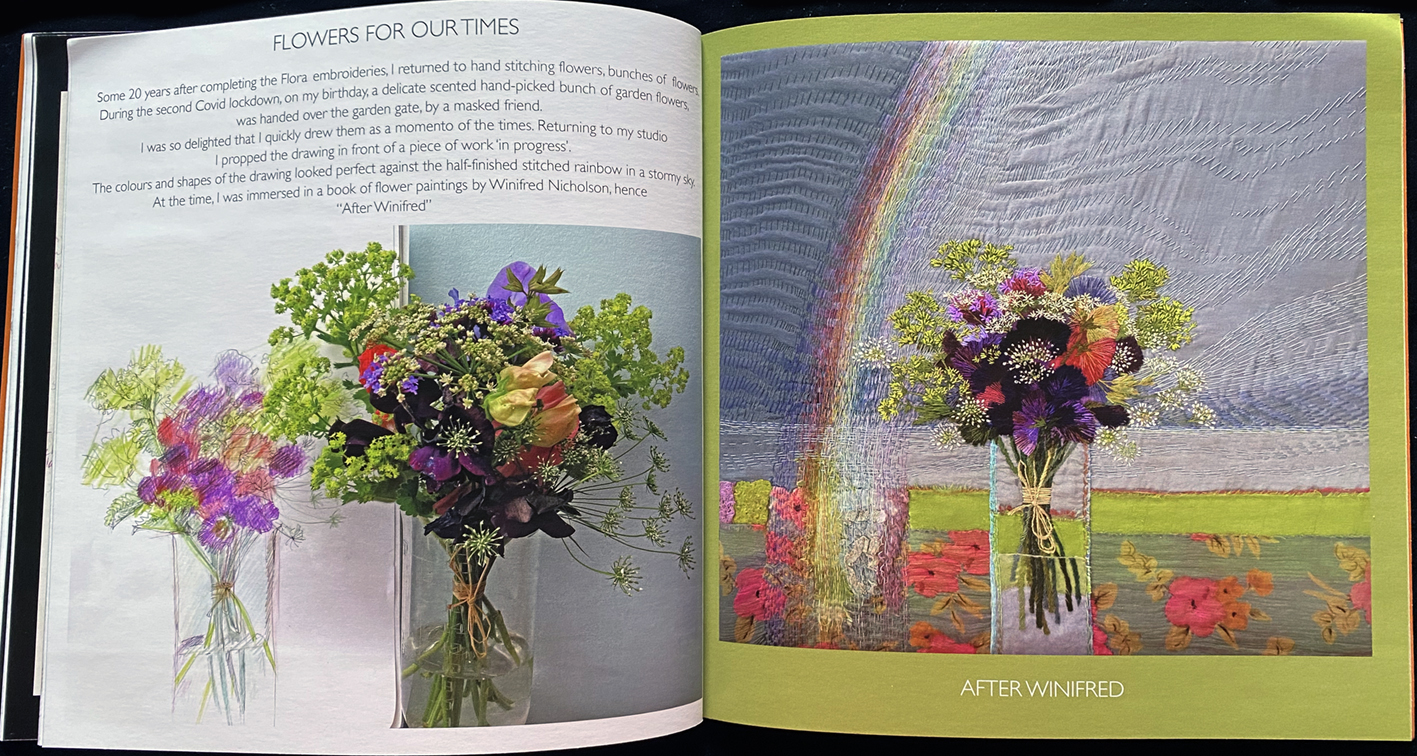
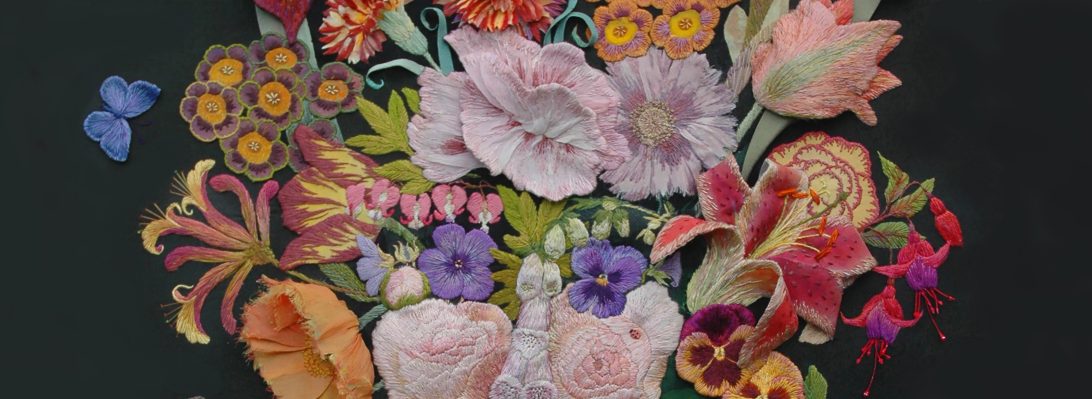
Here is a bouquet of hand embroidered flowers in ‘After Winifred’. I was given this bouquet during Covid, by a masked friend, in my garden, on my birthday. I was looking back though my Flora drawings to make some joyfulembroideries and had bought a book of flower paintings by Winifred Nicholson……
I keep a careful record of all my research drawings, this results in a whole range of different drawings, samples, notes and photographs being kept for further inspiration. Here are typical ways that I use these ideas and studies for new works. Above are some pieces of ‘The Enamel Garden‘ a major academic research project into using textile techniques for other materials, here vitreous enamel on hand cut sheet copper. It is possible to trace how I used my research drawings to create these flowers and hedges.
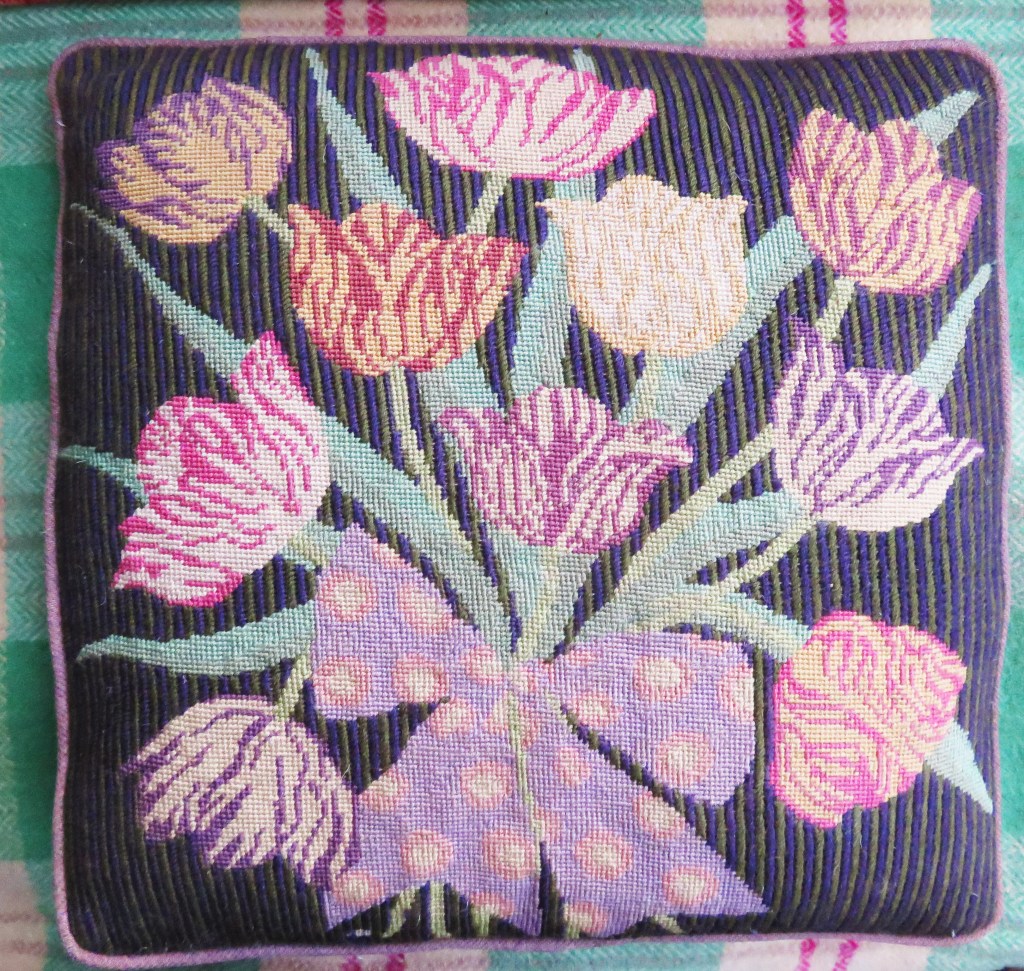
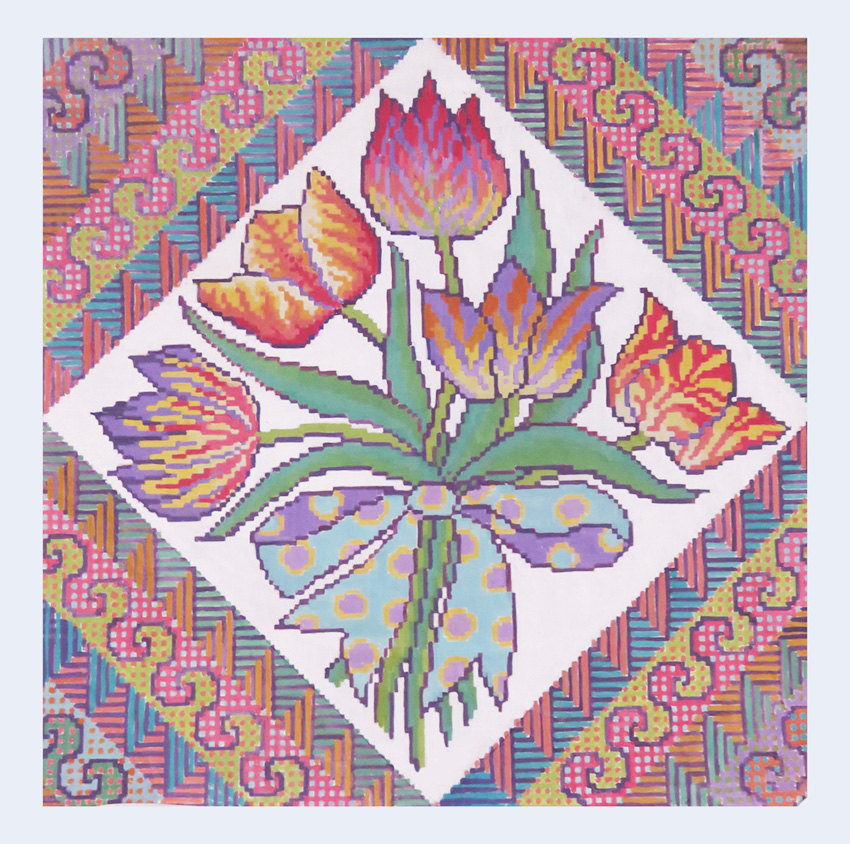
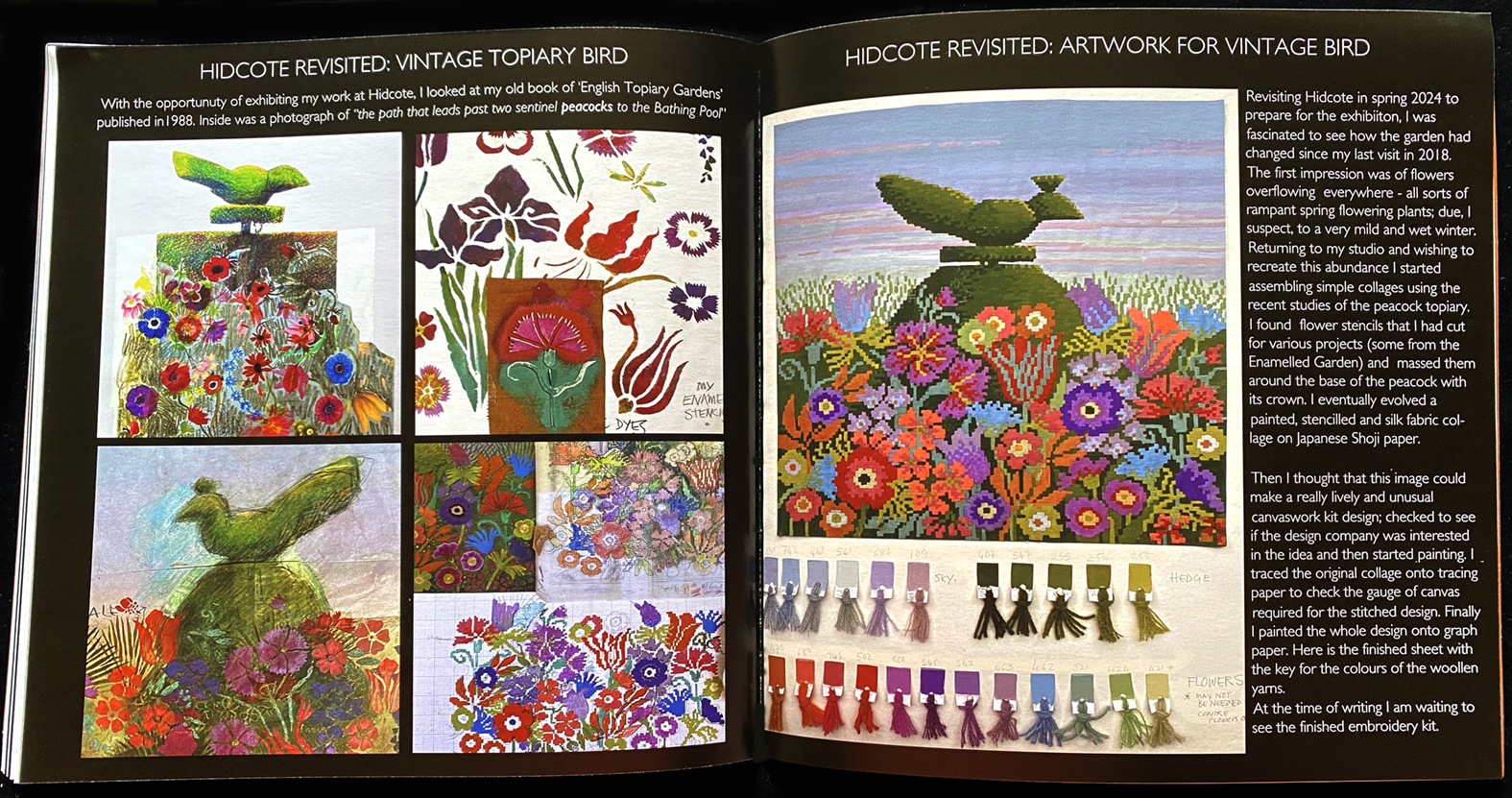
And my latest canvas work design for Ehrman Tapestry, a version of the Vintage Topiary Bird used for the front cover of the book. I designed this especially for the company to make a kit of this design to celebrate the exhibition…. I will keep the post about making it until later.
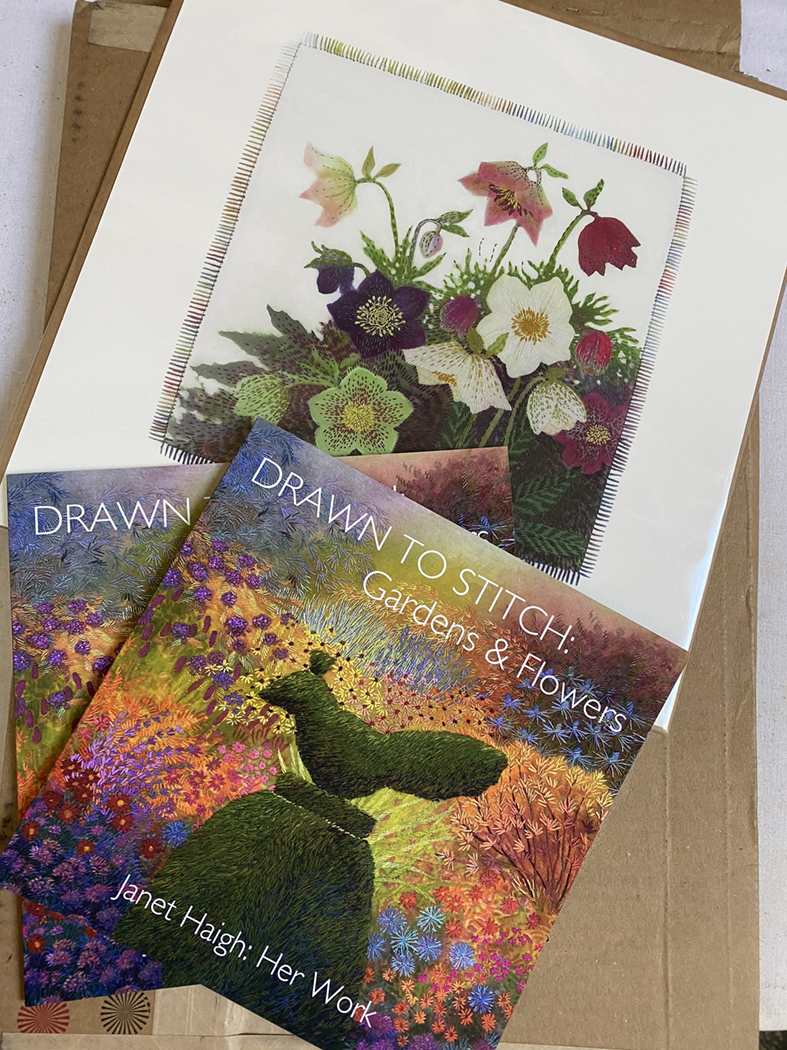
And at last I am selling the book from my Shopify site ( QR code below). Above is the flyer for the Hidcote exhibition that gives access to more information into to all the works contained in the book. But best of all in the first week of the show, my first package of books and a giclee print ready to be posted.
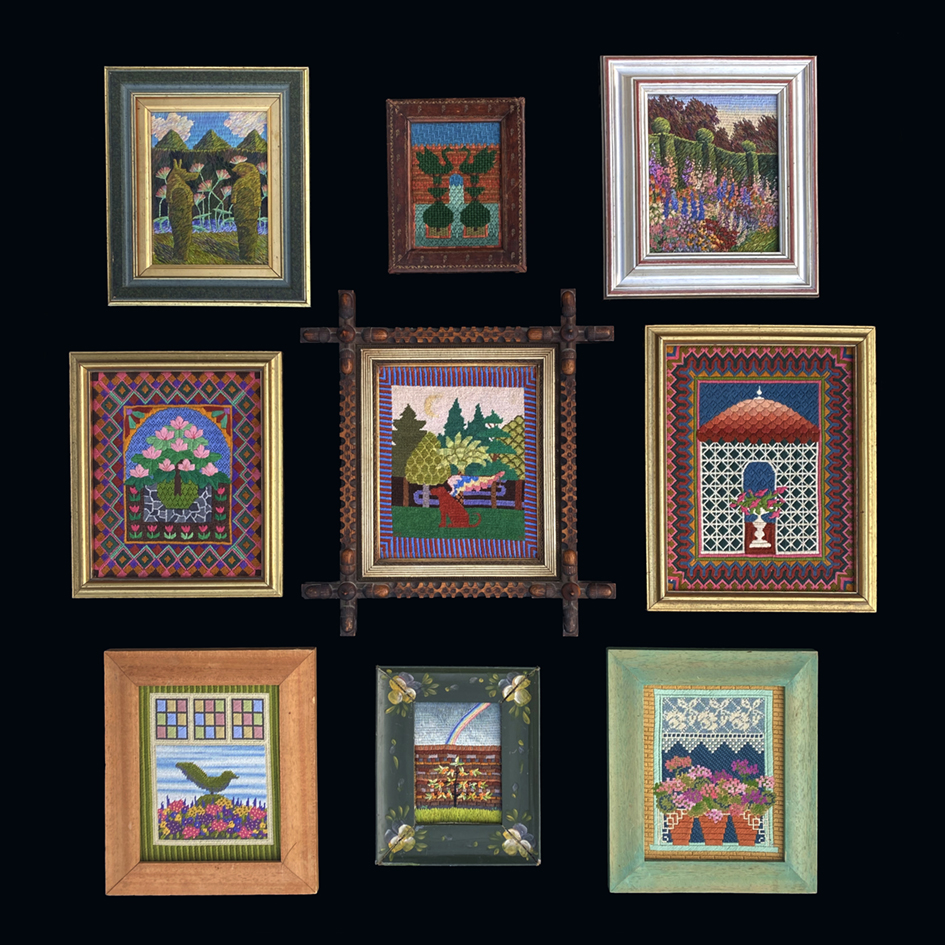
Invited to exhibit my embroideries at Hidcote Manor, a National Trust Garden, in April 2025, I immediately thought of my first visit in the 1970’s; I had just started to embroider, and the effect that it has had on my stitched work ever since. Above is a small selection of my first-ever embroideries that were inspired by my delight and fascination with gardens and flowers.
I stared with basic canvas work and enjoyed the restrictions imposed by the strict stitching and its filling-in-until-you-finish discipline. I was designing pictures in order to learn to embroider my ideas.
It was after visiting Hidcote that I started to draw gardens, mostly details of planting and of course, topiary. I took photographs and scribbled down notes to remember colour planting and topiary shapes to develop into embroideries. Now I realise that this was the time when I found my own way of stitching by using blended colours and really just stitching my drawings. I always scribbled drawings, took too many photographs and made notes ready to be tranformed into working drawings, and this is how start my work now, almost 50 years later.
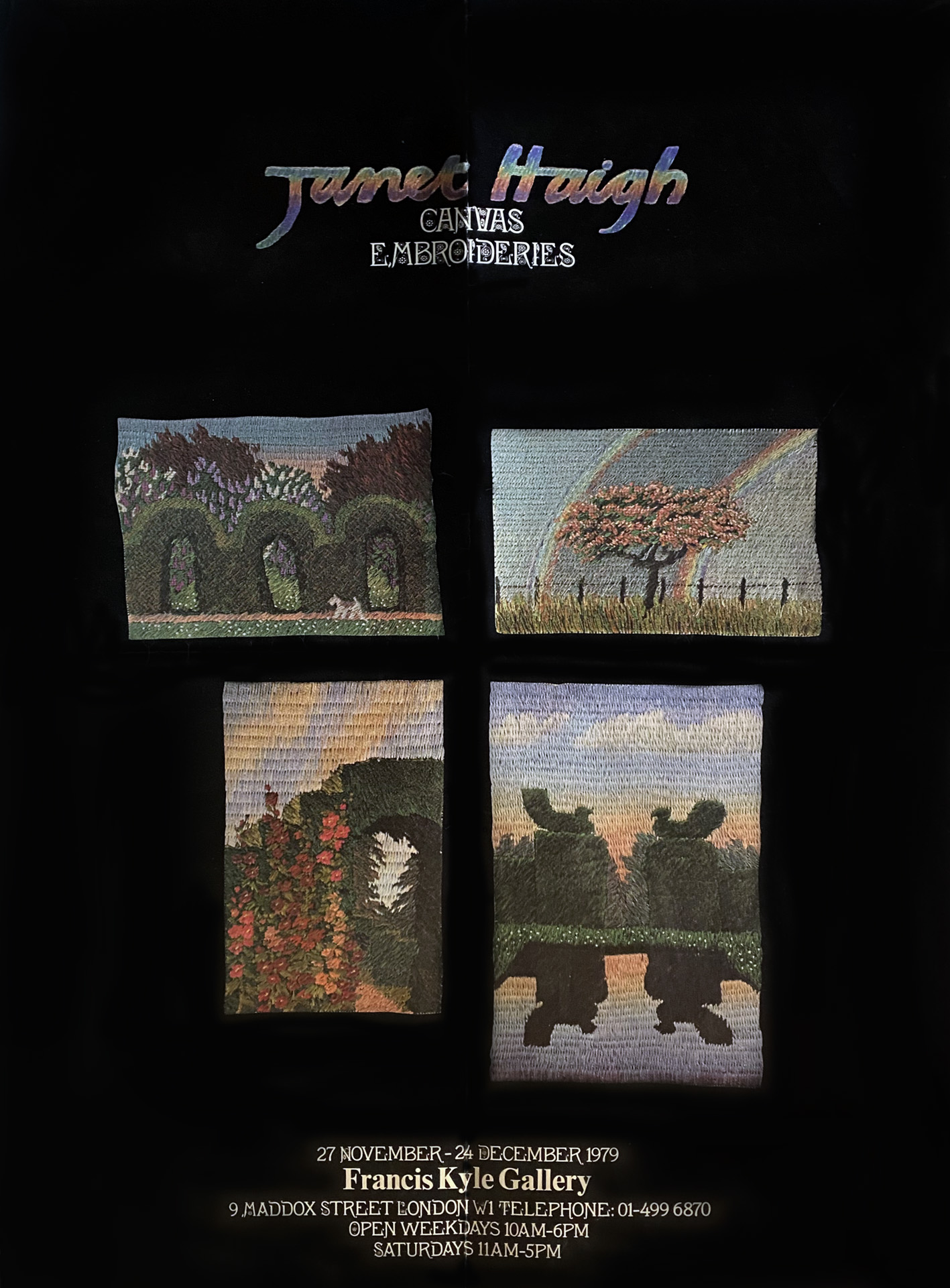
Above a rather creased poster from my first one person show at Francis Kyle Gallery in 1979, showing my small scale canvas embroideries. My early fascination with topiary is evident.
Oddly I do not actually like the idea of strictly clipped hedges, specially when trimmed into animal and bird shapes, but this feeling completely disappears when I actually see it for real. I find this ambivalence really useful and for me it provokes new ideas; why bother to make anything that holds no meaning, mystery or is simply a puzzle for you to try to solve? But mostly I am delighted by the sheer absurdity of it. Why do we tether bird-shaped hedges to heavy domes of yew – to stop them flying off?
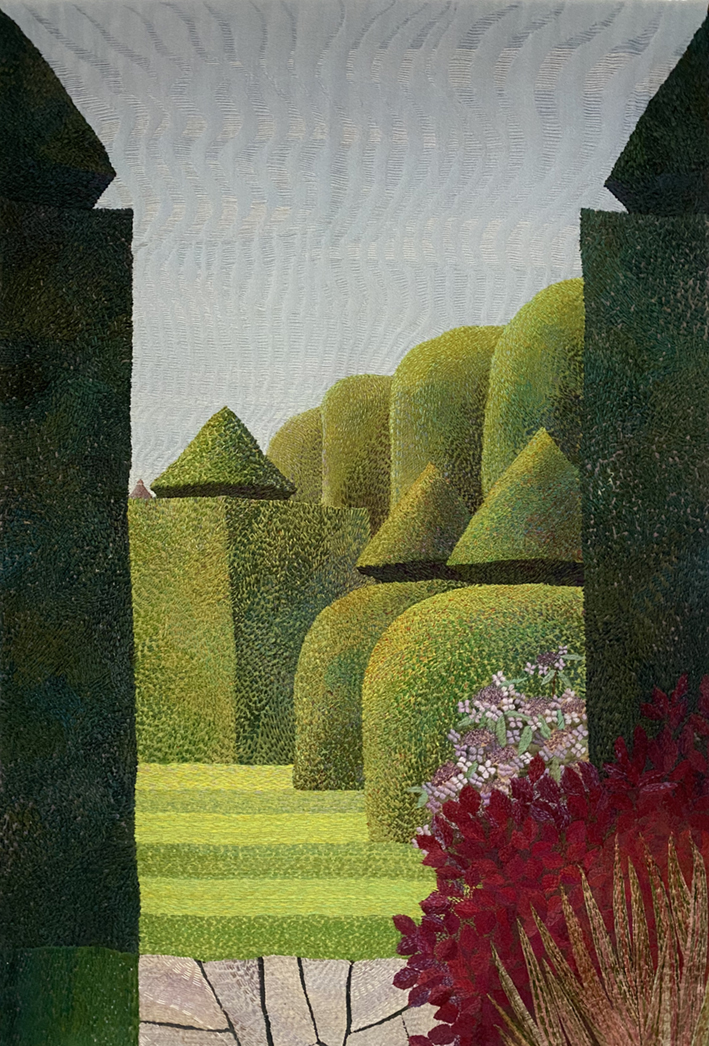
And I have continued to embroider the topiary figures that are often seen in grand gardens. Above is ‘Great Dixter’ a small silk embroidery circa 1980, that was very inspirational in making new pieces for this exhibition. Right is ‘Lytes Carey’, another National Trust garden, this is made mainly with simple large running stitches in woollen yarns onto a wool ground for a big woollen panel, in 2001. I always enjoy seeing the dense green walls of hedges surrounding an abundance of flowers, as seen below on my several visits to Hidcote in 2024.
Insired to make new works for the exhibition, back in the studio I combined different drawings, prints and photograps of several aspects of the garden’s abundance and used some old stencils and wonky photocopies that had been over-printed with my embroidered flower images. From this I developed a collage from shoji paper and stitched silk. Then found an old photograph of the birds as I can remember them with their crowns as peacocks.
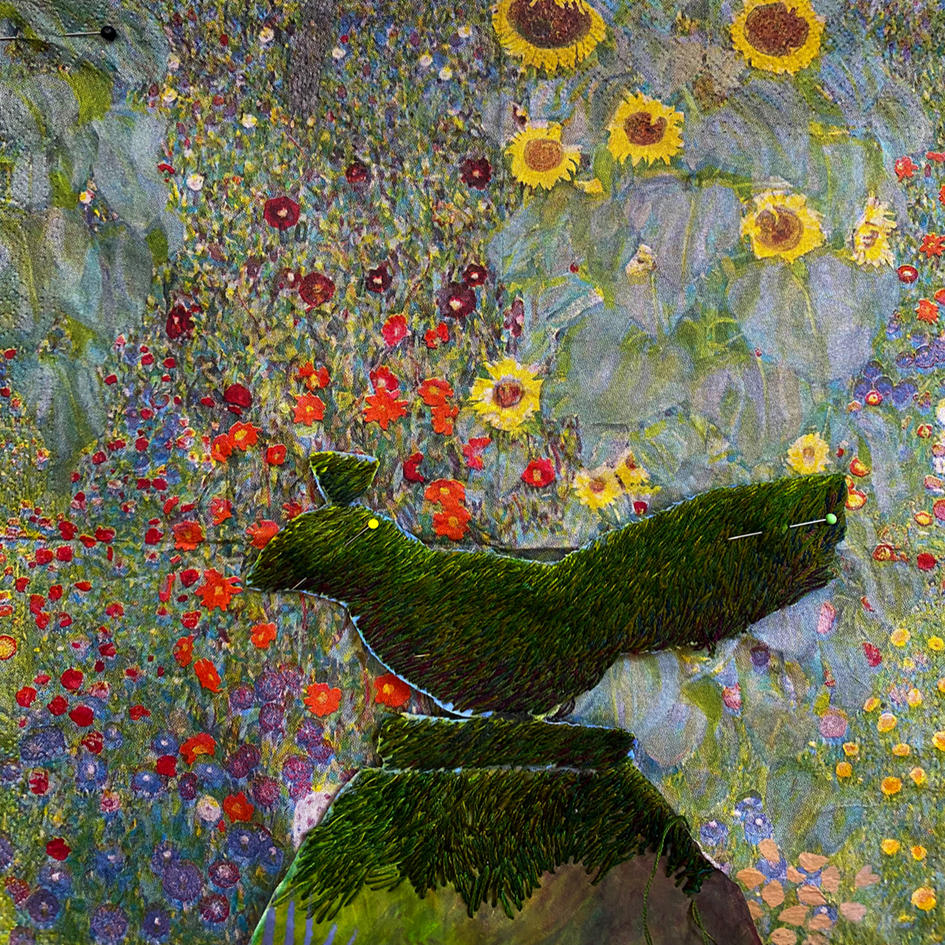
The abundance of planting in the garden beds reminded me of Gustav Klimt’s flowery lanscapes, I began to imagine the plants at Hidcote developed into a wall of flowers. I had bought a packet of paper napkins patterned with a Klimt garden for presents to friends, from a museum in Vienna, but had kept them myself. I took one and pinned it to my studio wall, with the other half formed ideas.
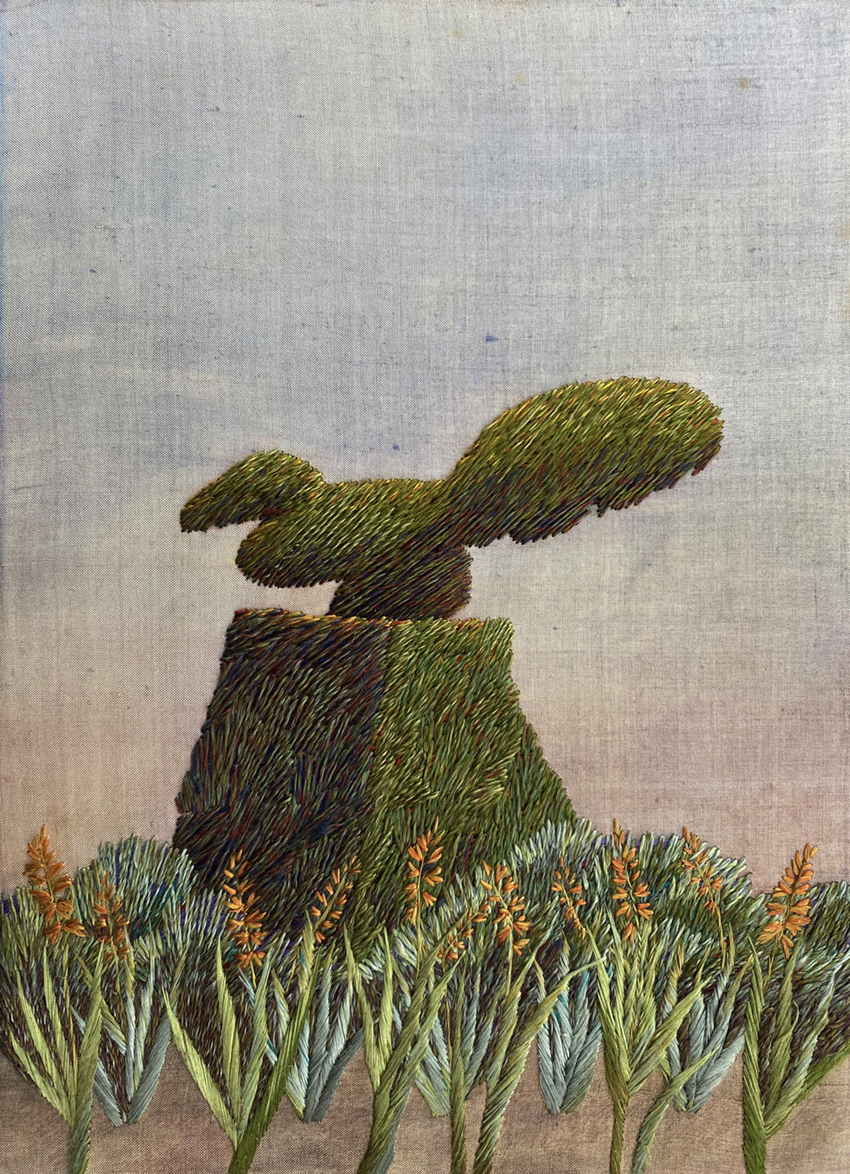
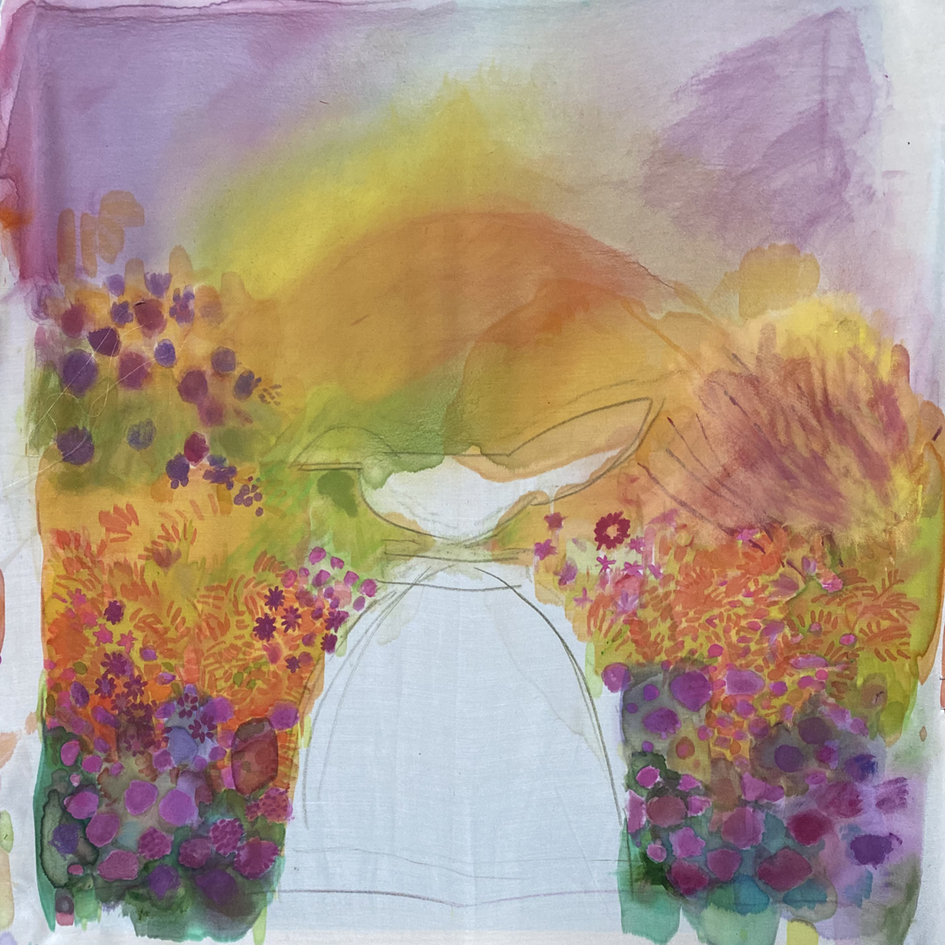
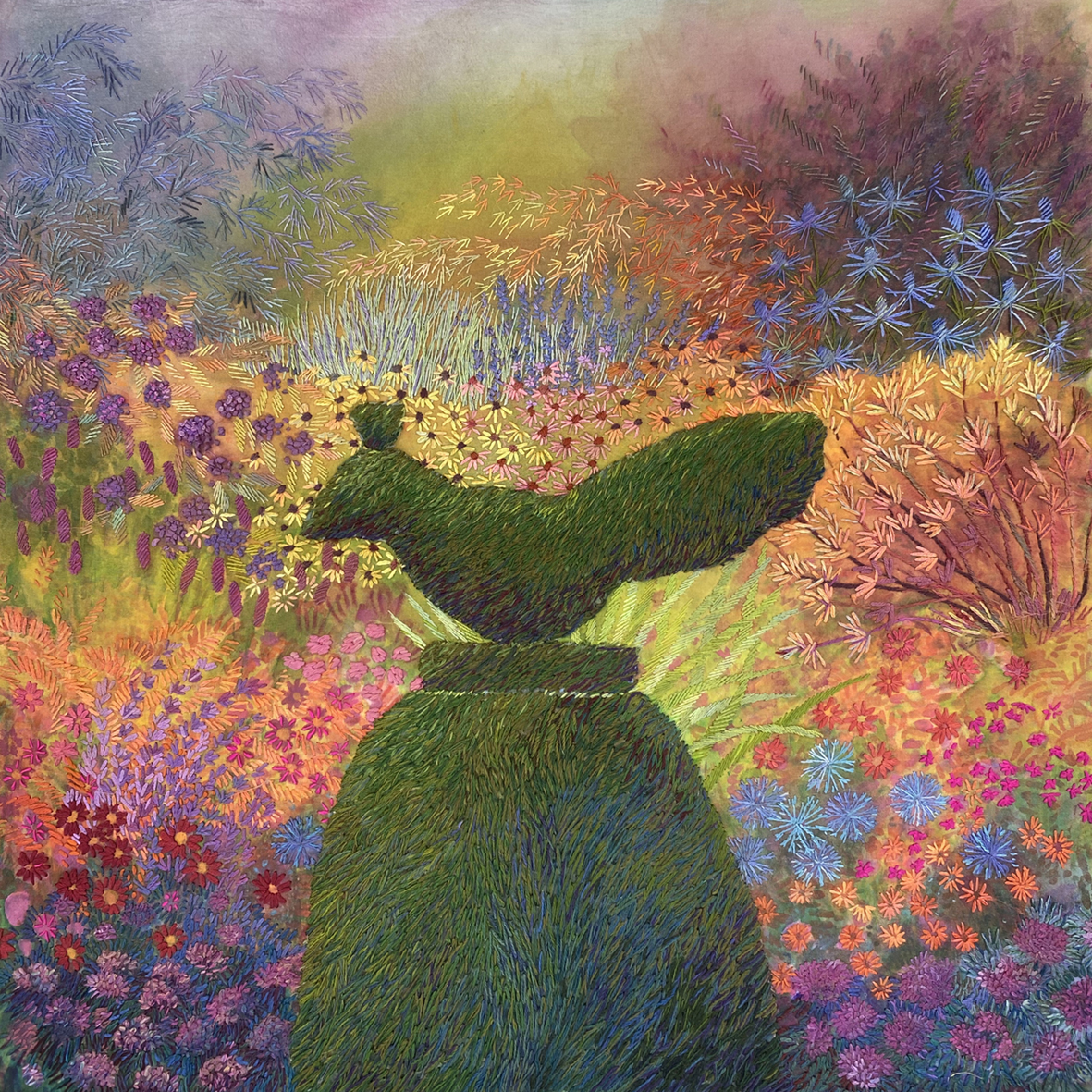
Stages in the inspiration: designing, drawing, dyeing and stitching my homage to Gustav Klimt. I stitched a bird in twisted silk thread on a fine silk ground, then painted dye onto another silk ground adding many of the flowers and leaves, found in my photographs, to make the flower wall. Eventually I stitched the finished bird into postion.
The finished ‘Vintage Topiary Bird’ has become the front cover of the picture book/catalogue that I have produced specially for this exhibition. It has just been delivered to the publishers in time to be printed and for sale at the start of the exhibition Inspired to Stitch: Hidcote Revisited.
first page of my reborn Flora research/sketchbook – Flowers Again!
Recently, the “After Winifred” embroidery has inspired me to develop work to use as Giclee prints in order to add a fresh way of getting my work ‘out there’. I turned to my old Flora workbook, some 20+years old – but still alive for me as a source of inspiration.
last last pages of drawings circa 2000 in Flora workbook .
drawings and stitching samples for Auricular Theatre 1998
painted studies of garden Iris circa 2000
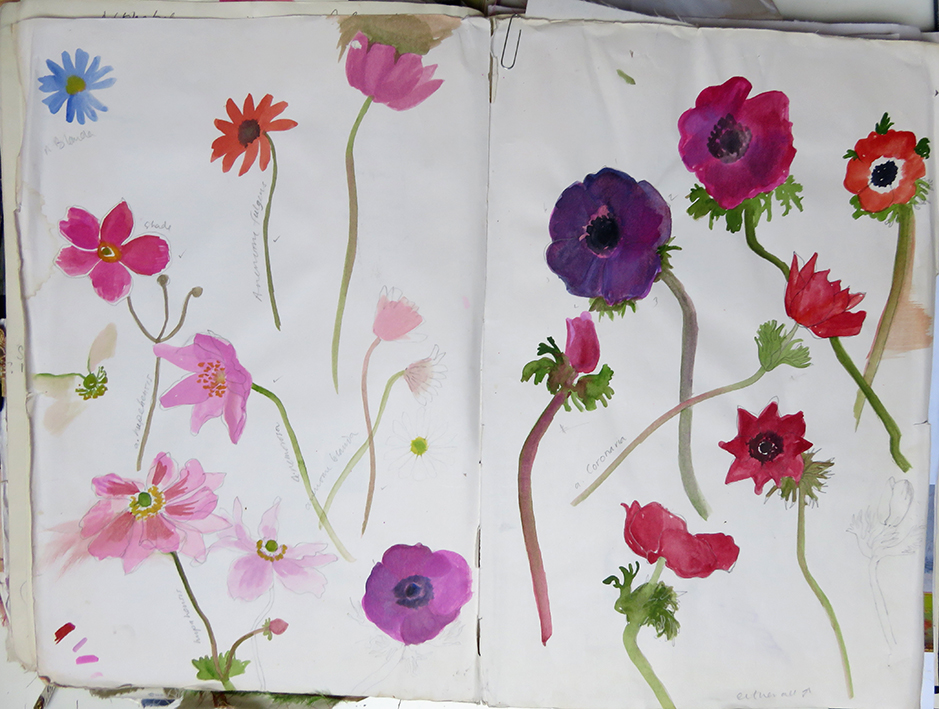
most used pages -Anemonies painted from life and photos.
I found some empty pages at the end of the old book and started to collate recent samples and drawings of bunches of flowers grown and made up at Court House Farm, where I conduct drawing workshops, using the cutting garden as inspiration.
second page of the book – old samples and magazine cuttings for colour a small bunch of dahliasobvious inspiration from Winifred Nicholson flower paintingmy initial research fixed now into book showing early samples of new-to-me Inktense pencils – as dyed ground for stitching
looking back at my Flora work, which is 3 dimensional and very heavily embroidery, I now want a freer drawn imagery to stitch into. So I bought some Derwent Inktense pencils that basically act as dyes when wetted and left to dry – I did many samples but found my drawings had too much information in them – I needed to loosen up further. Ha ha – the story of my working life!
first inkjet pencil drawing second freer drawing sample hand stitchingdesign page using a very old photograph of my own collection of hellebores against a silk ribbon applique.
To enable me to play easily with the new ink crayons I chose an old set of drawing research and photographs to work with. The colours of the crayons are very brilliant and I needed to find ways of making more subtle colours, so stippling, cross hatching and dotting colours one over another made for rich but softer ground colours – these techniques are still a work in progress. Below are 2 studies of the under drawings using pencil dyes ready to be stitched
Meanwhile I have been looking at all my old flowery finished works and their drawings to use as reference and then reframing/remounting stitched pieces ready for the printers.
original drawing for this older Hellebore embroidery right early Hellebores silk embroidery
the little Hellebore image above is my first Giclee print and the smallest at 30cms/12inches square.
Here is the open door into my completed ( well just a few more pictures to put up) patch-work room, using fabrics from the Kaffe Fassett Collective. It has taken 6 months to achieve. I started 2020 during the last Covid 19 lockdown in England and we are still not entirely unlocked mid way through 2021.
I aim to take you around the room to see how it all has come together, here the door from the porch has a vitreous enamelled finger plate – now I want to make more of these for inside the room…the enamelled fireplace can be seen with our old furniture and carpets safely back into place.
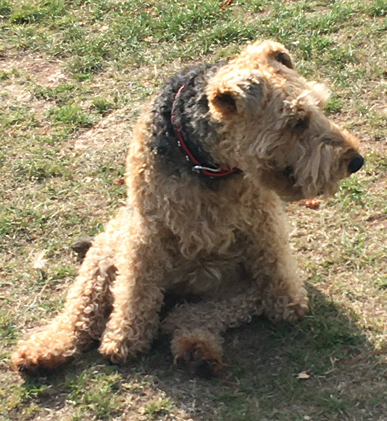
turning left is the view into the small panelled room, our 2 Irish Terriers and the enamelled fire surround – see previous post for making this….luckily my much loved vintage Deco glass shade tones perfectly…now how did that happen?
Above are 3 views of the chimney corner with 2 different totally different Flag representations. the row of flags at the sea side is an old painting by Stephen Jacobson next to a ghostly silk organza flag by Nigel Hurlstone. this piece of work proved pivotal for me to see how the room could hang together using cooler colours
Once we had started to put the room back together our 2 Irish terriers, Maeve and Murphy took a particular if very relaxed interest in it.
I found on Ebay a beautiful discounted Zoffany silk striped fabric and bought enough to make 4 very large padded curtains for the big Victorian windows in the room. The fabric cost me about 4 times the amount I had spent on the rest of the room…but they work well once I had trimmed them with some vintage woven ribbon that I over – dyed to suit the colour of the paintwork – as you do! And then I found these mazing brass tie backs on-line at my favourite store for just about everything decorative, Anthropology.
Continuing around the room…
In the the corner between the windows hangs an old (and much loved by me) painting by my husband, Stephen Jacobson, of my father’s greenhouse that he built in my family’s garden on the Wirral in north west of England.
From the photographs I have posted so far it is hard to see that the patchworks are all padded and quilted, but it is evident that my ‘in the ditch’ sewing notbetter placed than my hammering in the copper tacks that fasten the fabric to the battens. On the tiled table is a flowery flower vase by Tean Kirby.
the opposite end of the room to the fireplace with the bay window looking out on the overgrown garden
one of a pair of window seats with an old canvas work cushion sample and the luxurious silk curtains and brass tie backs. Then to the other new thing I bought for the room – the glamorous mauve velvet mini chaise – from a TK Maxx sale!!!!!! Well I had to balance the spend on the curtains.
Coming Into Port – Stephen Jacobson
Above is ‘ Coming Into Port’ – I leapt on this for the room when it came back early from a “closed for Covid” exhibition and it fitted perfectly. Basically our house serves as a venue for our joint work. I made the large cushion especially – it uses all the major colours of the room, and in fact the whole house, in my wonky version of Flame Stitch; and I have been commissioned to make a design from this by Ehrman Tapestry so look out for it next year if you stitch canvas cushions.
So here we are at the porch door again – and the gingers are waiting for us – well actually for Stephen with the biscuits to get them to pose….
and that is it – at last after so long – finished enough for people to see it – with the doors and windows open and only 4 visitors at a time!
The patchwork walls are almost completed, just some finessing needed so time to think of the fire grate. We measure carefully and then cut 20 copper tiles ready to be decorated – using my favourite Drawn Threadwork stencils. I started to scribble lots of ‘back of the envelope’ ideas as to design layouts – but decided to just make the stencils and then see how they best worked together.
An assortment of design, scribbled ideas for the enamelled copper tiles ideas
I found a small table cloth ( in my stash) with very large scaled drawn thread-work embroidery that would be suitable for this making many variations from just 2 basic designs. I needed 2 stencils one square for the corners of the grate and a striped version for the longer lengths. Initially I thought it needed to be made larger to fit the cut copper tiles so I had to extend the stencil. I appliqued extra pieces of embroidery, using a machine for strength (for when it is stretched on a frame) then cut away the linen beneath it.
a corner of large scale vintage drawn-thread work table cloth with extra embroidery machine stitched in for a bigger stencilthe stretched stencils are tested using enamel powders sifted first onto paper using the corner design, the next image is the long length stencil between the corner stencils then straight onto a copper tile ready to be fired
meanwhile the rest of the copper tiles have been cut and checked for how they fit together – like everything else in this very old house nothing it straight or even.
i had wanted to verdigris the tiles but decided to stick with what I knew, so I started sampling the enamelling colours. It is a few years sinceI have enamelled anything but remember the colours that will best look like verdigris – I match the pale greens and blues to a naturally verdigris copper strip I found in the studio
samples of copper enamel colours to make a similar effect to the real verdigris copper strip, the first set of hearth tiles placed in position for deciding the final design
after the gas stove had been replaced in its original position, I continued to adhere the top set of tiles in their allotted places. They make a very uneven but harmonic set of colours…so then I needed to re-paint the surrounding columns and wooden skirting to blend in with the rest of the room.
finally I ran around the house searching for the pieces I could put on the new mantlepiece – my old mirrored glass candle holders fit in very well. The small separate enamelled strips of copper are leftovers from cutting the tiles, plus anything else I could find in the studio that could be fired with the remains of the vitreous enamel colours – real make do and mend patch-working.
My next post will show the whole room complete with art works, cushions and flowers!
research workshop materials -printed paper butterflies
‘Wings and Things’ is the working title for an exhibition being developed for the local community’s annual “Westbury Park Festival”.…last year we hosted a drop-in making felt flowers – this year we are show-casing the talents of the staff and tutors at Heart Space Studios – so no pressure!
research workshop materials – feathers
Each of the 11 people who opted to work towards the theme have committed themselves to attending up to 3 research sessions when we all work together to make a mixed media exhibition – by mixed media I really mean any materials that can be connected to textiles, either physically or metaphorically. ‘Things with Wings’ was an idea proffered by Debby Bird (who else?) who is a busy tutor at the studios and a major force for developing new ideas for classes. We are working together to make an unusual and hopefully amusing exhibition
selection of glass beads for workshop materials
It is always fascinating to see how each person responds to any given the brief: we had asked for any ideas and drawings/ samples of work ready to be discussed on the day – we wanted everyone to participate in helping one another develop ideas, otherwise working in a group can be really distracting.
Step Wooster brought the real thing
teeny tiny drawing book of ideas with pigeon coloured materials – Steph Wooster
Steph Wooster brought several real birds wings that she had been given by a local game butcher, plus some tiny drawings in the goes-everywhere-with-her-sketchbook. She placed the book open at a pigeon drawing next to a bag of – to my mind – Pigeon Coloured materials….
Ilaria Padovani’s grandmother’s patchwork design re-sampled for the project
Ilaria Padovani, brought a couple of samples specially prepared for the day – one a pair of collaged wings which was bright and busy, but another patchwork made from a pattern that her grandmother had made for her as a child it was her favourite winged thing – the dragonfly – and it is full of flight!
We immediately advised her to just make lots and lots of them in all sorts of different colours and to exhibit them flying randomly across the walls. I had brought in several frames to establish various sizes of each piece – Debby and I needed to have an easy hanging session prior to the exhibition opening. It was decided to wrap the dragonfly patches around small stretched canvasses and so keep them light and airy.
Mary Bishop – appliqued and embroidered birds
Many textile artists, regardless of name, work with bird imagery; Mary Bishop has made several pieces of bird related embroideries and so she brought a few of her early samples and an open mind, as it was her first tutor’s making group attendance. She is really taken with the idea of Magpies – after all they do like bright shiny objects and we always have lost of those at Heart Space.
glamorous feathers placed on top of a vintage bird book I had brought to the workshop – a really good idea for further collages here.
beads and feathers for Magpie’s stash
I thought she should start with the nest – I mean she can easily do the birds at home alone – but the nest and it’s contents could be found in the studio stash….I asked her to just find lovely things a magpie might steal from us and then to make a nest from them, later she can choose to use parts of it as a sort of grounding for the birds or develop other ones from other materials….the ideas are endless here.
starting to make the Magpie’s first nest – Mary Bishop
Some people had already started making flying things from textiles, Sophie Bristol has carefully cut wings from a length of vintage lace..the ways ahead were obvious, lots of different wings from different laces just needs to sort out the bodies – rich ground for playing with all sorts of media. However……
beginning of a cut lace butterfly – Sophie Bristol
striped of silk fabrics to make into a 3D bird cage….a really innovative idea and a lot of interesting work to develop.
during the introduction when everyone had to show and talk about their own ideas she liked the idea of making a cage from a sample made in an earlier workshop.
She set about making a prototype in card and tape to ascertain the sizes and shapes required – but what will the cage contain?
cylindrical cardboard sample for Sophie Bristol’s birdcage
One way to use a themed exhibition is to try something new or an idea that has been on the’ back-burner’. I think Kirsten Hill-Nixon thought this way. She arrived with lots of well organised materials, books and ideas – lots of drawings in her research book and a firm grasp of what she wanted to achieve…it’s a tall order!
like a cabinet of curiosities – Kirsten Hill-Nixon’s research materials
Kirsten wants to make a series of exhibits of ‘natural’ objects trapped under glass domes…she is making different types of what look like fungi and cast off chrysalis shells. She is making them out of all types of fabrics, waxed and “preserved” – I found these curious things near a batik kettle – where are the winged things that maybe emerged form them?
waxed casts and wrapped objects for Kirsten Hill-Nixon’s curious collections of post-flight litter?
Ilsa Fatt had already designed and made several beads that were based on hearts with wings but the general consensus was that she should make bigger beaded wings –
Hearts with Wings glass beads – plus some wriggly beaded ‘things’ – Ilsa Fatt
twisted beaded wire winged thing – Ilsa Fatt
Debby Bird had made lots of tiny wings and insects using twisted silver wire and she suggested Ilsa make some and by the end of the session when the red beaded winged thing emerged we all wanted to wear it, either as a brooch or worked into a necklace.
Silver wire shapes with opalescent threads ready for sampling – Debby Bird
Debby Bird always has lots of different media to develop into new and desirable objects and images…she excels in hunting out amazing new products and manages to incorporate them into her work…unlike the rest of us! She had made several different samples prior to the session but the thing she settled down to was an idea from her paper cutting experiments.
perforated paper dragonfly design – Debby Bird
the results of a long time piercing the paper with a needle was ethereal and beautifully nuanced when see against the skylight. I am looking forward to seeing how this essentially simple idea is developed into further work….all sports of light fitments and holders could be made – I must give her some vellum to sample.
new research tools for our latest volunteer, Ceema McDowell
Sitting next to Debby, who by piercing paper was working with one of the most primitive way of making a mark, was Ceema McDowell, busily using the most modern of research tools to develop her peacock design…the strands of random dyed woollen yarn is reassuringly traditional.
Threads found when sweeping Heart Space Studios workshop floor
And to me – what did I get to do? well not a lot on the day but I have had a frivolous idea for this project – it is not at all what I usually concern myself with, but it would not go away….so I told the group to see how they would react – they laughed but said it could be really interesting.
One of the daily chores of running a workshop -based studio is sweeping the floor before and after every workshop – and there always seem to be tumbleweeds of threads and fabrics under the tables and in the corners…
left over fabric scraps from my own studio floor
as well as spilled beads or left over buttons…….it was the buttons that made me ponder: why are there always masses of Beige Buttons left unused in any button collection?
Beige buttons fly to button heaven with silk embroidered wings: sample idea by Janet Haigh
I started to imagine where all the unused beige buttons will eventually go; will they fly off to a beige button heaven? Will they then become pearl buttons when they were beatified? I also thought of the threads and the fabric scraps…what would become of them if they flew to heaven – how would their wings look and what’s more – what would their eventual version of heaven look like?