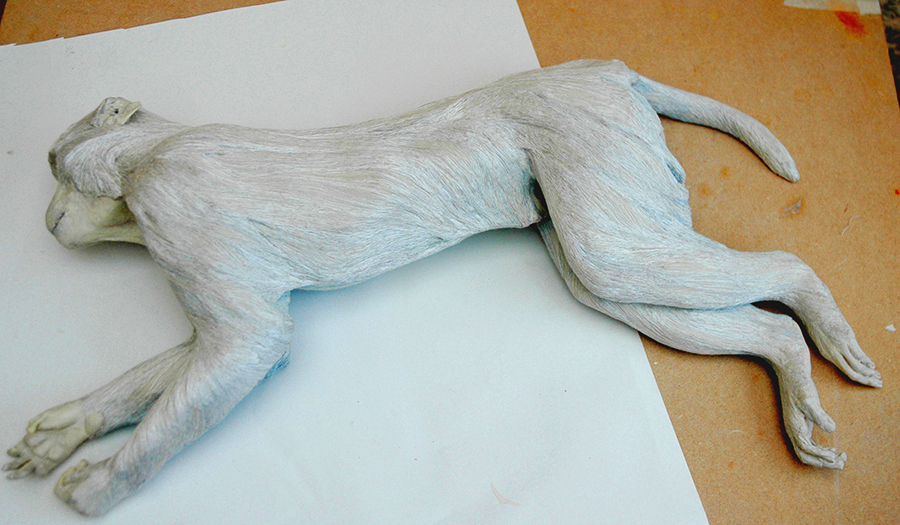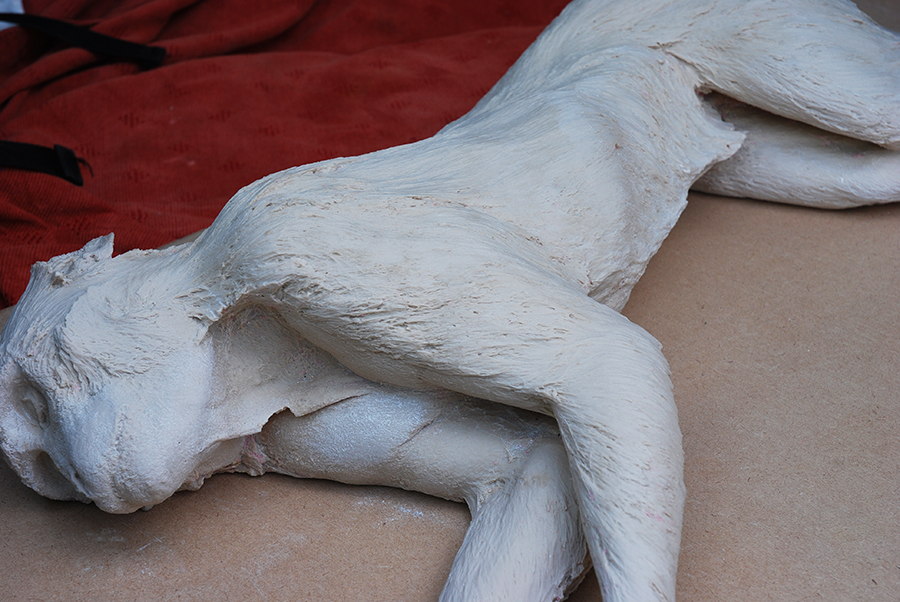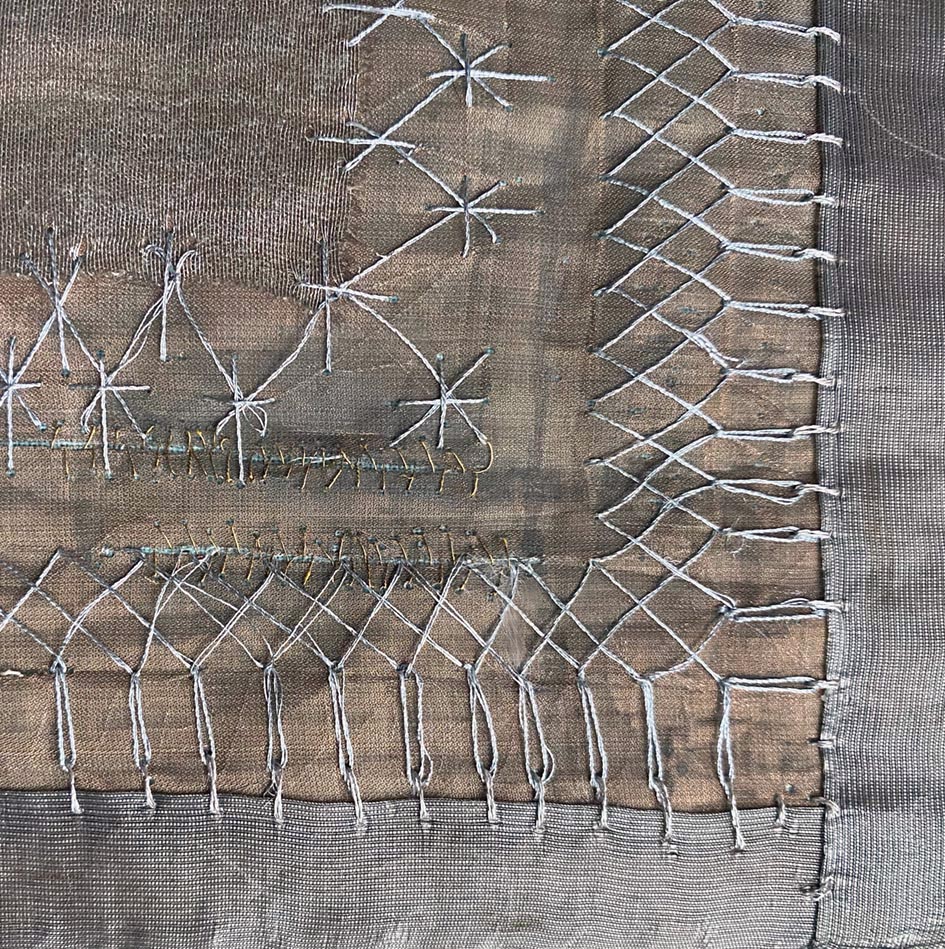
I was invited to the Hugh Lane Gallery in Dublin recently, to discuss the making of the stitched silk covering for the sculpture “Primate”( above) by Daphne Wright. The gallery had recently acquired the sculpture for its permanent collection, and Jessica O’Donnell, the head of the Education and Outreach department, had asked Daphne, who had commissioned me to make this in 2009, if I would be willing to talk to the conservation department to give them any insights into the process. I was so delighted to be asked for this because, I not only could explain the ways of making it, I had kept all the materials and stitching samples, and there is a blog that explains the whole 3 month long process.
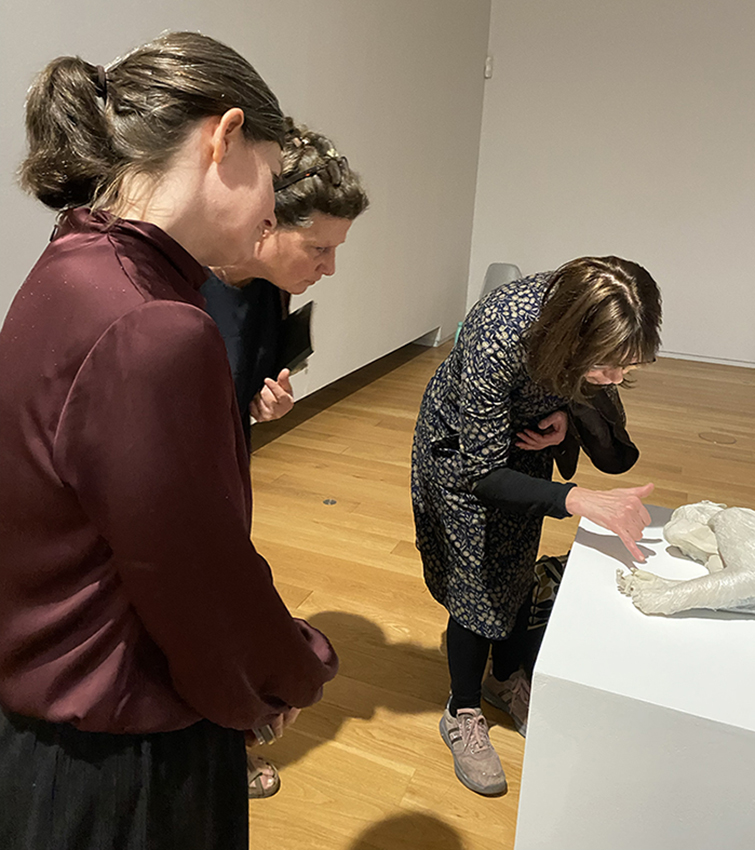
We all first viewed Primate in the gallery where he was lying alone in the middle of a large darkened room within a spotlight. Daphne spoke about the difficulties of obtaining the cast and I later talked with her about various ideas and conversations we had about aspects of our collaboration – it had been intense. However, I have seen this work in various circumstances from busy National Trust properties, in commercial art galleries, and our own studios and now here in pure isolation…un-nerving.
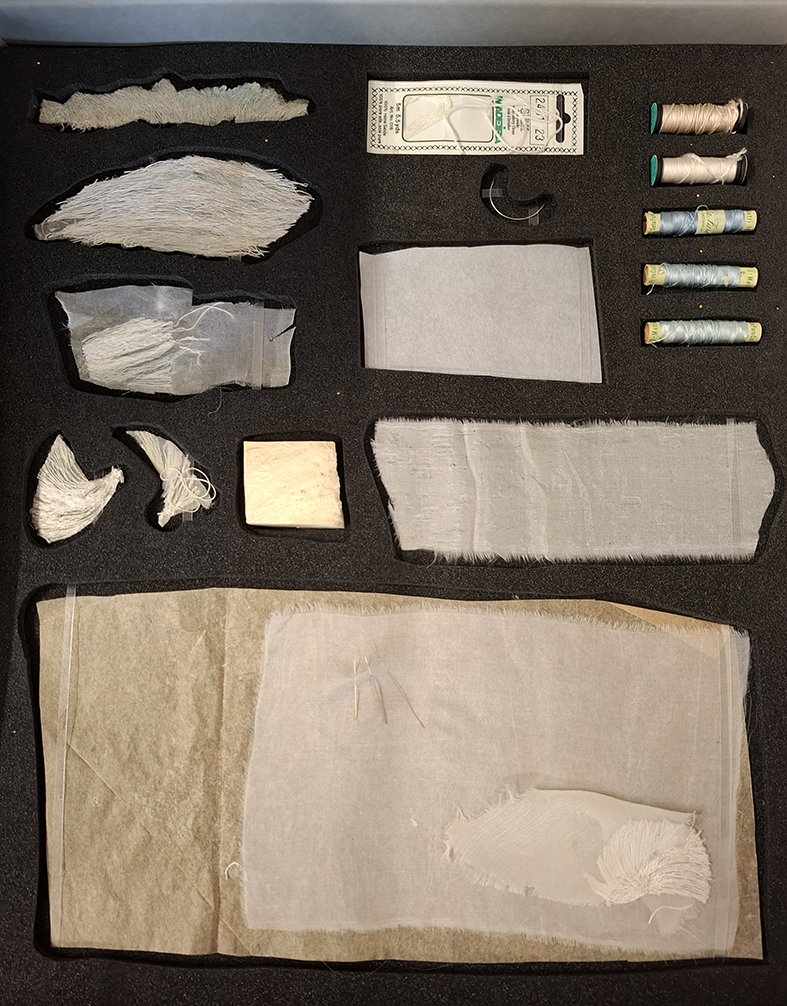
Next we went behind the scenes of the museum and I showed the small set of samples (below left) that I had kept: silk organza and different backing materials, paper backed adhesives, silk threads, needles, and the cut out and discarded stitched pieces, even a sample block of the marble resin; all kept in my research stash to explain my journey. Below right shows the way the gallery has now laid them out for viewing in the education department – so perfectly neat and simple.
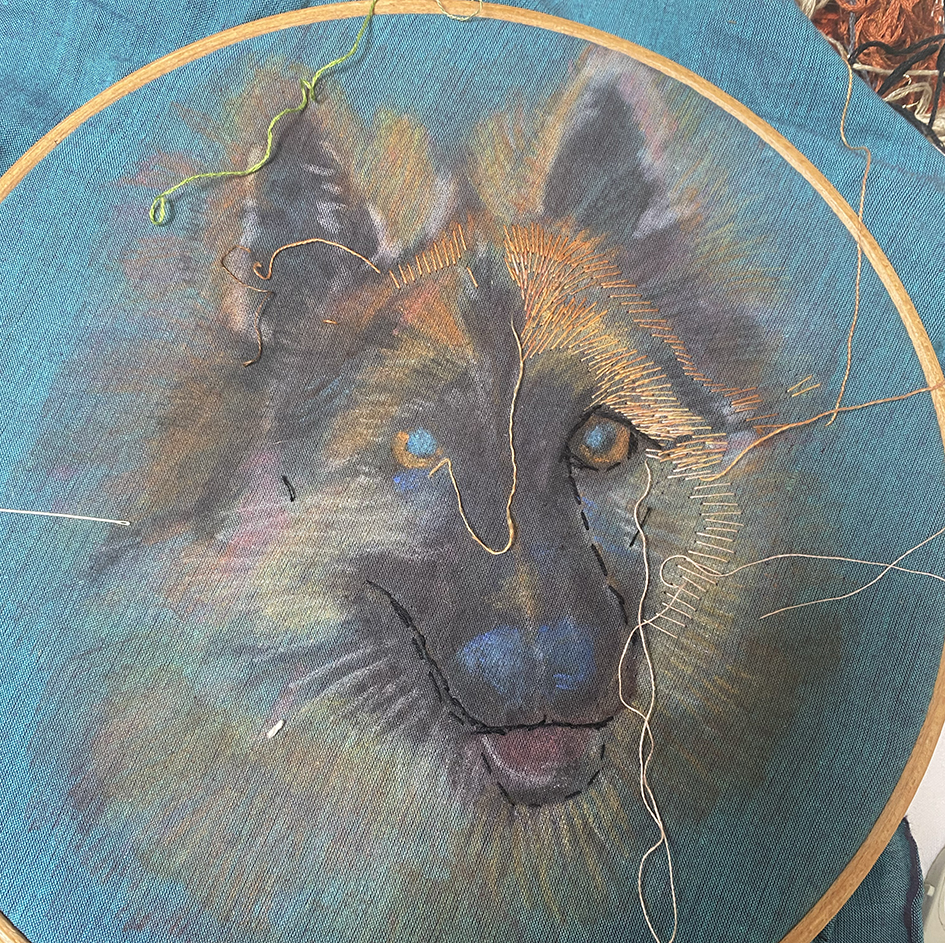
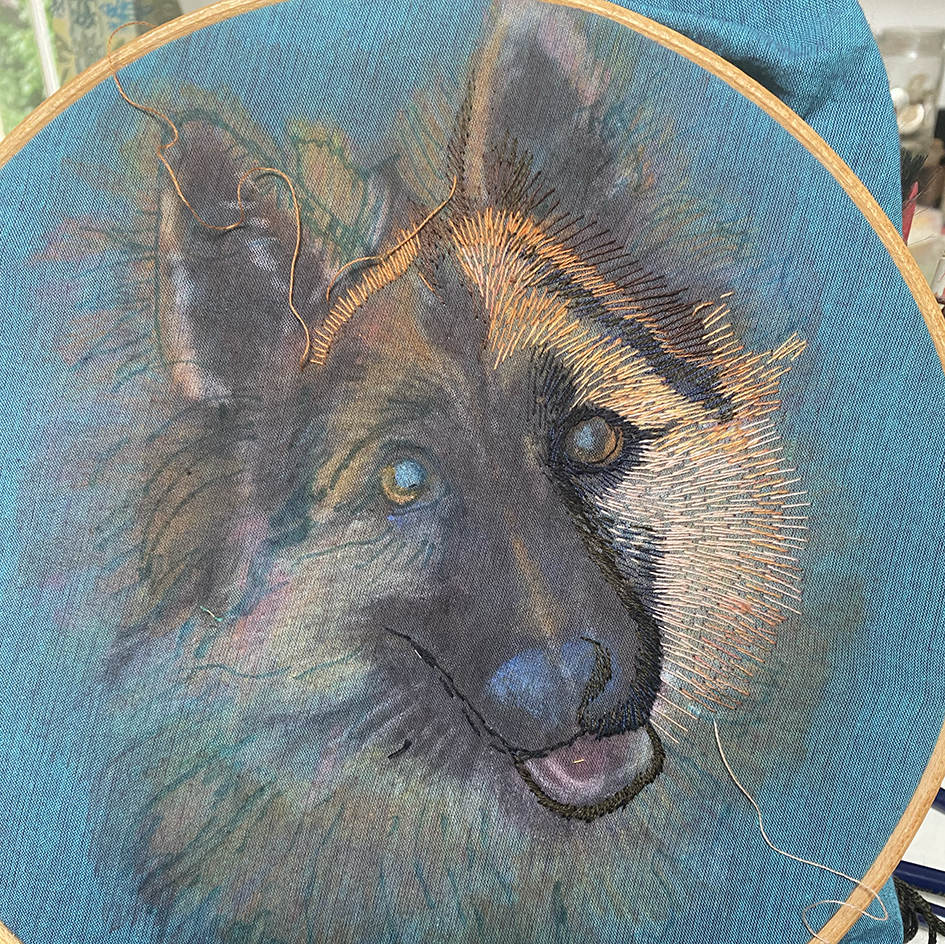
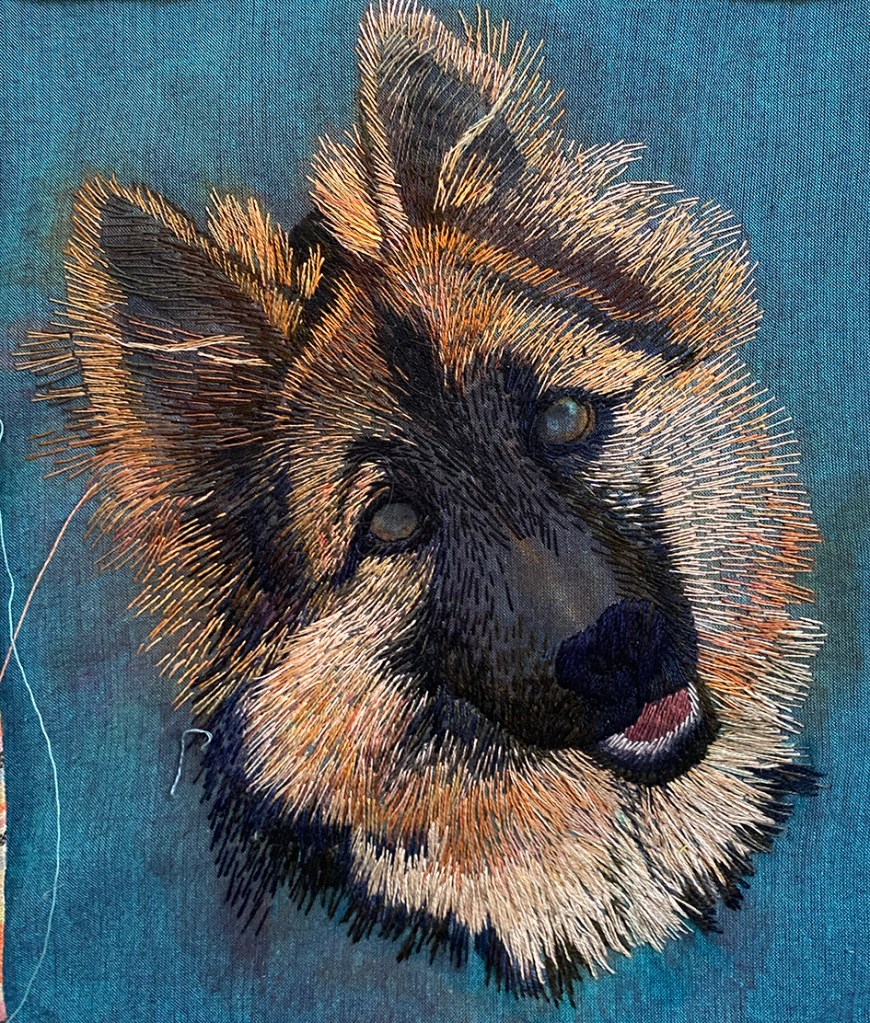
Below the basic and flawed resin and marble-dust cast of the Rhesus monkey, and the stitch development at about the 3/4 way stage, on my studio table.
And here is the gallery where the Primate was introduced to the public as a new acquisition to the Museum’s collection. When I saw this space for the first time it felt like entering a tomb, or at least a place of veneration and it still makes me feel bereft every time I look at this image.
This commission has had a considerable effect upon my stitched works, even up the present day. For further insights and my stitching this work please go to my post in COMMISSIONS: Primate.
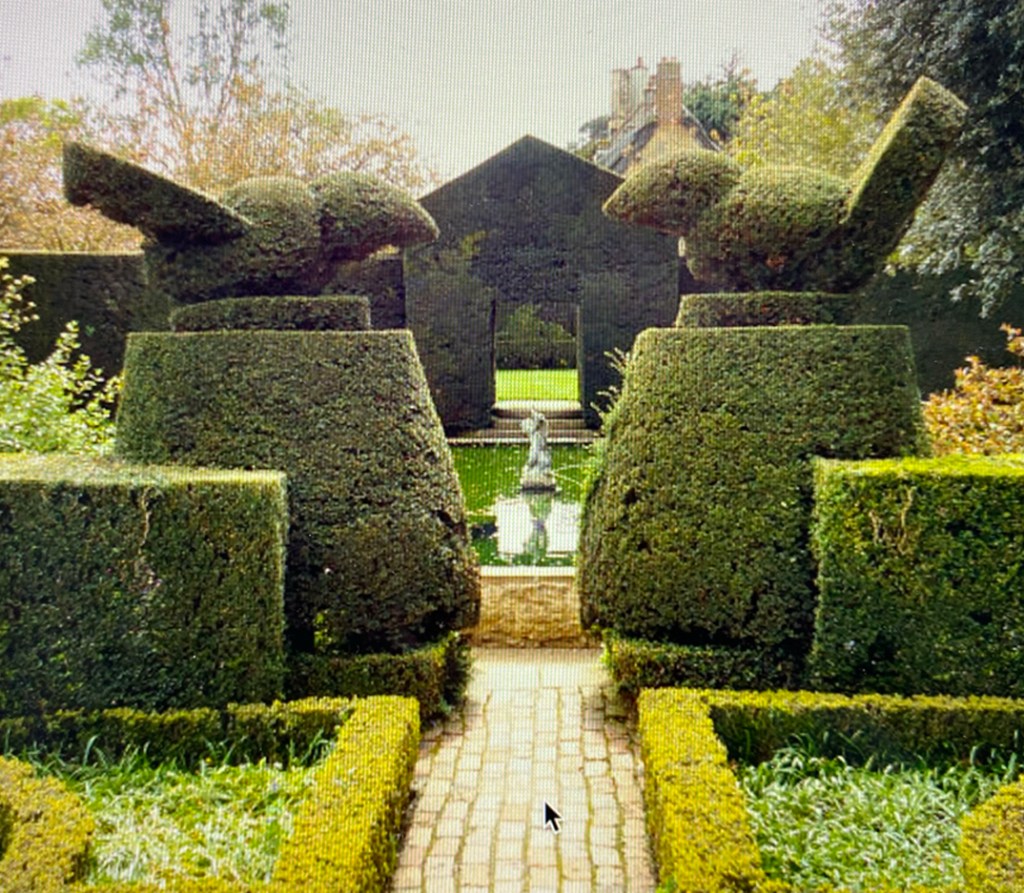
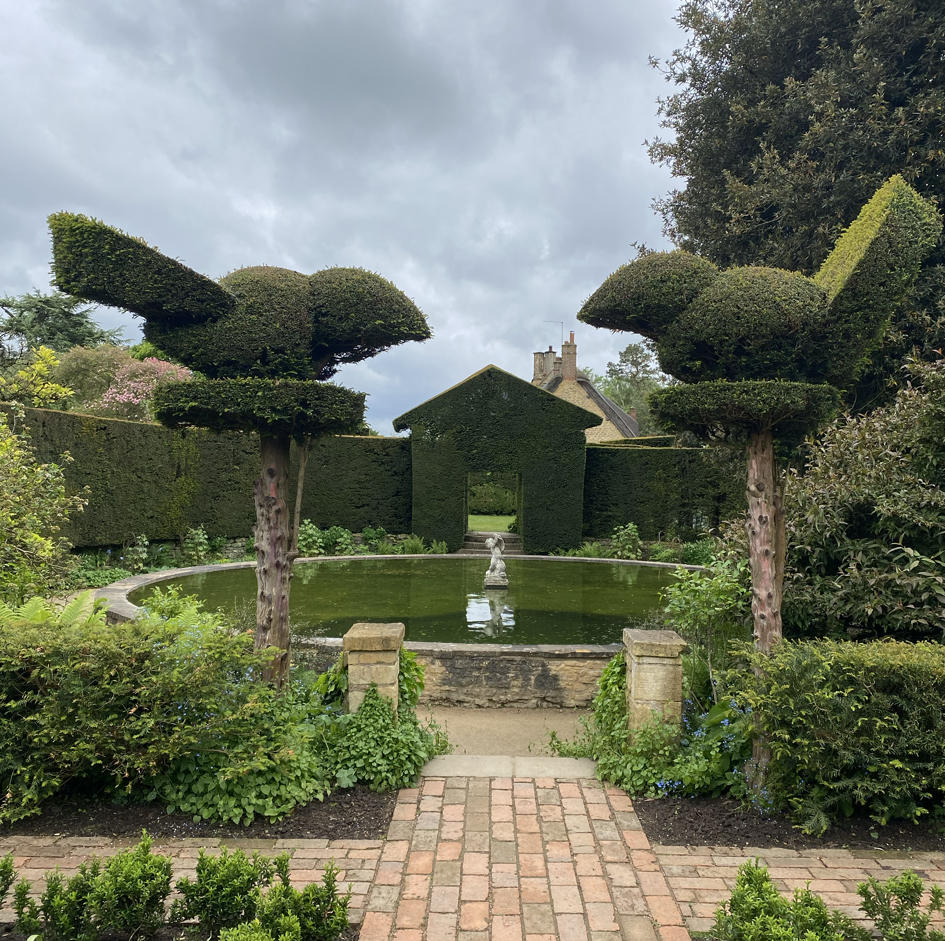
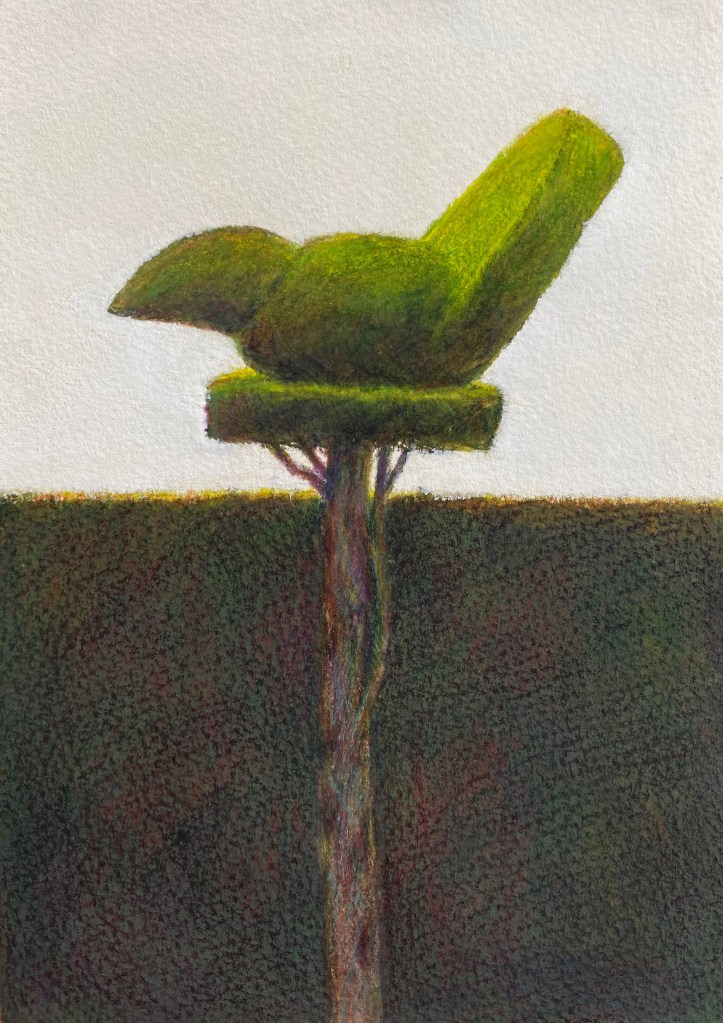
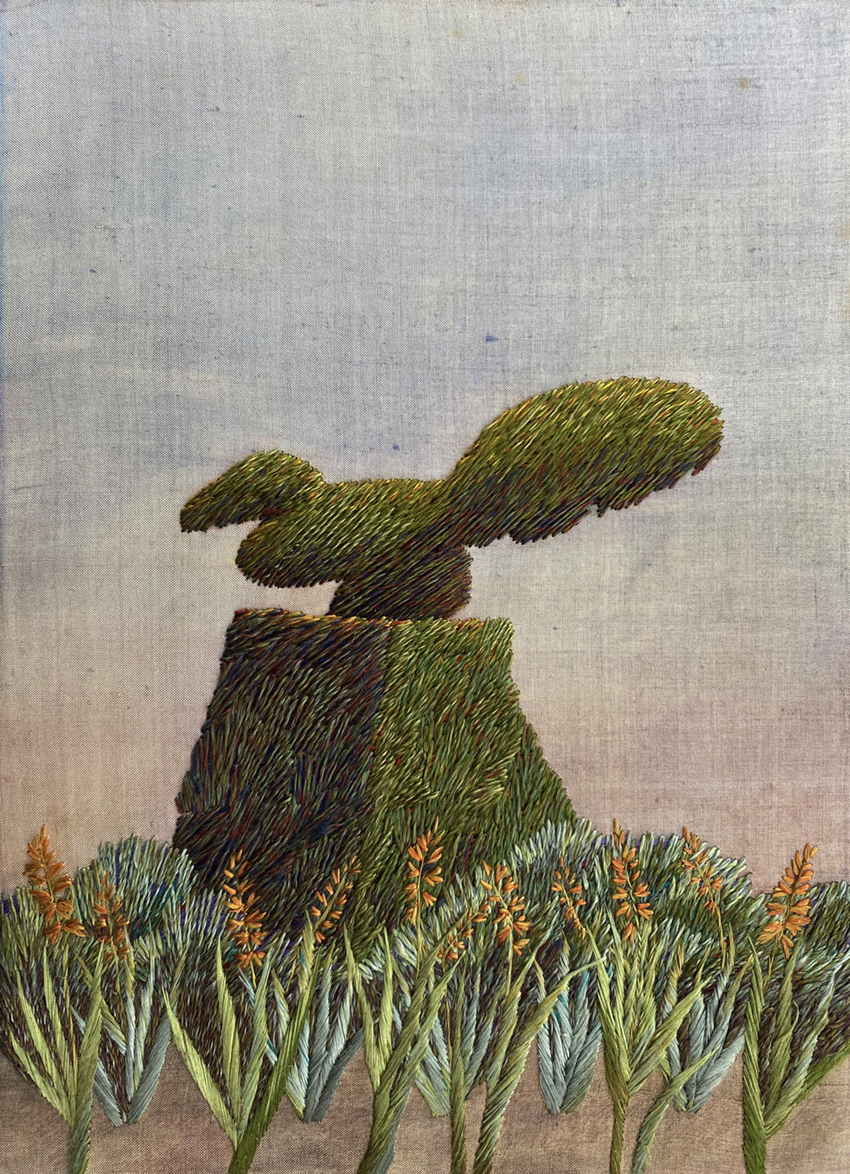
I gasped when I first saw these 2 topiary birds when visiting Hidcote to discuss my exhibition “Inspired to Stitch” for the Manor House gallery in 2025, where were the large bases of yew that they had perched upon for over 100 years?
Hidcote then Hidcote Now
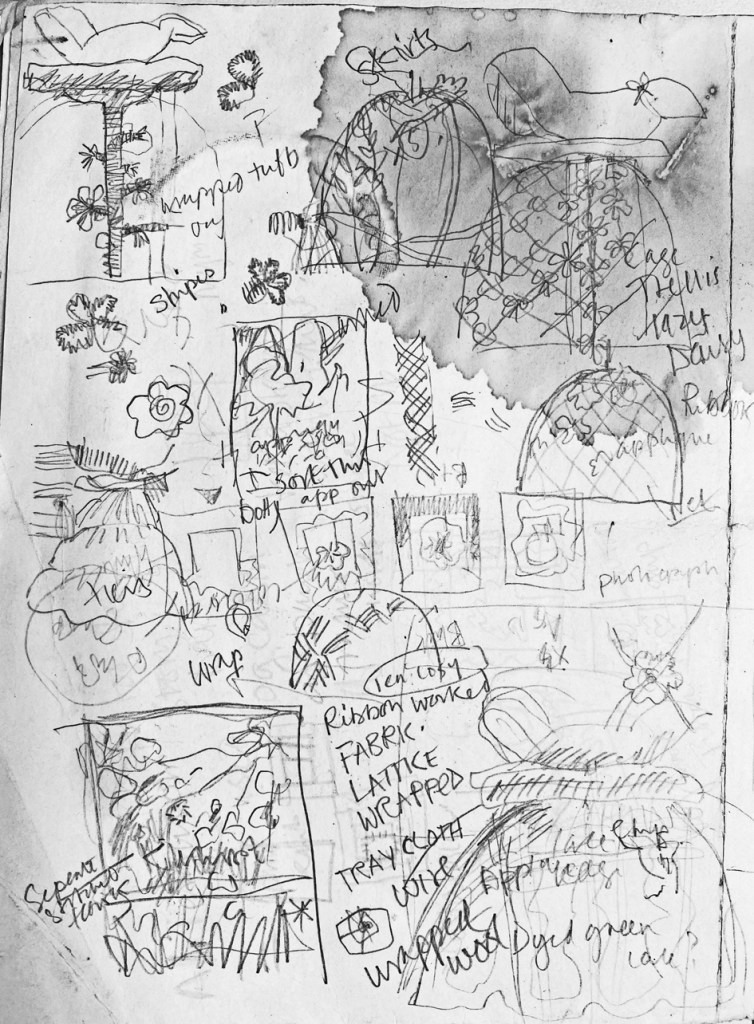
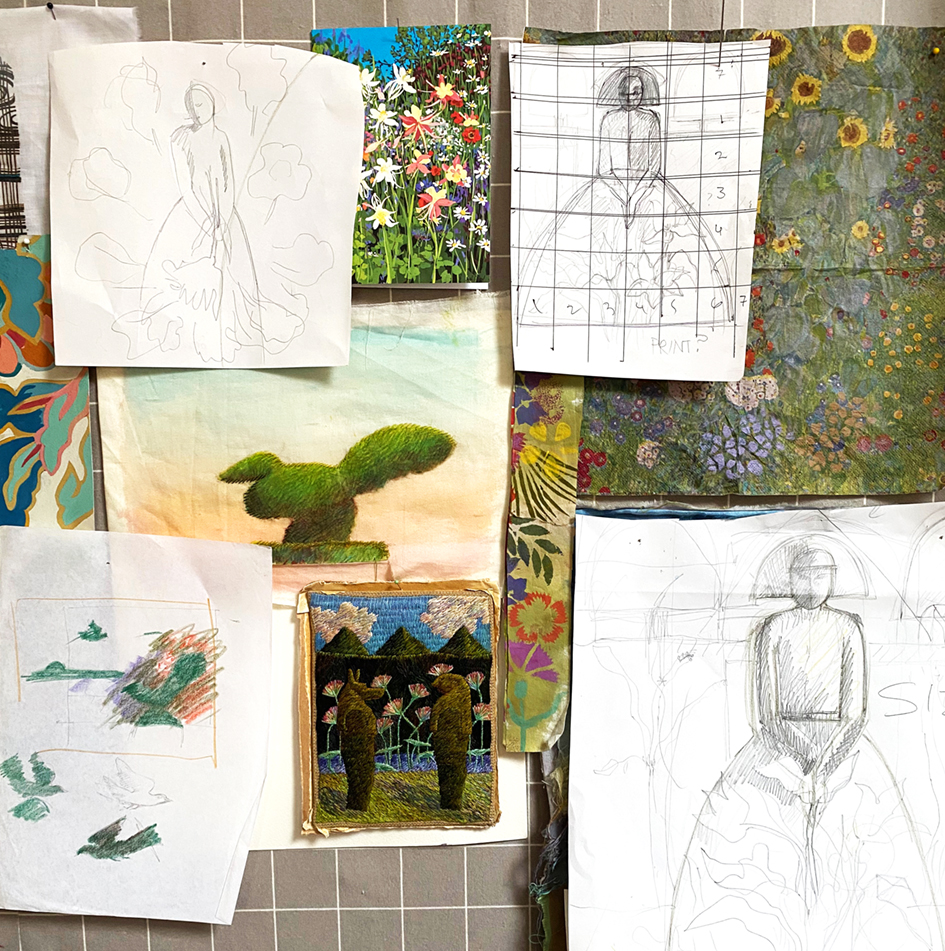
It was explained that the loss is in part due to necessary pruning( after the covid closures) needed to maintain access to the steps to the pool. Now they sit on top of bare but beautifully dappled trunks. I immediately thought “I can mend them”, visually of course! My idea was to create 2 wide ‘skirts’ of different fabrics – but when I started to think about making skirts my mind started to race with ideas. I quickly scribbled some down onto the only scrap of paper I had to hand…..
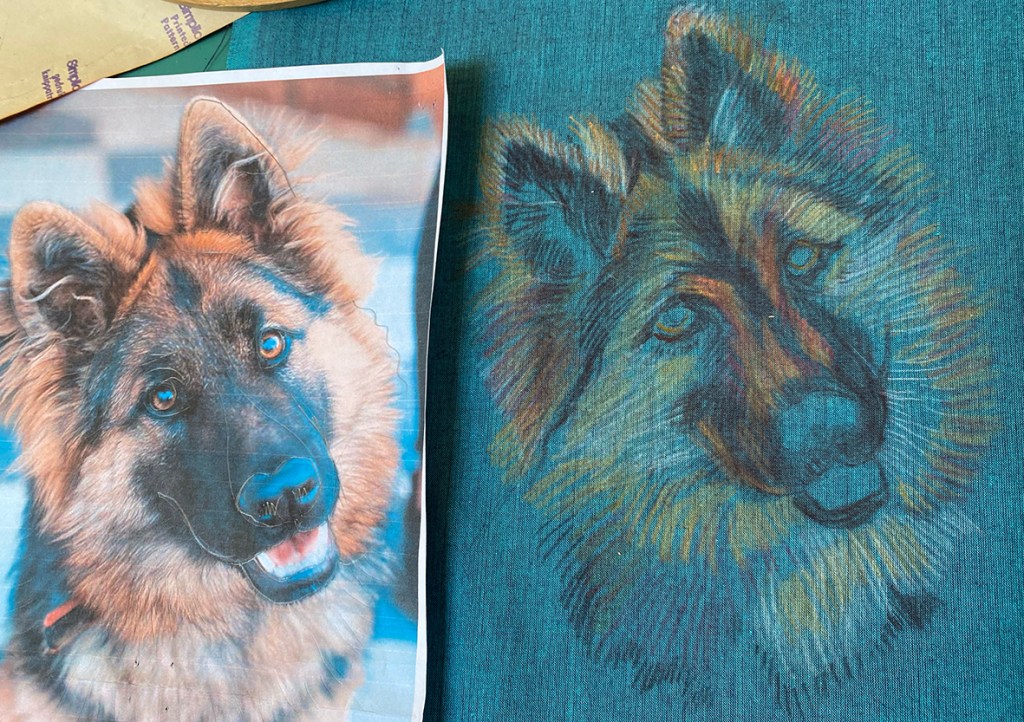
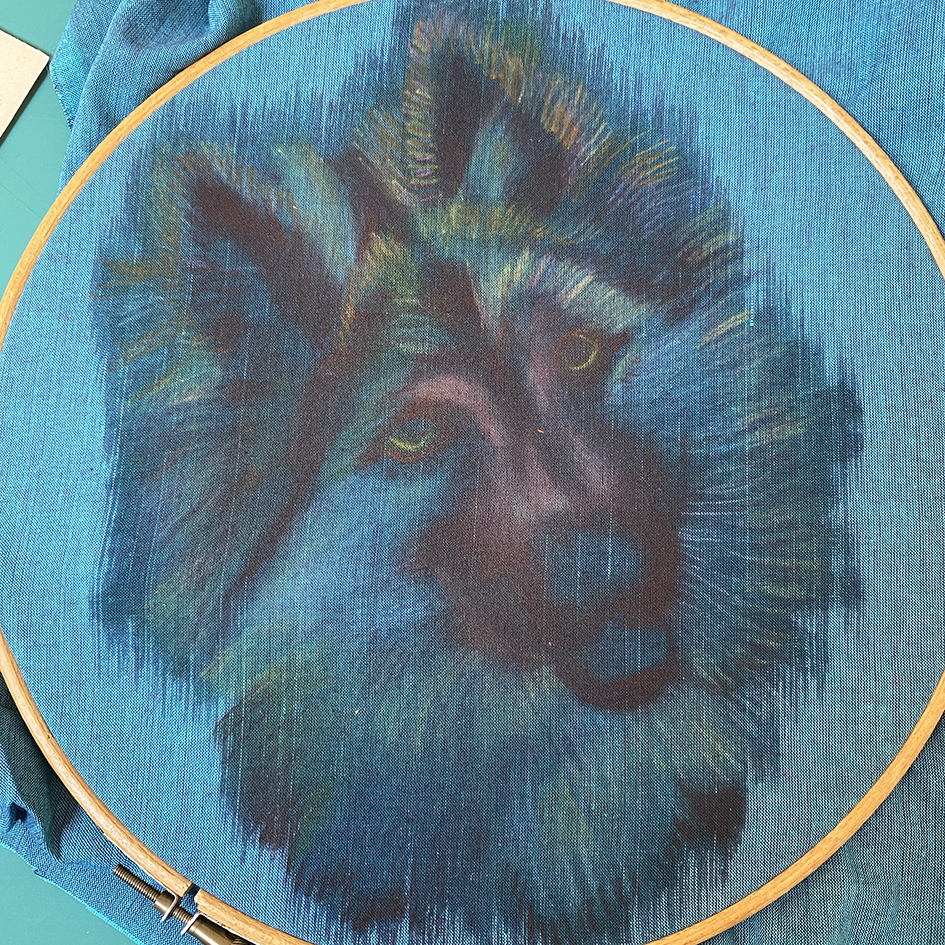
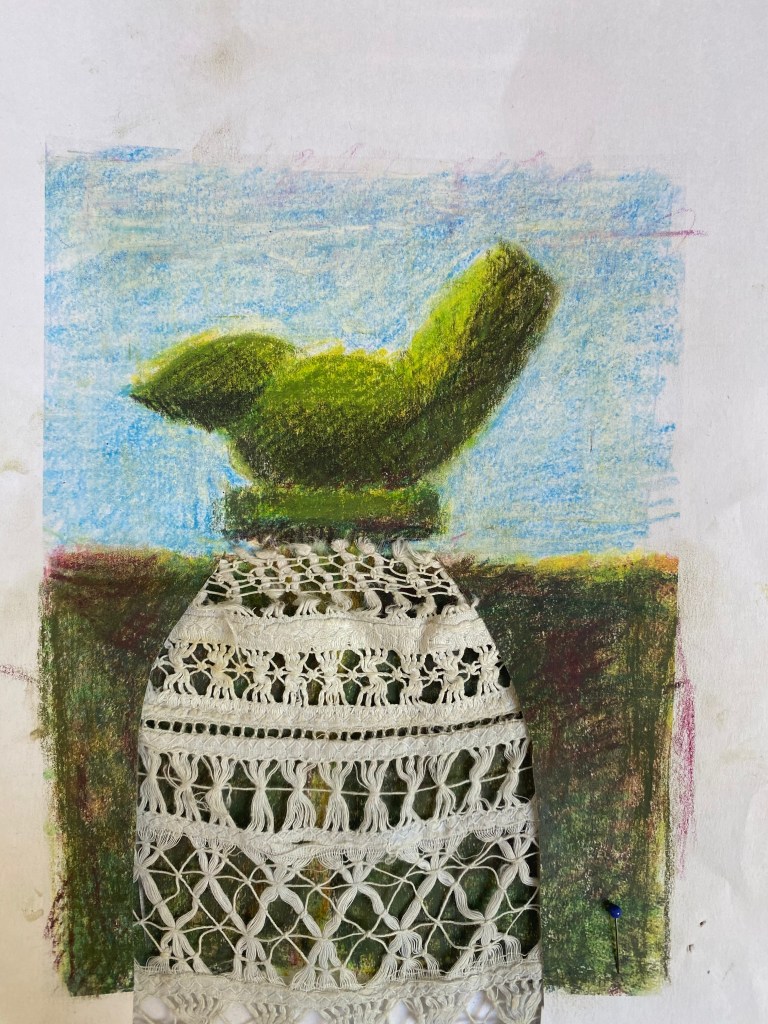
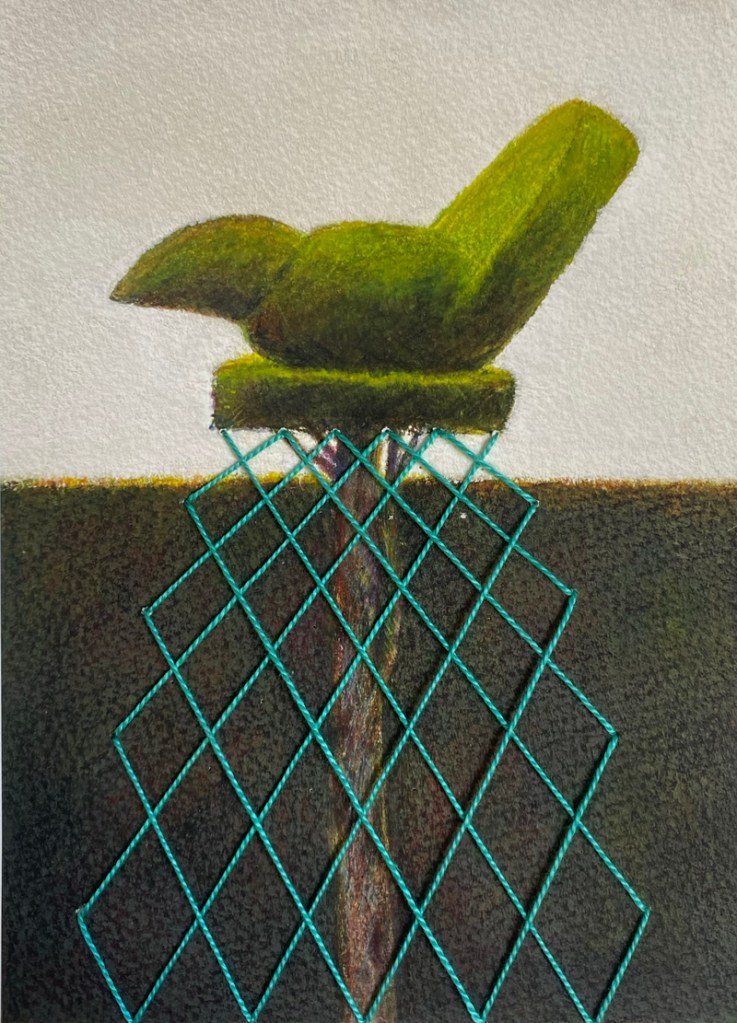
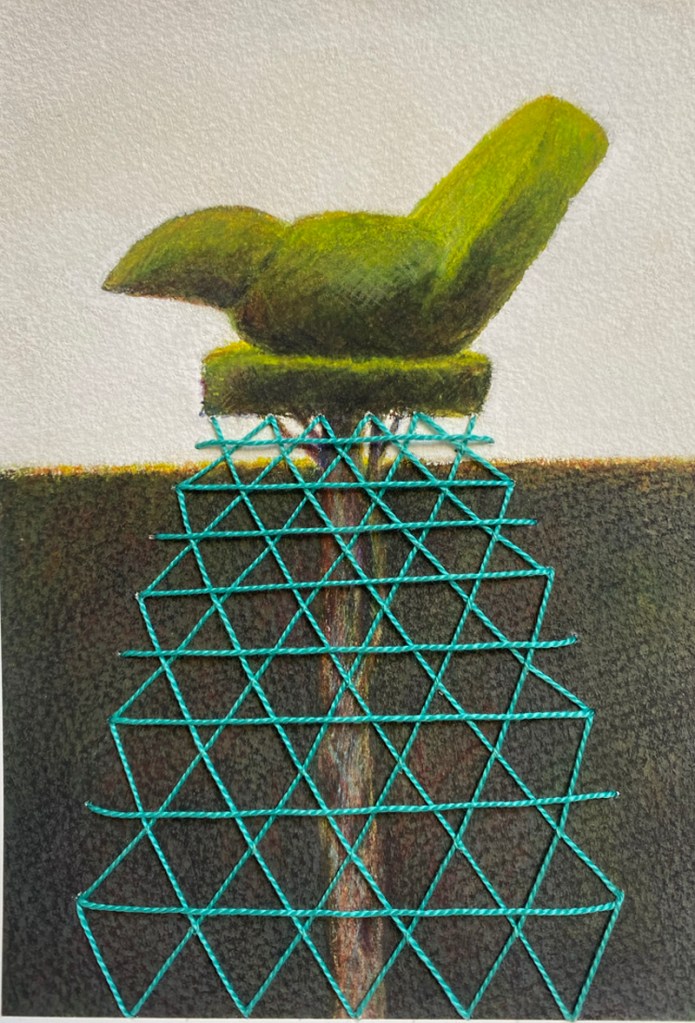
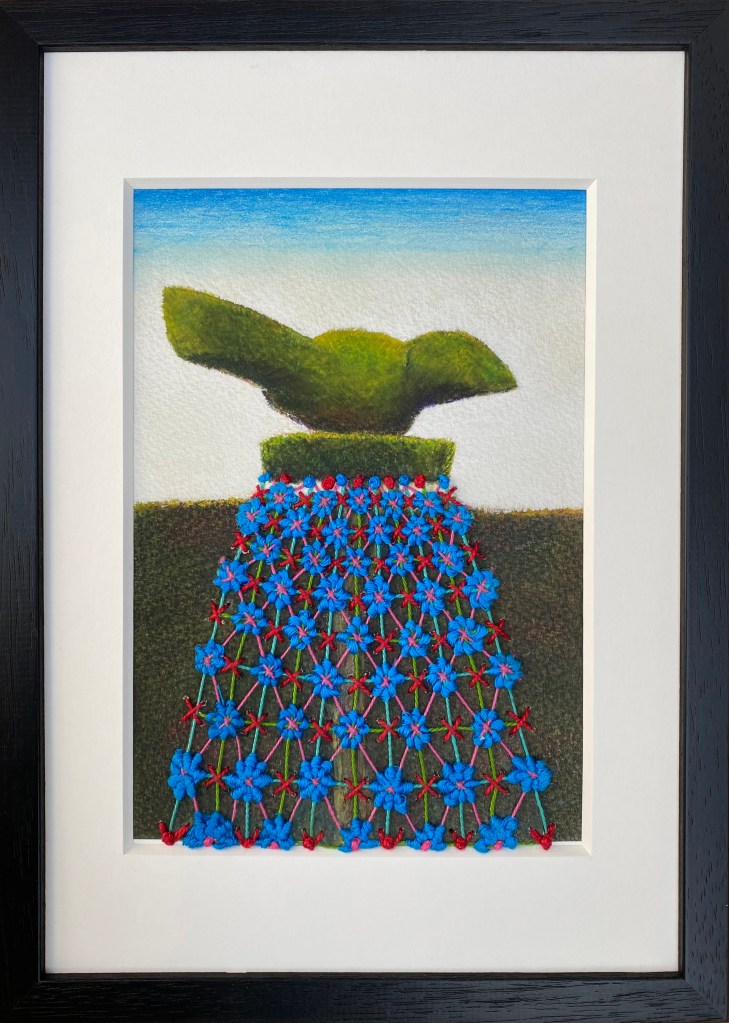
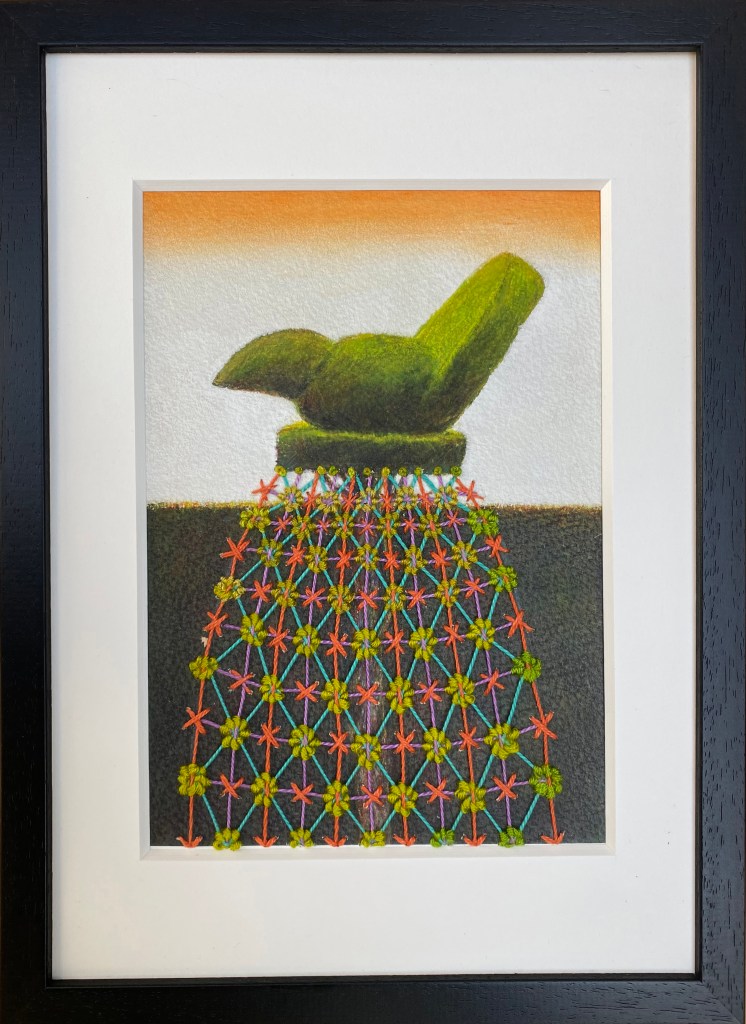
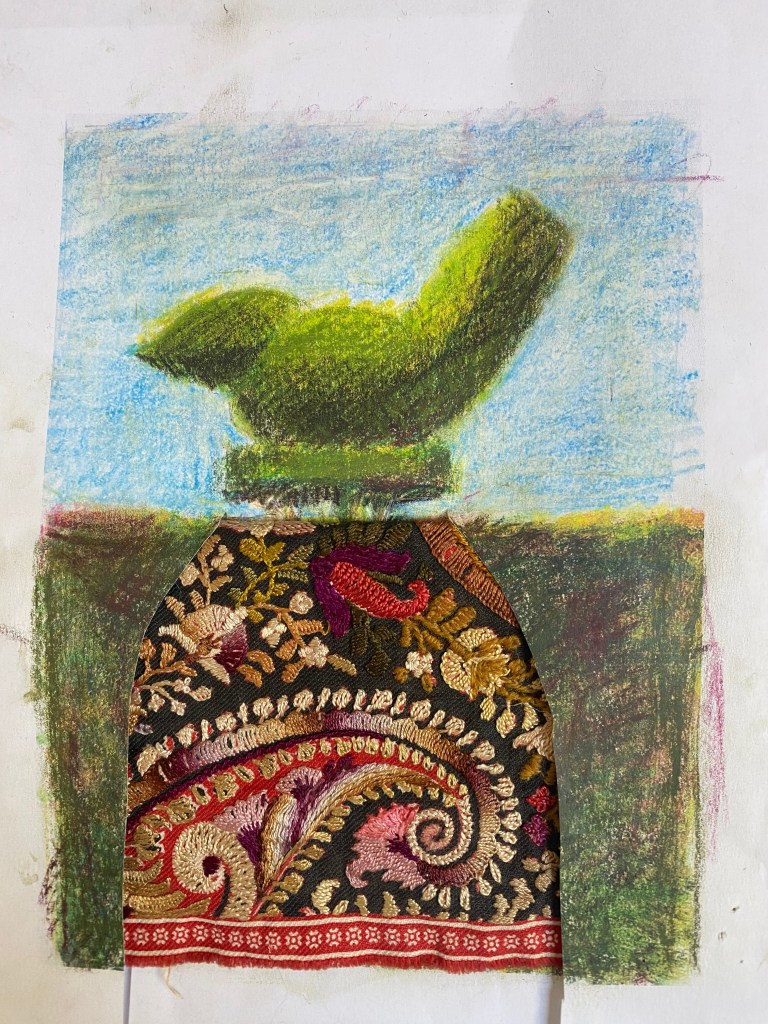
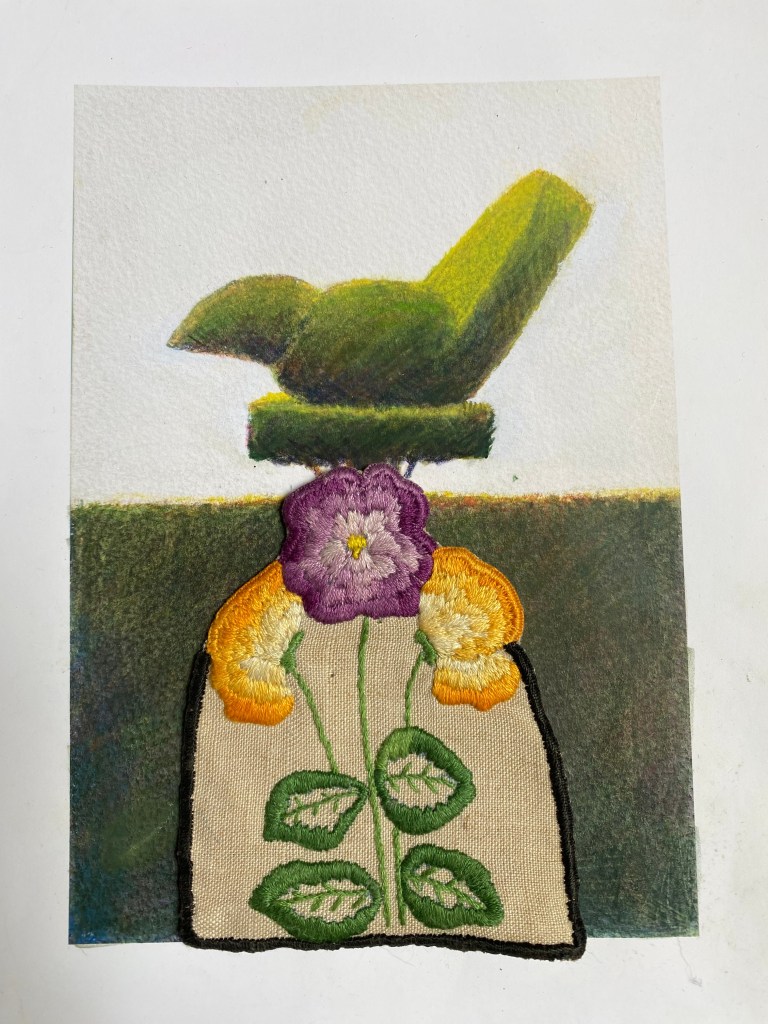
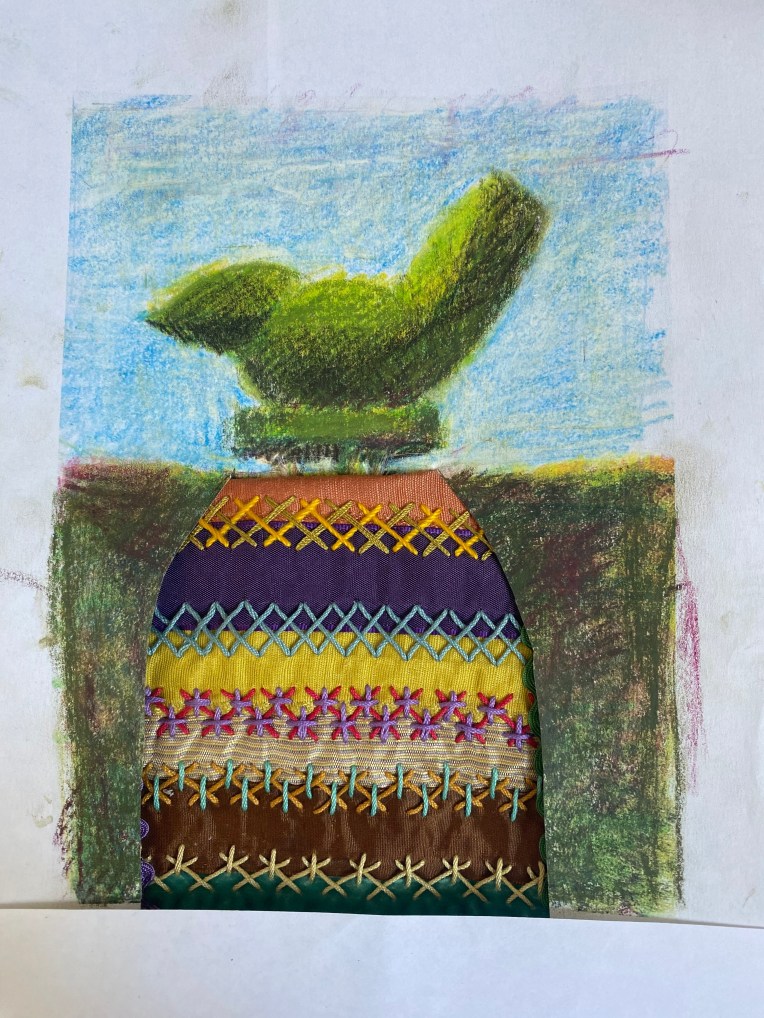
I decided to make small drawings of the 2 birds and then I could dress them both in a fabric skirt. Now how make this look feasible in reality. Using Inktense pigment crayons A4 sketchbook paper I roughed out the basic hedge shapes, but I had so many different ideas when I looked at my vintage fabrics scraps, that I decided to make a 2 sets of giclee prints, in order to illustrate all my ideas.
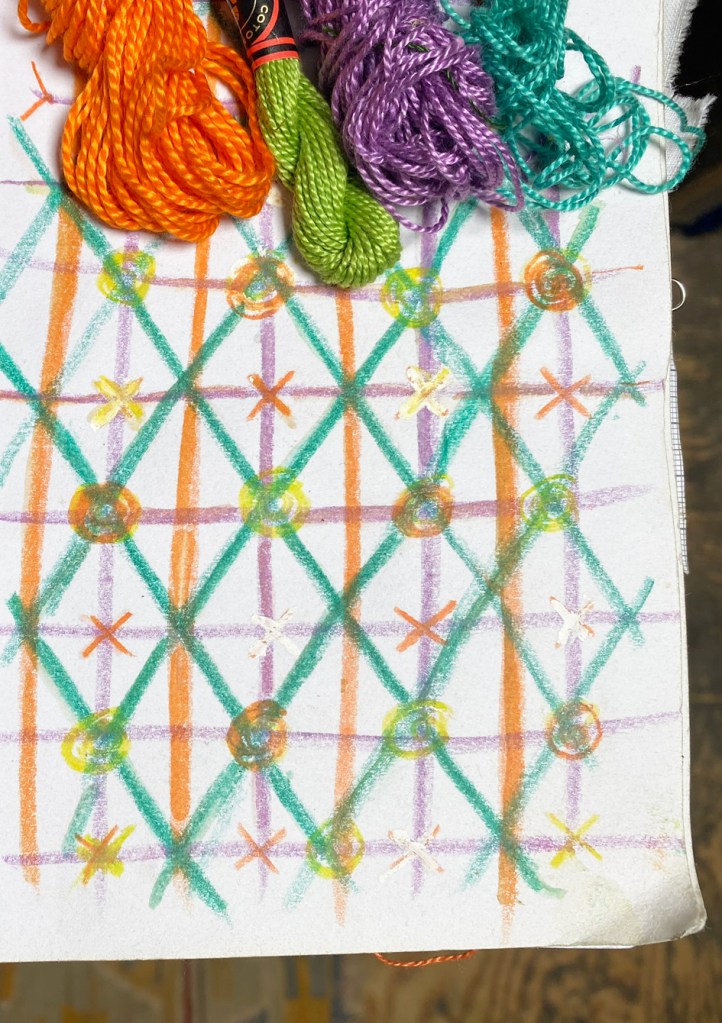
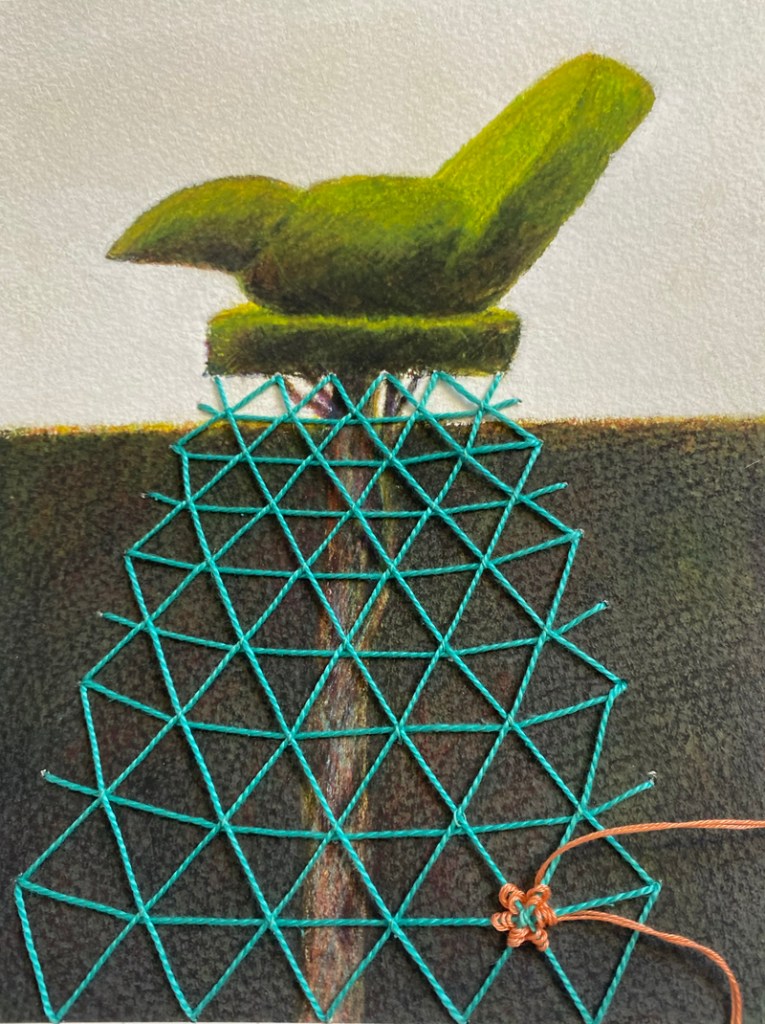
Above, the 2 giclee prints developed from the original drawings from my photographs, the first design was for a lattice or Jacobean Laid Work (see below the samples on the rough drawings).
The first skirt sample was stitched straight into a bird print, using a fine twisted cotton thread. When beginning any new project, I always attempt a challenging piece of ‘inspirational’ work, by which I mean it will make me want to carry on with all my new ideas.
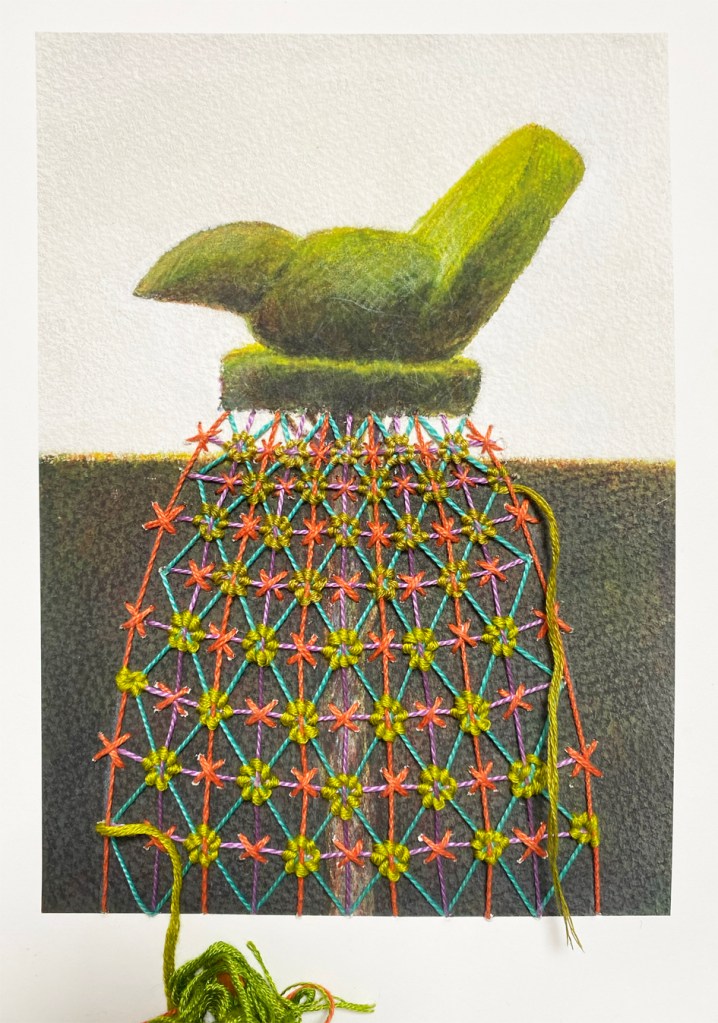
Above is the first design I completed for a whole set of 22 ‘Birds in Skirts” and I made them especially to sell at my ‘Inspired to Stitch’ exhibition This is an unusual step for me as I very seldom sell my stitched works. So now they have all been mounted, framed and glazed ready to be delivered to the buyers after the Exhibition closes.
There will be more posts about these stitched prints, as this is a new and exciting way for me to work. It combines my love of drawing and stitching and opportunities to develop many variations using my collection of vintage fabrics. I am now conducting new classes to cover some of the ideas and new-to-me techniques that I developed for creating the Birds in Skirts edition
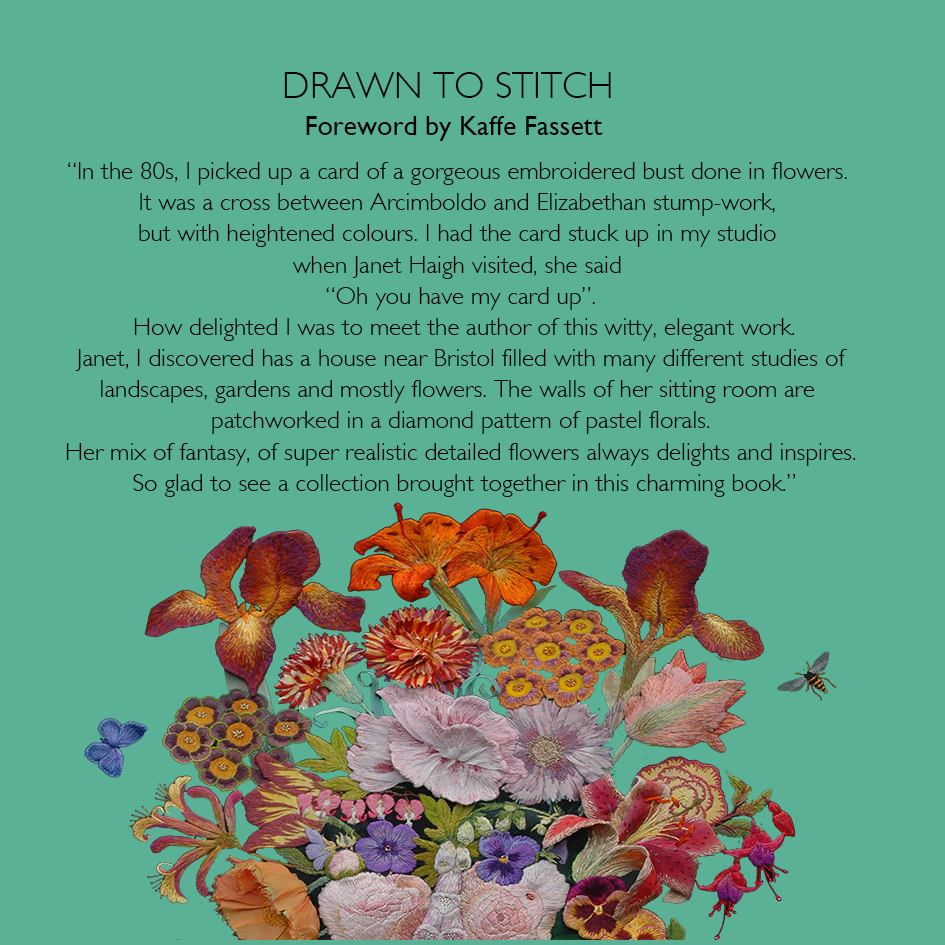
This is the foreword, kindly composed by Kaffe Fassett, for the first page of my latest book I made as a catalogue/ picturebook to accompany my latest exhibition Inspired to Stitch: Hidcote Revisited. at Hidcote gardens in Gloucestershire.
It illustrates part of the story of my career in stitched textiles, from my first ever embroidered picture above, made out of the sheer frustration of working in the fast-track commercial fashion industry in London, after I left Liverpool Art College in 1970. And it is an imagined garden.
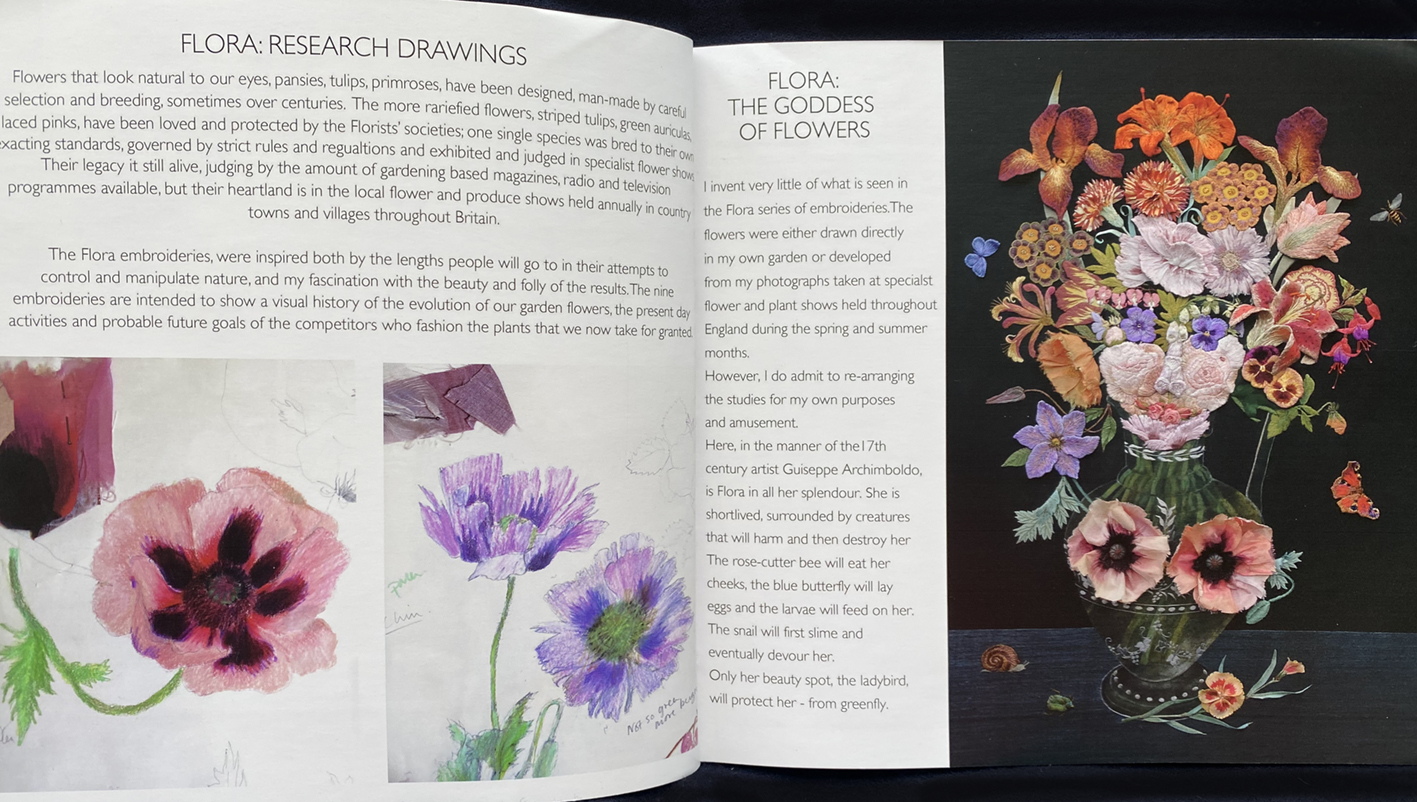
Fast forward several years to 1992 (you will have to buy the book for more information)and I am totally committed to all things flowers, gardens and topiary! Here are several pages from the book to whet your appetite and first here is Flora, the Roman goddess of Flowers.
Flora is the central image of 9 embroideries called ‘The Flora’ that tells a visual history of the development of, what I now think of as, “designer flowers”.
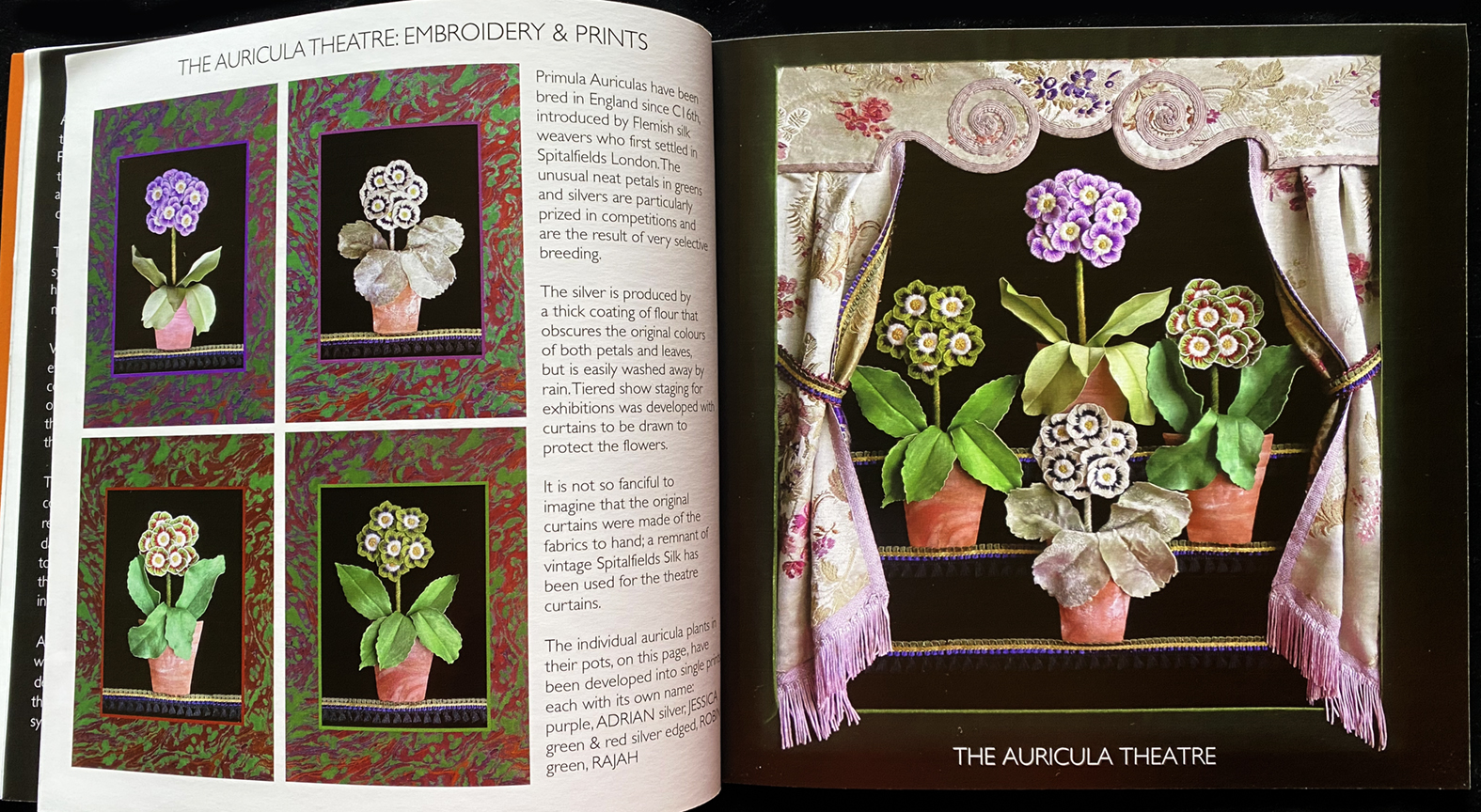
The Auricula Theatre above, with a series of small giclee prints I developed from the original silk embroidery. The protective curtains are made from a piece of vintage Spitalfields silk.
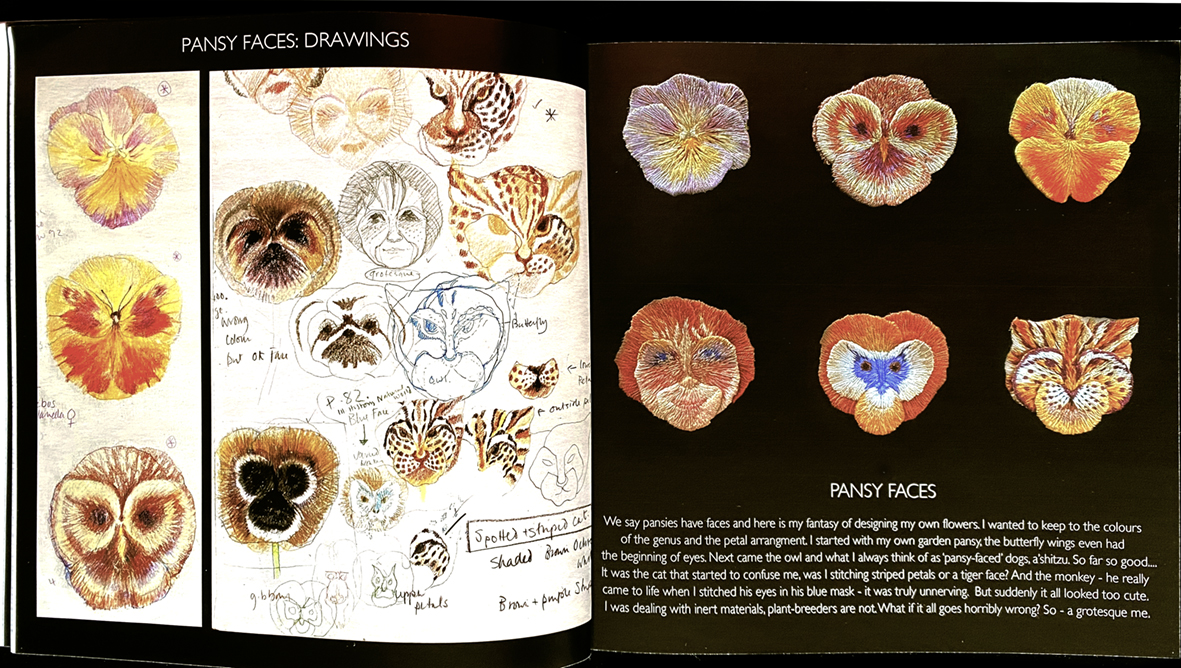
Pansy Faces and my drawings for the inventions I imagined as my exhibit in our town’s annual flower show.
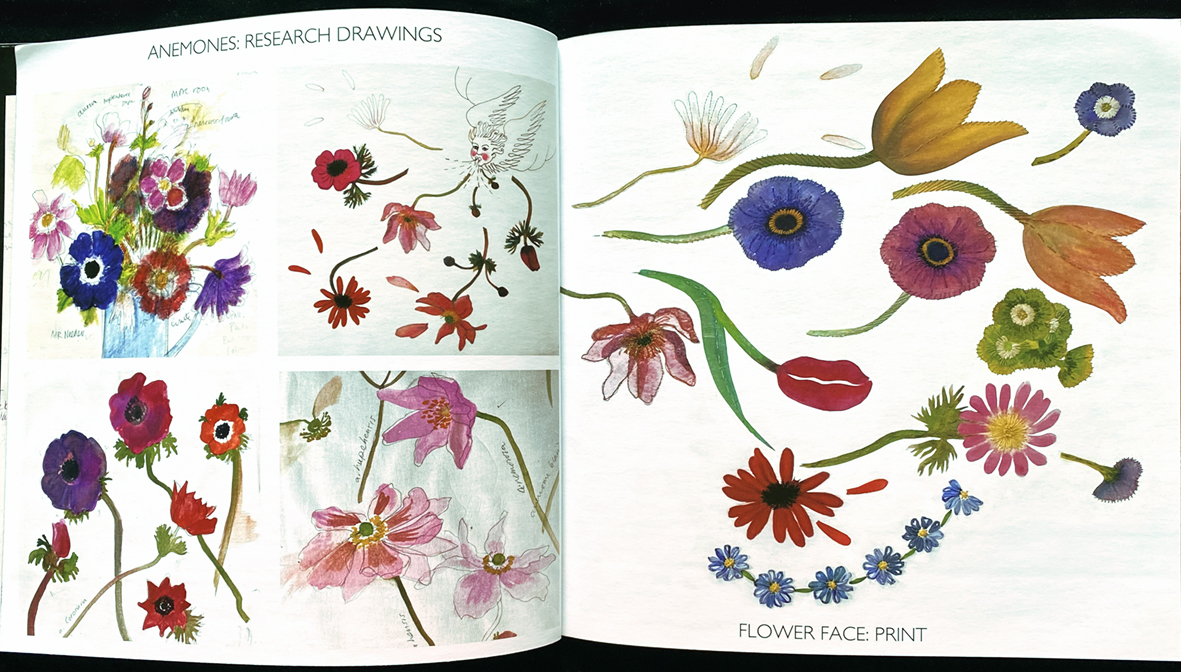
A personification of Blodeuwedd, or “Flower Face” from Welsh folk lore; this is a giclee print of the original stitched silk collage on paper, that I developed from my old drawings made for ‘The Flora’ .
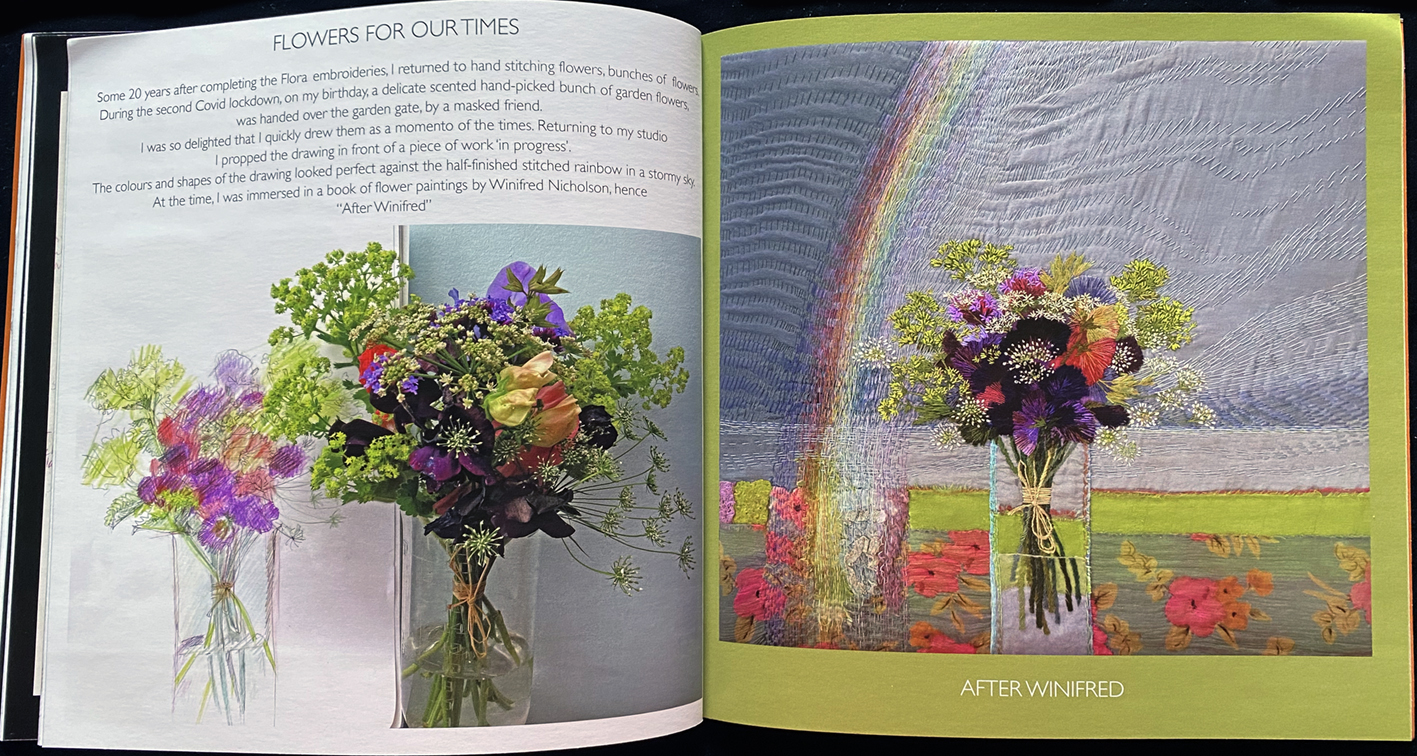
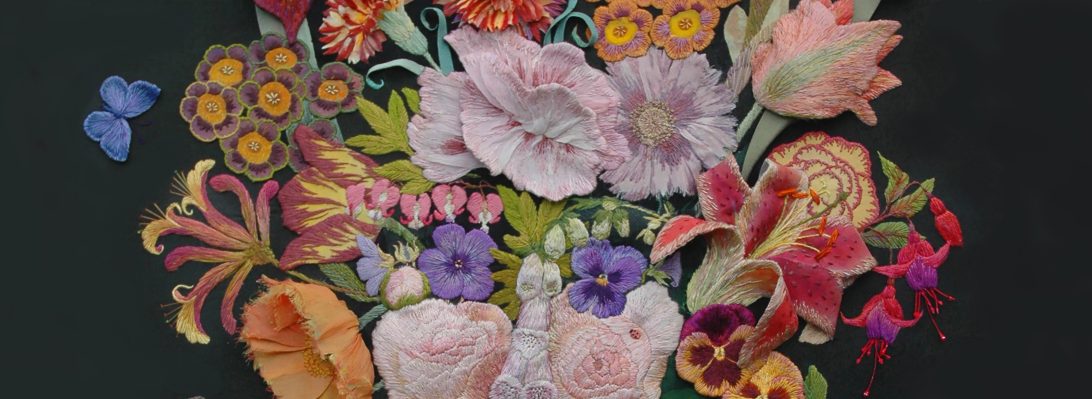
Here is a bouquet of hand embroidered flowers in ‘After Winifred’. I was given this bouquet during Covid, by a masked friend, in my garden, on my birthday. I was looking back though my Flora drawings to make some joyfulembroideries and had bought a book of flower paintings by Winifred Nicholson……
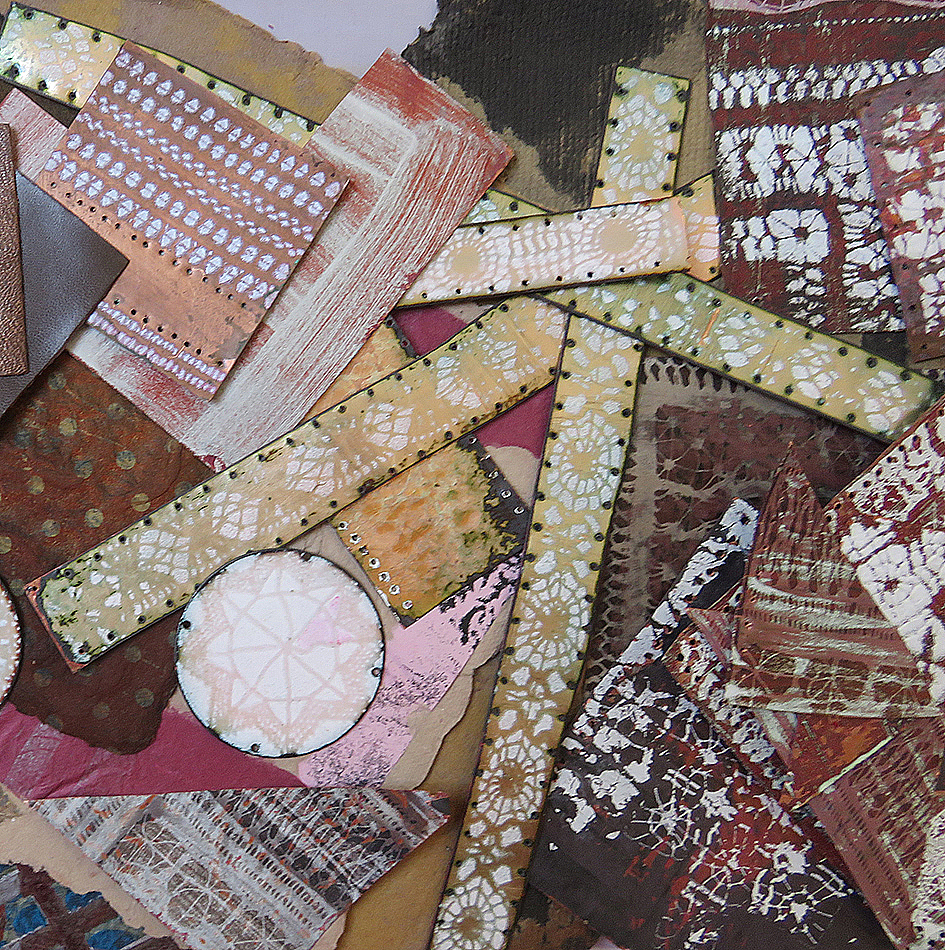
I keep a careful record of all my research drawings, this results in a whole range of different drawings, samples, notes and photographs being kept for further inspiration. Here are typical ways that I use these ideas and studies for new works. Above are some pieces of ‘The Enamel Garden‘ a major academic research project into using textile techniques for other materials, here vitreous enamel on hand cut sheet copper. It is possible to trace how I used my research drawings to create these flowers and hedges.
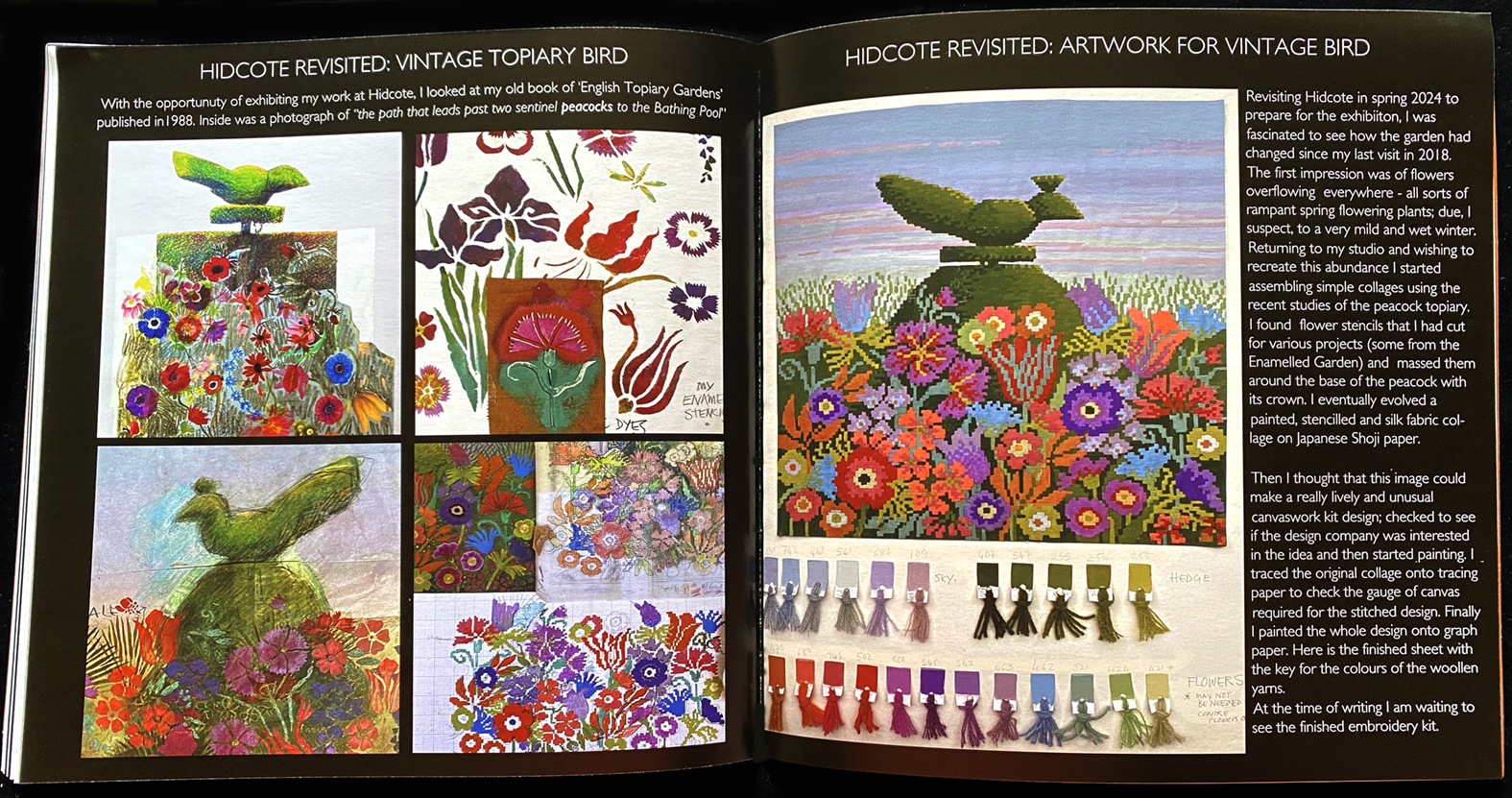
And my latest canvas work design for Ehrman Tapestry, a version of the Vintage Topiary Bird used for the front cover of the book. I designed this especially for the company to make a kit of this design to celebrate the exhibition…. I will keep the post about making it until later.
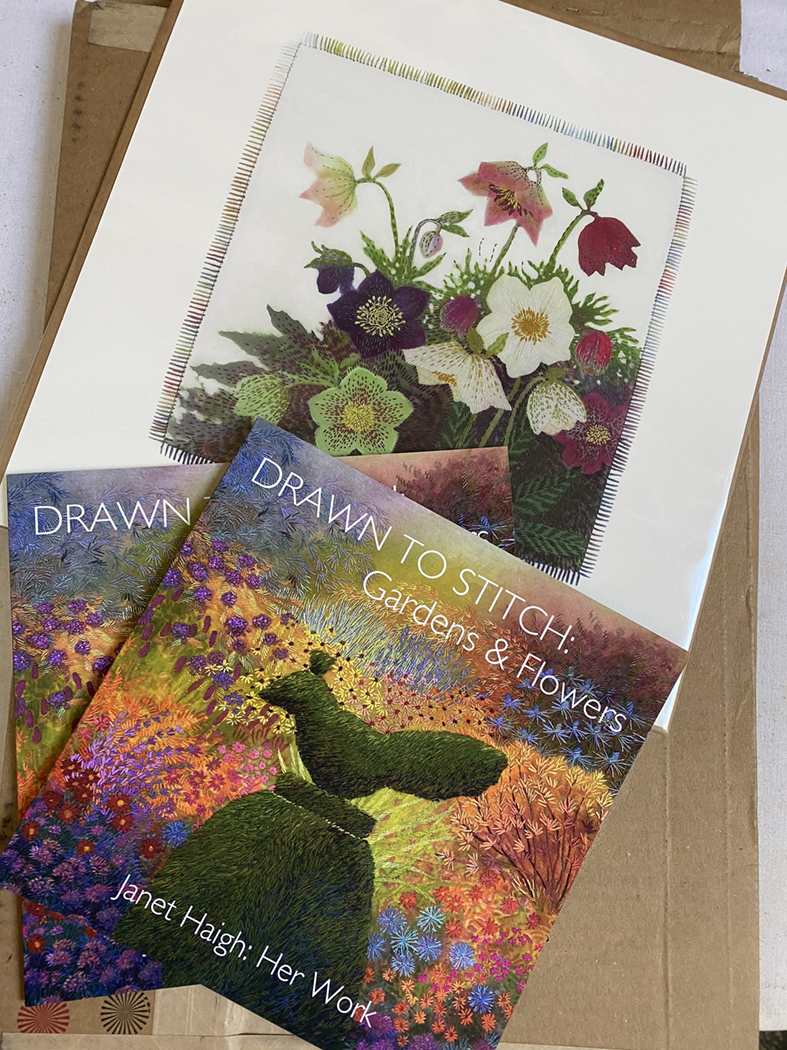
And at last I am selling the book from my Shopify site ( QR code below). Above is the flyer for the Hidcote exhibition that gives access to more information into to all the works contained in the book. But best of all in the first week of the show, my first package of books and a giclee print ready to be posted.
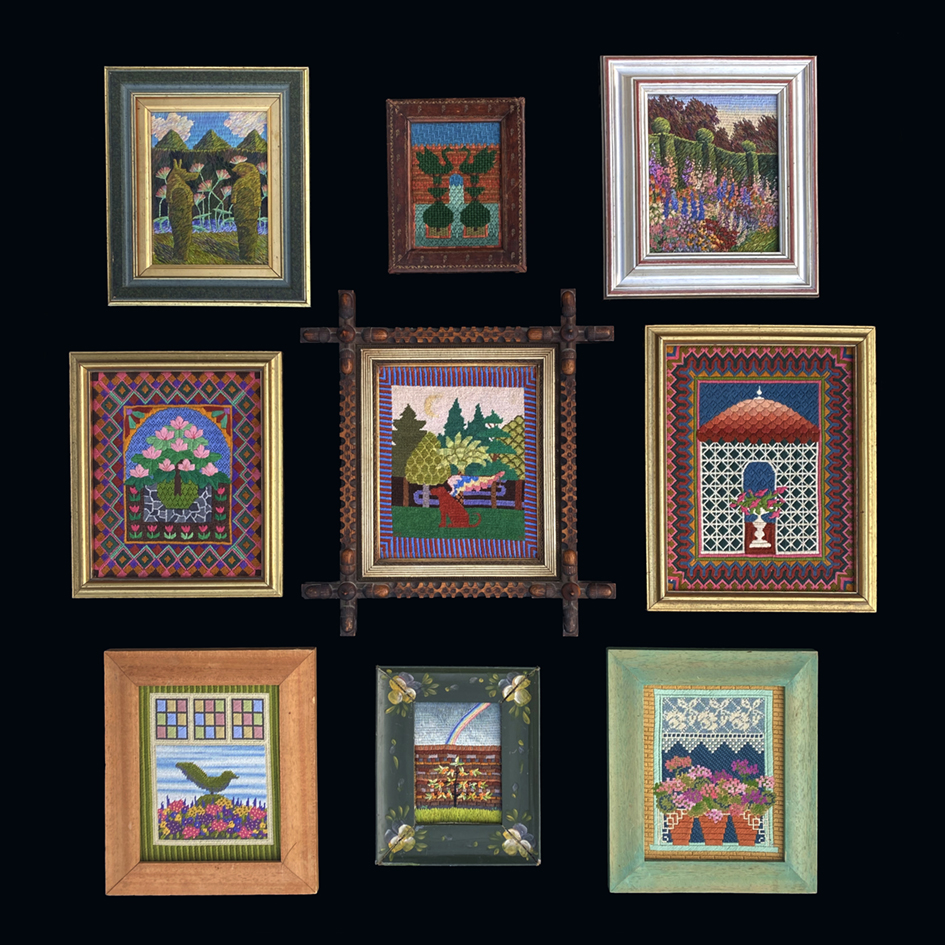
Invited to exhibit my embroideries at Hidcote Manor, a National Trust Garden, in April 2025, I immediately thought of my first visit in the 1970’s; I had just started to embroider, and the effect that it has had on my stitched work ever since. Above is a small selection of my first-ever embroideries that were inspired by my delight and fascination with gardens and flowers.
I stared with basic canvas work and enjoyed the restrictions imposed by the strict stitching and its filling-in-until-you-finish discipline. I was designing pictures in order to learn to embroider my ideas.
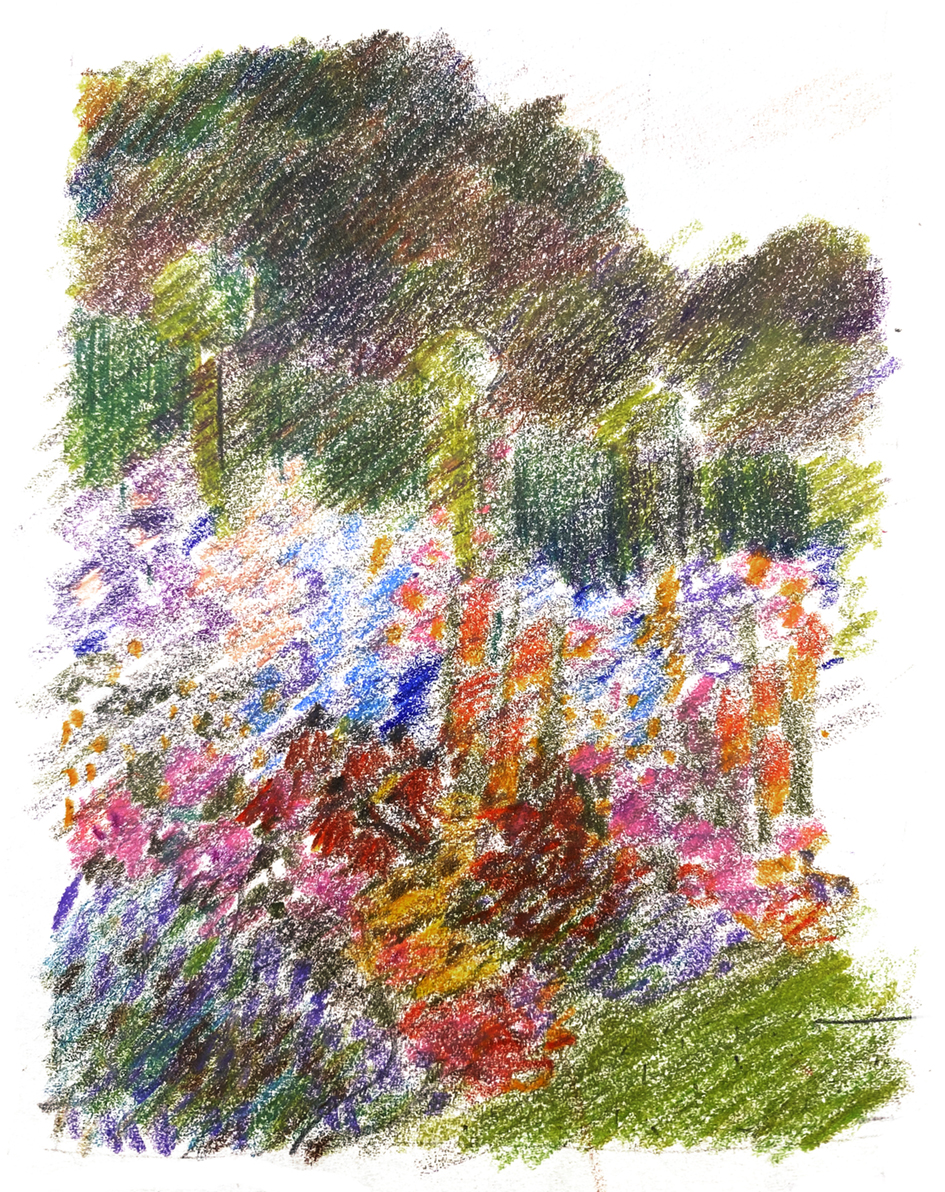
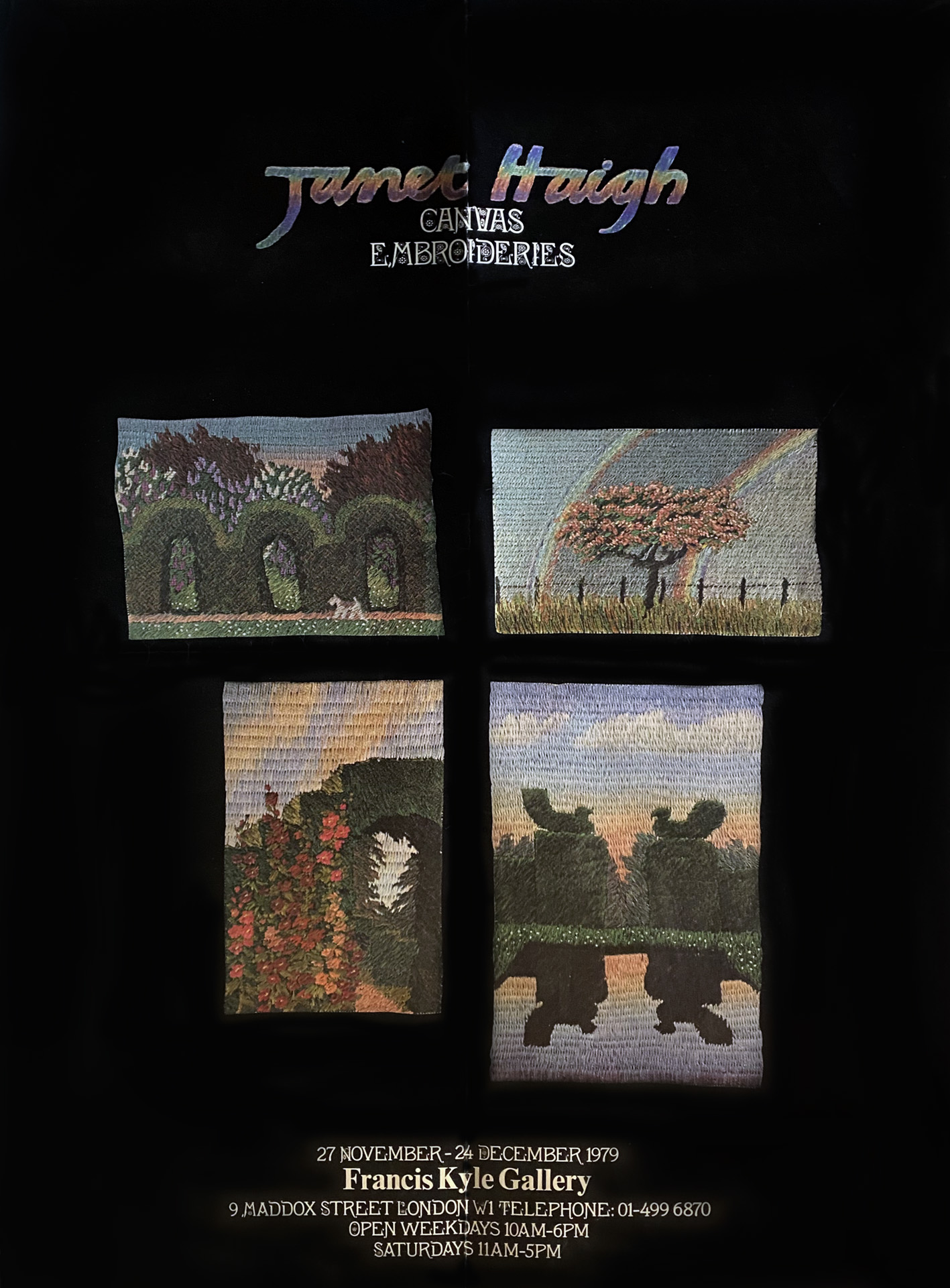
It was after visiting Hidcote that I started to draw gardens, mostly details of planting and of course, topiary. I took photographs and scribbled down notes to remember colour planting and topiary shapes to develop into embroideries. Now I realise that this was the time when I found my own way of stitching by using blended colours and really just stitching my drawings. I always scribbled drawings, took too many photographs and made notes ready to be tranformed into working drawings, and this is how start my work now, almost 50 years later.
Above a rather creased poster from my first one person show at Francis Kyle Gallery in 1979, showing my small scale canvas embroideries. My early fascination with topiary is evident.
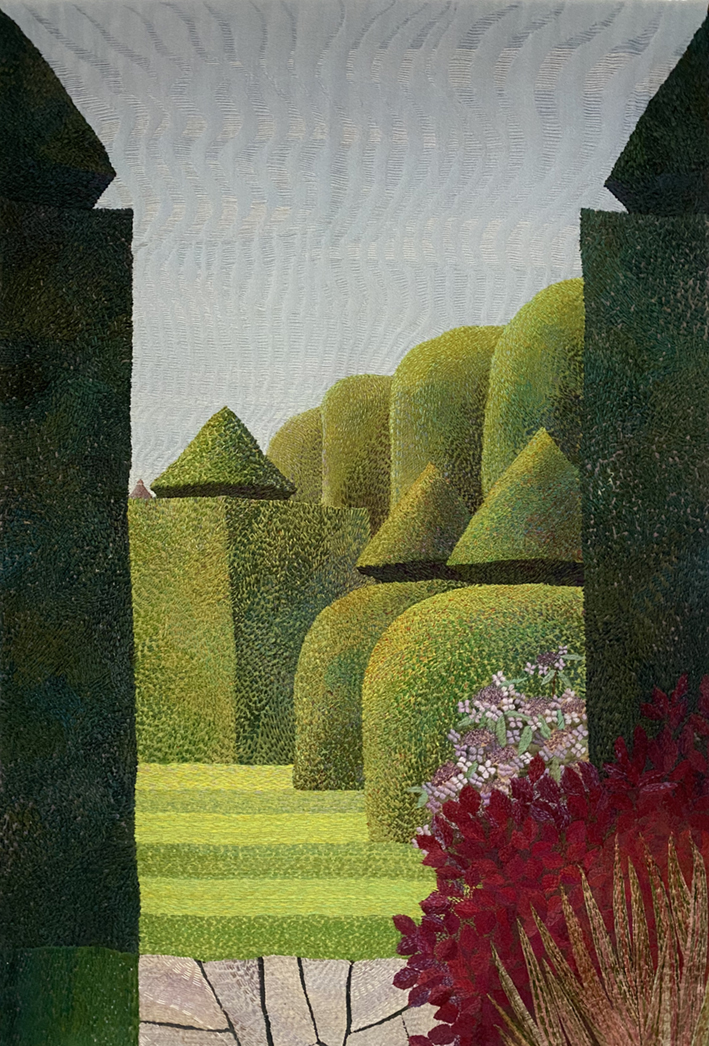
Oddly I do not actually like the idea of strictly clipped hedges, specially when trimmed into animal and bird shapes, but this feeling completely disappears when I actually see it for real. I find this ambivalence really useful and for me it provokes new ideas; why bother to make anything that holds no meaning, mystery or is simply a puzzle for you to try to solve? But mostly I am delighted by the sheer absurdity of it. Why do we tether bird-shaped hedges to heavy domes of yew – to stop them flying off?
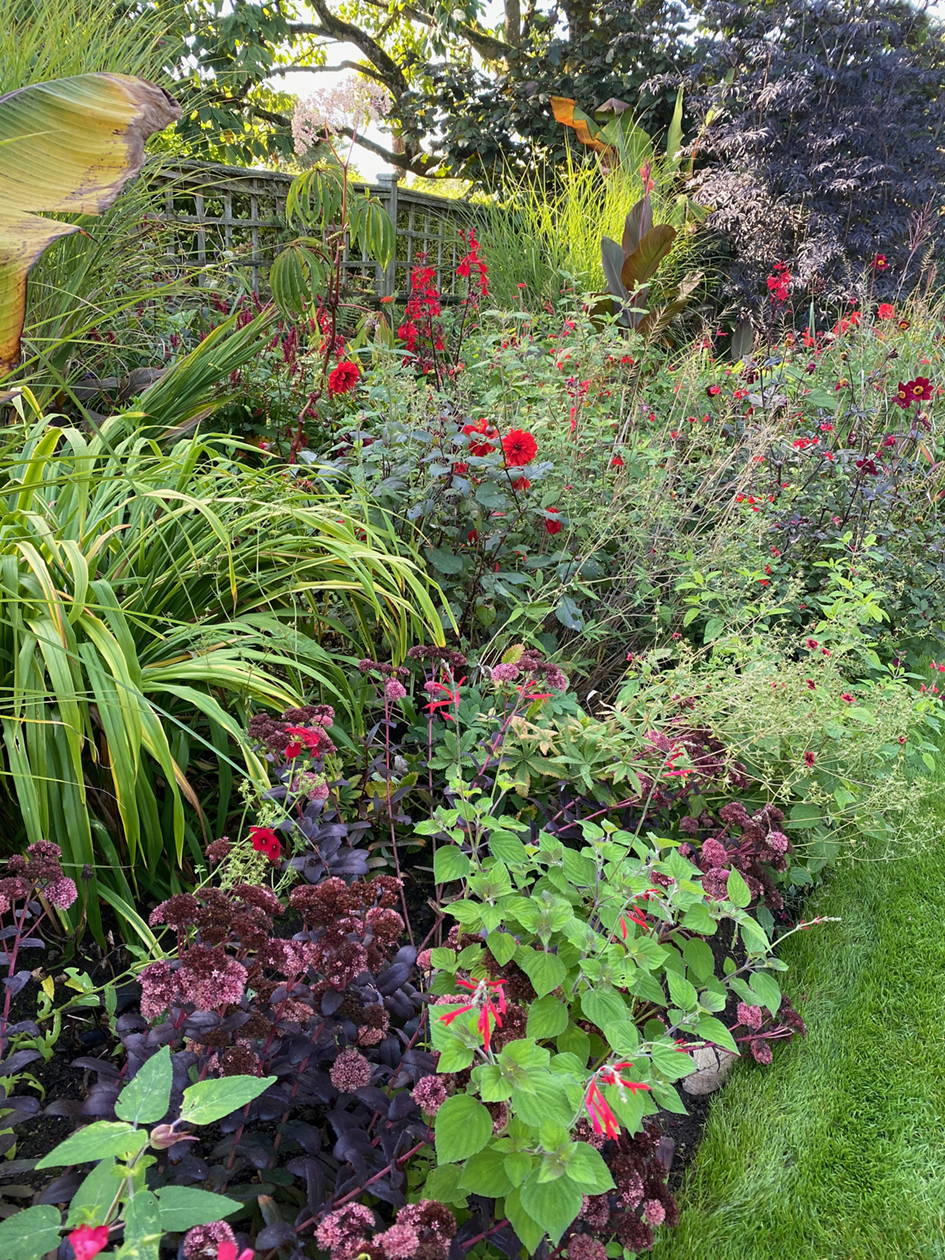
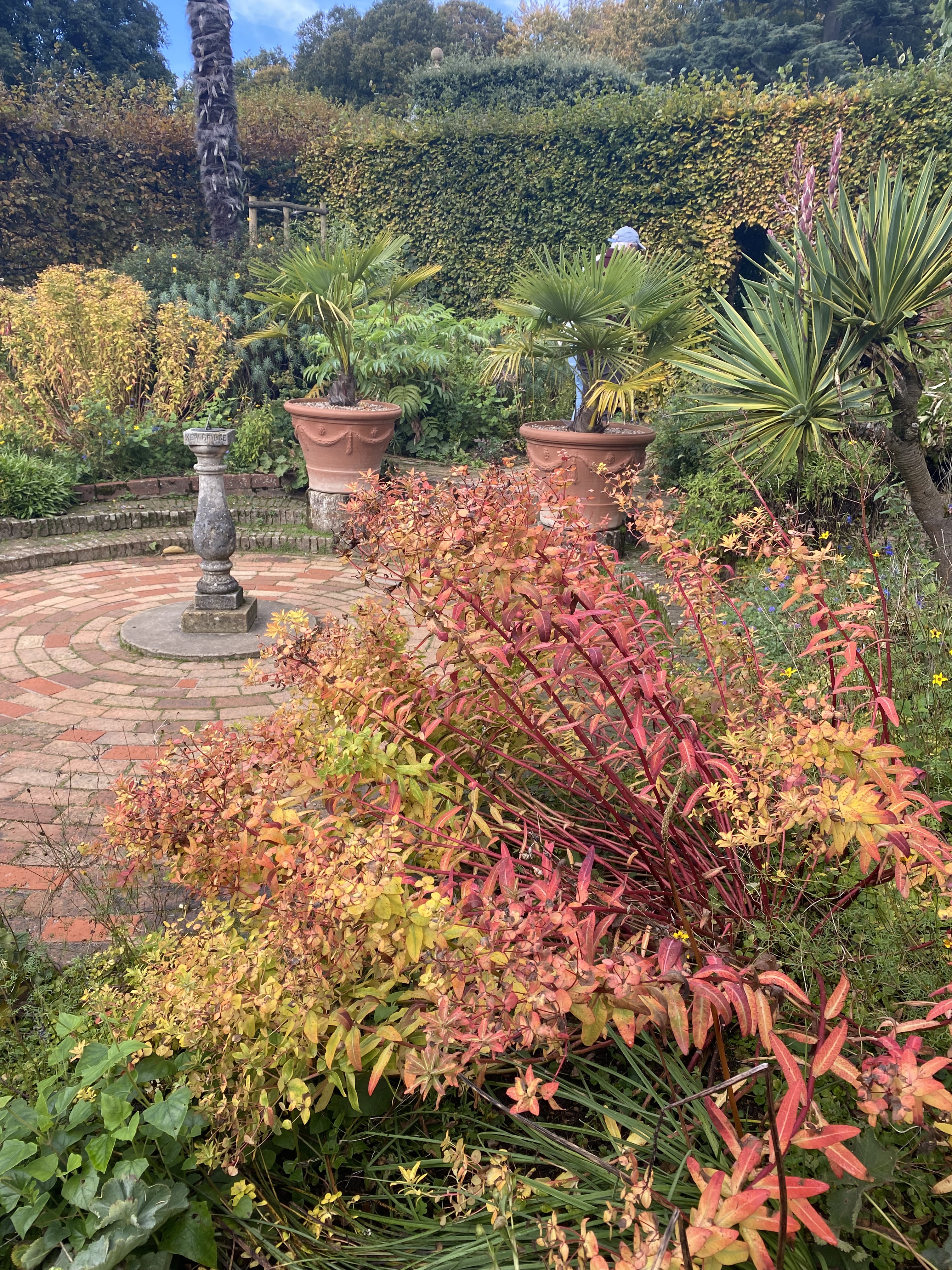
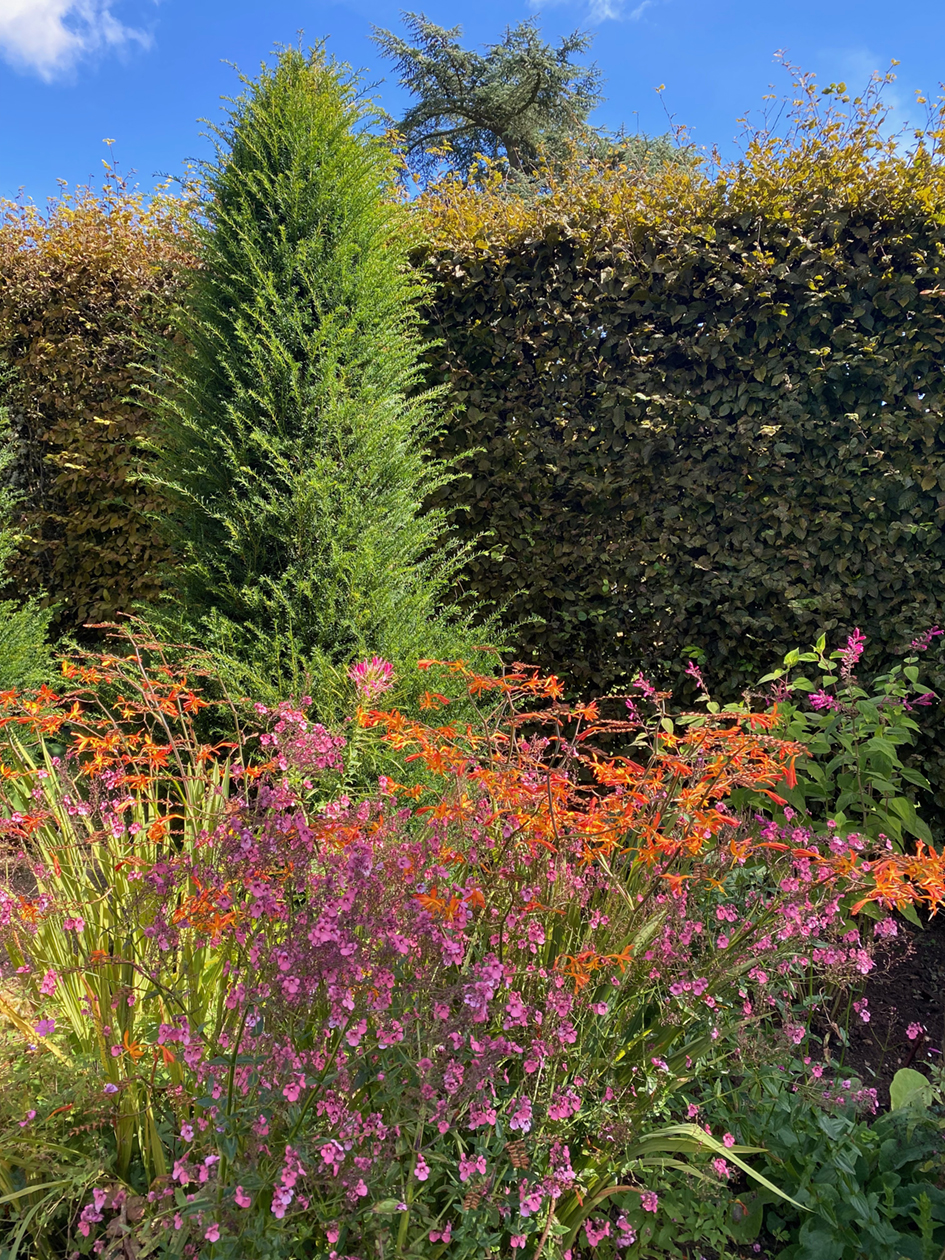
And I have continued to embroider the topiary figures that are often seen in grand gardens. Above is ‘Great Dixter’ a small silk embroidery circa 1980, that was very inspirational in making new pieces for this exhibition. Right is ‘Lytes Carey’, another National Trust garden, this is made mainly with simple large running stitches in woollen yarns onto a wool ground for a big woollen panel, in 2001. I always enjoy seeing the dense green walls of hedges surrounding an abundance of flowers, as seen below on my several visits to Hidcote in 2024.
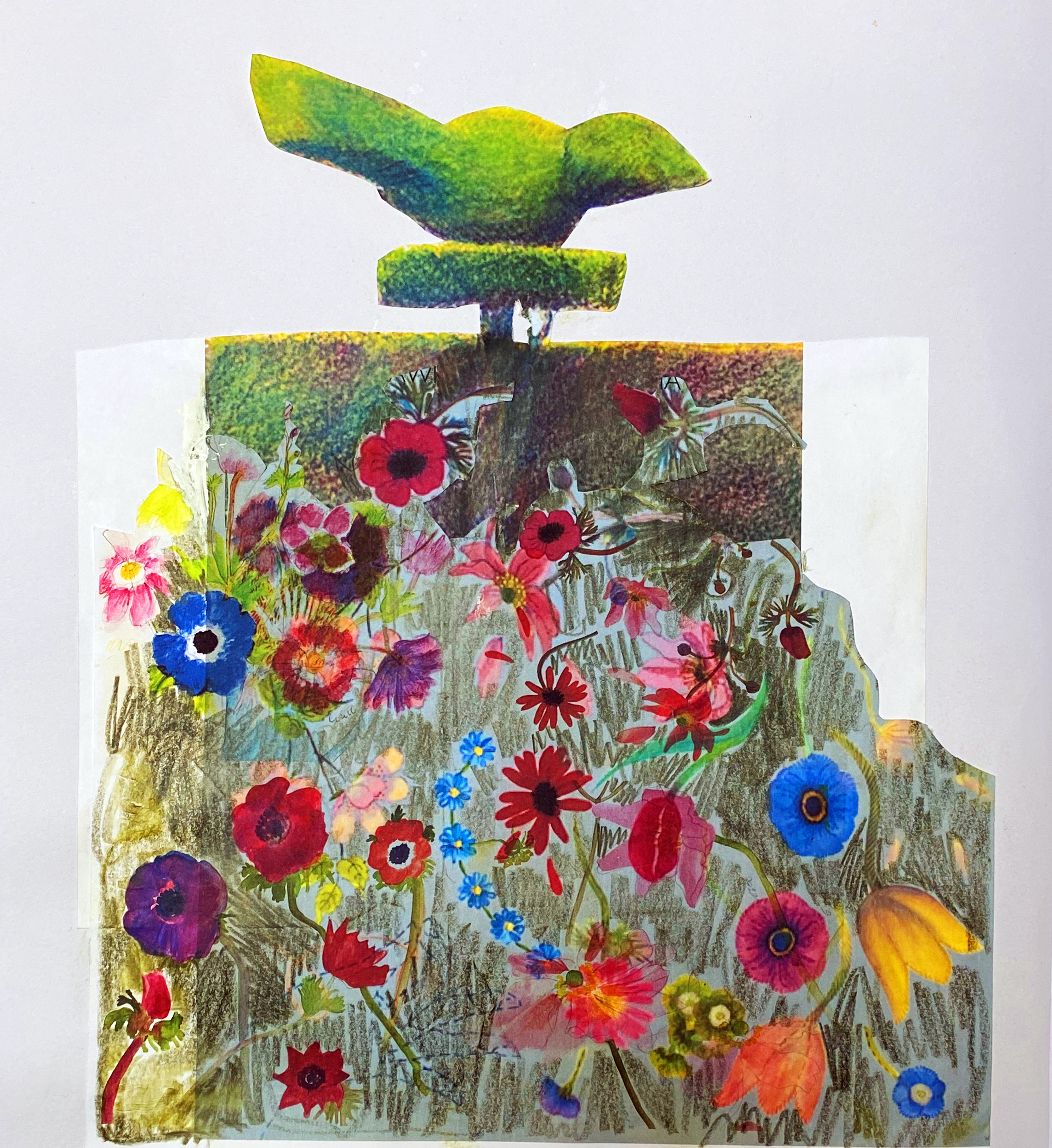
Insired to make new works for the exhibition, back in the studio I combined different drawings, prints and photograps of several aspects of the garden’s abundance and used some old stencils and wonky photocopies that had been over-printed with my embroidered flower images. From this I developed a collage from shoji paper and stitched silk. Then found an old photograph of the birds as I can remember them with their crowns as peacocks.
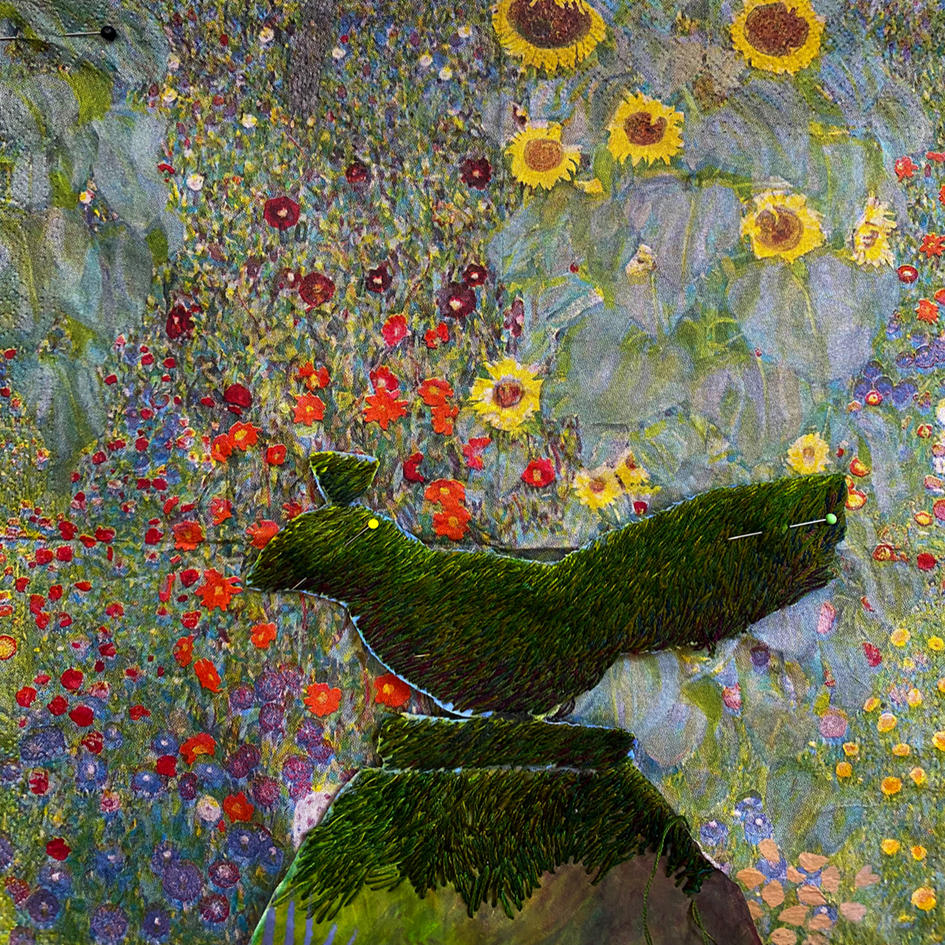
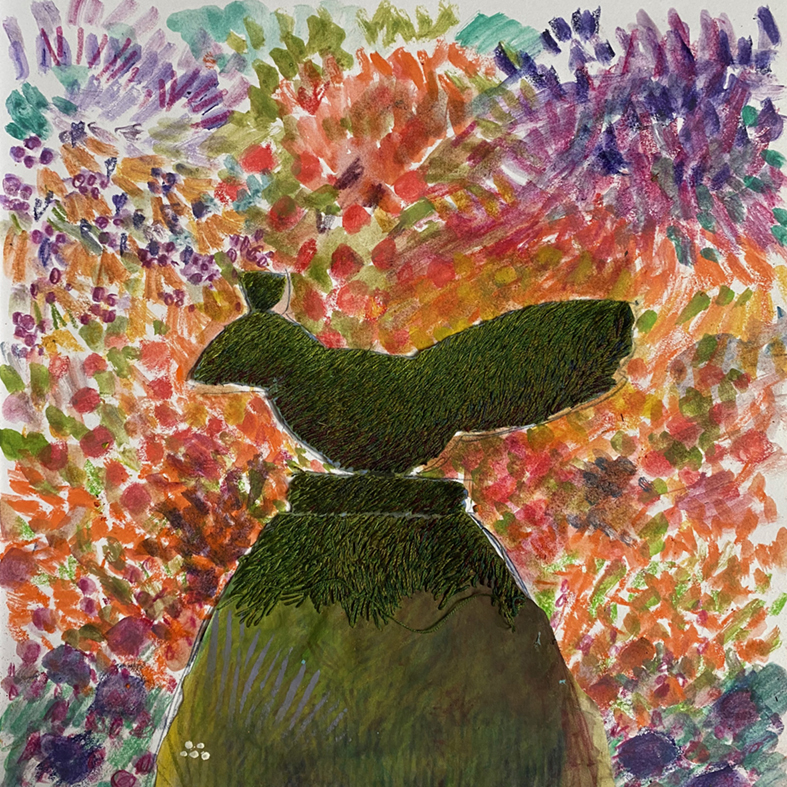
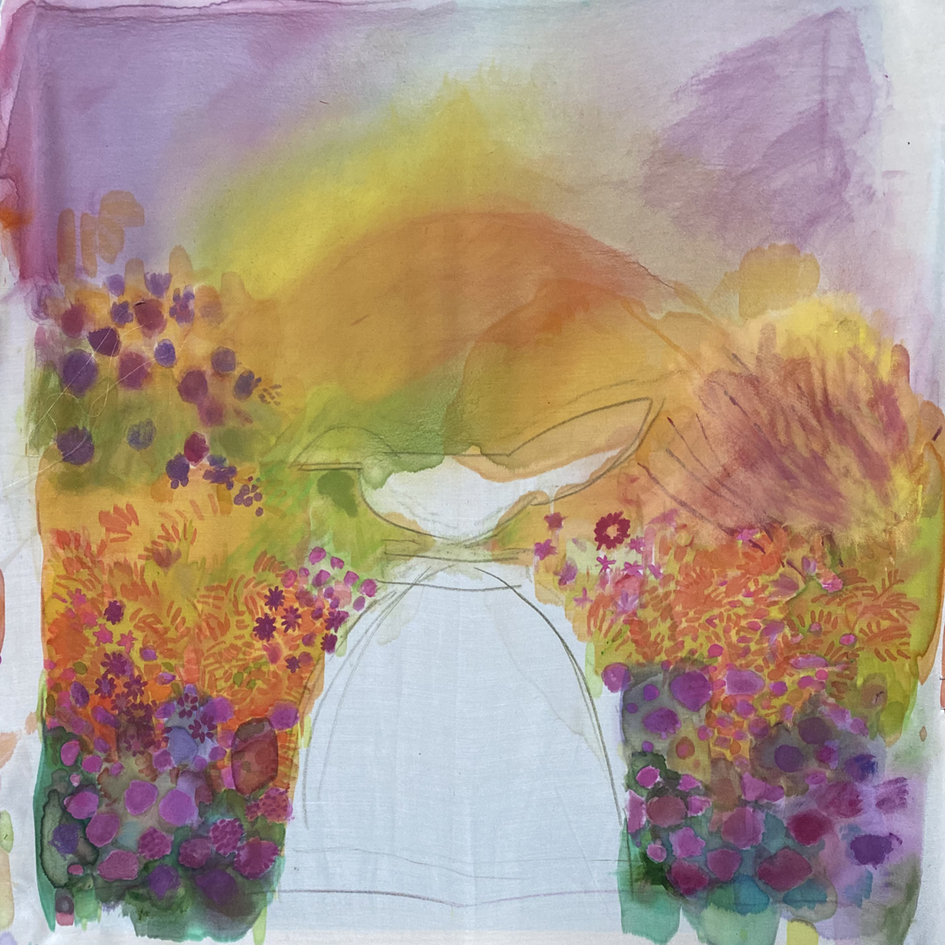
The abundance of planting in the garden beds reminded me of Gustav Klimt’s flowery lanscapes, I began to imagine the plants at Hidcote developed into a wall of flowers. I had bought a packet of paper napkins patterned with a Klimt garden for presents to friends, from a museum in Vienna, but had kept them myself. I took one and pinned it to my studio wall, with the other half formed ideas.
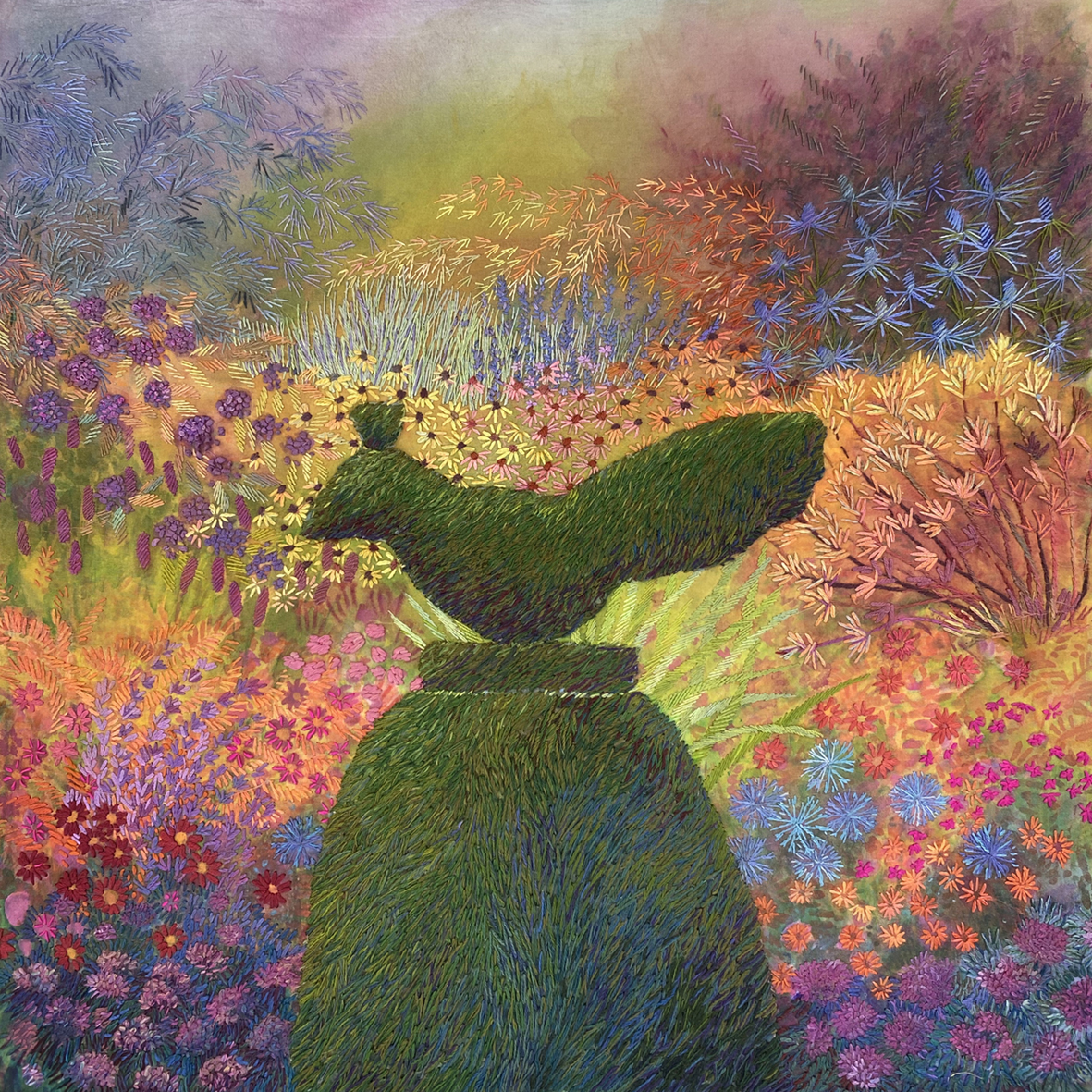
Stages in the inspiration: designing, drawing, dyeing and stitching my homage to Gustav Klimt. I stitched a bird in twisted silk thread on a fine silk ground, then painted dye onto another silk ground adding many of the flowers and leaves, found in my photographs, to make the flower wall. Eventually I stitched the finished bird into postion.
The finished ‘Vintage Topiary Bird’ has become the front cover of the picture book/catalogue that I have produced specially for this exhibition. It has just been delivered to the publishers in time to be printed and for sale at the start of the exhibition Inspired to Stitch: Hidcote Revisited.
It is not without irony that I am posting the mending my old ‘mended hearts’ metal embroideries.
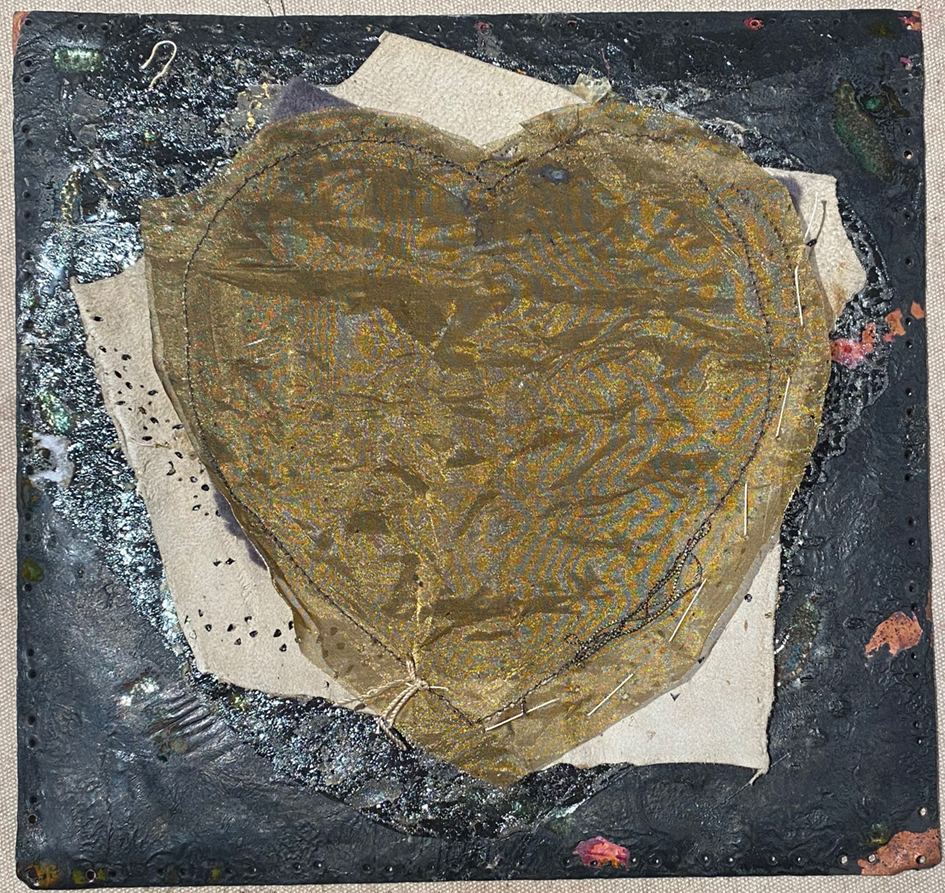
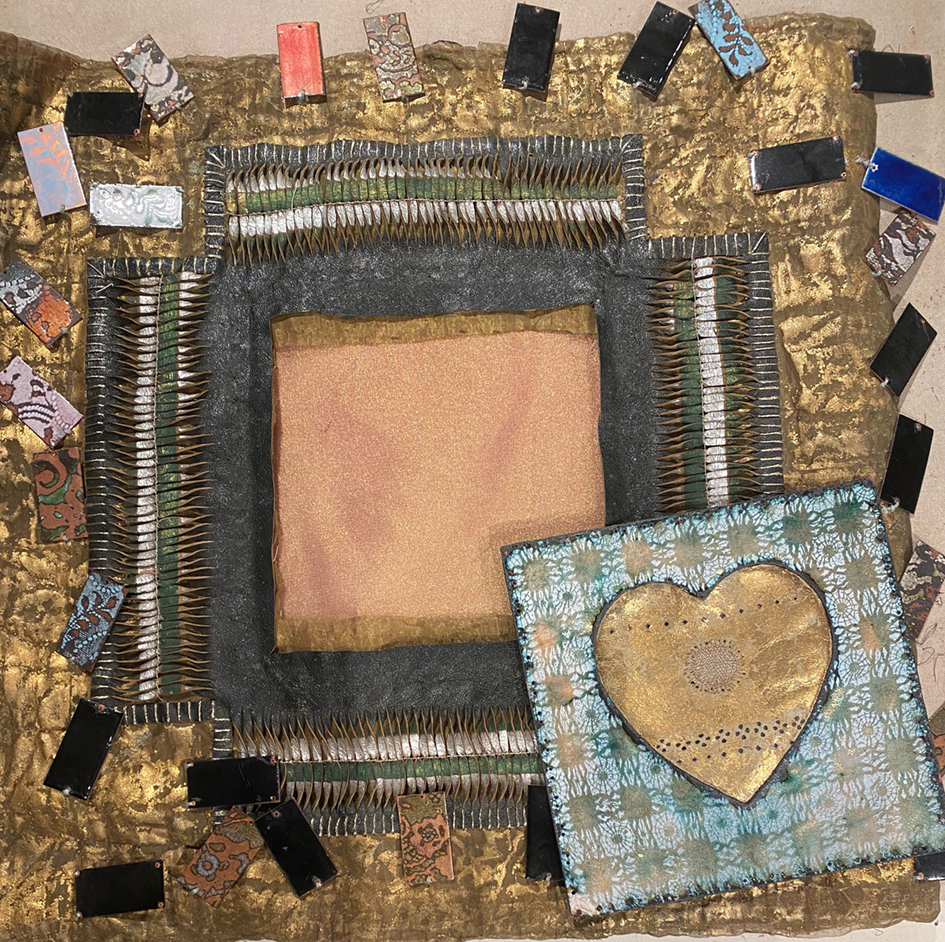
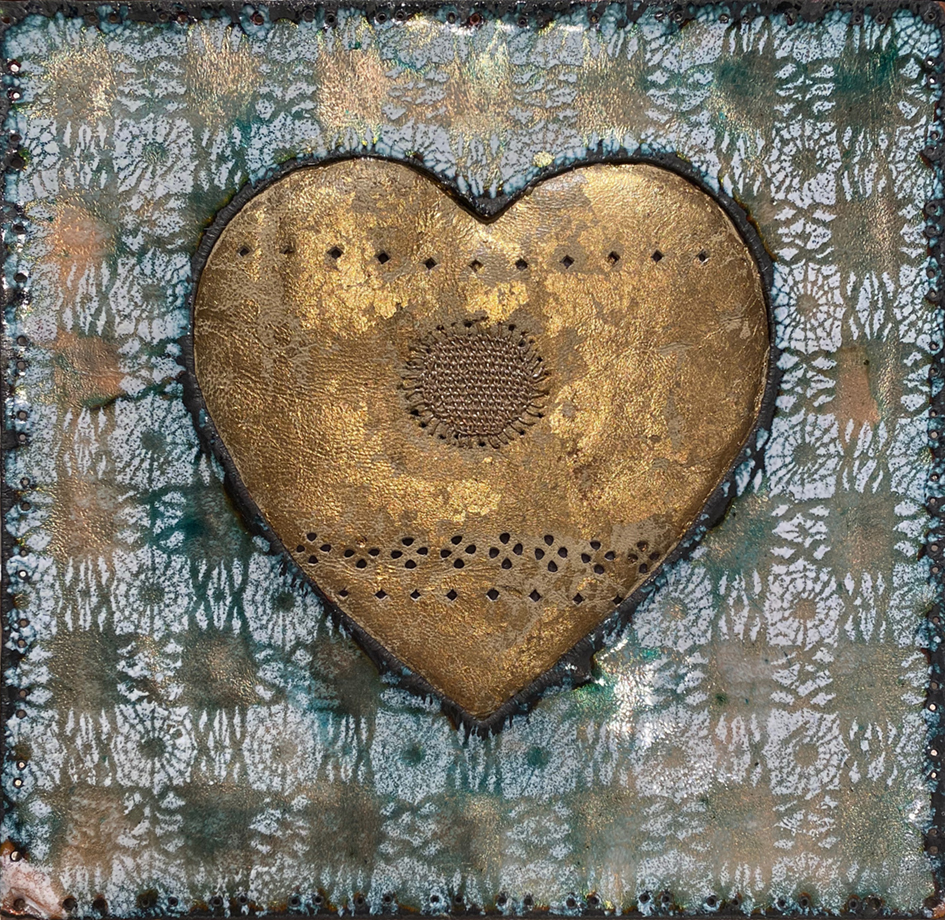
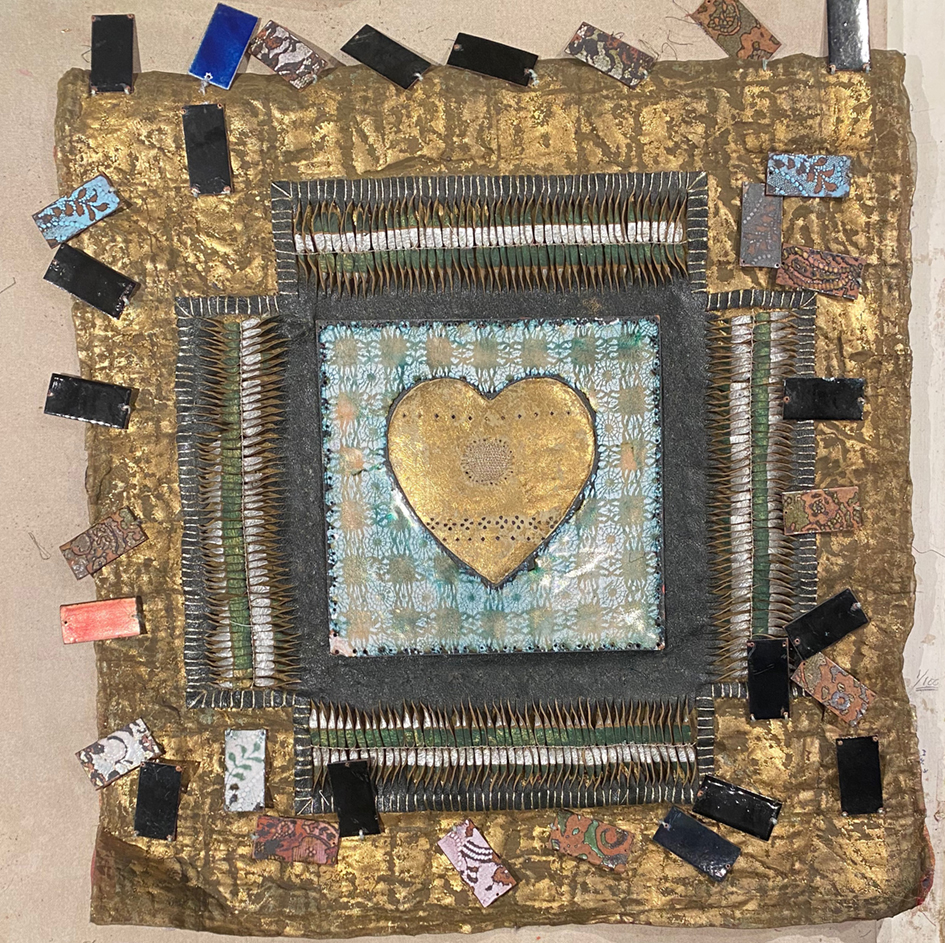
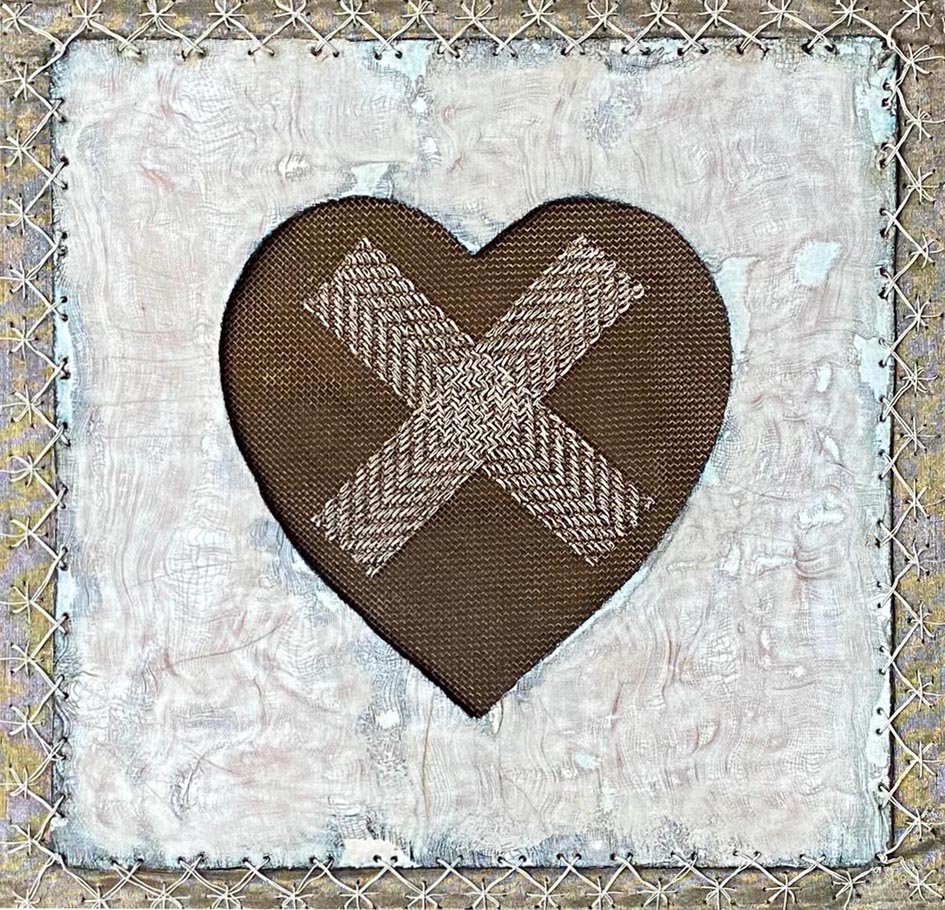
Above are the original images of 2 pieces of old work (circa 2010), left is Discarded Heart, and right Crossed Heart. They are just 2 of the outcomes of much experiment with some challenging materials – I was interested that these metal fabrics would last for a long time – far longer than the natural fabrics that I usually use…..how wrong I was!
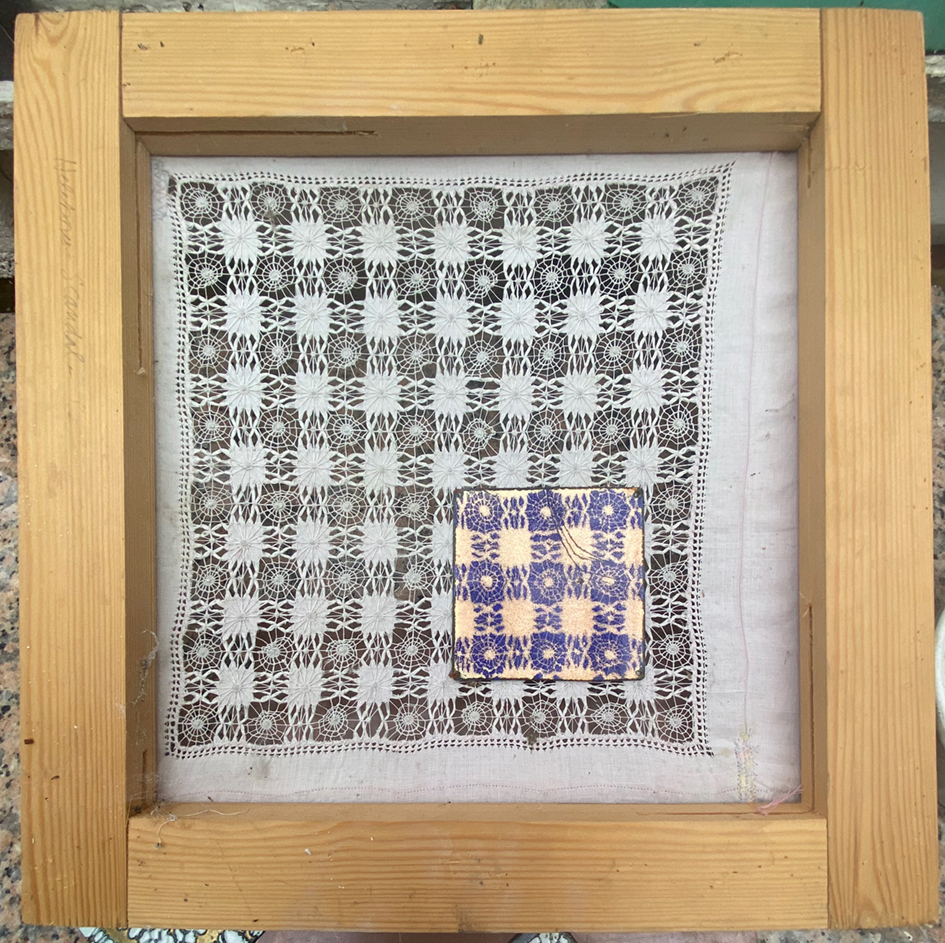
Searching in my studio I found a drawer full of old ‘fabric enamel‘ samples, that I had made use of for Discarded Heart. I had often used drawn thread-work as stencils and amazingly found the original stencil fabric , stretched and ready for use.
The most difficult thing I had to do was to repair the cracked enamel square. I wasn’t sure I could do this as it needed to be re-enamelled in exactly the same place as the original – fat chance! I carefully removed the gilded and stitched leather heart and re-gilded it. SO taking courage in both hands I re-stencilled it using a strong white enamel, then fired it at a very high heat and this made both the pattern very feint, and the cracks filled up – result!
Back of centre panel with leather and bronze fabric cut to free heart for repairs
Front of re-placed re-enammelled heart
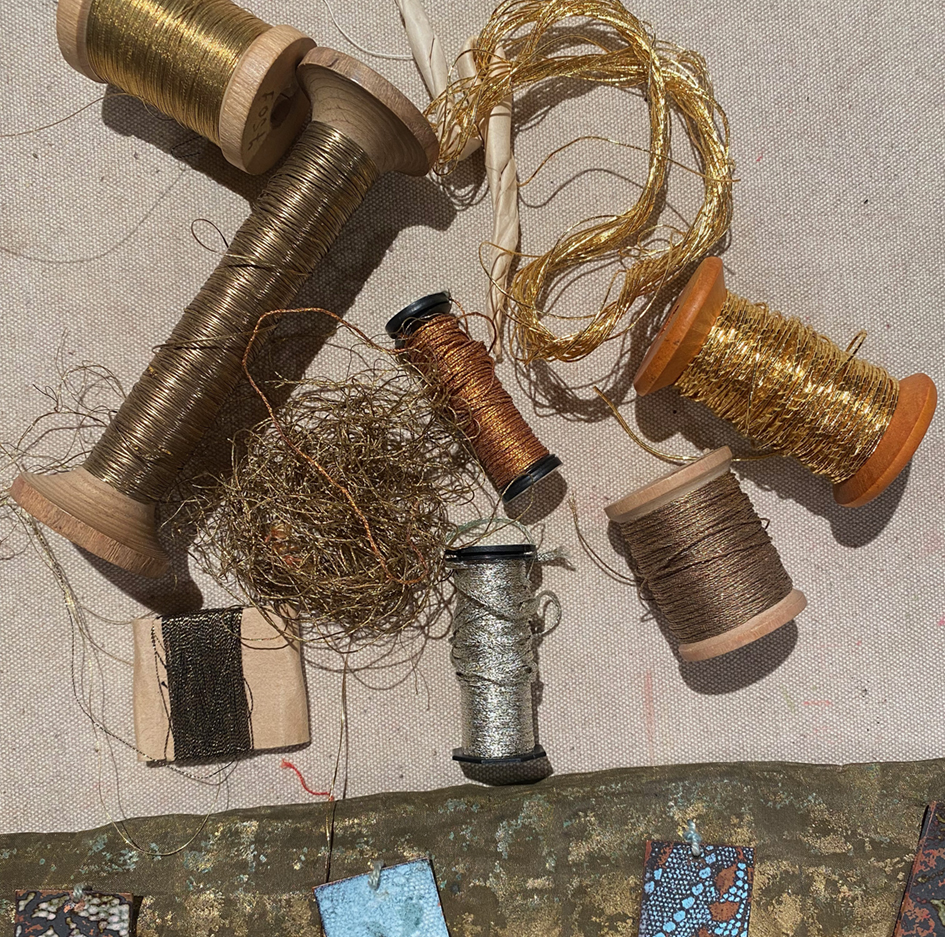
To get it back into postition I had to re-excavate and re-drill the stitching holes, so that I could painstakingly stitch the whole square by hand using real metal threads, ( trying hard to stick to my intention of NOT buying new materials but recycle anything I already own). I had several real Japanese gold and some copper wrapped threads to choose from, but this thread had to be strong and resilient for stitching through metal and leather.
After several half days of really awkward stitching, I managed to herringbone a wrapped copper thread all around the square.
Relief, as I had already offered the Discarded Heart (as it was it was originally made from lots of my. unsuccessful samples ) to the Welsh Quilt Centre as part of my 6 months exhibition called Hearts and Flowers in 2024.
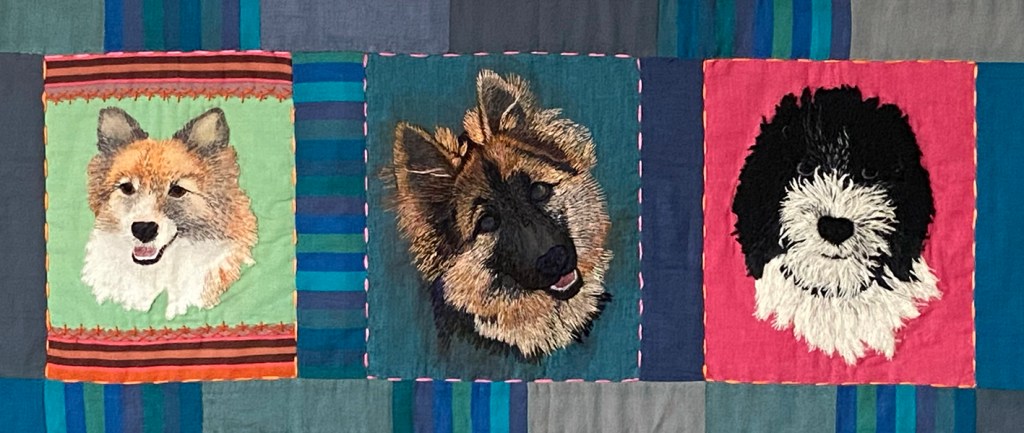
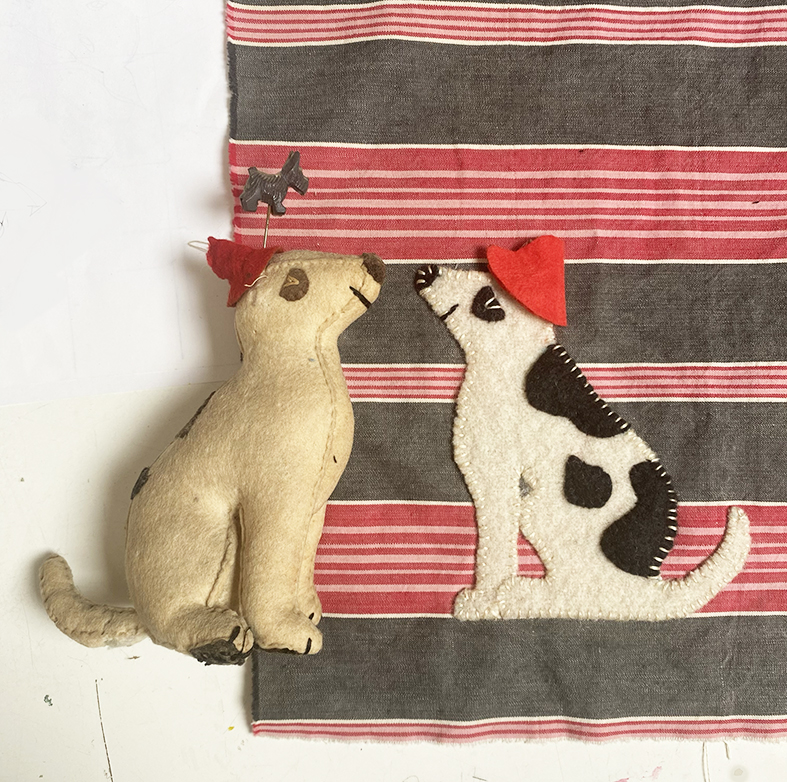
So far so good, but the next piece, “Crossed Heart” was really badly damaged – mostly by fading but seemingly anything it had been in contact with over the last 10 years….including my hands while working it! Everything seems to mark these refined woven metal fabrics (and I suspect Boysie, an ex fox terrier stud dog). And I thought that these fabrics would be as hard wearing as they are tough to stitch! I didn’t offer this piece for exhibition as I was not at all sure if I could make it look worthy of being exhibited again.
The only area not stained, faded or split was the centre panel of a decorative cross darn in white wire into a heavy copper mesh I had copied from a Darning Sampler in the Bristol City Museum and Art Gallery which has one of the most famous Sampler collections in the world. I kept this, but now had decide just what to keep as signs of legitimate wear and what I just couldn’t aesthetically live with!
The whole sorry embroidery put onto my worktable and pinned into place – the metal fabrics have a tendency to roll up on themselves when left alone; a metal memory even after 10+ years of being stretched on a fame. The staining is plain to see with the general fading and tarnishing, but what you can’t see are the splits on the background fabrics underneath the rows of herringbone stitches.
The first area I felt confident to work was a rip and I cut away the fraying fabric – a mistake – but hey ho, nothing ventured…and started to darn the gap in the metal and nylon woven fabric with 1 thread from a stranded silver hank of 6 strand….very tricky – I may yet go back and rework this!
I was not very confident to continue, but I had started and I am of the sign of the crab…..very tenacious. Here are various ruined areas of the work, with different mends : a proper running stitch strengthener over a pulled thread area, sewing an extra border in a nylon and probably lurex woven fabric (once a very glamorous skirt worn to a 1 very glamorous occasion)to hide the worst of the staining on the outermost edge of the piece ( Boysie?) and then surrepticious stitches to draw the edges of the split fabric together. The herringbone stitches had started to unravel – and by this time so had I.
but eventually they are finished enough for safely re-stretching and possibly have their place in the lay-out for the gallery as part of a group of stitched metal mended hearts…
I have been invited to exhibit my work at The Welsh Quilt Centre, when they re- open for next year. So I have been carefully choosing pieces to make a cohesive exhibition of the recent Flowers For Our Time, the related Flora embroideries with the collection of bedding, Make it Through the Night.
I realised that the work chosen fell into 2 distinct groups – there are always cross currents and references in any body of work sustained over long periods of time and some of these embroideries are 20 years old! I wanted to make links between them, and decided on a new piece that encompassed the mending broken hearts themes of the bedding with the perennial flower themes.
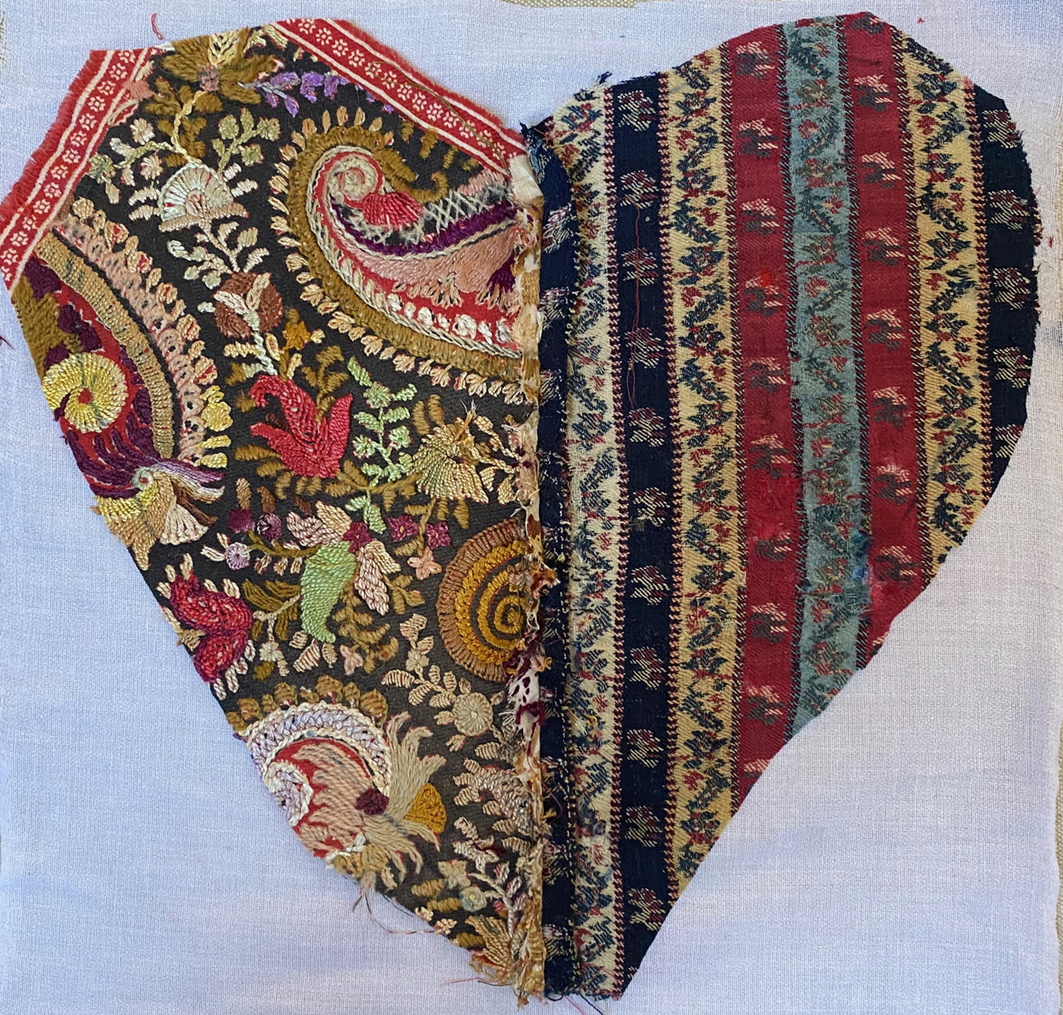
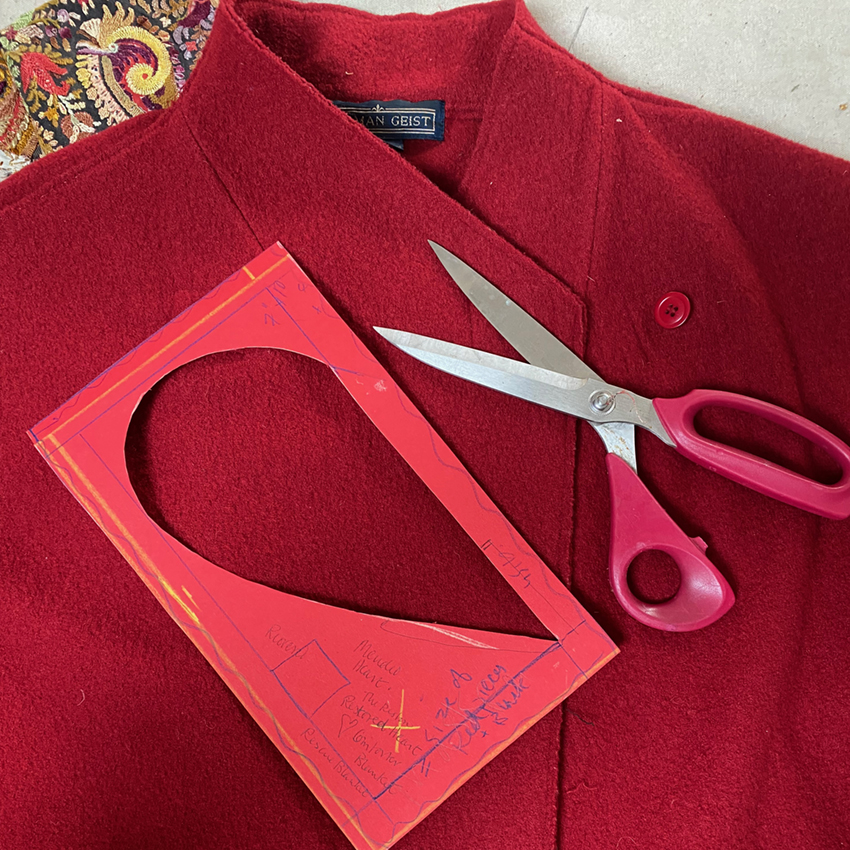
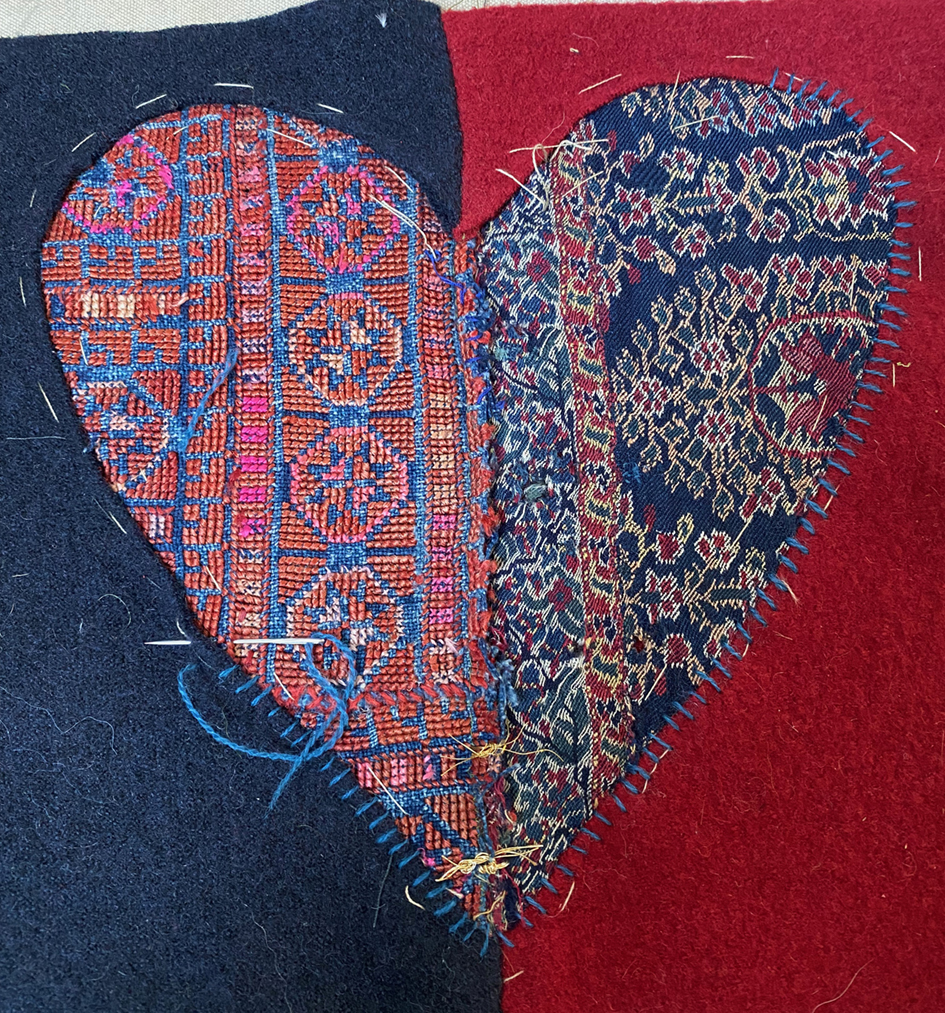
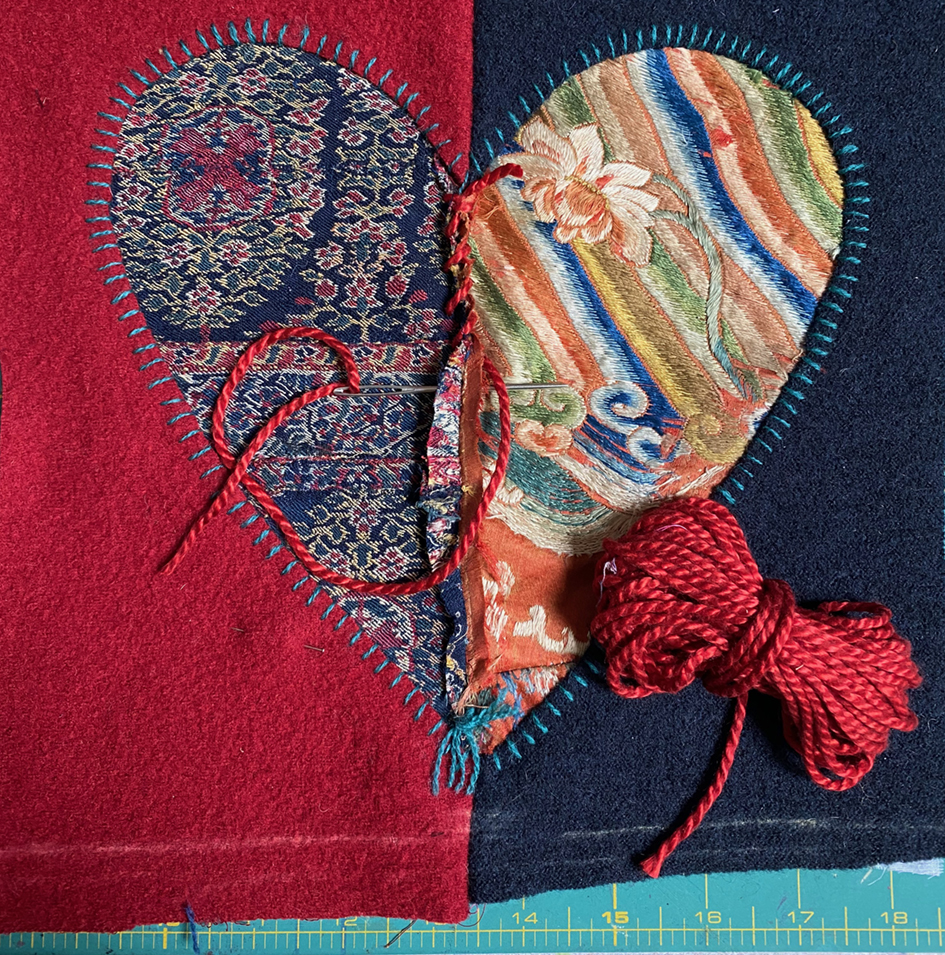
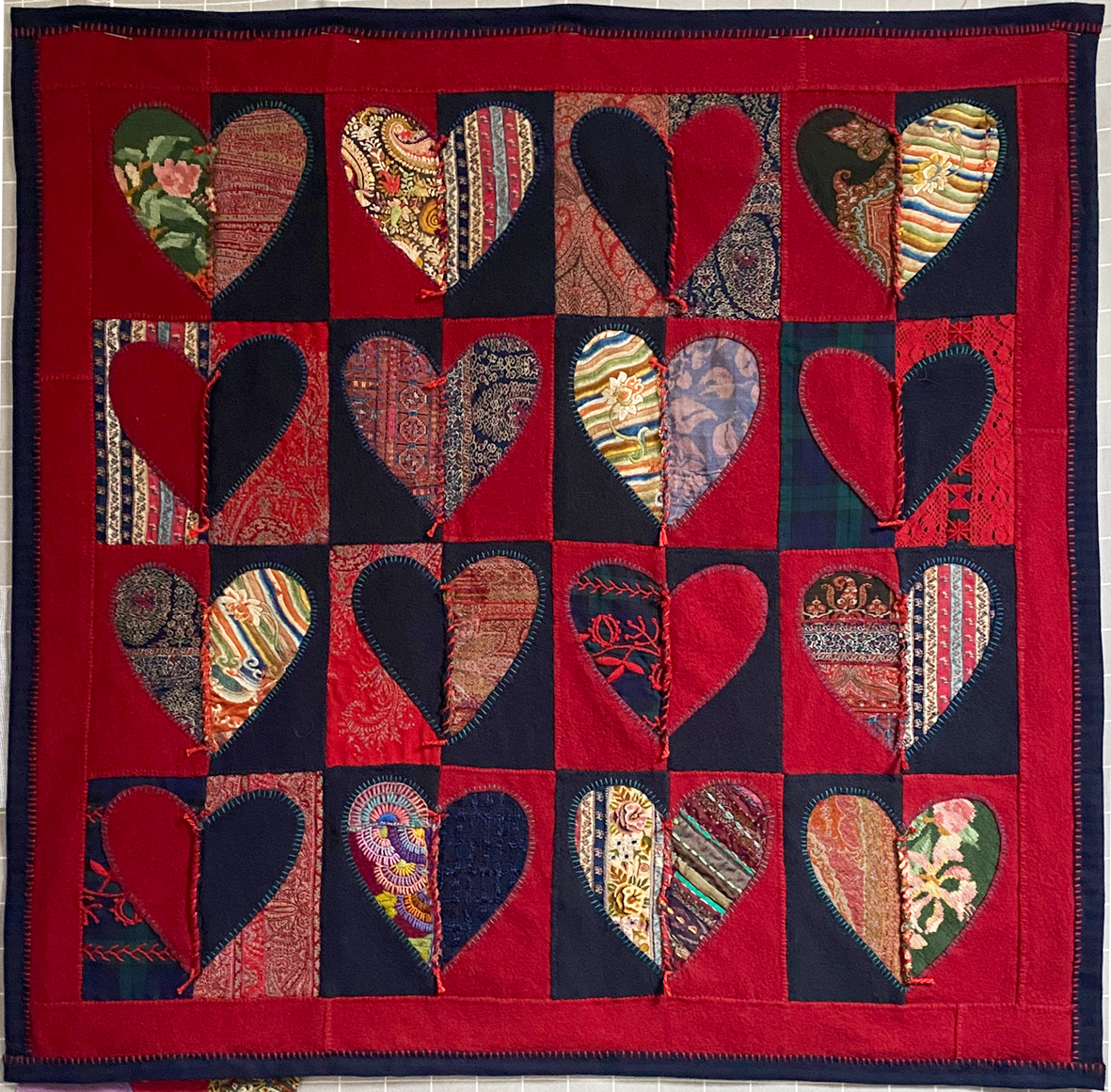
My sacrificed jacket fabrics reconstructed as a heart – the opening page in my sample/sketch book for “My Badly Stitched Blanket”.
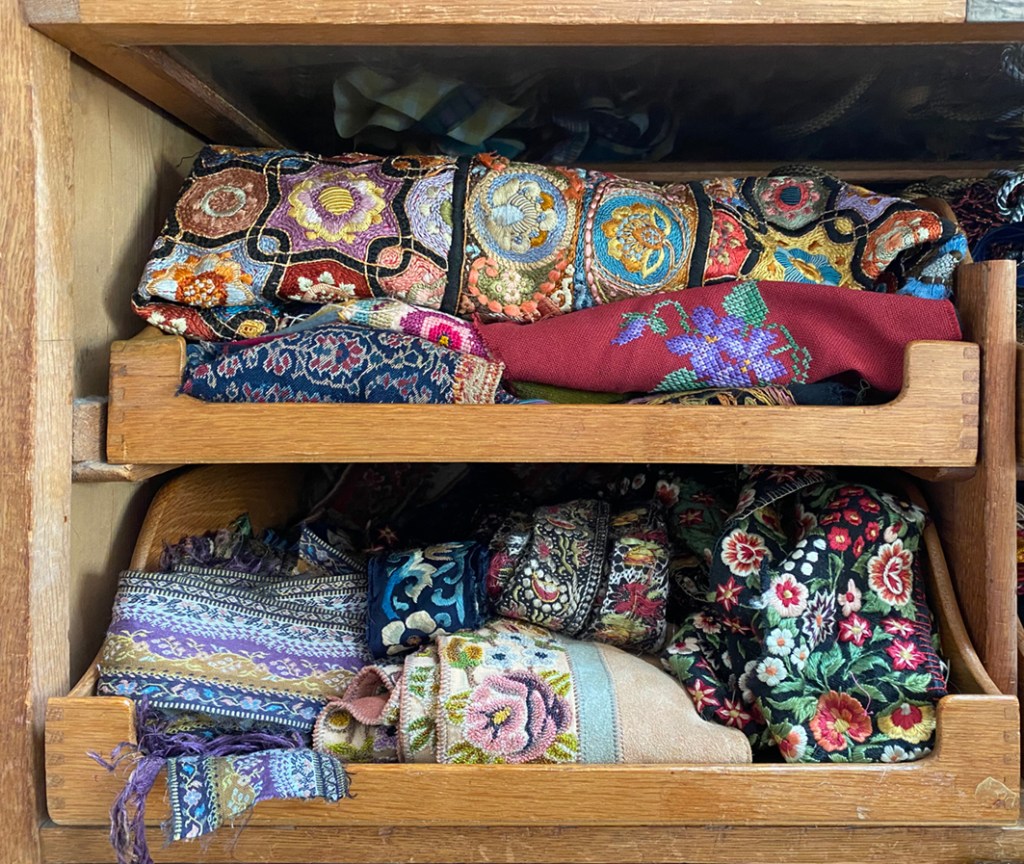
I looked at my studio wall and saw a small group of pinned samples for designs for Ehrman Tapestry company – the rows of split hearts and some fabric scraps that I had wanted to work into new designs. I also thought that it was time to use some of my most beautiful vintage embroidery scraps that I had hoarded for years… I had an idea to make a blanket – a comfort blanket.
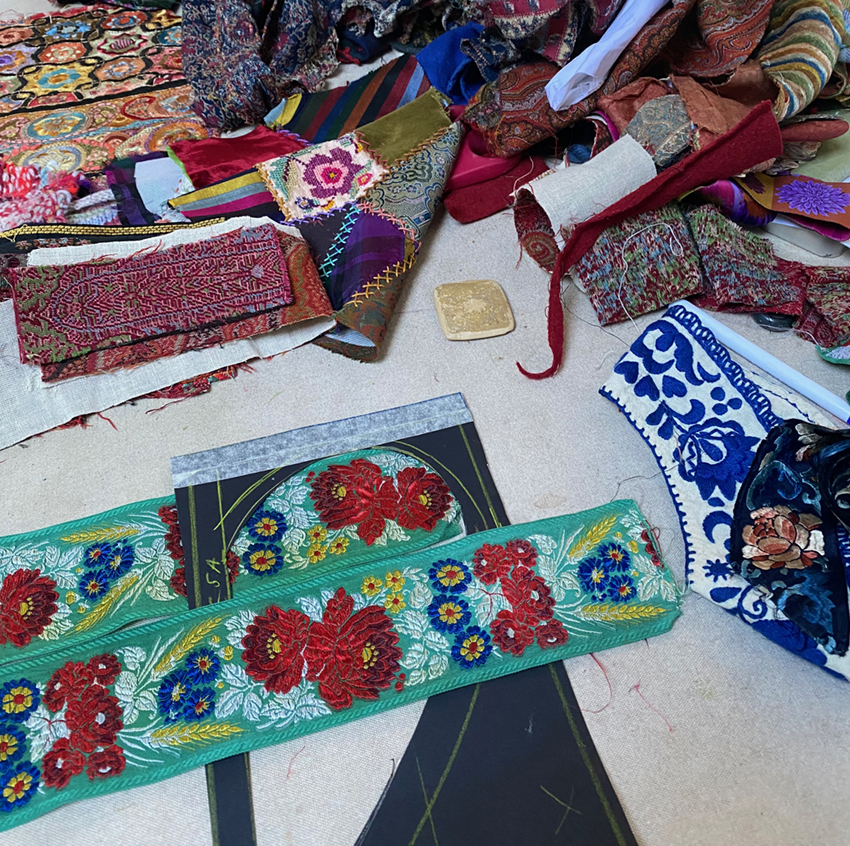
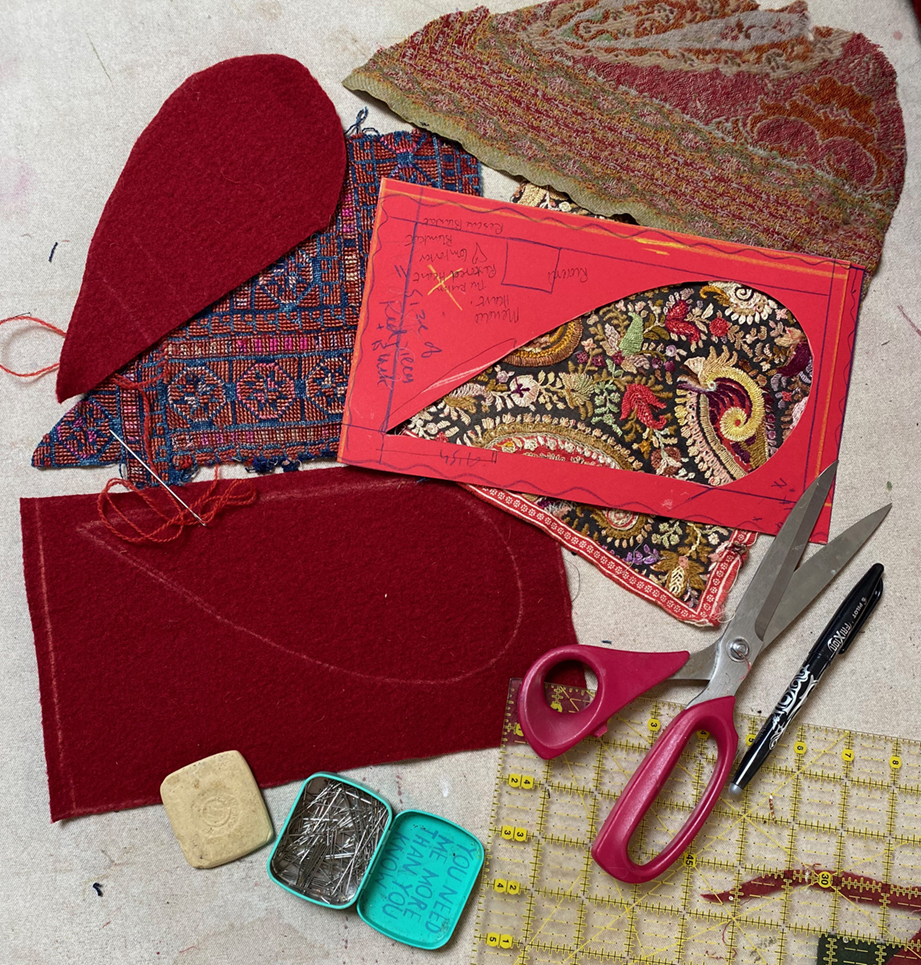
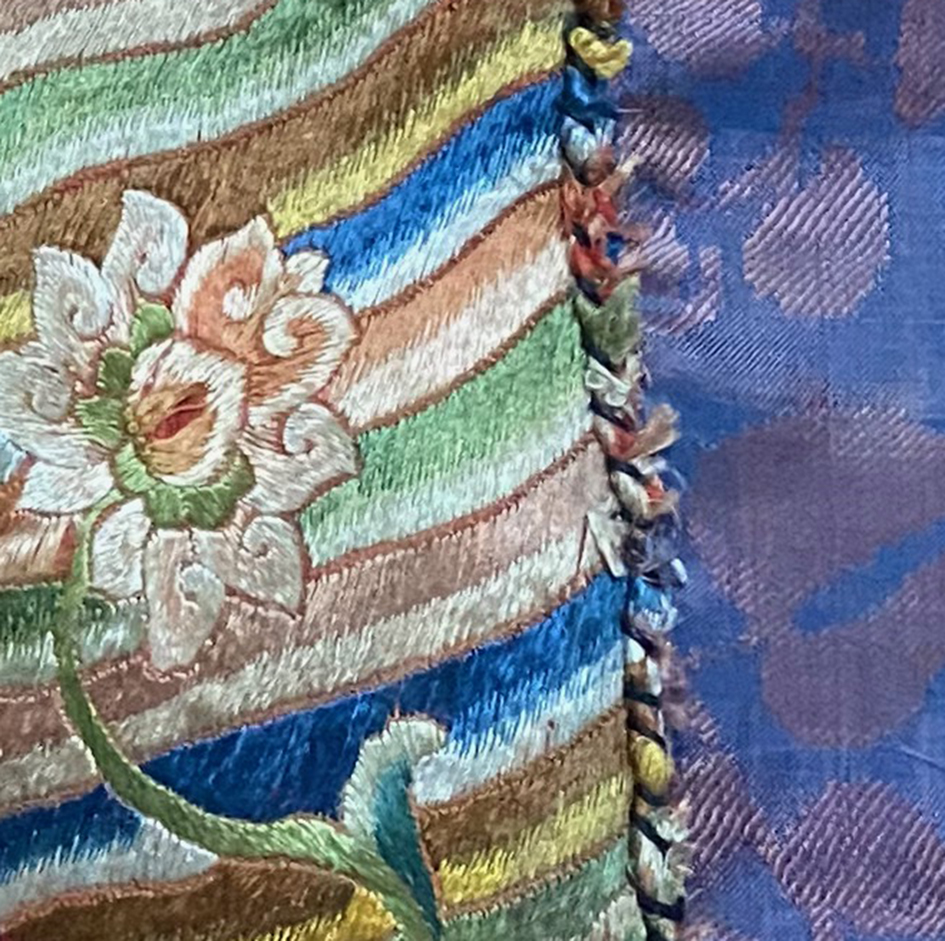
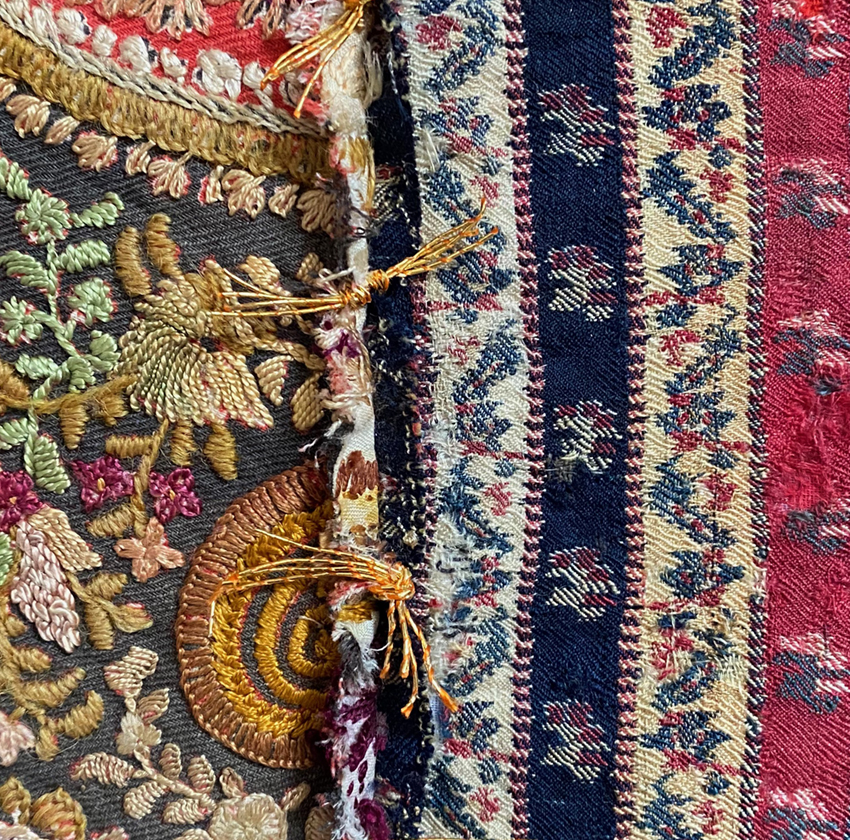
I cut a card template and started to place it over the treasured collected fragments of fine hand woven woollen shawls, silk Chinese robes and European woven ribbons and embroideries. I found my own old un-sold fabric design samples (from when I was a free-lance designer for an international fashion fabrics company). I thought I could use all of them all together – more is more!
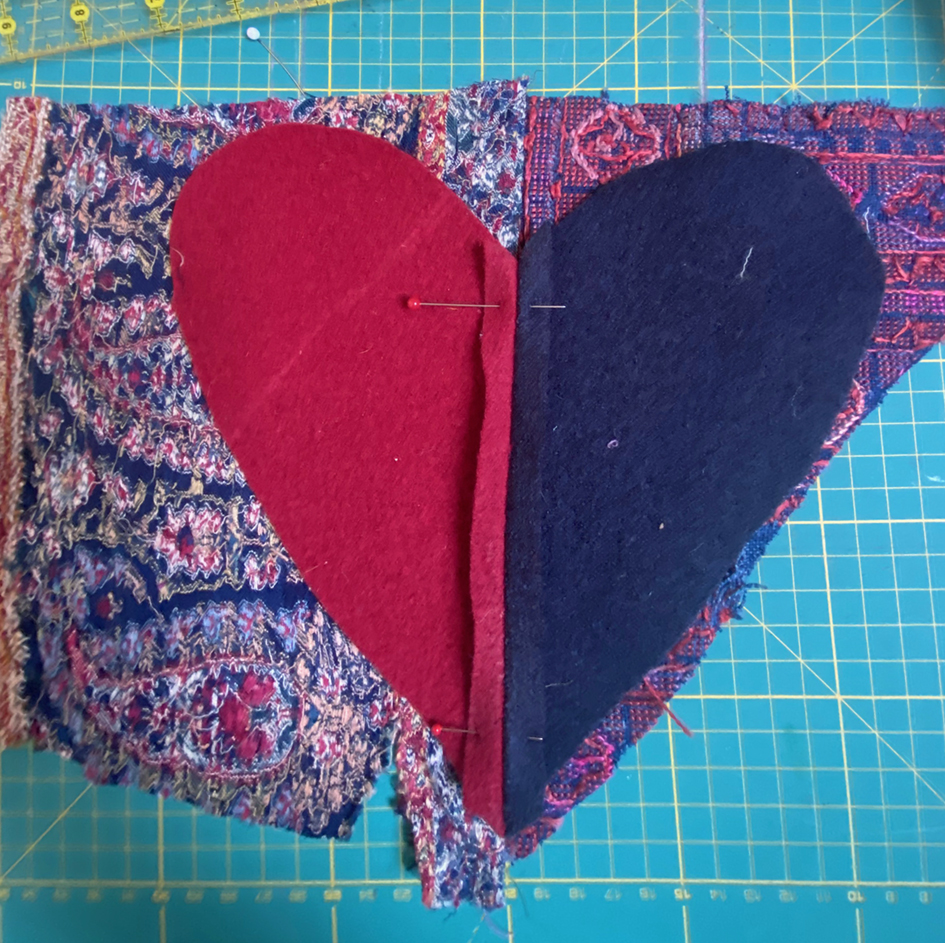
Choosing from my truly delicious and damaged fabrics, I cut out an oversized heart shape, and quickly realised that my original idea would look like patterned porridge. I needed to add some strong plain contrasts. And this is where the difficult part of this design process really started. I had very 3 old and well loved boiled wool jackets that I didn’t wear anymore I have to admit that I am very attached to my clothes and keep them for years. But the colours were perfect…….
Cutting up the red one was not so bad, it only got used lately for occasional dog walks, and it had suffered from moth. Somehow the idea of setting my treasured vintage and antique fabrics, in new cloth just didn’t seem right. With a heavy heart, and after a few days consideration, I reluctantly unpicked it and started to cut it up for the blocks. This was to be a hand-made quilt and this decision made me consider the work beyond its original purpose by provoking me to consider what it meant for me. It became deep down and personal.
I now wanted to show that this work was a part of my broken and mended hearts theme, which is predominantly red and black embroidery on white bedding, but this was supposed to be a celebration of colour and pattern. Now I was mending, recovering, recycling and rescuing my treasured fabrics and clothes as I had admitted to myself that I was never going to wear or find a better use for them. I couldn’t bring myself to photograph the cutting up of the navy blue Oscar jacket (I have kept half for a pattern – someday).
now the central join of the split heart was to be fully in evidence and the more jagged the join the better…completely at odds with my normal practice of (over) controlled stitching. I decided to use the Surgeons’ Knots on the outer seam and leave it un-neatened, like a scar. I tried various threads; above left an oversewn waxed thread and I thought about gold as still I have real gold threads bought in Japan years ago – totally perfect until I saw a hair conditioner advert featuring gold filling on a dreary vase – suddenly all forms of value has been taken away from this ancient mending symbol for me for now. Then I found the too-heavy-to-sew red silk.
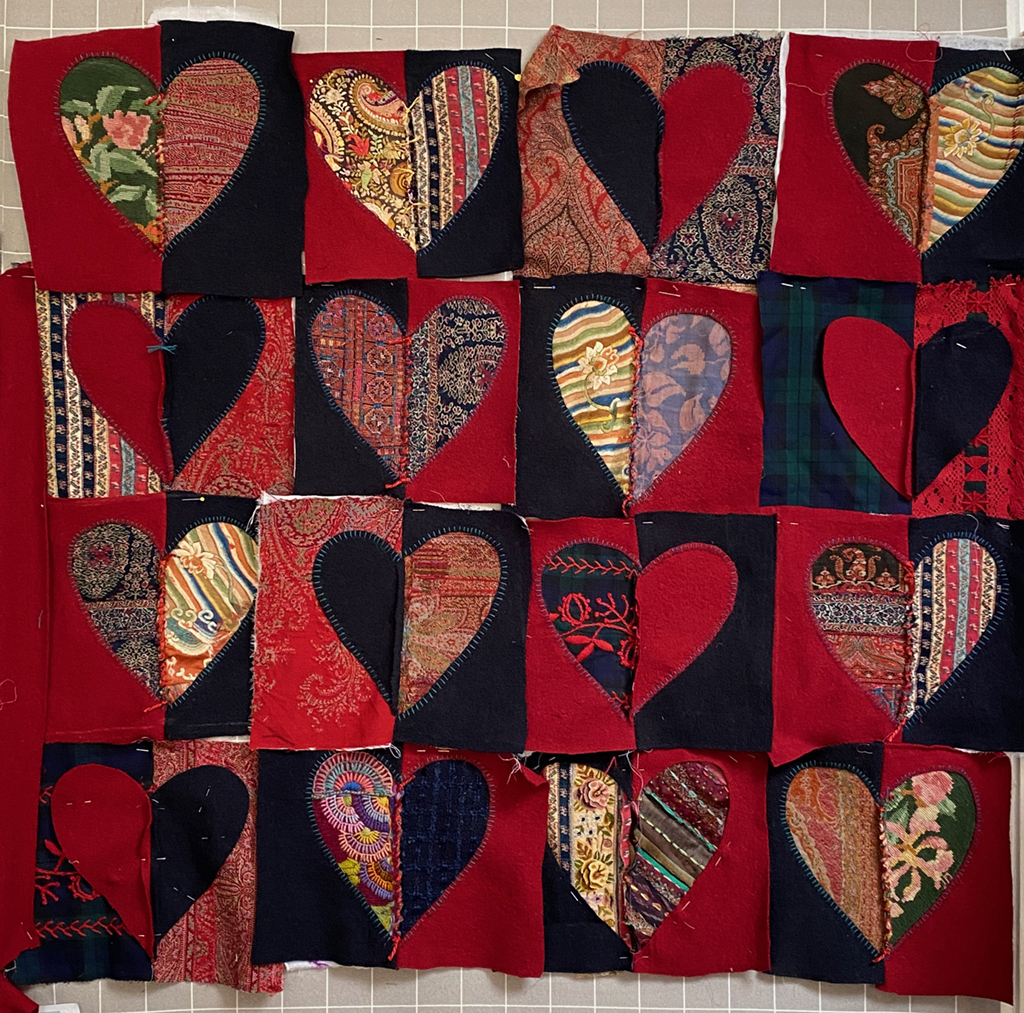
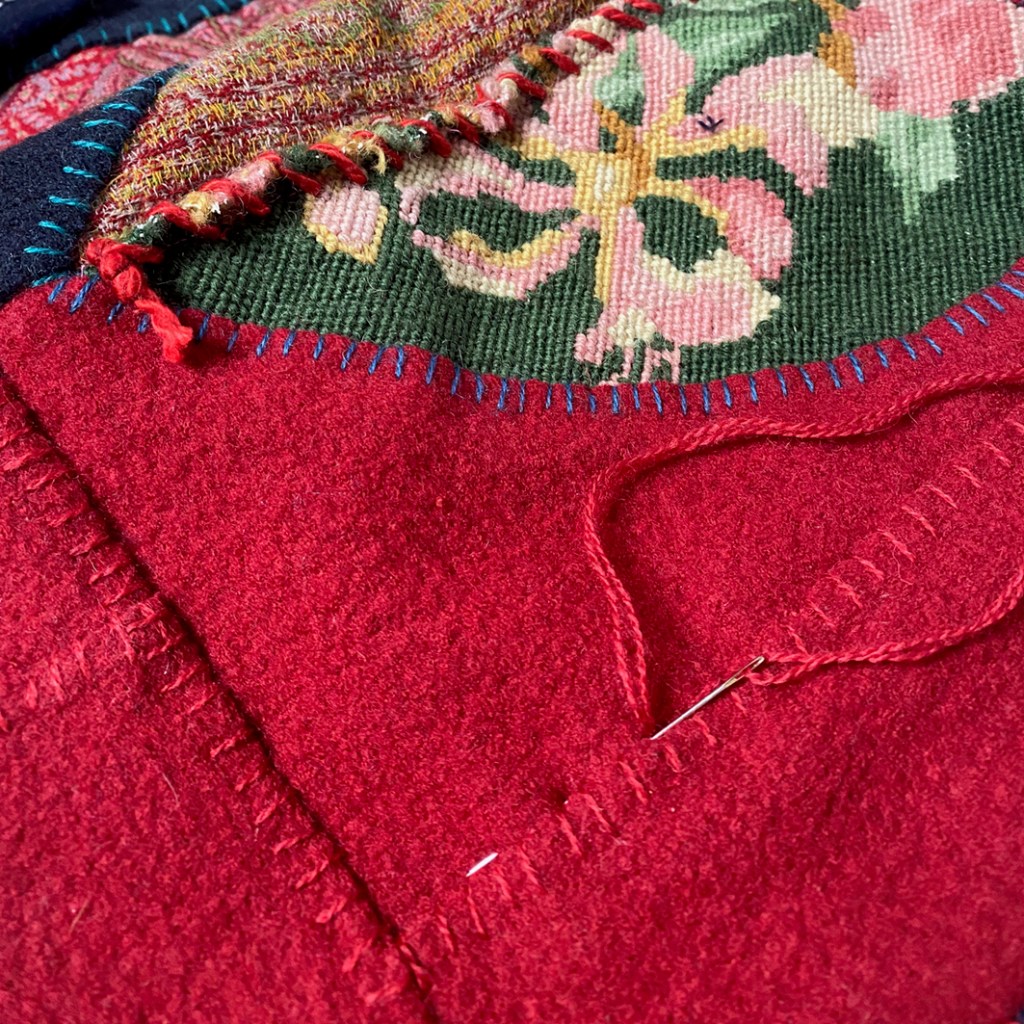
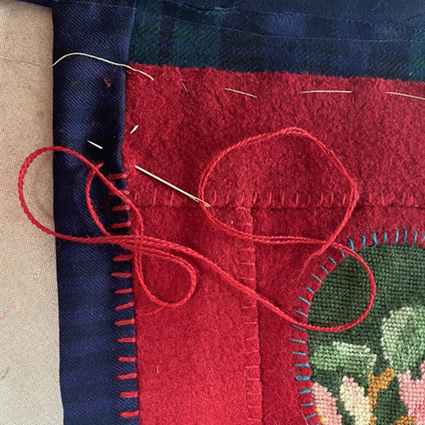
And this is where the title of the quilt arose – there is no way that I could control stitching this yarn and coupled with the slightly wonky sewing in the hearts I think it is a perfect title. Eventually I rescued enough fabrics to make 16 blocks to arrange on the quilt wall ready for sewing together by hand onto a large sample of tartan wool as a backing!
This was plain sailing after all the the decision making – but as I had oversewn the hearts into the blocks in fine wool yarn, I now felt I had to continue with the borders in the same way but the lack of having to rule a stitching line and unpick when necessary made this 2 weeks of work rather than 2days!
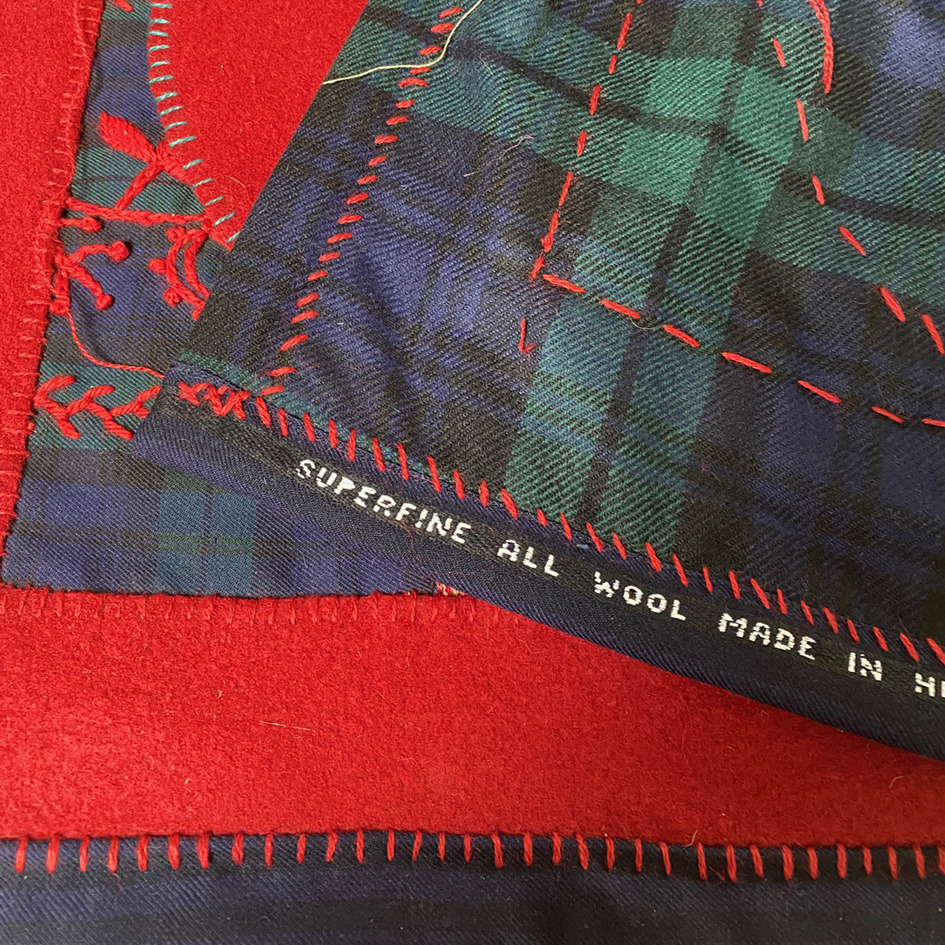
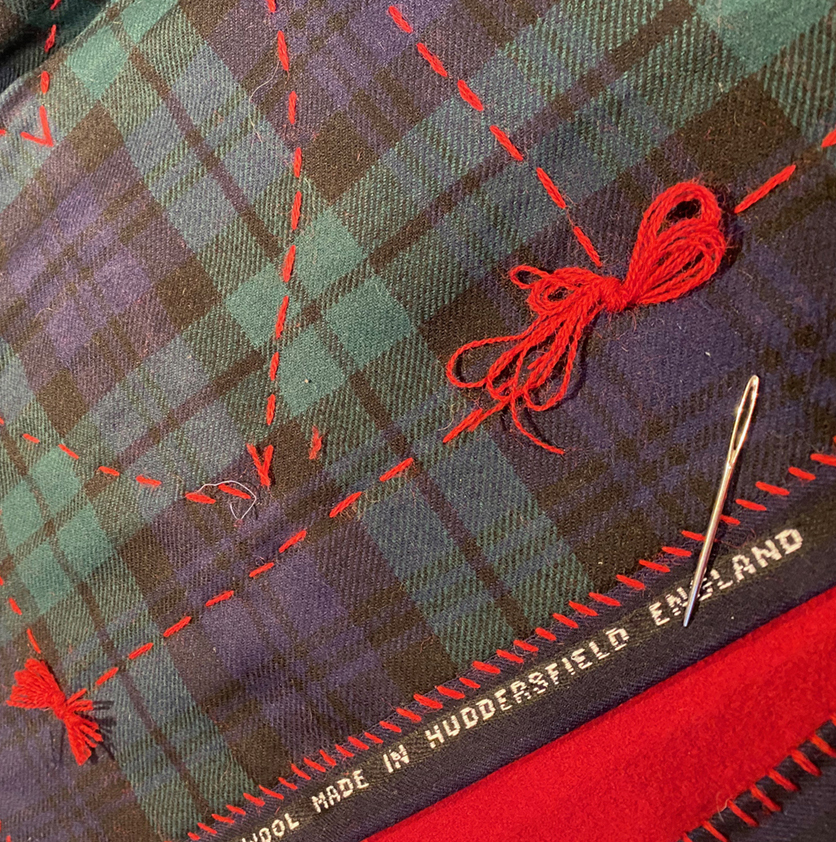
I kept the beautifully woven selvedge of the last border fabric as a testament to the quality of “Superfine” British wool and weaving traditions. And here it all is pinned to the wall this morning.
Over the past few years I have been intending to start selling giclee printed versions of my personal stitched work. The latest pigment prints available are unbelievably faithful in reproducing my finely stitched work…but where to start? Flowers – where else? I determined to develop some new flower embroideries for this venture.
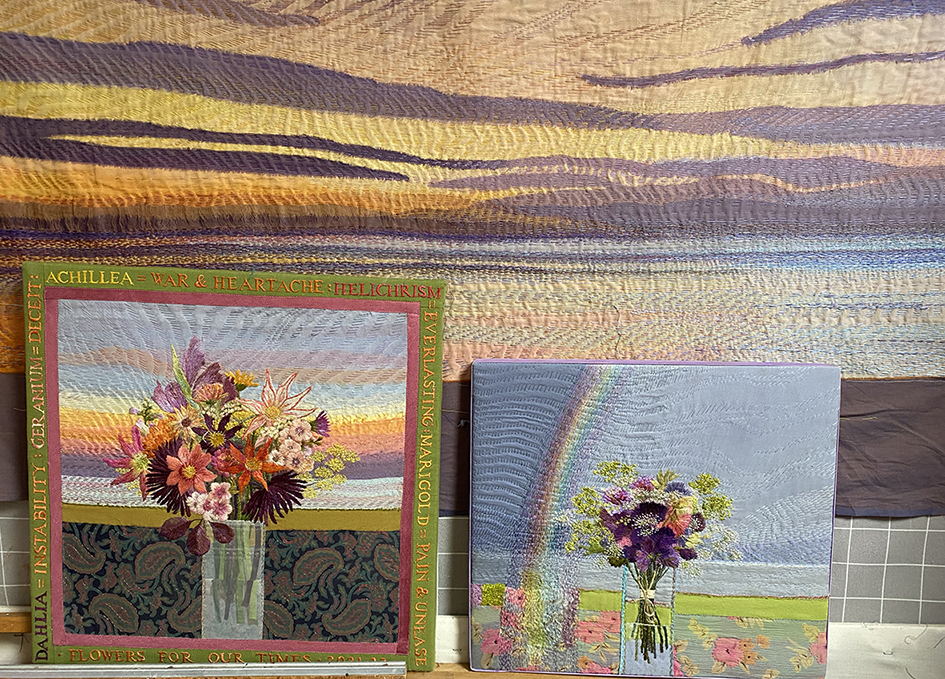
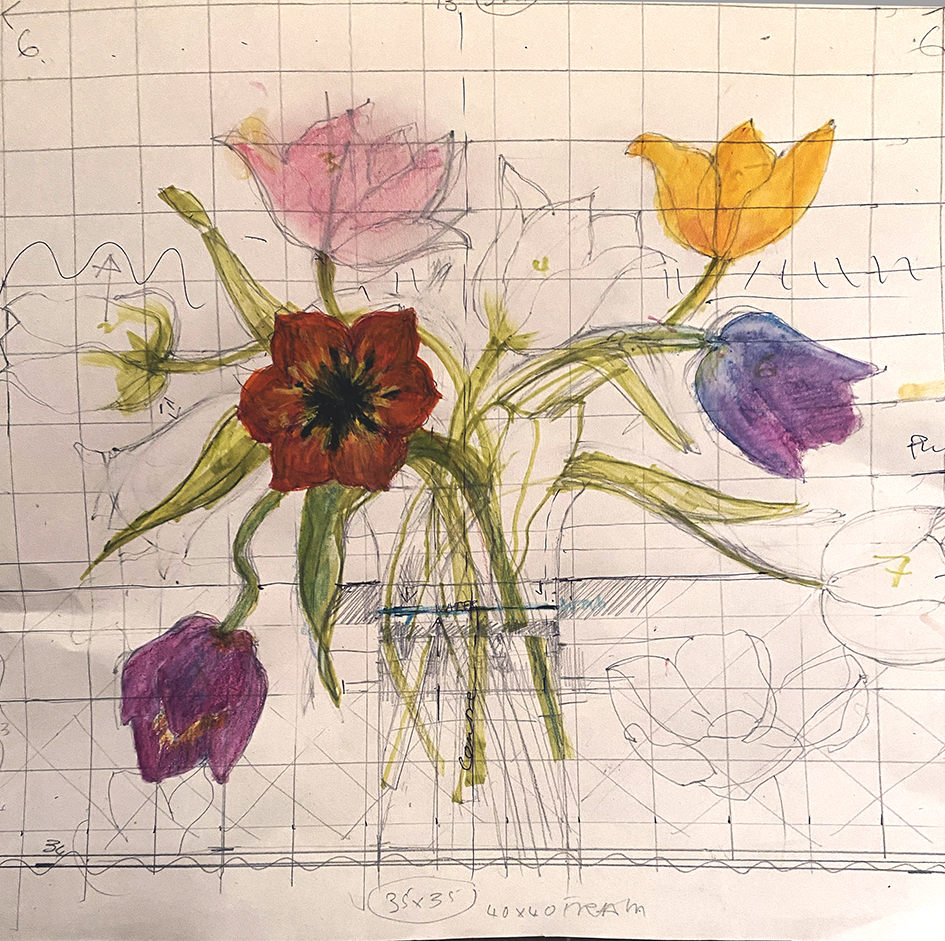
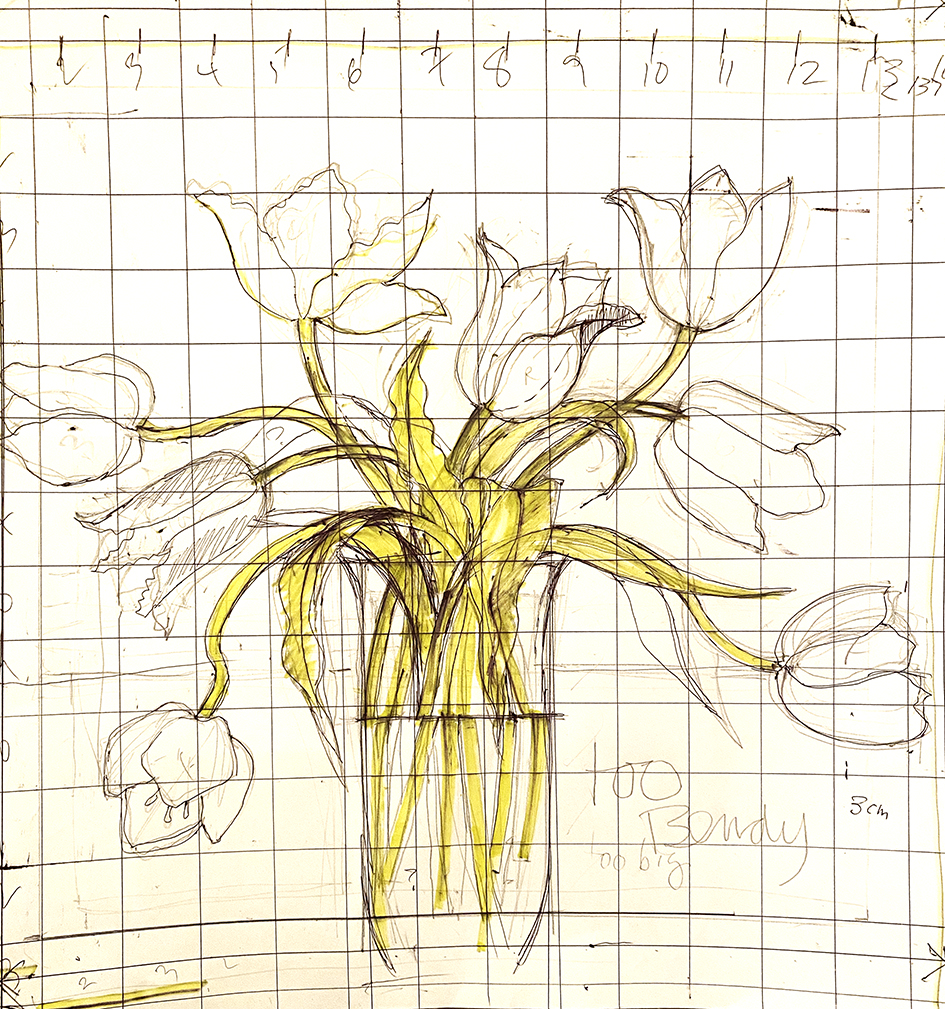
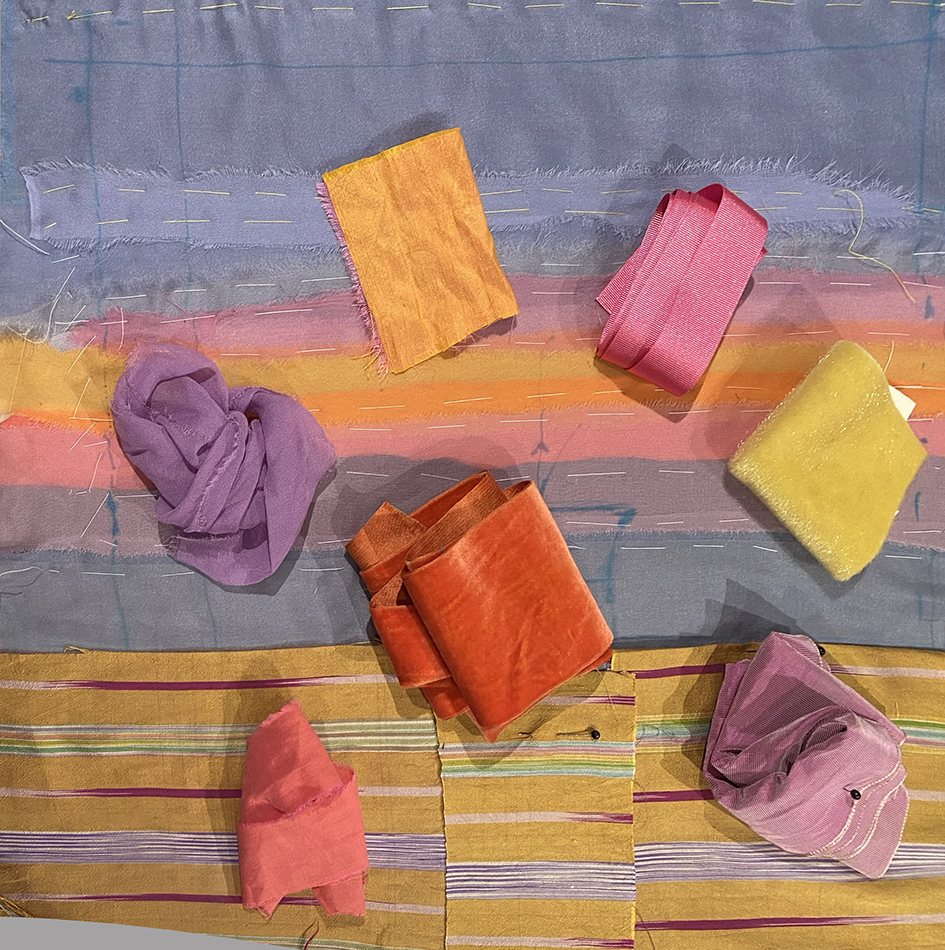
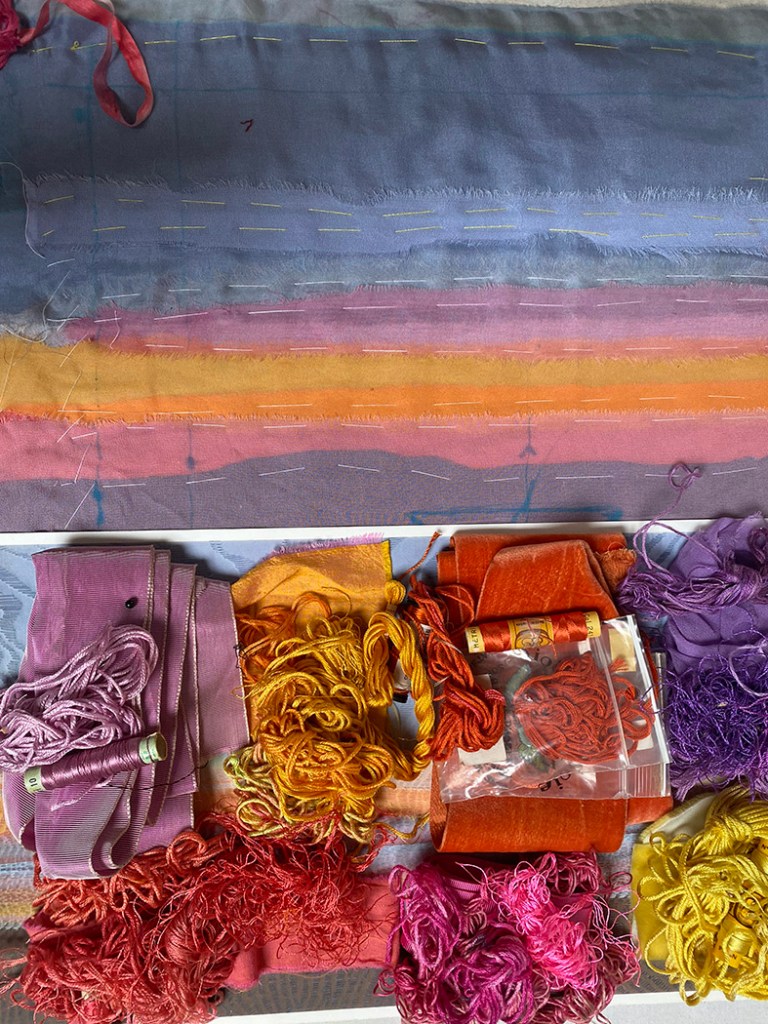
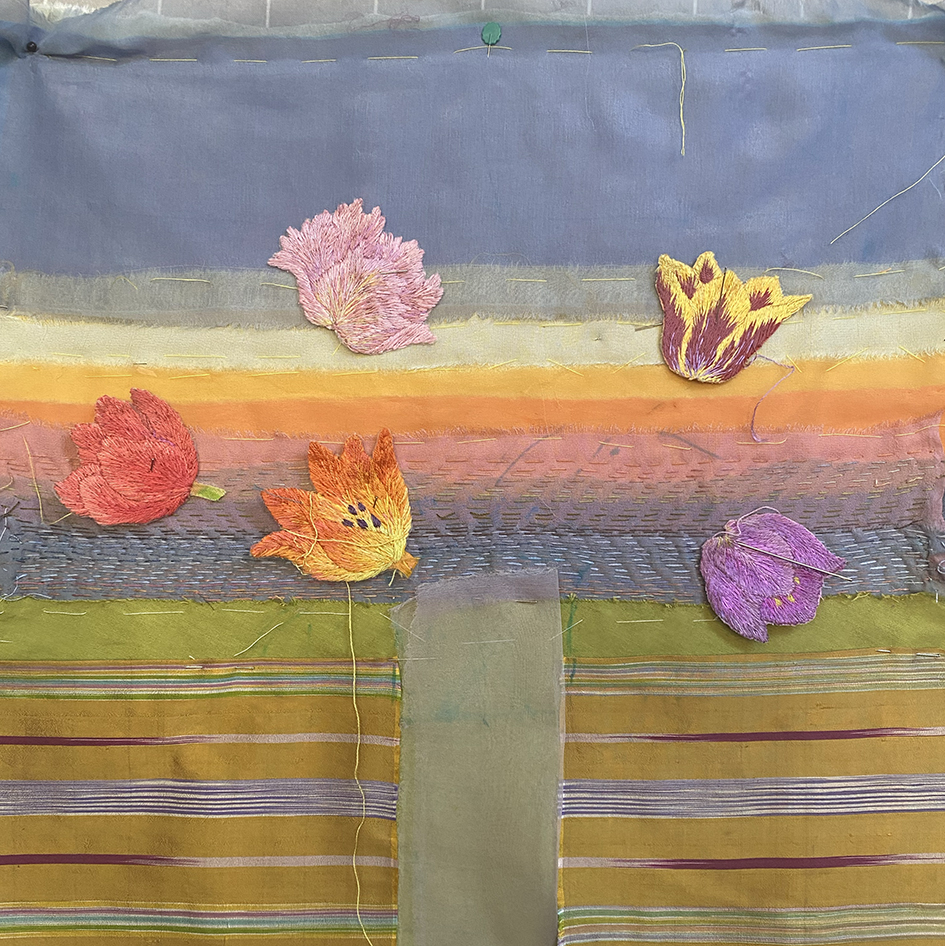
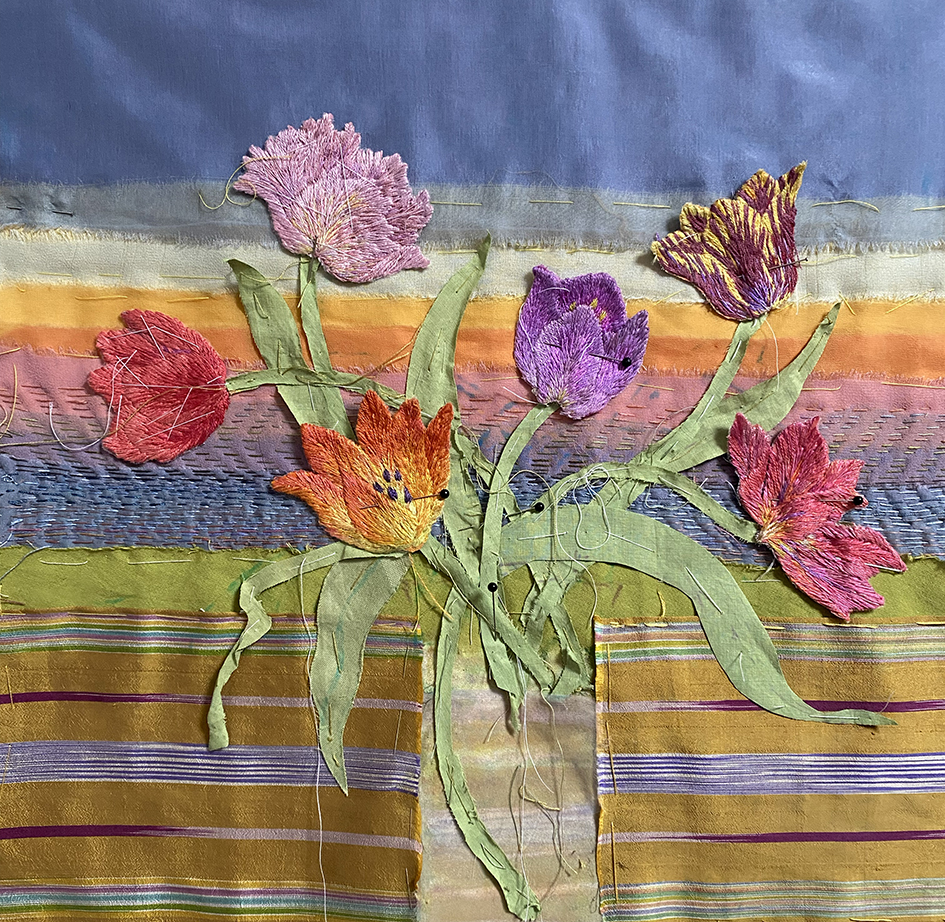
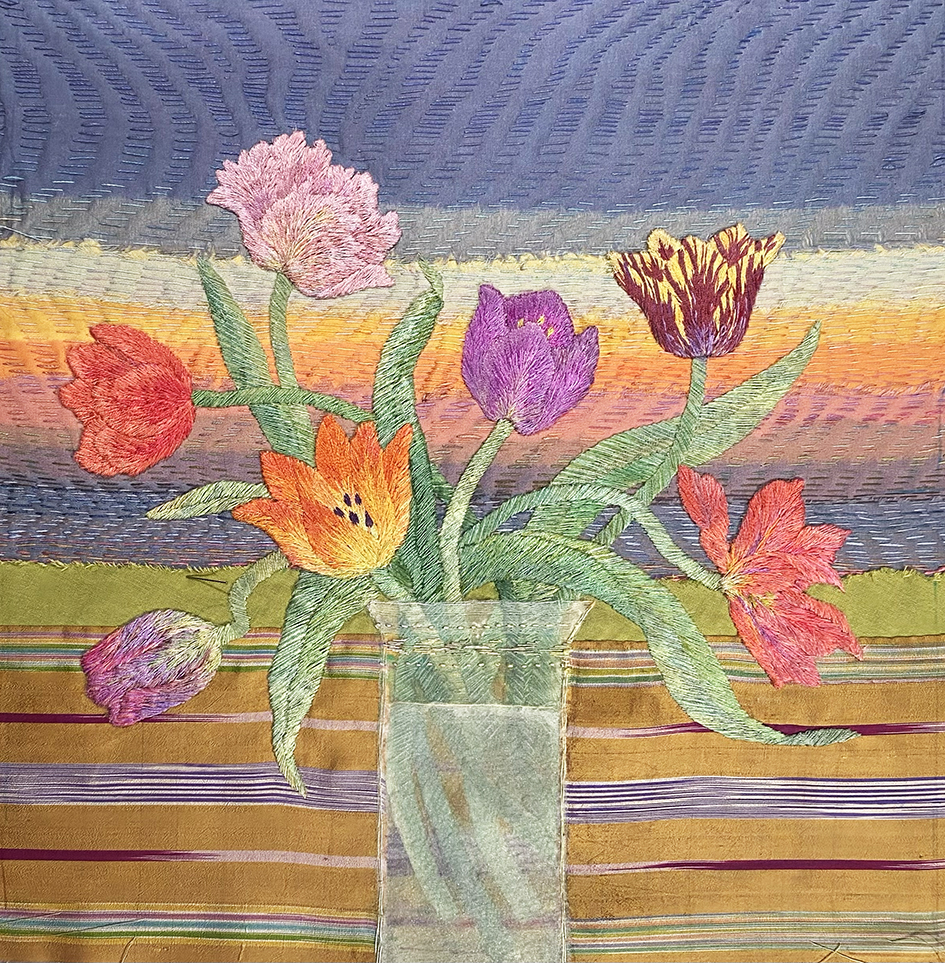
Following on from revisiting my old research books and past work, I decided incorporate the flower embroideries with the Kantha stitched skies as in After Winifred. I took a beautiful bunch of dahlias and held them against a large scale Kantha Stitched sky in progress on my studio wall. I had been brought the flowers by Helen Reed, who owns Court House Farm and runs a seasonal cutting garden amongst other ventures. And where I hold drawing sessions in the summer months.
I also eventually started to work on an idea taken from a rare photograph of my garden Hellebores in a vase and in front of my scarf design of Hellebore flower heads. What is odd is that while Hellebores are one of my most favourite flowers, am not keen on Dahlias and did find myself reluctantly stitching them onto a small version of the Kantha sky. Below are the first 2 prints in the series Flowers For Our Times, on the left is Dahlias, on right, Hellebores
Reflecting on the Dahlias and Hellebore pieces (made between winter 2021 to early 2022) I felt as if I had made a definite link between my old and new work in order to make the really vivid giclee prints, available soon at Heart Space Editions. But although technically demanding, using the new Inktense dyes from Derwent, I decided that this was not the way forward that I had imagined it would be.
I returned again to my early flower work and re-read the catalogue of my exhibition of Flora’s Legacy, held in Bath in 2000 ( yes – so many years ago!!!!!) and realised exactly what was missing – symbolism – or the half hidden messages often contained within these earlier works.The centre-piece from the exhibition, Flora – the Roman goddess of flowers, had what was missing from my new works…the hidden meanings and humour – here some blackish, bawdy humour.
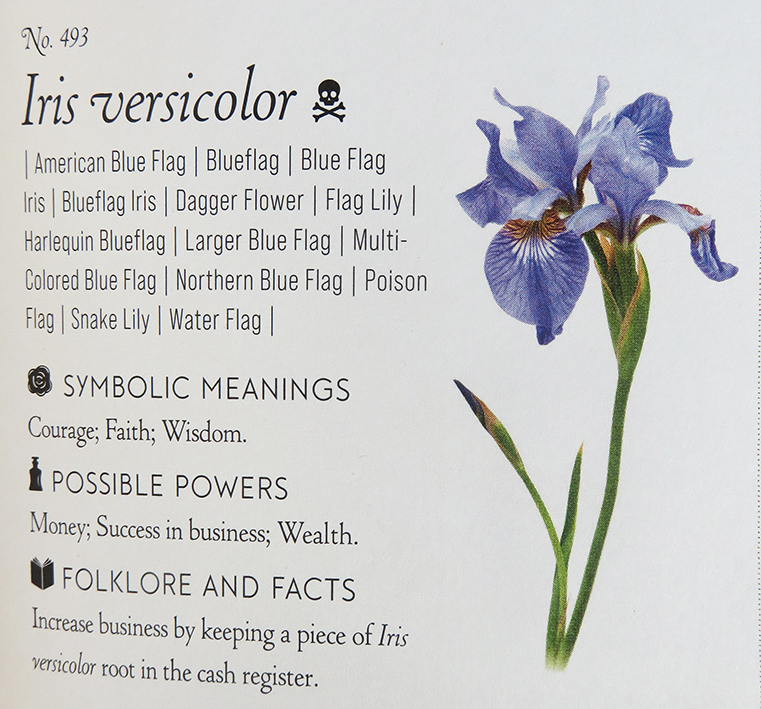
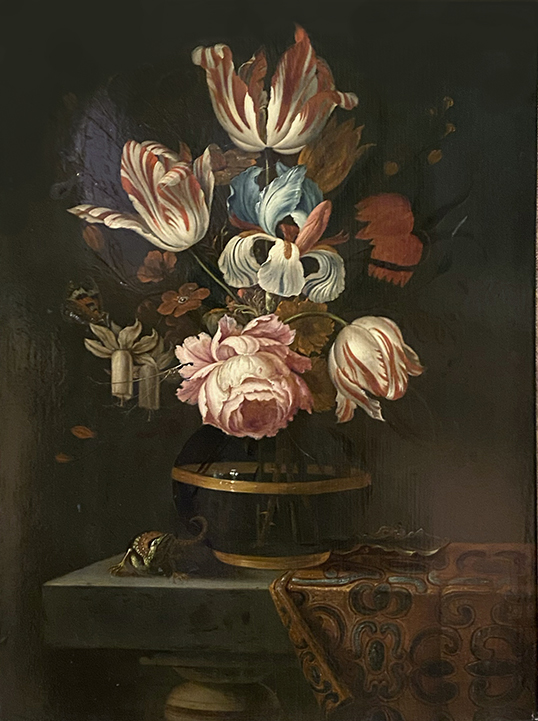
Turning to the many and various dictionaries of symbols I keep in the studio library I thought I would invent a bunch of flowers instead. The meanings of plants and flowers are universal and every culture has its own beliefs, sometimes conflicting – sometimes they are entirely in agreement: a poisonous plant is a poisonous plant. Out of curiosity I checked what the 2 bunches meant adding, the meanings to my original studies…..
I must admit that I was shocked, relieved, delighted and then excited to find that I had embroidered War, Scandal, Uncertainty, Instability and Sickness within 2 pretty bunches of flowers. But everyone else around me was spooked. So – they asked – where did I get this information from? Well in my books of symbolism, the most curious and confusing is The Language of Flowers – but oh the possibilities that it offers for mixed messages and hidden warnings amuse me enough to keep going with this theme.
Using just my old folders and Victorian books of flower meanings lead me to a brand new fully comprehensive dictionary by S. Theresa Dietz – published by Wellfleet Press, and the here I discovered far more arcane information than I had gleaned from my all my original sources.
So now what to do next – can you guess?
check the gallery sectionto see more outcomes of this ongoing project
These rapid drawings below are early attempts to express one of my most vivid dreams lest I ever forget it…. But the dream was not ready to be forgotten, it has reoccured often in one form or another – evidently I have not learned its message; the loosening ladder rungs and the tiny impossible blue window never change
the earliest drawing above on the left has some written comments that I was interested in using for the embroidery also I seem to have both shoes on; the one on the right is scaled up for embroidering on a sheet! What was I thinking?
Here I am again some years later ( the shoes are getting looser) climbing out of the chaos of my scribbled darning designs for a book that eventually never got published!!!!! with a burning heart to the right and no way back down that ladder. Circa 1998.
So I recently decided to embroider it as a pillow for my ongoing project Make it Through the Night . It is a simple idea and my friends who saw the drawing were highly amused by me in my nightdress losing my shoes…but I started this piece just before the lockdown and now I see it in a very different light.
The most recent drawing I made using a photograph of me in my nightshirt climbing on a chair.
drawing now traced straight onto the pillowcase in water soluble pen – all the drawings alongside
The interpretations of dream referring to ladders are many and varied depending if you are climbing up or down, and a broken rung (just the one) means “you will never achieve your greatest ambitions” while “to lose a shoe is indicative that you have forgotten something important ” or “finding your direction in life difficult” – and as to the lack of underclothes whilst climbing a very high wall in your nightshirt……
I found stitching the ladder the most challenging piece of work, a vintage pillow has only a limited space for inserting embroidery hoops and working straight onto fine linen needs stretching. I preferred to use some natural linen yarns and whip them into position making a more fluid line – finding knots and drawing them became a fascination.
above are the various ways I managed to stitch the ladder into position, with and without a stretcher.
Now to the window: in some dreams it is impossibly teeny tiny, in others I get to go through it – only to find a steep and shaky descent on the other side into more blueness, the one thing always in common is that it is always a brilliant and shining deep blue
the background of the sky is painted with cotton dye, then embroidered in silk threads, it is high up in the farthest corner of the pillow case
and here it is finished – washed, starched and pressed as a proper piece of Household Linen
I feel now that it makes its own statement without the added words; and why should it balance? I mean, what am I describing?
AND it is only after finishing this that I see this is a perfect portrait of how I feel right now – just coming out of the strictest lockdown period….uncanny!
However, we were well into the current lockdown before I had found the impetus to finish this work. And while stitching I realised that I just wanted to stop this whole project that excavates very personal ideas, dreams, mottoes, and observations….I did have more ideas that I planned to stitch, but now I no longer want to make them. It has taken me over 10 years, off and on, to get here.
folded book of flowers and butterflies – Ilaria Padovani
The world is full of surprises. You invite a group of people to develop ideas together in a studio in order to make work for a themed exhibition over a period of 6 weeks, then they go away and come back 3 weeks later with something completely different – Hey Ho! BUT sometimes the things they bring back are so different and you realise that they have taken a new direction because of the theme – what could be a better result?
folded book with moths- Ilaria Padovani
So when Ilaria Padovani, who is a volunteer at Heart Space Studios, arrived the day before the deadline with 4 folded and paper sculpted books, I could only gaze in amazement (she was making a flight of patchwork butterflies last time we spoke)! I had asked everyone to write a few sentences about why they had done the work, knowing from experience that most people engage more easily and trust the words they read, rather than the images they view – I have the opposite point of view but that’s anther story!
‘VERBA VOLANT, SCRIPTA MANENT…Spoken words fly away, written words remain…’
“This was my big sister’s reply to a letter I had written to her pontificating on how to raise her child. Although my intentions were good I had been arrogant and hurtful to someone I love dearly.After her phone call, I stayed up all night thinking of a way to show her how deeply sorry I was for my inconsiderate missive. I had wished the words I had written could have flown away from the page like a flutter of butterflies.
I started folding the pages of a book she used to read to me as a child. I folded a kaleidoscope of butterflies and arranged them soaring out of the pages. The making was cathartic to me and so was her forgiveness on receiving the book”.
stitched and printed air mail letter – Steph Wooster
Writing was a theme for many of the pieces in this mixed media exhibition. Steph Wooster, was researching ideas about carrier pigeons, doves and messages of peace, so this old airmail letter has been printed and then embroidered in cross stitch with a the one thing that you can’t give up when waiting for news. Steph’s images are truly mixed media, she prints, knits and embroiders onto papers and fabrics of different densities – layering the multiple sheets of images and text together.
multi-media layered image of pigeons and laurel branches – Steph Wooster
multi-media Hope dove – Steph Wooster
” I have an ongoing interest in mixing media, materials and processes. Attending workshops at Heart Space has introduced me to paper-cutting and patching processes that I have explored further with my knitting, stitching, printing and sketching. Making work for Things with Wings I immediately thought of pigeons. I love pigeons, grey, common, mundane and overlooked. Their invisibility and homing instinct led me to layering maps, graphs, envelopes, knitting, photographs, feathers and tracing paper. I wanted to show the humble pigeon as cousin of the dove who brought Noah the olive branch, embodying hope for the future.”
Mary Bishop has used her own hand-writing to inscribe poems and rhymes that have been illustrated by embroidering into papers and fabrics. I always recite this rhyme when I see any magpies – its an old English saying. Mary has condensed and enriched her first sample idea that she was working on in the studios to make these encrusted applique and collaged pieces.
Magpie’s nest – Mary Bishop
My inspiration for this piece was my workroom which is like a magpie’s nest, full of bits that glitter and are pretty, things that cry out to be reused. I really enjoyed reflecting it in this nest
ladybird, Ladybird – Mary Bishop
I love ladybirds, so pretty and attracted to colour, I was really inspired by my many colours of threads to build up this flower bed and the cobweb to illustrate this lovely poem.
Keeping with framed pictures, Debby Bird made some really popular (and fast selling) beetle things, some with wings but the main interest for all the viewers was the materials she used, interference foil that distorts the light rays into rainbows of different hues being the most fascinating. The free machine-stitched insect boxes illustrate her idea that many insects are as precious and beautiful as jewellry displays.
Things With Wings – Debby Bird
Flying and Crawling Jewels – Debby Bird
“Despite being overlooked and under-loved , Insects are the most successful of the worlds’ species . They are so varied and often more beautiful than the most precious gems, yet they can take off and disappear before you get a proper look.
My free-stitched specimen boxes are representing the energy of live bugs just gathered for a quick inspection before they fly home!
There are classes is this technique by Debby in the new Heart Space Studios Autumn programme of workshops
Sarah Dennis cuts paper by hand and the results are stunning, she conducts her very popular workshops, both day and evening sessions, for Heart Space Studios. The 2 large pieces of work attracted a lot of admiration, people can’t believe that they are looking at a hand made piece of such simple means. I like her simple explanation for the genesis of her things with wings…..
Deep Blue – papercut – Sarah Dennis
I love nature; these pieces were inspired by watching a David Attenborough documentary.
Deep Blue was created after watching a scene where the ocean and the sky met together – watching a bird dive from the sky and the whale swam around the surface of the ocean in a circular motion, the fishes sprung out of the waves into the sky. I wanted to capture the movement and life of that moment in paper.
Flamingoes, paper cut – Sarah Dennis
Flamingos is a response to how astounded I always am by the incredible journeys that animals make to survive. I try to exemplify the beauty of nature through the delicate detail of paper.
Some people are really good with the words that they use to describe how they developed their imagery – Sophie Bristol, our administrator – studied History of Art for her BA hons. degree at the Courtauld Institute, so I was not surprised by her eloquence when she wrote about the piece that, at first glance, looks to be just a highly decorative triptych.
gilded triptych – Sophie Bristol
One of my greatest past-times is exploring flea markets, making chance discoveries of overlooked gems, which might not be particularly valuable, but are lovely none-the-less.
I recently stumbled across a pack of playing cards at a market, and was drawn to the gilded image of a bird on the reverse. The picture fascinated me because it was both beautiful and slightly sinister. I decided to incorporate the cards into a piece for the Wings and Things exhibition, using hand-embroidery skills, beading, and mixed-media techniques to continue to explore the tension between the beautiful and the macabre.”
Alas, my own framed pieces are very conventional – I had to make them relatively quickly at home in any spare time I could find, so relying heavily on my stitching skills, I made what I hope are amusing images of the ends of things….
“One of the daily tasks of running Heart Space Studios is sweeping the studio floor. Things found on the floor though, are often lovely – scraps of silk, ravels of multi-coloured threads and scatterings of beads; but as they are so small and dusty they usually get binned.
the Apotheosis of the Embroidery Thread Ends – Janet Haigh silk hand embroidery
Buttons are another matter, they get used here for eyes and noses for toys made at children’s parties; but after a few months only the brown and beige buttons are left in the tins. I suspect that most homes harbour a tin of odd brown and beige buttons….
the Apotheosis of the Beige Buttons – Janet Haigh, silk hand embroidery
I got to thinking “Ideally, what would happen to the beige buttons that no-one wants, or the teeny scraps of ragged fabric and threads? Where would they go, what would they become”?
the Apotheosis of the Fabric Scraps – janet Haigh, silk applique and patchwork
So now we get to the things out of the frames – I feel that out of the frame is perhaps a better way to develop work like this – so we had a flight of dragonflies from Susi Bancroft, rather difficult to photograph, so here is just one; he looks kind of menacing – but as Susi says……
One imaginary winged creature – Susi Bancroft. wire and beads
“ inspired by my delight in watching dragonflies in flight whilst walking by the river. From pale green delicate ethereal things, to flashes of bright iridescent colours skimming the water, I caught my breath watching them. These creatures are an interpretation, a play on ideas. My mind wandered around the real as well as imaginary – the beauty of nature and the fantasy of invented things with wings – from fairies to surreal stinging insects! These may hang indoors or outdoors – catching light and breeze and hopefully raising a smile!
Made on the sewing machine from wire wrapped in glittery metallic thread with seed beads I pre-threaded on the wire – a somewhat exciting technique which requires some nerve!
But where are the things without wings? Well for a start there are lovey simple feathered heart shaped hangings form Jane- Marie Mahy, our display manager.
Feathered Beaded Heart – Jane-Marie Mahy
” I was inspired by the work I have done in the past for Heart Space Studios simply decorating willow hearts which are rustic in texture against different found objects – lovely old beads, buttons and lately clock faces. Feathers were the obvious things to add to the hearts for this project and making them into these angelic hearts”.And unusual beaded necklaces made by Ilsa Fatt, who teaches beaded jewellry making and often using her own lamp- worked beads as inspiration..
black and white necklace _ Ilsa Fatt
Re Necklace – Ilsa Fatt
“The seed for the idea of Spirit-Bird necklaces came not from a bird, but a beetle. I was thinking about the sacred Egyptian scarab beetle, which led me to thoughts on the strange Egyptian bird-headed gods. These were in my mind when I first started making glass beads for the Heart Space exhibition.
As I worked, I became more and more drawn to the idea of the bird totems of the Pacific North West coast, such as the thunderbird that can shape-shift into human form. The little glass birds that finally emerged are things-without-wings, but for me they embody the idea of wings, and of the power of imagination’s flight.
And now for both things with and without wings from Kirsten Hill-Nixon, who works with us teaching felt-making but has many other skills to be developed. she really took flight (sorry) with her imagination for this project.
The image below does not do justice to this piece – it lives under a vintage glass dome so is very hard to see with reflections everywhere – It is made up from some dyed and embellished real chrysalis – and the strange beings that have escaped from them…the twig is felted wool but everything else is metal and glass, with found objects like large beads and parts of domestic plumbing as well.
Curious Chrysalis – Kirsten Hill-Nixon
“What a Great Title – ‘Wings and Things’ – ‘Things’ could be literally anything! And with winged shoes, aeroplanes, sycamore seeds and half the animal kingdom to choose from – what should I do? I spread out all my shiny objects, threads and fabrics on a large table, things I have been hoarding for years waiting for an opportunity to use them – and here it is.
detail – Dragonfly, embellished chrysalis, tin foil, wire and beads – Kirsten Hill Nixon
There is always a moment of great excitement finding a shiny beetle in the garden; that unexpected flash of sparkling wing on the dragonfly – so Bugs it had to be. Small and precious like jewels, my winged things would need the protection of a glass dome just like the exotic specimens in a Victorian museum collection
I spread out all my shiny objects, threads and fabrics on a large table, things I have been hoarding for years waiting for an opportunity to use them – and here it is.
sheer invention – Bugs – Kirsten hill-Nixon
and just one more from this set of Things with Wings