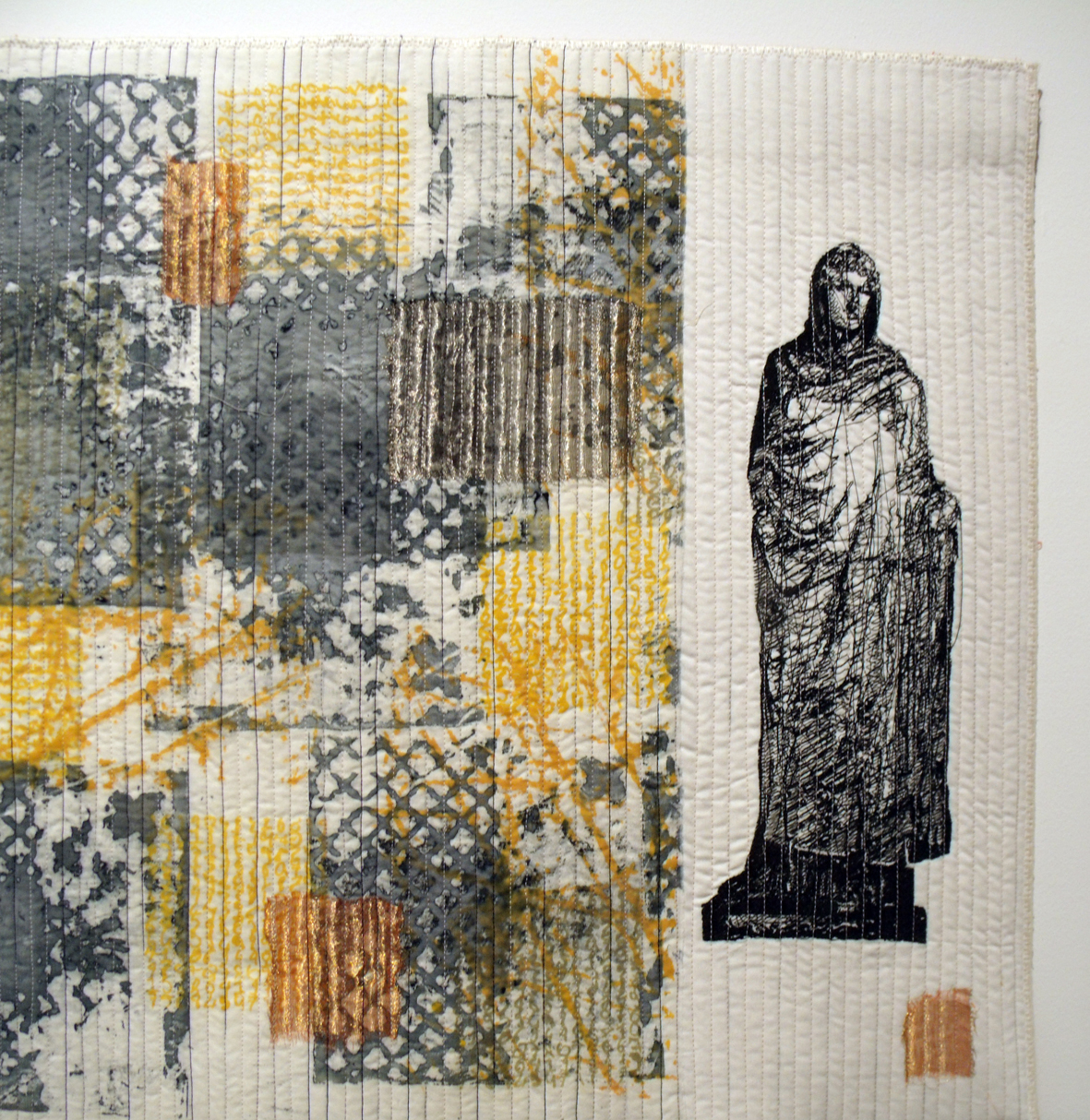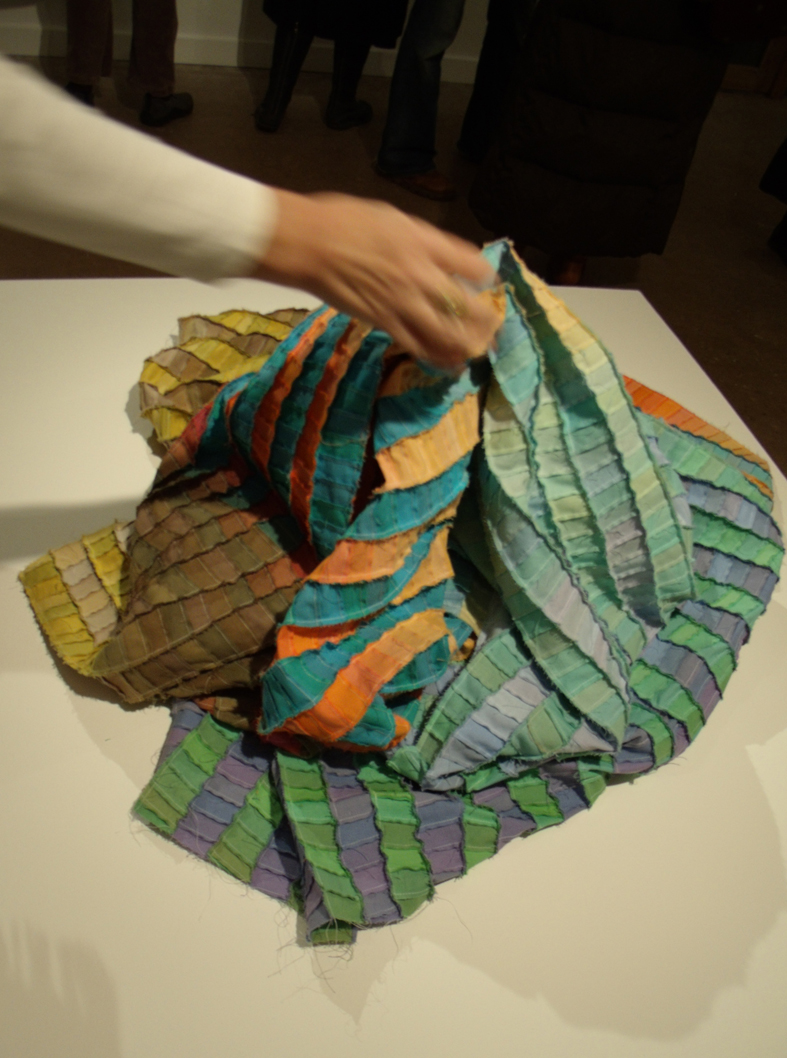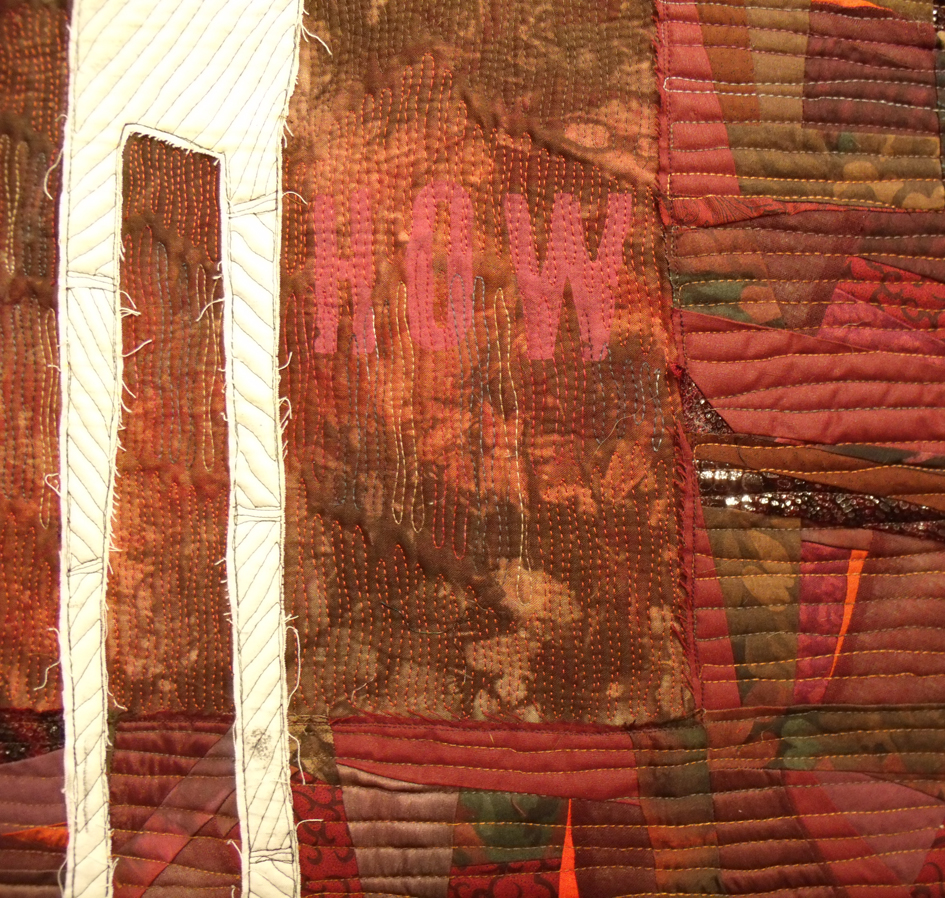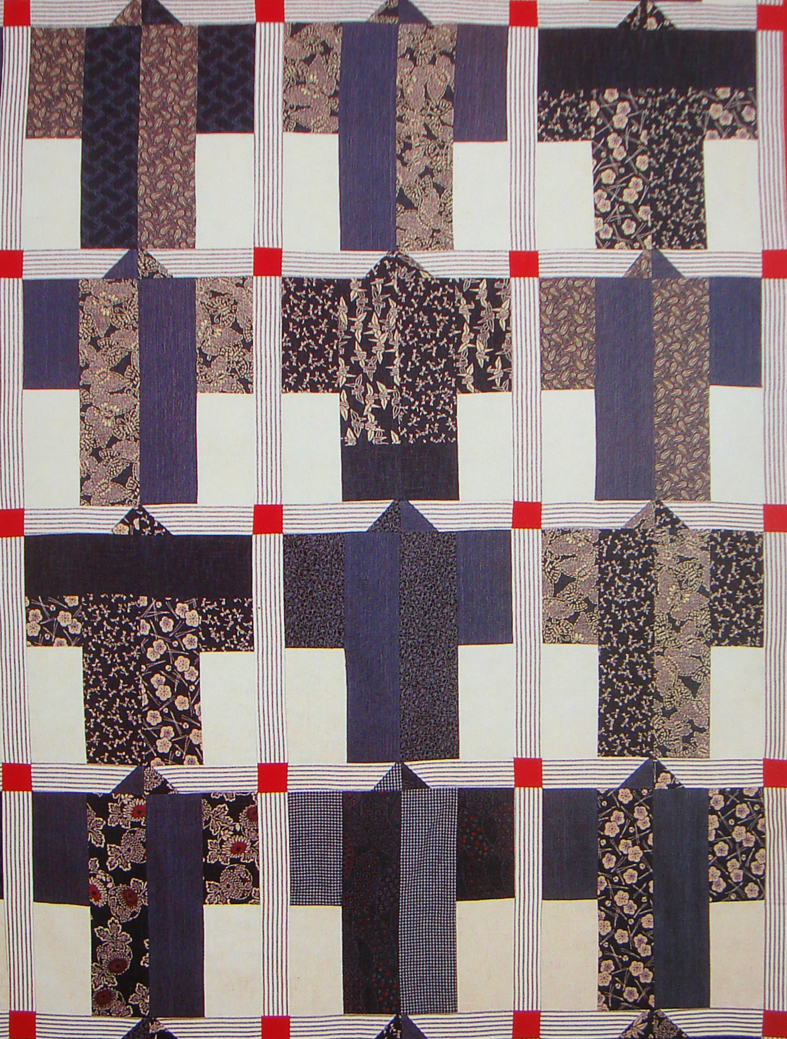
Voices, The Quilt Art Group

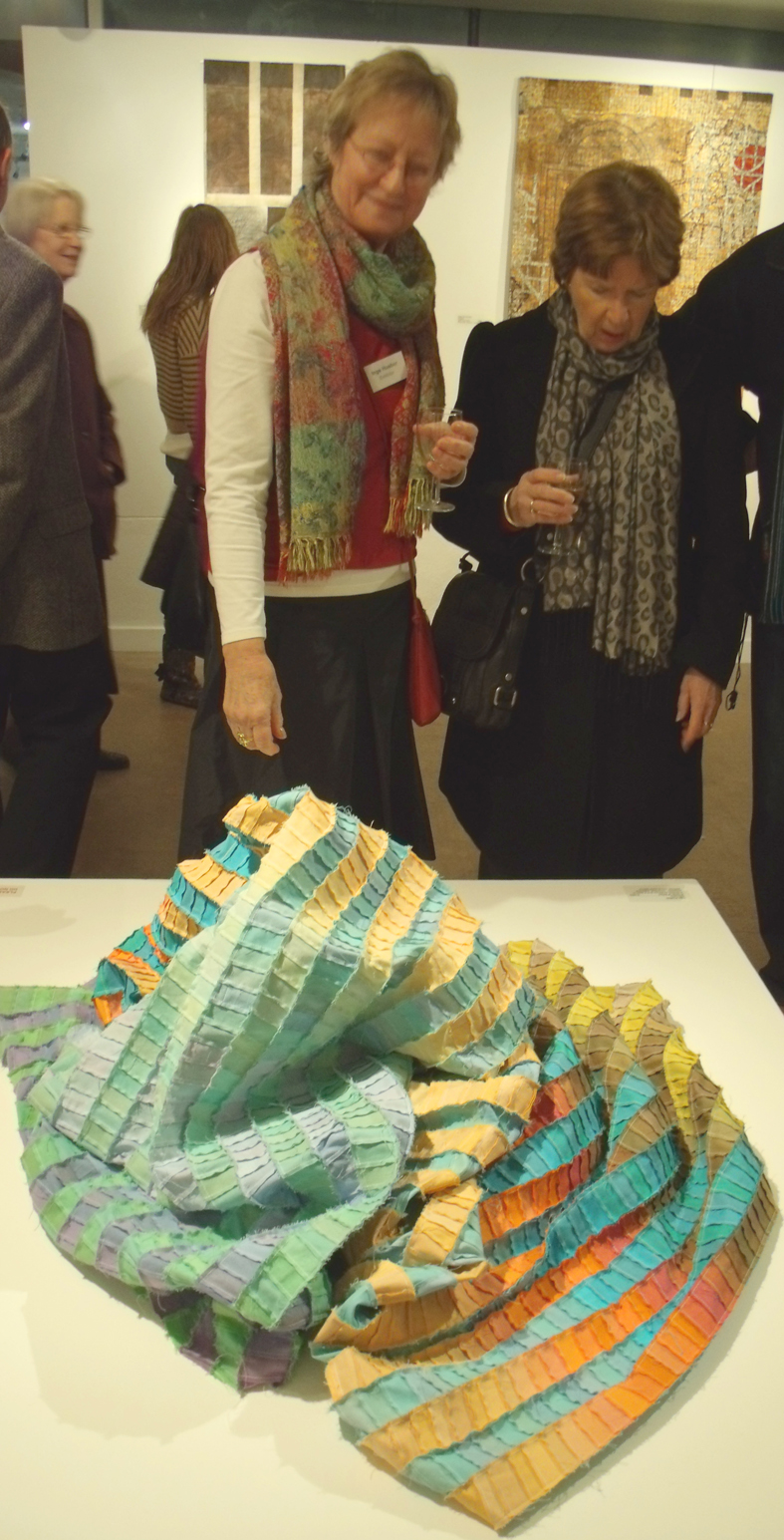
My new year’s resolution was to get out and about a bit more so when I was asked to open an exhibition of quilts at the Devon Guild Craft Centre at Bovey Tracey, England, I said yes, even though I was a little daunted. However several people asked if they could have a copy of what I had said to publish on their various websites, and I thought well why don’t I blog it? So, here it is.

” When I was first approached by the Devon Guild to introduce this exhibition, I could not imagine why I had been asked! But when I checked my diary for the day’s date I felt a little more adequate for the task – I was scheduled teaching a Crazy Patchwork Workshop at my new textile venue, Heart Space Studios in Bristol. Patchwork Quilts, like Japanese Kimono, are for me the epitome of textiles – perfectly useful art objects.
When looking at the catalogue for VOICES and the Quilt Art Group’s website, what first impressed me about the group is that this international organization has managed to keep successfully connecting and exhibiting together for nearly 30 years – this is no small achievement. At present the group members live and work separately across several European countries and America. What they all share is the universal language of stitch, and speak it in the dialect of quilt.

It is now common practice for artists to use whatever materials they feel appropriate to express their ideas. Indeed any art establishment abreast of the times and at ease with itself takes the use of mixing media and genre for granted.Without naming any of the usual suspects, the fact is that quilts and large – scale fabric installations are now widely accepted as a vehicle to relay an artist’s inner vision.

But this was not the case in 1985 when the Quilt Art group formed and stated that its intention was to ‘deliberately make quilts as an expression of art….and to extend the boundaries of quilting as an artistic medium and achieve wider recognition of the quilt as an art form” .  this surely demonstrates that it was a pioneer in bringing about the changes we take for granted today.

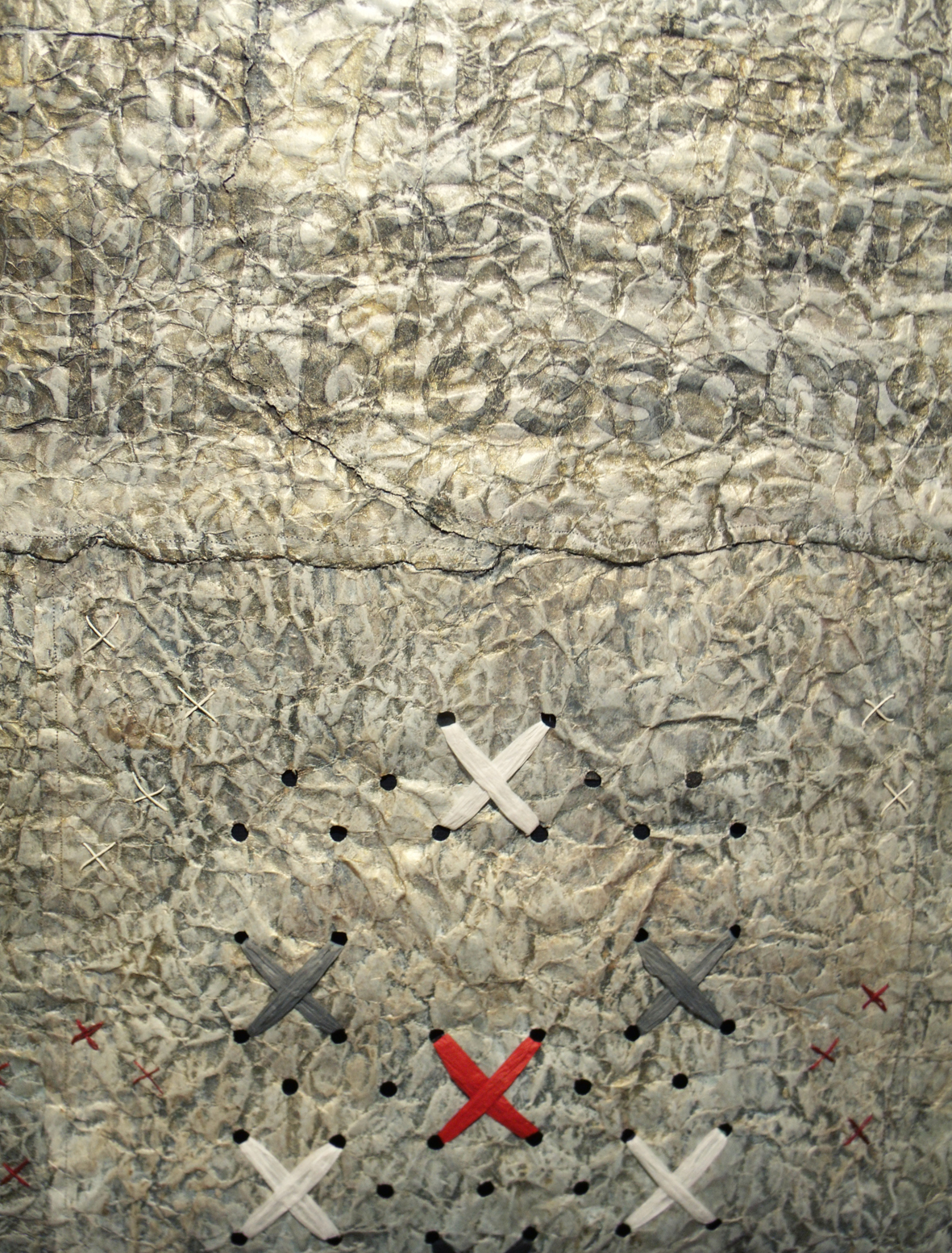
By using an extended range of techniques, materials and tools associated with traditional quilt making the group aimed “ to create non-functional quilts to be displayed for their visual aesthetic; coupling integrity of expression and quality of craftsmanship.” The work here is as much a statement about craftsmanship as it is about personal expression.

It visually and sensually demonstrates many successful examples of that wonderful moment of transition when putting different materials and techniques together, the disparate things become whole.

These fabrics have attained their integrity by fusing together a variety of several textile “languages”. Here we see evidence of the traditional craft skills juxtaposed with today’s technologies. The fluency with which different techniques are used to make one whole piece enables these works to be studied long enough to be “read”. The rich and varied surface sustains the viewers’ interest so that slowly more subtle meanings are revealed.

Reading the group members’ personal statements it becomes obvious that  choosing textiles for a means of expression is not happen – chance

Mirjam Pet-Jacobs  writes

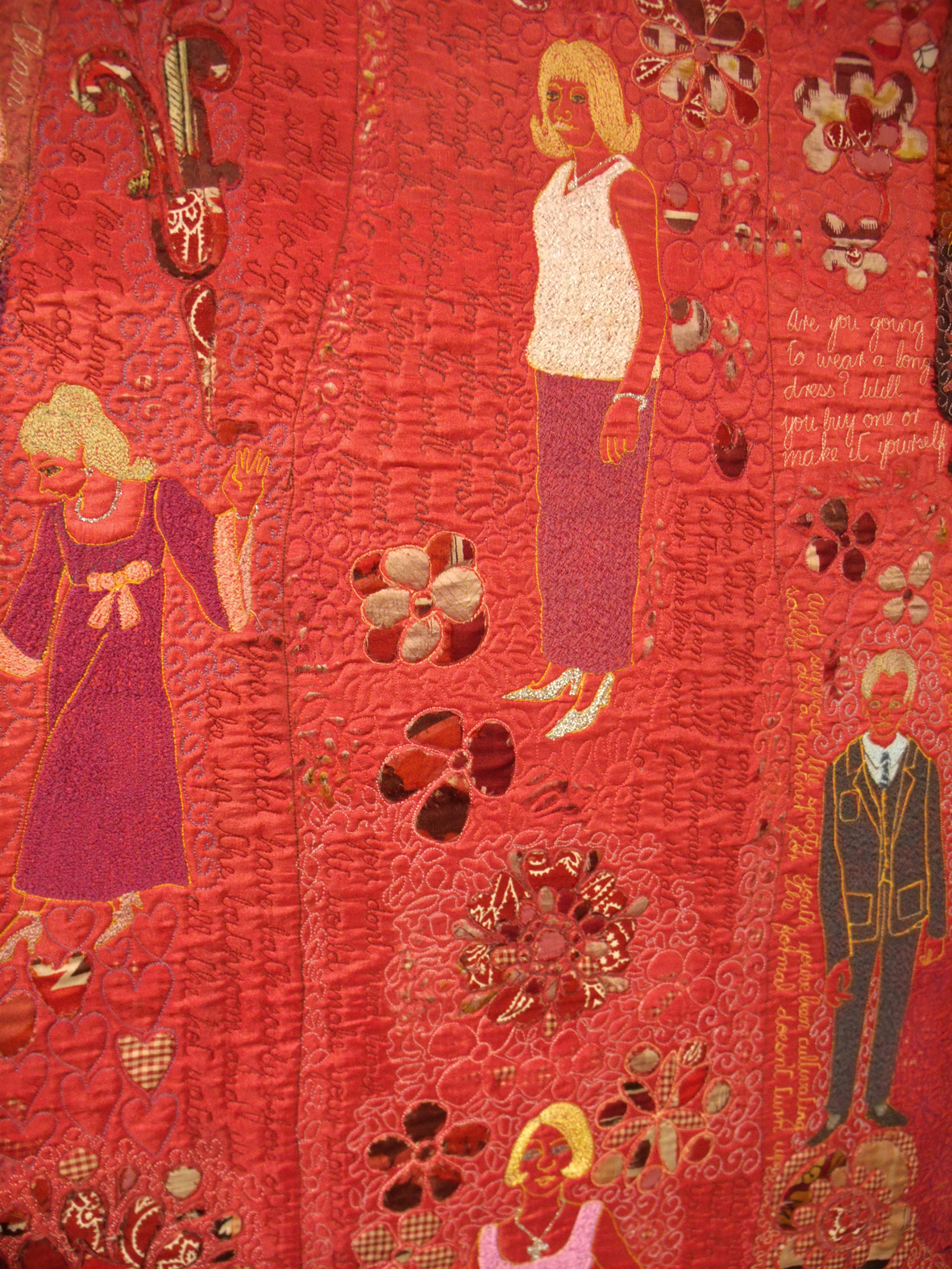
“ Maybe because they are so commonplace, textiles have the enormous power to both evoke recognition and to tell stories “ and several of the artists talk about “ storytelling”

Elizabeth Brimilow in her personal statement says

“ Fibre has been grown, spun, woven, dyed and stitched for thousands of years. I stitch and manipulate cloth, which is used for its tactile quality, its intimacy and its substance. Through my hands I have a story to tell and this connects me to other times, places and cultures.”

The meaning contained within the making is as important as the choice of the right tool for the right job, or put it another way; being in command of a range of technical ability gives the maker infinite choice to find the telling means of expression whatever the message. To develop a level of craft practice so that the actual means of production stops being the first, and sometimes the only thing to notice, takes much time; we now talk of 10,000 hours to attain fluency in any skill.

I stitch by hand and I am aware that time must be spent in a state of concentrated repetitive making to achieve fluency. It isn’t so much the precision of stitching, it is rather the rhythm that has to be established to enable a maker to sustain a large piece of work over a long period of time. Whether making by hand or machine an almost meditative state of mind needs to be attained to complete most large -scale work.

To quote Richard Sennett,in his book ‘The Craftsman’

“ Built into the contractions of the human heart the skilled craftsman has extended rhythm to the hand and the eye.”

And as Inge Heuber  says on her web site

“ you understand best what is created by your own brain and heart. “ and she also writes of “waiting for a special rhythm “ to start before she works.

This exhibition of quilts is varied in its subject matter, and outcomes. Some works are expressions of emotions,

some are personal memories….

some overtly political, and sometimes they just appear to have been made for the pure joy of colour and tactility.

But by and large they have been produced with enough thought, innovation, knowledge and craftsmanship, to achieve a piece of work worthy of contemplation beyond the overall quality of its making – which is surely what differentiates art from craft ?”

When I had looked at the actual exhibition, (I had only researched the catalogue and the individual artist’s websites) I certainly could have written a great deal more and about other connections and ideas that flowed from this work, but close readers of my texts will recognise quite a few of my favourite themes are here so I let it stand.

Heart Space Knit and Stitch Club

Debbie Bird’s embroidered landscape

The new Heart Space Knit & Stitch Club had its second meeting with a “Show and Tell” session, meaning everyone was asked to bring a piece work, preferably textile, either something or their own making, or something inspirational, held memories that they could talk about.

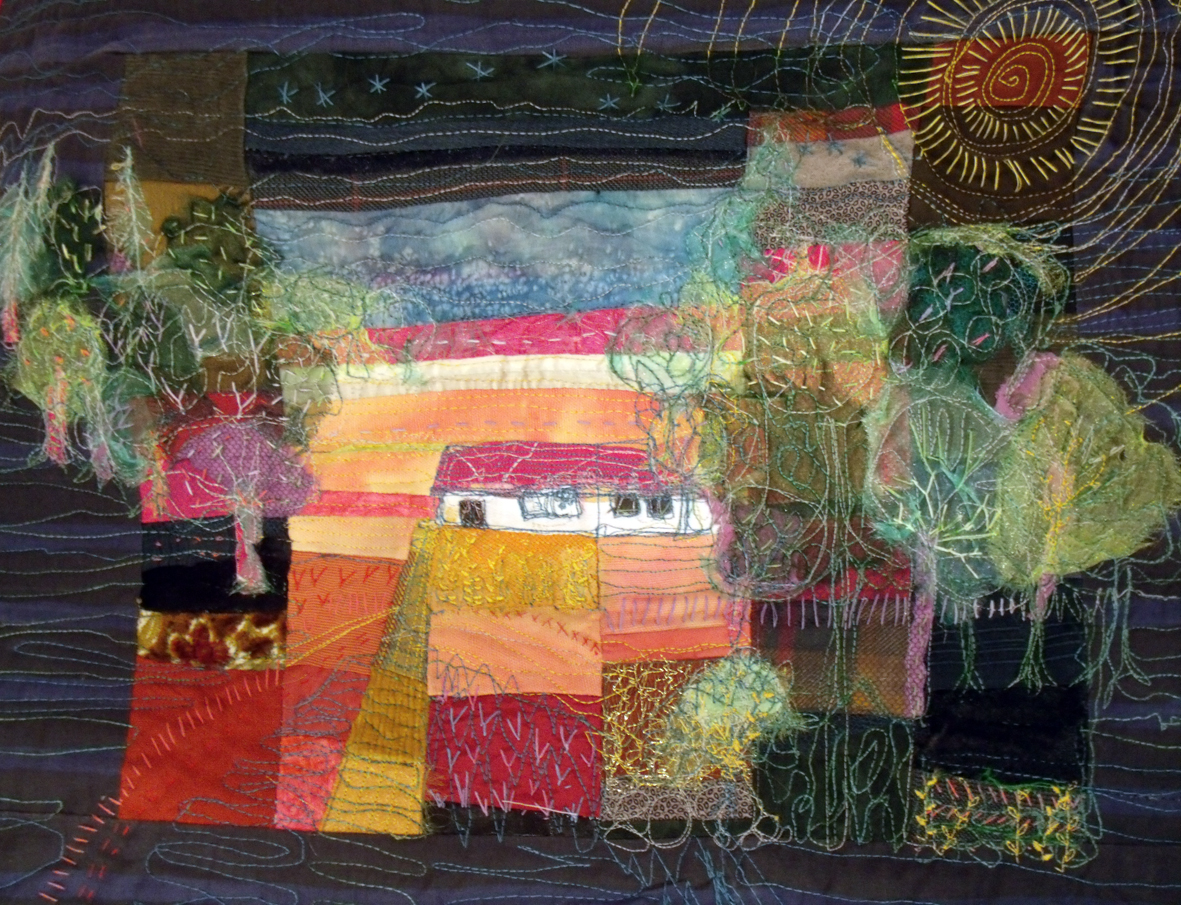
Debbie Bird, who is one of the our regular tutors ( and has agreed to be a leader for some of the club’s stitching sessions) showed 2 completely different textiles. One was a richly embroidered, patch-worked landscape that she had made at a weekend workshop run by Ineke Berleyn the colours sang out and Debbie told us that she was thought it very inspirational as she had lots more ideas to develop from this workshop. The other piece she had brought could not have been more different…

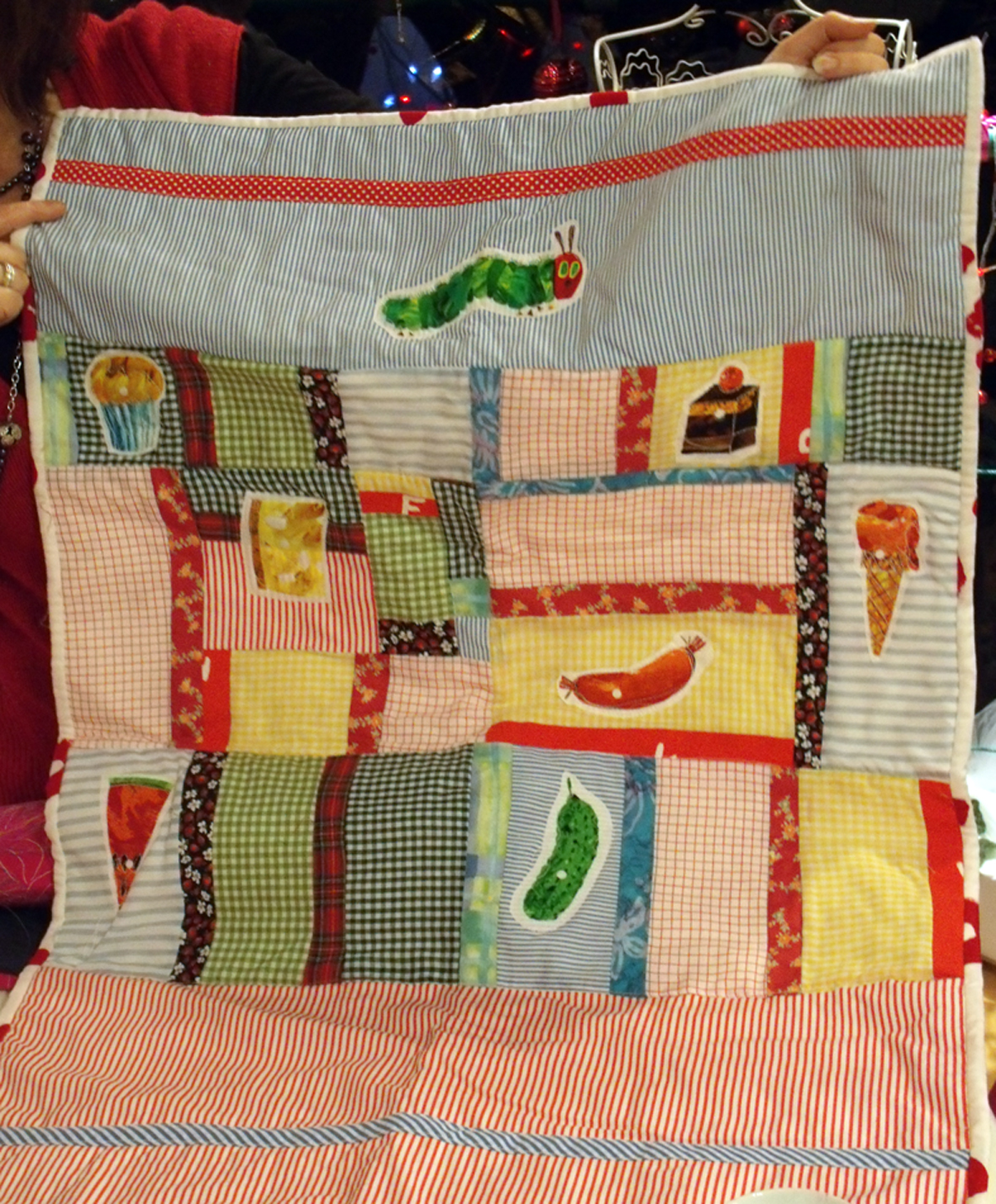
Debbie Bird’s patchwork quilt – the Hungry Caterpillar

It is a patchwork quilt made for a child, out of scraps she had left over from patchwork commission; she just pieced it together from what she could find quickly and because she enjoyed making the first quilt so much. What I liked about her ‘show and tell’ was that she showed 2 sides of her work,  she brought them to explain that if you love textiles you tend to love all manner of different textiles, so the club should be varied in its approaches to what we have to make together.

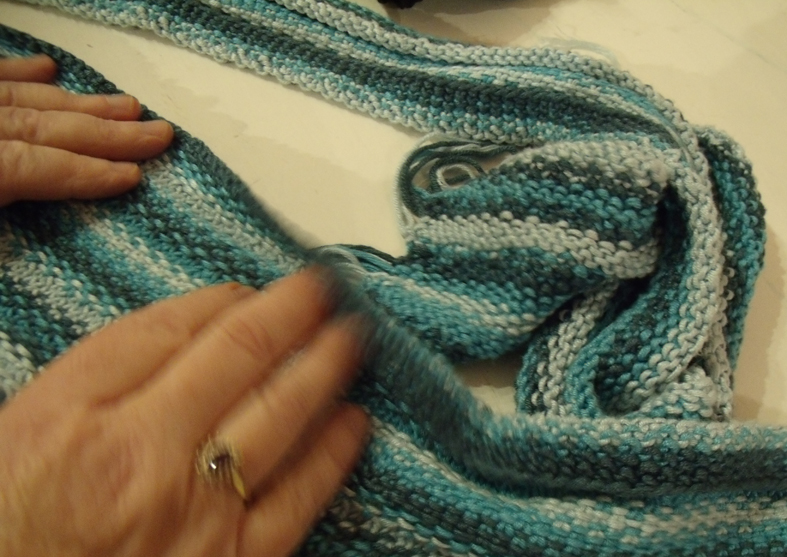
Clare Griffel’s knitted scarf with rolling edge

Clare Griffel who is also a leader for the club, showed some very simple knitting, a long scarf knitted lengthways to look like a woven fabric, and talked about the problems of casting off. The method she had used  for this was too rounded and caused the scarf to roll, this started her on a quest for different methods to achieve flat edges – something she will be able to help others with on the knitting nights.


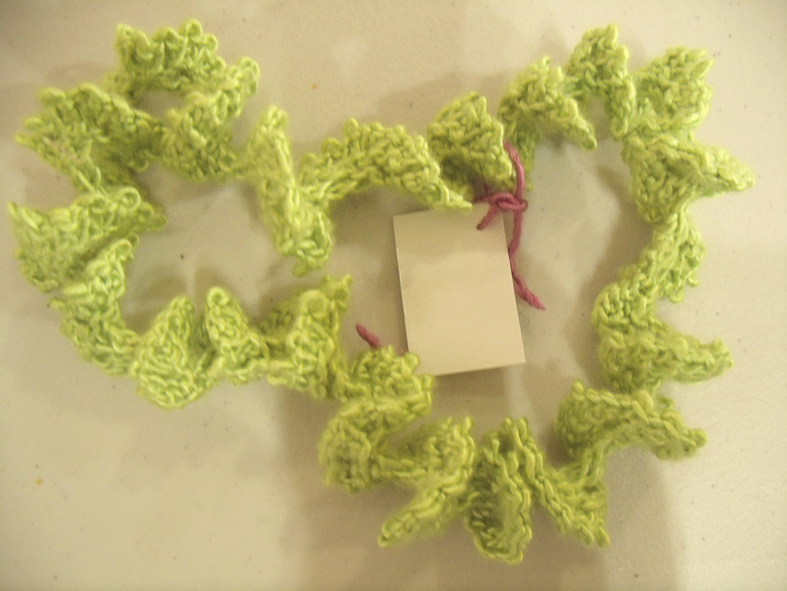
Knitted silk necklace

But she also brought a purposely rolled piece of silk knitting that makes an unusual necklace (we sell these in our shop Space) and everyone including the stitchers wanted learn how to make this. And she showed a book that had inspired her and recommended to us all, an knitters almanac by Elizabeth Zimmermann, I will get more details about this at the next knitting session of the club.

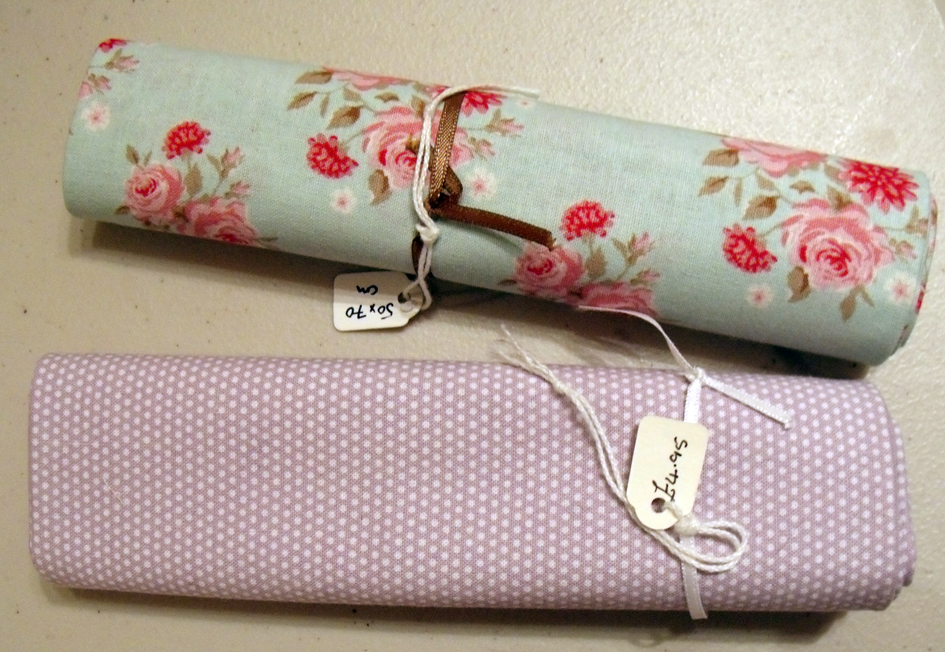
Not everyone brought along things they had made, Clare showed us 2 lovely rolls of cotton she had bought from my favourite Bristol craft shop, Creativity,  she intended to make summer bunting with it and we all agreed we would have been tempted by them as well, they were so beautifully but simply presented.

Sophie showed some images she had learned to print onto fabric at a recent series of Teresa Searle’s evening class at Heart Space, she intends to embroider into them.

Sophie’s choice – sorry – couldn’t resist it.

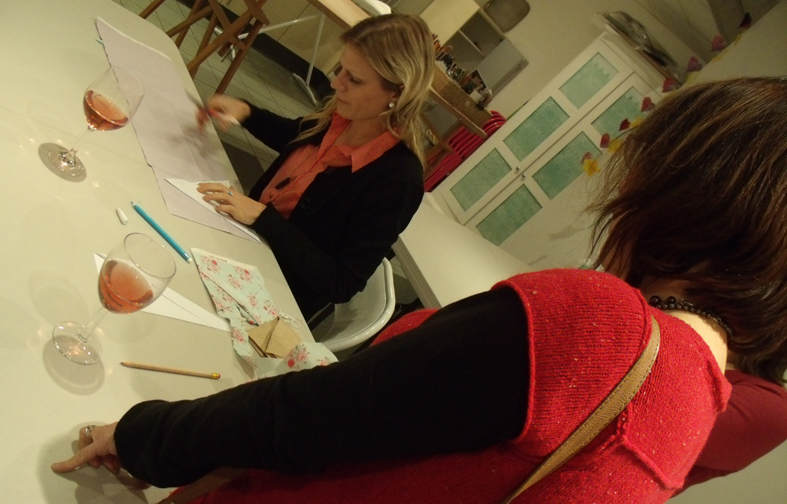
After the ‘show and tell session, both Clare and Sophie went into the large studio and started making…with plenty of pink fizzy fuelled advice from the rest of us. Yes I know that we shouldn’t have a drink on the work table but it was a pre – Christmas get together.

Debbie gives bunting advice to Clare

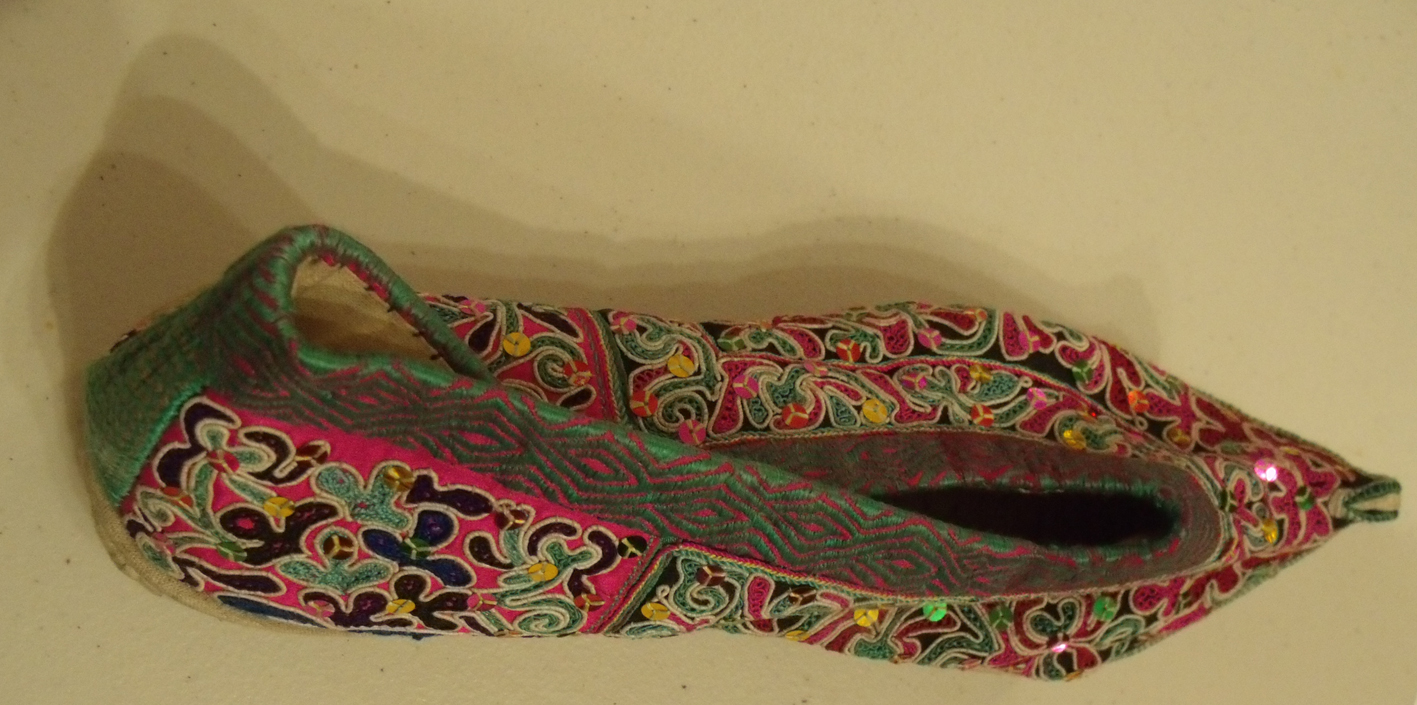
Meanwhile we had other wonderful things to look at, Jan Connett, a stitch club leader showed embroidered shoes she had bought in rural South West China….

embroidered Chinese slippers, the insoles have flowered fabric to tread on.

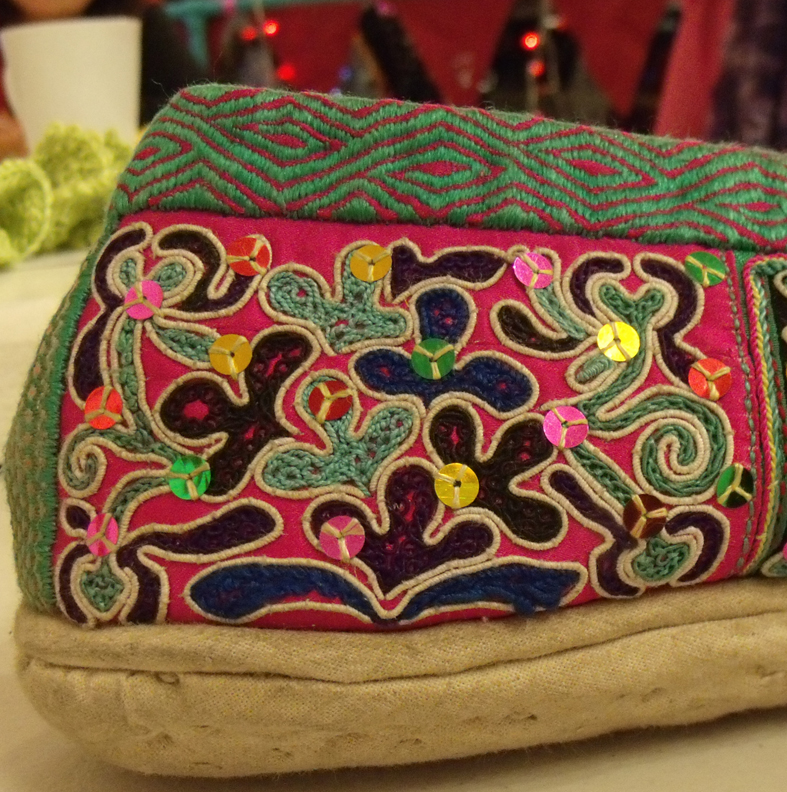
we were all intrigued by these and spent a long time inspecting the needlework, including pattern darning, couching, chain stitched fillings with heavily quilted soles, everything hand stitched and then sequined!
detailed view of the brilliant embroidery

Then another embroidery made at a workshop, Carol brought in a proper old-fashioned needle-case, made at a Kelly Aldridge class.

proper hand embroidered needle-case by Carol Clarke

I am very intrigued in who goes to classes and who doesn’t – I don’t, it has never occurred to me go to another embroiderer’s class (except when I check into Heart Space classes) I just go to books or museums to study other embroideries for information; maybe I am too insular in my outlook. I have however gone to many other types of workshop in pursuit of my own development, jewellry, metalwork, enamelling, photography, all things I can’t imagine how to do at home alone.

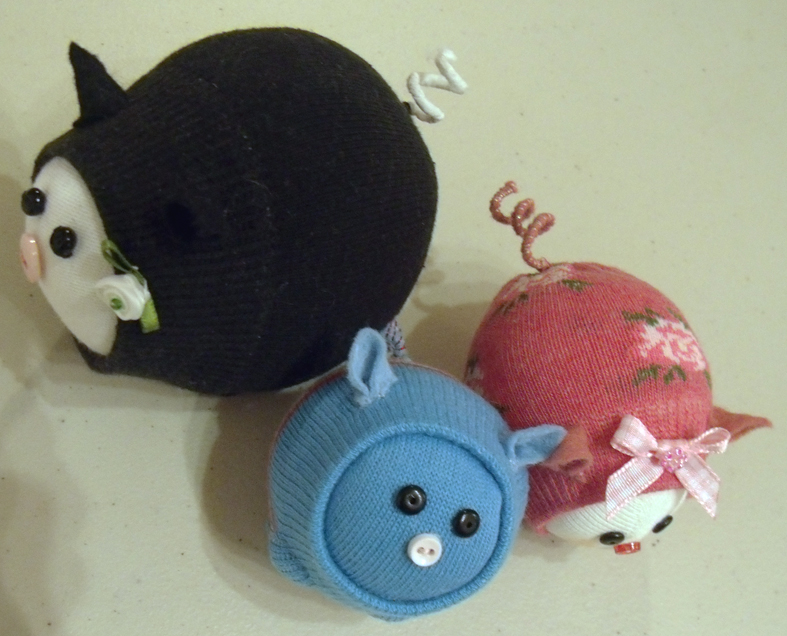
But a real advocate of workshops, particularly ours, is Libby, she couldn’t make our first workshop so sent her sister instead, and then using the diagrams and notes that I had provided for the mirrored hearts, brought in her versions and also some sock pigs….she was laughing, rather sheepishly, as she was pulling these out of her bag  – it must have been my face – what on earth was she going to show us – here was I thinking how wonderfully eclectic everything has been and now – Sock Pigs?

Libby Butler’s sock pigs

Well what a surprise, they were adorable, and what is more very exquisitely made. Libby is a really good needle woman, she had re-made the pinned and beaded heart some months ago so I know how much care she takes, but these funny little pigs were her version of some she had been taught to do elsewhere –  I especially liked the tails….

backsides of Libby’s pigs

and what did I show?  Well they are things already contained in the blog the mended white Edwardian blouse from my very first post and the Bleeding Flowering Heart. which is in the Heart pages. I am so looking forward to the stitch club developing, we seem low on knitters and this is reflected in the post. But next time I will redress this and concentrate on the knitting members. We plan to meet every week on a Thursday night  so there should be plenty to report on judging by the variety shown by members at these start-up sessions.

Drawing Embroidery

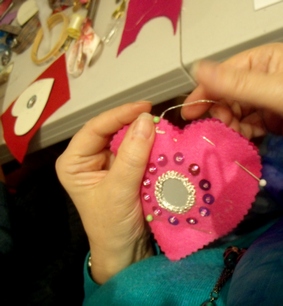
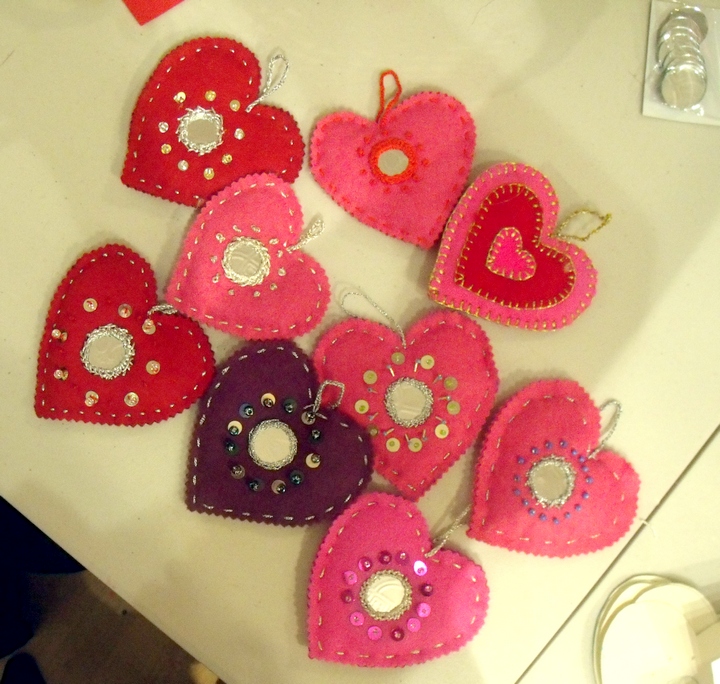
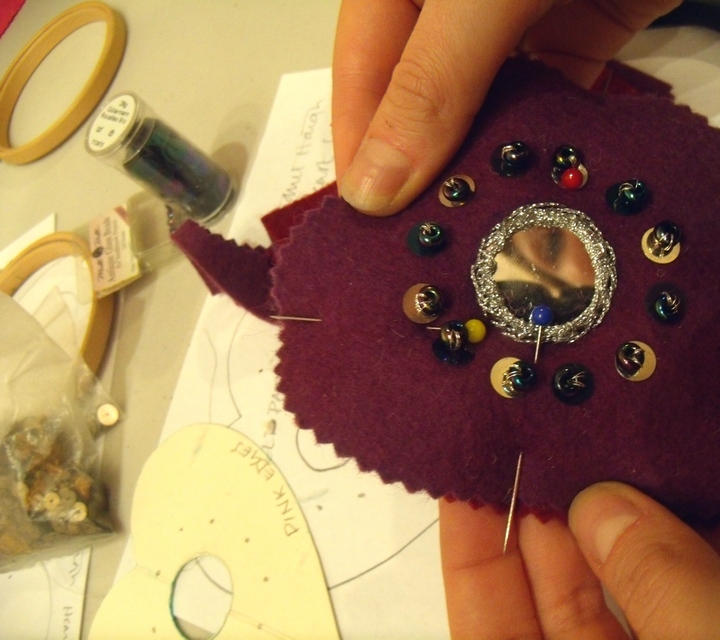
This little heart has been made for a project for the new Heart Space Stitch Club. I designed several small felt hearts that could be made in an evening and taken home. I offered everyone a choice of colours between bright pinks and rich reds with sequins and beads and silver thread embroidery, it is Christmas after all.

One of the makers was amused at the frivolity of her choice of materials, excusing herself by saying it was a only a gift for a child. But then I explained that she had made a perfect symbol for protecting a child, the heart is now a universal symbol for love and the mirror would divert the ‘evil eye’; traditionally shisha mirrored embroideries were used to decorate children’s garments

So imagine my feeling when looking carefully at the images I had taken throughout the evening I saw the maker’s eye gazing out of her tiny stitched mirror.

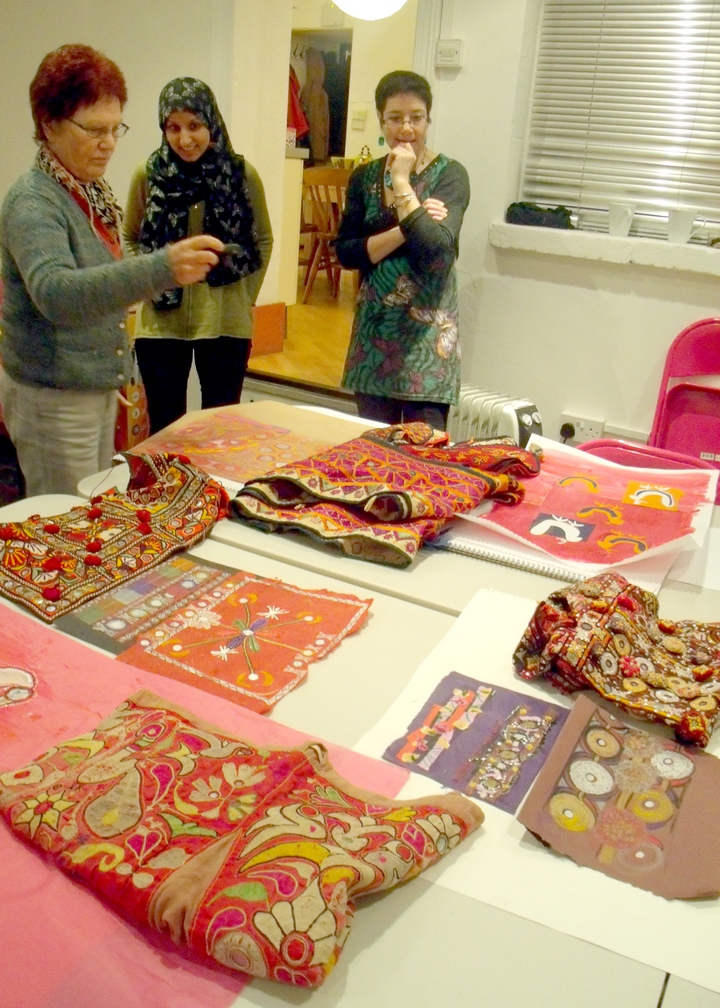
This struck me as the perfect way to introduce the collection of embroidered garments I had organised for the Drawing Club the following weekend.

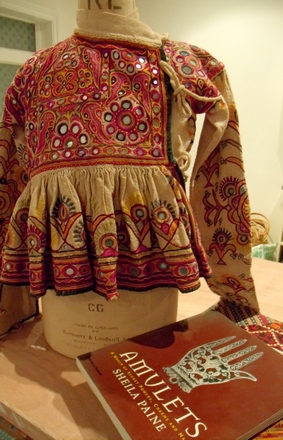
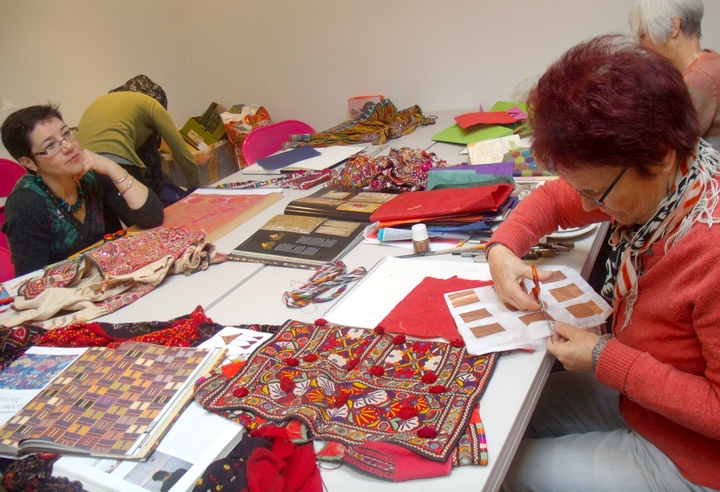
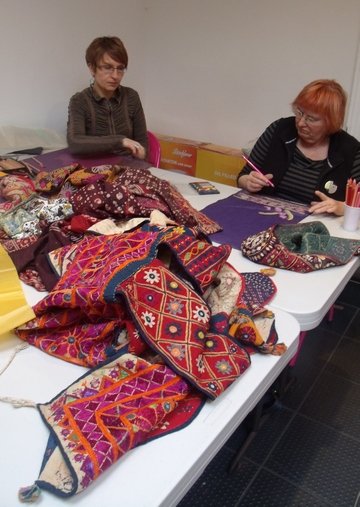
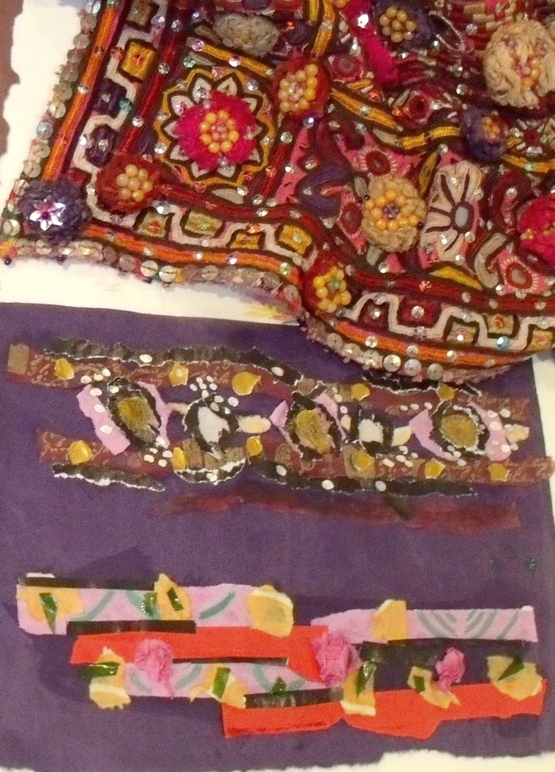
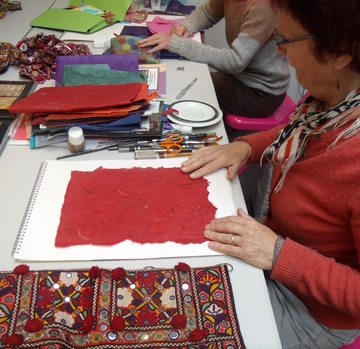
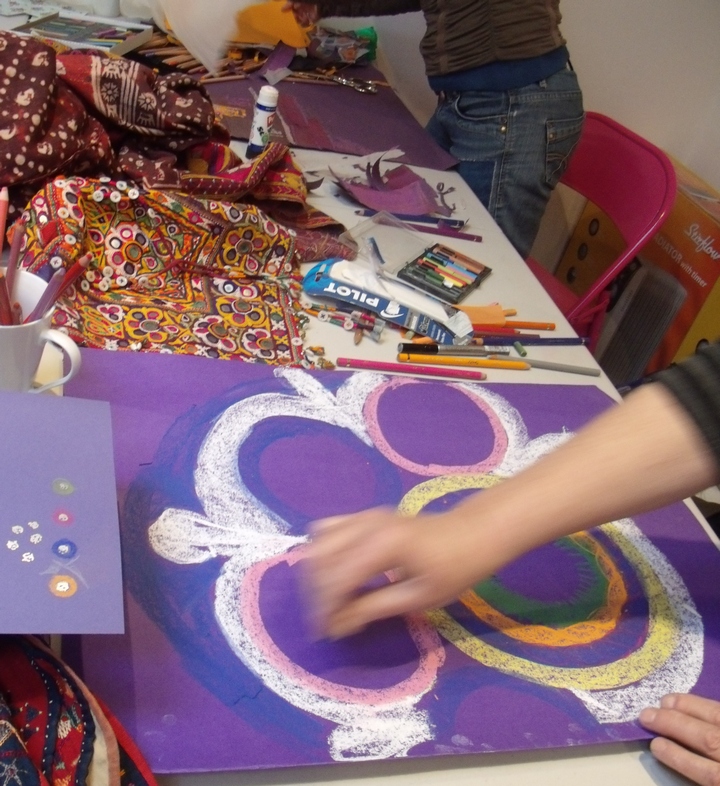
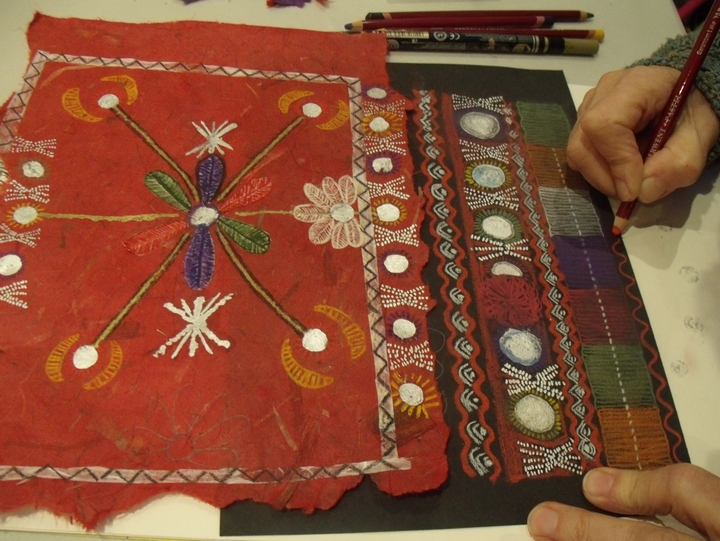
The fabrics I had chosen for the drawing class were an wonderful array of embroidery in wools and cottons and silk and silver, mirrors, buttons, shells and coins on dyed and printed grounds, all made by hand and traditionally worn for festive occassions by people of the desert communities in Pakistan and Rajahsthan and Gugarat in India. I had also brought in some books that deal with the symbolism for these fabrics, amongst them one of my favourite resource books, Amulets by Sheila Payne.

But where to start with such a myriad of pattern, texture and colour, I said to try to be faithful to the colour and the students soon set to work colouring and cutting to form backgrounds for the detailed drawings.

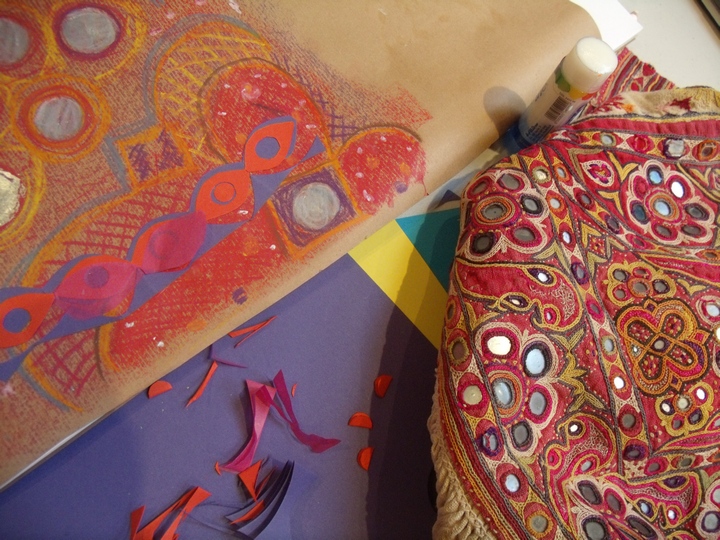
These are all worn and faded fabrics, so some of the first studies were surprisingly subtle, chalks applied to darker grounds give a broken faded effect. For the first exercise I asked the class to describe the embroidery in as much detail as they could, just to get them focused. This is after all, primarily, an observational drawing class.

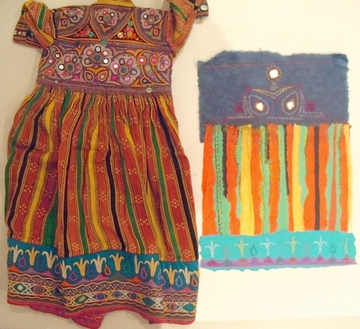
Describing the details made lively descriptive drawings and collages. I liked the inventiveness when students started to make 3D collages for describing tufts and fringes.

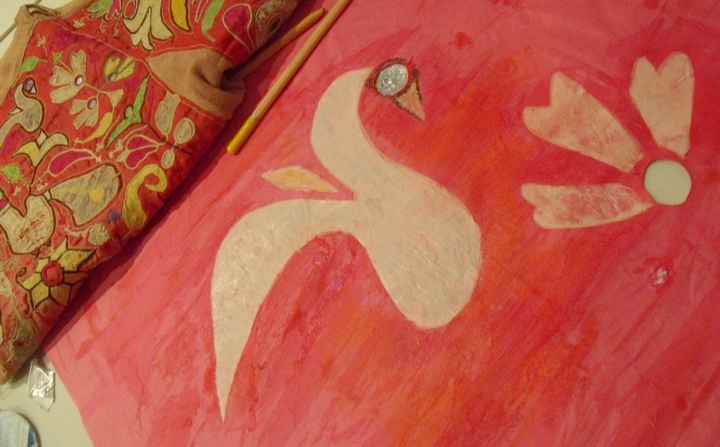
However not all the colours were difficult to attain, several people had brought in their own materials and some of the hand-made papers were really good colour matches. As one member of the group had requested a workshop featuring collage I had provided lots of coloured tissue papers with paints and inks in silver, plus silver- well silver coloured, metal leaf.

Then the drawings, themselves  started to become collages, so they were being made in a similar way to the fabrics – by being separate pieces stitched together and then embroidered.

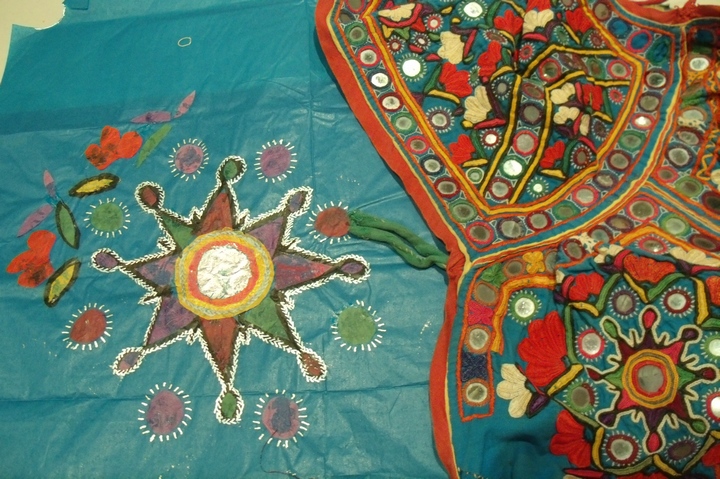
I had asked the class consider how to recreate the effects of the light bouncing from the mirrors, several different techniques were tested, silver inks, paints, foils and fibre tipped pens, that all gave different results.

the application of silver foil was particularly successful at rendering the reflecting light.

There were several fabrics that were not mirrored, but with strong embroidery patterns that were developed into bold drawings.

and also some very large but subtle collages captured the beauty of worn fabrics

Eventually new and fresher studies started to emerge, the students were starting to express more than the look but also the spirit of the materials.

 But at the end of the afternoon, we looked at all the studies alongside the actual fabrics and were amazed at the way that they belnded together, it was difficult to tell which were fabrics and which papers, not the intention of the exercise but interesting, considering the free way in which the drawings had been assembled.

Commemorative Crazy Cushions Completed

2 Commemorative Crazy cushions

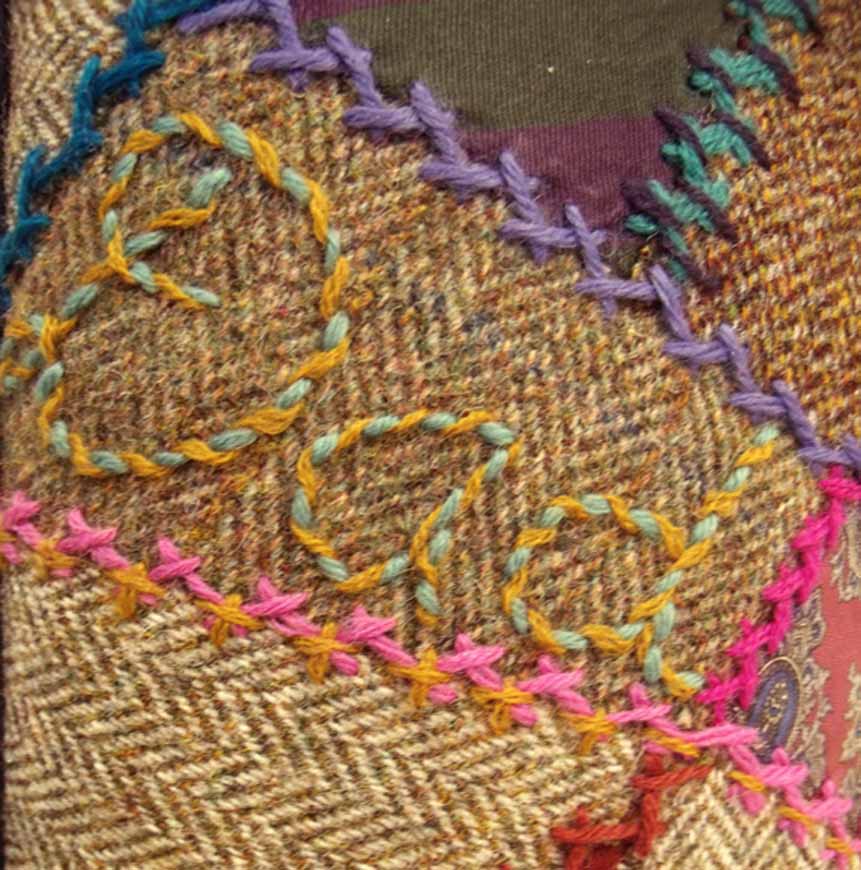
The most hits my blog has ever received in its entire life span of 18 months, was shortly after the Commemorative Crazy post, and many people contacted me saying how much they liked the content and story. So I was delighted when Jane called in to Heart Space Studios to show me the finished cushions that she had made in time for Christmas for her 2 children.

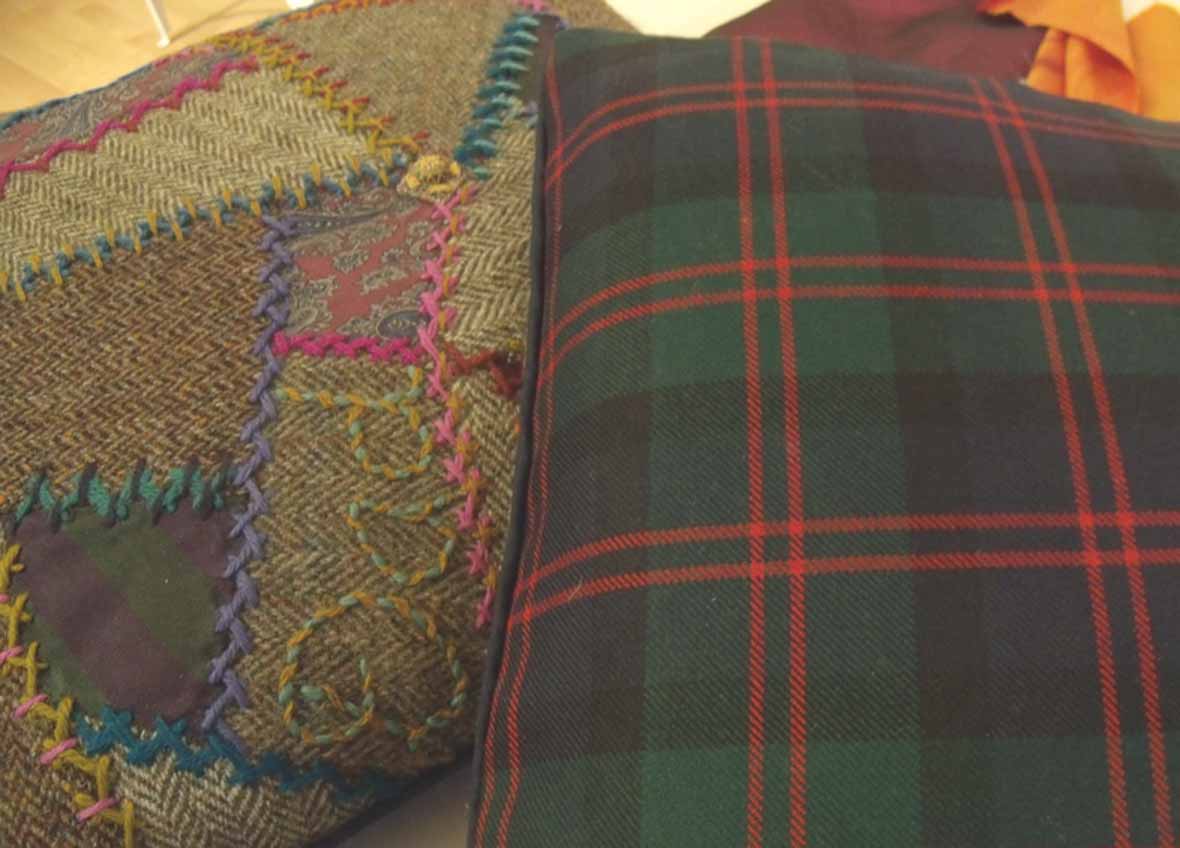
cushions showing tartan fabric backing

They were so beautifully made, using fabrics from her late husband’s sports jackets and ties, and Jane had been able to use the small piece of  tartan fabric, that was her husband’s clan tartan as the backings to the cushions. (did I say that I have a tartan as well – the Hay tartan – all brilliant  red and greens overlaid with a very noisy white check –  nowhere near as tasteful as this one)

close up of the lively wool plain and tied herringbone stitches

She had embroidered “DAD” on one, at her daughter’s request, it is in whipped running stitch, very subtle and almost merges with the tweed background.

whip stitched commemoration

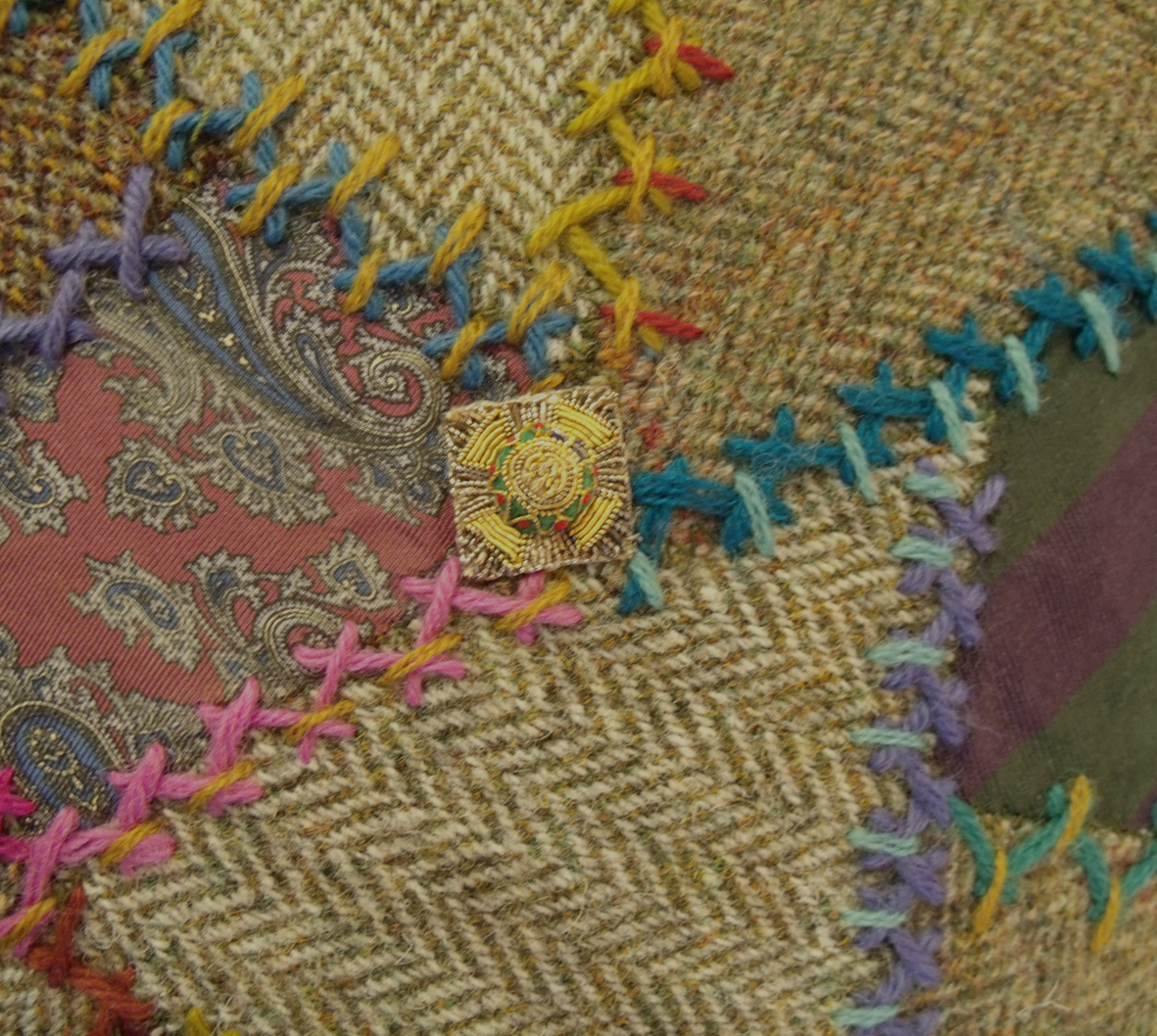
And amongst some other memorabilia, Jane found her husband’s  ‘pips’, these are badges usually in the shape of  a star or a crown and worn by army officers on the epaulettes of their uniforms.  These particular ‘pips’ are actually stitched onto fabric in  gilded thread so two of them they were put to good use at the seam joins of the crazy stitches. Usually a star is stitched  at such points by the embroiderers of the  traditional crazy patchworks.

gilded ‘pip’ used as a foil for the collision of several rows of embroidery

Jane has enough fabric to make another cushion for herself and even some smaller gifts for other members of the family…. and then she may decide to design and make the large throw from the remaining tweeds. I will keep a record of this progress.

Crazy Patchwork Class

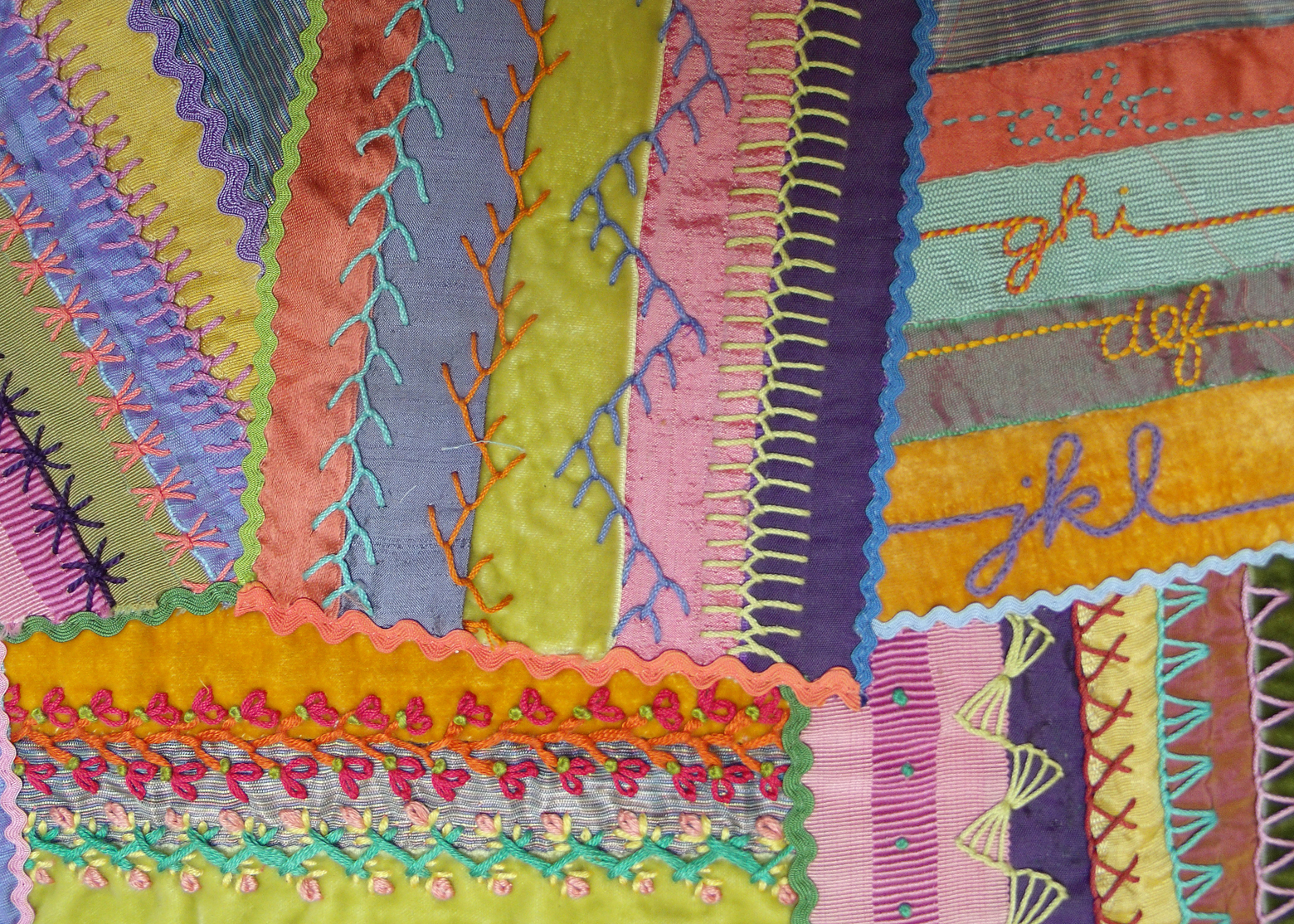
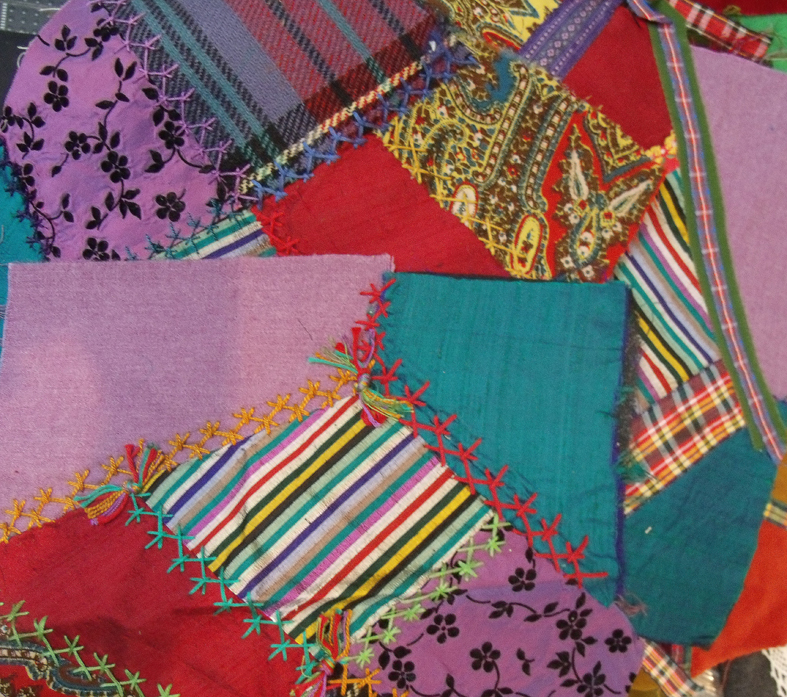
crazy stitch sampler

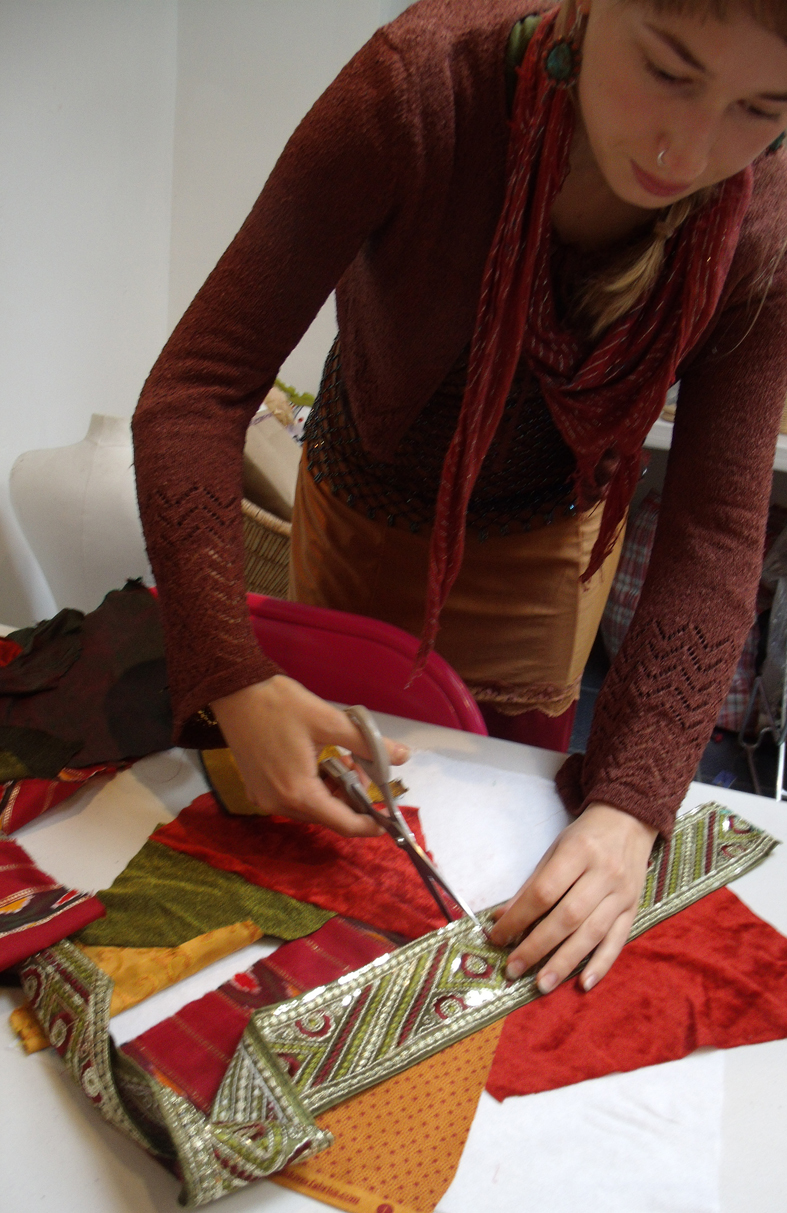
Yesterday I  taught a Crazy Patchwork class at Heart Space Studios. It was such an enjoyable experience I had forgotten how wonderful it is to just play with colours, textures and threads to produce a whole new seemingly haphazard fabric…and such a pleasurable way to re-cycle old fabrics.

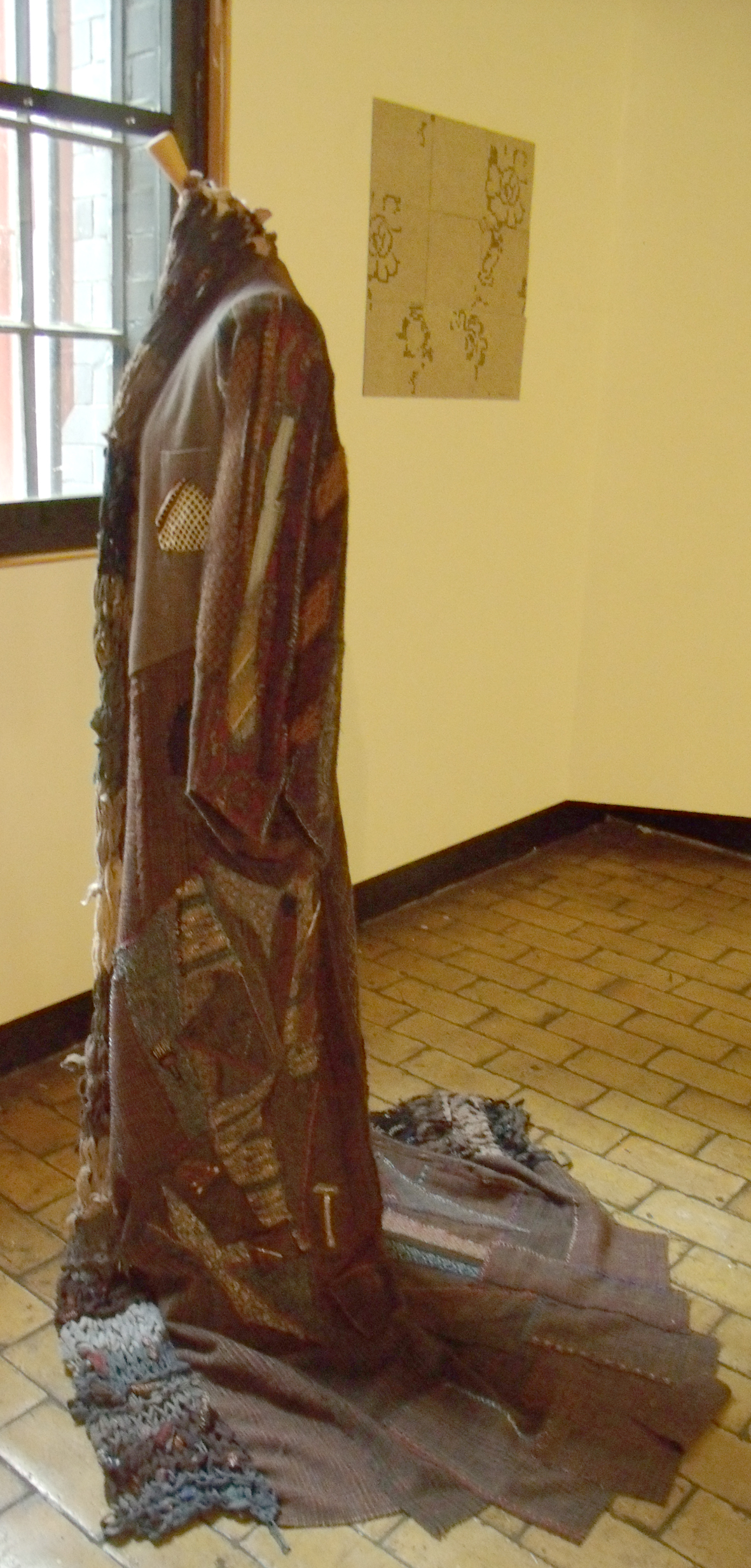
Sue Bradley’s Crazy patched coat

As it is not much made at the present time, I was really surprised and delighted when I saw Sue Bradley’s exhibit “My Father’s Coat “. At the weekend I had visited the TFSW touring exhibition, Material Actions in Bristol,   Sue’s coat had several areas of Crazy patches applied to the ground fabric but unusually she had used tweeds and  dark woolen cloths. The effect of the exhibit was very dramatic, it tells the story of her father and this is the response to her inheriting his  clothes and recently discovering them

This reworking for sentimental purposes is within the Crazy tradition of recycling precious cloths, but usually the preciousness comes from the quality of the fabrics, not the associations.

beaded and embroidered sampler

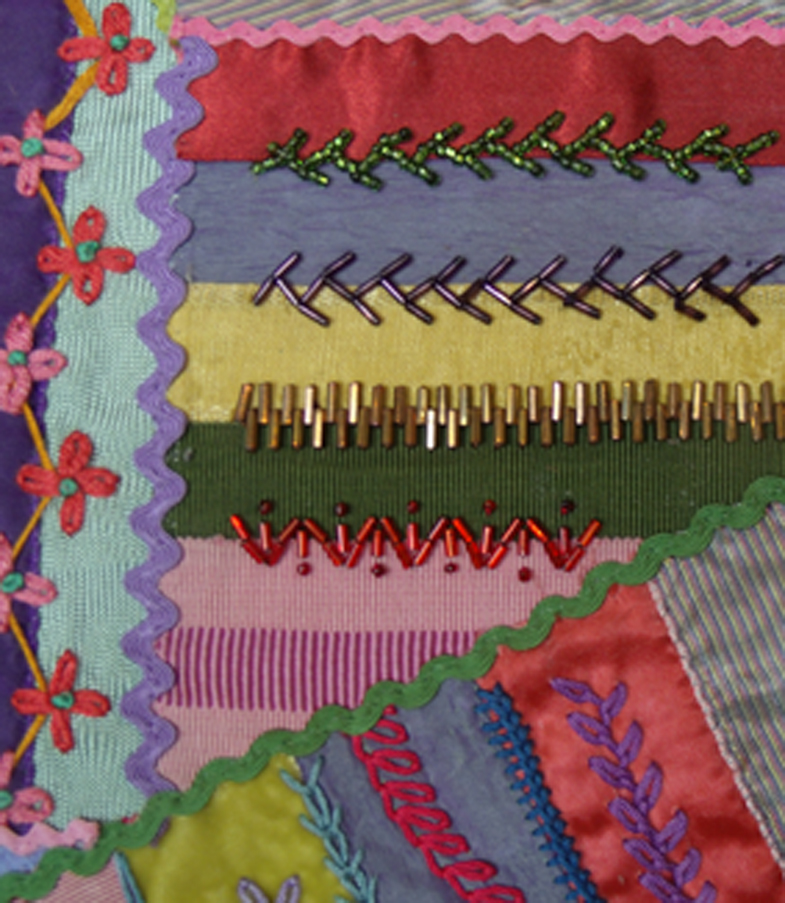
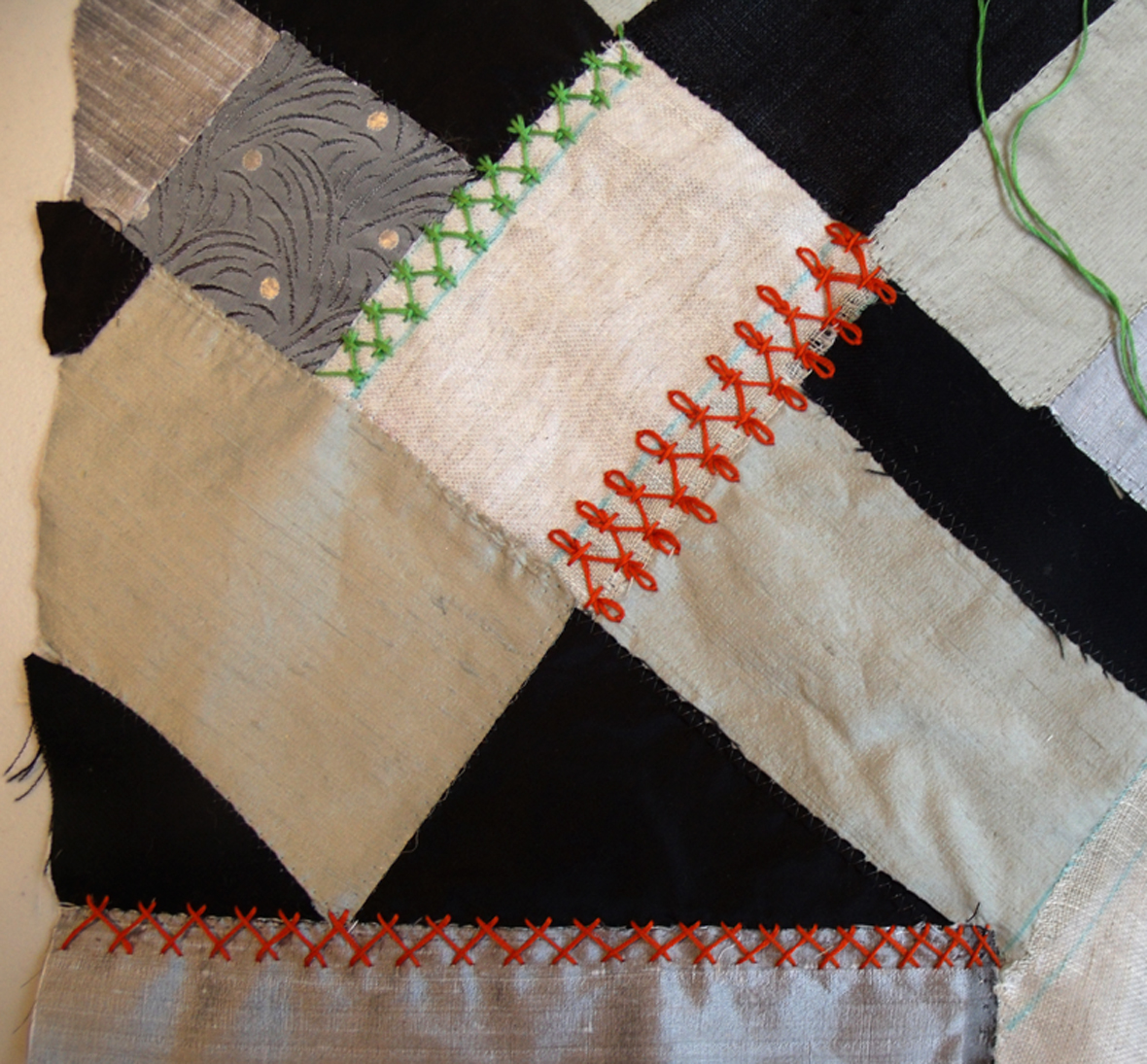
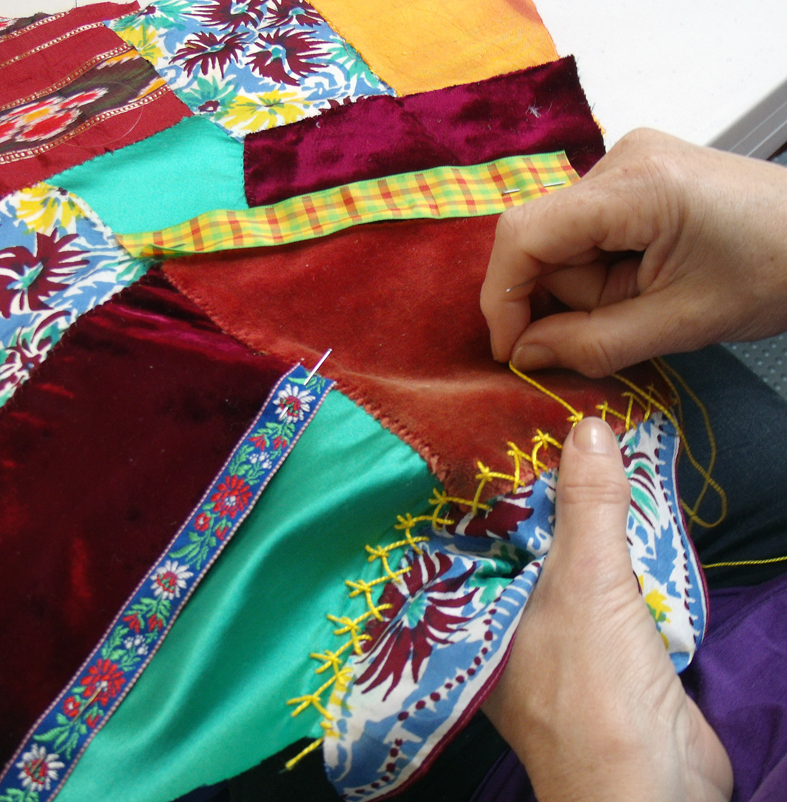
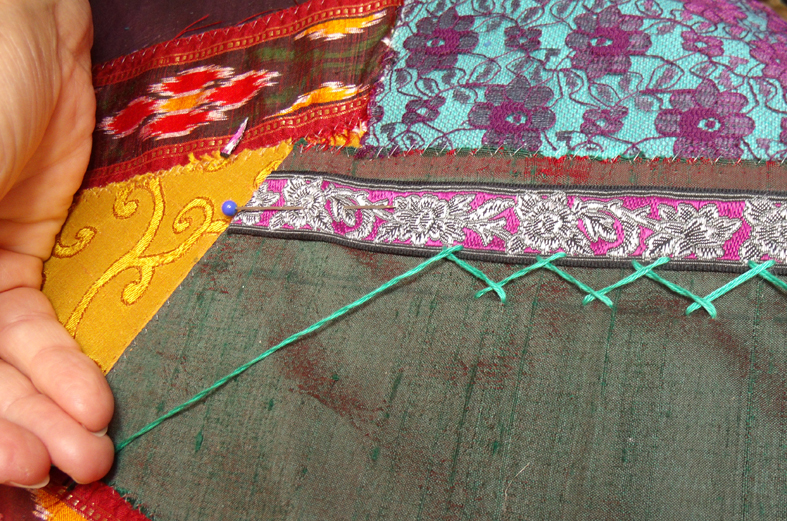
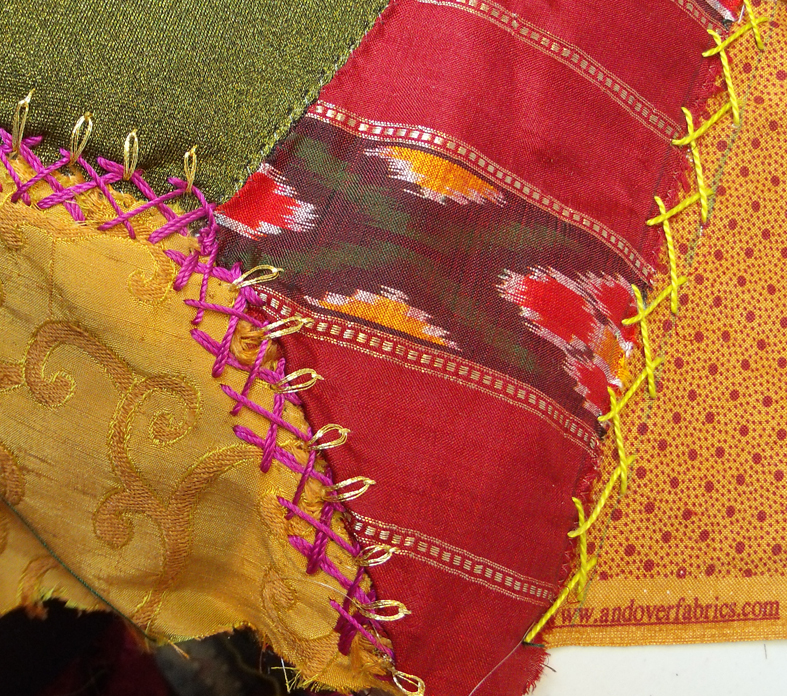
Crazy Patchwork (it is actually an applique process) was usually made from the most glamorous fabrics – ones that would not be able to withstand the wear and tear of domestic patch-worked  quilts and bed-covers. To add to it’s unsuitability for domestic use the overlapped seams are embroidered over  – which is its major attraction for me   – a case of more is more – not a popular concept for today’s makers!  However one of my first published books was about Crazy,  Collins&Brown ISBN 1 85585 641 7

Paperback book on Crazy Patchwork

 I used several of the samples from the book as illustrations for the class..

samples from  my Crazy book

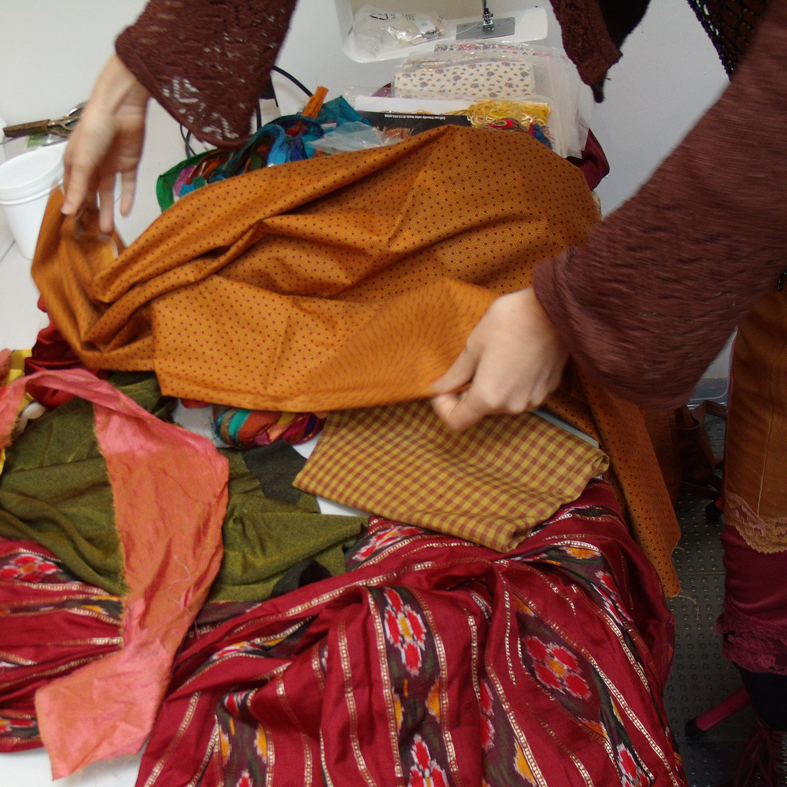
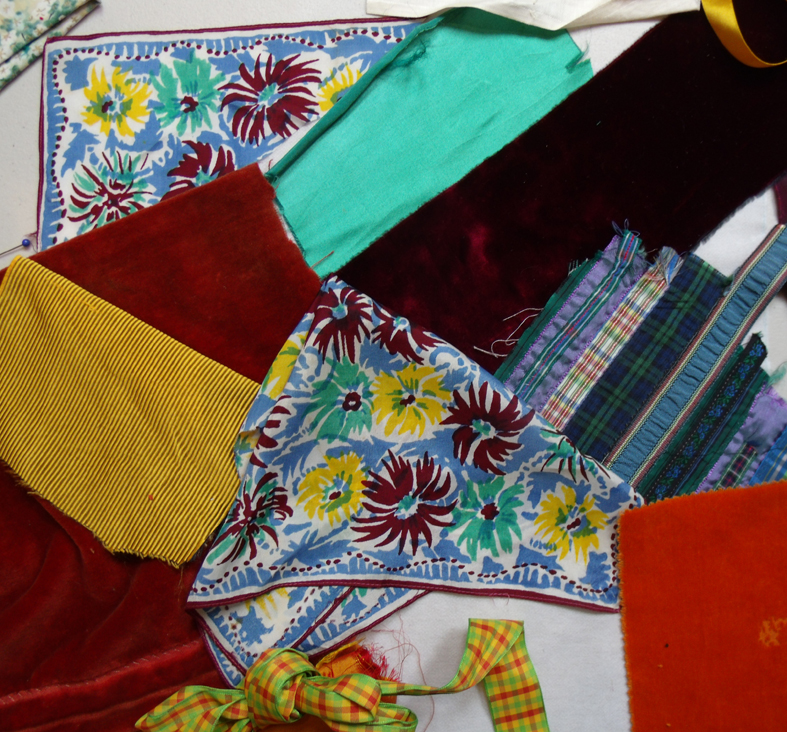
Getting started is a real treat as you just have to surround yourself with as much fabric as possible to choose a colour scheme  – even if only making up a small square to learn all the steps invloved.

some of the fabrics available for use at Heart Space

Some of the students brought their own stashes of fabrics and the swapping began,

Sophie’s stash of Indian silks

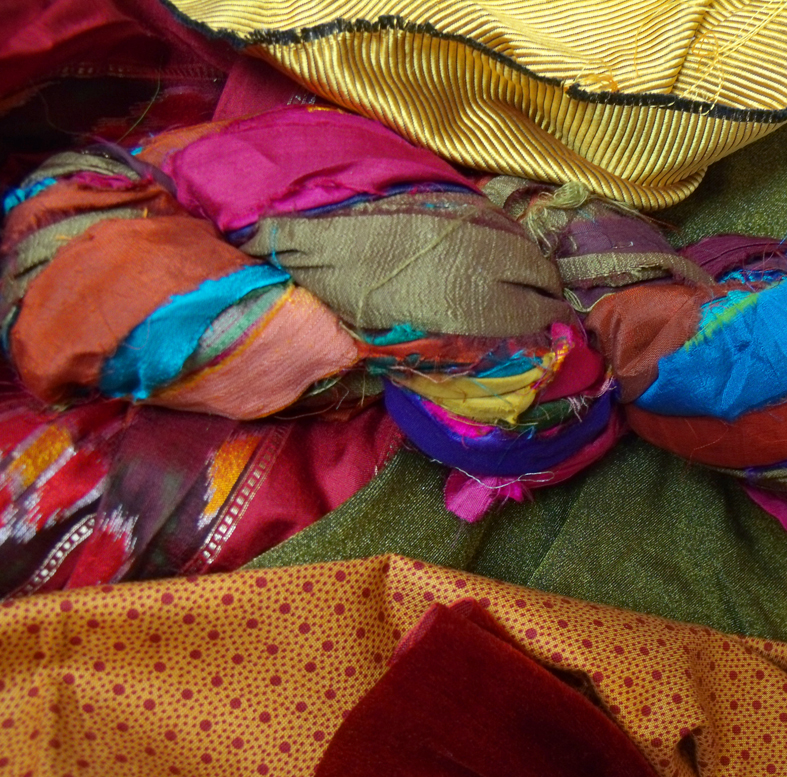
One fabric was exceptionally popular, an Indian ikat dyed and woven silk – you can tell autumn is in the air.

The popular Indian Ikat silk

 I used a method of choosing one patterned fabric then finding other toning or matching fabrics to complement it, this ensures that the small sample will be colour co-ordinated.

to begin with even cutting the fabrics takes a bit of nerve

Ribbons, braids  and all sorts of scraps can be used up. Some choices are made and remade several times before committing to the next stage.

Jane’s selection based around the sprinted silk handkerchief.

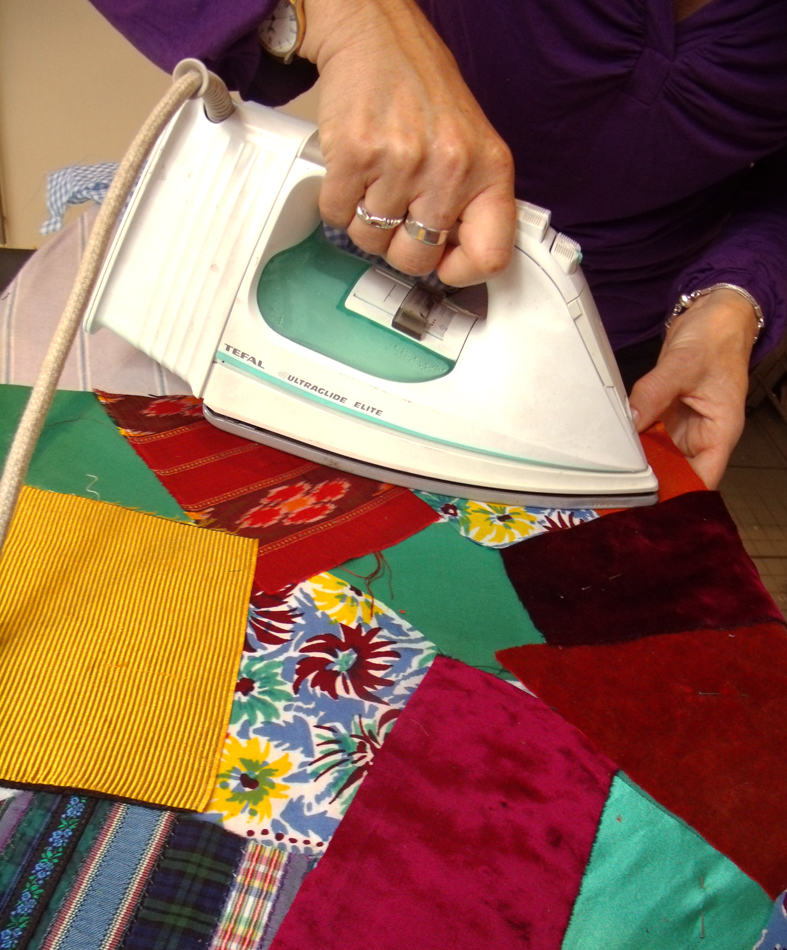
There are really no seams to worry about as everything then gets bonded onto a backing fabrics using an iron.

pressing the patches into position

And then the embroidery begins – but before this can happen the coloured threads are chosen. Embroidery is not just a decorative device as it can be used to balance colours within the patch-work and also decorate large areas of plain fabric.

choosing colours for embroidery

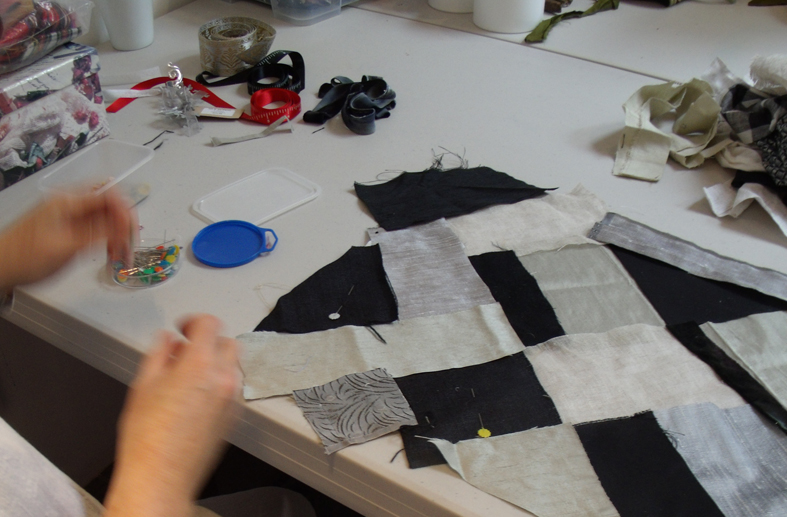
Sometimes the colours for the embroidery can come from a totally different source, here Liz decides to choose to stitch the neutral patchwork with the colour of the heads of her pins.

using the pin heads to decide colour scheme for embroidery

I was really interested in seeing this choice made as this maker often uses a range of brilliant pinks, turquoises and purples for her work, here she was wanting to try a new colour gamut and so used the class to this sample something different.

Now down to stitching  – a water-erasable blue pen is used to make a guide for neat but always very short rows of stitching

herring bone stitches to cover the seams

I had to teach some of the students the new stitches and some were having to remember them from childhood, but all were delighted to be learning something new.

using the yellow herringbone stitch to balance the design

embroidering braids to silk and lace.

corners are always a problem – maybe a shisha mirror will cover the collision.

Eventually the students went home with enough information and threads to finish the panels for themselves  – and this morning I had this message from Jane Blair –

“Thanks so much for the crazy patchwork class, just what I wanted and lots of scrummy fabrics and threads….I will bring it in when finished and drop off any threads left.”

So hopefully I can post the finished results later………..

Strictly Stitching

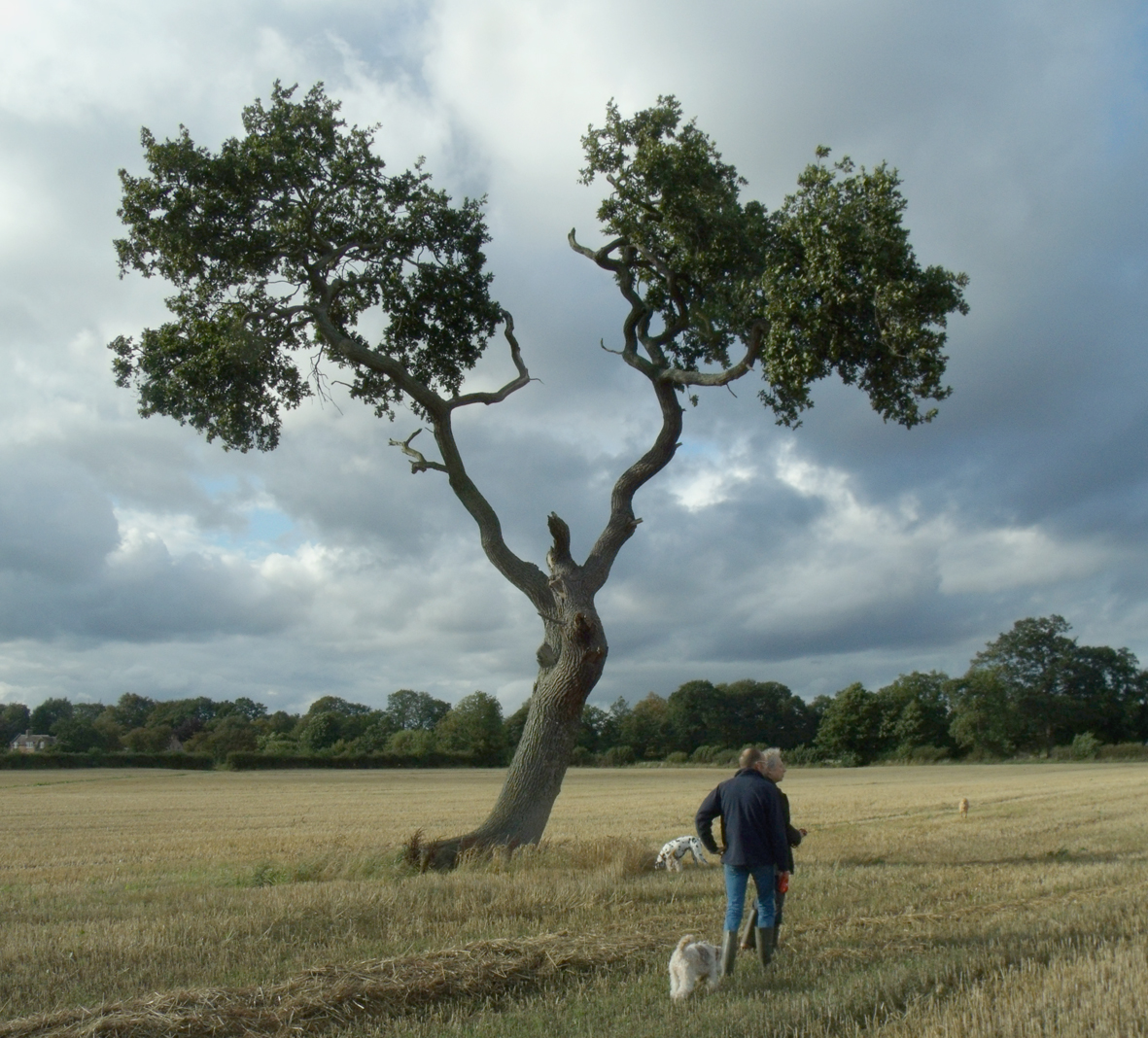
What has this tree got to do with strict stitching? Well 2 things really – first – I took this photograph in a field in deepest Shropshire, it reminded me of a painting by Pollaiulo, of the nymph Daphne turning into a tree as a result of her asking the gods to intervene in her immanent rape by Apollo.  Can you see the way her upturned arms are turning into leaves as she pleas for help?  I find that this is usually the way with the gods, they do give you what you ask for, eventually, but never how you quite imagined it  – which is why I have been wanting to stitch an image of this particular event for several years.

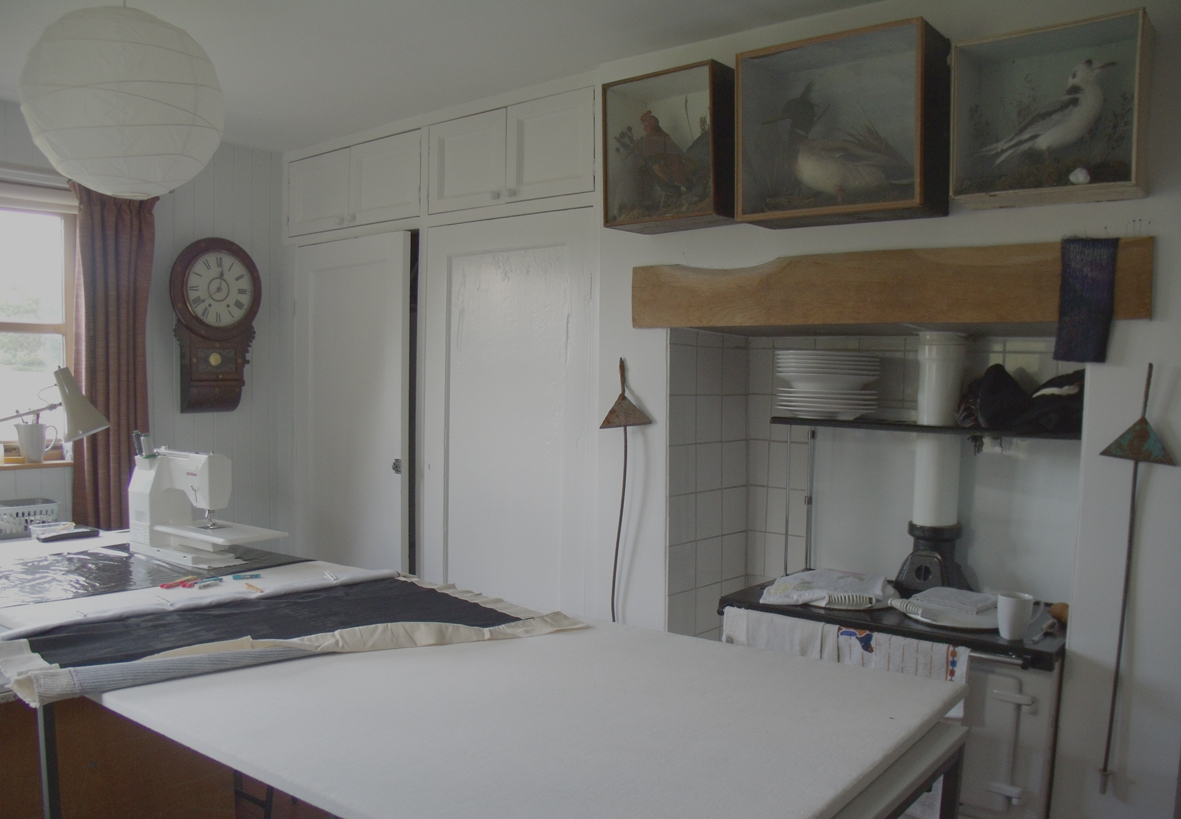
Secondly – we were on a flying visit to see our friend Nigel Hurlstone, his dog Lola Delores, and his new work in progress – now Nigel is a strict and relentless machine stitcher and I want him to come to Heart Space Studios to talk and teach later next year but I also want him (or I) to make a kimono out of some of his new fabrics. When we First arrived I walked into his kitchen and immediately spotted the stitched sample pinned to his kitchen range.

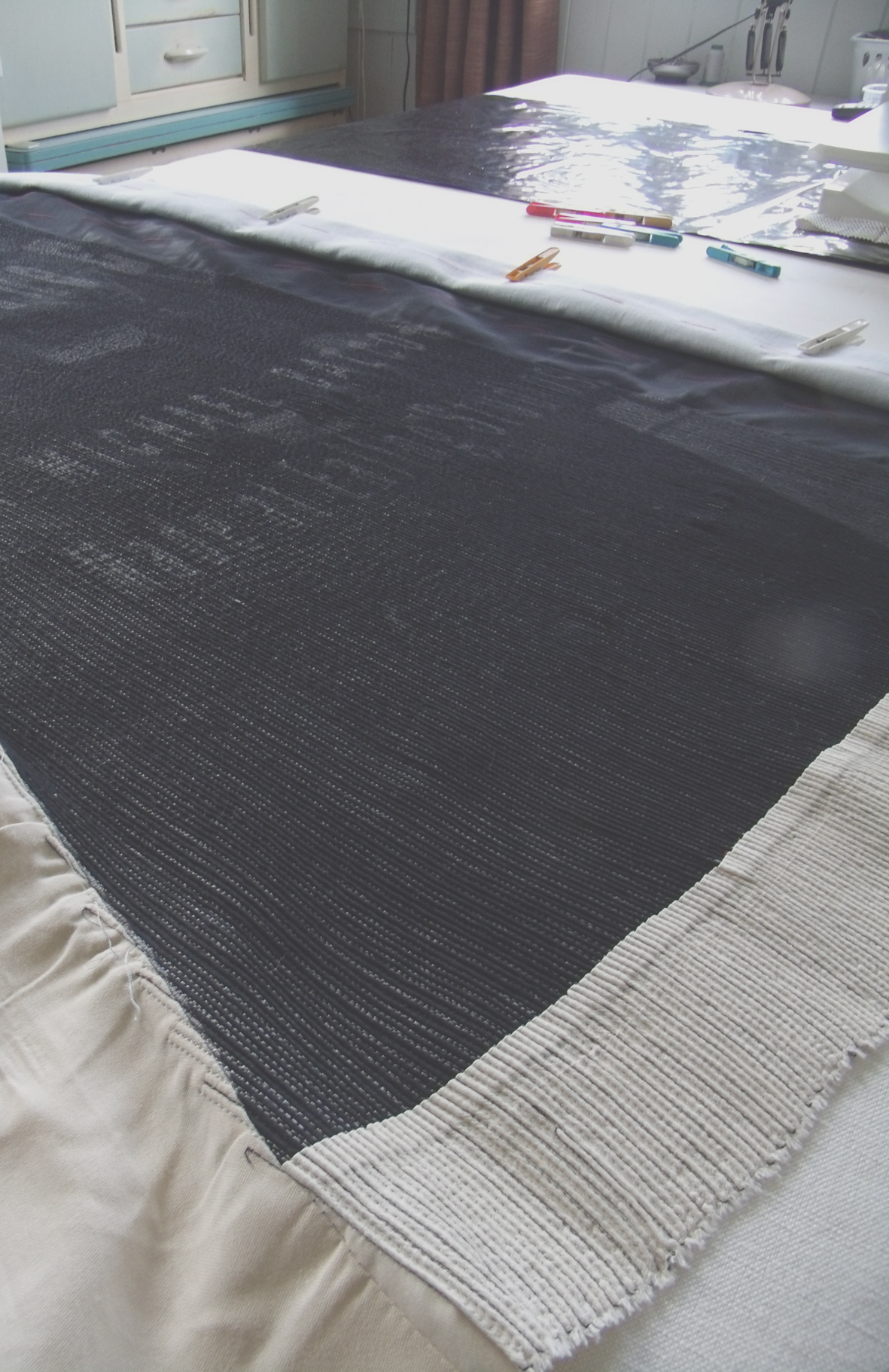
Turning around, instead of the usual kitchen table I saw a large -work-table complete with sewing machine and a half stitched sample rolled up and pegged to keep it in order – this is the lightest room in the house so I wasn’t so surprised  – but no supper in here tonight.

Kitchen table overtaken by stitched sample

Now this is what I call strict stitching; but not exactly what you imagine to issue from a country kitchen is it?

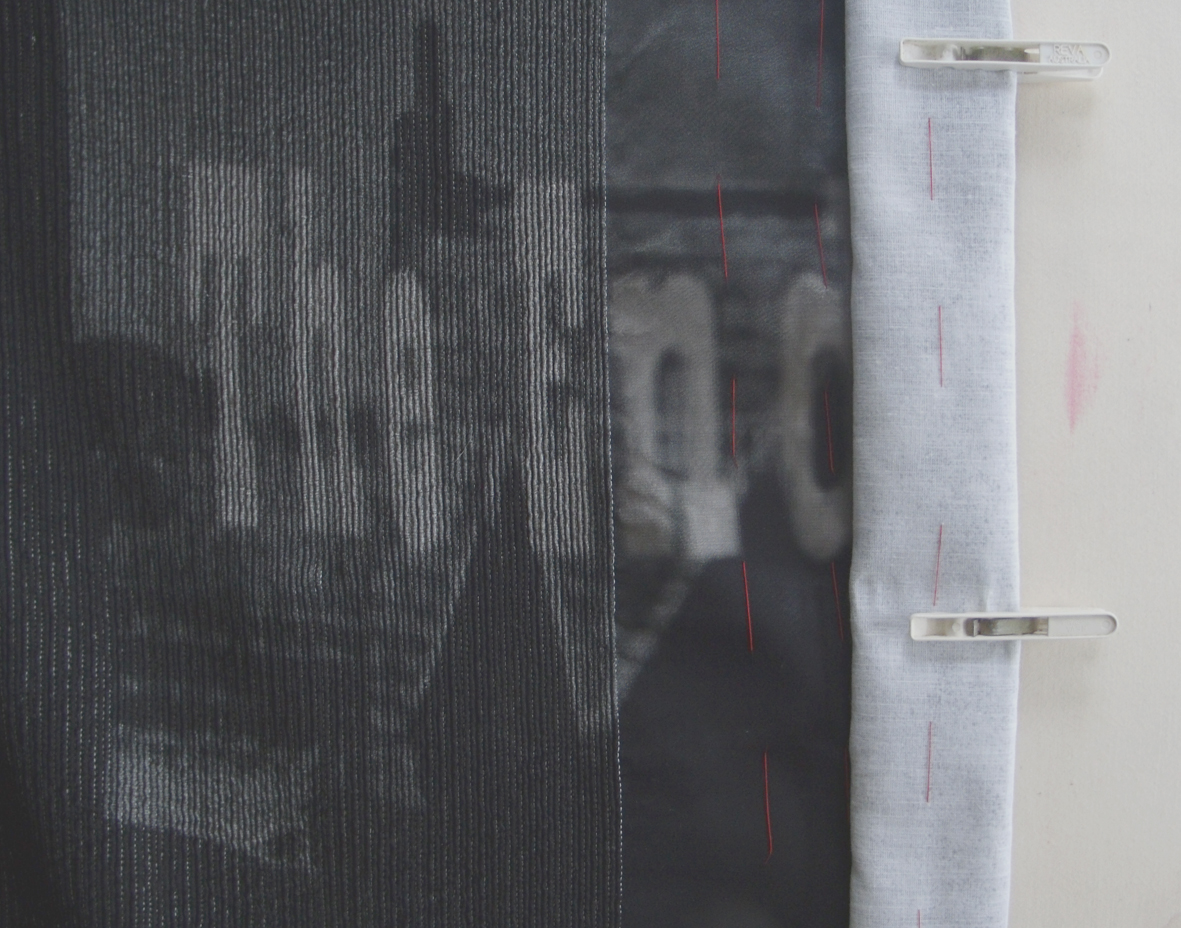
This is a new set of work but where on earth had he got the inspiration to stitch End Captions from old Hollywood films with rigid rows of double needle machine stitches? “I don’t know hen” Nigel said “I just like doing it for hours at a time – keeps me focused”  I know when I am being fobbed of but as he was a founder member of my Stitching and Thinking group, there was no need to go further at this point.

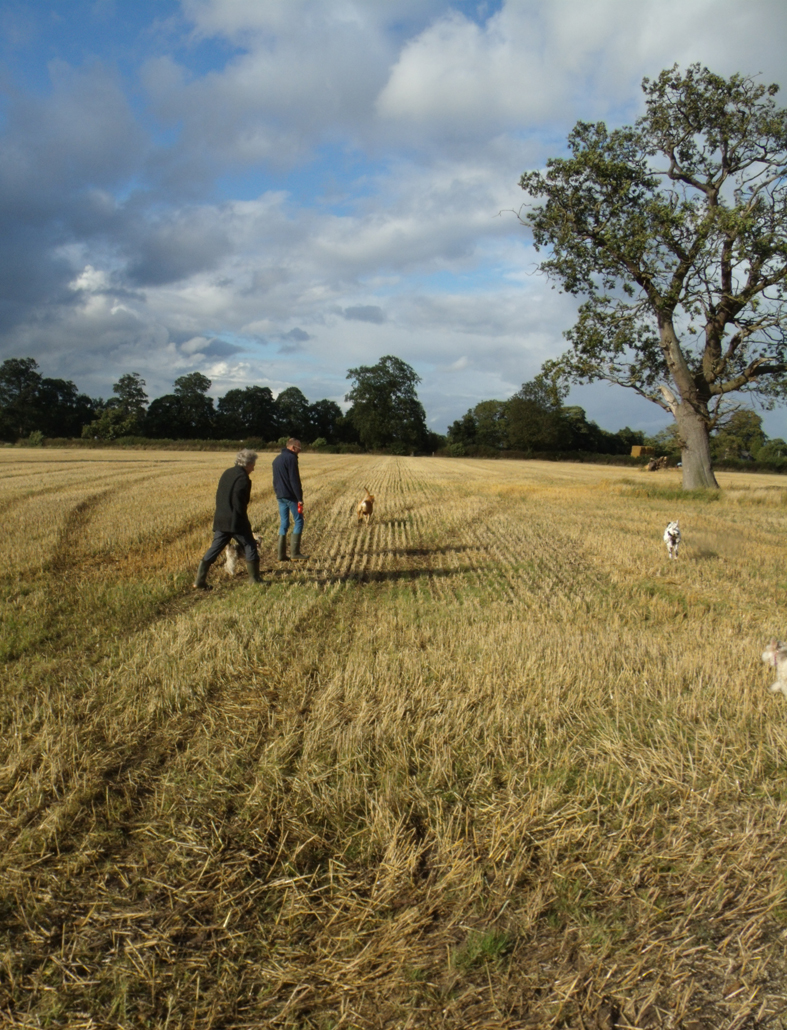
So first things first, an early evening dog walk.

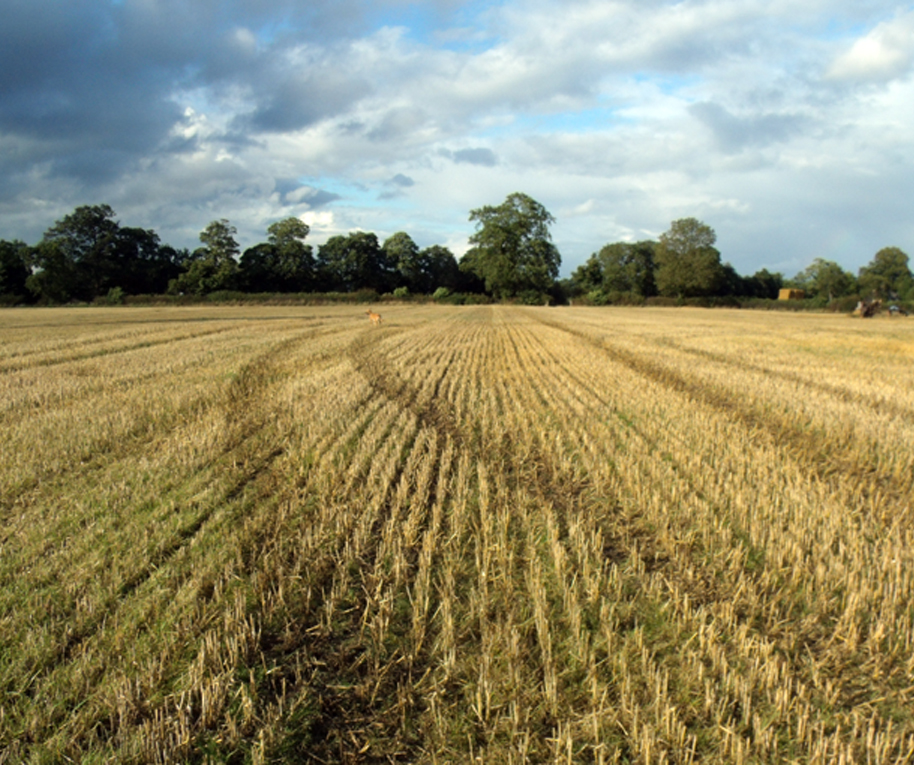
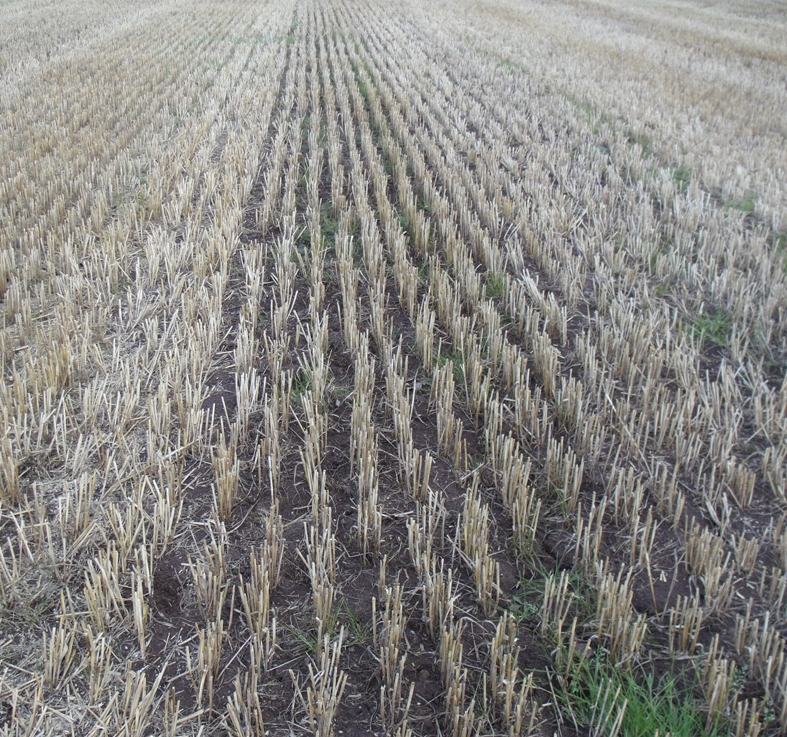
and the moment we walked into the fields surrounding his house it was obvious why he was stitching row after row after row with  twin needles….

Now looking back at some earlier work the effect of living in fields of maize, barley and corn became obvious.

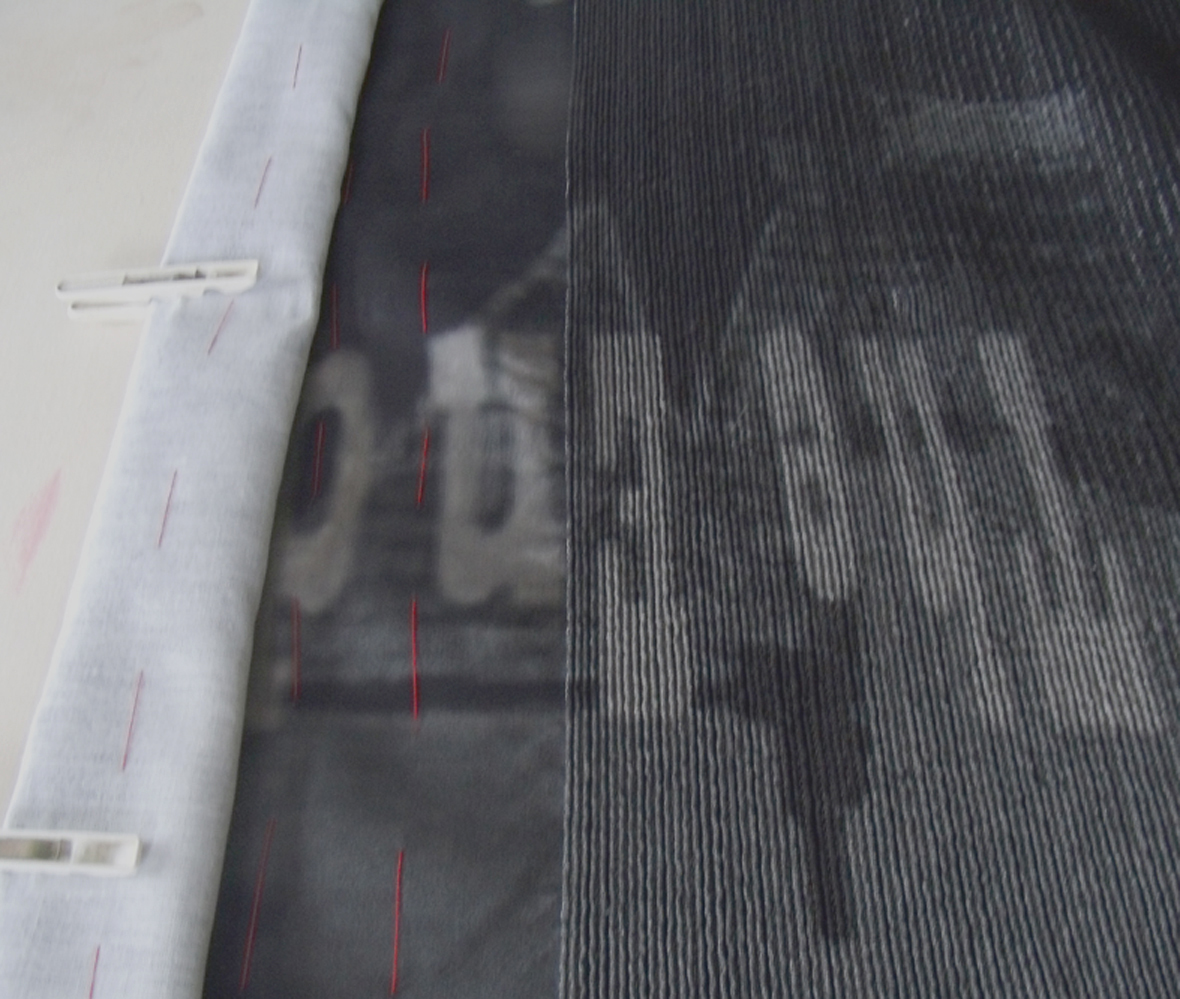
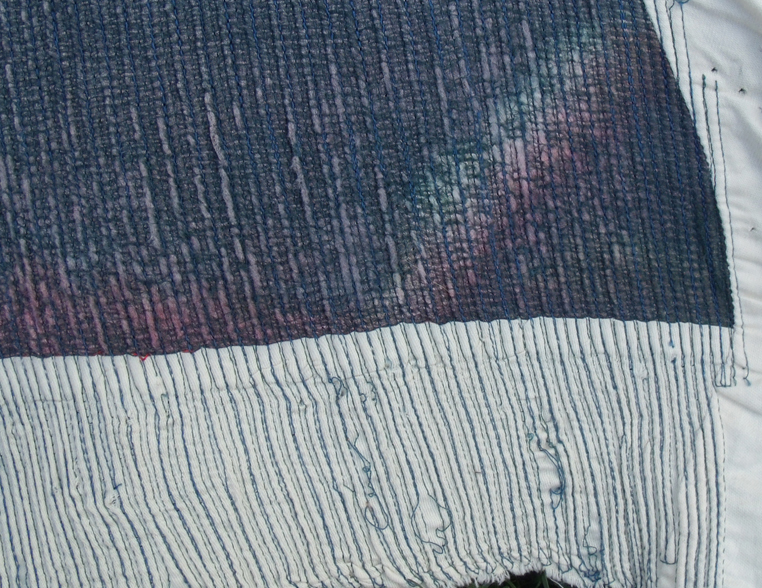
However back at the  work-table I became fascinated by the edges of all the unfinished pieces: now I really get really iffy when people praise the incidentals about my work, they usually  just love the back of the embroideries…..and here I was liking the edges of the material used for stretching

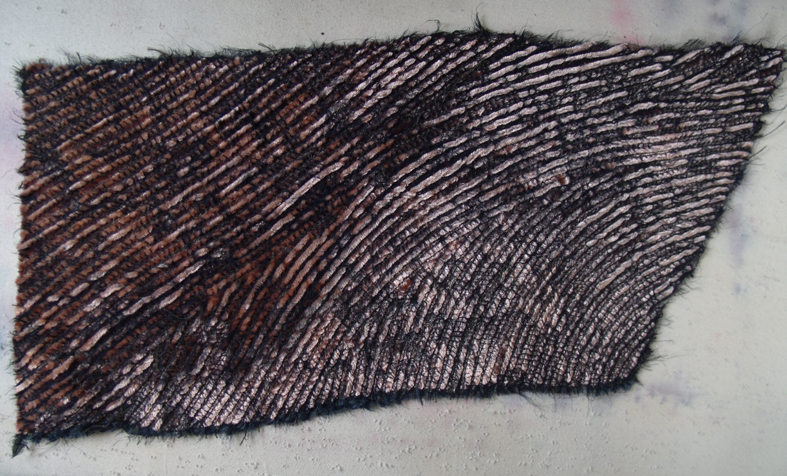
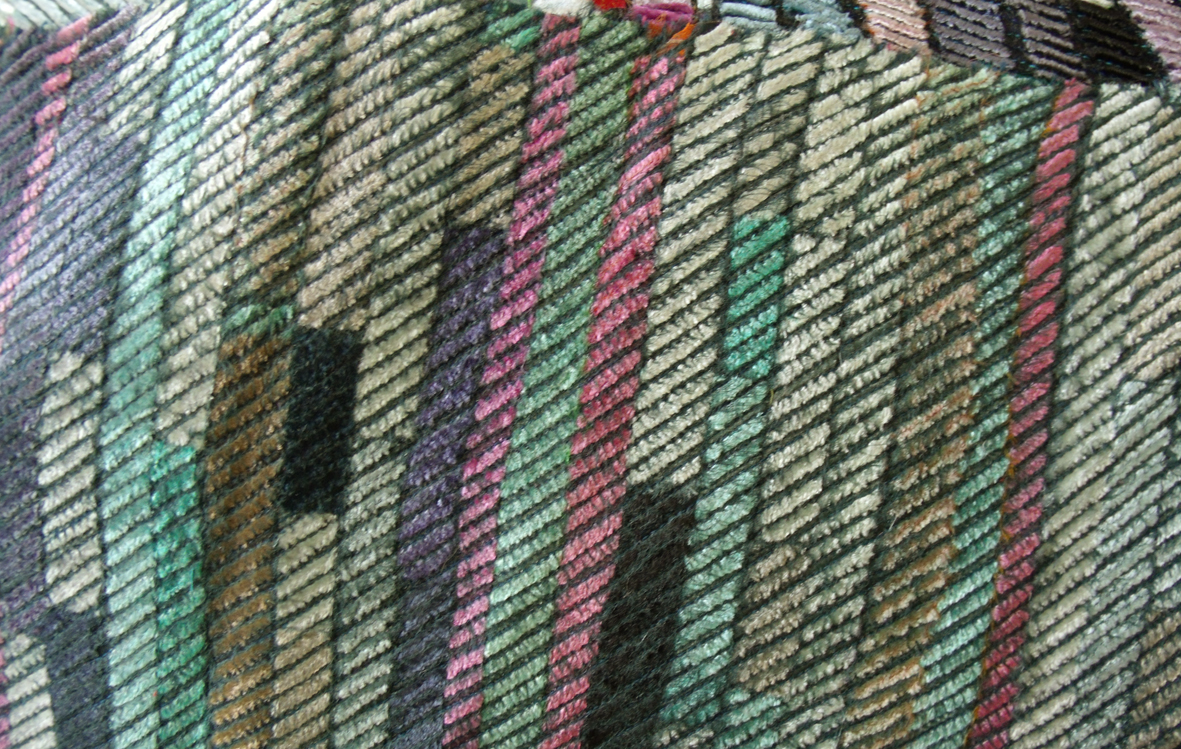
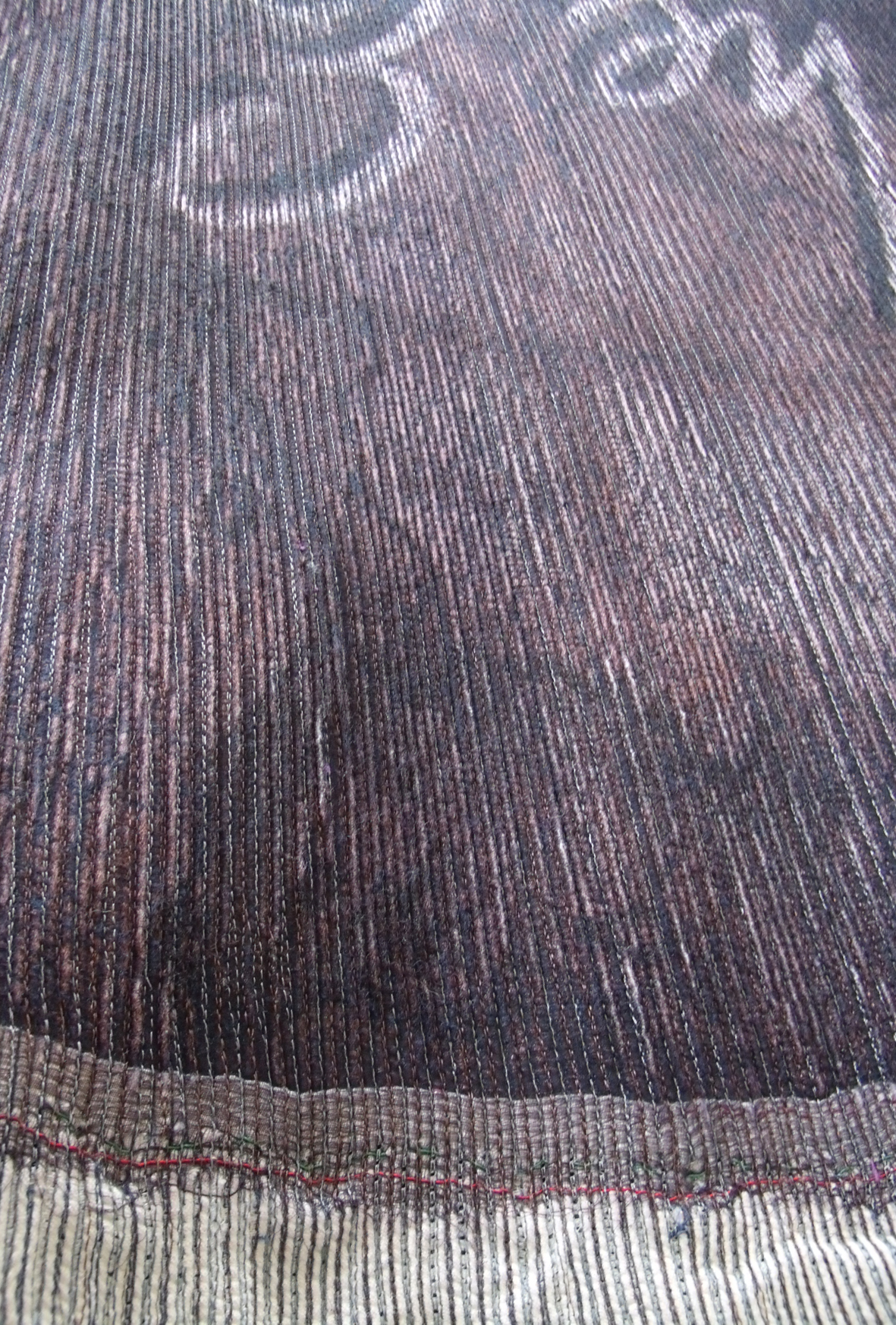
The way the colour collects and intensifies when channeled and seen against the contrasting white strip is compelling and the stitching makes the cloth feel very seductive, it rolls and folds easily in the hands and I just want to make clothes with it – an unusual reaction as I gave up designing and making clothes many years ago.

What is curious and fortuitous, is that the stitching brings into focus the enlarged and hazy digitally printed images. The large scale of this work and the intensity of the rich blacks remind me of sitting in darkened cinemas as a child, engrossed in those huge black and white films, Technicolor was the colour film of choice though.  I was immediately transported back to The Rialto in New Ferry, the local cinema of my childhood home – eating chocolates and watching the Saturday matinée with my brother Colin.  So strange,  the sensations buried in our minds waiting for an opportunity to be delivered after some 50 years by a strict piece of stitching…….

.

More Kimonos – drawing and embroidery

Since my last post I have been immersed in Kimonos. I have rediscovered my early fascination for these wonderful garments; wonderful to me because they are the perfect fusion of textile and clothing. Hang them on a stand or against a wall and they work as strongly shaped art pieces – wear them and they both reveal and conceal themselves and the wearer, the patterns undulating across the body in slow movements – hard to run in a kimono.

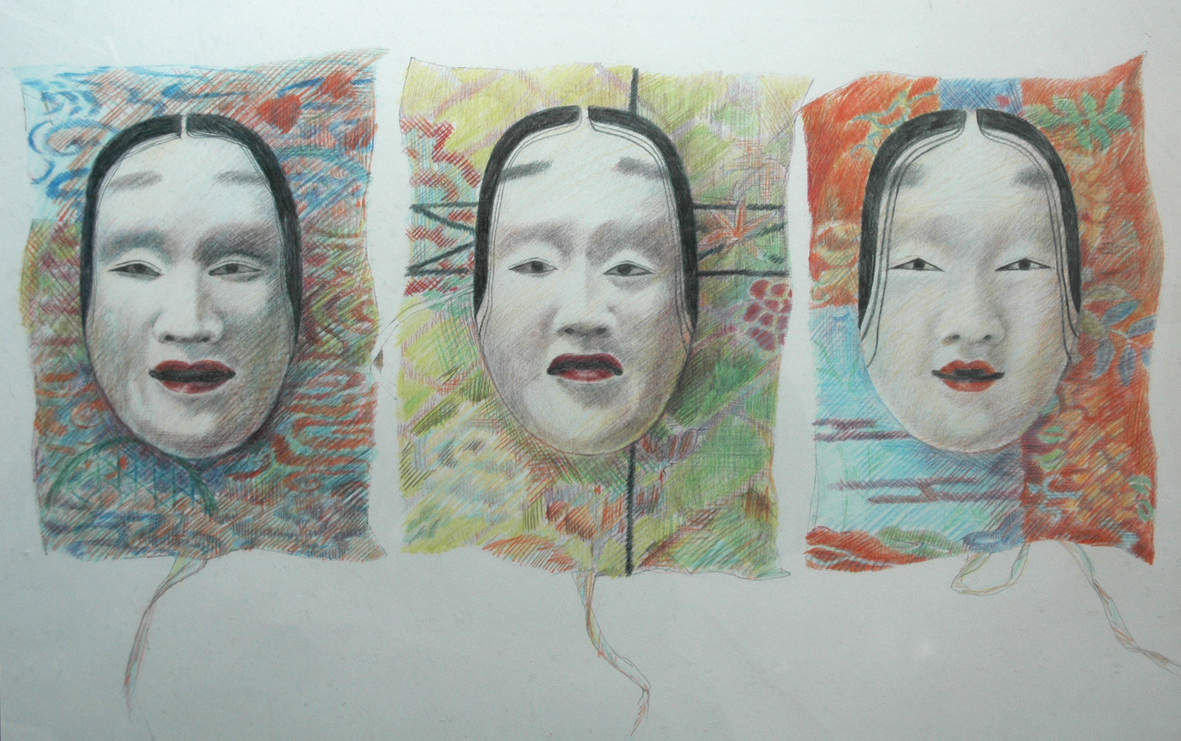
I have been searching through my records for my Japanese inspired embroidery slides. I had an exhibition on my return and showed embroideries, drawings and screen prints evolved from my hundreds of photographs and the day book drawings. Above is a neighbour’s child in her typical young girls’ red and white kimono. Japanese clothing has strict colour and pattern codes, they could not tell my age because I wore such a divergent range of clothes in different colours. I liked the way colours were described –  purples and deep blues are said to be Noble.

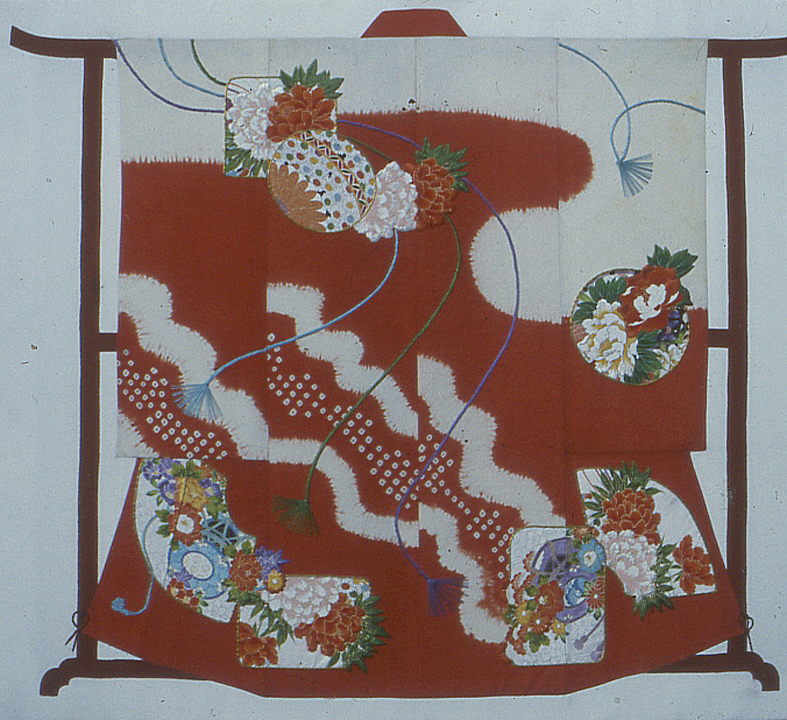
silk embroidered panel appliqued with traditional fabrics and my only successful attempt at shibori – the red ground of the kimono

However the fabrics I was attracted to were the brilliant silks in reds, pinks, yellows and gold, these glamorous fabrics were what I had come to see and tried to emulate..

This was hard as I had many techniques to master and I only had 5 weeks to assimilate the information…each Japanese textile apprentice takes 7 years to perfect their skill in one technique.

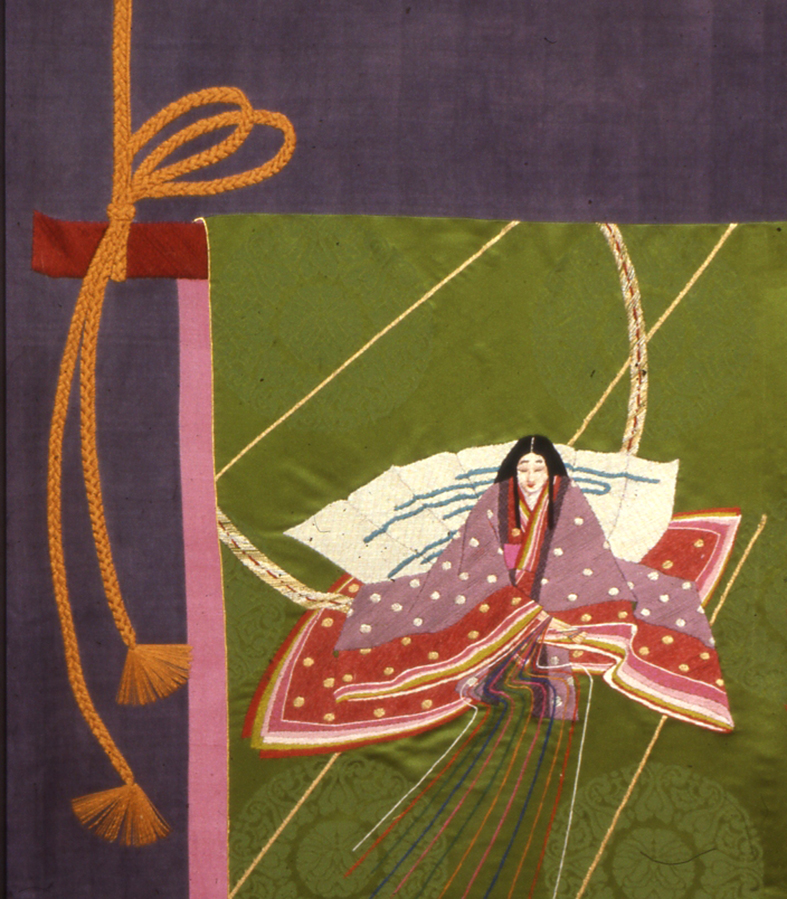
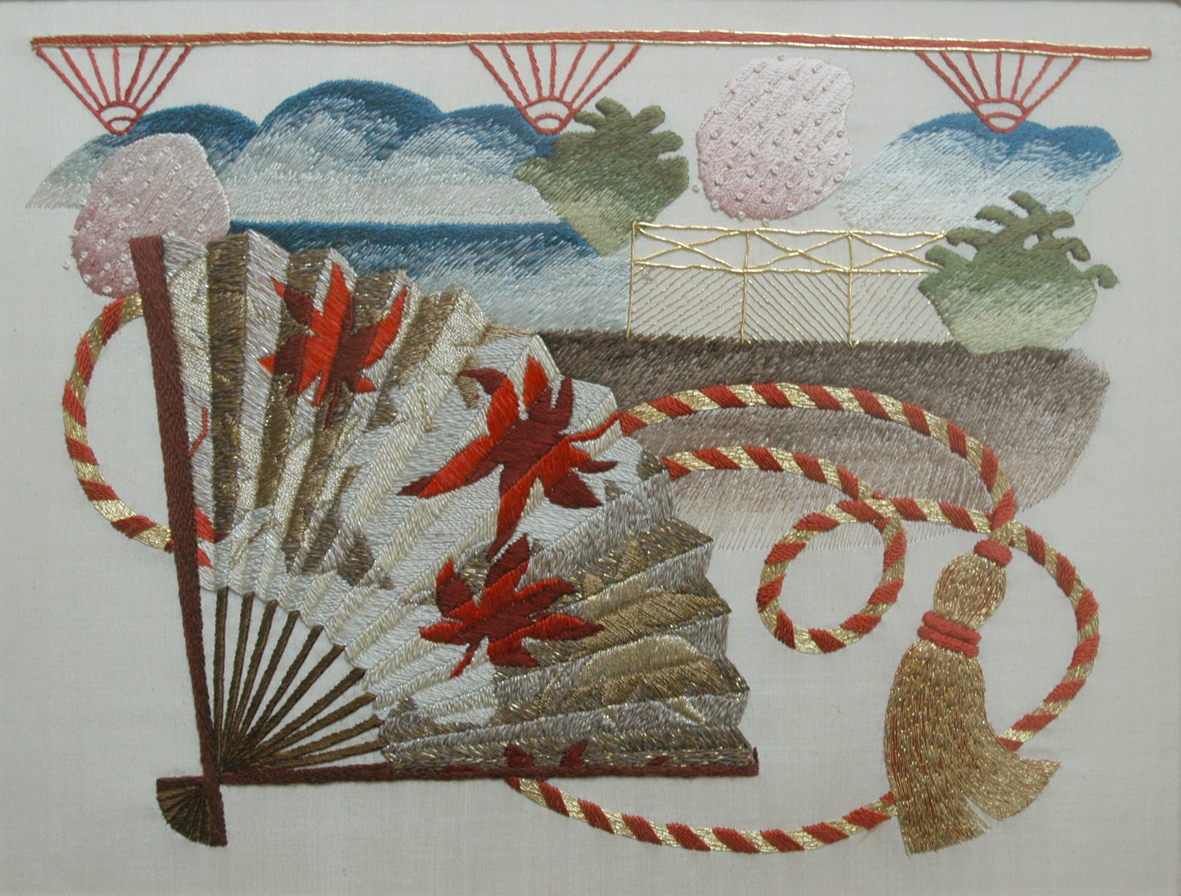
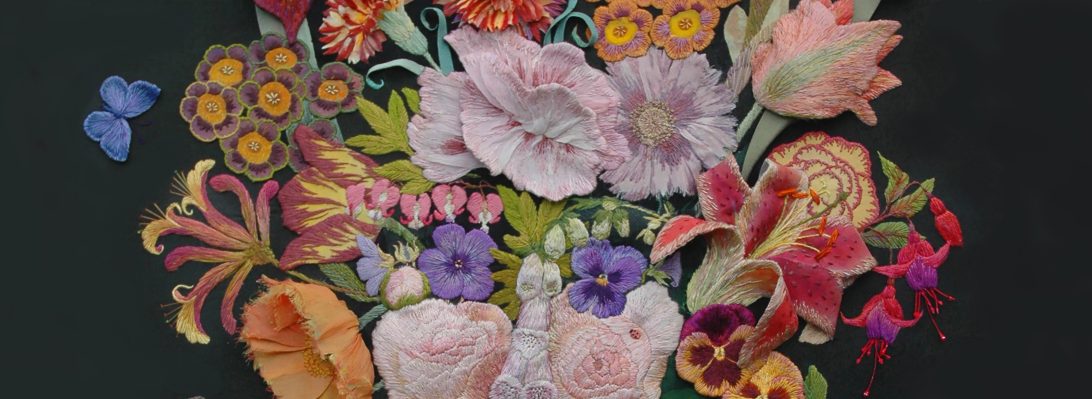
The only technique I came near to getting to grips with and which has stayed with me was silk embroidery in long and short stitch – see the Flora embroideries – and also I usually applique most of my embroideries together to make larger works out of different pieces of worked fabrics, this developed out of sheer necessity as I could never sustain any of the techniques to make more than a small sample.

However what the precise and perfectly placed stitches of Japanese embroidery enabled me to do was to stitch lively and nuanced versions of my drawings…and I am surprised now looking at this old work how my drawings did not change but my embroideries did. Check out the early sketch book drawing of the little girl in the red kimono at the top of the post and this later drawing for exhibition on my return. They are essentially drawn and coloured in the same way, crayoned first with defining pencilled lines, I still draw like this today and not surprisingly my handwriting is exactly the same.

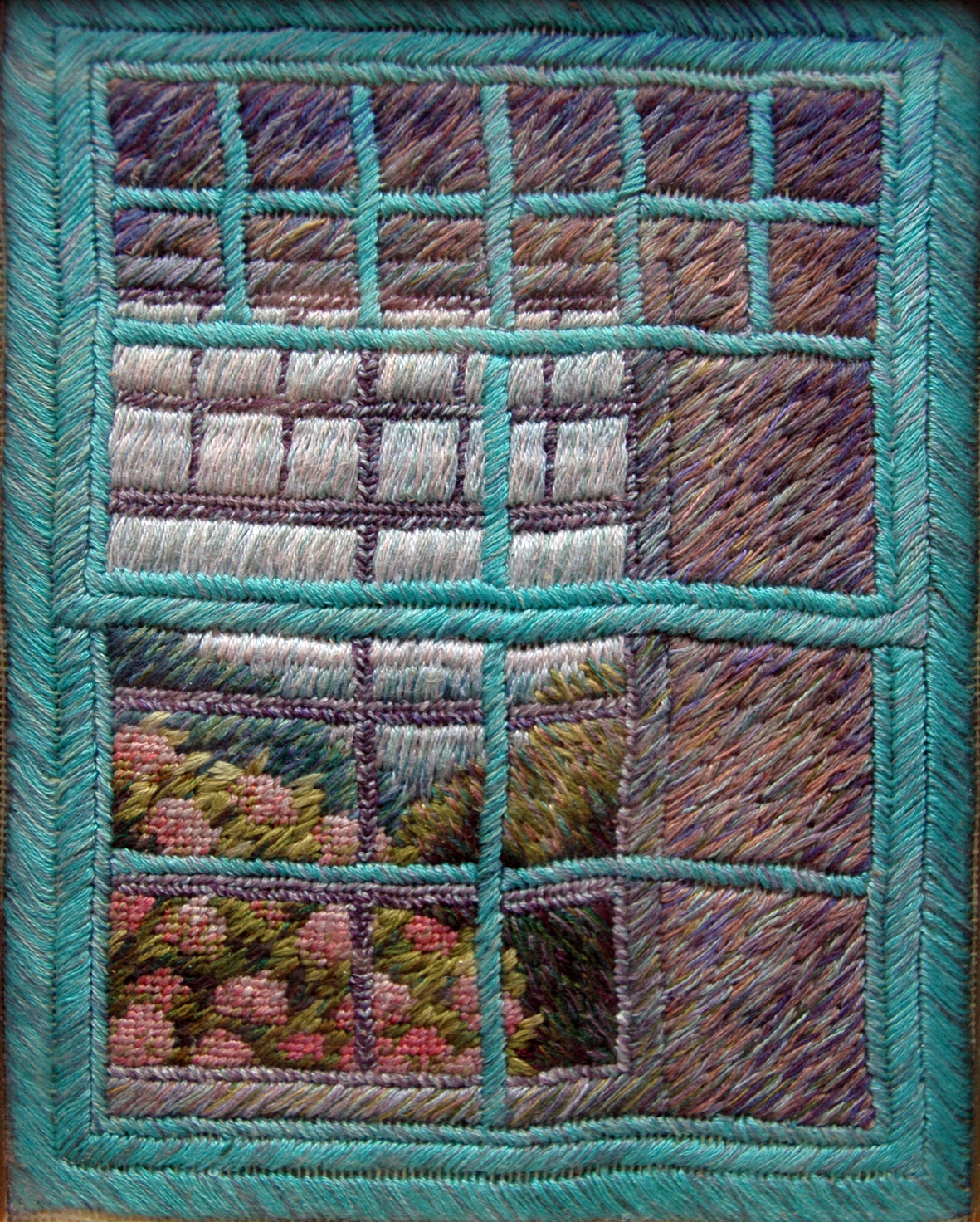
Now look at the early canvas embroidery just prior to my visit. Here is my small scale, densely stitched canvas, enclosed space, rigid structures and very heavy stitching.

Yes it’s still solid stitching but look at the space and movement and white exposed ground on my first embroidery on my return, below and it is 4 times the size of the canvas embroidery…..

my scale, techniques and sense of space completely altered and suddenly nothing is centred…..it is flying around

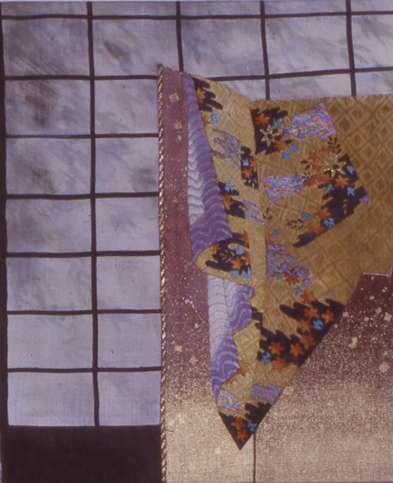
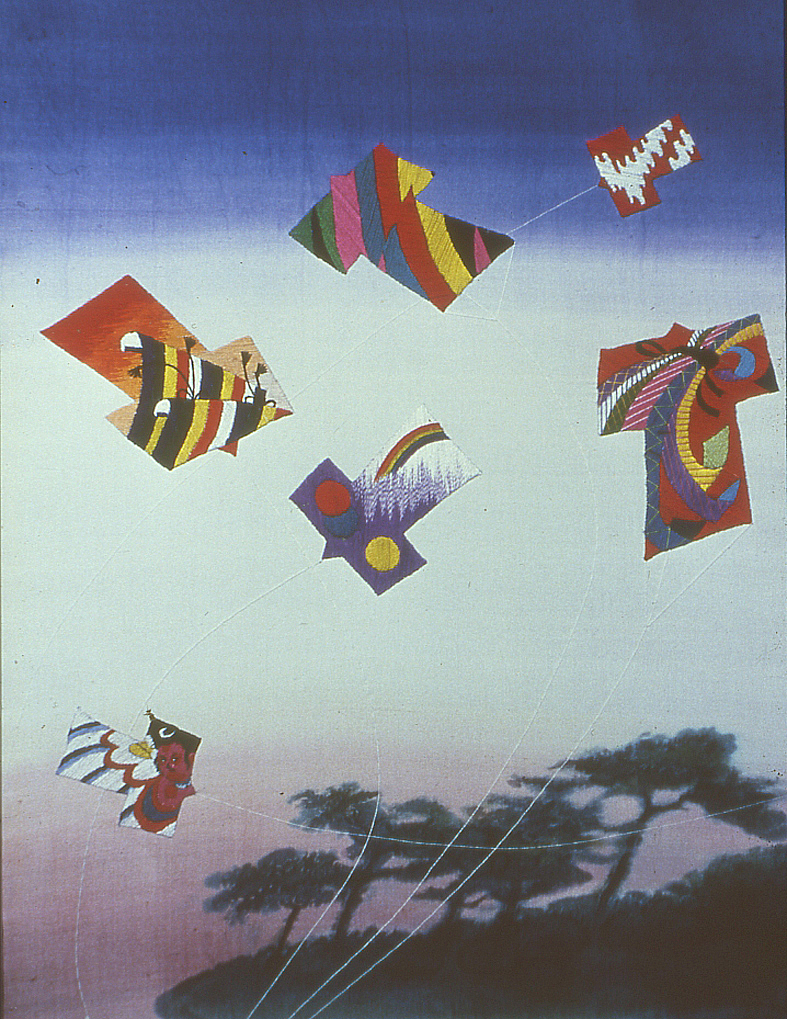
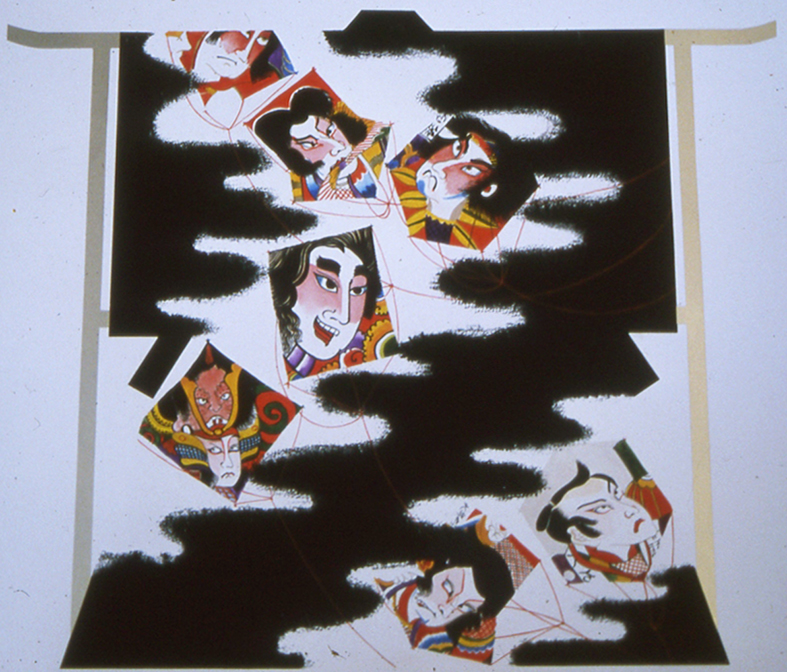
Even on the large variable edition silk screen prints of kimono on stands, the Kabuki kites are whirling around

The next kimono post will get me back to the present ideas for the workshops at Heart Space Studios. But because of writing and researching for the blog, things have changed from what I first imagined I would teach …but that’s what ‘Re-Searching’ does for you – takes you further than your first thought into territories new and uncharted.

Corsets Galore

black silk corset made by Lisa Keating

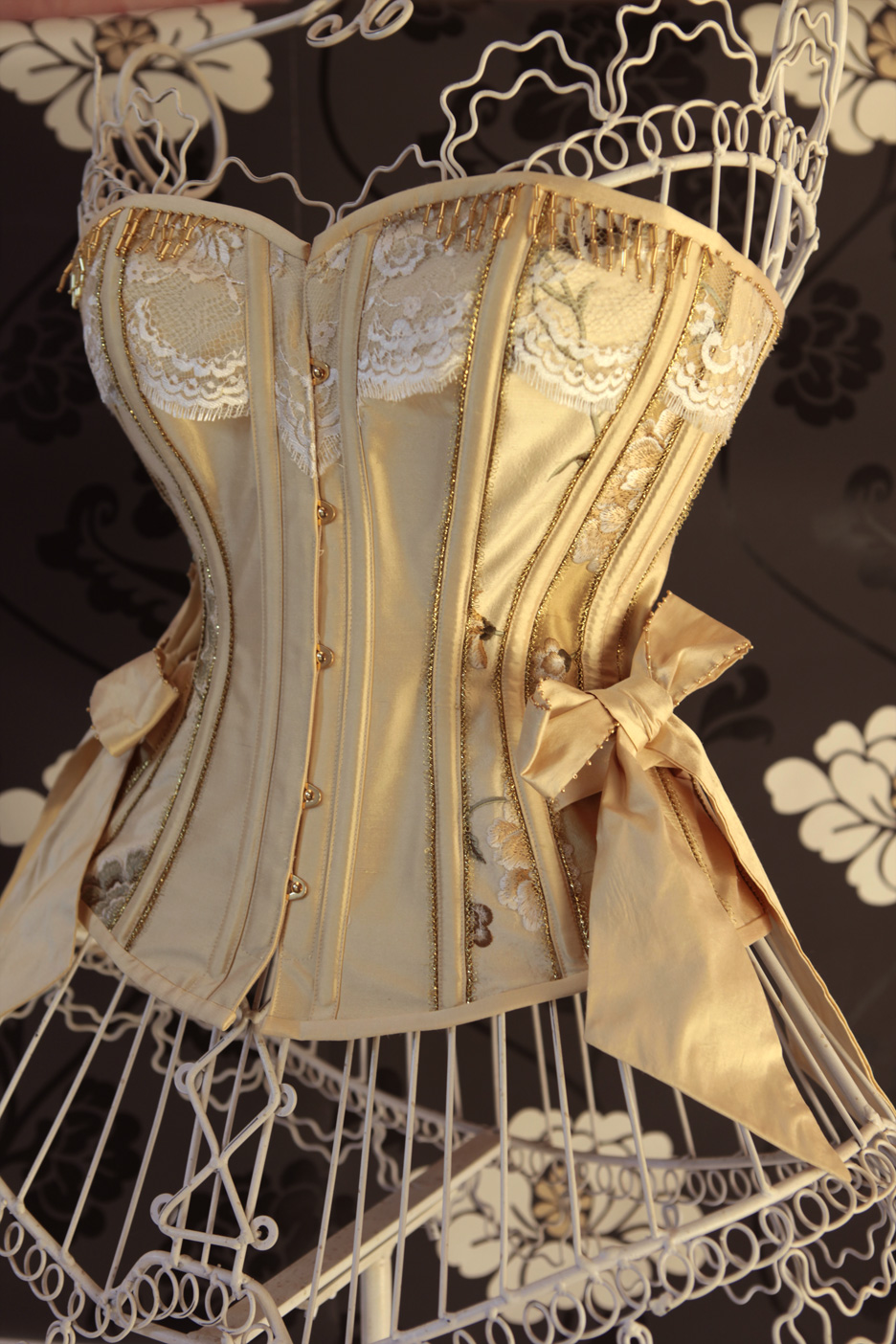
I have never been very interested in corsets beyond museum studies, but last week I became totally entranced by them – why? because in to Heart Space Studios came an ex fashion student of mine, Lisa Keating, nee Best, and she brought the most ravishing selection of her bespoke corsets.

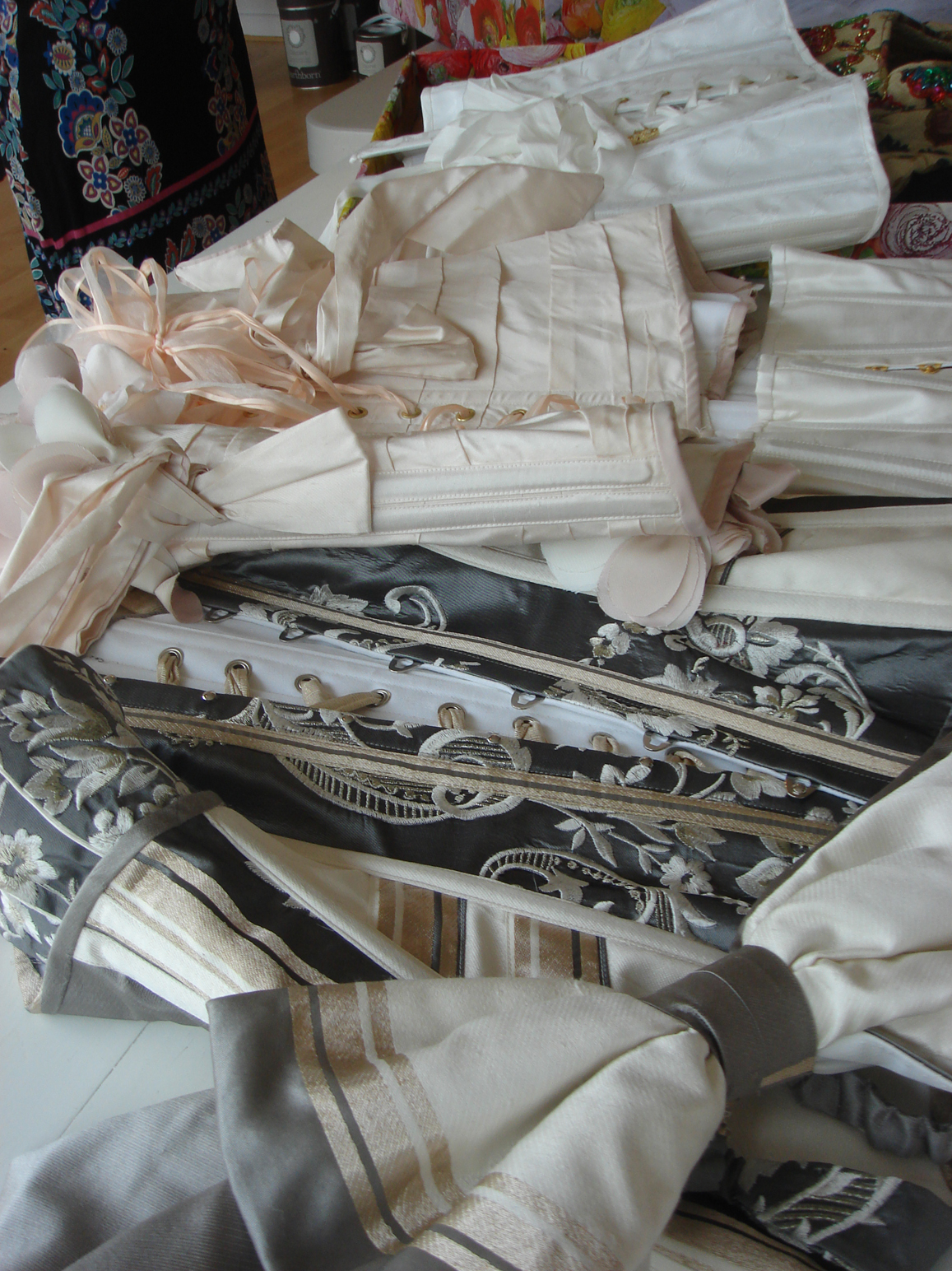
a small selection of hand made corsets - designed to be worn to be seen

I had invited her over to see if she wanted to develop some workshops for us, having met her at my recent open studios, where she turned up, out of the blue, with her husband, Mark, another ex – student, and their 3 children. It has been 20+ years since I taught her but I remembered her very well as a lively(!) opinionated and talented student – I was sure that she would bring me good things to see but I never expected this….

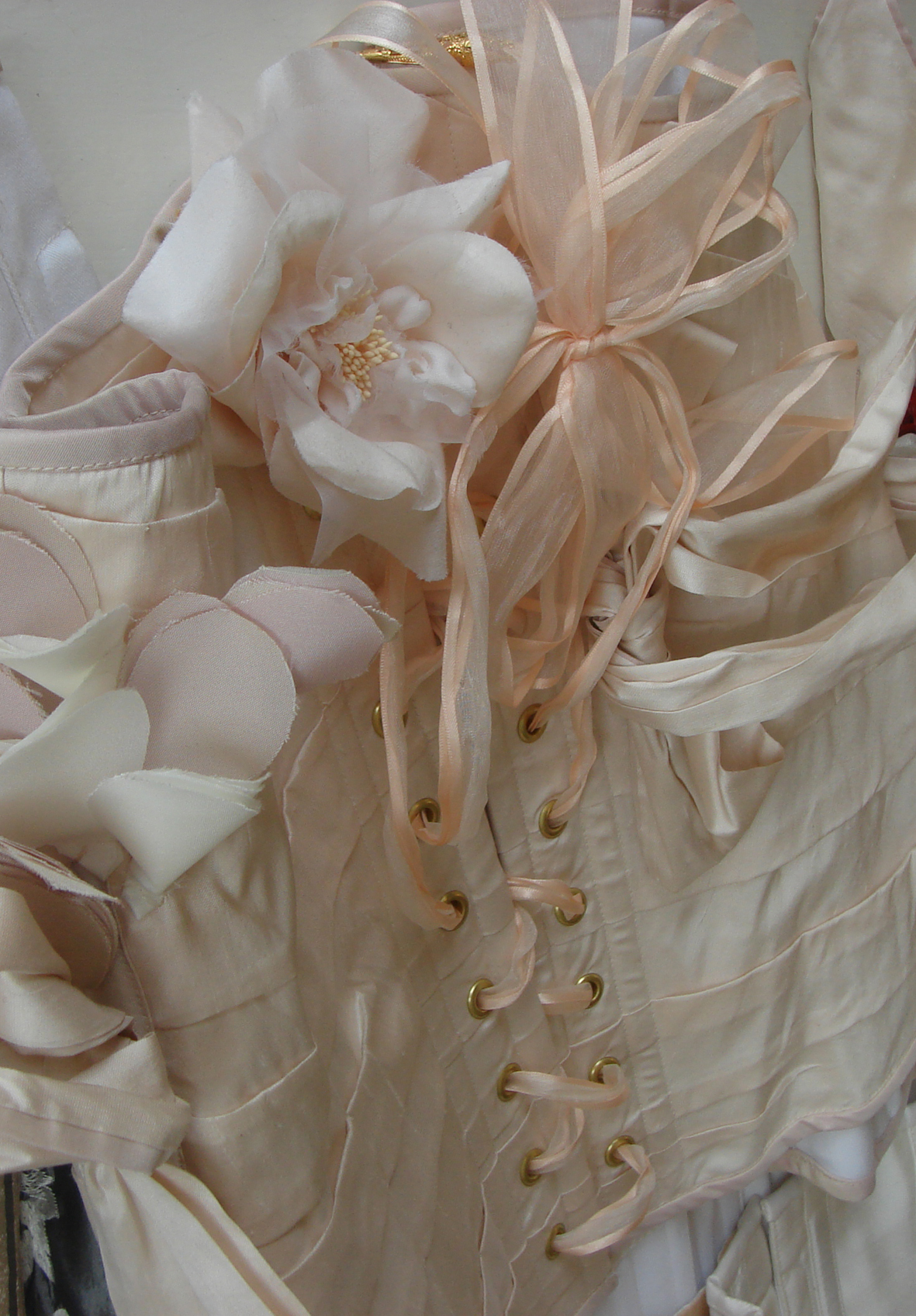
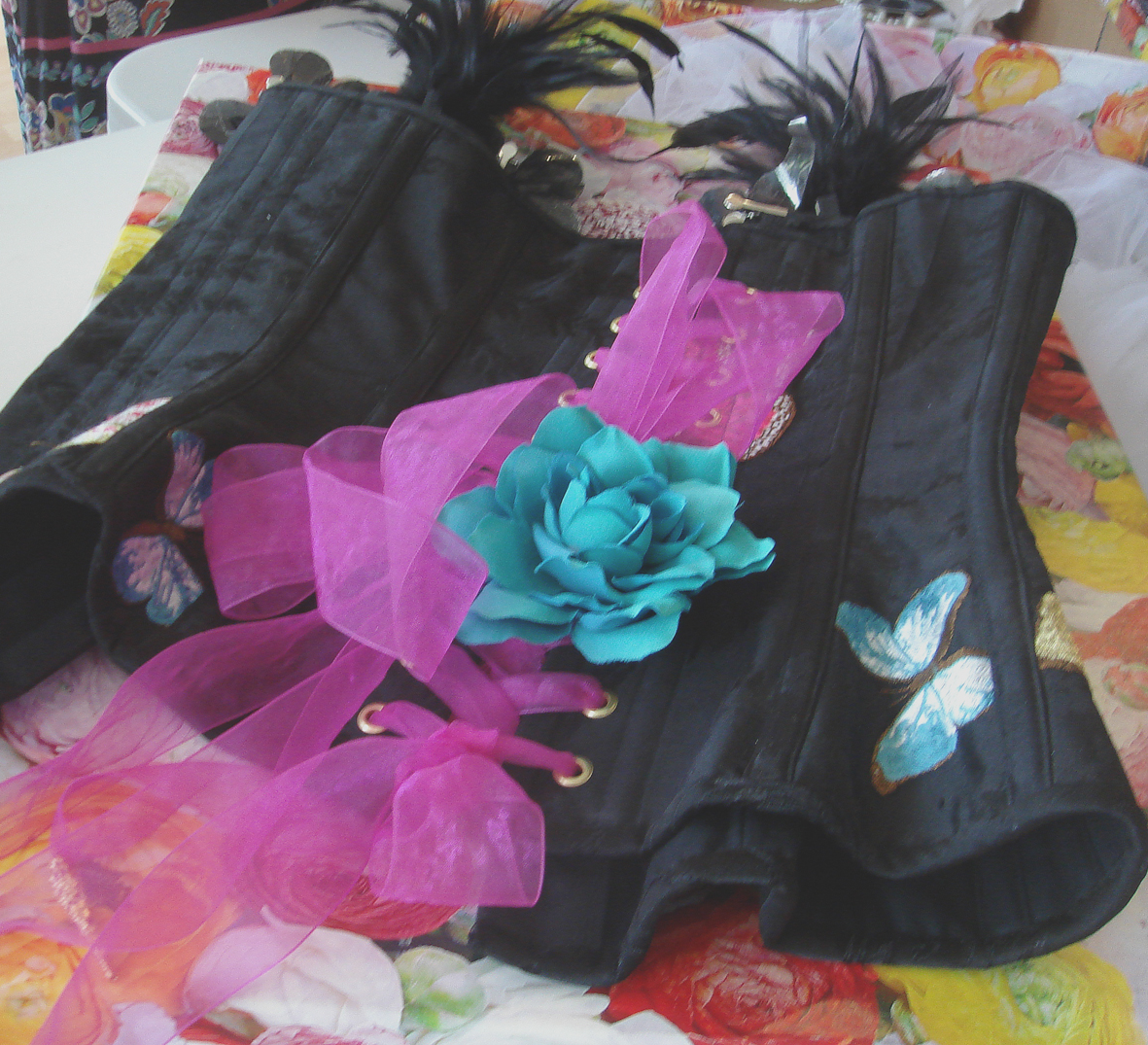
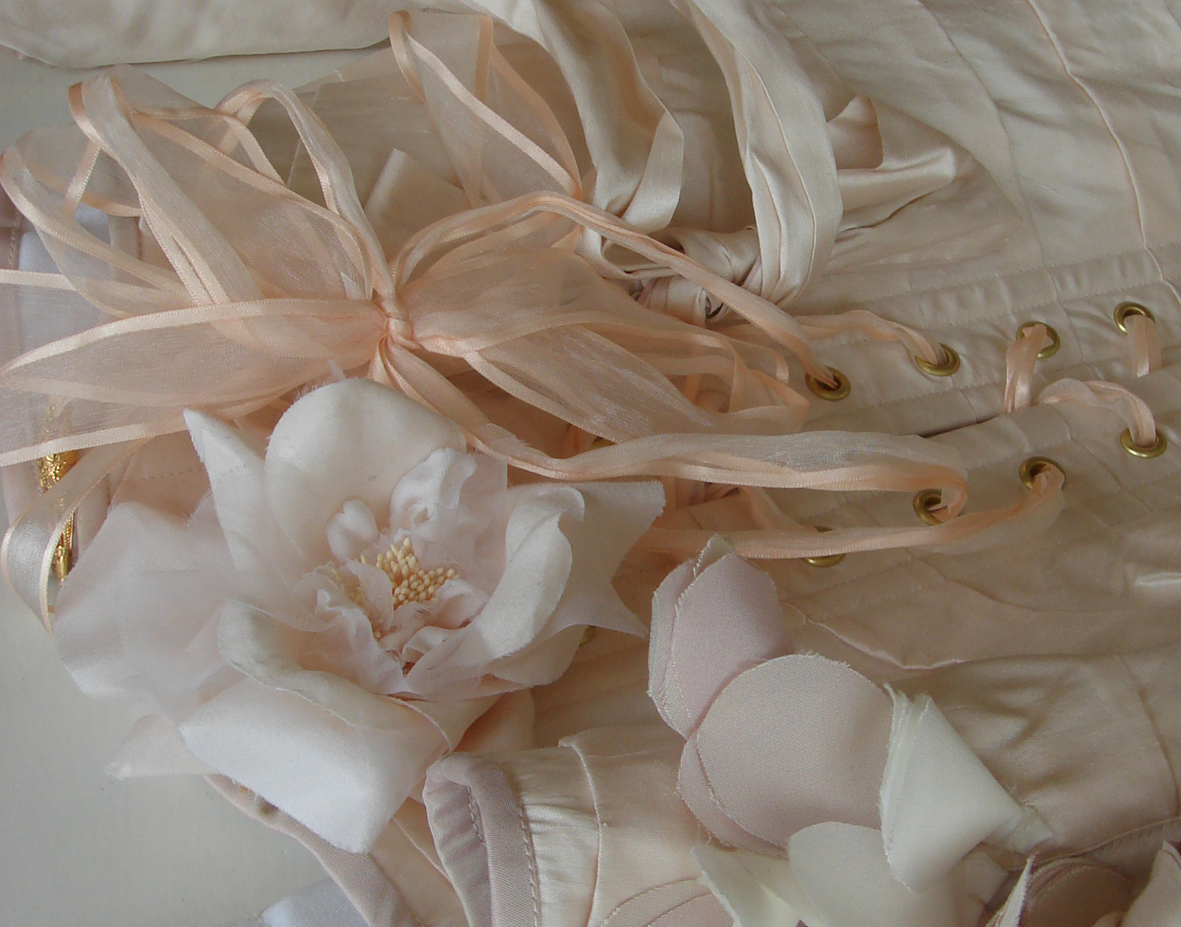
romantic silk corset with ribbon lacing and fabric flowers.

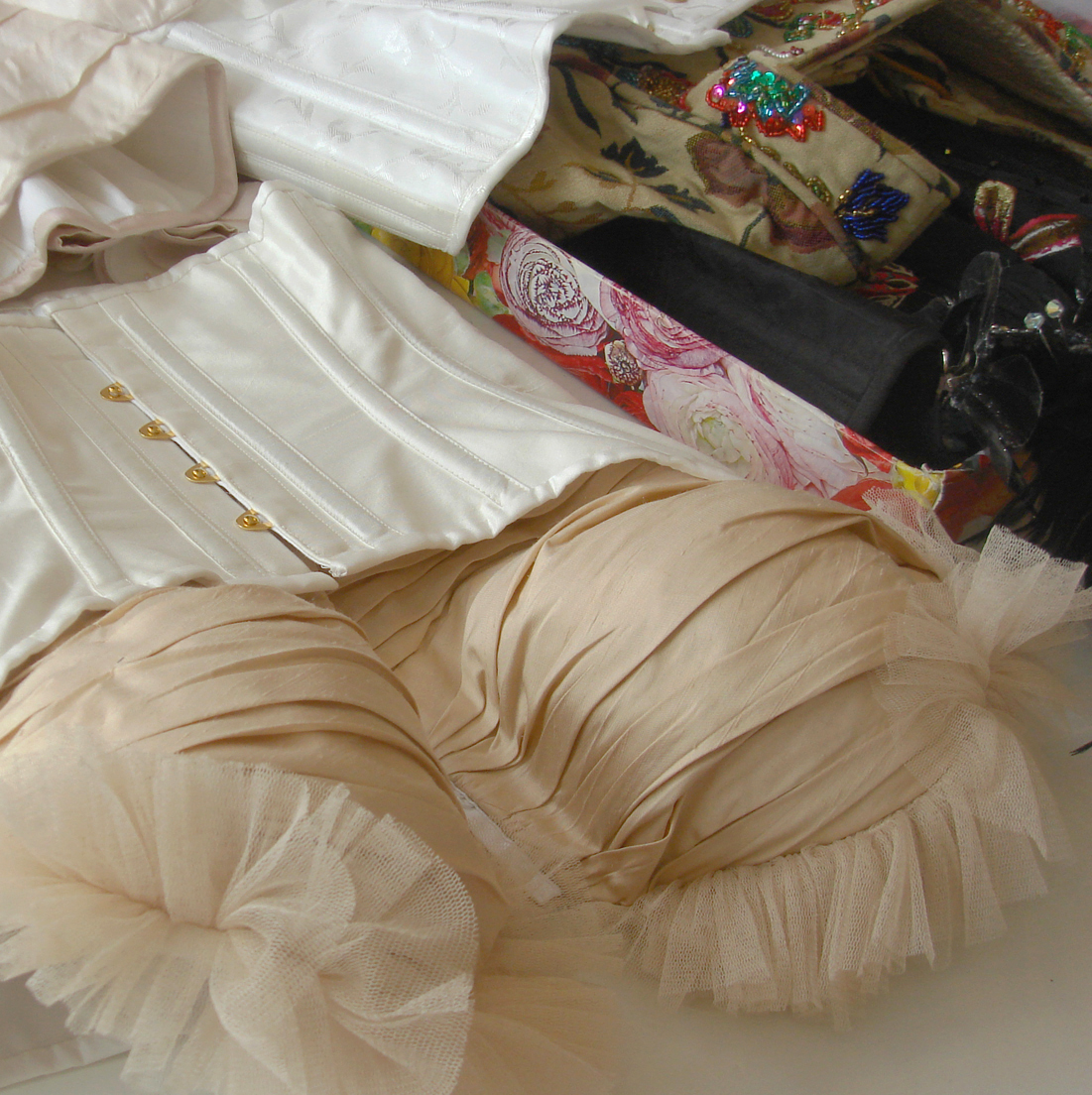
Out of a beautiful flowered box came delectable things, pale be-ribbonned silk corsets, for a fantasy wedding; ruched silk with net frills for a ballconette effect…I think I have this terminology correct!

sexy ruched ballconette bra and a box of beaded corsets.

lace and bows ad bugle beads in silk taffeta

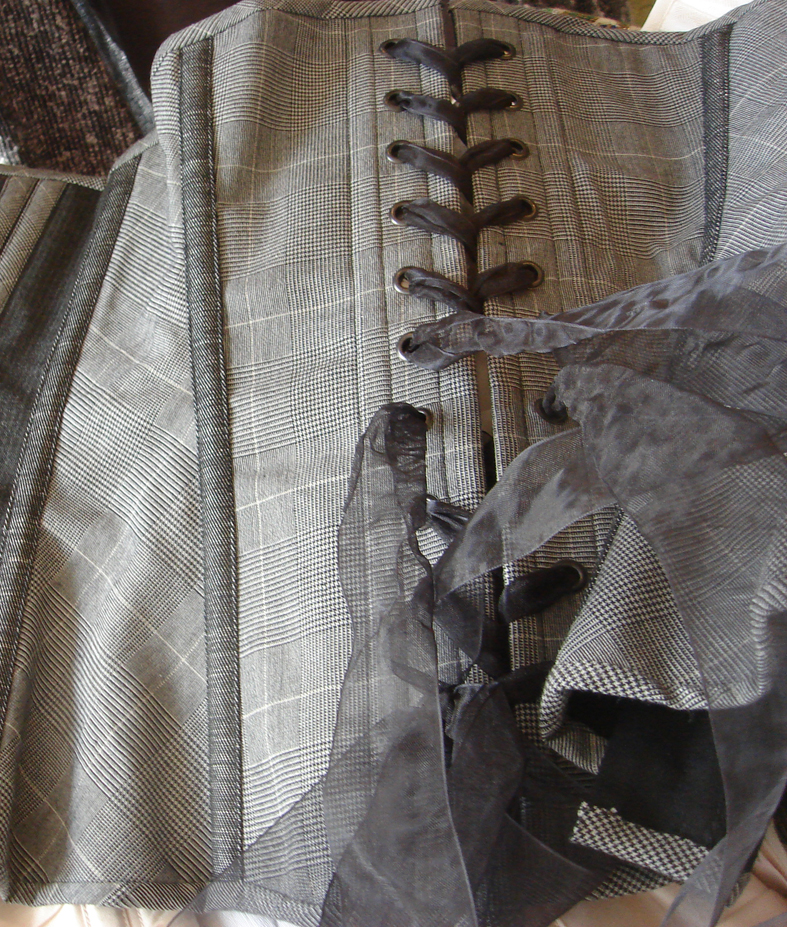
For Strict mistresses, there was a tailored corset in a smart checked suiting fabric.

office wear for a strict mistress

and even a very patriotic Rule Britannia number…..

the union flag inspired corset worn by Lisa's daughter

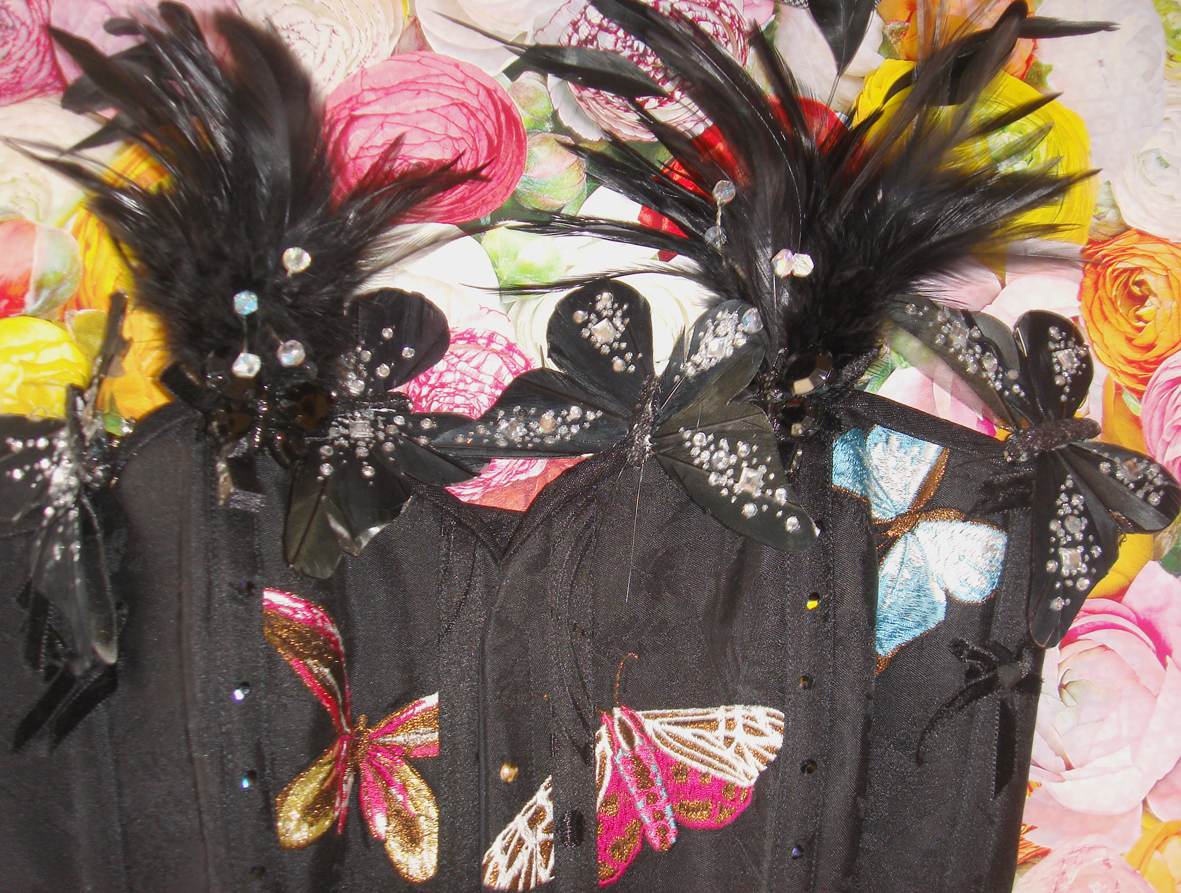
There were also embroidered butterflies, flowers and feathers and bows and lacing….

be-ribbonned, butterflied, flowered and feathered

and apparently if you wear one of these fabulous contraptions they can take 7, yes, seven inches off your waist – that’s a lot more in centimetres.

the front has even more feathered butterflies, jewells and embroidery....

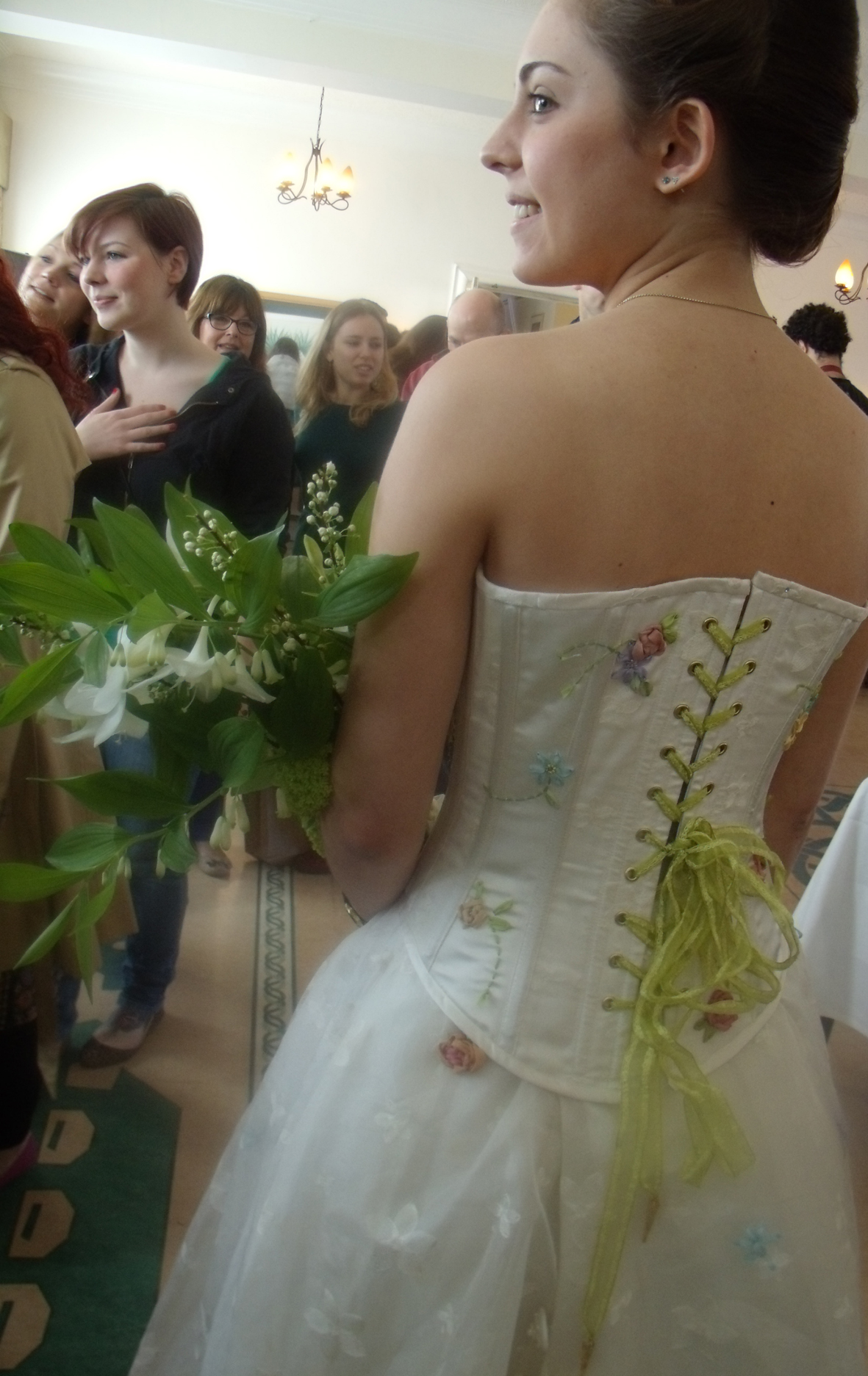
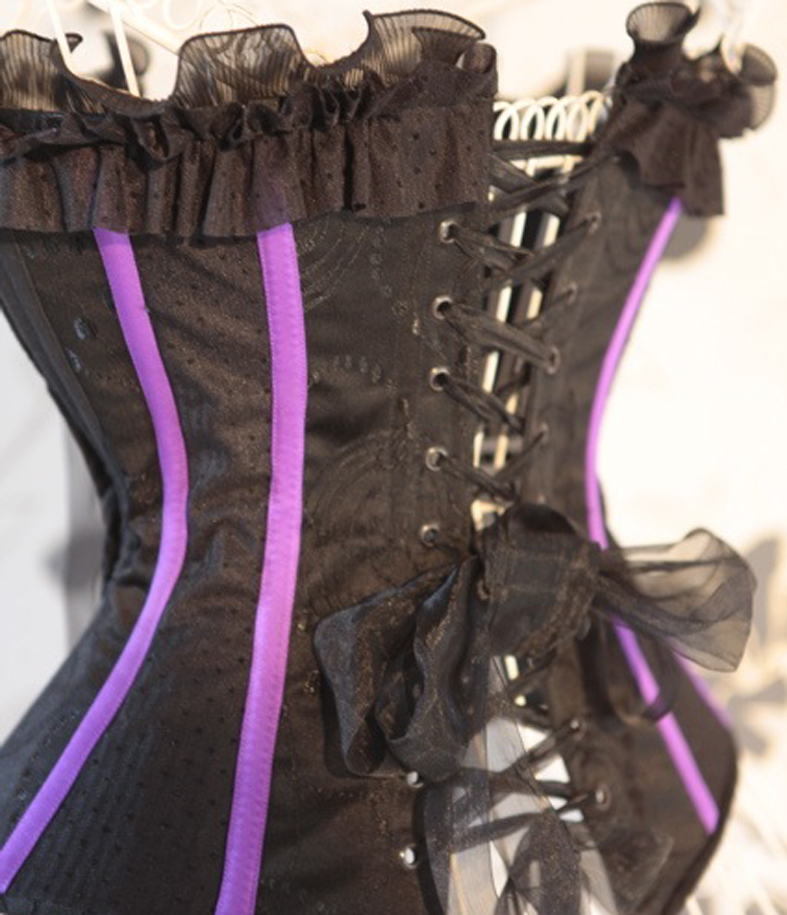
All the corsets are boned and laced at the back and this is where the fitting starts to work, I thought the backs were as fascinating as the fronts

laced back with eyedlest and a silk ribbon to match the frills.

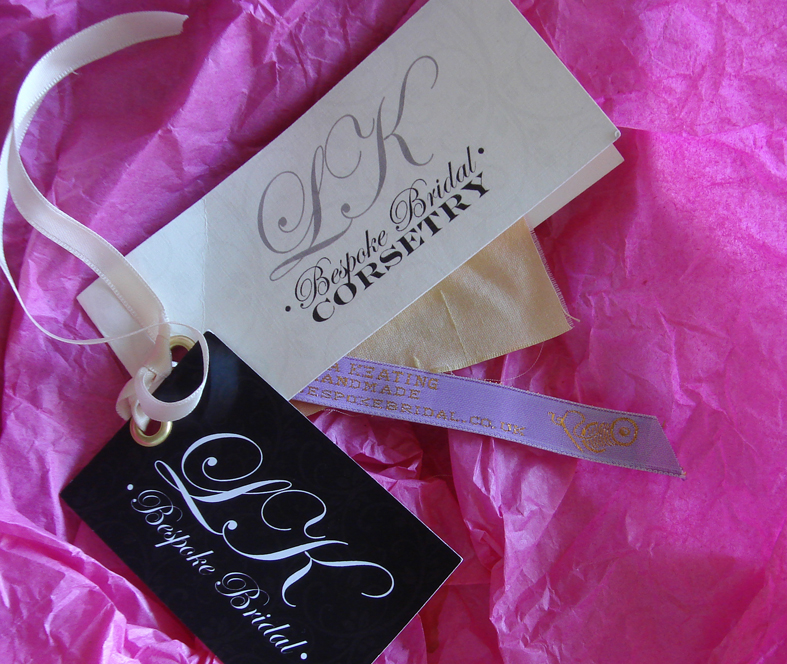
even the labels that Lisa had made for her business cards and samples were delectable.

Lisa Keating business card and samples

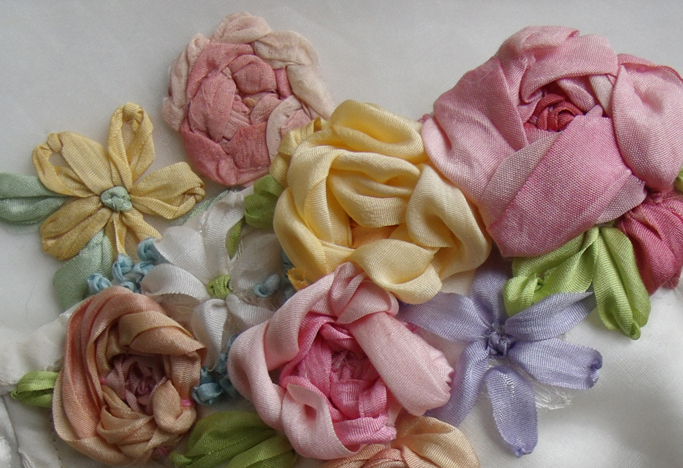
I will leave you with one last lovely image so that you can come and make some of these wonderful things in August at Heart Space – we have plans for making a ribbon flower encrusted corset between us.

Inspirational Indigo

Heart Space staff went on a jolly last week, to Glastonbury for an antique textile sale. It was held in a beautiful refurbished medieval barn which although toweringly beautiful was ffffffreezing…….

After rootling around, trying on hats, sighing over Edwardian wedding dresses and ball gowns, we eventually ended up buying all kinds of small affordable things. I always try to find either useful fabrics I can work on, got lucky and bought 12 matching linen handkerchiefs for my Make it Through the Night project, or totally Inspirational Objects – which can mean anything at all that just gets me itching to work. We  all eventually gravitated to one particular stall, Slow Loris – an oriental textiles and vegetable dyed clothing stall selling wonderful embroideries and traditional  ethnic indigo fabrics.

Martin Conian is a fascinating and knowledgeable dealer in wonderful things. I have scant knowledge of these textiles except that they come from a group of ethnic Chinese peoples living on the borders of Thailand, Burma, Laos and Vietnam in south East Asia, known as the golden Triangle so I am just showing you what I liked and eventually what I bought for inspiration

Martin has spent many years visiting, collecting, trading and working with the people who still make these costumes, books, fabrics, jewellry and boots…I got particularly interested in the boots.

embroidered silk boots and shoes

as did Sophie, our volunteer organiser who loves everything vintage, especially textiles.

We were both fascinated by the embroidered boots

But the real delight was when we turned them over and discovered……

Embroidered Soles!

But what I really really wanted to buy – and if I could have found one to fit me I would have gone onto debt for – is a pleated burnished indigo skirt.

 What I did eventually feel able to afford on the grounds of Inspirational Object was a metre of beaten indigo cloth; apparently the indigo is mixed with many other active natural additives to get particular effects and colours. I can only recall Martin listing egg white, persimmon, urea, amongst the different lists of ingredients he quoted to make up each different dye.

And why did I buy this simple cloth with all the wealth of other desirable things?  Well suddenly I saw a connection with some other things I am wanting to work with – when I get some time- to try to make some type of collaged/appliqued/stitched/ enamelled/ threaded leathers, metals and fabrics that will be combined on such a way that I can develop an entirely new set of work.

Below is a selection of the fabrics and objects that I will now start to think about again – watch this space – but don’t hold your breath!