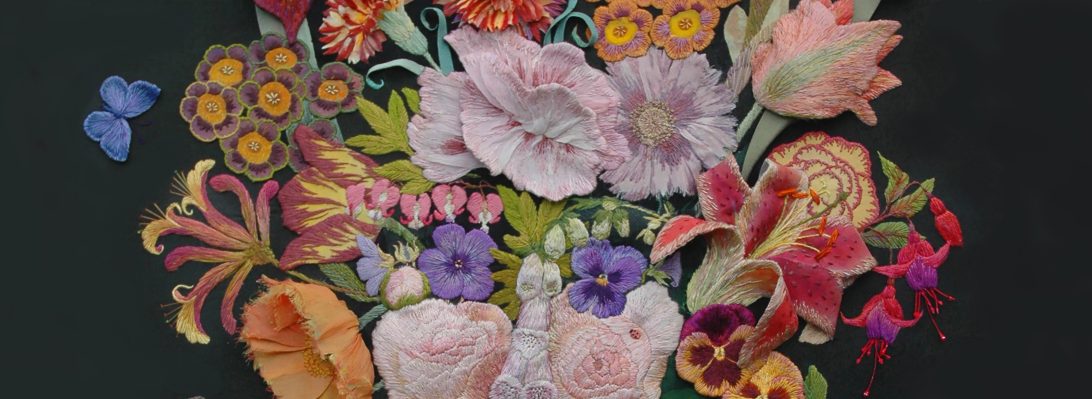
It is almost 20 years since I had this disturbingly beautiful dream but I have NEVER forgotten it. Re-visiting my sketch books archive, I found the original drawing that was hastily scribbled down when I thankfully I woke up.
Now, I have decided to complete my long standing/stitching on-going work project “Make it Through the Night“, after not working on it for more than 5 years. I have determined to complete the project to a degree where I can hopefully resolve it but so as not have it in my brain as frustrating “unfinished business”. I just can’t ignore it any more…. too much of me resides in it; and as the composer Gustav Holtz puts it ” Compose nothing unless the not composing of it becomes a positive nuisance”
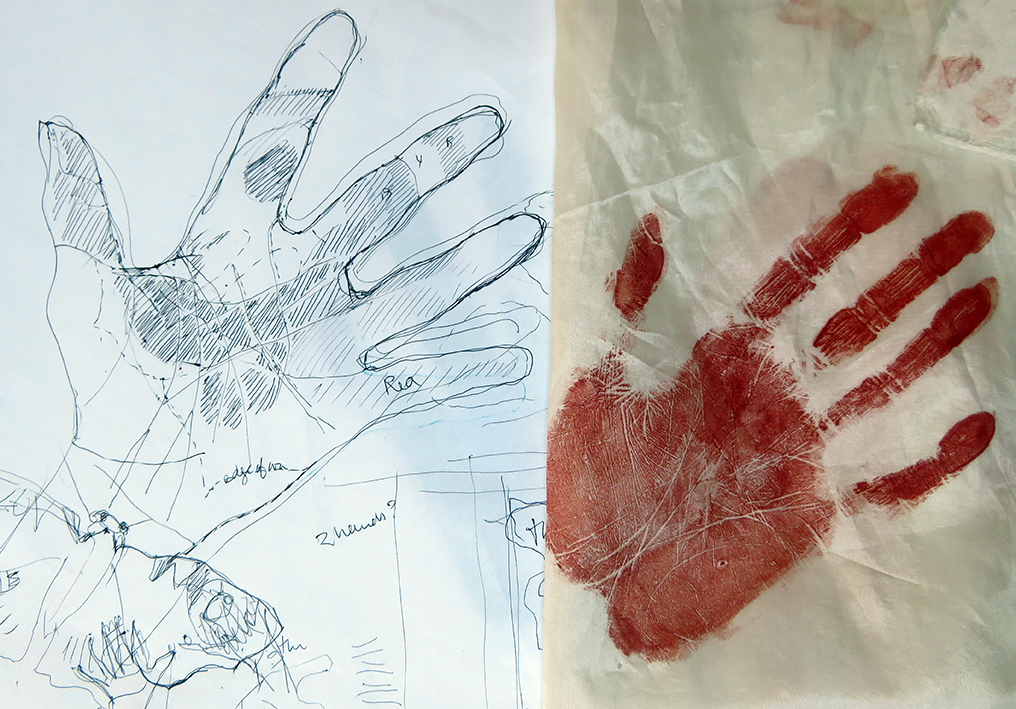
The initial drawing , above left, is dated 28th July 03; the second drawing is another later version when I was trying to make a composition for a stand-alone embroidery….. now I have decided to add it to the ‘dream pillows‘ and I need a different composition. Recently looking very carefully at the 2 drawings I realised I had completely forgotten that the butterfly had a face – YIKES!
In the actual dream it was a giant butterfly several yards/metres wide, dying and lying on some grass underneath a tree, the remnants of wings scattered round it. People were picking up the large technicoloured pieces of shattered wing and I really wanted some as well – but I thought I would get it something to drink first, then decided to pick it up and take it to a nearby puddle, the result was my butterfly covered hands…I abruptly woke up.
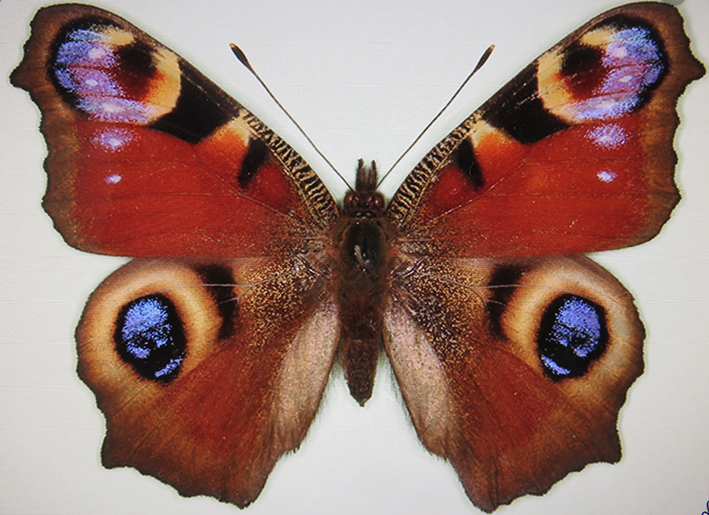
I started to research the ways on which I could have held the massive butterfly. I looked at many different British butterflies and chose the Peacock mainly because it was so colourful but it has eyes as well – one of the major symbols I use in my work. Every year we get smaller butterflies over-wintering in the house but these beauties are rare here.
I had my own hand prints on silk, from an earlier area of research and I liked the way the lines of the palm were voided. I now transferred the palm lines to the outlines of my hands so that they would interrupt the wing pattern.
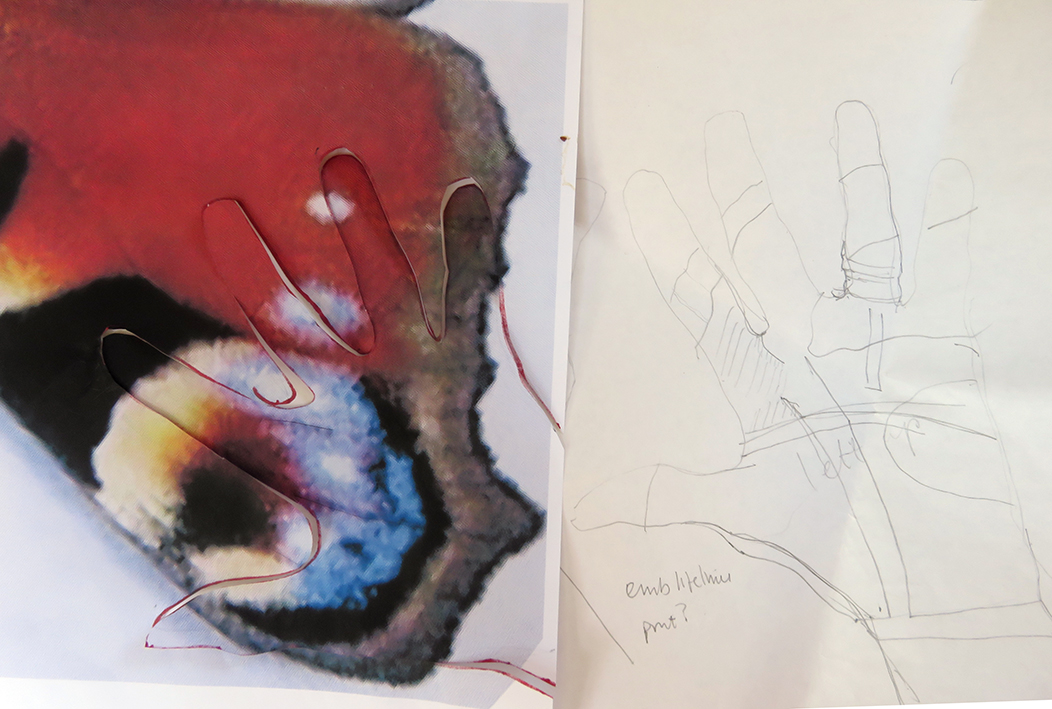
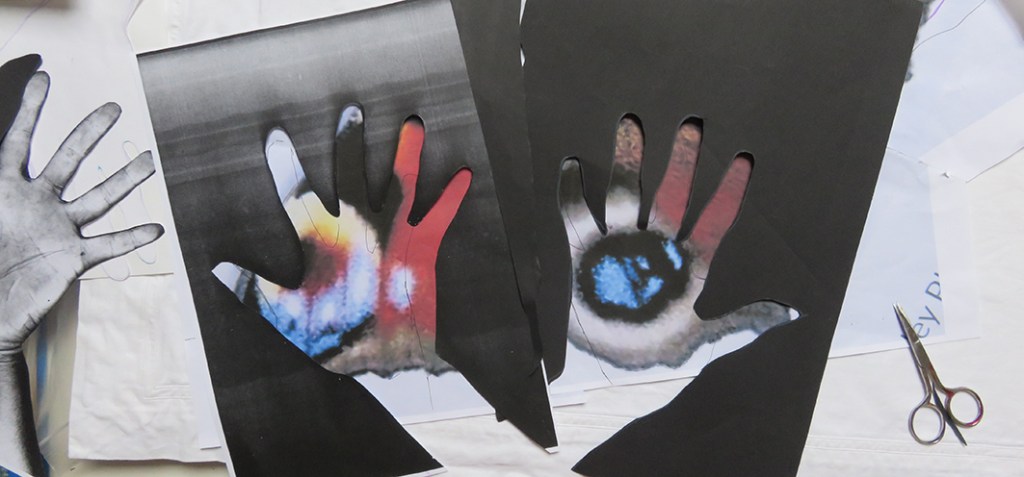
moving around with the photocopied cut out hand shapes to find interesting enlarged wing patterns to embroider.
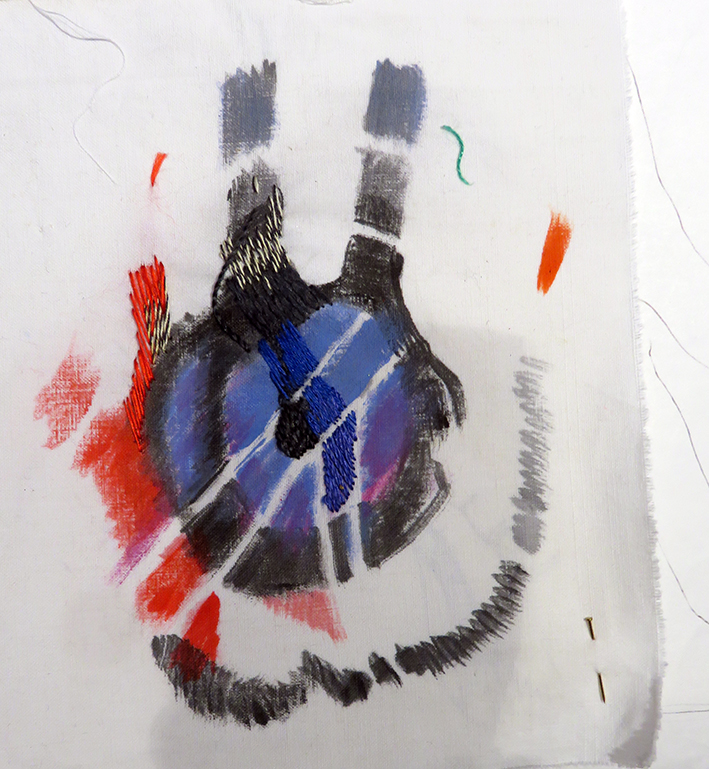
I enlarged the first peacock butterfly image and cut out my hand shapes…next I had to add the patterns to enable me to stitch the whole hands……the original working drawings below with a a technical sample that I would use for the very complicated patterned hands. I decided to paint dye onto the ground first to give me guidance for the colour blending and to assess the amount of work I would have to manage.
the separate hand drawings with a very crude but vital painted dye and stitching sample.
Next I had to imagine the shattered butterfly – I tried many variations; the shape had to show a degree of violence and some direct connection in the shapes left after my hands had devastated it, because it shows the terrible result for the insect…
3 of many versions of the lay-outs for the pillow, the hand writing is in water soluble pen
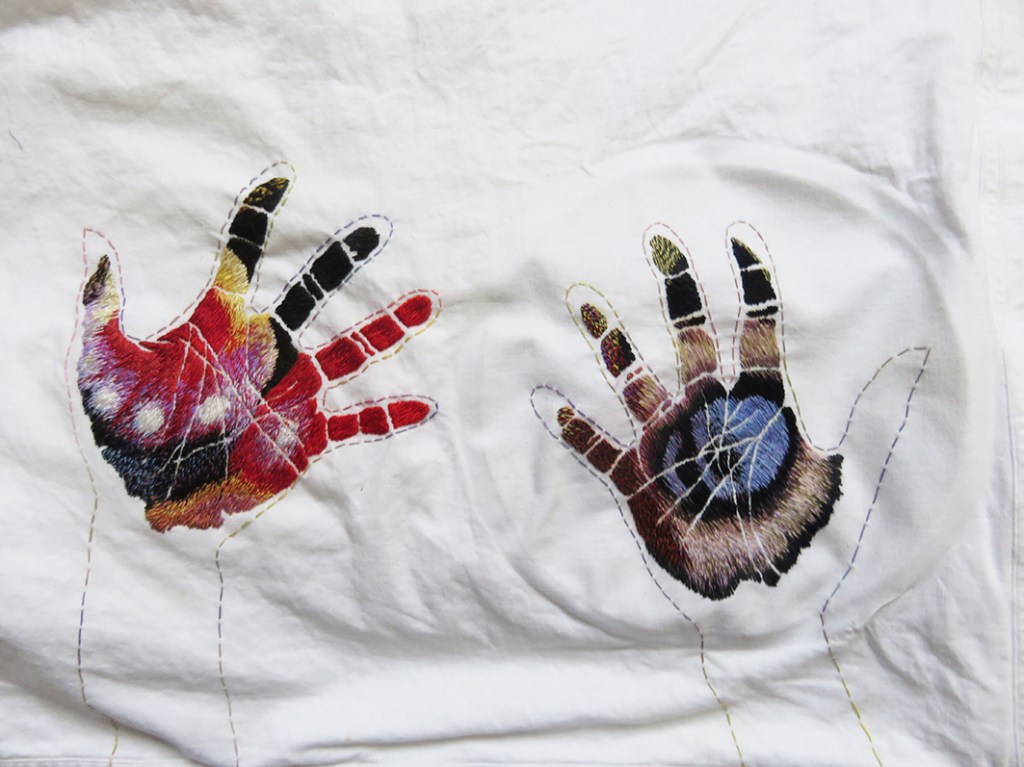
I drew the hand outlines and running stitched them, then drew my palmistry lines on each hand and painted dye within the lines and fixed it securely – all of this before I could start stitching, which I was itching to do …..
2 images above show the first and last day’s stitching of the hands. I started this project in early August and now it was late September – I needed to move onto the butterfly now…
working from my research drawings, I drew and embroidered the main area of the butterfly and then placed paper shapes to act as the shattered wings to make some connection to my hands.
research materials and dyed butterfly with the embroidered version with paper shapes in place for the broken wings.
It was at this point that something strange started to happen….I found a trapped Peacock butterfly in the window of my studio, I was delighted, I had never seen one of these in the house; the weather was still warm, so I let him go….
But then more and more Peacocks came into the studio, and in different areas of the house… in all we had 11 different Peacocks visit us. SPOOKY WOOKY……
the 3 photographs are of just some of the 11 different butterflies that came into the house over the last 3 months while finishing the embroidery. The image of the butterfly lying in my palm was taken on 25th December – amazingly it died with it’s wings folded back to show the eyes, I take this as a rare and wonderful Christmas present.
Sadly some of them died indoors and I keep them in m studio – they are all in different conditions; some very tattered wings and faded colour but others still beautiful.
my small collection of some of the autumn visitors I think there is another embroidery here……
so I eventually finished the pillow, completed the writing in running stitch and it is ready to join the Make it Through the Night project.
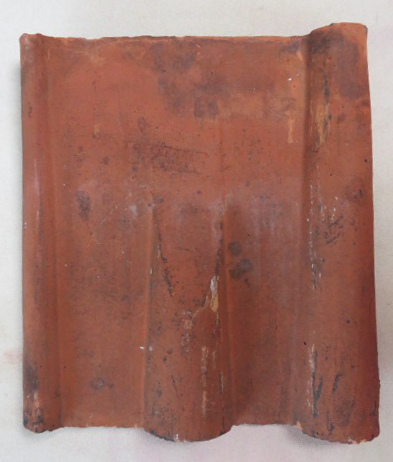
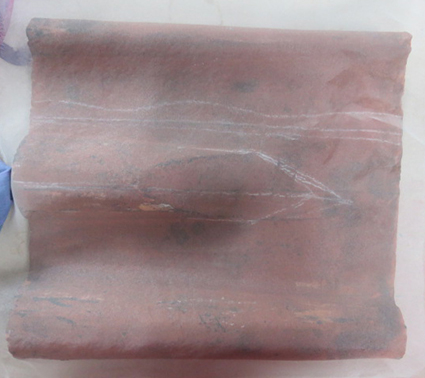
The Curzon Cinema in Clevedon, North Somerset, https://www.curzon.org.uk is my favourite (actually our only) local cinema; it looks and feels like the picture houses of my childhood in the 1950’s. (photograph above courtesy of Go Bath Bristol) Saved by the community from total dereliction some years ago, it now has a major problem, the roof is leaking and needs major money for repairs. So there was a call – out for local artists to help – decorate an old roof-tile in any way whatsoever ………and they are being auctioned on line next month from 1st December 2019.
the roof tile when it appeared was a bit of a shock, very curvaceous, I applied a layer of organza and turned it on it’s side….a felt a sea scape emerging. the headland of the Kilkenny Bay seen from our house and garden, on late sunny evenings…utterly magical.
The central curve reminded me of the the headland at the end of the bay where I live, Battery Point, on the Severn estuary, fanciful I know but I have many drawings of this view and have made many different types of work from the studies.
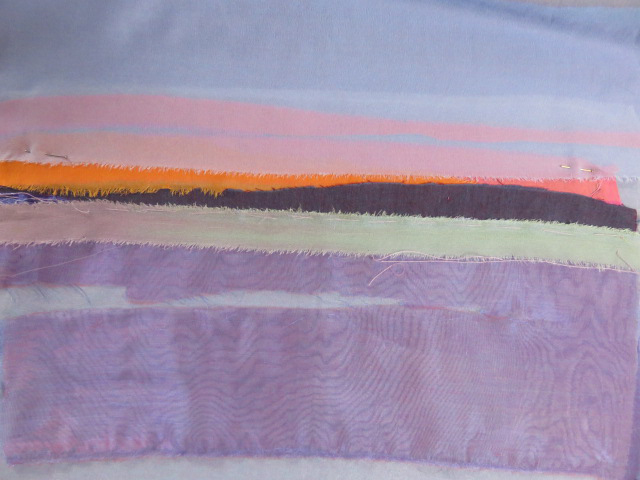
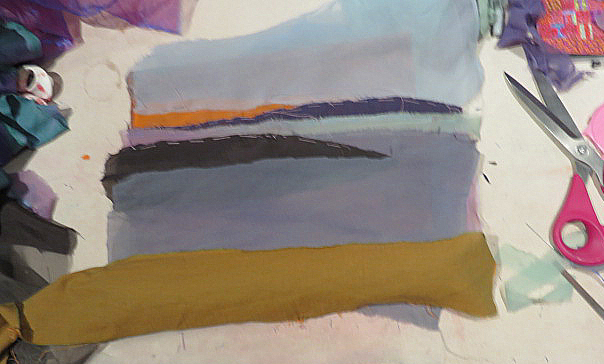
I tried many variations of colour scapes from my earlier drawings. I liked the glistening nylon shot fabric for the water, trouble is that the water of this estuary is never a deep true blue, air-force blue is as good as it gets. For some reason I started with the lump on the left…so the view was of the other end of the bay where the sun sets and all the colour emerges from…but it wasn’t working for me – then one morning I just changed it around so it looked like the Battery Point headland…I was suddenly on home ground..or should I say water?
I added the salt marsh fabric, a piece of green and orange shot cotton is the perfect colour of the marsh when the late afternoon sun lights it up in the autumn – the rest of the sky and sea seem purple in comparison.
The task now was to organise the layout of the fabrics so that they would lie in straight lines when they were eventually placed onto the undulating tile …this took some calculations as the tile is wedge shaped but the sea level and the salt- marsh horizons are straight….
I start to running stitch the sky …..but I have decided against the brilliant blue sea I hid it under a translucent layer of silk!
I used the simple running stitches of Kantha technique for this appliqué, I have to get the fabrics to stay together in a soft and malleable form so that I can easily manipulate the fabric over the lumpy tile.
I continue to stitch down the length of the tile – it takes several days but as always fascinating to handle the colour changes. The stitching is quite large and almost crude using a heavy gauge silk thread but very satisfying to do; usually when working this technique I use one single thread of silk and it takes ages and ages to cover the ground
As I continued to stitch the colours became muted and now the once brilliant orange sky was being challenged by the bright green of the salt- marsh; reluctantly I changed the fabric after several different variations of shot cottons had been tried, but there is enough going on in this small space as it is – hey ho!
eventually the finished piece is ready to be mounted onto the tile covered in wadding.
I then covered the tile in a layer of very thin wadding, sticking it down with thins lines of fabric glue so that I could continue to embroider the silk piece to it. I have evolved this technique for covering 3D shaped objects over many years of trial and error but this was a real challenge.
Having aligned the top of the stitching to the top of the tile I tacked it into position, then pinned it all along the undulations…it’s really tricky work trying to keep the horizon lines straight…all those years of pattern cutting came into play! The top and bottom were secured by over stitching onto the back of the tile wadding, pulling and stretching as I proceeded eventually it was securely stitched and bedded into position.
the back and front of the tile side by side – now photographed the tile just looks flat and with wobbly sides…but it feels lovely to hold.
I am really liking the feel of the tile now it is so softly padded and am thinking of possibly making some more stitched covers for other objects – one day. Meanwhile my husband Stephen Jacobson, has painted another view of the estuary using the imprint of the tile manufacturer as a flag with a view of the band stand at Clevedon. And artist Alfred Stockham has painted eyes to create a curious face and called it ” The Man in the IronMask “
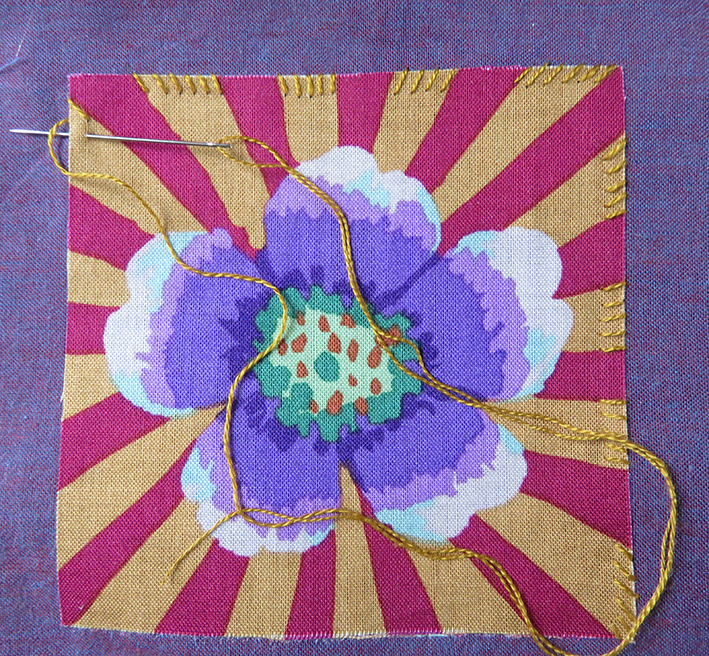
hand hem stitched sample of Broderie Perse as sewn on the original quilt
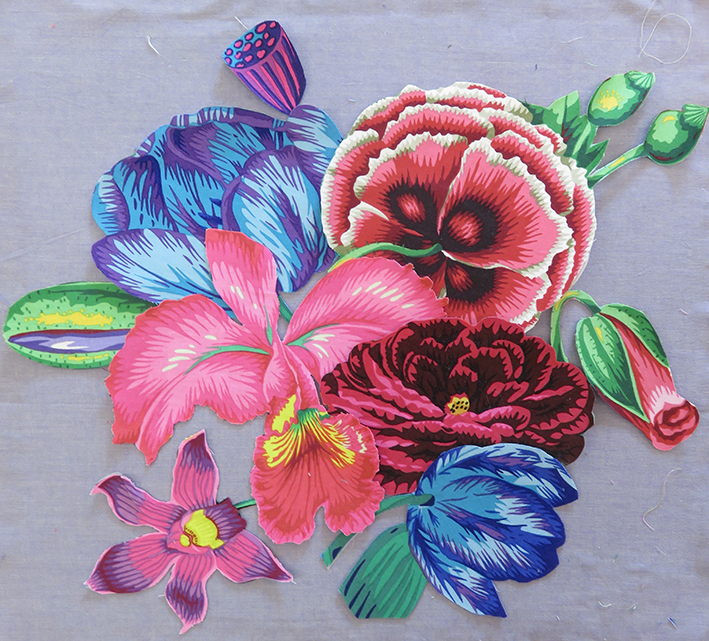
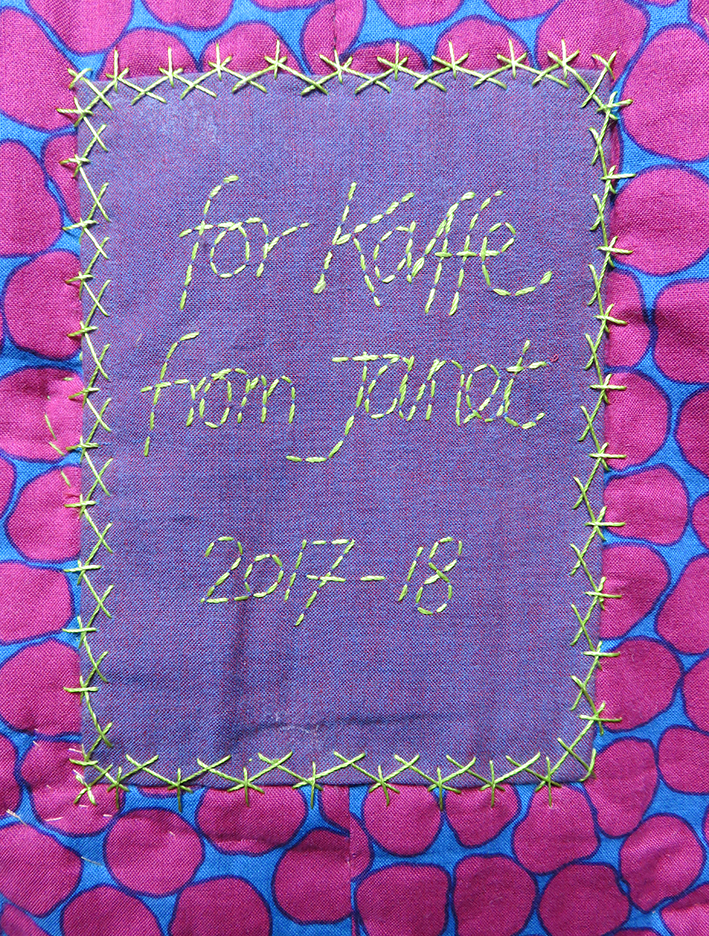
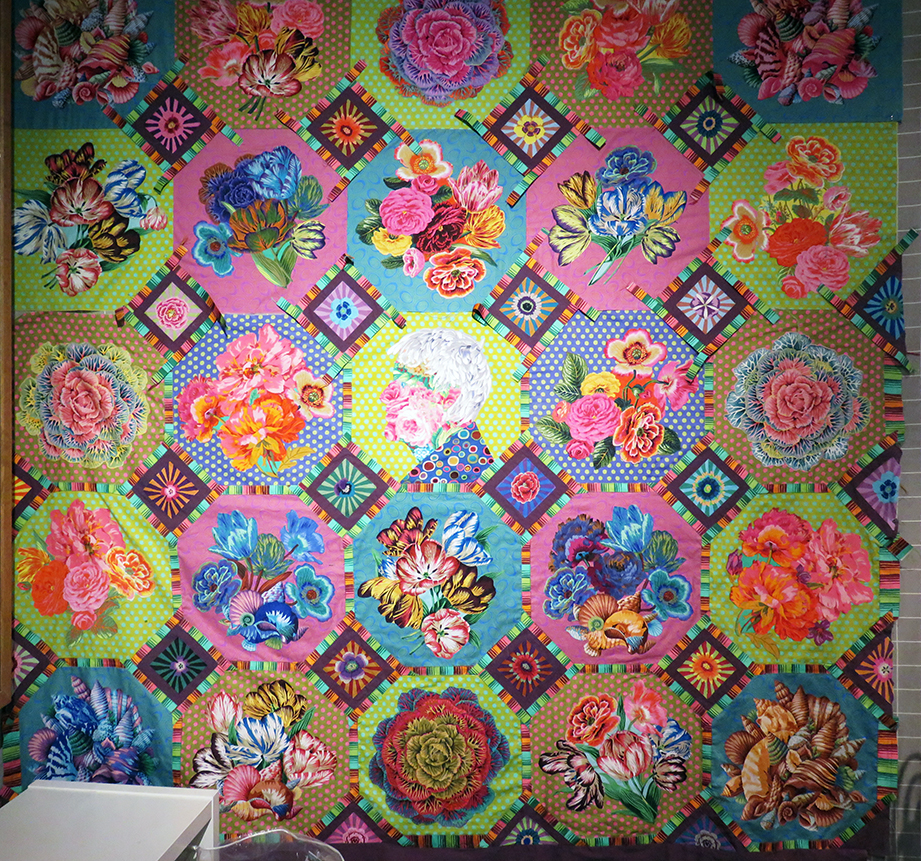
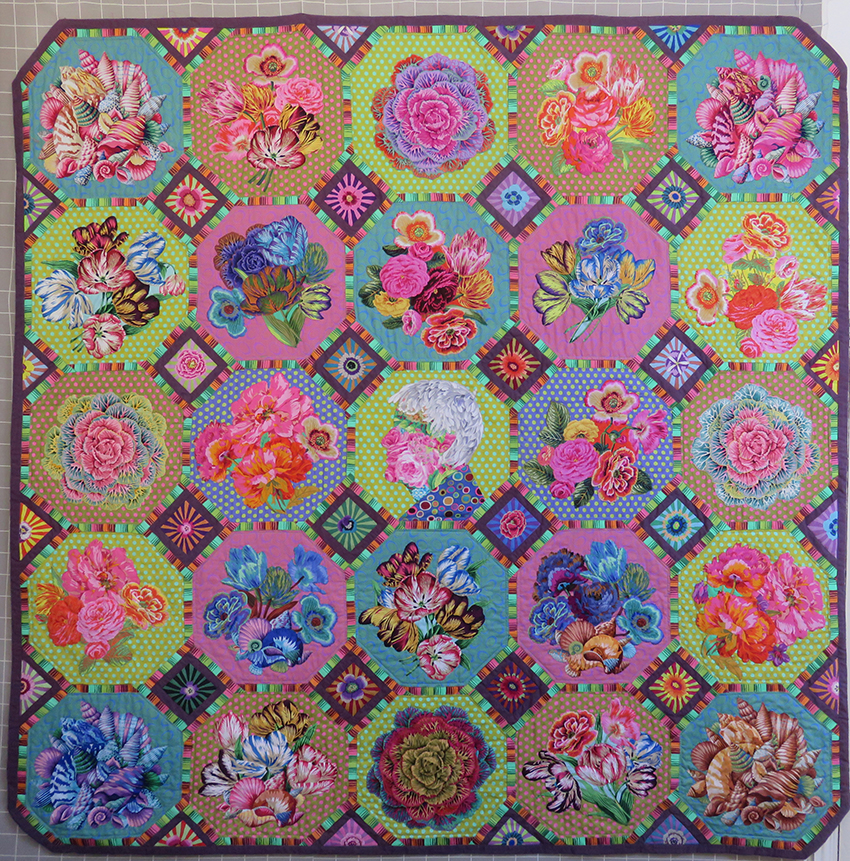
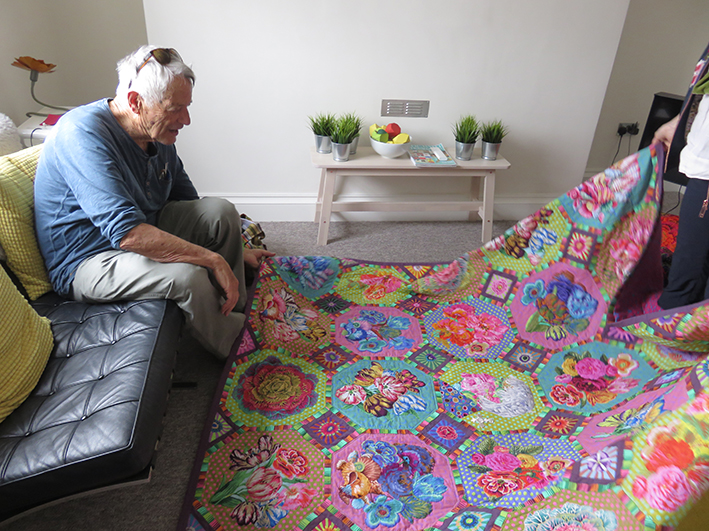
As part of the activities developed for the current Kaffe Fassett exhibition at the American Museum in Britain I am giving 2 separate day workshops to make a small panel of hand appliqué flowers. I am supplying the same fabrics used for the large scale appliquéd quilt that I made for Kaffe to celebrate his 80th birthday.
Kaffe visits his present in the quilt room at the American Museum
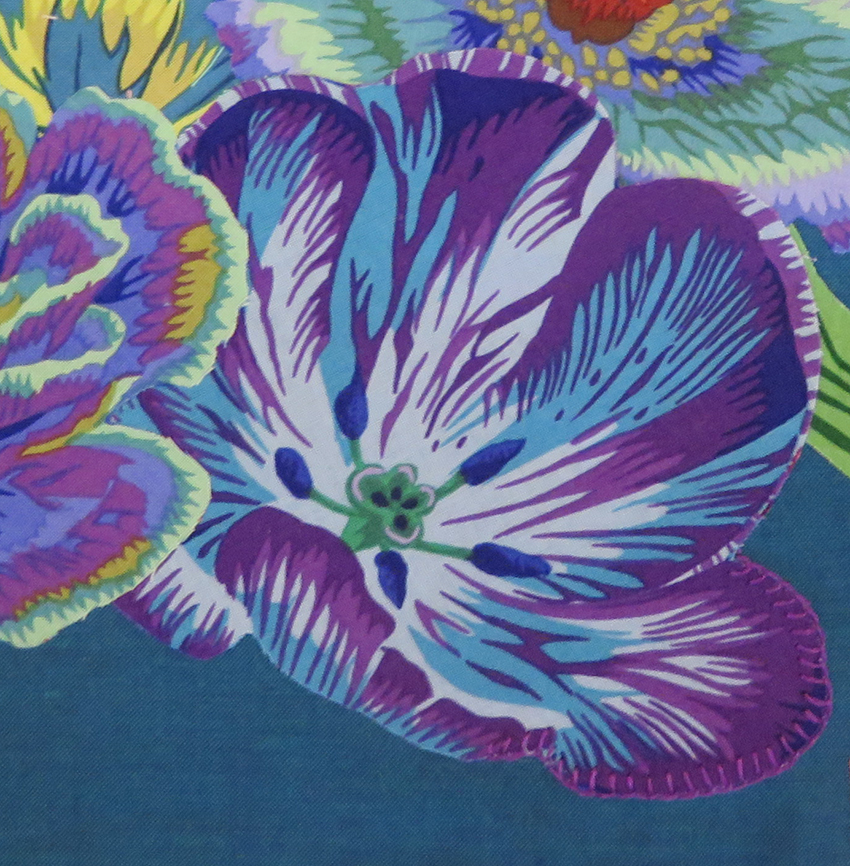
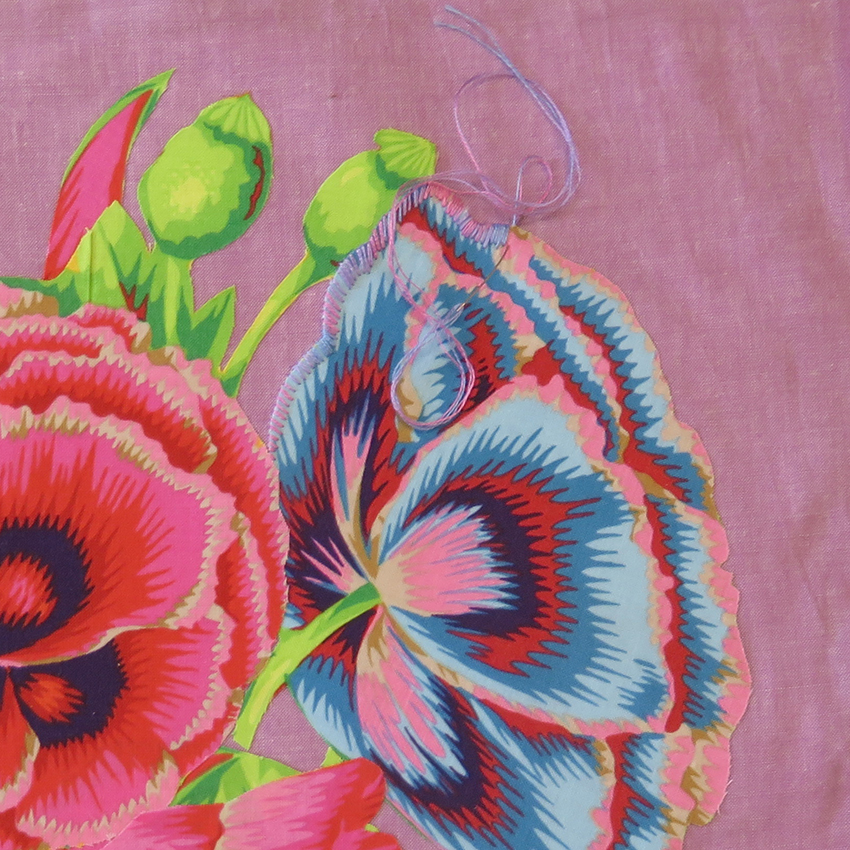
I started the day by taking all the participants to the museum’s Quilt Room to see the original quilt and explained some of the techniques we would cover. I explained my technique of hand stitching over the raw edges of the bonded motifs, which is easier than the original way of turning a small hem and stitching onto the panel. They were asked to design their own version of the appliquéd flower and shell panels – but not the central Kaffe portrait.
Kaffe Fassett Collective fabrics bonded with heat transfer papers
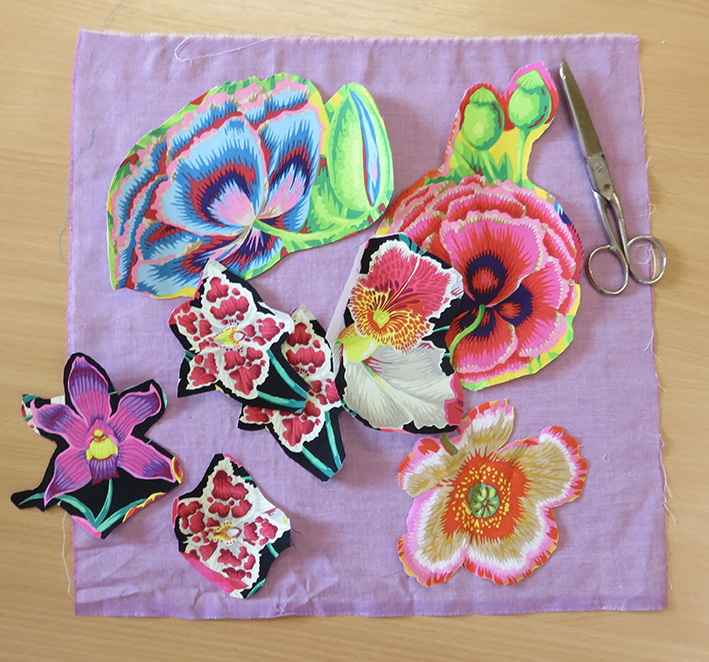
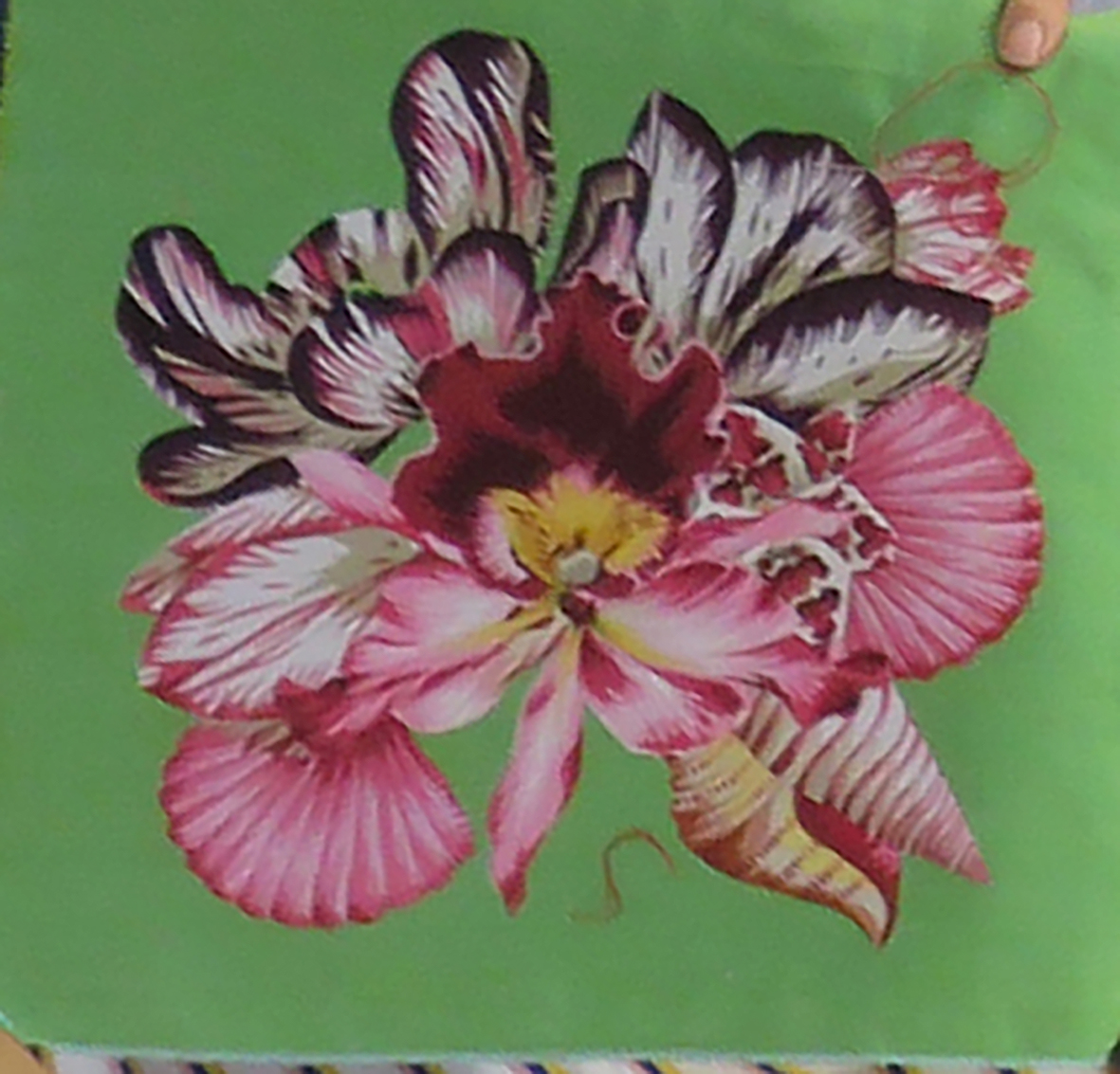
I had prepared a whole sheaf of flowered fabric by pressing heat transfer paper onto the backs of them so they were ready to cut out. I also took the remaining motifs I had cut, but not used, from my quilt. Plus a selection of different coloured squares of Shot Cotton for the backgrounds, these I backed with a woven cotton interlining to strengthen them for appliqué to be sewn without a stretcher or hoop.
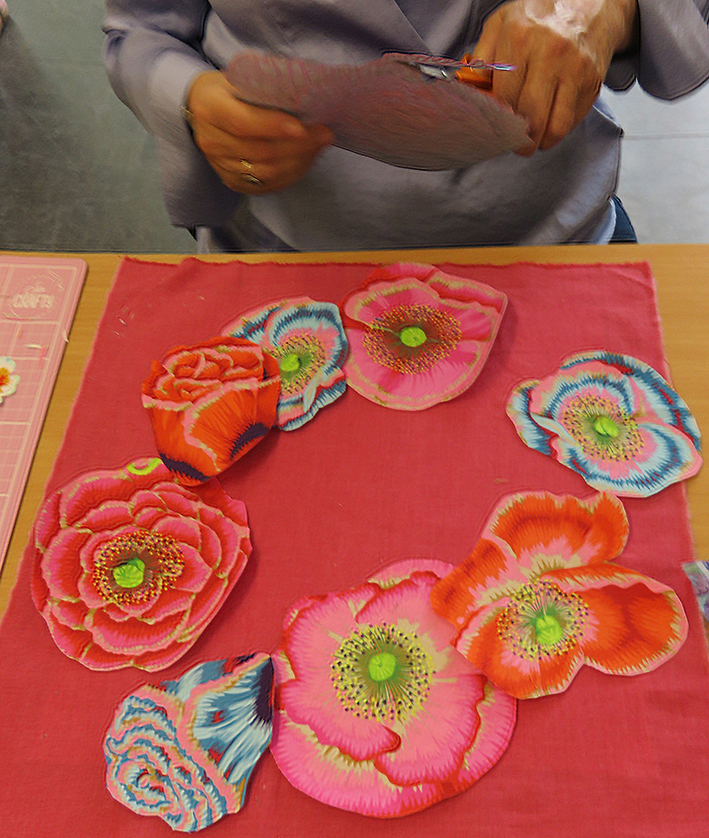
Everyone had to choose their own back ground fabric first, this makes finding colours for the individual flowers easier; I know how daunting it is to have so much choice. But they soon got going on the cutting and placing….
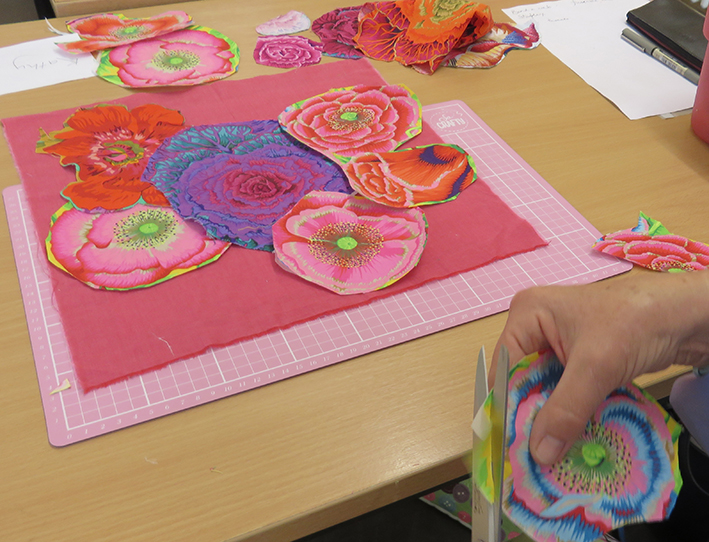
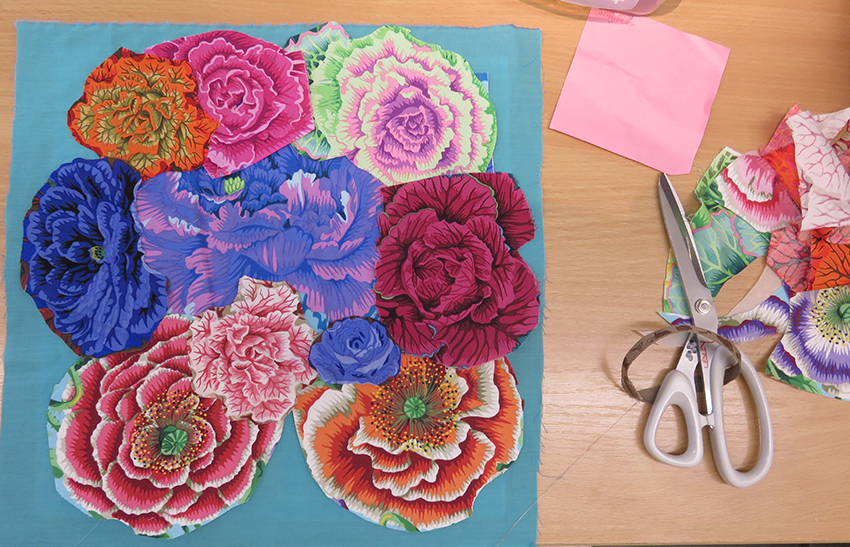
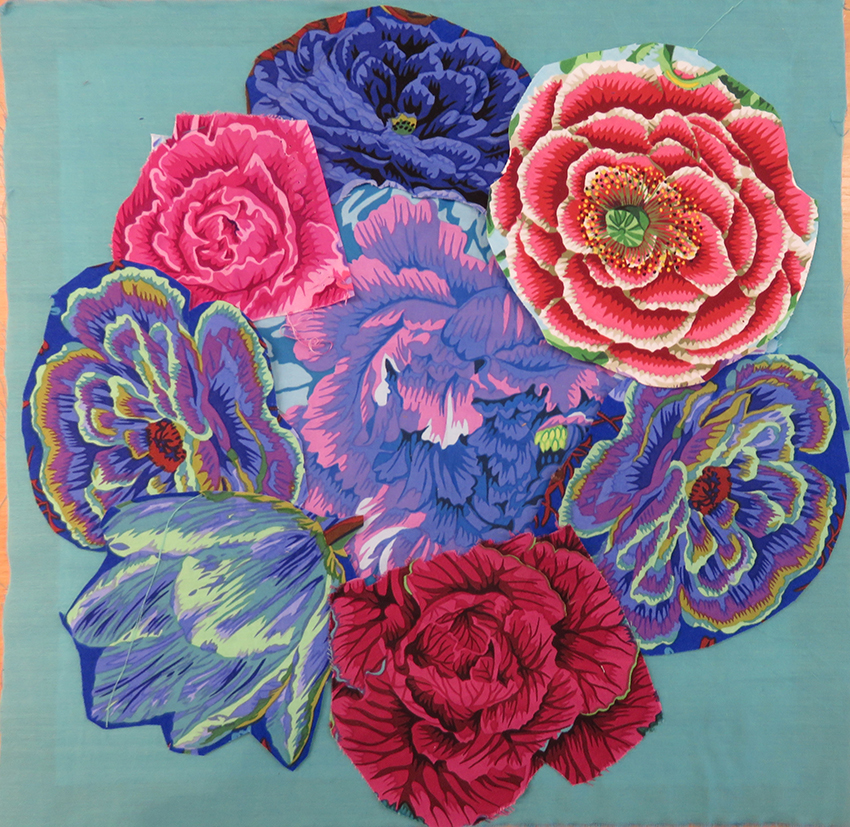
The first thing I noticed was that most people put far too many flowers onto the fabric squares with odd gaps between. I had to keep reminding them that this was to be a hand- stitched appliqué and to think about the work involved to finish the stitching later at home….. but even so most people favoured lots and lots of flowers, below shows some work in progress.
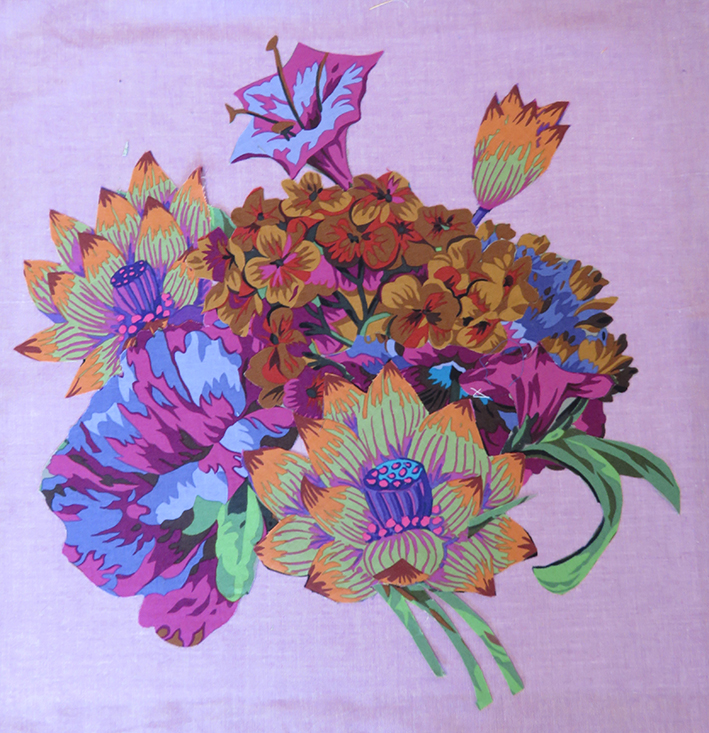
After the basic shapes were developed extra flowers could be found in the spare fabrics I had brought, and people could bond and press motifs individually to balance or fill up their basic design. Several people worked as I do and changed their designs a great deal during the design process until they were about satisfied.
Other people had very organised workspaces (very unlike me) and I enjoyed seeing their beautifully laid out tables with all necessary equipment to hand. They seemed to progress steadily and surely, with only a small tweak or suggestion of a different fabric from me
a work table set out with cut motifs and a camera ready to record a successful design
eventually all the designs were organised; some really interesting designs were arrived at by chopping and changing until the last minute…
but eventually everyone had to commit to trimming,
very very carefully trimmed stalks and petals ready to be bonded
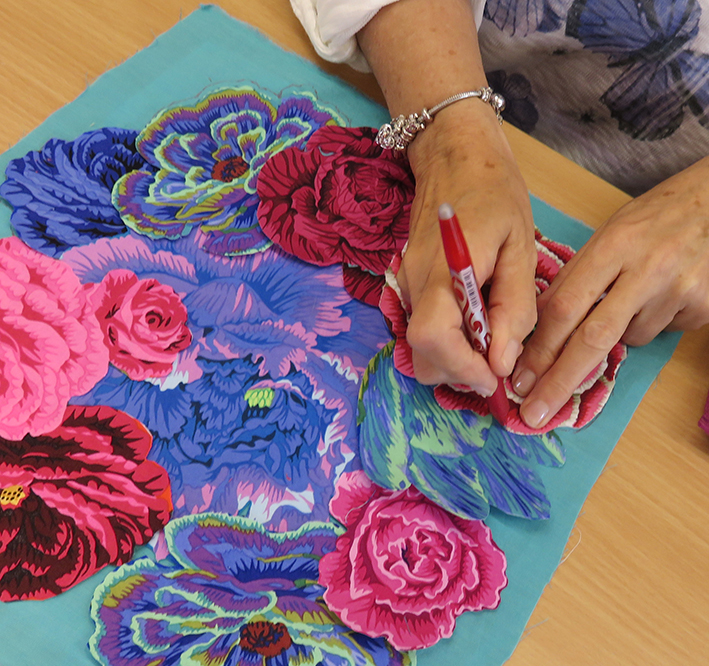
then tracing around places with a water soluble pen, before pressing the whole design into position.
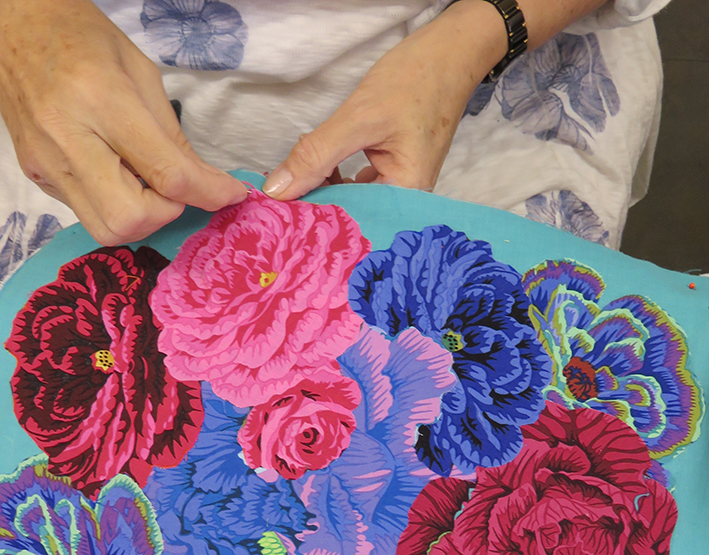
and then after a quick demonstration from me – start to stitch it.
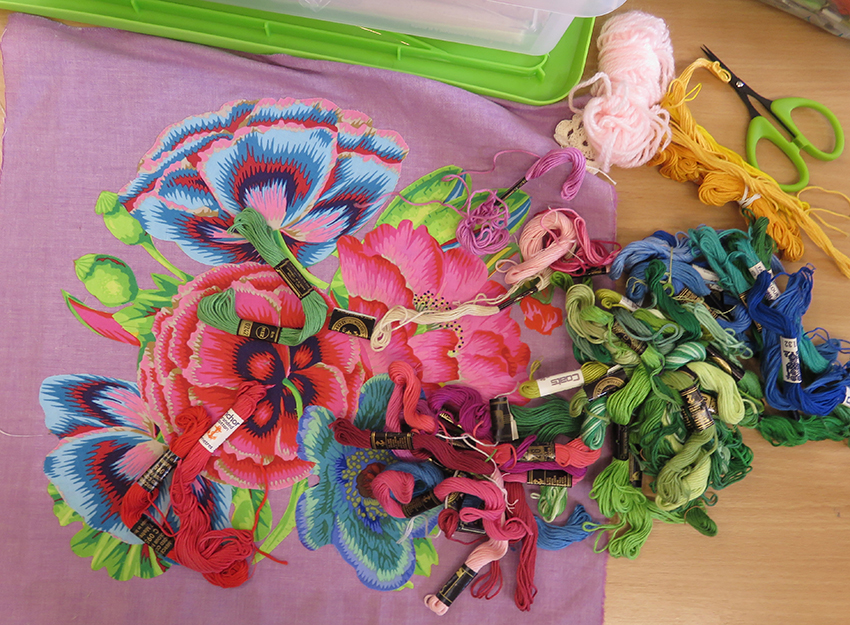
a range of embroidery cottons chosen to tone in with the fabric colours are ready to appliqué
They all were very skilled at this very precise stitching, a relief as poor work at this point can ruin all the meticulous care taken after this really intense design stage.
At the end of the afternoon session there was a lovely and varied set of designs and some were already being stitched – with promises from the rest that they would definitely finish them.
the whole ten class participants with their own ready-to stitch appliqué designs.
And for anyone who is interested in joining the next workshop – it is on Saturday September 21st 2019.
My final stitches on the back of quilt appropriately backed with fabric designed by Brandon Mably
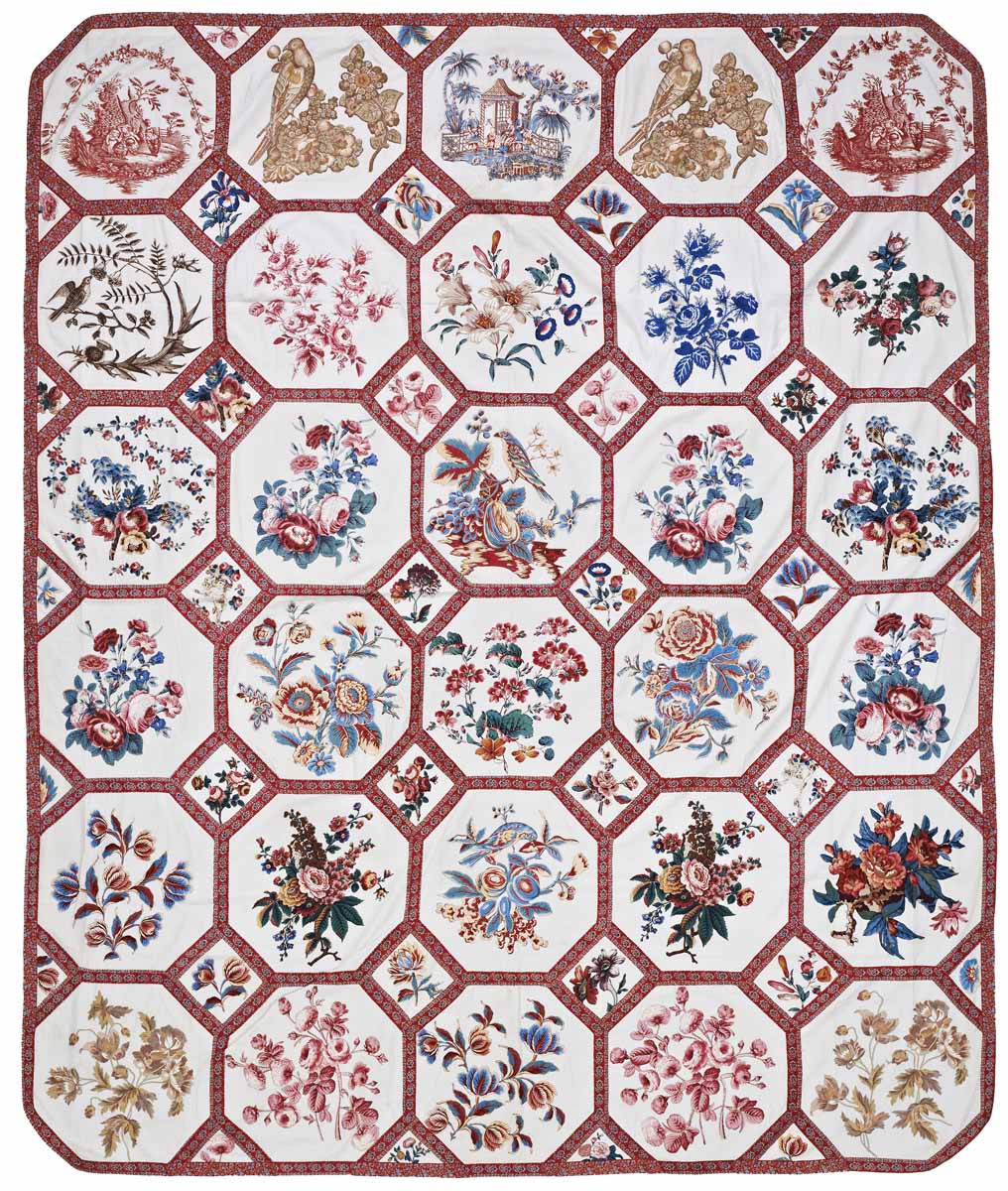
This major project started life in 2017 through sheer frustration. For Kaffe Fassett’s 2018 quilt book, based on traditional quilts housed in the American Museum in Britain he had asked that, as a hand embroiderer, I make his revised version of an ‘Broderie Perse’ in their collection. I was delighted.
I immediately started to sample some simple ways to make such a large hand stitched quilt nowadays, plus information notes for others to follow the instructions. However, due to lack of time due to publishing deadlines this quilt was dropped….Rats!
behind the scenes of the American Museum
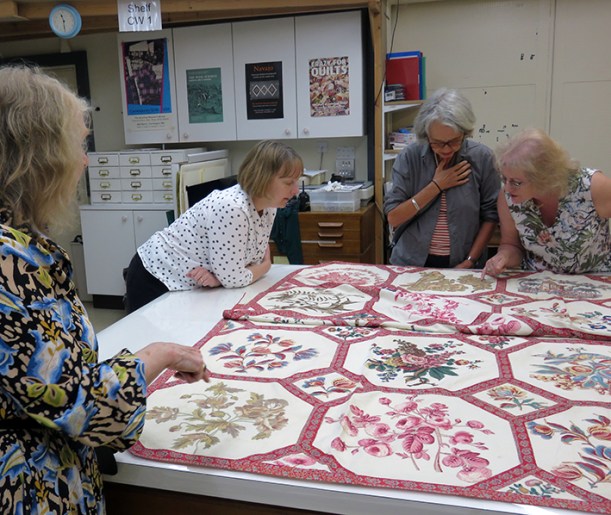
Later in the year I organised with the museum’s curator, Kate Hebert, to visit the archives with the UK making and publishing team. I asked to see ‘the one that got away’ and on hearing the story, Kate said that if I ever re-considered making the quilt she would show it in the quilt gallery alongside the original. Well of course I jumped at the chance to show work at this museum, and I did want to make the quilt.
I decided that I would make it as a present for Kaffe, it was his 80th birthday in December and I had enjoyed the last 3 years working with him on his books and my contract was at an end. I reasoned I would soon have plenty of time on my hands to complete the project in time for his birthday.
Kaffe Fassett studies new work on the quilt wall in my studio
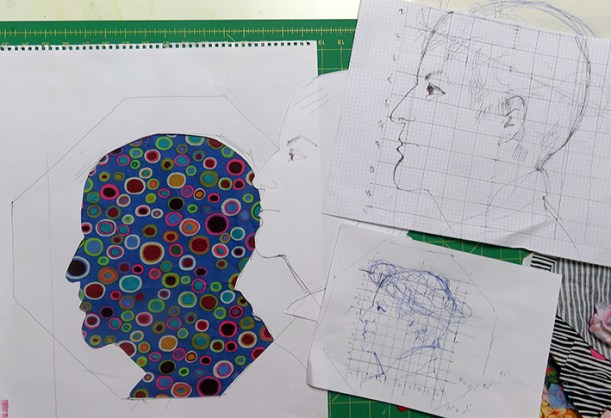
As I now had ‘carte blanche’ to interpret the design as I liked I decided to make his portrait as one of the panels. Using a recent photograph from his last visit to the studios I set about drawing and scaling the head.
the original drawings scaled up from the photograph
I made carefully measured sketches, and then 2 masks – one to the size of the hexagonal block and the other of the head. My initial idea was to garland the head with flowers – well why not?
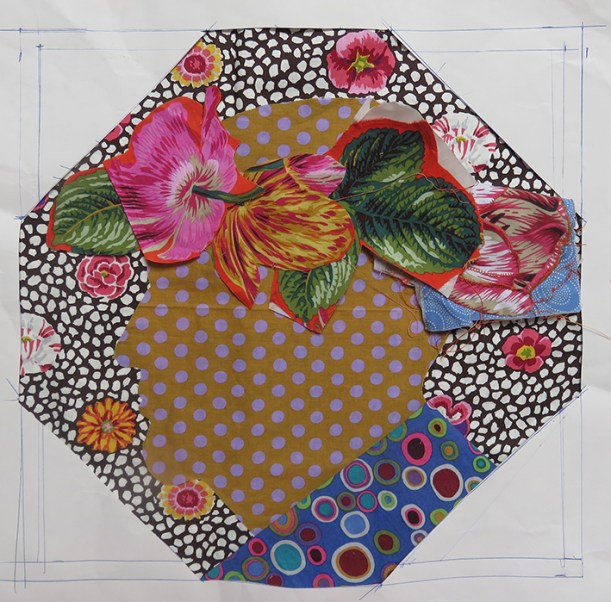
first attempt to design the head using some of my favourite fabrics
This looked miserable, and the garland didn’t fit into the hexagon very well – and then I would have to embroider the features; I remembered my ‘Flora’ embroideries influenced by Archimboldo – the artist who made faces from flowers. I tried various flowery fabrics from the Kaffe Fassett Collective.
This selection took several days and I was still not convinced I could make it work well enough, then into my studio stepped an old university colleague from my teaching and researching days, Dr Dawn Mason, with the perfect bunch of flowers to match the work – I believe that chance happenings are not always random
serendipitous flowers – I am on the right track
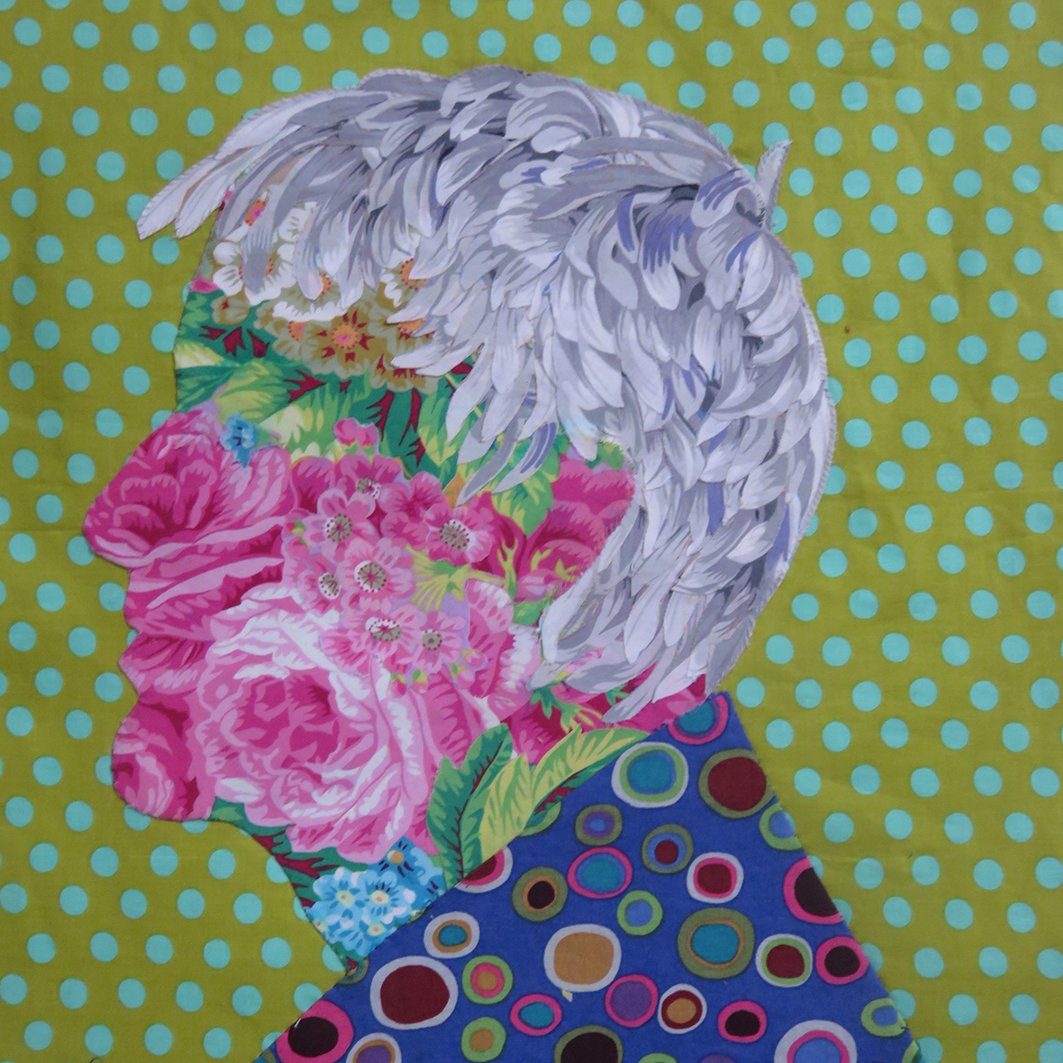
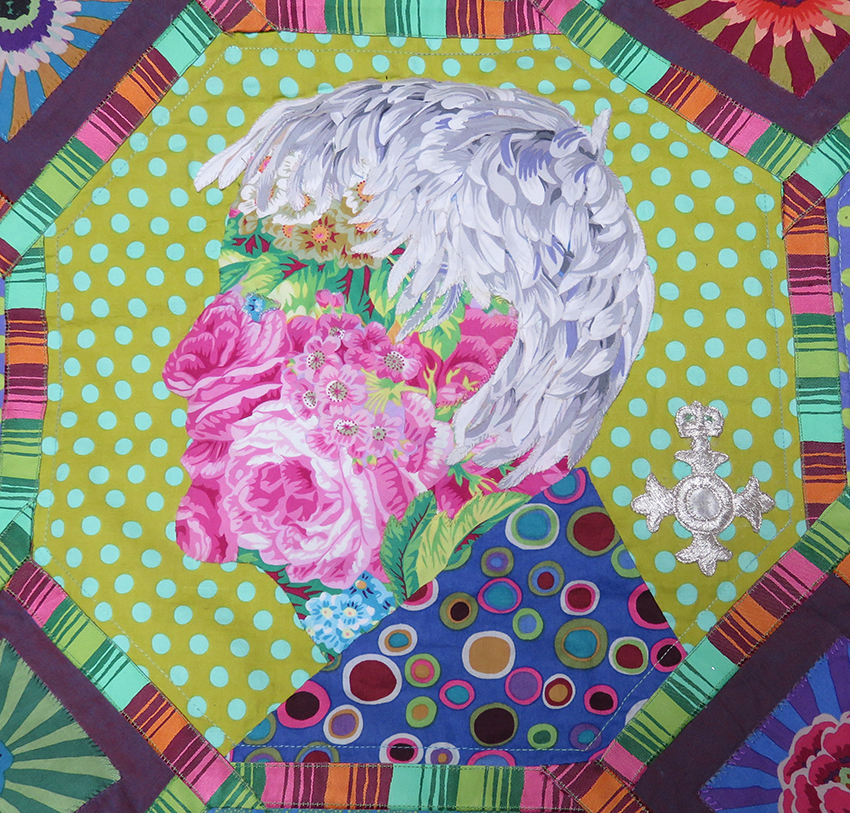
I persevered. Eventually I chose the fabric placement, cut it out with a tiny seam allowance and hand slip stitched it to a spotty fabric, adjusting the chin to become a tad larger proved successful. Very carefully I placed a blue bud for the eye. Suddenly Kaffe appeared in front to me.
chosen fabric on drawing
perfecting the chin
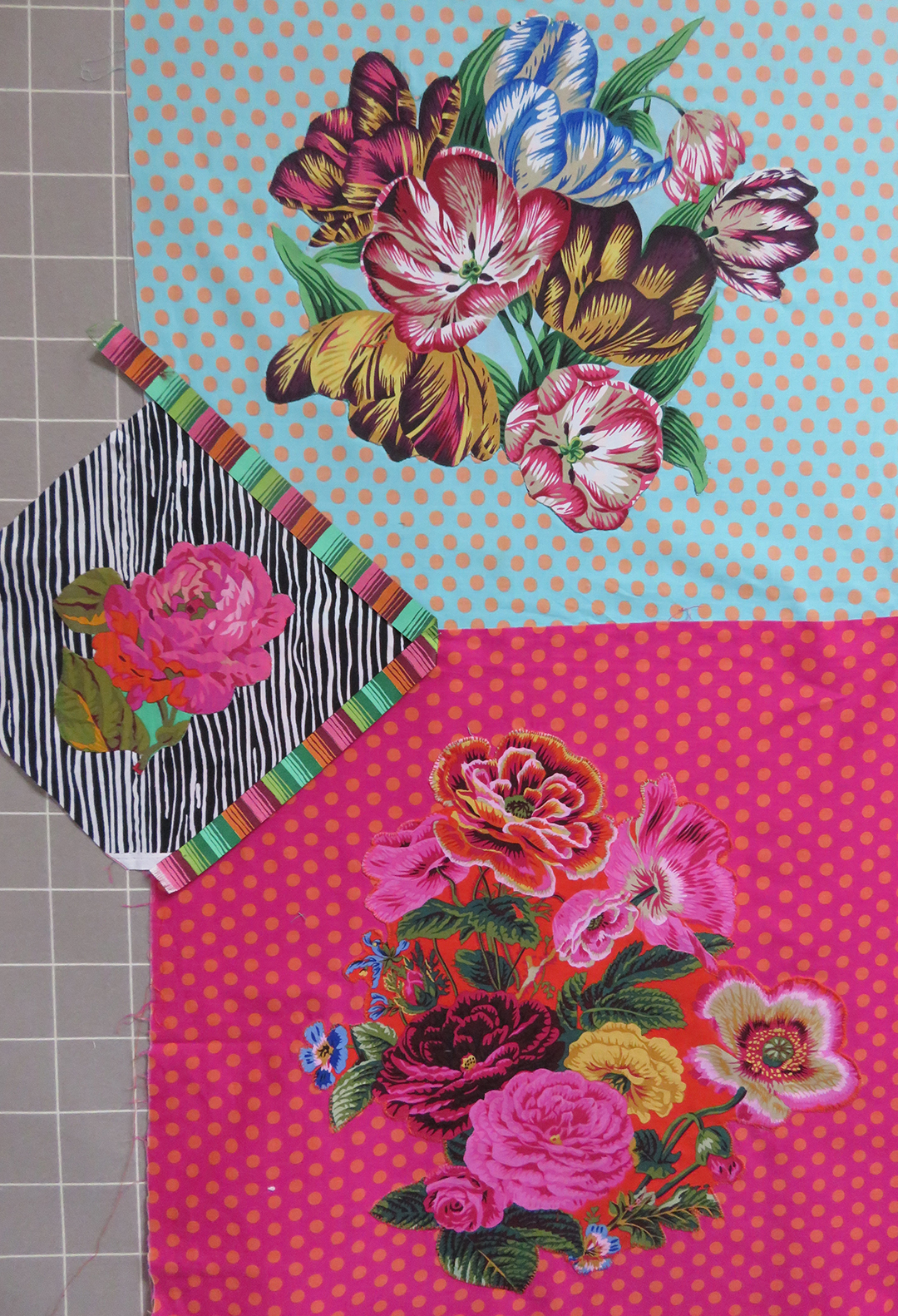
Now for the hair: I found the white petals of Japanese Chrysanthemum by Phillip Jacobs perfect for my purpose, and so it appears does everyone else; the hair is the thing that gets the attention. In fact most of the fabrics that I used Summer Bouquet and Shell Bouquet and Tulip Extravaganza are designed Phillip Jacobs, his fabrics are so elegantly drawn and painted and the perfect replacement of the original chintzes.
The next stage was to decide the rest of the portrait. For the shirt I had a smidgeon of an old version of Kaffe’s Roman Glass in blue, I had bought years ago – and after many trials chose the fresh Spot fabric in the colour ‘Pond’ for the background.
the finished head
Now for the rest of the patchwork, So far this has taken me about 3 weeks of drawing and stitching – but it is still only June.
the original samples for the American Museum book
I dug out the abandoned samples I had made for the book – I needed to make more other panels to add to the portrait.
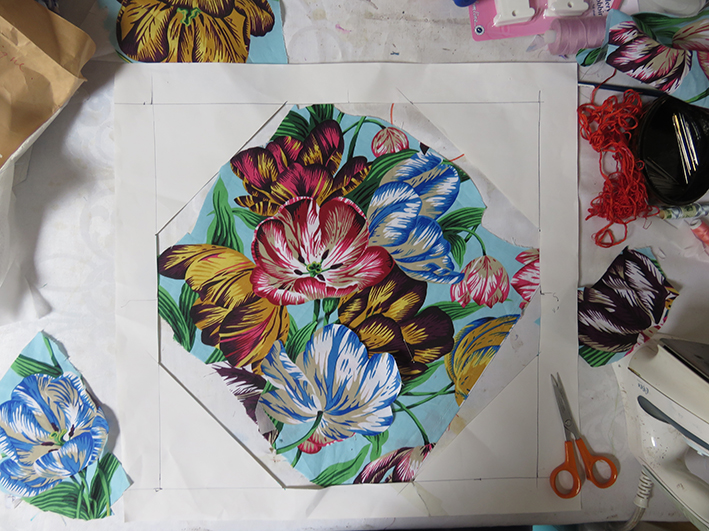
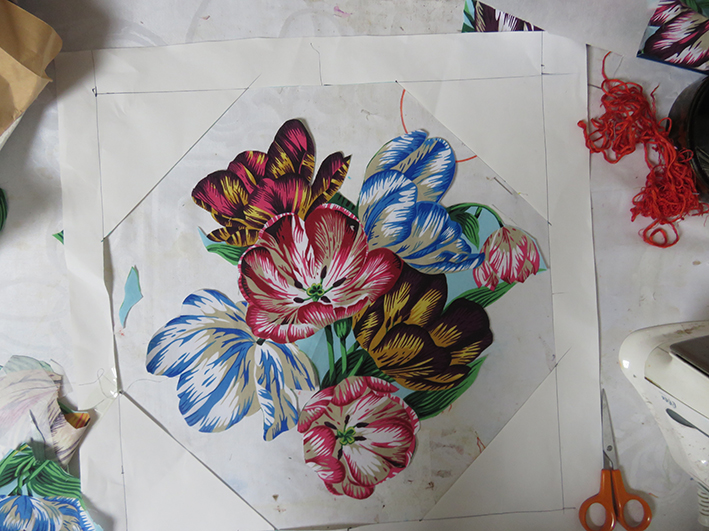
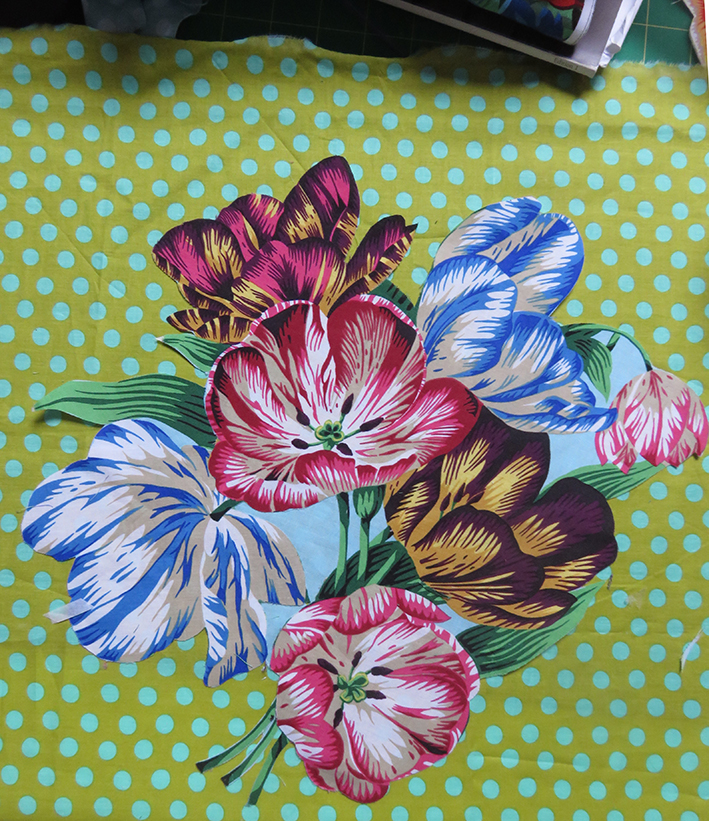
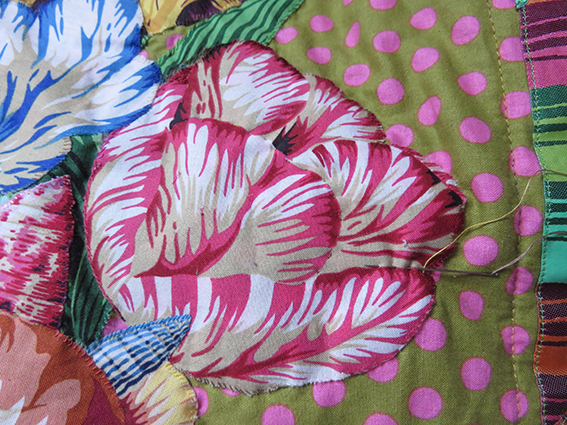
To make the bouquets, the fabric has to be backed with a bonding paper, carefully cut out, placed into position by re-arranging the various elements to fit harmoniously, pressed, then hand stitched around each raw edge, the stitching is quicker than the arranging and my idea of blissful work.
The quilt slowly started to grow; but trying to control the overall colour was the most difficult thing – colours that work on their own or in a sketch suddenly look drab or take on another shade when placed next to one another – obviously. But the colours of the flowers changed the balance every time I added a new panel. It was my major ongoing and fascinating struggle to get these balances to work.
my textile studio September 2017
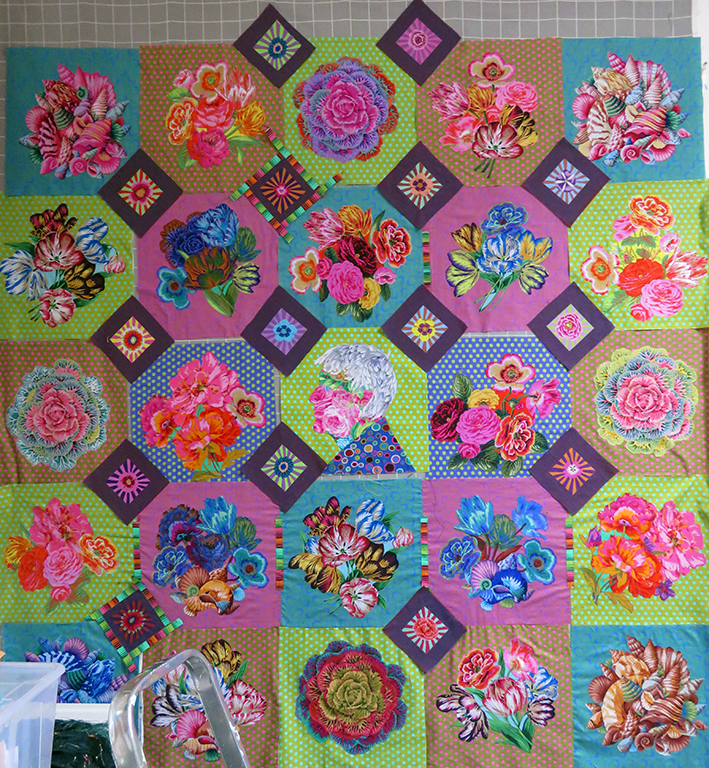
By September I had eventually made my fabric decisions, I had to make multiple versions of some of the panels – all in different colour-ways, but this gave cohesion to the busy design. I also added 4 shell corners, this was possibly the easiest panel to apply as the size was perfect and the shape fitted – just a few additions to balance colour.
making larger Brassica panels
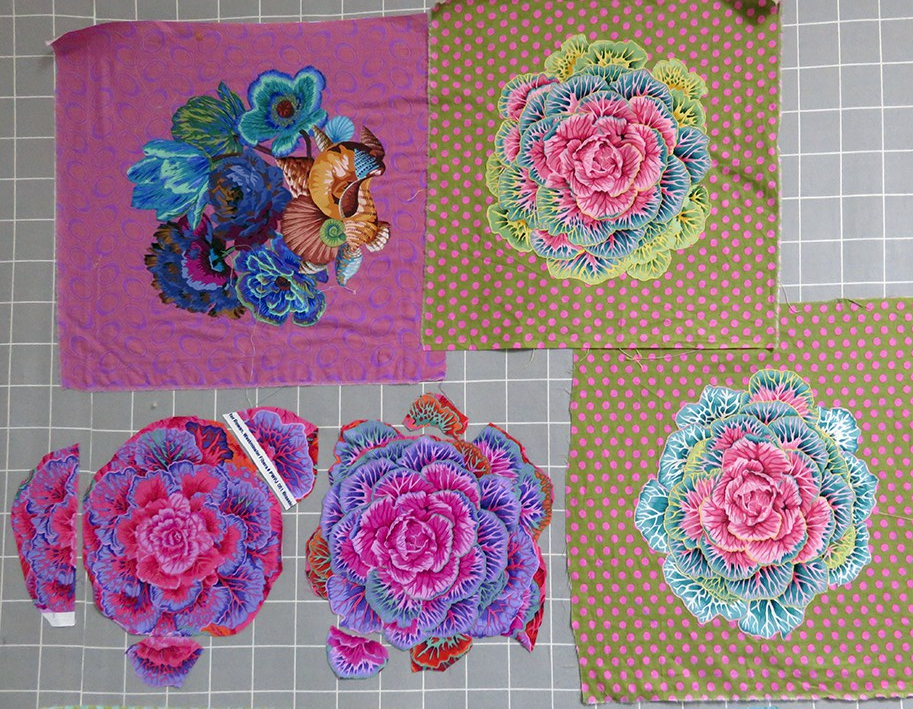
Above shows the development of the Brassica panels, they needed to be made larger by adding extra rows of leaves before hand sewing them onto the grounds.
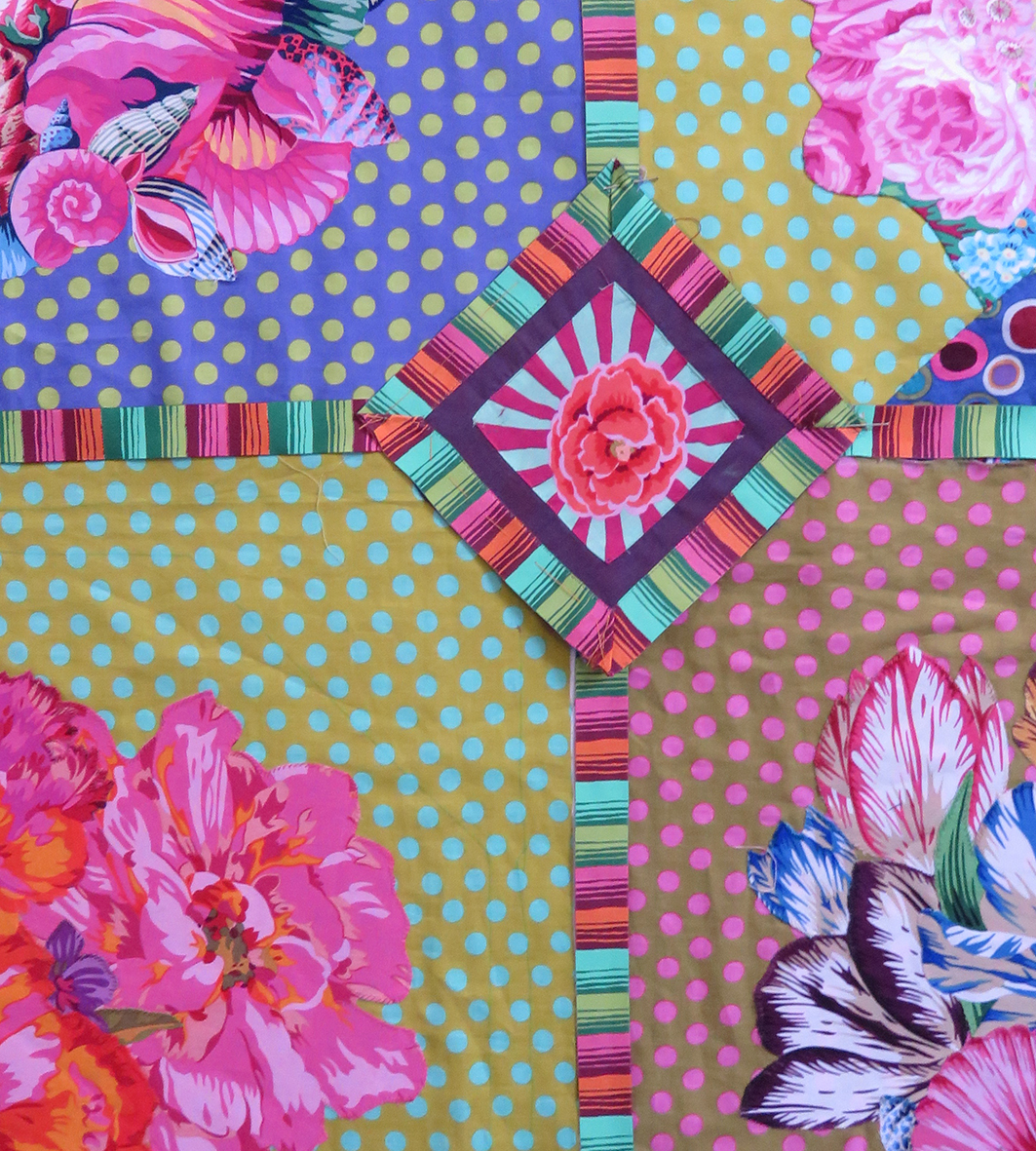
The next stage was to add the diamond shaped patches at the intersections of the squares.
the added diamonds start to assert themselves
And this is when the panic started – suddenly this massive work, that had grown over months took off in another direction, these diamonds dominated the entire design – already busy, this was manic
The only thing was to keep going – too late to stop now – the samples below looked fine
hand stitched applique
sample of pinned Phased Stripe by Renaissance Ribbons
I started to applique the tiny cut squares from Kaffe’s fabrics, Sunburst onto Shot Cotton dozens of them, all hand stitched in 2 colours and I slowly added them to the quilt on the wall ….and the result below doesn’t have all the dividing ribbon strips yet!
without the addition of all the ribbons – hells’teeth!
This was beginning to look overloaded, so I called in my 2 trusted quilt makers, Julie Harvey and Ilaria Padovani – they have very sound taste in all things quilt, and I knew they would tell me the truth. They just laughed and said “well it is for Kaffe and ‘more is more’ with him – why are you worried’?
It was the addition of the ribbons, kindly donated to me by both Edith Minne, owner of Renaissance Ribbons and Brandon Mably (who was in on the secret) that tipped the balance of the work and I suddenly understood that the work had ceased to be mine – it was now Kaffe’s. This happens when you are commissioned to design and make stuff for people – you need to work with their ideas/tastes/preferences – otherwise they don’t pay you! But this wasn’t a commission this was a present, and it was all my own work – I realised now just how much I have been influenced by working alongside him.
the quilt starts to look like it belongs to Kaffe
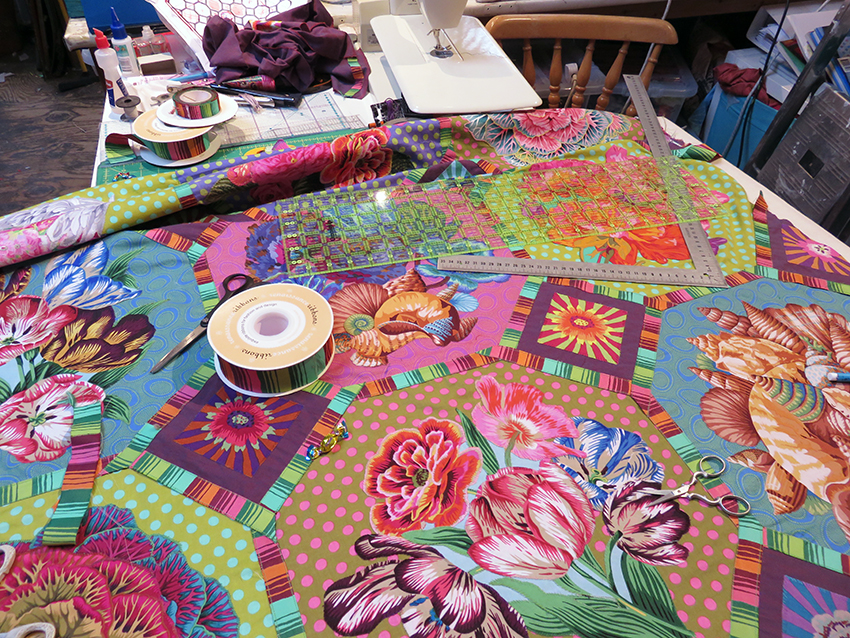
So I machined in place all the ribbons – a mammoth task for a hand embroider! they were very tricky to manipulate especially as I had to split many yards of a wider ribbon to get the correct proportion, both Edith and Brandon were out of stock of the narrow version. Hey ho! Thankfully Julie machine stitched it all into position first and then I started to hand quilt all around my stitched applique – another mammoth task, but so rewarding, the quilt looks suitable wonky – in a good way – it looks very hand made
March 2018, finally finished – I thought!
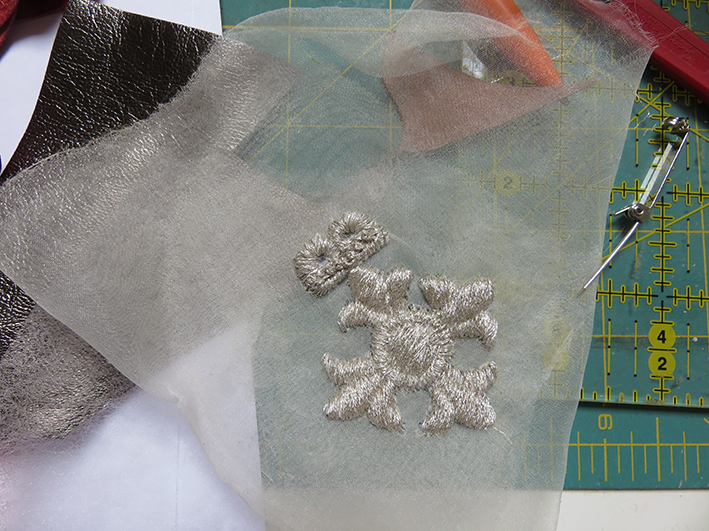
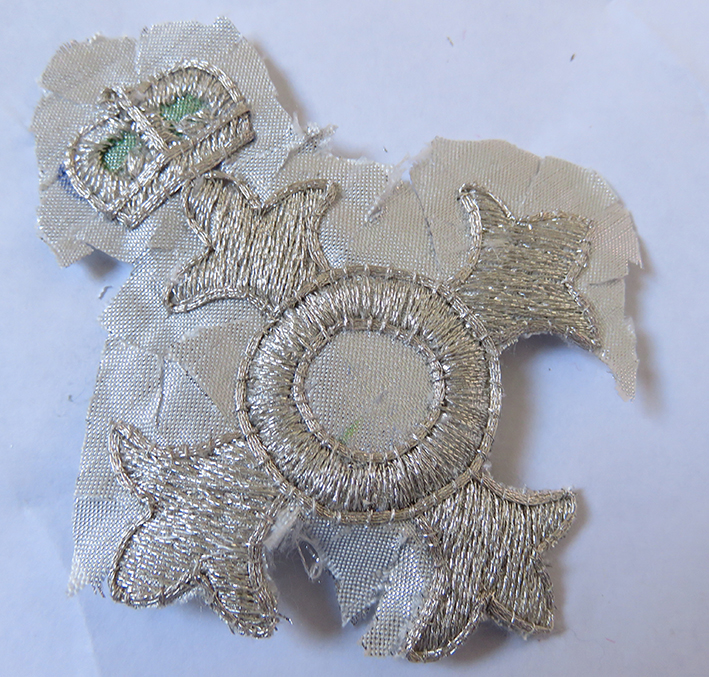
It was completed in March 2018 but I had not time to deliver it; then Kaffe was awarded an MBE and I know I have to include this – so back again to the finished quilt
I made a sample first and then the real thing and appliqued it to the ‘finished’ portrait
portrait complete with medal
In Bath, where Kaffe and Candace Behouth, have an exhibition together based on Flowers , I delivered another set of 5 quilts for the next book and my “surprise”
And Kaffe’s reaction when he was shown it?
Worth every moment.. I made the sample into a badge for Brandon – this says it all!
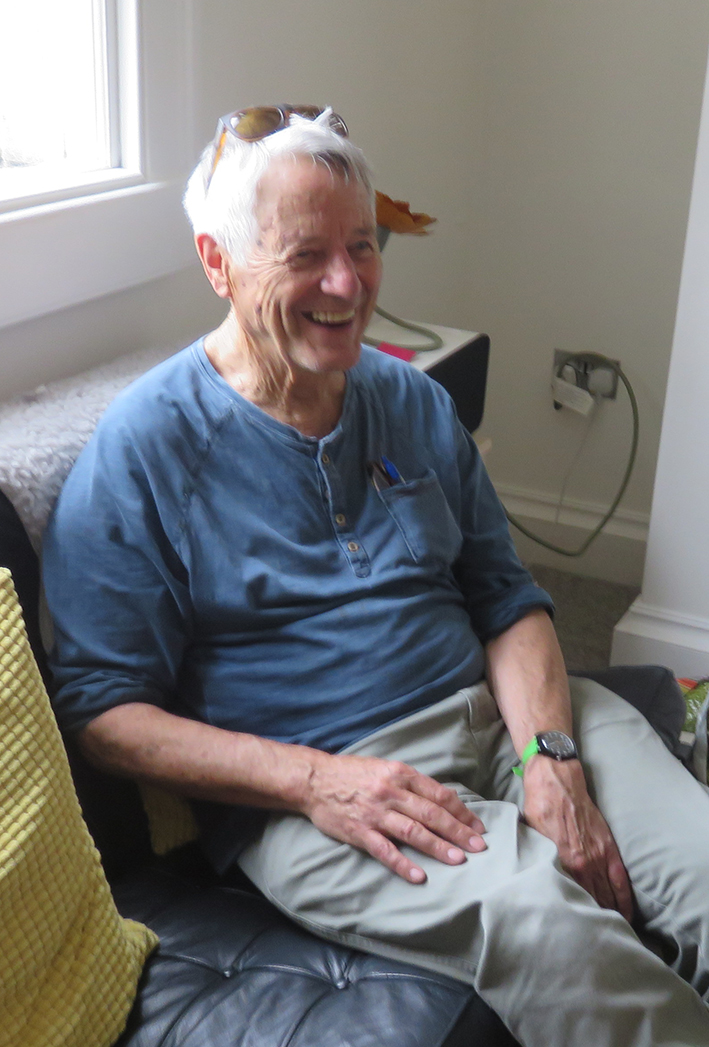
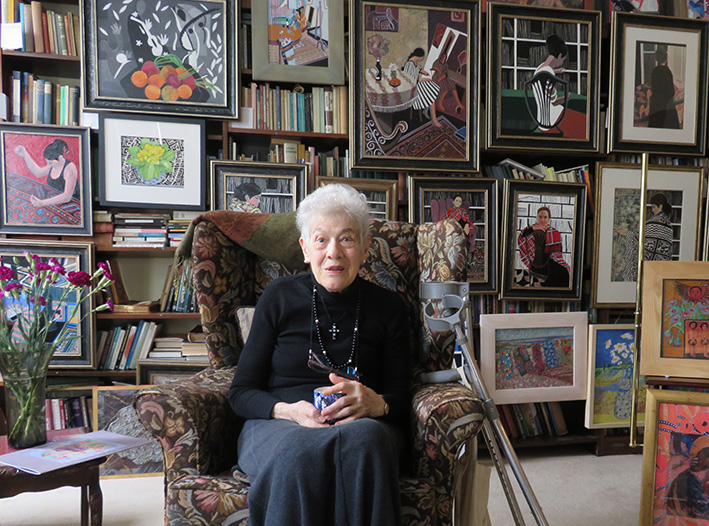
My recent meeting with Lillian Delavoryas is, in her words “serendipitous” and in mine “bizarre”. During October 2017 I was visiting various friends who were taking part in the annual West Bristol Arts Trail . The artist, Anna Christy, recommended that I visit the studio of another friend of hers who, “used to design textiles”; she was sure that we had a lot in common. I recognised the name immediately, but it was late in the day and the studios were all closing, so with 10 minutes to spare I rushed into the signed doorway, and felt that my working life had come full circle.
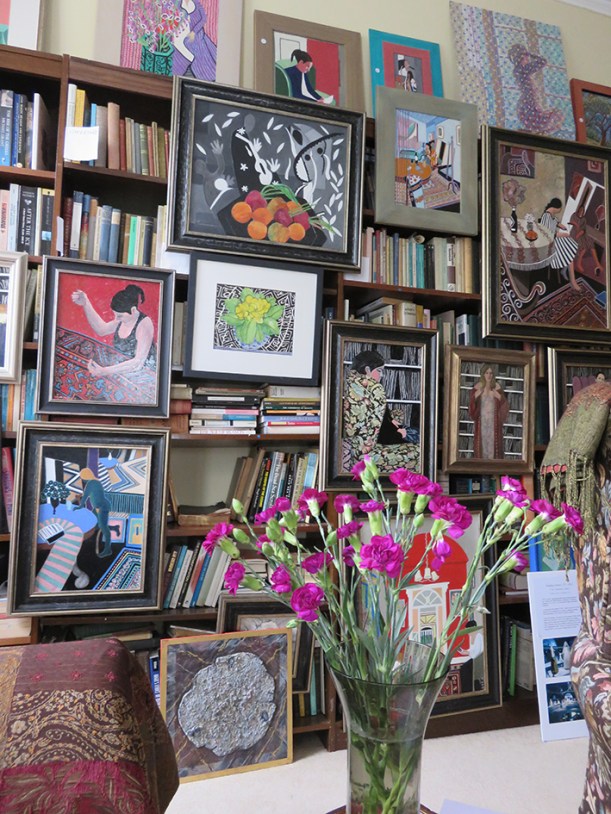
Paintings hung on the bookshelves – all for sale
I walked into a sitting room full of people and hung with small jewel-like paintings of people, landscapes and flowers. lovely work but this wasn’t what I was expecting!
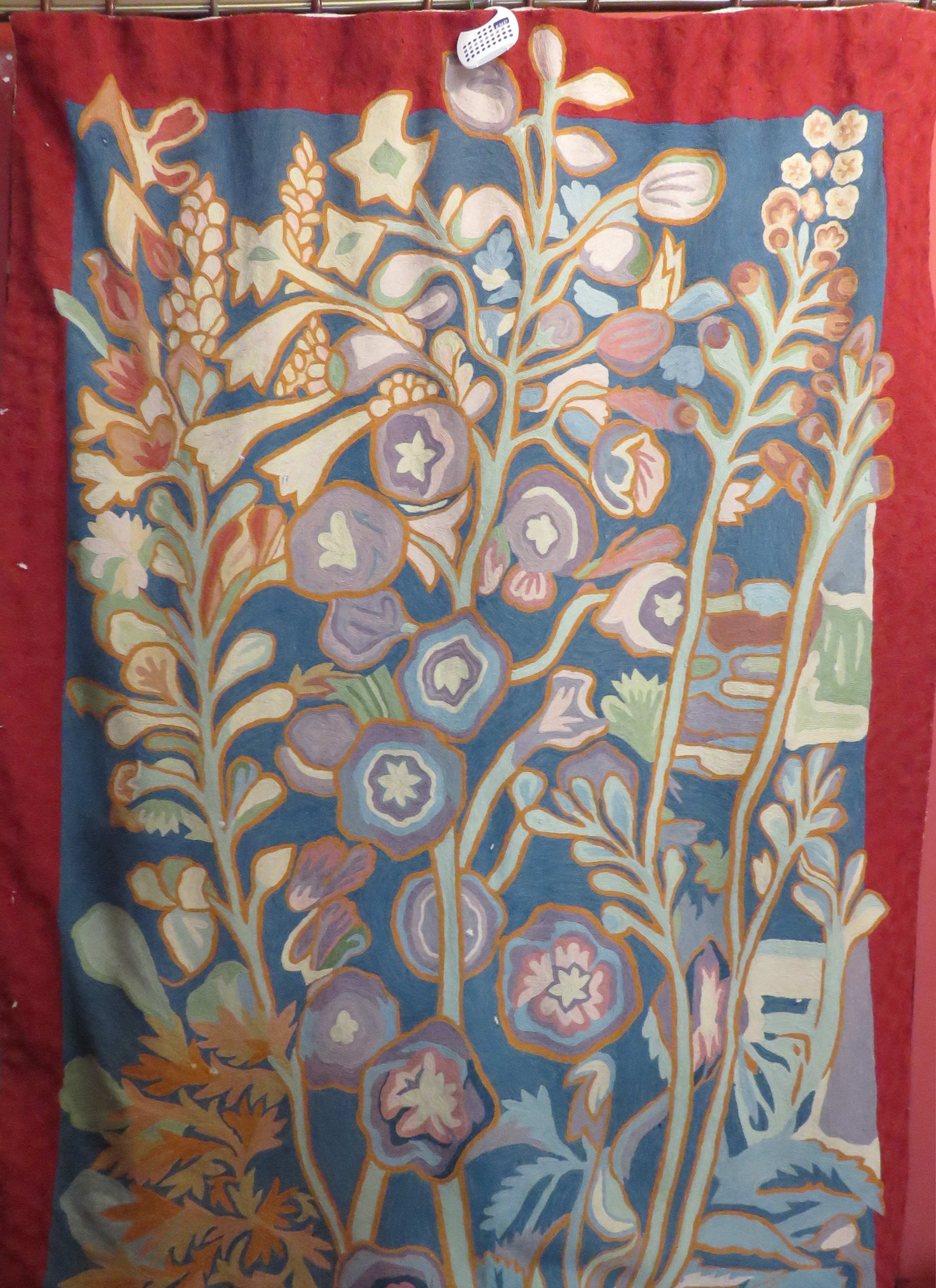
wool tambour work wall hanging
but in an adjoining room I saw a large blue and mauve flowered embroidery, this looked more familiar. then delving further into the exhibition I found a piece of work I recognised, Nicotianas.
Nicotianas – Lilian Delavoryas
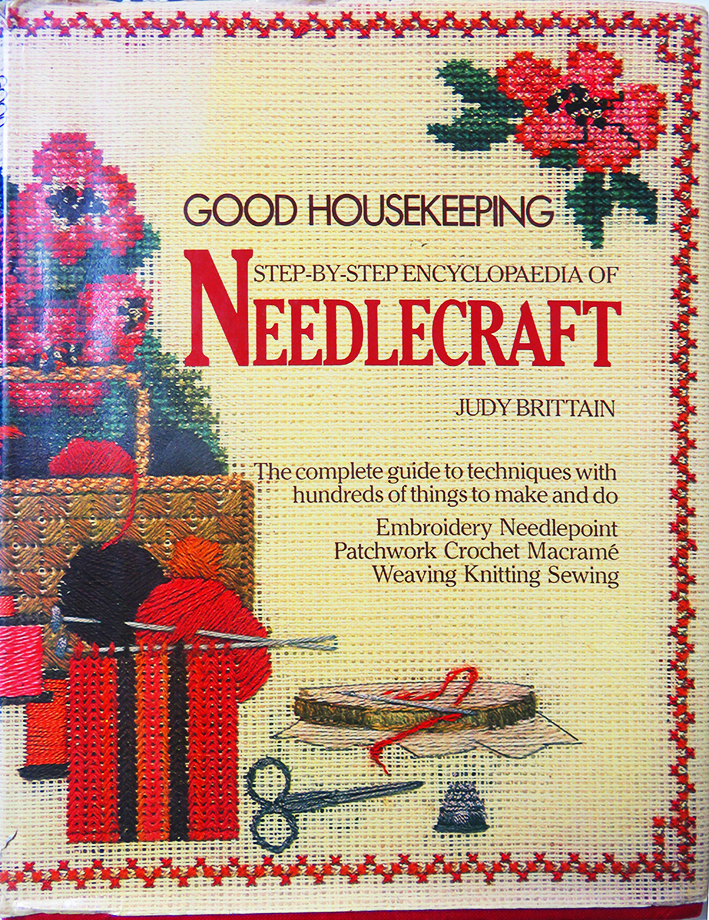
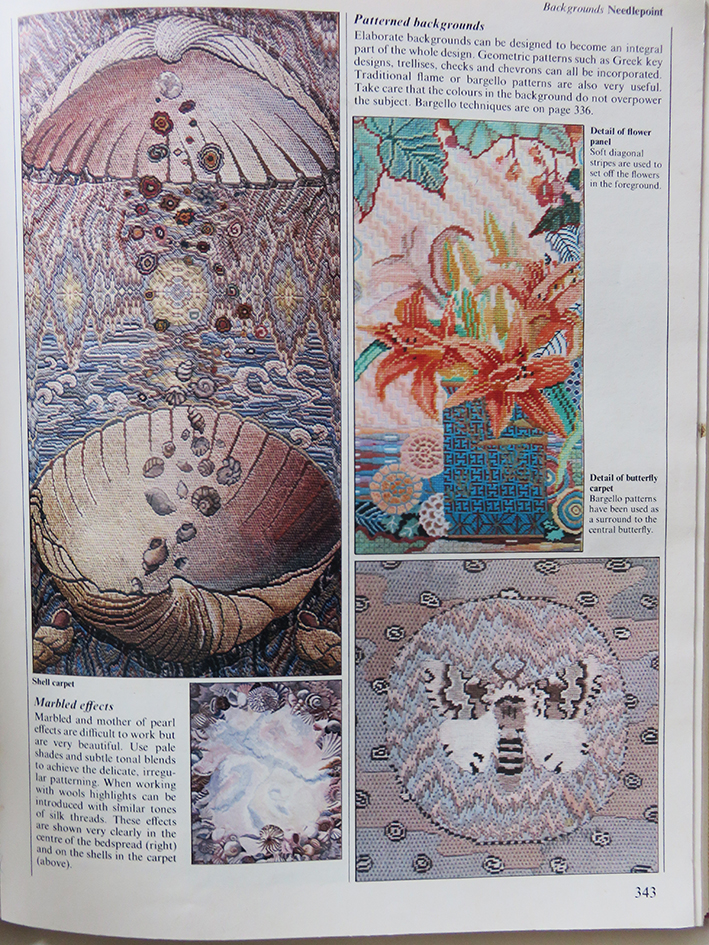
I had just a little time before she closed, and although I had never met her, I realised who she was, sitting on a settee amidst cushions that I also knew were her designs. Thanking her for the opportunity of seeing the exhibition, I introduced myself and explained that I often worked with Kaffe Fassett, organising the production of his patchwork quilts for publication and exhibition. Also that I had worked on the original “Good Housekeeping Encyclopaedia of Needlecraft, first published in 1979 by Ebury Press and was now delighted to see some of her original work.
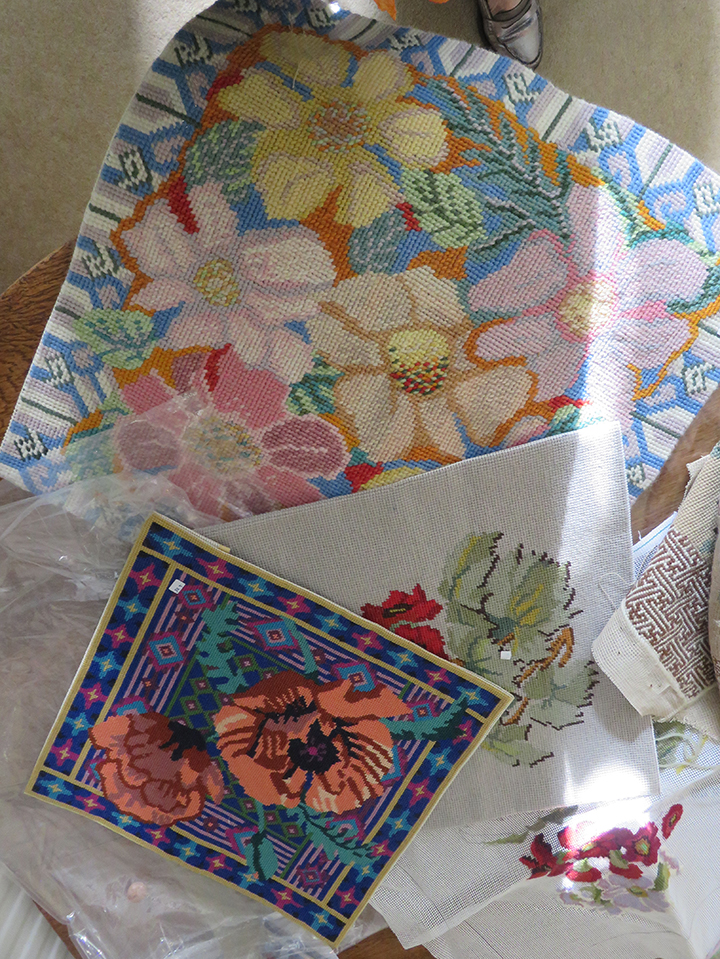
2 days later, she emailed me asking that I visit her with the idea of helping to find a home for her collection of textile based books and various pieces of her old work , some half-finished canvases, needle work samples and painted design drawings. She thought it could all go to a school as an aid to design education!
Lillian Delavoryas and Kaffe Fassett and were leading textile designers in the late 1970’s, when I first left college and became a freelance designer and illustrator in the Fashion industry. Influenced, no doubt, by their work I taught myself to hand embroider onto canvas as a way of the easing the frustration of my hectic working life. But my early works were tiny, so when I saw the scale of these pieces I was deeply impressed. Kaffe and Lillian knew one another when they both lived in America and he is responsible for bringing her to the UK, in order for her work to be recognised here.
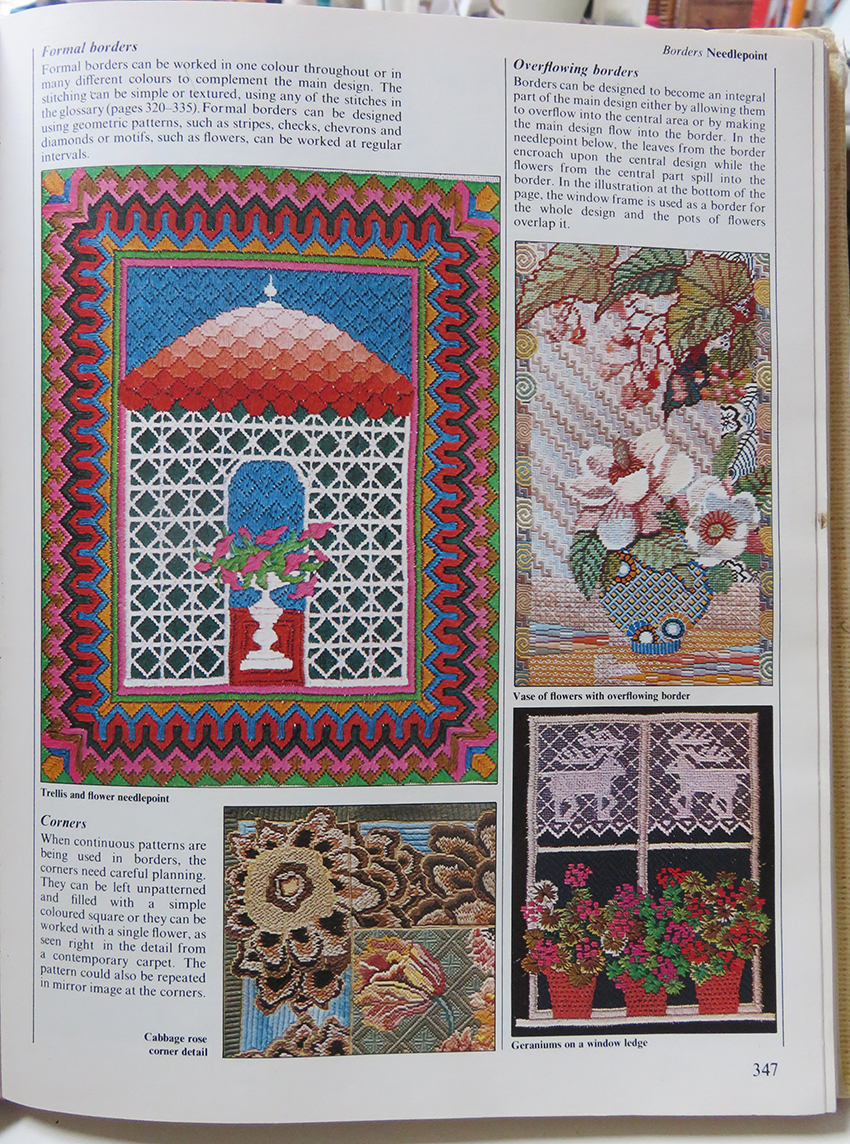
page of Kaffe Fassett’s and Lillian Delavorayas’ work Good Housekeeping encyclopedia of Needle Work
Good Housekeeping pages with my tiny work blown out of proportion next to Lillian’s
For the past 3 years I have been working directly with Kaffe Fassett, organising the making of his patchwork quilt designs as well as other stitching projects. I was recommended to him by Susan Berry, the publishing consultant of his major series of patchwork books. Susan was the first person to commission me in publishing, and I have worked with her on many projects over the intervening years. So now you see the complete circle!
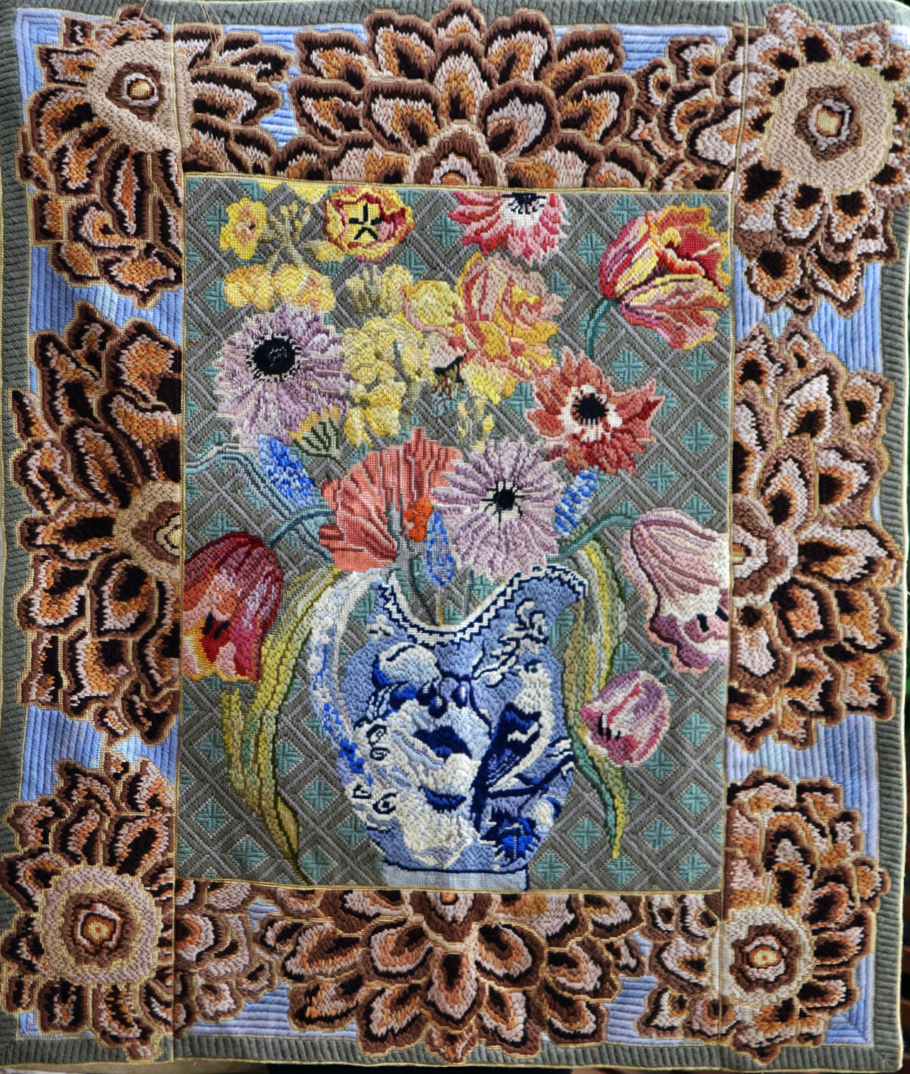
needlepoint hanging – vase of flowers, the corner of which can be seen on the page above
When I visited, Lillian had organised a whole lot of different books, copies of articles featuring her past textiles and the promised samples.
various cushion cover designs
sample stitched bid on large drawn canvas
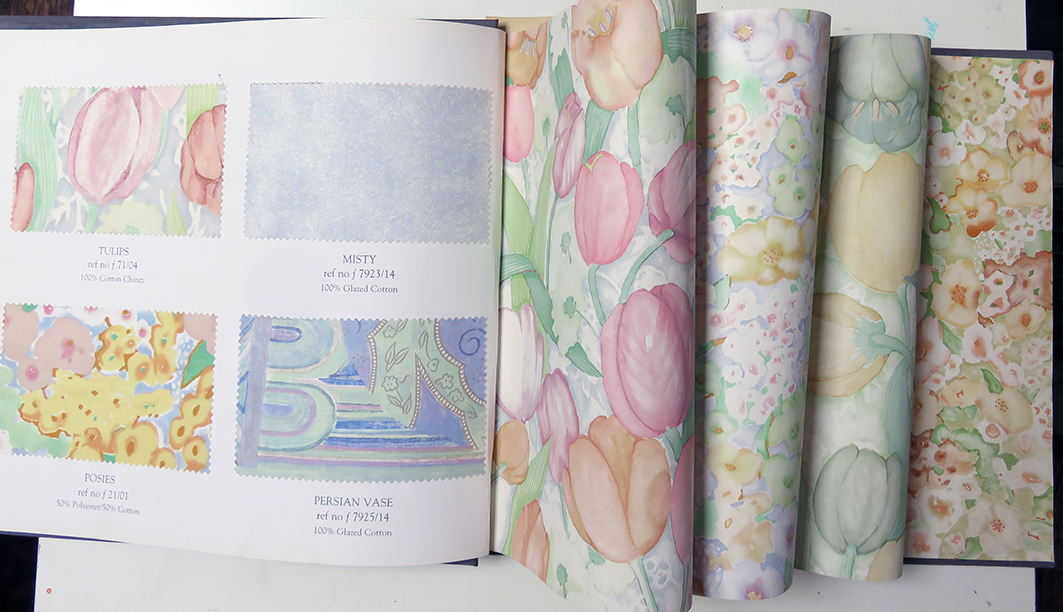
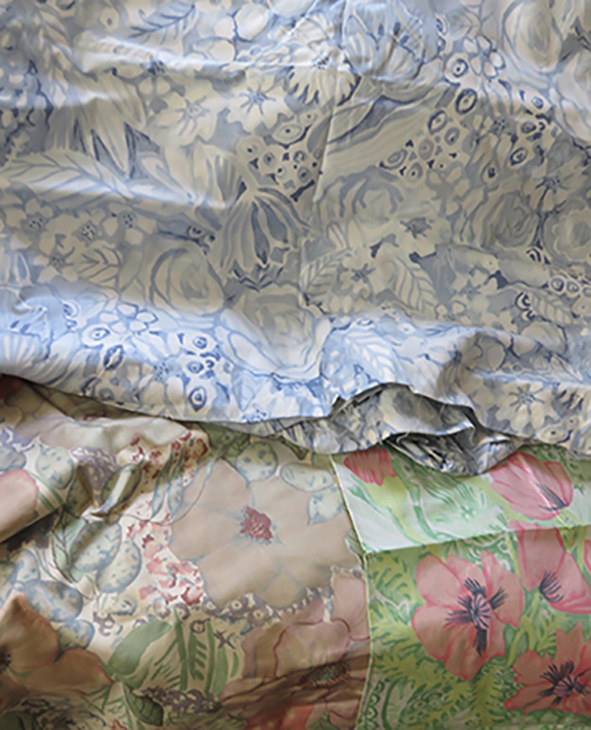
Also, and this I did not expect, samples and books of fabric and wall paper designs from Designers Guild circa 1980’s , all looking very familiar to me. Lillian assured me that she had ceramics to match somewhere in her flat, and a lot more besides – if I was interested….
2 wrapping papers
Designers Guild fabric samples
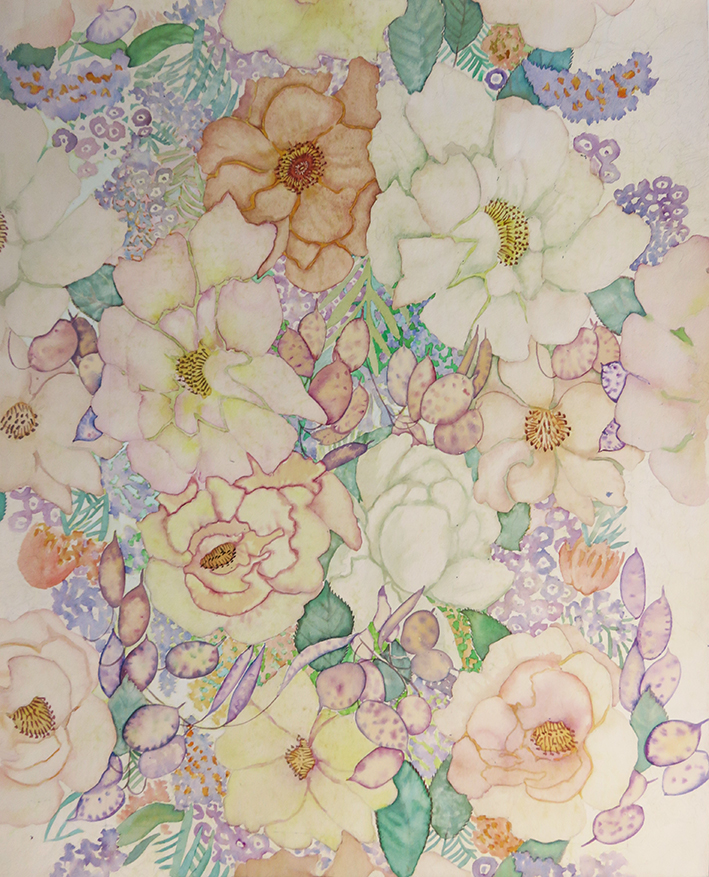
beautiful water-colour and pencil design drawing
Assessing what I was looking at – a part-archive of an innovative and influential designer of 20th century textiles, I suggested that she collect as much of her work as she could locate and that we try to tell her textile design ‘story’. I thought that it would eventually become of interest either for a museum to keep as an archive and a work-in-progress exhibit, or to students undertaking higher degrees, to research and catalogue it all, enabling her to be set within the context of 20th century design.
Lillian Delavoryas October 2017
This is an ongoing story. My next contact was Hugh Ehrman of “Ehrman Tapestry” for whom Lillian, Kaffe and I have worked. Explaining to him of my serendipitous meeting he at once visited me, bringing a folder of painted paper designs that his company had held on her behalf…but that will be covered in the next post on this saga.
although I was not aware of it at the time I wrote this blog this is the very last post for Heart Space Studios…we conducted many more parties, clubs and classes , we have now ceased trading as a class based studio – however I continue to make my work and explain many different ways of constructing and thinking about the making of ‘Her Work‘ in my ongoing blog http://www.janethaighherwork.com.
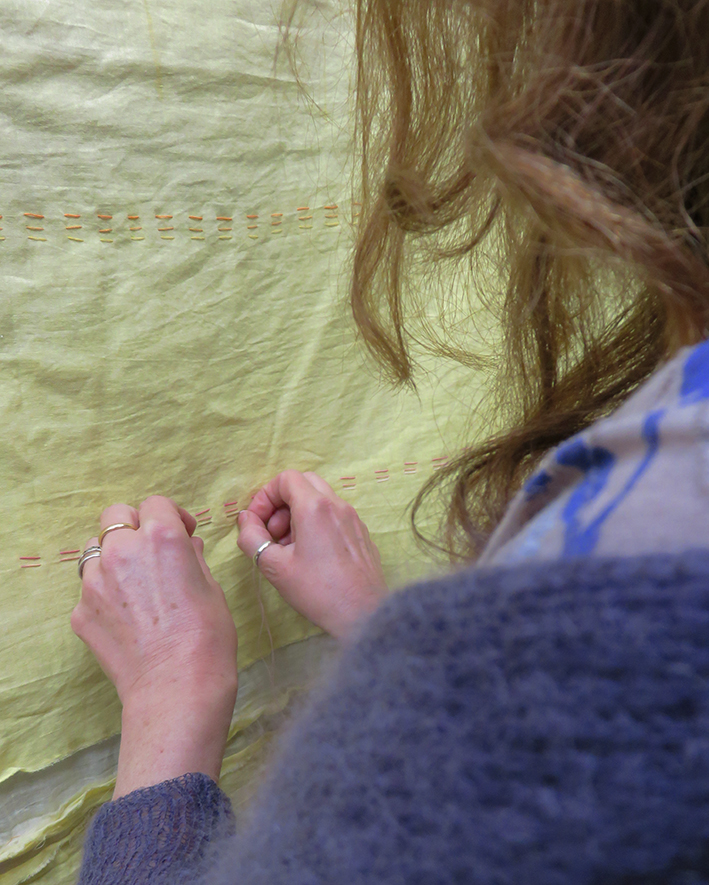
Susi Bancroft stitching her suspended large Kantha piece in Heart Space Studios
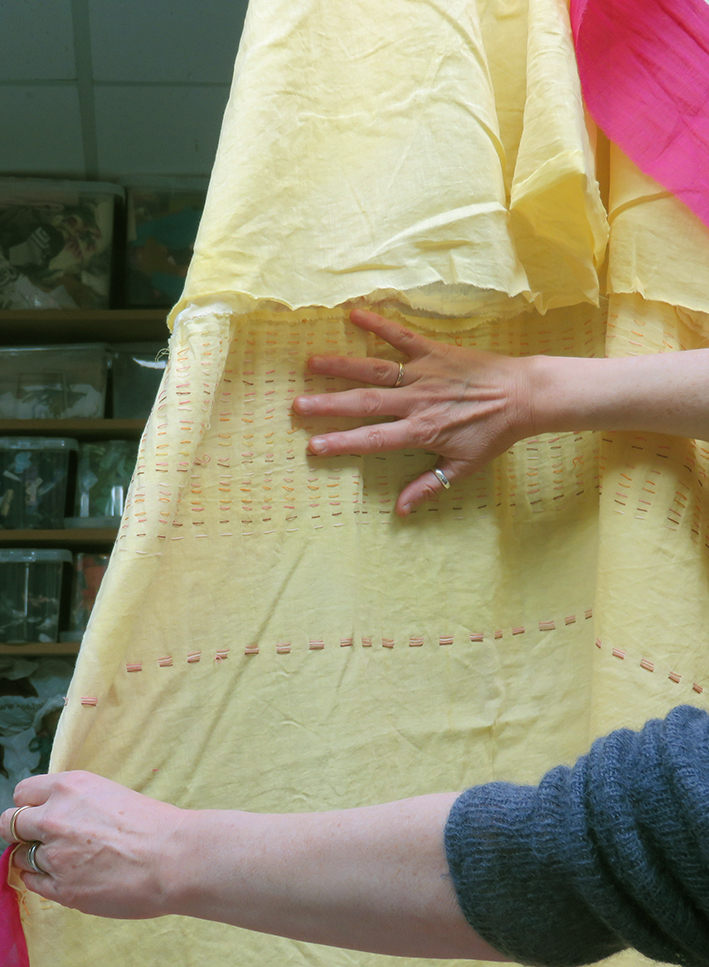
Autumn is here and the new term started for Kantha Club – run by Susi Bancroft for Heart Space Studios. We all wanted to swap summer experiences and stories and show what we had been up to – or not!
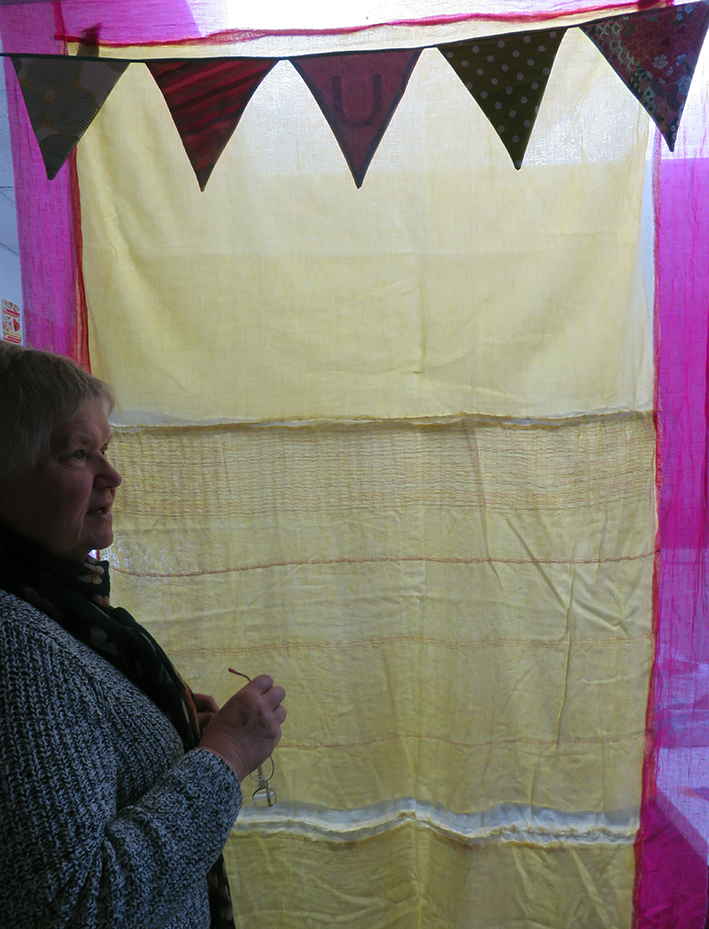
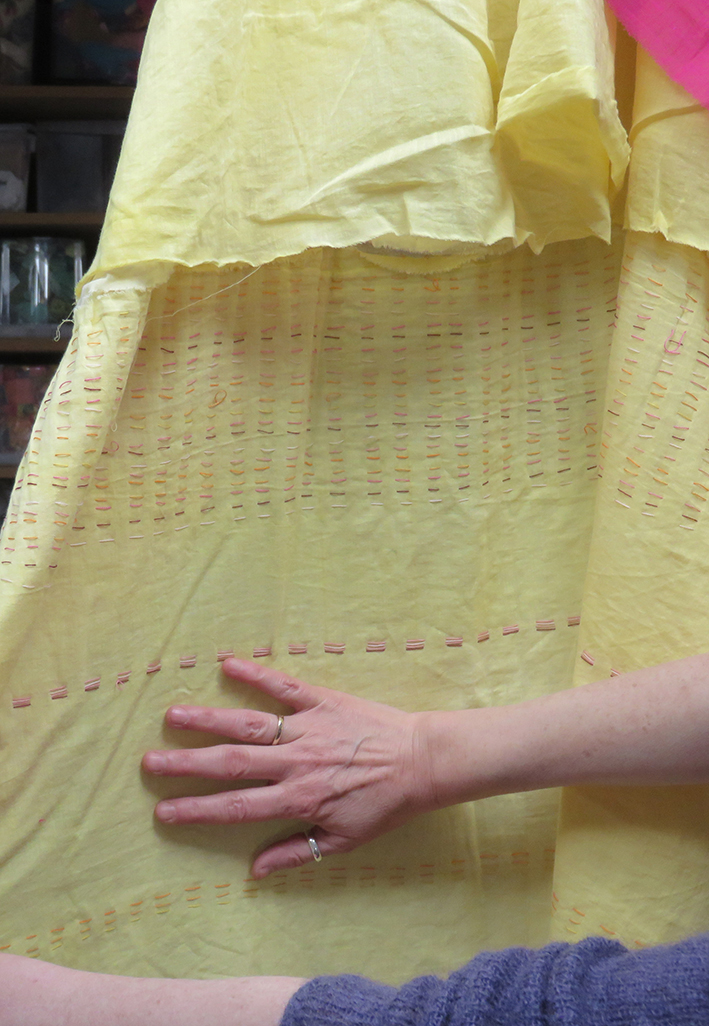
Kay at the back of the Kantha sheet – the light shining though the colour was lovely, showing up the rows of stitches.
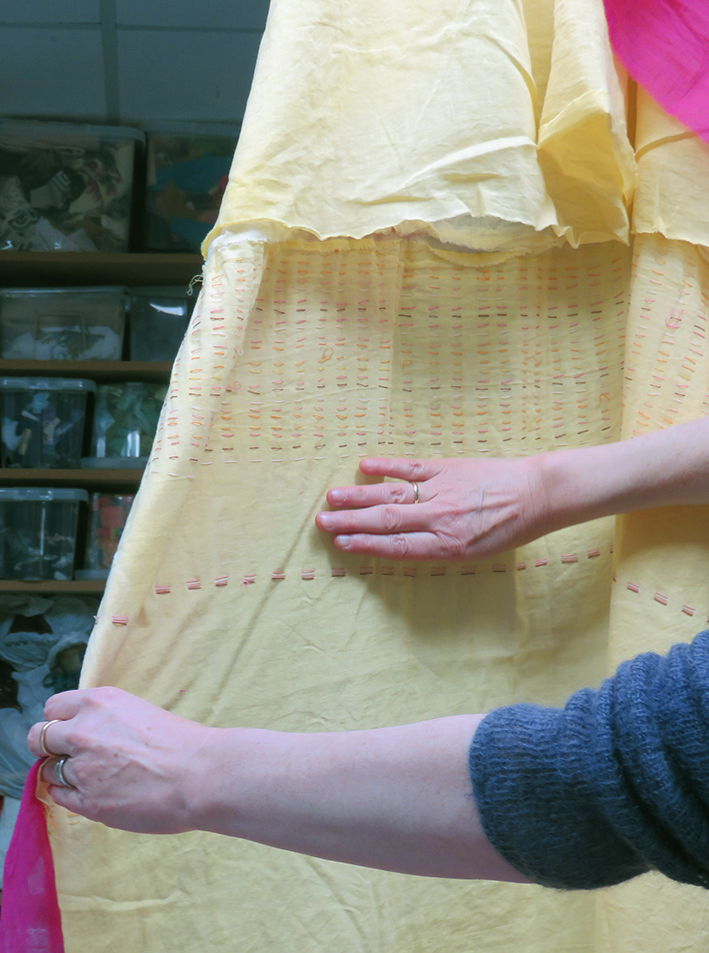
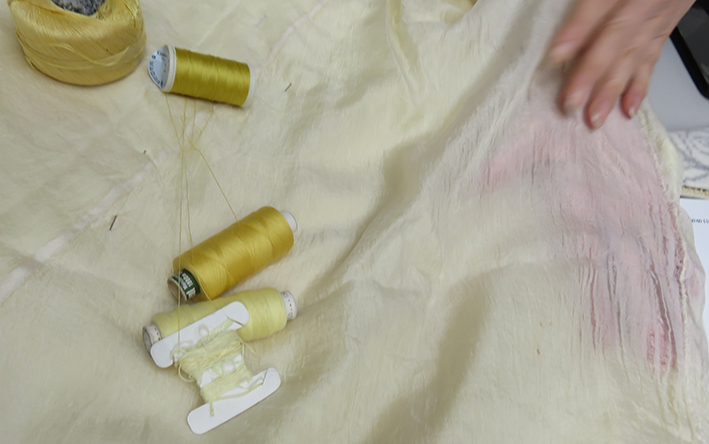
Susi had embarked on a very large piece ( I meanwhile had put my first attempt at a large piece aside). She had dyed the fabric in Turmeric and Tea to get this very subtle yellow. She finds it easier to hold the needle at the eye end to keep the cloth steady – so each stitch requires 2 hands on the needle, standing to work on such a large-scale fabric she says ” I am surrounded by beautiful colour with the light behind you, like being cocooned in colour “
closed hand with thumb kept into palm = the narrow band
wide open hand = the wide band of stitches
Explaining how she made decisions for spacing the stitching bands by using simple hand measurements she said “I used the fact that I couldn’t see the whole cloth working so close up so the hand spans were the measurement I adopted”
hand spans for the gaps between stitching lines
to enable her to keep stitching rhythmically while standing up, she threaded several needles at a time in different colours, using each as she felt that she wanted them – relying on her instinct for the colour striations, she enjoyed the feeling of the fabric being “just being out of my reach’ whilst she worked.
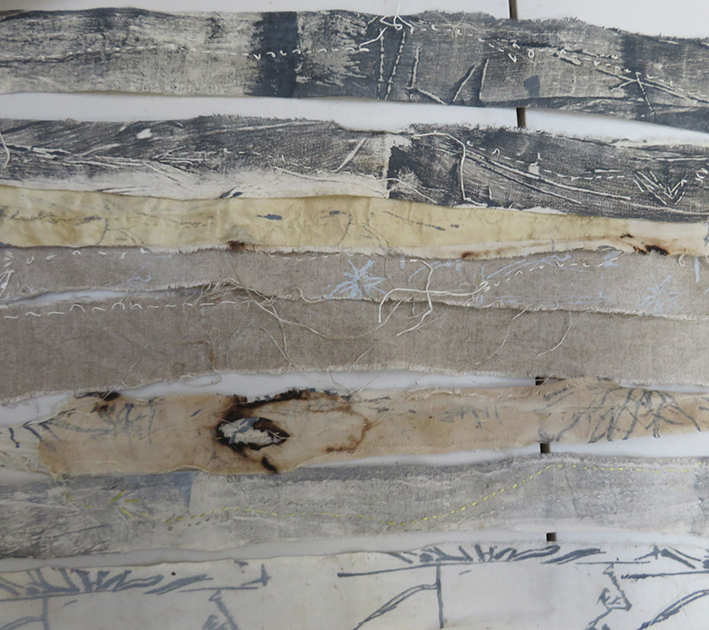
Kay Swancutt showed us some dying samples that she had stitched , she had exhibited these recently at Nature in Art and used many natural materials to make the different patterns and colours
samples of natural dyed fabrics by Kay Swancutt
more of Kay’s experimental samples
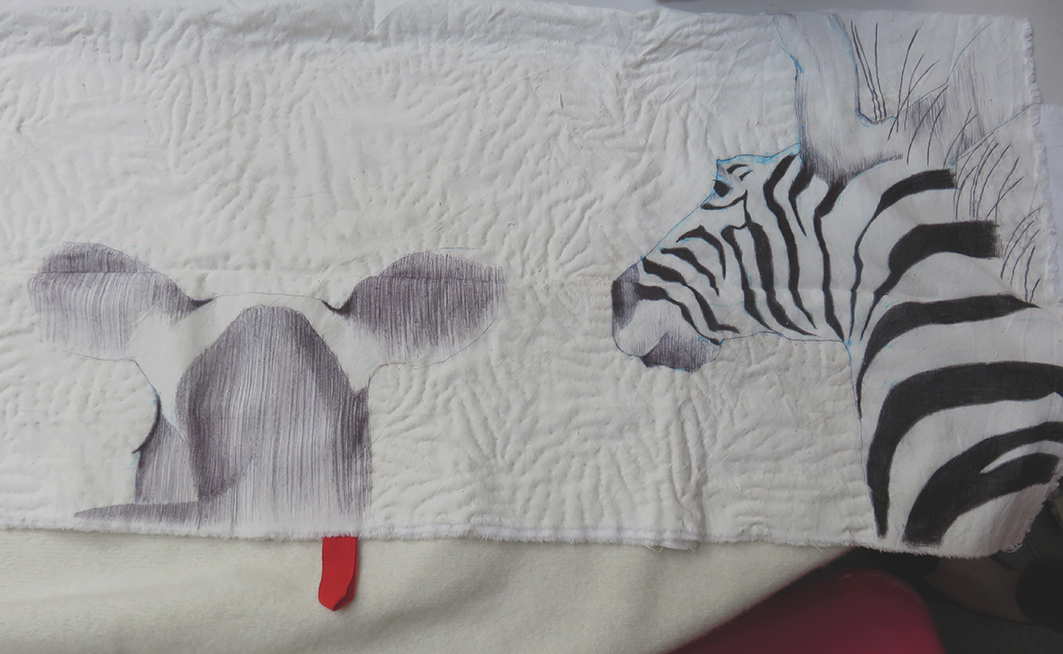
Steph Wooster brought several examples of her earlier drawn textile work that she has now worked with a kantha stitched ground…these were also exhibited at Nature in Art and I feel that they could lead to even more intricate background stitched patterns – I am thinking animal skin patterns, leaves, grass..
Steph Wooster’s Biro drawing of animals from the Bristol Museum, augmented with ripples of stitching
I particularly like the combination of the stark elegant drawings and the tone on tone rippled grounds.
Biro drawing of animals and kantha stitched ground – Steph Wooster
she also brought a new piece fabric that she wanted some feedback from us – it was a parachute silk sheet, very old and damaged,
choosing coloured threads to mend the fragile silk sheet
she wanted to mend it – we suggested she start with the weakest area.
carefully searching for the weakest points ot start to mend using Kantha as a technique
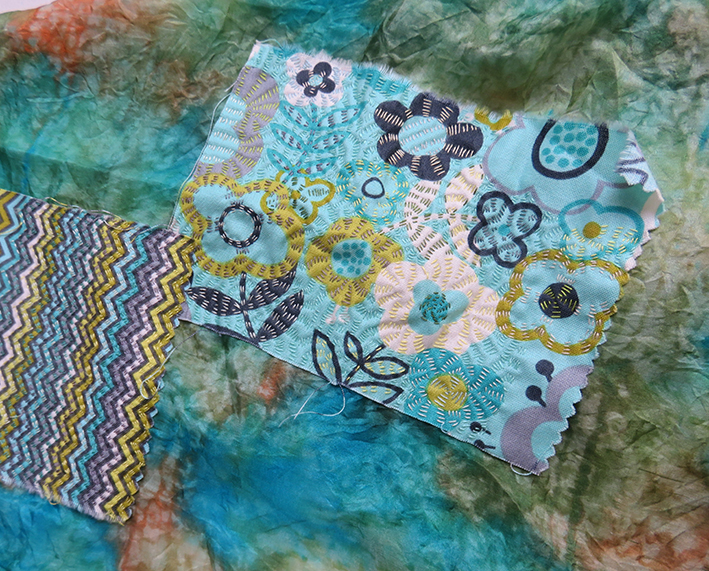
Meanwhile Naomi Clarke has been having fun just using Kantha technique to stitch the patterned cloth and also appliqueing it to the tie- dyed ground – as a technique this could really be developed to make lively fabrics
Naomi Clarke’s Kantha applique
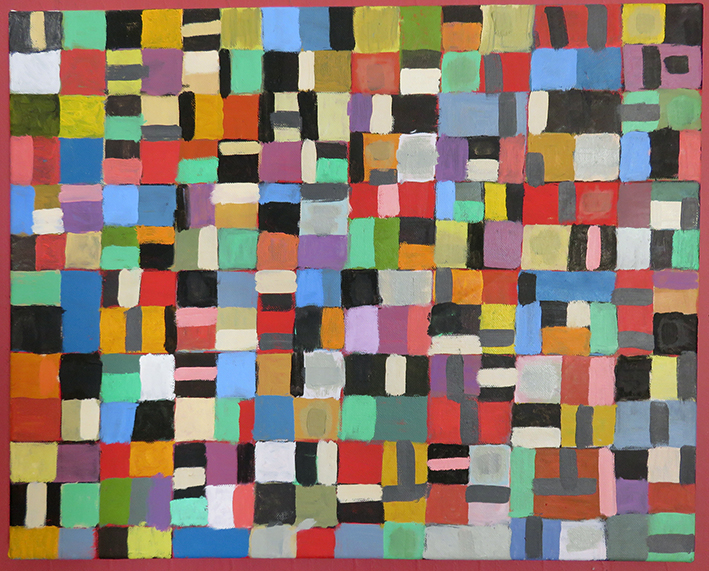
I had started another project in the break – a quilt based on a painting by Alfred Stockham, an old friend and ex colleague, it is a small painting that had always called to me to be made as a patchwork…
oil painting by Alfred Stockham
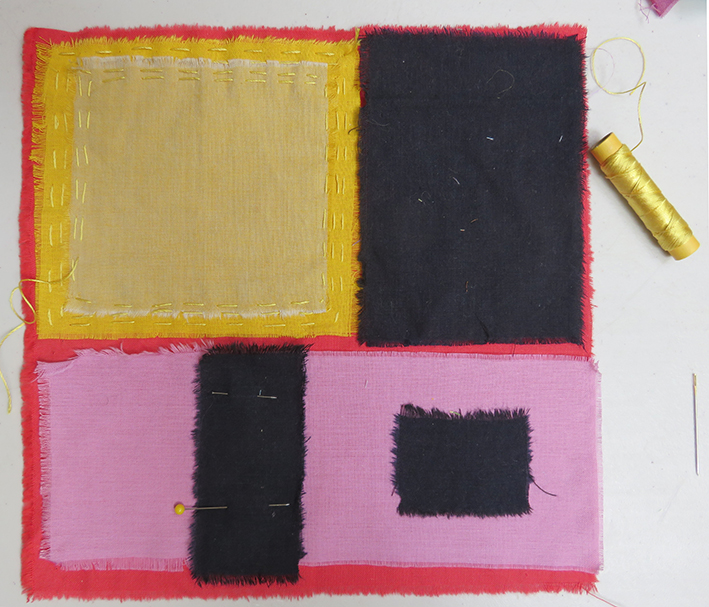
starting in the top right hand corner I ripped some pieces of shot cottons into squares and strips and stitched them down onto a red cotton ground…the coours of the threads made for the nuance of his dragged brush marks
starting the squares of painting patchwork
completed square of kantha stitched patchwork
during the last few hectic weeks of launching my book it has been a relief to get back to simply stitching these square transitions from paint to cloth
I am interested to see how each square is in itself a small complete composition
I am fascinated by this work but it may take some time to get finished
the start of the first row of patches for the painting quilt.
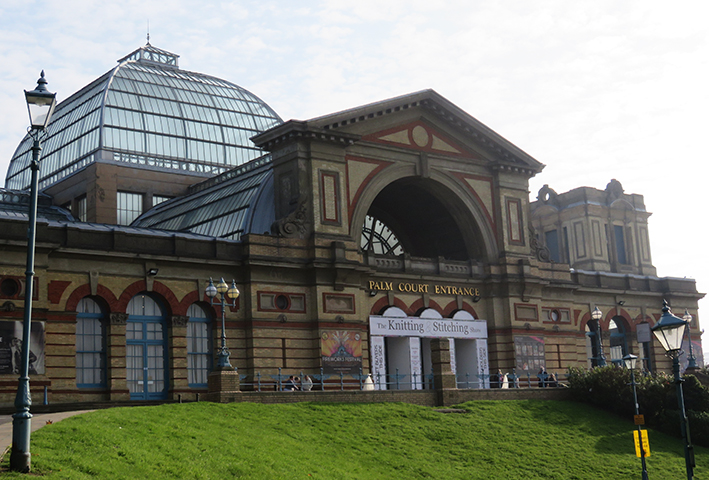
Alexander Palace – the Knitting & Stitching Show entrance
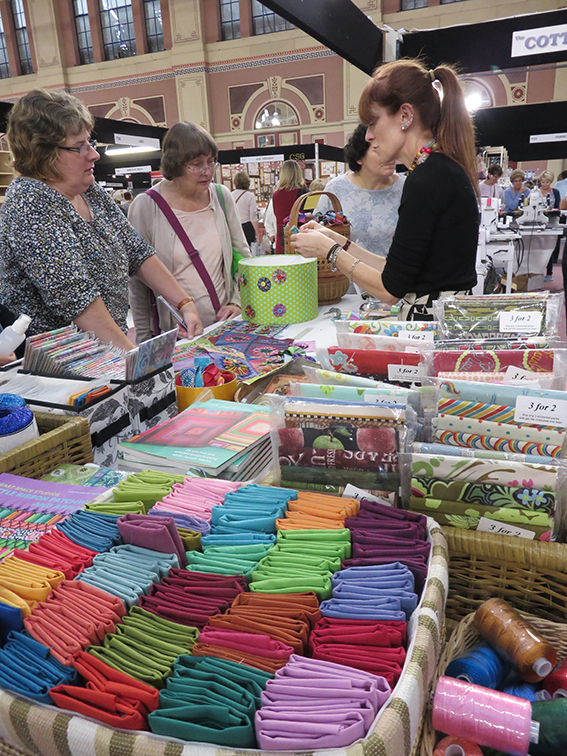
And so to Ally Pally for the annual Knitting & Stitching show, attentive readers of this blog will realise that this is where Heart Space Studios headed to advertise our new book at the invitation of The Cotton Patch, the home of all things patchwork and quilting in Birmingham. For a week I worked at this amazing show – and looking at textiles for so long, I now feel well able to select my personal ‘ Best in Show’ awards to several outstanding exhibitions and commercial stands.
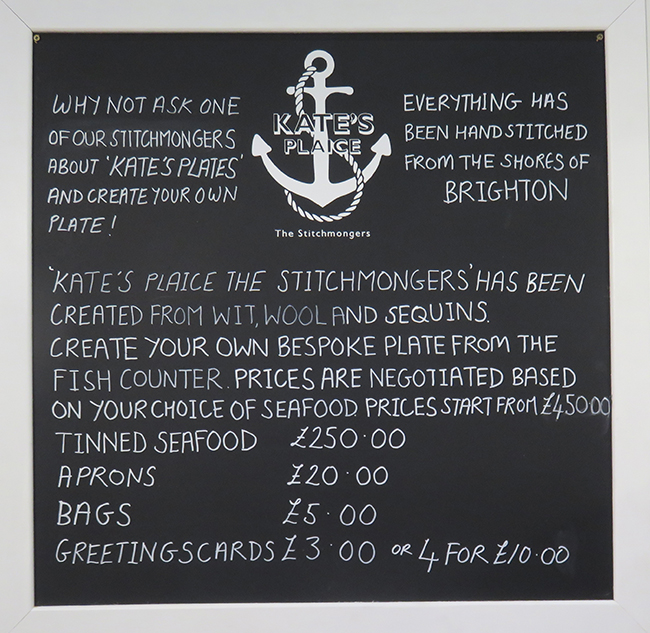
Kate’s Place blackboard
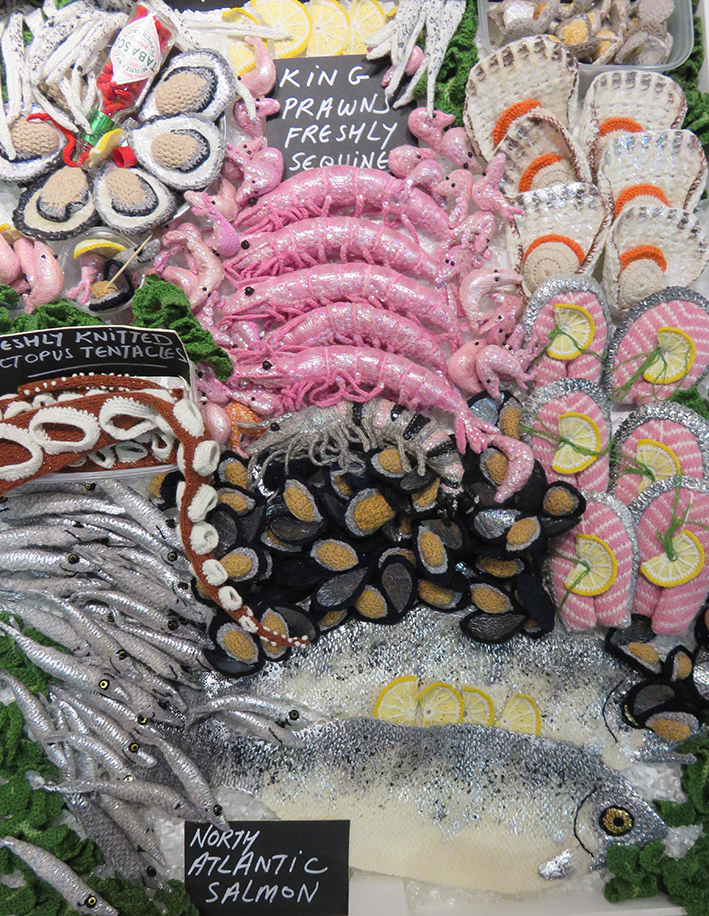
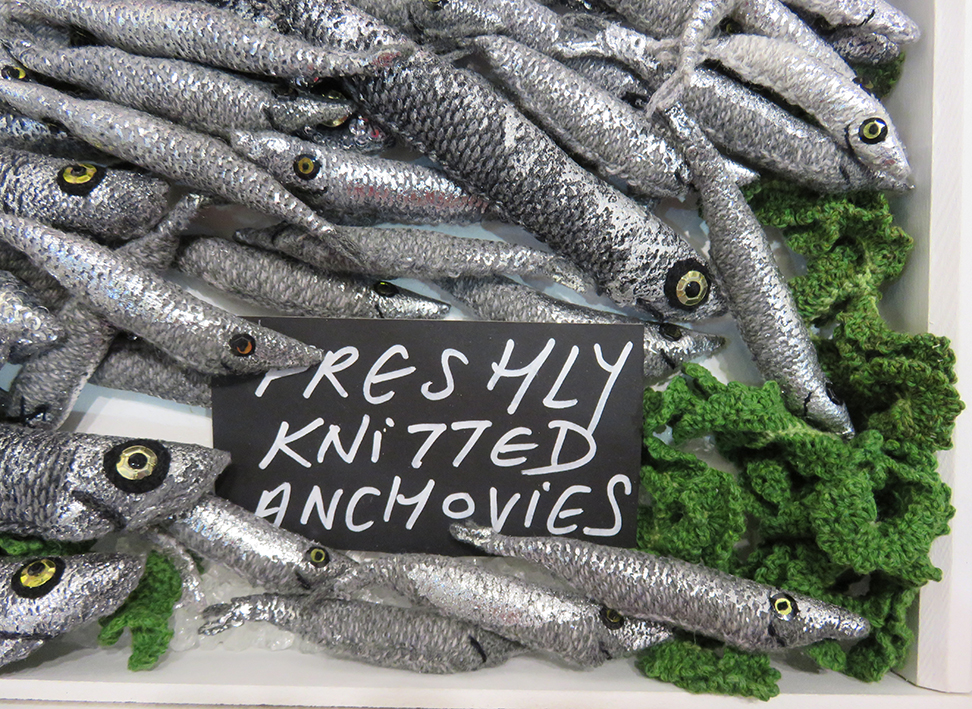
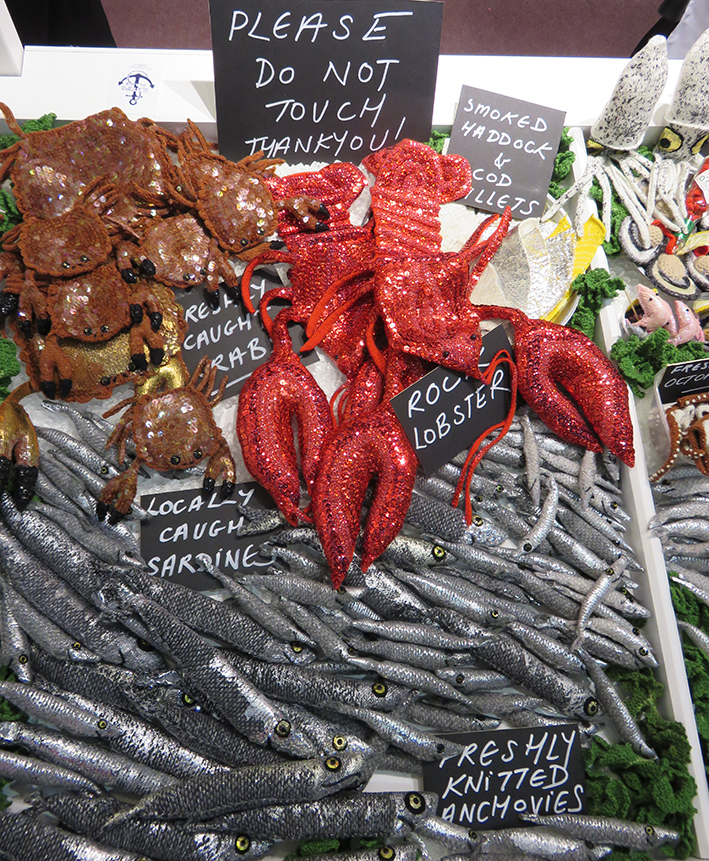
In no particular order – ” Kate’s Plaice the Stitchmongers’ ” was by far the most amusing, the concept or rather – to use a literary term – “the conceit” was completely thought through, it was highly technically proficient and the most entertaining piece of textile work that I have ever seen at this event.
the fish stall
The installation was designed specially for the Knitting and Stitching show by Kate Jenkins, Everything on the stand was completely in keeping with the joke…from the dressed shop assistants that like all good fishmongers knew their subject inside out and wanted to share their delight and knowledge with you, to the stunning array of ‘ seafood’ on offer…
detail of the central fish counter
below are the details of the counter of fish, the use of material and the shapes and colour are perfectly chosen – you really did want to order and eat what was on offer…..
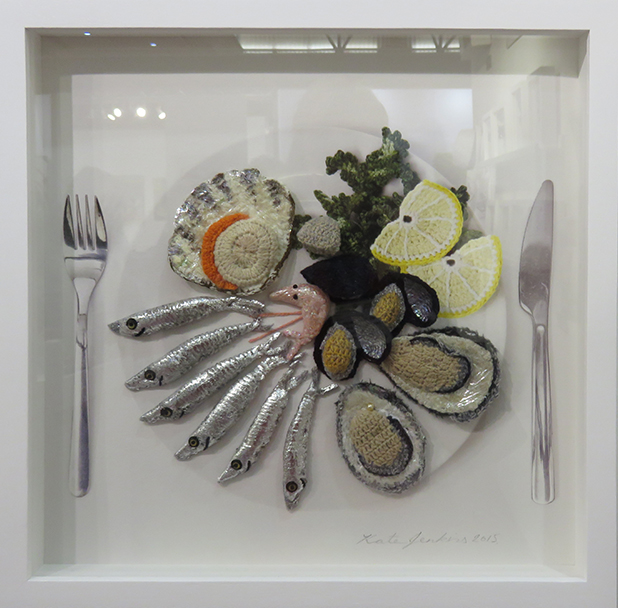
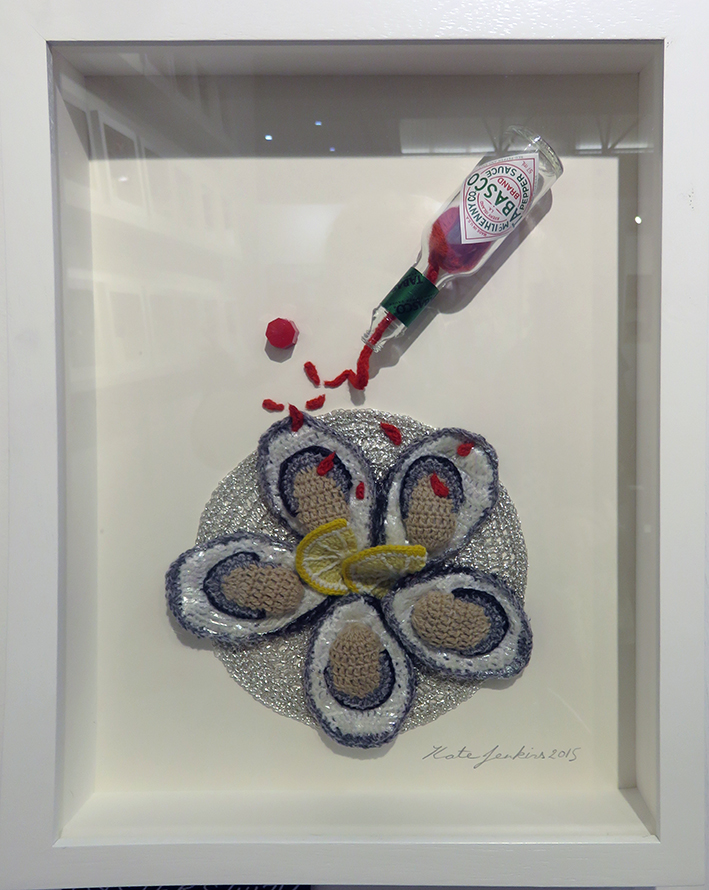
For those, like me, who prefer their fish cooked and served, rather than making the dish themselves, the fish platters definitely looked good enough to eat.
fish and seafood supper
tabasco and oysters
the hand written sign below, perfectly in keeping with the whole fish shop ethic, was written to deter a fellow exhibitor, an embroiderer, who pawed the little sequined morsels as they were being arranged, and was extremely rude when he was asked to stop! This is such an unusual occurance – stall holders being rude to anyone, let alone one another that I feel it deserves reporting.
thee sparkly lobster and the necessary notice!
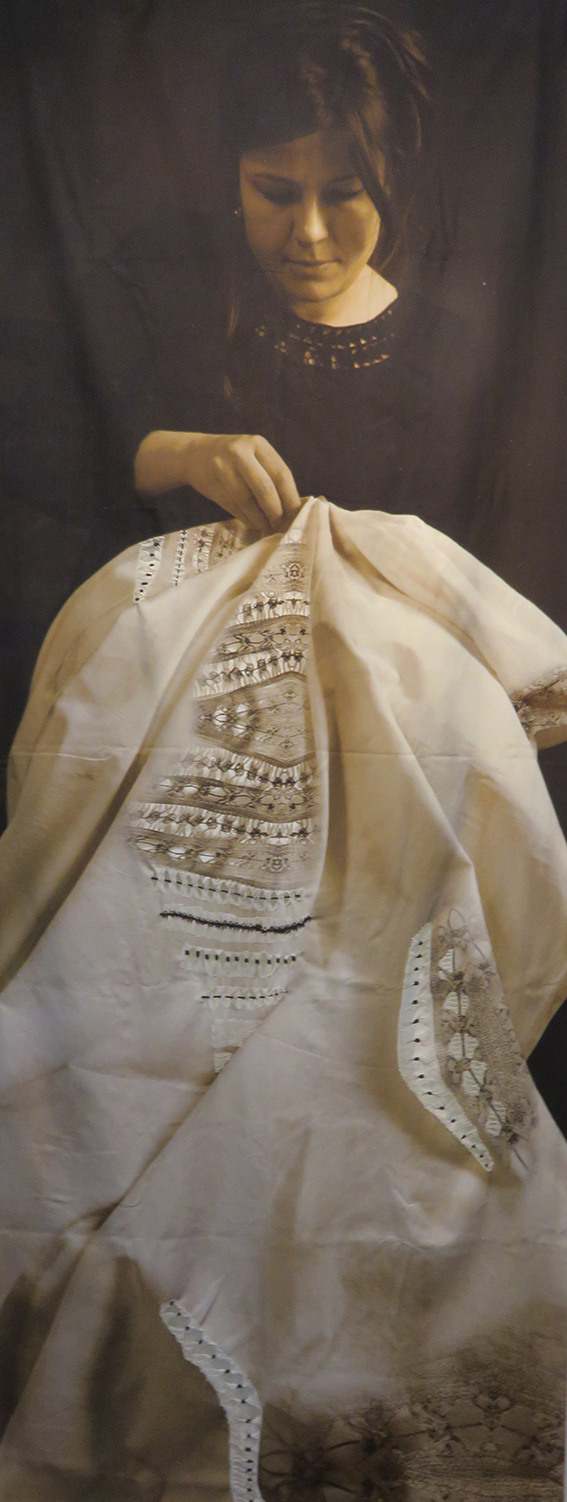
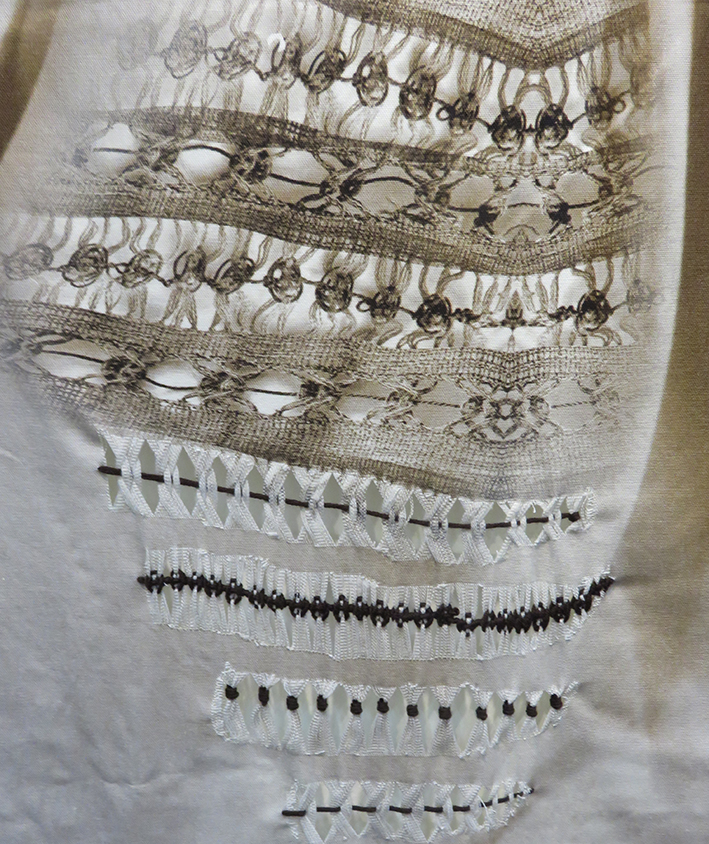
Among the exhibition, chosen from recent graduates by the Embroiderer’s Guild, was this enigmatic large photographic hand embroidered panel by Susana Borobia, part of an small body of work called ” Awaken Threads…this spoke ro me on lots of levels – it reminds me of my own work developed through a fascination with White Work techniques and the difficult transition from cloth or fibre to other materials…here is it managed elegantly and artlessly.
stitched photographic print by Susana Borobia
Detail of the stitched white work on the photograph
Ihave to admit that I chose to ignore the notice not to take photographs; it was early in the morning, I couldn’t find the student to ask and thought that she may prefer it to appear on this blog than me to ignore her work. I have had this problem of no photography before …but it is a odd embargo now in the age of instant imagery and social media and who can possibly copy this ??????…that’s my excuse anyway.
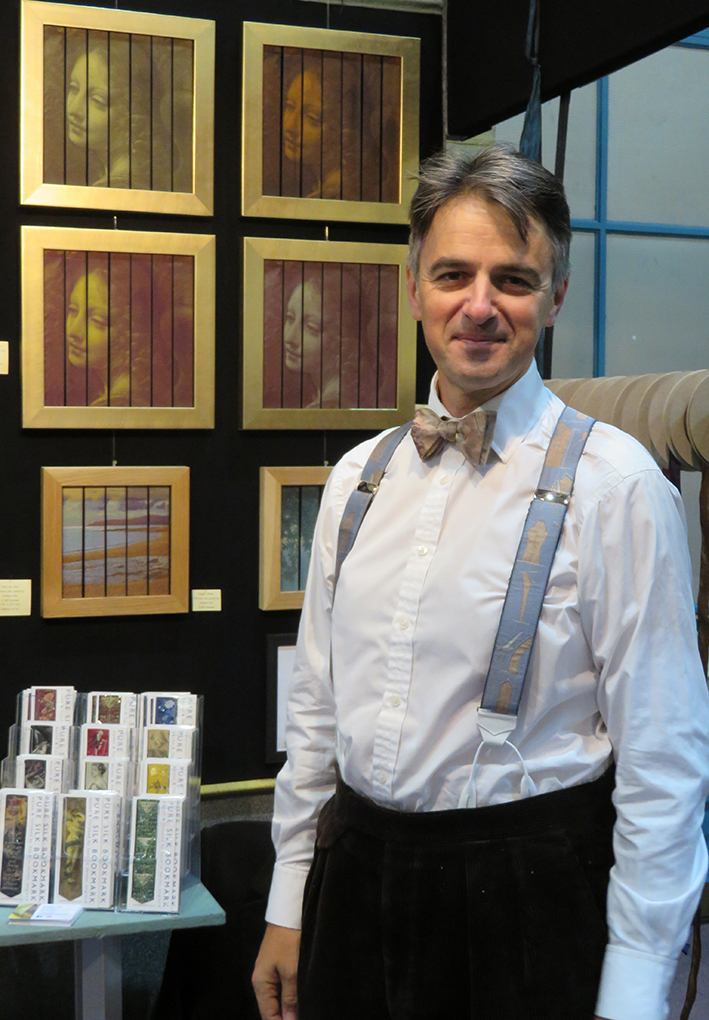
Robert G Ely, the perfect example of ‘ if you’ve got it flaunt it ‘ wearing his woven silk braces and bow tie
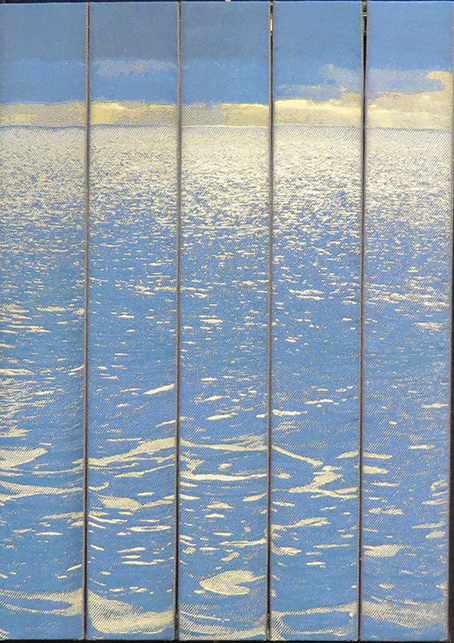
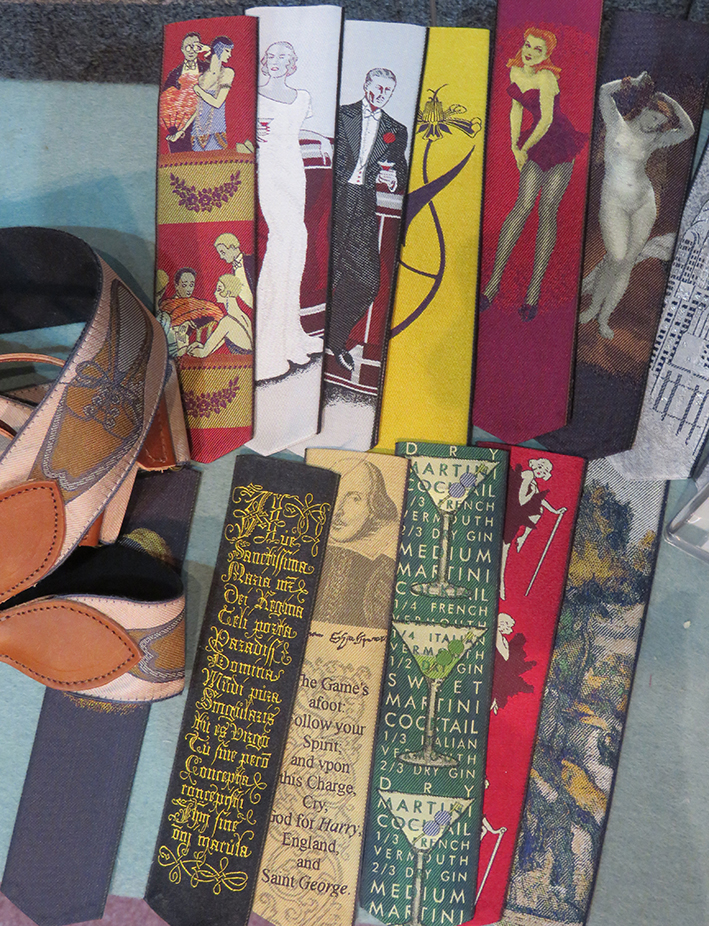
It is difficult to show a range of different work in such a small space as a booth in the fair – but here Robert Ely has managed to do exactly that – he shows his woven ribbon design work, such as braces and book marks with his more art based weavings of sea and landscapes – the ribbon dimensions are shared but the colour depth and small scale pointilism is also evident in both sets of work – seen below are the 2 types of work on display
woven ribbon seascape – by Robert G Elybelow are the 2 types of woven work that Robert was exhibiting
braces, book marks and other finely woven sauciness.
the seascapes exhibited made me think that he must live near me on the Severn Estuary, in fact these images are taken from much further down the estuary at Devon, Start Point.
this image I mistook for my local headland and lighthouse, Battery Point in Portishead, Somerset in fact it is form further down the estuary in Devon
what everyone goes to these fairs of is to stock up their stash! So 2 specialists who always show wonderful collection of the real things…first my old favourite importer of real Japanese fabrics, Euro Japan Links, a Japanese husband and English wife team who have been in business for years- long before their was a fashion in Japanese fabrics; their pieces of fabric neatly folded into colour co-ordinated ranges never fail to fascinate me.
Japanese patchwork cottons
Japanese kimono prints
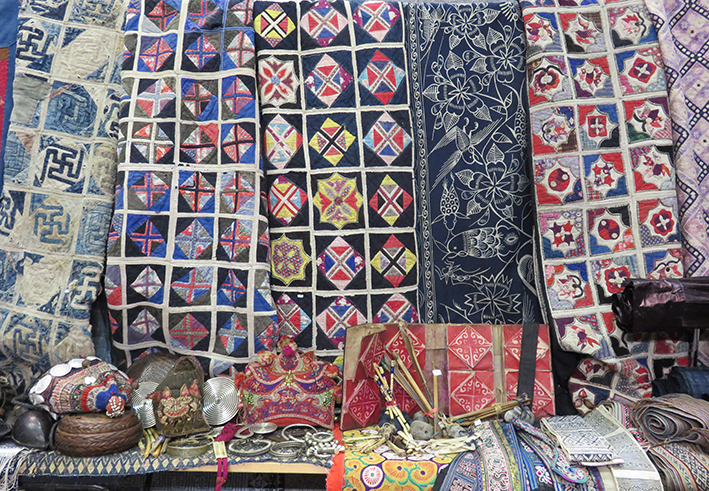
My other favourite company exhibiting and selling mainly tribal Chinese fabrics and clothing is Slow Loris. I have written about this marvelous collection for sale before but do so again as Martin Conlon the owner is a fund of knowledge and is really enthusiastic to tell you the stories behind the garments. There always new things to see – well old new things.
The Slow Loris stand of ethnic Chinese /Tibetan textiles
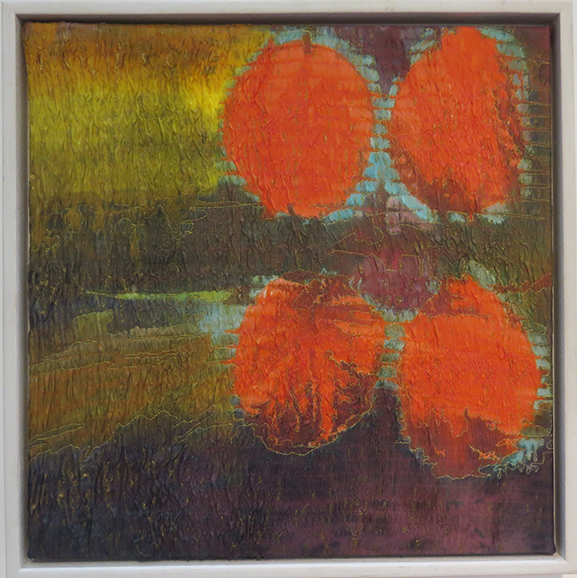
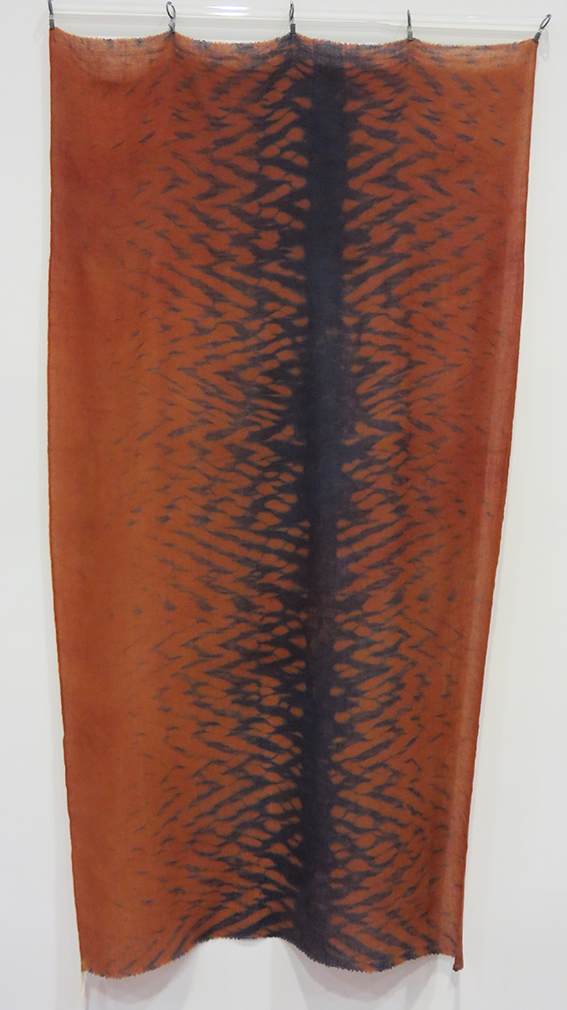
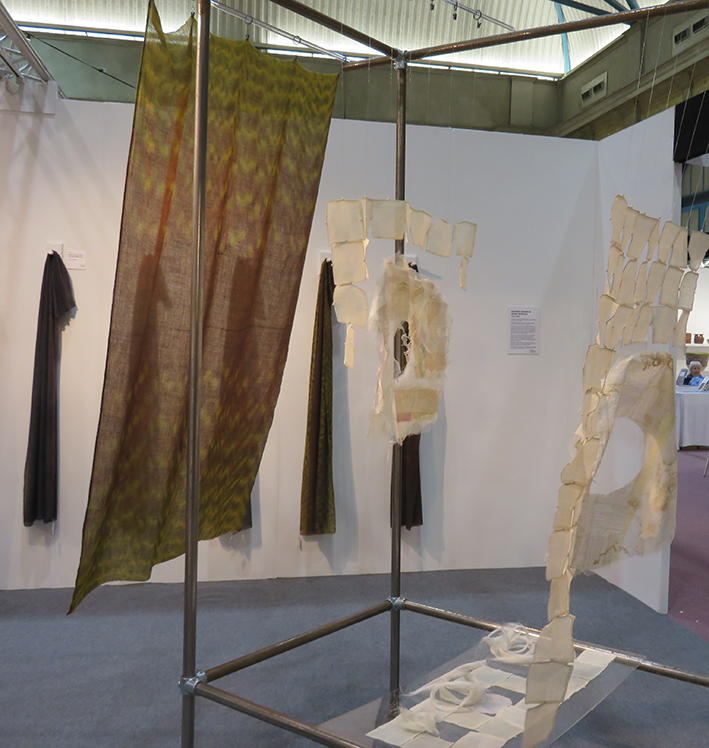
The other exhibition I liked for its sense of space and calm and truly sumptuous colour was ‘The Other’ coloured work by Vivienne Prideaux paired with the white and neutral work of Amanda J Clayton. They made a handsome area of beautiful controlled textile hangings and panels. I thought that these these glowing panels by Vivienne Prideaux were just so desirable, the depth of texture and range of nuanced colour that this artist builds up with her various tie dyed and gilded grounds is so inspiring – makes me yearn to return to my own studio again.
small dyed panel by Vivien Prodeaux
shibori dyed and gilded panel – Vivienne Prideaux
the neutral and range of white fabrics shown by Amanda J Clayton were perfect partners
Shifting sheets of fabrics installation in “The Other” exhibition.
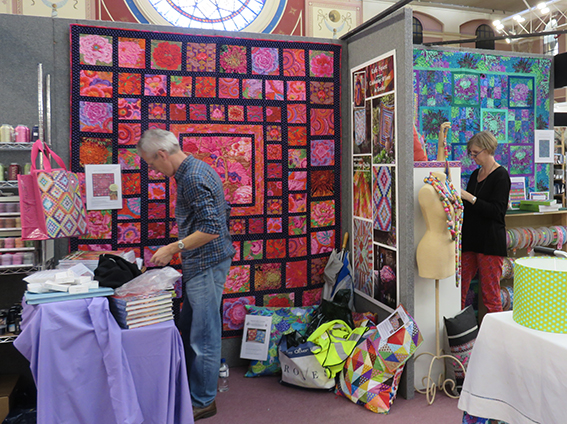
So enough of what I like – what about my exhibit…i was given a space on The Cotton Patch stand, to show and sell my new book, Little Ribbon Patchwork and Applique – comprising designs based on Kaffe Fassett’s ribbon collection for Renaissance Ribbons
several people helped me to set up and run the stand during the week …
Setting up the stand with Cotton Patch ‘s Nik Sewell sorting out the Kaffe Fassett books and Jane- Matie Mahy organising the Heart Space section
several people helped to run the stand with me for the 5 days of the show….
Ilaria Padovani form Heart Space Studios demonstrating how to make a ribbon yo yo on the stand
Susan Berry who had the idea of the book in the first place
The Ribbon beads have proved to be most popular things we show how to make in the book, see the next post down!
Stuart from the Sewing Bee programme and Jane- Marie Mahy with the ribbon beads – sort of says it all really!
One wonderful wrapped ribbon beaded bead by Debbie Cripps
And so to Bath, to launch the Heart Space Studio book, ‘Little Ribbon Patchwork and Applique’ at the American Museum, with a workshop in the morning to show how to make ribbon beads. I made these originally as a way of using up all the small ends of Jaquard ribbons made by the American company Renaissance Ribbons left over from the other projects in the book – but also to show off the wonderful floating threads that form on the backs of the ribbons.
contents of a ribbon pack given to each student for the workshop
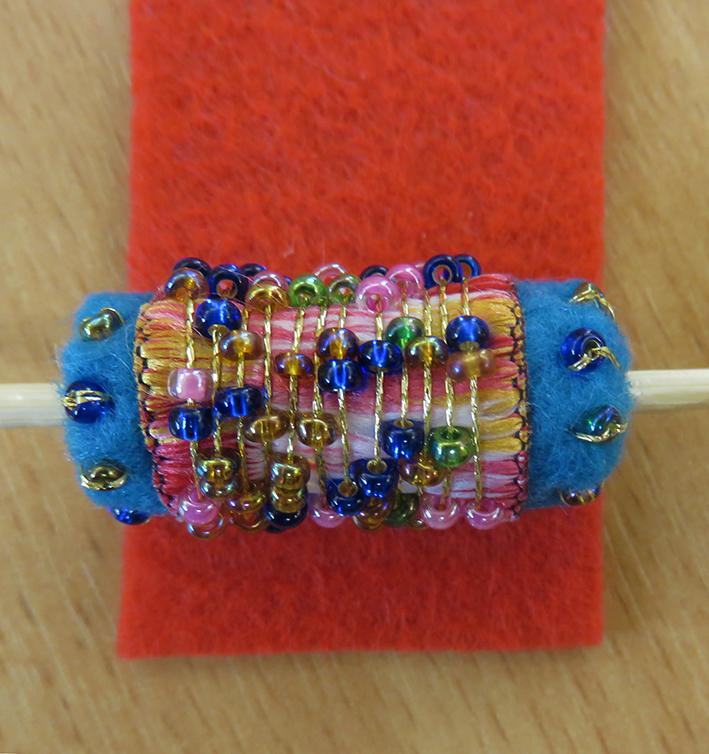
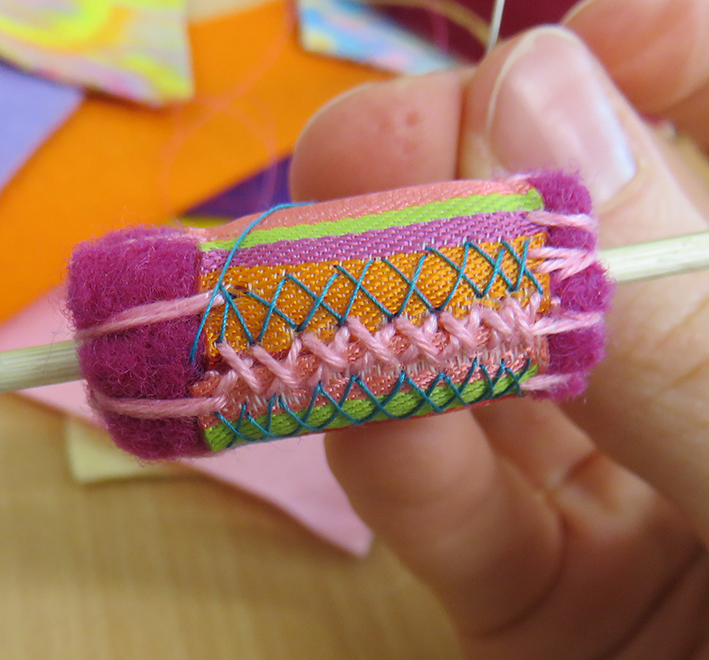
As the workshop was conducted for just the morning before the launch, we had only 3 hours to make beads, and knowing that choosing the ribbons and felts takes a long time, decision decisions….we had made packs of small pieces of ribbon and the felt strips – enough for 12 beads, added tiny glass beads for embellishing and some gold thread for wrapping and stitching, plus a small wooden skewer on which to assemble the beads. Each student was first asked to choose a package.
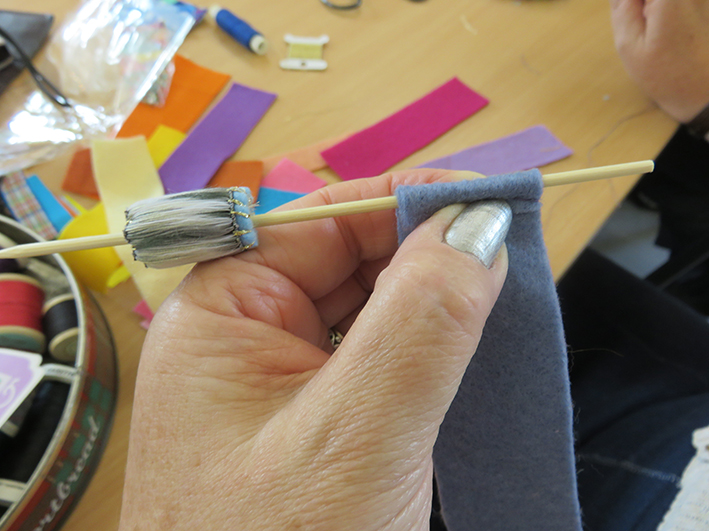
wrapping the scrap of Jaquard Ribbon wrong side outermost around the felt.
wrapping the felt to make the bead base
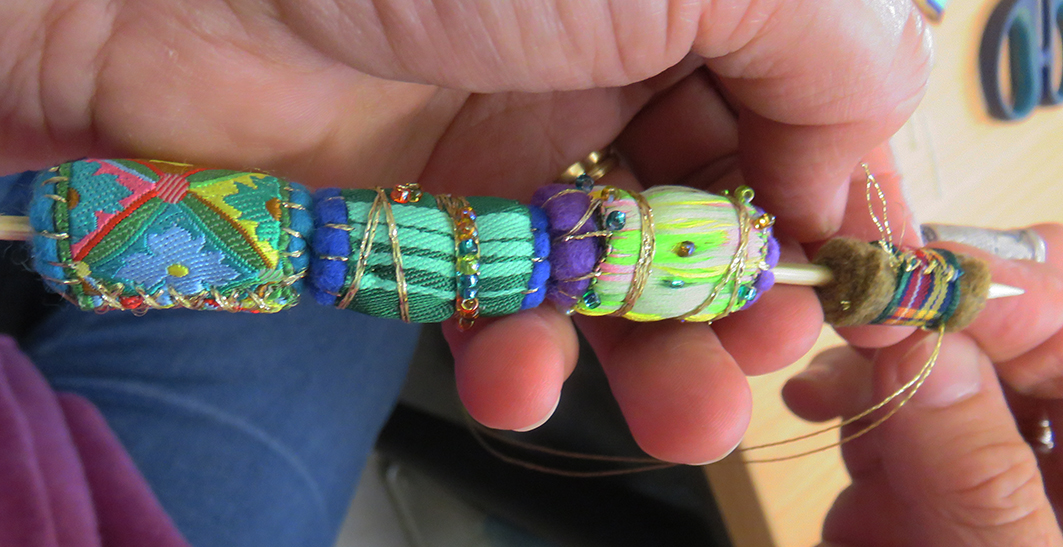
constructing the beads is easy peasy – if you can stitch neatly, I showed how to make 3 simple beads with variations.
three beads wrapped and stitched in gold thread and different ribbons
everyone quickly got wrapping and sewing and inventing different colours and patterns, fascinating to watch so many variations happen at the first ever class I have given in this technique.
colour co-ordinating beads with clothes
stitching the ribbons to the felted bead – a blur of activity!
just simple plain coloured thread cross stitch when repeated looks lovely..
embroidered bead by Naomi Clarke
when all the ribbon beads are strung together with glass beads onto an elastic cord the effect is simply lovely.
the finished necklace by Naomi Clarke
After this came the launch party, so we all made our way to the Gallery.
Earlier in the week, we had designed and re-packaged the basic Renaissance Ribbon packs that the gallery had in stock to sell with the books,
in the heart space studio making fresh sets of ribbon packs
we were really pleased with the effect….
our packs of ribbons displayed next to the new book in the gallery shop
lots of other people joined us for the launch…the heart Space tutors and friends all enjoyed a good time together
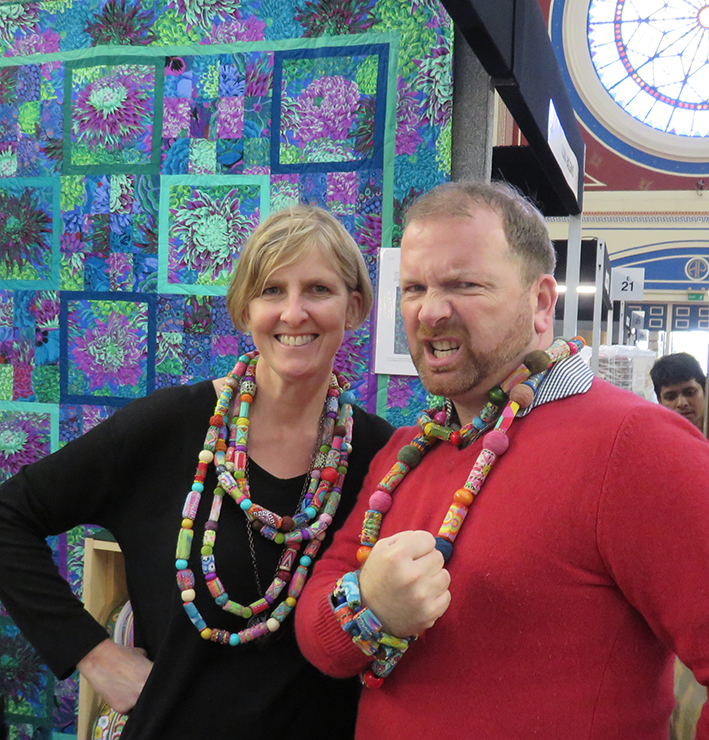
rare picture of me with my friends – I’m the one with the ribbon bead necklace
colourful Heart Space gals busy chatting together
All in all it was a good day, and lots of other guests have blogged it as well, most notably, Rosemary Murphy on one of her blogs for September 2015 http://storiesinwood.blogspot.co.uk/–
So that’s the Launch sorted, what next?
new ribbon version of front cover embroidery for Knitting and Stitching Show
new design for Cotton Patch stand F27, at Knitting & Stitching show at the Ally Pally, London
I have been invited to the Knitting and Stitching show in London by Nik Sewell the owner of The Cotton Patch to demonstrate how to make several simple projects from the book on their stand, F27. And to sell the books as well as lots of Renaissance Ribbons and Kaffe Fassett’s lovely shot cottons that are used throughout the book. So I am now busy developing new combinations as shown above.
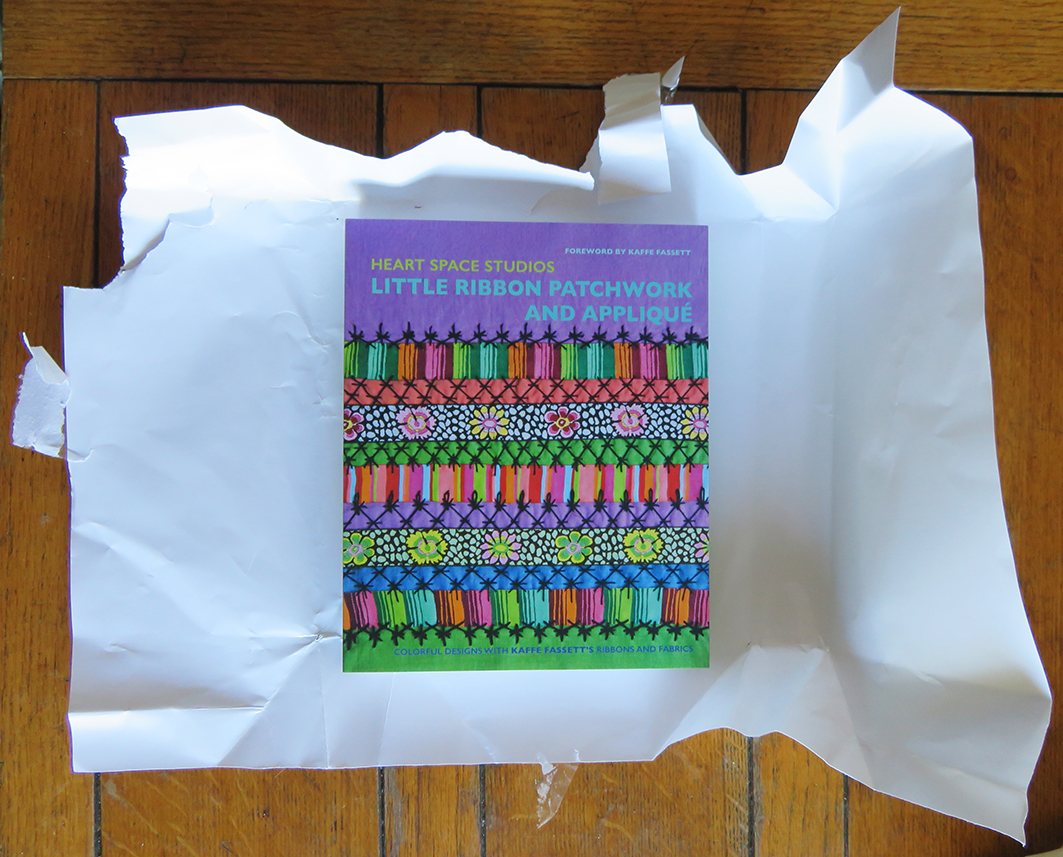
opening the package of the advance copied of Heart Space Studios’ first book
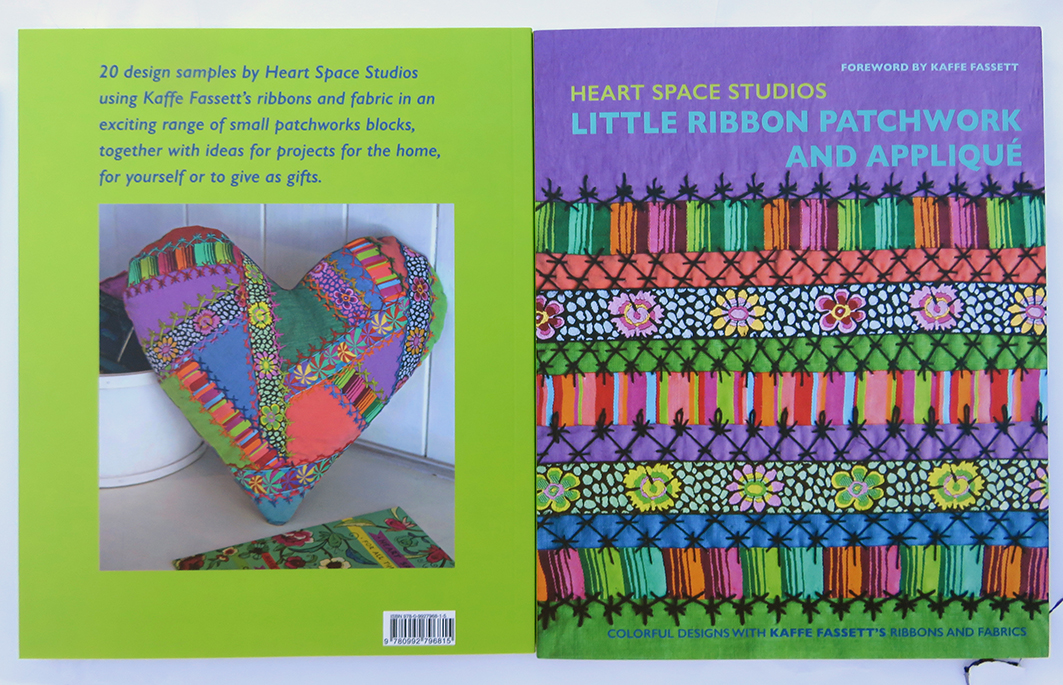
Here it is, my very first look at the proper printed books – Heart Space Studios’ Little Ribbon Patchwork and Applique, inspired by and featuring Kaffe Fassett’s wonderful ribbons. And this is the English edition, and it is published by Heart Space Studios…But oh the hopes and fears were in equal measure when I saw that neat white package of the first 10 advanced copies of the book…
all the angst and problems of getting the UK cover perfectly coloured have paid off
Originally the book was commissioned by the American publishers, Taunton Press ( and uses American terms and measurement – bliss – I was educated using inches and yards) and then I was offered the opportunity of producing a small UK edition and this is it. And as a consequence I have spent a large proportion of the last 9 months working on this and other publications involving Kaffe Fassett’s ribbons and fabrics……
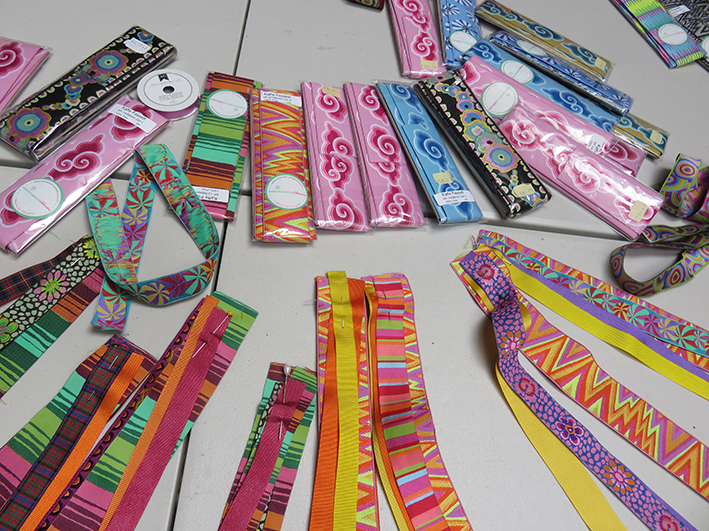
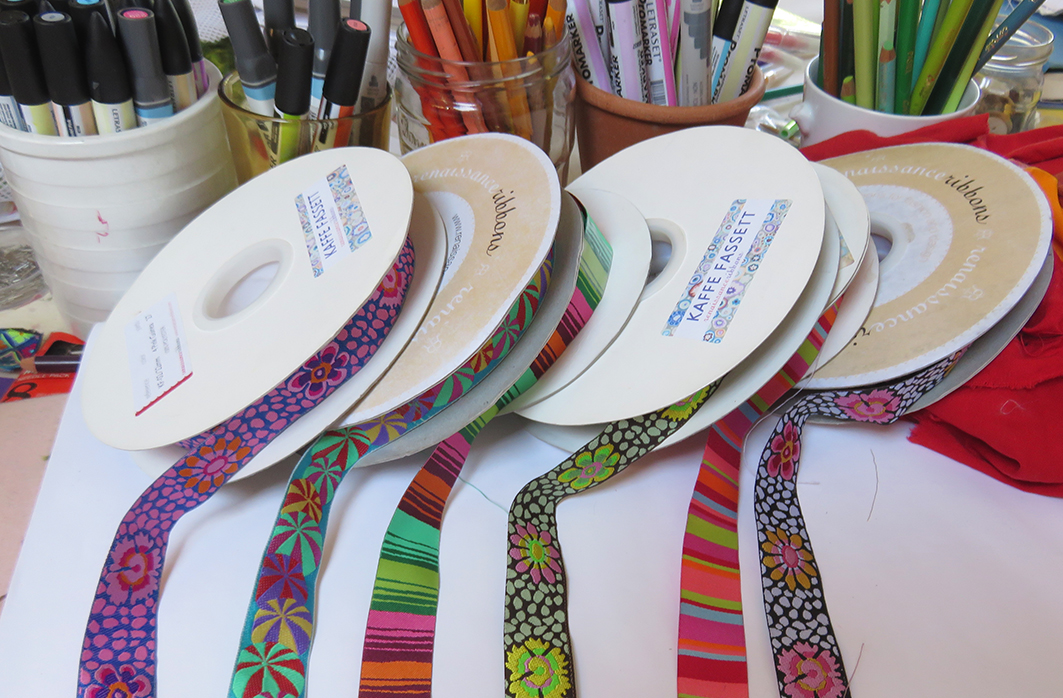
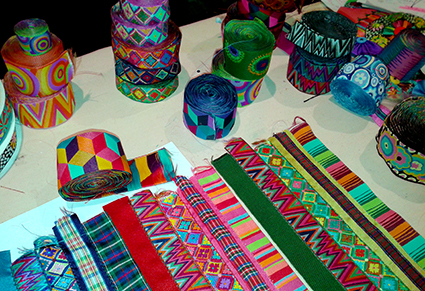
the 5 original reels of ribbon I designed with
I was first asked, by Susan Berry, a book producer concentrating on textile crafts (whom I have worked with for many years) if I had any design ideas for using the beautiful Jacquard ribbons designed by of Kaffe Fassett and produced by Renaissance Ribbons. Susan advised me to see them at his exhibition at the American Museum in Britain, that took place in 2014. Then I was sent a few reels of ribbons to ‘play’ with and this is what I came up with in the first few days….
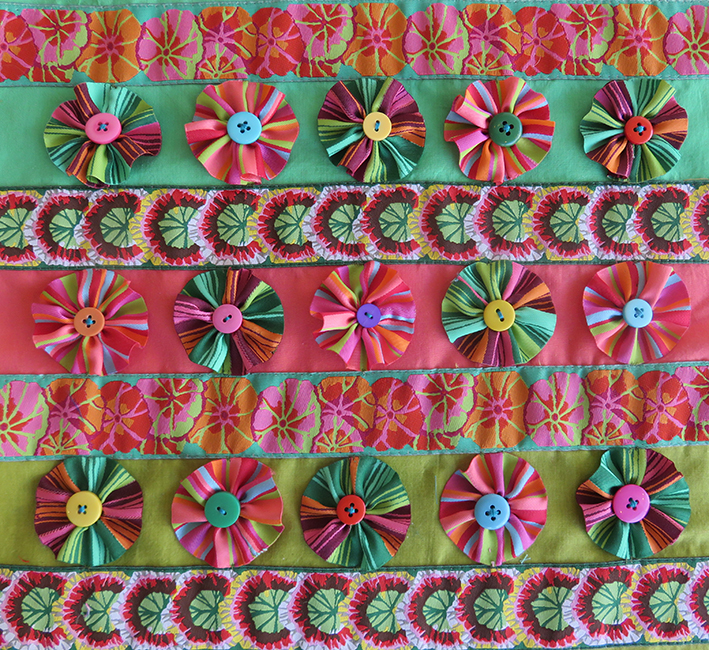
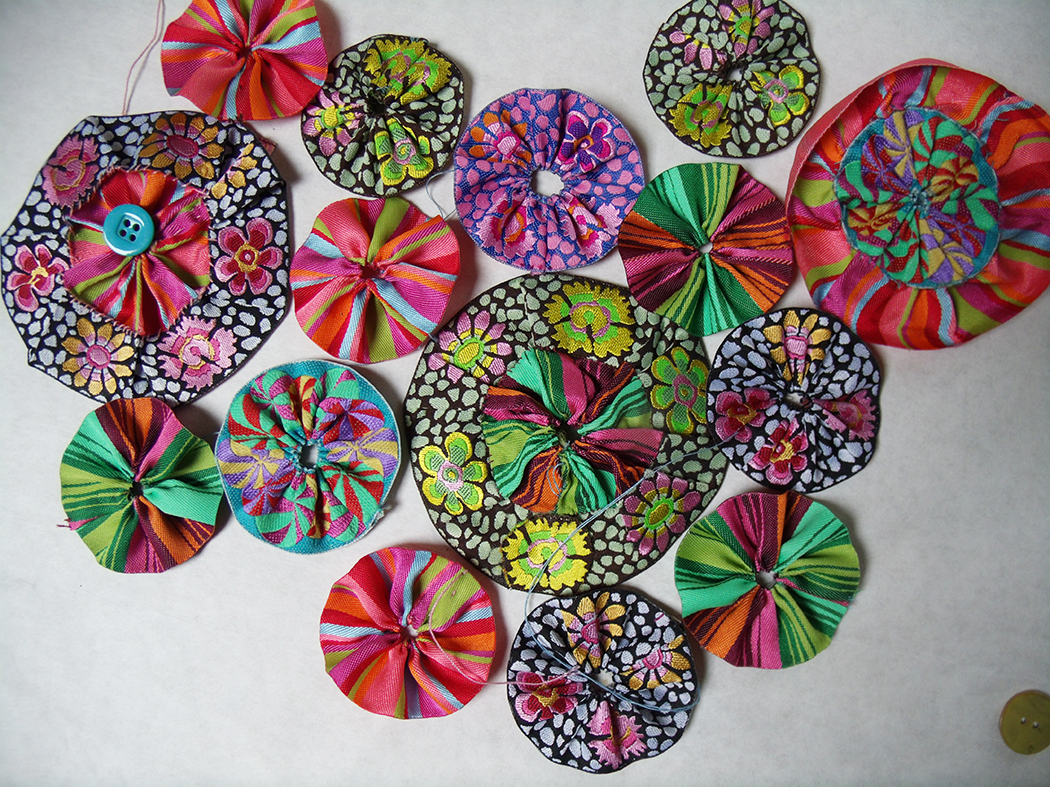
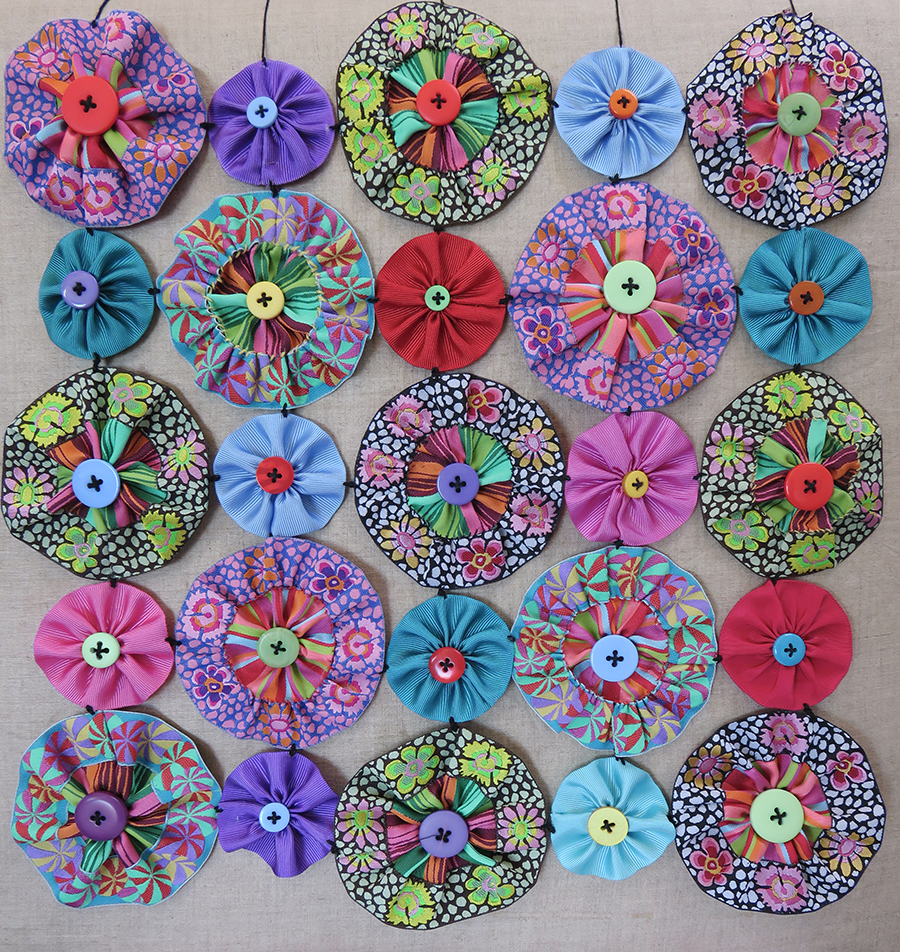
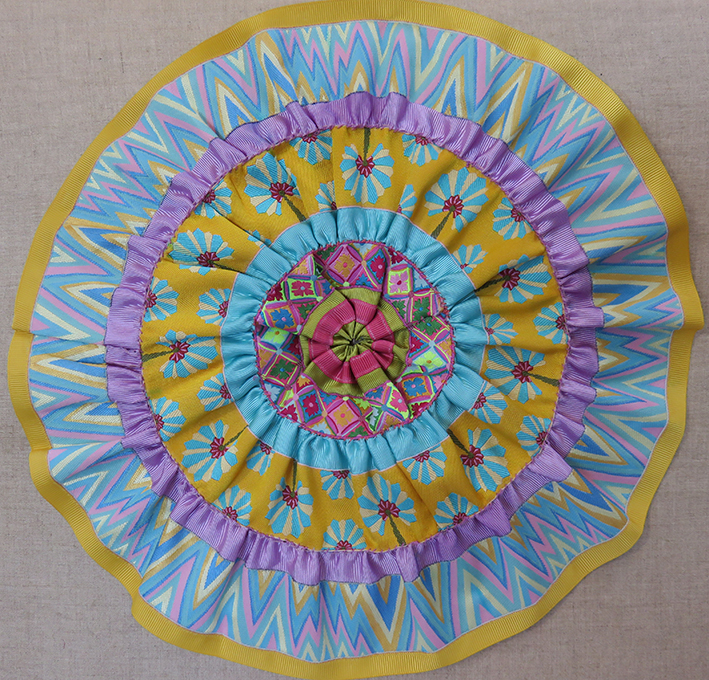
single and double ribbon yo-yos
I have a vintage – quilt hanging on my studio door and I immediately thought that this system may translate to the ribbons; so I just cut some random lengths and using running stitch gathered them up to form these pretty circles…some worked and some didn’t – see above; but it is a designers task to make them all work beautifully – so lots of samples later I made this, below, which I intended to grow into a huge throw or curtain.
yo-yo hanging – sadly this failed to make it into the book – it proved too complicated to show how to stitch together simply….
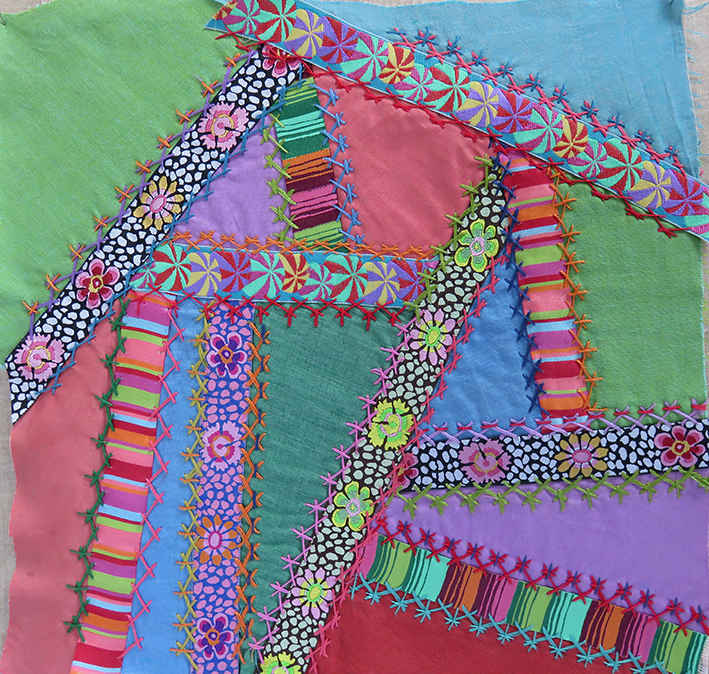
Then of course I thought of crazy patchwork, and this eventually became the heart-shaped cushion on the back of the UK edition cover
crazy patchwork with ribbons hand embroidered into position between the patches of shot cottons
of ribbon with the loose yo yo’s, easy -peasy as these ribbons have been designed to work together – a rich mix but what else would you expect from Kaffe Fassett?
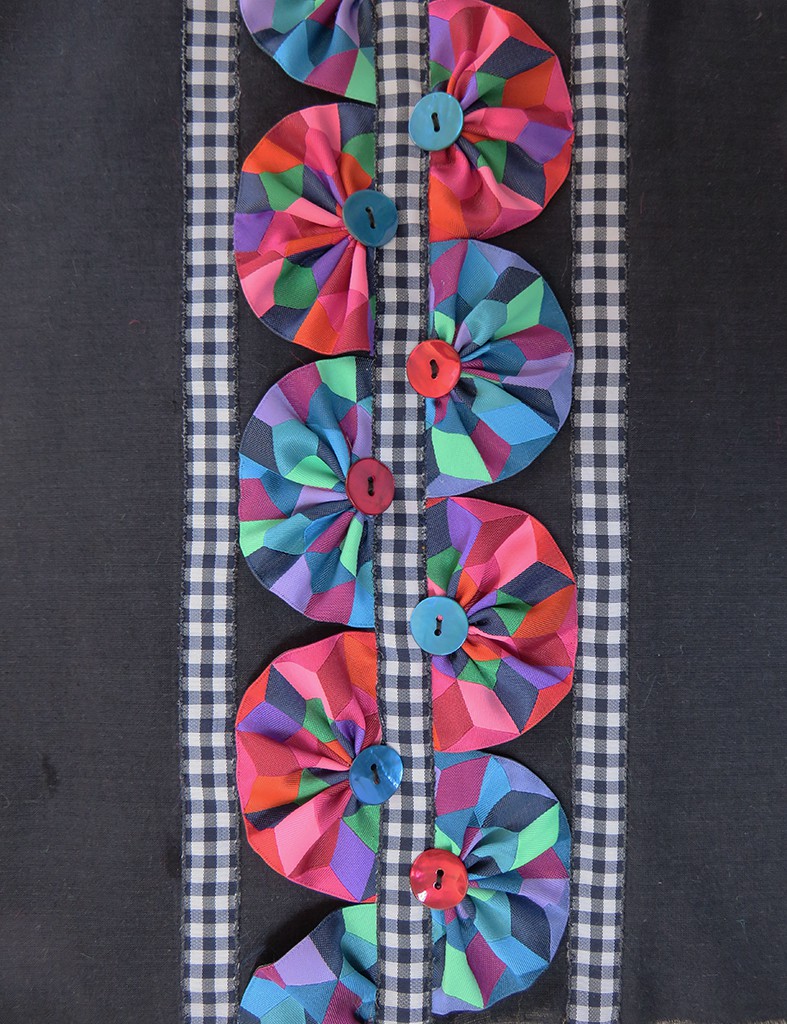
ribbon and yo-yo strips – first ideas
I just took lots of photographs as I researched, and sent them off with rough ideas for a book of small patchworks made of ribbon and plain fabrics – but the journey from playing with ideas to a finished book has been long and let’s say problematical – ideas are always easy for me to come up with, making them work for inclusion into a “how to do it” book is not easy at all.
new ribbon combinations
getting the new ribbons into colour combinations – here are the brights
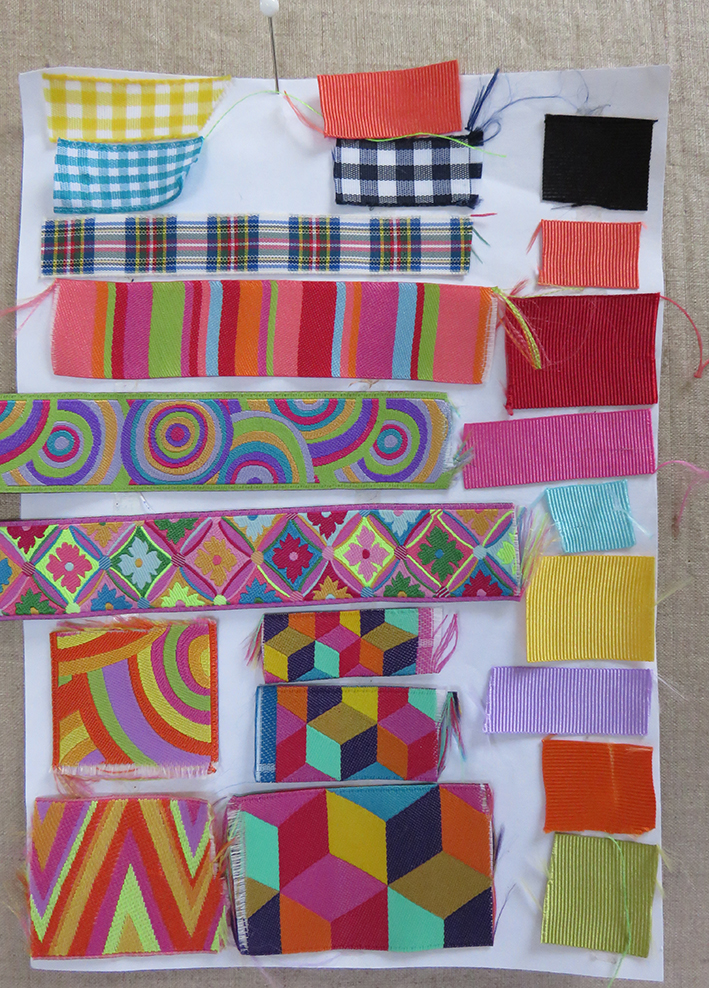
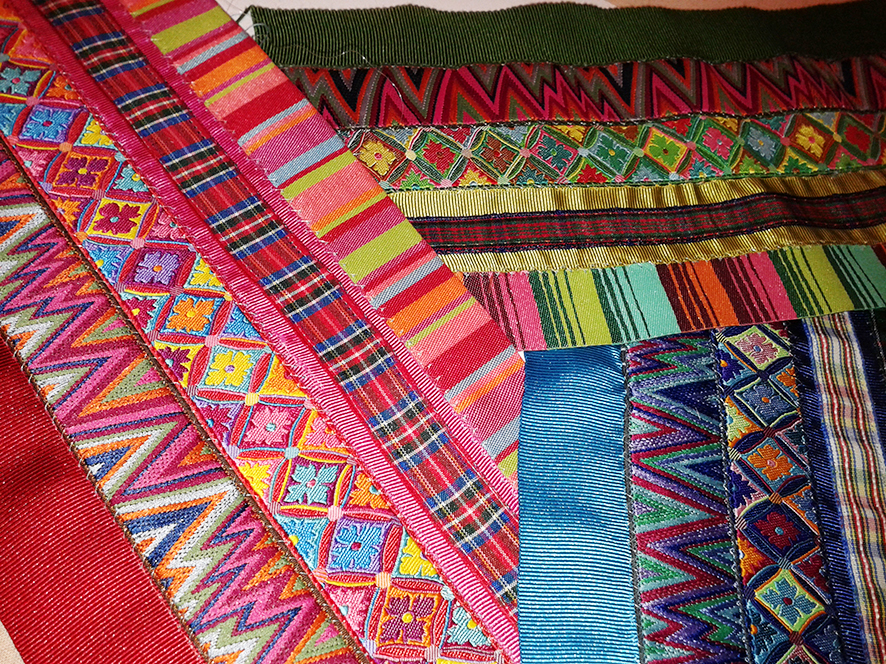
The first thing I realised was that I needed to put some other ribbons and fabrics with these intensely patterned Jaquard ribbons. So I included the Grosgrains, or Petershams, fine ribbed ribbons that come in many sizes and colours, Renaissance Ribbons have many different versions – and they duly sent me some and more of the new ribbons from their Kaffe Fassett range; and then I needed a ribbon that could be used to tone with the 2 brights – I chose my old favourites – tartans. Tartan ribbons are universally available now on-line, and they conform to the clan colours so I felt sure that most buyers of the book could get hold of them easily. But then which fabrics to use for the patchworks particularly the crazies?
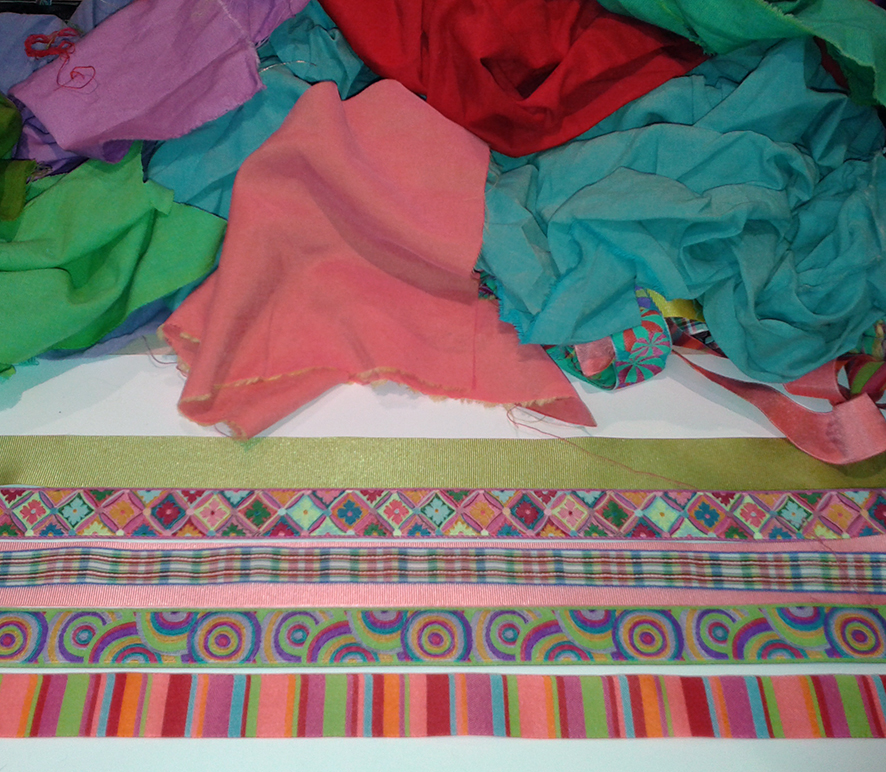
my stash of shot cottons selected to tone with the ribbons toning ribbons
I am a fabric hoarder, like most textile designers, and I found some small pieces of ‘shot’ cottons – the warp and the weft of the fabrics are different shades or even different colours from one another so the woven fabrics are subtle colours and so more easily used with other materials; and by chance who were these shot cottons designed by? Kaffe Fassett. So that was an easy decision as well and I sent off to The Cotton Patch, (who have the best user – friendly, on-line ordering fabrics service) for more samples of these lovely fabrics. I started designing approximately 20 different samples of ribbon patchworks and appliques.
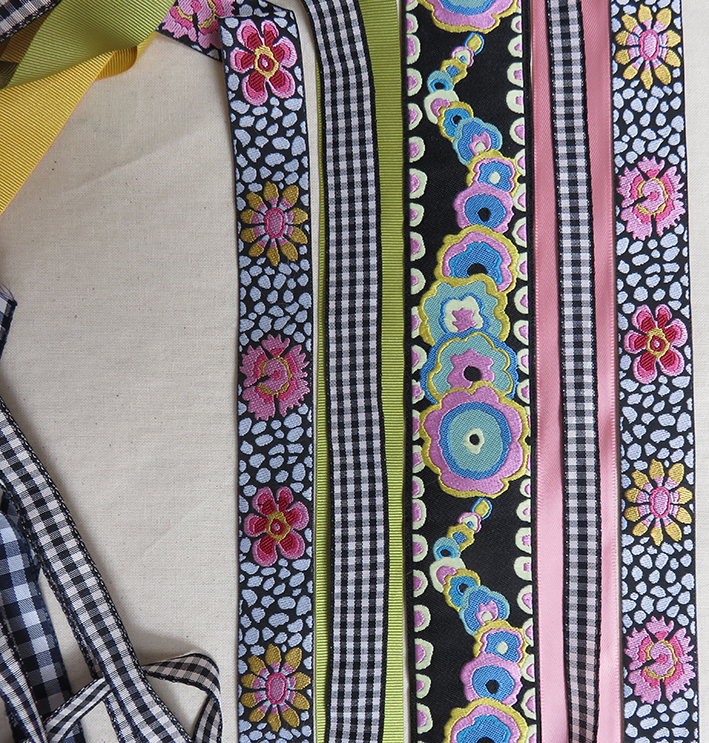
But I fist made myself some new fabrics – out of the ribbons themselves….
designing ribbon combinations for ribbon fabric
trying out different ribbon fabrics for crazy patchworks
what I needed to realise is that when you are making your own ideas for a book, it is important to be able to demonstrate by using photographs, drawings, diagrams and words how someone else, who has not got your knowledge and may even be a complete beginner, can easily follow the instructions …a lot of lovely ideas and more complicated designs got thrown out in this process.
But here are some examples of 20 samples that made it, from first ideas, through to illustrations of the steps involved and finally the 20 projects that I made with the samples. There are 4 types of patchwork and applique techniques in the boon, strips – see below, crazy, squares and yo-yo’s.
putting several ribbons together onto my work top, trying to make up a new ribbon fabric
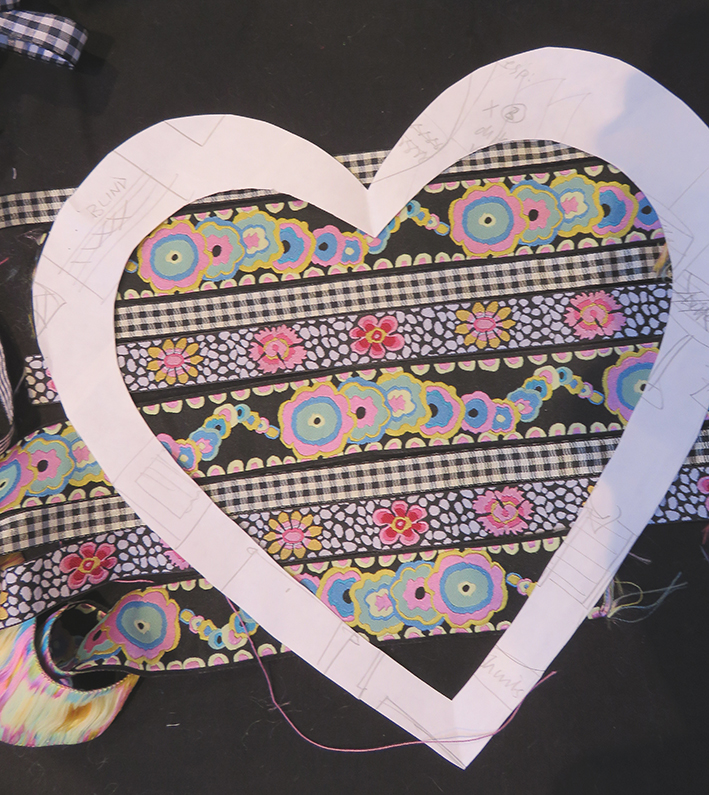
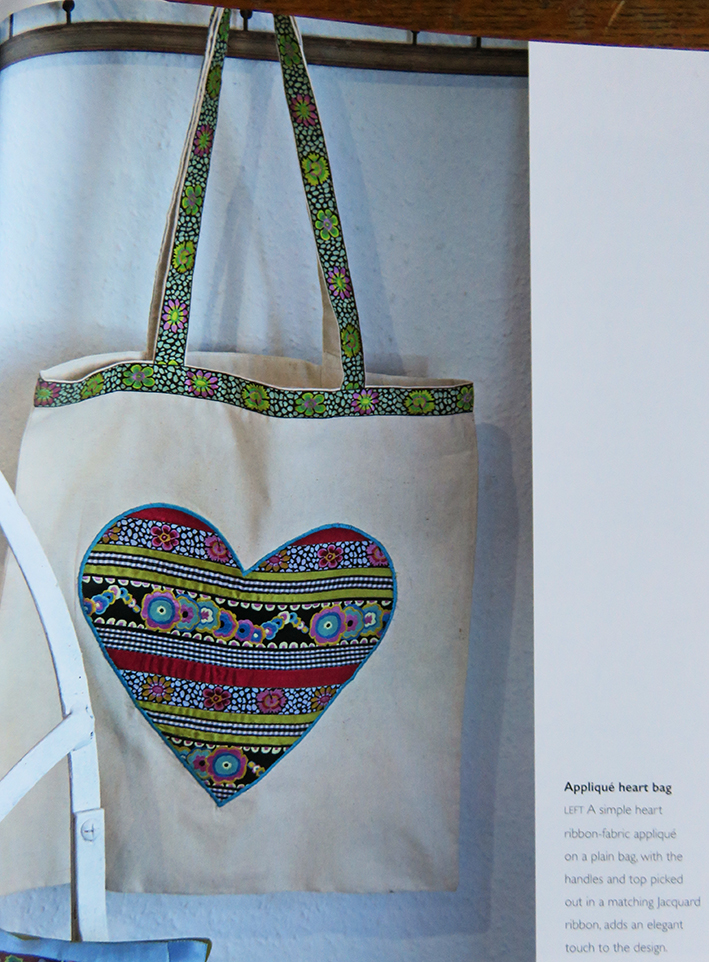
designing another variation of ribbon stripes for a heart shape applique
from the work table to the finished book in one bound!
illustration to make the ribbon fabrics
page from the book to show the heart shaped applique
and eventually this design turns up on the contents page as well….
content page of finished book completed with the same Ribbon Fabric
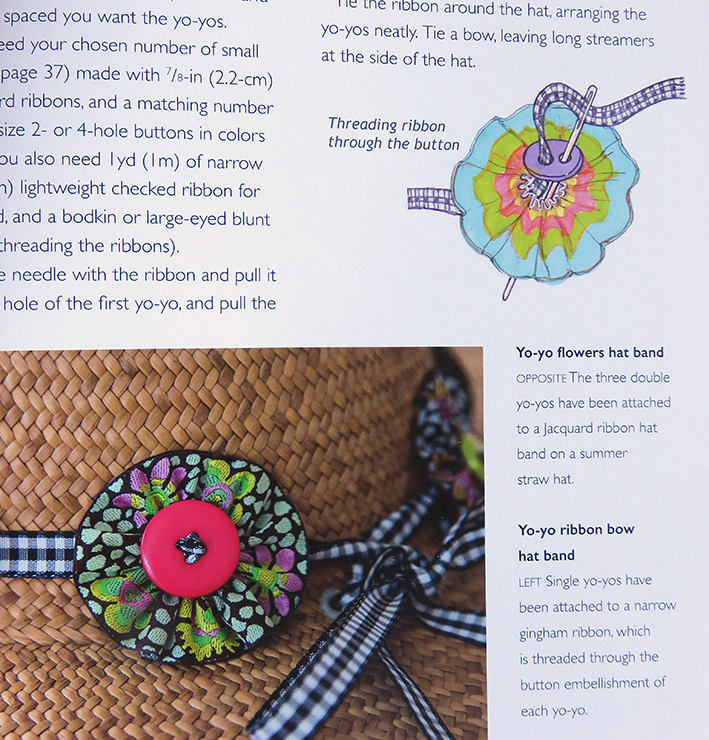
the yo yo designs quick and fun to make and design with, within the book they come single, embroidered….
hat band yo yo with button stitching ribbons
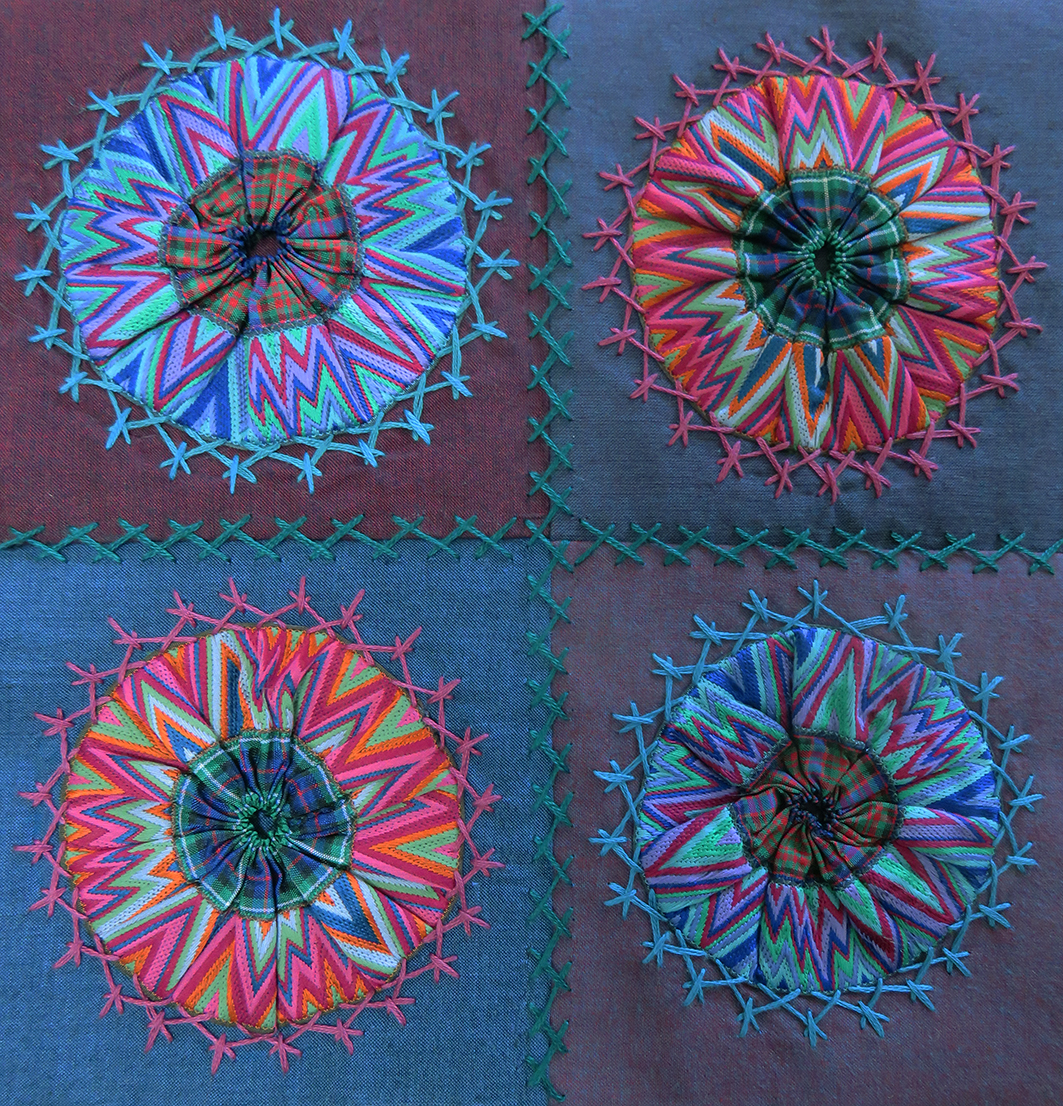
embroidered double yo yo square patchwork
halved and giant.
half yo yo bands
and one very very big yo yo.
in fact I could have written another book about making and decorating with yo-yos
project section of the book – with lots of different things to make
I could write for days about the book and all that it contains – but then why would anyone buy it? As I write I am waiting for the large consignment of books to arrive from the printers….it is a small edition but I have plans to advertise it, it is being launched on September 15th at the American Museum in Britain, well it is full of the American Kaffe Fassett’s ribbon designs… and for this I am giving a special bead – making workshop. ( more of which in a later post )Then the book is being sold with special packs of ribbons and fabrics on the Cotton Patch stand at the Knitting and Stitching Show in October; but meanwhile we have a lovely display in the shop window of Heart Space Studios, devised by our style guru, Jane- Marie Mahy, please see below and I have devised a whole set of classes to complement the book – go to http://www.heartspacestudios.co.uk/workshops/ribbon-patchwork-hearts-half-day-class/. for more information. And eventually we will be selling the new book on our website – watch this space
Heart Space Studio window display by Jane-Marie Mahy
























































![photo 3[1] copy](https://janethaighherwork.com/wp-content/uploads/2025/06/bd41e-photo-31-copy.jpg)
