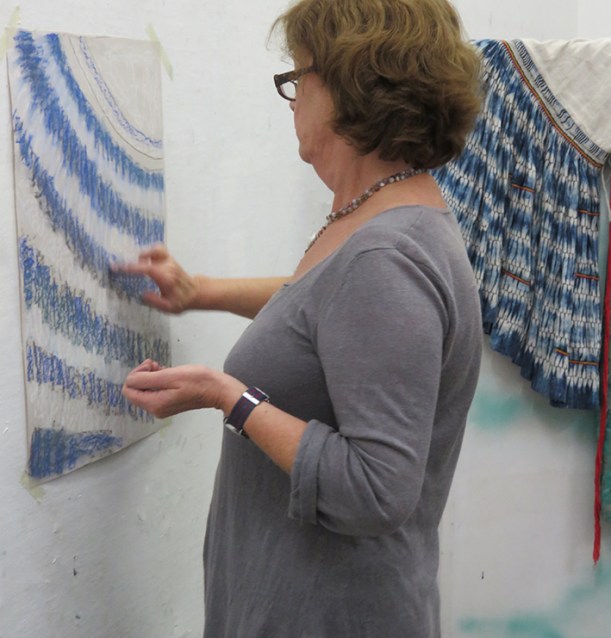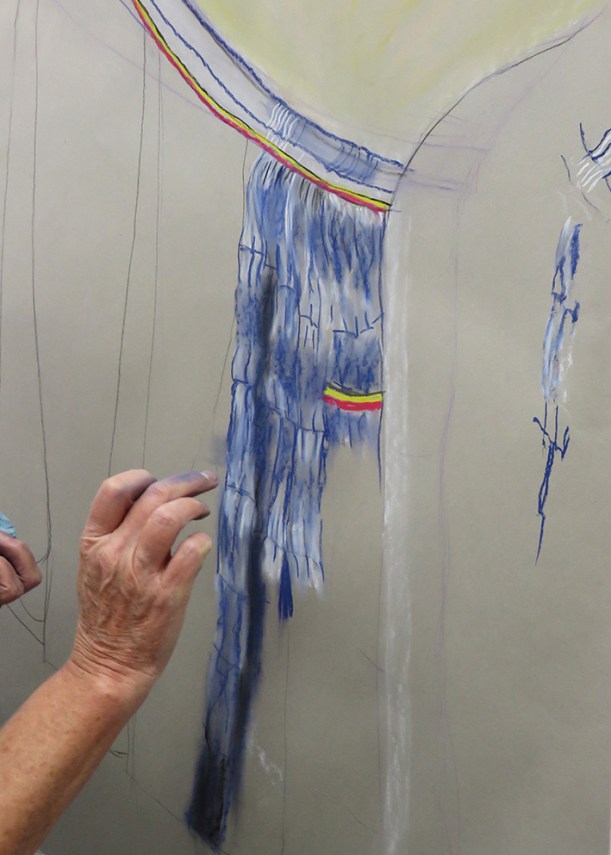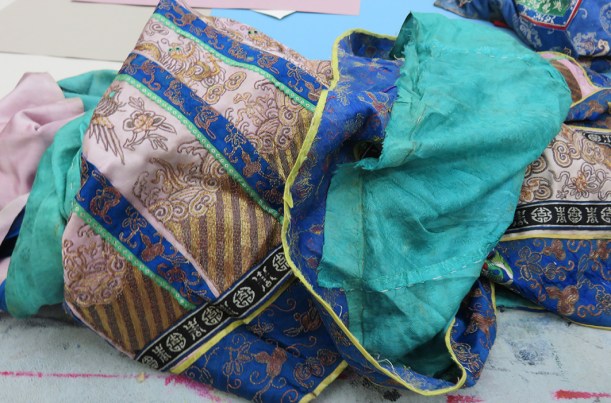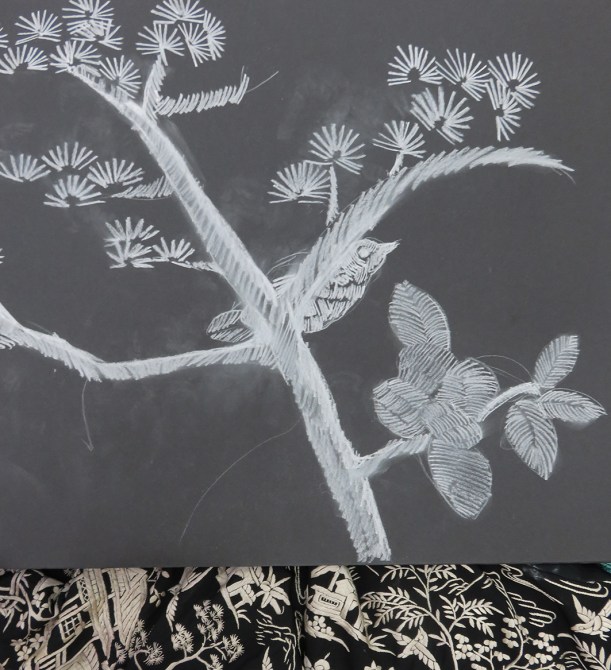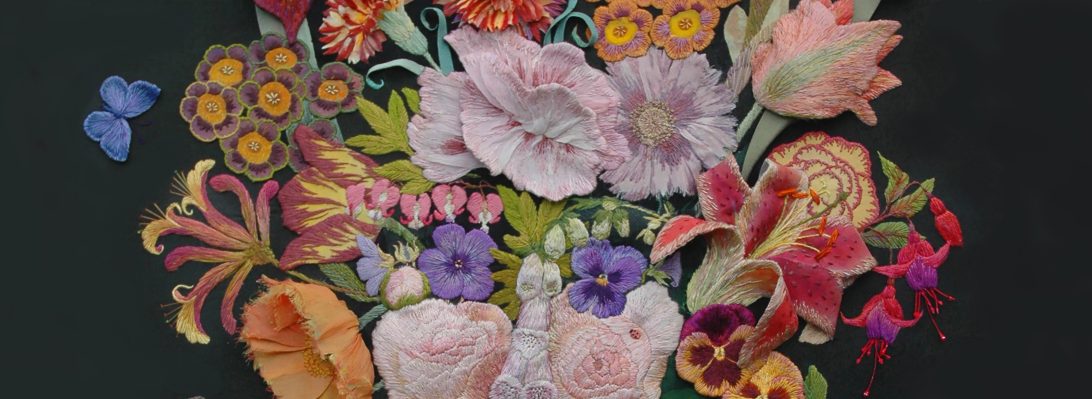
first page of my reborn Flora research/sketchbook – Flowers Again!
Recently, the “After Winifred” embroidery has inspired me to develop work to use as Giclee prints in order to add a fresh way of getting my work ‘out there’. I turned to my old Flora workbook, some 20+years old – but still alive for me as a source of inspiration.
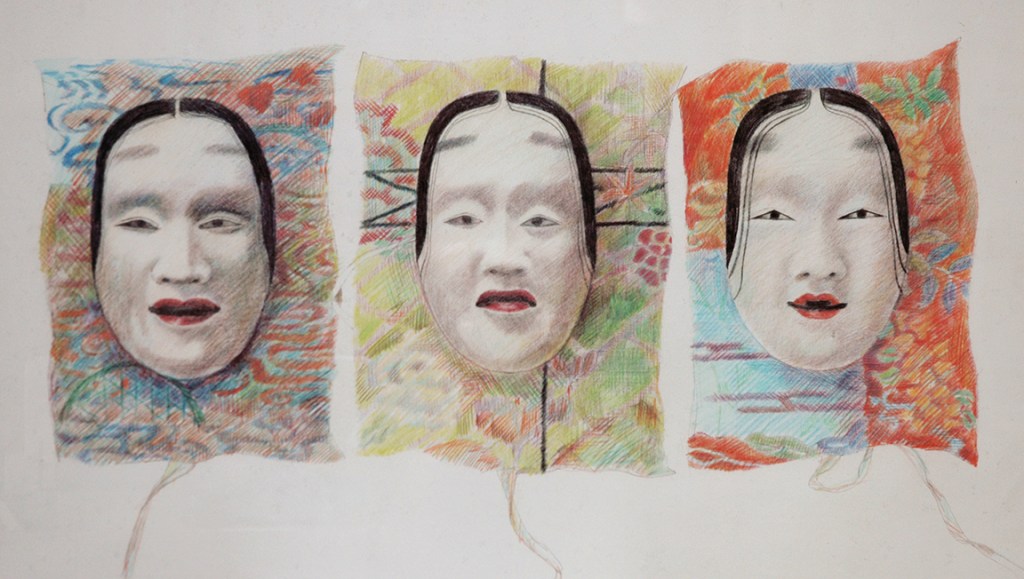
last last pages of drawings circa 2000 in Flora workbook .
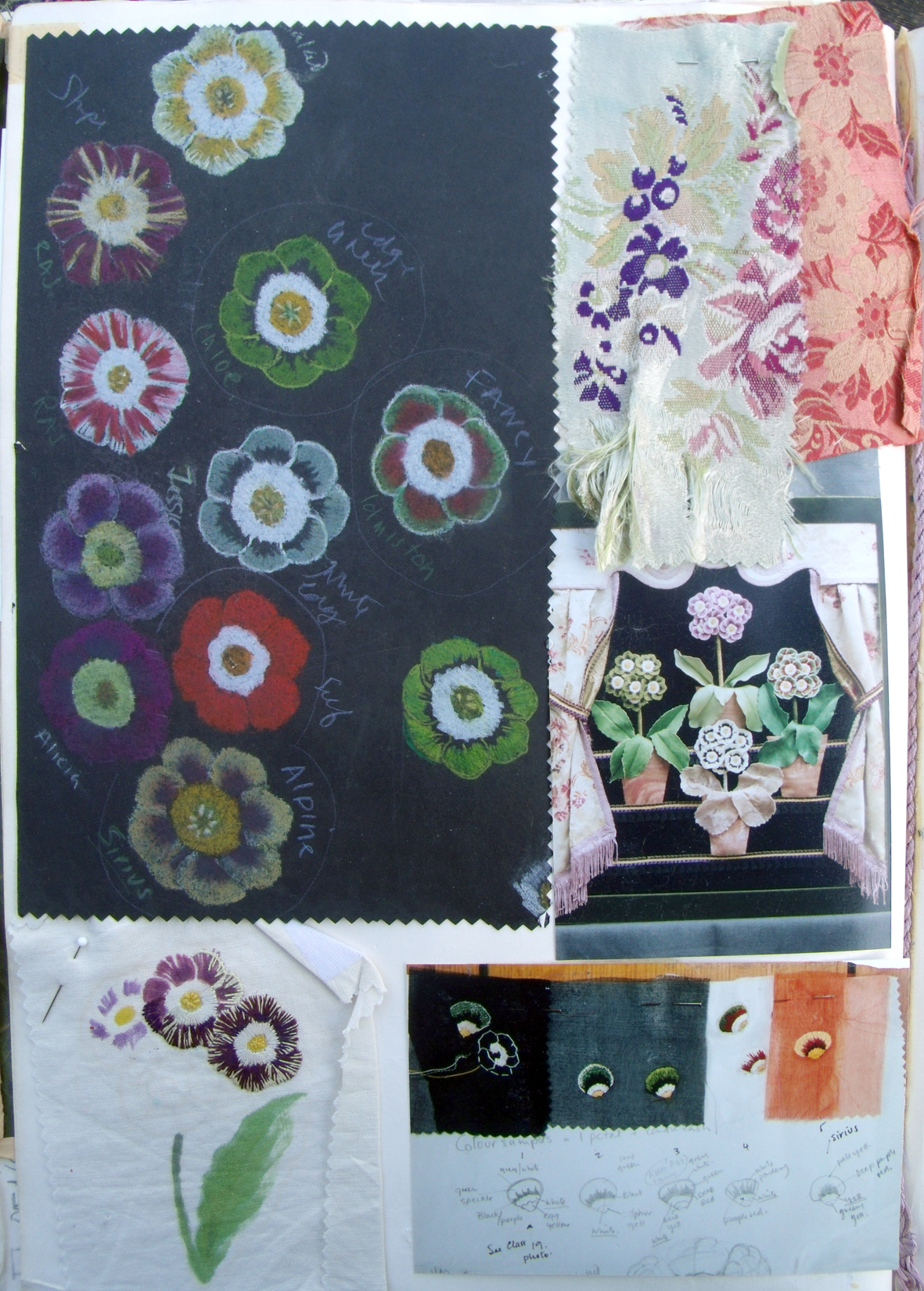
drawings and stitching samples for Auricular Theatre 1998
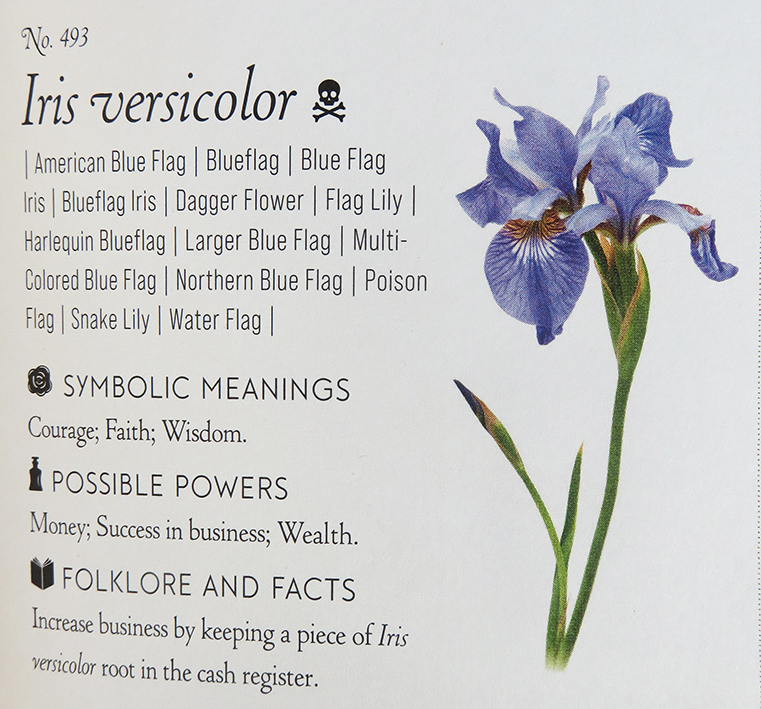
painted studies of garden Iris circa 2000
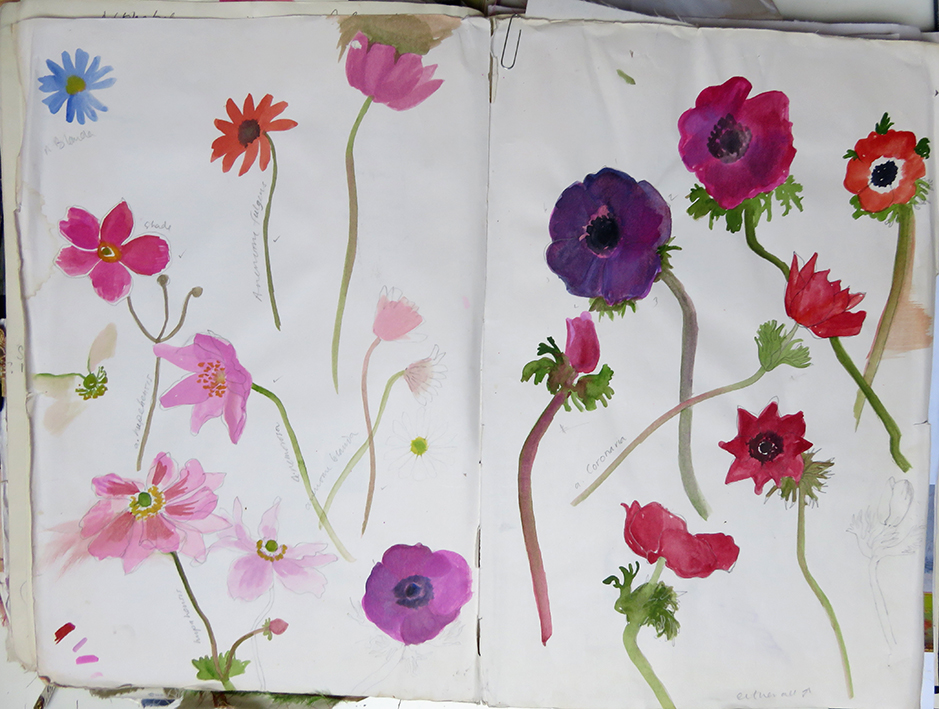
most used pages -Anemonies painted from life and photos.
I found some empty pages at the end of the old book and started to collate recent samples and drawings of bunches of flowers grown and made up at Court House Farm, where I conduct drawing workshops, using the cutting garden as inspiration.
second page of the book – old samples and magazine cuttings for colour a small bunch of dahliasobvious inspiration from Winifred Nicholson flower paintingmy initial research fixed now into book showing early samples of new-to-me Inktense pencils – as dyed ground for stitching
looking back at my Flora work, which is 3 dimensional and very heavily embroidery, I now want a freer drawn imagery to stitch into. So I bought some Derwent Inktense pencils that basically act as dyes when wetted and left to dry – I did many samples but found my drawings had too much information in them – I needed to loosen up further. Ha ha – the story of my working life!
first inkjet pencil drawing second freer drawing sample hand stitchingdesign page using a very old photograph of my own collection of hellebores against a silk ribbon applique.
To enable me to play easily with the new ink crayons I chose an old set of drawing research and photographs to work with. The colours of the crayons are very brilliant and I needed to find ways of making more subtle colours, so stippling, cross hatching and dotting colours one over another made for rich but softer ground colours – these techniques are still a work in progress. Below are 2 studies of the under drawings using pencil dyes ready to be stitched
Meanwhile I have been looking at all my old flowery finished works and their drawings to use as reference and then reframing/remounting stitched pieces ready for the printers.
original drawing for this older Hellebore embroidery right early Hellebores silk embroidery
the little Hellebore image above is my first Giclee print and the smallest at 30cms/12inches square.
Pastel drawing of dramatic cloud hanging over the Welsh coast seen at dawn one Sunday in February 2020…Something wicked this way comes?
I want to show how my stitched work progresses; here is a very heavily edited set of images taken over the last 2 months – from July through to the end of August 2022. Not shown is the unpicking, pulling apart already stitched fabrics and rearranging that leads to frustration and doubt but mixed with delight, calm contemplation and my eventual recognition that, having captured my original vision of this ominous sky, I can stop working on it. The drawing above took less than 1 hour, the piece shown below, more than 8 weeks…..
Week 1
The first stages were quite tricky to lay out using strips of silk georgette onto a pale cotton ground, that had to be kept scrupulously clear of stray threads while building the applique ground.
Week 2
By the end of the second week I had managed to cut the clouds and baste them all into position, then I checked them against my original drawing. The tiny sample of energetic Kantha quilting inspired the way I attempted to stitch the cloud.
Week 3
I started the running stitches in rows of single silk threads to create an undulating rippled surface. After a few unhappy days I stopped stitching, undid as little as i could get away with and inserted more pieces of rust coloured silk organza to give the cloud ‘depth’. The chalk drawing, above right, shows the paths I need to stitch along; I think stitching rhythms into cloth by using the Kantha technique is a bit like patting your head and rubbing your tummy at the same time – tricky!
Weeks 4 & 5
I was determined to use this piece of work to try to find a way of controlling the outer edges of the appliqued fabrics; usually when I make very large drifting Kantha Stitched Skies I leave them to be contained and wrapped out of sight when stretching the finished work. But here the view is much smaller as this black cloud did not extend the whole length of the estuary – it faded out just beyond my window frame. I looked at Georges Seurat (who is a great influence on the way I have developed the colour mixing within my stitched work) and adapted his painted canvas frames – his dots are my stitches ). And eventually the marsh starts to emerge, using large straight slanting stitches
Weeks 6 & 7
However as the stitching progresses the different tensions start to exert itself onto the fabric – where the stitches are close together the fabric width starts to shrink, which is to be encouraged as this gives the curious patterns that I feel are so like air currents…. So the side borders are unpicked and the the whole embroidery is squared up. When I had almost finished stitching I outlined the whole piece using a machine stitch to give me a better guide for the dozens of running stitched lines for the frame.
The finished work “The Dark Cloud” approx.18in ( 45cm) square
Here is a set of drawings that have lain in a research book for more than 10 years, the reason that I did them was in a university research project workshop – making our own brushes with the amazingly inventive American maker Bob Ebendorf. I made several brushes out of grasses, leaves and branches, picked on my morning dog walk. None survived the drawing session, shown below, in any state to be used again.
But these are the drawings that I made and they are completely unlike any of my other drawings – ever. the colour is Red ink and the single pages measure roughly A2 (26x36cms.) There are other maker’s brushes used as well, and in some I have drawn the brush with itself, then taken it for a ride over the whole page. I still find them exhilarating and teasingly inspirational.
Sea-heather brush and some small feather drawings, Hellebore stalk and Squirreltail Grass brushes draw there own self portraitsSeeded grass self portrait.Red Ink – double sketch book page Left: squirrel tail brush. Right: grain stalks brush self portrait. Red Ink mark making double page: Left: metal jewellery chains brush. Right: racoon hair brushesLeft: pattern making, metal chains brush & copper wire brush. Right: different brushes together.Red Ink and Long Human Hair brush over double page.
I use drawing to express myself to myself. I feel that Drawing is the language closest to my heart; my second and most used language after English, followed by the most difficult to have mastered, Stitching. It is the foundation of my chosen discipline of hand-made stitched textiles and almost all my work starts with a drawing, sometimes just a scribble or as a written note, but it will be expressed as a drawing with enough information for me to proceed.
Scribbled thoughts are put down as lists for skies I see when waking up, and on whatever is to hand. The imagery is enough to lead me to another drawing…..
the first annotated drawing left, was made in pencil in my bedroom in the dark as I saw the setting moon. The second later that day in my studio in order to make the full colour version that became my working drawing for the Kantha stitched embroidery
The working drawing stays with me though-out the stitching process; left the first attempt to translate colours to fabrics and later the stitch patterns were added to the original drawing to help me to understand how I am going to hand stitch the fabrics
Very occasionally when I work from photographs, I will start an embroidery without a drawing – and it always leads to difficulties as I am torn between the ‘real’ thing as recorded by the camera and my initial vision of it. Basically the drawing is the first edit of the image, it concentrates me on what was important when I first took the photograph, but the camera sees everything and I get seduced too easily by captured colour, and sometimes the colour isn’t the same as my memory.
Below are various single pages from individual sketchbooks – the top 2 are observational drawings taken directly from life, the red in pen and ink is a detail from of my garden, the iris was from a friends garden. The the others are all working /design/ research drawings, (with added photographs of finished brooches)
I keep all my working drawings in a series of books that go back some 40 years! The types of drawings collected in them range from a scribble on the nearest available paper, as above, through to straightforward observational drawings that then get re-arranged or even collaged together
above are the collages design drawing and the finished embroidery of the great garden designer Gertrude Jekyll.
then eventually the detailed working drawings are assembled and kept together, and accompanied by any other research materials.
The images above are open pages of my own research books from different long term projects, they really show the way my mind works, both visually and mechanically.
The 2 pages below are anemone flower drawings made from photographs in a garden magazine many years ago for my Flora embroideries, they have inspired many many different pieces of work in a variety of materials; good drawings have their own energy and life.
a few of the many different works that have been generated directly by the drawings above.
The images above are of vitreous enamel dishes and a silk applique with a machine stitched drawing that plays with the idea of anemones, another name is windflower.
Occasionally I do make finished drawings ready for exhibition.
but somehow the stitching seems always to get in on the act.
Sanderlings flight postcard: paper, crayon, silk.
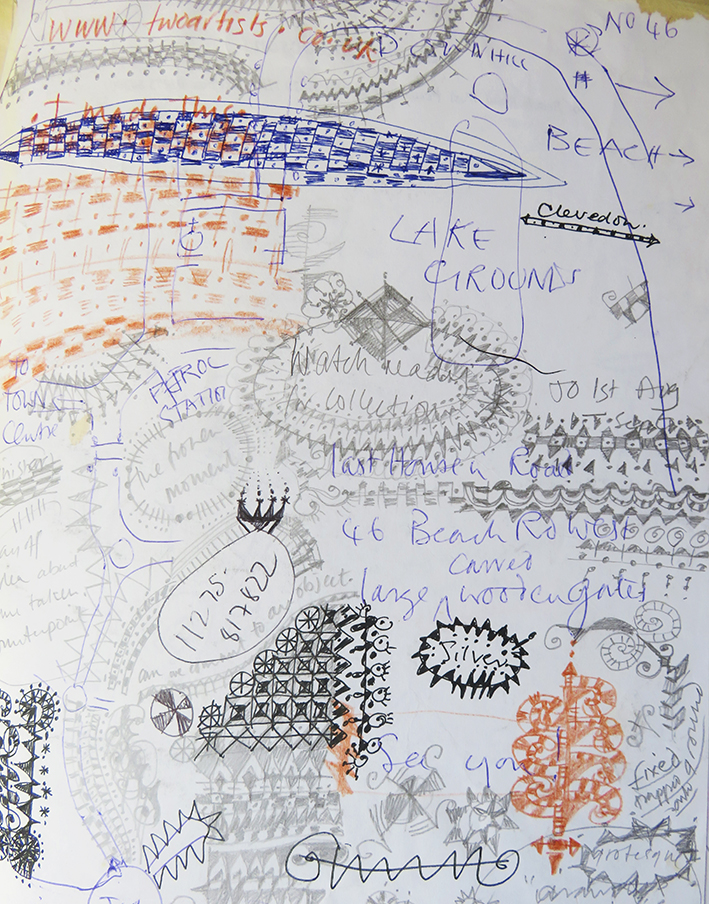
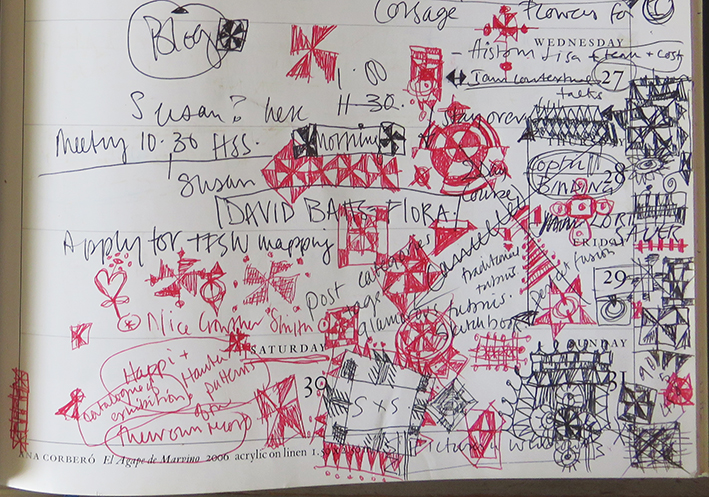
and here are I suppose my most personal drawings ( sad isn’t it) that just arrive onto any page near me, usually when I am talking on the phone to friends and colleagues, and sometimes prospective clients but always when i am fully engaged, they do not arise out of boredom. What is very strange is they have never changed over all the years I have been making them…
It is almost 20 years since I had this disturbingly beautiful dream but I have NEVER forgotten it. Re-visiting my sketch books archive, I found the original drawing that was hastily scribbled down when I thankfully I woke up.
Now, I have decided to complete my long standing/stitching on-going work project “Make it Through the Night“, after not working on it for more than 5 years. I have determined to complete the project to a degree where I can hopefully resolve it but so as not have it in my brain as frustrating “unfinished business”. I just can’t ignore it any more…. too much of me resides in it; and as the composer Gustav Holtz puts it ” Compose nothing unless the not composing of it becomes a positive nuisance”
The initial drawing , above left, is dated 28th July 03; the second drawing is another later version when I was trying to make a composition for a stand-alone embroidery….. now I have decided to add it to the ‘dream pillows‘ and I need a different composition. Recently looking very carefully at the 2 drawings I realised I had completely forgotten that the butterfly had a face – YIKES!
In the actual dream it was a giant butterfly several yards/metres wide, dying and lying on some grass underneath a tree, the remnants of wings scattered round it. People were picking up the large technicoloured pieces of shattered wing and I really wanted some as well – but I thought I would get it something to drink first, then decided to pick it up and take it to a nearby puddle, the result was my butterfly covered hands…I abruptly woke up.
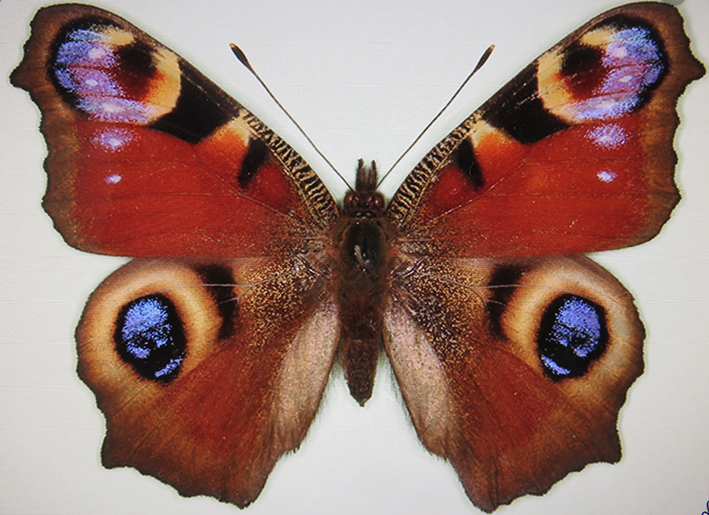
I started to research the ways on which I could have held the massive butterfly. I looked at many different British butterflies and chose the Peacock mainly because it was so colourful but it has eyes as well – one of the major symbols I use in my work. Every year we get smaller butterflies over-wintering in the house but these beauties are rare here.
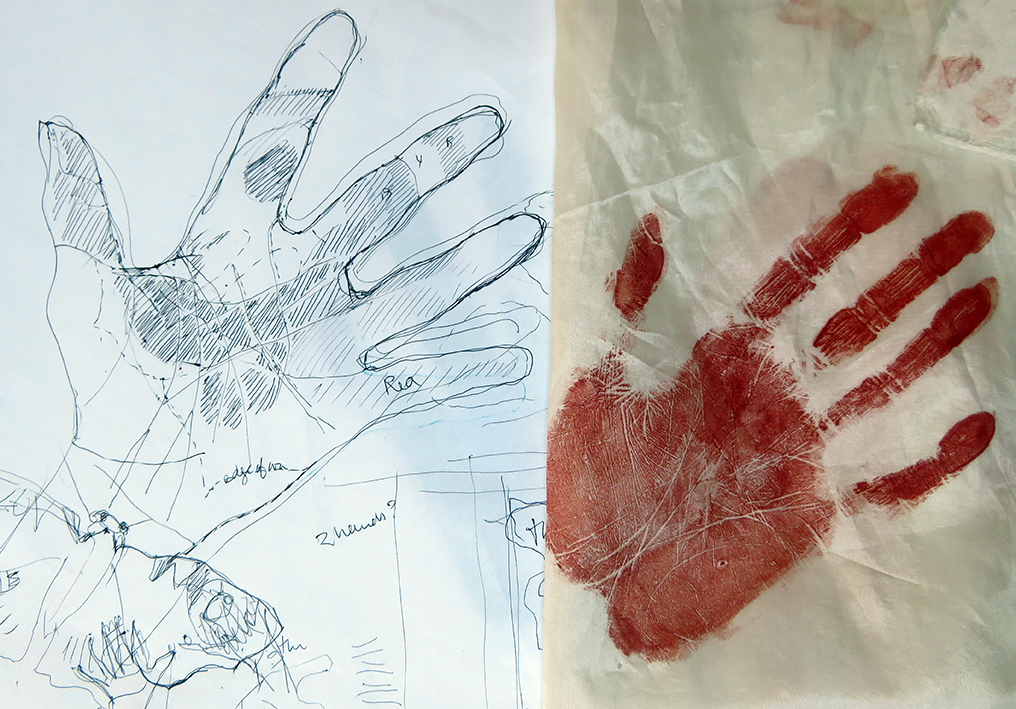
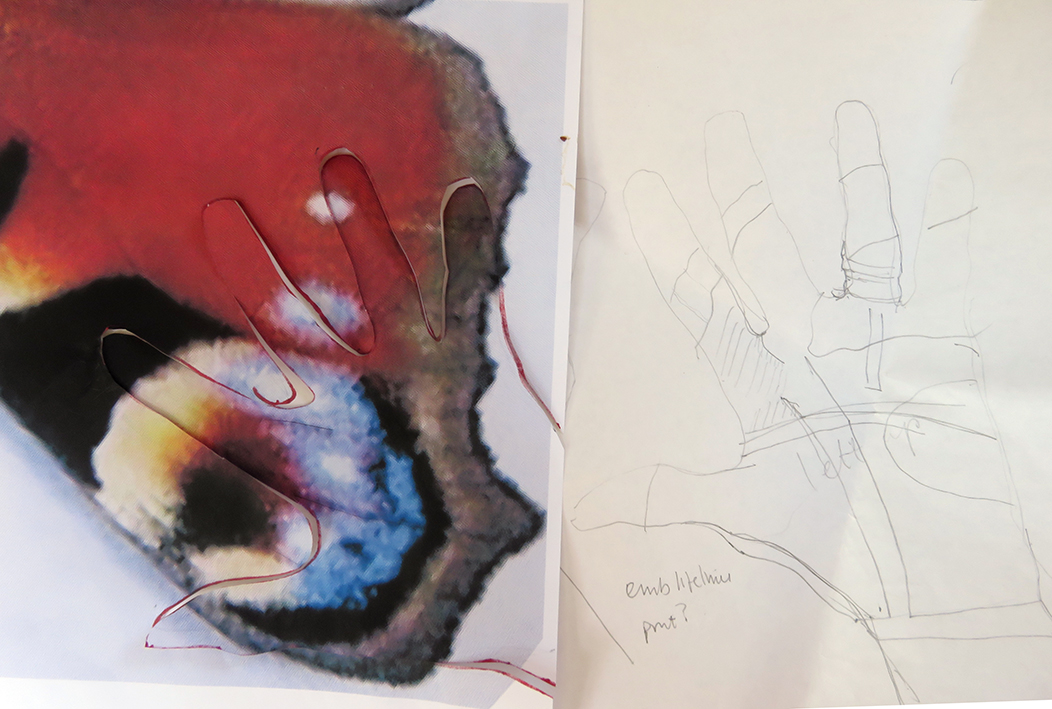
I had my own hand prints on silk, from an earlier area of research and I liked the way the lines of the palm were voided. I now transferred the palm lines to the outlines of my hands so that they would interrupt the wing pattern.
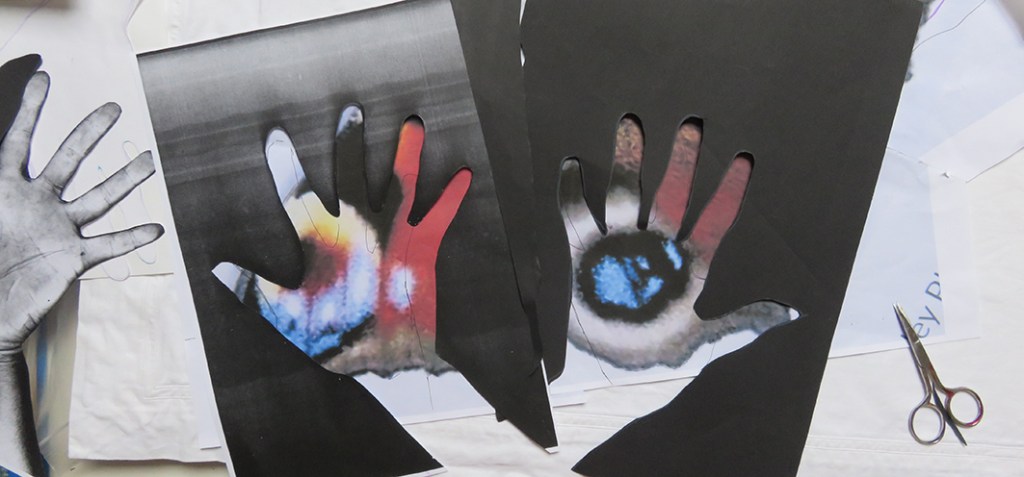
moving around with the photocopied cut out hand shapes to find interesting enlarged wing patterns to embroider.
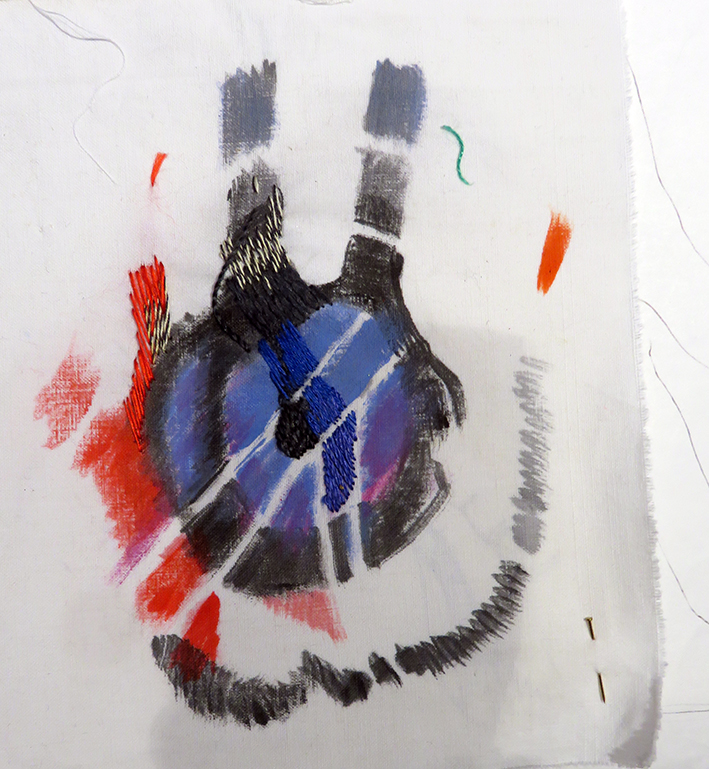
I enlarged the first peacock butterfly image and cut out my hand shapes…next I had to add the patterns to enable me to stitch the whole hands……the original working drawings below with a a technical sample that I would use for the very complicated patterned hands. I decided to paint dye onto the ground first to give me guidance for the colour blending and to assess the amount of work I would have to manage.
the separate hand drawings with a very crude but vital painted dye and stitching sample.
Next I had to imagine the shattered butterfly – I tried many variations; the shape had to show a degree of violence and some direct connection in the shapes left after my hands had devastated it, because it shows the terrible result for the insect…
3 of many versions of the lay-outs for the pillow, the hand writing is in water soluble pen
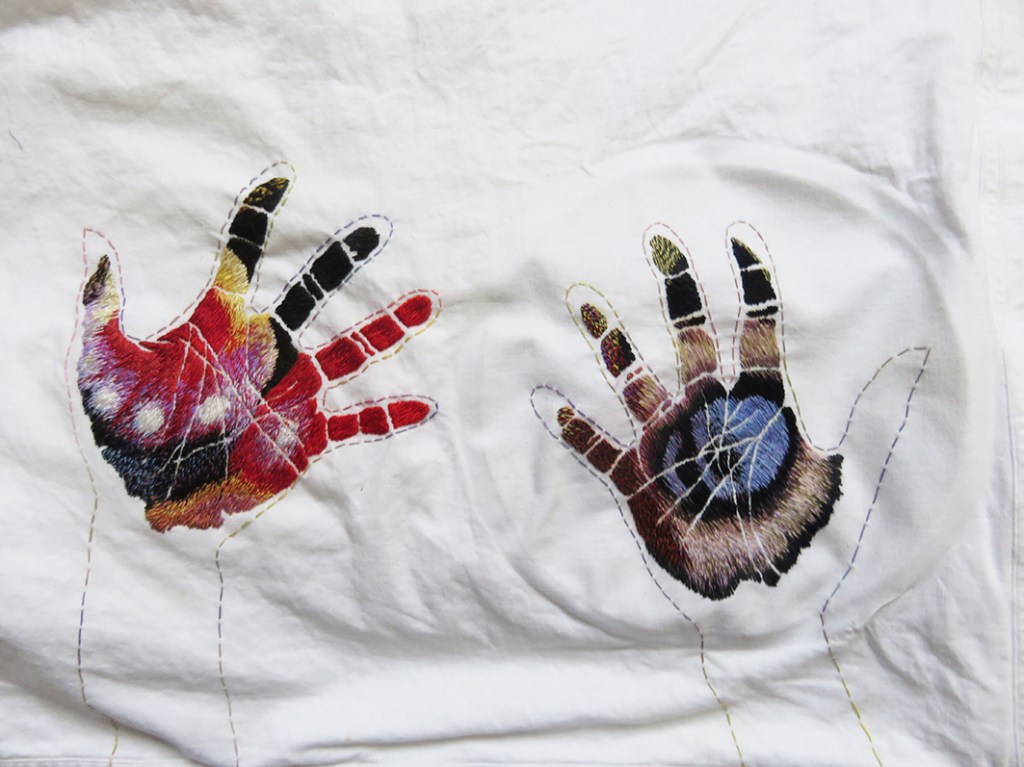
I drew the hand outlines and running stitched them, then drew my palmistry lines on each hand and painted dye within the lines and fixed it securely – all of this before I could start stitching, which I was itching to do …..
2 images above show the first and last day’s stitching of the hands. I started this project in early August and now it was late September – I needed to move onto the butterfly now…
working from my research drawings, I drew and embroidered the main area of the butterfly and then placed paper shapes to act as the shattered wings to make some connection to my hands.
research materials and dyed butterfly with the embroidered version with paper shapes in place for the broken wings.
It was at this point that something strange started to happen….I found a trapped Peacock butterfly in the window of my studio, I was delighted, I had never seen one of these in the house; the weather was still warm, so I let him go….
But then more and more Peacocks came into the studio, and in different areas of the house… in all we had 11 different Peacocks visit us. SPOOKY WOOKY……
the 3 photographs are of just some of the 11 different butterflies that came into the house over the last 3 months while finishing the embroidery. The image of the butterfly lying in my palm was taken on 25th December – amazingly it died with it’s wings folded back to show the eyes, I take this as a rare and wonderful Christmas present.
Sadly some of them died indoors and I keep them in m studio – they are all in different conditions; some very tattered wings and faded colour but others still beautiful.
my small collection of some of the autumn visitors I think there is another embroidery here……
so I eventually finished the pillow, completed the writing in running stitch and it is ready to join the Make it Through the Night project.
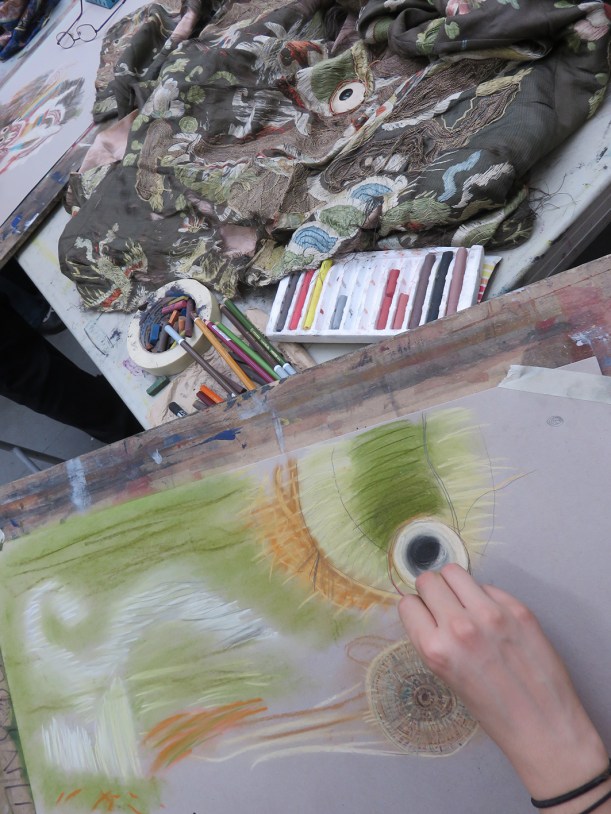
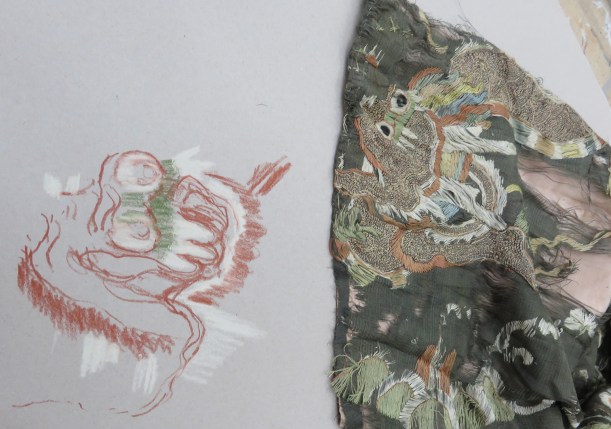
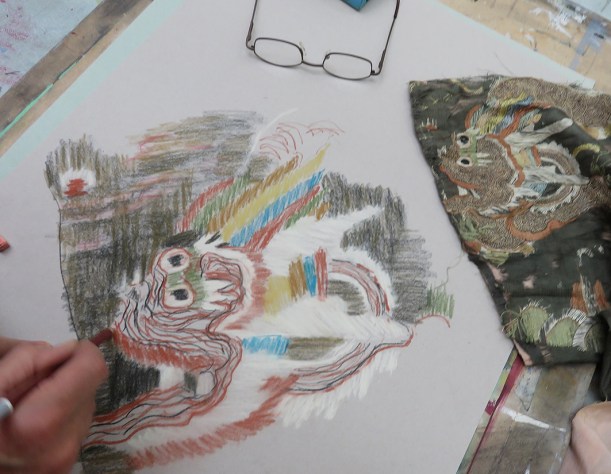
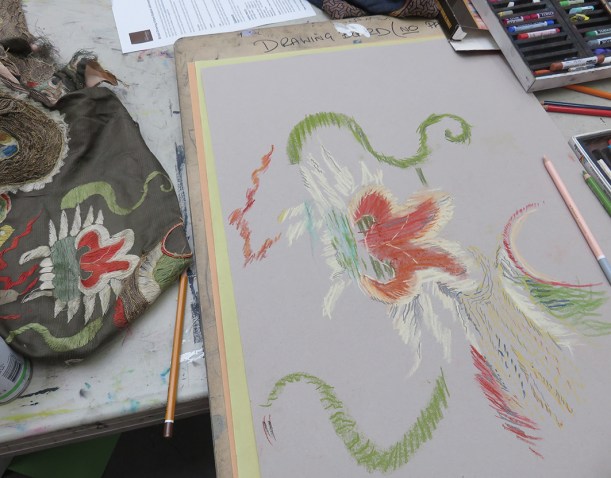
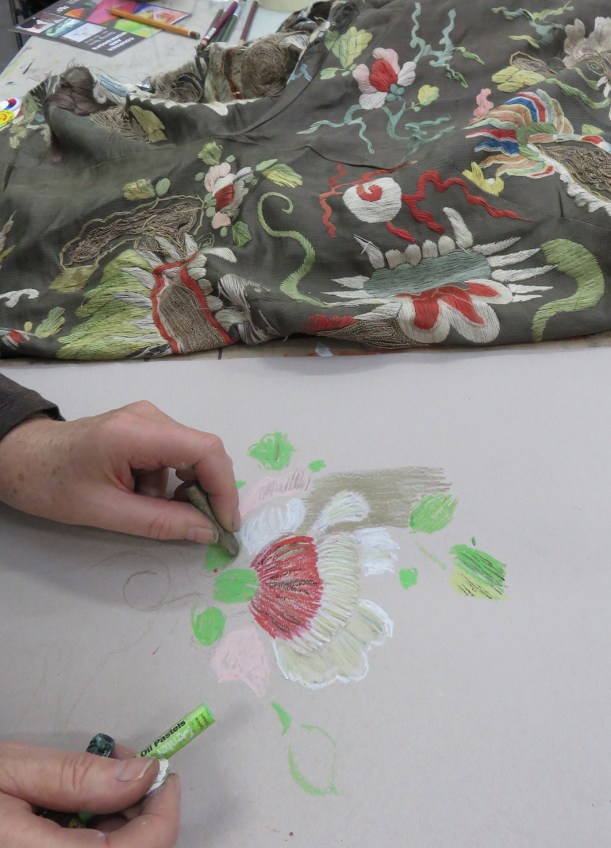
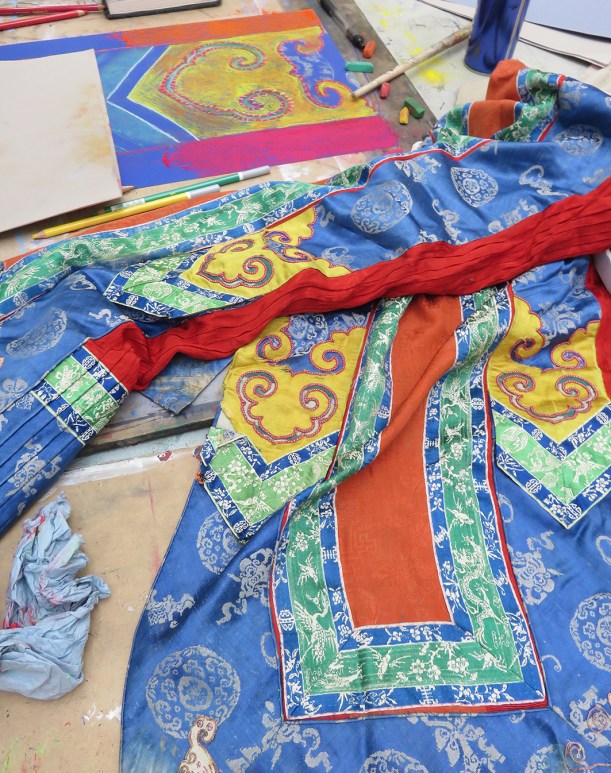
I have been invited to deliver 3 day drawing classes at the Bristol Drawing School based at the Royal West of England Academy. I was asked to work with my collections of vintage embroidered textiles which include Chinese embroidered robes, Japanese kimono and Indian/Pakistani children’s clothing and tent hangings.. first I brought in the Chinese robes…
starting to draw the threadbare theatrical Chinese Dragon robe
the old tattered, ripped and worn fabrics never fail to inspire students; each class is different – although my teaching methods remain basically the same: – take care to tell the truth about what you are seeing, pay close attention to the making processes and most of all the colour.
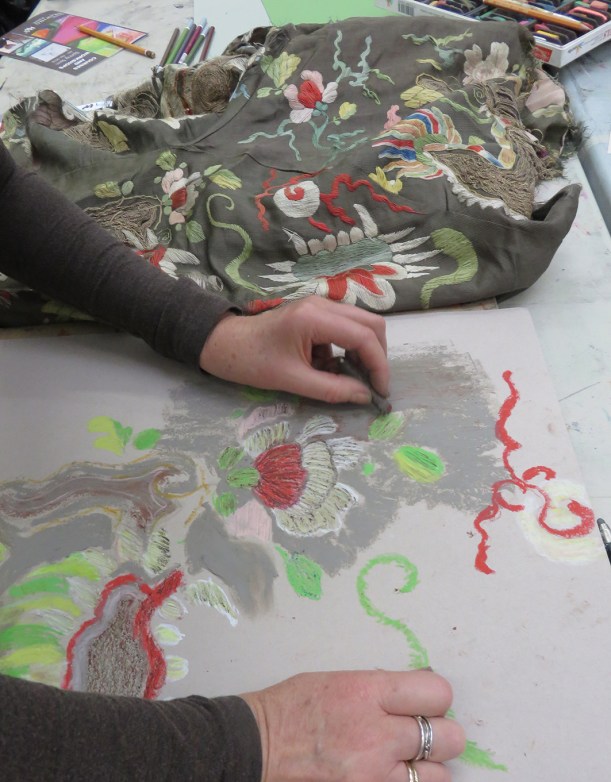
the sensitive drawing slowly evolves
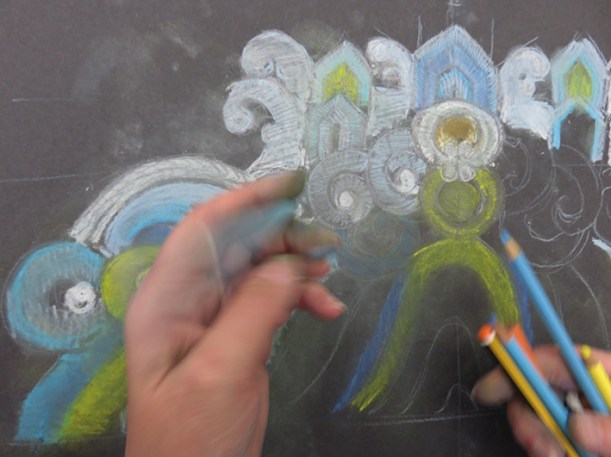
As we start to draw using only dry media – pastels, crayon and pencils – getting the colour correct is always tricky, but I try to get students to develop a colour quality rather than to try to copy the real colours…this teaches awareness of atmospheric colour.
another study of the same fabric – aiming to describe how it is stitched; not painted printed or stencilled…
I gave these students an hour to develop their first studies… they seemed to be engaged immediately – always surprising who picks what to draw. Unfortunately I have a very bad grasp of names – I could describe each student’s appearance perfectly by looking at their individual drawings but names evade me for this first week – my apologies to all.
starting out….
trying to get that elusive faded grey/ brown silk ground colour
.
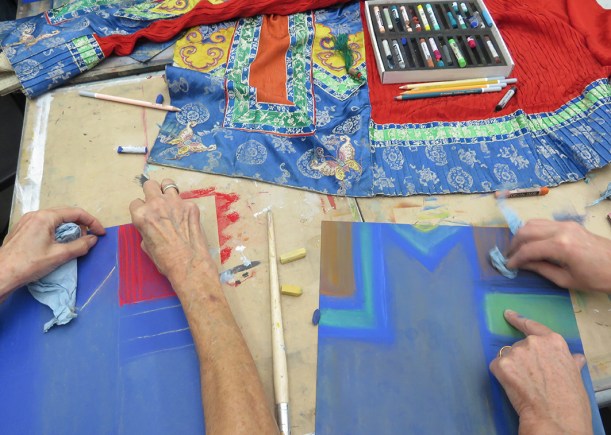
The silk theatrical costume of a dragon is really in a sorry state now but the colours are subtle, faded and very beautiful. The wild cardboard eyes of the dragon still command attention and trying to capture the quality of the threadbare silk really tests the students. For a totally opposite colour experience, the choice for those who like bold colour is the red and blue silk court skirt…
starting out with bold geometric colour blocks
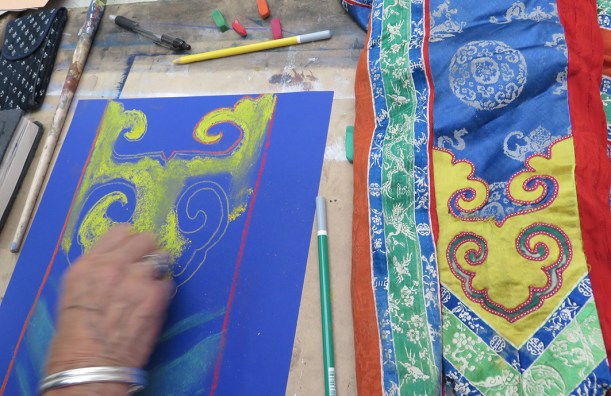
working from more decorative sections of the skirt still produces a strong response.
starting to map out the decoration – in reality a tiny hand stitched red binding on a yellow silk applique
getting to grips with the colour of the yellow silk
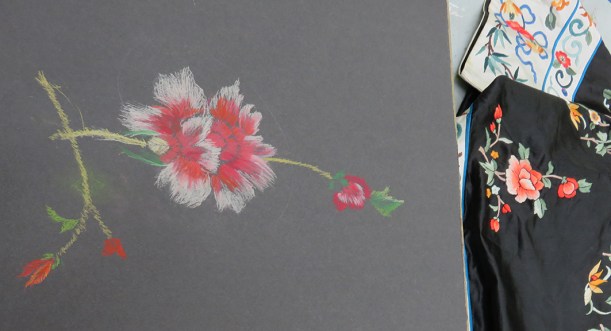
using the coloured paper grounds with the pastels makes it possible to give an impression of the nuanced colours of the faded and friable silks – blending the colors to achieve the exact shade is difficult but rewarding – and you learn a lot about colour mixing and trying to keep everything clean…
1 hour into the drawing, it takes time to build up this quality of colour in pastels.
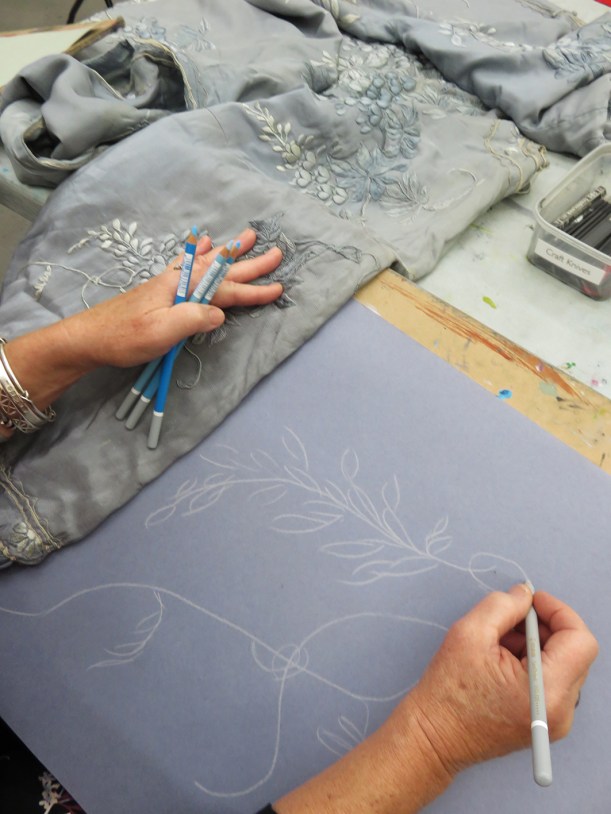
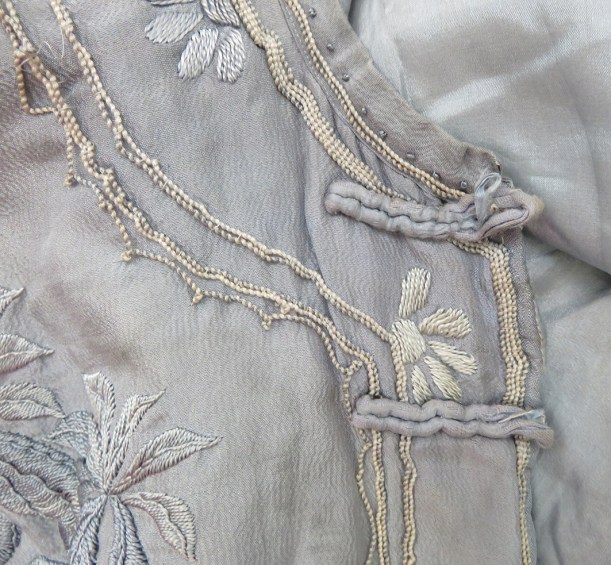
The soft grey-blue padded jacket, embroidered with wisteria blossoms, brought out everyone best attention to stitch…and although the colour proved illusive, many lovely studies were made from it.
drawing the meandering blossom on the padded and embroidered jacket
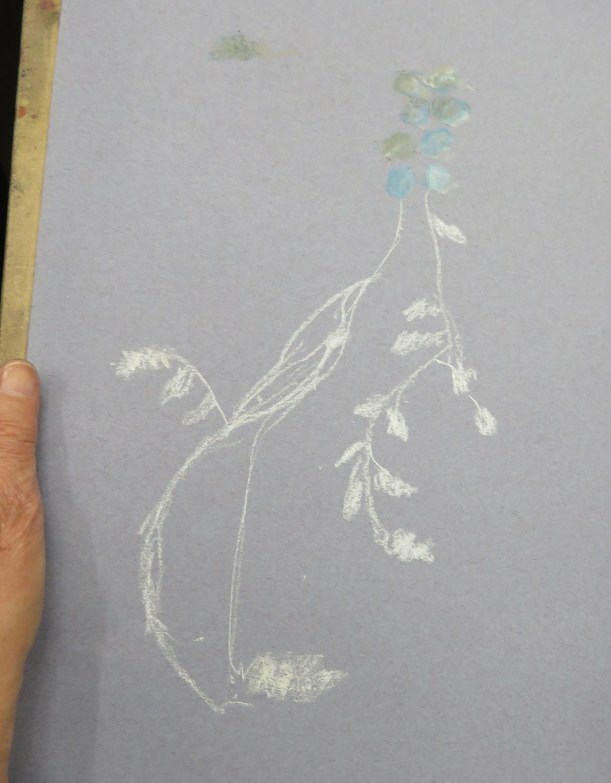
this simple tentative sketch captures the quality of the meandering blossom stalks
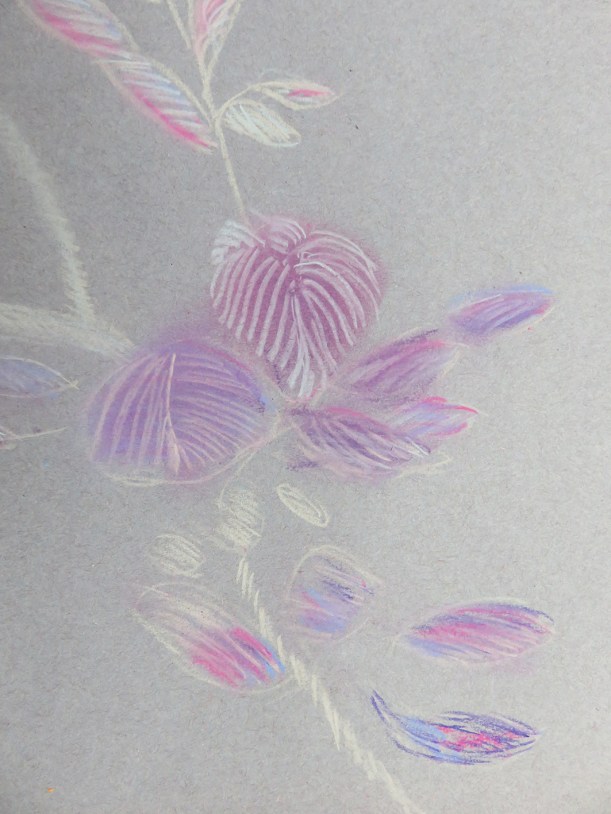
well the colour is way off – but what an interesting series of marks to try to capture the nuanced and subtle effect of the silk embroidery
We ended the morning with a short critical discussion about the work achieved in the first hours of the morning. In the afternoon session everyone chose different pieces to work with. I had more or less dictated the scope of first drawings (detail, detail, detail) now the students could choose how they wished to interpret the fabrics. The grey silk jacket still held its appeal.
wriggly line drawing trying to capture the crepe silk and hand stitched appliqued braid.
detail of the fastenings and braiding of the silk jacket
detail of the the hem of a large embroidered court robe with resplendent dragon
it is always interesting to see different interpretations of the same subject…the drawings below probably say more about the artists than the robe.
careful but lively study of the embroidered sea.
flamboyant cloud interpretation from the robe above
careful gradation of colours to describe the embroidered flower
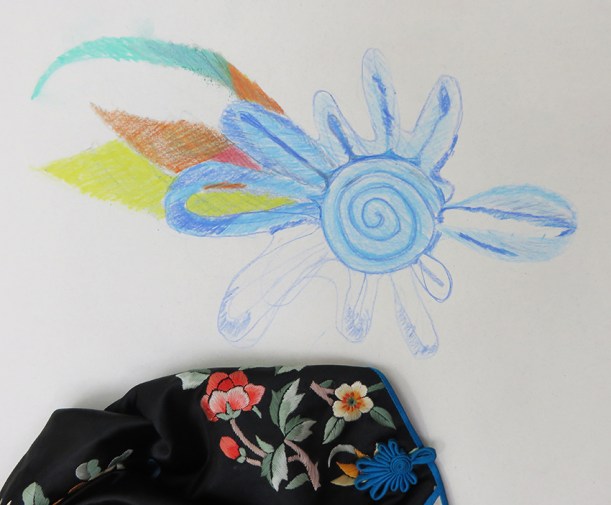
My own black modern Chinese embroidered jacket has resulted in these 2 different interpretations…however in the drawing below, the student told us that she had not drawn anything for more than 20 years – so as far as I am concerned this study is a major achievement – for bravery – but had it been on black it would have been even more striking…
strong drawing of a tiny frogged fastening – a very brave and successful start after 20 years of not drawing!
when studying textiles it is often difficult not to get engrossed by the garment they constitute – here are 2 images of drawing the same skirt – the first is about the skirt, the second about the textile and the fabric manipulation.
getting engrossed in the bands of stripes made by a shibori technique on a hand woven hemp, Chinese skirt.
more attention to the detail of the dying technique shown in the second study
the following drawing is totally different in its approach – the whole folded cloth has become a world of its own..
this large undulating drawing reminded me of a surreal landscape – fabrics as fold.
who would have guessed it is a study from a wrapped and folded silk skirt…but oh the colours!
how innovative to fold an old silk skirt and make a colour study .
and last of all this simple line drawing of a white hand embroidered black jacket – each line describing the direction of the stitch. How wonderful it would be to see this extended for a whole wall full!
simple linear drawing – a tiny detail from a Chinese embroidered landscaped jacket.
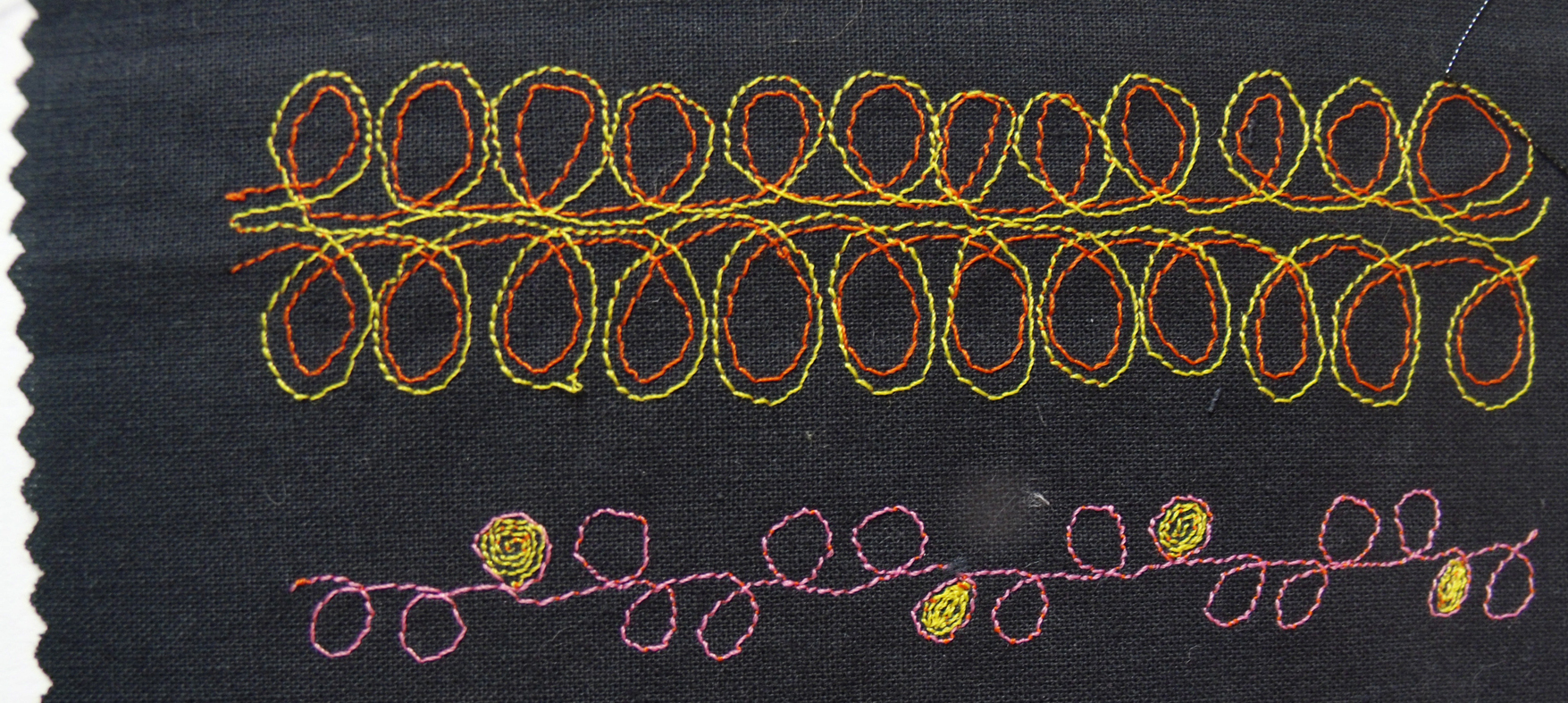
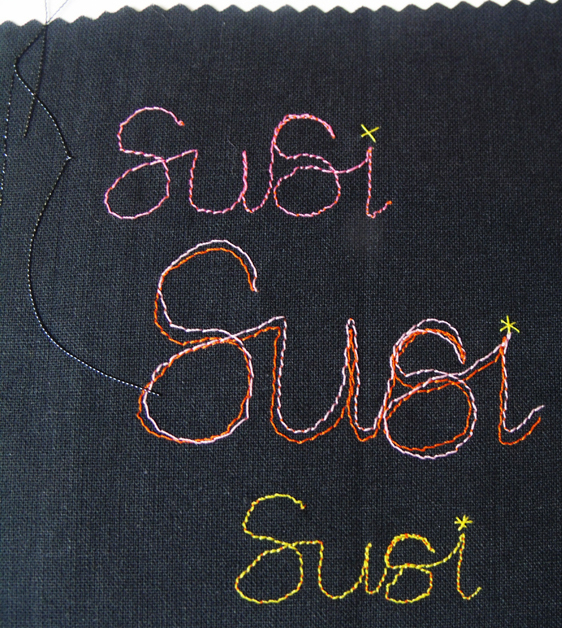
Simple sample of machine embroidery by Susi Bancroft
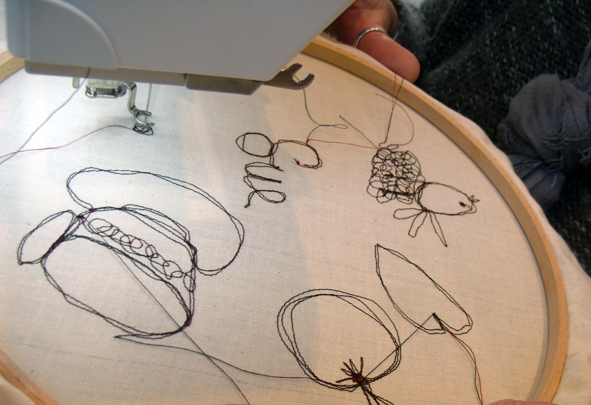
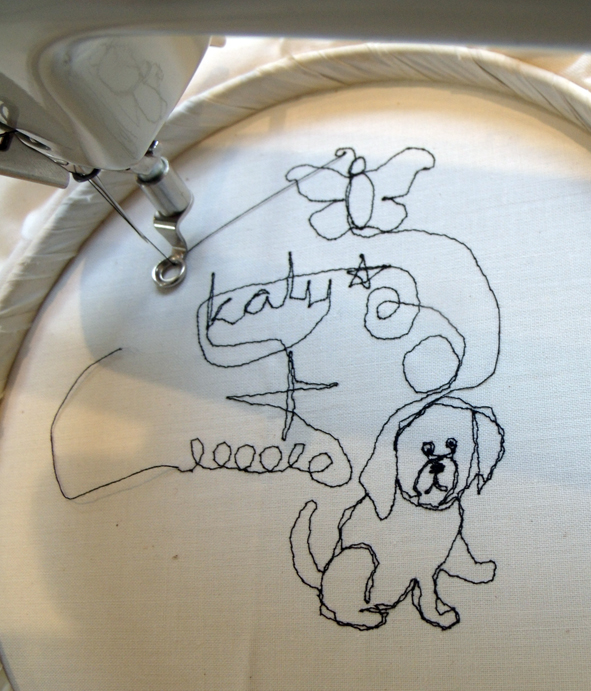
“Taking a line for a dance” is a good way to describe what happens with free machine embroidery…the freedom with which the needle can stitch patterns, images and even writing very fast – is really fascinating to watch. First disengage the feed dog – I just love that name for the row of teeth embedded in the metal plate below the needle….
free machine embroidery using a hoop and the sprung needle
and either using a specially sprung embroidery needle, with or without the old school embroidery hoop to keep the fabric tight, it is possible to move the fabric enabling the still needle to make lines of stitches.
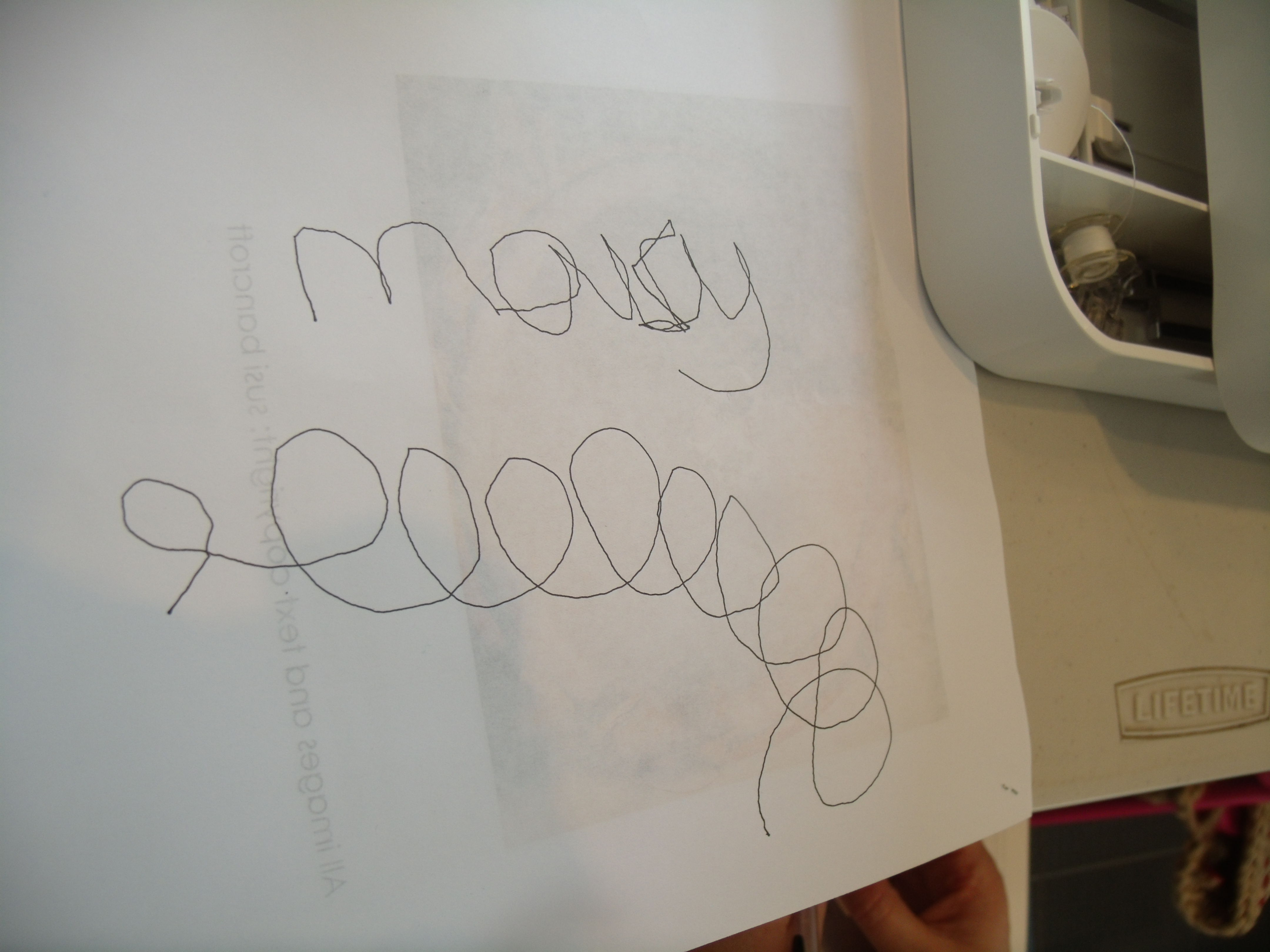
first drawing by moving the paper and not the pencil
moving page animal drawing – dog or cat?
Recently at Heart Space studios, Susi Bancroft taught a group of students how to achieve this technique in just one afternoon. First she got everyone to try to write their names or draw something by moving the paper while someone else held the pencil steady…with very unsteady results…but this is how machine embroidery works. She then got everyone stitching with reference to the drawings and suddenly things started to happen – fast
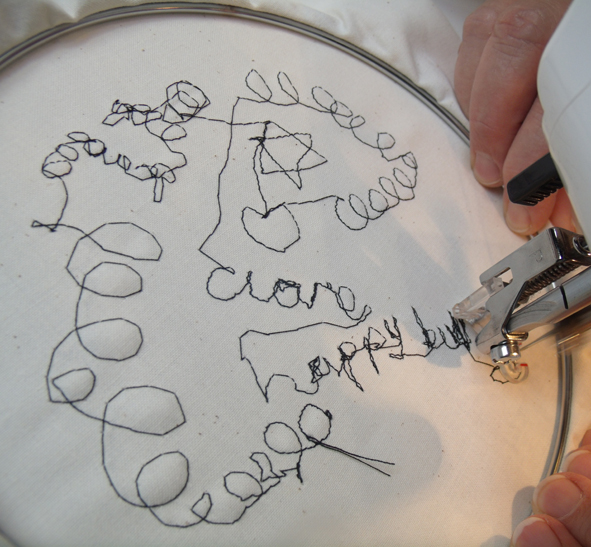
The first attempts at machining were definitely stronger than the pencil drawings. Susi always gets everyone to stitch in black cotton on white calico first, to gain a strong contrasting line..
first attempt to stitch drawing and writing
writing and dog drawing
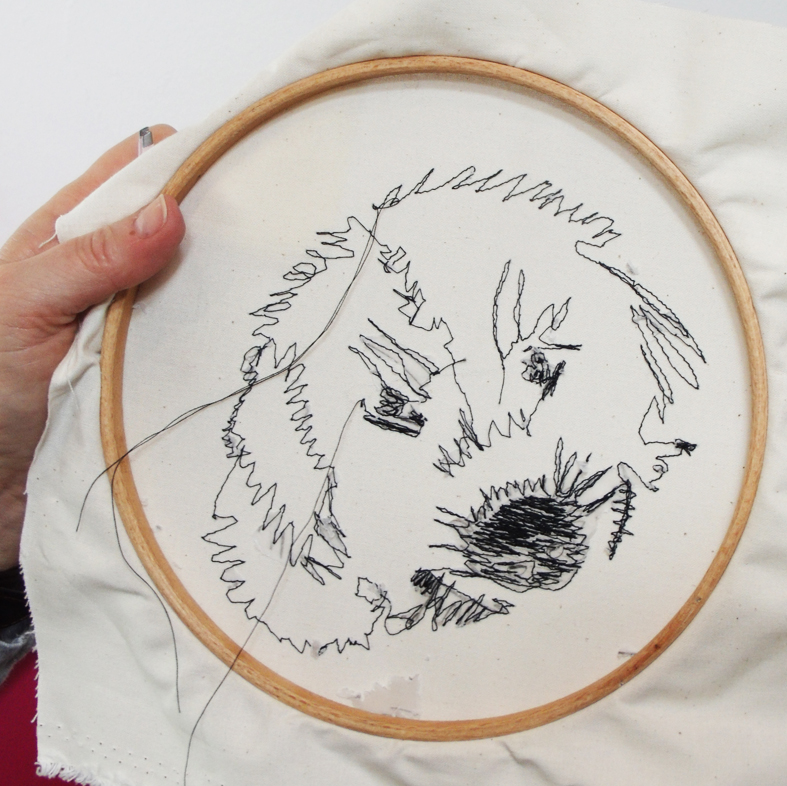
It didn’t take long before everyone was feeling a lot more confident and really getting to grips with larger scale drawings
freely machine stitched dog portrait
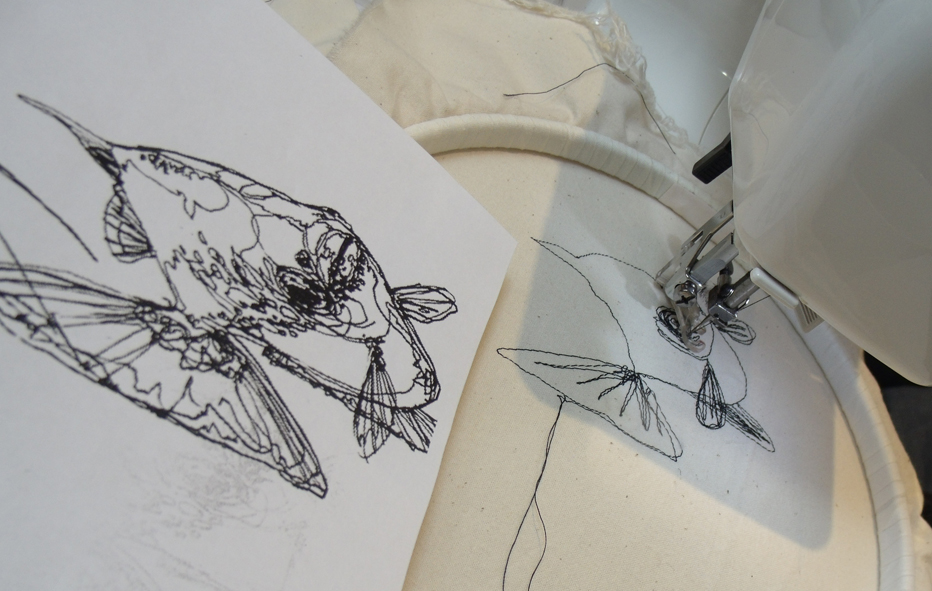
One of the exercises offered was to copy a black and white drawing a drawing – with remarkable results considering no guide lines had been drawn beforehand.
copying a line drawing of a fish – a free embroidery challenge.
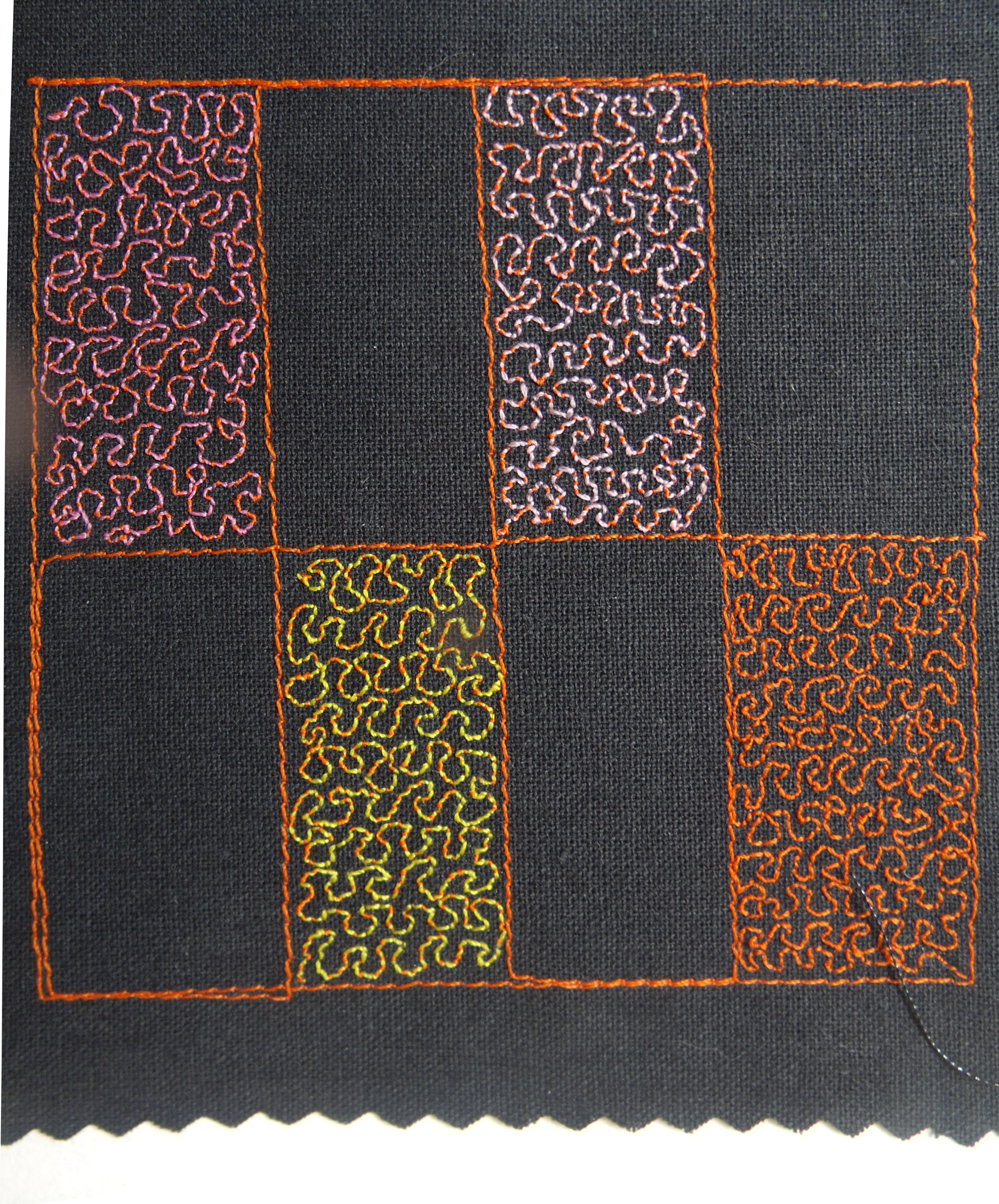
Susi had also brought in a book of samples of her own work and showed the students these to demonstrate what else could be achieved now they had the basics…
vermicelli linear stitching sample – Susi Bancroft
sample machined writing – Susi Bancroft
Now the colour started to be sampled, this is where all textile people get excited – endless possibilities just by changing the thread ….
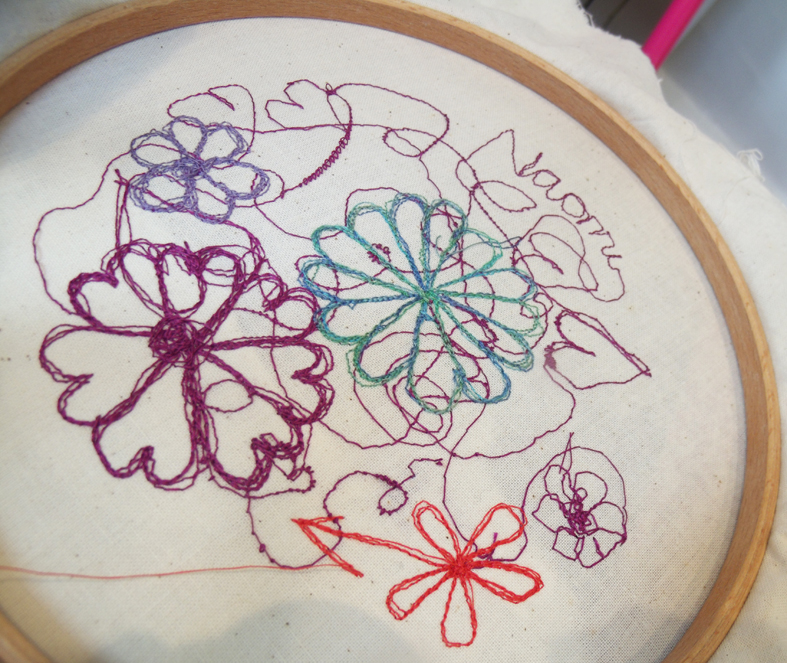
playing with coloured free machine with extra outlines
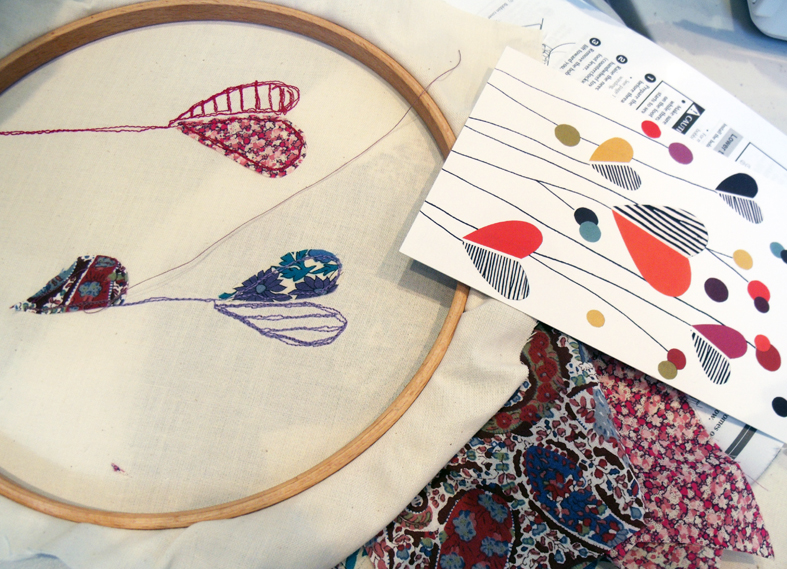
and appliqued fabrics started to appear – each person had brought some form of inspirational work, either an illustrated card or photographs and drawings
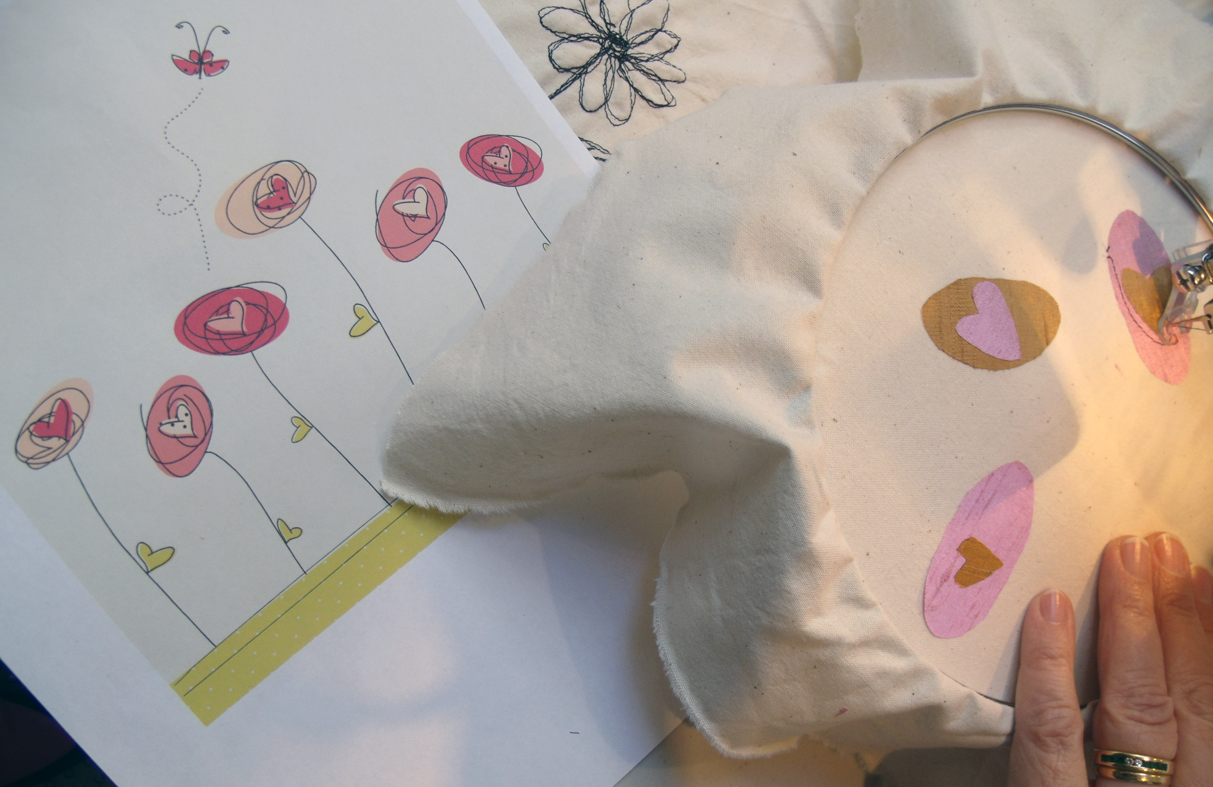
working small appliqued motifs from a commercial card design
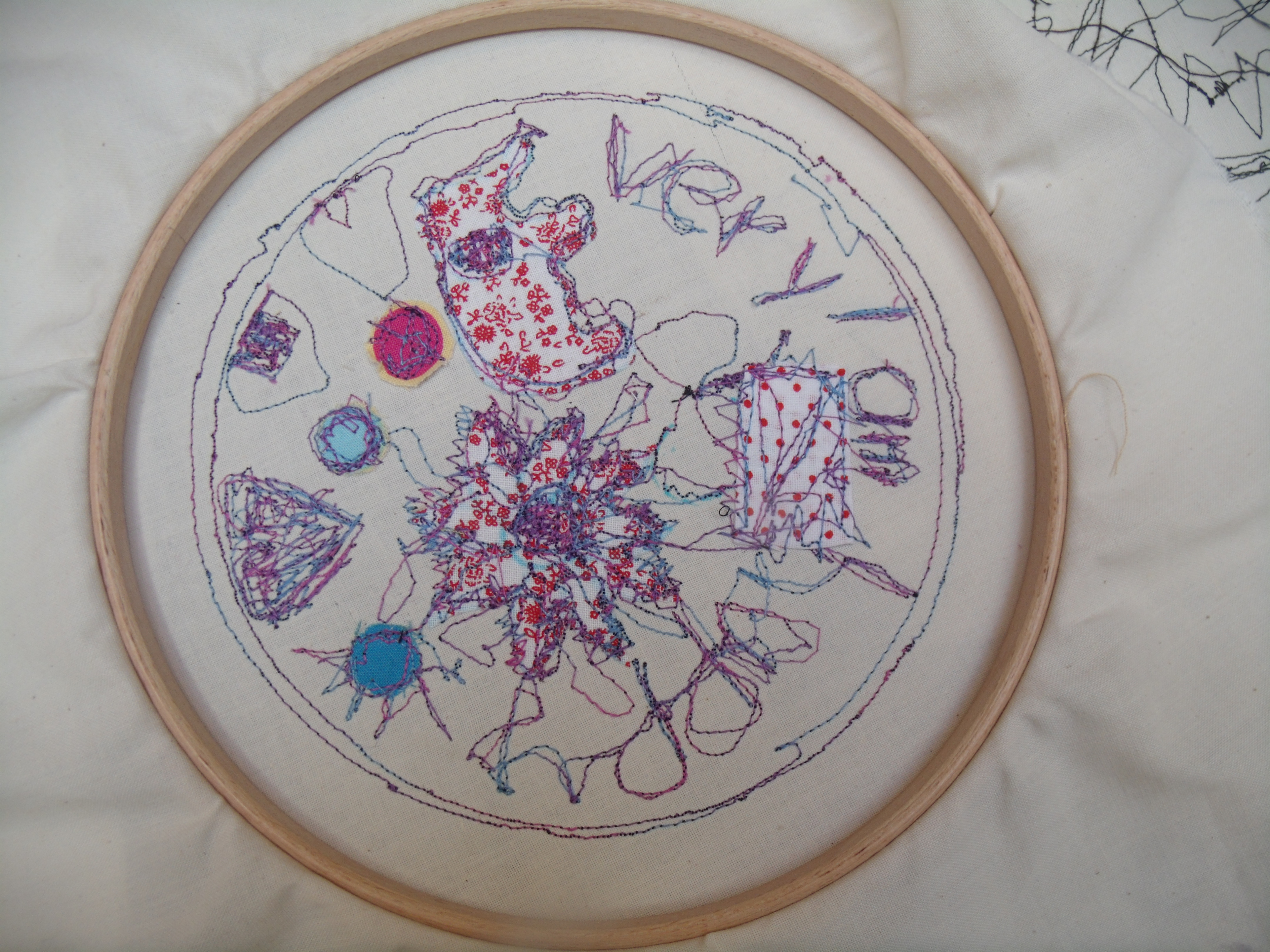
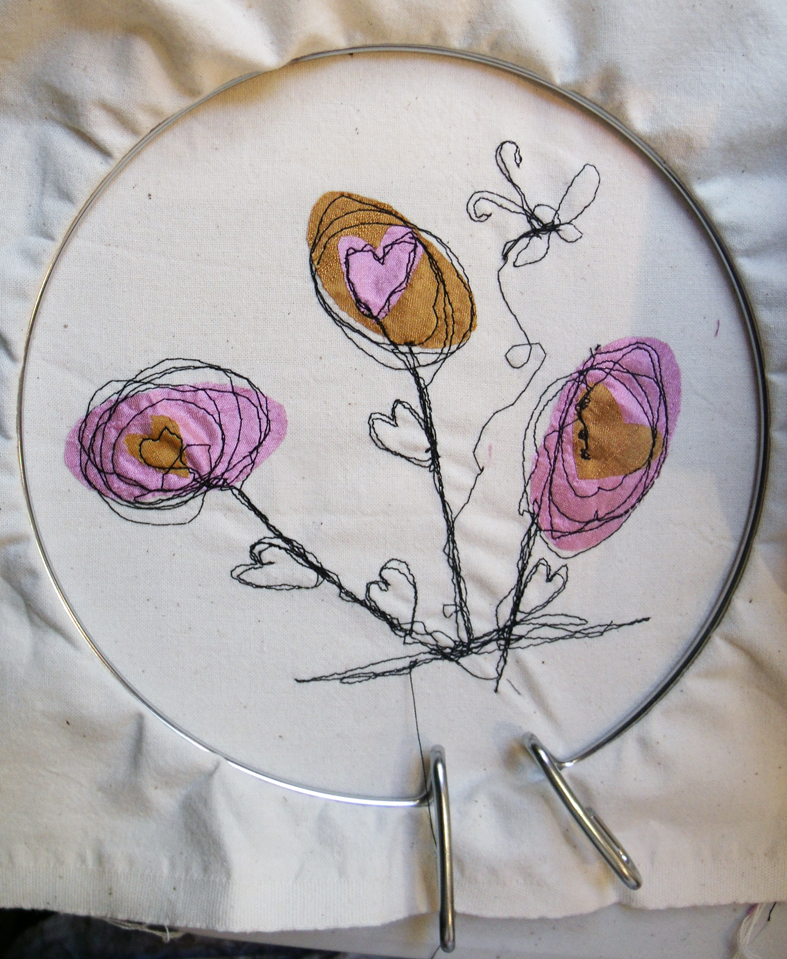
Now I know that working with the sprung embroidery or darning needle means that the hoops aren’t necessary, but Susi feels that for the first attempts everyone should adopt a belt and braces attitude, the fabric needs to be as taut at possible to get the best results. When everyone feels confident of drawing then they can remove the hoop – however most people took advantage of this restriction – this work below is already framed – it actually reads ” I am Very Happy”
circular embroidery made by keeping to frame restrictions.
and here the nuisance of not being able to manouvre the stitching past the hoops intrusive clamps has made a new design from the original card – go with the flow…..
design due to the constricting clamps – this is what sampling is all about – work with what you have got.
Some more renditions of photographs and cards start to take on a life of their own – this is why I think that copying something inspirational is a good way to start off any new technique, the worry of design is taken away and suddenly invention takes over..
copying the design in fabrics brings so much more pattern and texture
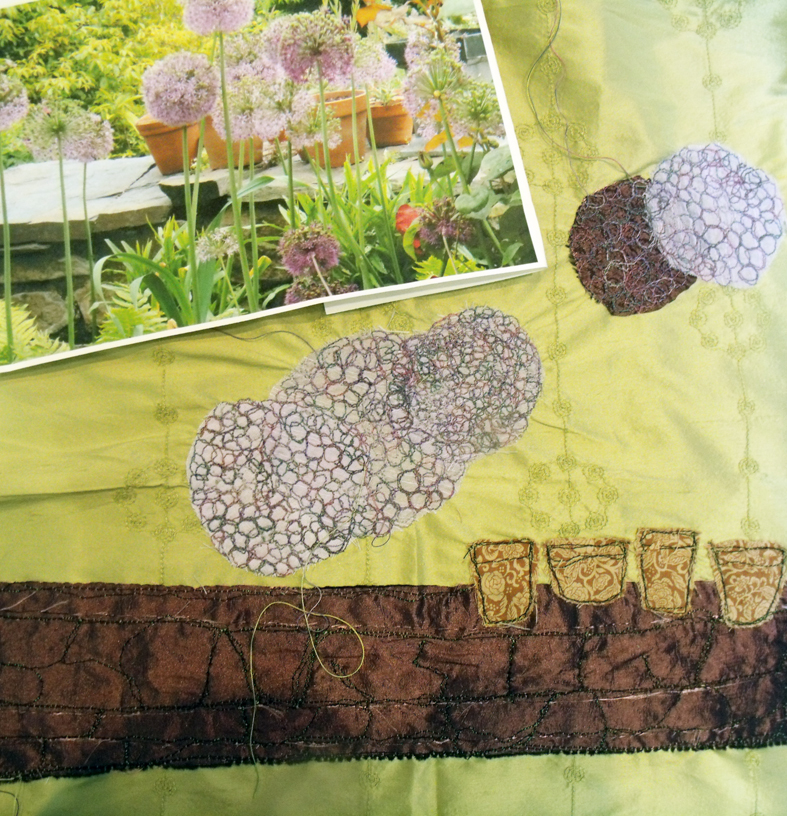
and working from lovely photographs is often a good way to get started – the fabric soon asserts itself.
photographic inspiration works for a colour gamut to get things going.
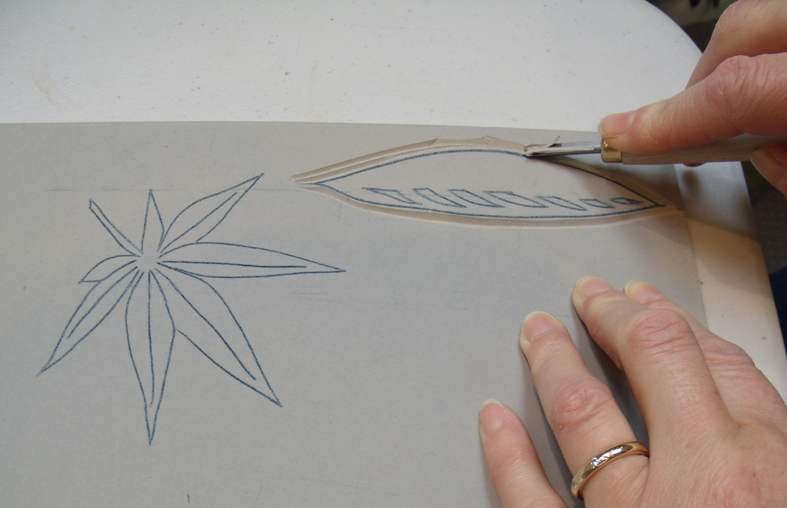
I haven’t cut and printed Lino for oh…..well, since I left art college in the late 1960’s, so that’s almost………. lets’ move on! Checking out our really popular Lino Printing on Linen workshop at Heart Space Studios, run by Jacqui Watkins, I had an overwhelming urge to join in – the sensuous feel of cutting through lino really appeals to me as it is another form of drawing – but the transformation when the block is printed is almost miraculous.
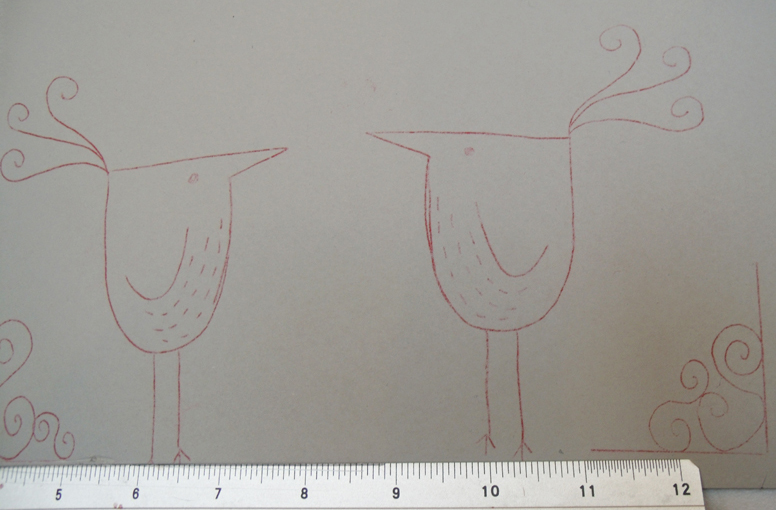
first simple line drawing on sheet of lino
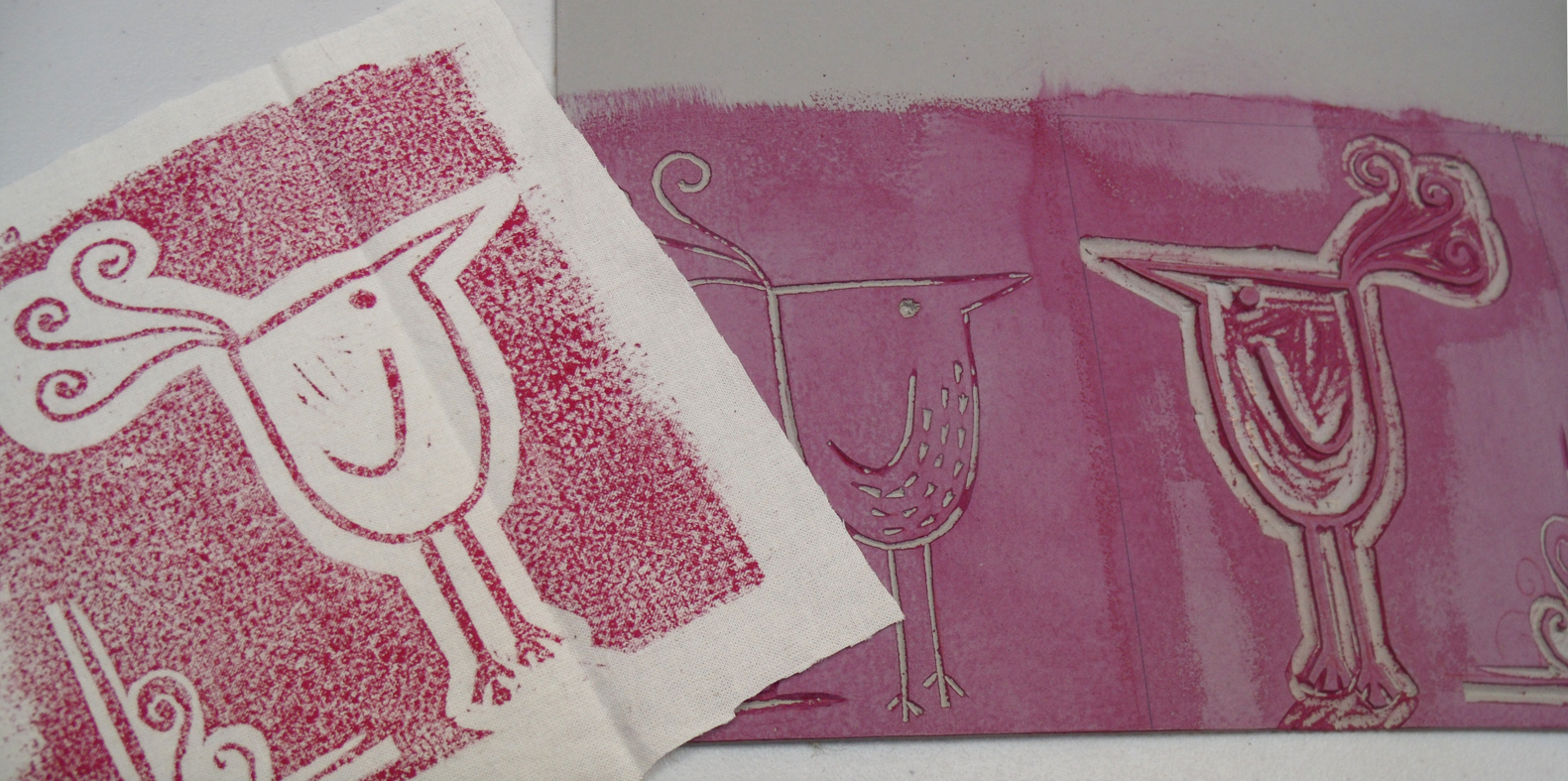
Jackie had asked people to bring in some simple linear images or their own drawings to work with, the first cuts were quickly sampled and assessed..
first sample print from the cut lino bird drawing.
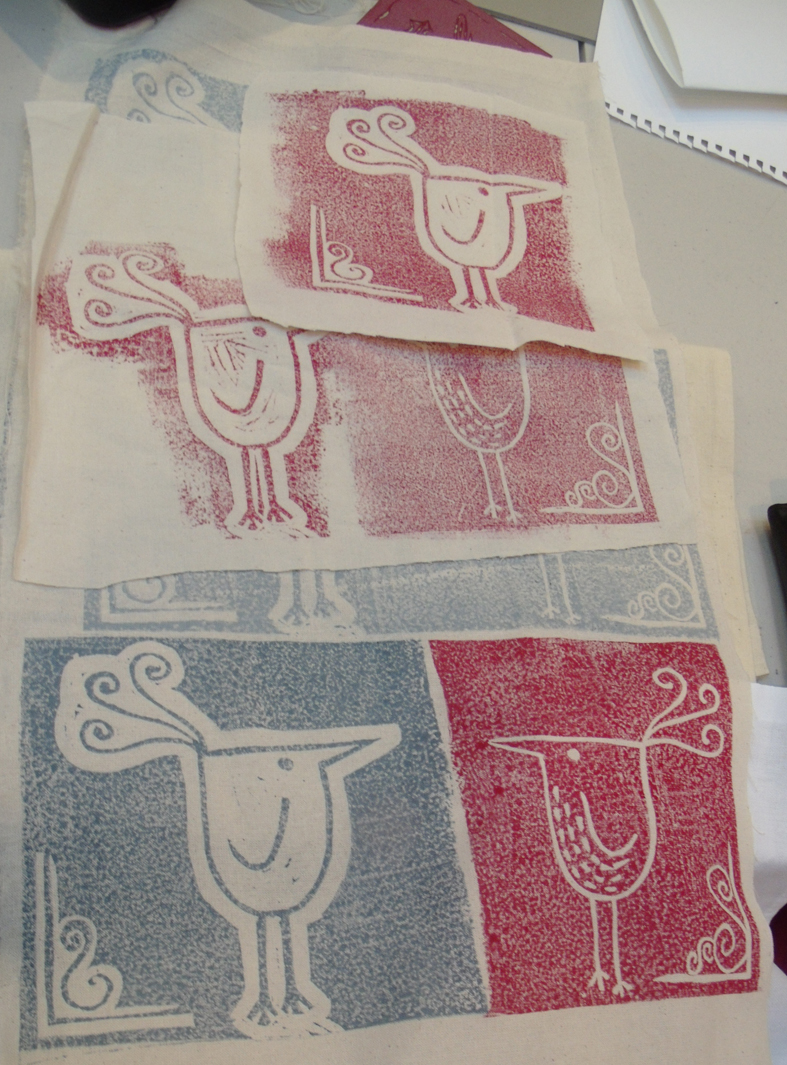
then different colours and fabrics were printed…it is such an immediate technique.
strike-offs of the bird block.
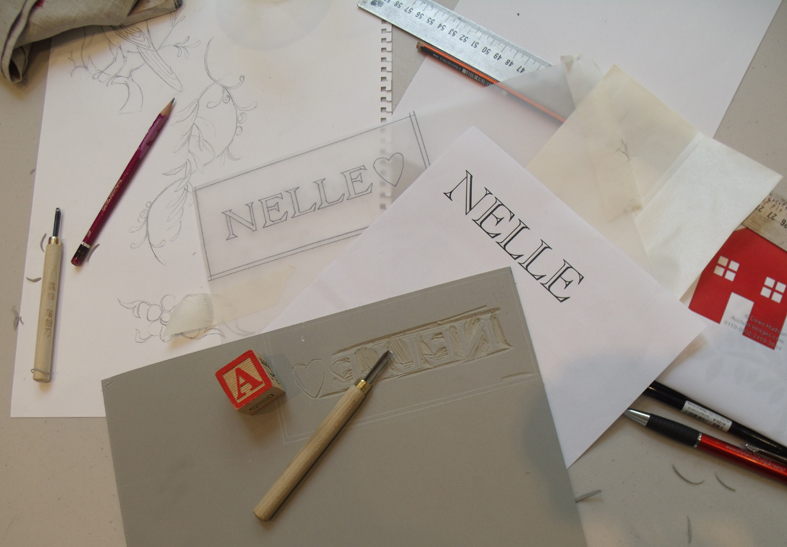
There were many different ideas in the group; lettering traced from a classic alphabet looks very different when cut and printed in this technique
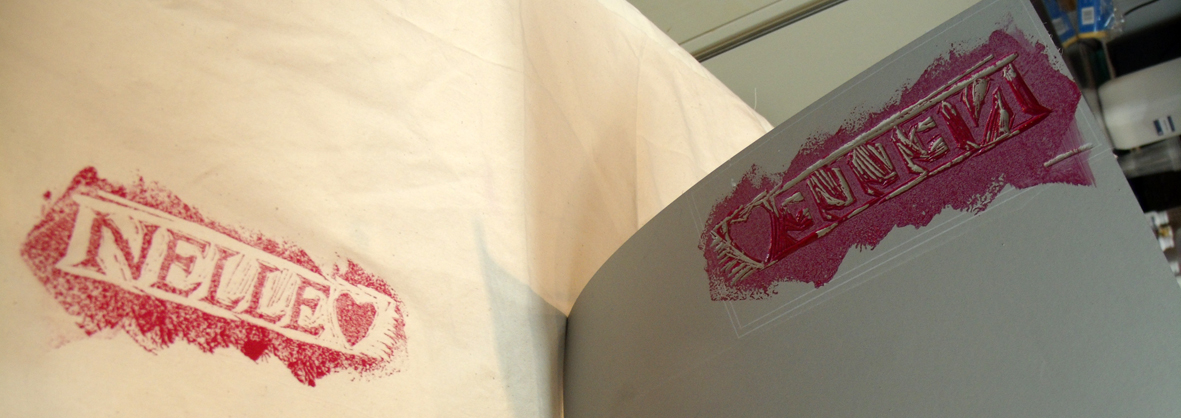
tracing for a child’s name and the resulting cut block – back to front don’t forget!
and the joy of the first sample print – magical….
Da Da….first sample print…easy peasy!
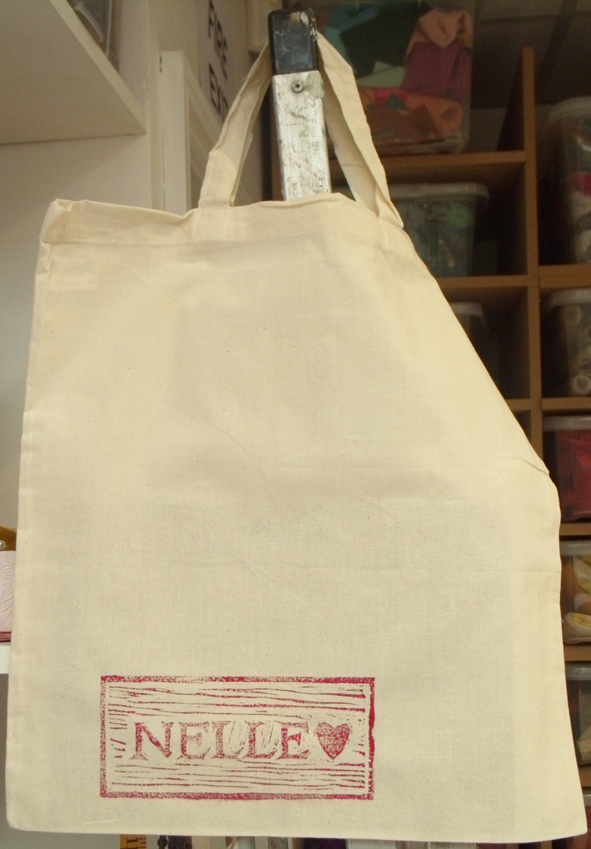
it usually needs a bit of tweaking to arrive at the finished result – to print a personalised kit bag for a daughter to take to school..
finished printed kit bag
Jacqui had brought several samples of her own prints to show that just small simple motifs can be placed together to suggest movement in the birds for example. Brilliant for beginners to just work on a few small images to gain confidence.
sample swatch of small stuff ready to be assembled into different designs.
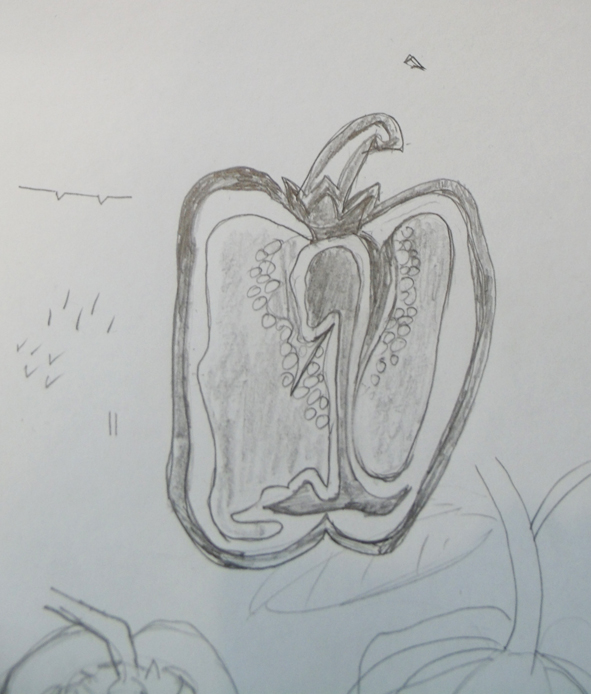
Looking round the I spied a drawing that was a very popular as a textile motif when I was an Art ‘A’ level student…half a pepper…but so retro now!
the pencil drawing of half a green pepper
I did wonder how the student would manage to overcome the solid shape; pepper insides are fascinating and intricate to draw, but a bit of a lumpen shape outside.
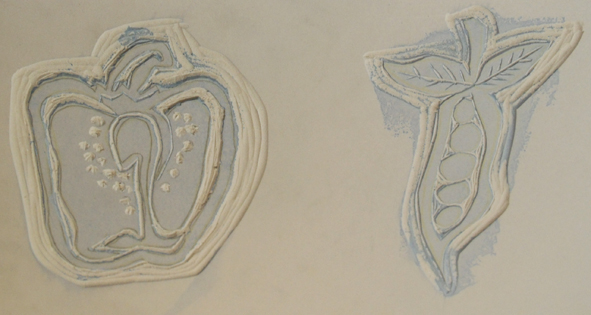
side by side half a pepper and pea pod
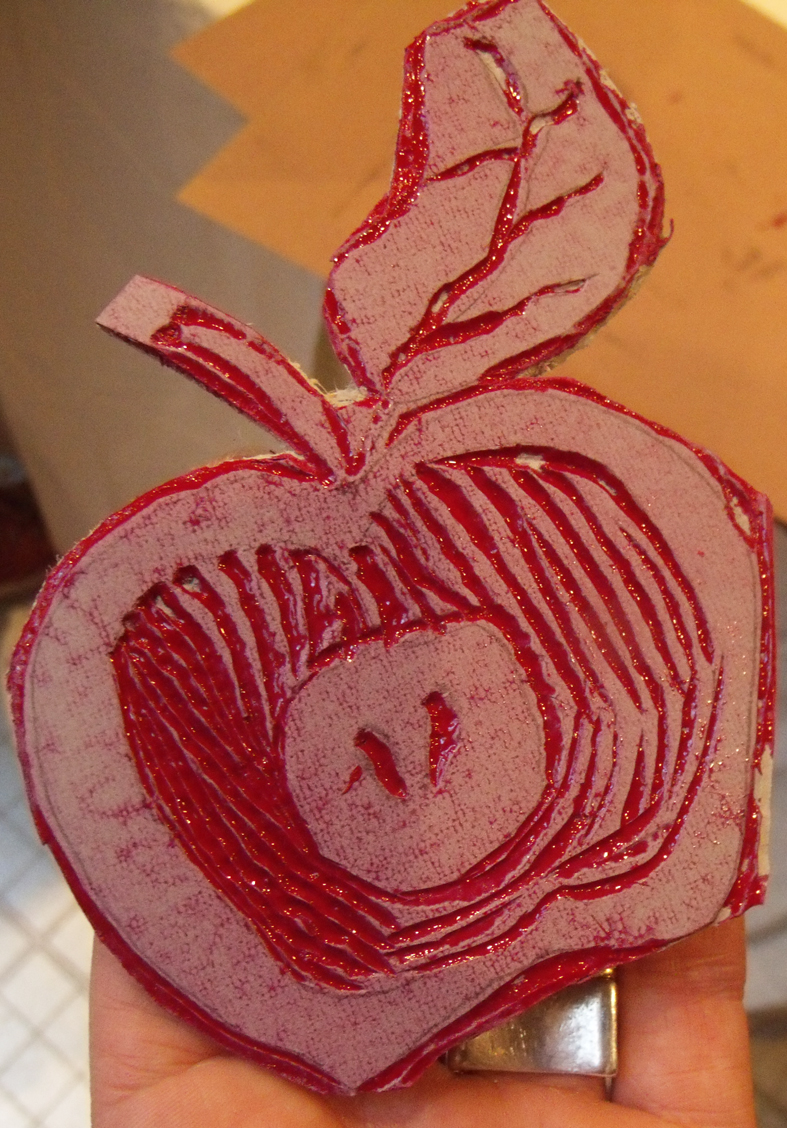
But seen next to the giant pea pod on the lino block, I was reminded of the vegetable drawings in vintage cook books by authors such as Elizabeth David and Jane Grigson. When printed onto a linen tea towel the vintage look was made even more apparent
looks exactly like a vintage tea towel, but so fresh and modern
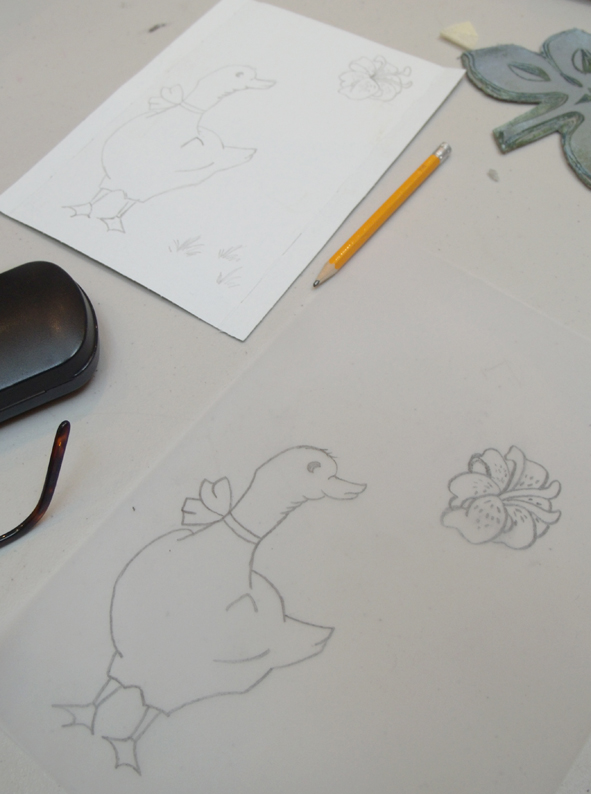
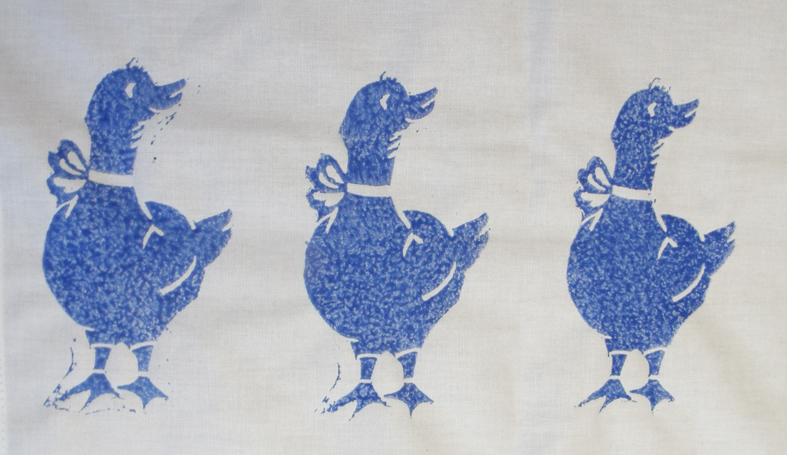
The difference between the initial drawings and the eventual fabric prints was remarkable, even a very commercial tracing of a Jemima Pubbleduck type duck
drawings of a commercial duck design
when translated into a solid shape that carries the texture of the lino surface with the marks left from cutting away the ground, form a lively visual combination .
three bird prints and three slightly different prints…
and this all adds to the attraction of all hand-block print techniques, each print is subtly individual…
just printed lino block with marks made by linen weave on the solid areas.
and looking at the freshly printed surface of the linen weave still apparent on the block above, you can see how this happens. Next time the block is ink rolled and placed on a fresh area of linen the results will be different.
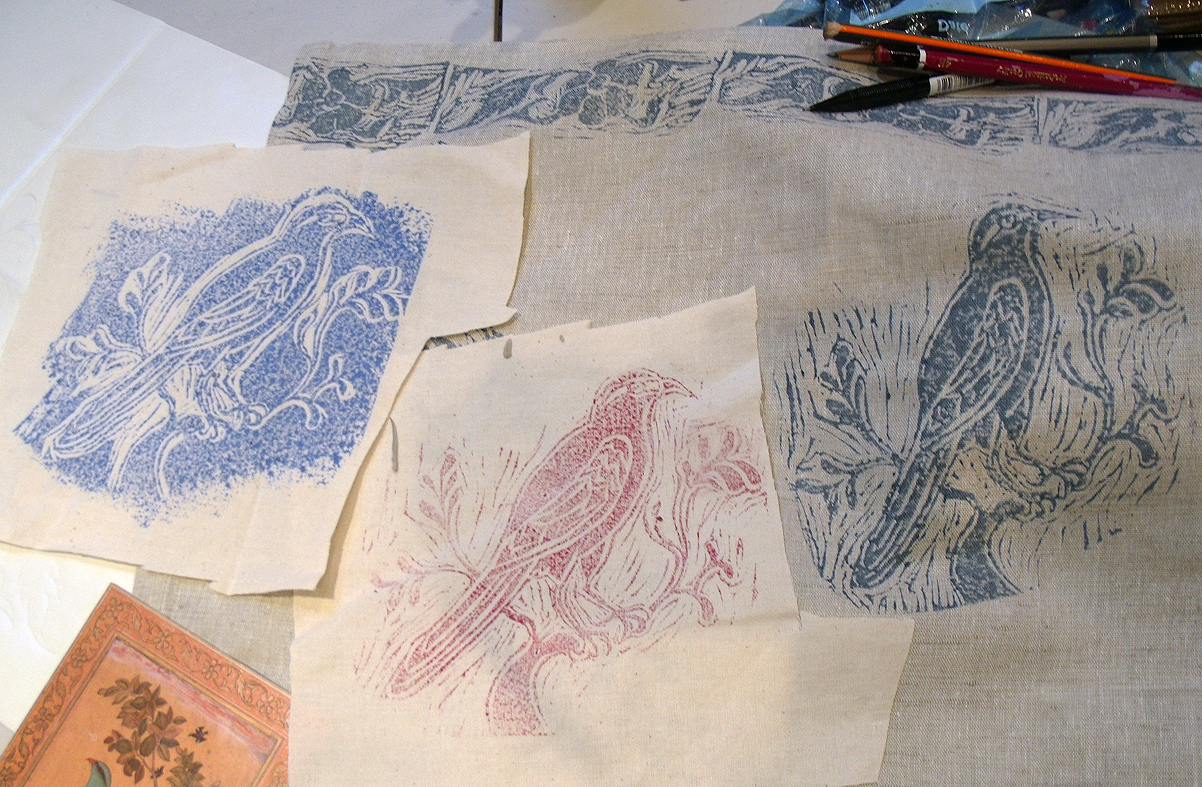
Meanwhile one of the students really took advantage of another result of hand block printing – the intentional inclusion of the cut away surface of the background..
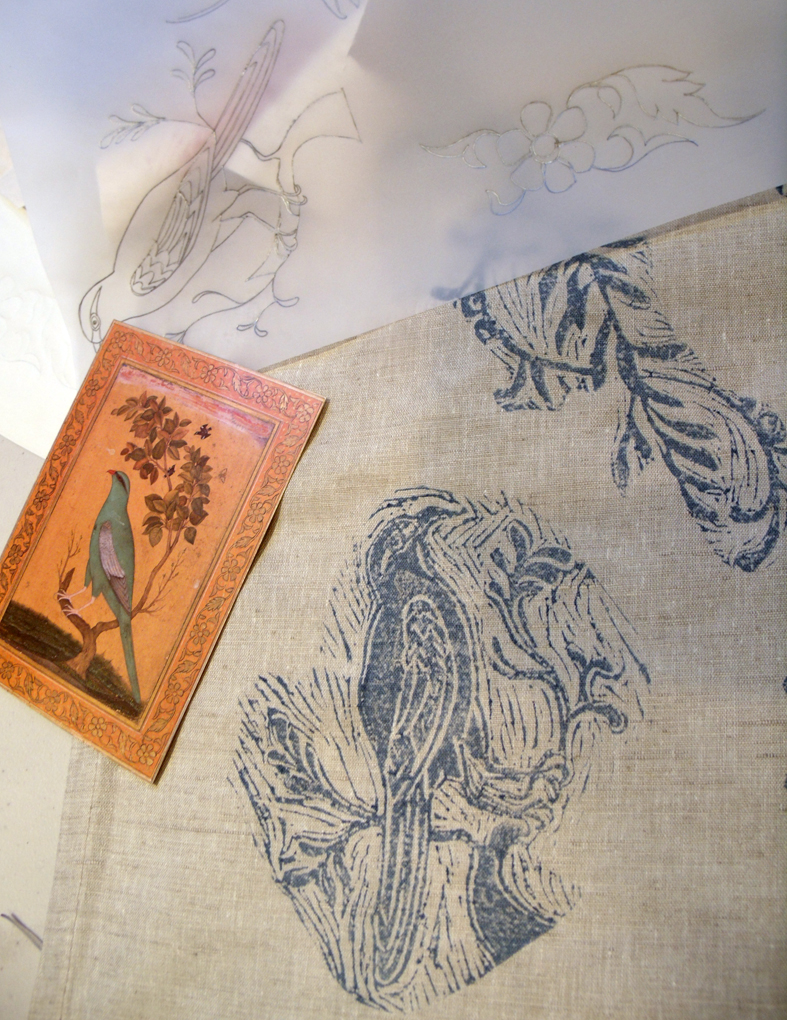
original card of bird image with tracing and eventual print.
as can be seen below, the different stages of printing on different surfaces, on the upper left is the first print with a mottled background, the red and other blue print shows the background cut marks have been rendered in a rhythmical pattern to further enhance the whole image.
various stages of print backgrounds for this bird and branch design.
I am hoping to resurrect my lino printing by making a block of the Heart Hand and Eye symbols that I use for the Heart Space Studio logo, this is from a tiny rubber stamp adapted from a commercial design. I am considering to make products to sell in the our gift shop…so watch this space.
this is the first drawing with my left hand, compare quality of drawing to writing!
Practice What You Preach, is a good motto to live by: so soon after I broke my right wrist, I decided to start drawing with my left hand – as left or weaker hand drawing is one the basic exercises that I often employ when teaching drawing to a group of nervous beginners as it levels out the drawing ability of everyone.
As you can see I decided to make linear observational drawings of the very thing that was ruling my life, the cast, sling and inert fingers of my right hand, also it would stay in position until I was finished. The first drawing took more than an hour to complete – a really long time for an A4 page of black and white line work. I used a propelling pencil, the first thing to hand, so the range of marks was restricted – but this turned out to be a useful restriction.
This first drawing has all the hallmarks of a weak drawing having been revised – I decided to make a continual line drawing, ie not taking my hands off the page as I seemed to have lost the innate sense of proportion enjoyed with my right hand, I couldn’t trust my judgement of angles and distances between the elements of the hand and arm. When I had finished the first lower drawing it looked really weak and wobbly and lost on the page, so I filled in the background of the scarf – this took a lot of time, my left hand has no strength and the shading looked scribbled instead of nuanced to describe the density of the fabric and the contours of the folds. Then I drew a line drawing of the first drawing, I was surprised that these clumsy drawings do sill look like my work…drawing is like handwriting.
my second sling line drawing
The second drawing appears simpler because I had more confidence after drawing for an hour and I used an eraser as a drawing tool – a very blunt instrument in my left hand. Still keeping the continuous line as a discipline this study suffers from overdrawing – a thing I absolutely hate in anyone’s drawing . The second firmer line that covers the first attempt is invariably clumsy and the drawing looks stilted ( see fingers); better a light wispy drawing than a second deader line. But even the writing is a bit more controlled. I also began to change the way of describing the fabrics, the dotted lines are my version of the crepe bandage.
my third drawing – sleeping terriers.
Deciding on making descriptive pencil marks rather than the continuous line drawings, the next day I embarked on drawing my dogs. I was confined to the sitting room to keep my arm still and propped above my heart to try to alleviate the bruising, and they had taken to settling down in front of the fire where they snoozed all day, although they often just got up and walked away mid drawing. The full length sleeping dog drawing above looks exactly like my dog Daisy, but not at all like my usual drawings.
I have written frustrated comments around the page – “line easier than shading” but I was finding that shading with a softer drawing pencil meant that I had very little control of the angle of the point – it was like drawing while looking in a mirror. The lines are fuzzy with the pencil lead wearing down quickly as I worked, I was unable to manipulate a sharpener – let alone a knife. The surface is getting rubbed with my left arm as I work and looks really lifeless.When using pencils I rely on the range of different tones available from even an HB pencil – but they rely on pressure to make them.
Daisy lying down
Reverting to the propelling pencil I attempted to make a more linear study of the dog’s fur; the way it grows is one the most interesting things to draw. I tried to add shading to the line without resorting to smudging and rubbing to get darker marks, but my left hand does not have the strength of my right to press down for a blacker thicker line. Again this drawing seems clumsy because of how I chose to make my marks I simply can’t use many of the refined marks available with my right hand. I reverted to my line drawings – they made me feel better!
my reversion to line drawing for Boysie’s head.
Now this really started me thinking about how I relate to my drawings, they aren’t just a useful tool to free the ideas in my head – although this is their most useful service to me; they actually explain the world I see to me and to everyone else who cares to look – they are the most direct and personal extension of me. I have spent a long time (way over the 10,000 hours required to make a craft skill second nature to the maker) developing a fluent style of drawing, almost shorthand, that enables me to both understand what I see and/or imagine. Look at my drawings and you will see who else I am – beyond the person in front of you – and they are how I want to be seen. Heck!
more recent left hand drawing of Boysie’s sleeping head
2 weeks on and I have started drawing the dogs again. My right hand, still in the cast, has some movement but it is too painful to use often. The drawing of the sleeping terrier above is a fair portrait of Boysie and also my line has become more descriptive. I am learning to make smaller studies, not expect too much – must remember to deal with details when teaching beginners.
Daisy asleep on Sofa next to me. using both left and right hands
Although these drawings are still very clumsy to my mind and painfully slow to make – they are of my scraggy terriers and friends can recognise them individually. The sleeping dogs above were both started with my right hand, I mapped out the whole area to be drawn first using my right hand, you can just see the outline. Now whether my belief in the outline made me feel more secure to use my left hand to work the details or whether using my left hand for the last month has given me more control I do not know – but these are drawings that do not look like they are made with the weaker hand.
But just so that you can see the model that I worked from, enabling you to judge if I am back to my fluent line – here is Daisy still asleep long after I had finished the study above.
my dog daisy – still asleep
There are all sorts of things written about drawing with your weaker hand – you are more in touch with your inner being, using the opposite side of the brain unearths alternative visions etc. All I have to say is that it is very slow, very demoralising to begin with and completely exhausting – just like learning to draw with your strong hand!