I use drawing to express myself to myself. I feel that Drawing is the language closest to my heart; my second and most used language after English, followed by the most difficult to have mastered, Stitching. It is the foundation of my chosen discipline of hand-made stitched textiles and almost all my work starts with a drawing, sometimes just a scribble or as a written note, but it will be expressed as a drawing with enough information for me to proceed.
Scribbled thoughts are put down as lists for skies I see when waking up, and on whatever is to hand. The imagery is enough to lead me to another drawing…..
the first annotated drawing left, was made in pencil in my bedroom in the dark as I saw the setting moon. The second later that day in my studio in order to make the full colour version that became my working drawing for the Kantha stitched embroidery
The working drawing stays with me though-out the stitching process; left the first attempt to translate colours to fabrics and later the stitch patterns were added to the original drawing to help me to understand how I am going to hand stitch the fabrics
Very occasionally when I work from photographs, I will start an embroidery without a drawing – and it always leads to difficulties as I am torn between the ‘real’ thing as recorded by the camera and my initial vision of it. Basically the drawing is the first edit of the image, it concentrates me on what was important when I first took the photograph, but the camera sees everything and I get seduced too easily by captured colour, and sometimes the colour isn’t the same as my memory.
Below are various single pages from individual sketchbooks – the top 2 are observational drawings taken directly from life, the red in pen and ink is a detail from of my garden, the iris was from a friends garden. The the others are all working /design/ research drawings, (with added photographs of finished brooches)
I keep all my working drawings in a series of books that go back some 40 years! The types of drawings collected in them range from a scribble on the nearest available paper, as above, through to straightforward observational drawings that then get re-arranged or even collaged together
above are the collages design drawing and the finished embroidery of the great garden designer Gertrude Jekyll.
then eventually the detailed working drawings are assembled and kept together, and accompanied by any other research materials.
The images above are open pages of my own research books from different long term projects, they really show the way my mind works, both visually and mechanically.
The 2 pages below are anemone flower drawings made from photographs in a garden magazine many years ago for my Flora embroideries, they have inspired many many different pieces of work in a variety of materials; good drawings have their own energy and life.
a few of the many different works that have been generated directly by the drawings above.
The images above are of vitreous enamel dishes and a silk applique with a machine stitched drawing that plays with the idea of anemones, another name is windflower.
Occasionally I do make finished drawings ready for exhibition.
but somehow the stitching seems always to get in on the act.
Sanderlings flight postcard: paper, crayon, silk.
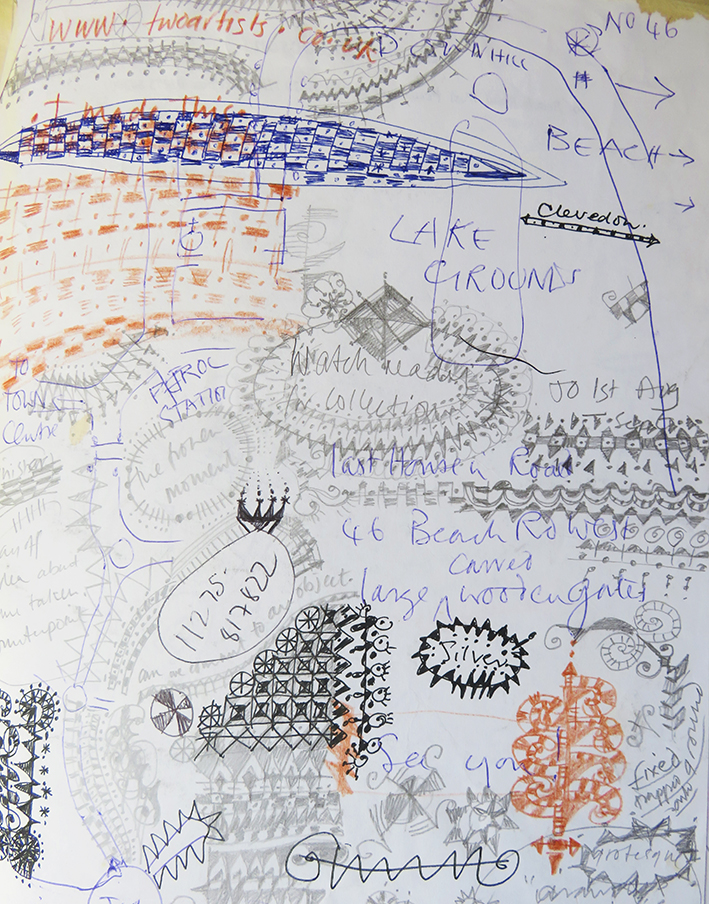
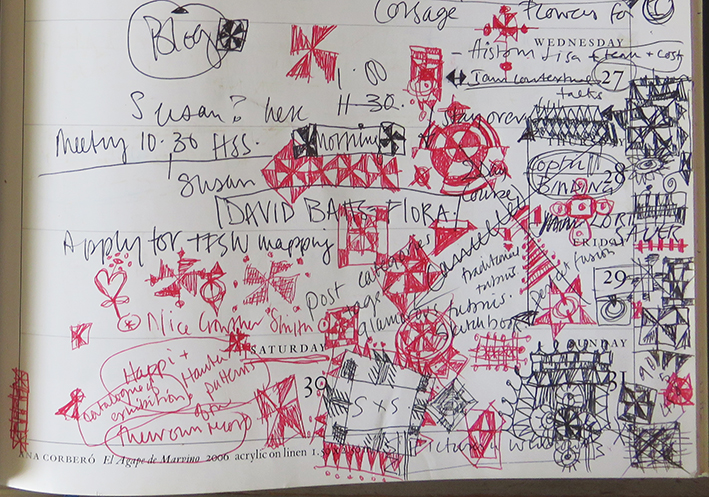
and here are I suppose my most personal drawings ( sad isn’t it) that just arrive onto any page near me, usually when I am talking on the phone to friends and colleagues, and sometimes prospective clients but always when i am fully engaged, they do not arise out of boredom. What is very strange is they have never changed over all the years I have been making them…
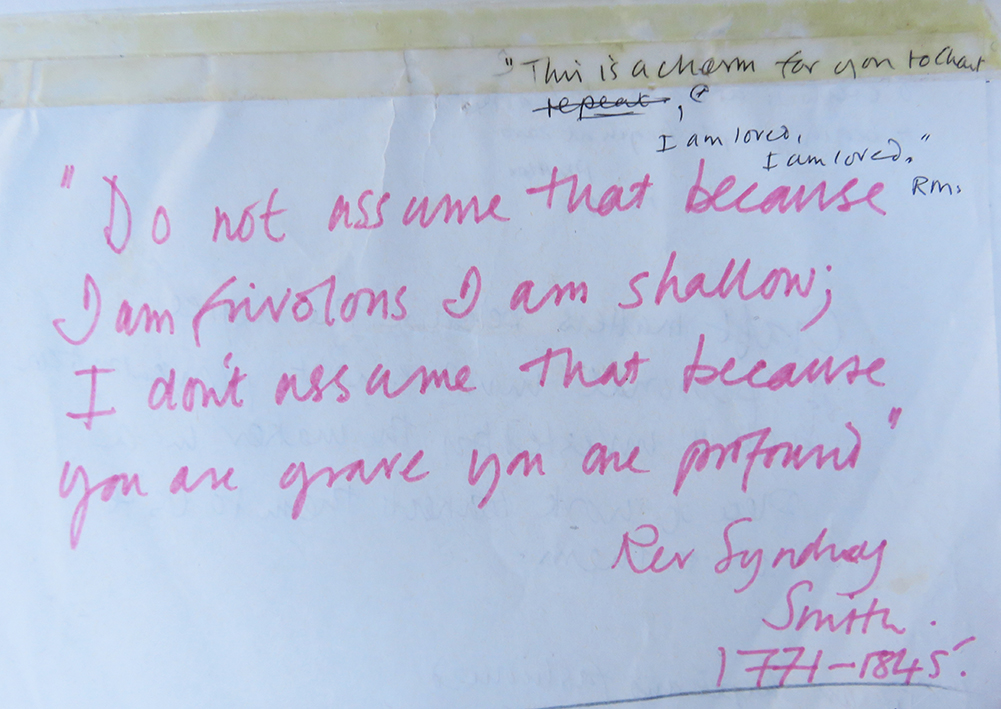
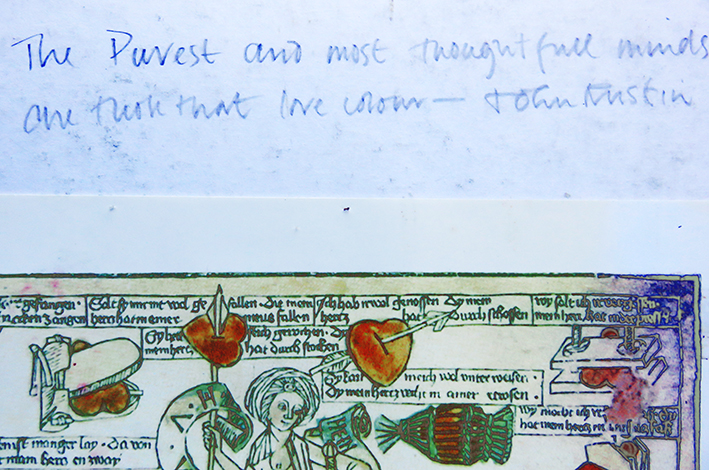
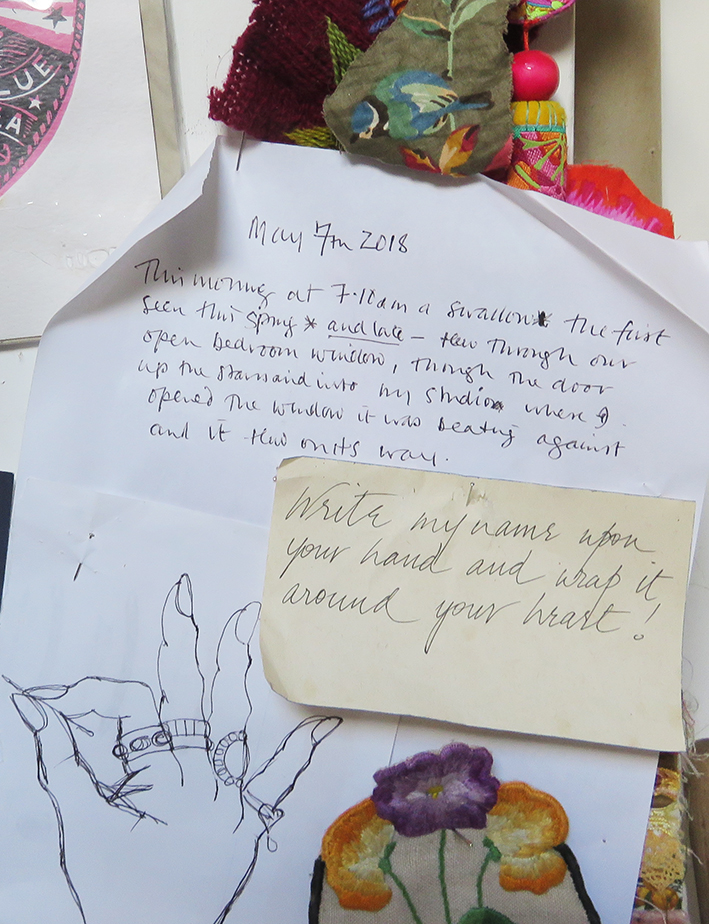
Affirmative sayings seem to be the philosophy of our times, the be-in-the-here-and-now mindfulness movement. But I have been collecting and pasting all sorts of sayings and mottoes in my work books and on my studio walls for years. Quotations, overheard remarks or messages and even poems from friends sometimes develop into pieces of work, but most often they just serve to enable me to grin and bear with it – see above!
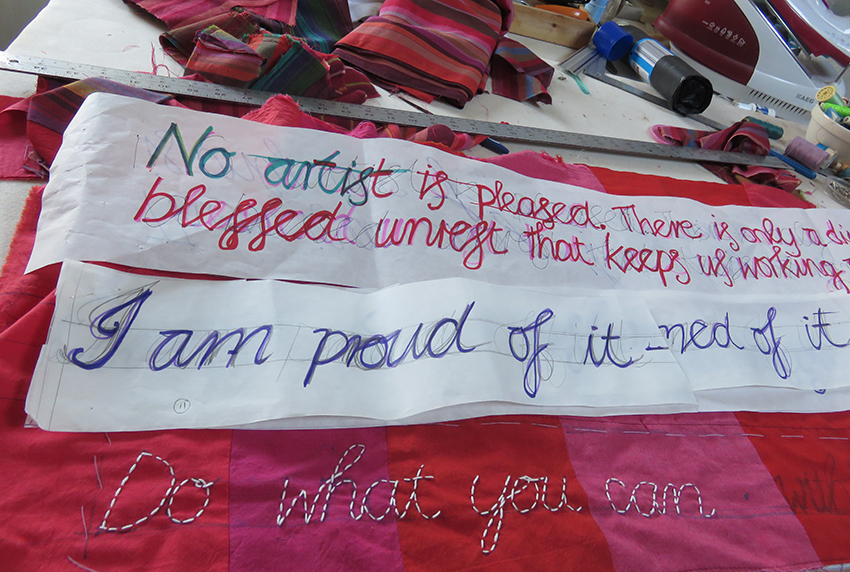
A current favourite was heard when I was mid-way through making the ‘Butterfly Dream Pillow’ – “I am proud of it and I am ashamed of it” immediately struck me as the perfect expression for how I feel about the work I do. I wrote it down on my work-top with the first thing that came to hand – an indelible pink marker! I have read it out to other artists and makers, and they smile and nod in recognition.
A quote from an interview heard on Radio 4 by a musician having just heard his own work played, my heart goes out to him.
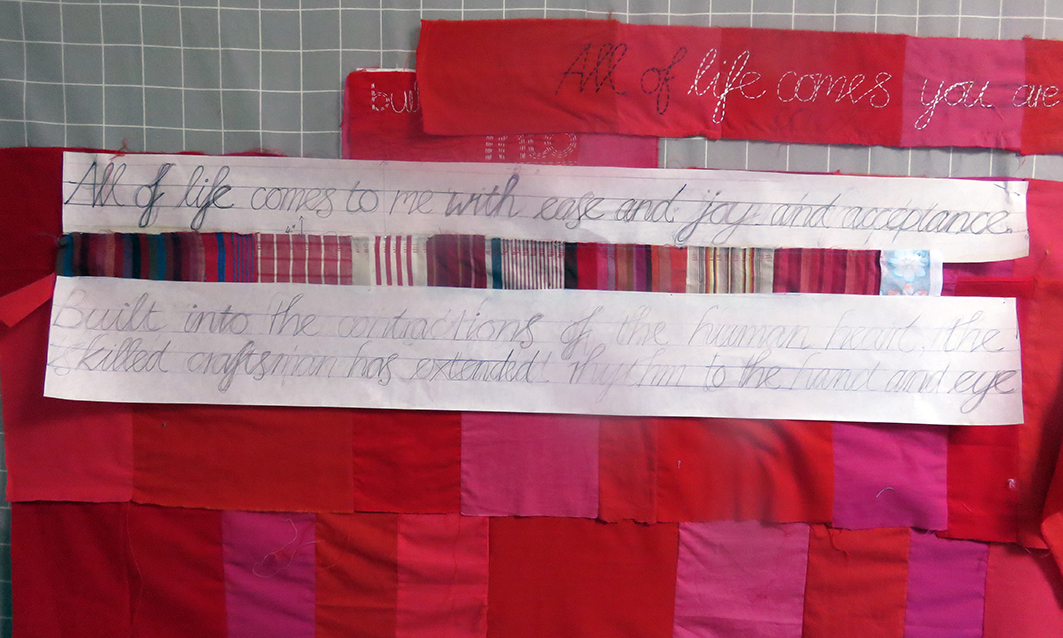
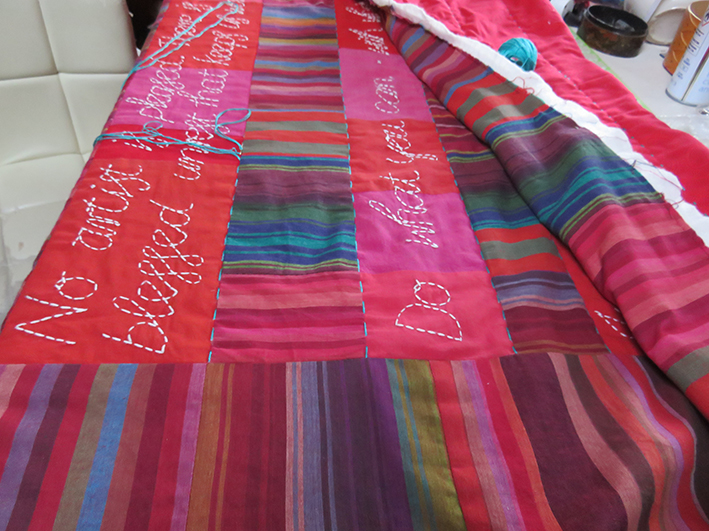
It almost made it onto my own Security Blanket, which is part of my ongoing work project, Make it Through the Night..and I did write it out along with the ones that have stood the test of time. I wrote all of them onto large scale graph paper so that my own handwriting could be resized, with the idea of stitching them easily. I have had this ‘affirmative sayings’ idea for several years, and for several different media, even as a vitreous enamel patchwork, but never had the time or energy to face making it. In between some commercial projects, late last year I started to make it – piece-meal.
the first attempt at designing the blanket as a strippy quilt with inspiration from an American quilt
Above show the first attempts to design the ‘blanket’ idea as a quilt; the inspirational Strippy Quilt above right is an American design, I love the wobbly lively stripes, like a flying flag. Initially I had considered stitching a vintage woollen blanket, then I realised that heaving around such a large piece of fabric would not be easy for a lot of hand embroidery. I remembered a Strippy Quilt in Unconventional & Unexpected: American Quilts Below the Radar” by Roderick Kiracoffe, it inspired me to change tack, this way I could stitch the sayings piece-meal and patch them all together at the end; it also meant I didn’t have to decide the order of the quotations immediately.
I started by using some scraps of vintage striped deckchair fabrics, but they were too hard to hand stitch into. I turned to my stash of scrap fabrics, Kaffe Fassett Studio’s lovely subtle shot cottons and woven stripes left over from various quilts that my team have made for his Patchwork and Quilting books were perfect. Very colourful and here very RED, and “the purest and most noble minds are those that love colour”. But not having enough of any one fabric for the background I cut my stripes into strips and joined the clashing shot cotton colours together as a background.
I have a saying that lives with me – a mantra that I recite during my sleepless hours of most nights; it has subtly changed over the years I have used it to still my thoughts, and I can chart my state of mind by what I have decided.
My subtly changed mantra is stitched onto the same set of fabrics, ready to be cut up and placed in the telling positions….
slowly the ‘blanket’ collects more words and becomes unnervingly personal for me; The Reverend Sydney Smith’s sublime epithet for not judging a book by its cover is really barbed, and oooh how many times have I wanted to say this out loud!!!!!
The finalised order pinned together on the quilt wall, tells a story about my working life over the last decade and more……hard to display – but here I am.
Eventually I got them all into order, some sayings were dropped or the blanket would be enormously long I would need to re-design, others were added as they described more succinctly what I wanted to express about how I feel about the work I do. The quotations are all by individuals who have used their life to express themselves, teachers and critics, a bon vivant, a dancer – and me. They are in order from the top, The Rev. Sydney Smith, John Ruskin, Richard Sennett and the last 2 (heavily edited) are by the American dancer Martha Graham. The succinct “Do what you can, with what you have, where you are”. sums up my husband’s philosophy for living…
Now to the ‘quilting’ or just a system of large straight stitches ‘in the ditch’ of the seams, to hold the the layers together. The finished piece is a tad wobbly, due to my inexpert ‘quilting’. Hey Ho, you can’t do it all!
Each quotation has its owner’s name and dates stitched onto the back of the quilt to be in line with the quotation
The finished piece pinned to my studio wall, waiting to be blocked and pressed;
And ” I am proud of it and I am ashamed of it” – go figure!
It is almost 20 years since I had this disturbingly beautiful dream but I have NEVER forgotten it. Re-visiting my sketch books archive, I found the original drawing that was hastily scribbled down when I thankfully I woke up.
Now, I have decided to complete my long standing/stitching on-going work project “Make it Through the Night“, after not working on it for more than 5 years. I have determined to complete the project to a degree where I can hopefully resolve it but so as not have it in my brain as frustrating “unfinished business”. I just can’t ignore it any more…. too much of me resides in it; and as the composer Gustav Holtz puts it ” Compose nothing unless the not composing of it becomes a positive nuisance”
The initial drawing , above left, is dated 28th July 03; the second drawing is another later version when I was trying to make a composition for a stand-alone embroidery….. now I have decided to add it to the ‘dream pillows‘ and I need a different composition. Recently looking very carefully at the 2 drawings I realised I had completely forgotten that the butterfly had a face – YIKES!
In the actual dream it was a giant butterfly several yards/metres wide, dying and lying on some grass underneath a tree, the remnants of wings scattered round it. People were picking up the large technicoloured pieces of shattered wing and I really wanted some as well – but I thought I would get it something to drink first, then decided to pick it up and take it to a nearby puddle, the result was my butterfly covered hands…I abruptly woke up.
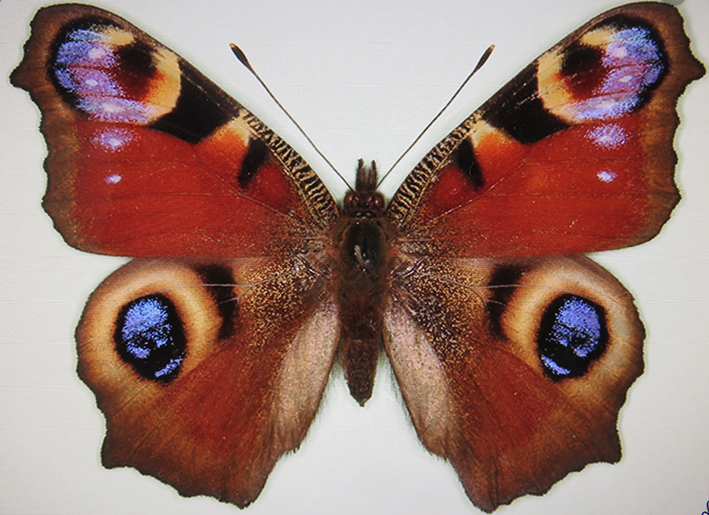
I started to research the ways on which I could have held the massive butterfly. I looked at many different British butterflies and chose the Peacock mainly because it was so colourful but it has eyes as well – one of the major symbols I use in my work. Every year we get smaller butterflies over-wintering in the house but these beauties are rare here.
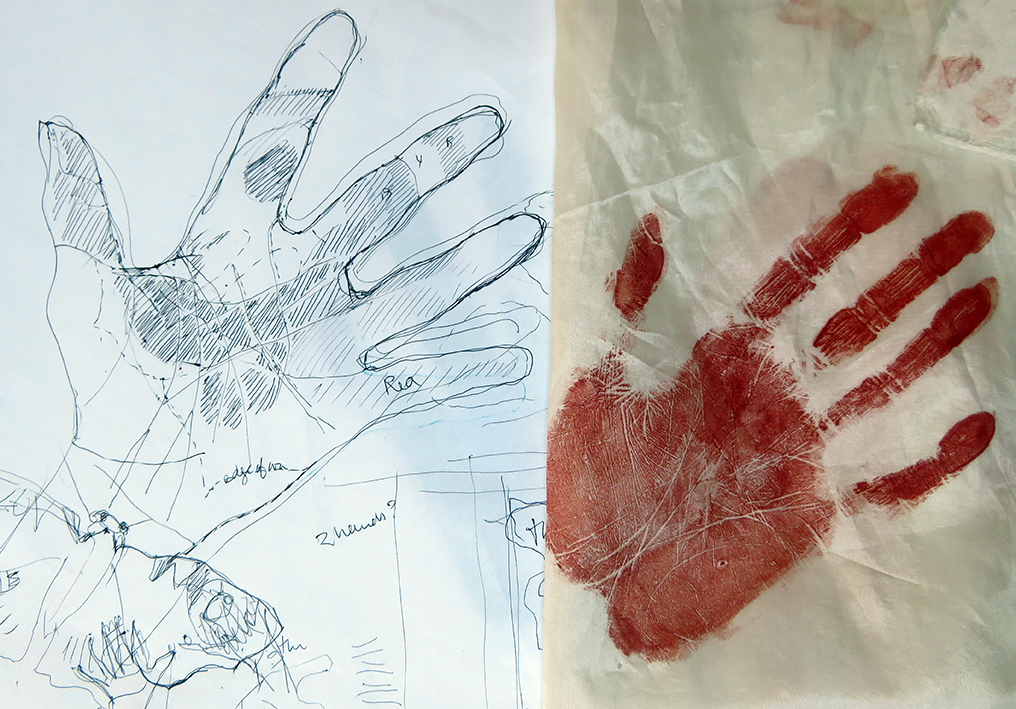
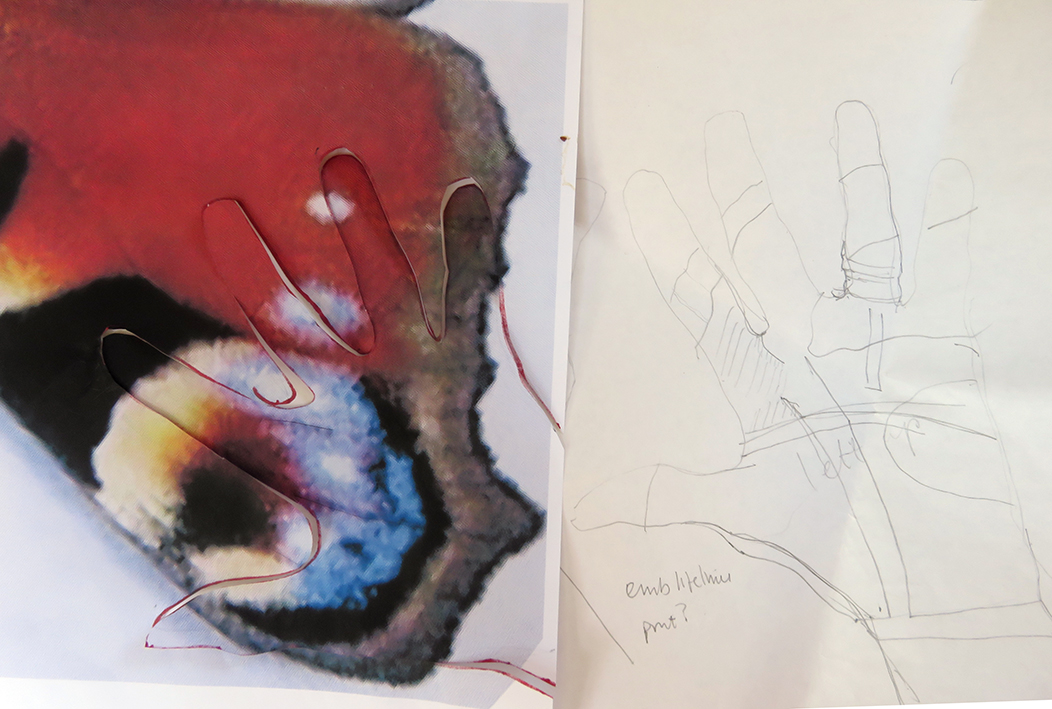
I had my own hand prints on silk, from an earlier area of research and I liked the way the lines of the palm were voided. I now transferred the palm lines to the outlines of my hands so that they would interrupt the wing pattern.
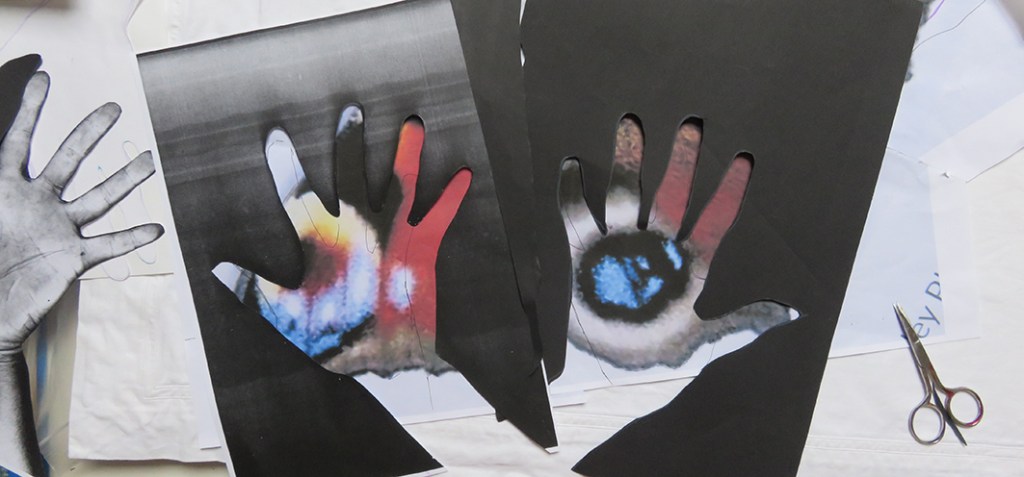
moving around with the photocopied cut out hand shapes to find interesting enlarged wing patterns to embroider.
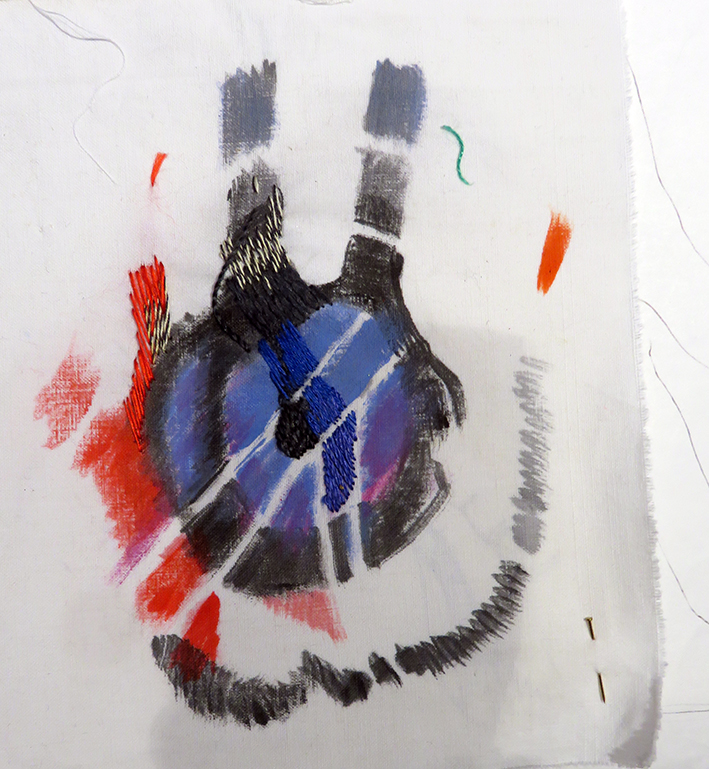
I enlarged the first peacock butterfly image and cut out my hand shapes…next I had to add the patterns to enable me to stitch the whole hands……the original working drawings below with a a technical sample that I would use for the very complicated patterned hands. I decided to paint dye onto the ground first to give me guidance for the colour blending and to assess the amount of work I would have to manage.
the separate hand drawings with a very crude but vital painted dye and stitching sample.
Next I had to imagine the shattered butterfly – I tried many variations; the shape had to show a degree of violence and some direct connection in the shapes left after my hands had devastated it, because it shows the terrible result for the insect…
3 of many versions of the lay-outs for the pillow, the hand writing is in water soluble pen
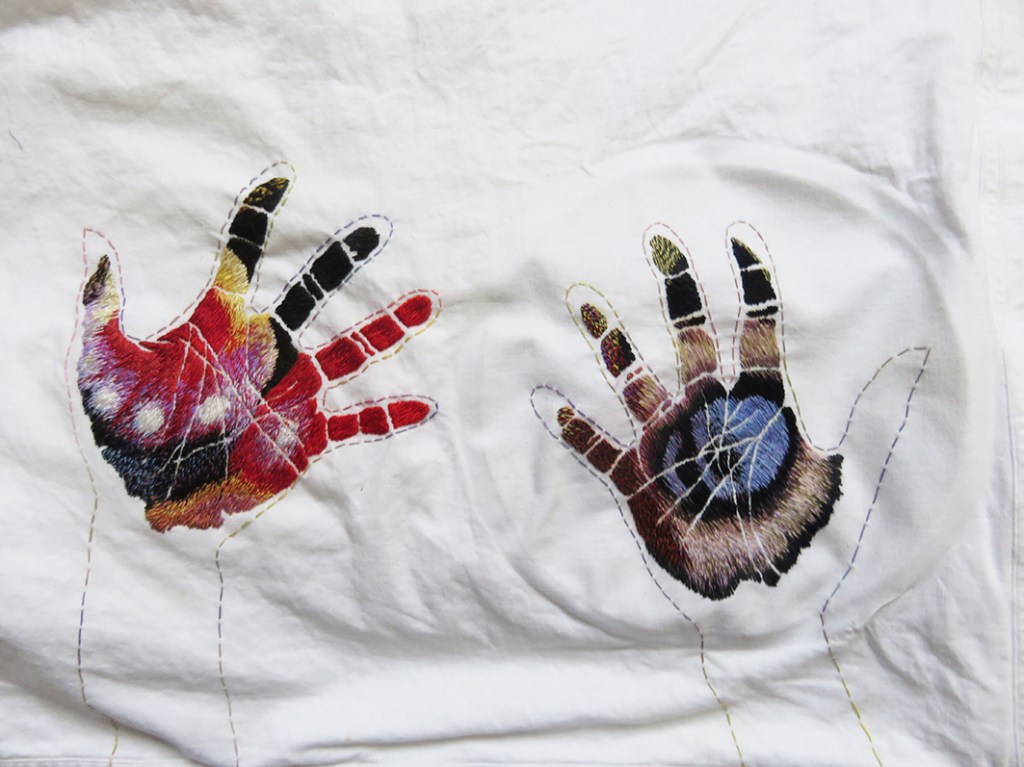
I drew the hand outlines and running stitched them, then drew my palmistry lines on each hand and painted dye within the lines and fixed it securely – all of this before I could start stitching, which I was itching to do …..
2 images above show the first and last day’s stitching of the hands. I started this project in early August and now it was late September – I needed to move onto the butterfly now…
working from my research drawings, I drew and embroidered the main area of the butterfly and then placed paper shapes to act as the shattered wings to make some connection to my hands.
research materials and dyed butterfly with the embroidered version with paper shapes in place for the broken wings.
It was at this point that something strange started to happen….I found a trapped Peacock butterfly in the window of my studio, I was delighted, I had never seen one of these in the house; the weather was still warm, so I let him go….
But then more and more Peacocks came into the studio, and in different areas of the house… in all we had 11 different Peacocks visit us. SPOOKY WOOKY……
the 3 photographs are of just some of the 11 different butterflies that came into the house over the last 3 months while finishing the embroidery. The image of the butterfly lying in my palm was taken on 25th December – amazingly it died with it’s wings folded back to show the eyes, I take this as a rare and wonderful Christmas present.
Sadly some of them died indoors and I keep them in m studio – they are all in different conditions; some very tattered wings and faded colour but others still beautiful.
my small collection of some of the autumn visitors I think there is another embroidery here……
so I eventually finished the pillow, completed the writing in running stitch and it is ready to join the Make it Through the Night project.
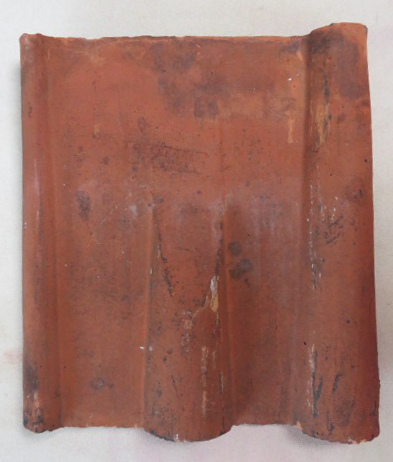
The Curzon Cinema in Clevedon, North Somerset, https://www.curzon.org.uk is my favourite (actually our only) local cinema; it looks and feels like the picture houses of my childhood in the 1950’s. (photograph above courtesy of Go Bath Bristol) Saved by the community from total dereliction some years ago, it now has a major problem, the roof is leaking and needs major money for repairs. So there was a call – out for local artists to help – decorate an old roof-tile in any way whatsoever ………and they are being auctioned on line next month from 1st December 2019.
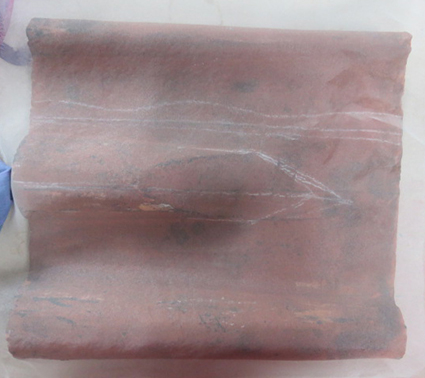
the roof tile when it appeared was a bit of a shock, very curvaceous, I applied a layer of organza and turned it on it’s side….a felt a sea scape emerging. the headland of the Kilkenny Bay seen from our house and garden, on late sunny evenings…utterly magical.
The central curve reminded me of the the headland at the end of the bay where I live, Battery Point, on the Severn estuary, fanciful I know but I have many drawings of this view and have made many different types of work from the studies.
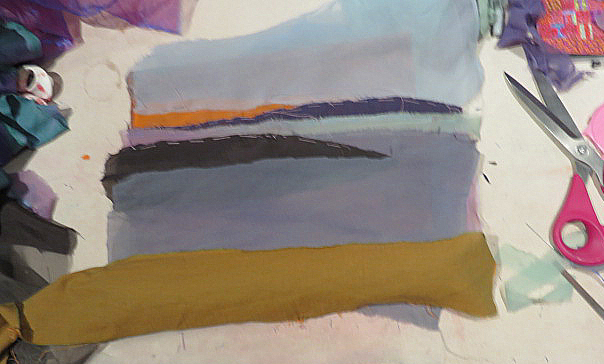
I tried many variations of colour scapes from my earlier drawings. I liked the glistening nylon shot fabric for the water, trouble is that the water of this estuary is never a deep true blue, air-force blue is as good as it gets. For some reason I started with the lump on the left…so the view was of the other end of the bay where the sun sets and all the colour emerges from…but it wasn’t working for me – then one morning I just changed it around so it looked like the Battery Point headland…I was suddenly on home ground..or should I say water?
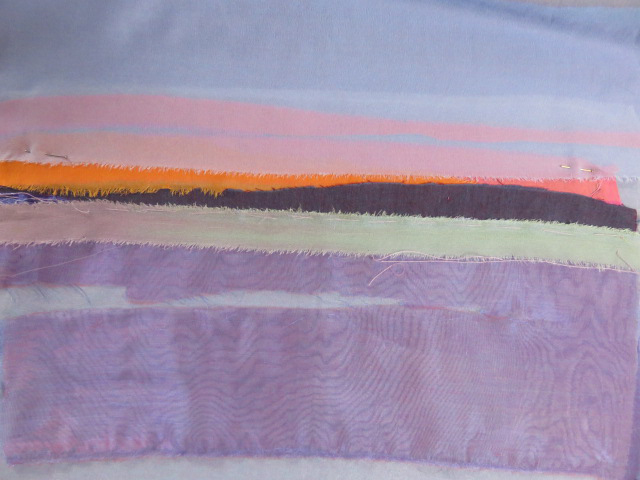
I added the salt marsh fabric, a piece of green and orange shot cotton is the perfect colour of the marsh when the late afternoon sun lights it up in the autumn – the rest of the sky and sea seem purple in comparison.
The task now was to organise the layout of the fabrics so that they would lie in straight lines when they were eventually placed onto the undulating tile …this took some calculations as the tile is wedge shaped but the sea level and the salt- marsh horizons are straight….
I start to running stitch the sky …..but I have decided against the brilliant blue sea I hid it under a translucent layer of silk!
I used the simple running stitches of Kantha technique for this appliqué, I have to get the fabrics to stay together in a soft and malleable form so that I can easily manipulate the fabric over the lumpy tile.
I continue to stitch down the length of the tile – it takes several days but as always fascinating to handle the colour changes. The stitching is quite large and almost crude using a heavy gauge silk thread but very satisfying to do; usually when working this technique I use one single thread of silk and it takes ages and ages to cover the ground
As I continued to stitch the colours became muted and now the once brilliant orange sky was being challenged by the bright green of the salt- marsh; reluctantly I changed the fabric after several different variations of shot cottons had been tried, but there is enough going on in this small space as it is – hey ho!
eventually the finished piece is ready to be mounted onto the tile covered in wadding.
I then covered the tile in a layer of very thin wadding, sticking it down with thins lines of fabric glue so that I could continue to embroider the silk piece to it. I have evolved this technique for covering 3D shaped objects over many years of trial and error but this was a real challenge.
Having aligned the top of the stitching to the top of the tile I tacked it into position, then pinned it all along the undulations…it’s really tricky work trying to keep the horizon lines straight…all those years of pattern cutting came into play! The top and bottom were secured by over stitching onto the back of the tile wadding, pulling and stretching as I proceeded eventually it was securely stitched and bedded into position.
the back and front of the tile side by side – now photographed the tile just looks flat and with wobbly sides…but it feels lovely to hold.
I am really liking the feel of the tile now it is so softly padded and am thinking of possibly making some more stitched covers for other objects – one day. Meanwhile my husband Stephen Jacobson, has painted another view of the estuary using the imprint of the tile manufacturer as a flag with a view of the band stand at Clevedon. And artist Alfred Stockham has painted eyes to create a curious face and called it ” The Man in the IronMask “
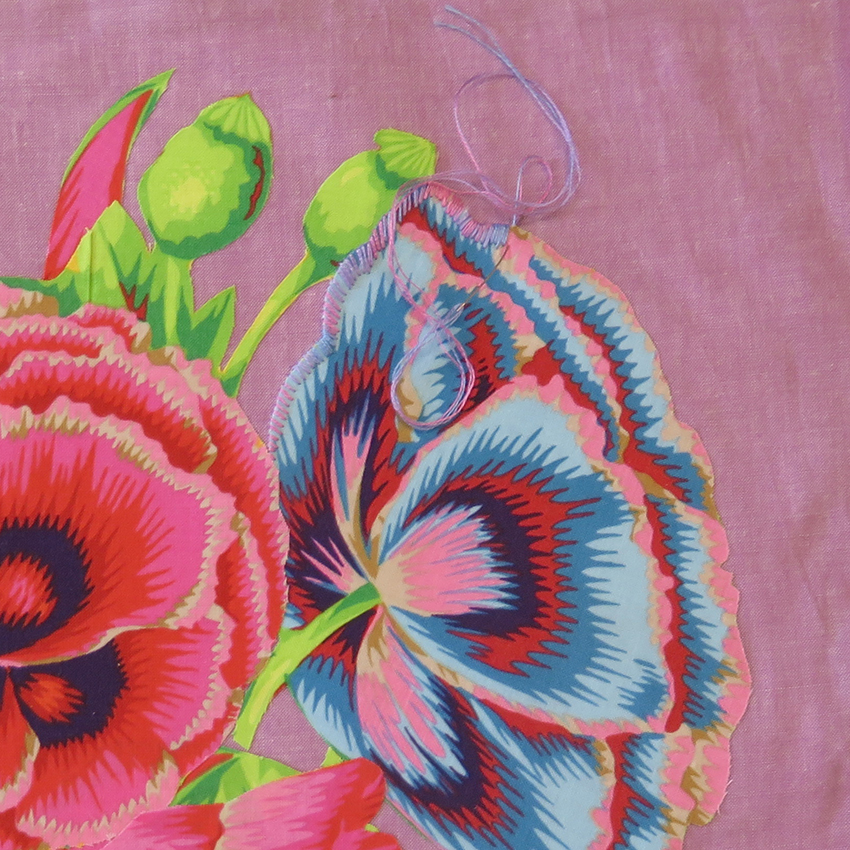
hand hem stitched sample of Broderie Perse as sewn on the original quilt
As part of the activities developed for the current Kaffe Fassett exhibition at the American Museum in Britain I am giving 2 separate day workshops to make a small panel of hand appliqué flowers. I am supplying the same fabrics used for the large scale appliquéd quilt that I made for Kaffe to celebrate his 80th birthday.
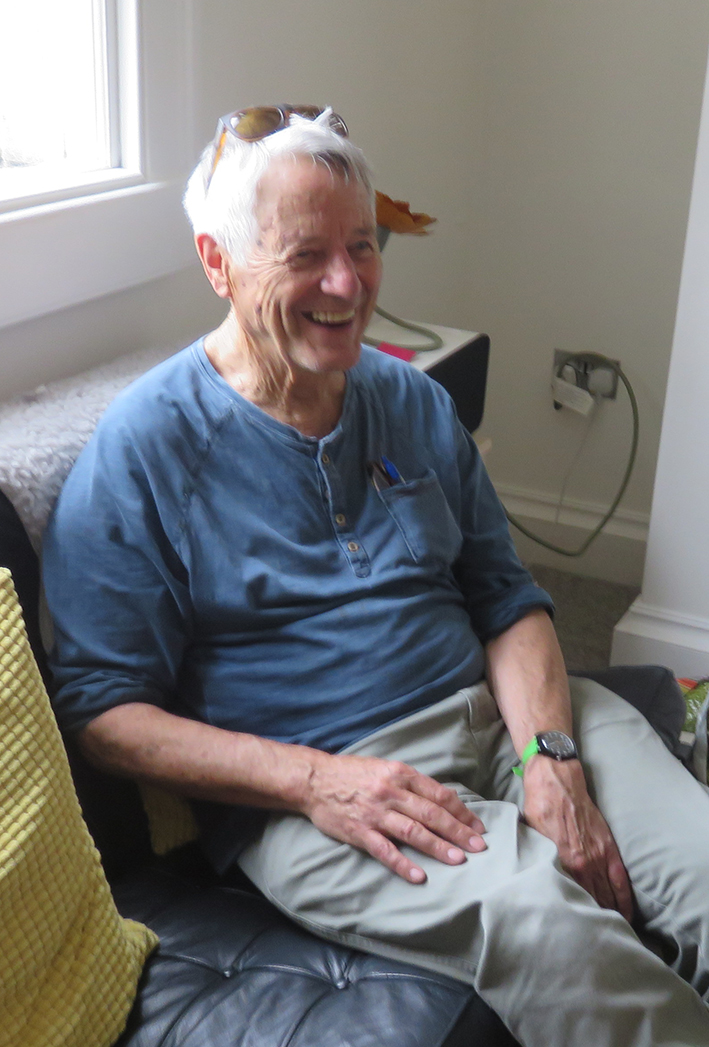
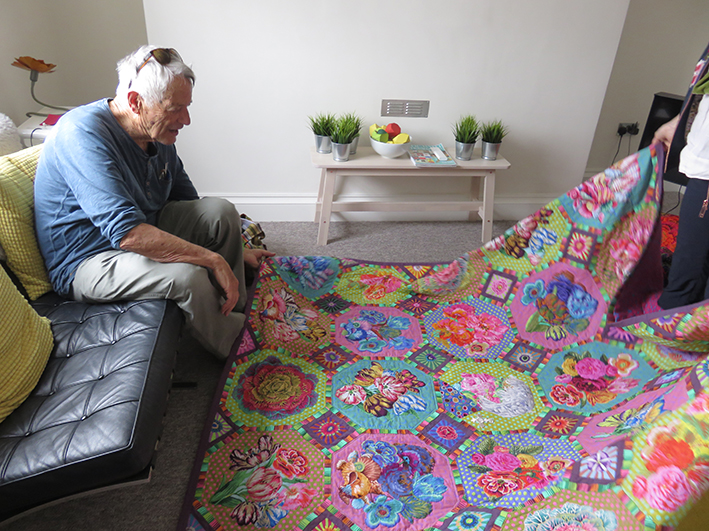
Kaffe visits his present in the quilt room at the American Museum
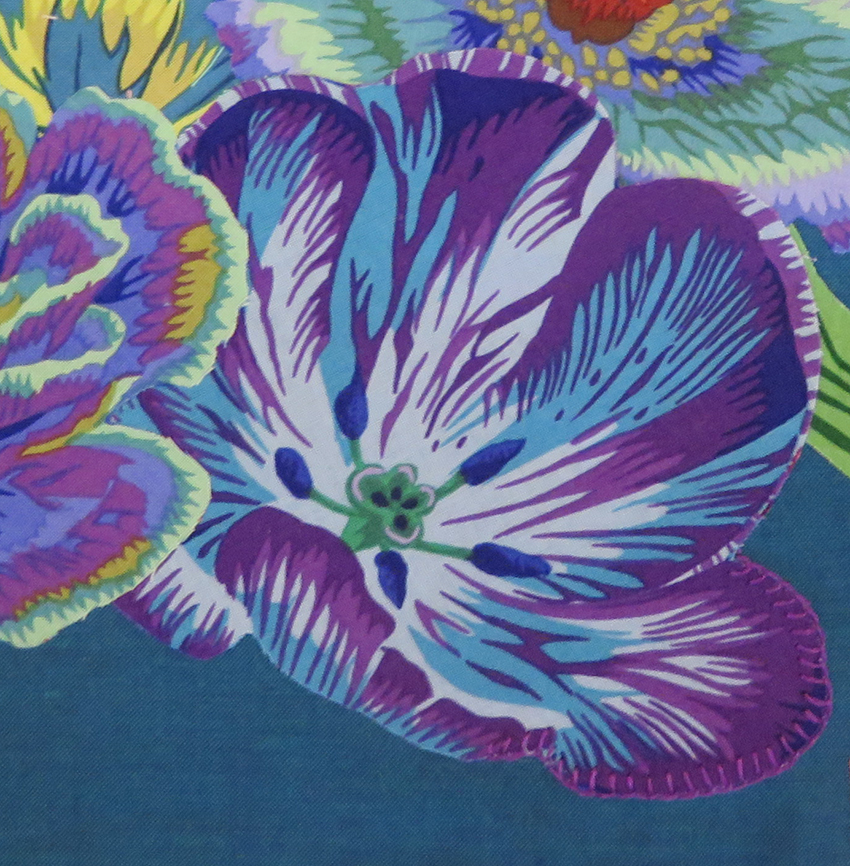
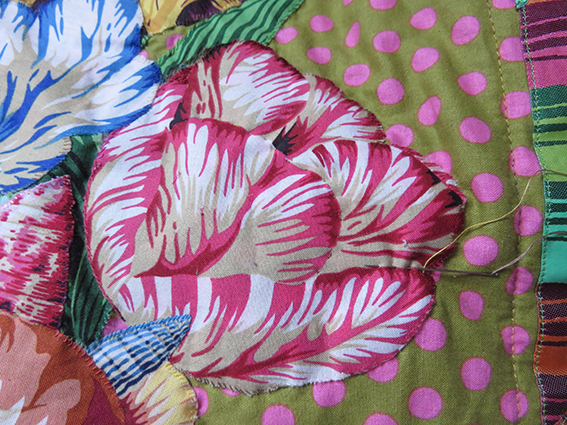
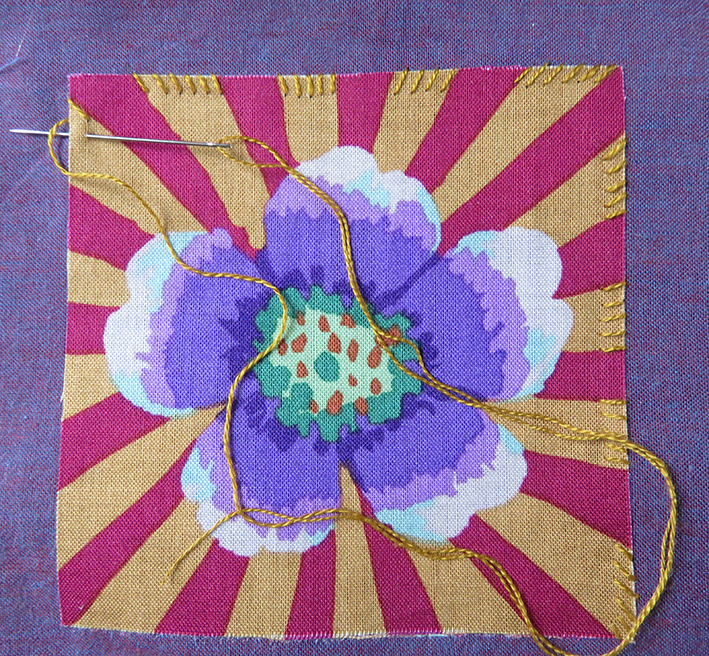
I started the day by taking all the participants to the museum’s Quilt Room to see the original quilt and explained some of the techniques we would cover. I explained my technique of hand stitching over the raw edges of the bonded motifs, which is easier than the original way of turning a small hem and stitching onto the panel. They were asked to design their own version of the appliquéd flower and shell panels – but not the central Kaffe portrait.
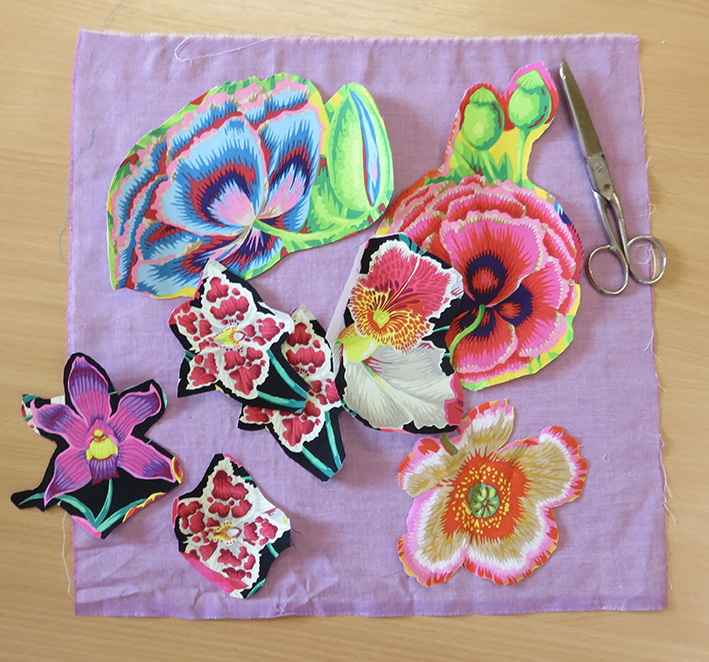
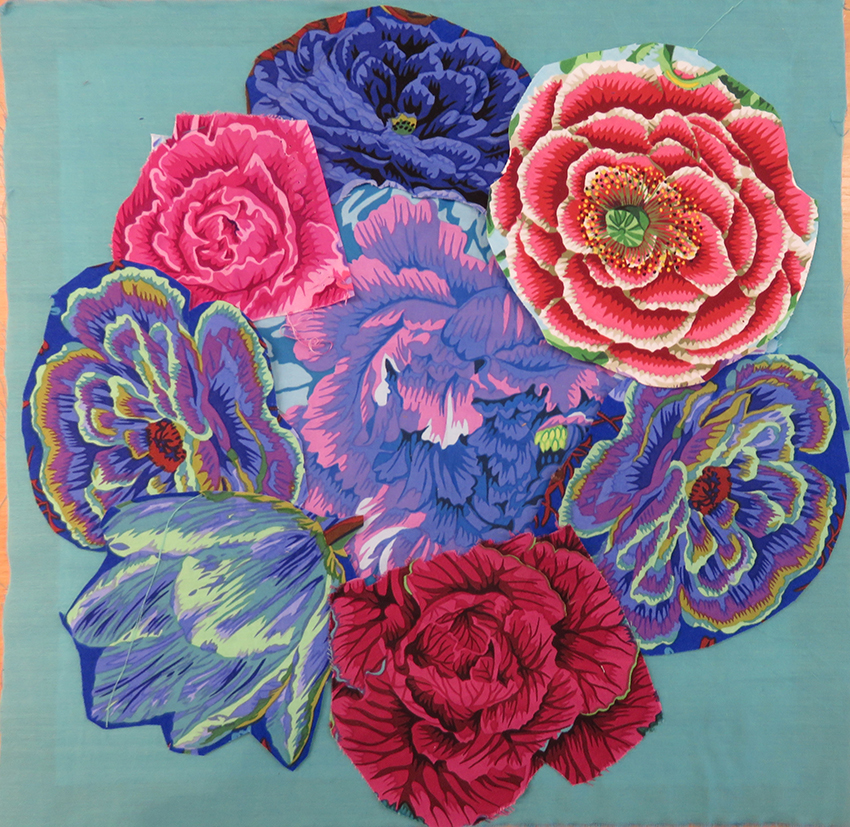
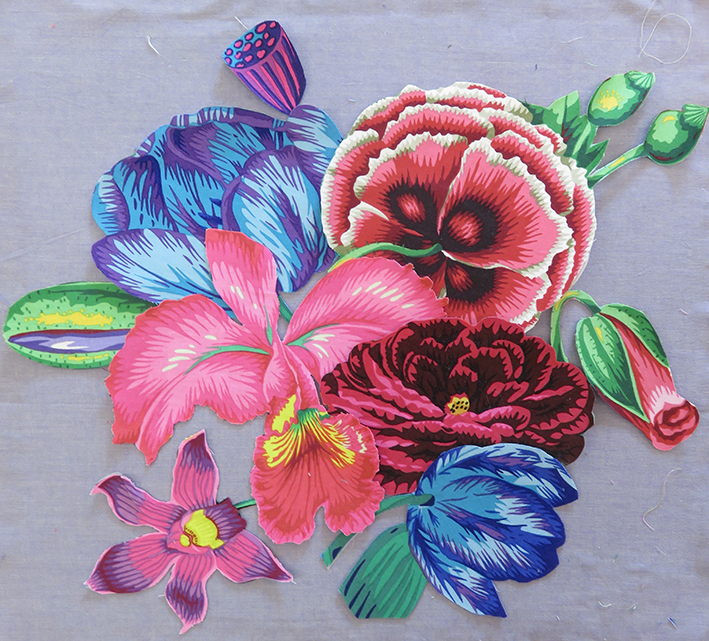
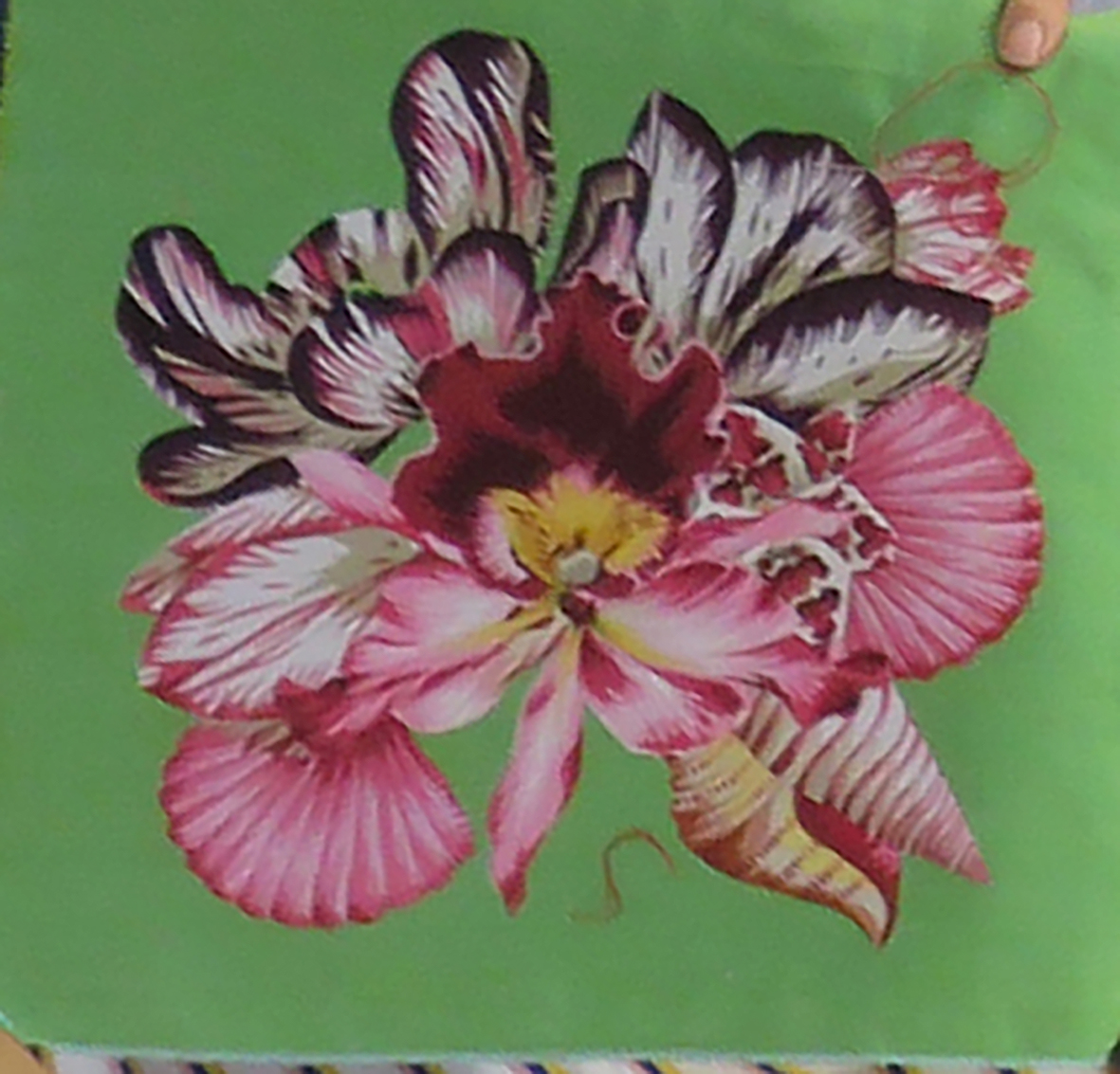
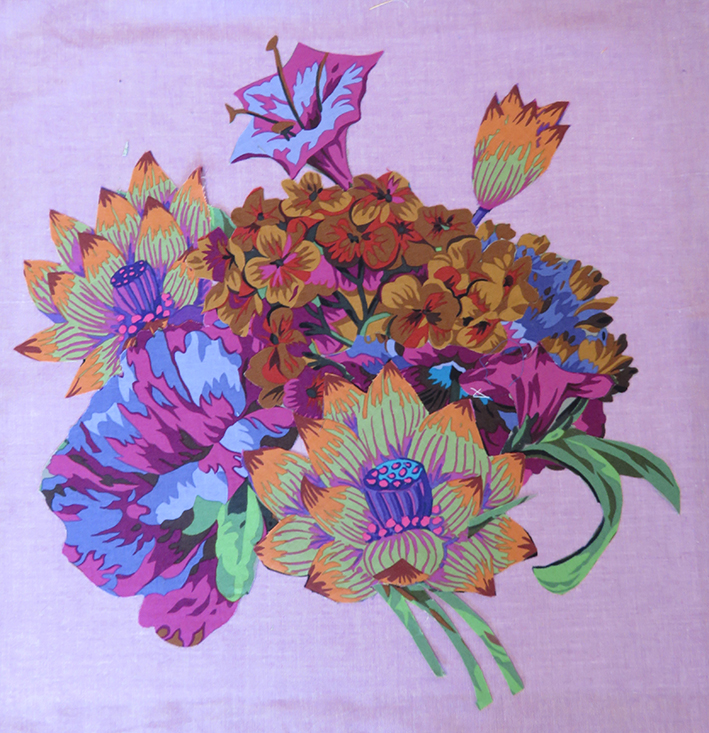
Kaffe Fassett Collective fabrics bonded with heat transfer papers
I had prepared a whole sheaf of flowered fabric by pressing heat transfer paper onto the backs of them so they were ready to cut out. I also took the remaining motifs I had cut, but not used, from my quilt. Plus a selection of different coloured squares of Shot Cotton for the backgrounds, these I backed with a woven cotton interlining to strengthen them for appliqué to be sewn without a stretcher or hoop.
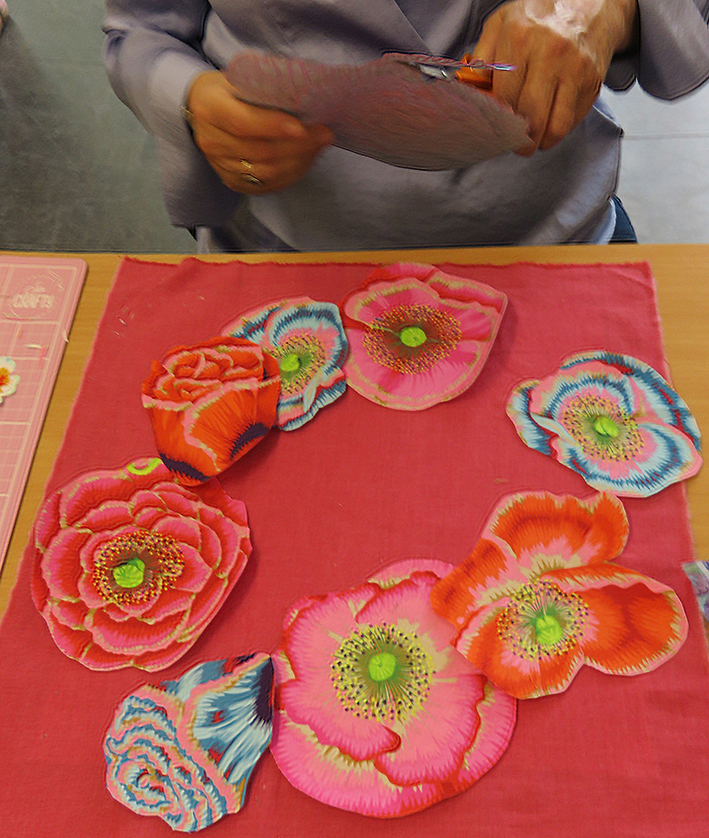
Everyone had to choose their own back ground fabric first, this makes finding colours for the individual flowers easier; I know how daunting it is to have so much choice. But they soon got going on the cutting and placing….
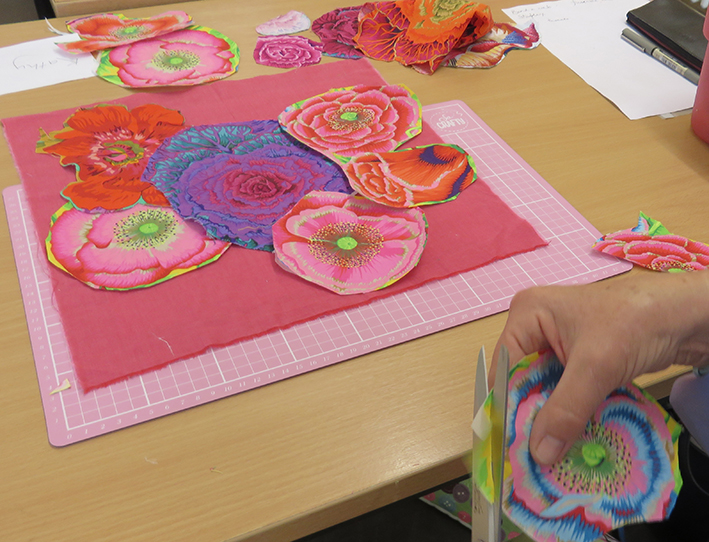
The first thing I noticed was that most people put far too many flowers onto the fabric squares with odd gaps between. I had to keep reminding them that this was to be a hand- stitched appliqué and to think about the work involved to finish the stitching later at home….. but even so most people favoured lots and lots of flowers, below shows some work in progress.
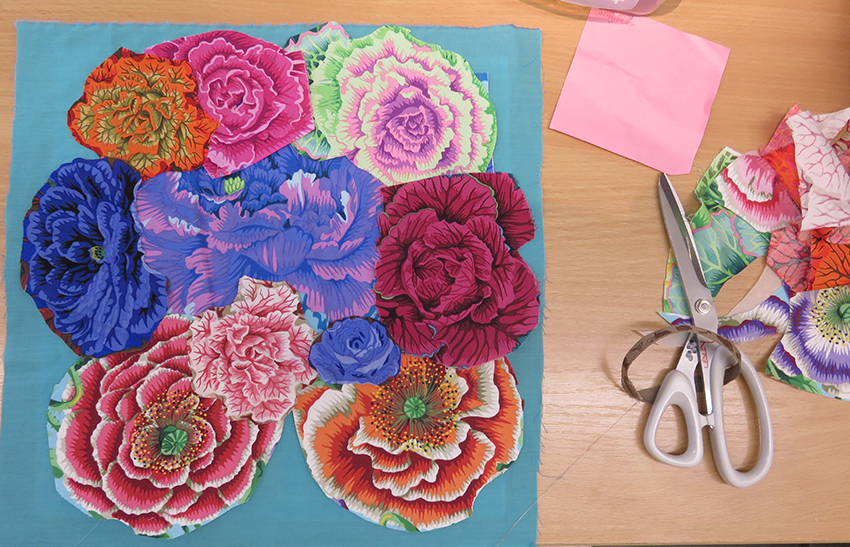
After the basic shapes were developed extra flowers could be found in the spare fabrics I had brought, and people could bond and press motifs individually to balance or fill up their basic design. Several people worked as I do and changed their designs a great deal during the design process until they were about satisfied.
Other people had very organised workspaces (very unlike me) and I enjoyed seeing their beautifully laid out tables with all necessary equipment to hand. They seemed to progress steadily and surely, with only a small tweak or suggestion of a different fabric from me
a work table set out with cut motifs and a camera ready to record a successful design
eventually all the designs were organised; some really interesting designs were arrived at by chopping and changing until the last minute…
but eventually everyone had to commit to trimming,
very very carefully trimmed stalks and petals ready to be bonded
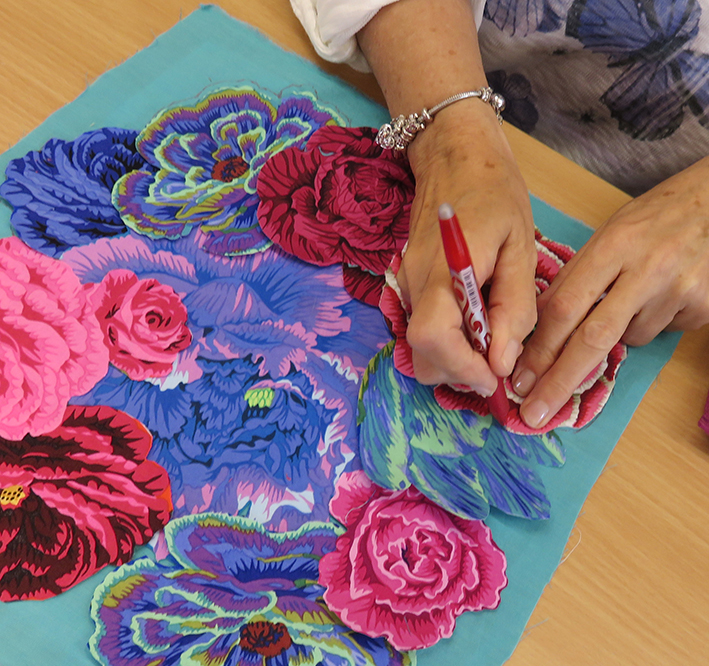
then tracing around places with a water soluble pen, before pressing the whole design into position.
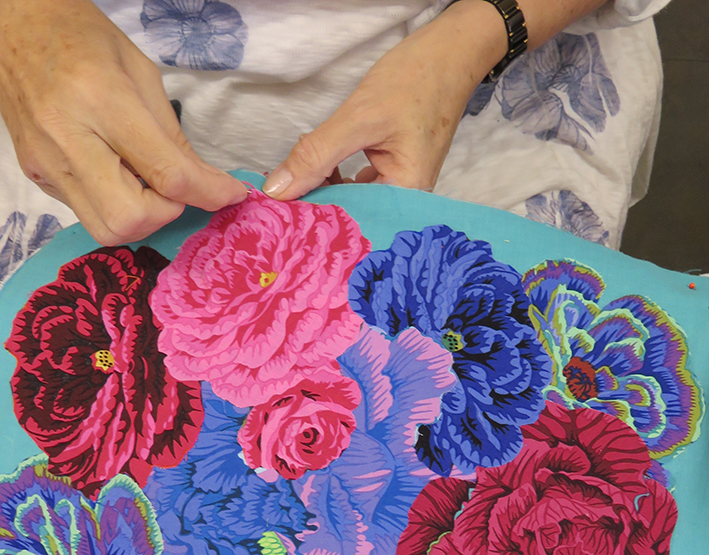
and then after a quick demonstration from me – start to stitch it.
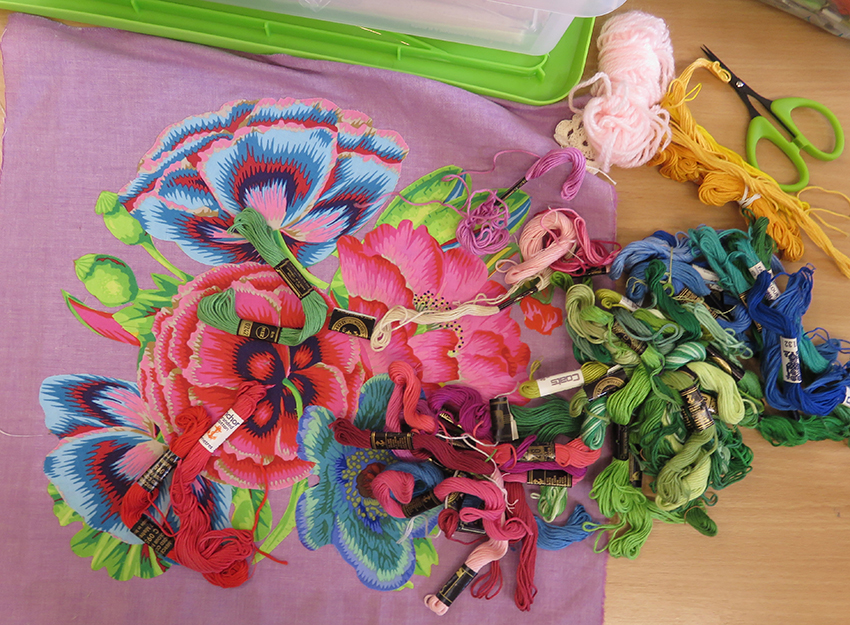
a range of embroidery cottons chosen to tone in with the fabric colours are ready to appliqué
They all were very skilled at this very precise stitching, a relief as poor work at this point can ruin all the meticulous care taken after this really intense design stage.
At the end of the afternoon session there was a lovely and varied set of designs and some were already being stitched – with promises from the rest that they would definitely finish them.
the whole ten class participants with their own ready-to stitch appliqué designs.
And for anyone who is interested in joining the next workshop – it is on Saturday September 21st 2019.
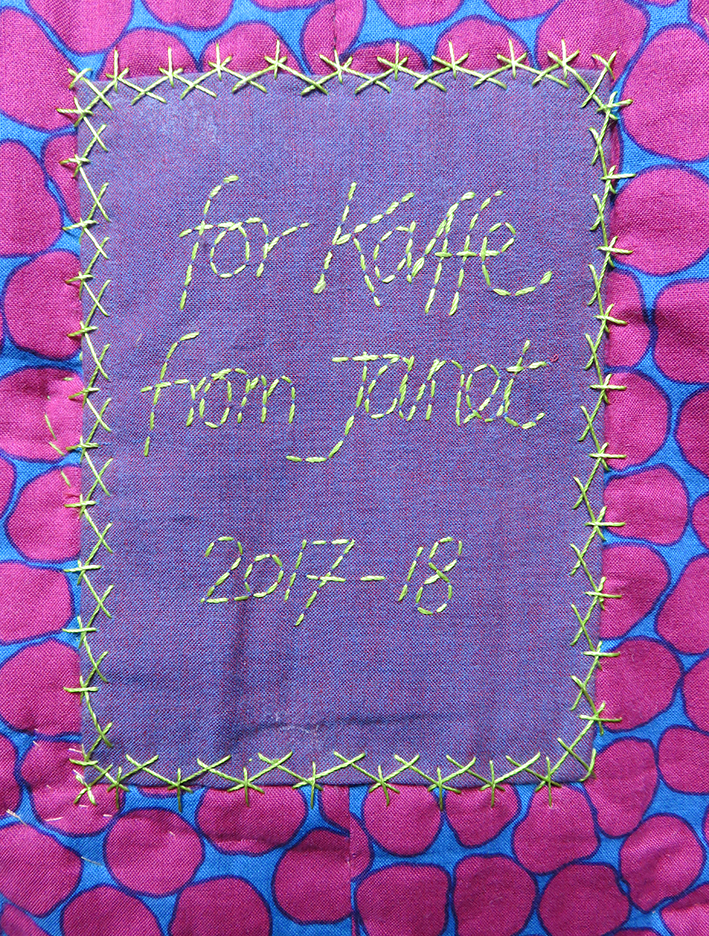
My final stitches on the back of quilt appropriately backed with fabric designed by Brandon Mably
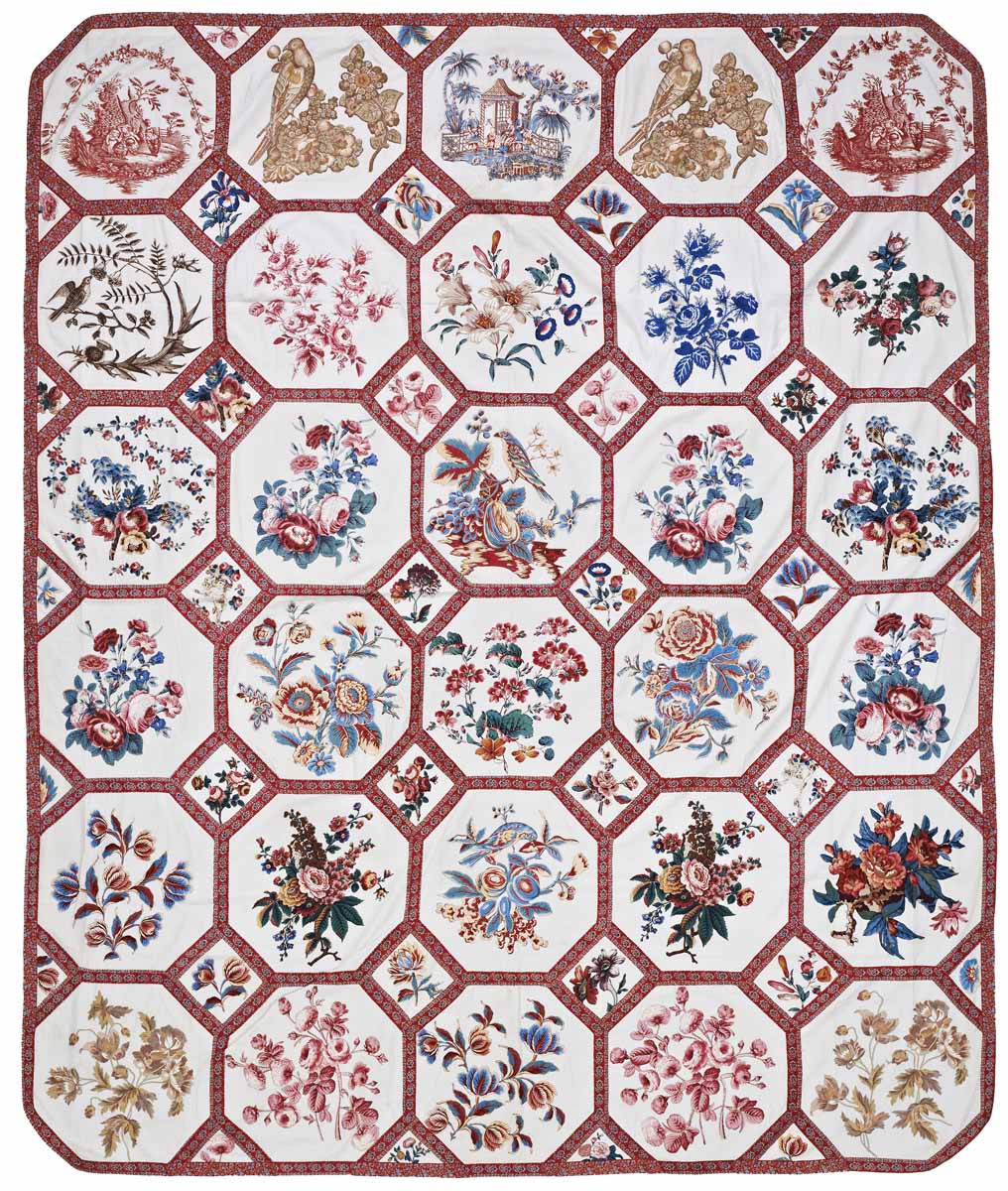
This major project started life in 2017 through sheer frustration. For Kaffe Fassett’s 2018 quilt book, based on traditional quilts housed in the American Museum in Britain he had asked that, as a hand embroiderer, I make his revised version of an ‘Broderie Perse’ in their collection. I was delighted.
I immediately started to sample some simple ways to make such a large hand stitched quilt nowadays, plus information notes for others to follow the instructions. However, due to lack of time due to publishing deadlines this quilt was dropped….Rats!
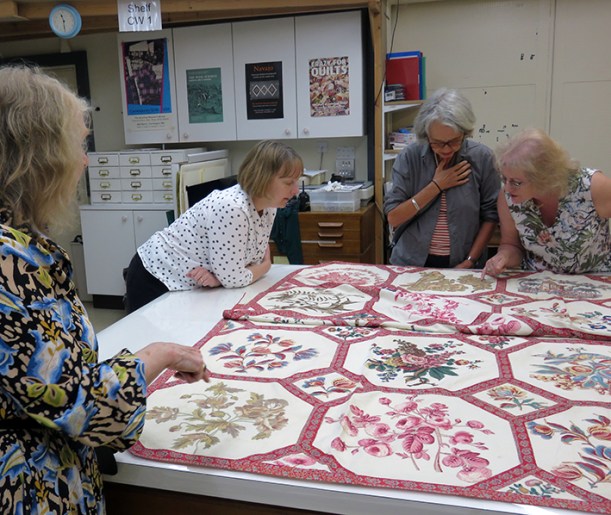
behind the scenes of the American Museum
Later in the year I organised with the museum’s curator, Kate Hebert, to visit the archives with the UK making and publishing team. I asked to see ‘the one that got away’ and on hearing the story, Kate said that if I ever re-considered making the quilt she would show it in the quilt gallery alongside the original. Well of course I jumped at the chance to show work at this museum, and I did want to make the quilt.
I decided that I would make it as a present for Kaffe, it was his 80th birthday in December and I had enjoyed the last 3 years working with him on his books and my contract was at an end. I reasoned I would soon have plenty of time on my hands to complete the project in time for his birthday.
Kaffe Fassett studies new work on the quilt wall in my studio
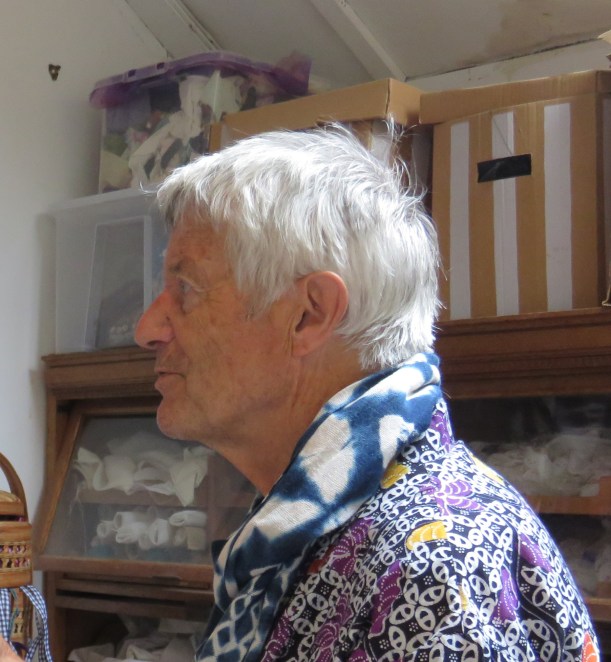
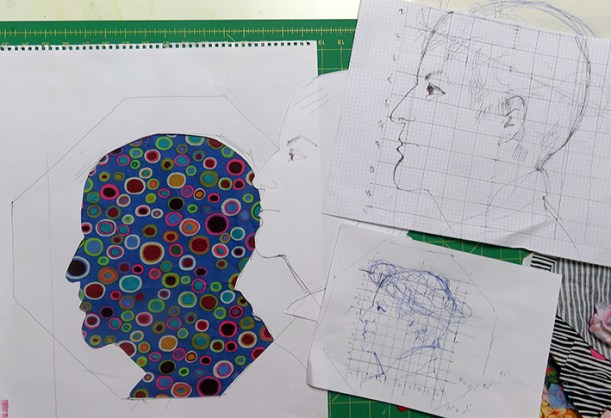
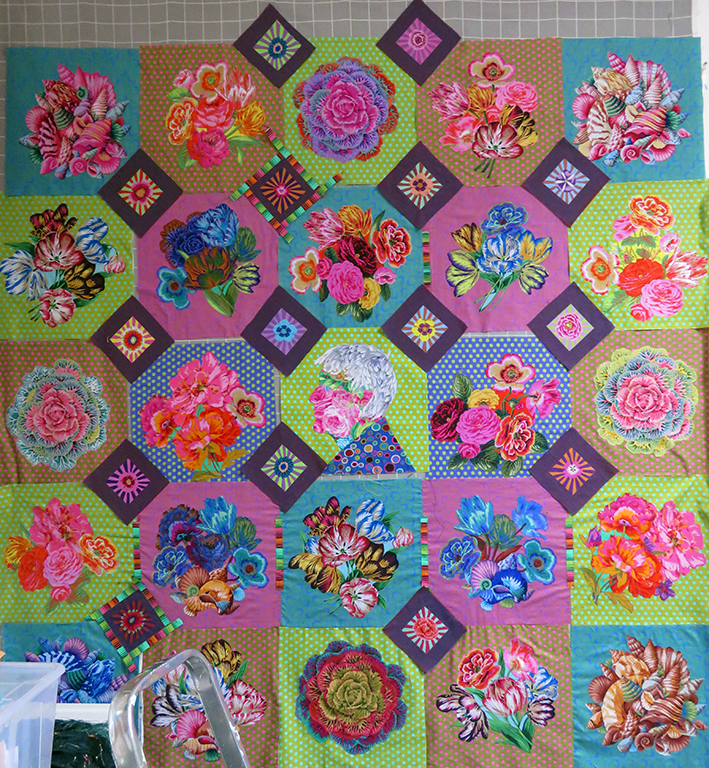
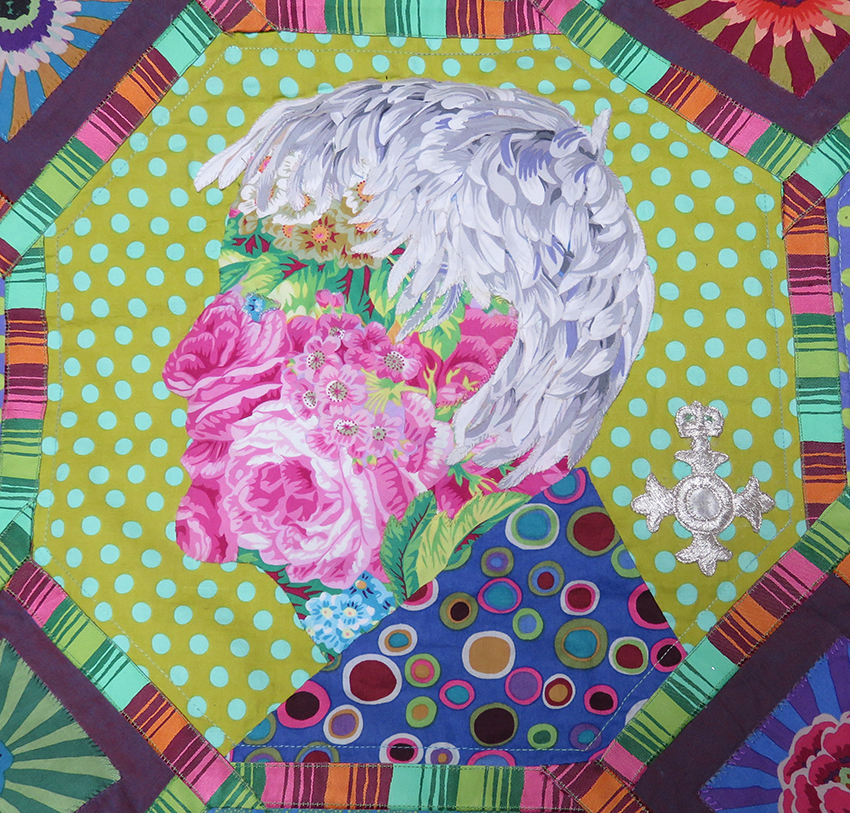
As I now had ‘carte blanche’ to interpret the design as I liked I decided to make his portrait as one of the panels. Using a recent photograph from his last visit to the studios I set about drawing and scaling the head.
the original drawings scaled up from the photograph
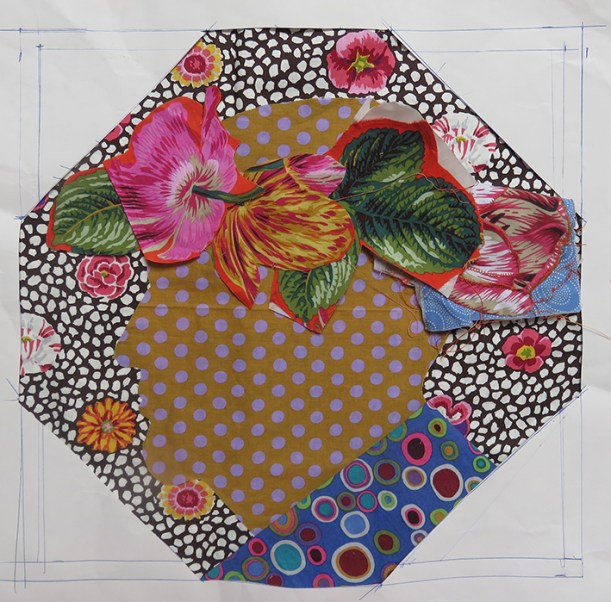
I made carefully measured sketches, and then 2 masks – one to the size of the hexagonal block and the other of the head. My initial idea was to garland the head with flowers – well why not?
first attempt to design the head using some of my favourite fabrics
This looked miserable, and the garland didn’t fit into the hexagon very well – and then I would have to embroider the features; I remembered my ‘Flora’ embroideries influenced by Archimboldo – the artist who made faces from flowers. I tried various flowery fabrics from the Kaffe Fassett Collective.
This selection took several days and I was still not convinced I could make it work well enough, then into my studio stepped an old university colleague from my teaching and researching days, Dr Dawn Mason, with the perfect bunch of flowers to match the work – I believe that chance happenings are not always random
serendipitous flowers – I am on the right track
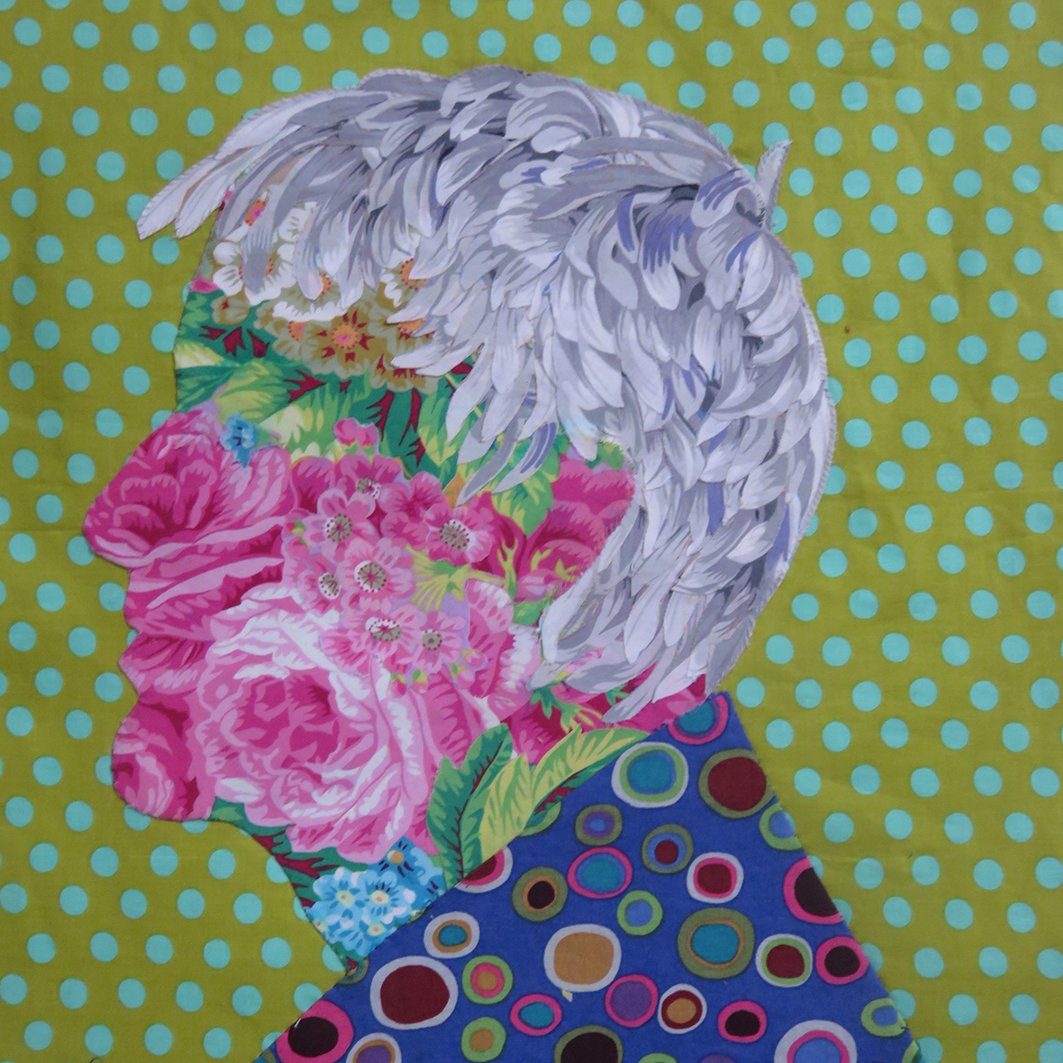
I persevered. Eventually I chose the fabric placement, cut it out with a tiny seam allowance and hand slip stitched it to a spotty fabric, adjusting the chin to become a tad larger proved successful. Very carefully I placed a blue bud for the eye. Suddenly Kaffe appeared in front to me.
chosen fabric on drawing
perfecting the chin
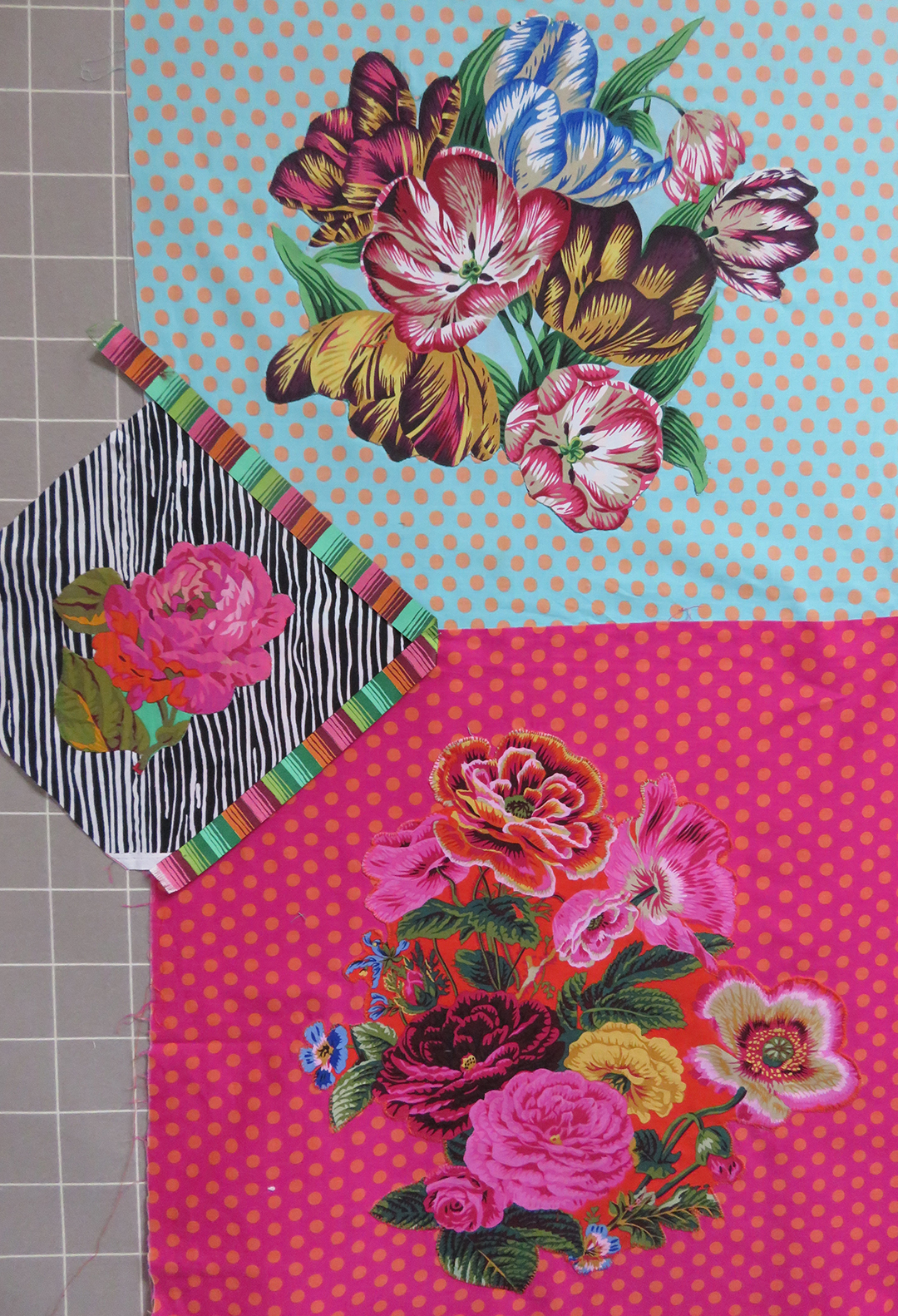
Now for the hair: I found the white petals of Japanese Chrysanthemum by Phillip Jacobs perfect for my purpose, and so it appears does everyone else; the hair is the thing that gets the attention. In fact most of the fabrics that I used Summer Bouquet and Shell Bouquet and Tulip Extravaganza are designed Phillip Jacobs, his fabrics are so elegantly drawn and painted and the perfect replacement of the original chintzes.
The next stage was to decide the rest of the portrait. For the shirt I had a smidgeon of an old version of Kaffe’s Roman Glass in blue, I had bought years ago – and after many trials chose the fresh Spot fabric in the colour ‘Pond’ for the background.
the finished head
Now for the rest of the patchwork, So far this has taken me about 3 weeks of drawing and stitching – but it is still only June.
the original samples for the American Museum book
I dug out the abandoned samples I had made for the book – I needed to make more other panels to add to the portrait.
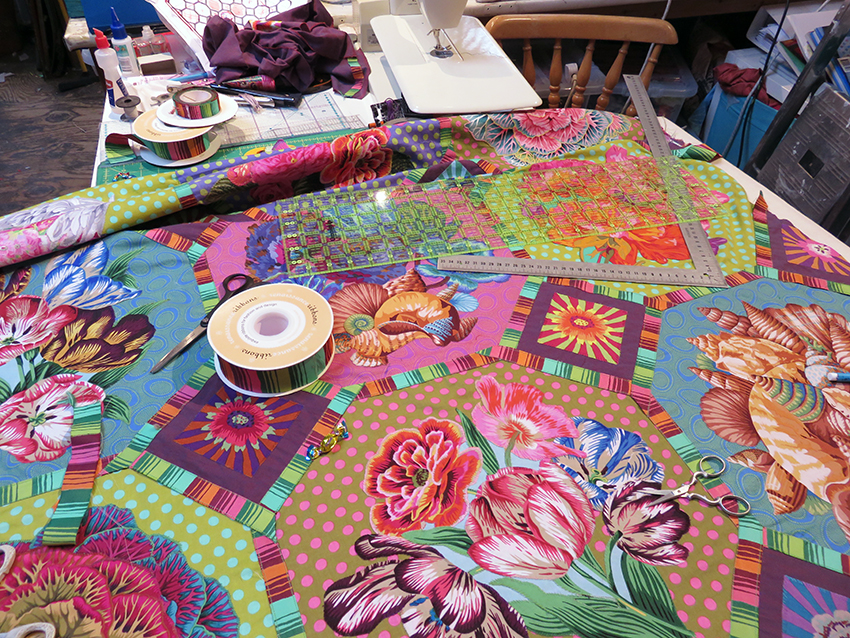
To make the bouquets, the fabric has to be backed with a bonding paper, carefully cut out, placed into position by re-arranging the various elements to fit harmoniously, pressed, then hand stitched around each raw edge, the stitching is quicker than the arranging and my idea of blissful work.
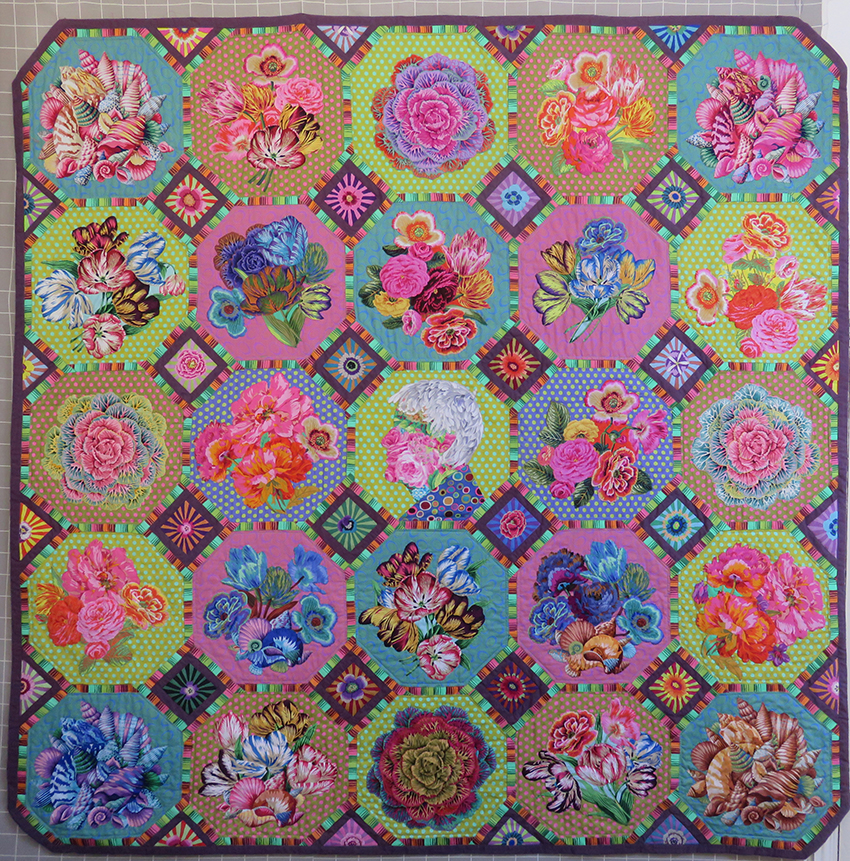
The quilt slowly started to grow; but trying to control the overall colour was the most difficult thing – colours that work on their own or in a sketch suddenly look drab or take on another shade when placed next to one another – obviously. But the colours of the flowers changed the balance every time I added a new panel. It was my major ongoing and fascinating struggle to get these balances to work.
my textile studio September 2017
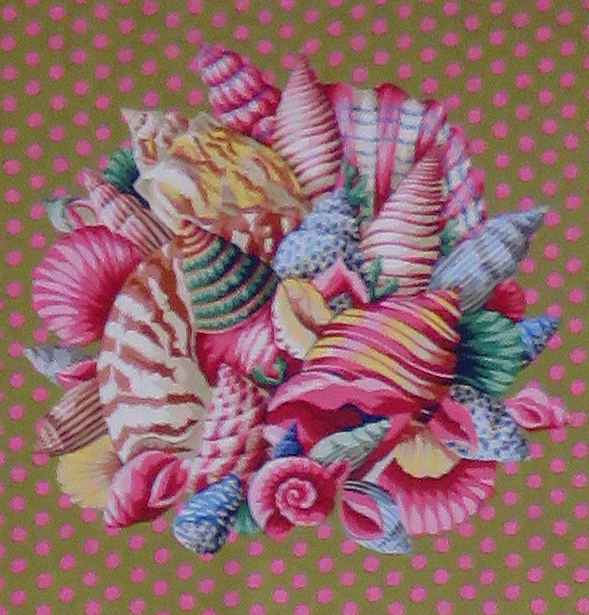
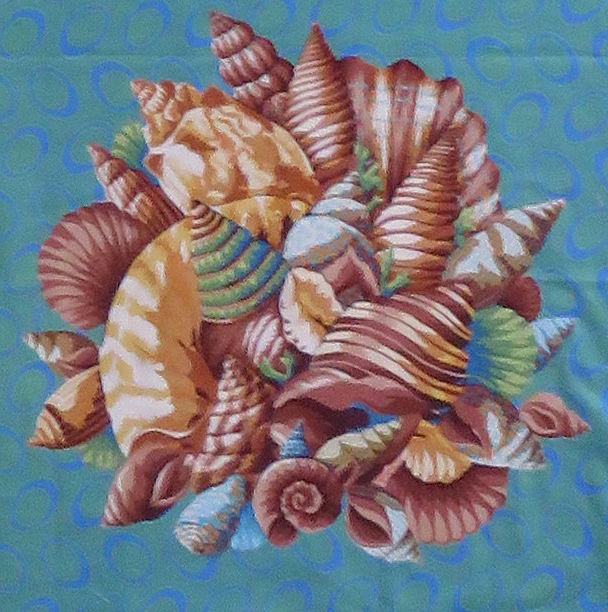
By September I had eventually made my fabric decisions, I had to make multiple versions of some of the panels – all in different colour-ways, but this gave cohesion to the busy design. I also added 4 shell corners, this was possibly the easiest panel to apply as the size was perfect and the shape fitted – just a few additions to balance colour.
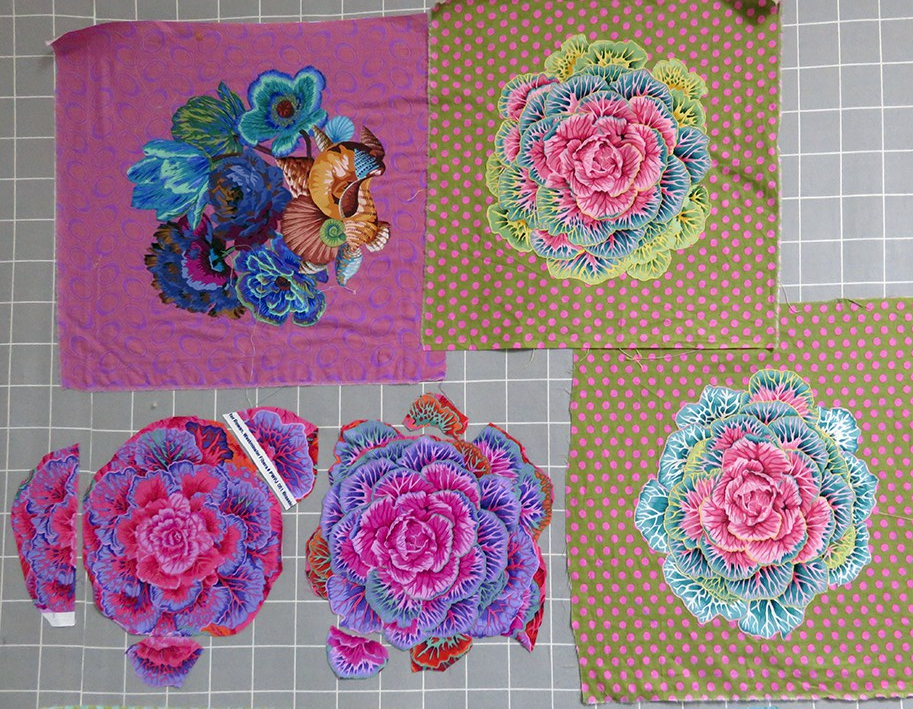
making larger Brassica panels
Above shows the development of the Brassica panels, they needed to be made larger by adding extra rows of leaves before hand sewing them onto the grounds.
The next stage was to add the diamond shaped patches at the intersections of the squares.
the added diamonds start to assert themselves
And this is when the panic started – suddenly this massive work, that had grown over months took off in another direction, these diamonds dominated the entire design – already busy, this was manic
The only thing was to keep going – too late to stop now – the samples below looked fine
hand stitched applique
sample of pinned Phased Stripe by Renaissance Ribbons
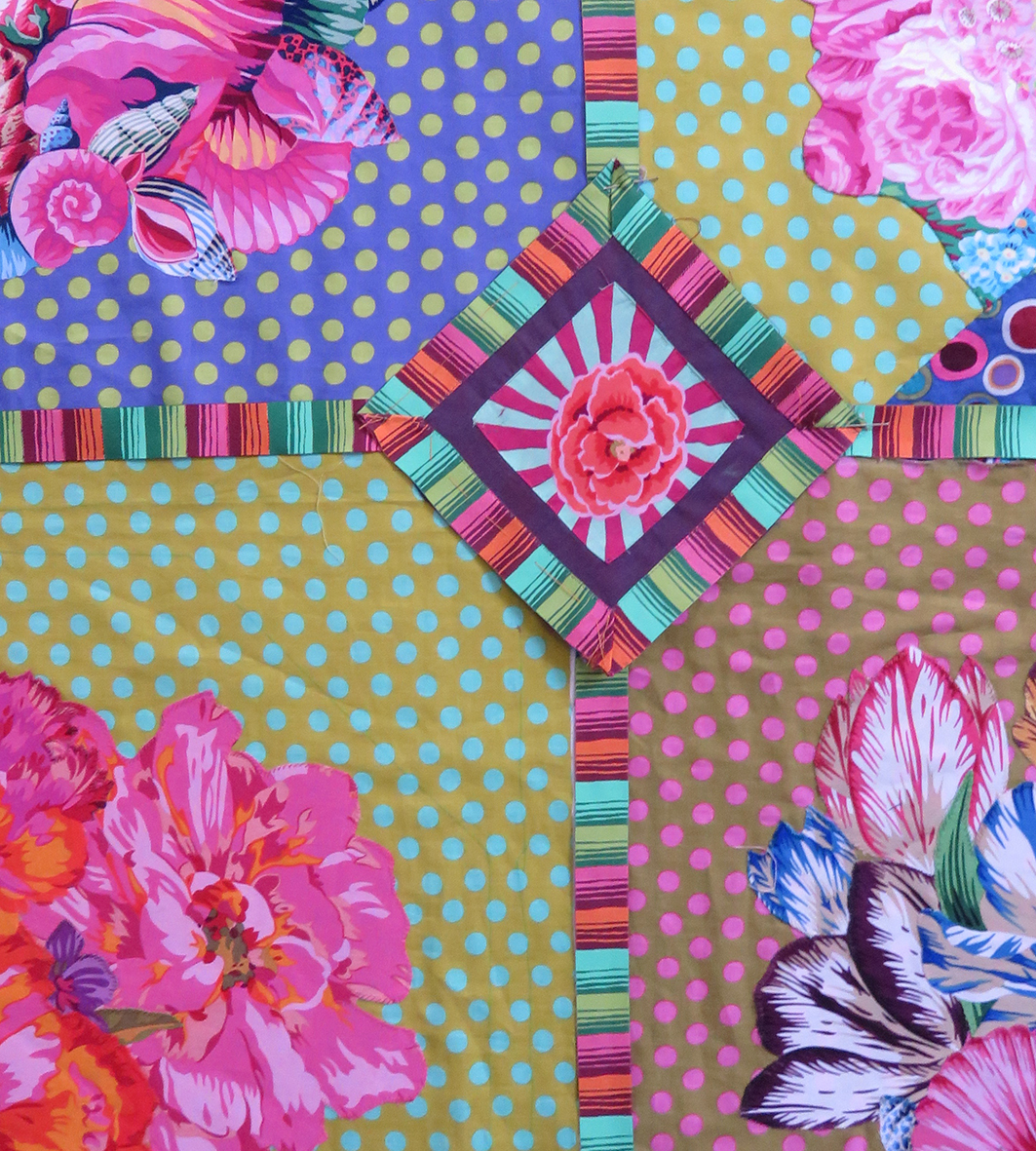
I started to applique the tiny cut squares from Kaffe’s fabrics, Sunburst onto Shot Cotton dozens of them, all hand stitched in 2 colours and I slowly added them to the quilt on the wall ….and the result below doesn’t have all the dividing ribbon strips yet!
without the addition of all the ribbons – hells’teeth!
This was beginning to look overloaded, so I called in my 2 trusted quilt makers, Julie Harvey and Ilaria Padovani – they have very sound taste in all things quilt, and I knew they would tell me the truth. They just laughed and said “well it is for Kaffe and ‘more is more’ with him – why are you worried’?
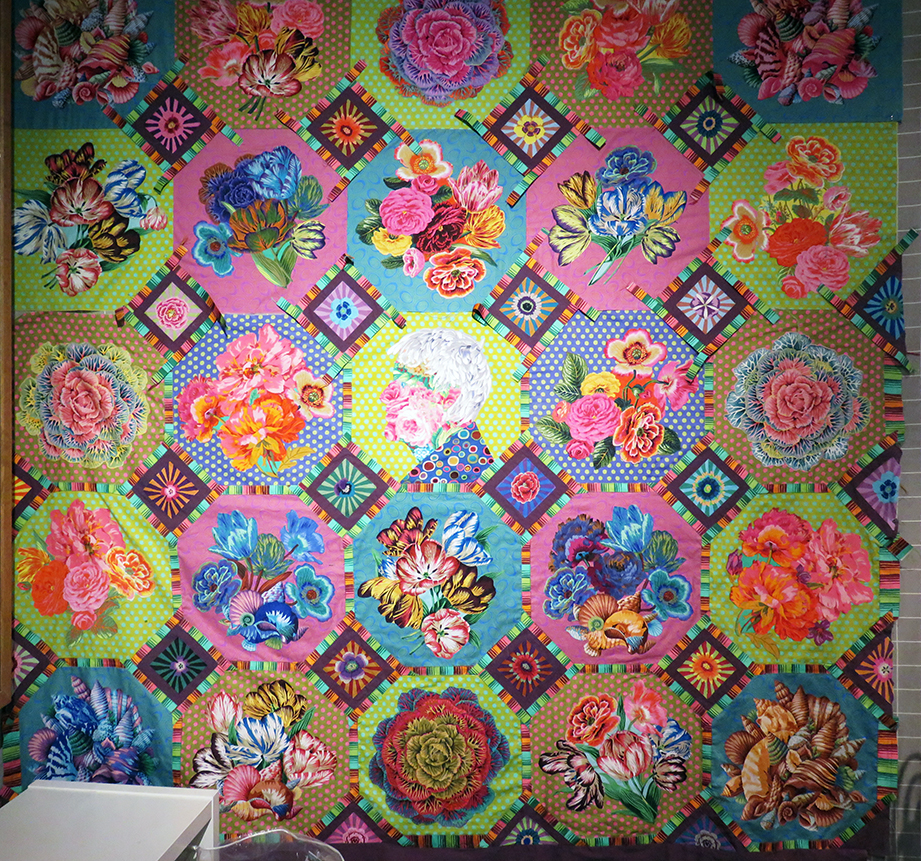
It was the addition of the ribbons, kindly donated to me by both Edith Minne, owner of Renaissance Ribbons and Brandon Mably (who was in on the secret) that tipped the balance of the work and I suddenly understood that the work had ceased to be mine – it was now Kaffe’s. This happens when you are commissioned to design and make stuff for people – you need to work with their ideas/tastes/preferences – otherwise they don’t pay you! But this wasn’t a commission this was a present, and it was all my own work – I realised now just how much I have been influenced by working alongside him.
the quilt starts to look like it belongs to Kaffe
So I machined in place all the ribbons – a mammoth task for a hand embroider! they were very tricky to manipulate especially as I had to split many yards of a wider ribbon to get the correct proportion, both Edith and Brandon were out of stock of the narrow version. Hey ho! Thankfully Julie machine stitched it all into position first and then I started to hand quilt all around my stitched applique – another mammoth task, but so rewarding, the quilt looks suitable wonky – in a good way – it looks very hand made
March 2018, finally finished – I thought!
It was completed in March 2018 but I had not time to deliver it; then Kaffe was awarded an MBE and I know I have to include this – so back again to the finished quilt
I made a sample first and then the real thing and appliqued it to the ‘finished’ portrait
portrait complete with medal
In Bath, where Kaffe and Candace Behouth, have an exhibition together based on Flowers , I delivered another set of 5 quilts for the next book and my “surprise”
And Kaffe’s reaction when he was shown it?
Worth every moment.. I made the sample into a badge for Brandon – this says it all!
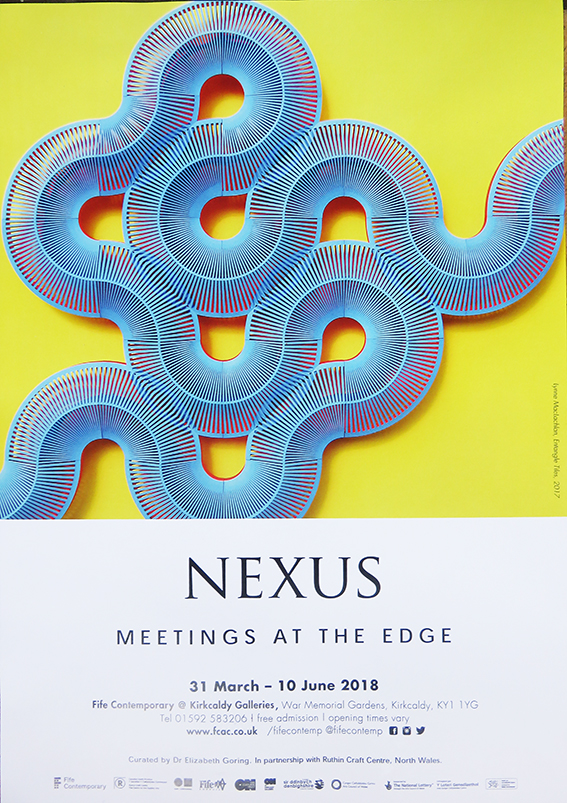
The night before the private view I had a dream that a giant version of the work featured on the poster ( see above) was writhing around the gallery walls and flashing strobe lights, while all the other pieces of work in the exhibition were equally massive and glowing while moving to – for want of a better word – ‘disco’ music: I thought – oh no! my poor flat patchwork!
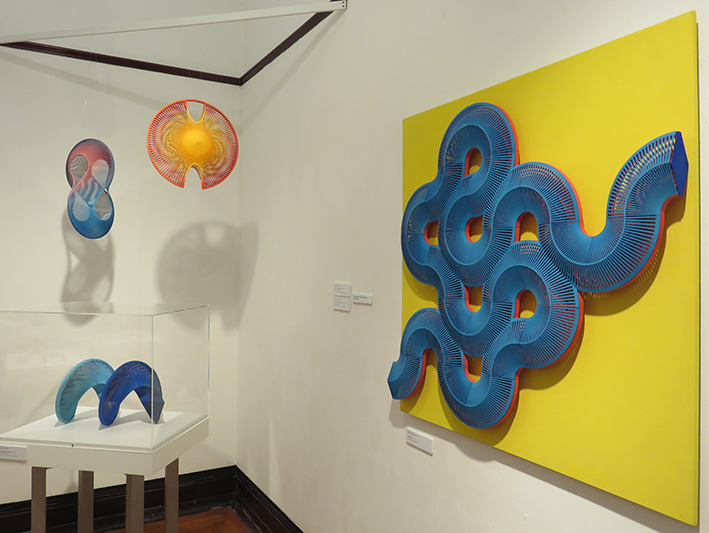
reassuringly static ‘ Entangle Tiles ‘ by Lynne Maclachlan
The featured work by Lynne Machlachan was on display with her other wonderful constructions in blends of strong colours they undulated around the walls and in the air. A panel of photographs showed them being worn, I hesitate to call them jewelry…
On reflection I feel that this work set an atmosphere for the exhibition; clear, strong, flat colour, immaculate attention to surface detail, and a definite sense of playfulness were qualities I enjoyed throughout the rooms. The only strobe effects were caused by overlapping patterns on a smaller scale in many exhibits.
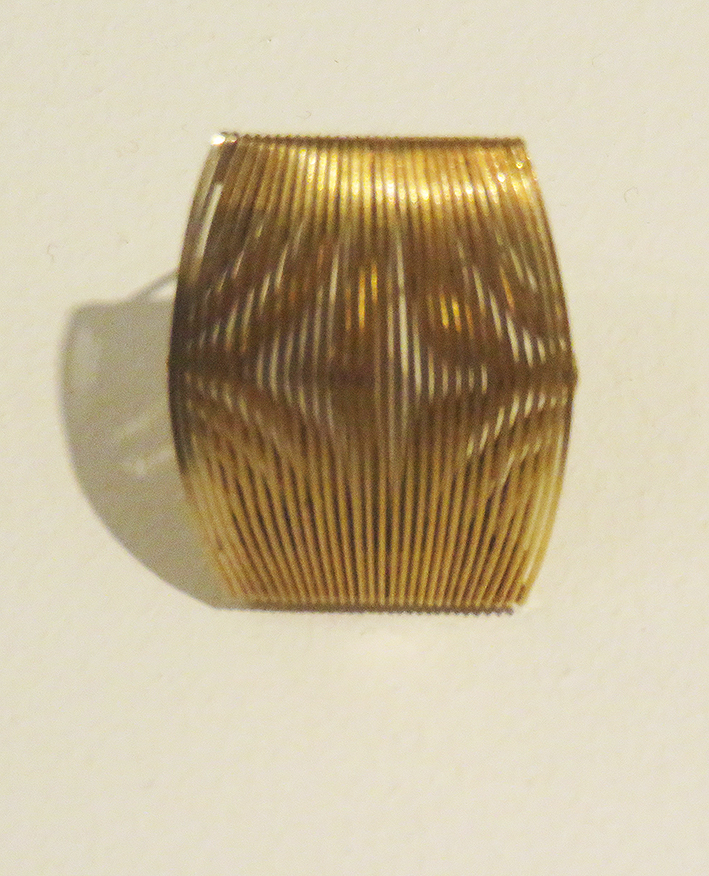
strobe effect in metal in tiny scale by Andrew Lamb
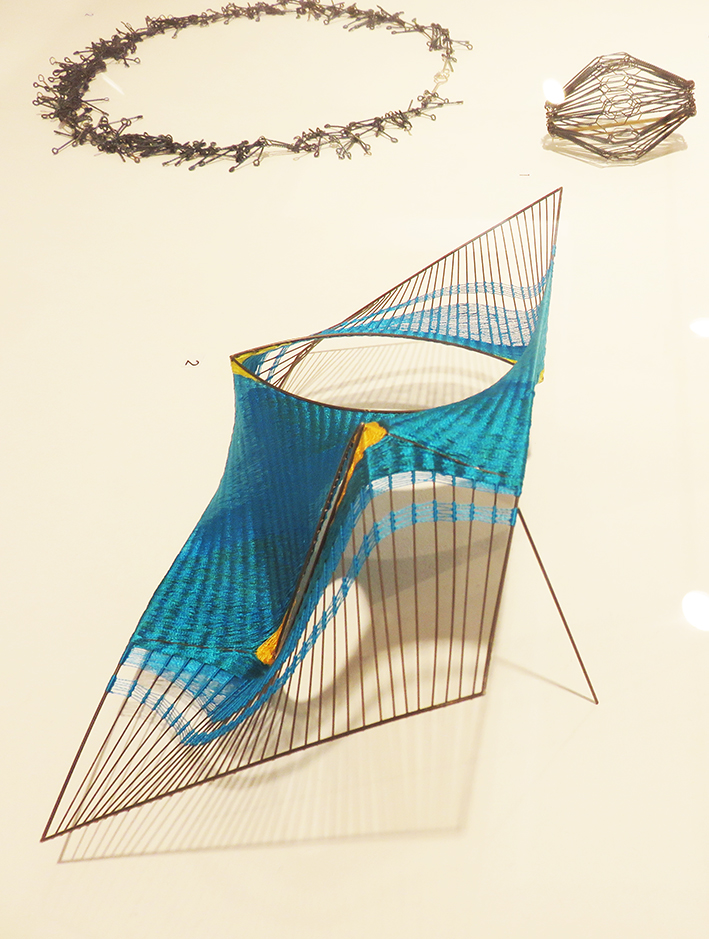
Whether by intention of the makers or sympathetic lighting on the part of the curators, the play of light and shadow were fascinating. I constantly returned to view the works of 2 makers who collaborated to show small woven metal constructions, Jonathan Cleaver and David Poston,
views of the woven metal works from different angles with metal jewelry work by
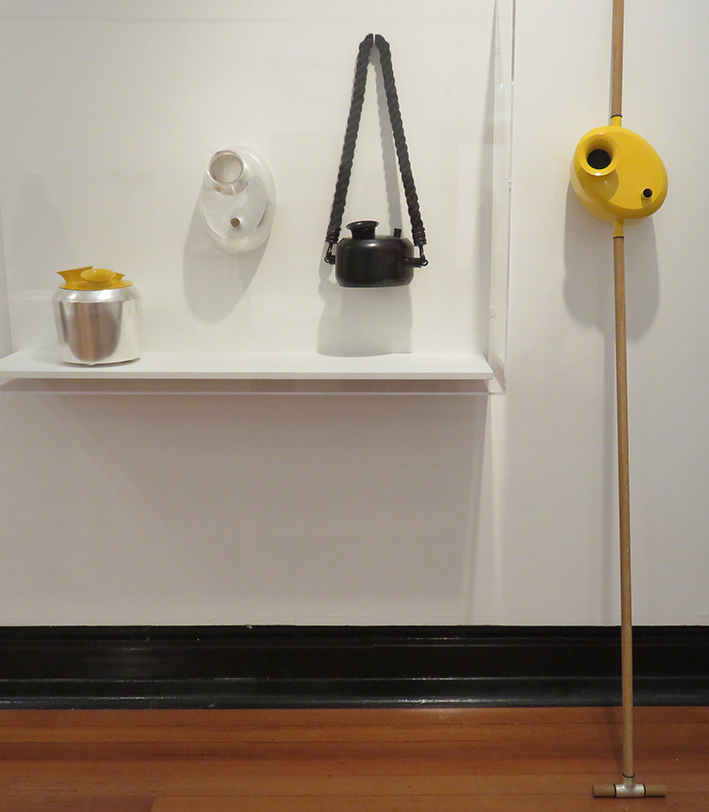
Even when I viewed larger scale works that had became almost installations in the way they were exhibited, the same themes of flat brilliant colour and clean elegant construction were apparent – and the use of this singing yellow and metal together.
colour and pattern throughout the exhibition links very disparate materials and ideas
machine embroidered coat by Jacky Puzey echoes the metal sculpture beyond
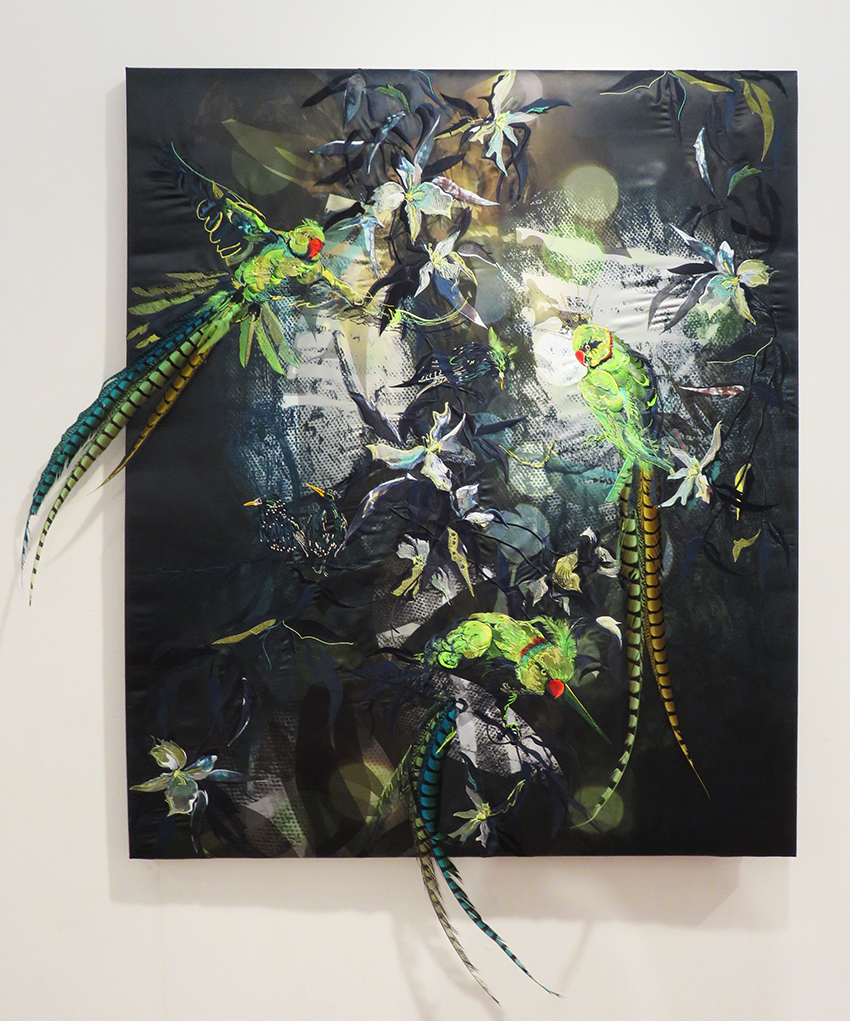
The machine embroideries of Jacky Puzey echo both colour and form when seen against the metal sculptures. Her large dramatic panel of birds is a real master class in placing together disparate materials and media so that they flow easily one into the another.
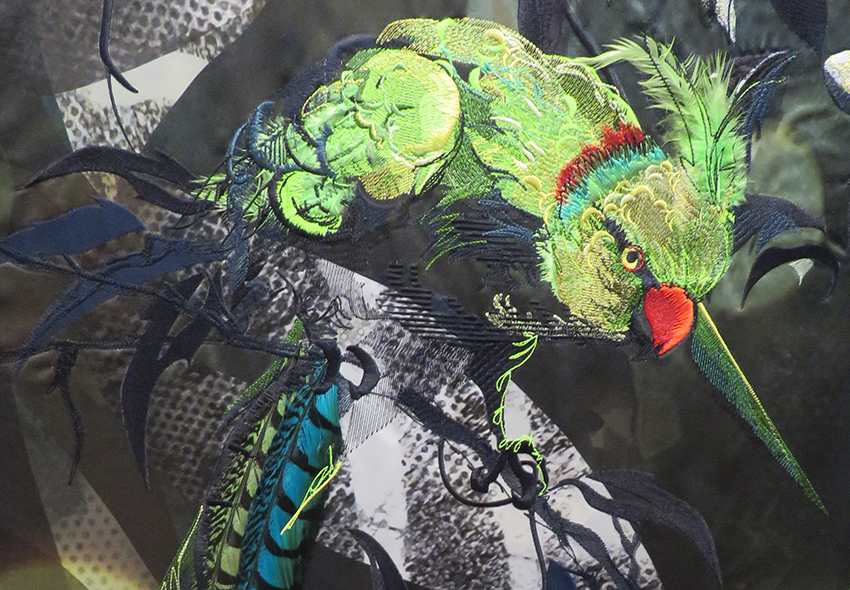
machine embroidered parrots in thread and feathers. Jacky Puzey
detail of embroidery and fusion with feathers – harder than it looks here!
The degree of skill on view within the exhibition is made apparent in different ways, certainly to change or add new materials to your original practice makes you concentrate on the “joins” and here nearly every piece of work combined either 2 or more materials or the makers had transferred the techniques of one discipline to another…or they made juxtapositions of natural with man made found objects – never easy.
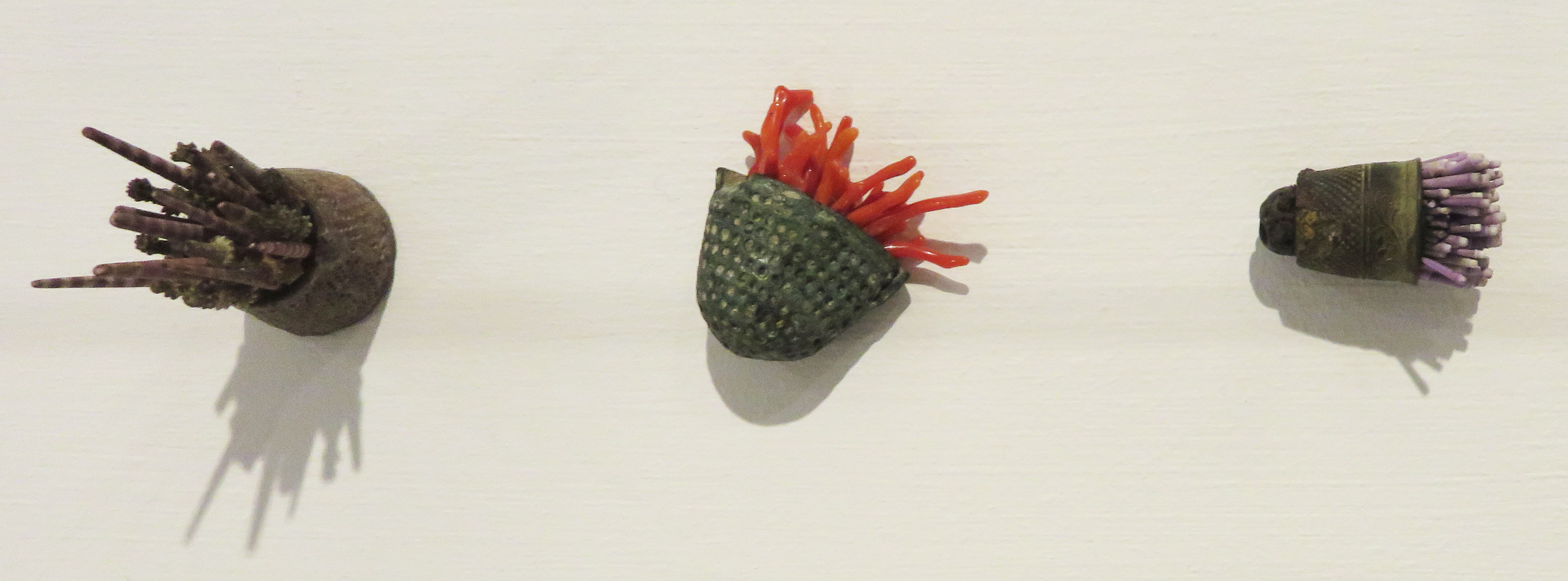
Ancient bronze thimbles carry coral and sea urchin spines, like tiny offerings to the goddess of stitch! And there were boxes made from a metal shield mount, still with tracings of old patterning mounted with diamonds.
One of the major themes of the exhibition is the transformation of one material to describe another and there were many examples including my own.
One of the advantages of Private Views is to meet up with other exhibitors, I often find that talking to people work who work totally differently to me are always stimulating. I was introduced to Valeria Nascimento and we spent some time together discussing our very different work. as we walked we both stopped and gazed at the work of Anna LorenzIt is intriguing; you just can’t guess the material ( well I am a maker and stimulated by materials) It looks like unglazed porcelain or paper porcelain, or unfired porcelain, or paper or felt or…. or….but it is news print; and it is perforated, but how? Valeria and I were looking behind it, inside its layers and I took this image of the gradated shadow it threw – so much a part of its complete and compelling mystery.
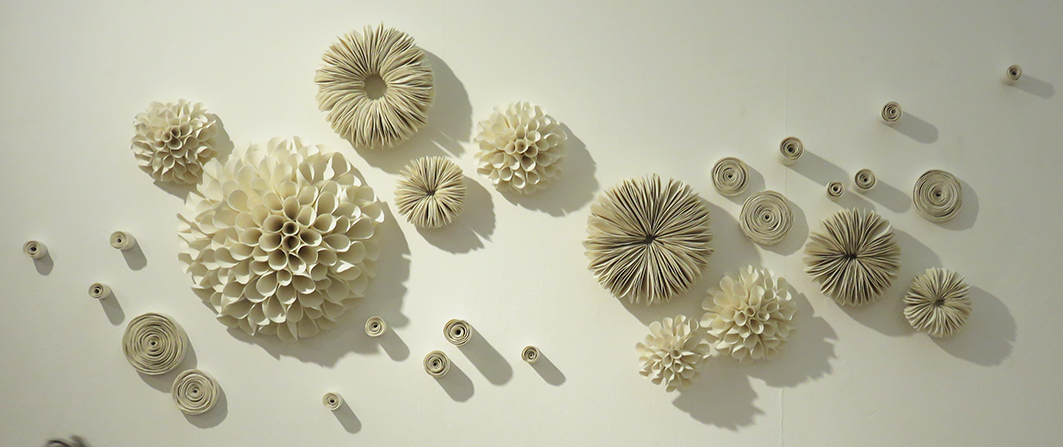
Arriving at Valeria’s work I realised that I had photographed it as soon as I walked into the gallery, drawn to the far wall of what looked like bleached shells and sea creatures.
porcelain ruffs and spirals
Her table of porcelain jewelry in stark blacks and whites really intrigued me, the fluffy neck pendants and the massive rings and brooches are not to my personal taste but their presence and implication of natural forms through simple and sympathetic use of her media, just made me want to hold them – and that’s why we go to exhibitions isn’t it – to extend our imaginations and ideas.
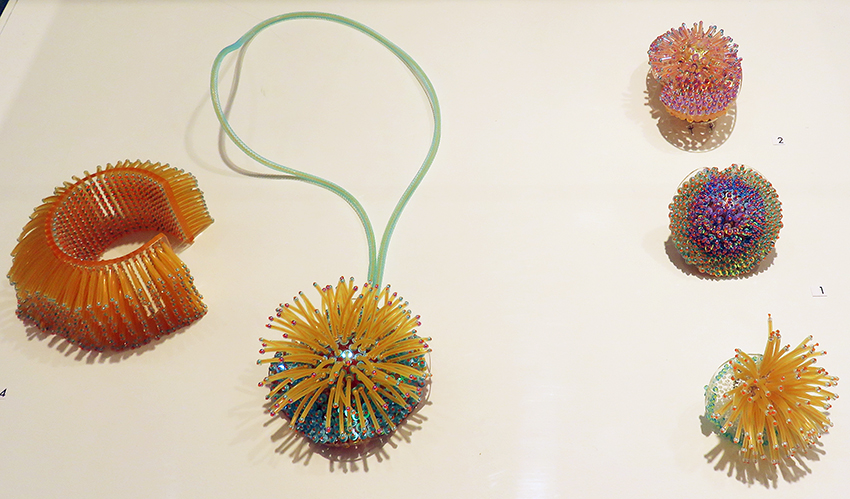
Sea creatures emerged as inspiration in the beaded work of Wanshu Li, translucent and iridescent tentacles of colour made up large rings and bracelets.
photographs of jewellery by Wanshu Li
and accompanying her work were high contrast photographs underlining the quality of deep sea beings… looking at this work made me see a fish in an adjacent vitrine.
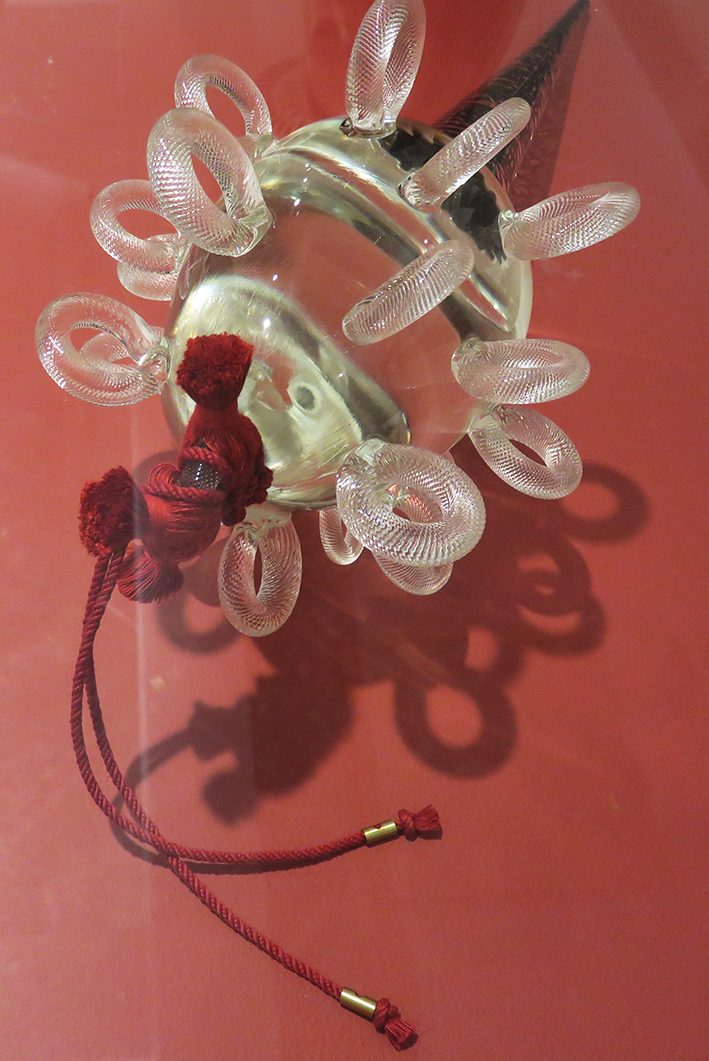
strange fish emerges from the glass work by Kate Haywood
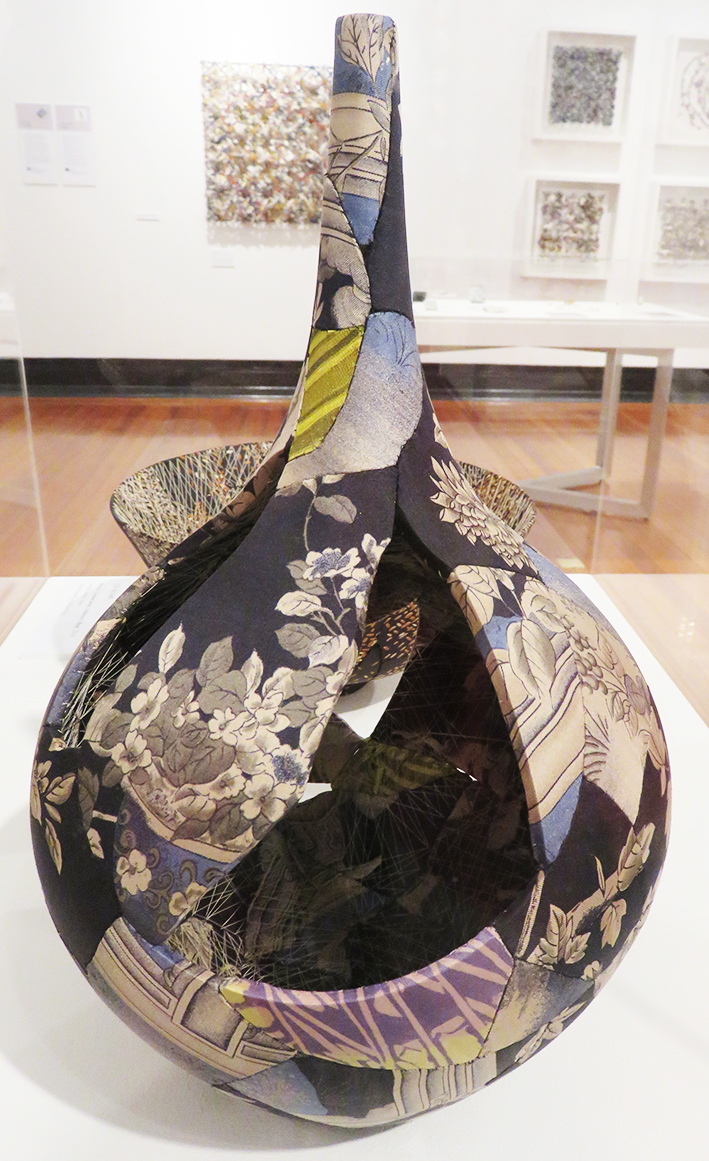
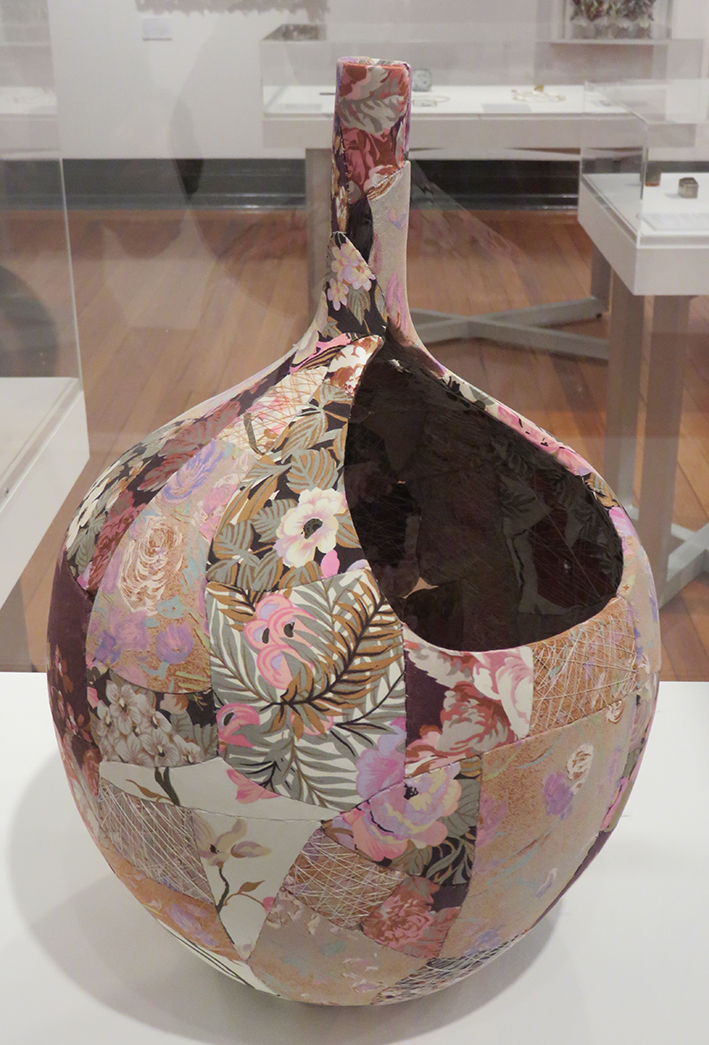
Every once in a while you see work that just makes you jealous and wishing that you could have made it – the work of Zoe Hillyard really stopped me in my tracks. First it was beautifully thought-through and formed, second it reminded of work that I had made previously, and third – I wished that I could have used it for an exhibition I co-curated some years ago – Mending at the Museum.
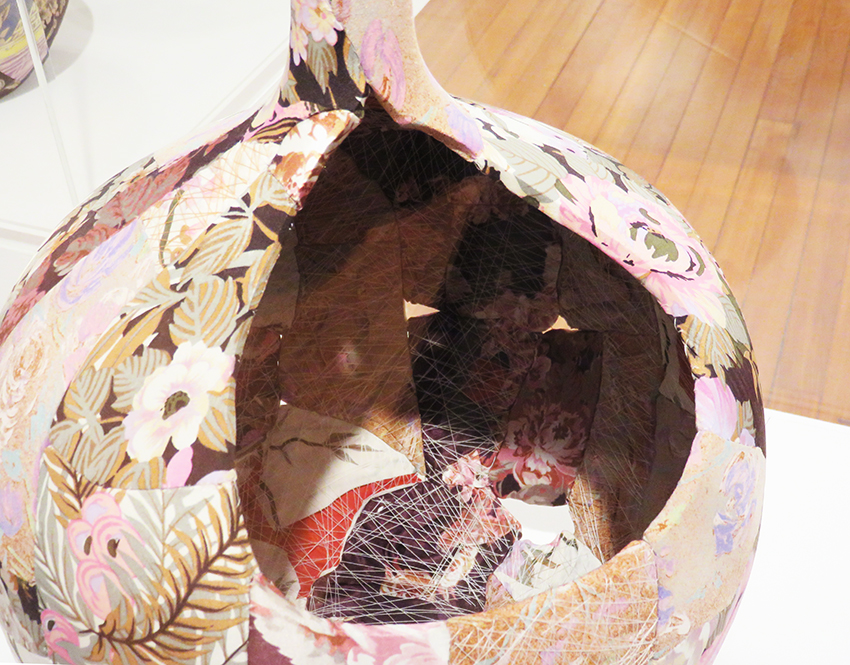
broken ans mended jar using fine fabric.
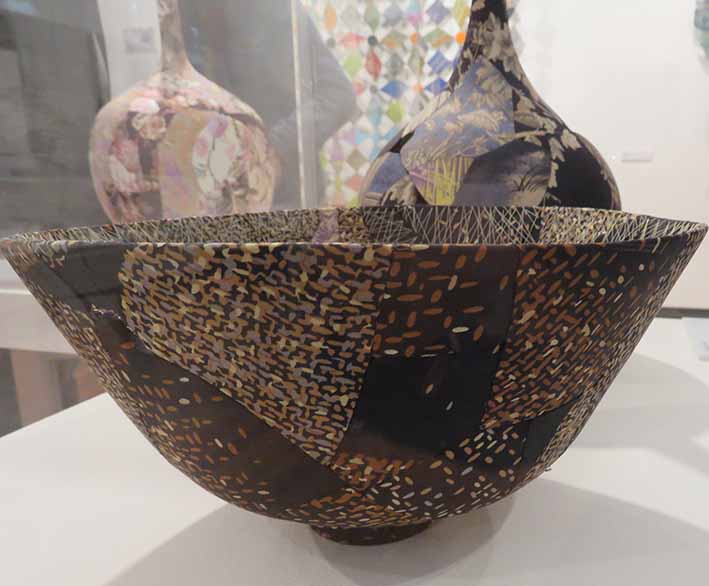
I had actually tried a similar exercise when I was working on ‘mending’ ceramics – but it did not look like this; here are elegant breaks, refined textiles wrapped and stitched to perfection and the soft colouring entirely at one with the materials – it is patch-worked!
I really appreciated this work, especially her dense stitching on the inside of the pieces, used to draw the fabric tight against the curves, she managed to make this as decorative as it was functional. Just so desirable and a perfect transference of materials and ideas – and she made the jars then smashed them herself!!
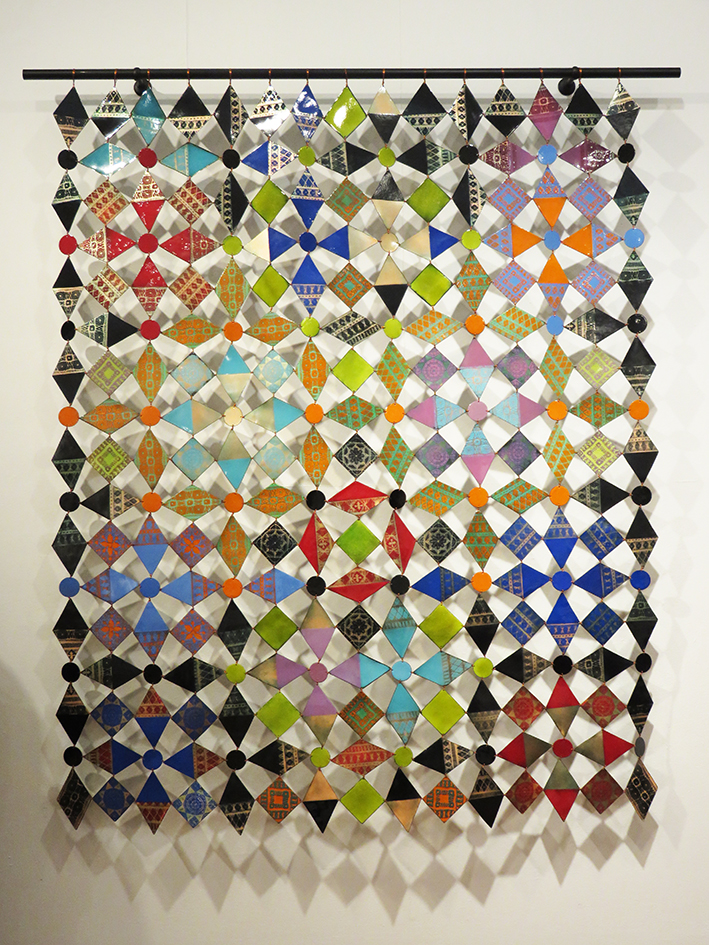
I cold go on and on about the ideas, images, thoughts and provocations elicited by this exhibition – but now show that finally, after months of work, the Patchwork Enamel was successfully transported and hung and here it is complete with shadows…
the first fabrics chosen for the quilt using the planting story board.
My latest commission is to design and make a patchwork quilt to be placed on a bed in a show garden for this year’s RHS Flower Show at Tatton Park. This is the idea of plants-woman and garden designer, Julie Dunn, And I think that her design is really intriguing – to make a garden for recuperation and healing, full of scented plants and herbs that aid relaxation plus a double bed in which to rest.
When Julie first contacted me, I responded by asking for her ideas for the atmosphere of the garden, particularly her chosen plants, so that I could give her some fabrics to consider.
original and amusing plants and atmosphere visuals for the garden
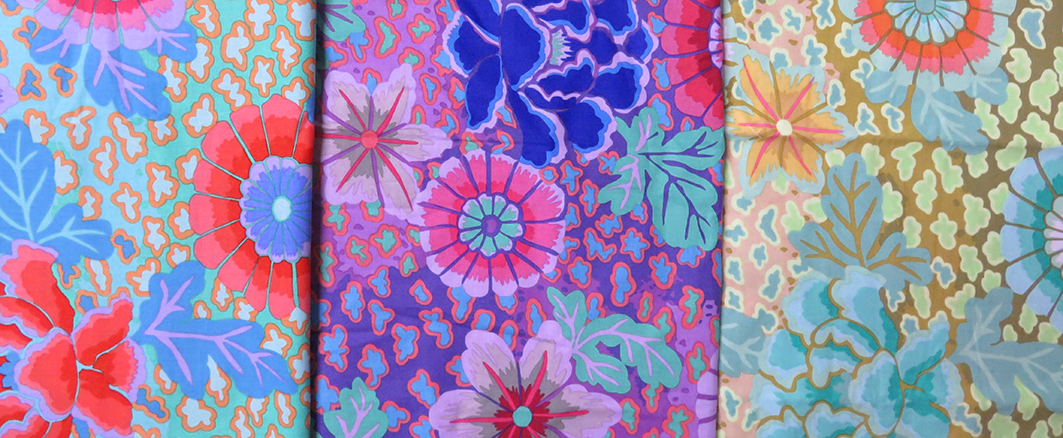
She had very definite ideas of the actual fabrics that she wanted – they were by Kaffe Fassett and they featured flowering plants, most notably Brassica – the classic fabric featuring flowers that looks like roses but are in fact cabbages.
1 co-ordinated fabrics surrounding the favoured Brassica fabric
I pulled together several colour “stories” to choose from. although they are similar they give very different overall tones – I wanted the quilt to reflect and augment the garden, not overwhelm it
2 grey version of Brassica with co-ordinates
The sheer scale and incongruity of the bed in the small ‘Back to Back” gardens in the show, means that it will dominate if we are not careful with the pattern and the colours
3 brighter, green and mauve colourways
The large enveloping quilt needs to give a feeling of comfort and protection as well as being light-weight and warm whilst the sleeper is wrapped up in it. I already knew what the backing fabric would be – Dream, one of my favourite Kaffe Fassett fabrics.
“Dream” fabric design – which colour to choose for the backing?
Julie and I spent a day in my studio, and with her visuals pinned to the quilt wall, we started to develop a design together. I wanted a very simple quilt design with large scale patches, as although a decent hand-stitcher I am not a happy machine stitcher, particularly with the precision needed for patchwork.
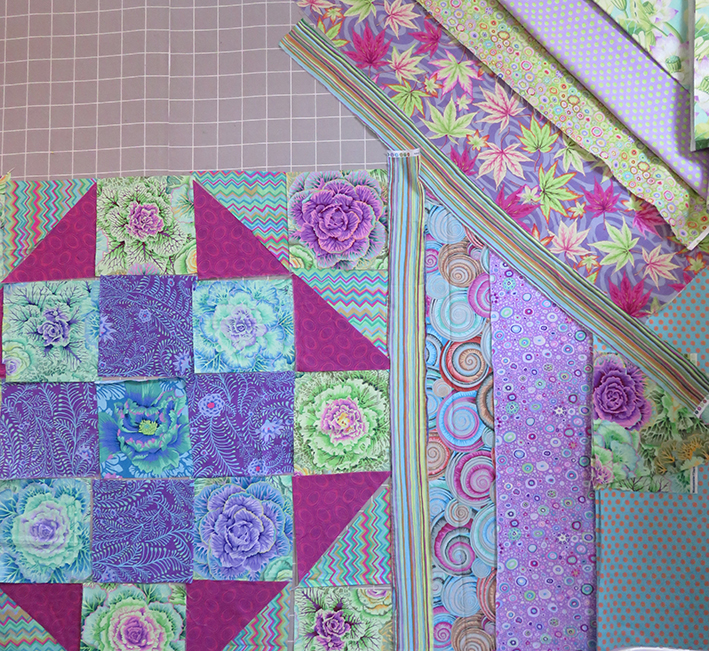
Working with the first of the colour-way choices shown above, I cut simple large scale heads from several shades of the Brassica fabric and simply made a chequer-board formation with them. This first attempt look too strongly coloured, but the simple square format was good as it showed the full ‘flower’ heads of the cabbages. But the simple deep pink strips looked too solid and they would dominate the entire quilt, we needed a more subtle variation. Cut into triangular sections, the square becomes a diamond
the next step of the design with the planing plans on quilt wall.
Julie was happier with this softer set of fabrics; strangely adding more patterns and colours often makes a design more subtle, the secret is to work within a tonal range – these red triangles dominate here – they may have to go eventually!
design development with more borders
I tried to balance the deep colour with a strong striped border but the dark blue stripes make the centre even more dominant. Julie wants the magenta red to stay as it is exactly the colour of a chosen Sanguisorba – I take her word for it.
re-arranging the strips of fabric to build up the medallion design
working on through the afternoon we slowly we start to feel that the colours, although strong, are softened over all and now enough of the quilt is decided for me to carry on developing the design from here.
the colour balance is better, the flashes of magenta ‘Maple Stream’ leaves help.
The actual quilt needs to very large, Julie’s vision of it is to cover the bed almost to the floor, this useful as I see the bed to be a type of extending couch- a day bed. Julie sees a four poster!
the mood board for the bed element
We turn our minds to the application forms and read them extensively and decide that I will illustrate the envisaged quilt on the envisaged bed in the envisaged garden…this I can do more easily than make the quilt, having illustrated all sorts of ‘envisaged’ designs for gardens, plants, embroideries, fabrics, enamels, clothes…..so I offered to illustrate the whole of the garden application.
my first rough idea of how the bed will look when dressed.
We discuss the problem of the English weather, even in July, we will need a canopy. I imagine that you would not use the bed when it was raining, but at a pinch could hide under a canopy at the head of it – if we use a day bed. But the vision of a real romantic bed with curtains is still the main aim. This is when as a designer, you have to really listen carefully to the client – and try to find a compromise; a drawing, even a scrappy one often makes your point, the metal sub-structure of the canopy will dominate the small garden.
the final illustration for the application.
Of course the one thing I felt I must do was to inform Kaffe Fassett of our plans. So at our next quilt design meeting I showed him the scribbled design drawing and the other garden plans and asked for his “blessing” for the project and could he sponsor it with his fabrics? His immediate reaction was to offer more suggestions about the design using lots of other fabrics I could use.
I am leaving the next stage of illustrating the garden for the application for another post – watch this space.













































 Sea creatures emerged as inspiration in the beaded work of