Everyone loves children’s art – either drawings or paintings; the pictures always have such energy and capture the spirit of the thing depicted – real or imagined. So when a visitor, Nadia Lanman, came to Heart Space Studios, to view my exhibition of ‘Mending Mottoes’ and asked if I would be interested in a commission to stitch one of her daughter’s drawings, I accepted at once – thinking “this is a challenge”
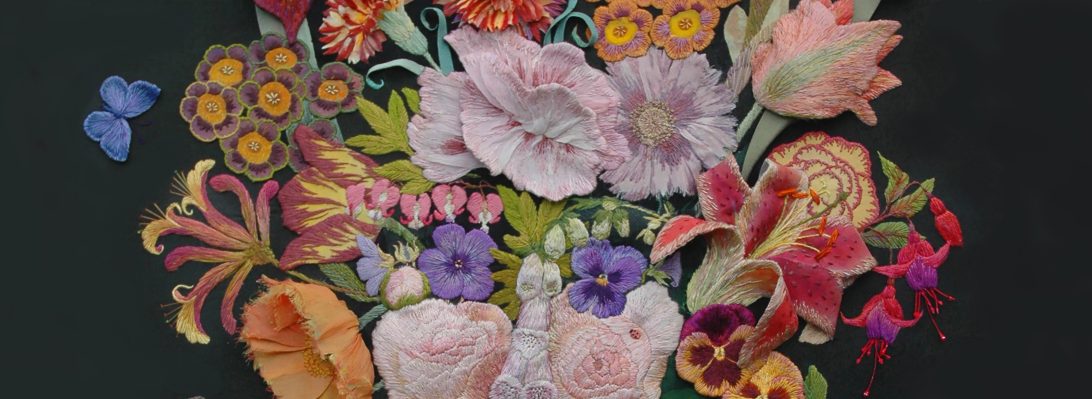
I asked to see several paintings and drawings so that we could make a decision which to depict, and really to see how difficult a challenge it would be. The price was also considered at this initial point as this was a thank-you and leaving present for the nursery school that 4-year-old Lola was leaving to go onto her primary school. Nadia brought in several, some simple line drawings and some full-on paintings. It became clear that Nadia really liked the rainbow painting (at the top of the post), water-colour paint on sugar paper…so typical of all children’s art – this was going to be a real challenge! It is one thing to stitch drawings but poster paint loaded on with energy ?
When we discussed pricing the piece I advised Nadia to go and buy a frame to keep the costs down; framing is really important but can be extremely costly, so I suggested choosing an A4 size as this was roughly the scale of the drawing papers that she had shown me – and an A size frame is easy to access; I promised her I would customise the frame if necessary.
Meanwhile I set about sampling the way to achieve the full-on colour.
first colour samples on shot pink silk
The first thing to research was the background colour, I found a yellow and pink shot silk fabric, that was about the same colour but slightly brighter than the sugar paper, this would save me having to dye the fabric – but how to get some background colour onto it first before I stitched it? i tried fabric paints but when dry it was like stitching hard leather. I needed the rainbow coloured in so I would not have to completely cover the ground with hand stitches – too time consuming, too expensive.
iron-on fabric dyes in pastel form
selecting thread colours to match paint
The next thing was to choose the threads. I had decided to stitch the whole piece in running stitches, this is the first stitch everyone ever learns to sew and it always looks both simple and innocent, so is a fitting choice for embroidering children’s art. Also I have used it a lot in my recent work, particularly when embroidering writing. I did think at this stage that machine embroidery would have been quicker to achieve the impression of saturated colour, but I am not a happy machine stitcher and felt that the mechanical aspect wasn’t in keeping with the subject; simple hand stitching was really the perfect technique to choose
I tried several yarns, silk and cotton and cottons and eventually chose a mixture of both, whatever would suit the paint colours.
directional stitching sample for rainbow and writing
I had photocopied the drawing and reduced the scale, to fit the frame, and to keep my fee as low as possible. I then drew onto this the direction of the paint brush, actually showing how Lola had swept the paint onto the paper, the lines would become running stitches, but first I had to sort out the message that Nadia wanted to send to the teachers on Lola’s behalf. “thankyou for my wings love Lola xx”
cut out photocopy and writing placement for the working drawing.
I had asked Nadia to get Lola to write it on a separate sheet of paper and then I traced it into position onto the photocopy – previously I had cut out the photocopy to gauge where to put the writing – a copy of this became my working drawing…..I have my own arcane ways of getting there!
I found this stitching really interesting, it had to be kept simple but needed to show the rhythm of the painted bands. Sadly the pastel once that it had been ironed to fix it was a bit too dull – but hey ho – it helped things go smoothly and quickly. What also helped was to draw the directional lines straight onto the dyed areas with a water-soluble pen to keep a track of the flow, they can be seen on the yellow band above. The last thing to do was to stitch the message again in running stitches, then wash and stretch the work and mount it in the frame.
finished and stretched embroidery
I so enjoyed this relatively simple stitched commission ( in comparison to the recent Thangka) that I thought it would be a good idea to run a class and now that I have sorted out how to express the rhythms and colours of paintings I think that I can show other people how to embroider their own children’s drawings – they would make great presents for anyone in the family. And when I told Nadia how her commission had inspired me to develop a new class, she immediately signed up for it!
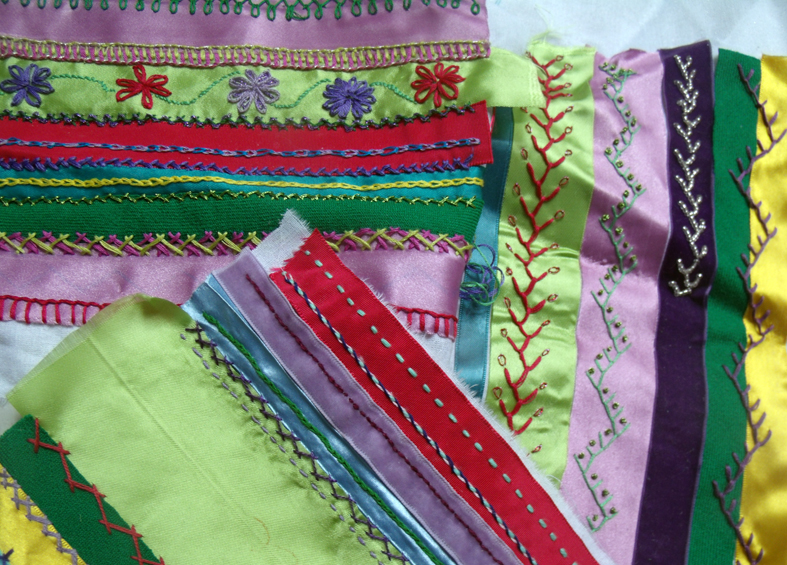
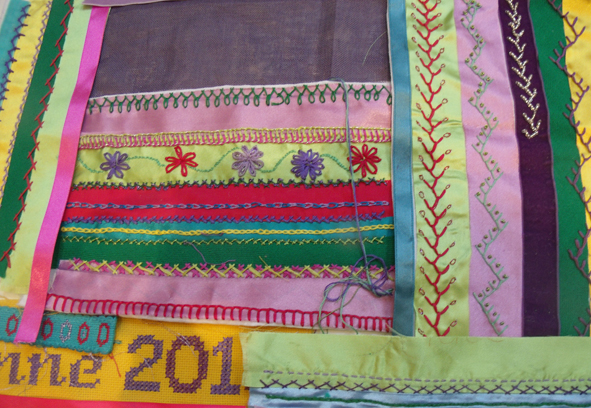
Crazy stitching on a Crazy Patchwork by Naomi Clarke from a recent workshop at Heart Space Studios
Crazy Patchwork classes have always been popular at Heart Space Studios and several people asked me to teach them more hand embroidery stitches, so I started a course called Crazy Patchwork Sampler. The course is built around the sampler that I made for my book, Crazy Patchwork, published in 1998 by Collins and Brown – it seems what goes around comes around……
my book of Crazy Patchwork ideas and designs.
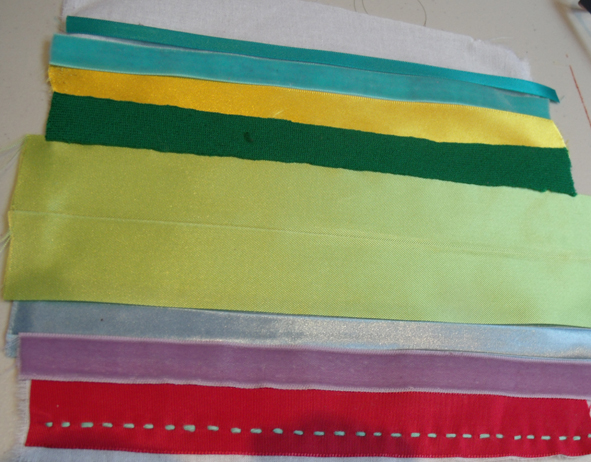
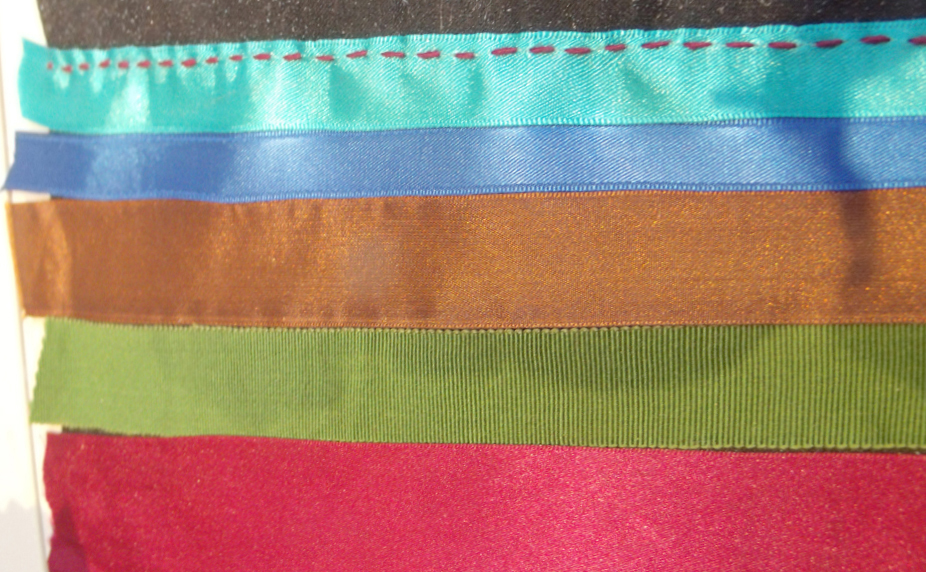
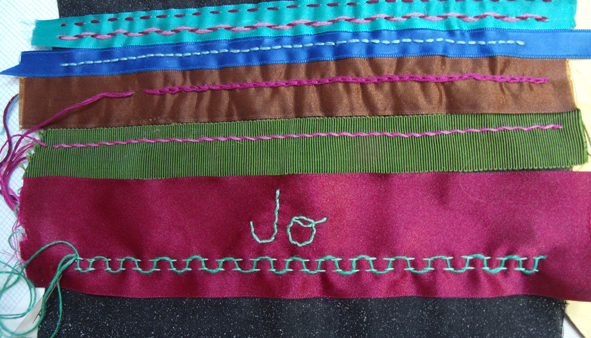
For the FIRST WORKSHOP I started off with the absolute basics, first we chose the colour scheme – I supplied various ribbons and fabrics for people to choose a small group of their favourite colours: this takes longer than anyone imagines it can and causes a lot of negative ideas to flow as people are usually very nervous about using colour, but I have learnt that this choosing is really important as eventually by using the same set of colours in various patterns and proportions the finished piece can be made harmonious.
strips of ribbon ironed on to backing fabric
first chosen coloured ribbons
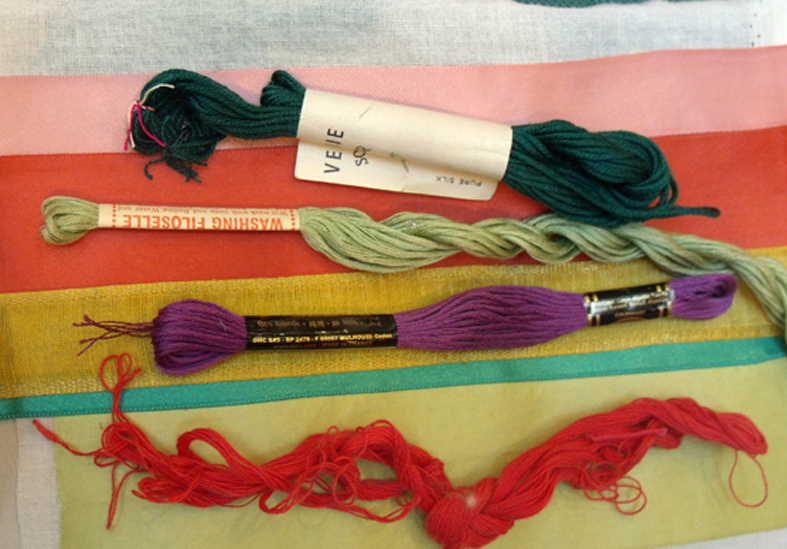
Most people, to their own surprise, choose colours similar to what they are wearing. The next choice to be made is the threads – I ask them to choose similar colours to the fabrics but to stitch in complementary coloured threads – so that the stitching will show up.
choosing complementary coloured threads
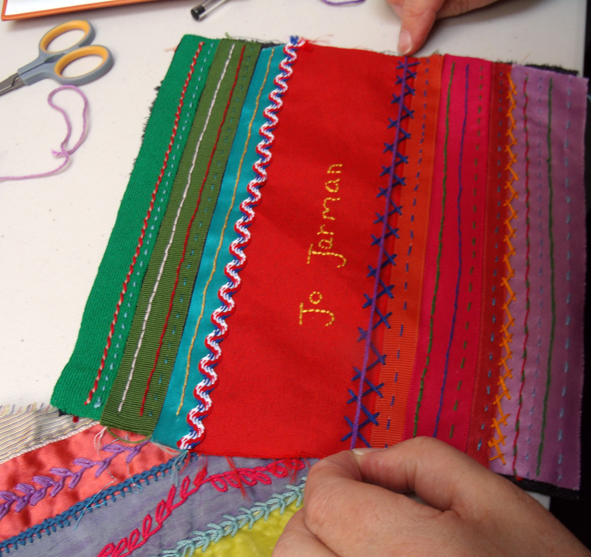
The first sampled stitches are the straight ones – running, back and all the variations, easy does it….but it also includes writing a name…very simple but very effective for the first workshop. There are various methods of writing onto fabric so that it can be embroidered and we start with the simplest by using a water-soluble pen or the old-fashioned transfer paper still used by dressmakers.
the maker’s name worked in back-stitch over water-soluble pen.
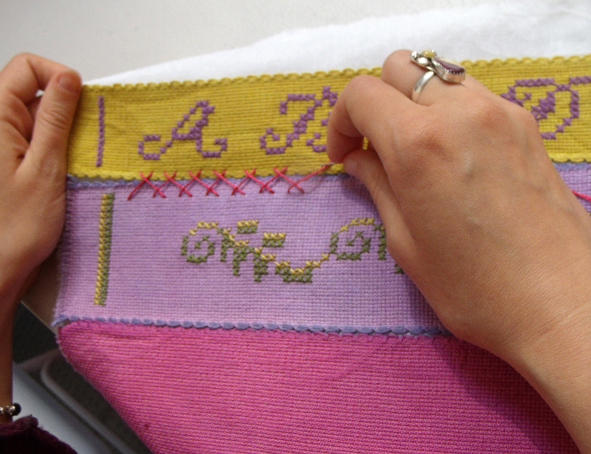
The SECOND WORKSHOPsession was cross stitch, counted and herringbone – which is the main stitch I use for joining the patches together. The group was still concerned about colours, but I assured everyone that we had a long way to go and plenty of opportunity to make the whole sampler work in harmony – I was delighted that they had all done ‘homework’ and had finished the first workshop’s ‘patch’ and found more variations to add to the straight stitches.
finished patch from first week being decorated with herringbone stitch
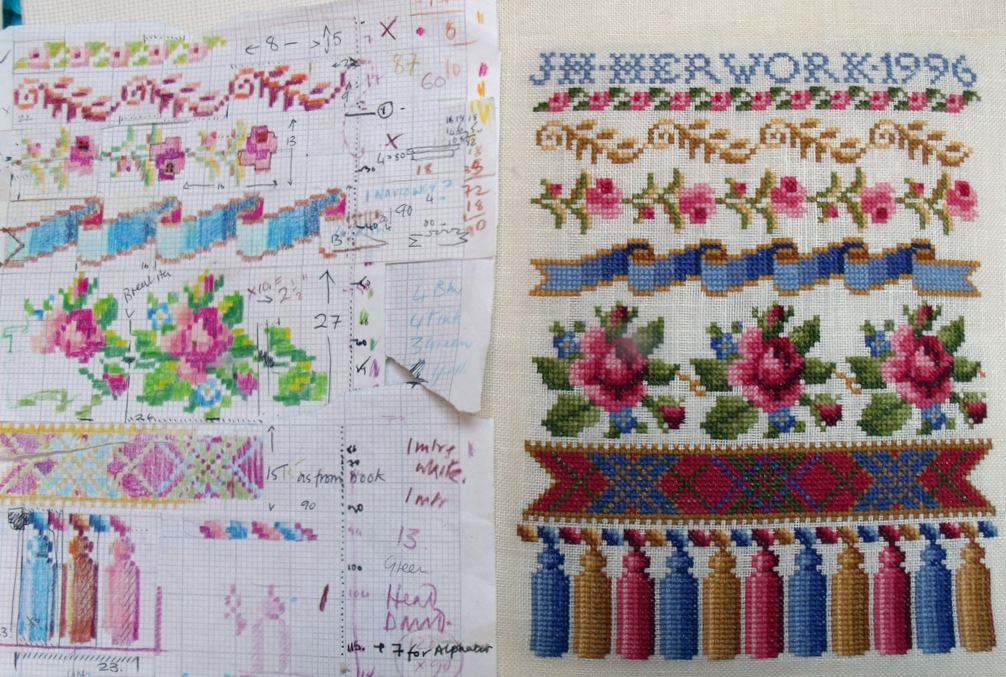
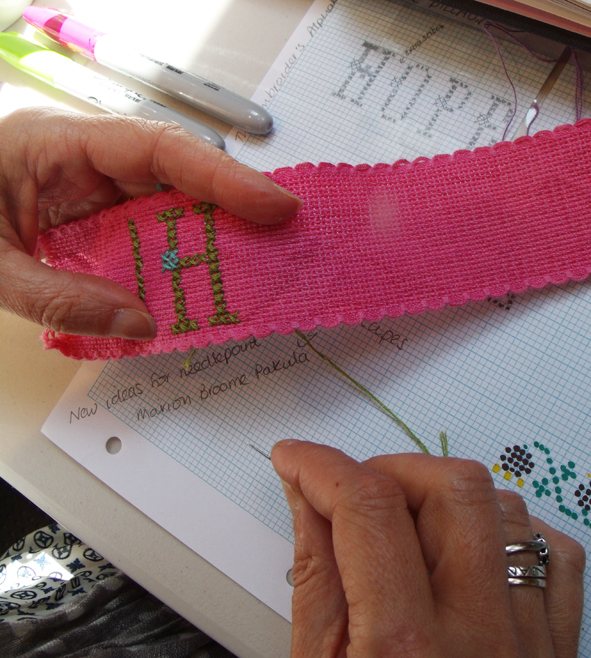
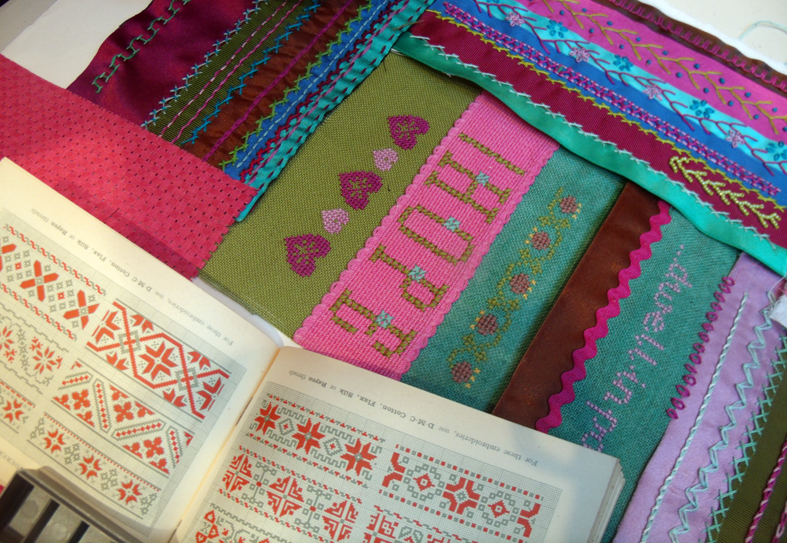
Counted cross stitch is another way of embroidering letters and numerals……
my working chart of cross stitch motifs for the accompanying sampler
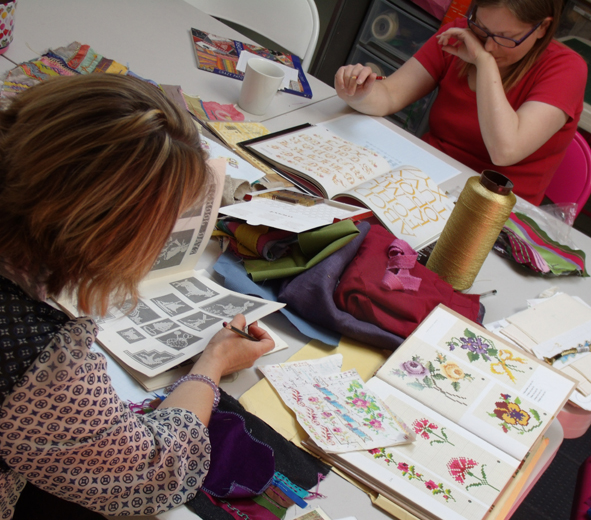
There is a whole world of cross stitch motifs and I like using the traditional ones – to illustrate the technique of charting for cross stitch I showed them some old work of mine that was designed from vintage needlework manuals. I still work as a freelance designer for a canvas embroidery company, Ehrman Tapestry, where I sometimes use similar charting for some of my designs, even though the stitch for tapestry is tent or half crass stitch. So I have lots of reference material and the group spent an hour of the 3 hour session looking at all my books and notes before they began charting their own designs.
Jo and Helen choosing cross stitch motifs and alphabets from my reference book
The task for this second session was to chart a name and date as well as a small multi-coloured motif and to stitch it onto the counted thread fabrics.
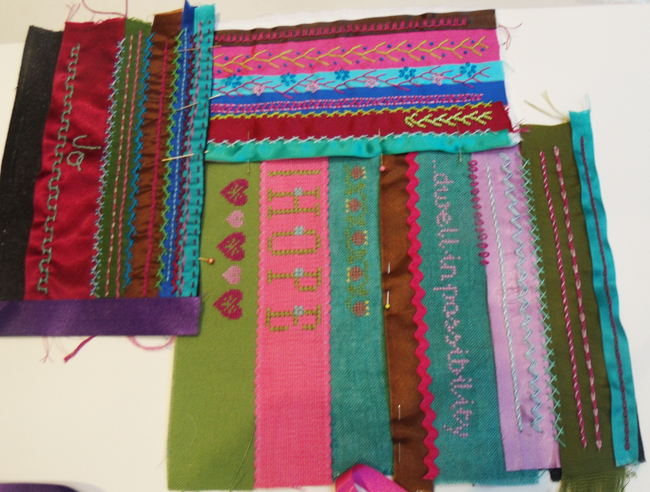
Jo decides to chart and stitch HOPE – she s going for an aspirational crazy sampler.
choosing the colours from a limited range of counted thread fabrics involves creative use of colour
Helen uses a shaded red thread creatively to harmonise her cross stitch samples with her first straight stitch patch
it is interesting how the maker’s character soon emerges from their choice of colour and letter forms, above Helen’s looks strong and directional while Sophie has chosen elegant letter forms and motifs ; the colour combinations are similar but the proportions are very different
cross stitched bands being cross stitched together
By the THIRD WORKSHOP the patchworks are starting to look very rich and there is less uncertainty about colour choices, everyone seems to be enthralled by this process and are bringing in finished pieces that they have developed at home alone….everyone comments on how good it is to just stop for a time and concentrate on their stitching.
2 finished ribbon patches with 3rd ready to be embroidered
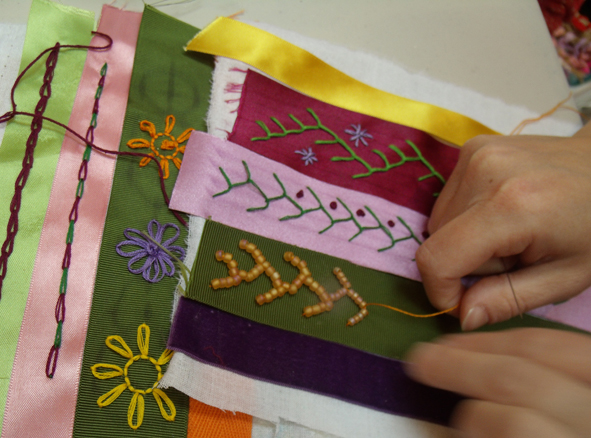
The third week is supposed to be looped stitches – chains and lazy daisies and feather, but we have to spend some time catching up on herringbone as the counted cross stitch took up most of the last class at the studio.
looped stitch patch of chain, lazy – daisies with feather variation being worked in beads
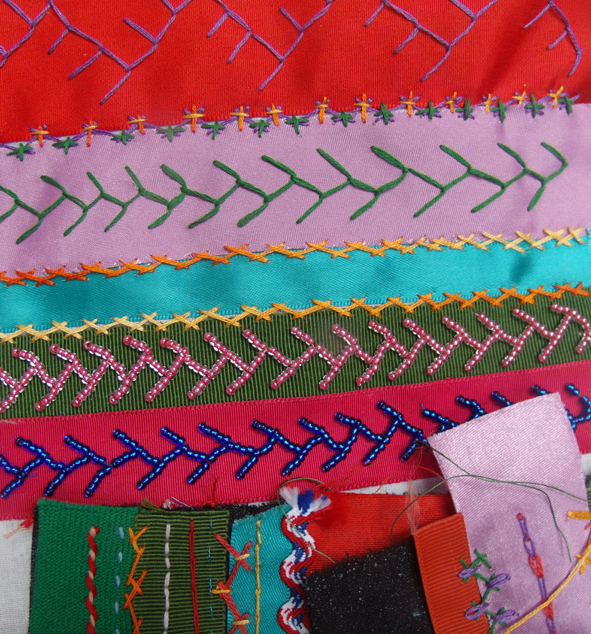
The patches are now starting to harmonise together by careful use of colour; everyone really enjoys the frivolity of stitching with multi-coloured threads to make up the herringbone variations
herringbone stitch variations plus feather stitch rows that are beaded
By the LAST WORKSHOP we have got a small range of patches ready to be worked into a whole square.
Anne’s collection of patches ready to stitch together.
The piecing together of the patches for the last class was easier because of the colour co-ordination of the embroideries, but the strict oblong patches made for geometric patterns for the final piece. Maybe for the next session of this class I will give each person a triangle as well as oblongs and squares of fabrics to apply the embroidered ribbons on.
geometric patterned patchwork for final piecing
I just didn’t have the heart to ask them to cut up their embroideries to look like a more authentic crazy, even so each person had completely different patchworks –
the inspirational crazy patchwork sampler is pinned together
This group of students want to learn more stitches and techniques so I am running an advanced course for them – and other more experienced embroiderers can drop in for single sessions. Considering that this group had only 5 classes for 3 hours each they have really advanced their practice in many ways and not just by learning how to stitch. I think that they have caught my bug – the embroidery bug – and are now developing their own libraries and stashes of materials ready to try out new techniques and new ways of expressing themselves.
vintage DMC book of counted cross stitches bought by Jo after seeing my old battered version with her almost completed Crazy Sampler
At the summer festival for our local community of Westbury Park in Bristol, England, Heart Space Studios held a day long drop-in session to make felt flowers – for all ages – and all ages came and made masses of flowers and went away wearing them.
selecting materials from the array of patterns and fabrics
Poppy helping choose felt shapes
I spent a few days making samples and developing patterns, getting supplies of felt and pre-cut flower shapes from the Craft Department, the one- stop on line shop for lots of interesting and exciting craft materials. The younger children of 4,5 and 6 years are not really able to cut and stitch all the little petal shapes so we provided lots of odd buttons and felt shapes
patterns buttons an felt all ready to make new flowers
and I had been given some strange pom poms from Aza Adlam, who is a member of our Wednesday Knit and Stitching club – they proved very popular after Poppy, my young volunteer had sampled a few and found out how to use them.
different designs using all different kinds of layers of shapes
I had designed several shapes for different abilities and tastes, the simple daisies were popular with the younger children – even a few boys got in on the act….
simple and effective felt daisy brooch ,
a badge for a fleece
The pom poms proved the most popular of all the styles for hair clips for girls…
brilliantly coloured pom pom flower
prettily coloured pom pom
and many children managed to make a couple of flowers in a very short time.
Meanwhile, for the more assured stitchers and one adventurous man, the spiral ruched flower was a quite a challenge.
Andy contemplates his choices of colours
these flowers are rather more sophisticated and a lot more fiddly to make well.
choosing 2 colours for the spiral rose.
The gathering threads on the interior spiral are simple to stitch, but manipulating them into something lovely is not so easy
the spiral rose is ruched by pulling the fine running stitches
the choice of colours here is all important…..
fastening the layers together with a large pony bead
trimming the petals later helps to retain a good even flower shape
wiggly scissoring helps soften the petal edges
lots of the finished flowers were worn with pride for the journey home, by parents who had joined in seeing how successful their children had been…..
nice use of a safety pin makes the old fashioned felt flower look modern
and other grown-ups who were all very colour co-ordinated
lovely heathery shade for heathery cardigan made by Heather!
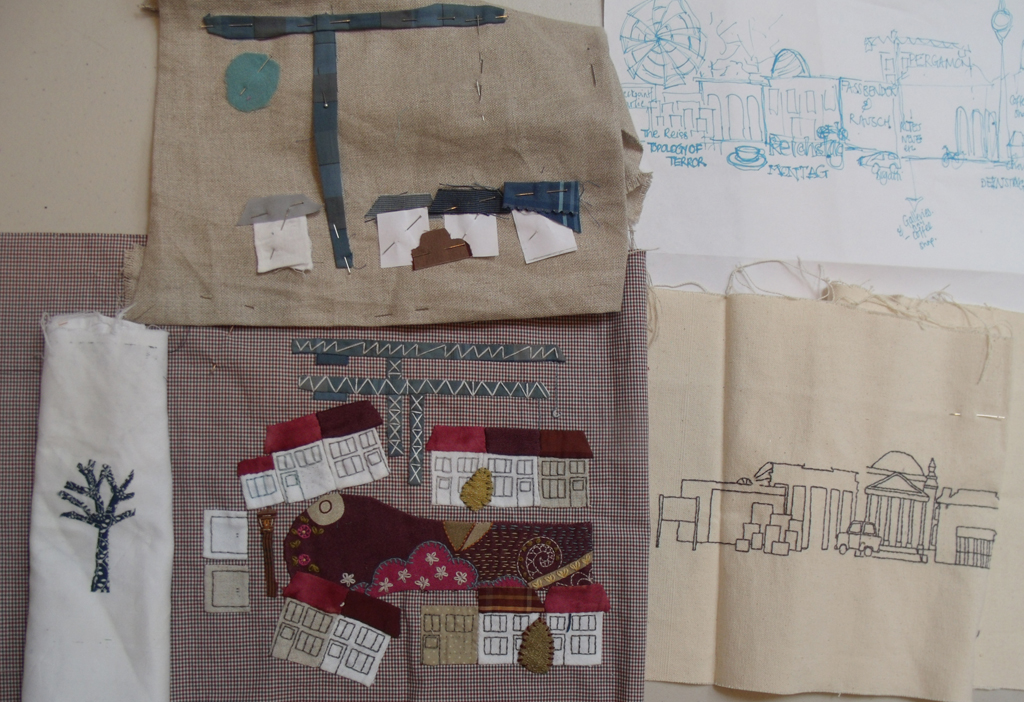
This vintage embroidered panel was brought to me by Caroline Doran who has requested a mentoring session recently at Heart Space Studios. Caroline was a member of our regular Knit and Stitch group who meet each week to talk, work and enjoy textiles together. The last time I had seen her she had brought a small hand embroidery she was working on, it was of her own neighbourhood with some enormous cranes from a local building site – she had asked me for some advice on windows . I remember discussing the work at length, which looked really very promising …then I didn’t see her for several months!
original neighbourhood embroidery – Caroline Doran
However she turned up again asking if I could review her work as she was a bit “stuck” : how well I know what that feels like…” is this piece worth going on with? What am I doing this work for? Why can’t I seem to keep going with the same momentum I started off with? Have I any other better ideas? We all experience this doubt when we make work that is slow going, you just have to keep stitching but it helps if you have some record of the why as well as the way the work came to be made – research – for want of a better word.
a small selection of the inspirational objects
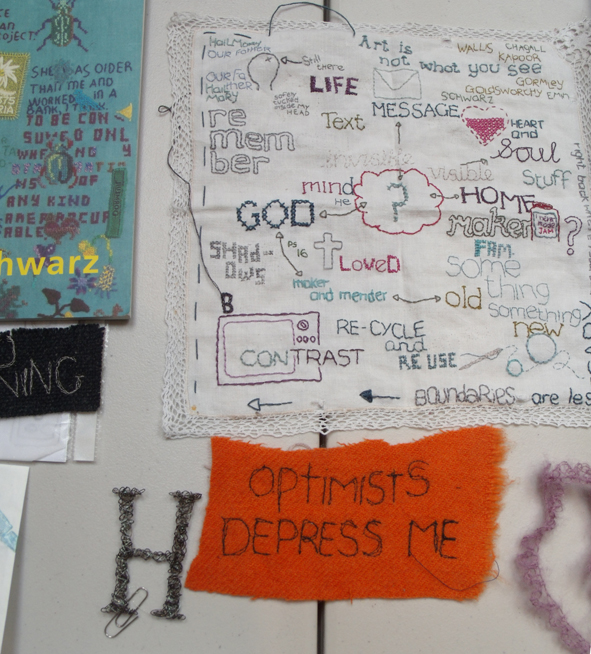
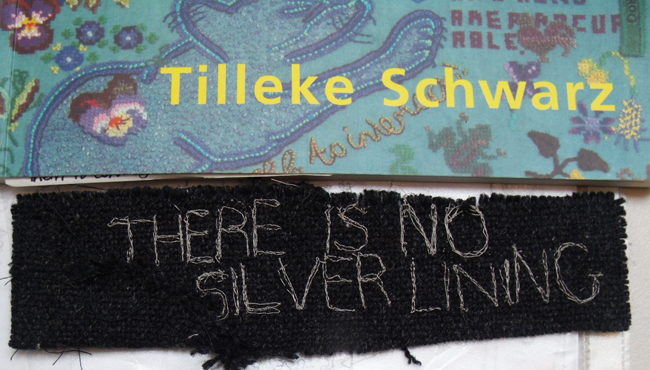
Before Caroline come to the tutorial I asked her to bring some inspirational objects or documents as well as evidence of her personal research – fabrics, photographs, books, drawings, scraps books, old work – whatever made her want to commit to actually making her ideas. She brought several telling things and as she unpacked them I started to make groups that showed how her own work connected to what she had brought along. Tilleke Schwarz ( on of my own great favourite embroiderers) had evidently been a real influence, in fact Caroline has attended on of Tilleke’s workshops in England. She had translated Tilleke’s acerbic but generally neutral stitched commentaries and slogans to make her own negative statements…
Tilleke Shwarz catalogue with an opposing down beat message
a sure reflection of how she was viewing her work ( and in complete contrast to my own rather more upbeat slogans)
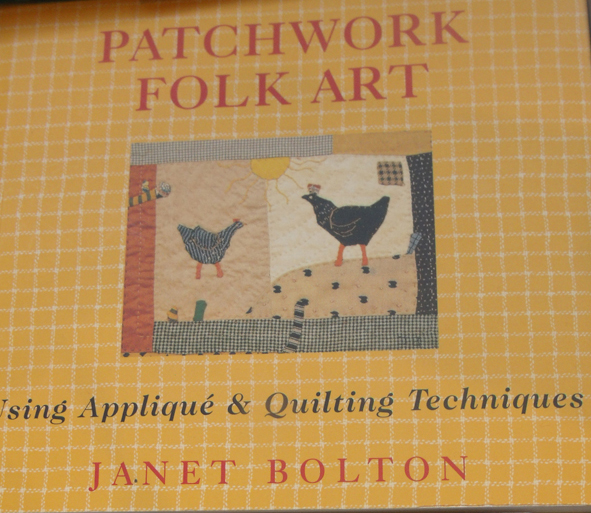
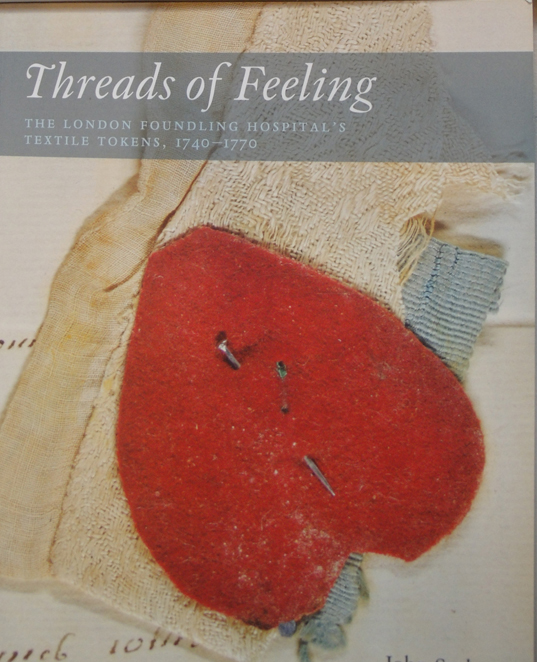
She also brought in several books, by other embroiderers who use applique and patchwork, notably Janet Bolton, but also the catalogue from the London Foundling Hospital about the mementoes left by mothers with the children they had entrusted to the future to the care of the institution. There is a very strong set of images and ideas being laid out before me. I was very intrigued to see what other work she had brought in to show me. A few years ago Caroline had undertaken an arts foundation course and she also brought along some of the work that she thought was still relevant to her now.
I find that the great breadth of foundation courses are brilliant for introducing students to a wide range of ideas and media but after a few years ‘at home alone’ the personal and, let’s face it, the available will re-assert itself. This situation can lead people to feel that they are not being adventurous, or the work doesn’t count as it is made of such mundane materials. But I think that this is the real strength of textile practice, for the most part it can be made using materials that are readily available, and these materials are the stuff of everyone’s lives and so are have many and varied associations with which to connect – for both makers and viewers. One thing that good foundation courses do give students is a sure sense of self-critical analysis, and this Caroline had acquired, if anything she was too critical, getting things ” too perfect” had rendered much of her latest work a bit lifeless, and she knew this – but how to remedy this is part of why she has come to me for help.
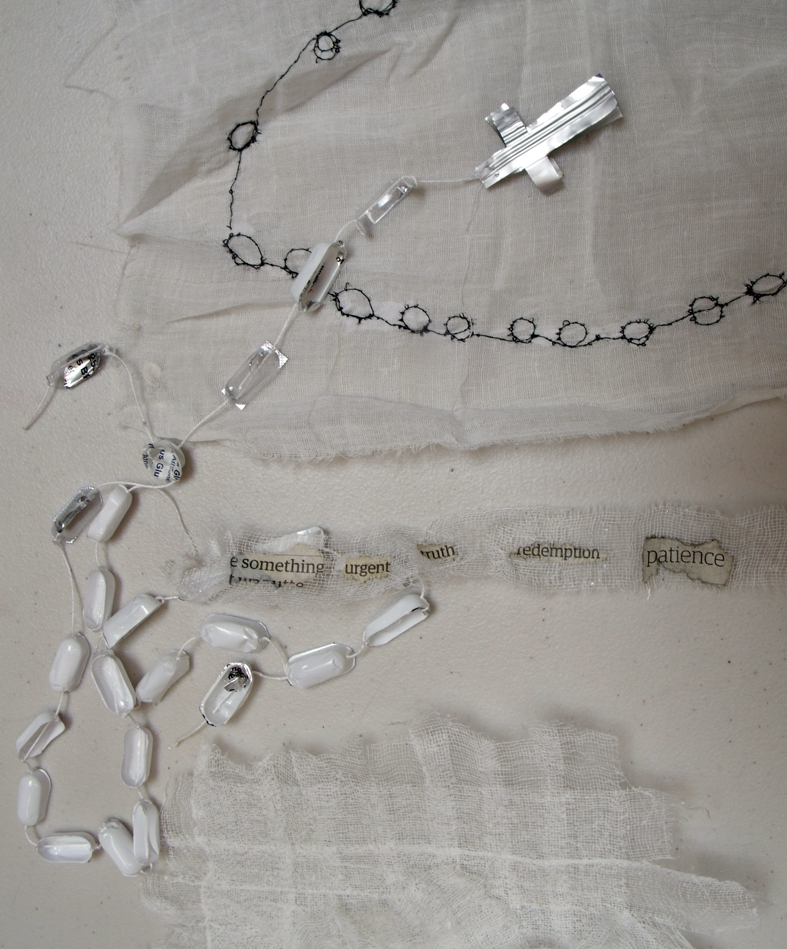
This set of work looked very different from the first work that had been brought out – a mixture of different media about all connected to her very strong family affinity to Ireland and her grandmother’s home. I was struck by several “necklaces” and embroidered images that made me think of rosaries,
recycled ‘rosary’
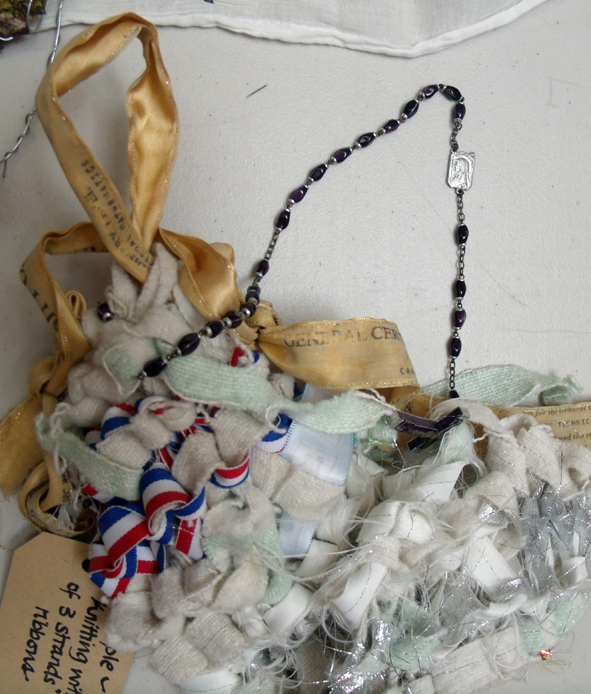
so wasn’t surprised when her grandmother’s real rosary turned up stitched onto a piece of work.
grandmother’s rosary stitched into woven fabrics
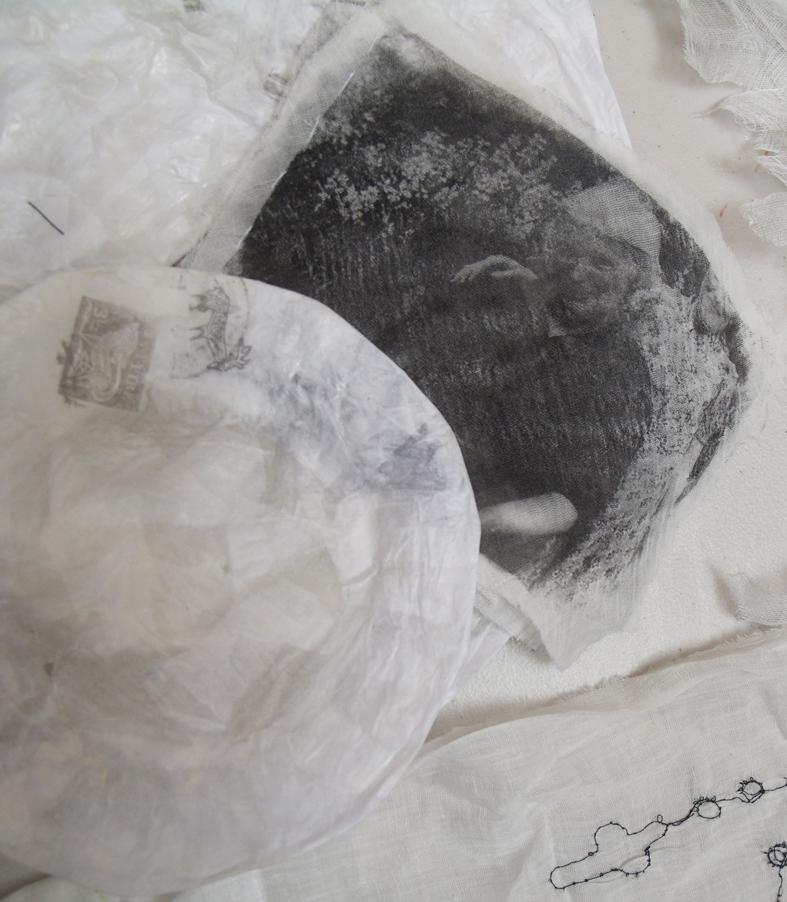
and her grandmother’s image was printed onto another fabric applique
photographic print of onto fine voile
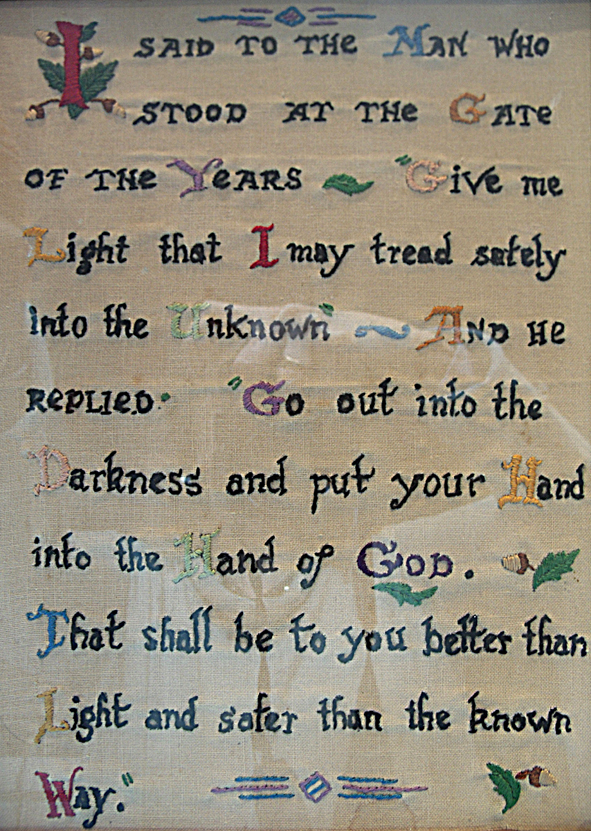
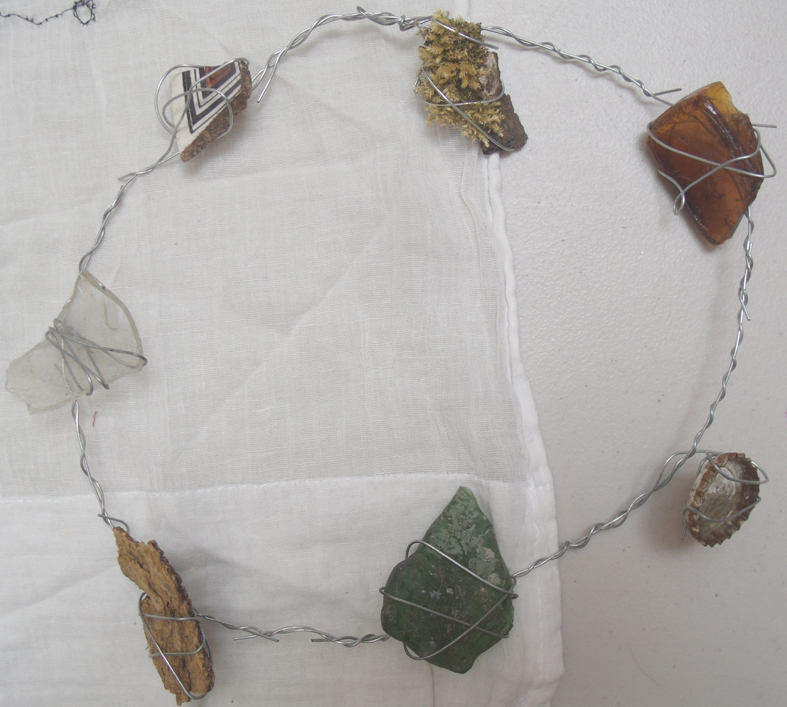
I was beginning to see the connection between the vintage embroidered verse – almost a prayer – that had come as piece of inspiration, with this almost sacred treatment of her Irish heritage. I started to ask about this connection and heard how Caroline still felt deeply connected to her Irish roots, still retained a religious faith and was now concerned with working with evidence of her family background, maybe using photographs, maps and other found objects. The most arresting piece that she showed me from this set of work was literally found – on a land fill site where she had made a necklace from shards of broken glass, pottery and stones – again a sort of secular rosary ….regarding or touching the objects made the viewer consider other lives, other places, tiles, bottle caps, lichen, glass, bark…..
shard necklace from land-fill site
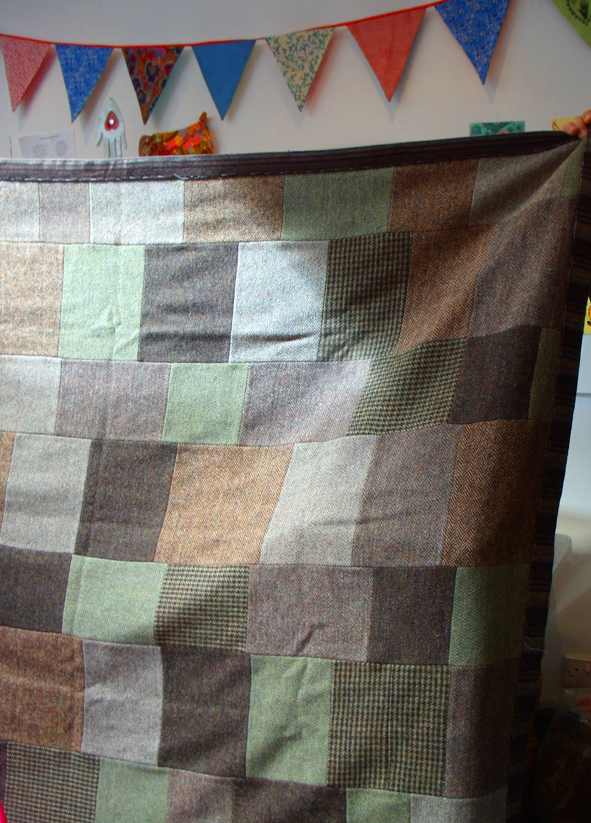
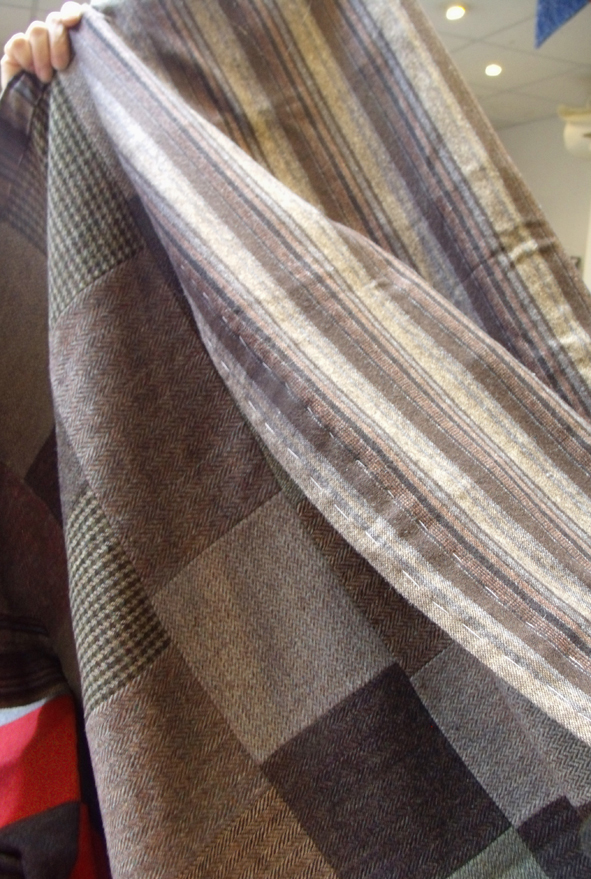
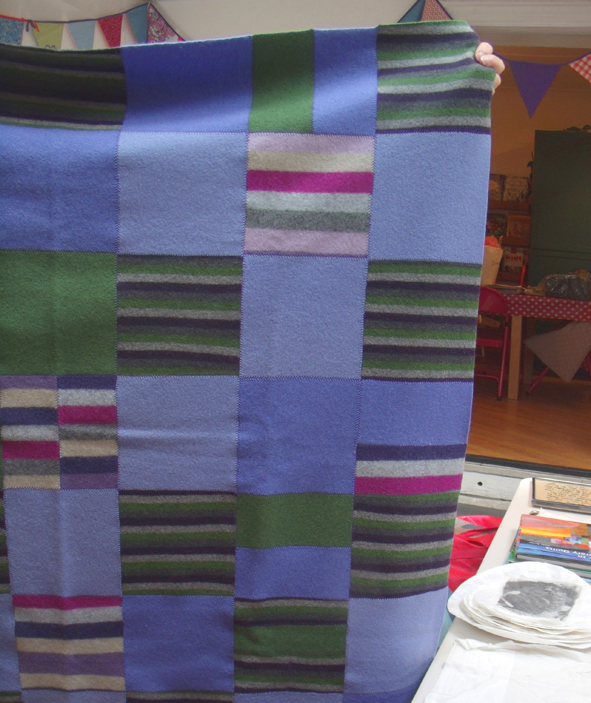
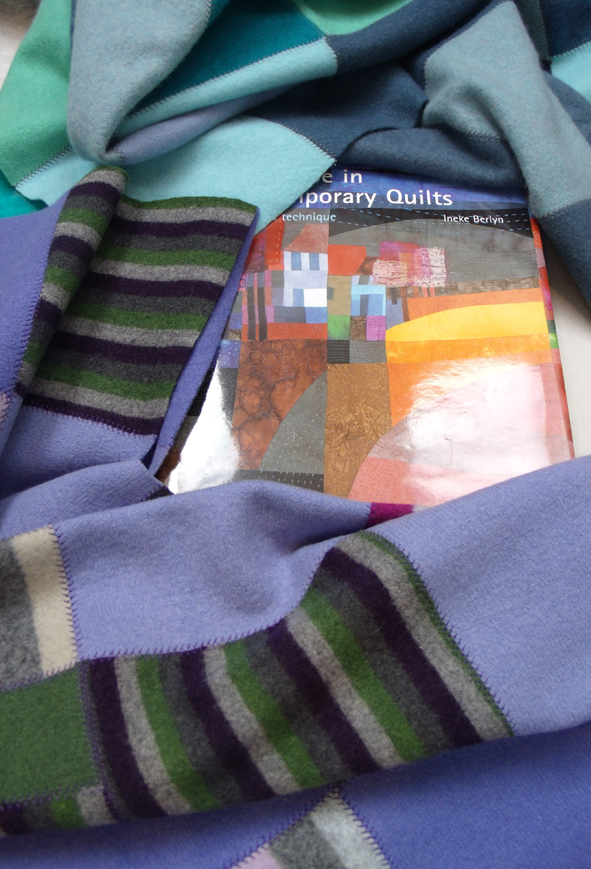
I was now considering how to help develop these disparate sets of materials and concerns into a more cohesive textile context, obviously some form of collage, applique or mixed media patchwork….when, as sometimes happens at the studios, we had 2 visitors from ‘Billie Jean’ which is a lively Bristol vintage clothes and fabric shop, they had been sent to us to show some things that we might be interested in seeing; and these were….. patchworks. Asking Caroline’s permission, I invited them in to see some absolutely lovely recycled tweed and knitted cashmere patch-worked blankets, that Billie Jean herself had made from their stash of old cashmere knitwear and woolen jackets, we were soon all chatting away about recycling, the beauty of old fabrics and how much we enjoyed the experience of just handling and making with textiles.
And as several of Caroline’s inspirational books had been about patchwork and applique, this seemed to be a good omen for the way to go…..as part of the mentoring session we now had to decide the way forward. I advise people how they might develop the next stage of their work, it is entirely up to them if they choose to take that advice. I see my mentoring role to be that of a person immersed in the same materials, techniques and often similar subjects as the people asking advice, and having been through similar making (or not making) experiences many times I have developed several strategies for looking at the work, getting some perspective on it – finding connections and as any tutor will do – suggesting new things to research to take the work forward.
group of half worked embroideries and drawings
We now had to look at what was in front of us, decide what was to be developed immediately, what could be parked for working on later when there had been more time for fresh research, and what could be safely consigned to a folder or file of past experience. I had grouped several half – worked embroideries and drawings together, they seemed to relate to a celebration of the city and street life, I liked their vivacity and thought that they could be somehow ganged up together to make a larger patchwork piece. This means they have to be somehow made to work together, more of the simple line drawings can be assimilated worked as appliques or linear stitching and as made into a textile map of Caroline’s geographical space.
We will wait to see if she brings anything back to me in the month ahead. I am considering developing mentoring as part of Heart Space Studios activities…so I do hope that she has gained some benefit from this initial session.
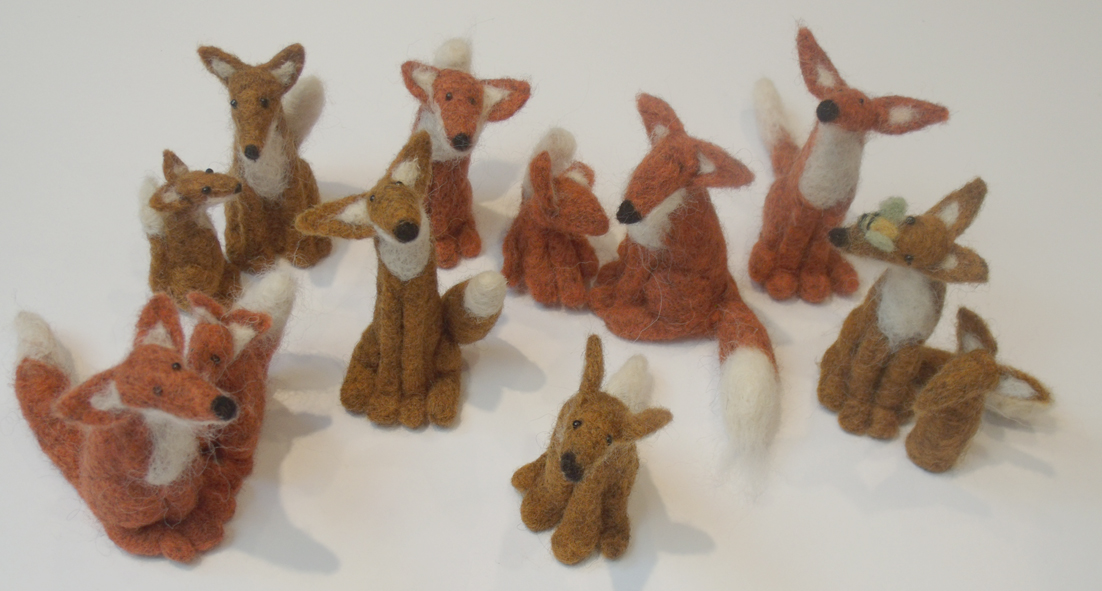
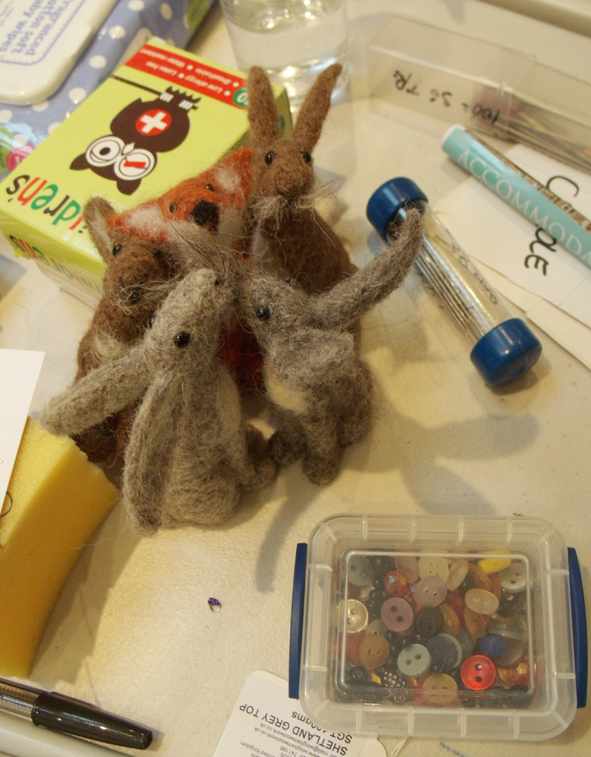
needle felted foxes, the results of the first workshop by Jenny Barnett
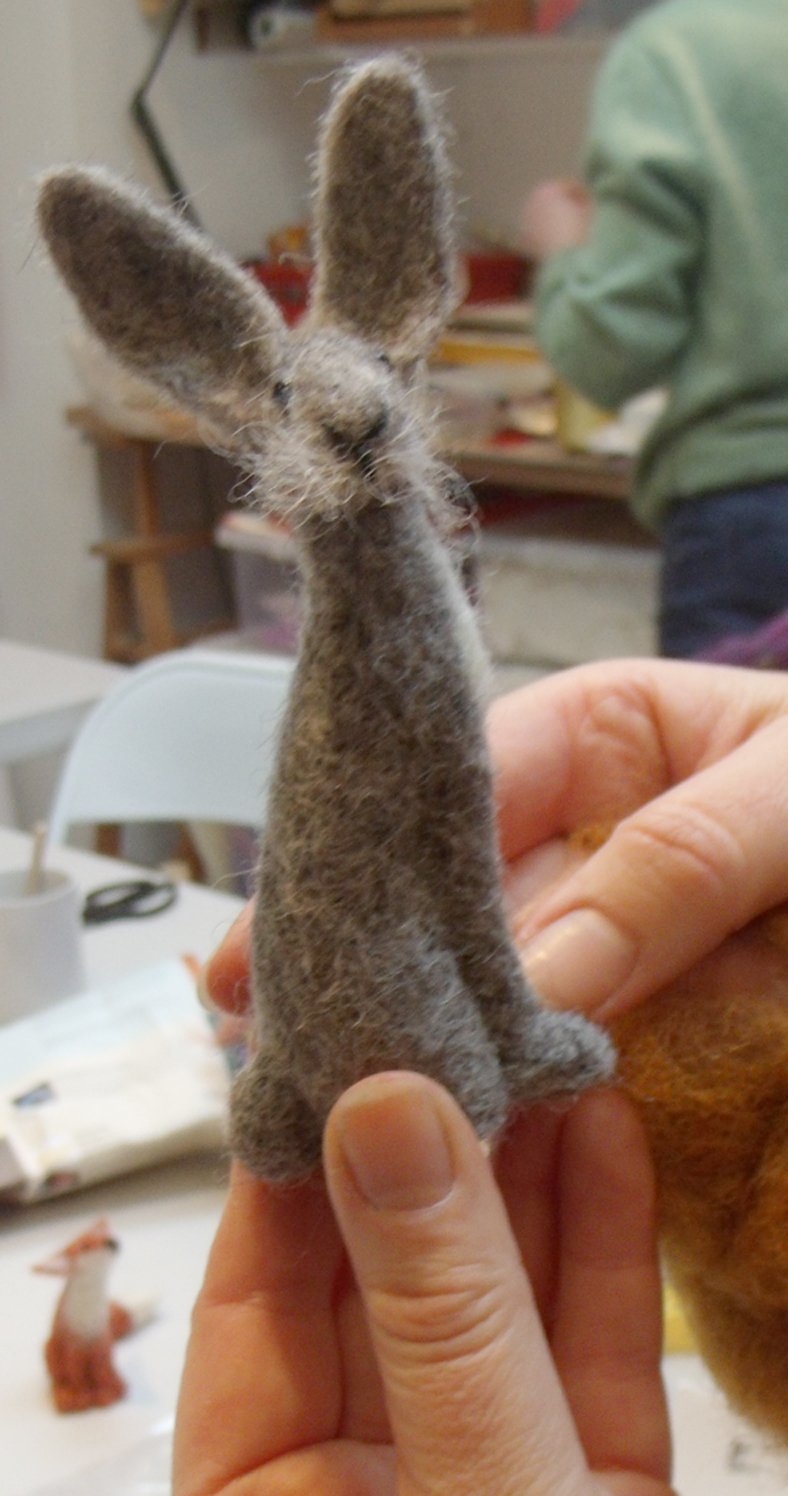
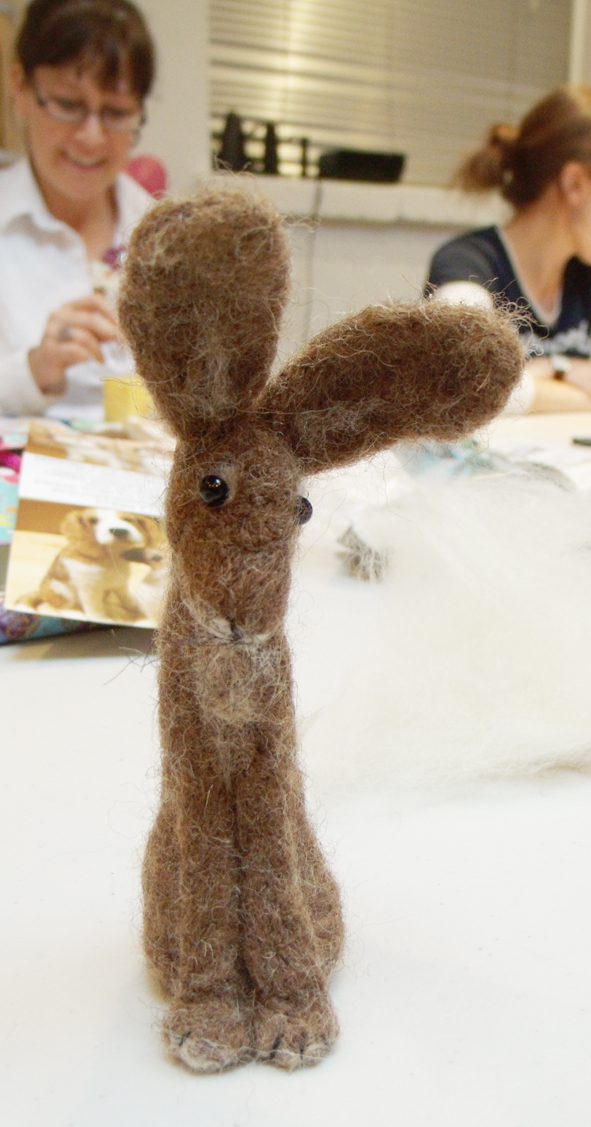
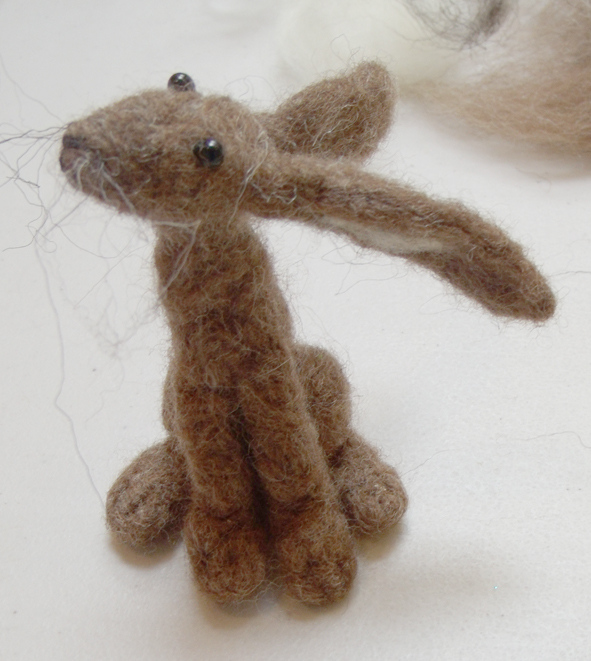
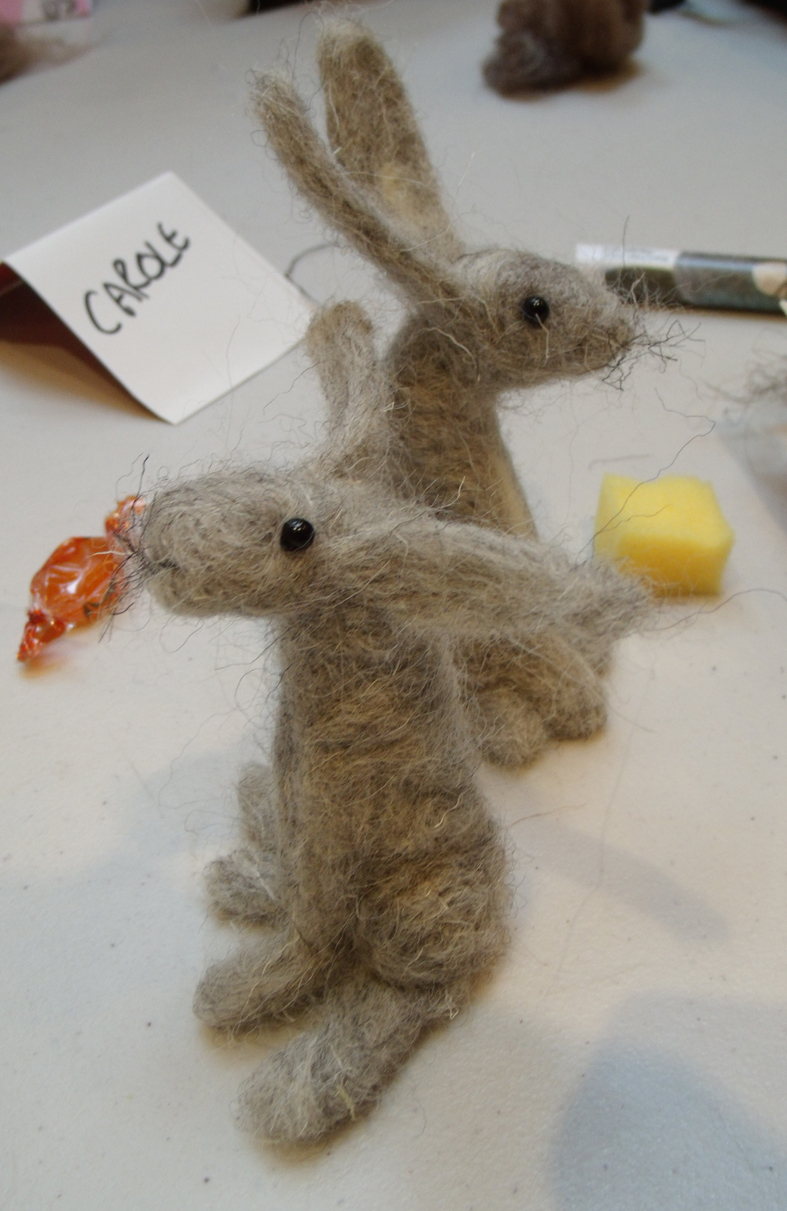
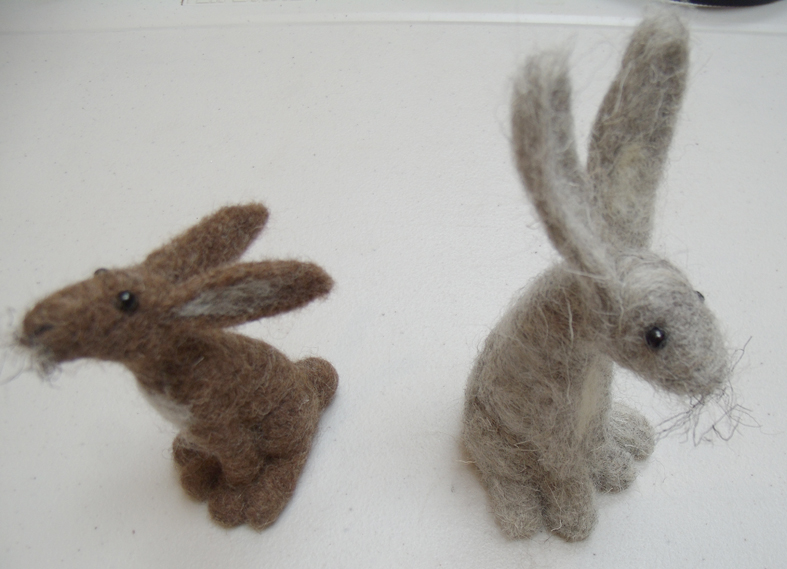
Needle -felting appears to be the most popular form of model making in textiles if the success of the 2 recent classes by Jenny Barnett for Heart Space Studios is anything to go by. Jenny gave her first workshop last month – foxes, and this month, hares……
all the mad MarchHares at end of the workshop
I was amazed by the range of expressions and attitudes that the different people managed to make using the basic kit that Jenny brings along to get everyone started.
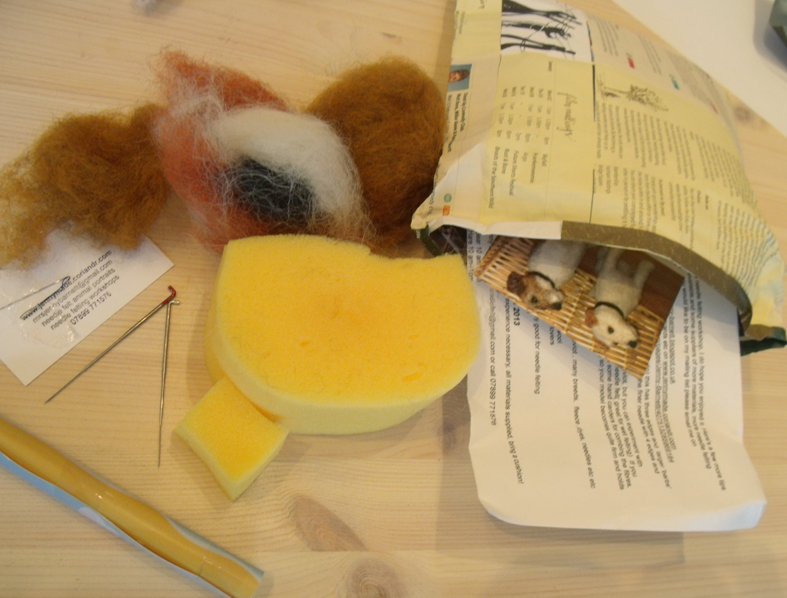
Jenny’s needle felting kit
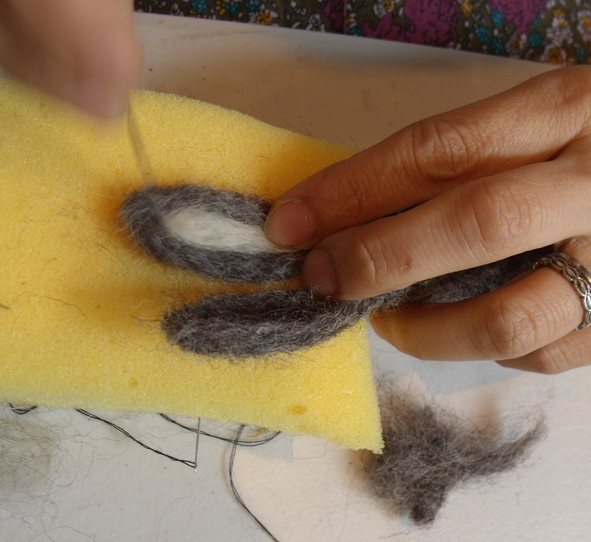
It comprises just a few simple things – wool tops in assorted colours, the special barbed needles for felting, a sponge to work on and some written instructions. Jenny also packed some love-heart sweets into the bags for her first visit to Heart Space Studios.
models waiting to inspire the makers
But most importantly to my mind, she also brings everyone an individual model to use as a personal reference – they look like sentinels or guardian angels watching over their allotted maker…the small perfectly formed creatures look on while the rolls and swatches of felt are poked and prodded into a brand new being.
a model looking on while another being is formed
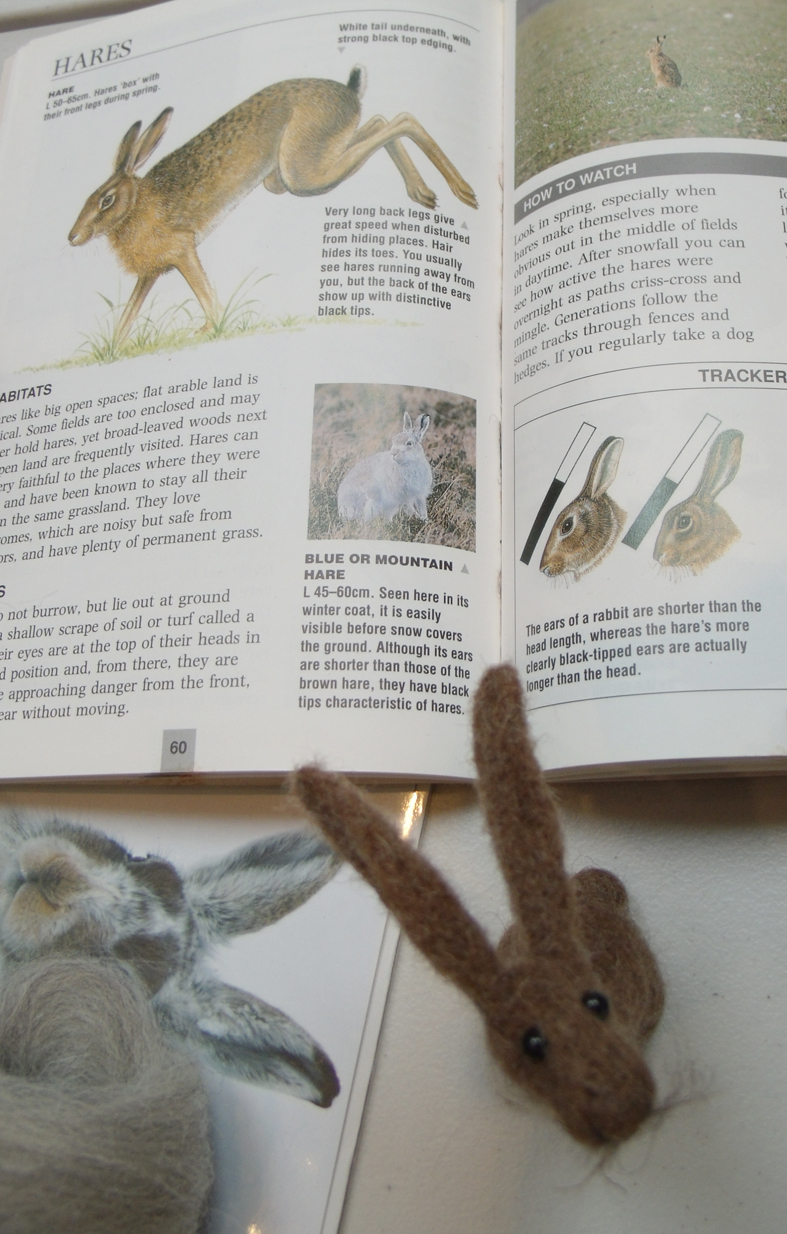
Jenny makes the most realistic looking creatures of all the needle – felted wild life I have seen, her naturalistic animals come from real observation – she lives on a canal in Gloucestershire, but she also she brings a lot of different reference materials to the workshops
research material for the Hare workshop
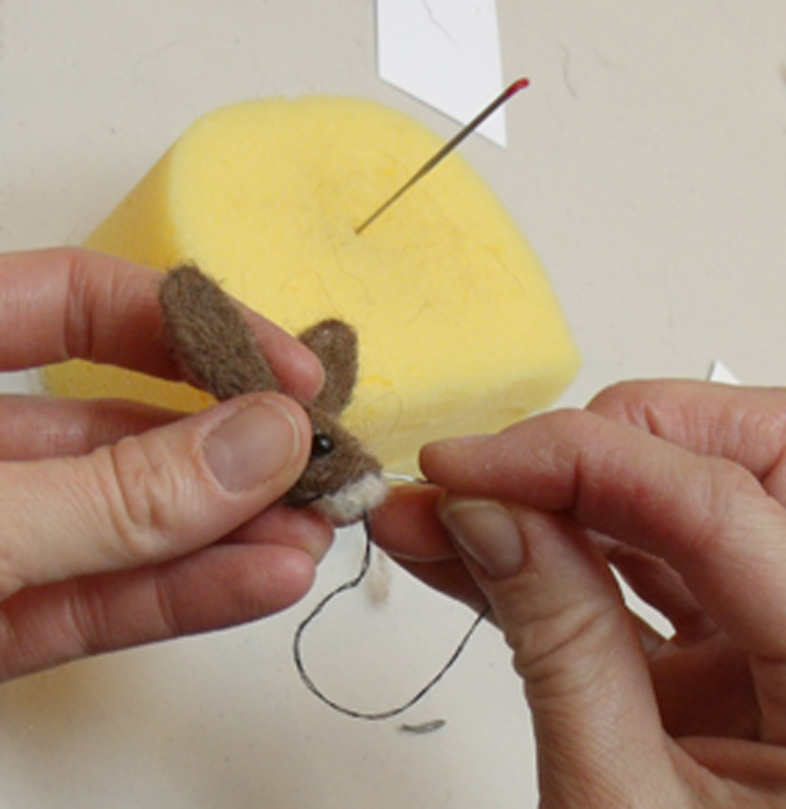
Needle felting is very different to wet felting, this is quick, really quick…the small scale animals take shape in rough form within an hour, the basic characters just seem to be conjured from each maker by alchemy. One minute you are looking at a table full of basic animal shapes, then the heads and ears are modelled separately ready to be applied
and with small adjustment of the angle when placing of the head, or an ear, the tiny being looks different – it has attitude……
alert and ready
thoughtful hare with Jenny in the background
and suddenly all the animals took on their own characters….
not at all sure
and after making one successful hare the class had a chance to make more – testing their new – found knowledge.
obviously twins
where are we?
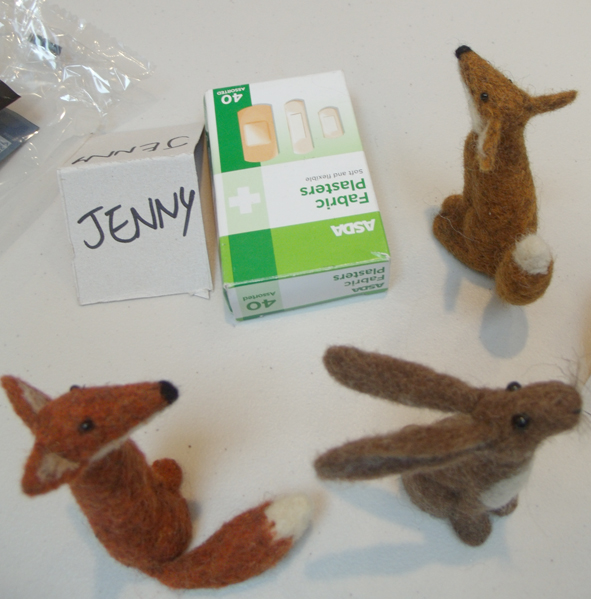
I was very amused though to find this group guarding the necessary packet of sticking plasters – needle felting is not for the inattentive maker.
guarding Jenny’s packet of plasters
looking on from a smart wicker basket were several other creatures
box of clothed creatures waiting for their chance to appear
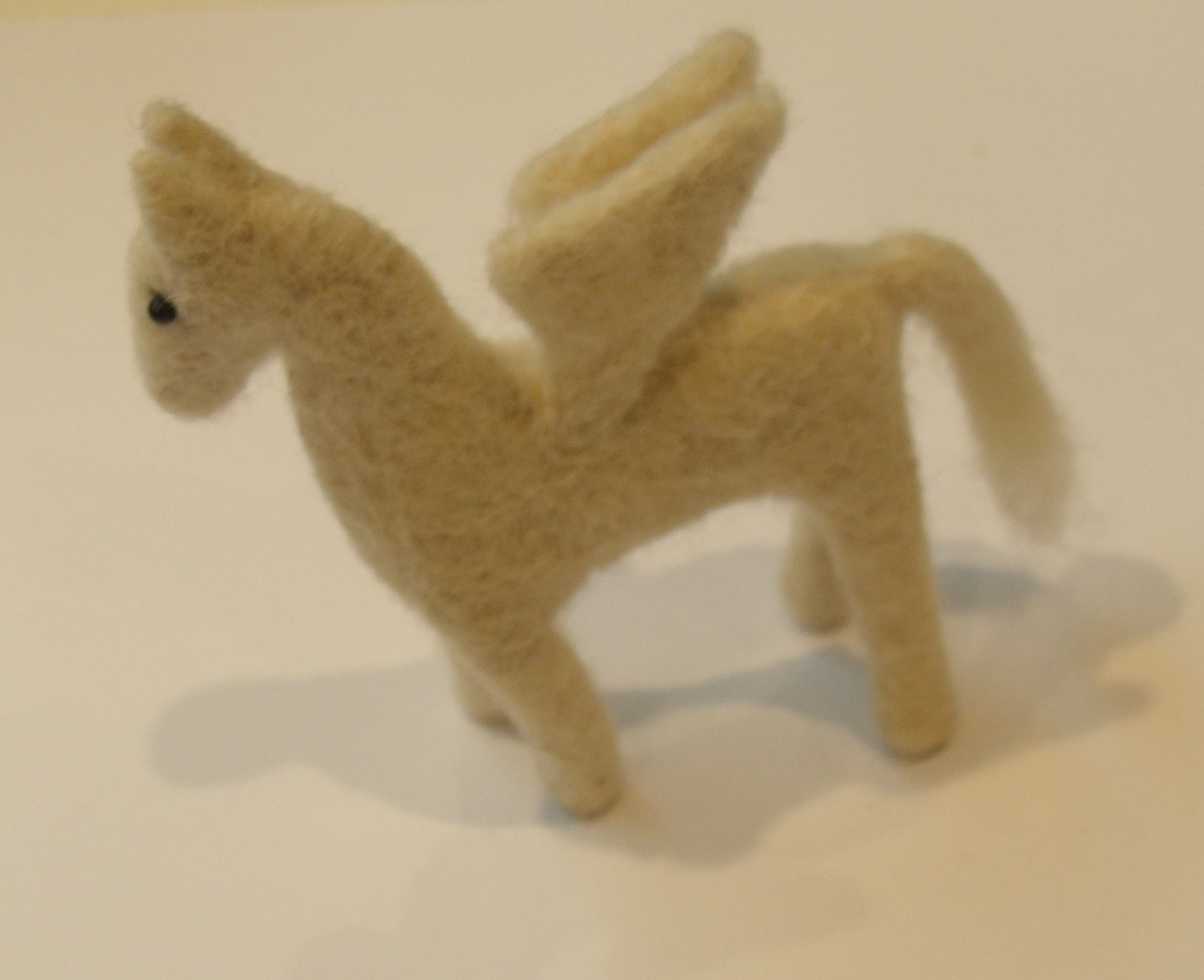
I had asked Jenny to bring them again as I remembered them from her first visit to us last year. I thought that now, having seen her work so successfully with the groups, she should conduct a 2 day Master Class for Heart Space – I had this idea when she brought out a simple winged horse that had broken a dream I have had recently…I wanted to try to make my dream creature ( more of this later, possibly – I often embroider my dreams)
little winged horse
I thought that it would be an opportunity to get different types of makers to develop their own characters. starting with the felted heads and bodies then dressing them in patch- worked clothes….so Jenny is developing a new Master Class for mid September at Heart Space.
But now it was time for all the new animals to go to good homes; they traveled in style – in the pretty bags that Jenny had provided each person’s kit in.
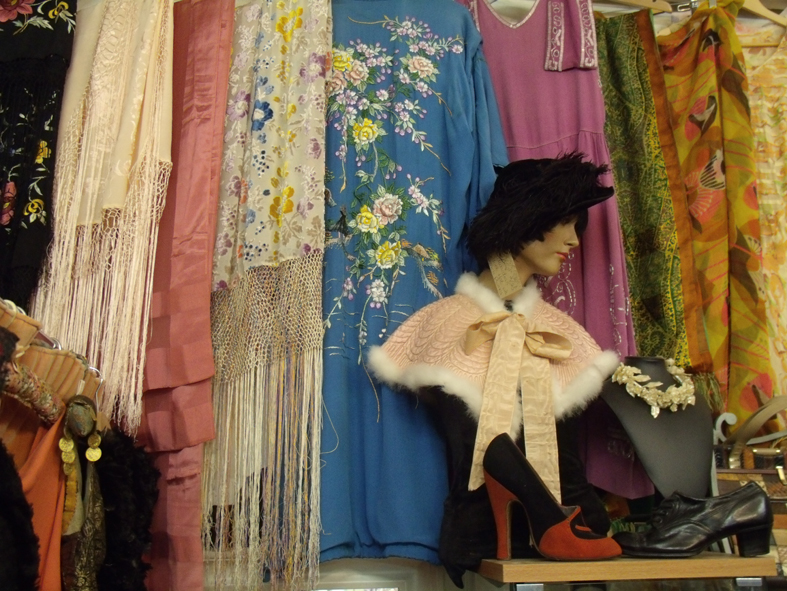
I really love vintage clothes and still wear pieces I bought 30 years ago when they were at least 30 years old at the time; keeping my old clothes alive and wearable has probably prompted my fixation with darning and mending. So I was very pleased recently to help Cleo Holyoak-Heatley, the owner of my favourite vintage clothes shop, Clifton Vintage Boutique, in Clifton Arcade in Bristol.
wall of beautiful embroidered gowns and shawls at Clifton Vintage Boutique
I was talking to her about the current Mending Exhibition while scouring round looking for something -anything fanciable; it’s not worth going to look for something specific in a vintage clothes shop – the eyes, mind and purse have to be open to anything and everything on display, in season or out…..
rack of fair-isle knit wear.
It was a freezing day and I was checking out a rack of Fair-isle sweaters and vests, when Cleo asked if I knew of anyone who could possibly mend a favourite Fair-isle sweater of hers with a hole in the elbow? I at once volunteered – it could be a bit of a challenge but as I am currently running mending classes at Heart Space Studios, I thought I could get some practice in.
Fair – isle sweater
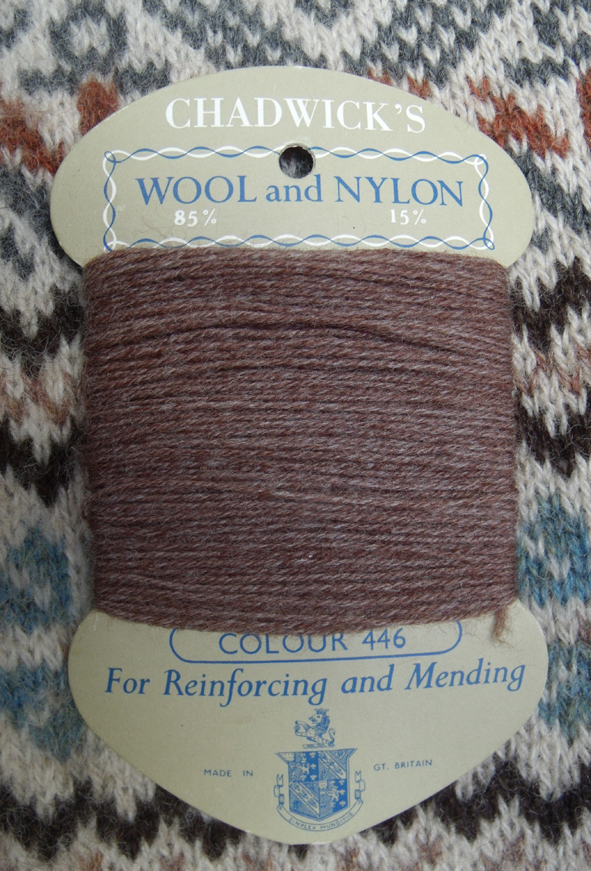
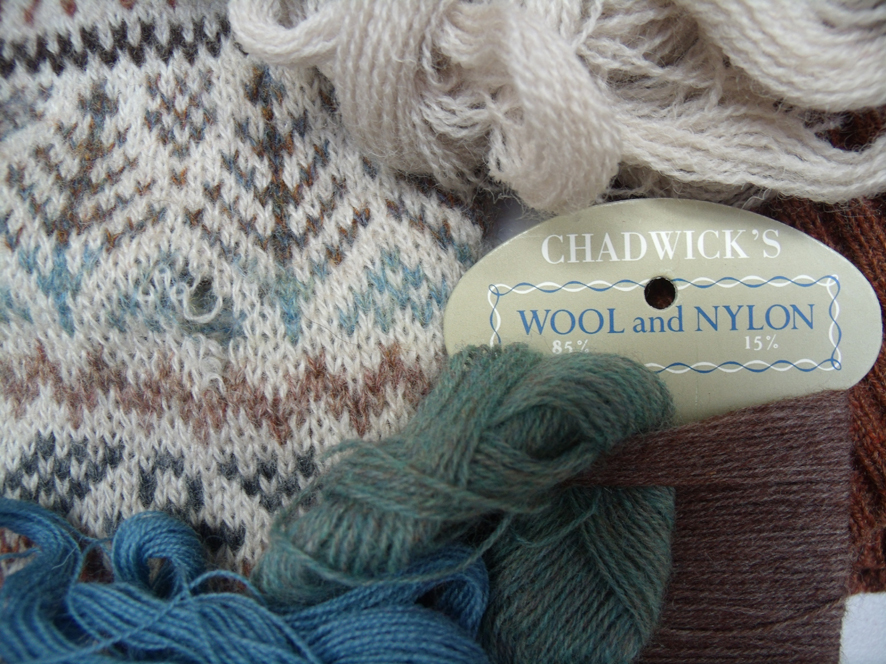
When I called back the following week, the sweater she brought out looked pristine, with band after band of different patterns, it almost looked like a sampler with sleeves. The hole was in the elbow and very small. I thought that this looked easy to stitch, what was going to be tricky was getting the right darning yarns in the right colours. Luckily Cleo had some old stock of vintage mending yarns, including a card of “Chadwick’s Wool and Nylon for Reinforcing and Mending”, the Nylon is included for strength so that the darn will last longer. Amazingly we found 2 perfect colours, I had to find the others – the background and some blue to mix to get the heathery look of the original wools. although this is a chunky jumper the yarn used is very fine, 2 ply – this is called crewel wool is embroidery terms and I have a stash of it to work my stitching samples when designing canvas needle work kits for Ehrman’ s Tapestry,
damaged sleeve with selected mending wools
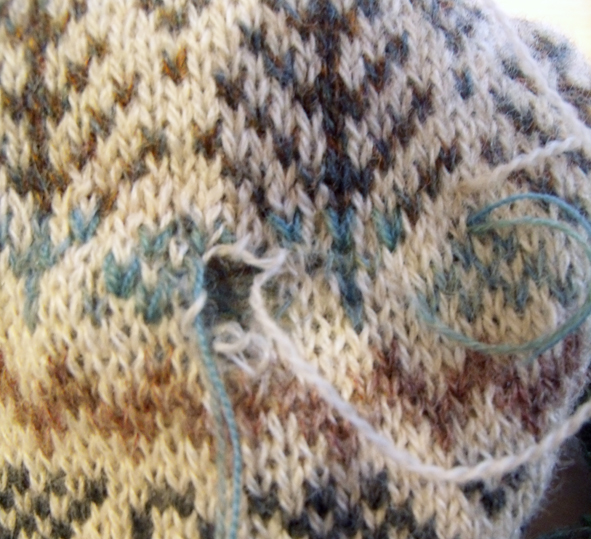
The first thing I had to do was secure the knitting form un-ravelling any further, easy enough in a small hole but needs quite a bit of reinforcement in anything bigger, I decided to try to re-knit the loops left over, but the wool was very weak and kept fraying. I have to say that what follows is for mending nerds only….. but if you want to see the finished result just go to the end of the post.
starting to mend the damaged area with the 2 colours of wool
The problem with any patterns, knitted or not, is that several colours have to be used to make an imperceptible mend , and here the damage extended through 2 colours, the pattern and the ground colours. so threading up 2 needle with the colours on each row, I started a few cms. away for the hole and using a type of French Darning , which is covering the knitting stitches along the row in a zig -zag pattern, this covers the hole and reinforces the surrounding fabric.
working the brown stitches over the existing pattern
The back not so wonderful to look at but the extra stitching makes for reinforcement and elbows wear out first
back of darned area
The mending looks OK on the front, you can just see the different colour tones of the darned area –
finished darn showing different tones of stitched threads
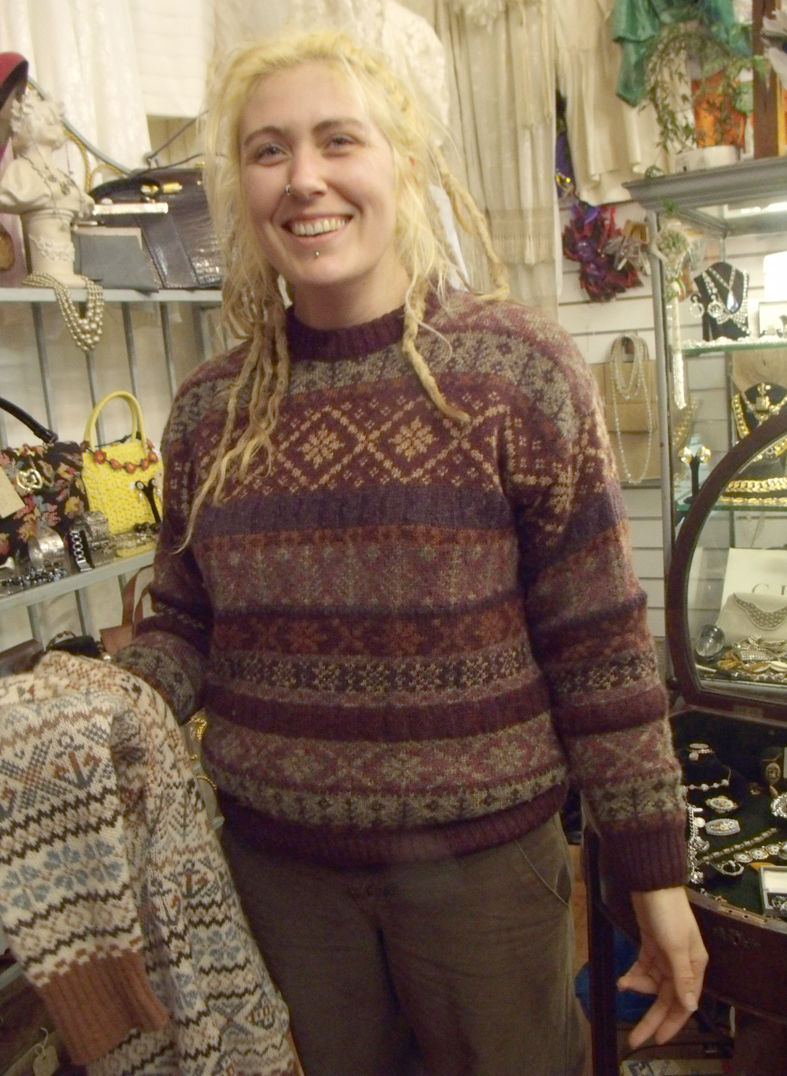
When I returned the sweater, Cleo was really thrilled and was wearing another of her Fair Isle collection…
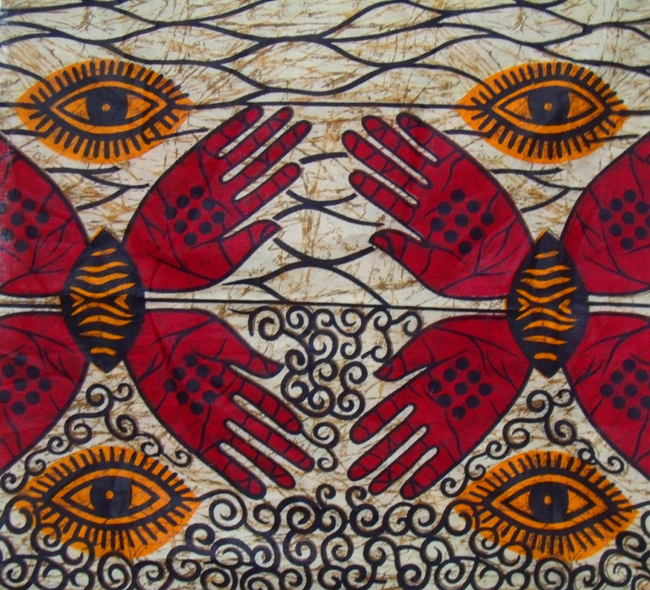
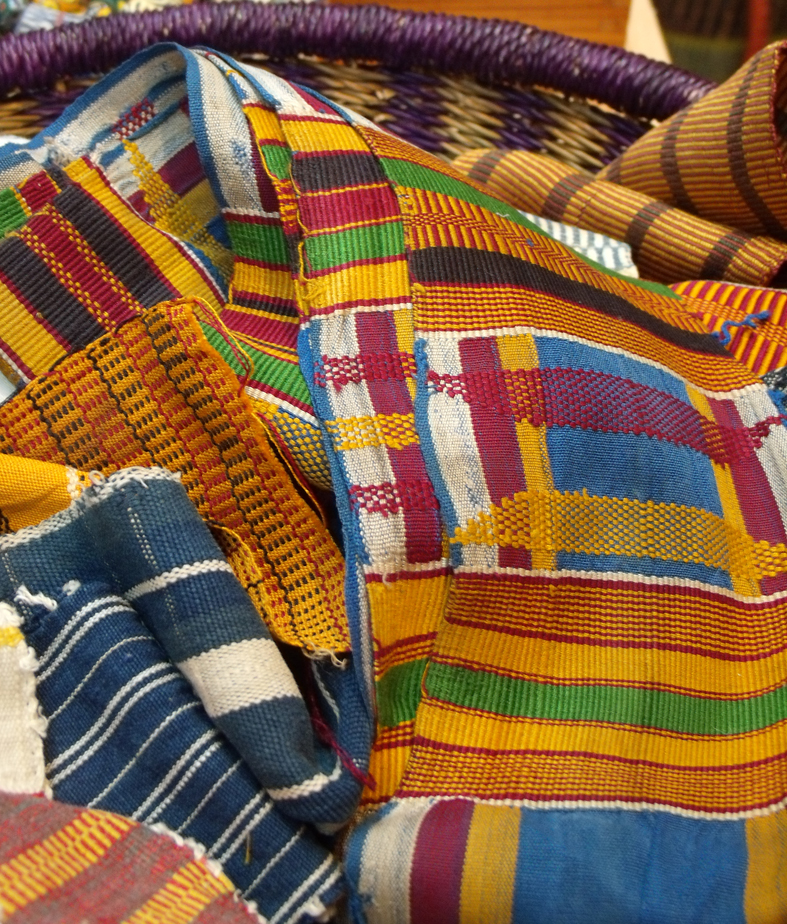
When I think of African cloth, block printed or woven strip cloth is what I imagine; bold colour in figurative prints or geometric woven designs…
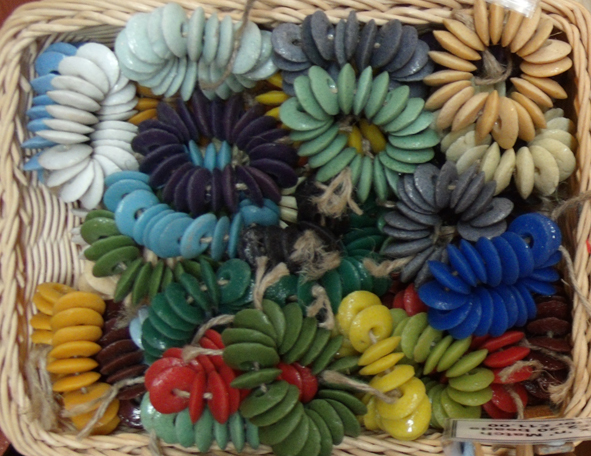
So it was with real delight that I saw and met with Magie Relph the owner of the African Fabric Shop recently. Initially I met her at a quilt show last year and was introduced to her by a colleague, Liz Hewitt, who thought we should connect; then about a month ago she came and visited us at Heart Space Studios to talk about selling some of her magical fabrics and beads through the shop.
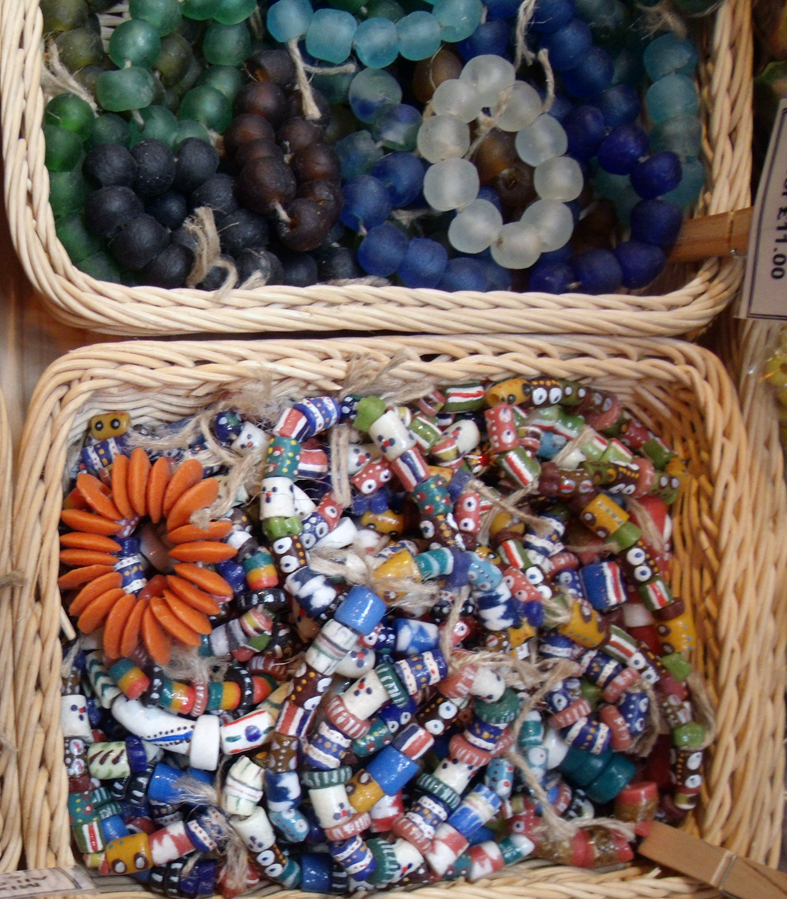
selection of African glass beads
I remembered her stall at the show so clearly, lovely fabric prints of all descriptions,
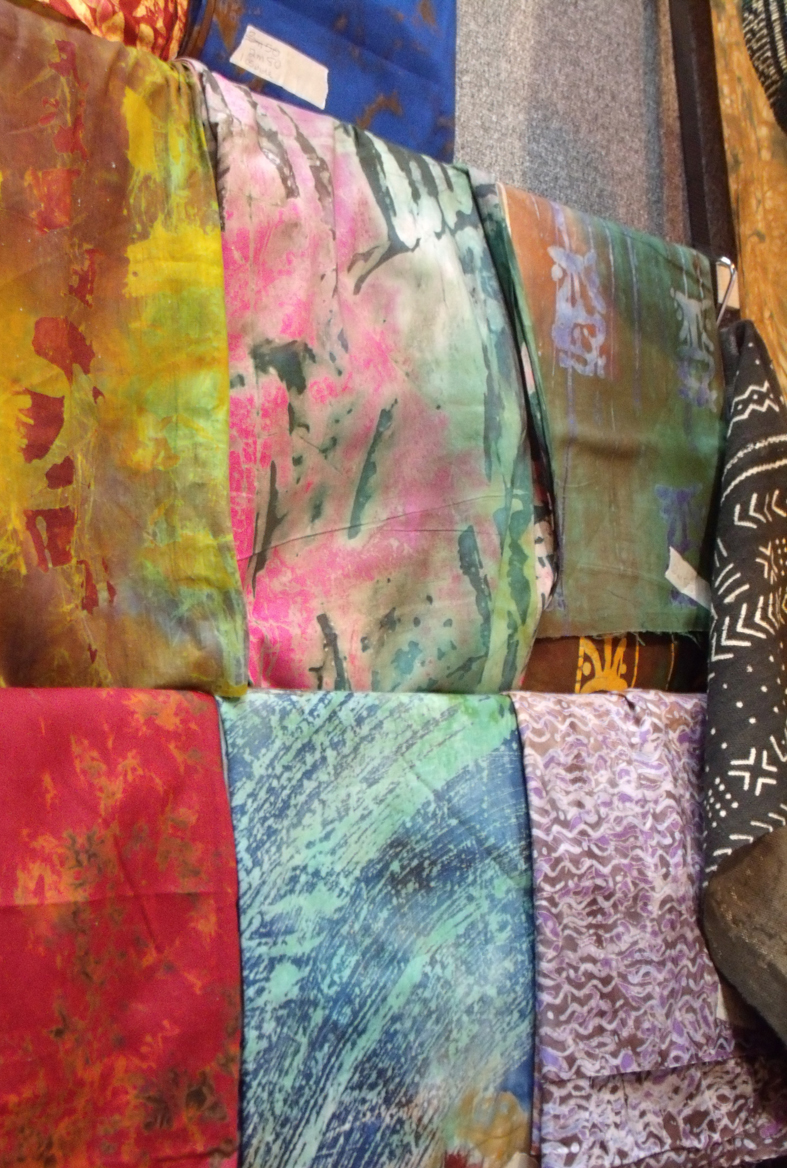
subtle batik resist dyed cotton lengths
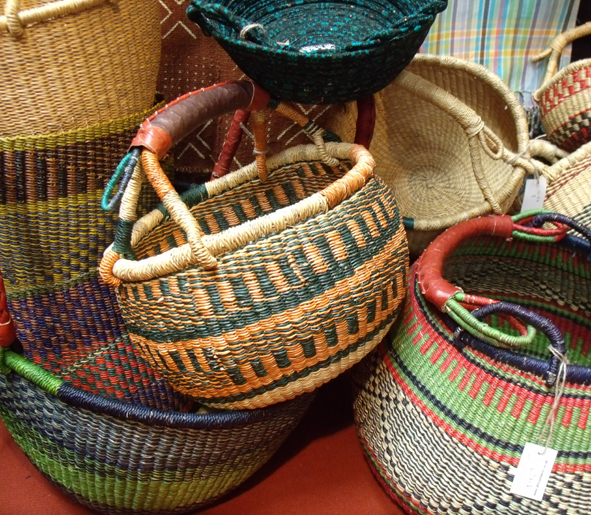
as well as baskets and beads made from all types of recycled materials….
hand-woven baskets on the African Fabric Stall
I really like sea glass – broken glass that has been dulled by time spent in the sea – nature’s perfect re-cycling system; the milky colours and softened shapes are really appealing and looking at this selection below I am wondering why I didn’t buy any if not all of them?
sea glass bracelets
Then just after Magie’s visit, another piece of Africa found its way to Heart Space Studios; Marina Harvey, a South African designer and pattern cutter, came and talked to the Thursday Evening Knit and Stitch Club about her printed fabrics that she made several years ago on the ‘MA in Print’ course, at UWE, Bristol.
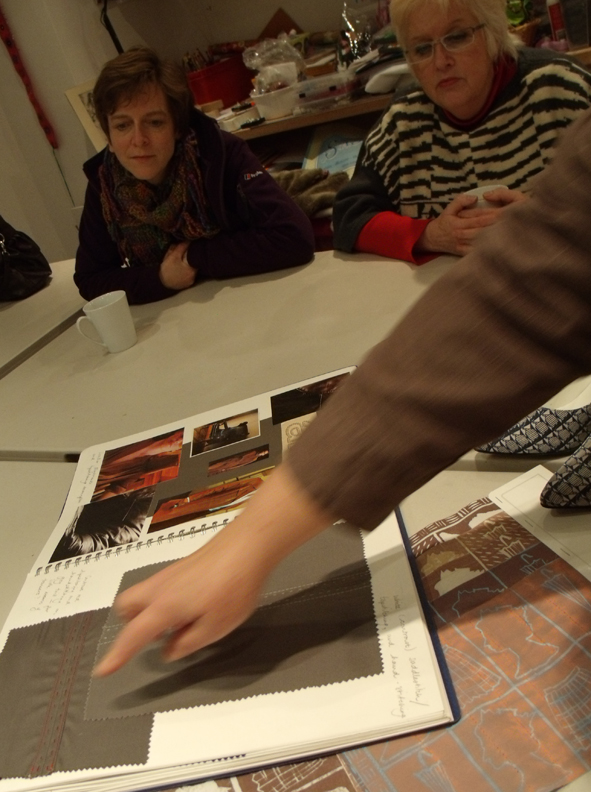
Heart Space Knit and Stitch Club, Show and Tell with Marina Harvey
Marina has written a course for Heart Space Studios to make and decorate a skirt in a series of evening classes, using some of the techniques she developed on her MA, (this will run later in the year) but I asked her to take part in the ongoing programme of “Show and Tell’s” we hold occasionaly at the weekly Club sessions, as it is a chance for local makers to bring their work and talk about it to us.
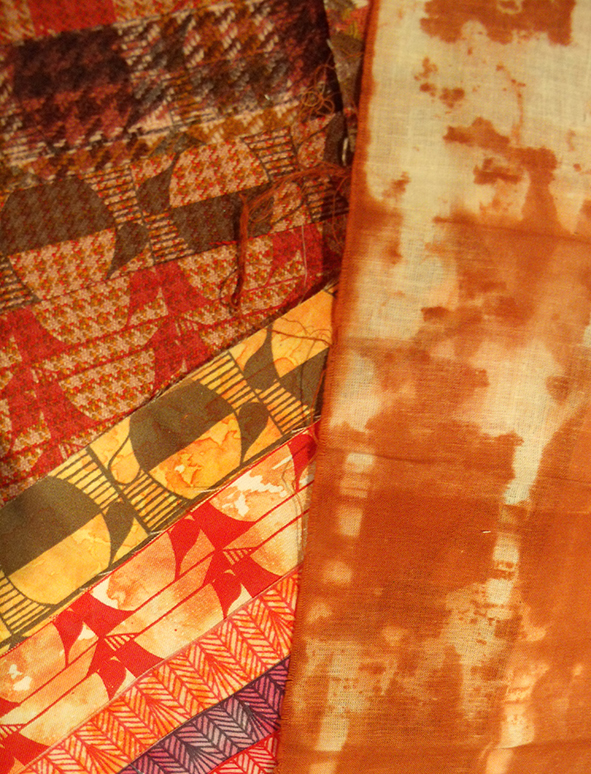
Marina printed and patched fabric swatches, based on African batik fabric scraps
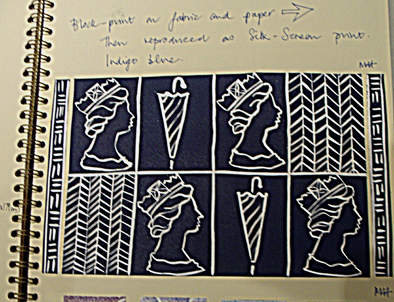
Marina talked to us about the idea behind her MA collection: when she came to England to teach and study she was fascinated by the archetypal British fabrics notably woolen tweeds and in particular the cloths worn in traditional sporting pursuits, hunting, shooting and fishing but for dressage in particular …… we were all very surprised by this choice, but of course woollen tweeds in South Africa would be a novelty. Marina set about blending the differences between the cultures by using fabric as her medium, the Queen and her Majesty’s interests as her subjects!
sketch book with paper print featuring brollies, herringbone tweed and Queen Elizabeth 2nd
Marina used African printing systems, block prints, batiks and discharge screen printing to pattern the tweeds, and she patterned them with tea cups and saucers, she was very generous in bringing all her research materials, work books and fabric samples for us to study closely.
printed tea-cup tweeds with African batik samples
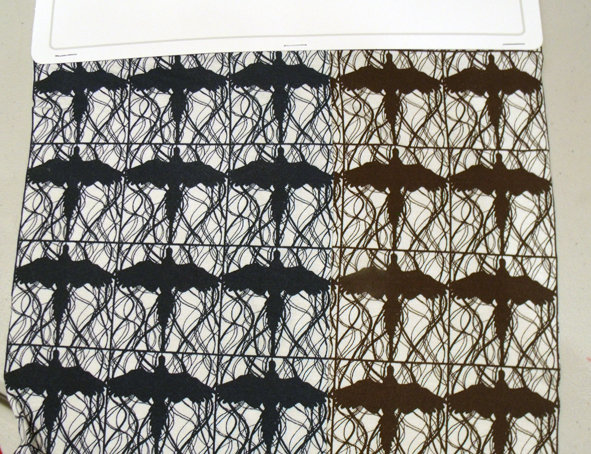
Designing her textiles to make into clothes for her degree exhibition, she chose to work in the 3 colours only, indigo blue, red and dark brown, predominantly found in sishweshwe or shwe shwe – the traditional South African fabrics of the Zulu and Lesotho nations.
colour strike-off sample print in brown and blue
The combination of British imagery,’ Pheasants Flying for Cover’ which is printed in the traditional shwe shwe colours is a perfect combination very successfully in keeping with both cultural traditions.
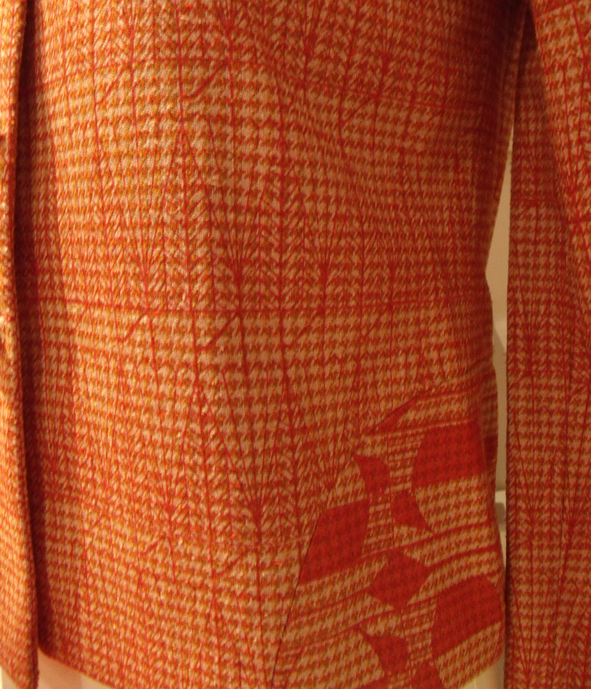
red block printed design for tweed jacket
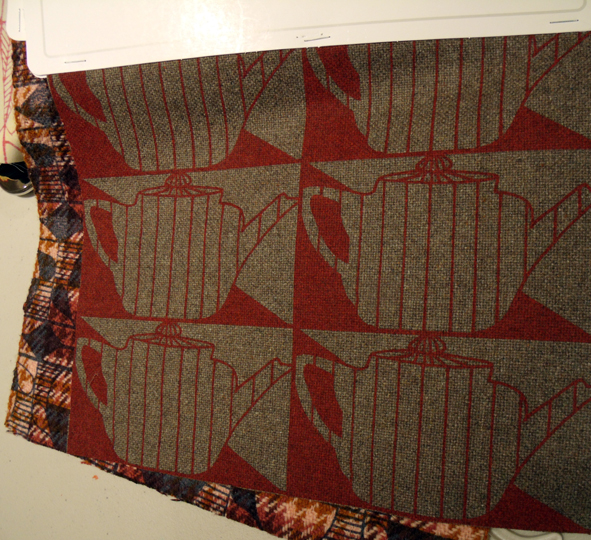
the resulting fabrics are subtle blends of African colours and British icons, T.pots look like African flags are printed on traditional gamekeeper’s woollen drab,
red T pot print on tweed
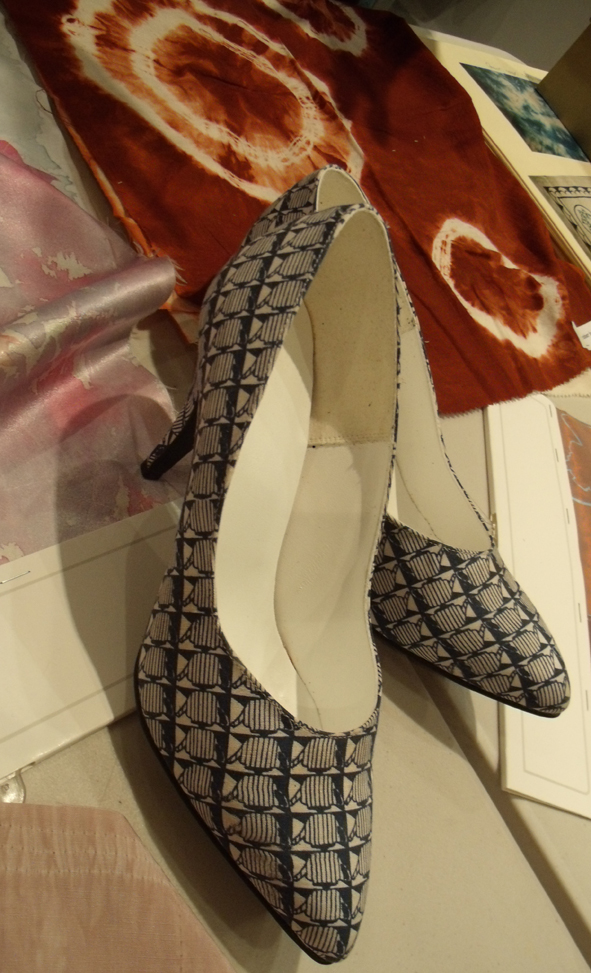
and the ultimate indigo shwe shwe inspired print of miniature T.pots for elegant court shoes
my sentiments about the Mending at the Museum exhibition
The exhibition ‘Mending at the Museum’ has finally been launched at The Bristol City Museum and Art Gallery – and it runs until April 2013….which sounds simple enough but it is the culmination of at least 3 years collaborative practice based research between academics and professional makers and artists. The ‘Stitching and Thinking’ research group, which I facilitated in my post as a senior research fellow, evolved the exhibition via a series of mixed media workshops, visits to the museum’s mended collections, many meetings, discussions, conference papers and a small sample-stage exhibition; and it also caps off my academic career which started in 1973 and finished last year in 2011….. So no pressure then.
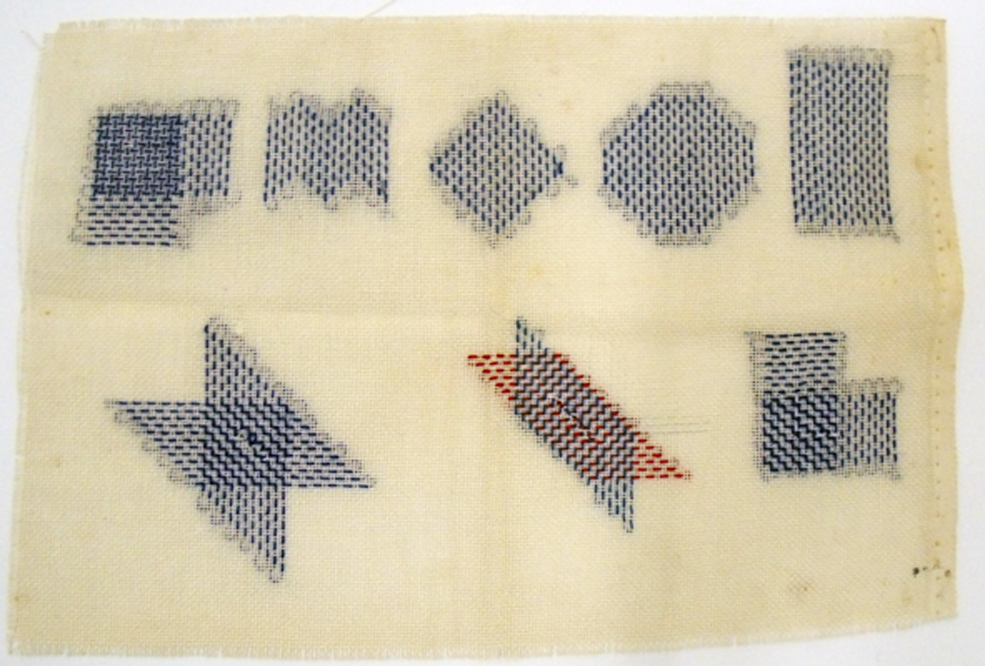
mending Sampler from the Bristol Museum collection
I co-curated the exhibition with Dawn Mason, currently the award leader of Drawing and Applied Arts at U.W.E. Bristol, and my long-term academic colleague and collaborator in all things stitched. In the museum we worked with Karin Walton, the Curator of Applied Arts at Bristol Museum, and who holds the secrets and the keys to the museum’s sampler collection, the mending samplers were the main inspiration for the work that has finally been exhibited.
school’s sampler from the museum’s collection
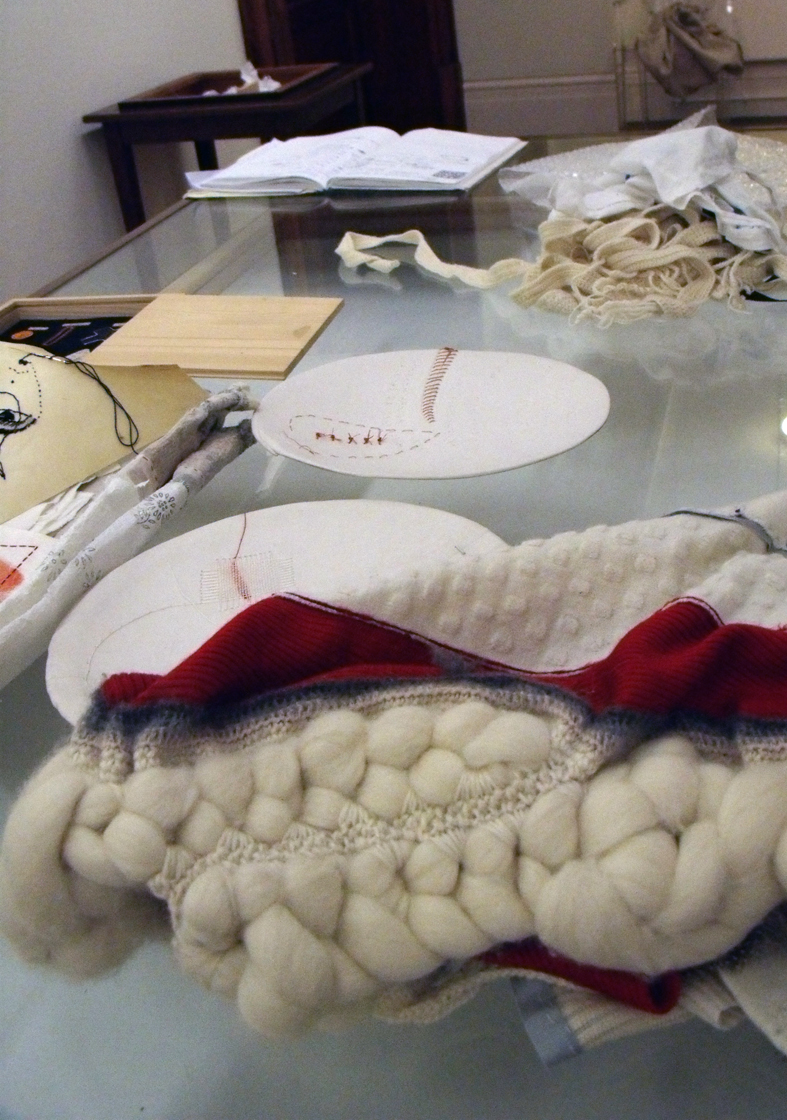
table of samples and exhibits
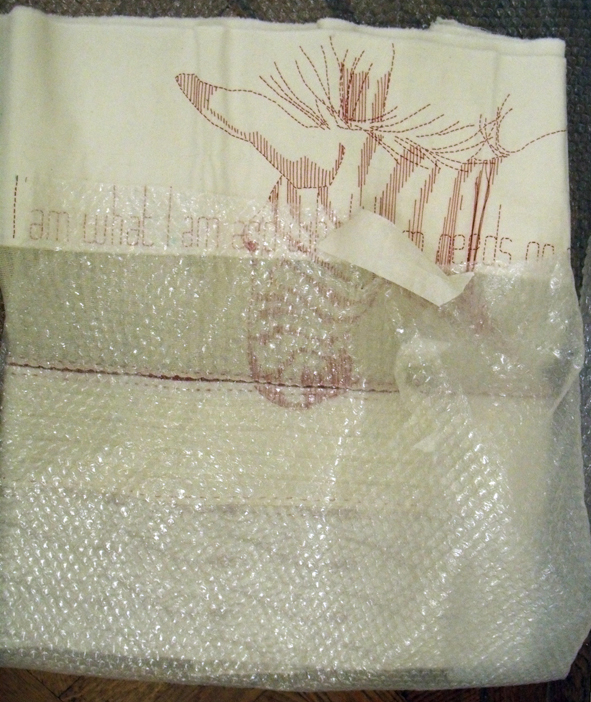
Steph Wooster’s wrapped work
When I arrived on the first morning to hang the work, Dawn and Karin had already placed the exhibits, still in their wrappings, on the floor below the wall space allotted to them, but there were piles of extraneous pieces, scattered over tables and chairs, it became my task to sort these out.
The idea of the exhibition is partly to show how ideas evolve during the making process – Dawn and I have written and spoken many times of the necessity of makers to have time for reflection; making work worthy of contemplation requires as much time for the thinking as it does for the making process. It is a constant making and thinking about what you made, re-making, re-thinking until somehow the pieces resolve themselves and you wonder how they could ever have become anything other than what they are.
Each exhibitor was responsible for physically putting their own work on the wall, this saves so much argument later….but with only 7 exhibitors who know one another well we each respected one another’s’ space – well most of the time. So during the next 2 days each member of the group came and sorted their own work out meanwhile just looking at all the unwrapped pieces was really fascinating as work seen only at the sample stage 4 weeks before, now appeared ready for the wall. Work can made or marred by the way it is hung and also what it is hung next to. We were all acutely aware of how the whole exhibition must work together. It comprises 3 different elements; some of the museum’s mending samplers, our own samplers of work made throughout the research period, and the pieces made specially for exhibition.
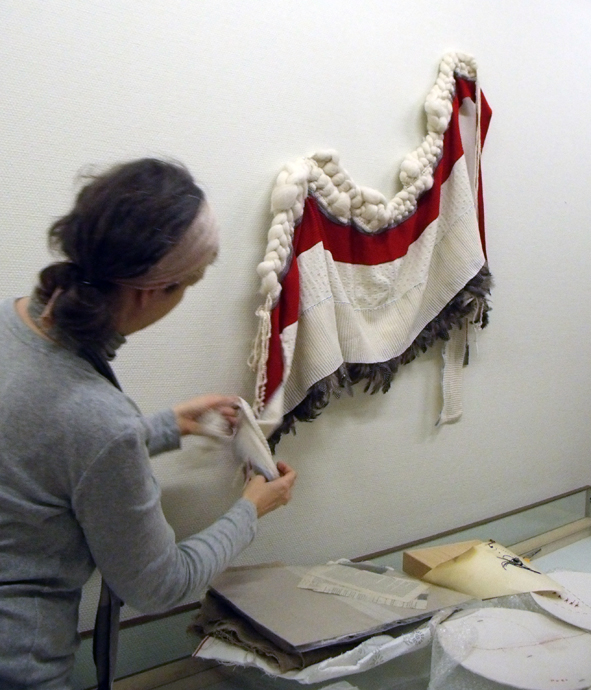
Steph Wooster draping her knitted shawl
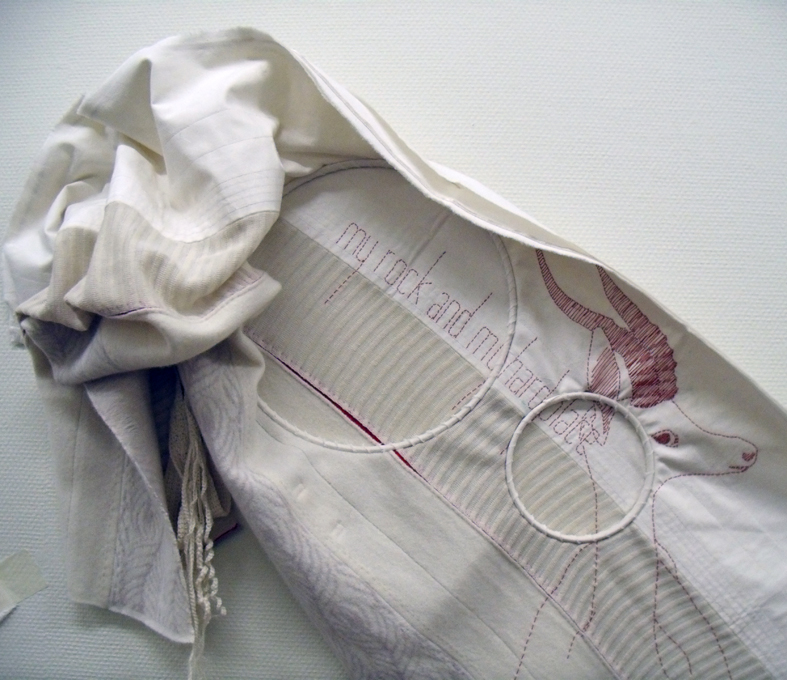
Steph Wooster’s knitted and pieced work looked different when it was stretched over some embroidery hoops that acted almost as magnifying mirrors – drawing the eye to the details of her messages. She writes of museums being ‘houses of high culture; they show the best of us’. Finding evidence of mending within the museum’s exhibits she delights in glimpses of ‘everyday life’ . Her work, influenced by the written messages on samplers, ‘celebrates the ordinary’ by using simple fabrics with ubiquitous machine knitting.
one of Steph Wooster’s knitted and stitched wraps “you are my rock and my hard place”
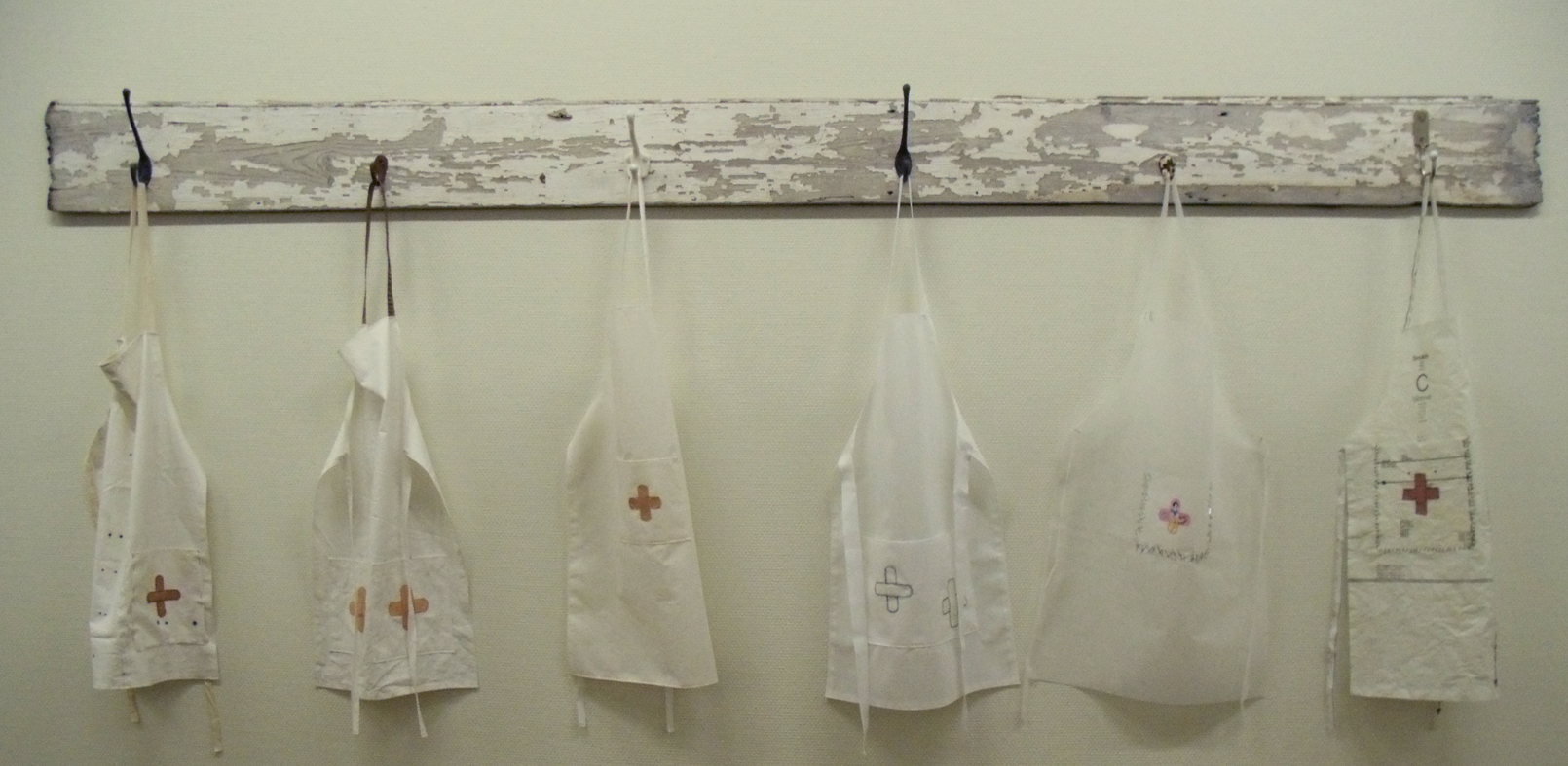
Jilly Morris‘ children’s aprons came neatly laid one on top of the other with a Fragile label printed on the cardboard wrapper – a comment, I felt, not about the fact that the contents could be damaged but of the fragility of what was inside and already ‘ damaged’ .
Jilly Morris’ stack of children’s aprons
The title of the work produced is ‘Mending Takes Time’ and refers to the functional stitching that was traditionally taught as part of their general education to girls, as transferable skills in an era when fabrics were ‘treated with regard’ and material was frequently mended to preserve a precious commodity – so at odds with our easy access to all types of fabric from all over the world.
Mending Takes Time – Jilly Morris
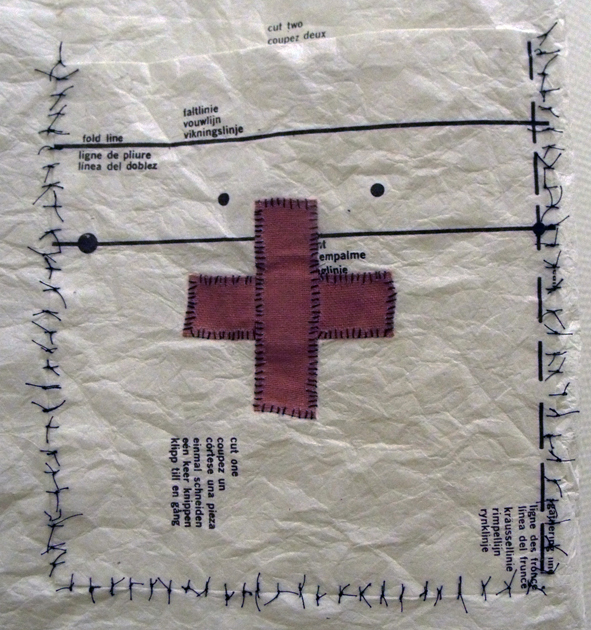
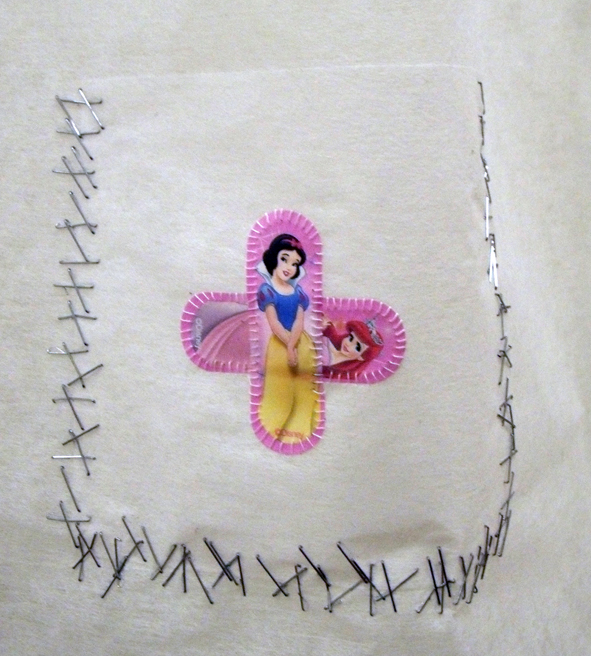
The cross shape made by various commercial medical dressings recall the basic shape of most darns seen on the samplers; when executed in ready-made modern plasters she references the ‘quick fix mentality and disposable culture’ of the present day.
Jillt Morris, child’s apron with first aid pocket – paper
Jilly Morris, Child’s apron pocket with commercial first aid plasters and staples
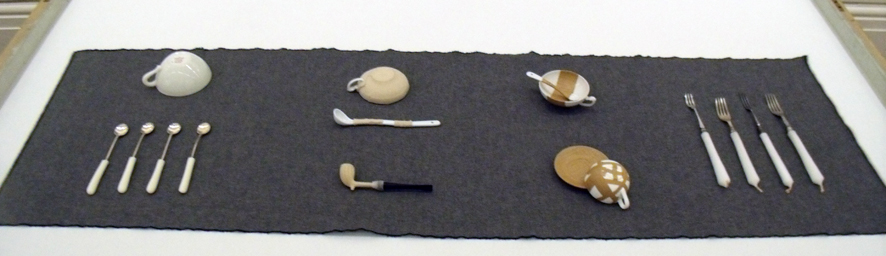
Jess Turrell came in with a box of assorted table-wear cups, saucers and a range of metal components such as spoon bowls, fork tines, knife blades and their specially made handles – which she made up before she placed them in a large vitrine.
Jess Turrell making her Fork Handles
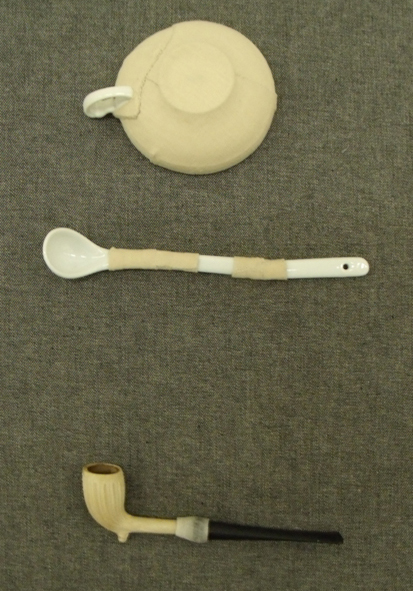
Jess Turrell first aid plaster wrapped ceramics
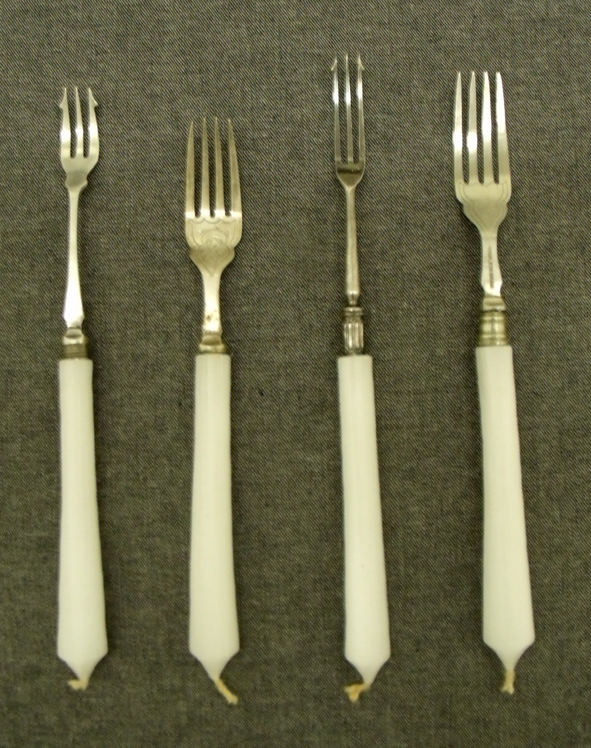
Her work is called “Inappropriate Mendings” and she is having some fun at the idea of making aesthetically elegant mending that is really useless for any practical purposes, fork handles are whittled from wax candles (gedditt?) cups are mended with calico, and spoon handles wrapped in plasters from the first aid tin.
Jess Turrell, Fork Handles
Jess Turrell – vitrine of inappropriate mendings
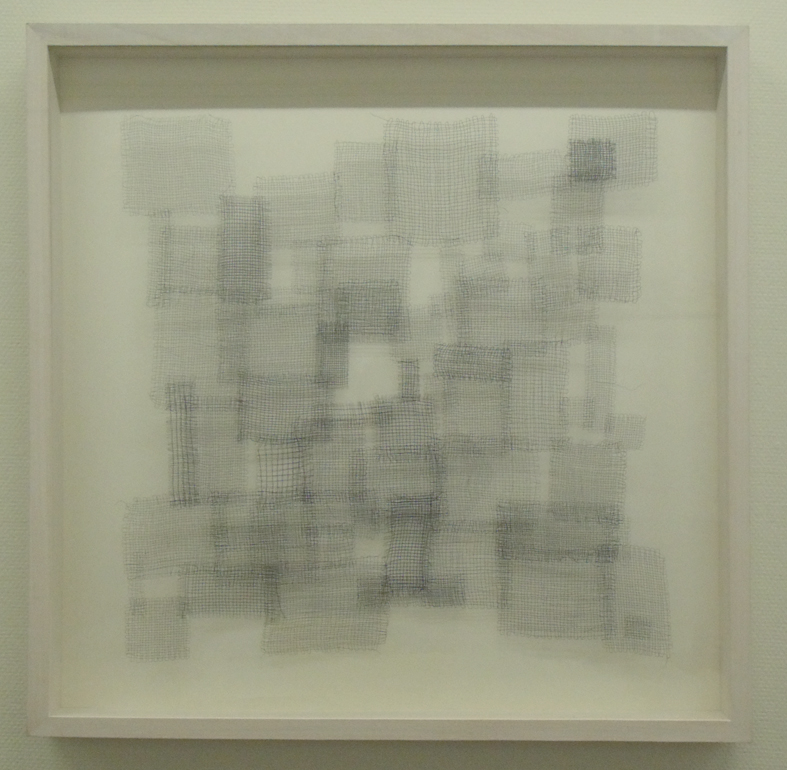
Dail Behennah brought in a fragile darned wire piece, mercifully it was framed and so this was the easiest to hang…the piece is simple and refined and references a particular black darning sampler in the collection, which is placed in a vitrine opposite her work.
Dail Behennah – Holding it Together, copper wire and thread.
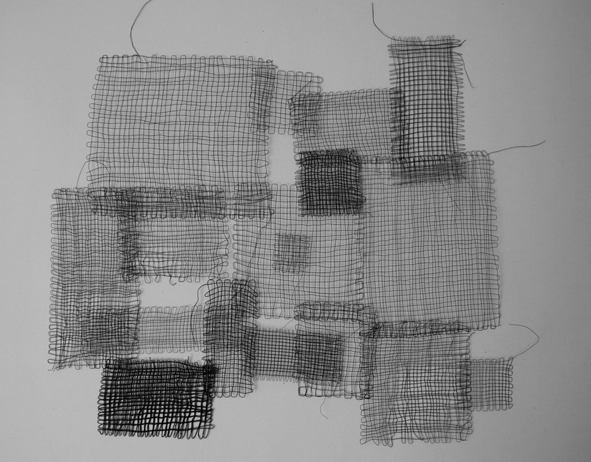
Dail reflects that the darning in an old garment are often stronger than the fabric that they hold together, she has taken this to ‘absurd lengths’ by making a piece of metal fabric entirely compose of darns. The shimmering quality of the image is created by the shadows set up by the work being suspended in a box frame, below is the darning fabric in the making
Dail Behennah, darned fabric detail.
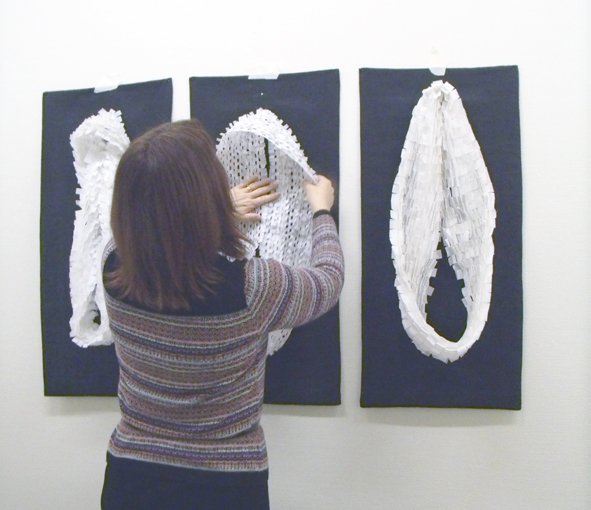
Dawn Mason exhibited a series of different responses to the mending samples, called Face to Face her work reflects the reverse side of the samplers, some how when we look at the ‘wrong’ side of a piece f stitched work it seems much more immediate, the involvement of the maker is more apparent because here we see the comings and goings or the threads and often the struggle the maker has had is left as evidence where on the front of the work all is perfectly presented and correct. (I know that given the opportunity people usually will look at the back of any stitched work – maybe searching for signs of the maker’s involvement )
Dawn Mason, hanging her newest pieces – cotton organdie
The work she showed was made over the entire duration of the project and shows the progression of her own personal work…
Dawn Mason – early stitched and darned work – printed polished paper and thread
Dawn Mason, stitched texts on printed polished paper and thread
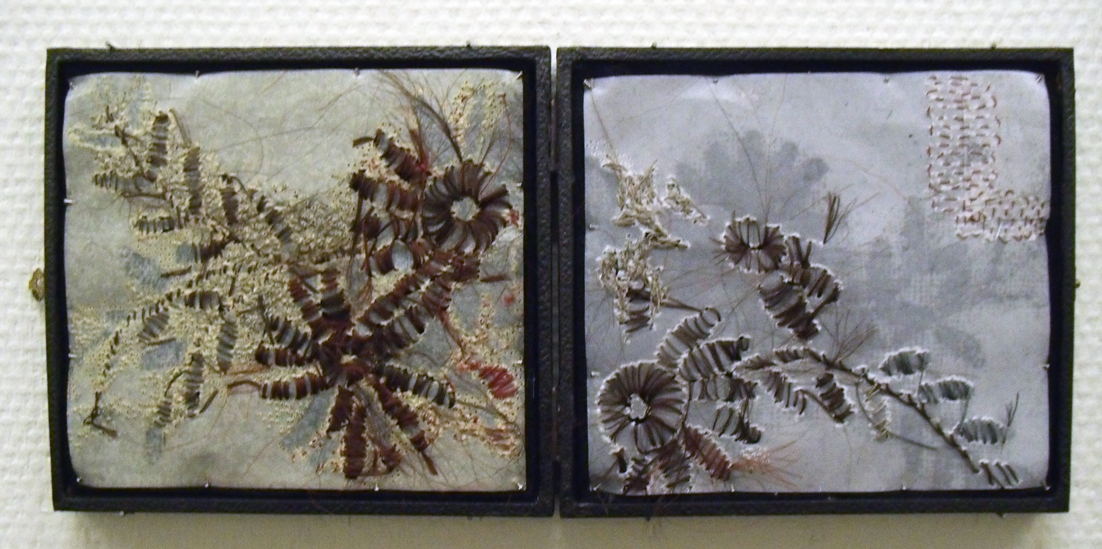
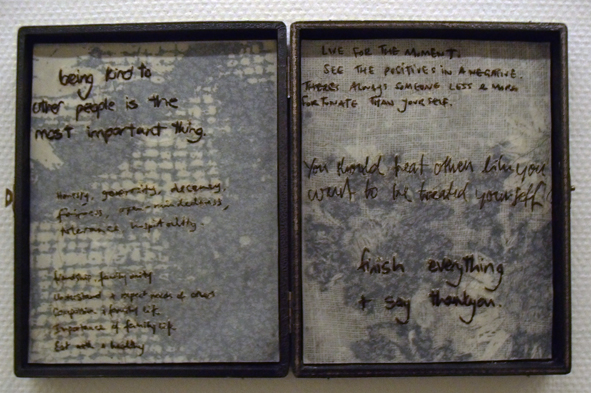
Like Dawn’s exhibited pieces, my own work forms part of an ongoing series of stitched work, that has been a direct consequence of our involvement in this project. “Make it through the Night” includes many references to mending as mending broken hearts has been the major inspiration to my personal work for several years now – as this blog illustrates – there are many postings around the ideas and practice of mending, and the first ever post was about my mended clothes………
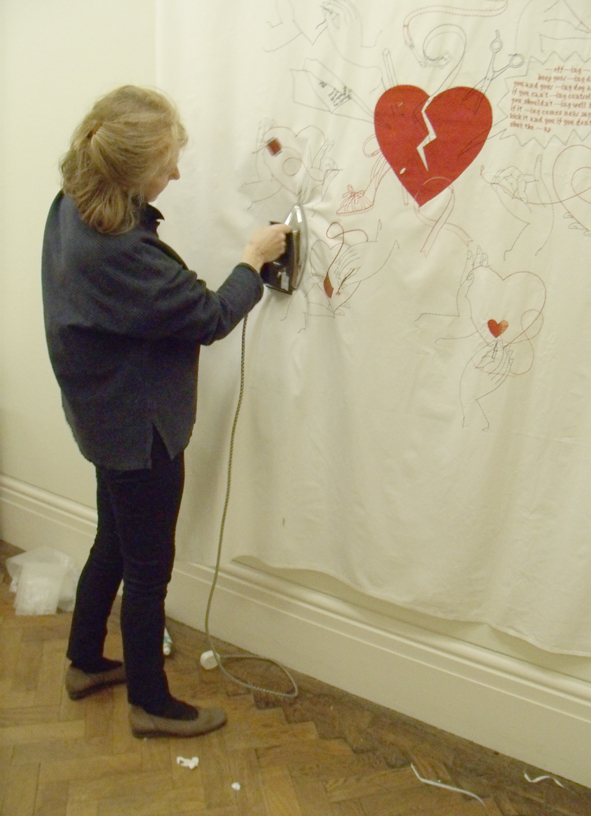
a rare photograph of me in action – here pressing ‘Counterpane – Counterpain” on the museum’s walls
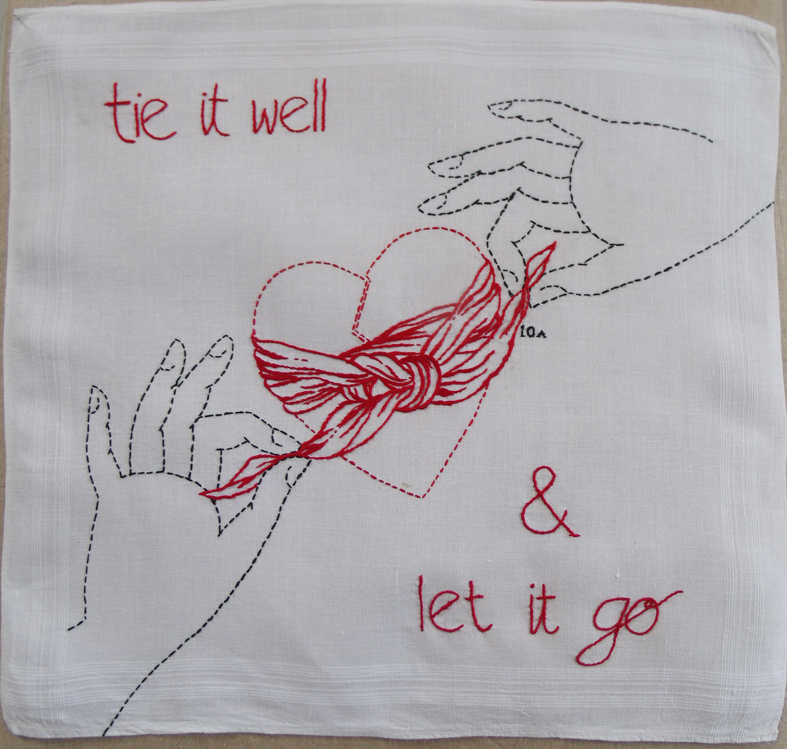
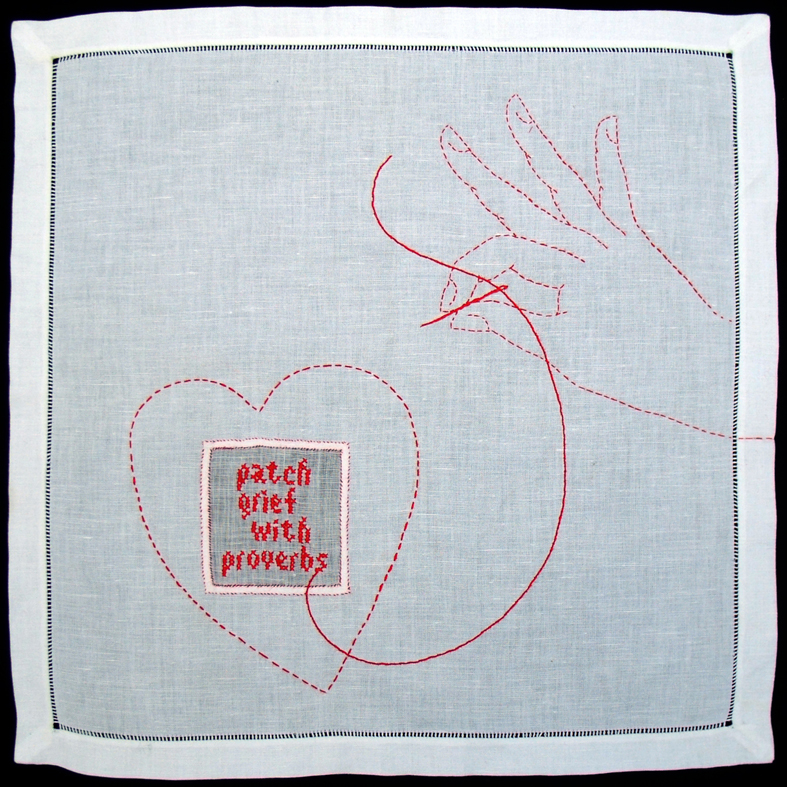
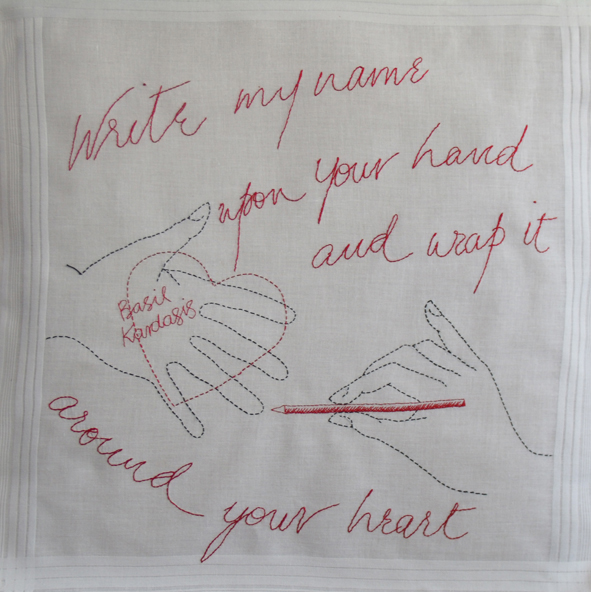
I have made a whole series of embroidered handkerchiefs, let’s face it some nights we have all needed a handkerchief if only to hold on to. So I have embroidered them with positive mending mottoes and other words of wisdom – the set is called ‘ Patch Grief with Proverbs’ a sentiment that rings true to me. How often we just find ourselves reciting platitudes in response to grief?
Janet Haigh embroidered linen handkerchief with linen voile patch.
Greek proverb, cotton handkerchief and thread
I made 21 embroideries all with their own distinctive darns and patches to reflect the written proverb, they took quite a time to get onto the wall…..I had to search many different sources to find enough texts to make a wall full – but one lovely Greek proverb was given to me by Basil Kardasis and this was the last piece I embroidered – an a very large-scale cotton handkerchief I had to purchase new – the rest were all on vintage linen.
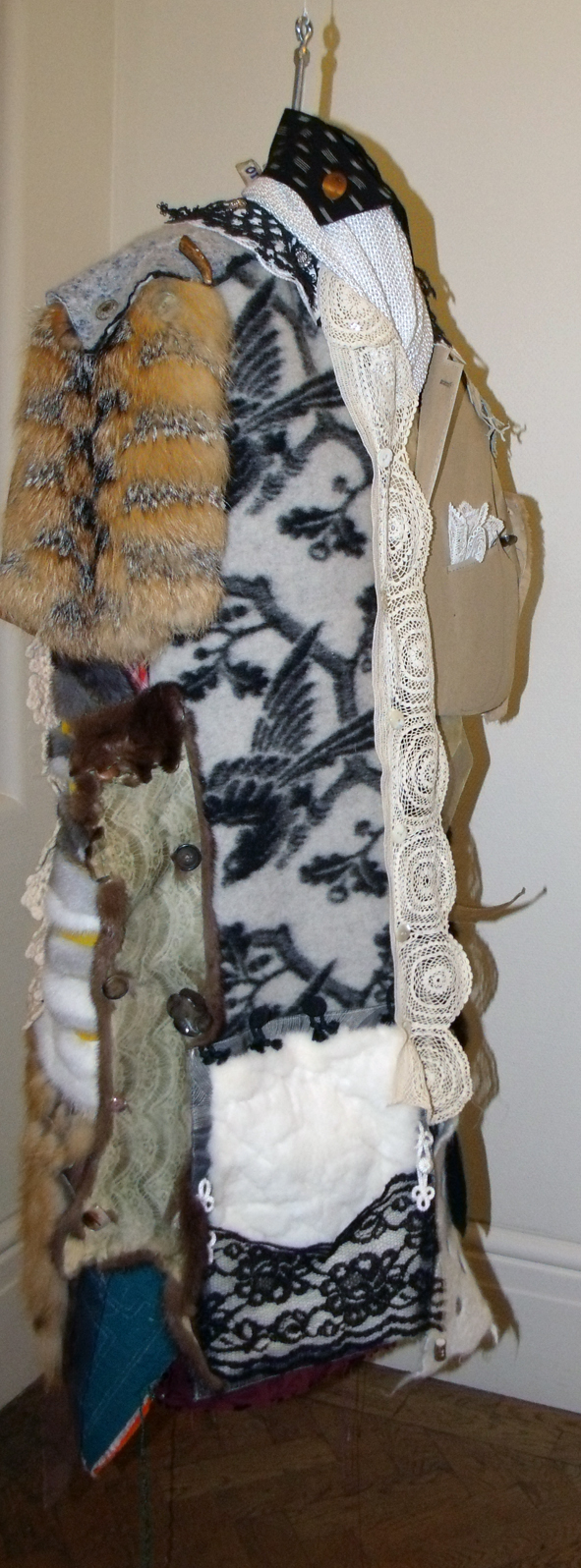
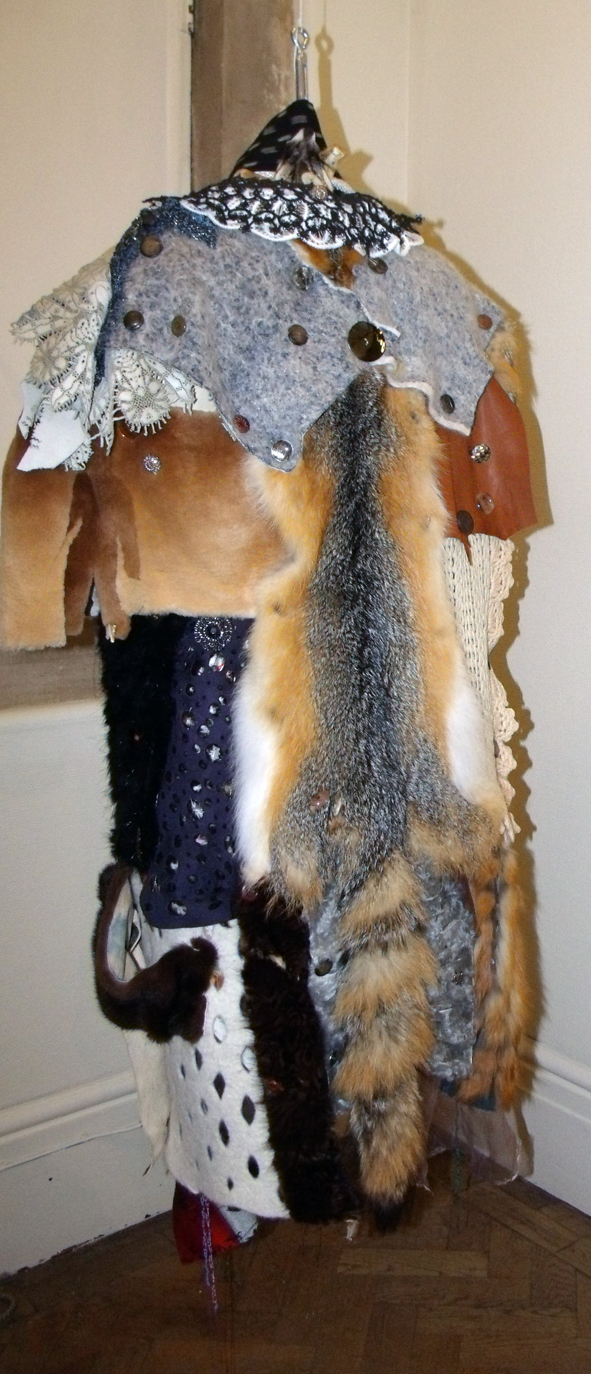
Which brings me neatly to the last exhibitor, Basil Kardasis, his exhibit is called ‘The Buttonhole’, and he collected from his family and friends ( we all had to contribute) ” treasured, revered materials…that may represent them ” and also a button; then , with the help of his sister Ella, spent may months button-holing all the pieces together so that they made a “protective cloak” for his son.
Many different materials and articles appear in the cloak, which has a very colourful interior as well, the range of fabrics perfectly reflect his wide-ranging experiencing as a designer and educator world-wide, students and colleagues and friends from practically every aspect of his life gave him wonderful and rare pieces of cloth for this coat, my favourite is a piece of lasered leather in a lace pattern – now this I could really get working on – it only I had much more of it…..
lasered lace calf skin
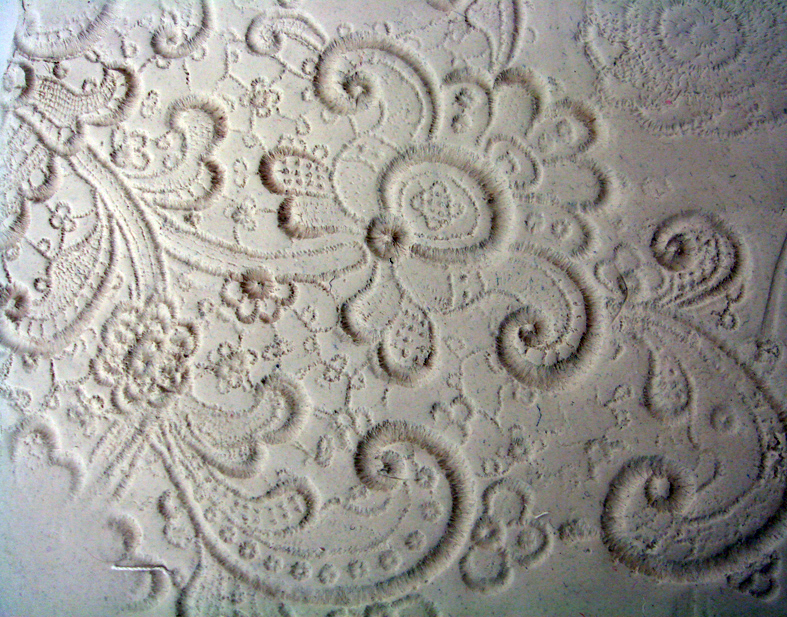
Looking at the image now of this lasered work I am reminded of the joint piece of work that had to be abandoned for inclusion in this exhibition, due to personal reasons by my making partner Hanne Rysgaard. We were making a porcelain hanging from impressed lace fragments but sadly this was shelved until we can both find the space in our very busy lives to get together again and make it. Now I am thinking that these 2 disparate materials may somehow work together…leather and porcelain – Basil where did that lasered skin come from and is there any more?
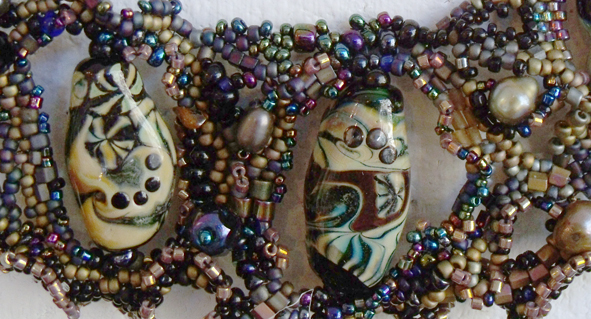
detail of lamp-worked glass beads based on fossilised dung – Ilsa Fatt
The intricate hand made beads shown in the detail above are based on Coprolite – icthyosaur dung, or more simply – fossilised poo...Ilas Fatt has developed these beads as part of a collaboration with Lyme Regis Museum where artists have been asked to work from specimens from the museum’s collection to be shown in an exhibition in 2013 – so a sneak preview at Heart Space Studios
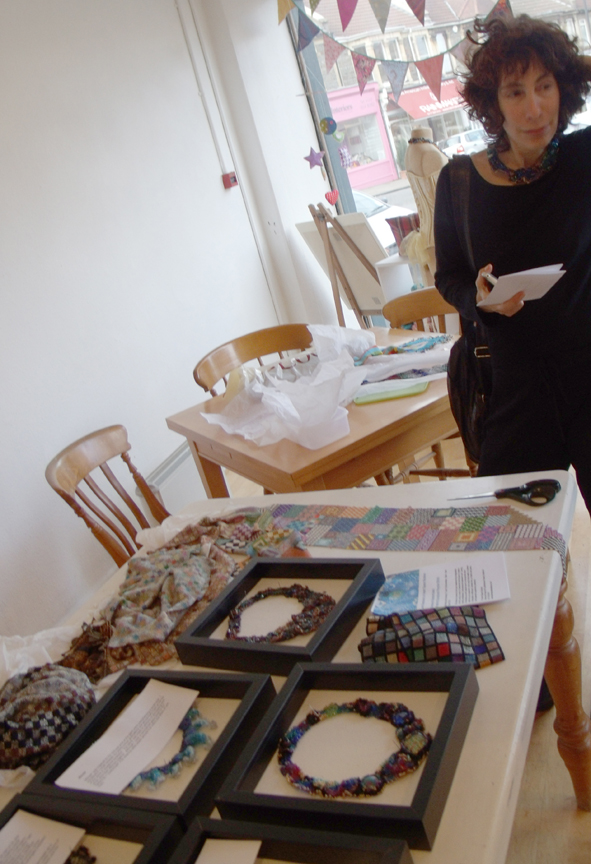
Ilsa brings in her exhibits to the empty exhibition wall at Heart Space Studios
We have concentrated on bead work to advertise the next Master Class given by Ilsa – she describes it as being in ‘Freeform Sculptural Peyote Stitch’ I describe it as an absolutely amazing jewellry – making opportunity where using a variety of bead-work techniques a densely embellished bracelet will be formed – with integral fastening – my favourite aspect of Ilsa’s jewellry – she really has designed elegant and workable fastenings for her bead – work – for this alone, it would be worth taking the class.
A table full of gold and black beaded exhibits
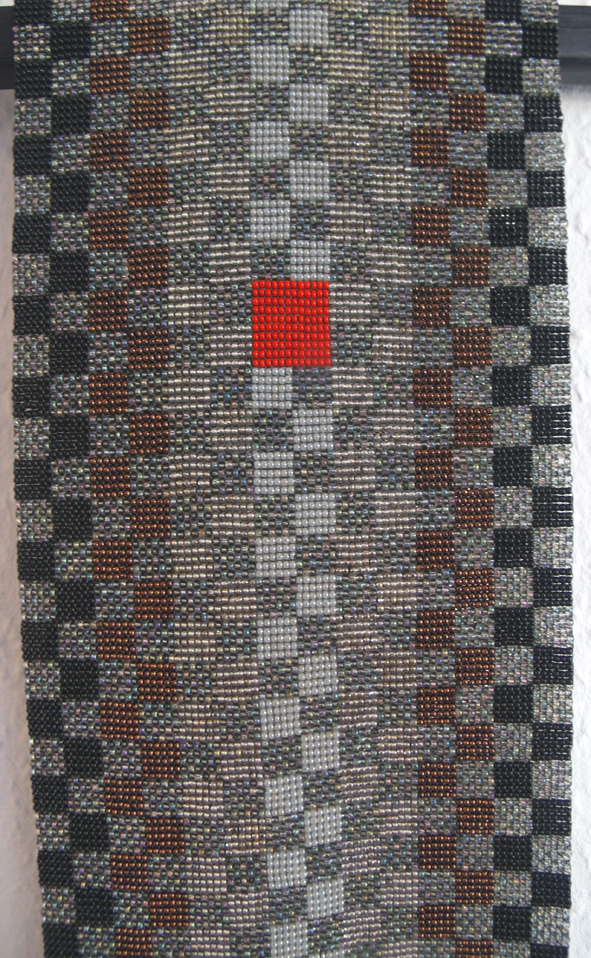
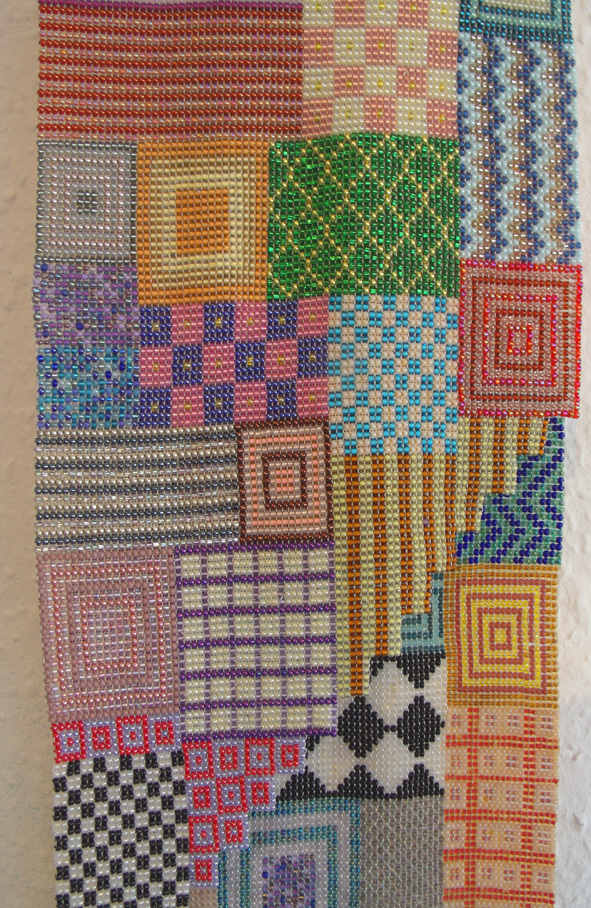
Putting together this beading exhibition was fascinating, seeing how different designers had managed to make such contrasting pieces by using simple beadwork techniques. Ilsa Fatt uses Peyote stitch and Janis Taberner and Kristina Ferron use square stitch. When all the pieces different pieces were assembled they looked wonderful just draped and jumbled together over the tables – I was in favour or showing them draped on the wall, but when we saw the hangers for the Janis’ scarves we realised that formality would reign… but how to place all the disparate work together for a successful exhibition?
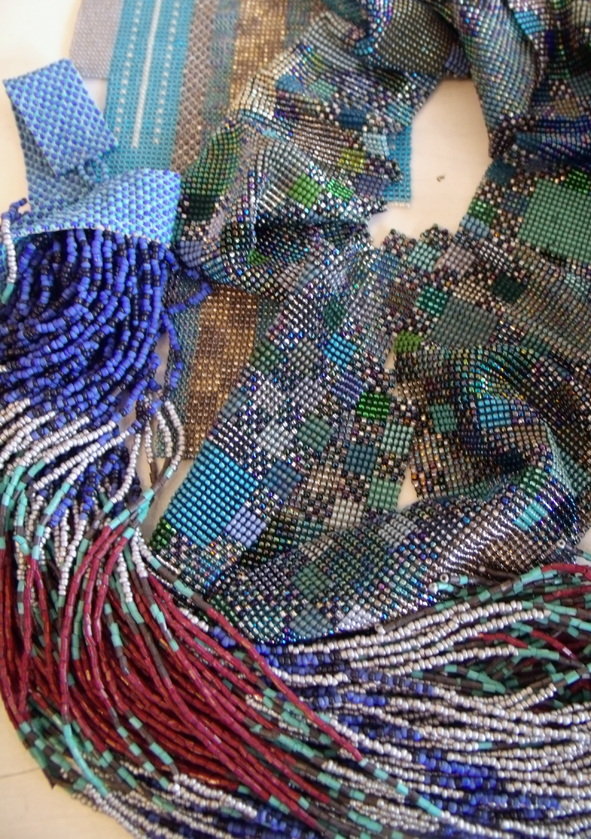
Blue and turquoise colour story
Sophie, Heart Space’s administrator and general genie, thought we should colour co-ordinate them – well I wasn’t going to deny that so we grouped everything together in ‘colour stories’. This made life much simpler and meant that at least the different types of work would hang together well
gold and bright colour story
First we placed everything on the floor in the colour groups.
the black and gold group on the floor
the long scarves made perfect borders for the boxes of necklaces. The rich colours of each designer’s work really enhanced each other.
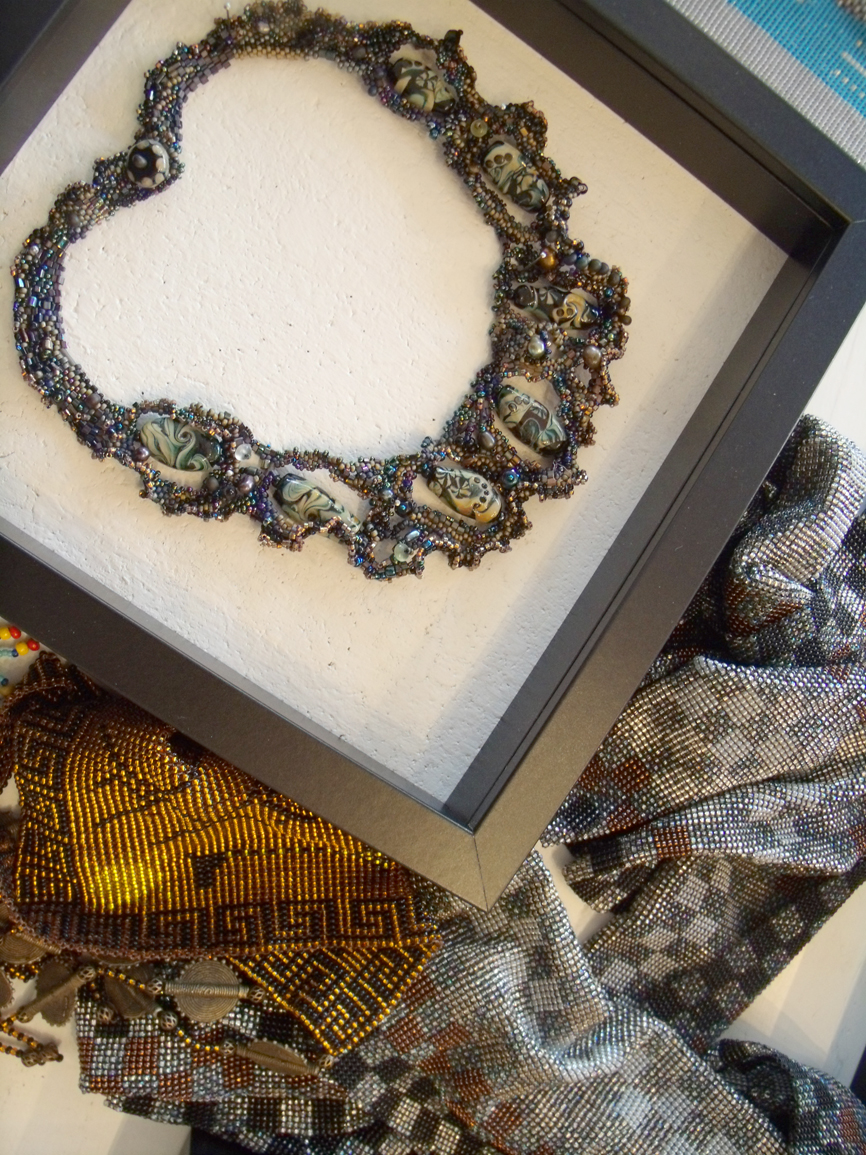
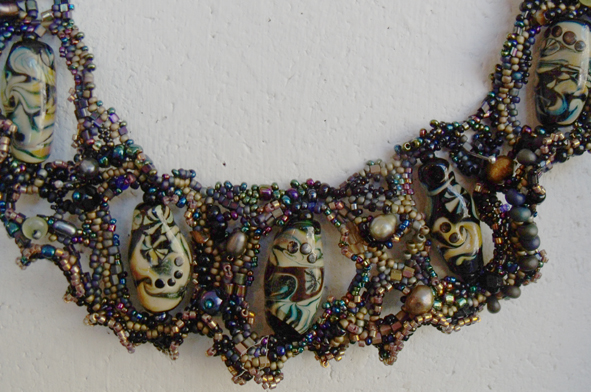
hand made Lamp-worked glass beaded necklace based on Coprolite – Ilsa Fatt
black squared scarf – Janis Taberner
black and grey squared scarf – Janis Taberbner
detail of Carnival necklace – Ilsa Fatt
Ilsa is offering students her own lamp- worked beads as part of her Master Class ensuring everyone makes a unique piece of work.
blue group with deco necklace by Janis Taberner and ethnic inspired pieces by Kristina Ferron
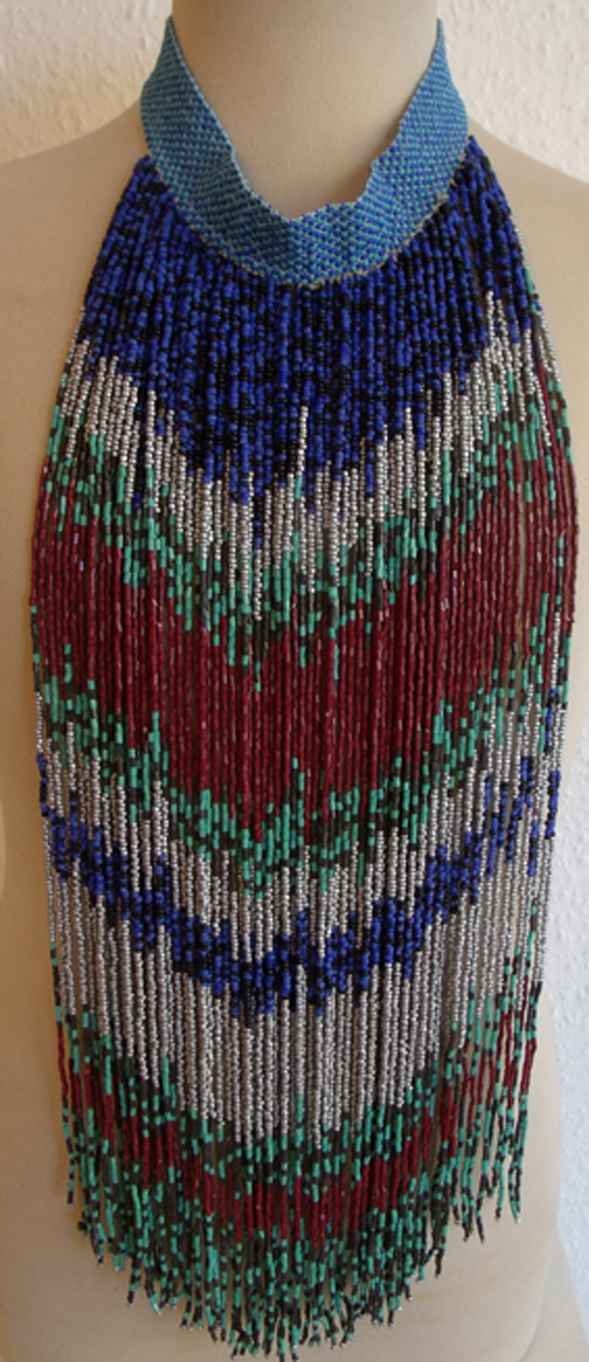
The Blue grouping was easy-peasy – we used small stands and simple boxes to show the work, the brilliant blues and turquoises of Kristina’s ethnic necklaces, Kristina explained that she really likes “Big Jewellry” – a woman after my own heart.
blue square stitch scarf – Janis Taberner
strings of beads necklace – Kristina Ferron
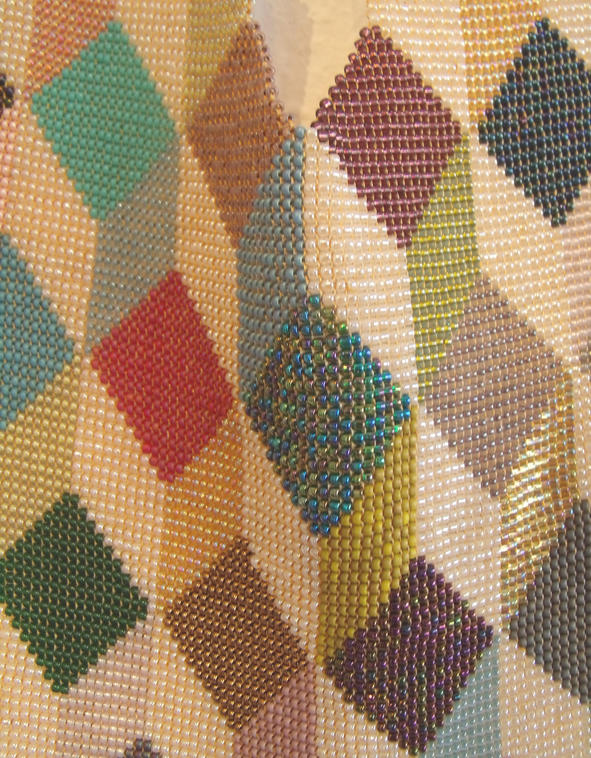
The next group along the wall is in brilliant colours with gold; 2 scarves and a necklace that is based on the tumbling blocks patchwork design – Janis’ background in embroidery shows in her wide range of textile inspiration for these works.
Brilliant gold group – Janis Taberner
detail of the tumbling blocks design
detail of edging on patchwork design
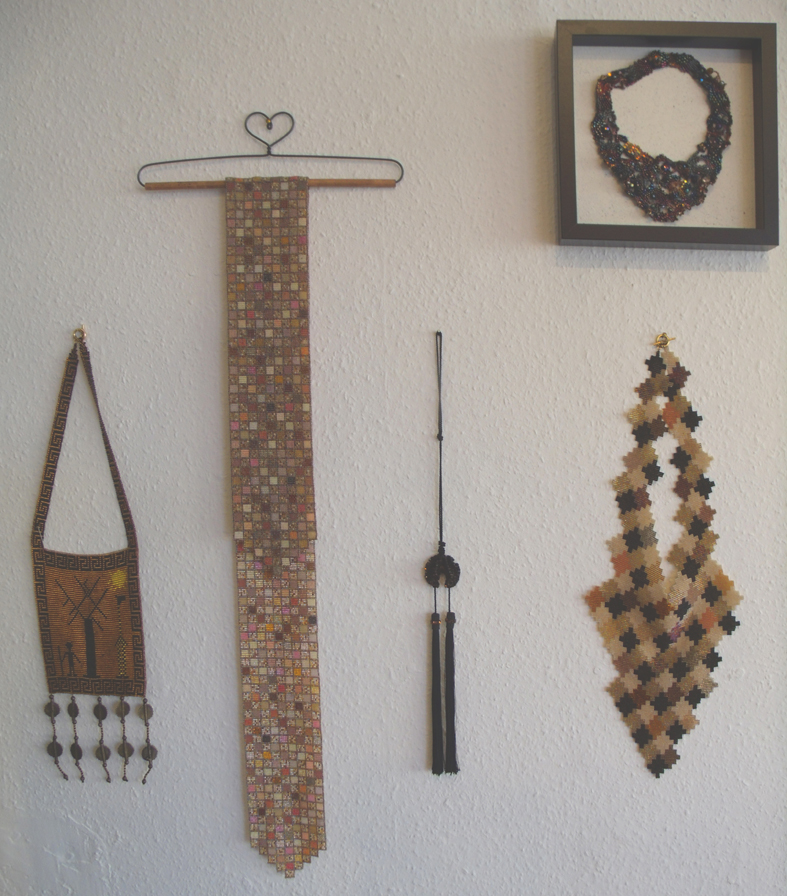
and the last group is a series of different items in gold and autumnal colours made by all three makers, including another collar this time in what appears to me to be a hounds-tooth check pattern.
autumn gold group by all three makers.
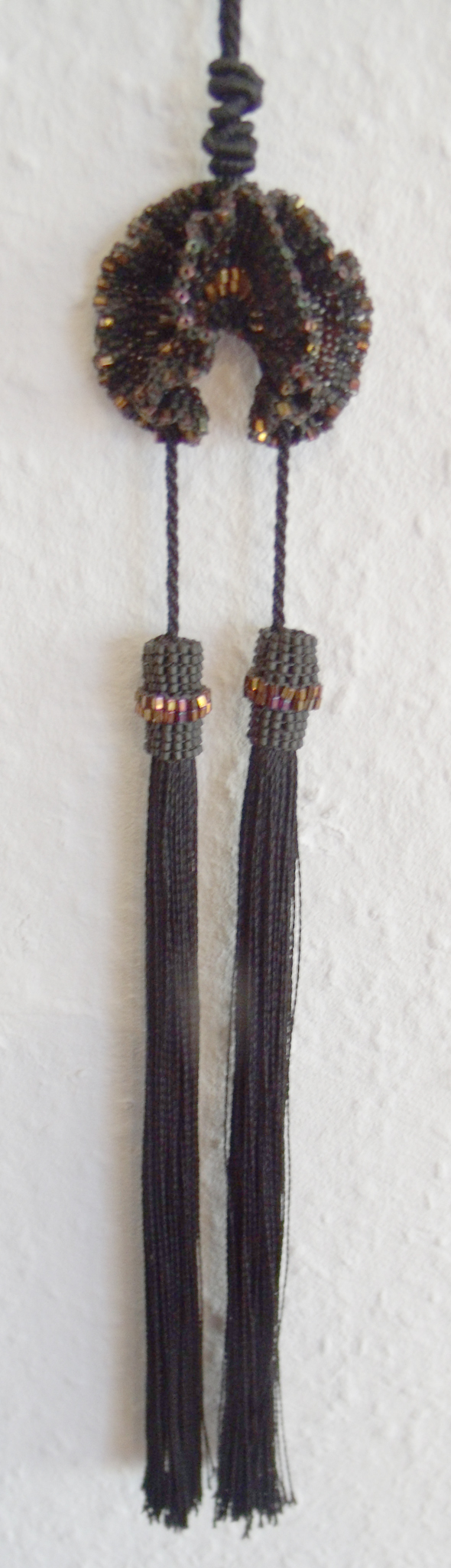
plus a beautiful frilled pendant by Janis where she has also braided the cord and tassell using a Japanese technique.
frilled pendant – Janis Teberner
beaded bag – Kristina Ferron
and also this sumptuous and subtle necklace by Ilsa.
autumn colours and gold beaded necklace – Ilsa Fatt