QUILTS

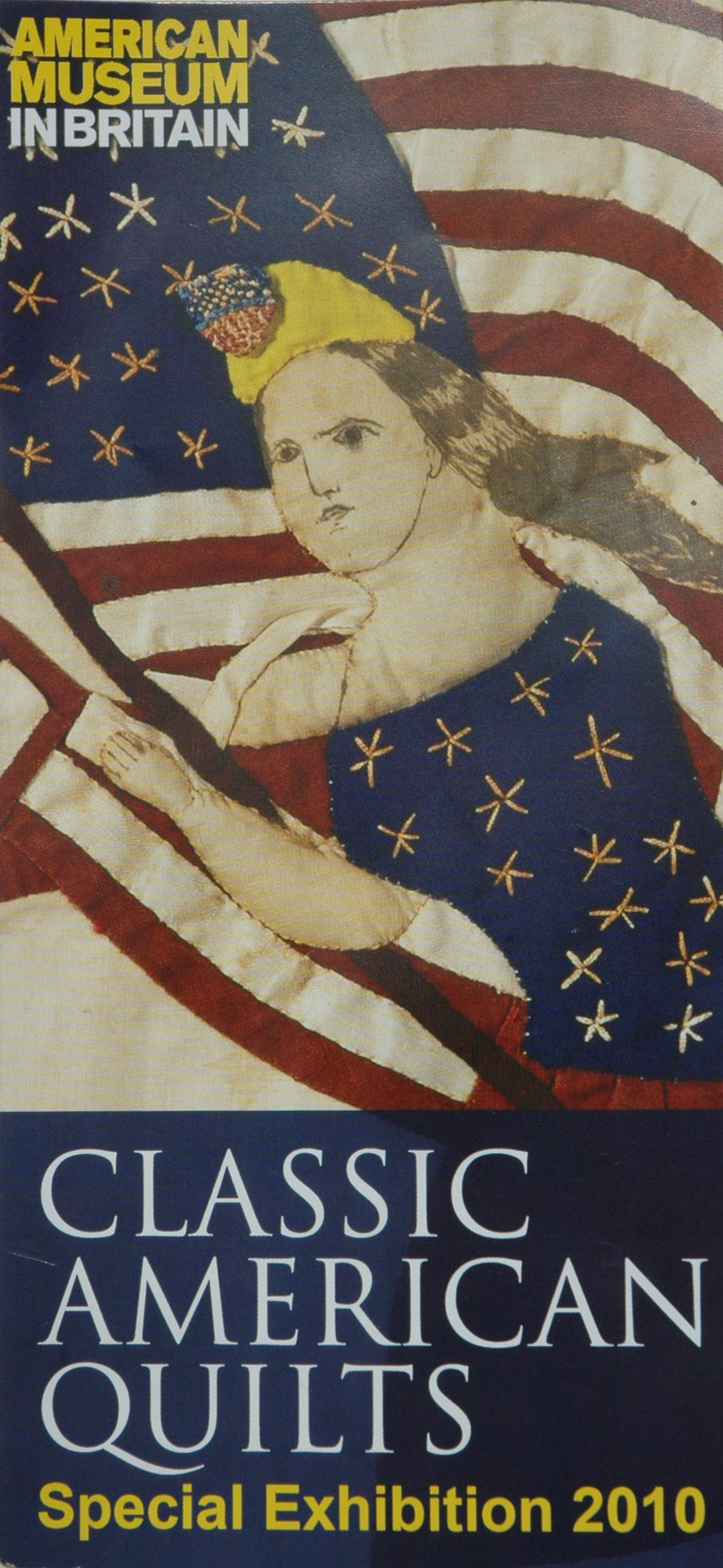
Last week I went to The American Museum in Britain, at Claverton Manor which is set on a slope overlooking a valley just outside the city of Bath. I know the museum well having visited it many times for the last 30+ years since I moved to the west of England. This occasion was organised for Textile Forum South West members specially to see the museum’s collection of Classic American Quilts as part of what seems to be the year of the quilt in Britain; the V&A museum is currently showing a large quilt and patchwork exhibition which I saw earlier in the year.

This smaller show is of traditional quilts only (held to celebrate the new book “Classic American Quilts from the American Museum” by Scala publishers and written by Kate Hebert the Collections Manager and Laura Beresford, curator) but coupled with the opportunity to see the quilt collection within the museum itself, it really is worth a visit before it closes on 31st October. The one thing about the museum which makes it stand out from others in this country is the quality of its staff, unfailingly friendly and polite even when telling you that you can’t take photographs, but knowledgeable to a remarkable degree about the entire museum.
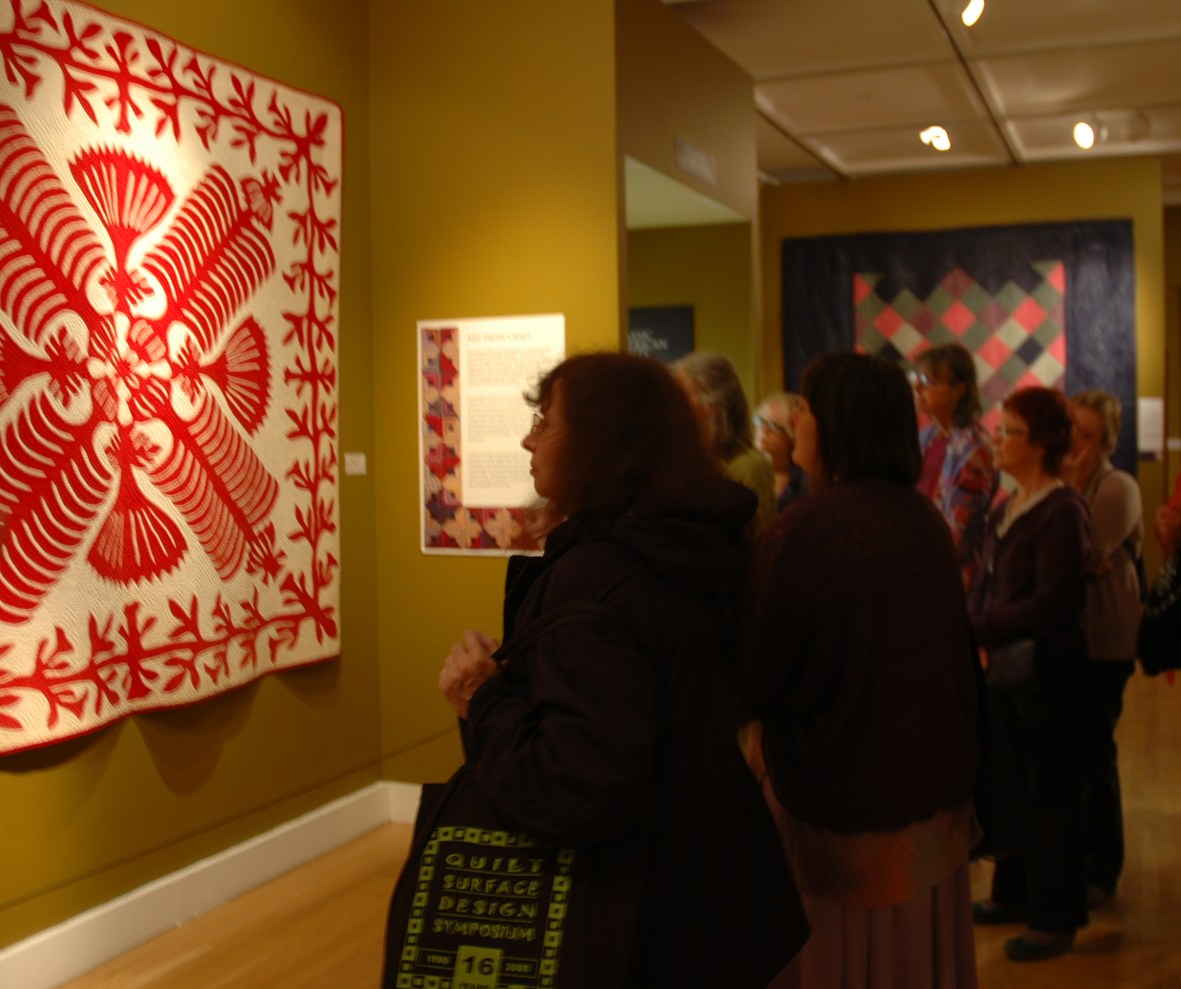
TFSW party in front of “Queen Kapi’olani’s Fan quilt

One of the most interesting things about the quilts are the names given to them in the catalogue, which you can see on the museum’s website. Here the Hawaiian quilt in the classic exhibition has a truly remarkable title. As a visiting party we were given a very thorough guided tour from one of the quilt specialists, Judi Grant, she certainly knew the collection and its history well and even the quilt experts amongst us were impressed.

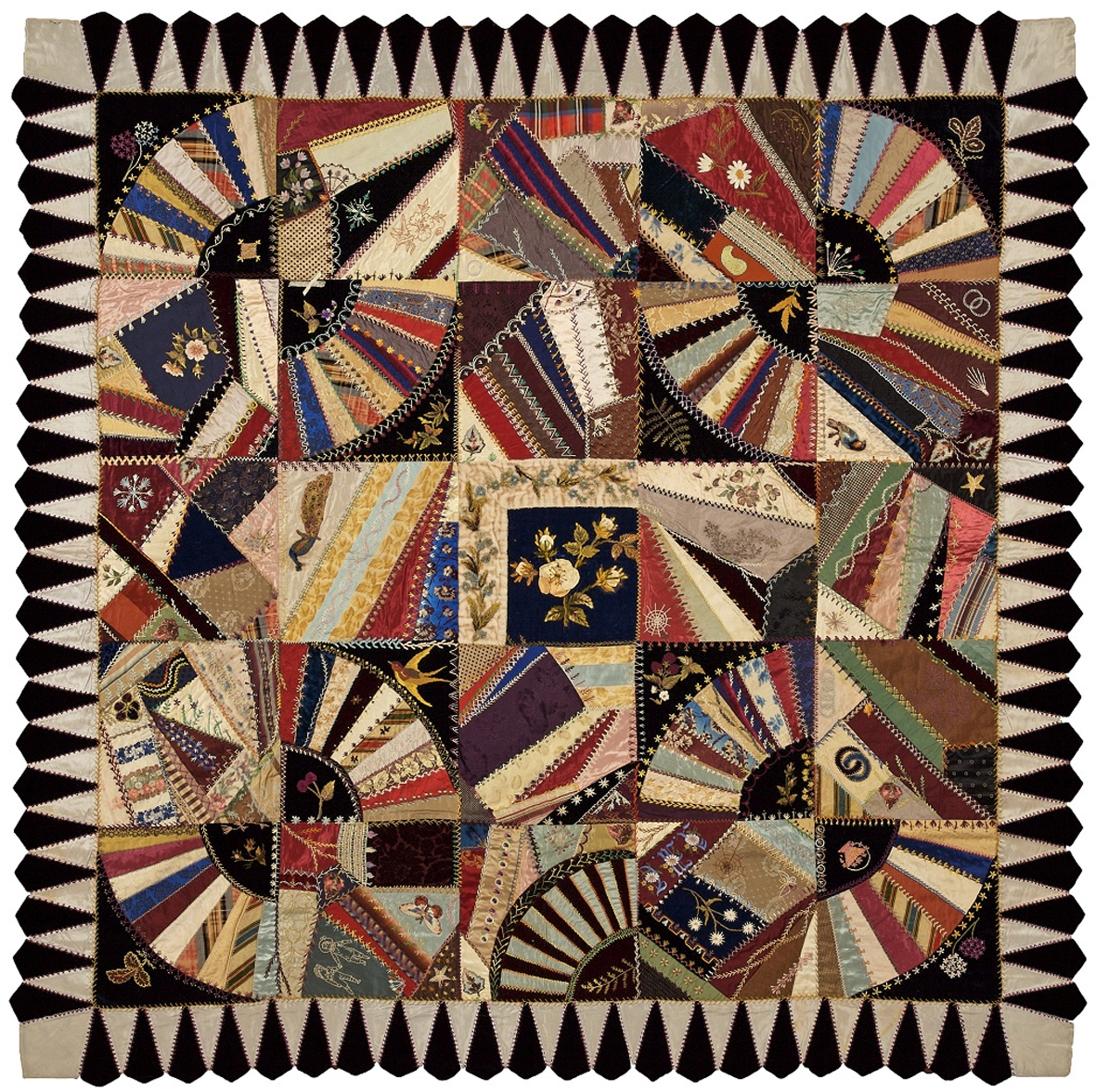
crazy patchwork with fan edge

I particularly like crazy quilts as they are usually embroidered and several years ago I wrote and sampled a book called Crazy Patchwork, for the publishers Collins and Browne. To my delight I found a darning sample in one of the corners of this quilt, but because of the necessary low light levels needed to conserve the collection I have only got a very shaky picture from my hand held camera which was only permitted without the flash.

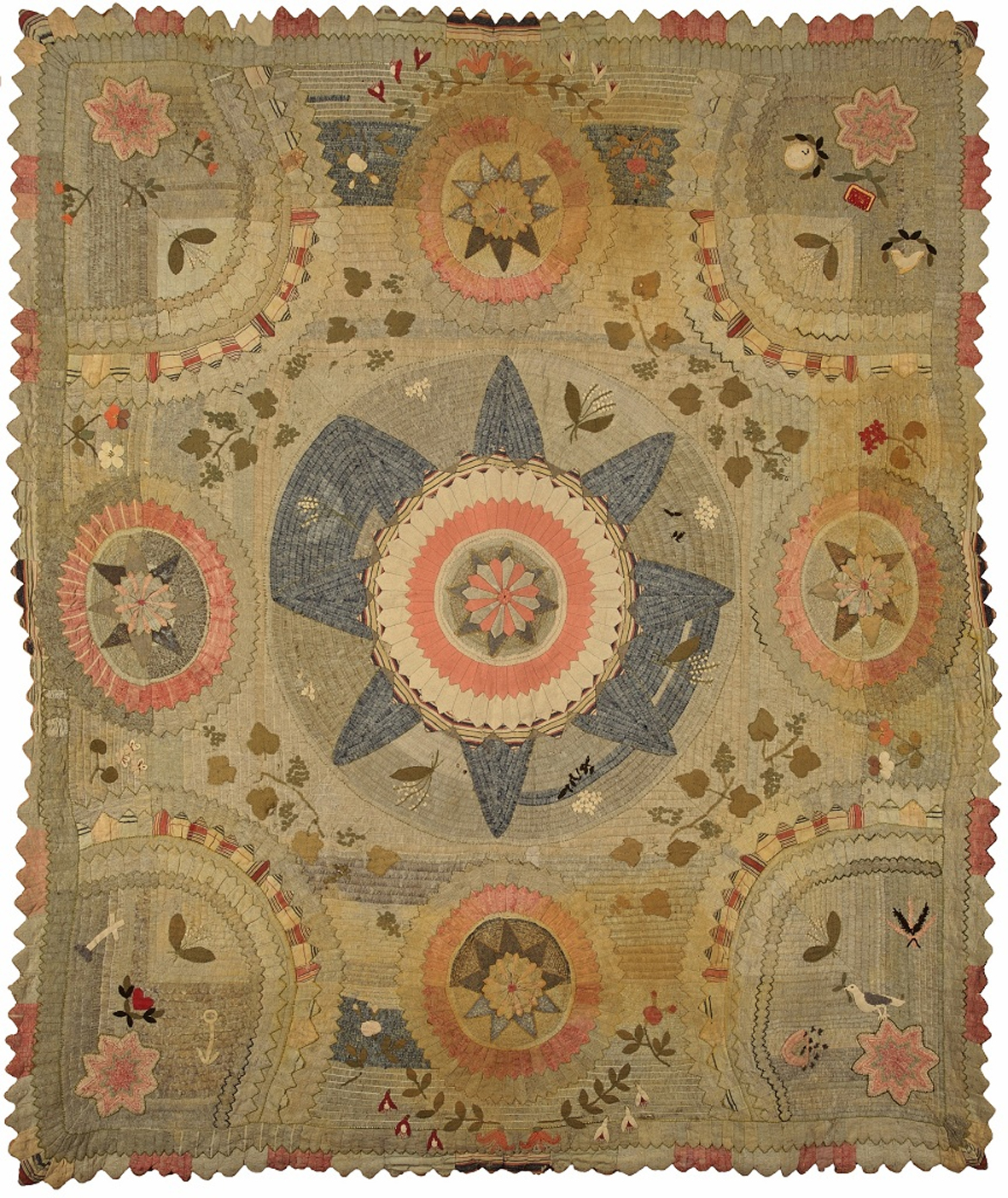
So this got me looking really carefully at everything else for signs of mending and darning. The guide had explained that the museum policy is to conserve but several of the quilts showed signs of mending, obviously made before the museum had acquired them. This 19th century wool quilt was very unusual for the amount of darned areas, it must have been highly valued by its owners to have kept repairing it and I imagine this was not just a case of  necessity for it really is a beautiful textile; the soft and faded colours  make harmonious patterns even though it is stained and worn.

wool applique quilt, the most darned and mended quilt in the entire collection

While on my hands and knees trying to photograph the darns on this woolen quilt I found this tiny red heart appliqued in the left hand corner. Now who put that there for whom? I asked myself.
Now I had a mission for the rest of the collection – looking for mending….so off we walked to the manor house to see the main quilt collection and on my way up the stairs, I noticed this perfectly crafted stone repair.

inset stone repair on the stairs of  Claverton Manor house

The collection on view is apparently only a small proportion of all the quilts that are held and I recognised most of these quilts from earlier visits;  sadly one of my  favourite pieces is not photographed, either by me or  by the museum for its own archives yet – a small patchwork that is tied together rather than quilted, it is made out of faded blue  and white working clothes fabrics, denims, tickings and shirtings. It is the first piece that you see on the racks of quilts and it brings home to you just why this type of textile was first made – out of sheer necessity.

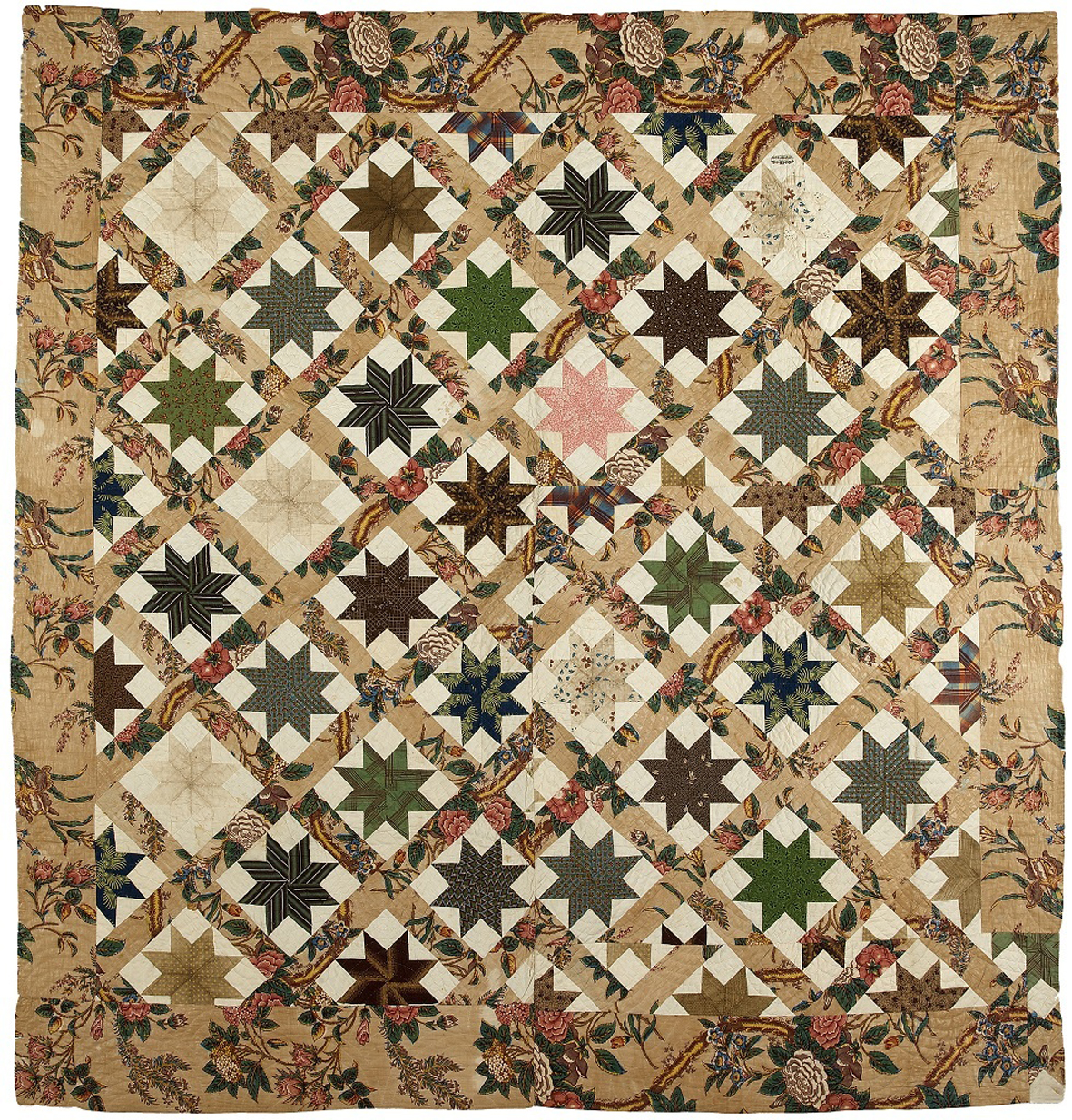
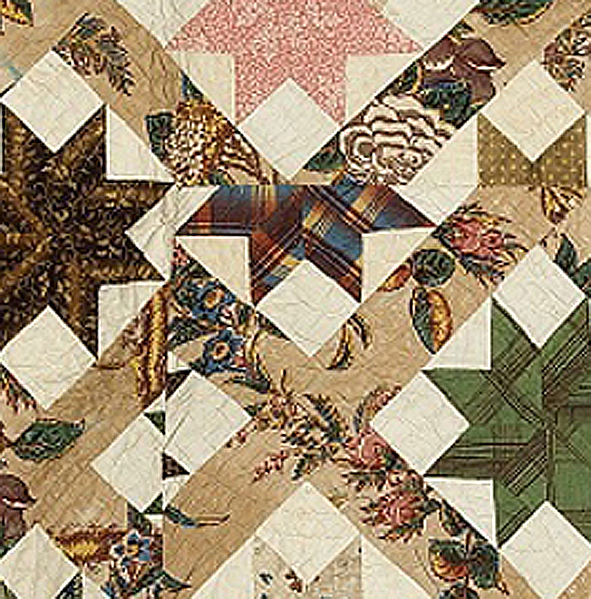
But onto a spectacular quilt with a spectacular name, the Tippecanoe and Tyler Too quilt, it is large and made of  stars set in diamonds which are sashed and bordered with chintz prints, but even better from my point of view –  a quarter of  it has been cut and re- sewn together in a very curious patchwork.

Tippecanoe and Tyler Too quilt
detail showing the join in the large patched area of the quilt

The quilts are obviously my major reason to visit the museum so often as well as the various textile exhibitions they put on in the purpose built modern gallery, but it is also full of fine furniture, ceramics, stencilled rooms and a large ornate copy of the Declaration of Independence, which I particularly like as July 4th is my birthday.

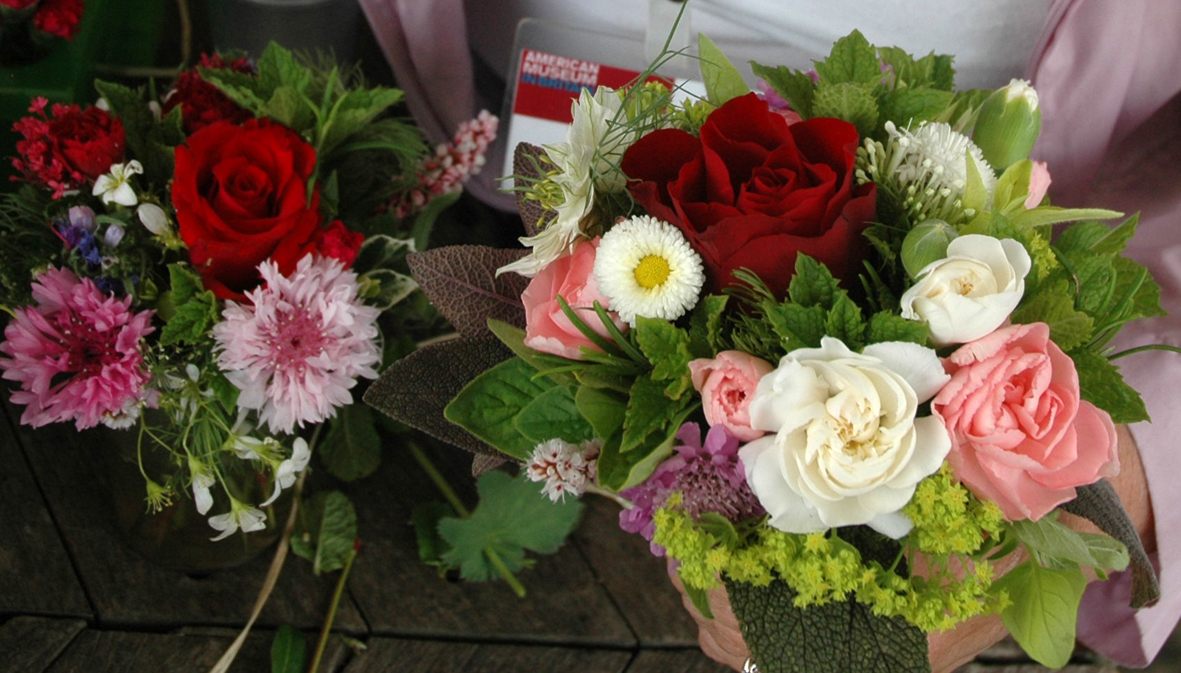
tussie – mussies in the making

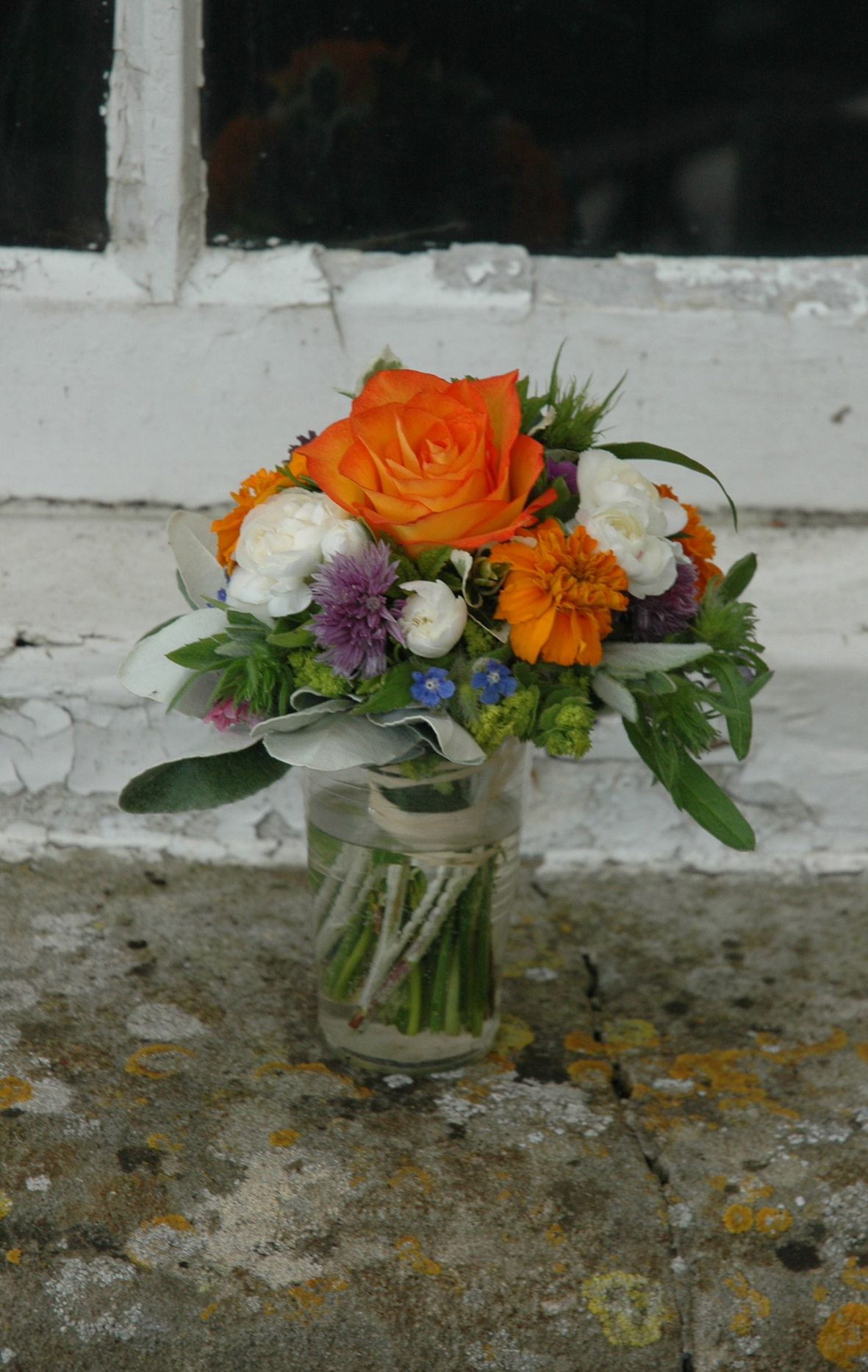
However no visit is complete without sampling the brownies and cookies for sale in the stores and the terraced restaurant/tea rooms – not exactly a diner –  but once on the terrace go to the small herb shop where tiny hand tied bunches of flowers are made and sold, called tussie-mussies they are exquisite and worth a blog all to themselves.

flower arrangement on window sill overlooking the terrace

Even More Hearts

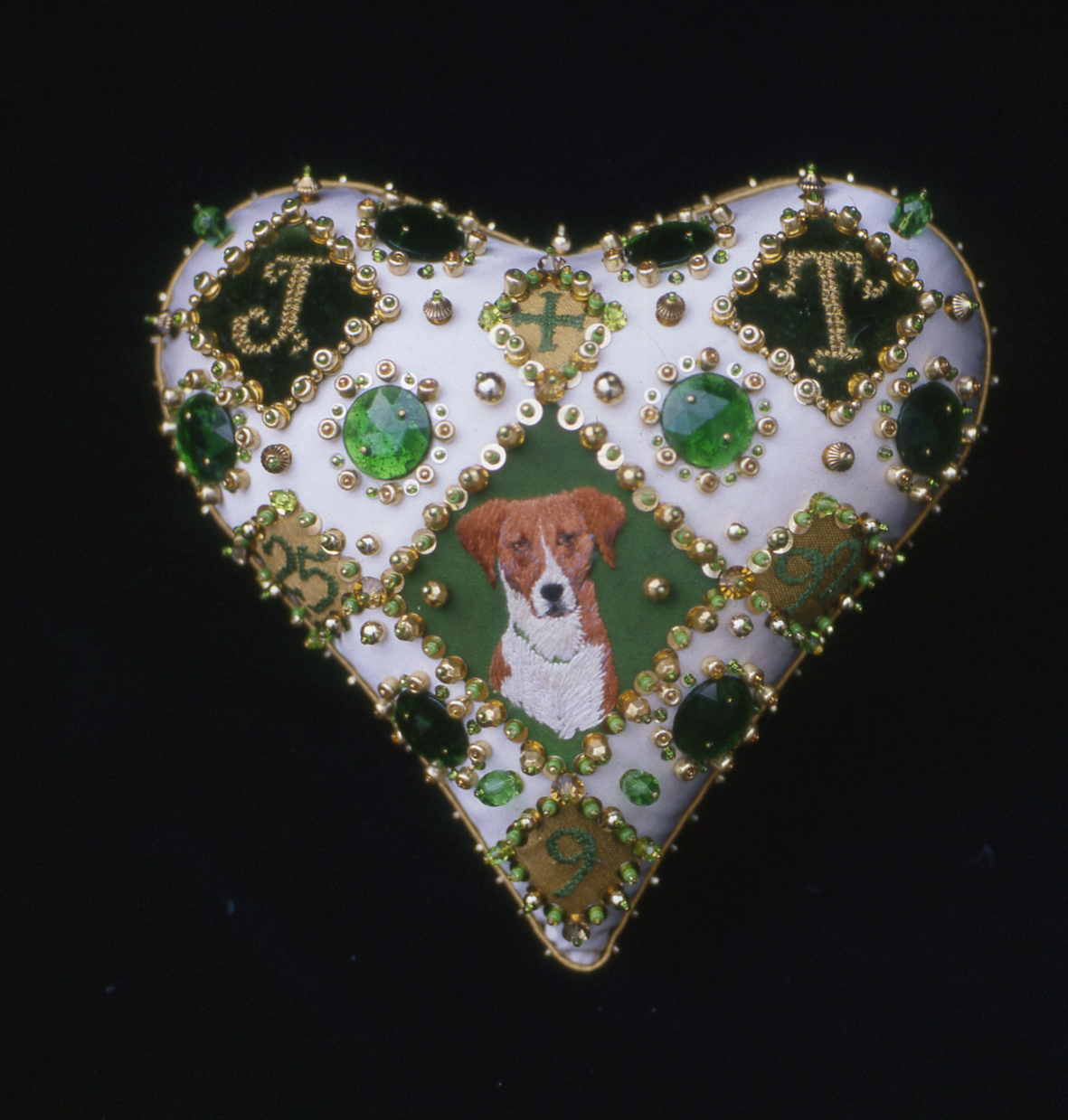
stuffed and beaded heart with portrait of Nimrod, given as a gift to celebrate his owners' wedding.

Looking for more hearts to update the Gallery  I found this stuffed heart image which I had made to celebrate the marriage of  Tim Tanner to my  niece Jo Haigh (owner of the old mended Barbour) it depicts their dog, Nimrod, Nimmie for short. Nimrod was from a  Newcastle dogs’ home, Jo had visited and asked to see only the dogs on “Death Row” and found this beautiful cross bred dog, we think between a fox hound and something much noisier.  After the wedding they went off travelling, parking the dog with her parents – he stayed with them for the next 10 years on and off as she and her husband worked all around the world. I decided to make this portrait of him for them to take on their travels.

From stuffed hearts to empty ones…and so to something entirely different :- about this time last year I took part in a Box Workshop run by Elizabeth Turrell, and Matthew Partington at UWE.Bristol.

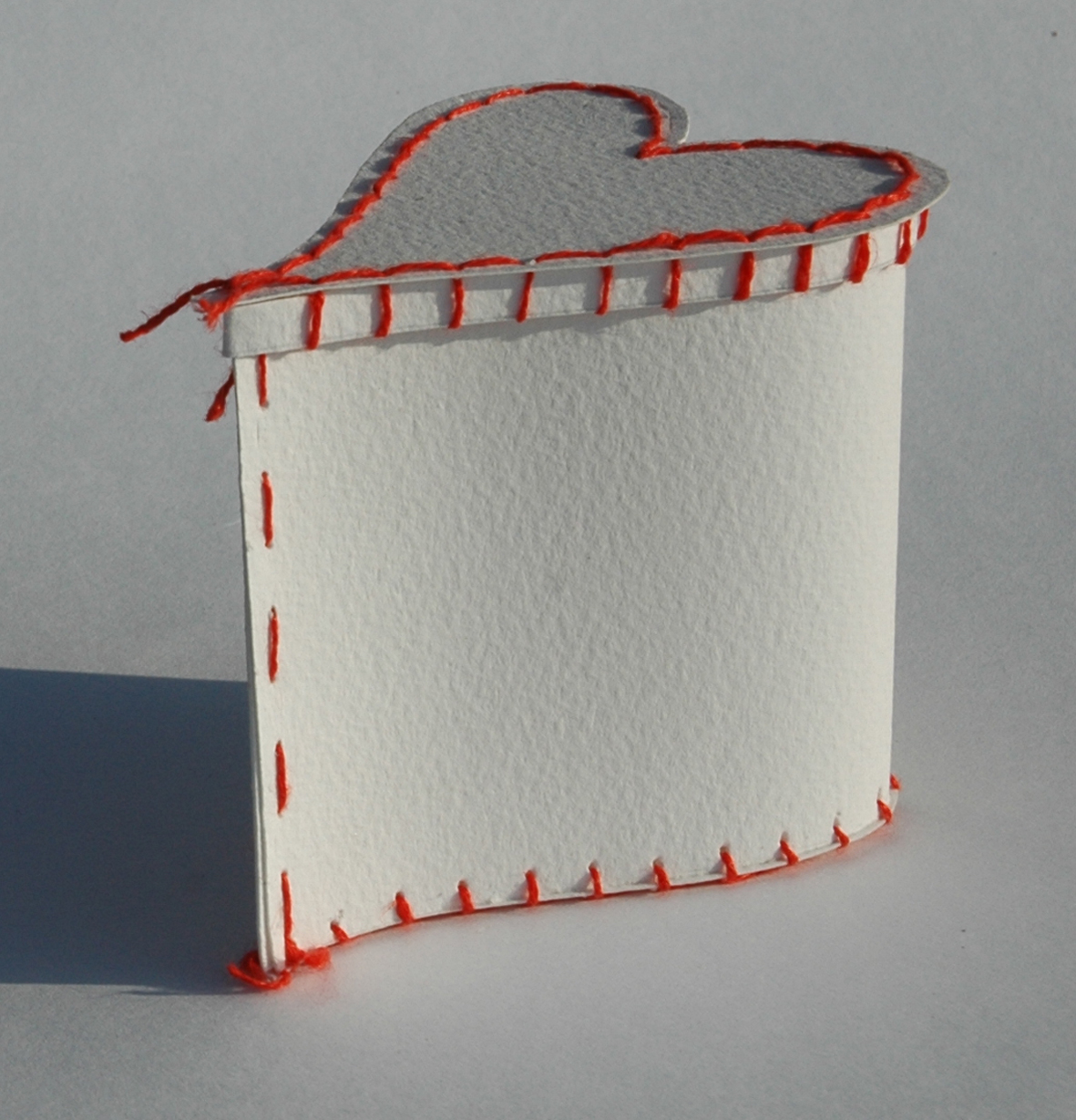
stitched paper heart shaped box and lid
interior of small heart box

I think the world can be divided between people who can make boxes, wrap up presents and who are neat, neat, neat, and then there’s the rest of us.

I really didn’t know how to start the project as I like to draw my ideas first and then attempt to make the drawings; but everyone else, jewellers, ceramicists, enamellers and sculptors, immediately started cutting, folding and making intricate and intriguing shapes.

I did know that I wanted to stitch the parts of the boxes together,  so I did what I always do in such circumstances, fell back on my old ideas, just to get me making – the innovation could come later when I had found something to physically work with. I  cut strips of paper, scored, folded then stitched them together in buttonhole and running stitch and of course some of them became hearts.

Then looking at them again this morning I realised they reminded me of something I had made earlier with a similar construction…..

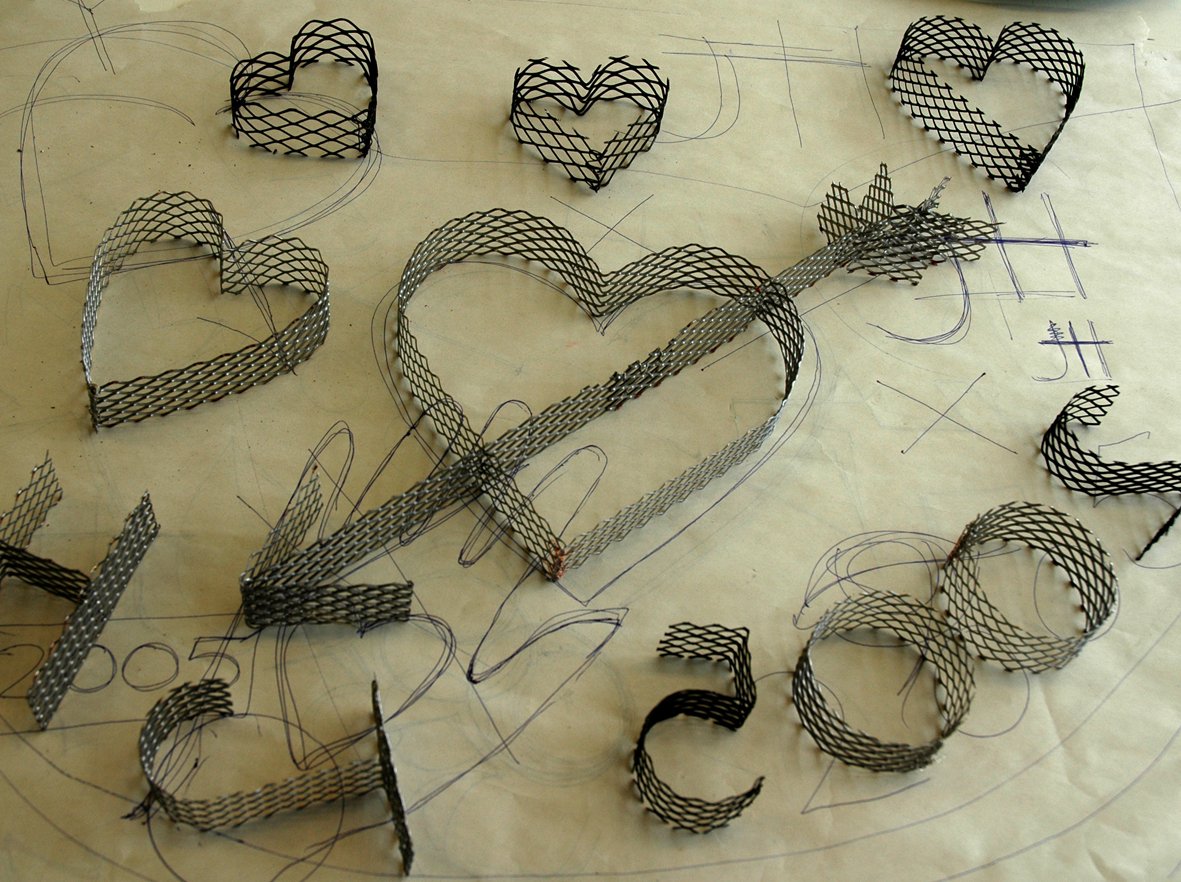
folded steel mesh stilts for holding enamelled wares for firing

Above is a set of stilts I made for holding my work in an enamelling kiln. Aware that even the smallest stilt leaves an indented mark on the counter – enamelled backs I designed and folded metal mesh shpaes to be seen. These particular stilts were made several years ago to hold a large piece of lasered steel ( 60 cms wide), which had been stencilled with sifting enamel on the front.  But it also demonstrates that absolutely anything I have to make can be invested with the heart’s symbolic significance.

Stuffed Hearts

soldier's beaded heart

On the subject of hearts…..searching my archives for more heart pictures for the Gallery section I remembered the stuffed and beaded hearts I used to make. Above is the first beaded heart I bought, it is probably from the first world war; the ribbons were specially woven for soldiers and sailors for giving as gifts. Here the military ribbon forms the centre- piece of this ornate pinned and beaded heart. I found that it had been stuffed with sawdust and so that is what I always use; sailors often used sand. Below is a much larger heart made by a sailor and again I think, from the early 2oth century.

sailor's beaded heart

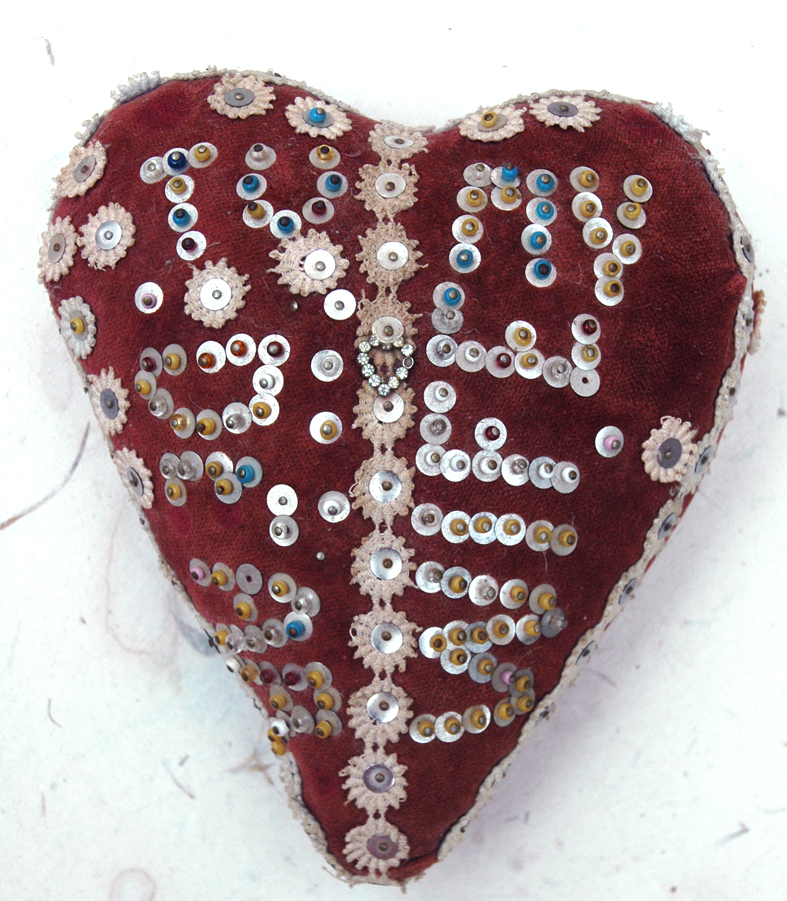
But my favourite heart is this  dusty and damaged one; it is really small about the size of my hand and simple beaded and sequined message says “to my dear wife”

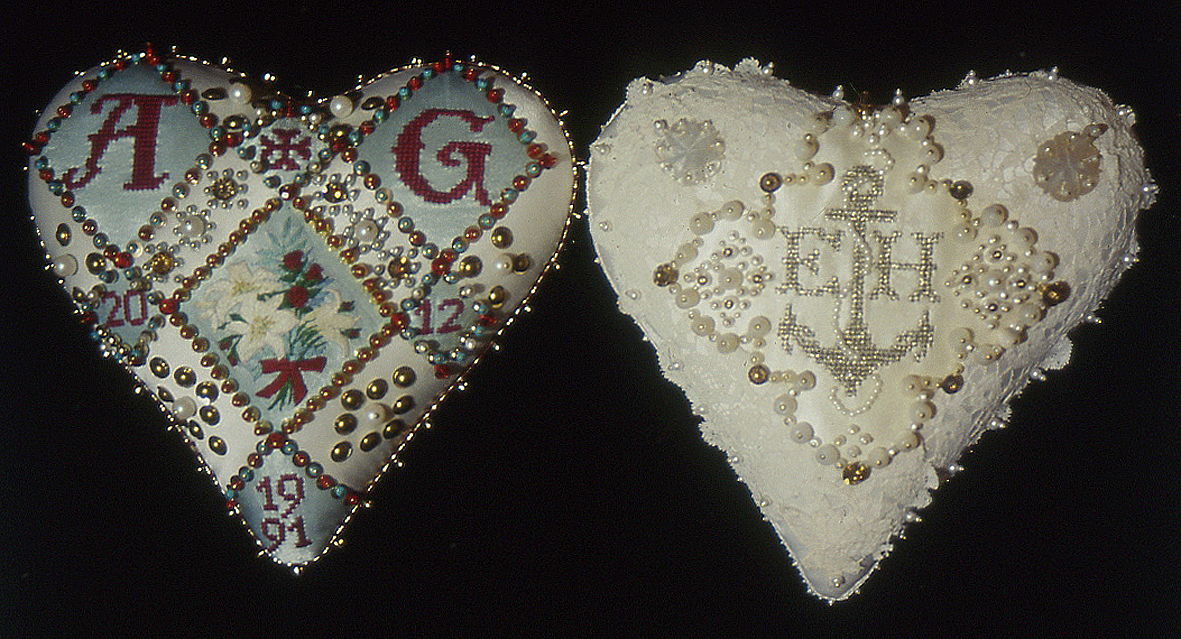
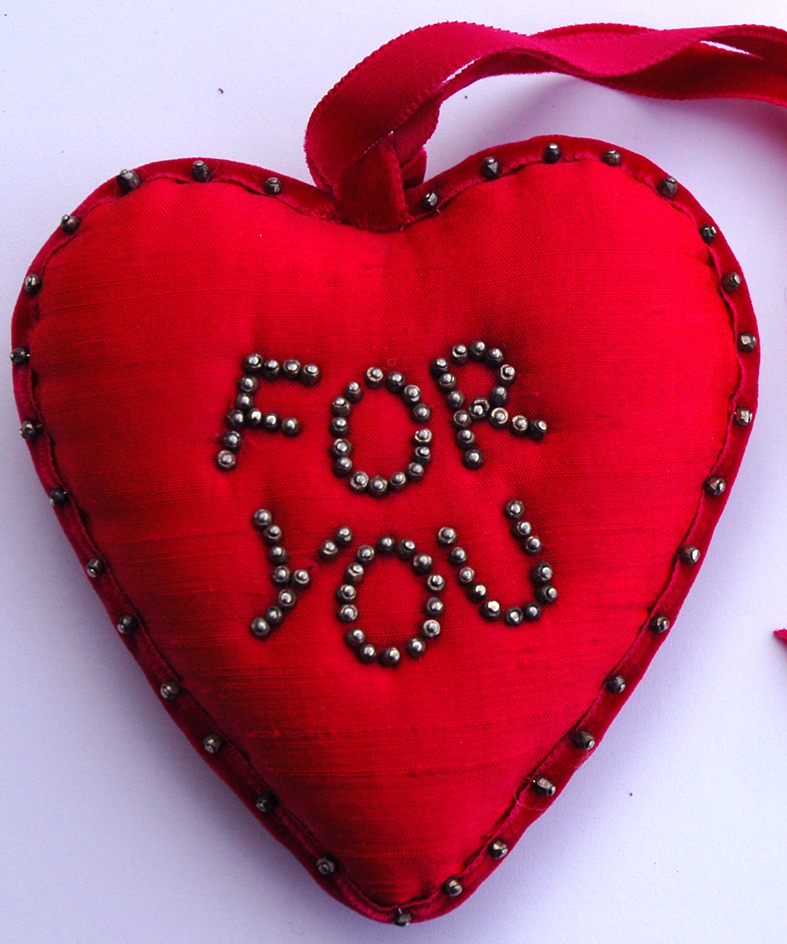
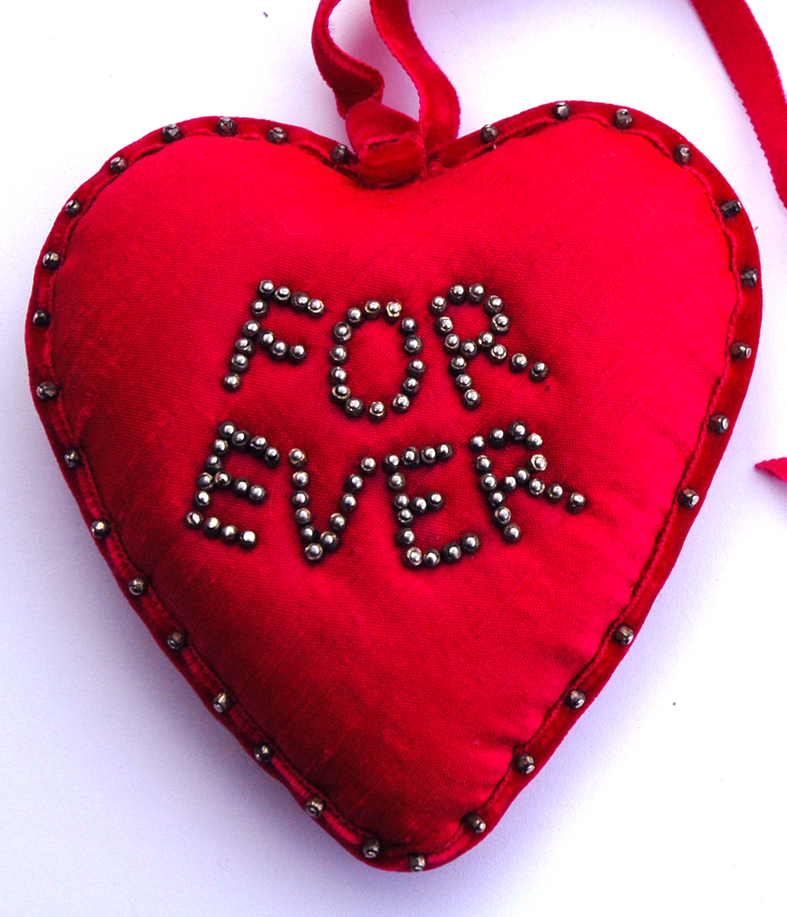
I started to make the hearts for presents, just to give to family and friends but they were so popular with people who saw them when visiting my studio that I made a few to commission. The first ones were for wedding presents, a mother for her daughter, I remember it was a winter wedding and the colours used were from the floers of the bouquet which are embroidered in the central panel. The writing is in cross stitch

two hearts made to commemorate a winter wedding.

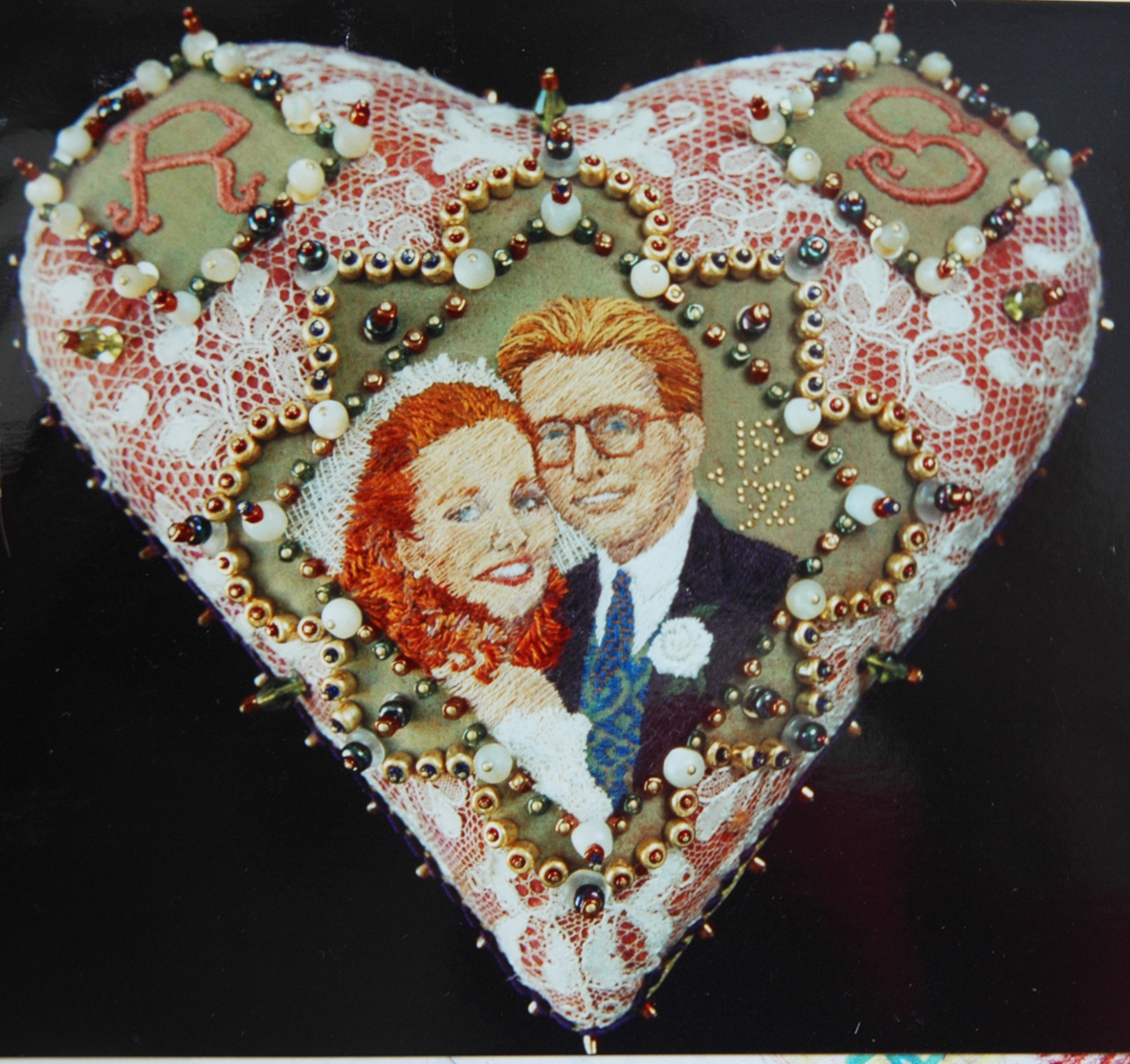
first wedding anniversary present with a stitched portrait of the couple on their wedding day

Following this I made several wedding presents and left, a first anniversary present – again given by the mother of the bride -I can see the date is 1992 and is made in tiny real gold pins. The couple’s initials stitched in the top curves of the heart in padded satin stitch. I used to embroider family portraits and had some years previously embroidered this daughter as part of a larger piece, so it was really special to have this commission.

Not given to very romantic gestures on my own behalf this next heart, encrusted with all sorts of wonderful scraps of embroidered textiles, was actually made for my book, Crazy Patchwork – published in 1998 (by Collins and Brown ISBN 1 85585 641 7)

this was made as for my own 25th wedding anniversary.
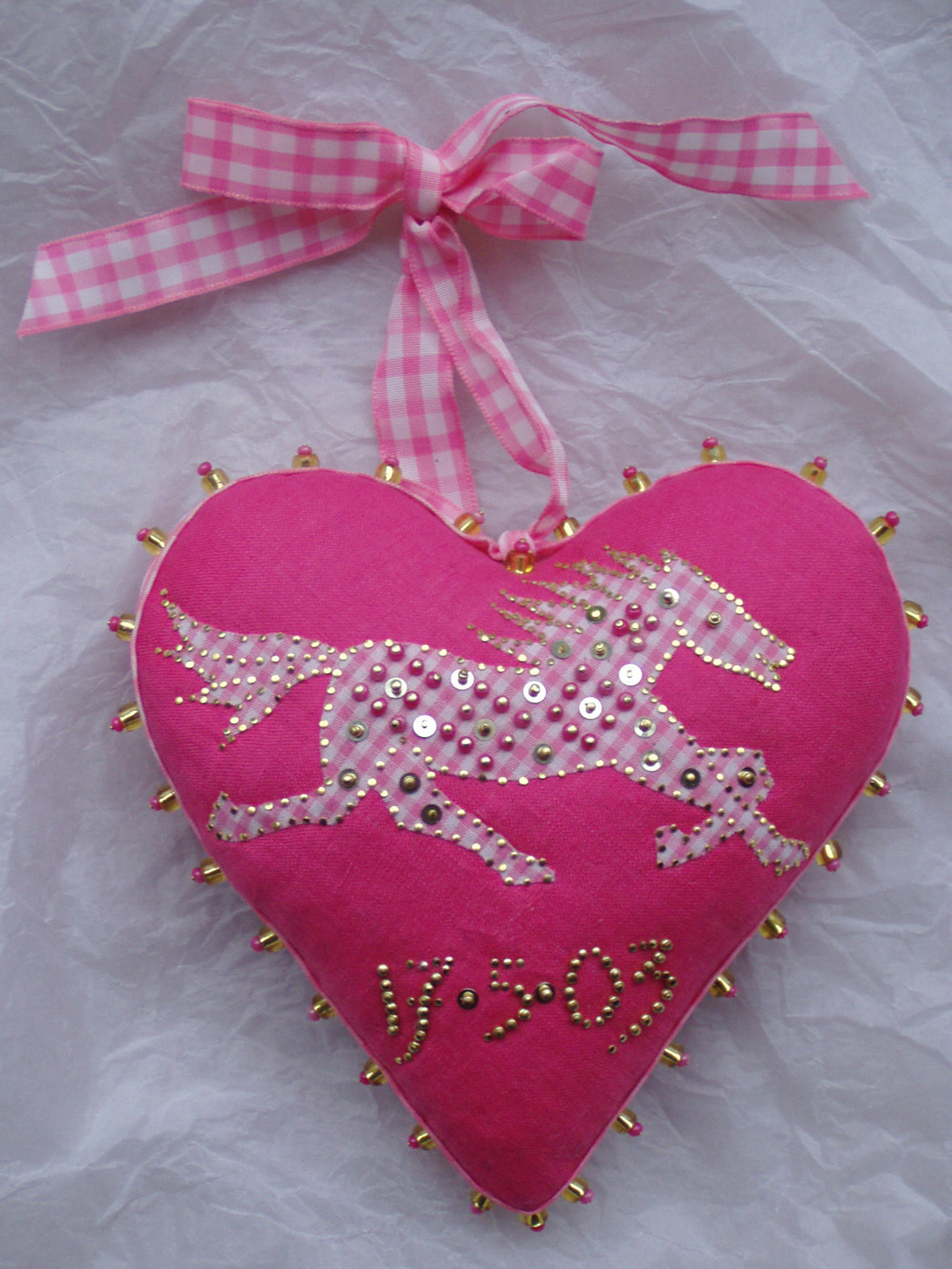
front of a child's birthday heart with applique gingham horse
back of heart with the dedication and dates in gold pins

I have also made several hearts to celebrate births and naming ceremonies. Pin cushions were given as gifts for weddings and for a new child as originally when they were made by hand, pins were  very expensive; so small stuffed cushions with pinned messages were presented to both brides and new babies as symbols of good luck.

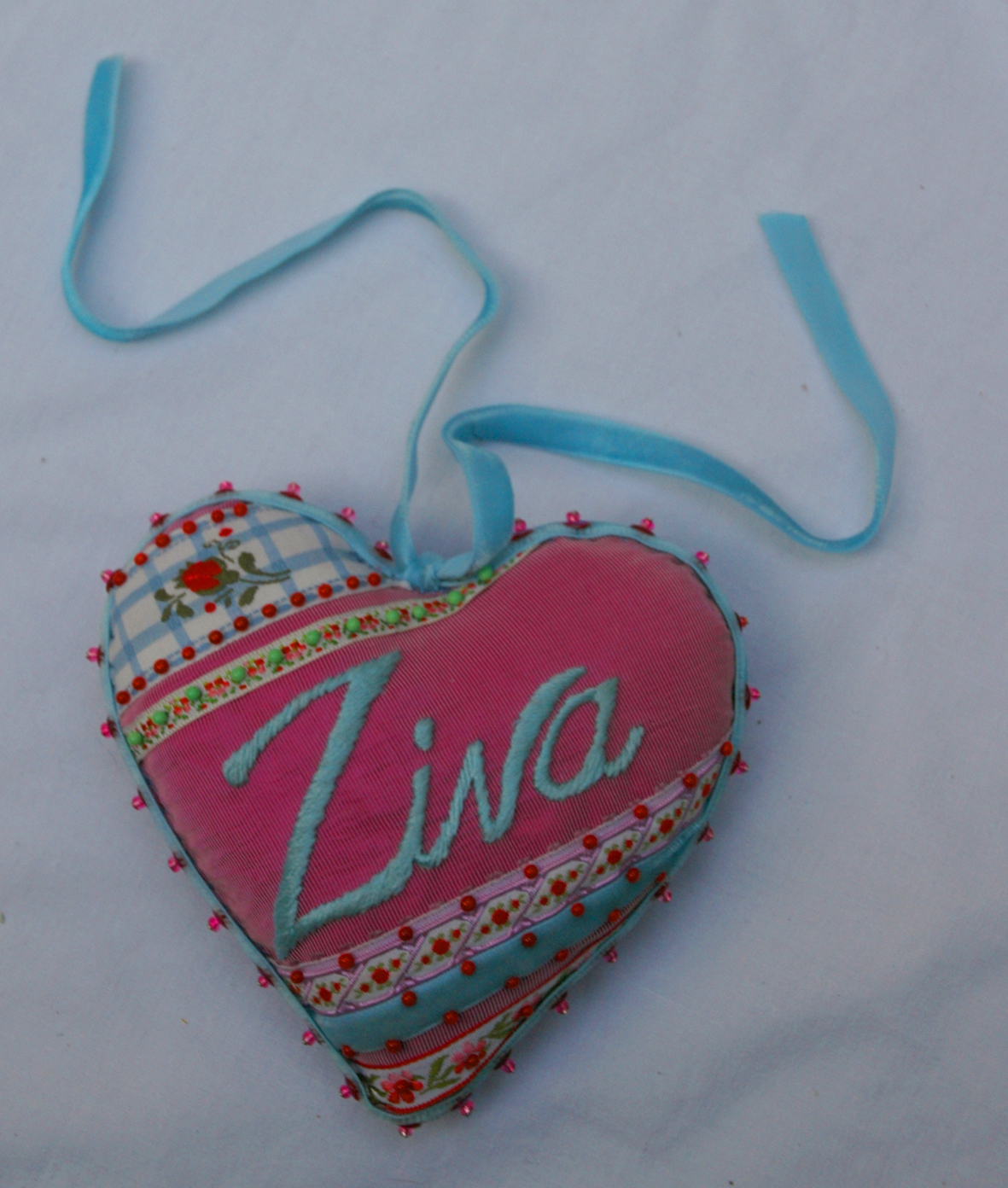
The small pink heart ( about 8 cms ) was a first birthday present to my nephew’s daughter Brannie and the glamorous heart below is for the daughter of my husband’s nephew, Ziva.

be-ribboned heart for a baby girl

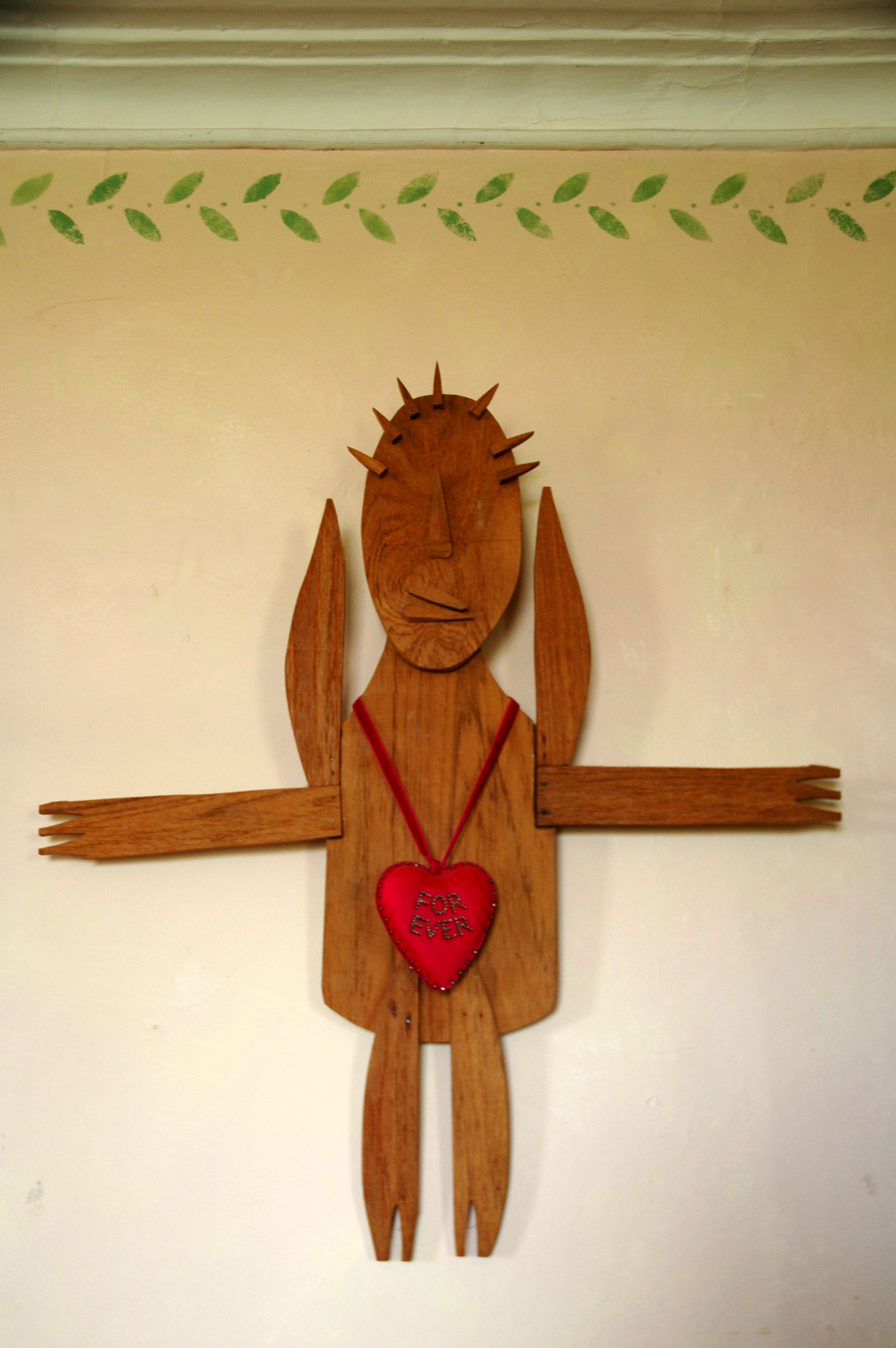
The hearts I make are all fairly small between 8-12 cms. deep, but they feel very good in the hand, a satisfying weight and shape to hold easily. I have made a few smaller ones mostly for workshops and for some reason the one below has stayed with me, it hangs in various places in the house, at present around the neck of an angel  on the landing between the bedrooms and the studios.

wooden angel with small silk and silver beaded heart.

More mending

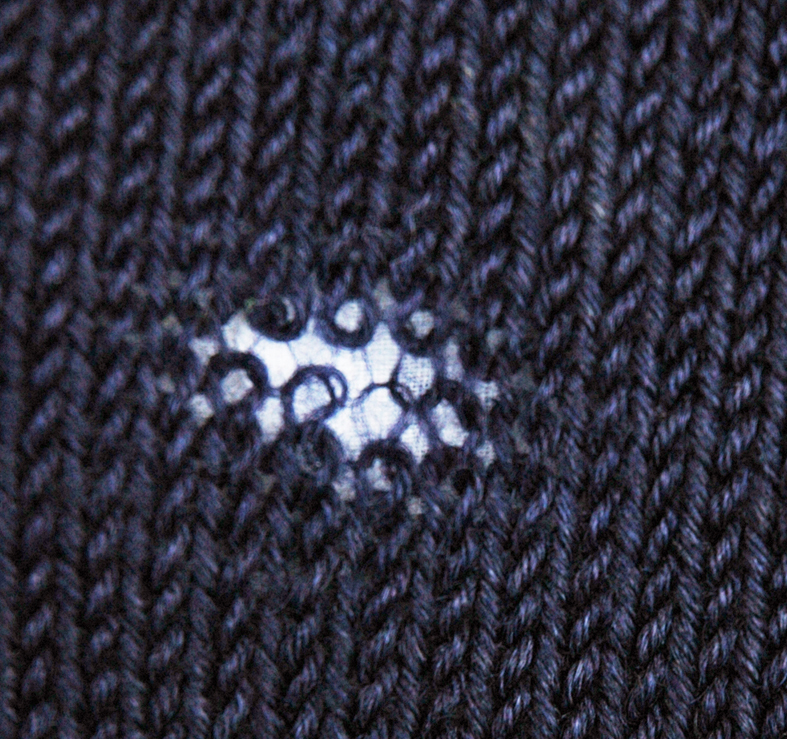
small worn area on elbow of hand knitted sweater.

Talking to friends  Rosemary and Peter Murphy about my mending theme, Peter asked if I was up to stitching an “invisible” mend on a sweater for him as he didn’t feel that he wanted the darn to seen. Immediately I informed him of my new found belief that mending is a sign of worth and he should be proud to wear a very conspicuous darn – he wasn’t convinced – but assured me that if I would mend it he would write the story for the blog, so here it is:_

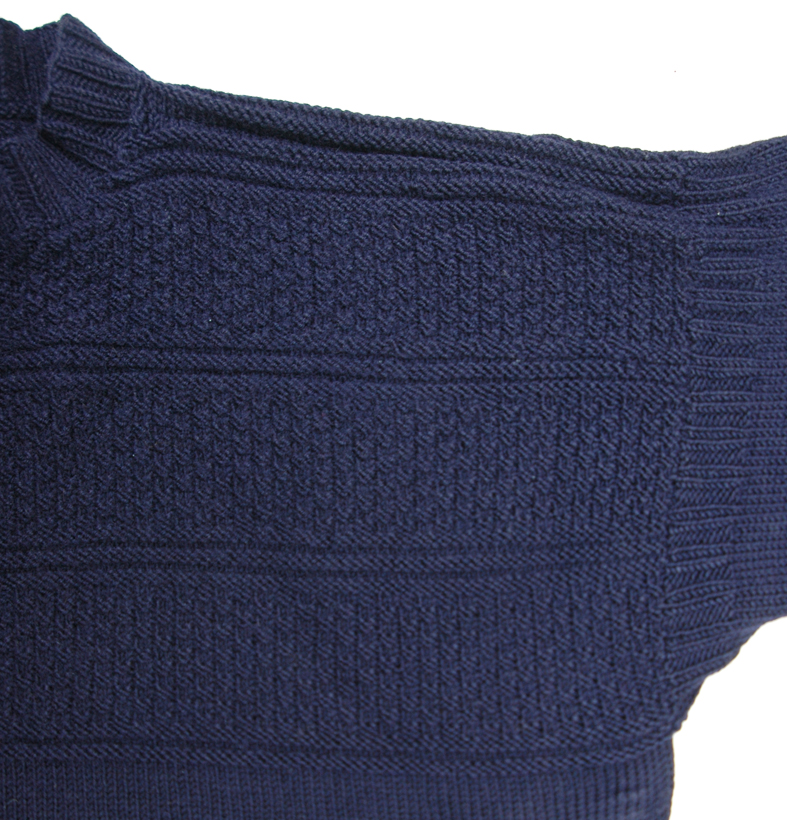
“My mum Knitted the jumper about 35+years ago and I rediscovered it during the recent cold weather. It was lurking in a wardrobe forgotten and ignored but it’s lovely and warm (a little on the heavy side perhaps) but still in good condition apart from the worn elbows. I would be delighted if you could strengthen them before it is too late!  Coming from the Welsh Valleys (born 1913) Mum was a demon hand knitter as was her mother before her. After many years she treated herself to a noisy Knitmaster machine that she was very proud of. I’m afraid she produced so many woollies for the family, close and extended, that we soon couldn’t wear them out quick enough. If they did show any signs of wear she would set about unpicking them to produce yet another garment. She couldn’t waste good wool.The jumper is, I believe, a fisherman’s style from the Yorkshire fishing village of Staithes. I’m sure you know the story about each fishing village having its own pattern so that in the event of a disaster, bodies could be more easily identified.

  1. Staithes fisherman's knitting pattern

As an art student at Leeds in the ’60’s such clothes were very trendy. Guernseys and fisherman’s’ smocks were practical as they “weathered well” with all the plaster and paint stains. They were usually worn  with a pair of tight jeans and Chelsea boots. Years ago I wore this jumper to a concert at Colston Hall in Bristol. During the interval a woman tapped me on the shoulder to say she added the jumper and where had I bought it. She was delighted to find out that my mother had made it and asked if we still had a copy of the pattern, addresses were exchanged, phone calls made and the lady received the pattern – Mum was delighted by this compliment to her knitting.

darned elbow patch, stitches follow the rows of knitting to reinforce the worn area -

Looking back, her skills were taken too much for granted but I am sure that she took pleasure in us all wearing the results of her enthusiasm, it was after all an act of love.I hope to bring the sweater to you to be restored and revived”.

Well I have tried my best but matching the wool was difficult, this is the nearest I could get using in my whole wool selection and I had to slit tapestry wool into just 2 strands  to reinforce the elbow.

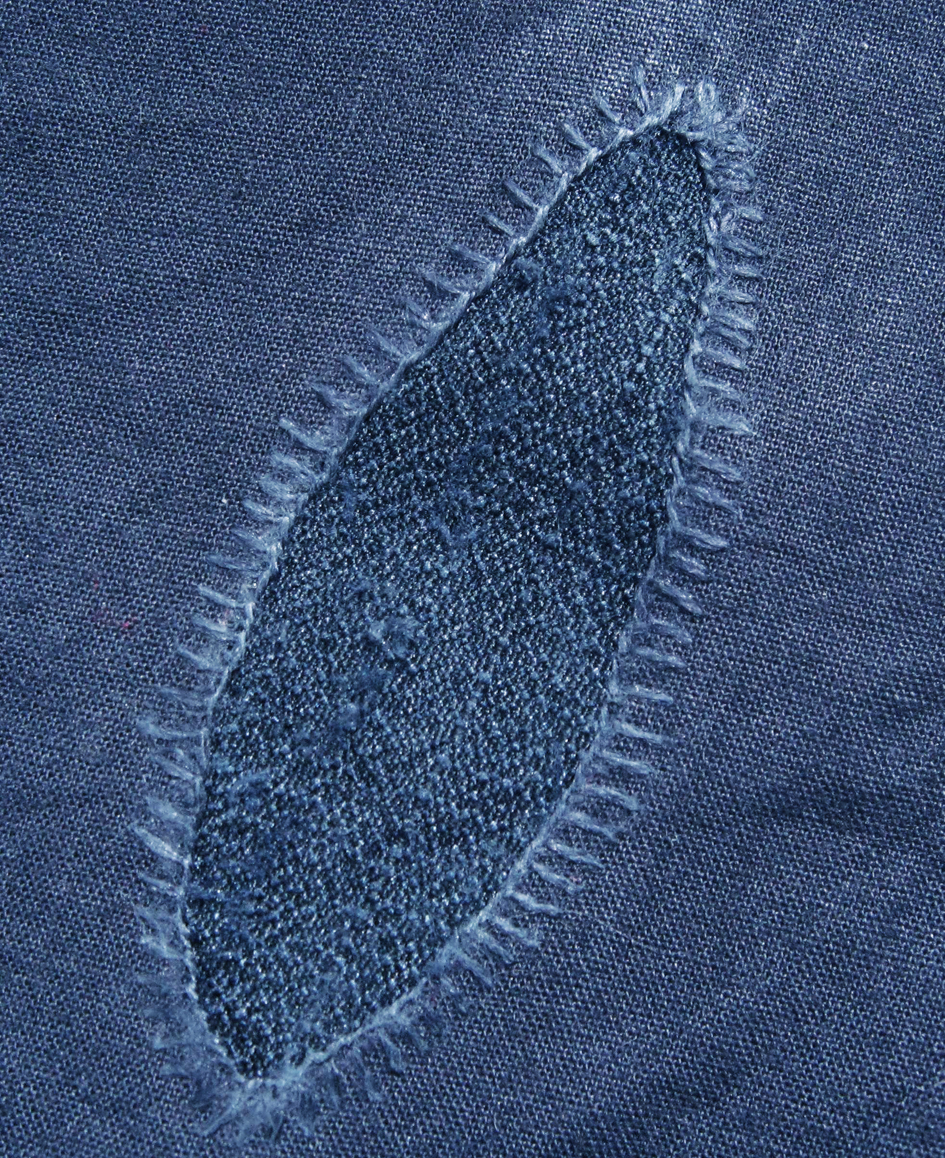
Meanwhile on a navy blue theme, I have been sent a picture of this small and beautifully stitched inserted patch by Dail Behennah.  She visited to my studio in order to find a fabric to match for her new and damaged skirt, we found the perfect colour in linen and also an exact match in linen thread to make tiny buttonhole stitched edges. It looked absolutely fine until she washed it – the skirt faded and the patch didn’t.

3cms long inserted patch with buttonhole stitch edge by Dail Behennah.

Stitching Ceramics – First Samples

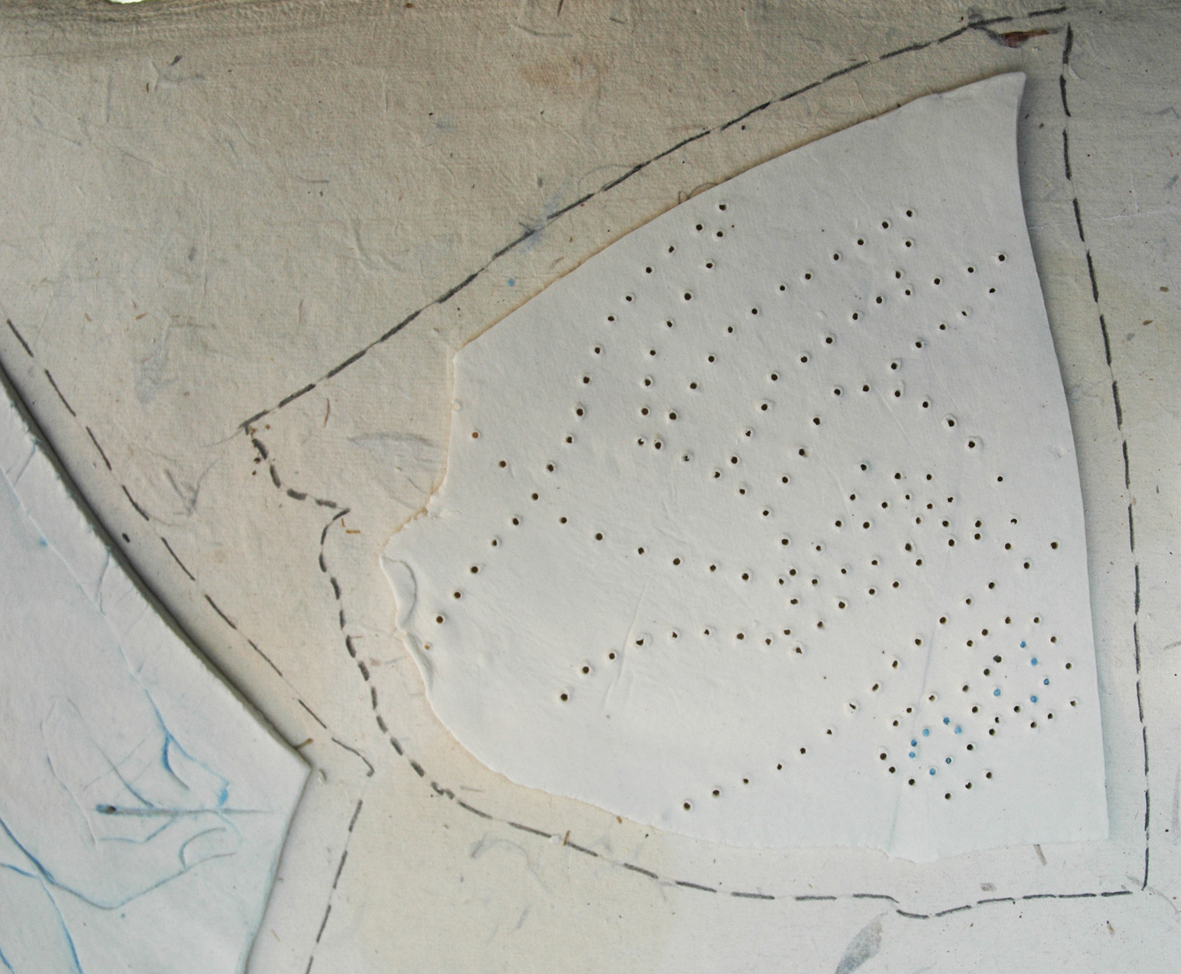
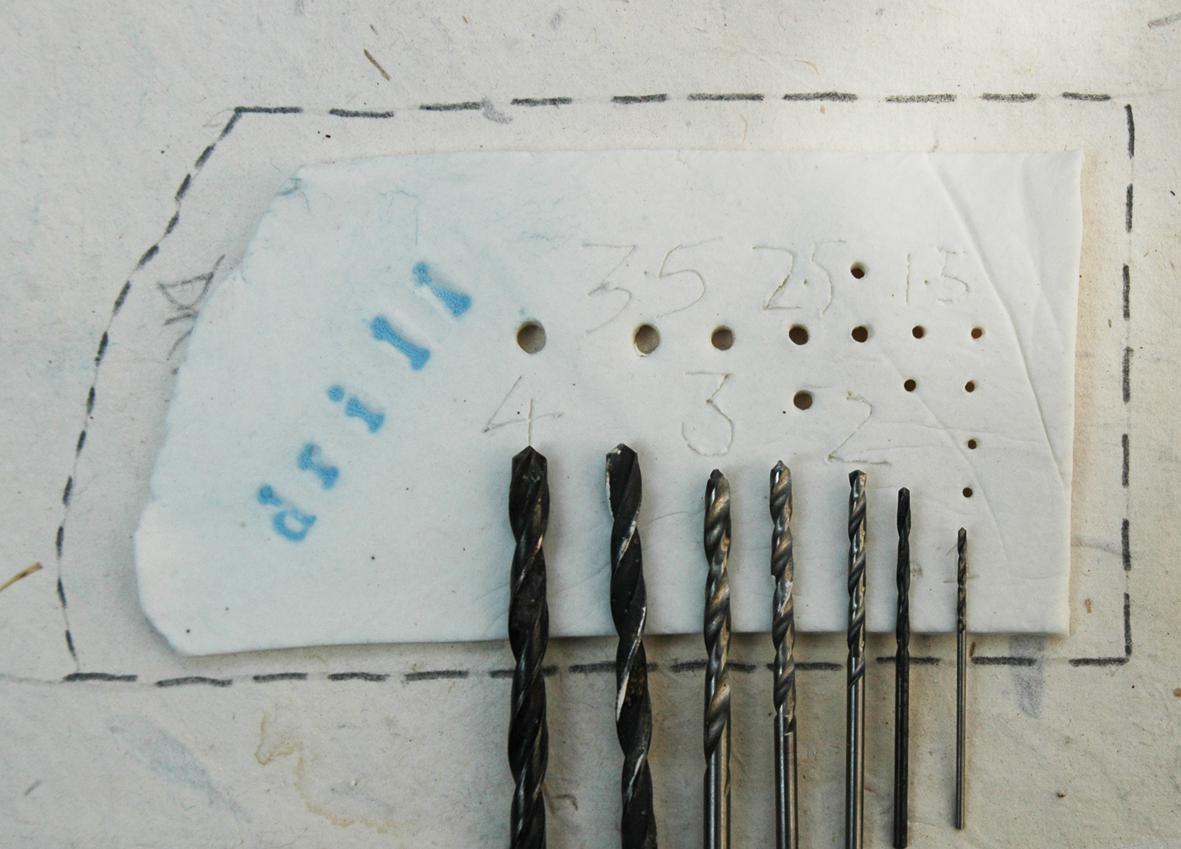
Today I went to Blaze gallery and studio to collect some of the fired paper porcelain samples from Hanne Rysgaard, (see Archive for first Stitched Ceramics post) and brought them to my studio here to colour and stitch. I am primarily testing how much the porcelain shrinks when fired; Hanne calculates at 20% shrinkage but that I need to see what that looks like.  Then I can decide how big to make the dishes for the stencils and the shapes to impress into the surface – but even more importantly calculate the size of the holes I will eventually stitch.

drill bits with sizes and resulting size changes after one high firing. The dotted outline surrounding the sample is the original unfired size of the paper porcelain

It appears that the smaller the hole the less it appears to reduce and after firing they seem to fit the next smaller size –  so a 2.5 bit will now fit -just- into a 3.sized hole and as they all need smoothing with a file that seems easy enough. I chose to make most of the holes at 1.5 size drill bit and now this easily admits a medium sized crewel needle –  a sharp pointed needle with a long eye for threading thicker yarns.

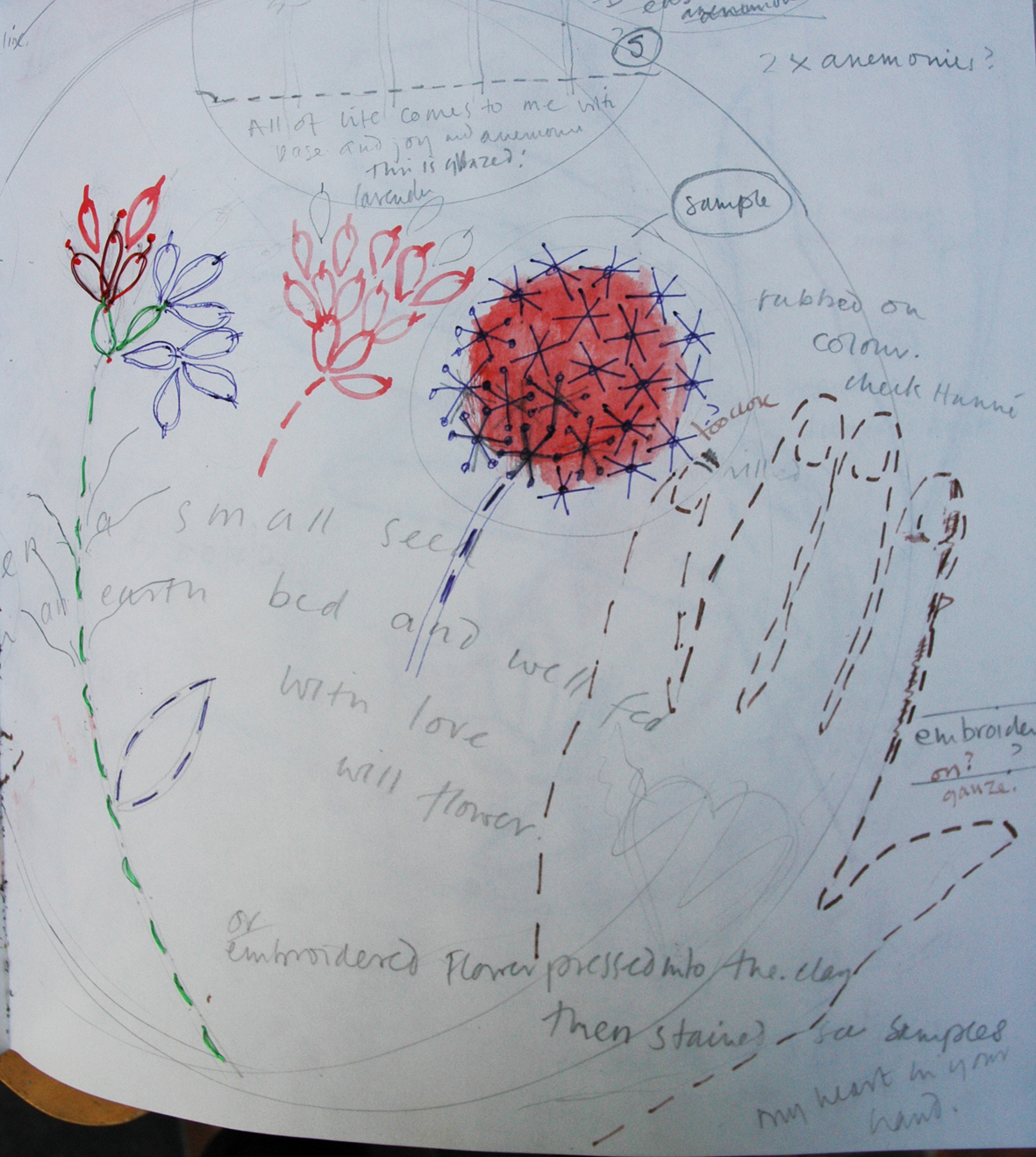
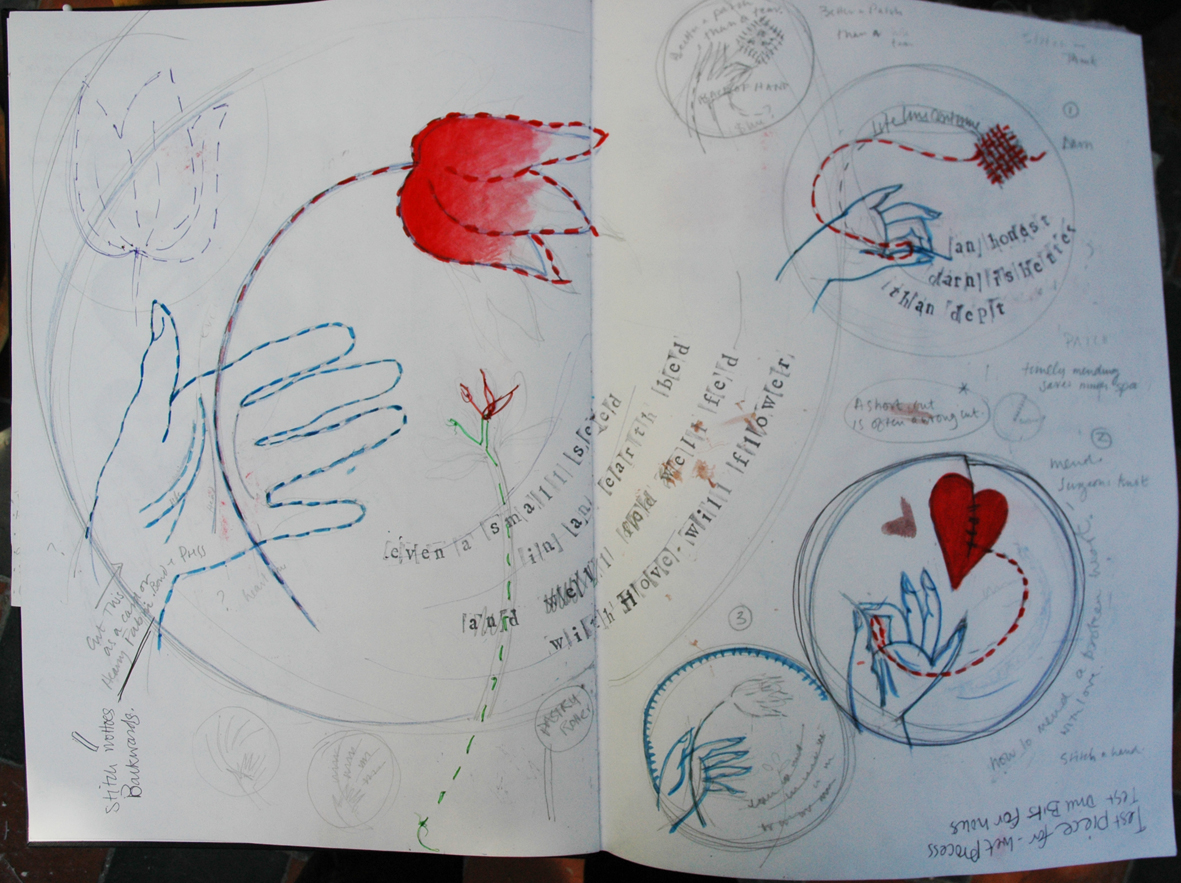
drawing for ceramic dishes, drawn around my own hand; stitched wire flowers
sketches for hands, flowers and mending broken hearts dishes.

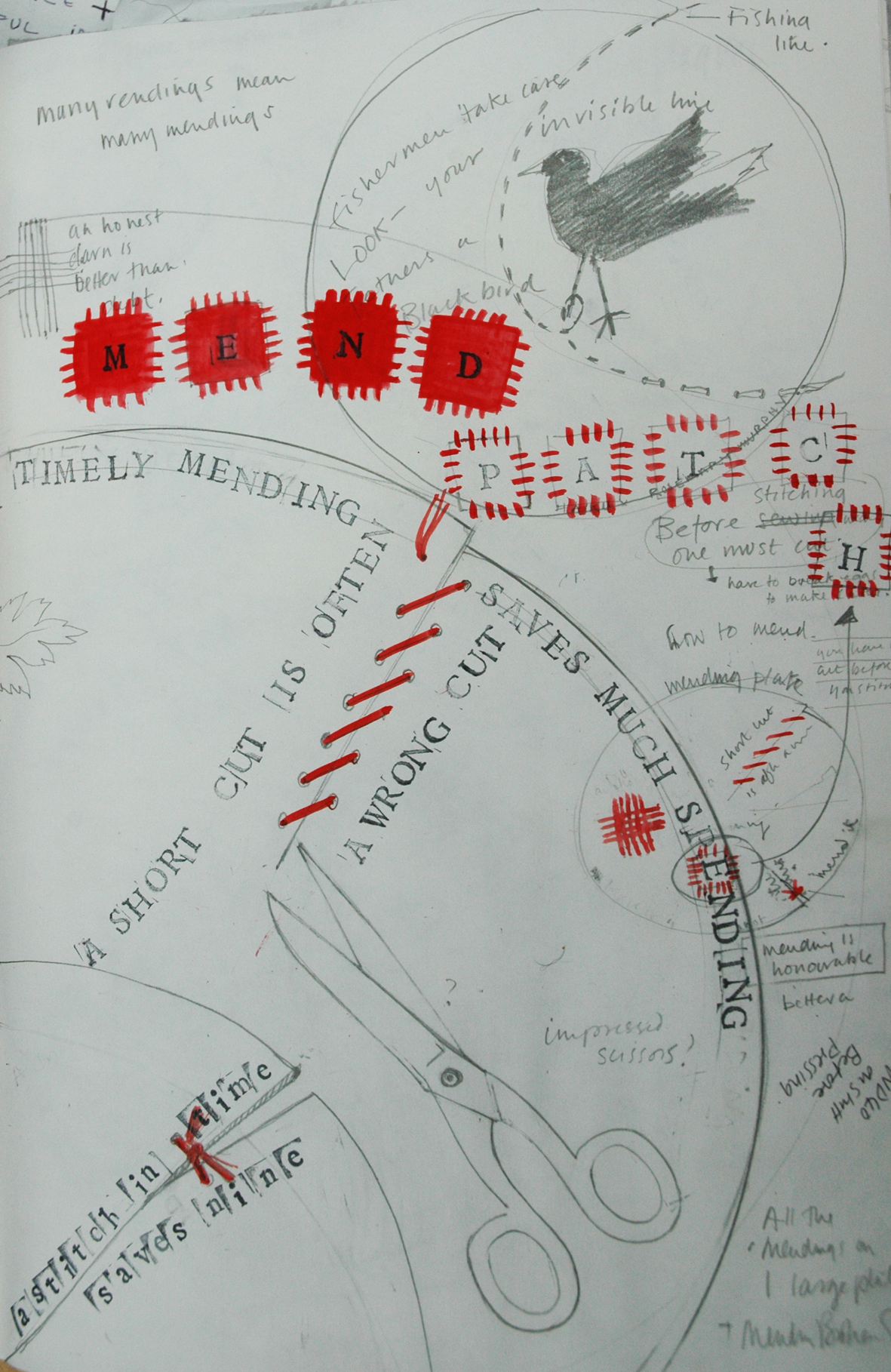
I made several pages of drawings for poems, mainly haiku on the subjects of flowers and hearts, written by a friend Rosemary Murphy, but also I liked the sayings about mending – now there’s a surprise! Anyway samples are made for the mending hands designs and the poems as this is the set of ideas that I have decided to develop into porcelain plates and dishes.

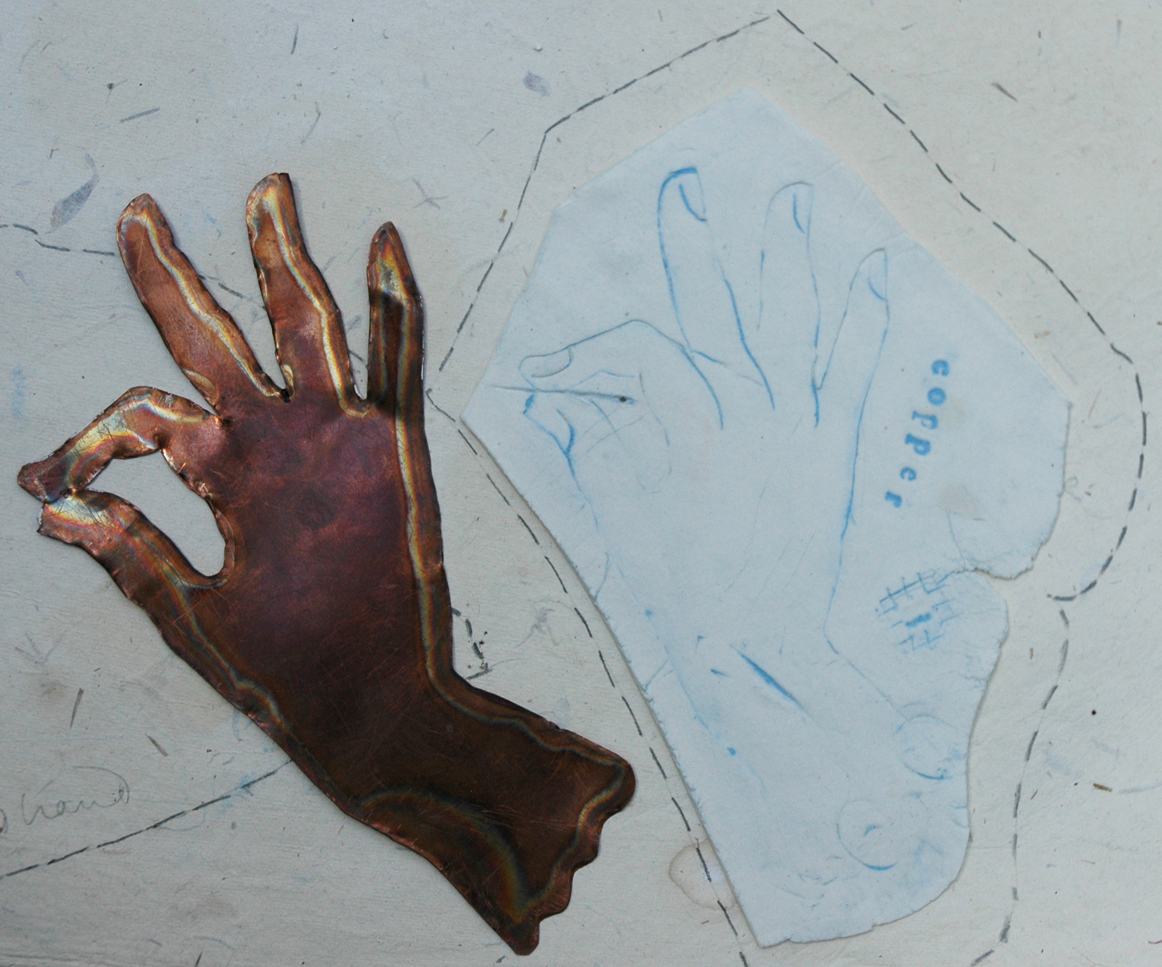
I also wanted to impress the hands as I had previously impressed the lace in the large sample plate – see first blog on Stitched Ceramics – so I used a hand that I had previouslycut out of  copper sheet using my plasma cutter, this was adapted from my letterhead which I have used for over 20 years. I also am waiting for another cardboard hand impression to be fired to make a comparison between metal and card.

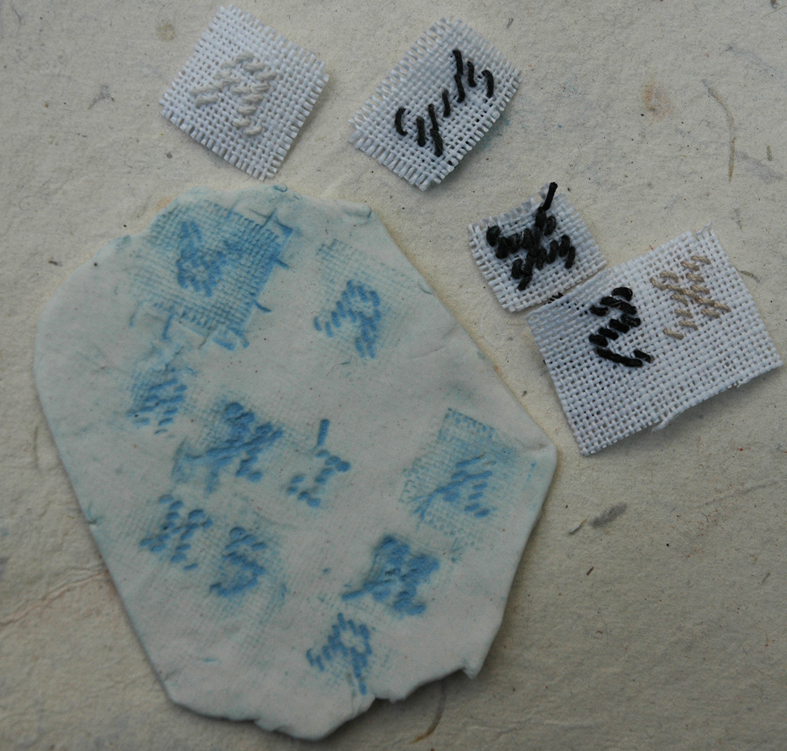
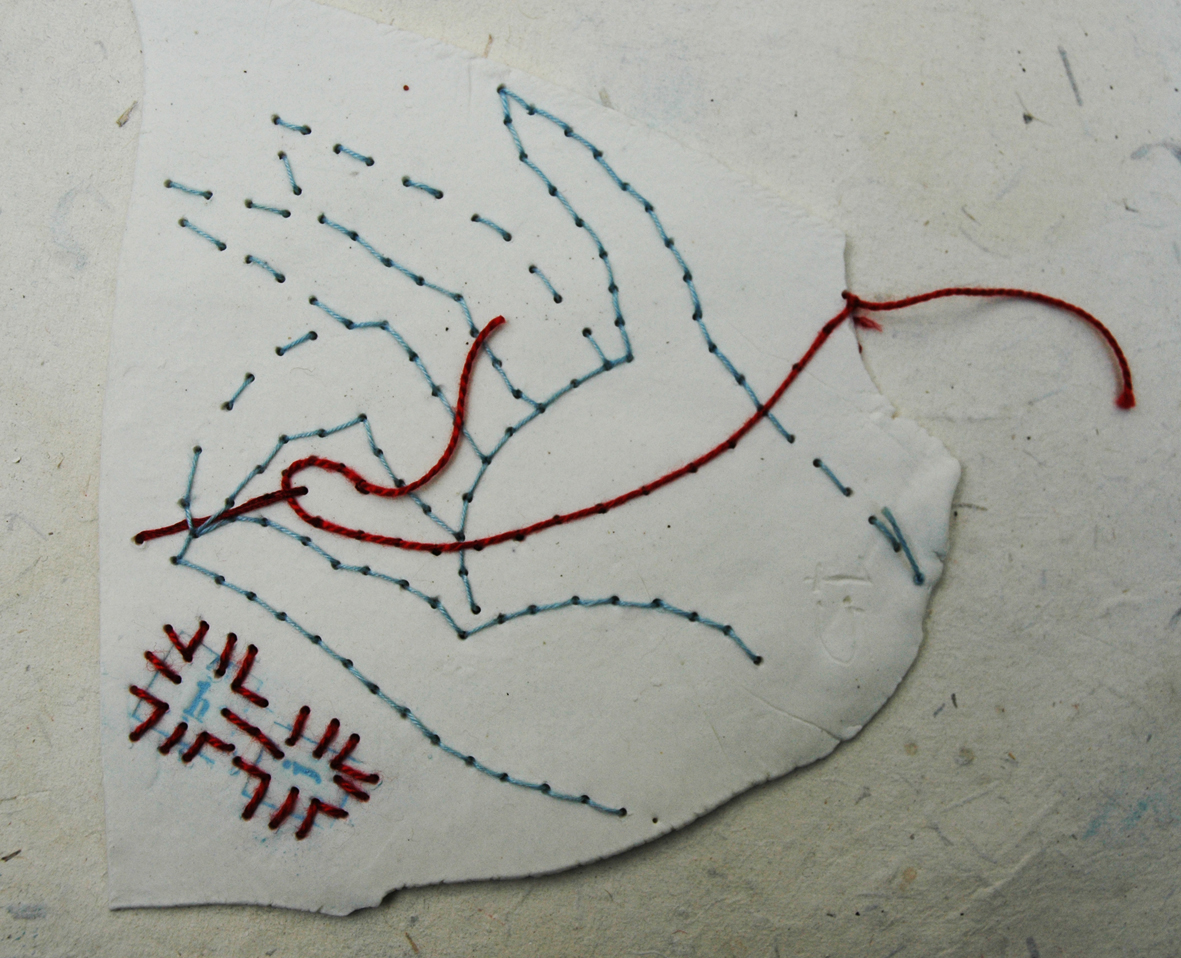
The impressed hand is coloured with pale blue powdered enamel so that the outlines are seen more clearly, I think that this colour relates to the embroidery patterns I have been using as references in some of my  other stitched work. I am also considering how I want the lettering of the mottoes and poems written and below is a sample of a some stitched letters from a whole alphabet I had considered sewing in order to make individual stitched letter impresses, but they appear too indistinct at this tiny scale – I may return to this idea though for other works in porcelain or enamel.

So I will use the commercial stamped letters for the writing in this series of work, I like the way that the rather wonky stamps counter the more fluent and elegant hand impressions and drawings

Stone Hearts

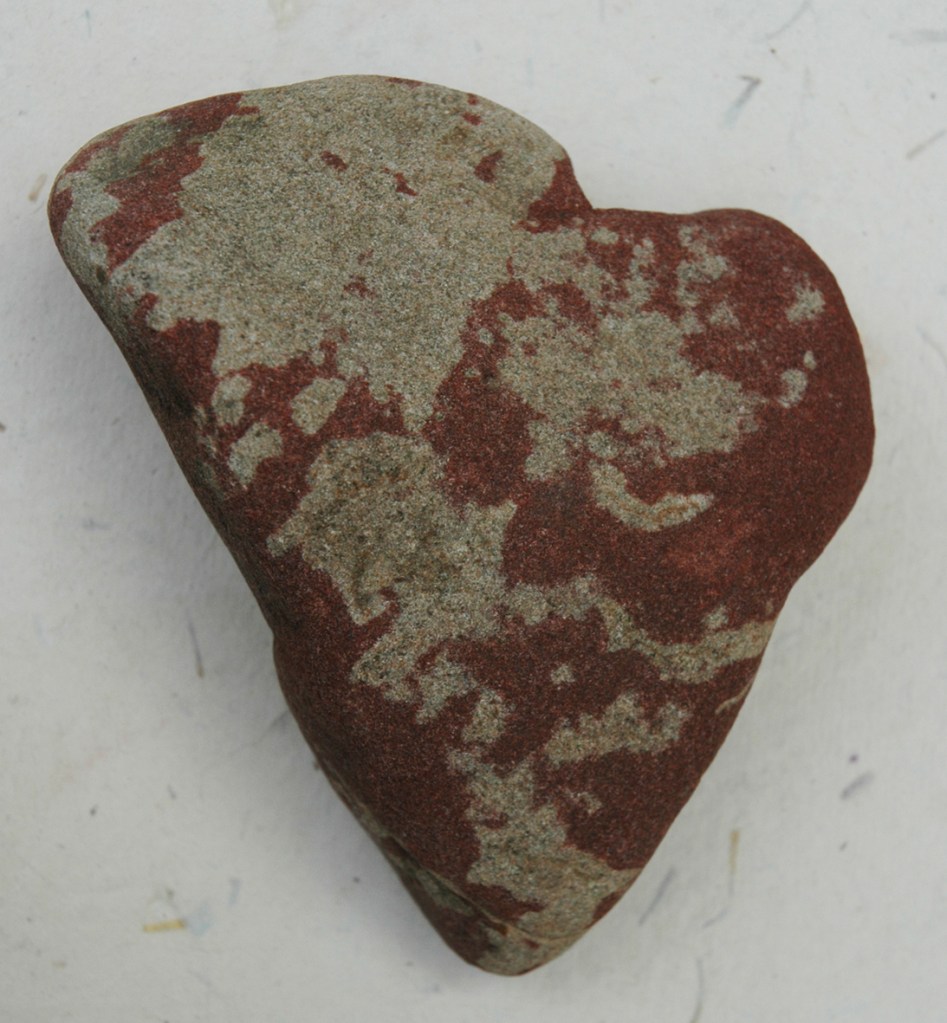
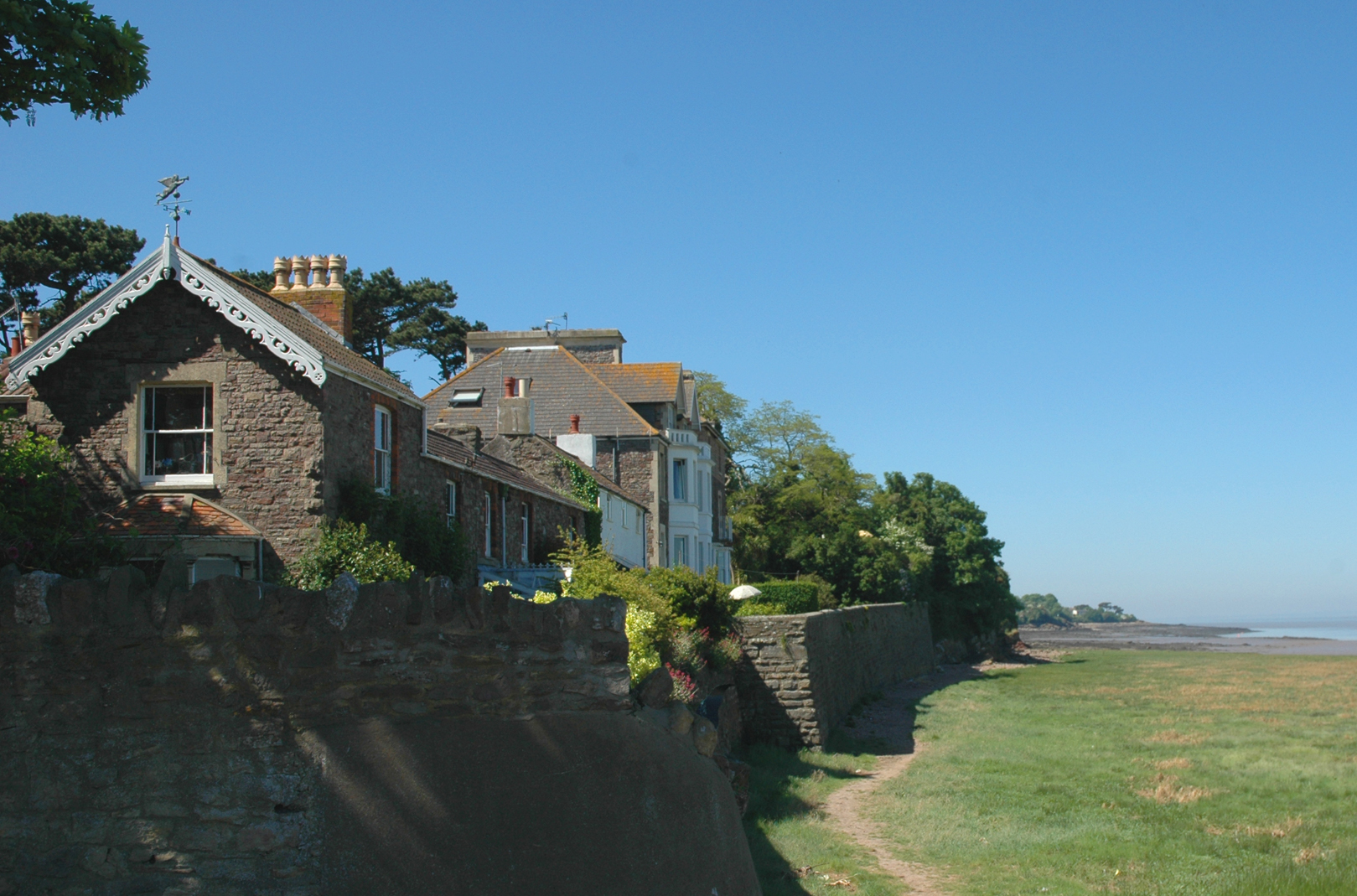
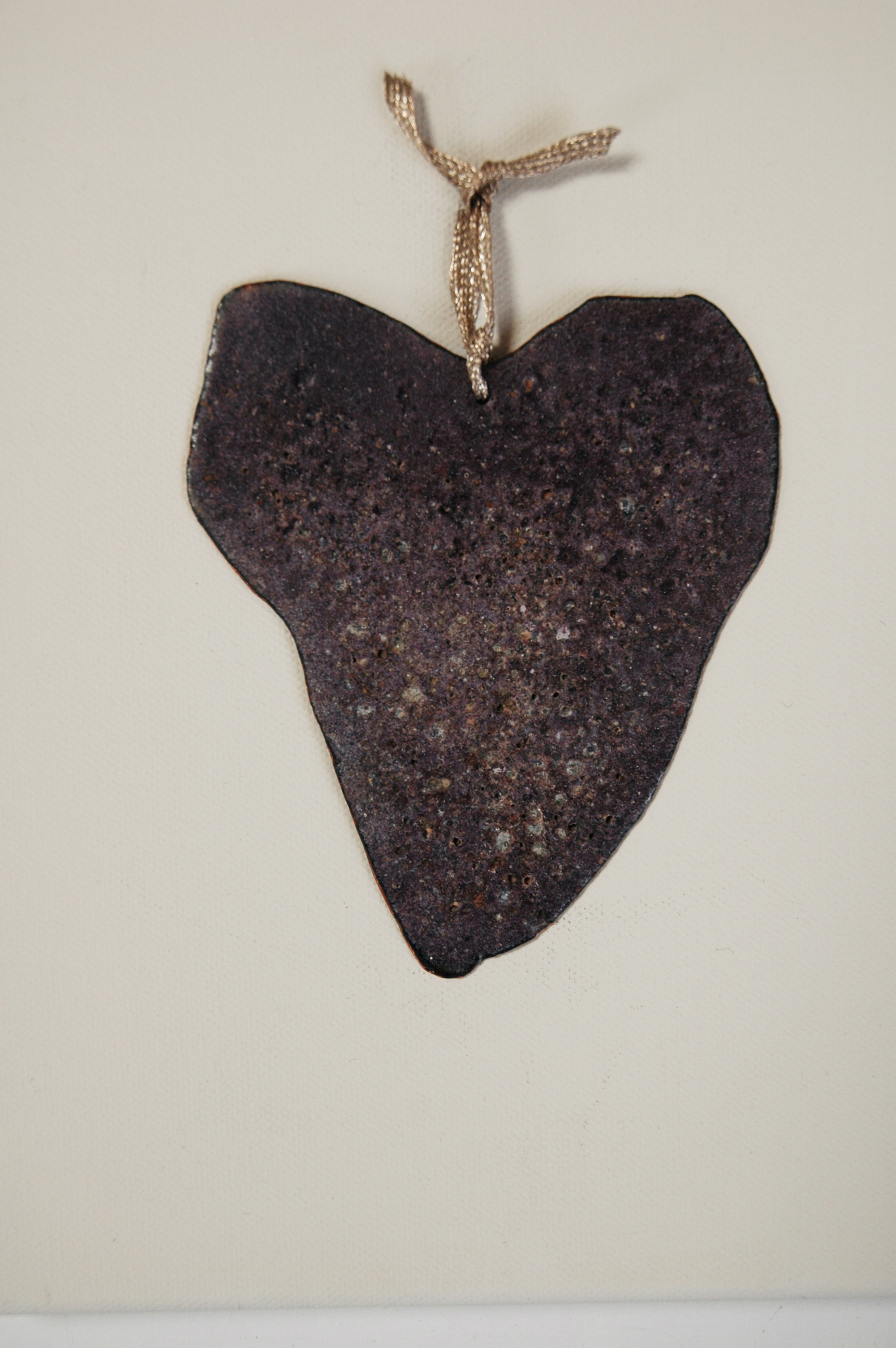
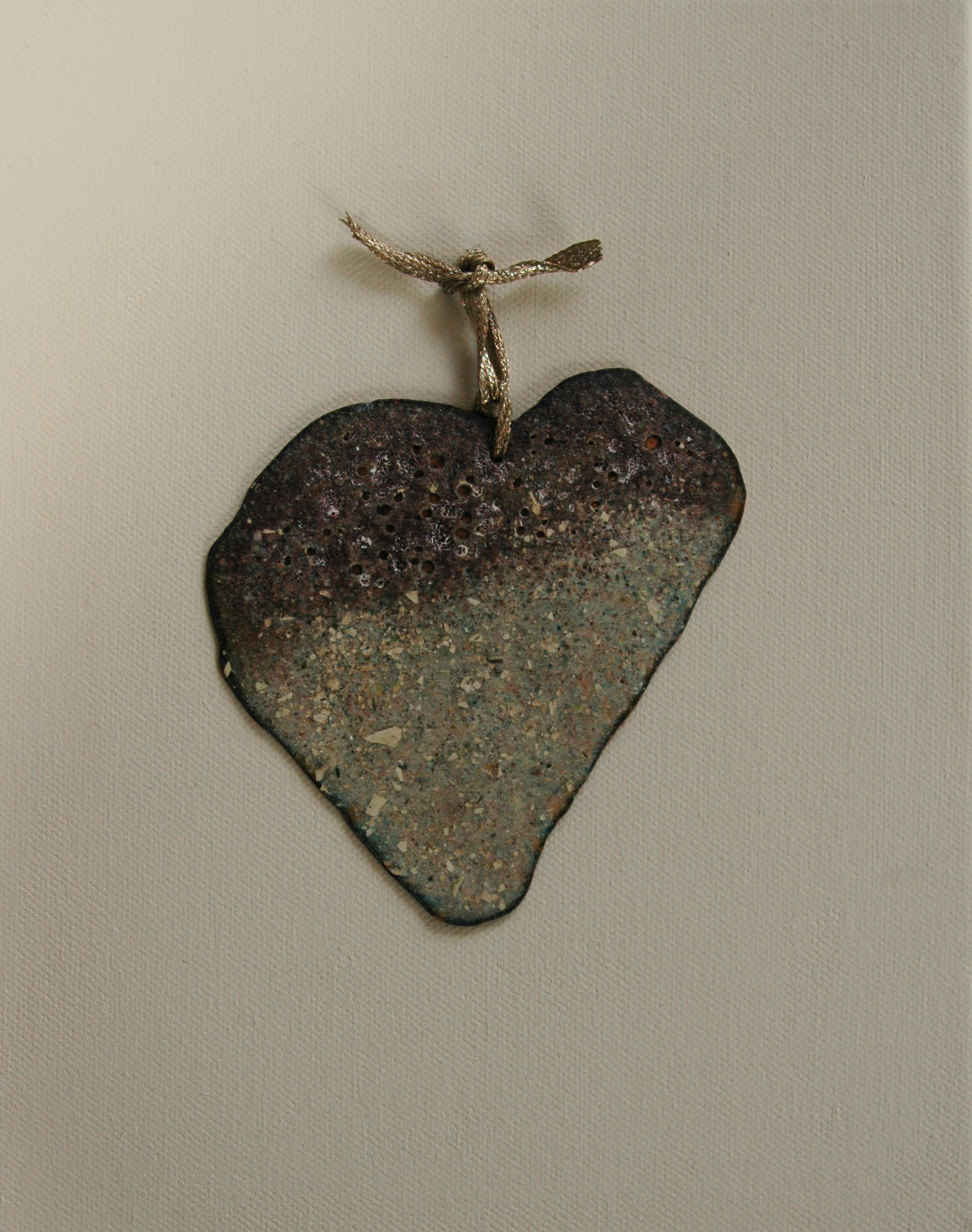
This morning, walking my dogs on the beach on front of my home in Portishead, I found a large heart shaped stone. I added it to my collection which I have been making for over 10 years. In all this time I have found about 60 stones, but not all from this beach. I walk here every day, it is just a narrow strip of stony land at the edge of a salt marsh on the banks of the Bristol Channel, where the Severn estuary joins the river Avon. In old maps this area is called The Severn Sea.

the salt marsh underneath the sea wall at Portishead, our house is the first on the left

I have collected heart stones from some other beaches and people often bring me them to me as well,  everyone loves the search when walking the dogs; but when they find any  better stones than I have in my collection, they usually take them home with them – I prefer to think that they take them away as a reminder of a good time……

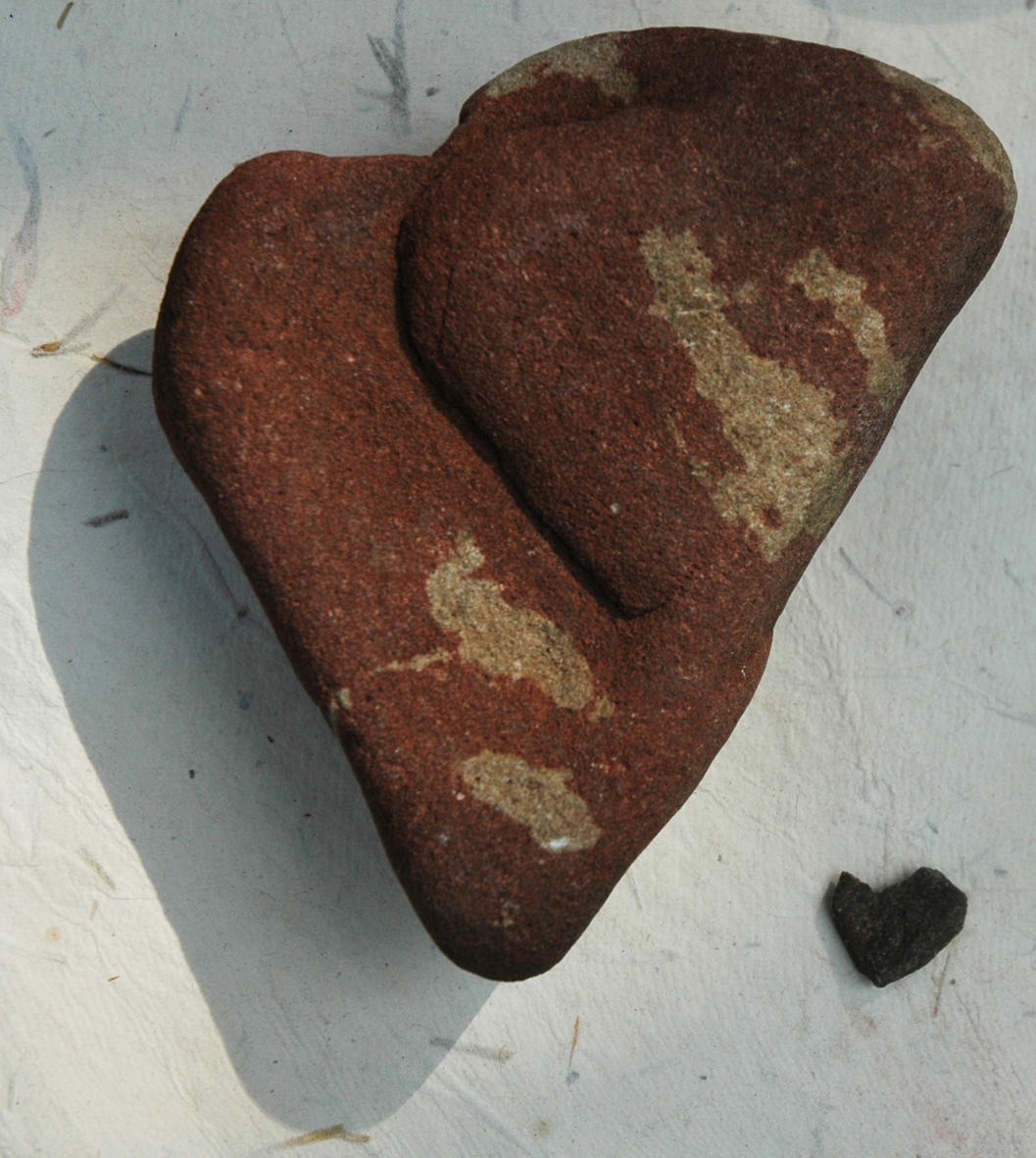
back of sandstone heart with tiny black gravel heart which is 1cm in length.

There are rules to what can be accepted as a heart stone, they have to be held to the sky and seen in silhouette, back and front – often the backs don’t have the same shape, they also have to have a top and a base and the cleft has to be indented. However some stones in unusual colours or ones that come from other beaches are admitted….and some days I just have to find a stone before I leave the beach – over time they have become talismans for me.

I started to collect the stones as a memorial to my oldest friend, Sue Marshall, known to everyone else by her married name of Sue Bernstein. She died in 1998 at 50 years of age, from breast cancer, and on my last visit to her I promised that I make some work in her memory; we had had a conversation where we both agreed that her cancer was the result of a heart broken too often. From this time I have used the broken and mended heart as an ongoing inspiration for my work. A smooth stone has to be  broken before it can become a heart stone.

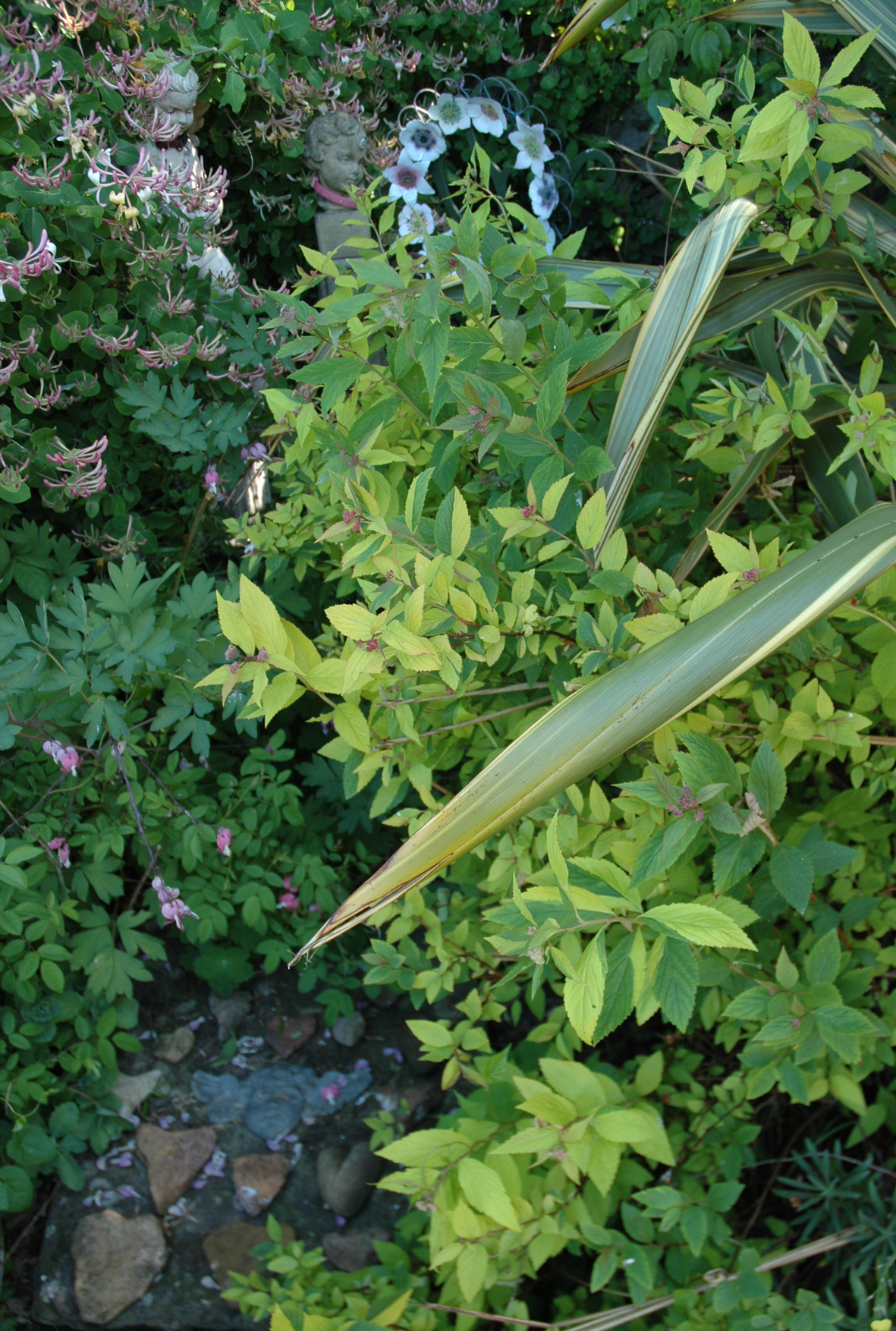
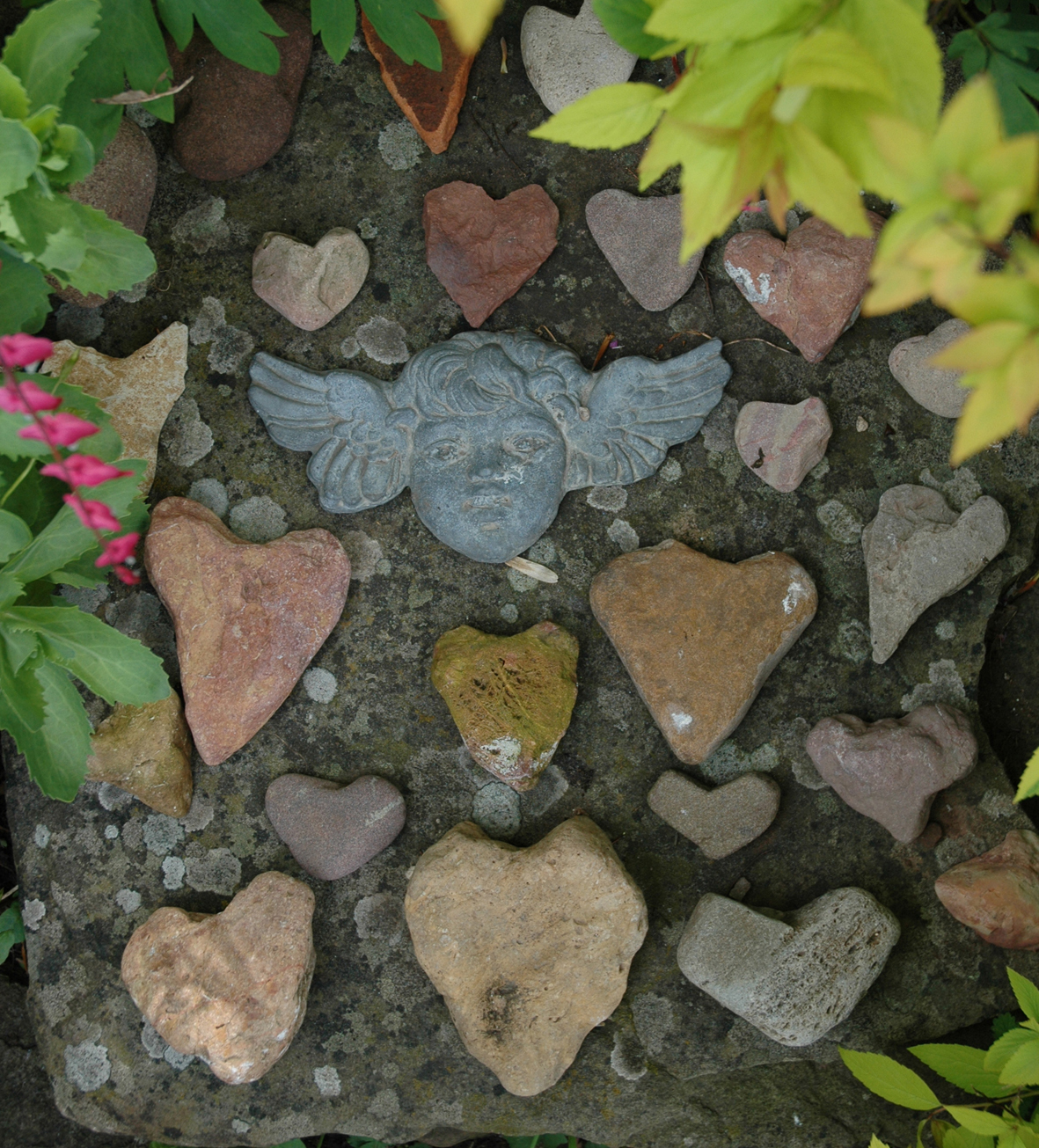
For many years I just collected the stones knowing I would do some work from them some time, I kept them in strict rows on top of a plan chest outside my studio, waiting for an idea to develop. Meanwhile I took some of the largest hearts and placed them as a memorial in the area of the garden we use for our dog’s graves. It is planted with flowers that are in keeping with the area, below a Dicentra Spectabilis, bleeding heart arches over the heart stones memorial.

Dog's graves with hearts stones memorial, the angels wear the dogs' collars.

Eventually I made a collection of badges for an exhibition for ETC, an applied arts group of researchers at UWE Bristol, (click on to ETC on blogroll to see more badges). I drew round the smaller stones, both back and front and then cut these out of copper and enamelled them using sand and grit from the beach mixed with the enamel, they were then stoned down to take off the shiny enamel finish

the collection of 50 enamel badges made from the shapes of the beach stones laid out above them

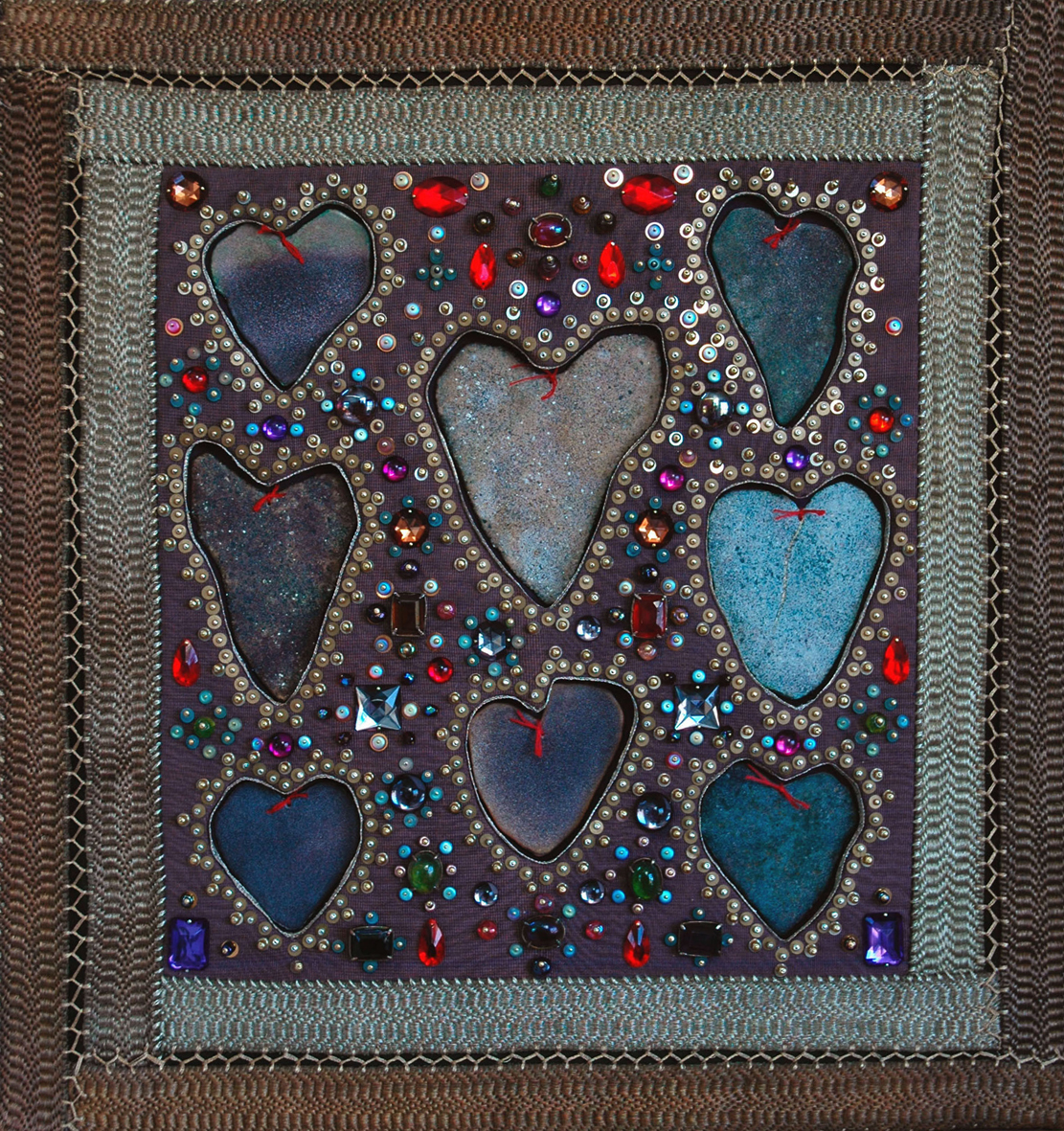
I also made a larger piece for an embroidery exhibition where I made 5 Icons and Icon covers for a series of enamelled hearts.  I was playing with the idea that the stones themselves are worth nothing, the only value invested in them is by the viewer, the maker – in this case the collector. The surround or cover is made from heavy silver braids and watered silk pinned with all kinds of metal and glass beads. the hearts hang loosely, recessed within the cover which acts as a protective and glorifying surface. This particular embroidery was sold in a Valentine’s day exhibition at the Twenty Twenty Gallery in Much Wenlock.

Embroidered icon cover for enamelled "stone" hearts, pinned with glass and metal beads and sequins

I continued to make the broken hearts but slowly they started to get themselves mended…

broken and mended stones hearts: copper, enamel, mica and silk

Stitched Eye


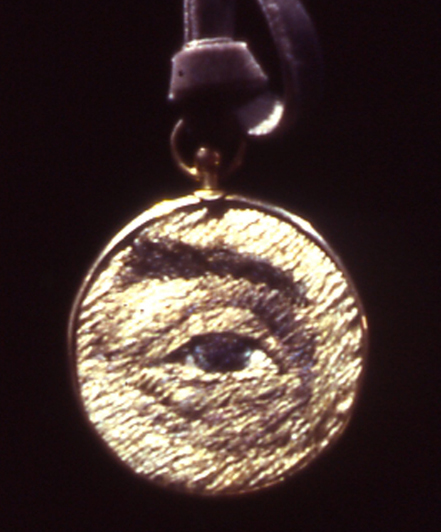
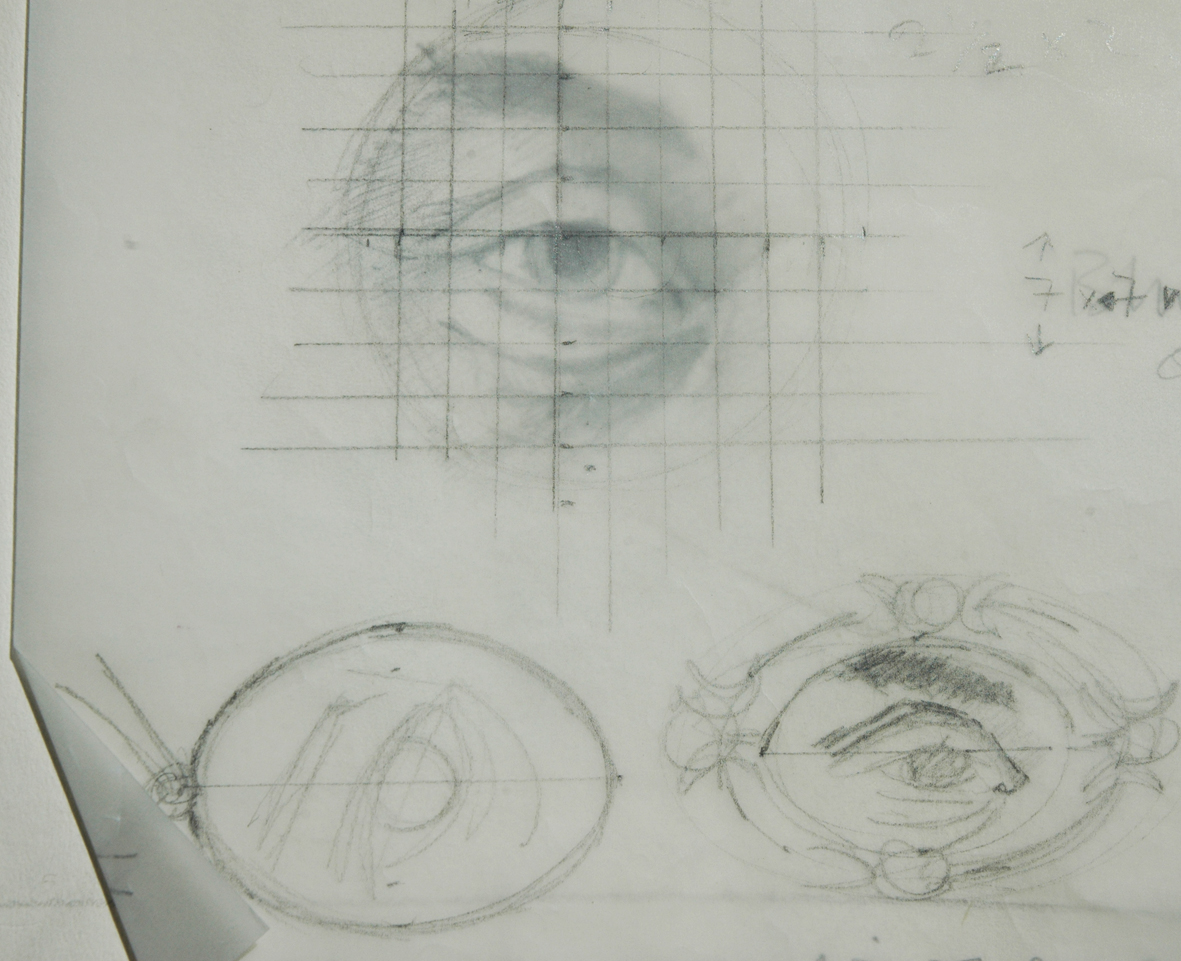
In response to the Burka Eyes page I received a comment from Rosalin Sadler, who commissioned this eye embroidery of her then husband, Howard Jacobson in the 1990’s. I remembered the piece well, it was quite a challenge, not just the small scale (approx 3cms) but the fact that a likeness had to be achieved in this one facial feature.

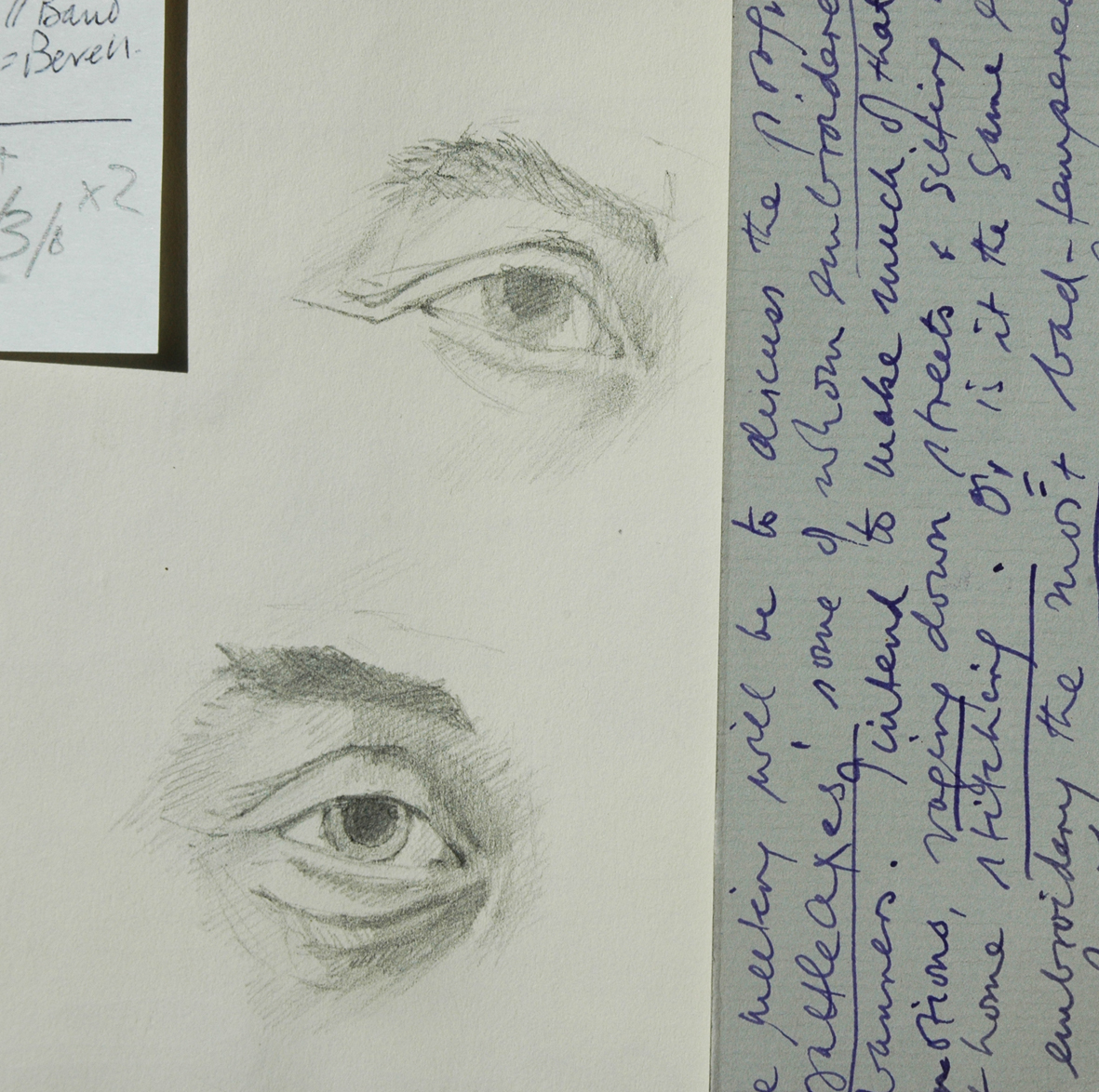
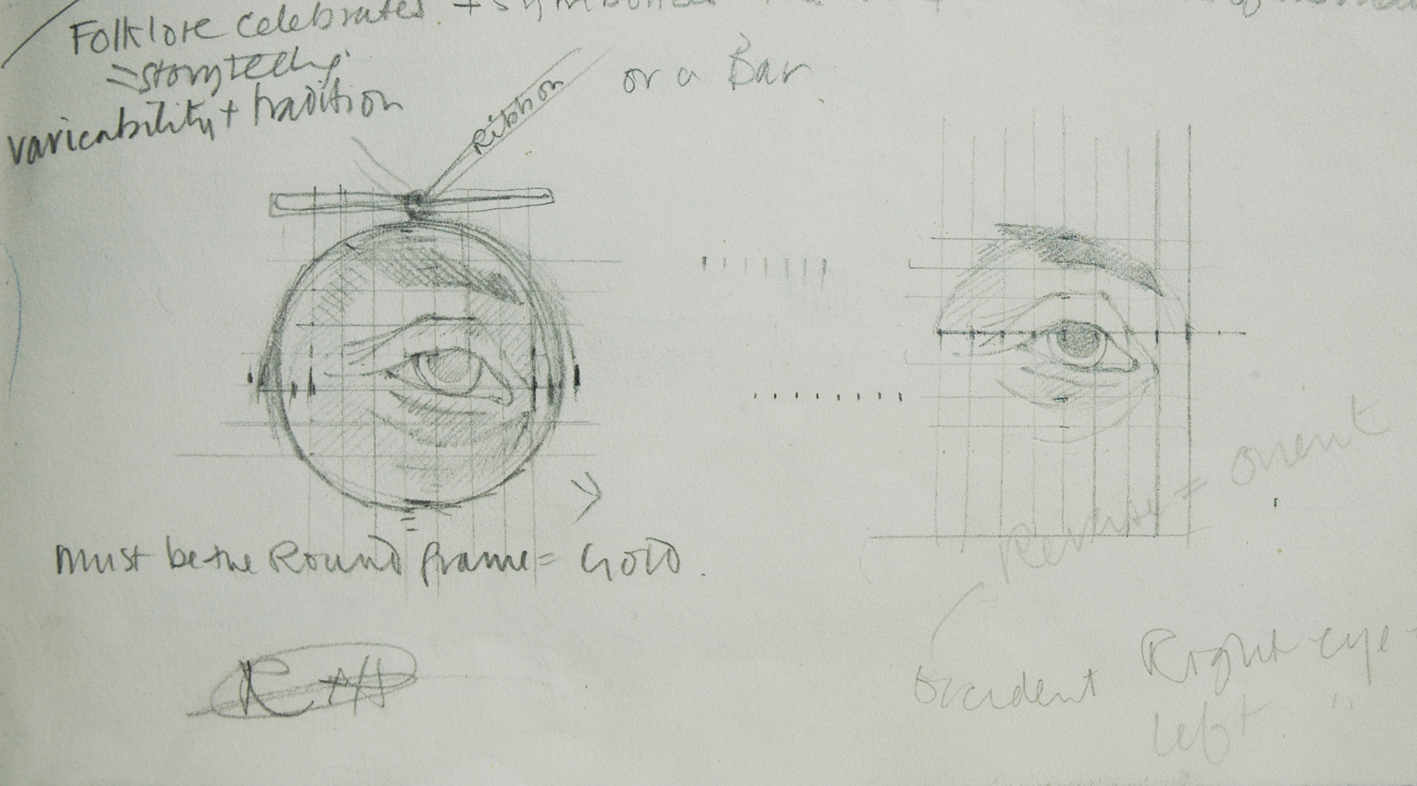
I made several pencil drawings from life, the drawings above are from my workbook from the years 1995 – 7 . The upper drawing is of my husband Stephen Jacobson’s eye, his brother Howard’s  is below it and this is the drawing I worked from. At the side of the page in my book I have pinned a card from Rosalin discussing some of my other embroideries, she is asking me if I feel that embroidery is the most bad tempered of all the arts. I now remember a discussion about the precise stabbing action of stitching and how much I felt it suited my nature……

I also remember researching into eye symbolism, apparently it is believed in West, that the right eye was a symbol of the sun and the future and the left of the moon and the past ( in the East the eye meanings are reversed).  The right eye that was chosen. There are also some handwritten notes suggesting colours “Blue grey – olive green flecked with ginger”

.

In her comment Rosalin mentions the mount, which I also have a note of,  it was gold, antique and bought in Bristol, where l was living at the time.

What has been really interesting is finding so much information about an old piece of work, both her reminiscences and my working information. I am now becoming very thankful that I have kept my samples and working drawings for most of my working life, they may become very useful as I continue this to write this blog. And here, possibly, is evidence of the beginning of my fascination with eye symbolism.

Stitching Ceramics

I am working with a ceramic designer, Hanne Rysgaard, as part of  project, called Stitch and Think  held for members of the ETC group at U.W.E. Bristol. Hanne and I have formed a making partnership to help one another develop new stitched work. We are, in effect, acting as each others’ technicians but the resulting collaboration is helping to develop some new and interesting ideas for both of us.

We are at the stage of selecting and sampling the main techniques and materials we both want to work with, she is helping me make large porcelain plates that I can cut, stitch and decorate with fabrics and words;  I am giving her fabrics from my studio stash to impress into the clay or make into decals – eventually I will stitch her work for her. This is a good division of labour, we both get to play with new materials and ideas and we don’t have to take forever to become fluent in a new technique to get anywhere.

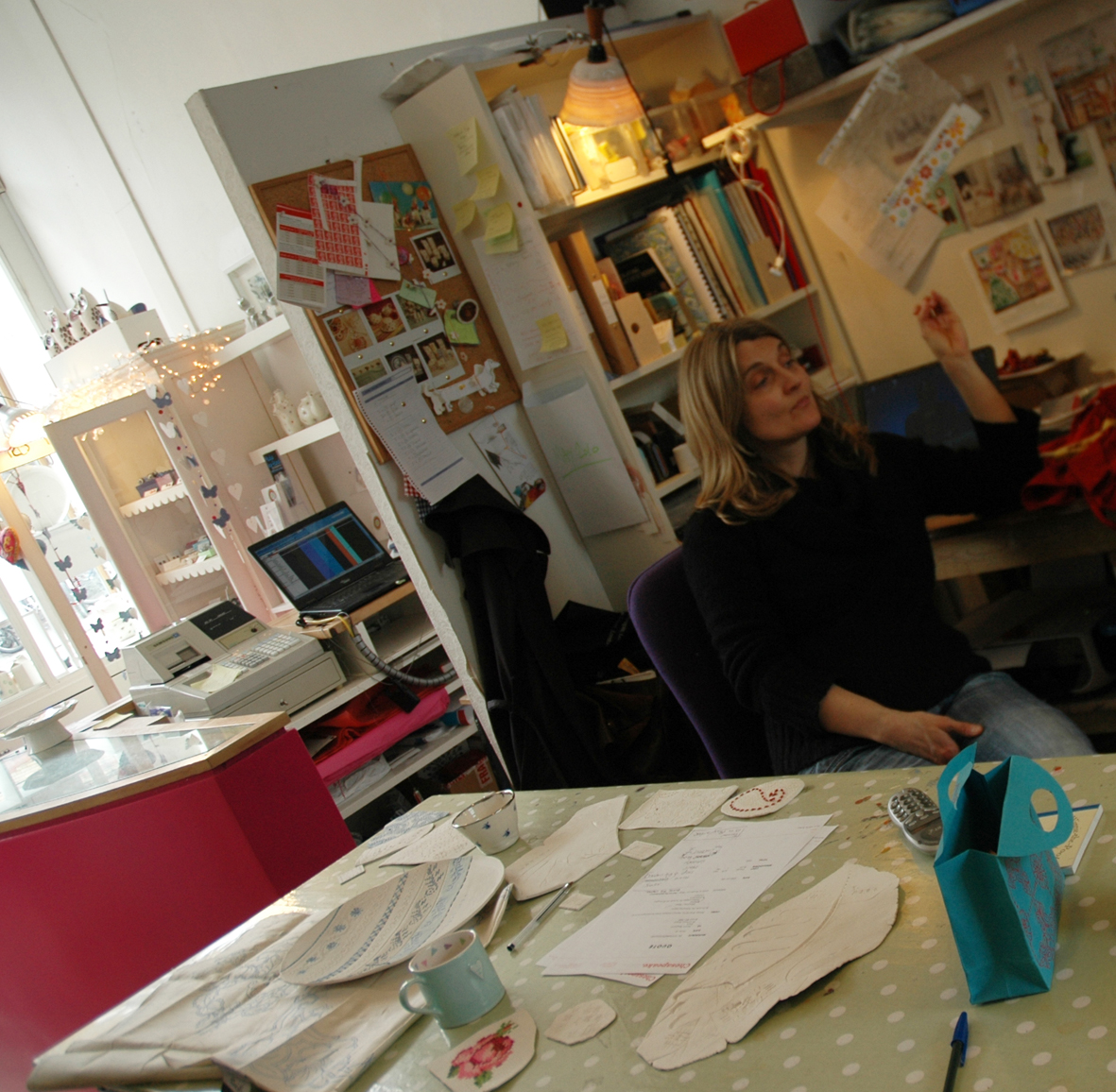
Last week I visited her at Blaze Gallery and Studio in central Bristol; it is co-operatively run with several people working on the premises and always shows fresh and innovative work including invited local makers.

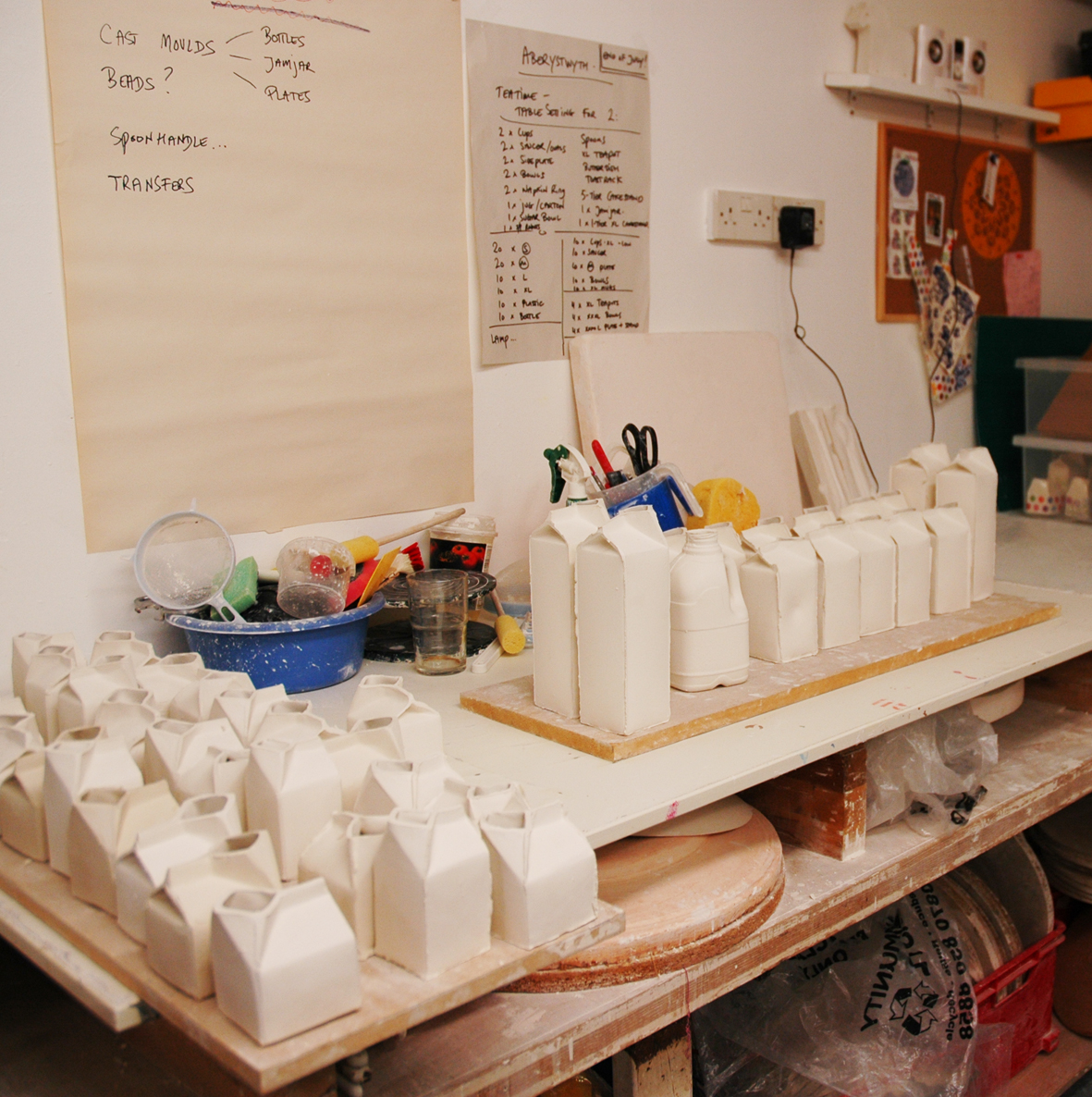
Below is Hanne’s workshop where she produces her ceramics to sell in the shop and various other outlets, at  the moment these milk jugs are hot favourites when eventually wrapped in flower power designs or spots.

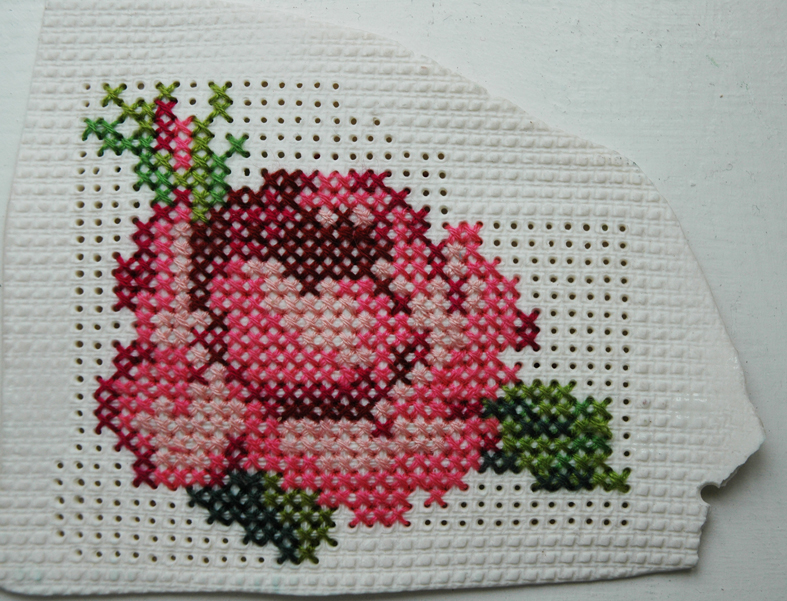
I had taken her my first completed set of samples, 2 dishes and some embroidered pieces of porcelain and paper porcelain, we had made these some time ago at a previous workshop, and they were finally fired and stitched. On the table are several other pieces we are considering.

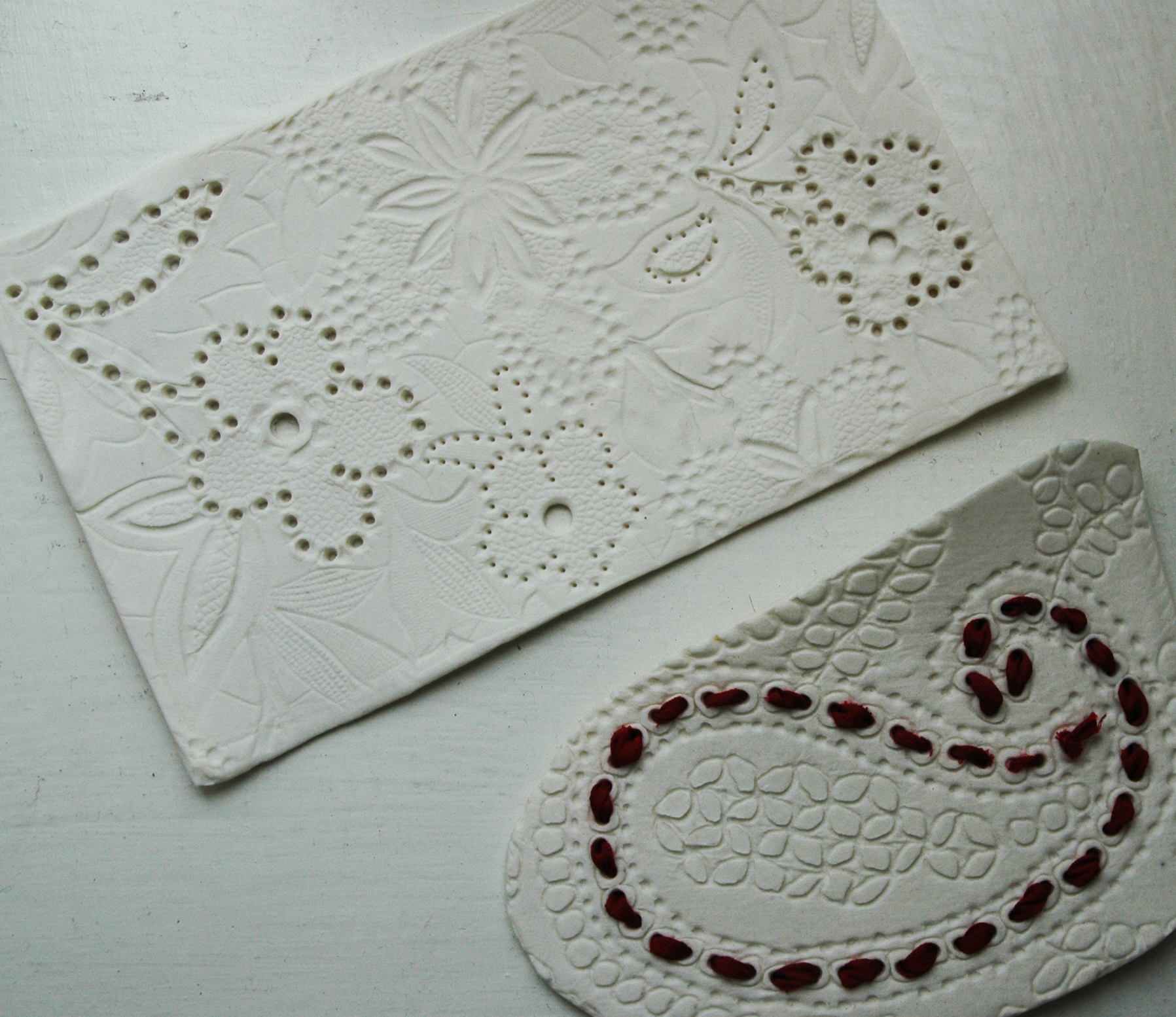
I have been working with the idea of vintage printed linen embroidery motifs which are folded under the plate, trying to recreate the light blue guide  line for embroidery – here I have embedded some colour into the pressed clay and stitched the finished sample in a matching linen thread. Below are more of our earlier samples of impressed and stitched paper porcelain.

And I have also been experimenting with more mending ideas …… see previous blogs…. I am loving how easy it is to cut and manipulate the fresh porcelain. But am having to do more sampling to assess the right size to make the holes as the clay shrinks when fired …so I  have several more samples to be fired this week

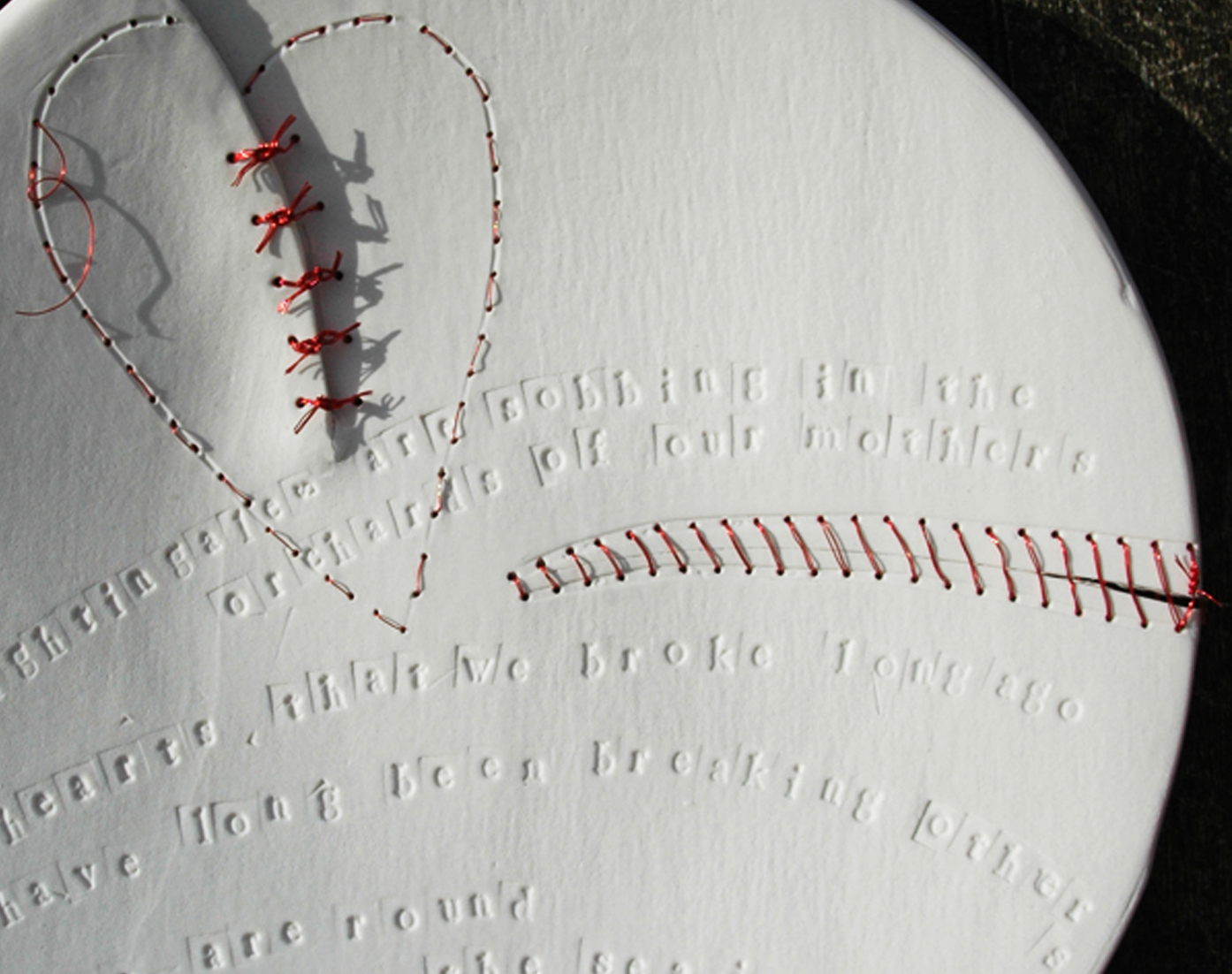
I made this plate which I cut, pierced and “mended”  with red wire – it features a broken heart and  one of my  favourite poems by W.H. Auden. This week I am working on a series of drawings to develop a set of  broken and mended plates based on this. I am also introducing images of working hands and “make do and mend” mottoes, so I will show more of this ongoing work when the new samples have come out of the kiln.

Make Do and Mend Stories.

I must have inherited a mending gene, these pictures have just been mailed to me by my niece, Jo Haigh and they are of my father’s old patched and mended Barbour fishing jacket. Jo had been given it for riding in when a teenager by my brother, Alan, who had inherited on my father’s death.

Now my brother says he can remember buying the coat with my father – they were both serious anglers – and he even helped to sew the patches on it, I  doubt this bit, but it might explain the distressing zig – zag stitched leather patch below.

I  can also clearly remember stitching this coat; under my Father’s precise instructions and measurements, I inserted large plastic poachers’ pockets to the inside – each just big enough to hold a trout.

At the time she received the coat, Jo says she just loved wearing it because it wasn’t all shiny and new like everyone elses’ riding gear and it was so patched she felt like a pirate…always a fanciful girl. Later, intrigued by the coat she looked it up on the internet and the label showed it was made and bought around 1960, which makes sense as I can remember sewing those pockets when I was a student in the late ’60’s.

The patches were definitely made to last, not only are they all machine stitched on the outside in carefully toning thread (you don’t want to draw any attention to yourself with an odd bright colour when out fishing – in fact my father’s entire wardrobe was in muted tones of what we called “lovat green” with the occasional grey or rust woven in) but inside, these are reinforced with leather patches – definitely a belt and braces job.

The last time I saw the coat must have been in the 1970’s when my father was still out and about wearing it, by which time I had left home to study and work in London.

But as soon as I saw these pictures I could smell the coat, a sort of mixture of wet grass and fresh river fish combined with that strange sinus clearing smell of waterproofed cloth. Immediately I was back at home on the Wirral, and for an instant my father was before me…how weird – but as Jo remarks “the things you hang onto always seem to have a story behind them”

This is the first story of the Darning Archive, there are more to follow – so if you have a mending tale just send me a message below.