mending the mending….

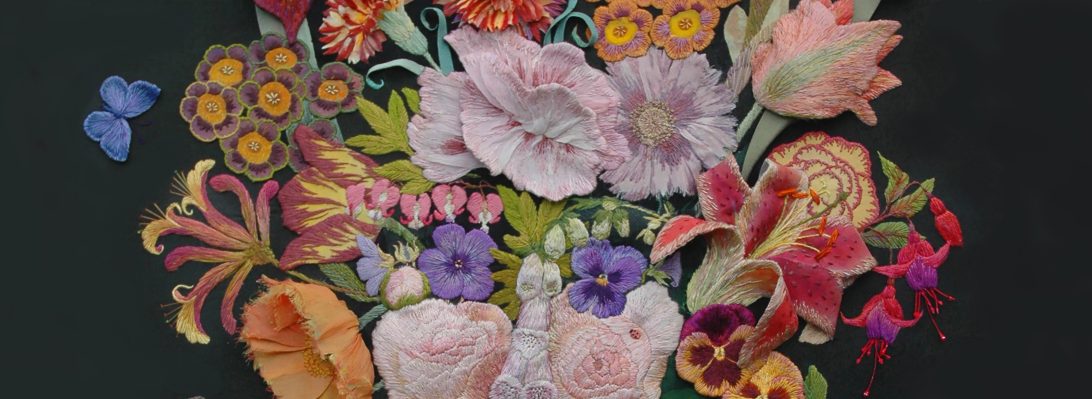
It is not without irony that I am posting the mending my old ‘mended hearts’ metal embroideries.

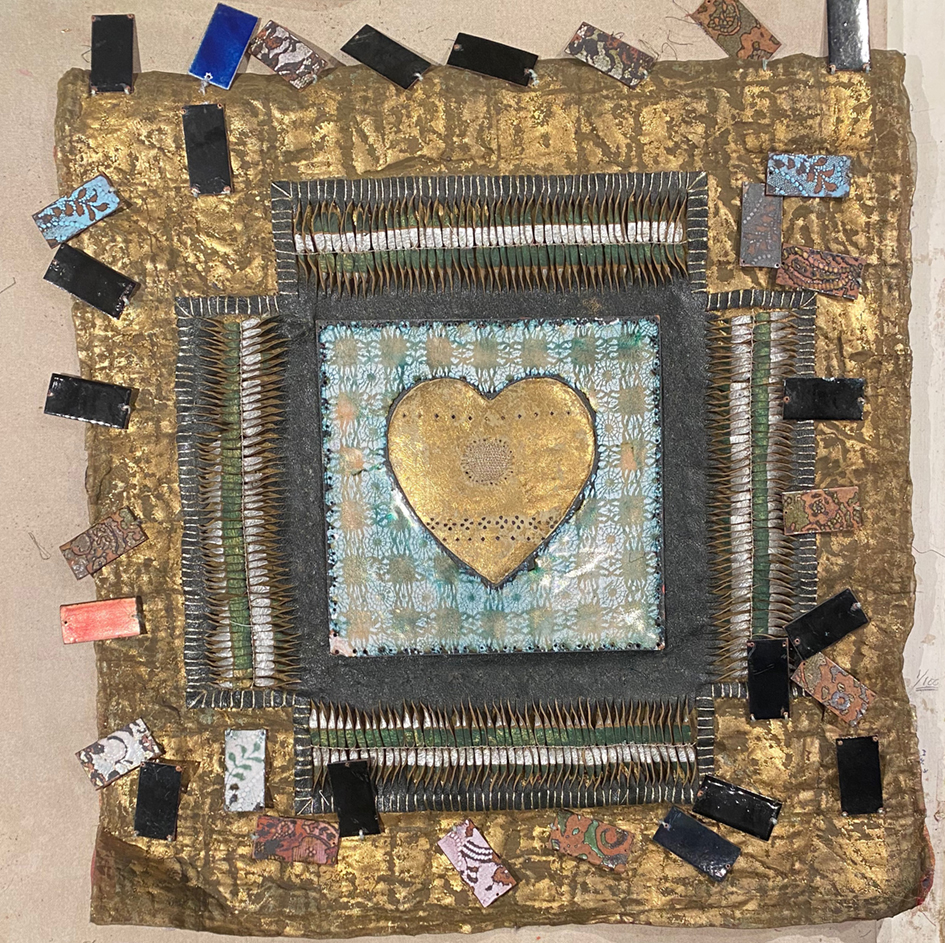
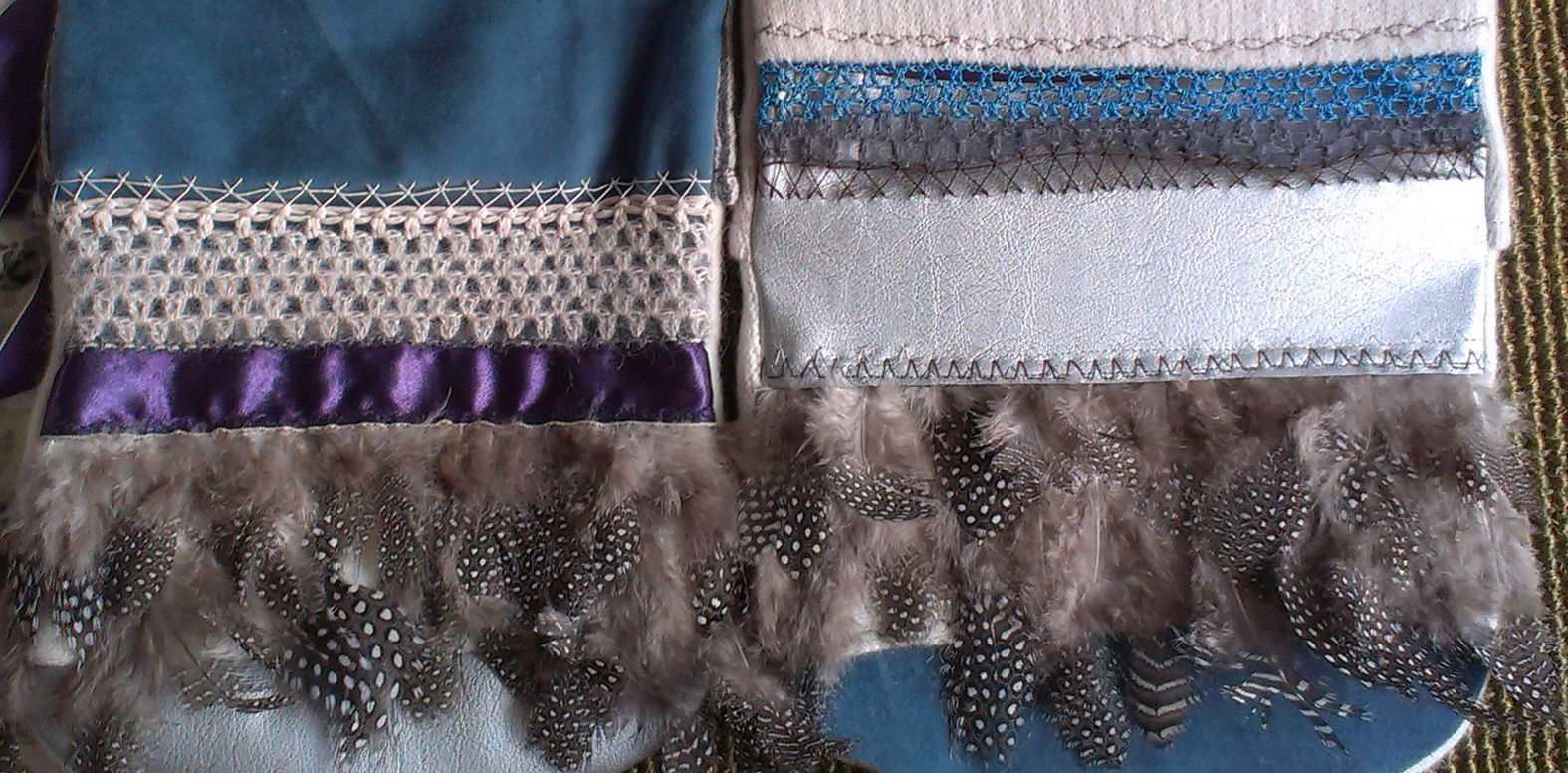
Above are the original images of 2 pieces of old work (circa 2010), left is Discarded Heart, and right Crossed Heart. They are just 2 of the outcomes of much experiment with some challenging materials – I was interested that these metal fabrics would last for a long time – far longer than the natural fabrics that I usually use…..how wrong I was!
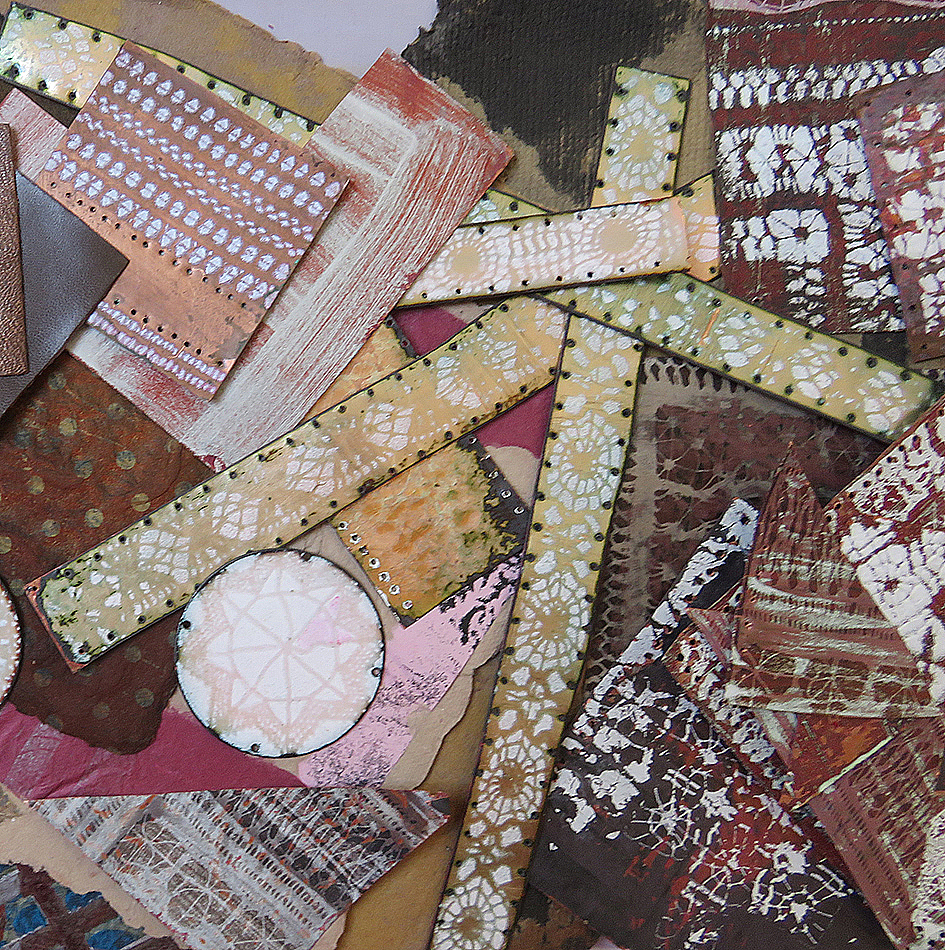
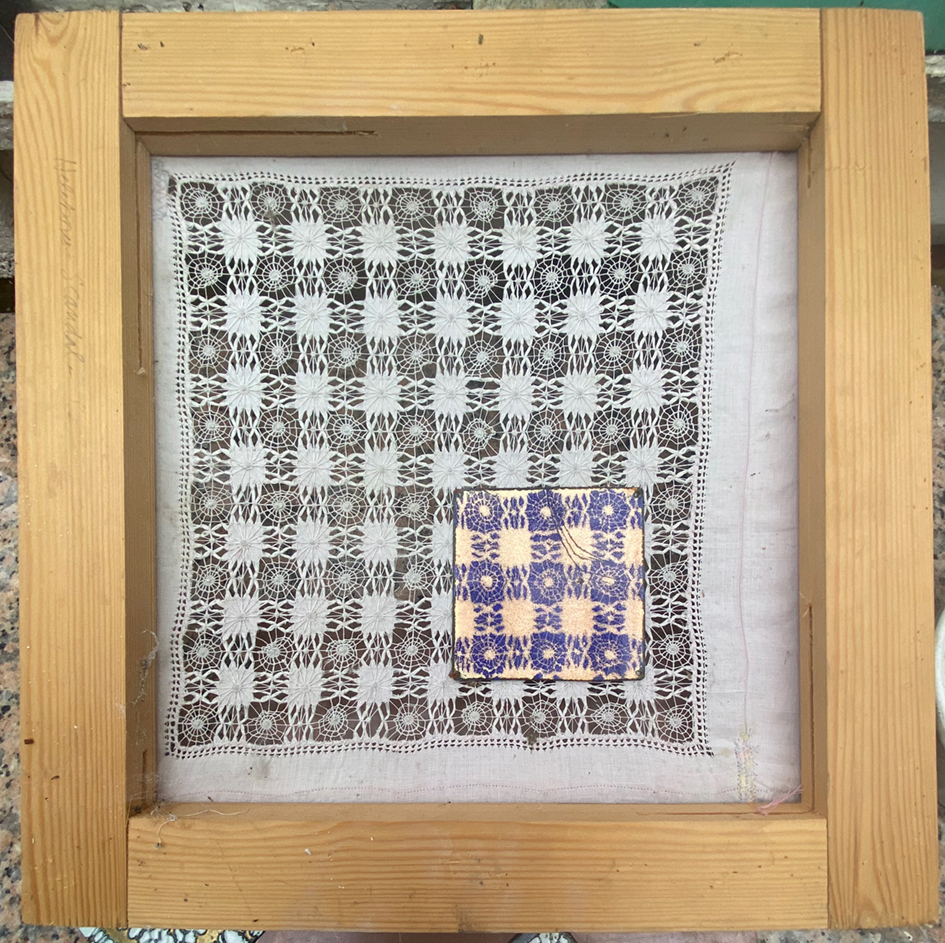
Searching in my studio I found a drawer full of old ‘fabric enamelsamples, that I had made use of for Discarded Heart. I had often used drawn thread-work as stencils and amazingly found the original stencil fabric , stretched and ready for use.

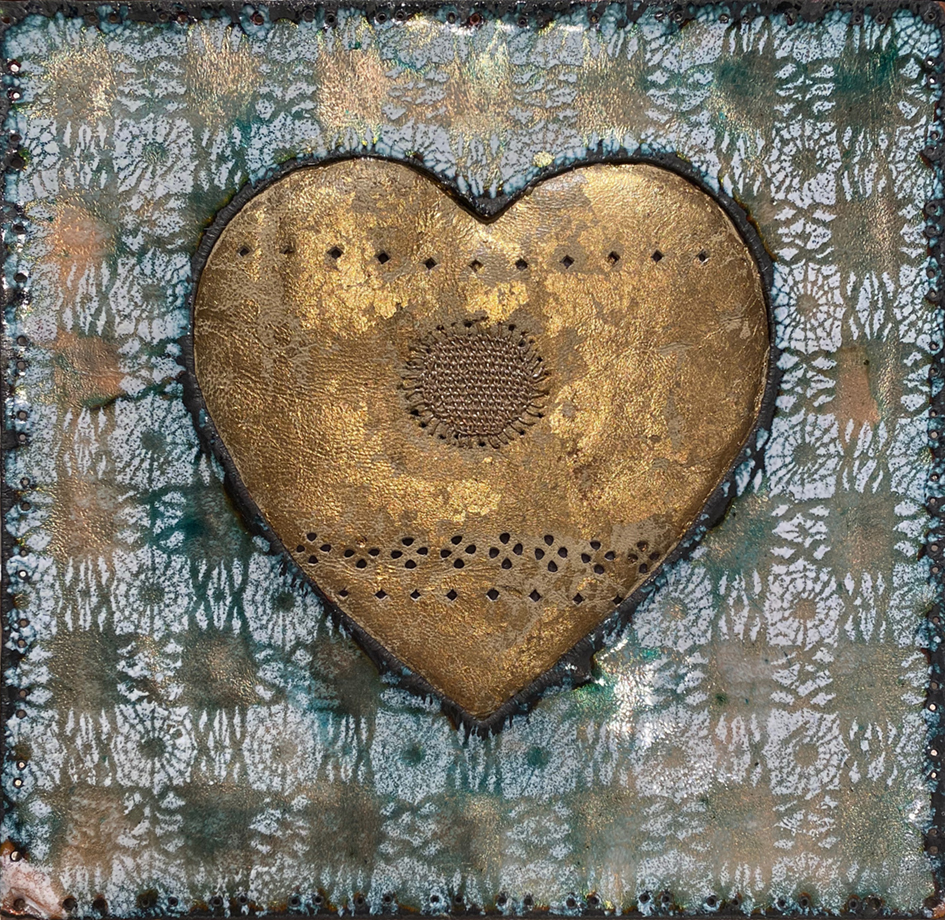
The most difficult thing I had to do was to repair the cracked enamel square. I wasn’t sure I could do this as it needed to be re-enamelled in exactly the same place as the original – fat chance! I carefully removed the gilded and stitched leather heart and re-gilded it. SO taking courage in both hands I re-stencilled it using a strong white enamel, then fired it at a very high heat and this made both the pattern very feint, and the cracks filled up – result!
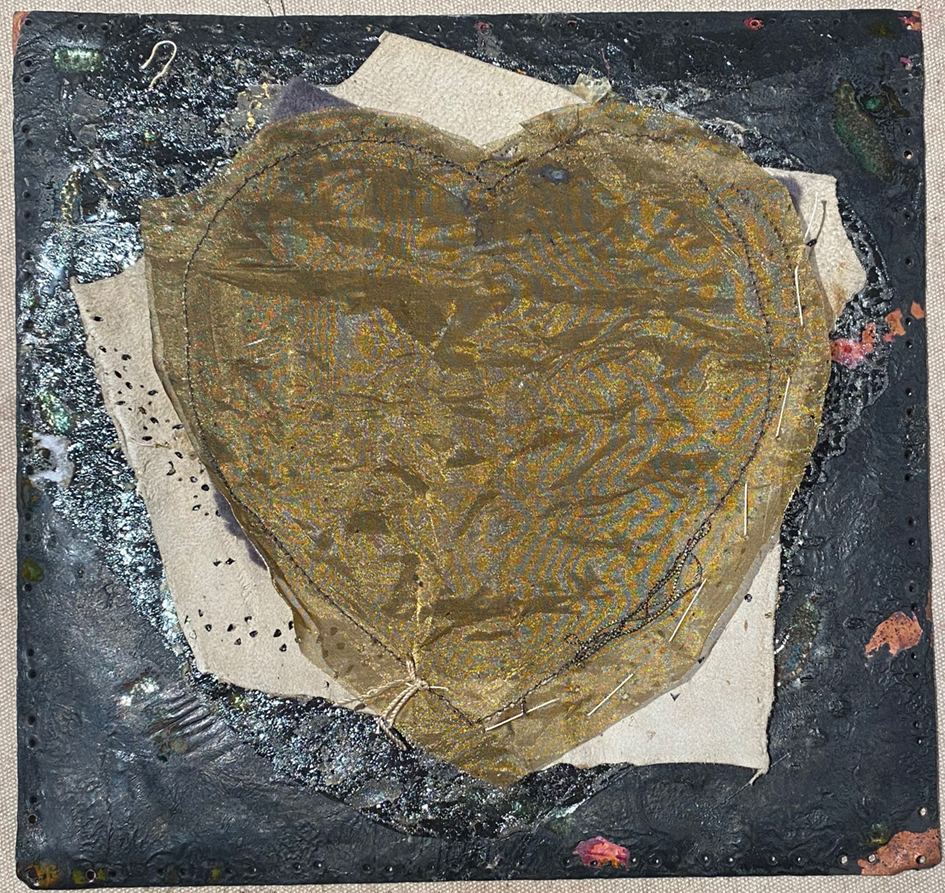
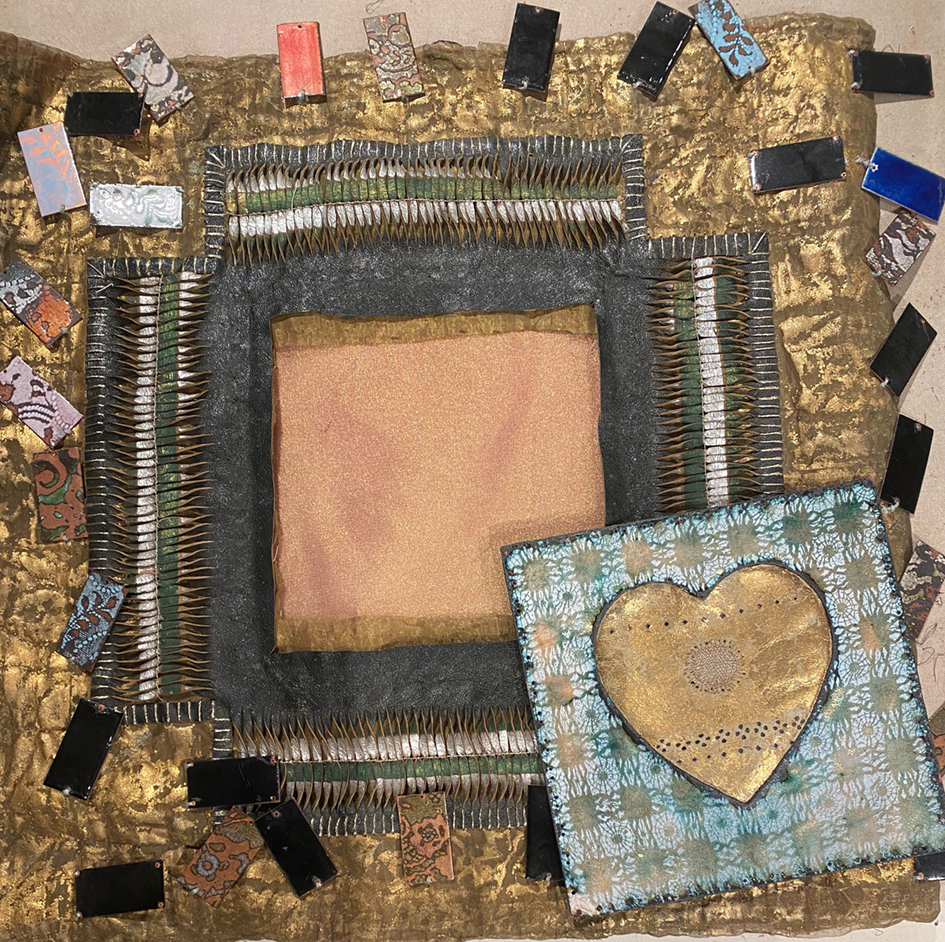
Back of centre panel with leather and bronze fabric cut to free heart for repairs
Front of re-placed re-enammelled heart

To get it back into postition I had to re-excavate and re-drill the stitching holes, so that I could painstakingly stitch the whole square by hand using real metal threads, ( trying hard to stick to my intention of NOT buying new materials but recycle anything I already own). I had several real Japanese gold and some copper wrapped threads to choose from, but this thread had to be strong and resilient for stitching through metal and leather.

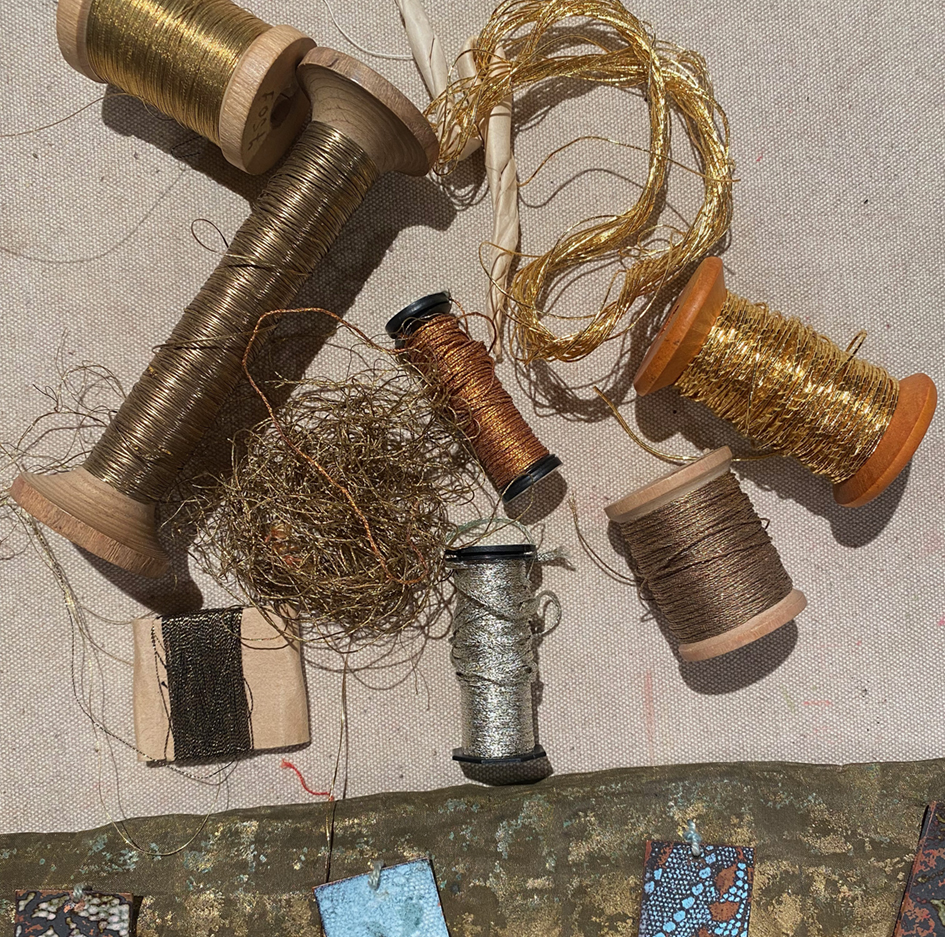
After several half days of really awkward stitching, I managed to herringbone a wrapped copper thread all around the square.

Relief, as I had already offered the Discarded Heart (as it was it was originally made from lots of my. unsuccessful samples ) to the Welsh Quilt Centre as part of my 6 months exhibition called Hearts and Flowers in 2024.

So far so good, but the next piece, “Crossed Heart” was really badly damaged – mostly by fading but seemingly anything it had been in contact with over the last 10 years….including my hands while working it! Everything seems to mark these refined woven metal fabrics (and I suspect Boysie, an ex fox terrier stud dog). And I thought that these fabrics would be as hard wearing as they are tough to stitch! I didn’t offer this piece for exhibition as I was not at all sure if I could make it look worthy of being exhibited again.
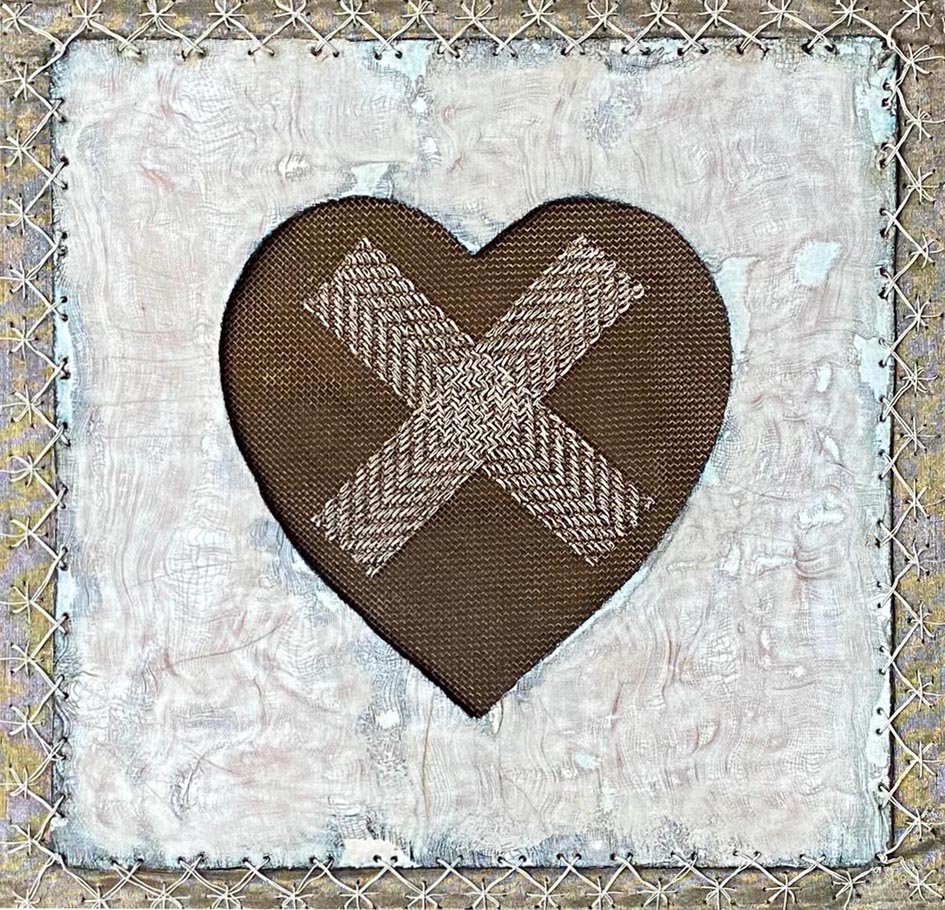
The only area not stained, faded or split was the centre panel of a decorative cross darn in white wire into a heavy copper mesh I had copied from a Darning Sampler in the Bristol City Museum and Art Gallery which has one of the most famous Sampler collections in the world. I kept this, but now had decide just what to keep as signs of legitimate wear and what I just couldn’t aesthetically live with!

The whole sorry embroidery put onto my worktable and pinned into place – the metal fabrics have a tendency to roll up on themselves when left alone; a metal memory even after 10+ years of being stretched on a fame. The staining is plain to see with the general fading and tarnishing, but what you can’t see are the splits on the background fabrics underneath the rows of herringbone stitches.

The first area I felt confident to work was a rip and I cut away the fraying fabric – a mistake – but hey ho, nothing ventured…and started to darn the gap in the metal and nylon woven fabric with 1 thread from a stranded silver hank of 6 strand….very tricky – I may yet go back and rework this!

I was not very confident to continue, but I had started and I am of the sign of the crab…..very tenacious. Here are various ruined areas of the work, with different mends : a proper running stitch strengthener over a pulled thread area, sewing an extra border in a nylon and probably lurex woven fabric (once a very glamorous skirt worn to a 1 very glamorous occasion)to hide the worst of the staining on the outermost edge of the piece ( Boysie?) and then surrepticious stitches to draw the edges of the split fabric together. The herringbone stitches had started to unravel – and by this time so had I.

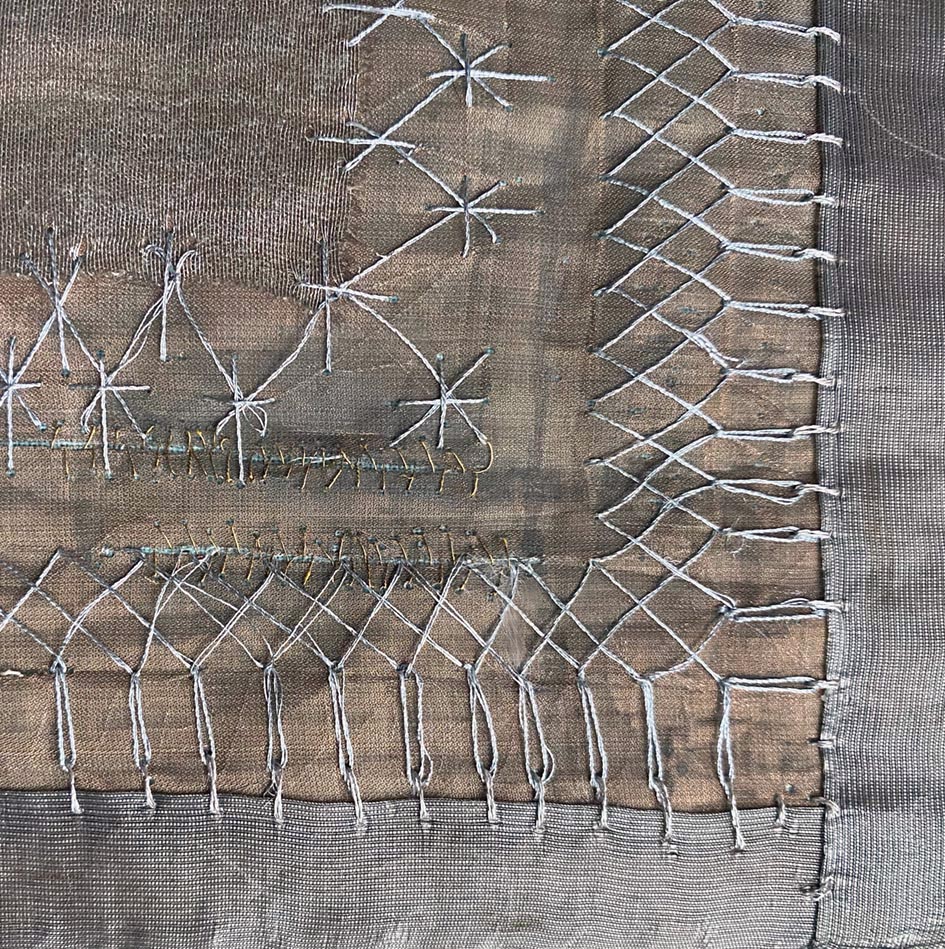
but eventually they are finished enough for safely re-stretching and possibly have their place in the lay-out for the gallery as part of a group of stitched metal mended hearts…

The mended Crossed and Discarded Hearts

Crazy Mixed-Up Samplers

GEDSC DIGITAL CAMERA

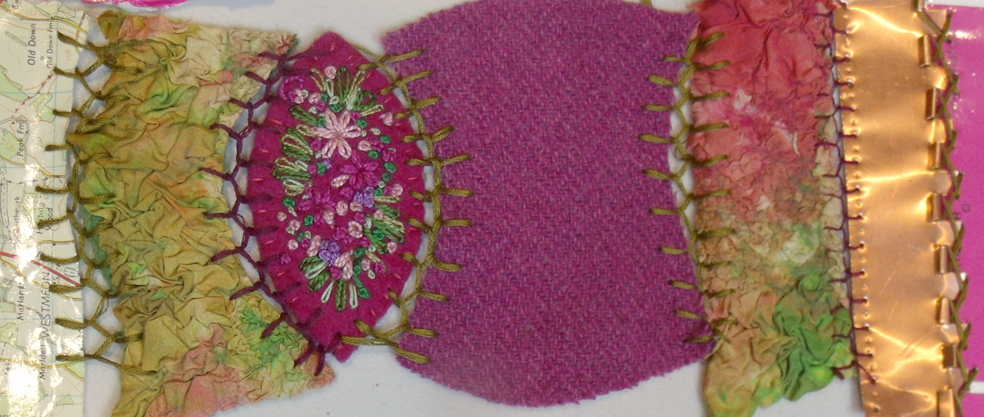
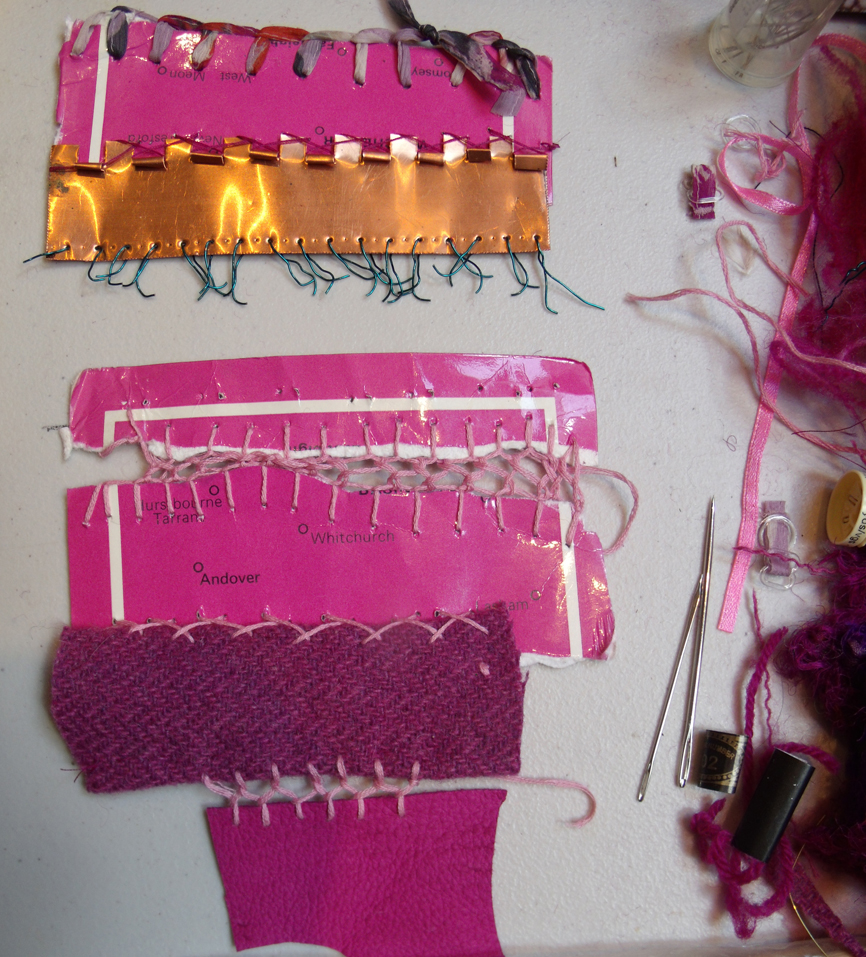
strip sampler of tweed, embroidery, nuno felt copper and paper- Kirsten Hill-Nixon

I am interested in developing a set of workshop using mixed media at Heart Space, think leathers, metals, ceramics, fabrics, glass and wood….. so I thought I could try the idea out on the people who work with us, all expert in their own field and up for a challenge.

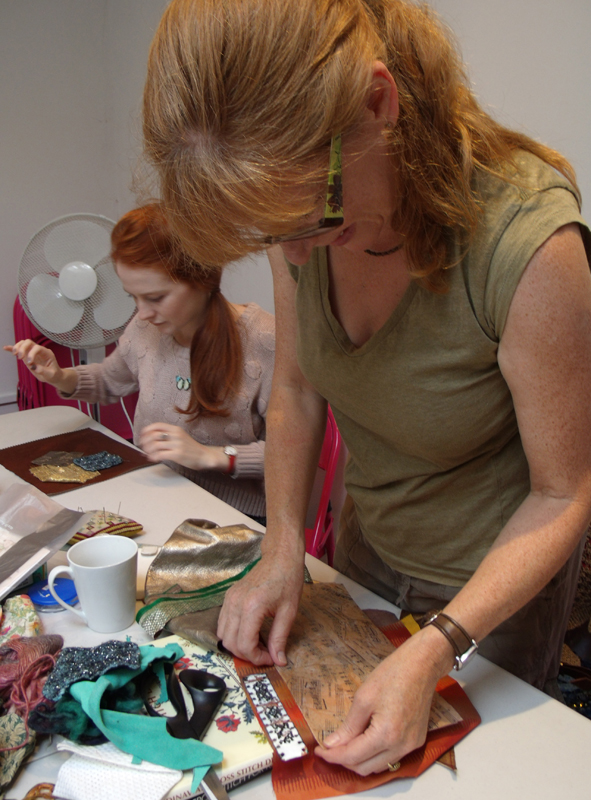
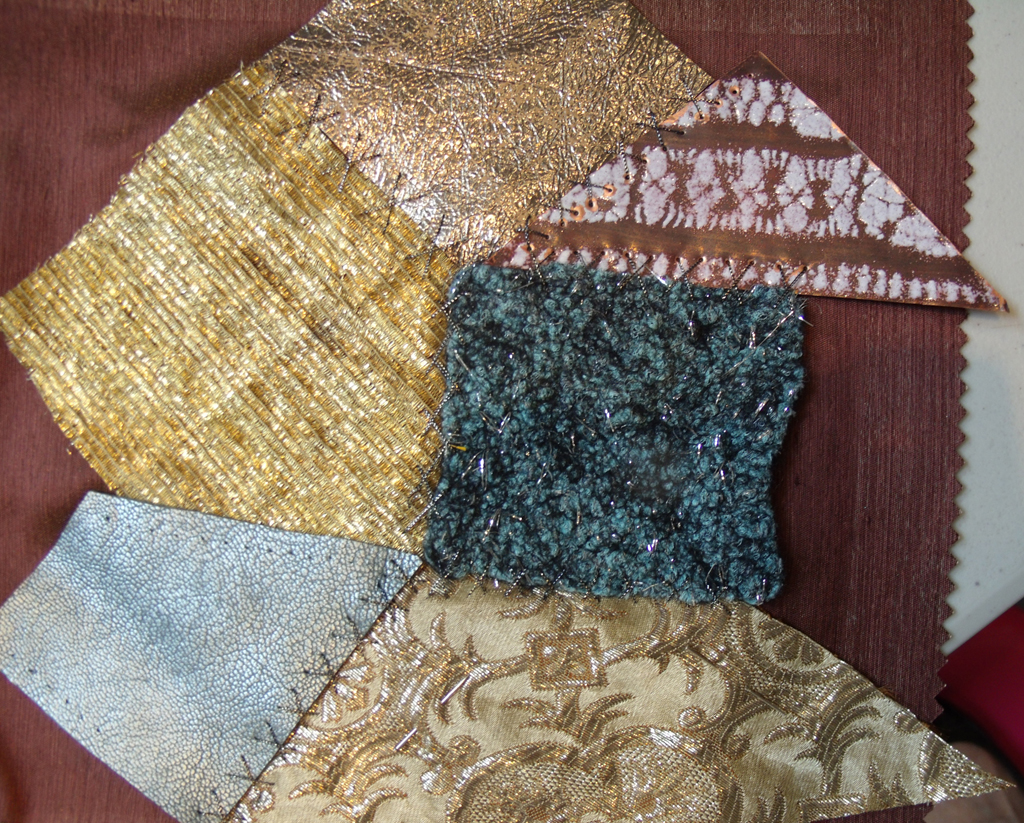
And as Crazy Patchwork samplers have been such a success at Heart Space Studios that I decided to run an Away Day for the tutors and staff to enjoy time making together. I asked everyone who could attend, to bring their own favourite materials and their tools. Each person would make either a strip sampler  or a crazy square sampler by using decorative embroidery stitches to join the materials together.

GEDSC DIGITAL CAMERA
tutor’s own stash of hand made wool felt
GEDSC DIGITAL CAMERA
the administrator’s collection of everything vintage

Most people brought their own stuff to share between the group, I am always impressed by the generosity of makers in workshops like this. The group dynamic is encouraged so that people really want to help one another. What is also an added bonus is finding a shared love of a particular technique or material, even makers of different ages and styles come together when they find they both appreciate a particular aspect of their chosen discipline.

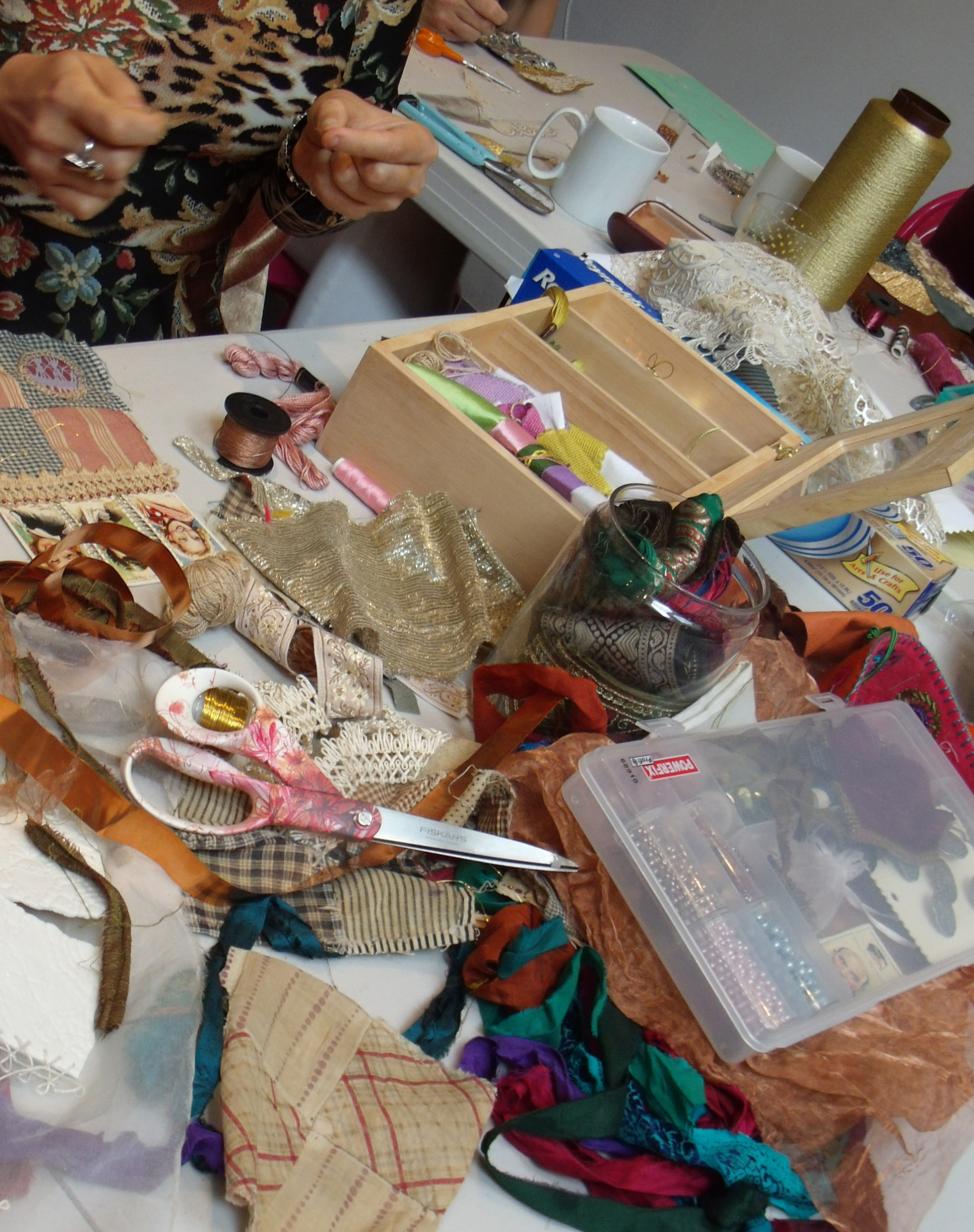
I also brought a large selection of materials from my home-based studios, all kinds of things: woven metal fabrics, stencilled enamels on copper, leathers, plastic lace, metallic damasks and other fabrics –  and also the tools to drill stitch and manipulate them.

one of the best things about attending any materials based  workshop is the abundance of new and unusual stuff that is introduced by people who are experienced in working with it – this can save days of researching.

GEDSC DIGITAL CAMERA
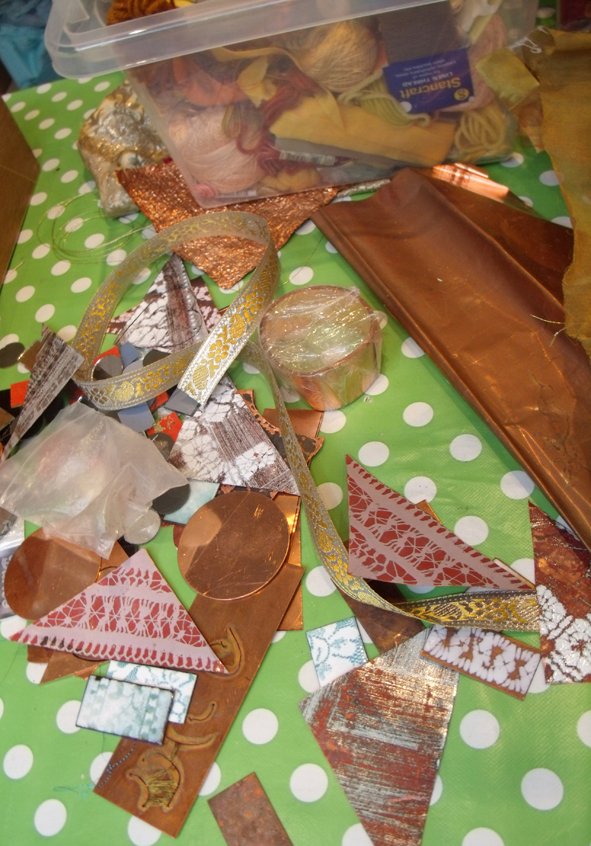
my stash of copper discs, enamelled triangles and metallic braids
GEDSC DIGITAL CAMERA
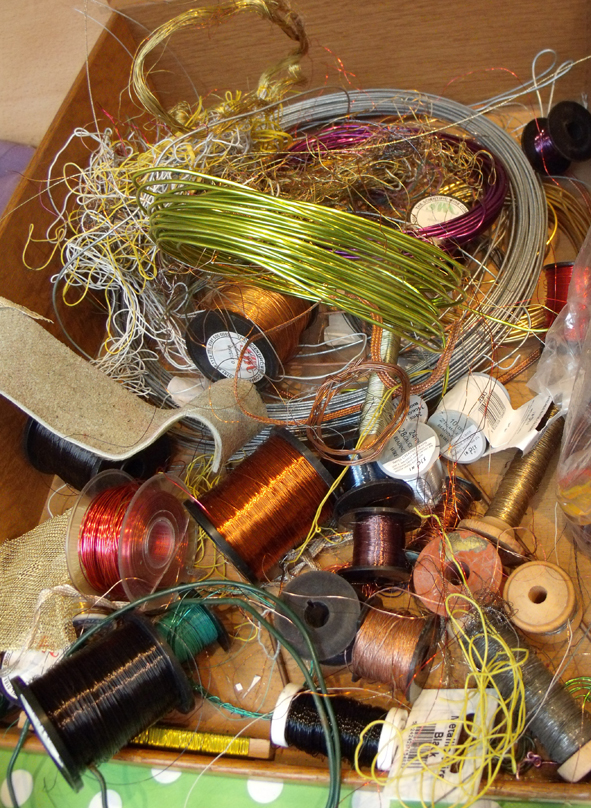
copper and aluminium wires for working with in any way possible.

I particularly like metallic leathers and fabrics, so I brought lots of these in for everyone to sample, as well as scraps of thin copper, some patterned with vitreous enamel. such a shame I had no time to experiment with the other tutors’ materials for this research session.

GEDSC DIGITAL CAMERA
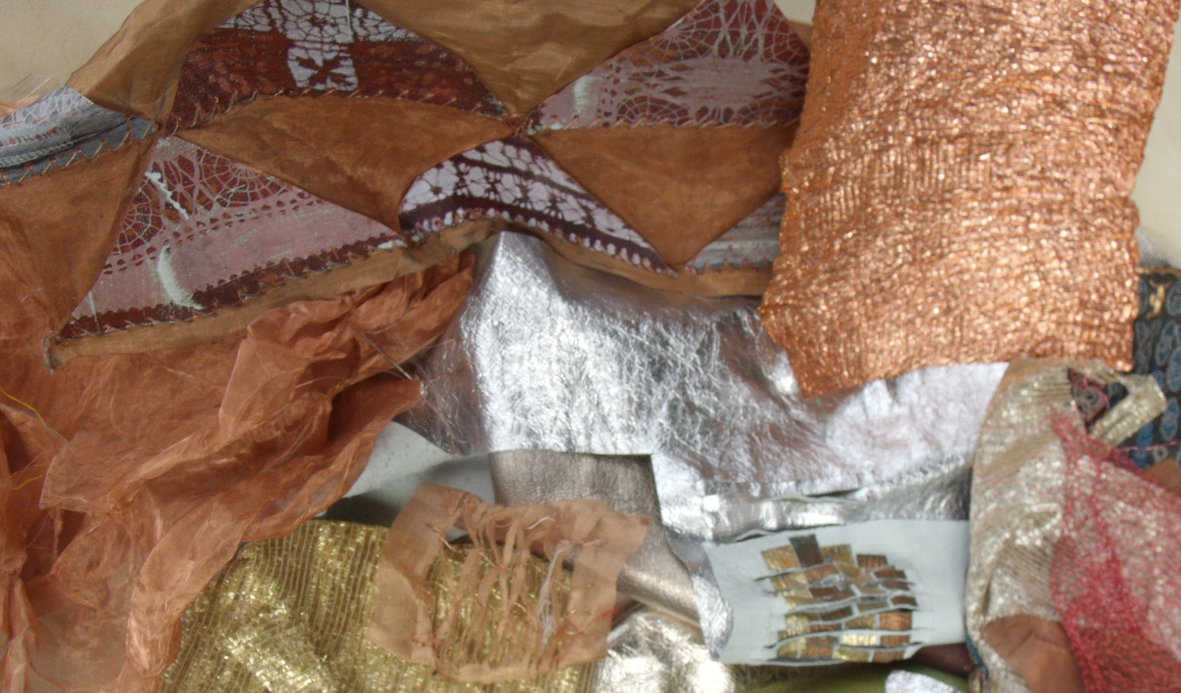
metal meshes and pressed copper foil, enamel applique and metallic leathers.

The task for the morning was to choose 3 different materials and join them together using their own preferred techniques or I would  teach anyone various embroidery stitches and techniques. As the group comprised experts in knitting, stitching, crochet, felting, print as well as display, administration and even a drama student (a daughter on a flying visit), it proved to be a mixed bag of talents, attitudes and experiences. Perfect for generating new ideas and enthusiasms

GEDSC DIGITAL CAMERA
colour co-ordinated mother and daughter

Everyone set to work choosing their 3 materials and laying them out, the strip sampler proved to be the most popular as it is the easiest to co-ordinate; odd crazy  shapes take a lot longer to set up.For the task of joining two of the disparate materials together – colour, surface texture, weight of each material has to be considered as well as the selecting the technique.

GEDSC DIGITAL CAMERA
traditional crazy shapes
GEDSC DIGITAL CAMERA
strip sampler of cotton, leather and paper

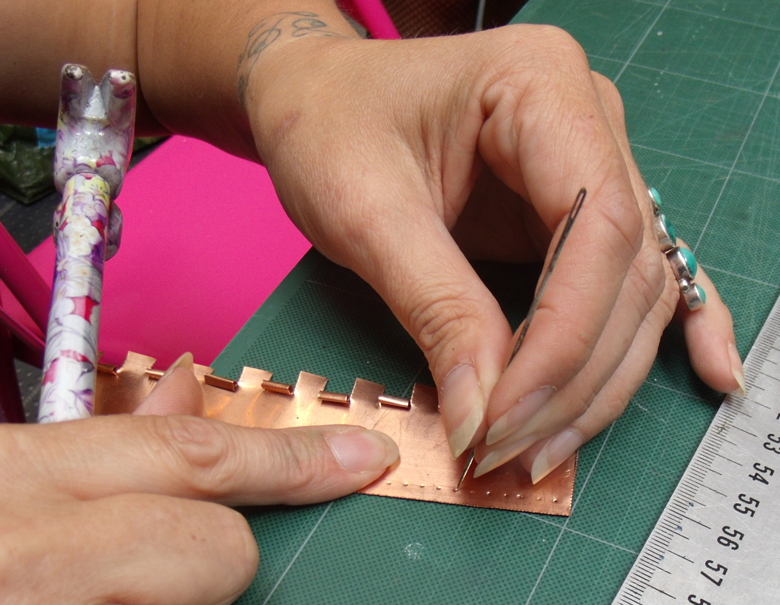
I showed everyone how to make regular holes in various surfaces, involving textile techniques – a tracing wheel, an old darning needle and a hammer! It works for me every time…..and off they went with mixed but interesting results.

GEDSC DIGITAL CAMERA
marking out where to make the stitching holes on copper.

At first everyone just chose a colour co-ordinated or used an unusual type of thread to work with…

GEDSC DIGITAL CAMERA
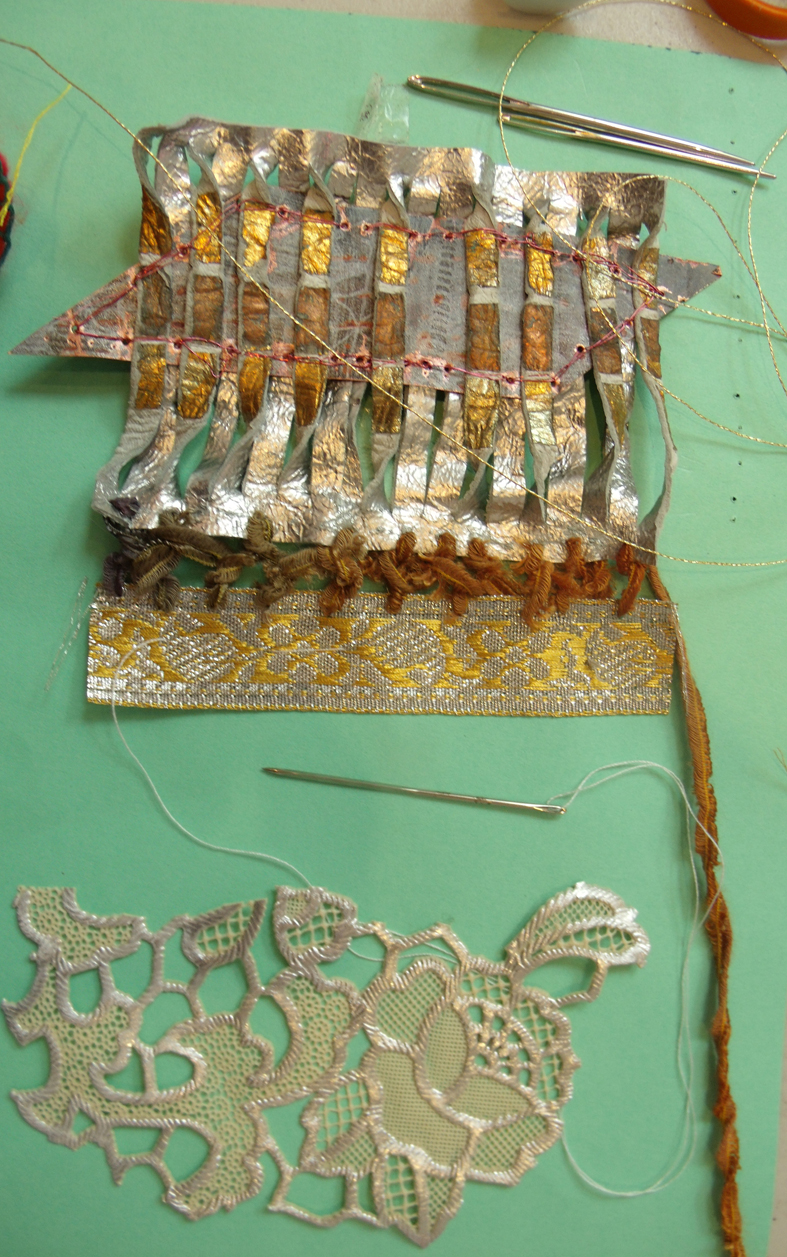
metallic leather, woven braid stitched together with silky knitting ribbon, awaiting the addition of a scrap of plastic tablecloth.

only to find that when stitched it looked very different than imagined. after a relaxed start the makers’ critical faculties began to kick in!

GEDSC DIGITAL CAMERA
colour co-ordinated threads and second thoughts

I noticed that the knitters worked completely differently from the stitchers; they immediately made a start by adding a linking system to one edge of a piece of material  either using  crochet or knit to form an edge ready to accept the next piece of material – this gave them much more contemplation time for what comes next – the stitchers are able to join 2 pieces together simultaneously. Why had I not appreciated this before?  However working the wire into fine leather was a fiddly affair – see below right.

GEDSC DIGITAL CAMERA
knitting wool onto a copper foil strip
GEDSC DIGITAL CAMERA
developing the crochet wire joining strip

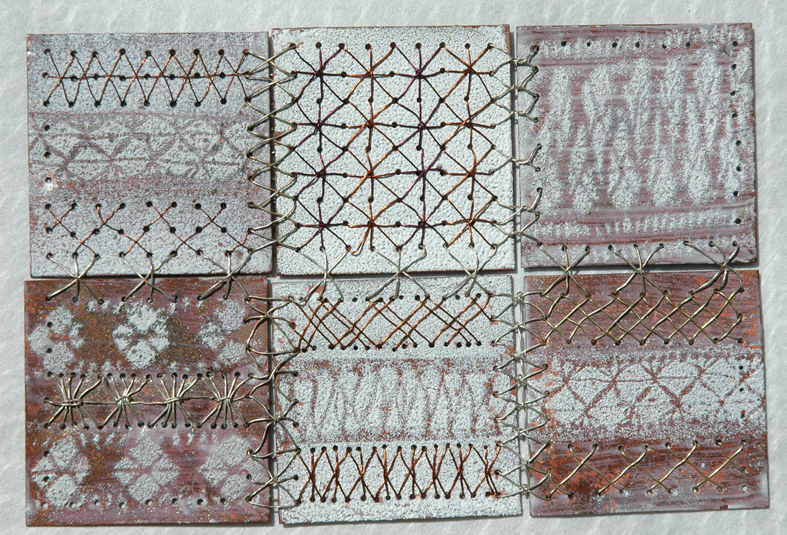
Now I really must get the knitters to teach how to do this technique. When I first attempted to join metal together using my own stitching techniques I used a different system – making rows of simple cross stitches between the strips of vitreous enamelled copper pieces, so joining each at the same time. It took me some time to try the different insertion stitches. In fact it was an aversion to drilling all the holes that put me off developing this technique for a long time – but now I happily drill rows of holes for hours at a time – well not exactly ‘happily’….maybe I will get to like crochet after all.

my very first attempt at joining metal with stitched wire

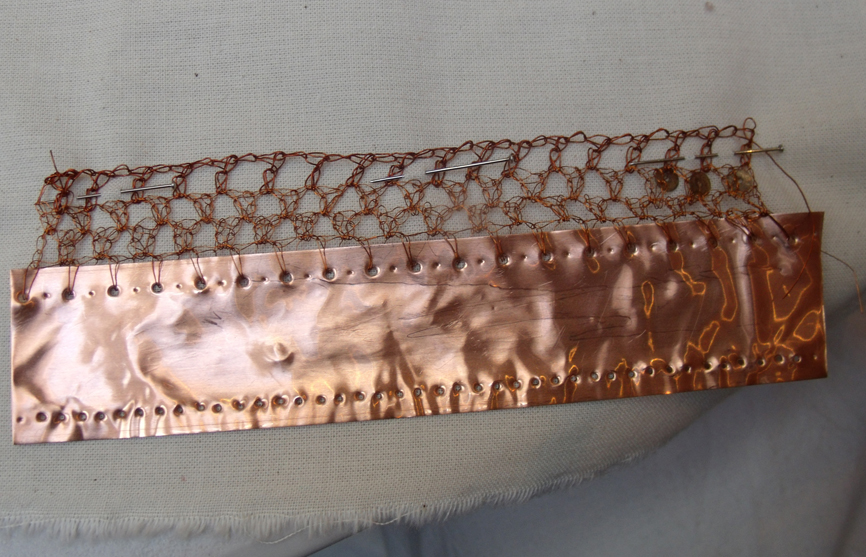
When the crochet wire was worked into some copper strips it was very successful…the strong steady base really helps achieve an even texture and the structure gives the metal wire movement and elasticity which is much more compatible to work into fabric.

GEDSC DIGITAL CAMERA
copper wire crochet edge to copper foil strip

now the strips of materials are starting to look like they belong together

GEDSC DIGITAL CAMERA
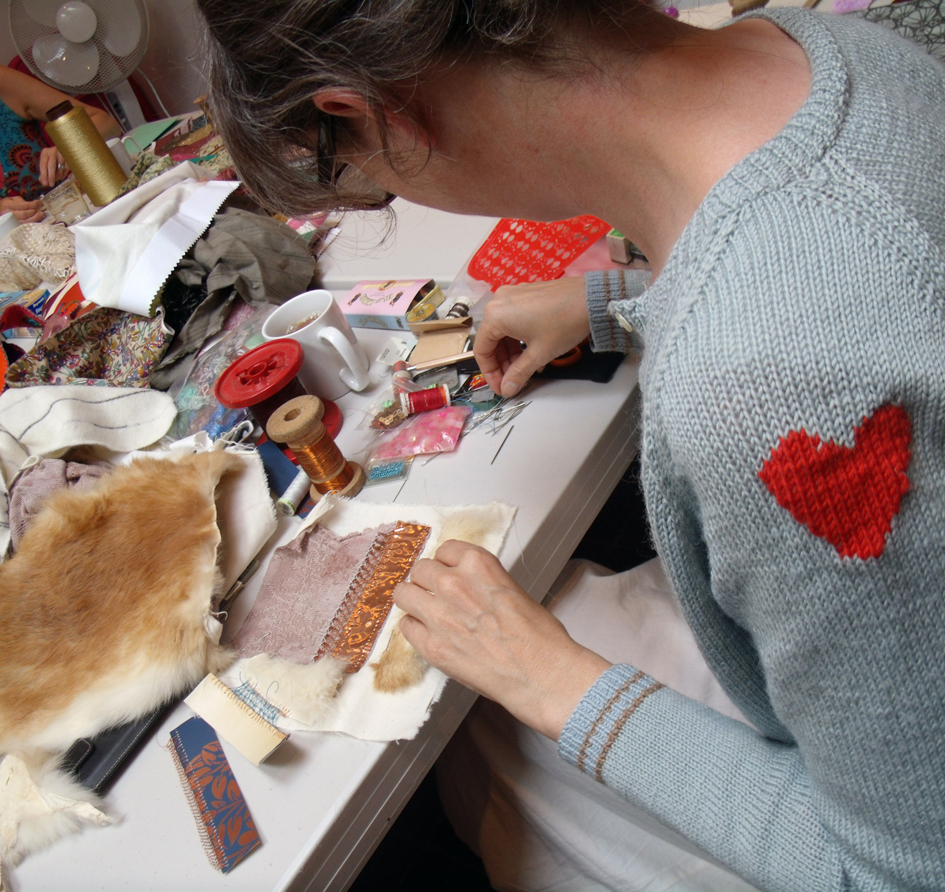
concentrating on the task in hand- and a heart on her sleeve

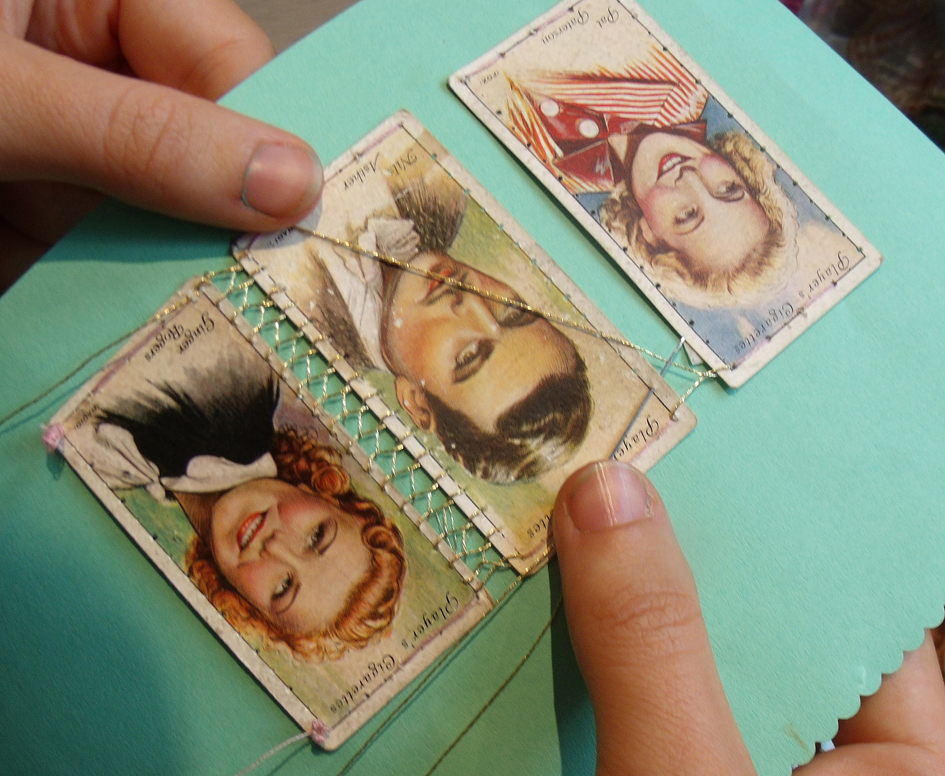
I showed several people how to embroider simple insertion stitches for a lace-like join…securing the fabric to a piece of card first to steady the gap between the pieces, a traditional technique found in my old embroidery manuals for white work.

GEDSC DIGITAL CAMERA
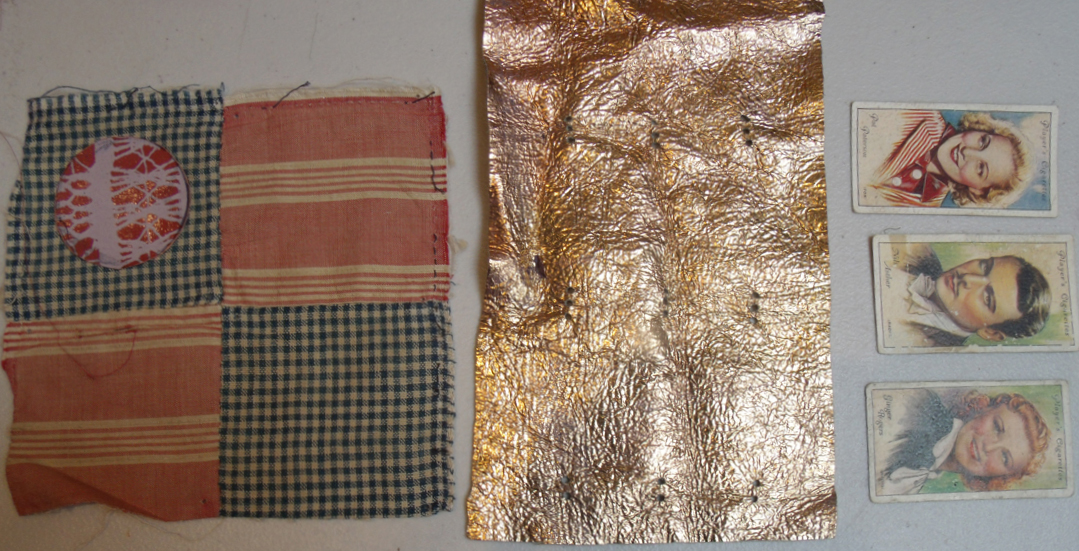
cigarette cards stitched onto paper to steady them ready for gold insertion stitching

Now the invention started to kick in…

GEDSC DIGITAL CAMERA
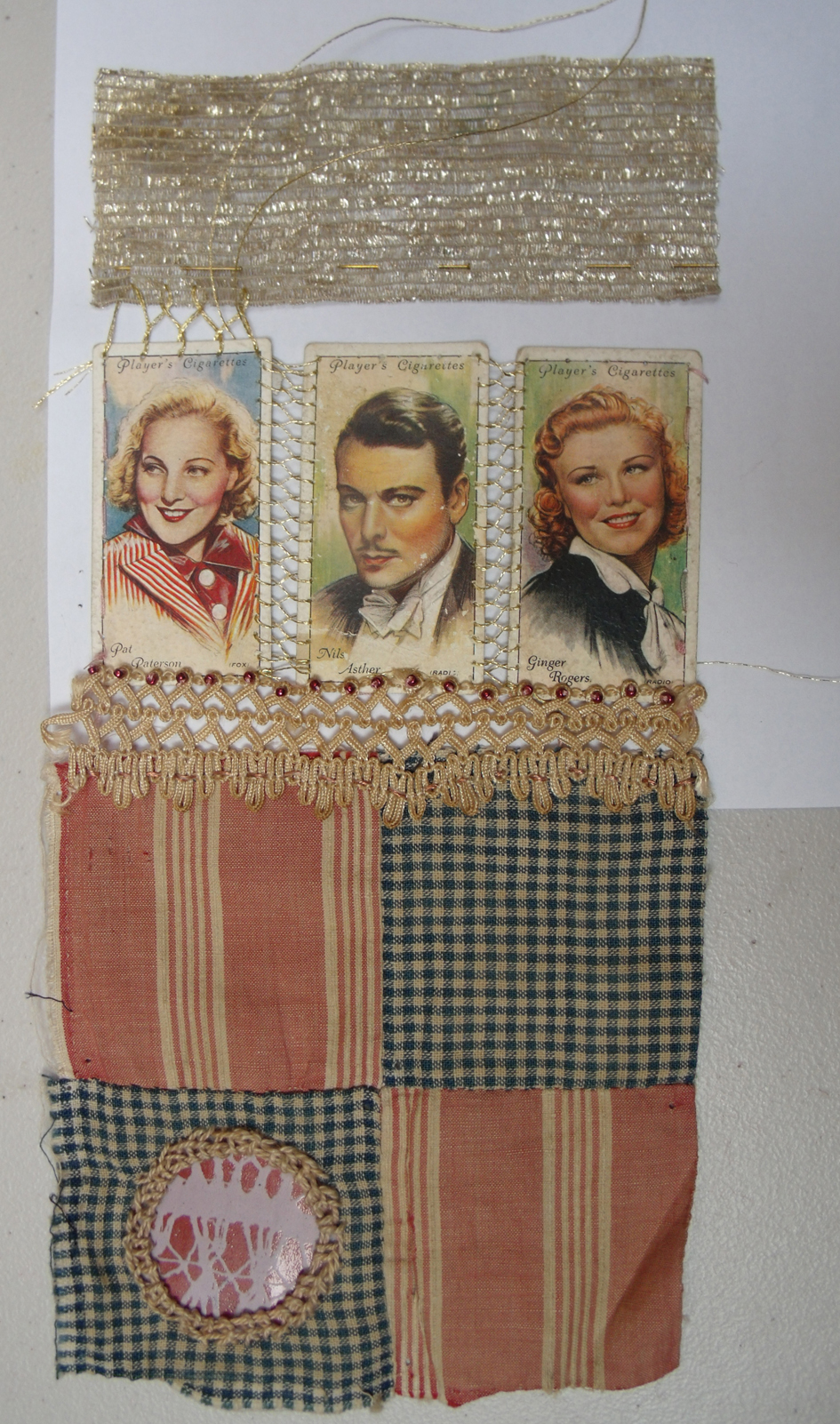
insertion stitches and beaded braid for that vintage vibe – Sophie Bristol
GEDSC DIGITAL CAMERA
a really crazy mix of materials crocheted together by Avril Best
GEDSC DIGITAL CAMERA
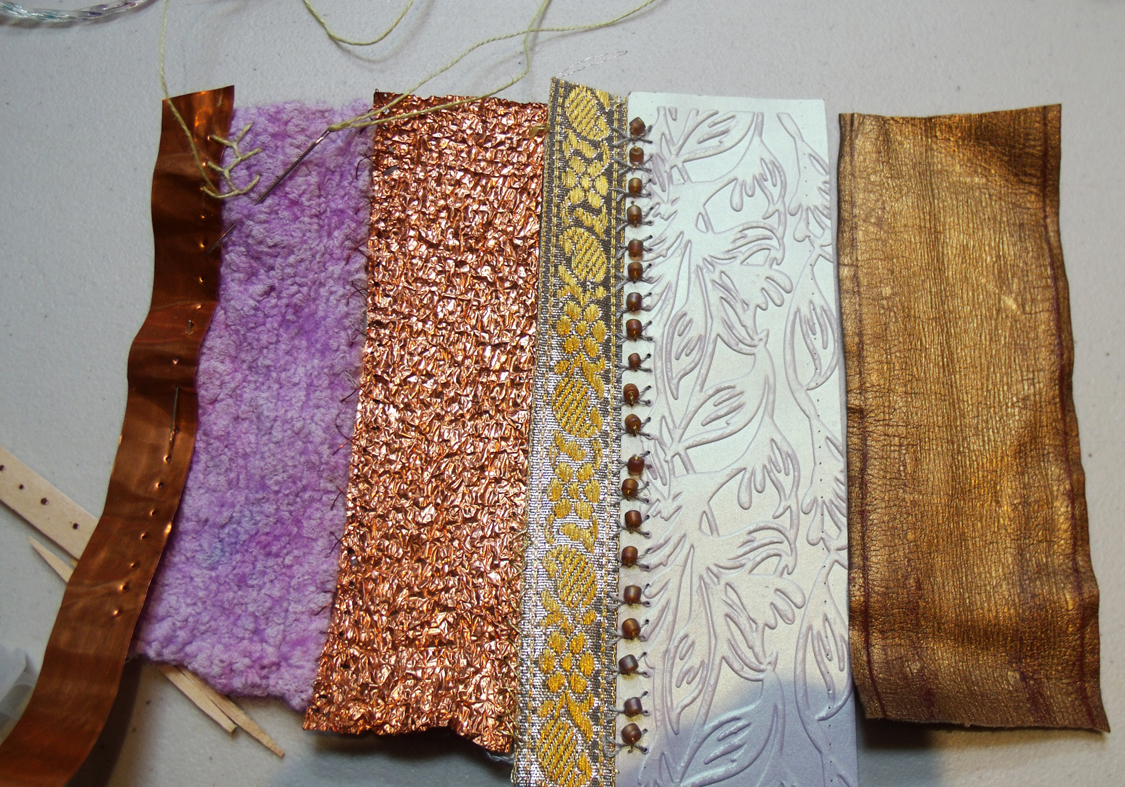
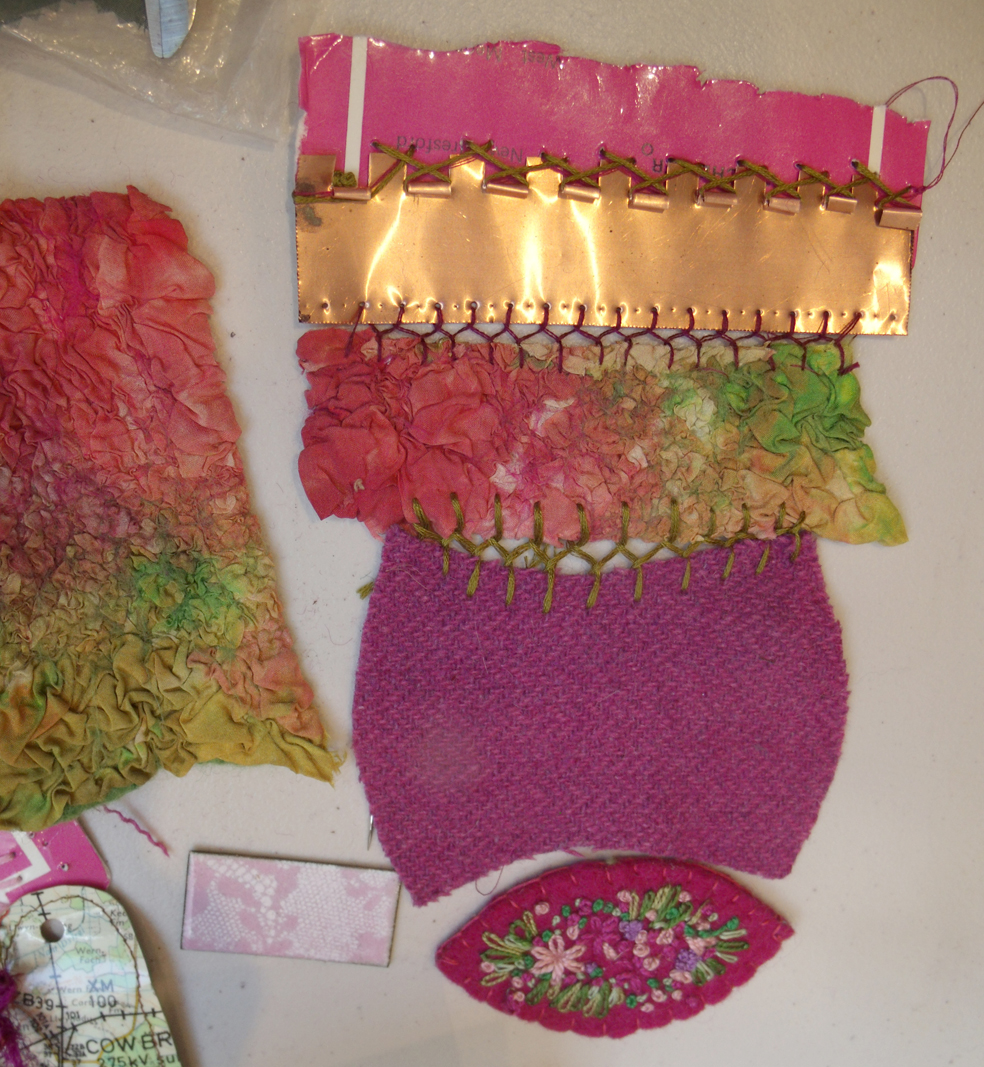
elegant beaded joining stitches between rows of leather, wallpaper, metallic braid, crumpled copper foil, nuno felted silk and drilled copper sheet – Debbie Bird
GEDSC DIGITAL CAMERA
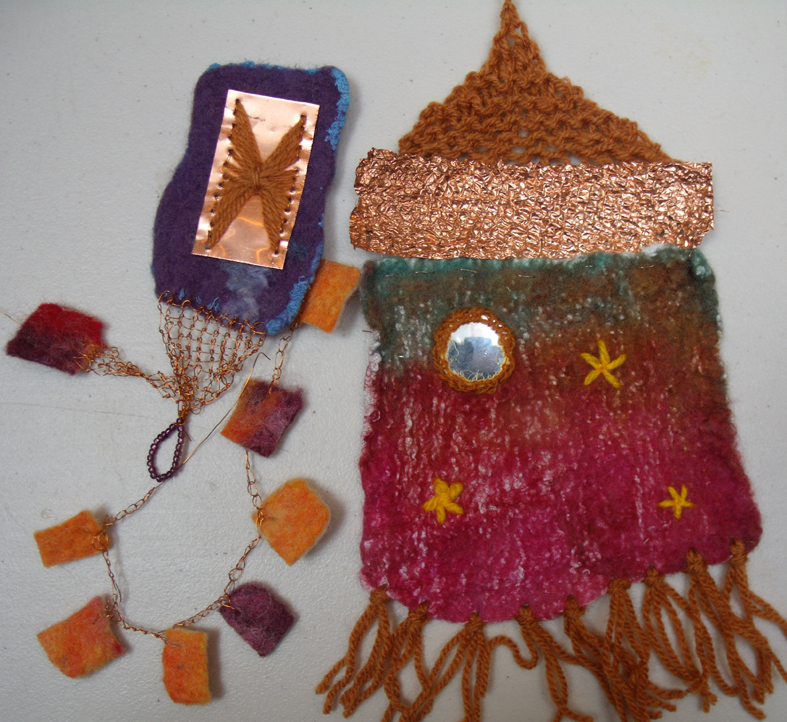
various knitted materials for joining disparate materials;- copper, copper wire, silk and wool nuno felt, shisha mirror in wool embroidery – Clare Griffel
GEDSC DIGITAL CAMERA
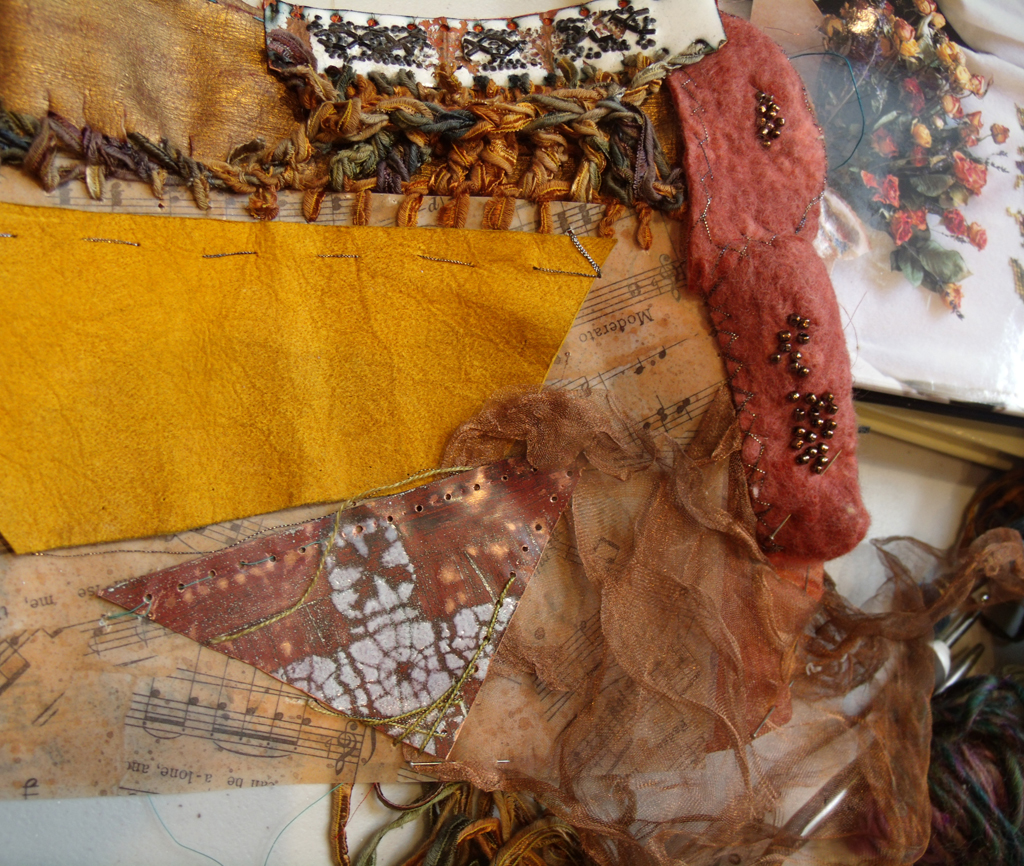
ripped card, copper foil, nuno felted silk and wool, tweed and hand embroidery all joined together in crazy style – Kirsten Hill-Nixon.
GEDSC DIGITAL CAMERA
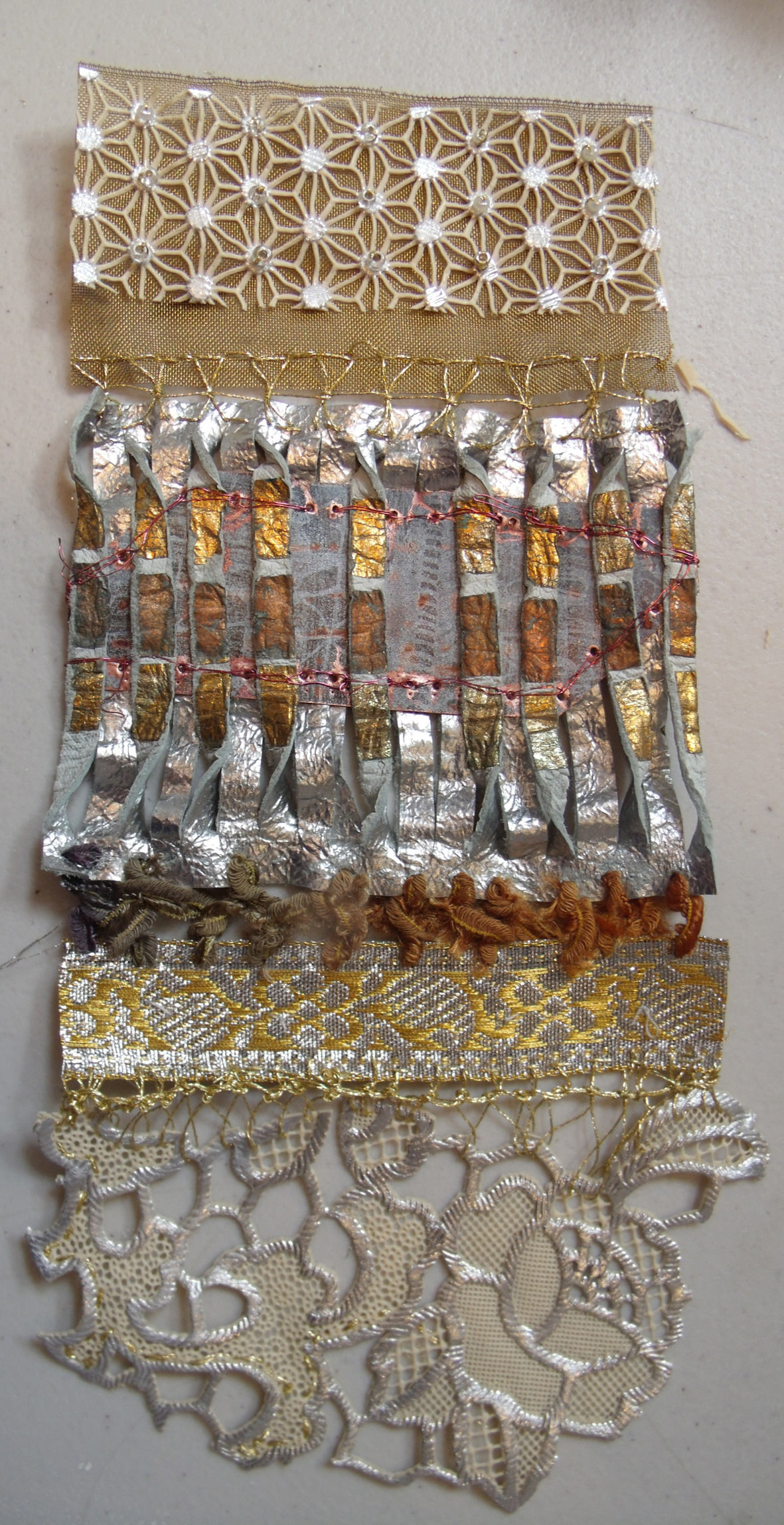
interesting how the plastic tablecloth now looks like a precious fabric when seen with the other expensive elements, leather, woven brass and silver fabric. Jane-Marie Mahy
GEDSC DIGITAL CAMERA
all things vintage – patchwork cotton, linen thread appliqued enamelled copper circle , cards and silver fabric. Sophie Bristol
GEDSC DIGITAL CAMERA
pre machine knitted lace, crocheted copper wire with copper foil and wall paper – Steph Wooster.

And to prove that sampling really does inspire people here is new work from Steph – the day after the workshop she added some of the sampled techniques and materials to her range of knitted hot-water bottle-covers.

steph hot
new knitted and embroidered samples – Steph Wooster