commission revisited

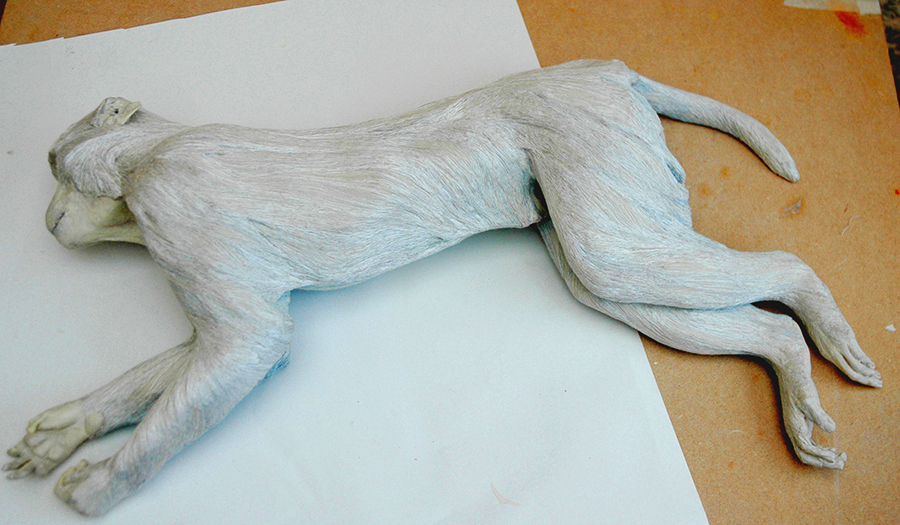
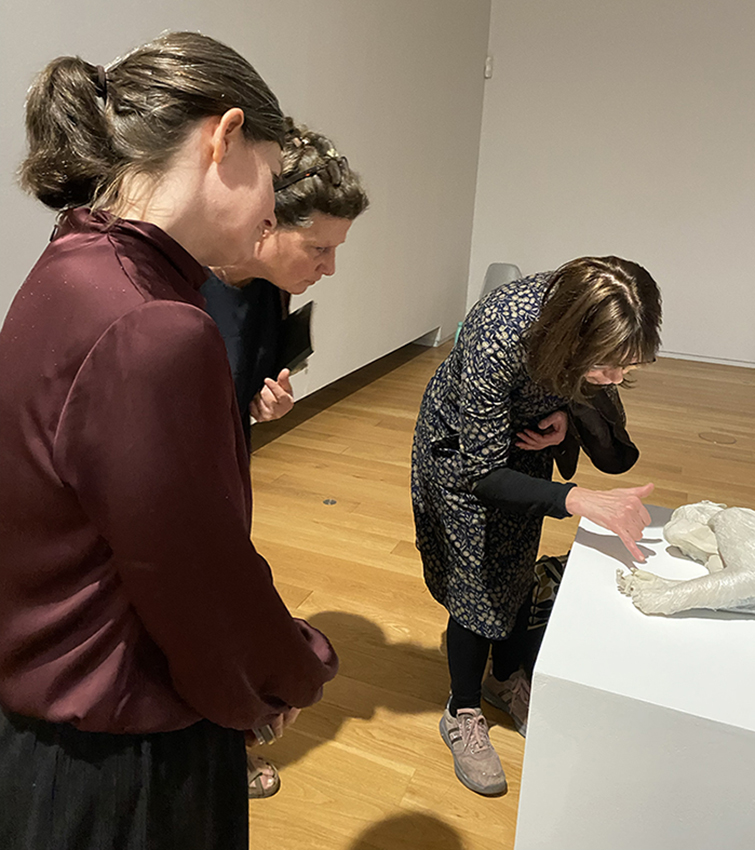
I was invited to the Hugh Lane Gallery in Dublin recently, to discuss the making of the stitched silk covering for the sculpture “Primate”( above) by Daphne Wright. The gallery had recently acquired the sculpture for its permanent collection, and Jessica O’Donnell, the head of the Education and Outreach department, had asked Daphne, who had commissioned me to make this in 2009, if I would be willing to talk to the conservation department to give them any insights into the process. I was so delighted to be asked for this because, I not only could explain the ways of making it, I had kept all the materials and stitching samples, and there is a blog that explains the whole 3 month long process.

We all first viewed Primate in the gallery where he was lying alone in the middle of a large darkened room within a spotlight. Daphne spoke about the difficulties of obtaining the cast and I later talked with her about various ideas and conversations we had about aspects of our collaboration – it had been intense. However, I have seen this work in various circumstances from busy National Trust properties, in commercial art galleries, and our own studios and now here in pure isolation…un-nerving.

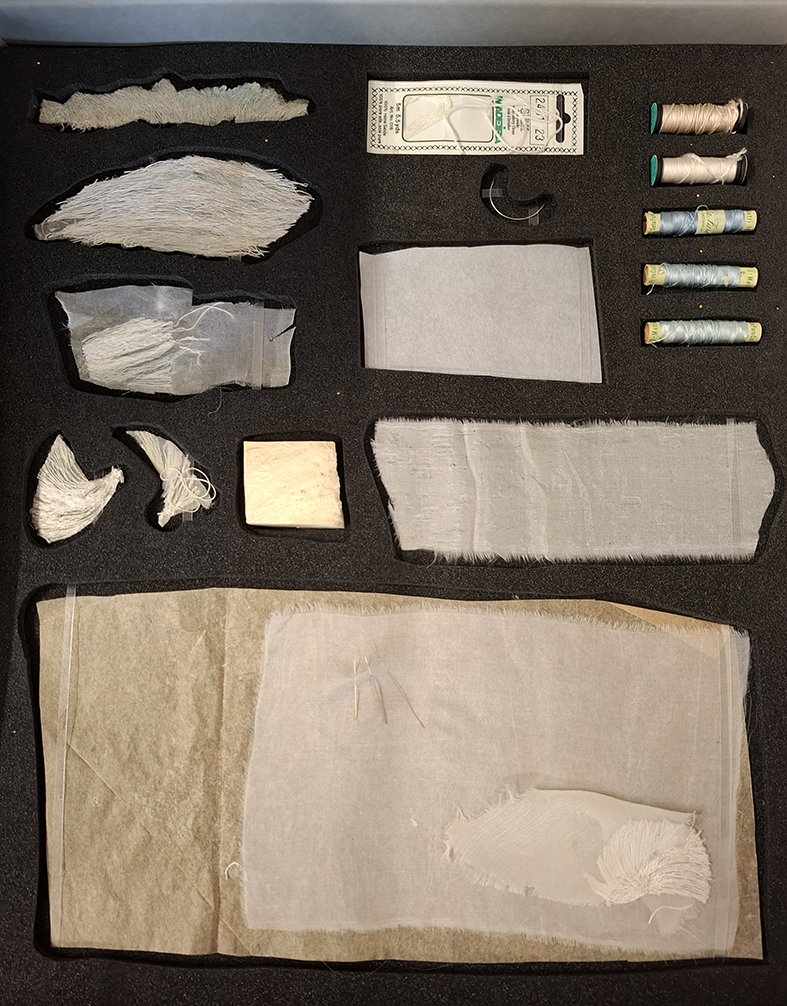
Next we went behind the scenes of the museum and I showed the small set of samples (below left) that I had kept: silk organza and different backing materials, paper backed adhesives, silk threads, needles, and the cut out and discarded stitched pieces, even a sample block of the marble resin; all kept in my research stash to explain my journey. Below right shows the way the gallery has now laid them out for viewing in the education department – so perfectly neat and simple.
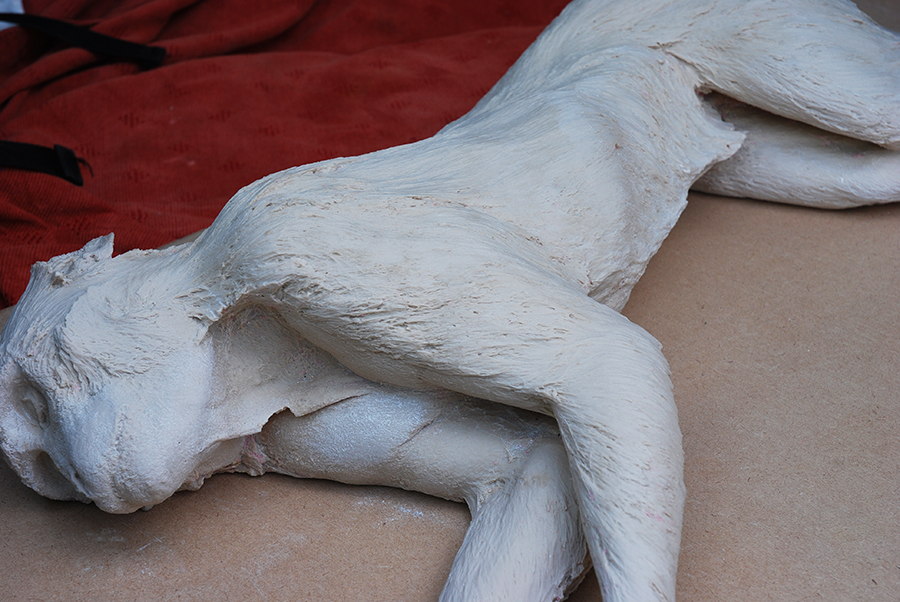
Below the basic and flawed resin and marble-dust cast of the Rhesus monkey, and the stitch development at about the 3/4 way stage, on my studio table.

And here is the gallery where the Primate was introduced to the public as a new acquisition to the Museum’s collection. When I saw this space for the first time it felt like entering a tomb, or at least a place of veneration and it still makes me feel bereft every time I look at this image.

This commission has had a considerable effect upon my stitched works, even up the present day. For further insights and my stitching this work please go to my post in COMMISSIONS: Primate.

birds in skirts

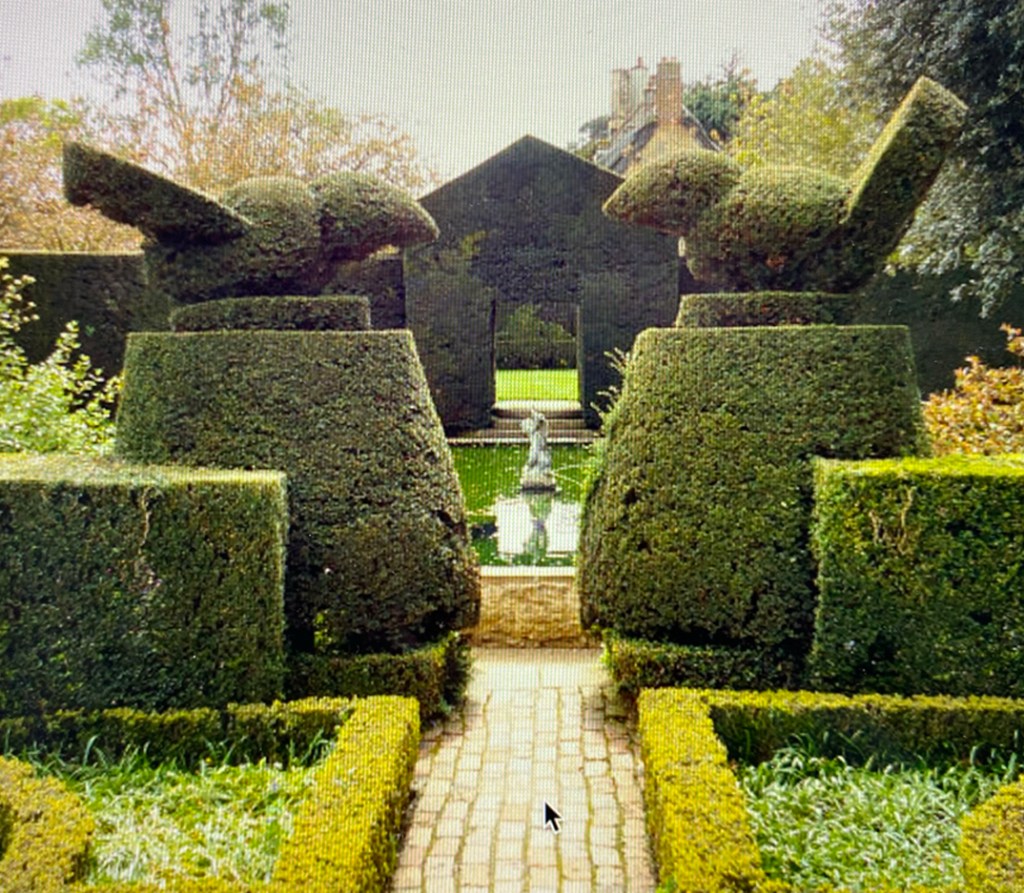
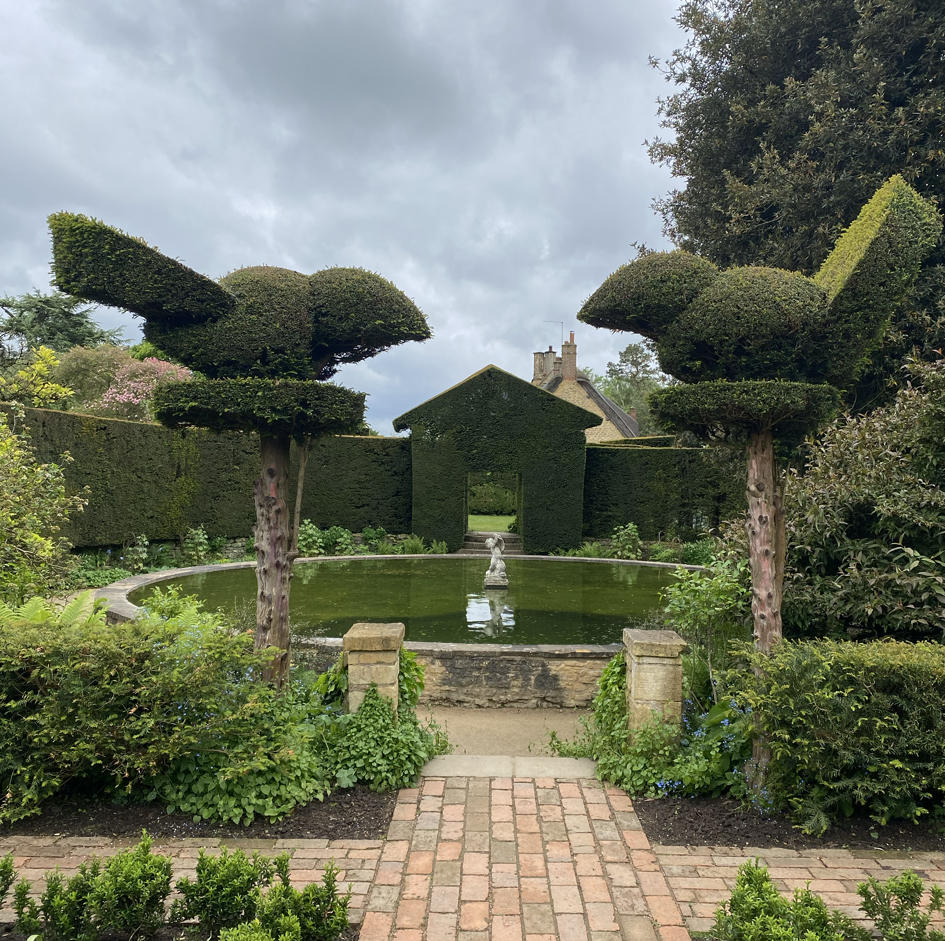
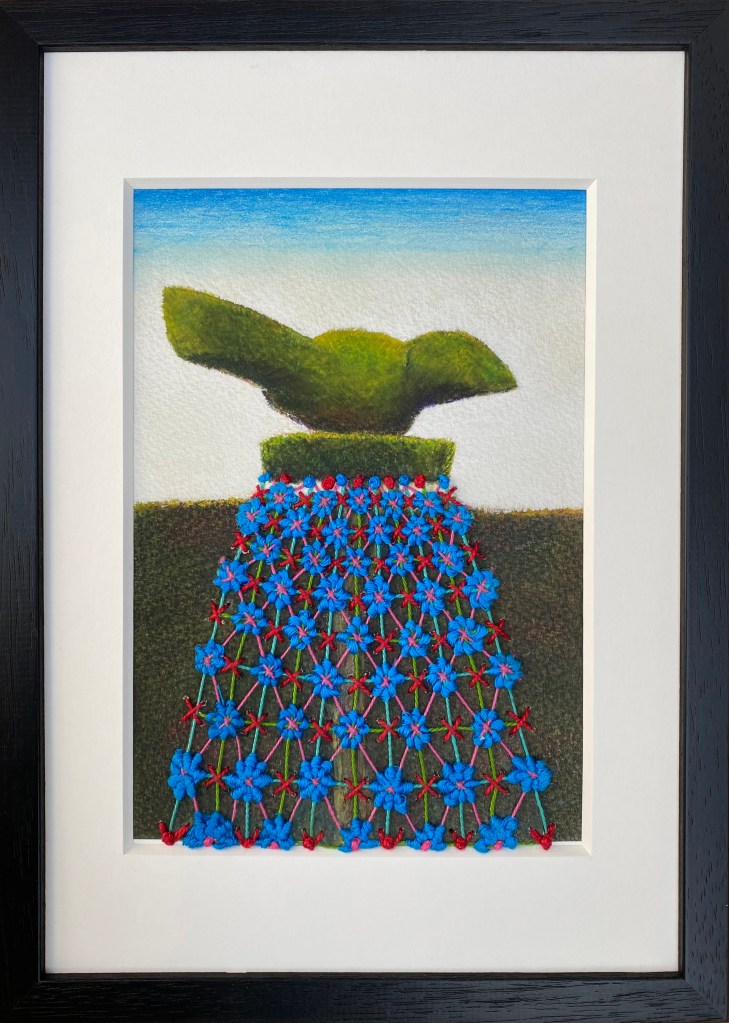
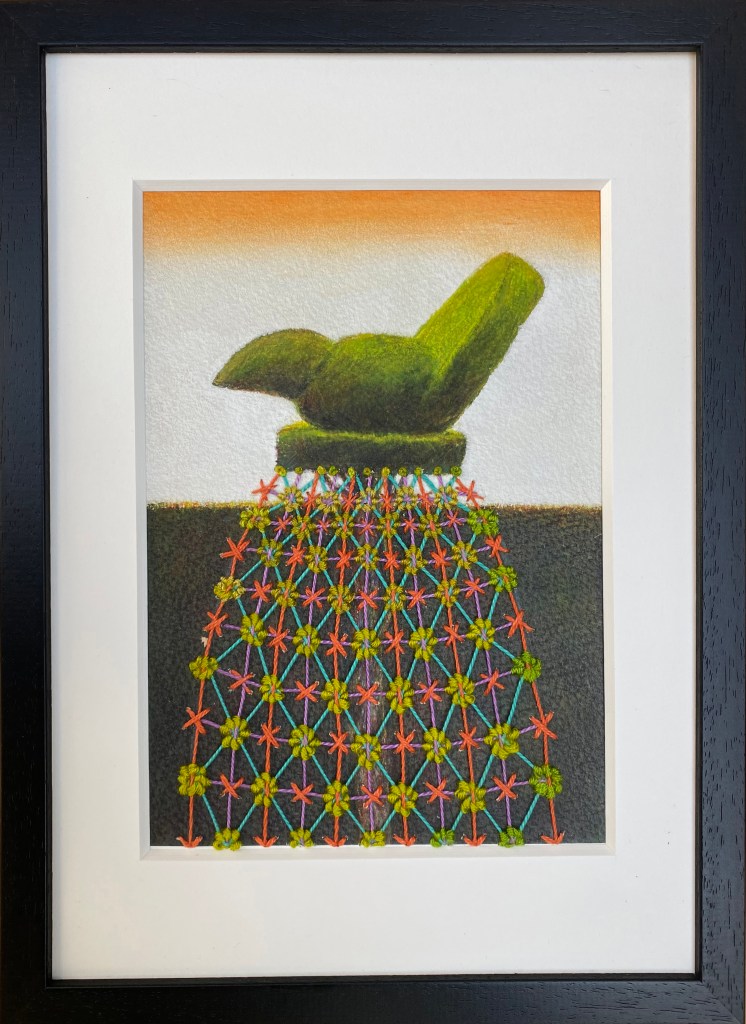
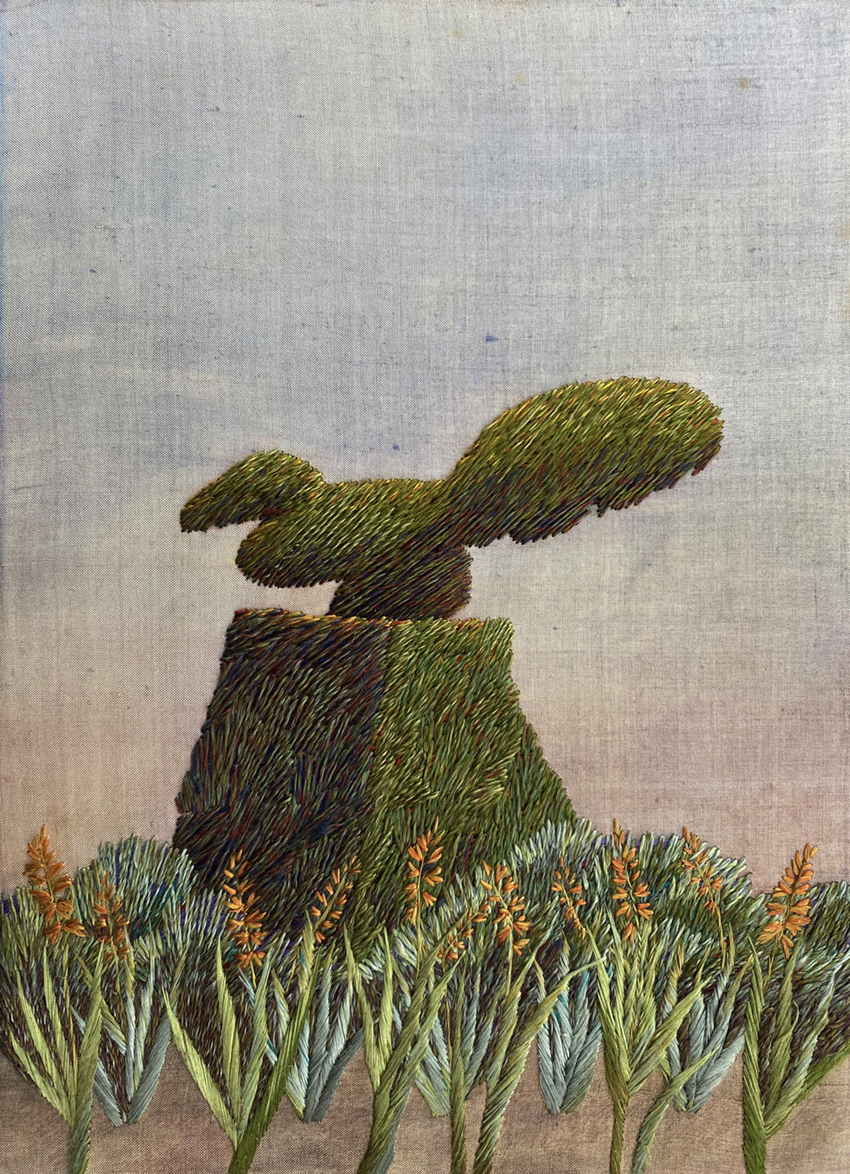
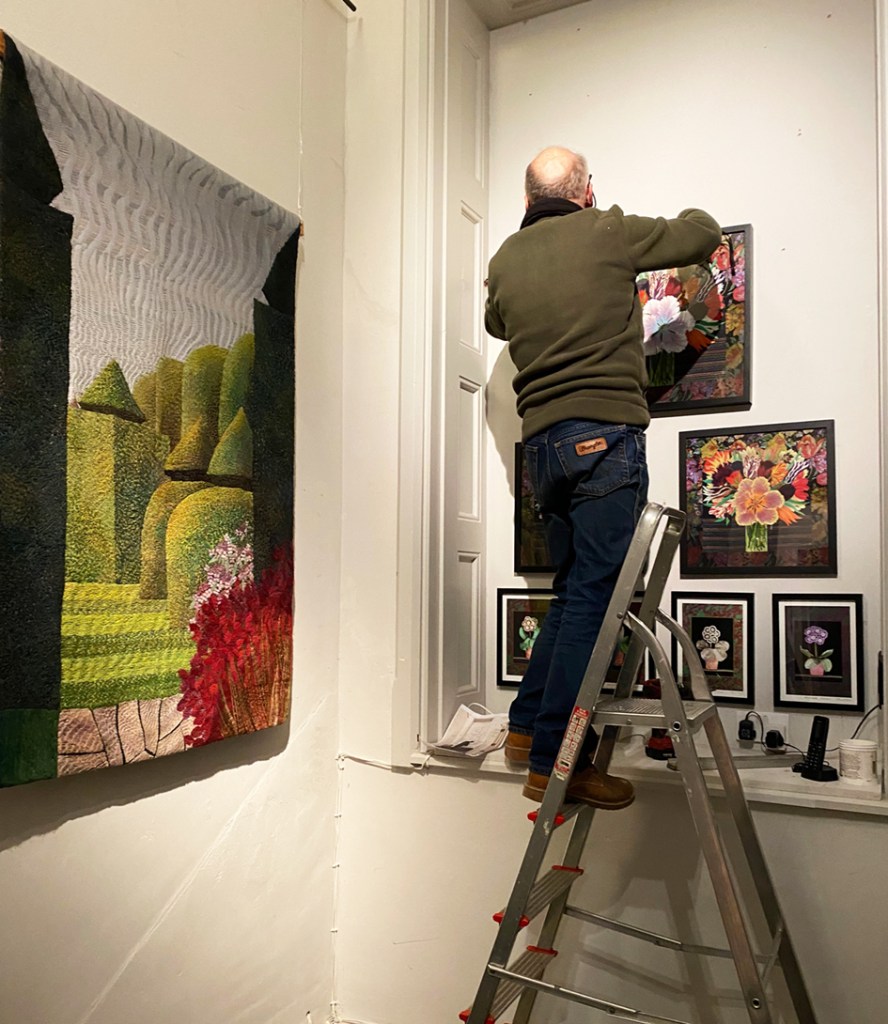
I gasped when I first saw these 2 topiary birds when visiting Hidcote to discuss my exhibition “Inspired to Stitch” for the Manor House gallery in 2025, where were the large bases of yew that they had perched upon for over 100 years?

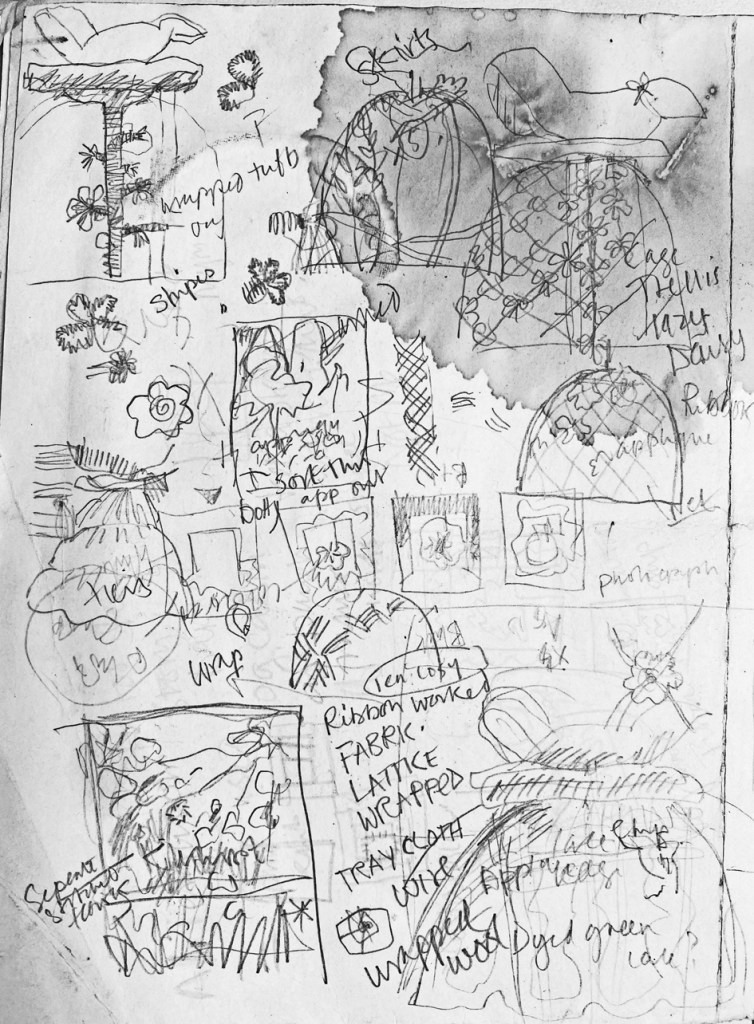
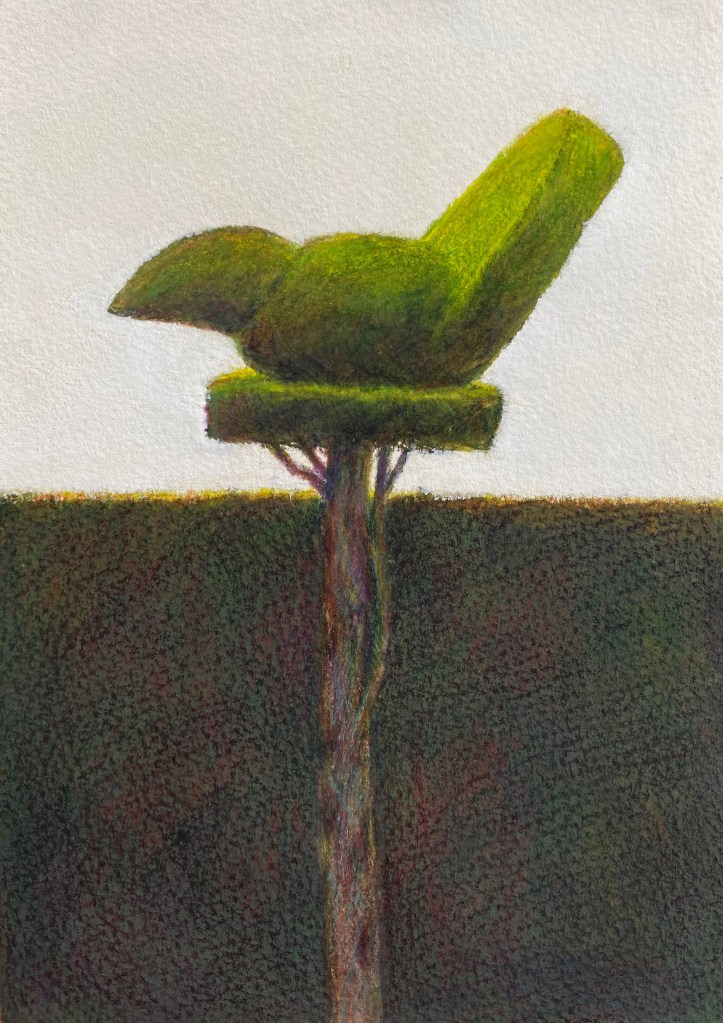
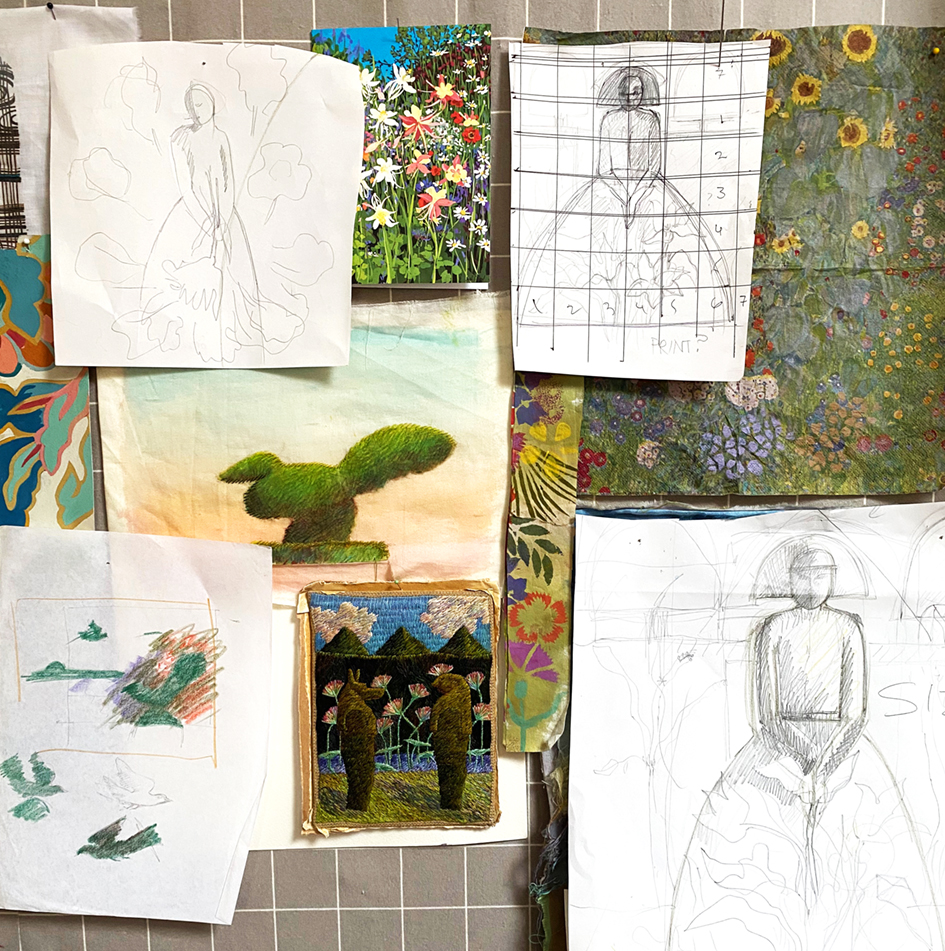
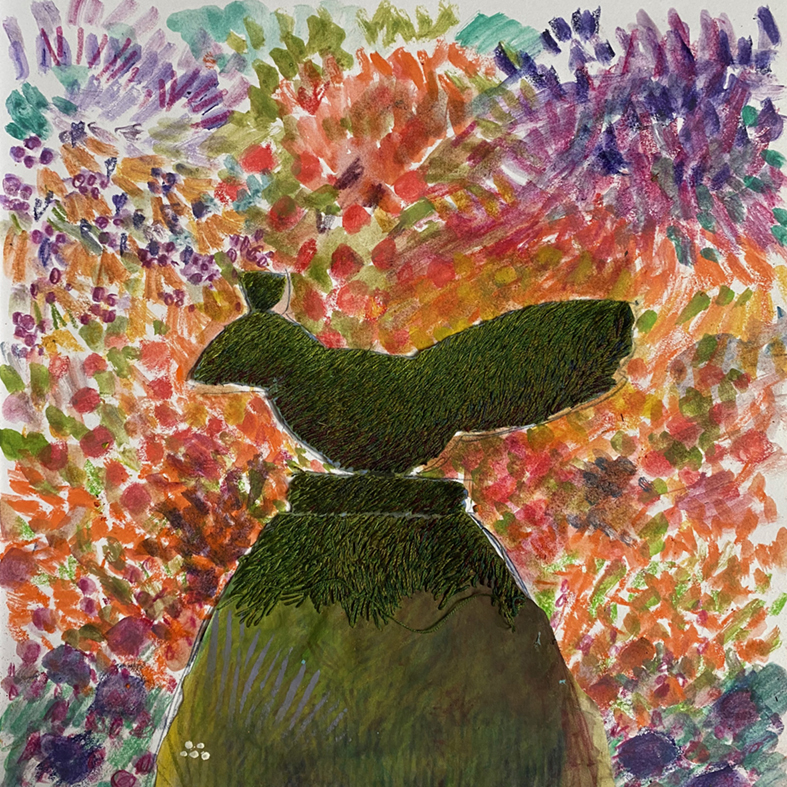
It was explained that the loss is in part due to necessary pruning( after the covid closures) needed to maintain access to the steps to the pool. Now they sit on top of bare but beautifully dappled trunks. I immediately thought “I can mend them”, visually of course! My idea was to create 2 wide ‘skirts’ of different fabrics – but when I started to think about making skirts my mind started to race with ideas. I quickly scribbled some down onto the only scrap of paper I had to hand…..

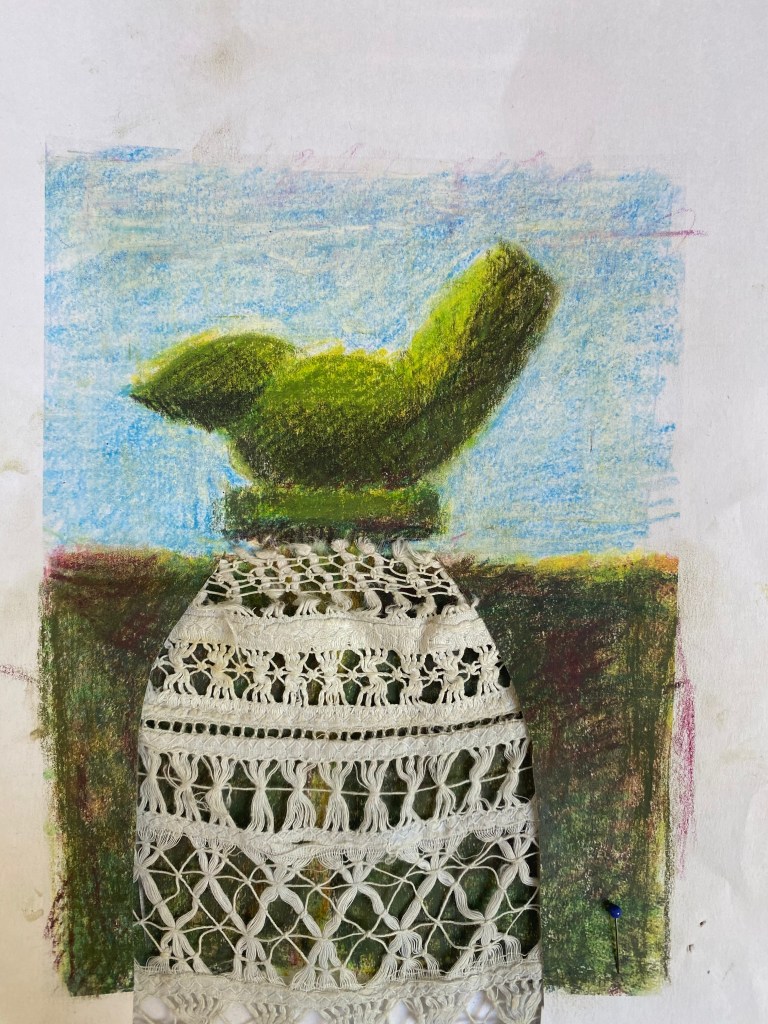
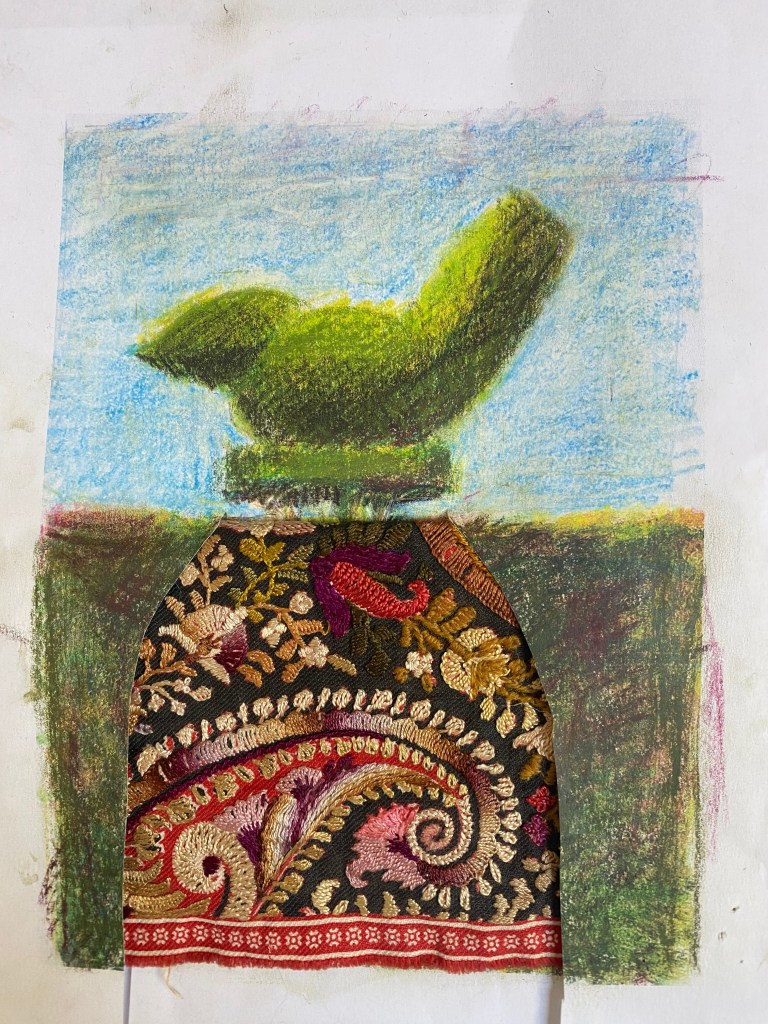
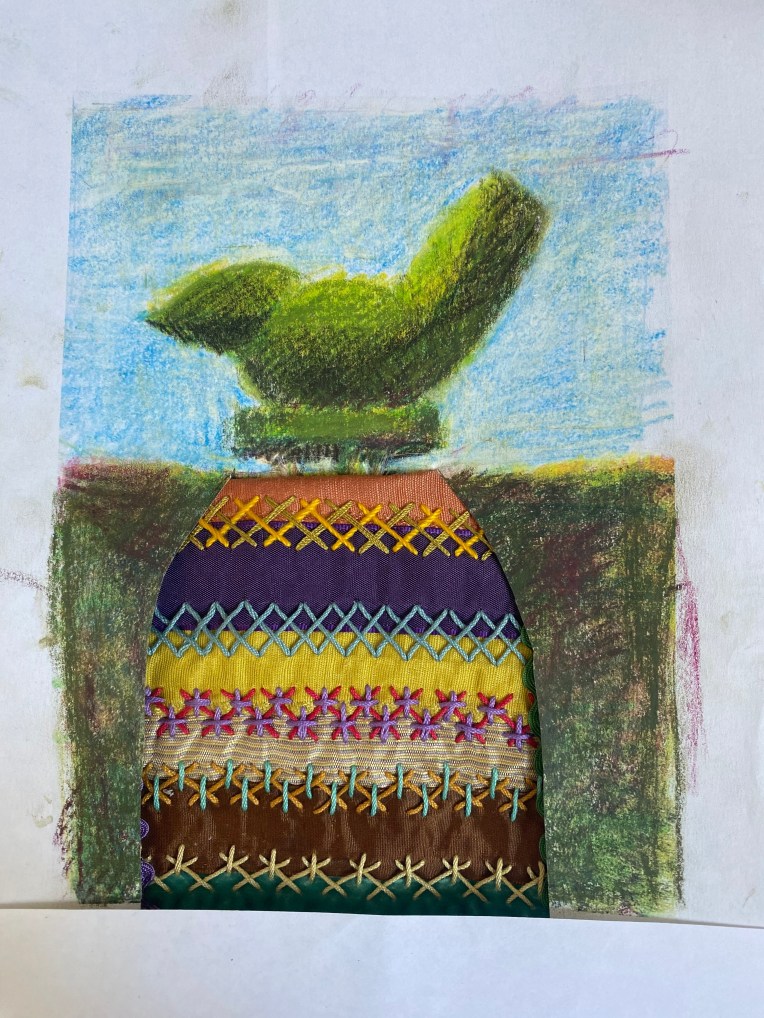
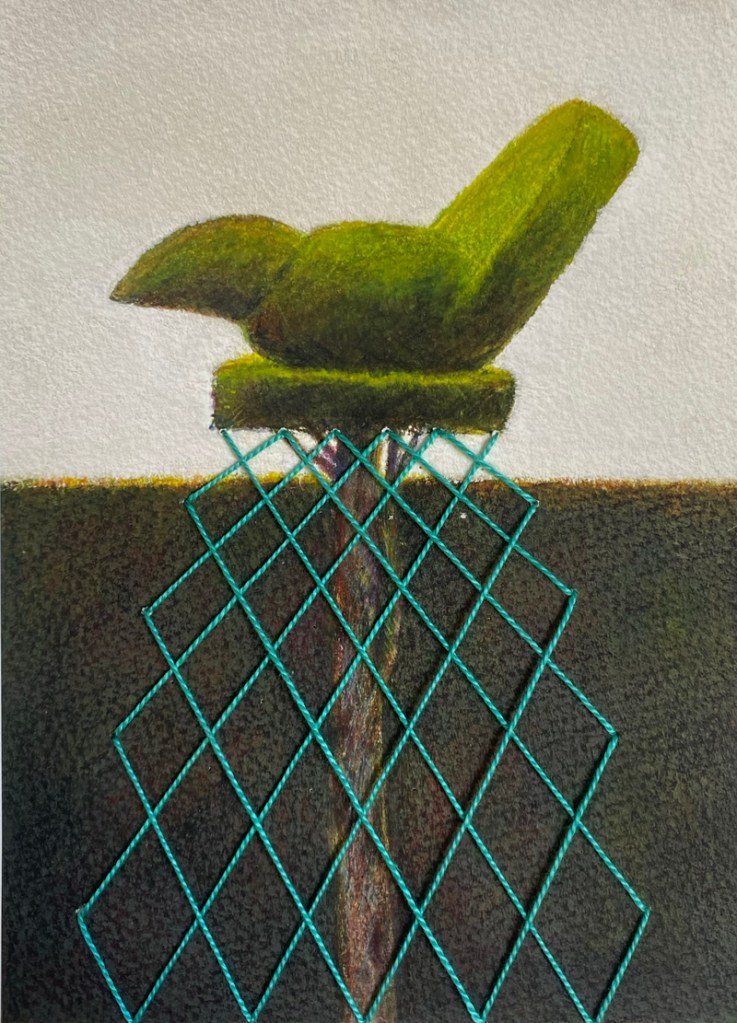
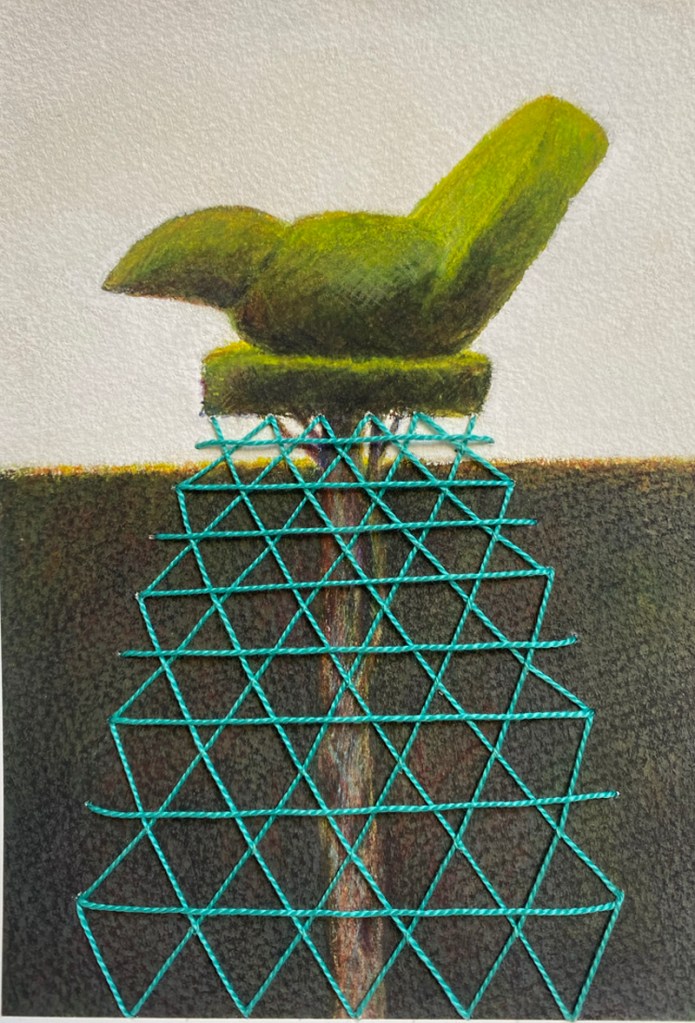
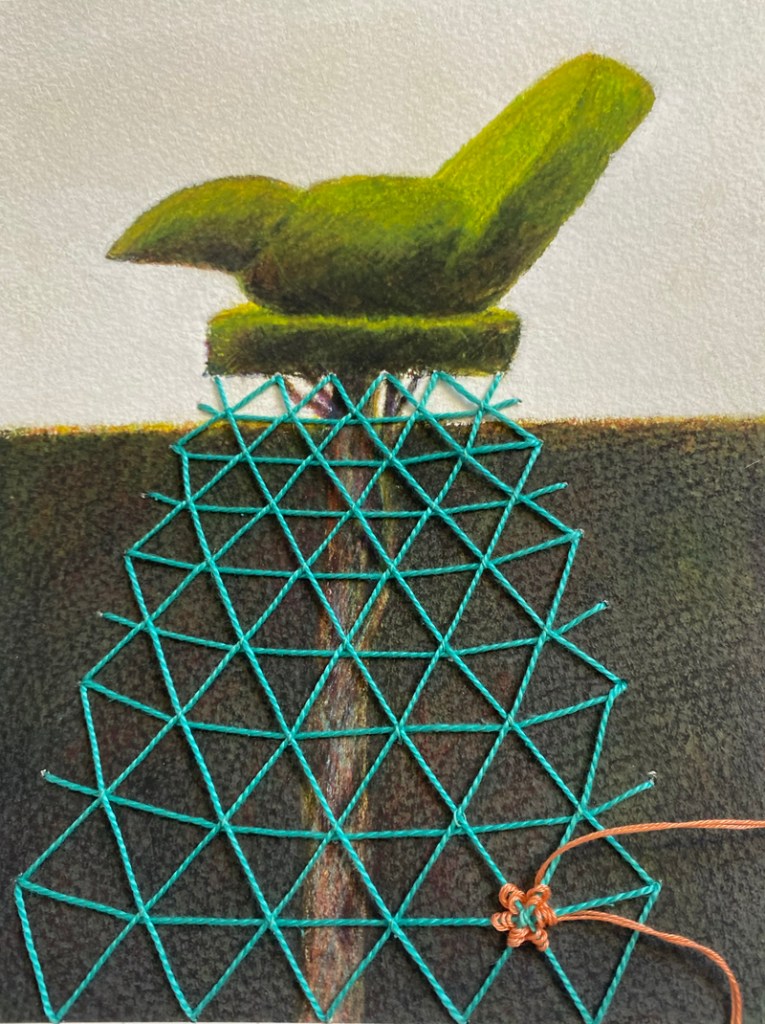
I decided to make small drawings of the 2 birds and then I could dress them both in a fabric skirt. Now how make this look feasible in reality. Using Inktense pigment crayons A4 sketchbook paper I roughed out the basic hedge shapes, but I had so many different ideas when I looked at my vintage fabrics scraps, that I decided to make a 2 sets of giclee prints, in order to illustrate all my ideas.

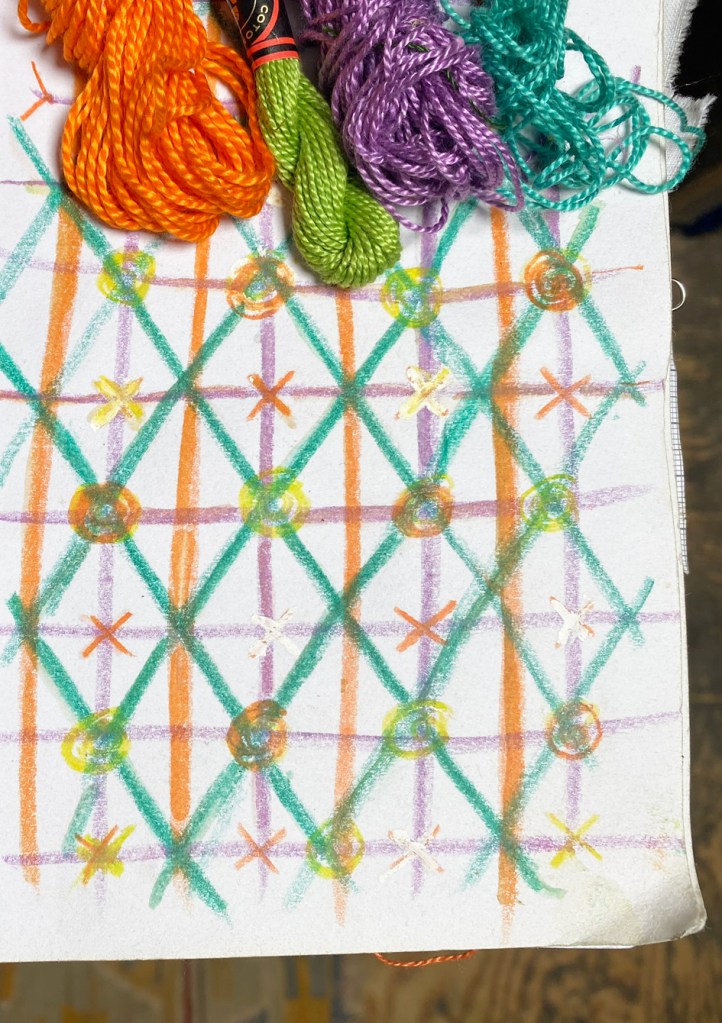
Above, the 2 giclee prints developed from the original drawings from my photographs, the first design was for a lattice or Jacobean Laid Work (see below the samples on the rough drawings).

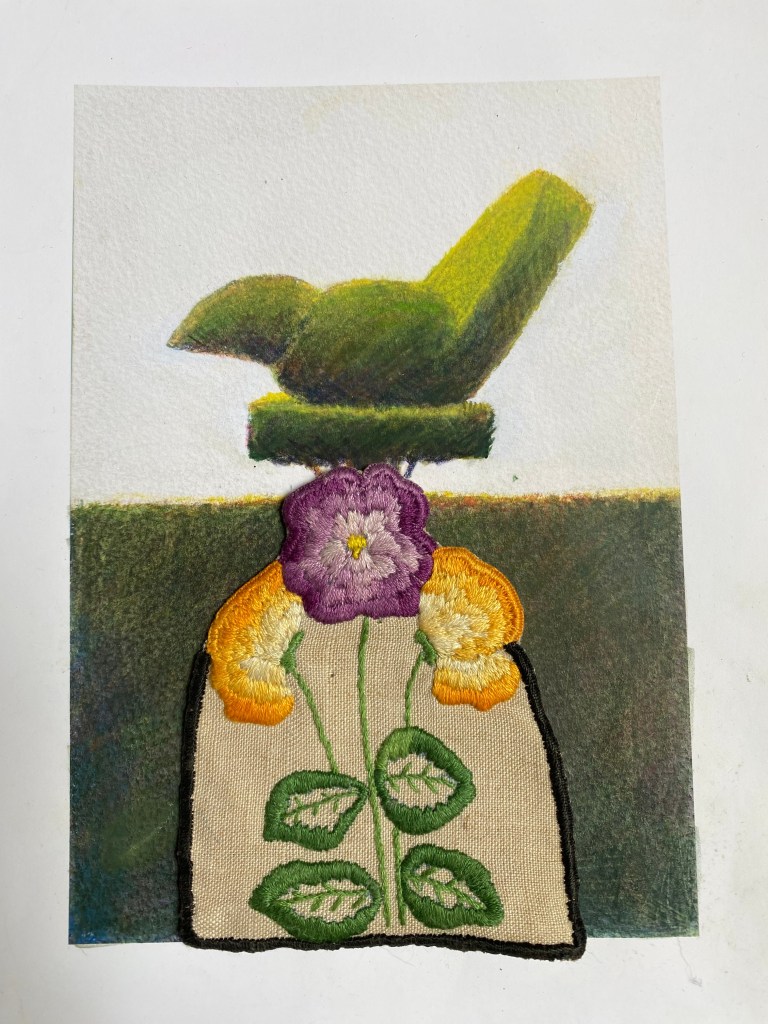
The first skirt sample was stitched straight into a bird print, using a fine twisted cotton thread. When beginning any new project, I always attempt a challenging piece of ‘inspirational’ work, by which I mean it will make me want to carry on with all my new ideas.

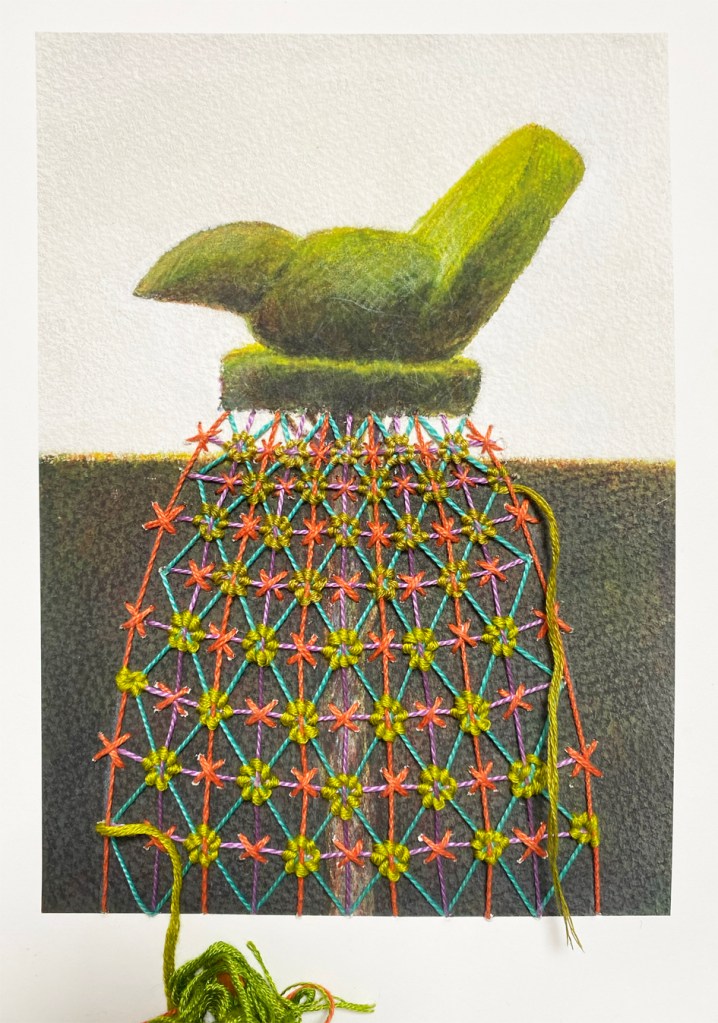
Above is the first design I completed for a whole set of 22 ‘Birds in Skirts” and I made them especially to sell at my ‘Inspired to Stitch’ exhibition This is an unusual step for me as I very seldom sell my stitched works. So now they have all been mounted, framed and glazed ready to be delivered to the buyers after the Exhibition closes.

There will be more posts about these stitched prints, as this is a new and exciting way for me to work. It combines my love of drawing and stitching and opportunities to develop many variations using my collection of vintage fabrics. I am now conducting new classes to cover some of the ideas and new-to-me techniques that I developed for creating the Birds in Skirts edition

DRAWN to stitch: gardens & flowers

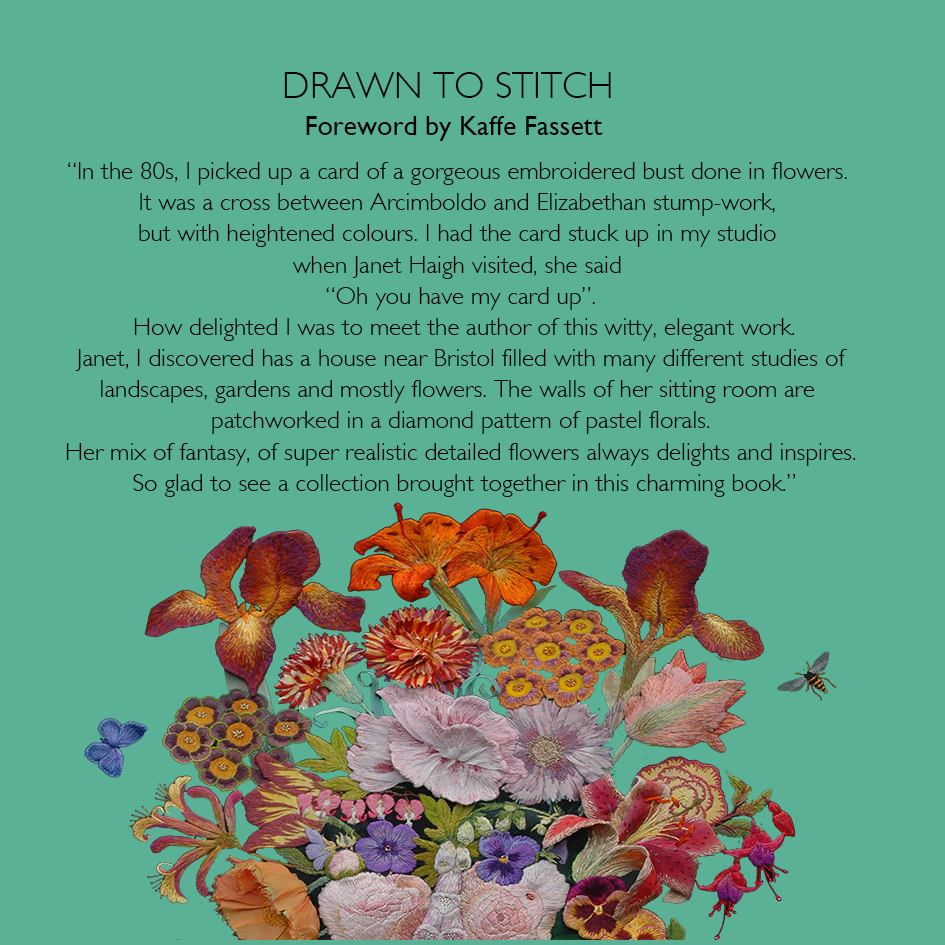
This is the foreword, kindly composed by Kaffe Fassett, for the first page of my latest book I made as a catalogue/ picturebook to accompany my latest exhibition Inspired to Stitch: Hidcote Revisited. at Hidcote gardens in Gloucestershire.

It illustrates part of the story of my career in stitched textiles, from my first ever embroidered picture above, made out of the sheer frustration of working in the fast-track commercial fashion industry in London, after I left Liverpool Art College in 1970. And it is an imagined garden.

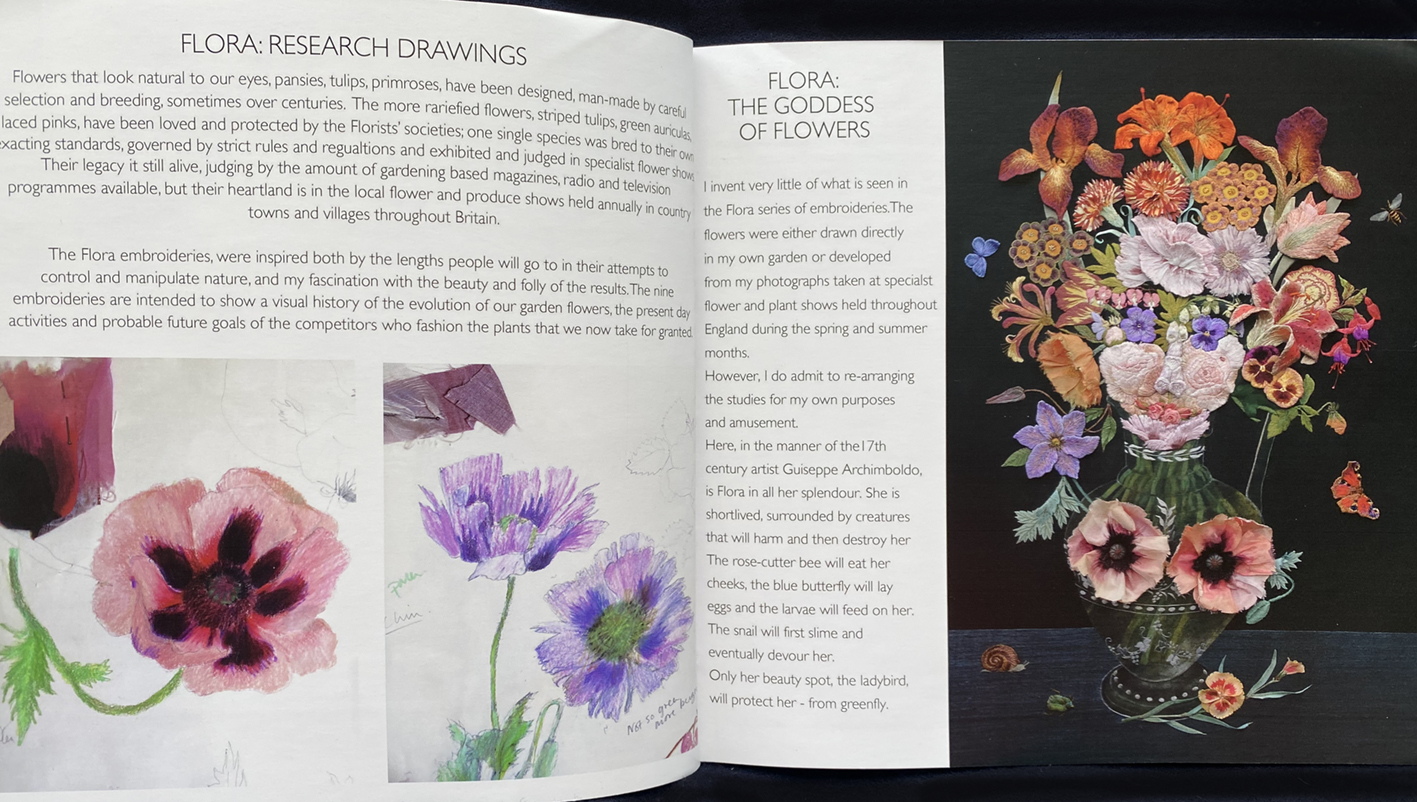
Fast forward several years to 1992 (you will have to buy the book for more information)and I am totally committed to all things flowers, gardens and topiary! Here are several pages from the book to whet your appetite and first here is Flora, the Roman goddess of Flowers.

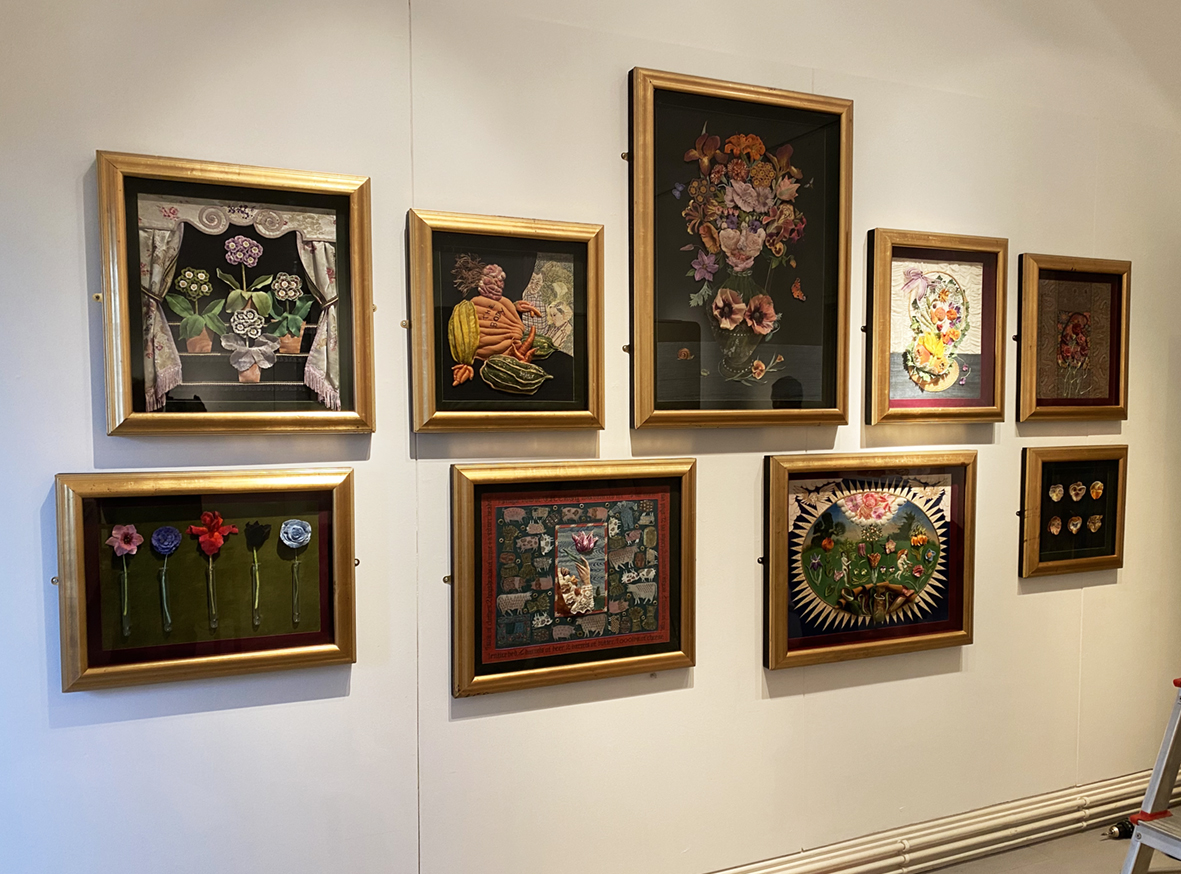
Flora is the central image of 9 embroideries called ‘The Flora’ that tells a visual history of the development of, what I now think of as, “designer flowers”.

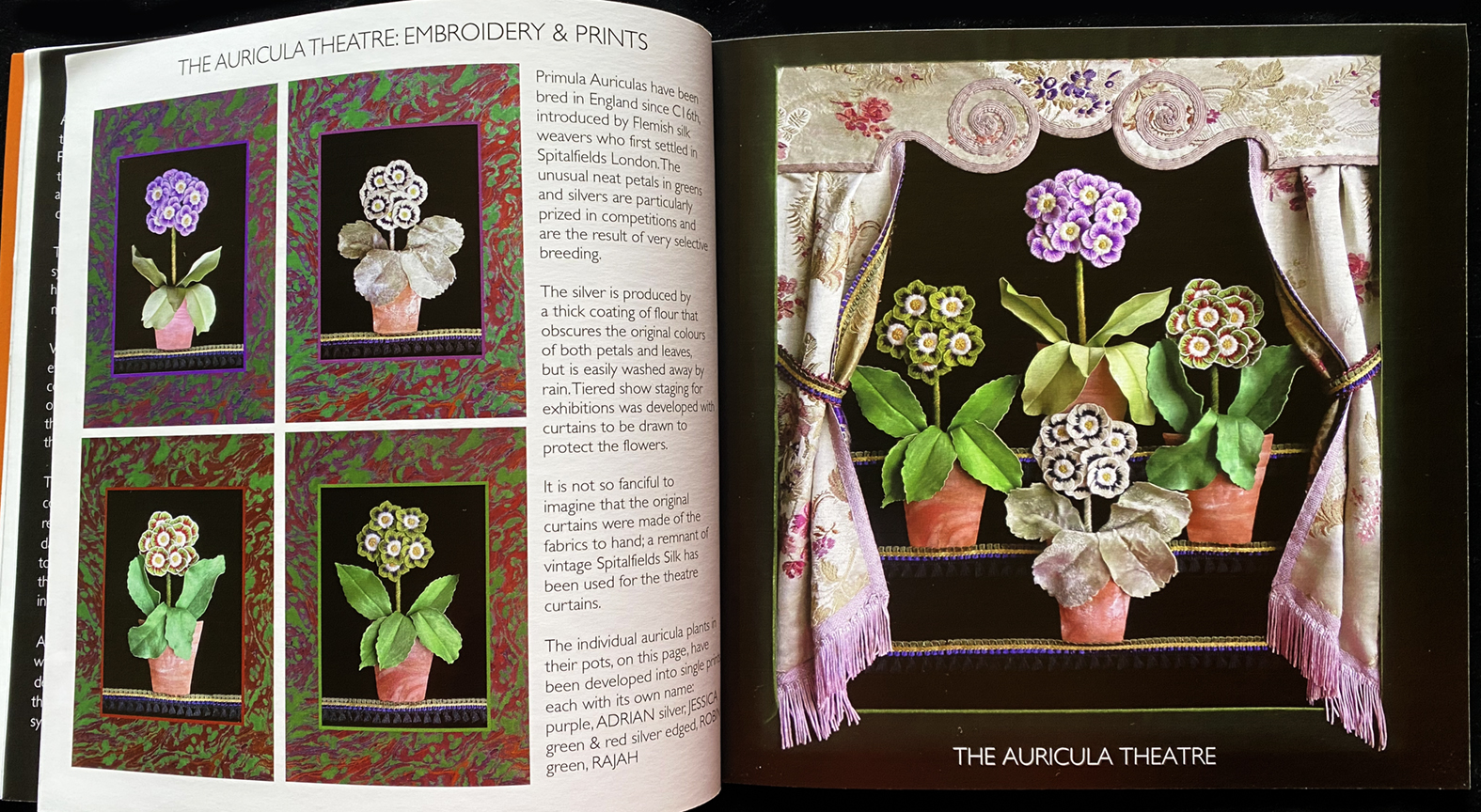
The Auricula Theatre above, with a series of small giclee prints I developed from the original silk embroidery. The protective curtains are made from a piece of vintage Spitalfields silk.

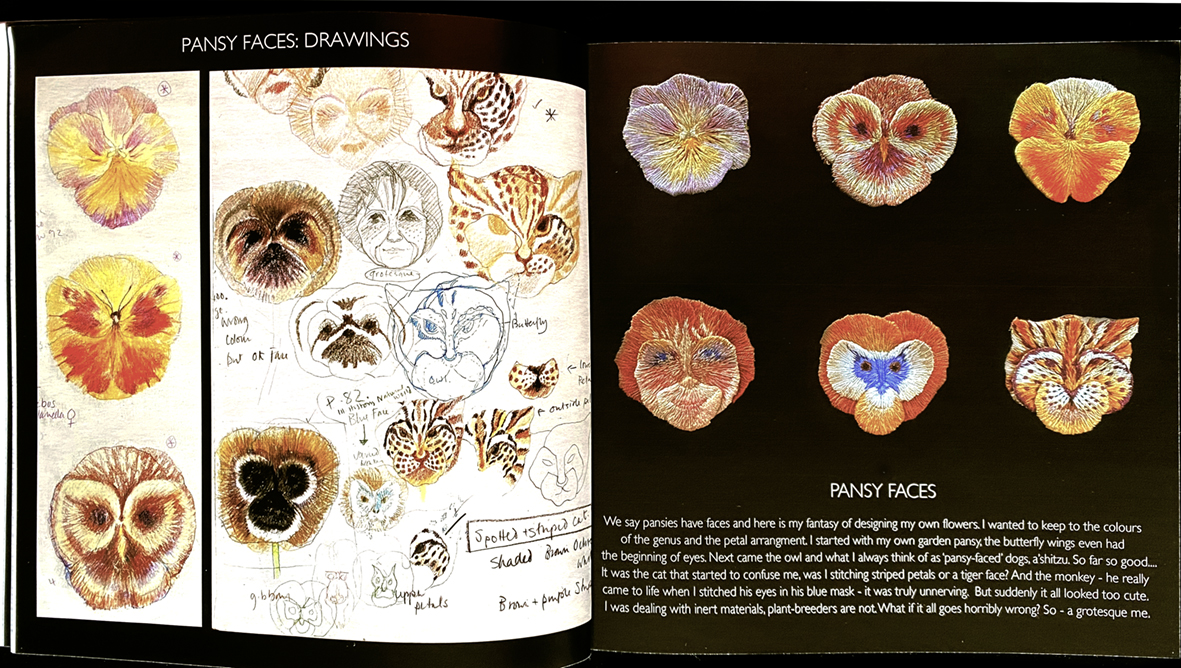
Pansy Faces and my drawings for the inventions I imagined as my exhibit in our town’s annual flower show.

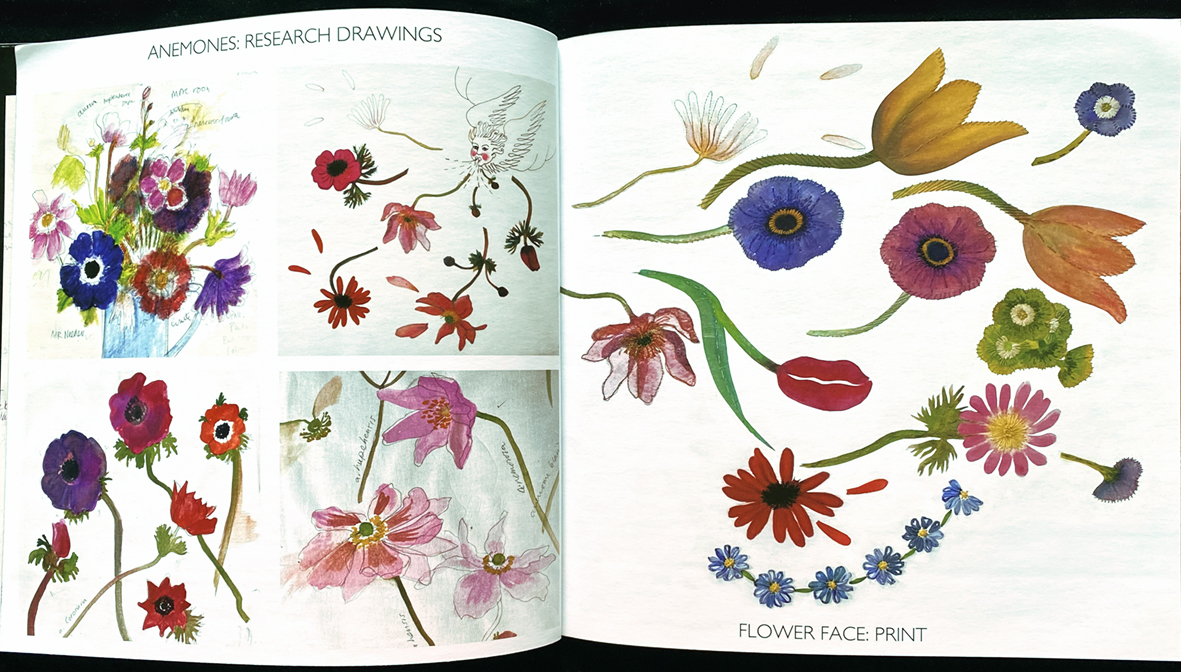
A personification of Blodeuwedd, or “Flower Face” from Welsh folk lore; this is a giclee print of the original stitched silk collage on paper, that I developed from my old drawings made for ‘The Flora’ .

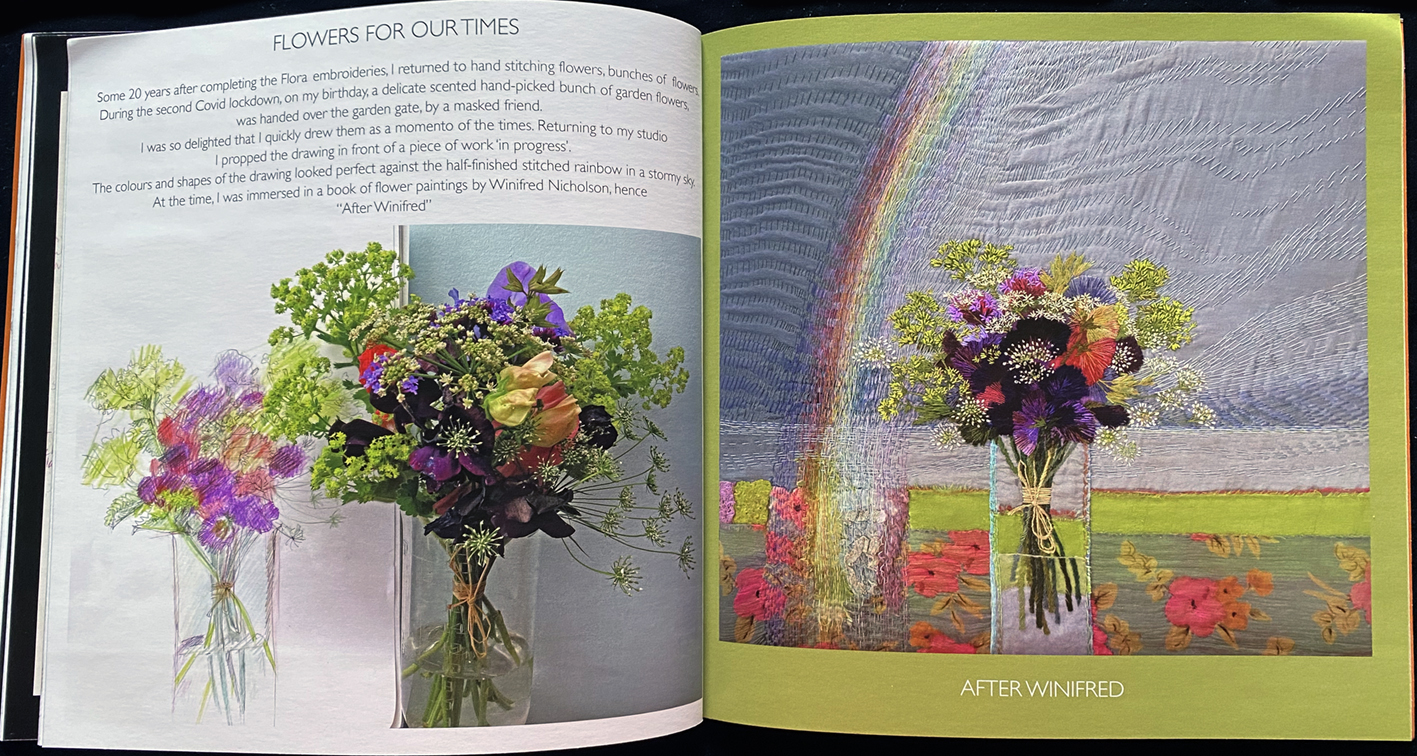
Here is a bouquet of hand embroidered flowers in After Winifred’. I was given this bouquet during Covid, by a masked friend, in my garden, on my birthday. I was looking back though my Flora drawings to make some joyful embroideries and had bought a book of flower paintings by Winifred Nicholson……

I keep a careful record of all my research drawings, this results in a whole range of different drawings, samples, notes and photographs being kept for further inspiration. Here are typical ways that I use these ideas and studies for new works. Above are some pieces of ‘The Enamel Garden‘ a major academic research project into using textile techniques for other materials, here vitreous enamel on hand cut sheet copper. It is possible to trace how I used my research drawings to create these flowers and hedges.

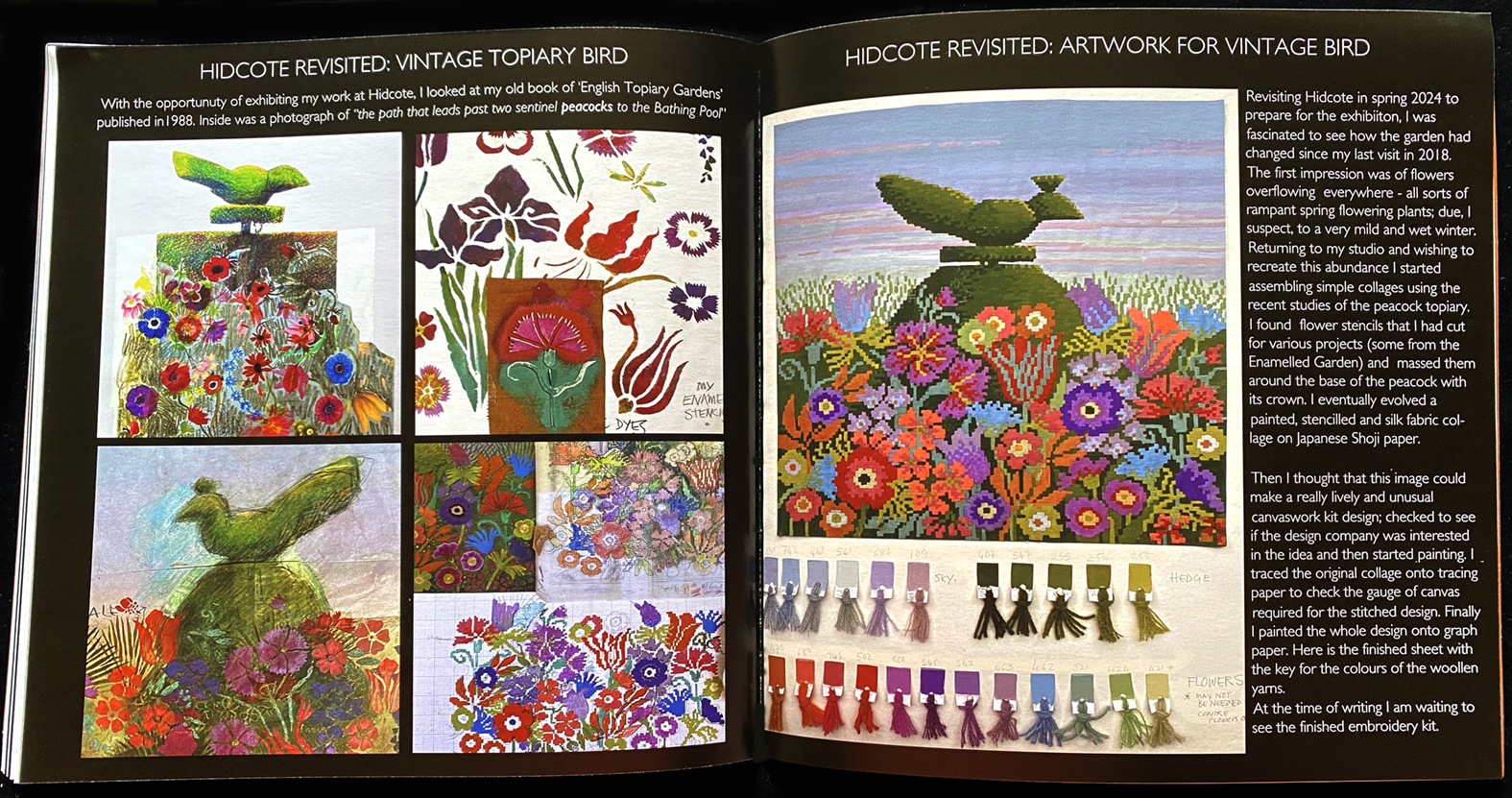
And my latest canvas work design for Ehrman Tapestry, a version of the Vintage Topiary Bird used for the front cover of the book. I designed this especially for the company to make a kit of this design to celebrate the exhibition…. I will keep the post about making it until later.

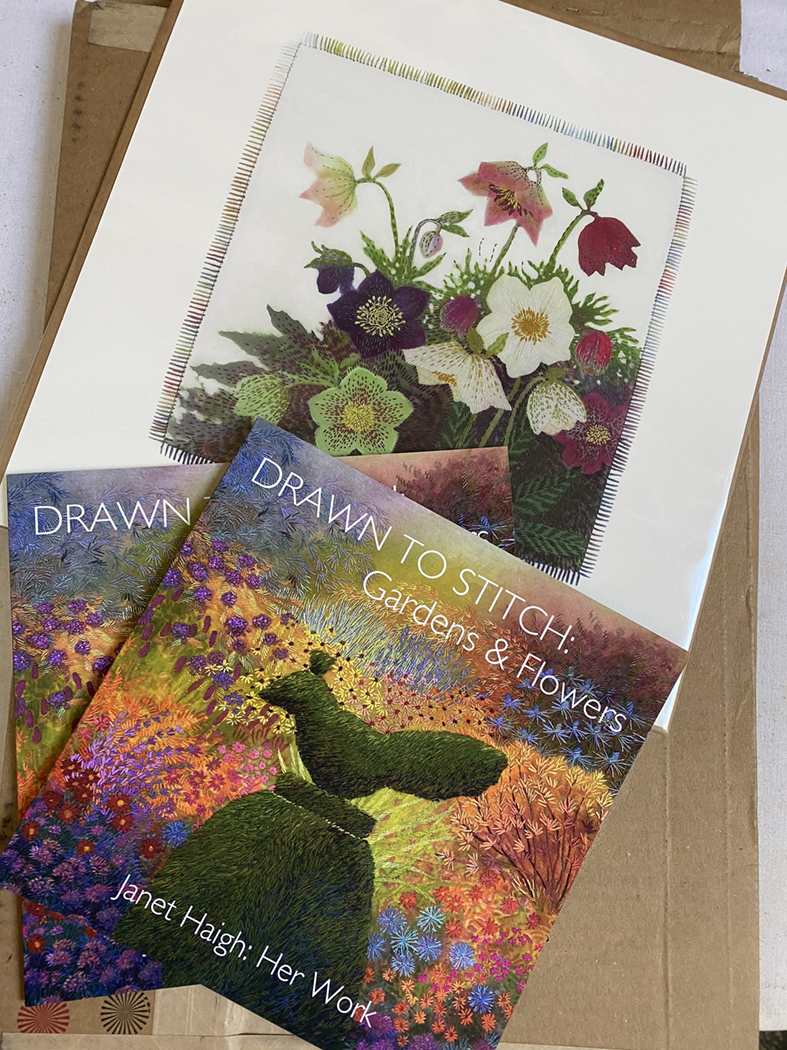
And at last I am selling the book from my Shopify site ( QR code below). Above is the flyer for the Hidcote exhibition that gives access to more information into to all the works contained in the book. But best of all in the first week of the show, my first package of books and a giclee print ready to be posted.

HIDCOTE REVISITED: NEW EXHIBITION

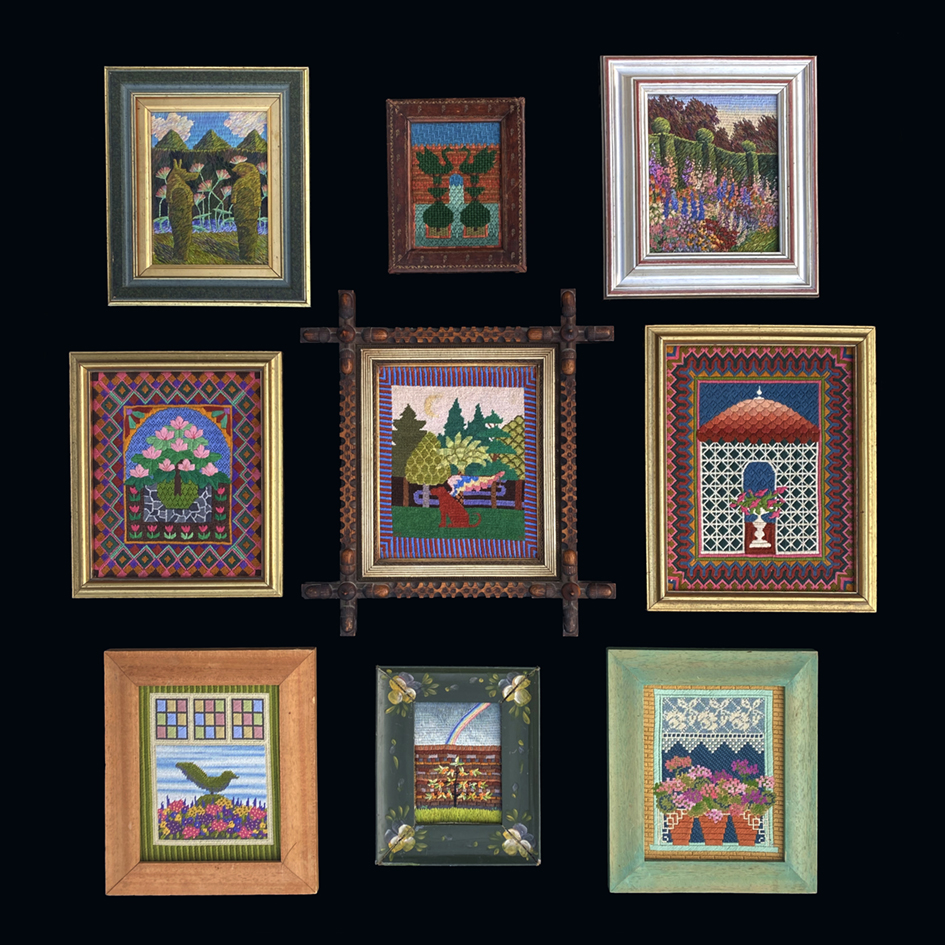
Invited to exhibit my embroideries at Hidcote Manor, a National Trust Garden, in April 2025, I immediately thought of my first visit in the 1970’s; I had just started to embroider, and the effect that it has had on my stitched work ever since. Above is a small selection of my first-ever embroideries that were inspired by my delight and fascination with gardens and flowers.

I stared with basic canvas work and enjoyed the restrictions imposed by the strict stitching and its filling-in-until-you-finish discipline. I was designing pictures in order to learn to embroider my ideas.

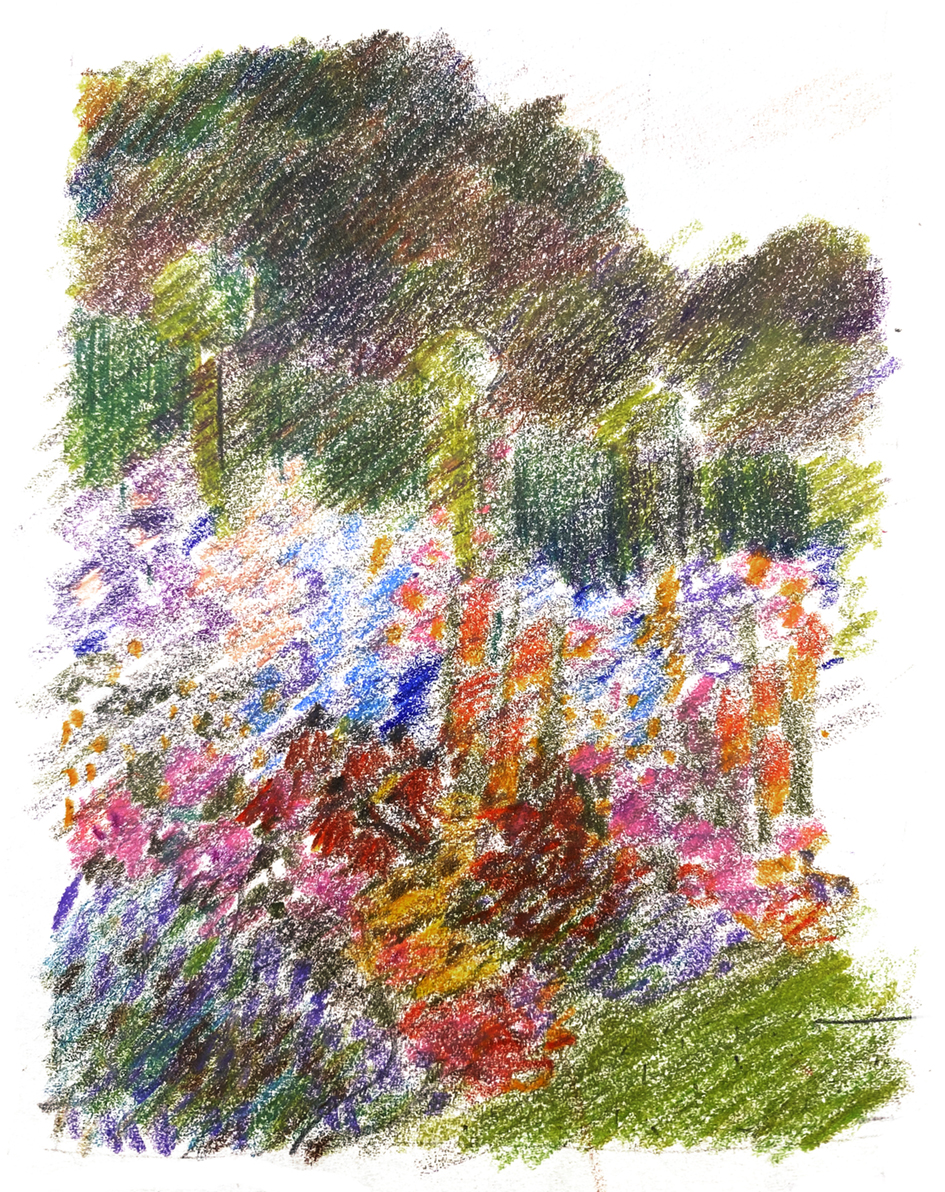
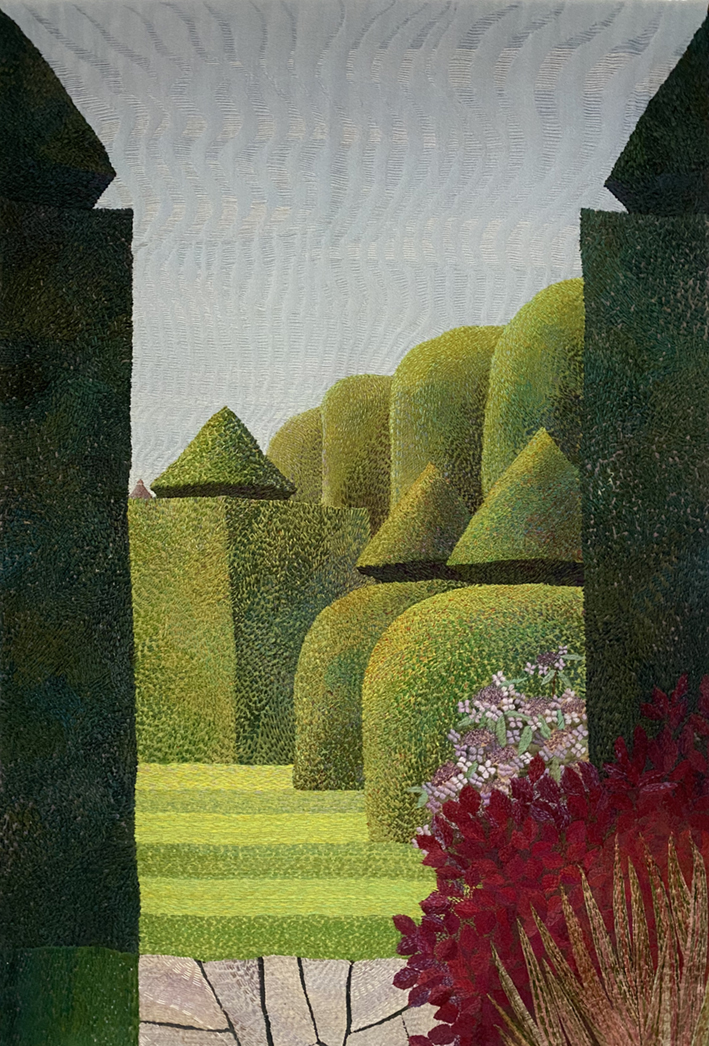
It was after visiting Hidcote that I started to draw gardens, mostly details of planting and of course, topiary. I took photographs and scribbled down notes to remember colour planting and topiary shapes to develop into embroideries. Now I realise that this was the time when I found my own way of stitching by using blended colours and really just stitching my drawings. I always scribbled drawings, took too many photographs and made notes ready to be tranformed into working drawings, and this is how start my work now, almost 50 years later.

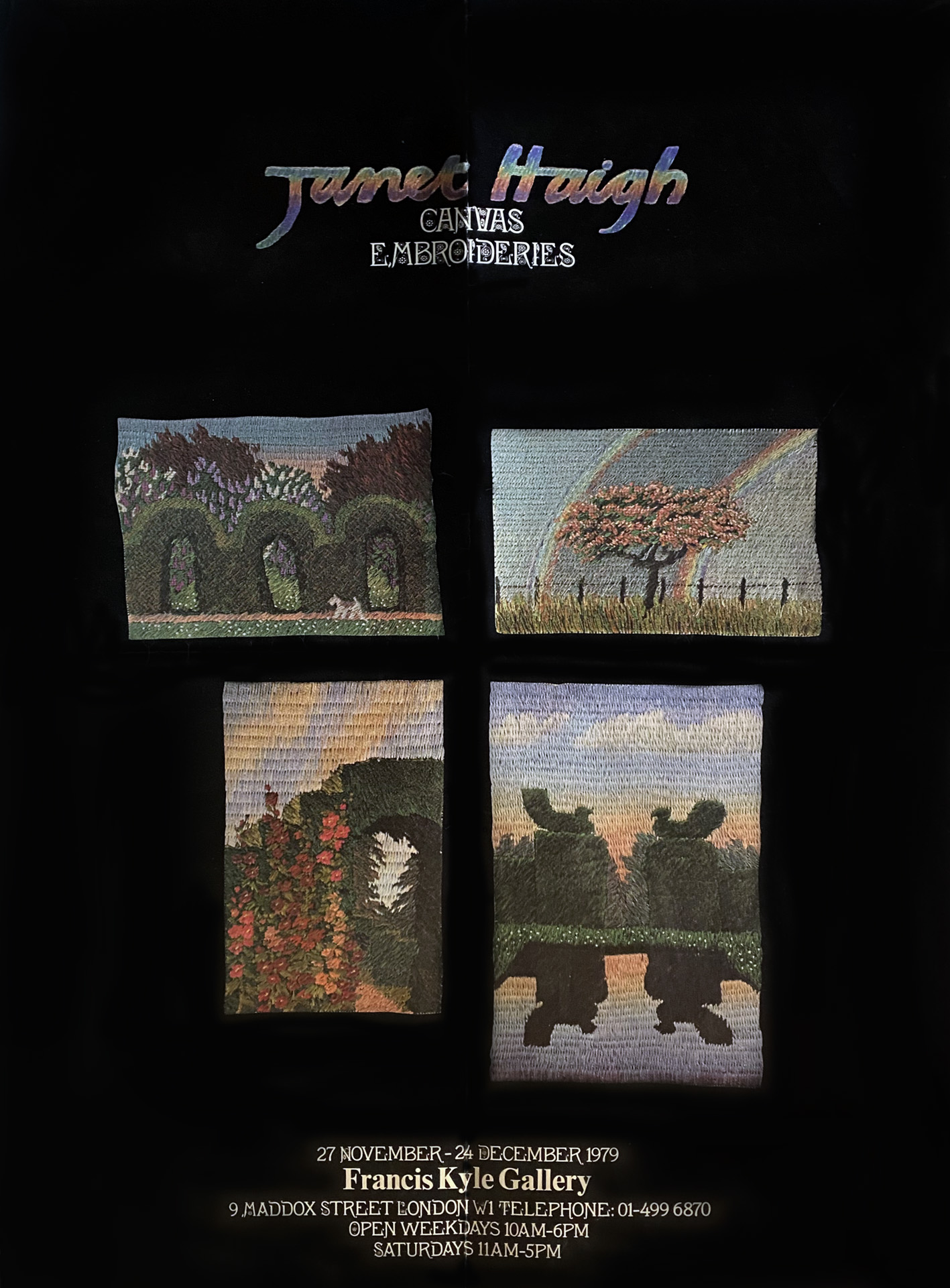
Above a rather creased poster from my first one person show at Francis Kyle Gallery in 1979, showing my small scale canvas embroideries. My early fascination with topiary is evident.

Oddly I do not actually like the idea of strictly clipped hedges, specially when trimmed into animal and bird shapes, but this feeling completely disappears when I actually see it for real. I find this ambivalence really useful and for me it provokes new ideas; why bother to make anything that holds no meaning, mystery or is simply a puzzle for you to try to solve? But mostly I am delighted by the sheer absurdity of it. Why do we tether bird-shaped hedges to heavy domes of yew – to stop them flying off?

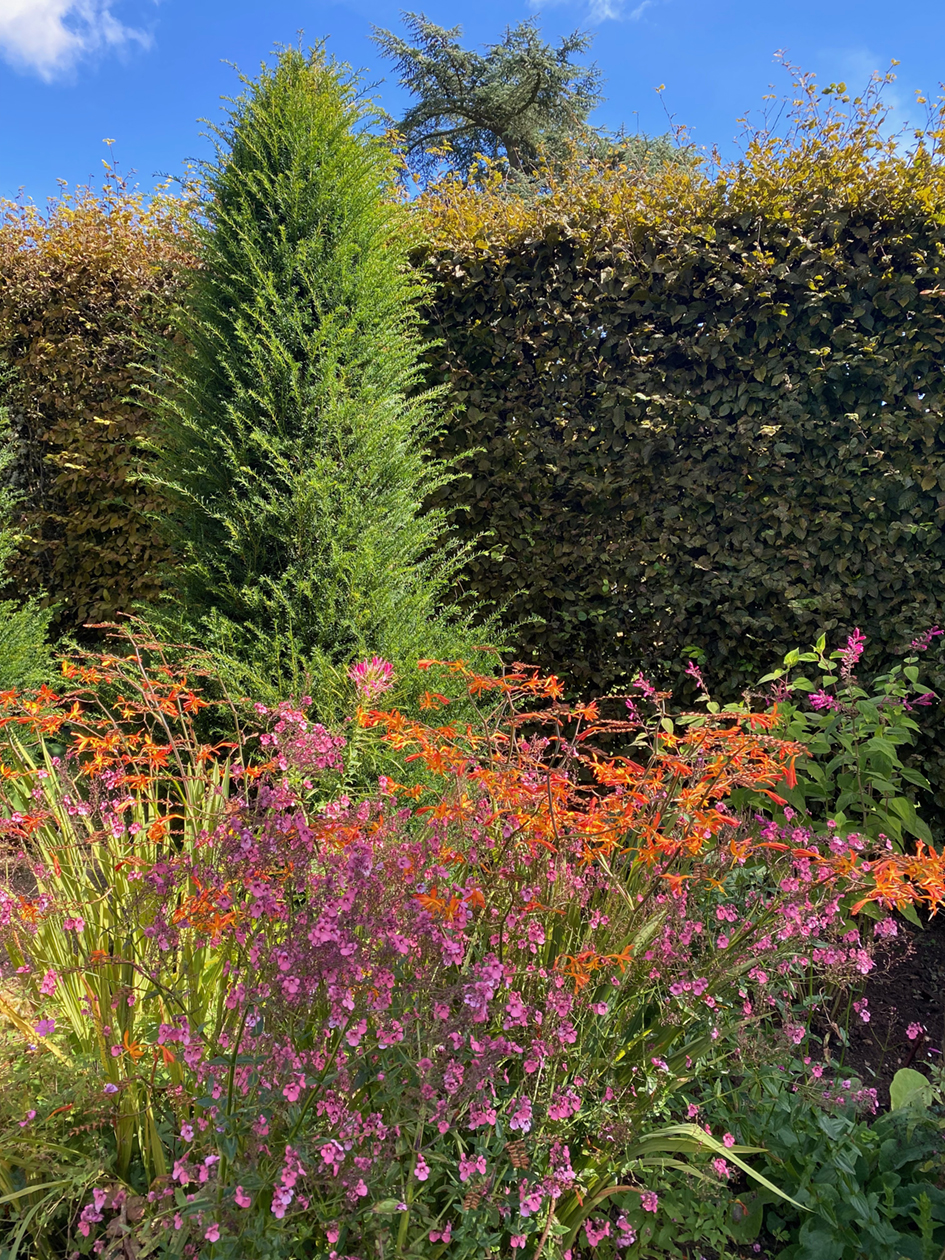
And I have continued to embroider the topiary figures that are often seen in grand gardens. Above is ‘Great Dixter’ a small silk embroidery circa 1980, that was very inspirational in making new pieces for this exhibition. Right is ‘Lytes Carey’, another National Trust garden, this is made mainly with simple large running stitches in woollen yarns onto a wool ground for a big woollen panel, in 2001. I always enjoy seeing the dense green walls of hedges surrounding an abundance of flowers, as seen below on my several visits to Hidcote in 2024.


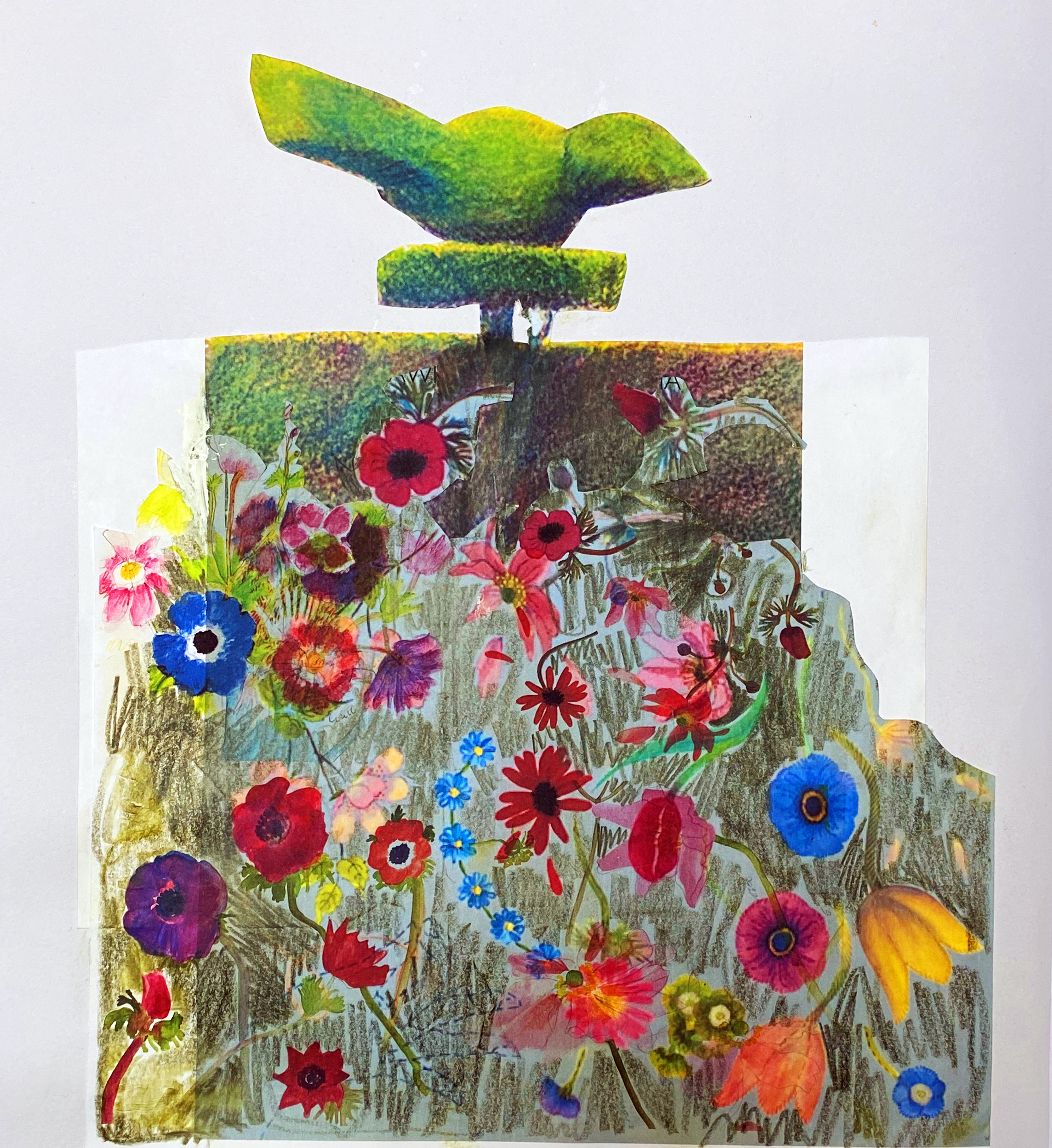
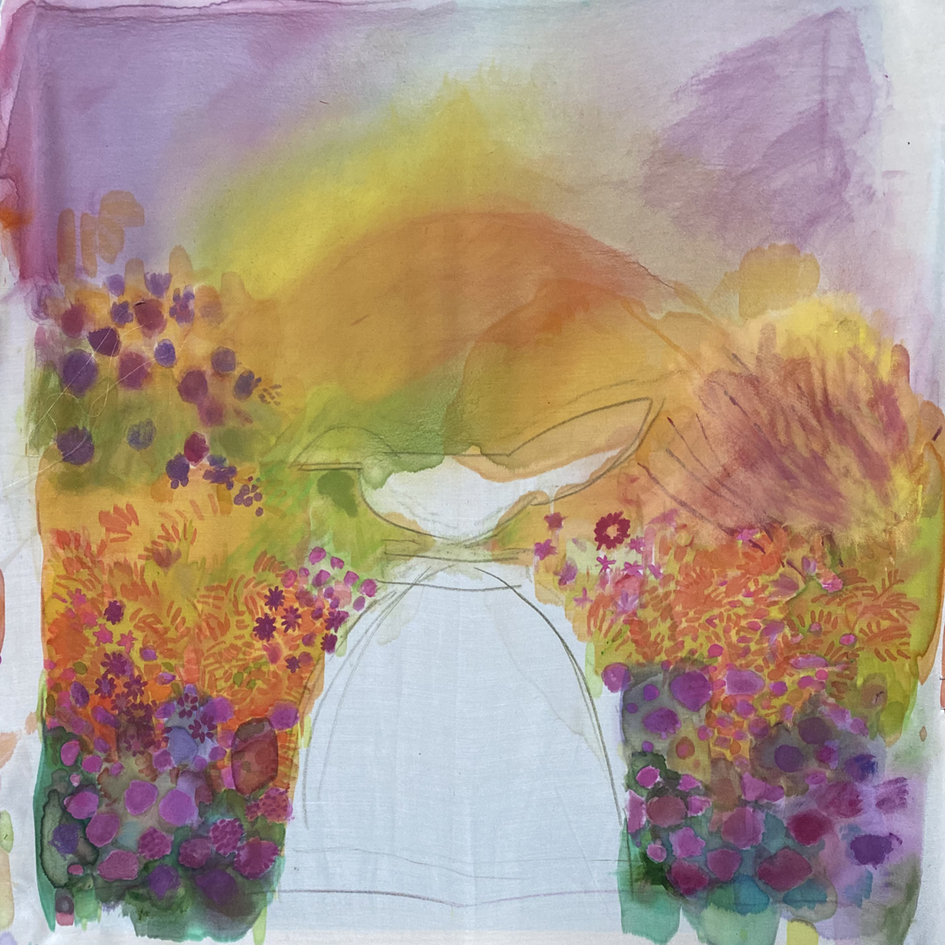
Insired to make new works for the exhibition, back in the studio I combined different drawings, prints and photograps of several aspects of the garden’s abundance and used some old stencils and wonky photocopies that had been over-printed with my embroidered flower images. From this I developed a collage from shoji paper and stitched silk. Then found an old photograph of the birds as I can remember them with their crowns as peacocks.

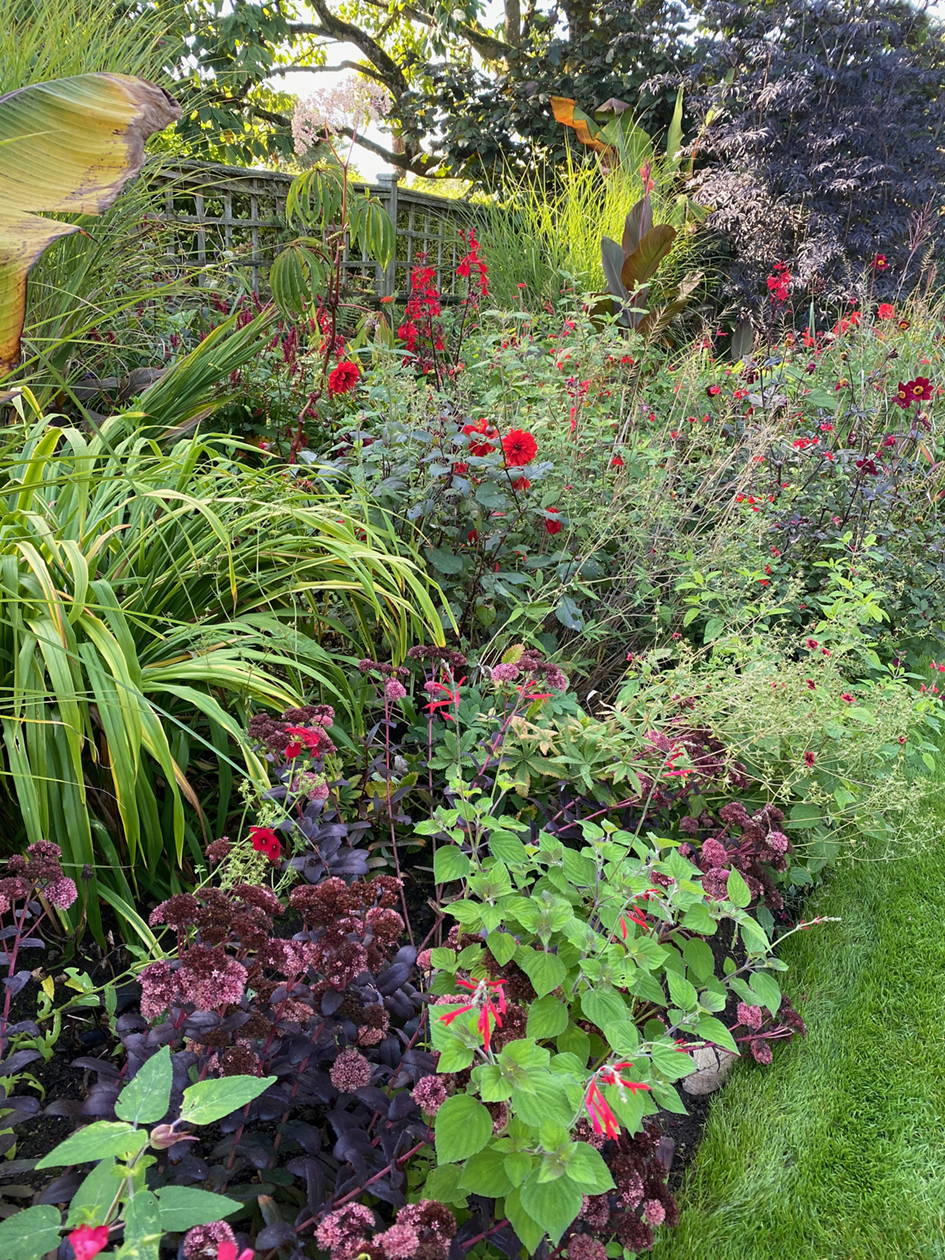
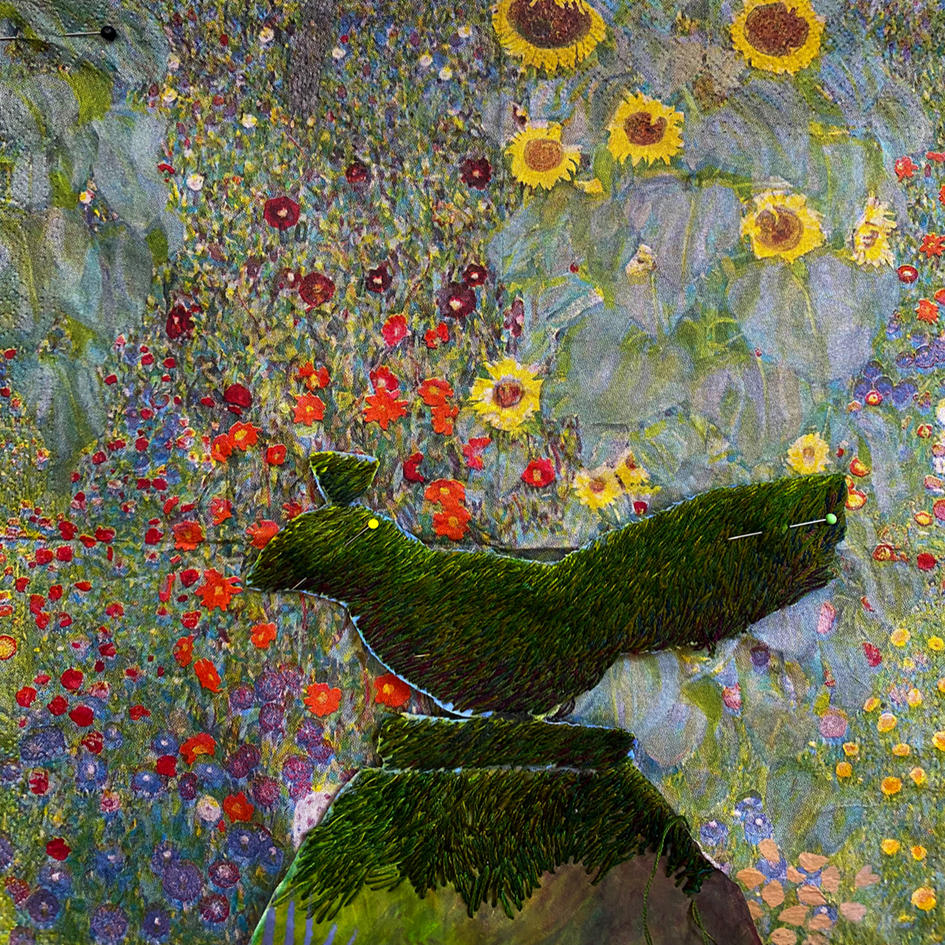
The abundance of planting in the garden beds reminded me of Gustav Klimt’s flowery lanscapes, I began to imagine the plants at Hidcote developed into a wall of flowers. I had bought a packet of paper napkins patterned with a Klimt garden for presents to friends, from a museum in Vienna, but had kept them myself. I took one and pinned it to my studio wall, with the other half formed ideas.

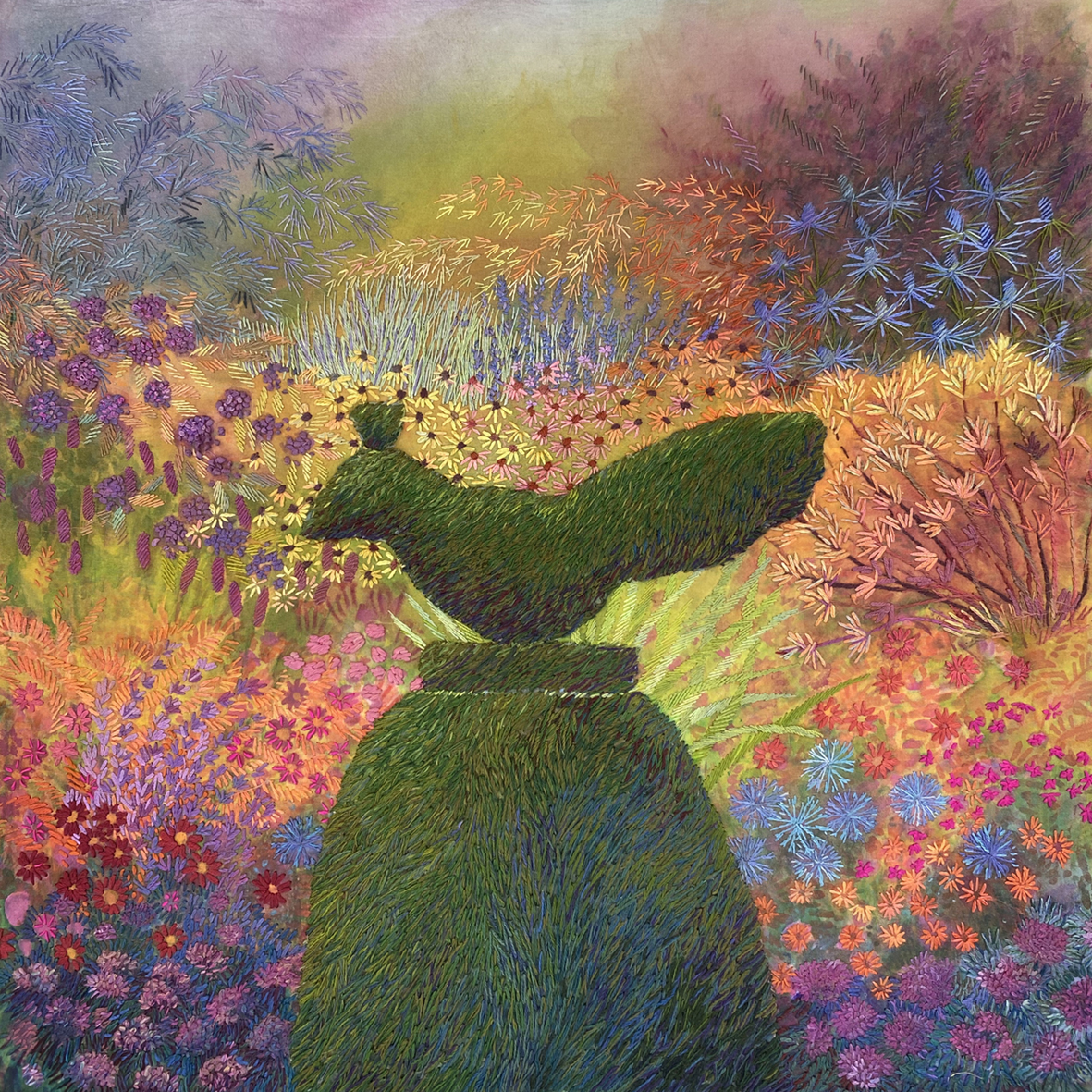
Stages in the inspiration: designing, drawing, dyeing and stitching my homage to Gustav Klimt. I stitched a bird in twisted silk thread on a fine silk ground, then painted dye onto another silk ground adding many of the flowers and leaves, found in my photographs, to make the flower wall. Eventually I stitched the finished bird into postion.

The finished ‘Vintage Topiary Bird’ has become the front cover of the picture book/catalogue that I have produced specially for this exhibition. It has just been delivered to the publishers in time to be printed and for sale at the start of the exhibition Inspired to Stitch: Hidcote Revisited.

Flowers & Hearts

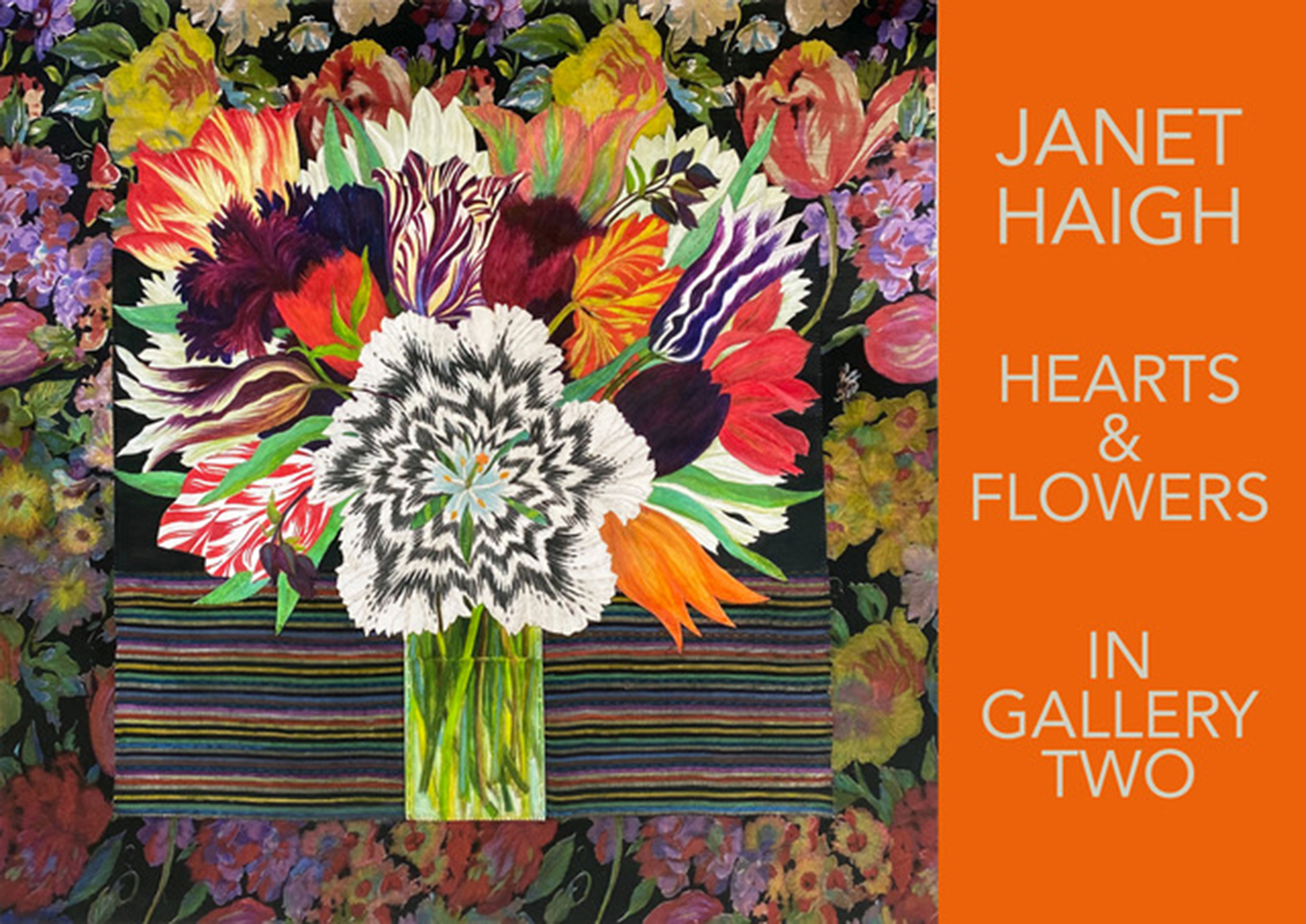
The new season’s exhibitions at Jen Jones’ The Welsh Quilt Centre, Lampeter opened a week ago today where I am exhibiting a small show of personal work – work that I make and keep for myself.

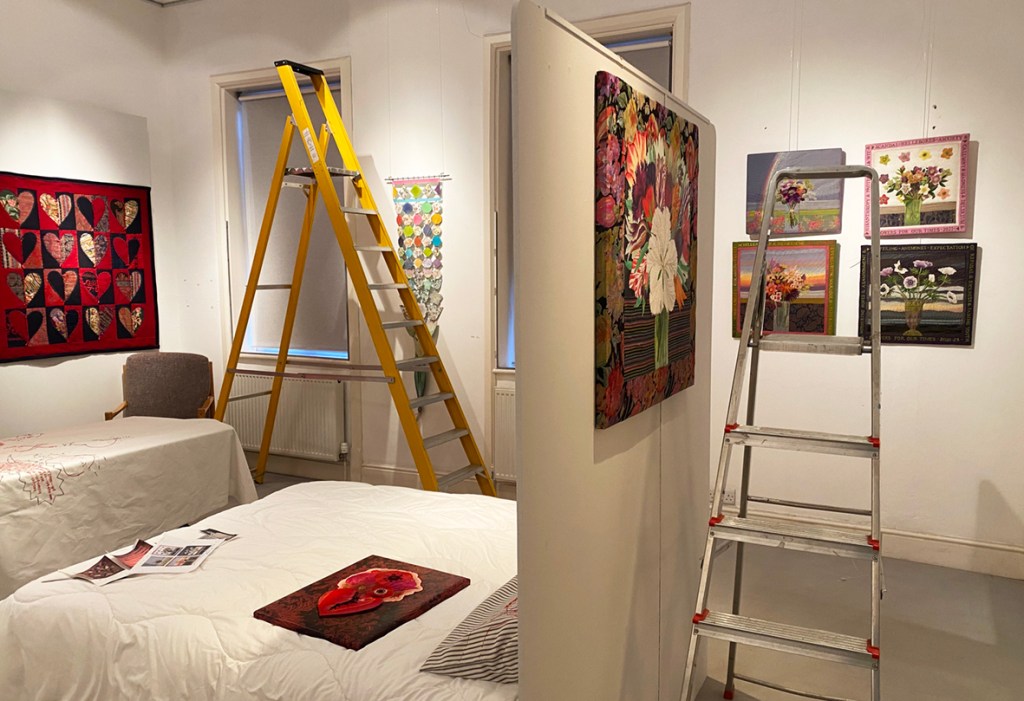
On my first visit early in 2023, when I took actual work to show Jen Jones, she offered me a small gallery for an exhibition and I decided on ‘The Flora’ embroideries. However on my second visit to the, now empty, room I immediately realised it would need far more works than I had imagined. I decided to add a more unusual collection of my textiles combining vitreous enamel and based on Mending. It features broken hearts and how to mend them, so Hearts and Flowers: starting at the begining and going round the room: this is the story of putting up the exhibition

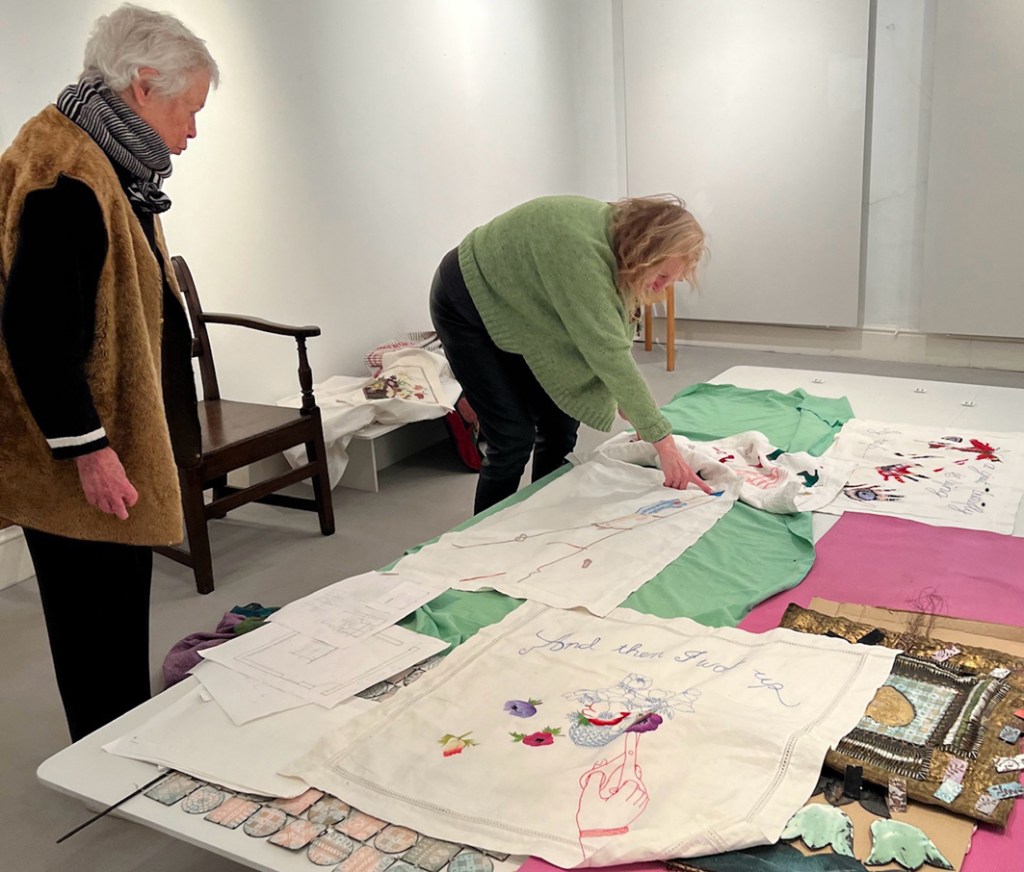
In the first week of March I took all my works and with the help of the whole team at the centre the exhibition was in place in a day(apart from a few extra tweaks before the opening)The first wall of work was The Flora. The exhibition curator/editor, Sarah James, remained focussed when I had lost mine.

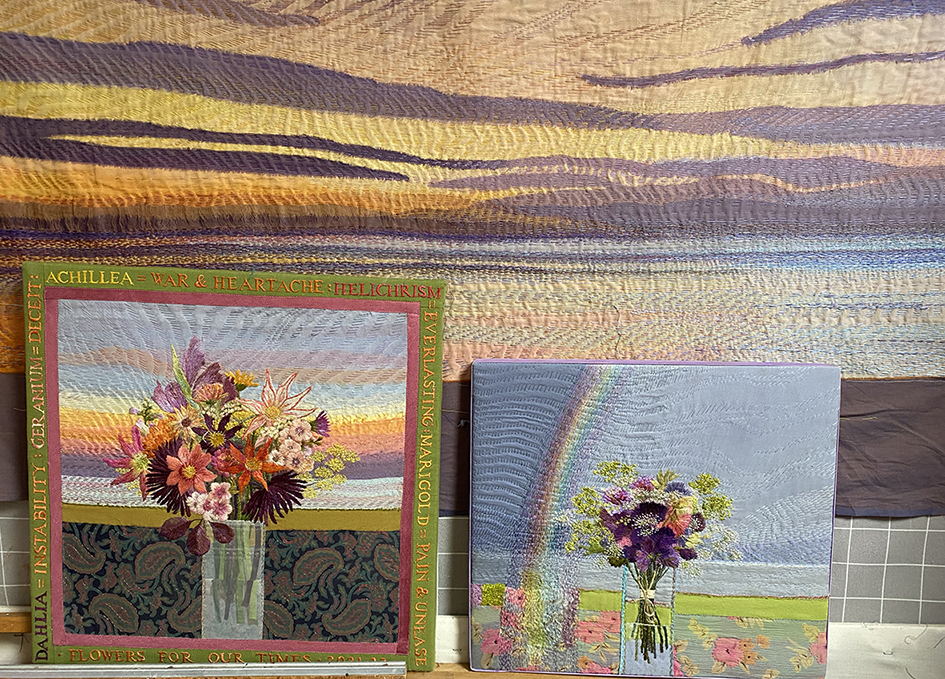
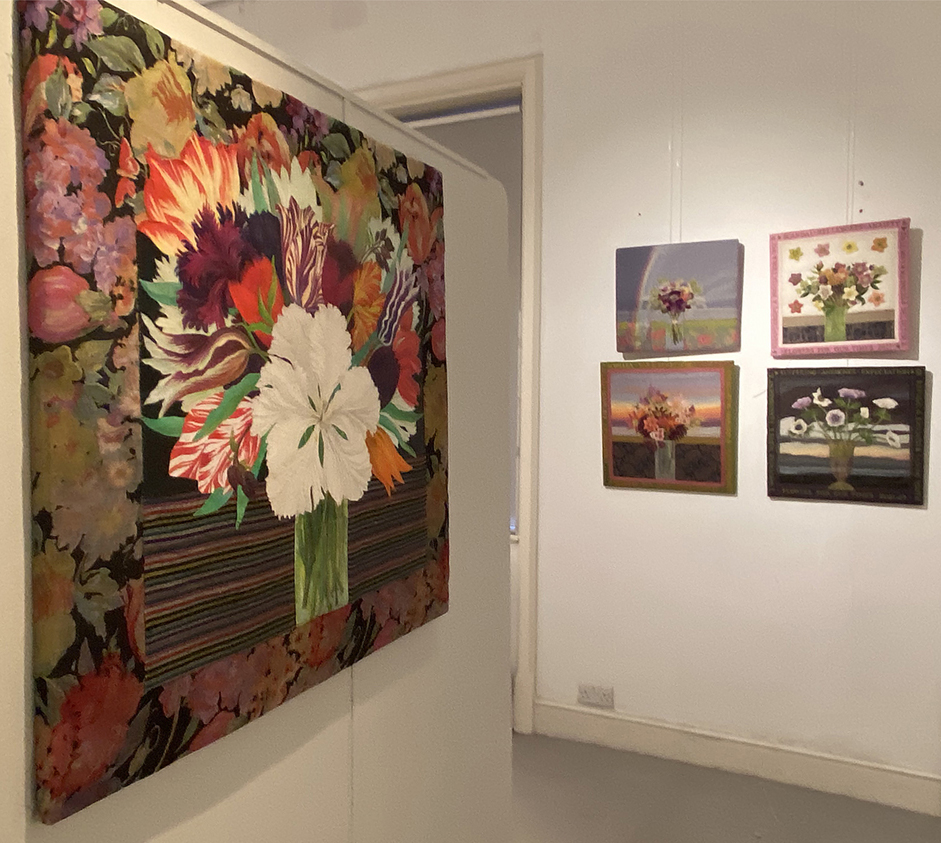
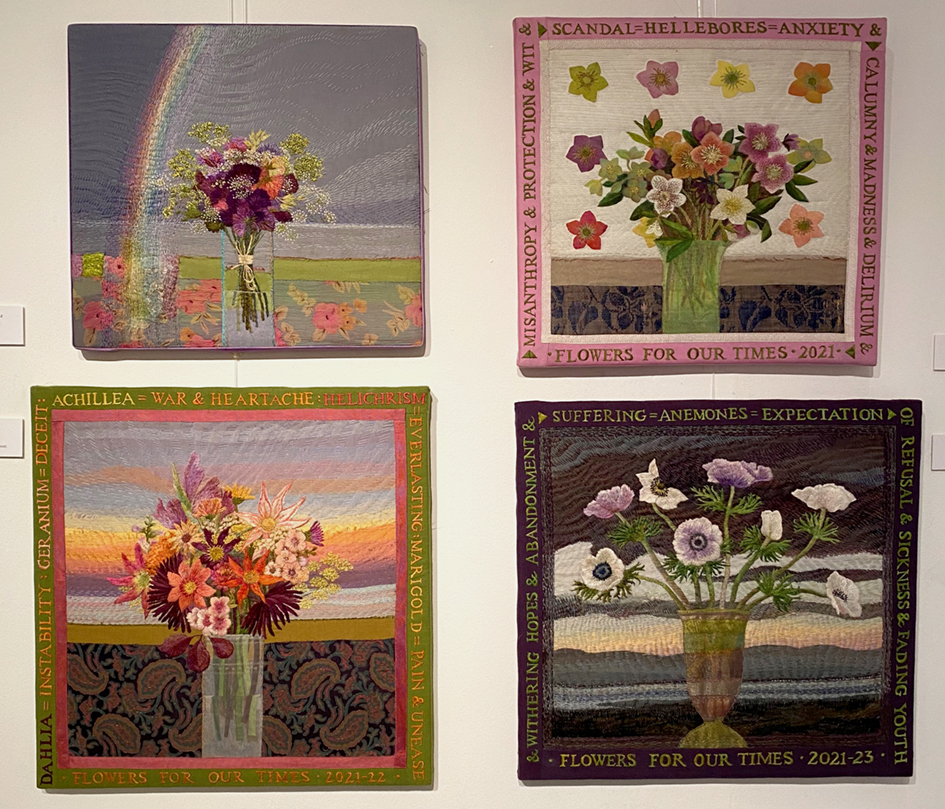
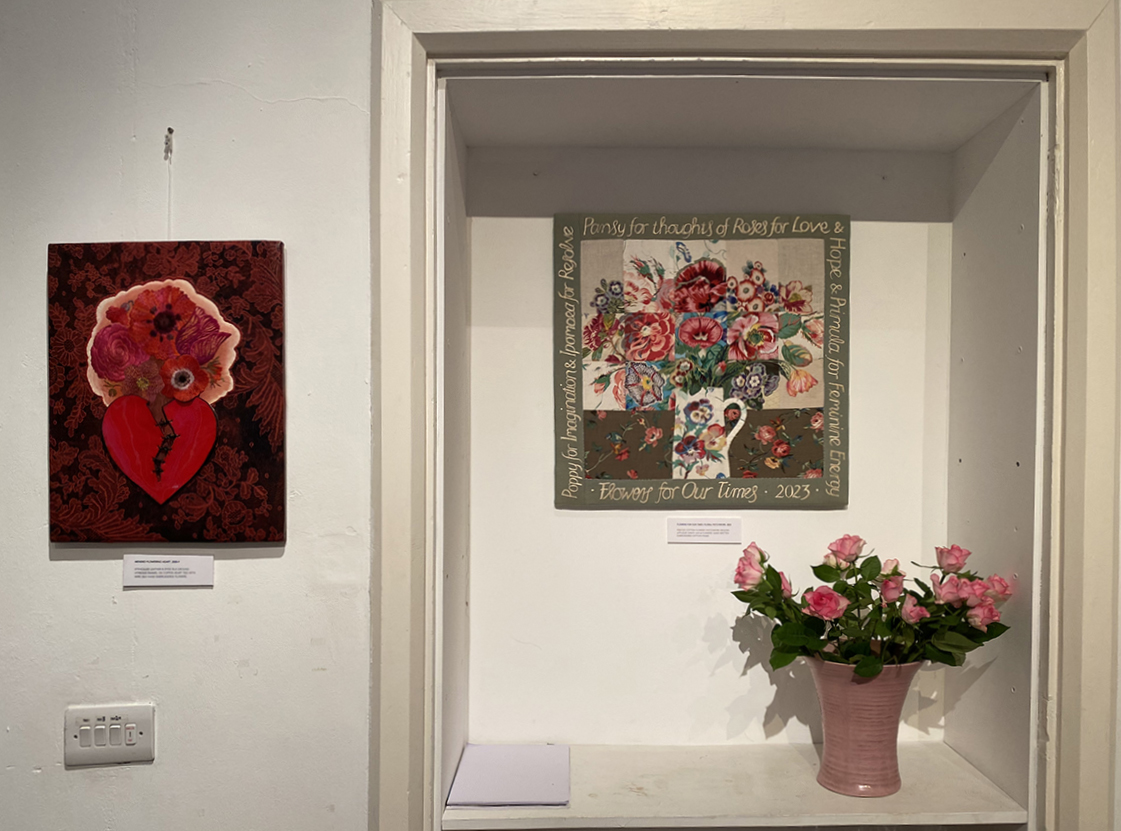
The Flora flowers give way to a group of ‘Flowers For Our Times’ my most recent hand embroideries..but they continue the themes found in Flora. On the left is a stitched appliqued drawing.

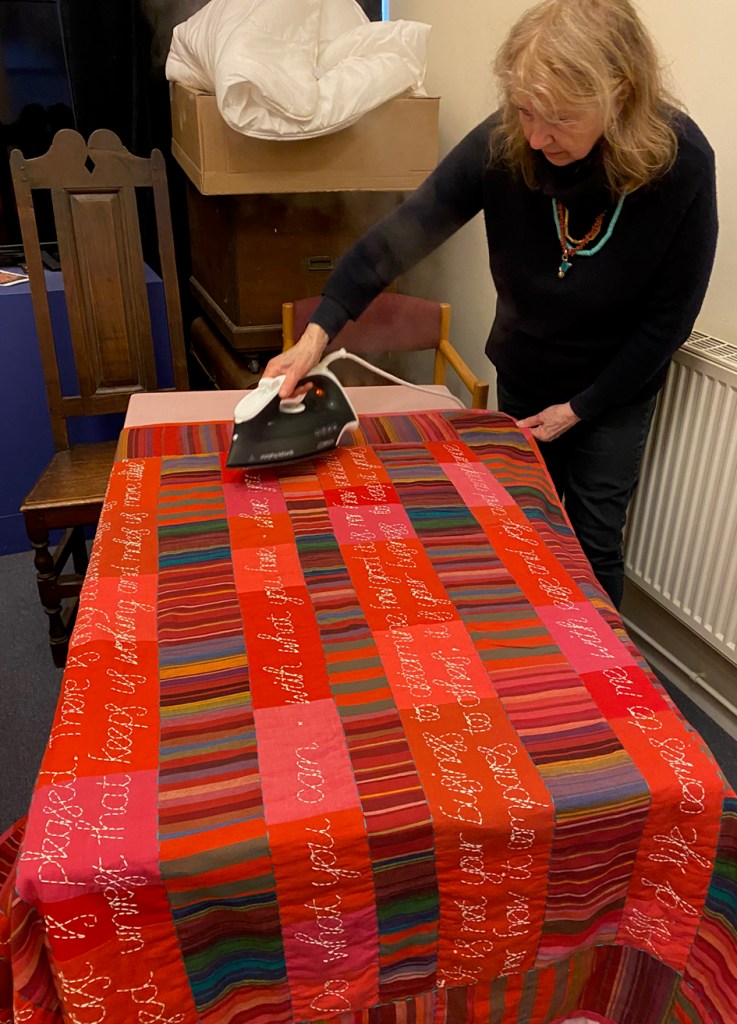
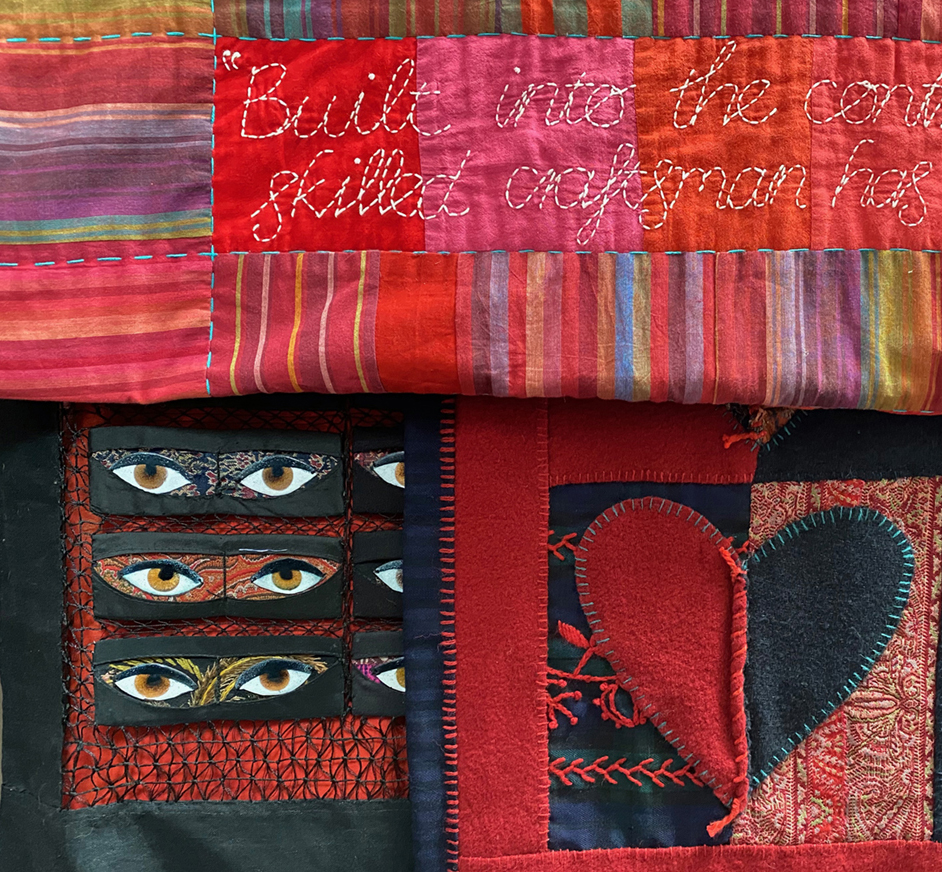
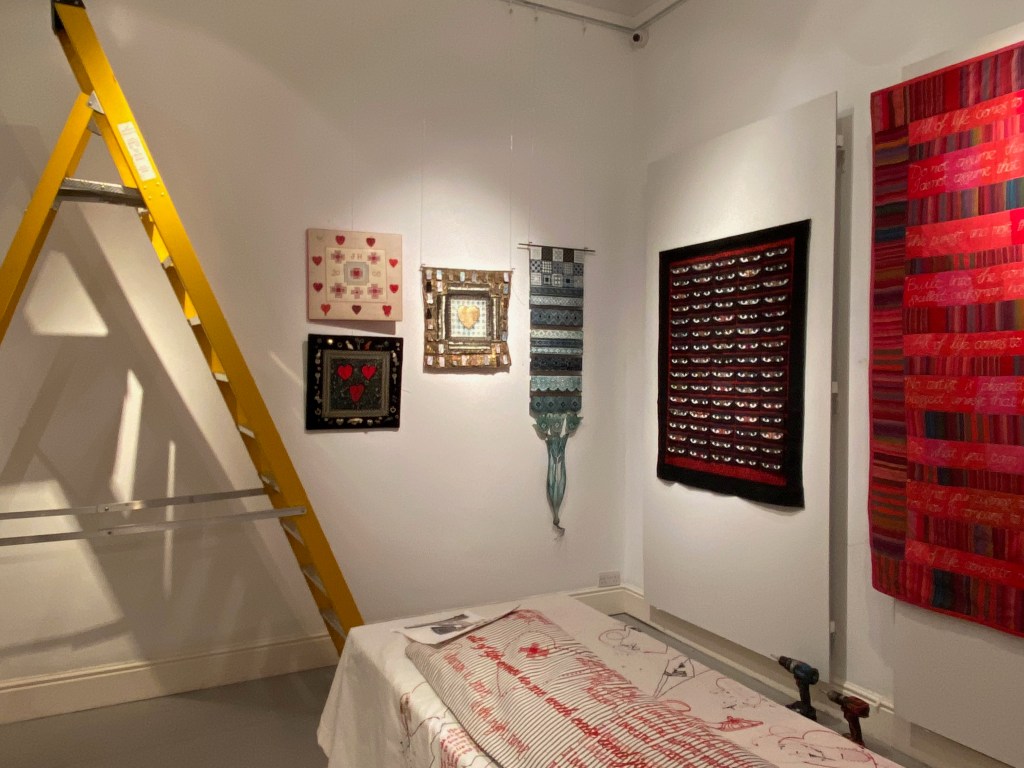
The flower walls give way to hearts (and eyes) so here are my minimally quilted fabric patchworks. This took quite a lot of preparation, pressing on my behalf and for Charles (and Russell) the gallery’s invaluable exhibition men, constantly measuring and sometimes just waiting, but colour co-ordinated!

The large Comfort (Hearts)and Security (Quotes) Blankets and Safety Curtain ( Eyes) had been draped over my bannisters for weeks (above right) but a 3 hour car journey had creased them; I am always relieved to be able press my work before it goes on display.

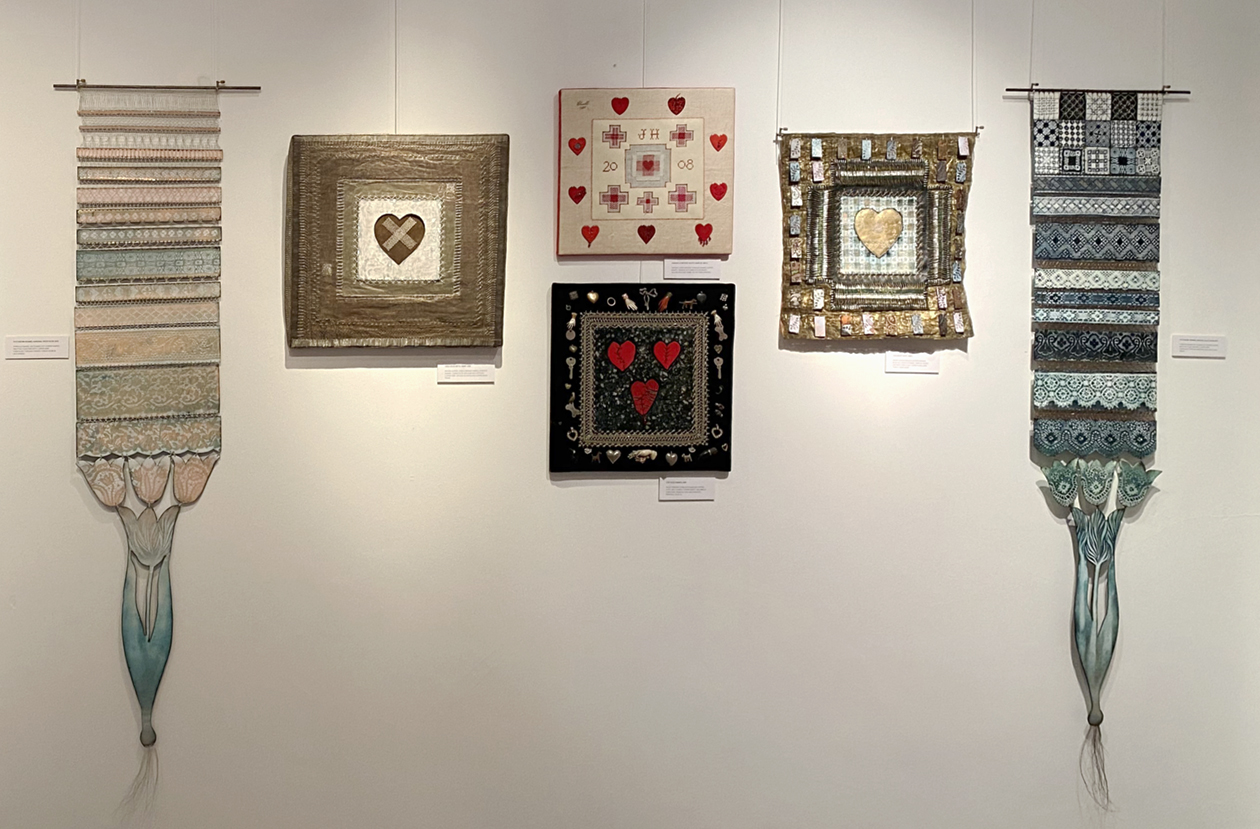
Moving round next are the metal and vitreous enamel hearts – all broken, discarded, damaged but saved in some way.

The works above are made of metal and glass enamel, they are stitched and embroidered with drawn thread work in copper wires on metal fabrics and copper plate. Patterned by sifting white enamels through Lace and Broderie Anglaise stencils, except for the red sampler that is darned in silk on vellum

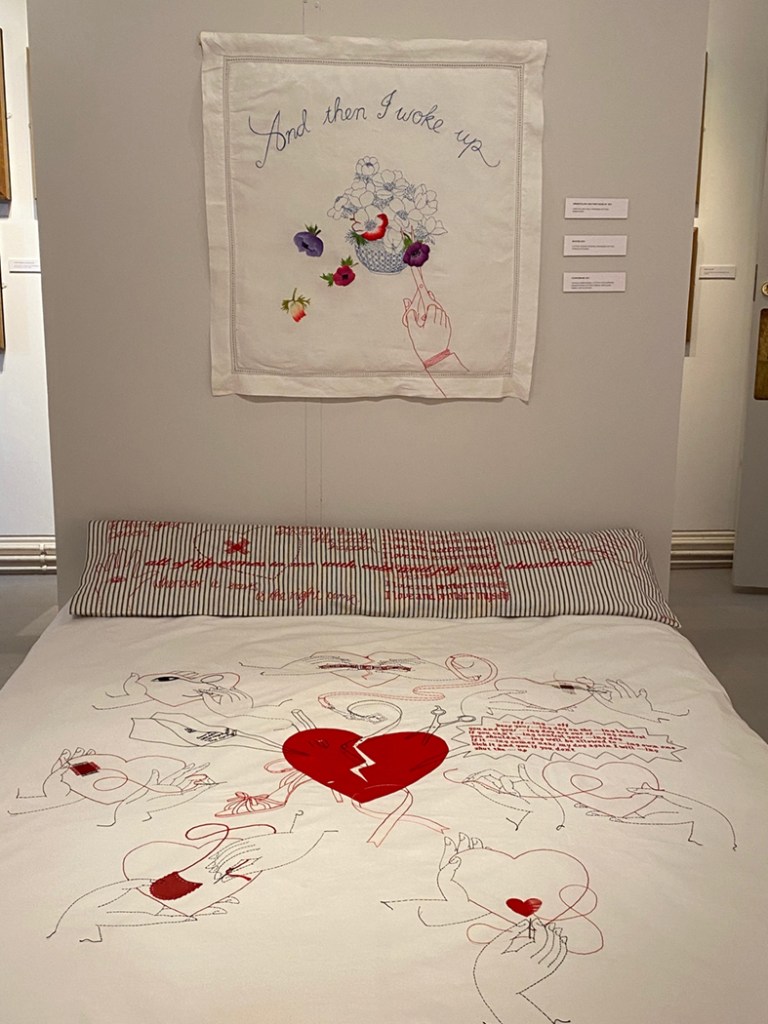
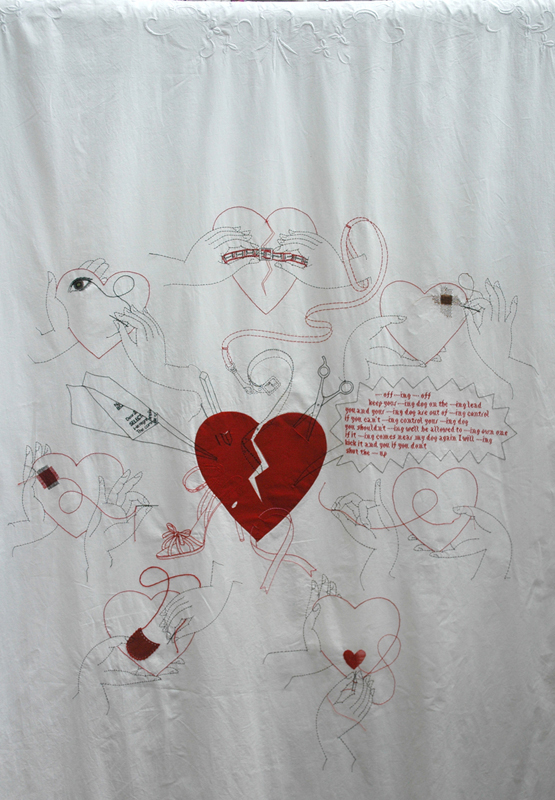
The bed in the centre of the gallery is Sarah James’ idea, she thought it would perfectly show off the bedding of Make it Through the Night and she was right! People are really curious and stop to ‘read’ the symbols and it makes sense when teamed with the Bolster.

Eventually we get back to entrance with patchworked and embroidered and flowers but outside in a vestibule there is still something else to see, Russell putting up my framed giclee prints, unframed for sale in the shop with many more flower pieces. And the large ‘Lytes Cary Manor’ woollen wall hanging taken from my studio wall where it has lived since 2001.

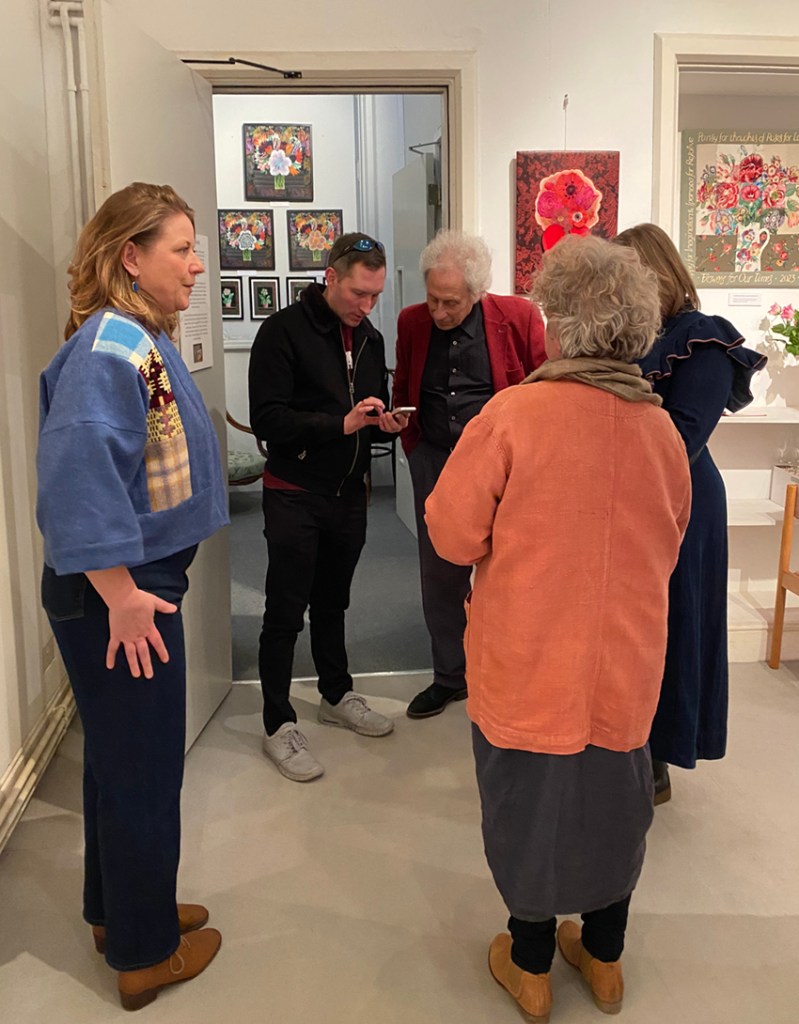
The very last picture I took was at the end of the Private View. A group of staff and on the left Jenni of Jenni Smith Sews talking to Hazel (who appears to organise just about everything around the Centre) waiting to hear how to get through the wild Welsh countryside to the restaurant for us to celebrate all the exhibitions and videos on display throughout this amazing place.

PS. my work is not for sale but my new giclee prints of embroidered flowers are available to buy in the fascinating vintage textile and bricabrac shop attached to the centre.

my 1960’s fashion sketch book

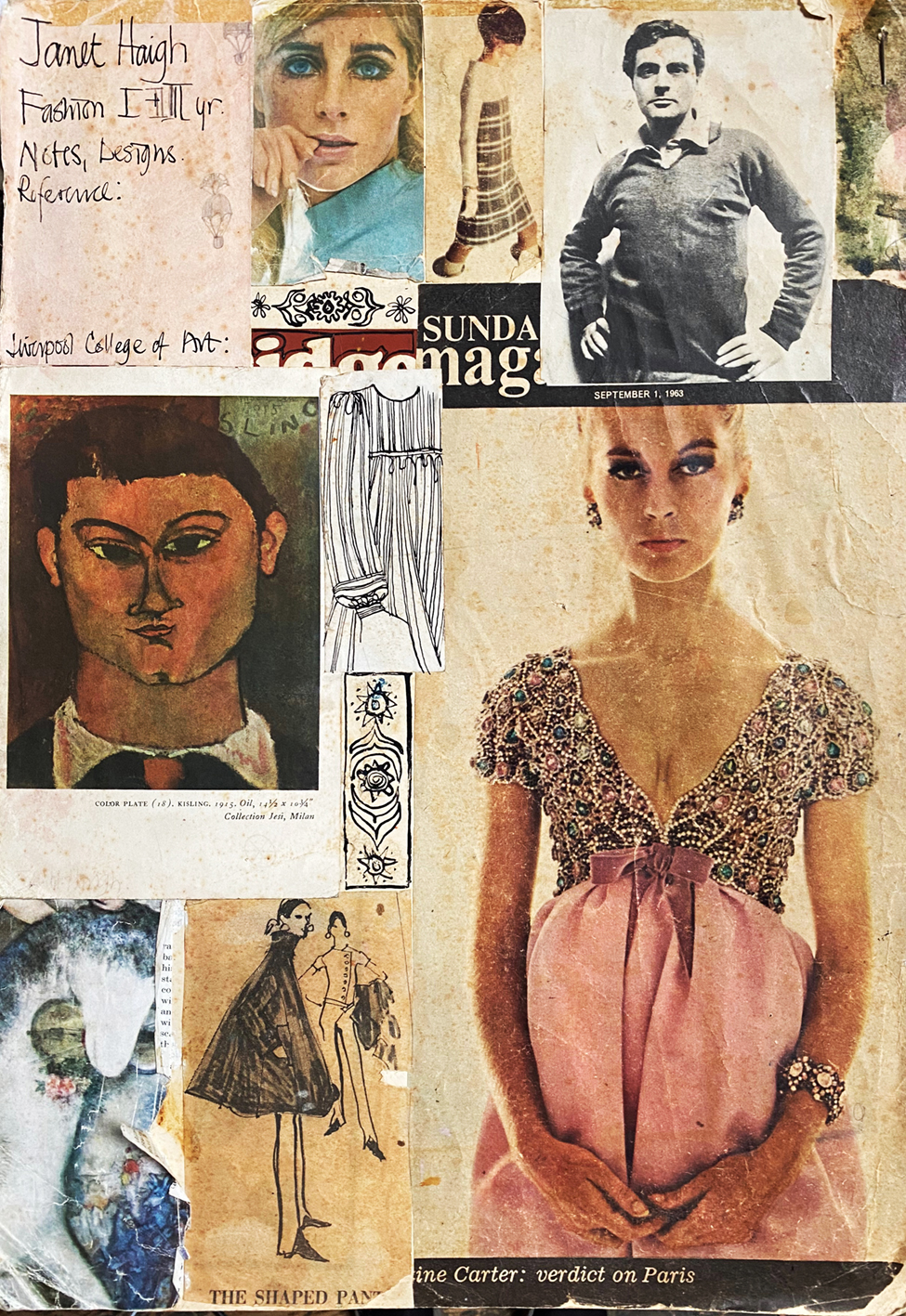
The cover of my late 1960’s sketch book – says it all!

Invited to conduct a week long course of drawing flowers and then to develop the drawings into a small sketch book at Court House Farm in early June, when the cutting garden flowers are blooming. I checked out my collection of sketch books/ visual research journals (whatever they are currently called) I have kept all my research books throughout my working life.

then I unearthed my first Liverpool College of Art sketch book circa 1968 – and this cover still looks like a protrait of my early loves and fashion influences …Modigliani, man and work, Chagall, dresses as worn a la Dusty Springfield; with the faces and poses of models that influenced my design illustrations. And inside???

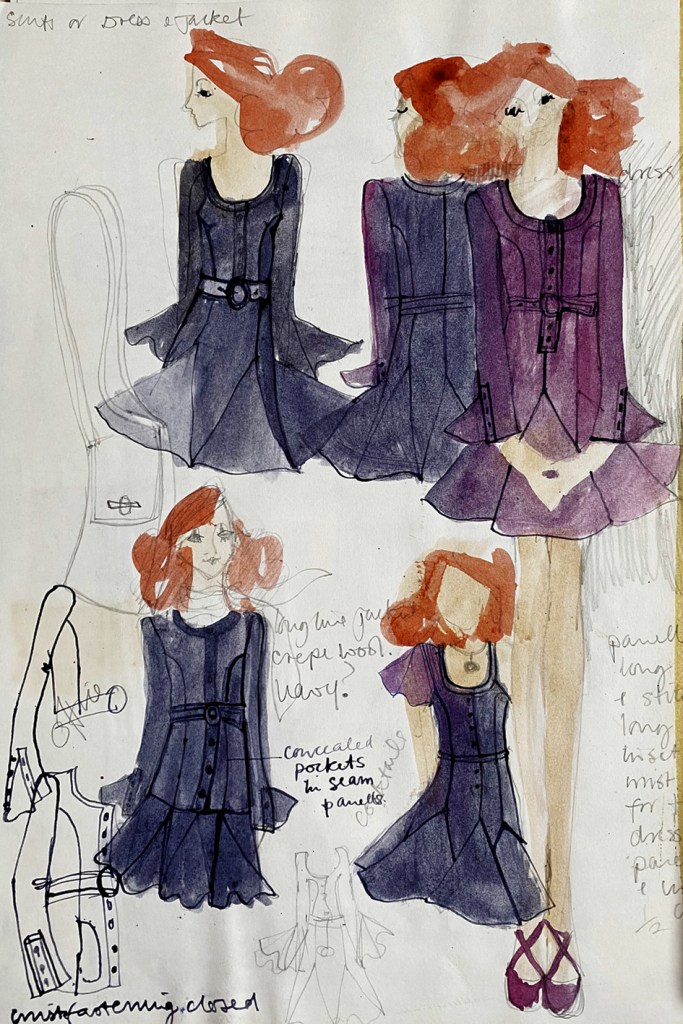
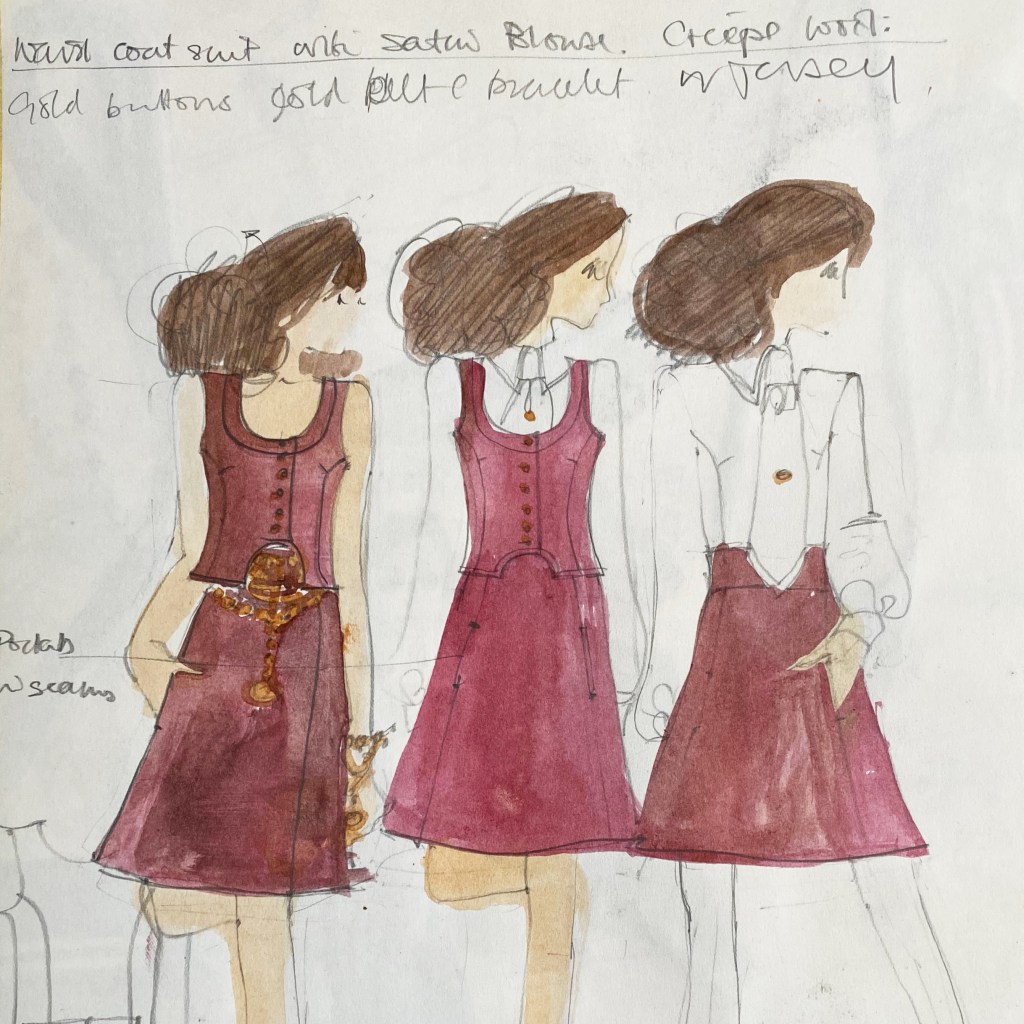
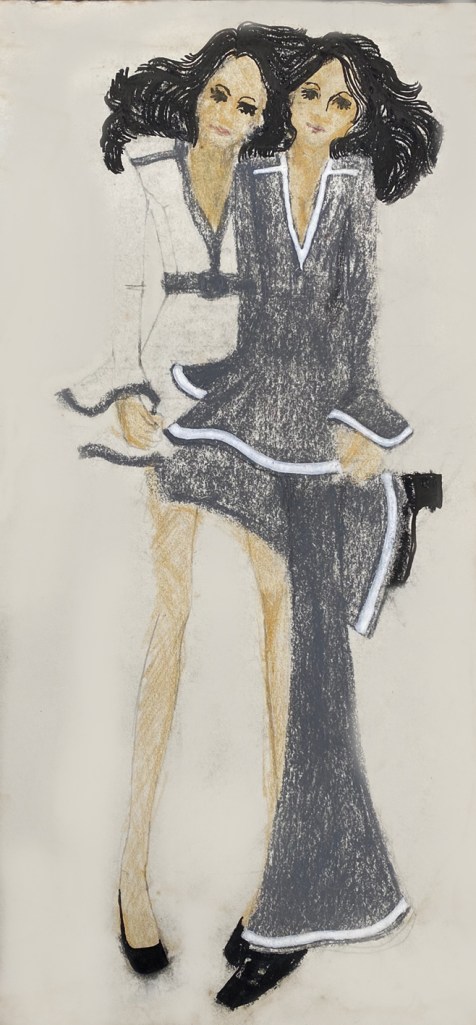
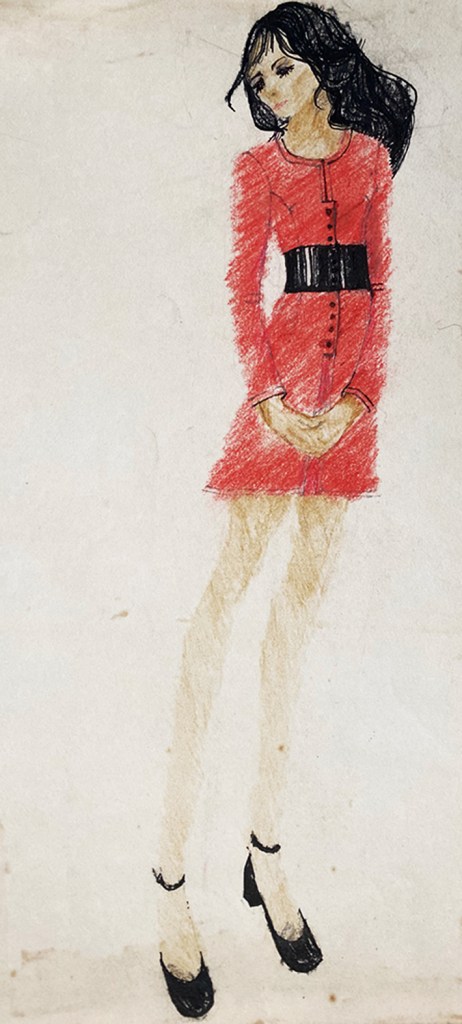
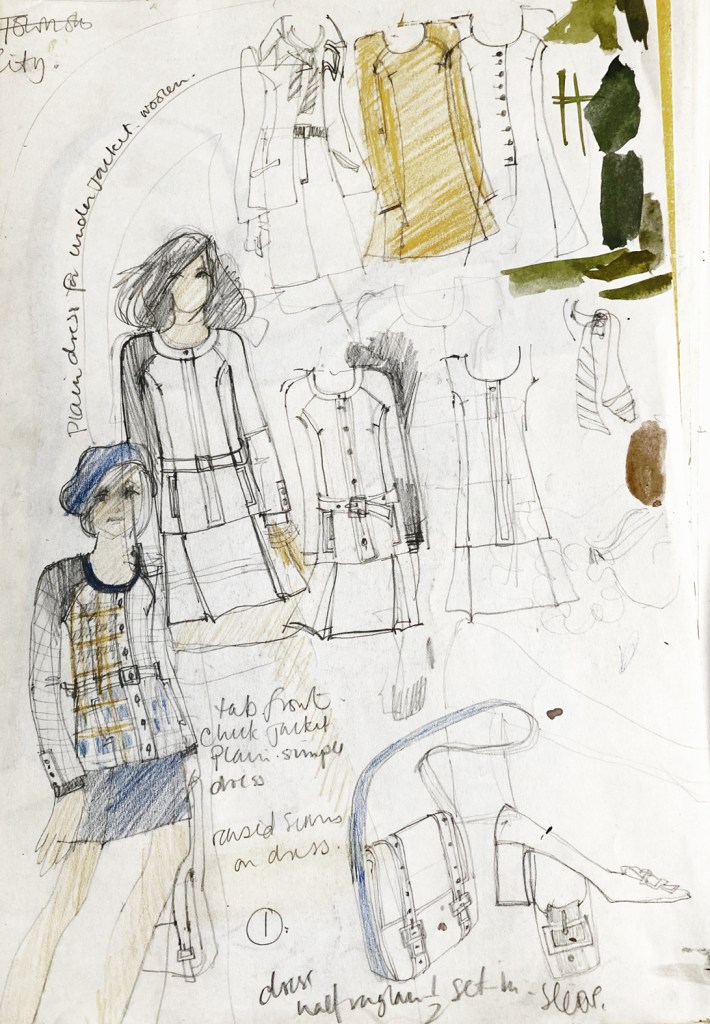
Above are a range of design drawings in pencil and coloured inks that were used to tint black and white photographs. I found that the colours were very subtle, I wonder what happened to them? These are layouts of my designs ready to be illustrated, I think for a competition for RSA (a brilliant organisation that enabled students to develop their practice with scholarships and grants). Everything looks in proportion until you see the legs, they go on forever. We were taught to make drawings that someone else could work the pattern cutting and making, a very good practice as I found out when I did become a fashion designer and illustrator in London in the 70’s. But what is really fascinating, the pages do not look so different to my own recent research books – just a change of subject matter- oh and embroidery!

These pages of flower are from my current research book started in 2023; I am still having a written conversation with myself. Back to the 60’s…….

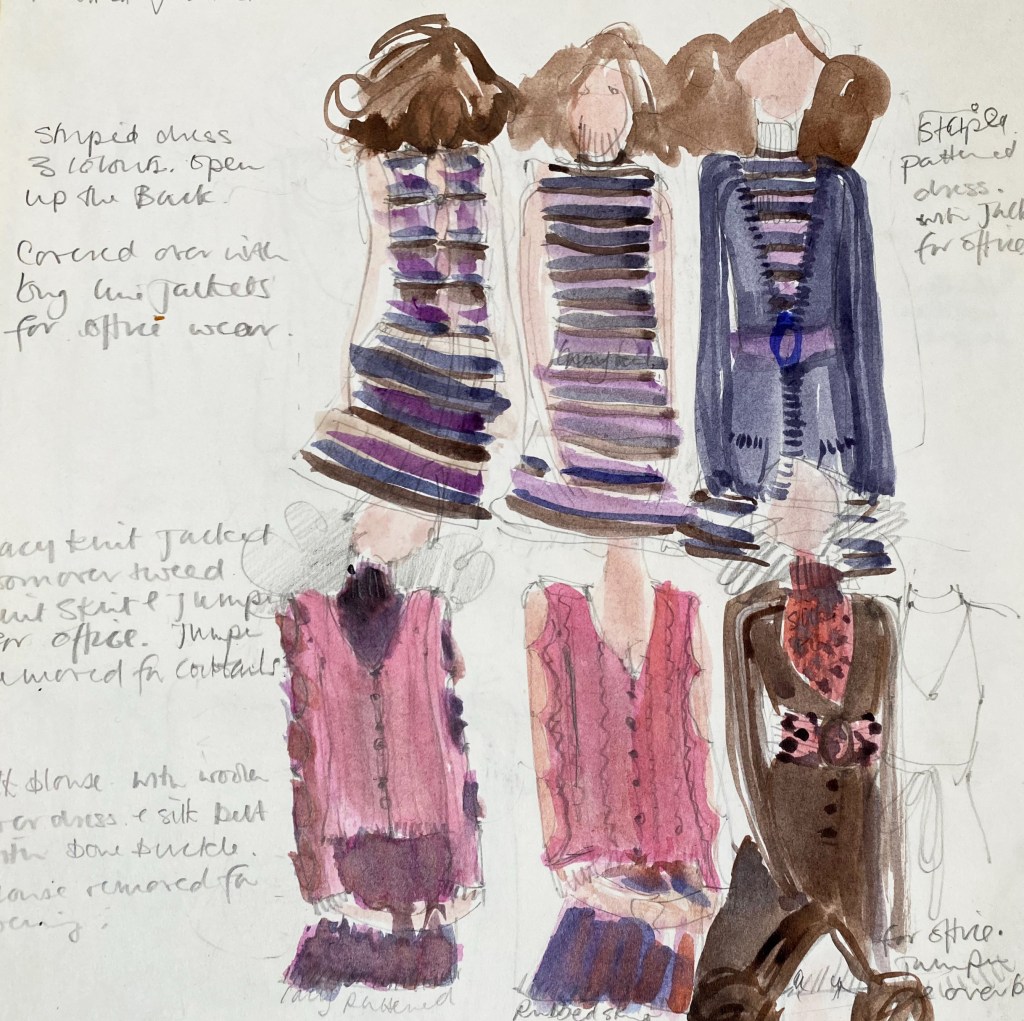
These very neat dresses were designed to be made in Double Jersey, a new innovation that made for easier pattern cutting (but little else as far as I was concernd). I always preffered my designs to be made in fine wool crepe. In the sketches below it appears I was also designing lots of accessories as well! the drawings above use my favourite media of the time – pastel with mapping pen and ink details.

Below are designs that use applique and embroidery – I remember embroidering woollen flowers onto a knitted dress for my final collection and I think this is where I really got the passion for embellishment and embroidery. My first freelance job was making and designing appliqued T shirts for the Mr Freedom in Kensington – the height of London boutique street fashion at the time.

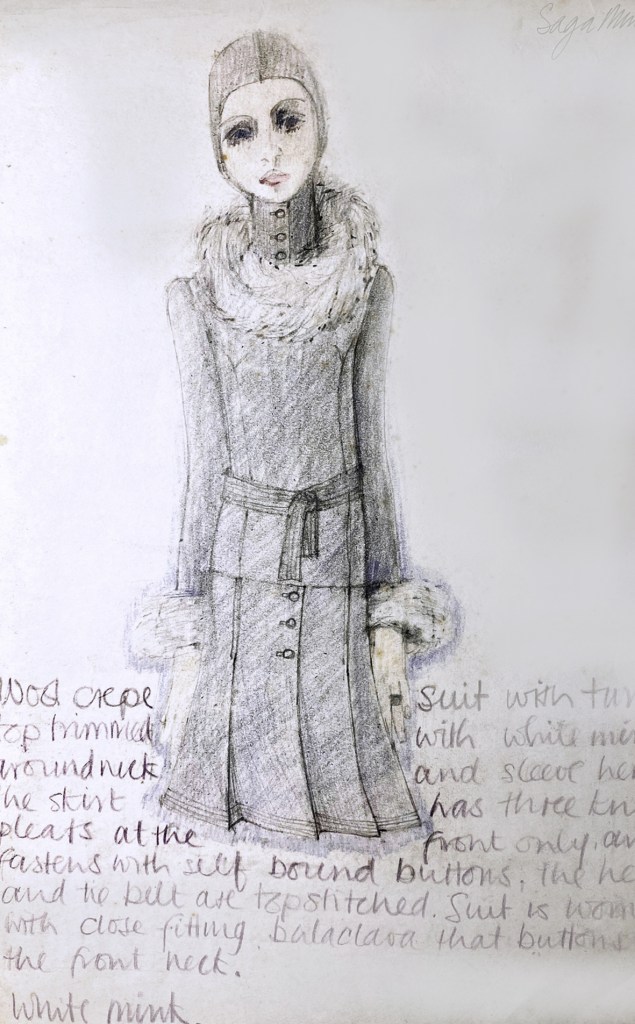
Another sign of the times the Saga Mink competition, ( I did not win – well just how much fur would these designs sell)? The anti fur lobbly was just starting up, but that’s another story. The drawings are in crayon and pencil.

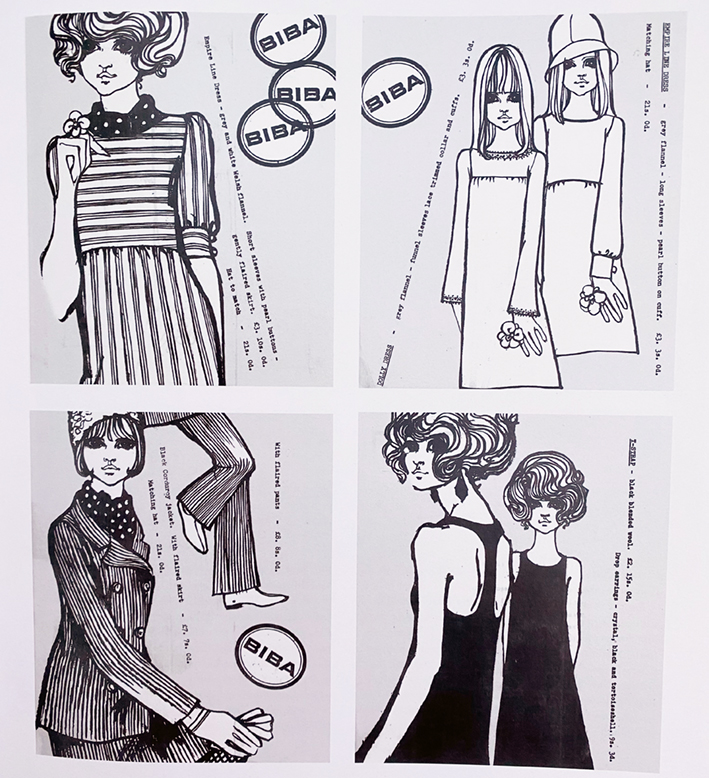
However here you can see the direct connection to the cover of my sketch book and the influence of my favourite fashion designer and illustrator – Barbara Hulanicki the design genius behind the most fashionable shop of the times – Biba .