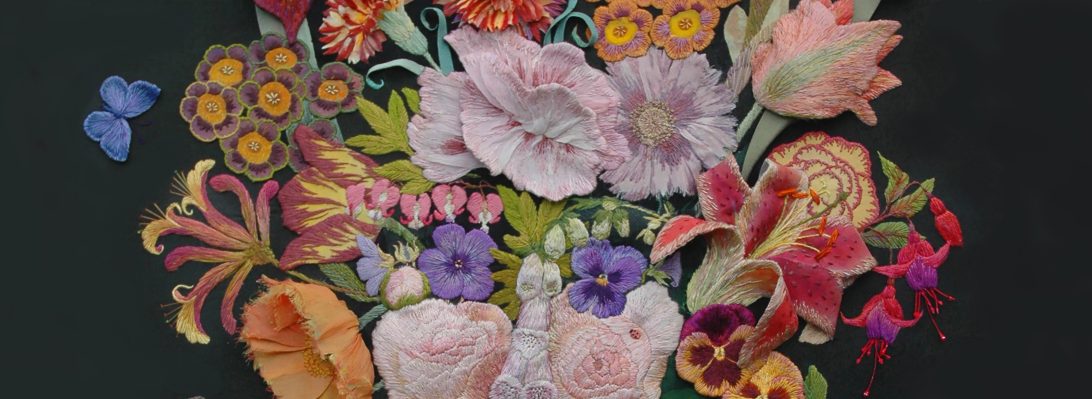
In 2009 I worked on a commission to hand stitch the pelt for the cast of a rhesus monkey, a sculpture called “Primate” for artist Daphne Wright, in her exhibition “Traits of Sydney” at the Frith Street Gallery, London. February 2010. This work took me several months and affected me a great deal – causing me to reflect upon my attitude to the animal.
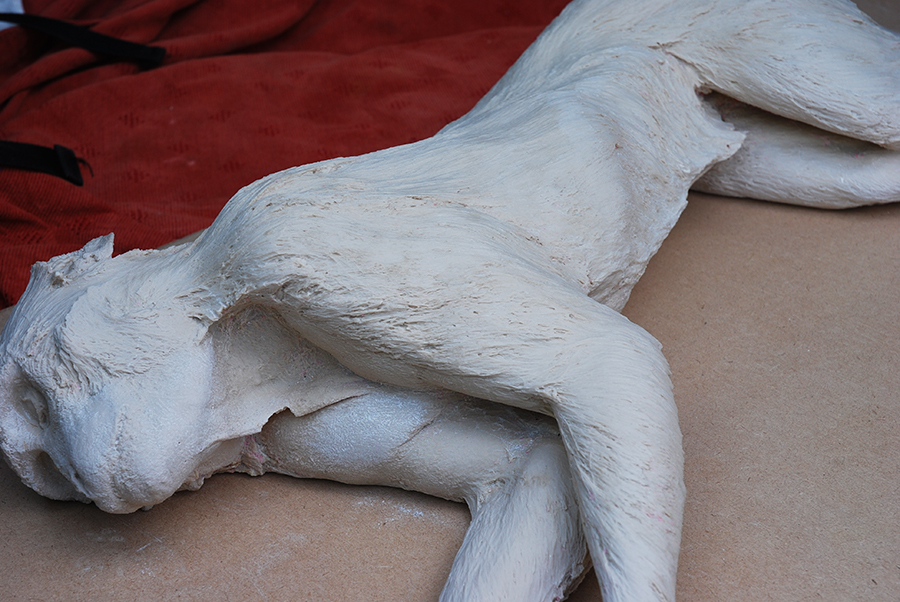
The animal cast above was permitted to be made for the artist by a laboratory in America; it was bred within a life-science programme. I had to seriously consider the value of my own work in relationship to it. Daphne and I had many discussions during the making of the work, the obvious things like, how will I manage to stitch a 2 dimensional coat onto a hard 3 D resin cast, and what with, and how long and how much will it cost …..But most importantly – what did this animal represent to me?
I do not want to get involved in a discussion about animal rights here, however I do share with the artist, the conviction that we often make our strongest work because we feel conflicted about our ideas around a subject. And so I would like to share with you how I felt and still feel about this work. I am old enough to have lived through many of the changes of attitude to animal research, when I was a child in the 1950’s I was vaccinated along with everyone else for the usual childhood diseases, smallpox, measles, polio etc. and I can’t remember any thoughts expressed as to the laboratory testing procedures at the time: the fact that I am a healthy and mature woman is due to animals like this monkey. No matter how I feel about the politics now, I owe these animals a massive debt of gratitude and I wanted to show by my work what this animal symbolised for me.
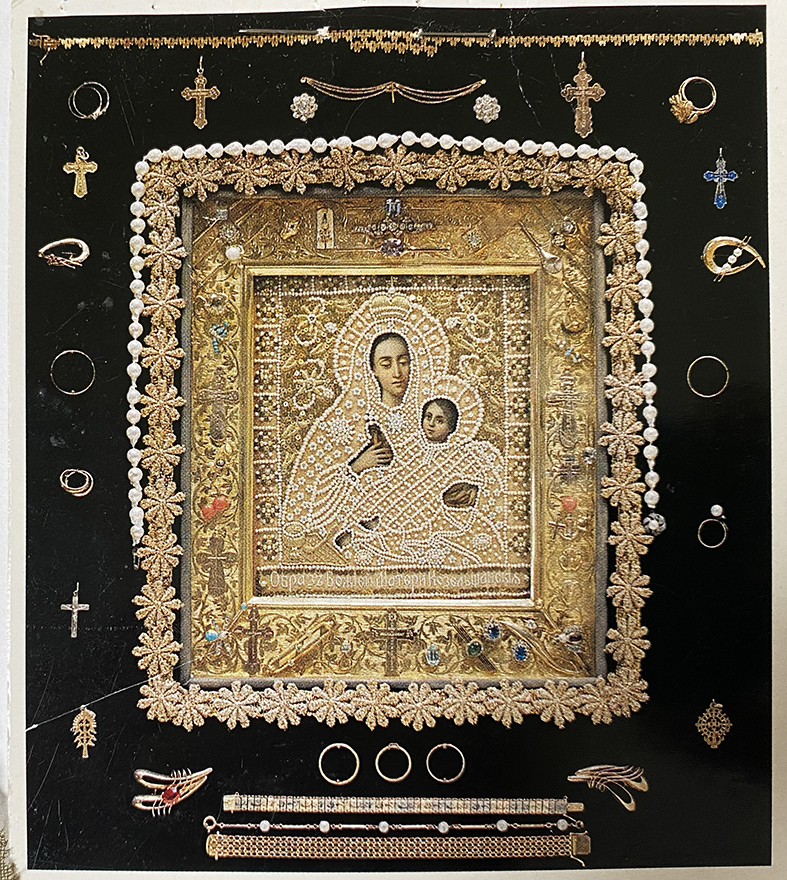
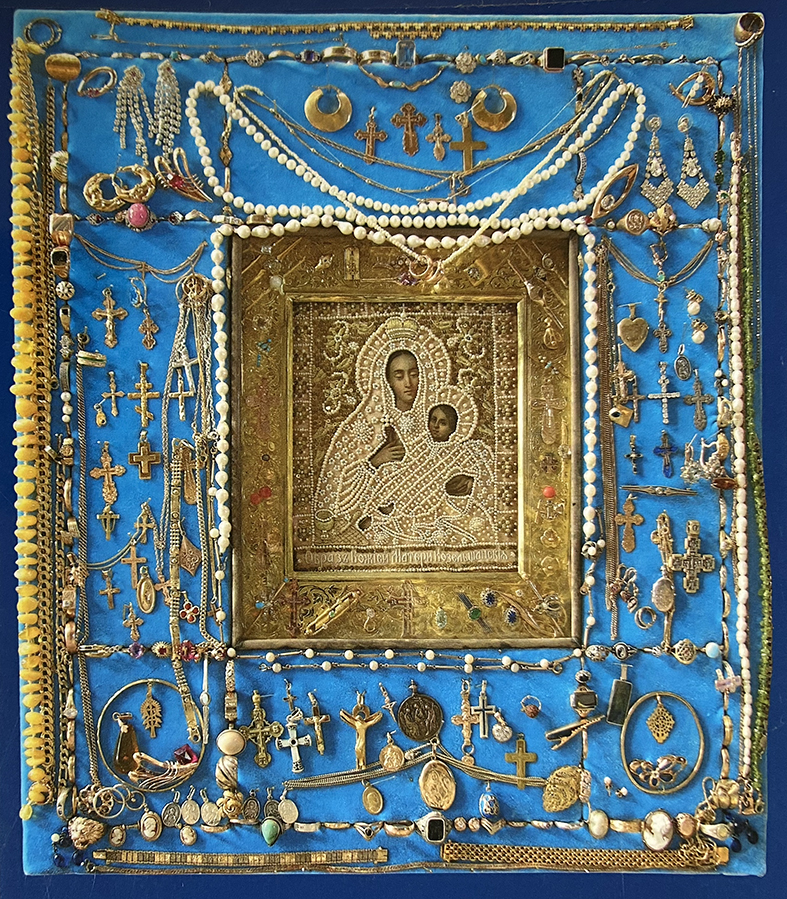
I knew I had to give all my attention and skill in stitching this work. I was intent on giving the cast a covering that was in keeping with the animal’s status in my own eyes, and after much thought I decided to see the cast as a Icon Cover, that are used as protective covering surrounding the image or embodiment of a saint. The protection is more spiritual than practical. The covers are often richly decorated with gifts from worshipers for thanks or requests for intercessions to the higher deity via the depicted saint. The richness of the covers becomes a symbol of the esteem or veneration of the saint. I offered this idea to Daphne for consideration, illustrating the idea by showing her some postcards I had been sent from Finland, by friend and colleague, Basil Kardasis; they depicted embellished and jewelled icon covers over a painting of the Virgin and Child

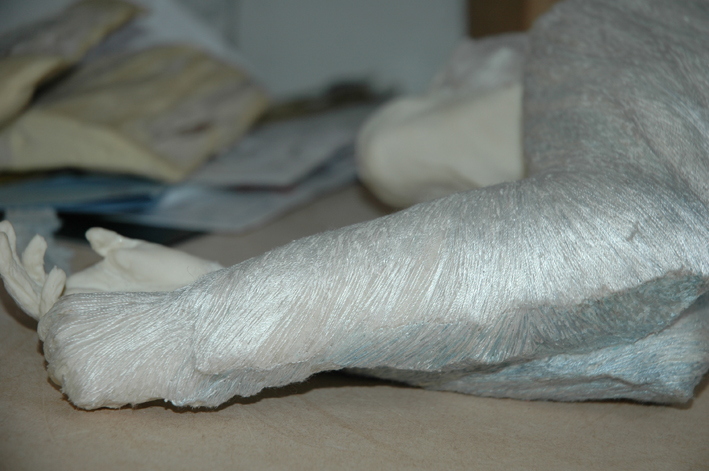
The effect of the light falling on the the directional silk stitches follows the rhythm of the fur, giving a sheen and movement to this static death mask. as seen above in my studio mid-way through the making process.
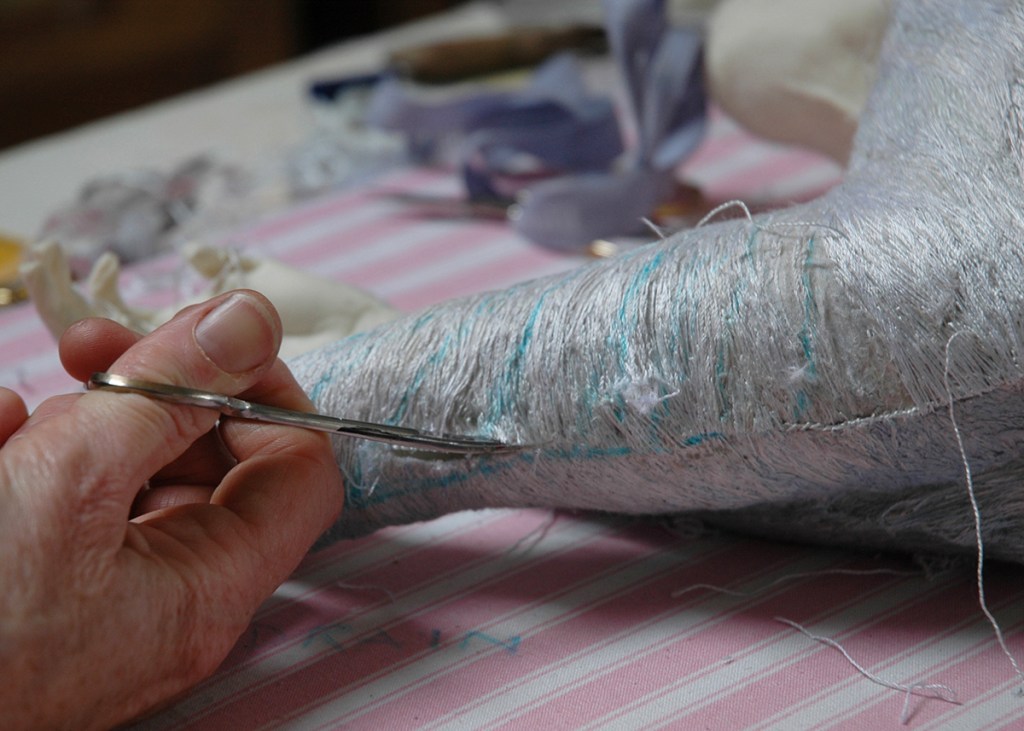
I was aware that the quality of both the craftsmanship and materials that I used in my work had to convince viewers that I was honouring the animal depicted. The choice of white deepening through to pale blues for the colour of the animal is also in keeping with religious iconography within the Christian tradition; Daphne chose it in spite of its religious iconography and I think because it was the least realistic colour of a the animal’s fur. I embroidered it with single silk threads using running stitch into transparent silk organzas and georgettes, so that the thread could be seen between the upper stitches which suggests individual strands of fur that make up a pelt.The real difficulty for me was to make the pelt less life-like, Daphne, kept insisting on a “draining” effect for the direction of the fur suggesting the life of the animal ebbing away. Consequently certain areas of the embroidery were taken and stitched several times to create her vision or maybe I should say intuition. It was a very strange and disturbing task for us both; for me to cut away days of work I knew to be faithful to the underlying pelt, and for her to stand by and watch as I marked up and cut the “skin”. We were always aware of the connection to medical procedures and found these alterations extremely unnerving; she was unable to look while I did it and I was just having to be stoical. The image below shows marking and cutting for alterations on a limb and the new direction of the stitching
But one remarkable and practical thing was born from this work, my return to hand stitching in thread onto fabric to making my own work. For several years I had been experimenting with textile techniques for other materials, a materials-led research project; stitching, stencilling, printing, and painting mostly in vitreous enamel on copper and steel. It had been a long time since I had stitched an entire piece of work in fabric and thread. Re-connected to my original medium, I am now aware that my long standing practice of stitch is still a potent medium for the expression of ideas I may want to ‘debate’ with myself

