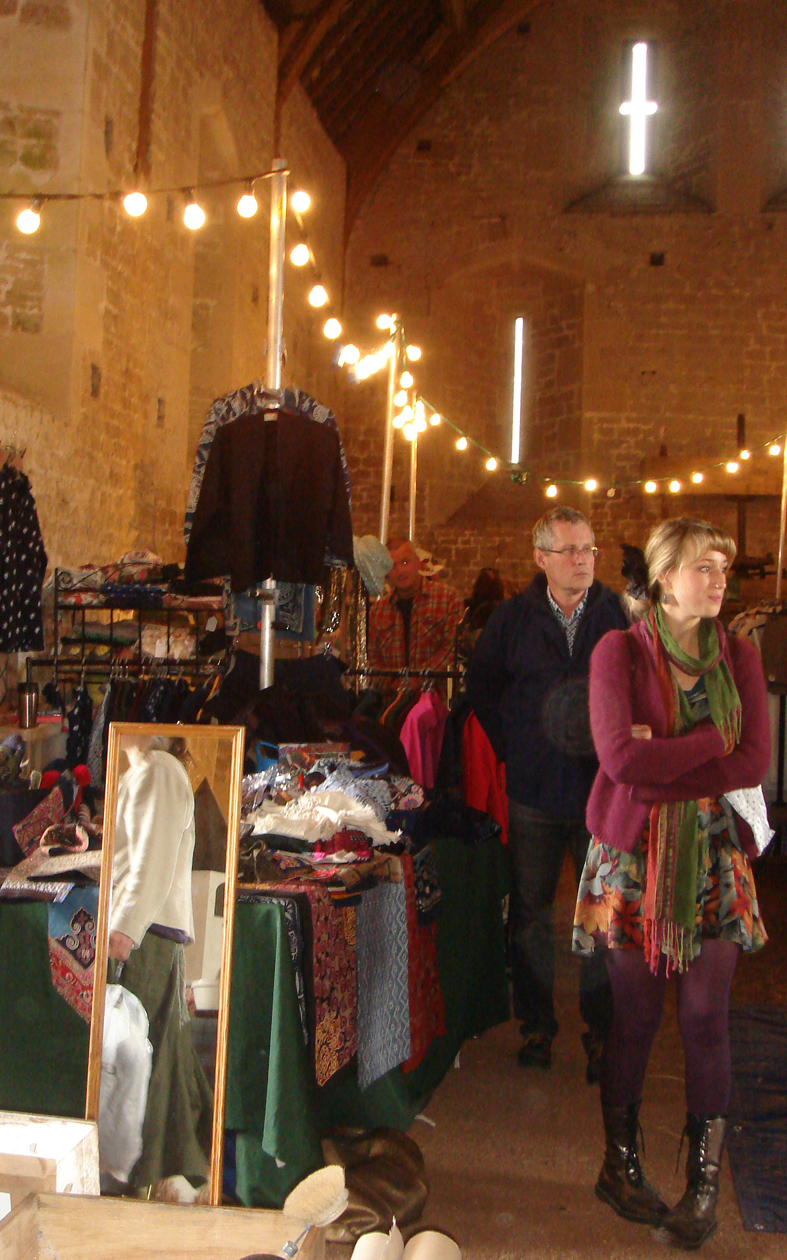
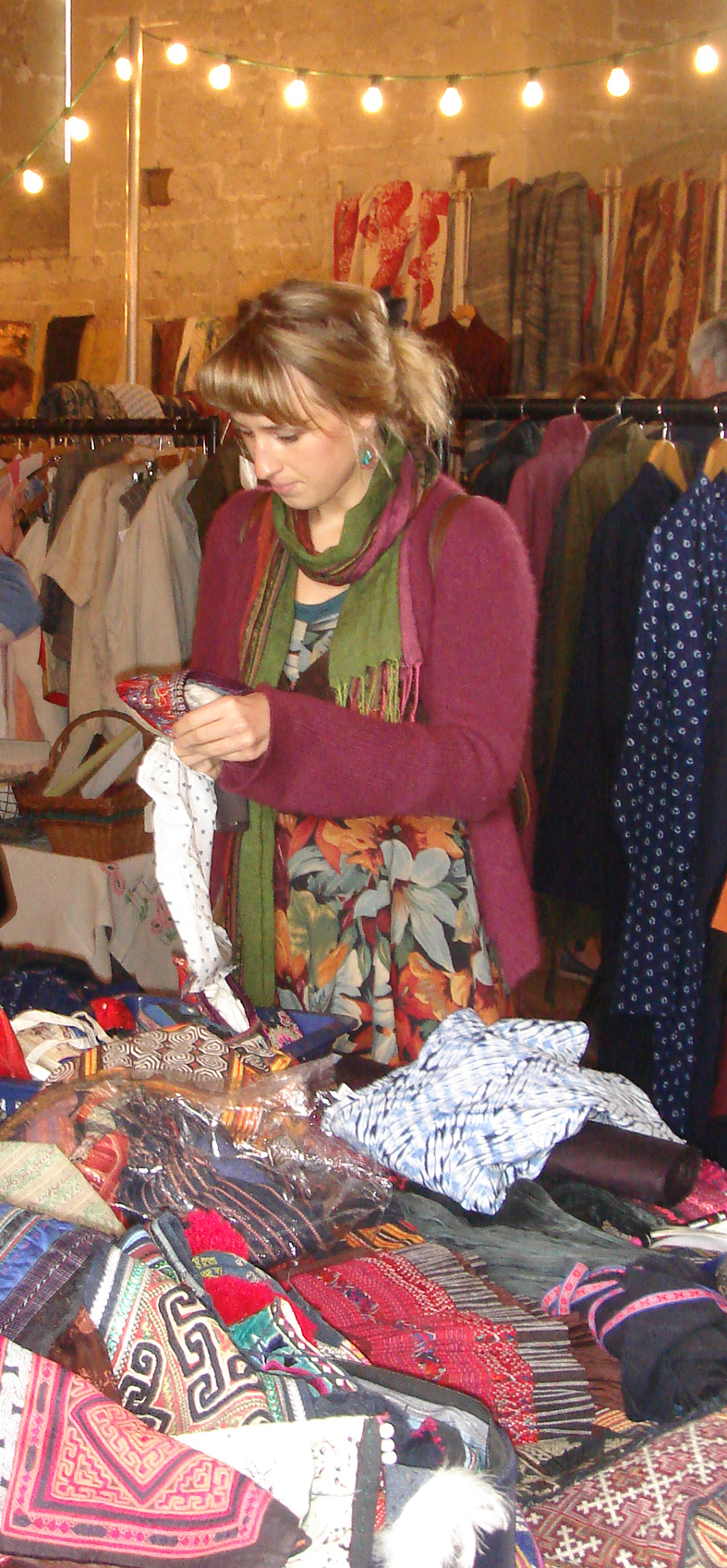
Heart Space staff went on a jolly last week, to Glastonbury for an antique textile sale. It was held in a beautiful refurbished medieval barn which although toweringly beautiful was ffffffreezing…….
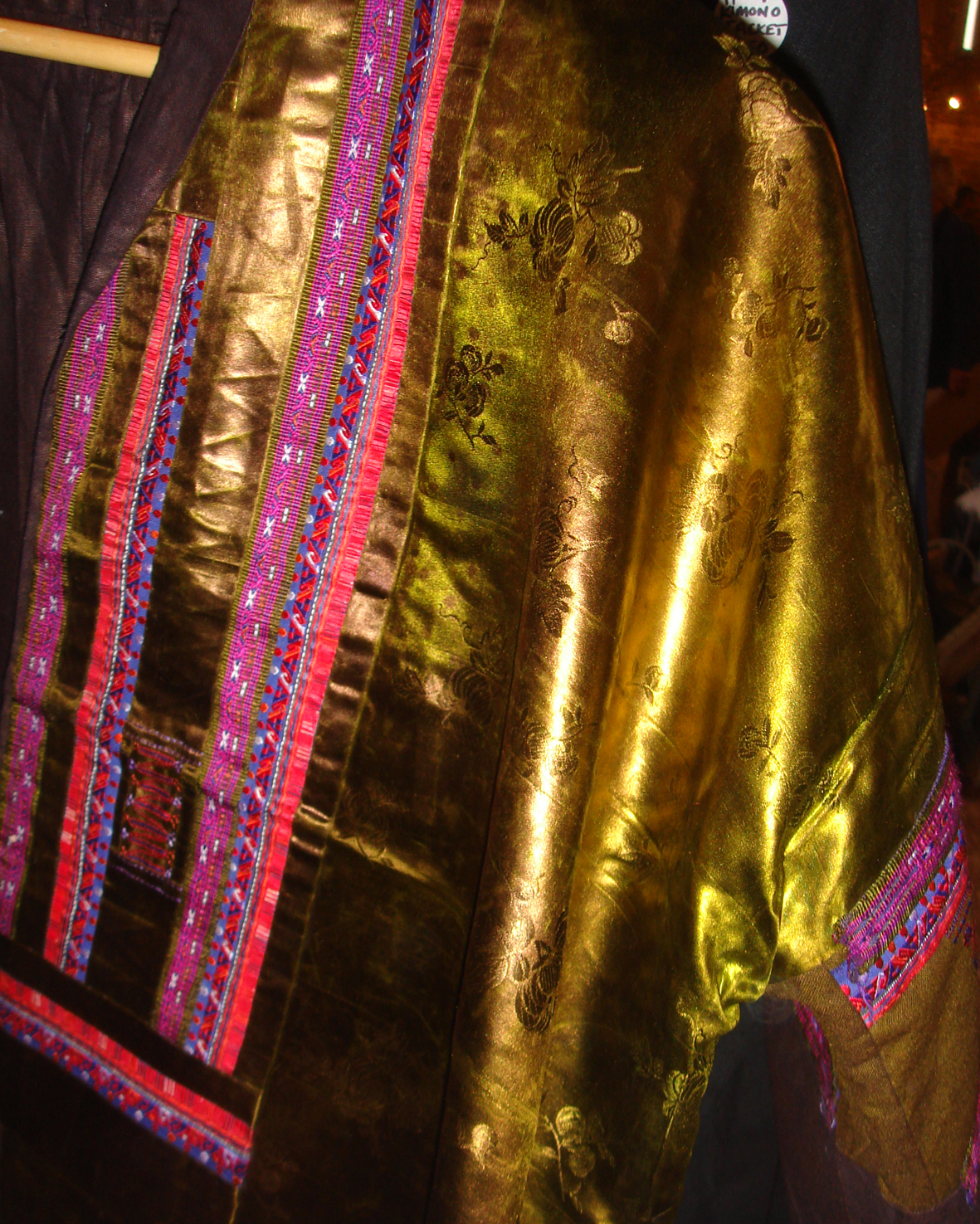
After rootling around, trying on hats, sighing over Edwardian wedding dresses and ball gowns, we eventually ended up buying all kinds of small affordable things. I always try to find either useful fabrics I can work on, got lucky and bought 12 matching linen handkerchiefs for my Make it Through the Night project, or totally Inspirational Objects – which can mean anything at all that just gets me itching to work. We all eventually gravitated to one particular stall, Slow Loris – an oriental textiles and vegetable dyed clothing stall selling wonderful embroideries and traditional ethnic indigo fabrics.
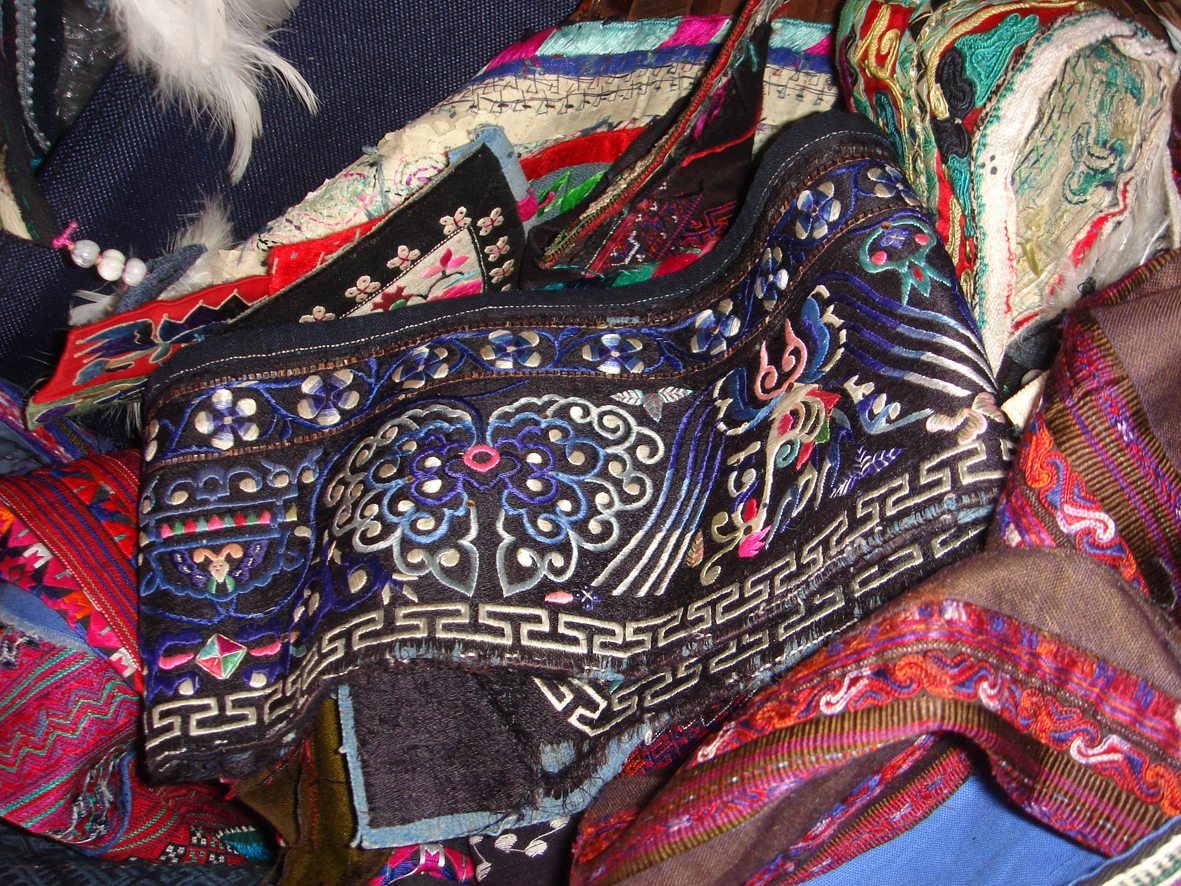
Martin Conian is a fascinating and knowledgeable dealer in wonderful things. I have scant knowledge of these textiles except that they come from a group of ethnic Chinese peoples living on the borders of Thailand, Burma, Laos and Vietnam in south East Asia, known as the golden Triangle so I am just showing you what I liked and eventually what I bought for inspiration
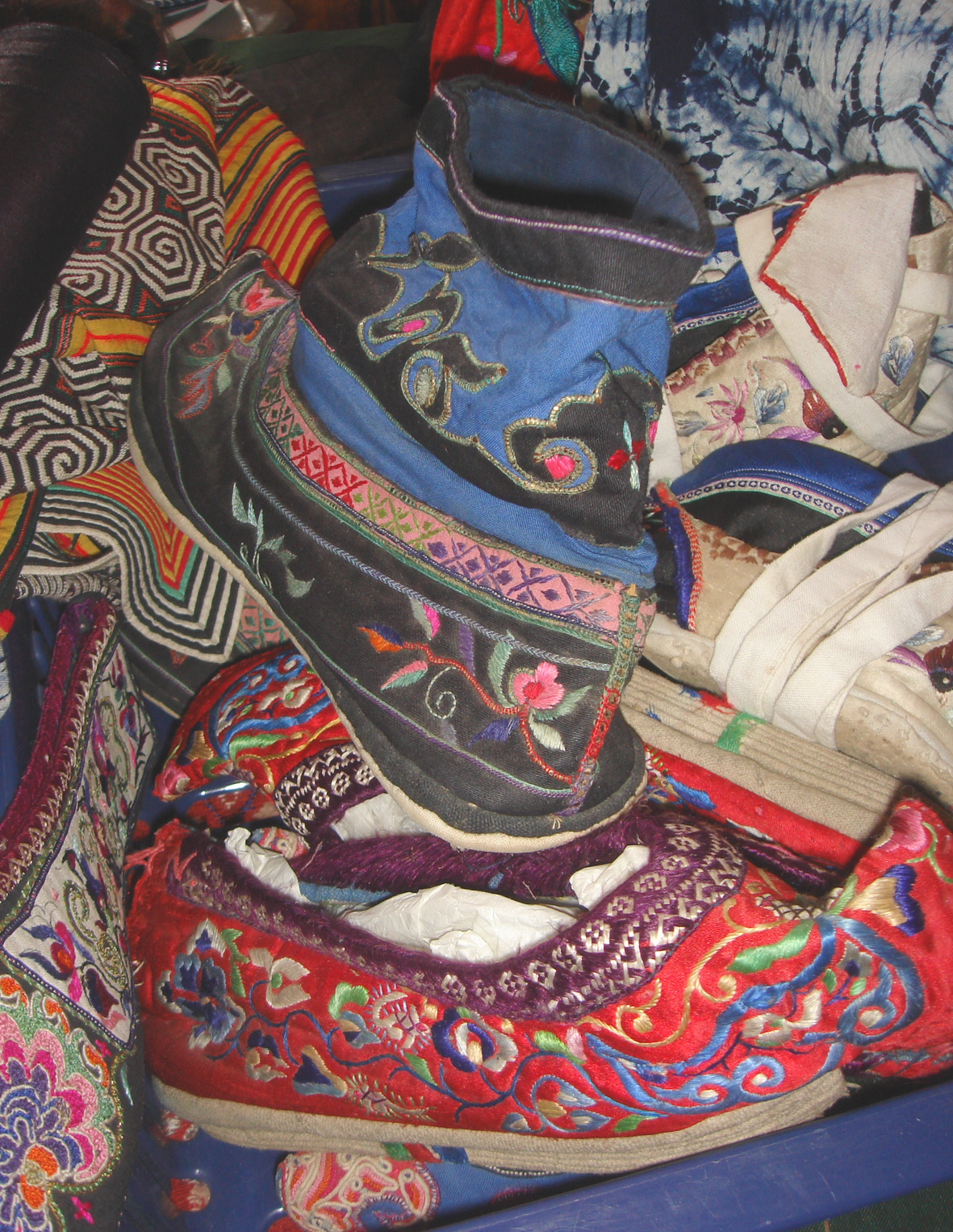
Martin has spent many years visiting, collecting, trading and working with the people who still make these costumes, books, fabrics, jewellry and boots…I got particularly interested in the boots.
embroidered silk boots and shoes
as did Sophie, our volunteer organiser who loves everything vintage, especially textiles.
We were both fascinated by the embroidered boots
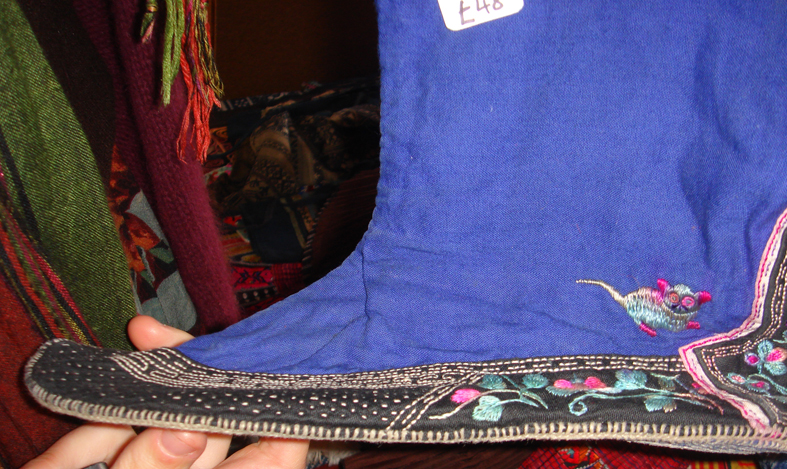
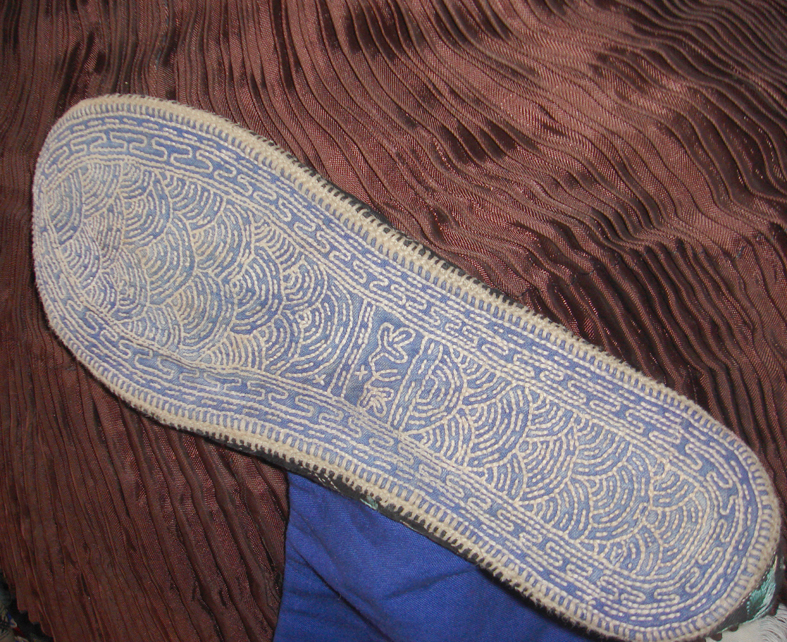
But the real delight was when we turned them over and discovered……
Embroidered Soles!
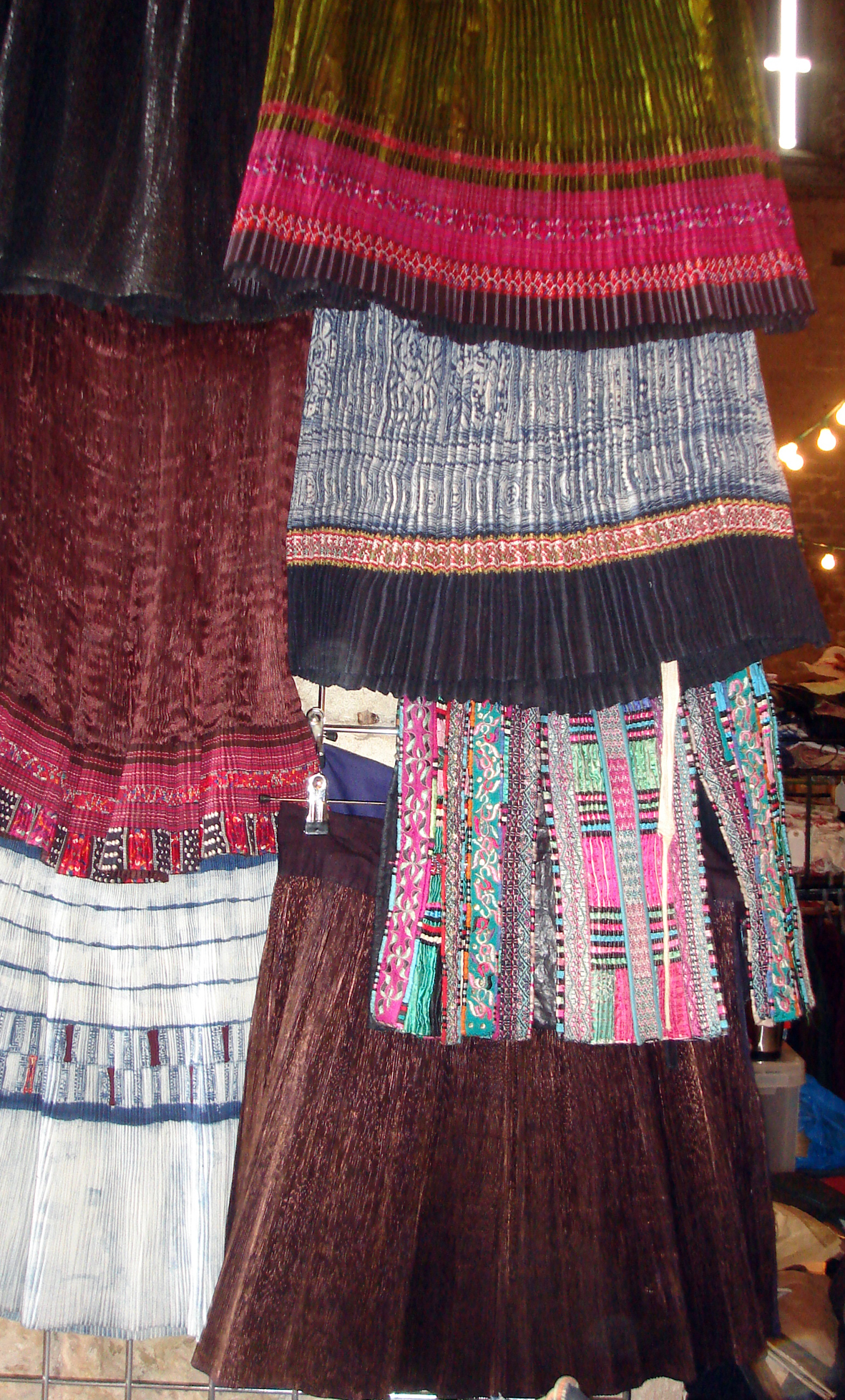
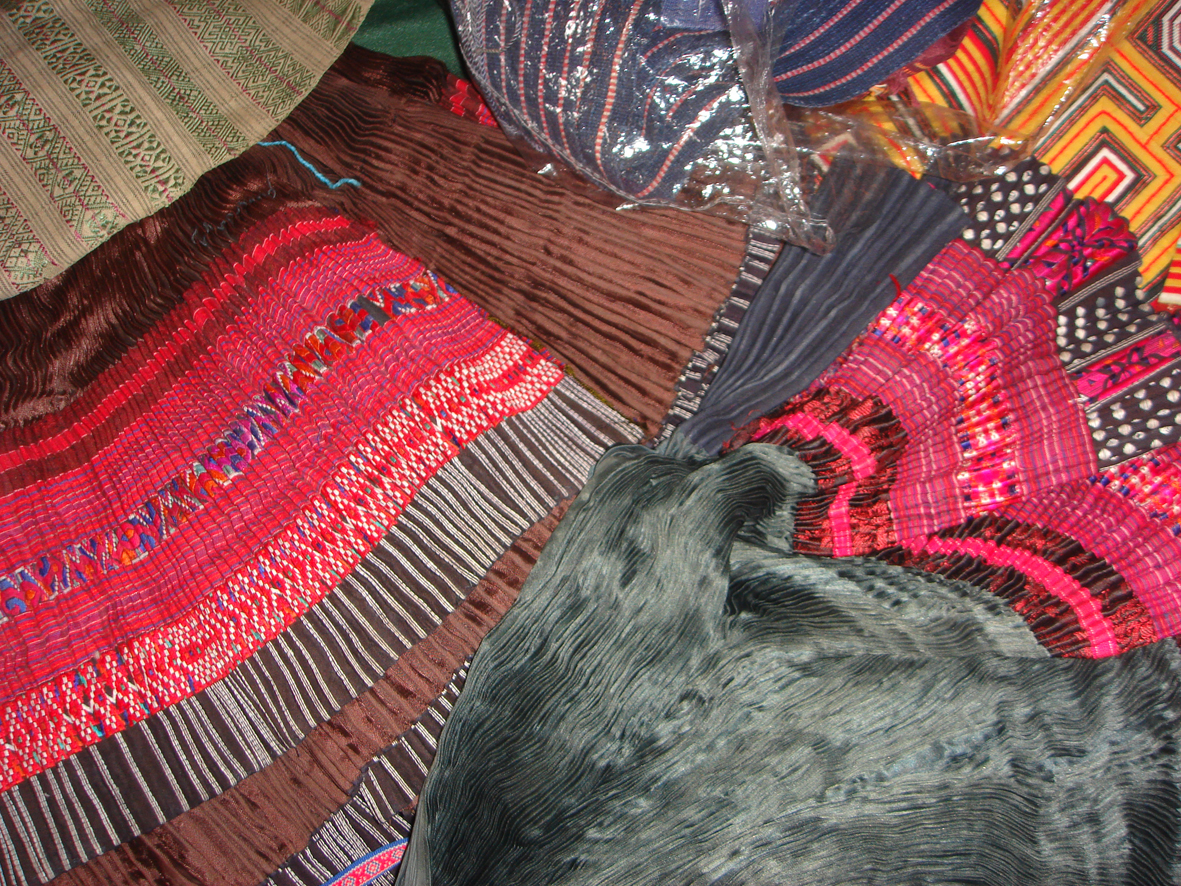
But what I really really wanted to buy – and if I could have found one to fit me I would have gone onto debt for – is a pleated burnished indigo skirt.
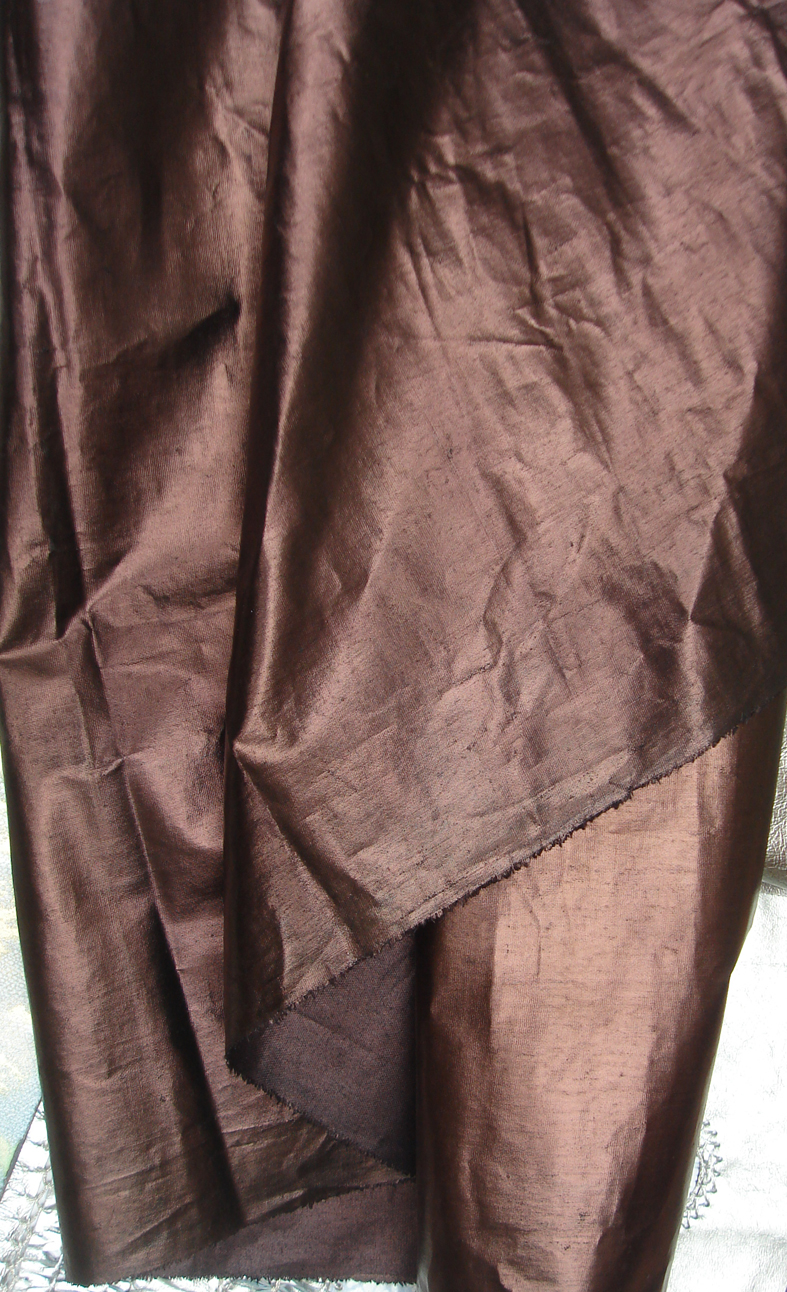
What I did eventually feel able to afford on the grounds of Inspirational Object was a metre of beaten indigo cloth; apparently the indigo is mixed with many other active natural additives to get particular effects and colours. I can only recall Martin listing egg white, persimmon, urea, amongst the different lists of ingredients he quoted to make up each different dye.
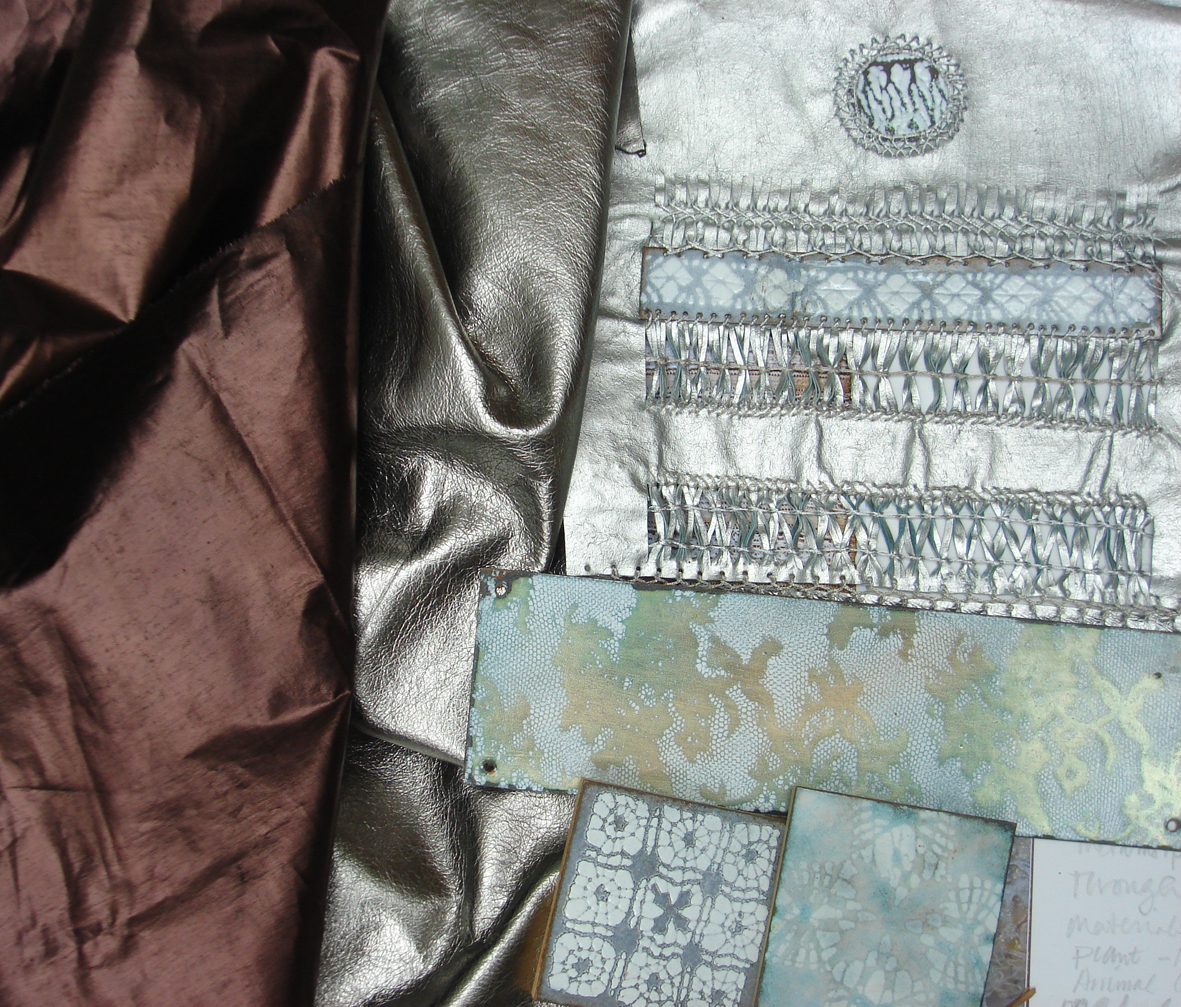
And why did I buy this simple cloth with all the wealth of other desirable things? Well suddenly I saw a connection with some other things I am wanting to work with – when I get some time- to try to make some type of collaged/appliqued/stitched/ enamelled/ threaded leathers, metals and fabrics that will be combined on such a way that I can develop an entirely new set of work.
Below is a selection of the fabrics and objects that I will now start to think about again – watch this space – but don’t hold your breath!
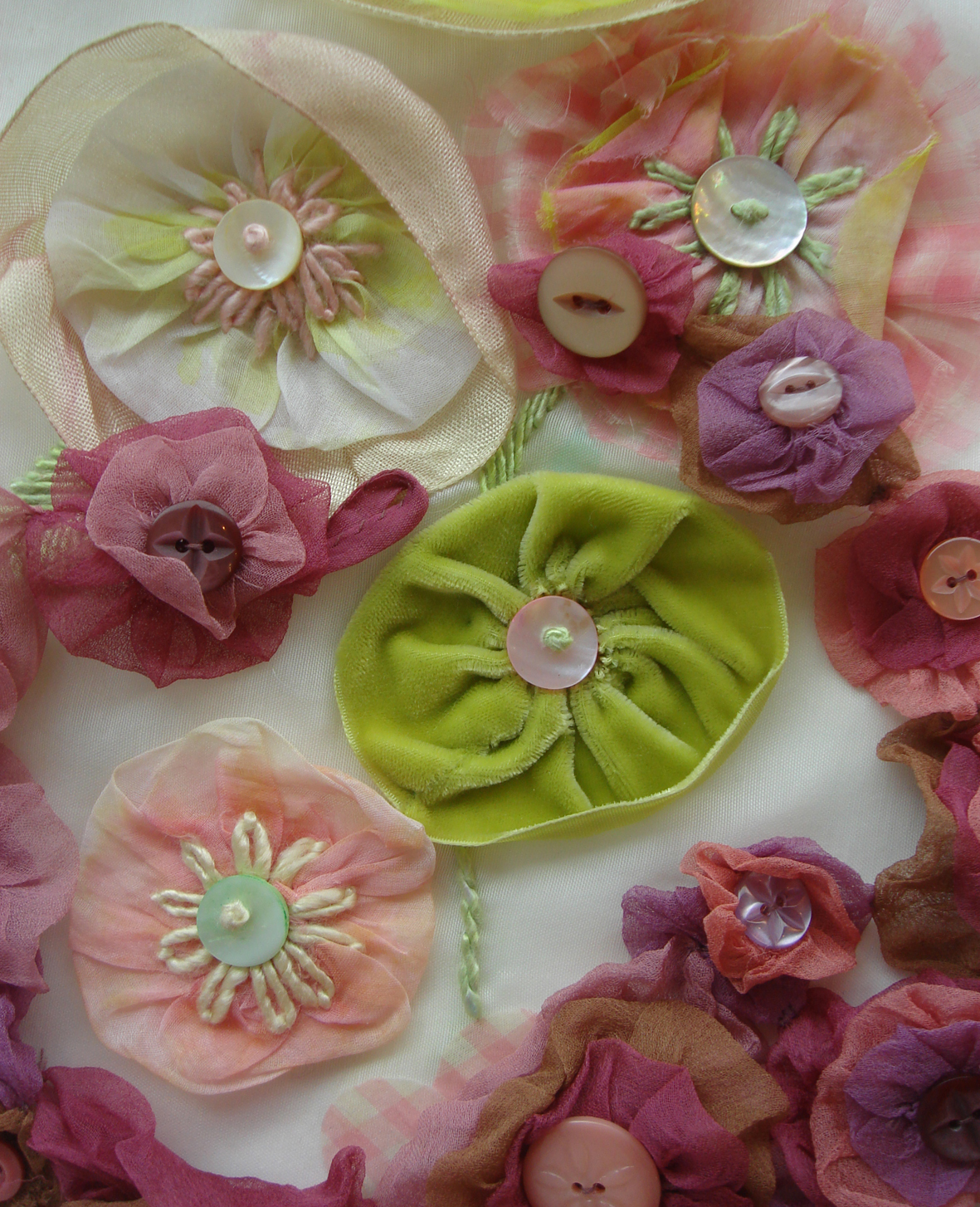
fabric and buttoned flowers - Teresa Searle and Janet Haigh
Textile jewellery comes in all sorts of styles and fabrics, there seems to be a definite trend developing at Heart Space Studios for all types of textile jewellry classes and they are really popular.
felt and fabric beads by tutor Patricia BrownenThe very first class that we ran was making fabric beads with Patricia Brownen and we are running these classes again later in the summer; the mixture of wrapped threads, beads and felt makes for really luscious beads that are simple and surprisingly quick to make.
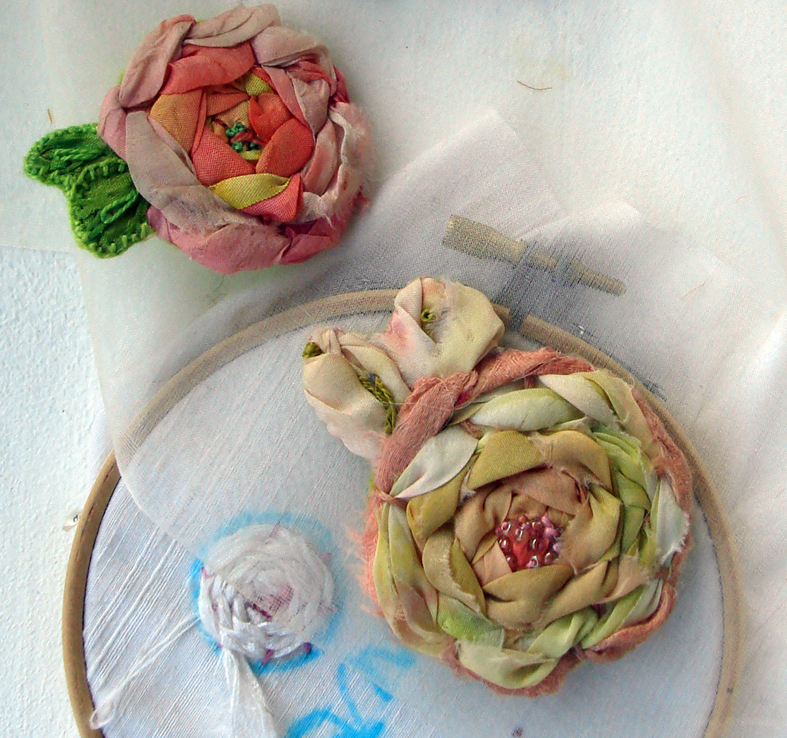
woven ribbon rose brooches - Janet Haigh
Next Saturday, 21st May, I am giving a workshop on making ribbon flowers, these are really simple, and can be used for all sorts of different things, brooches (as above) stitched onto hair slides, made into cards, or attached to a present, or even a small everlasting posy. I will demonstrate 3 techniques, woven as the rose above….
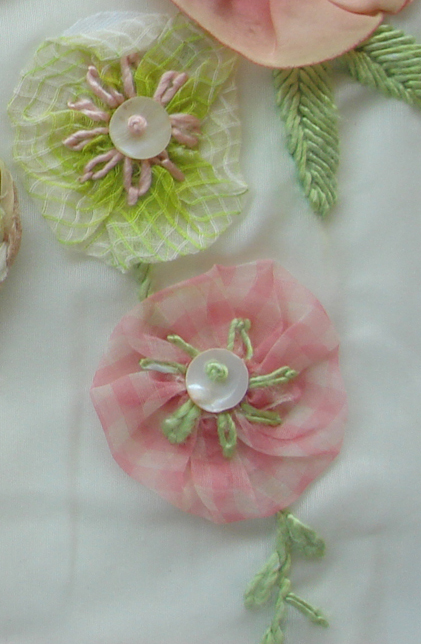
stitching ribbons as silk petals
stitched with fine ribbons or
ruched silk and organza flowers
ruched…it all depends on the quality and colour of the fabrics used that makes the difference to the flowers and at Heart Space Studios we have lovely and unusual vintage fabrics from which to choose..Hopefully I will show the results of the class in a future post – so watch this space.
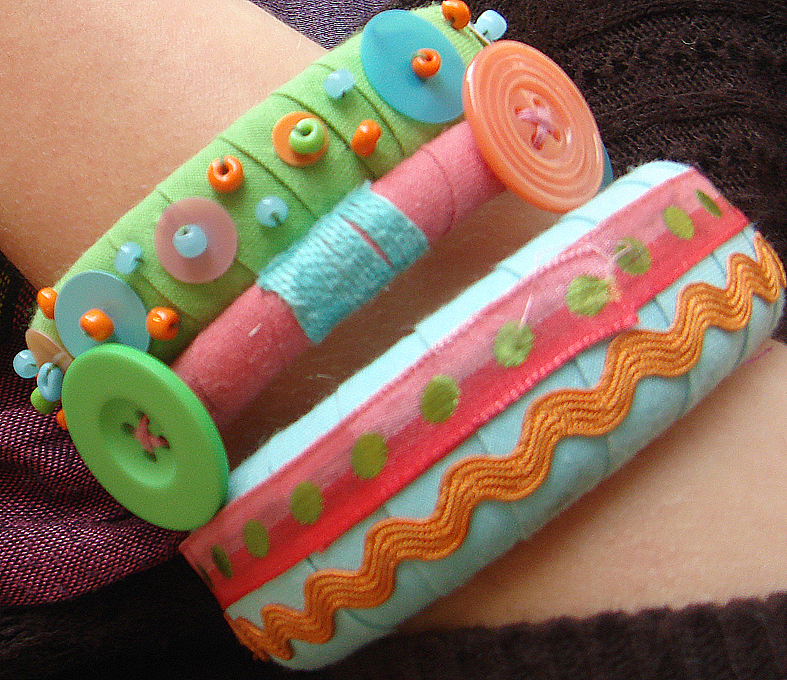
wrapped and buttoned bangles - Teresa Searle
Meanwhile several of the other tutors also running fabric jewellry classes.Teresa Searle is taking a class simply called Textile Jewellry, on Saturday June 11th and her ideas look lovely.She has more varied ideas than me as she makes bangles, brooches and necklaces.
2 necklaces by Teresa Searle, one flowered and one scrappy fabrics and beads.
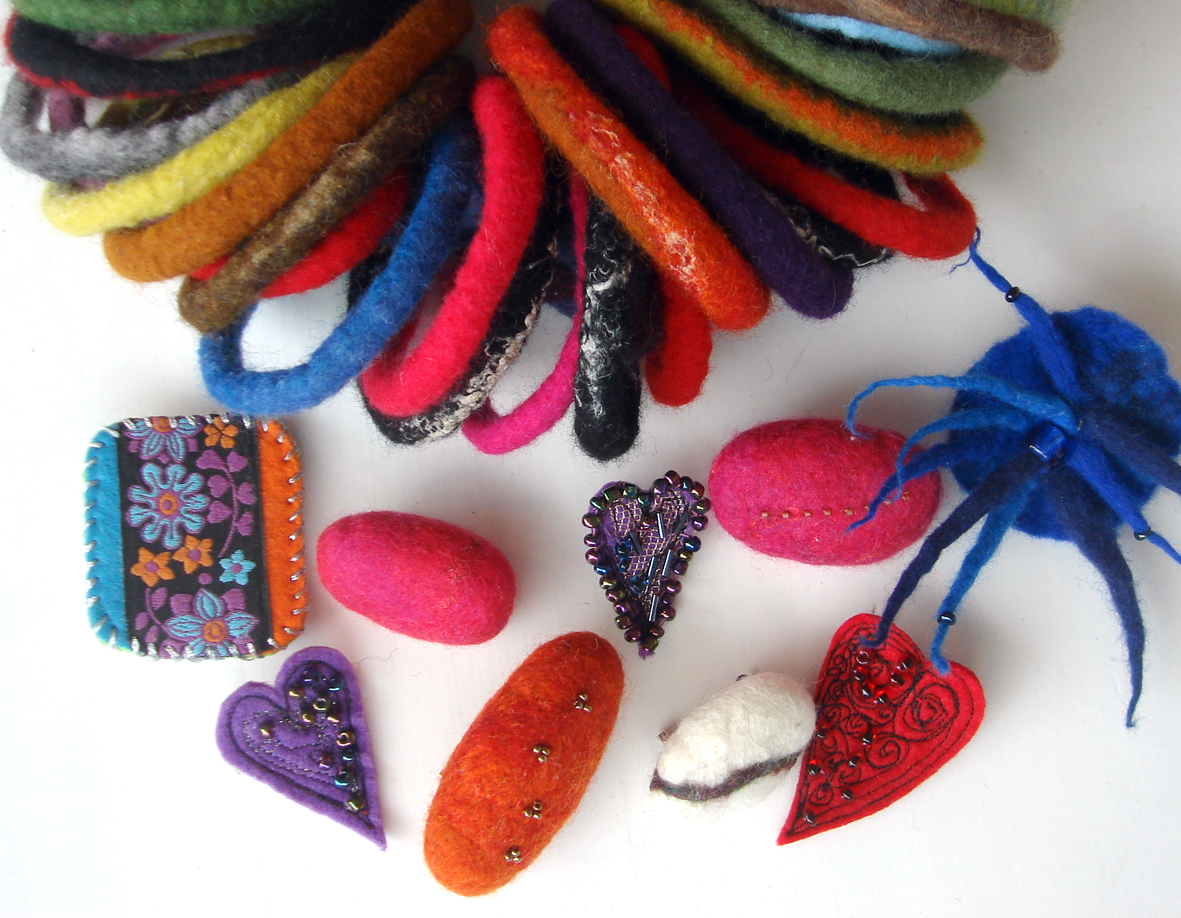
Two other tutors are making jewellry with felt, Janet Clarke, our regular felt-making tutor has designed simple and elegant round seamless felt bangles which you just want to make and wear several together. you will have this opportunity later in the summer. She also produces curious felt “stone” brooches – light as a feather but perfectly formed by her immaculate techniques and then there is the blue ‘alien’ brooch – see below…..
Whole felt bracelets by Janet Clarke shown with her felt stone brooches and her 'alien' threatening Debbie Bird's beaded felt heart brooches with one of my own appliqued ribbon and felt stitched badges
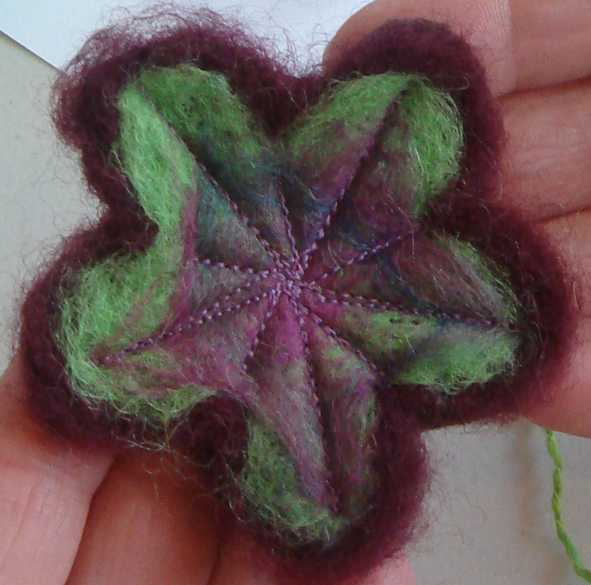
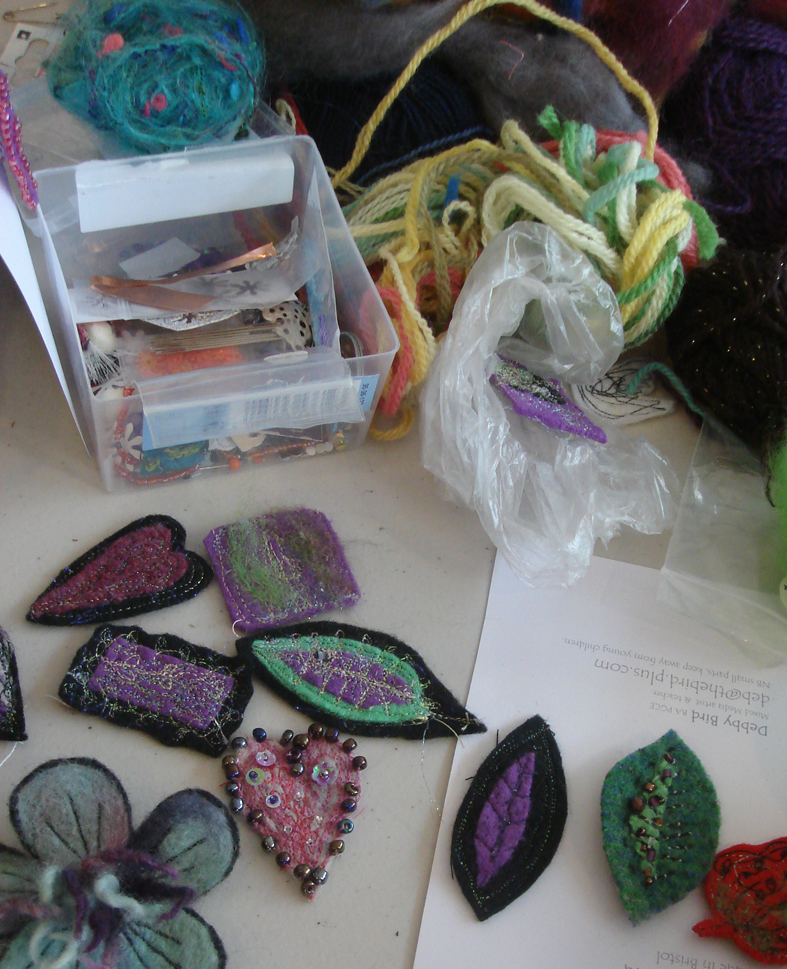
Debbie Bird makes brooches and jewellry from all sorts of stuff in her popular classes”Wear your Heart on your Sleeve”, below is a student’s first attempt at needle felt with machine stitching.
needle felted exotic flower - made at a previous Heart Space class.
Debbie’s next class is on 28th June, for all those who feel they might like to try her varied textile techniques to produce really personal jewellry.
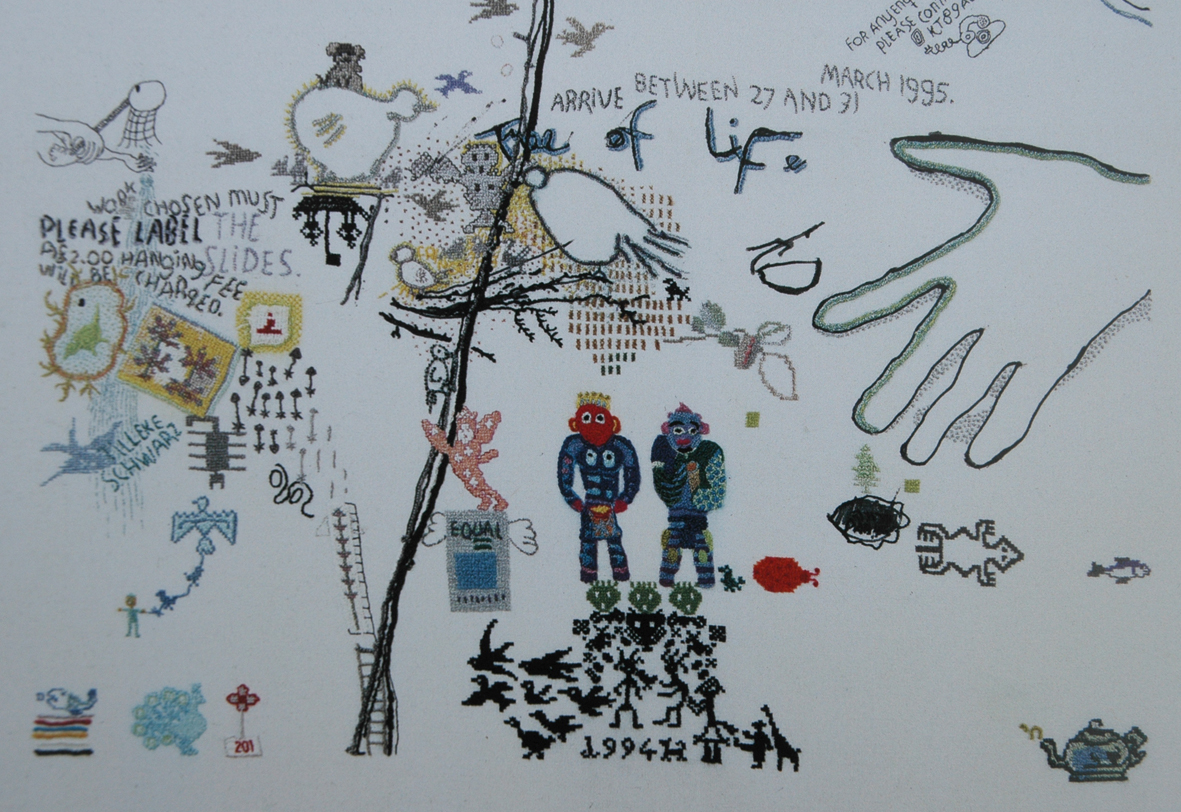
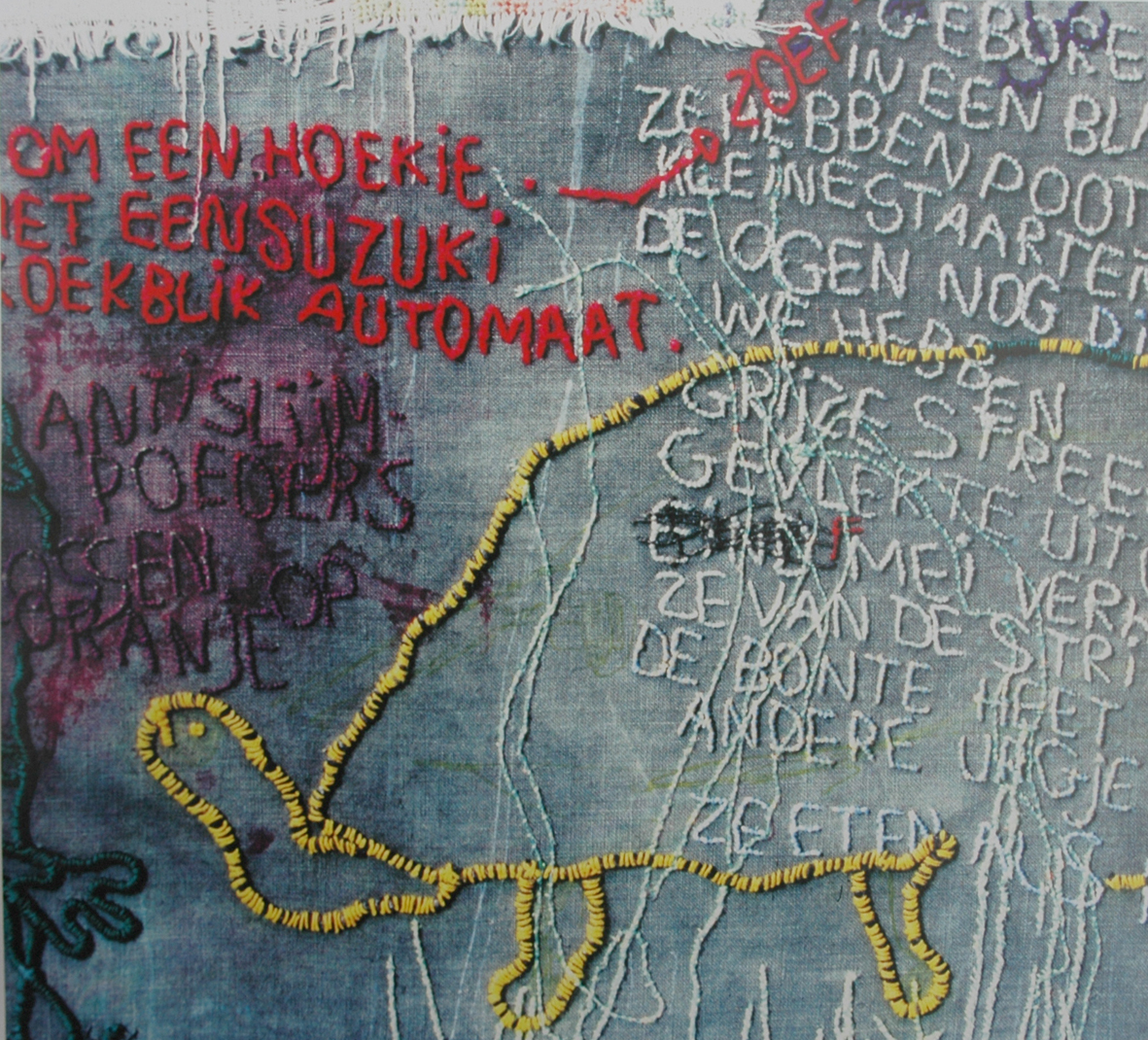
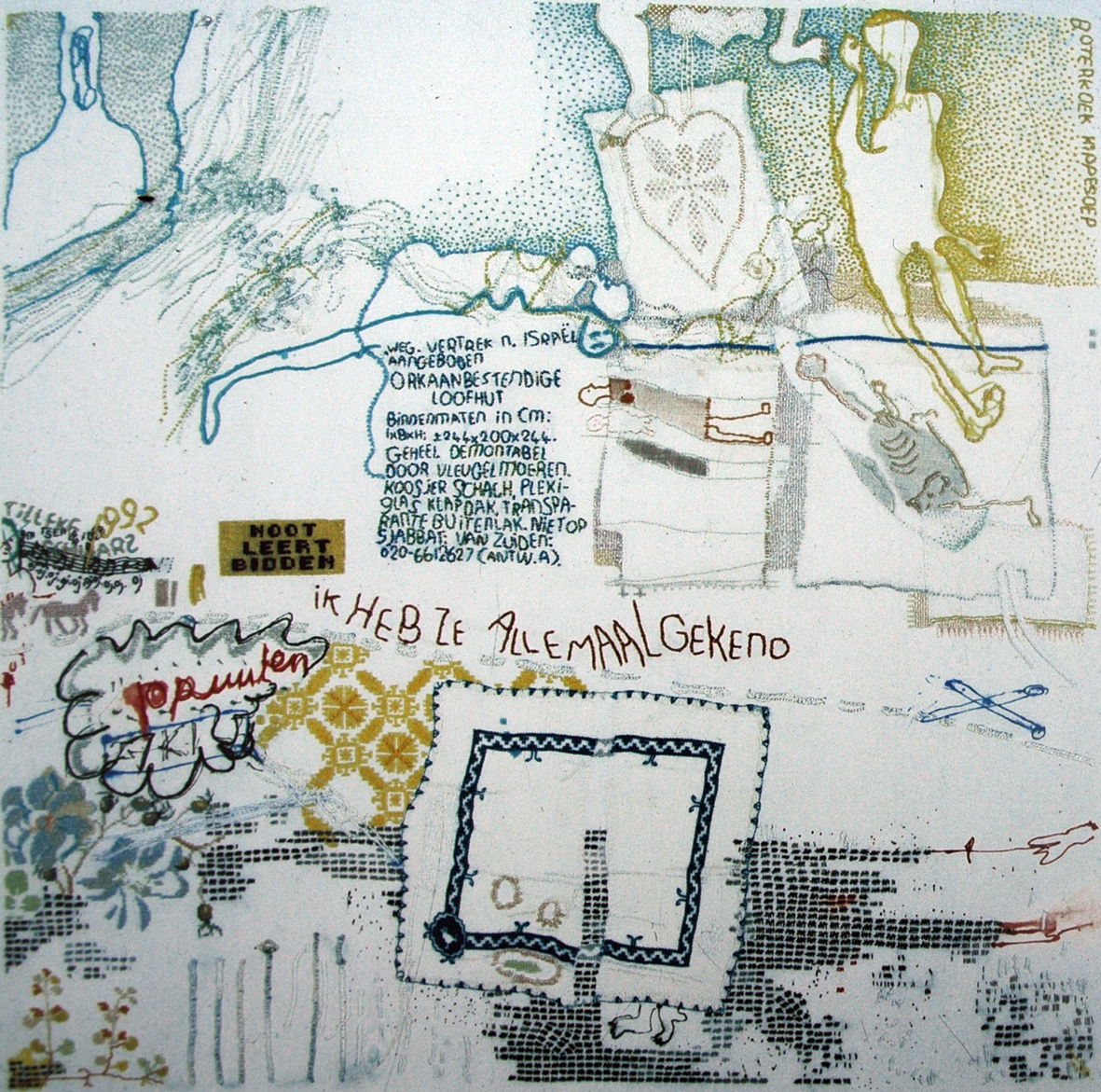
You know when you go to a textile exhibition and you just want to run away? I quite often feel like this for all the wrong reasons; but visiting ‘Word Play’ in The Museum in the Park at the Stroud International Textile Festival, I really wanted to just go home without seeing any of the other exhibitions on display throughout the town. The reason was seeing several hand embroidered panels by Tilleke Schwarz, some older works but one made this year.
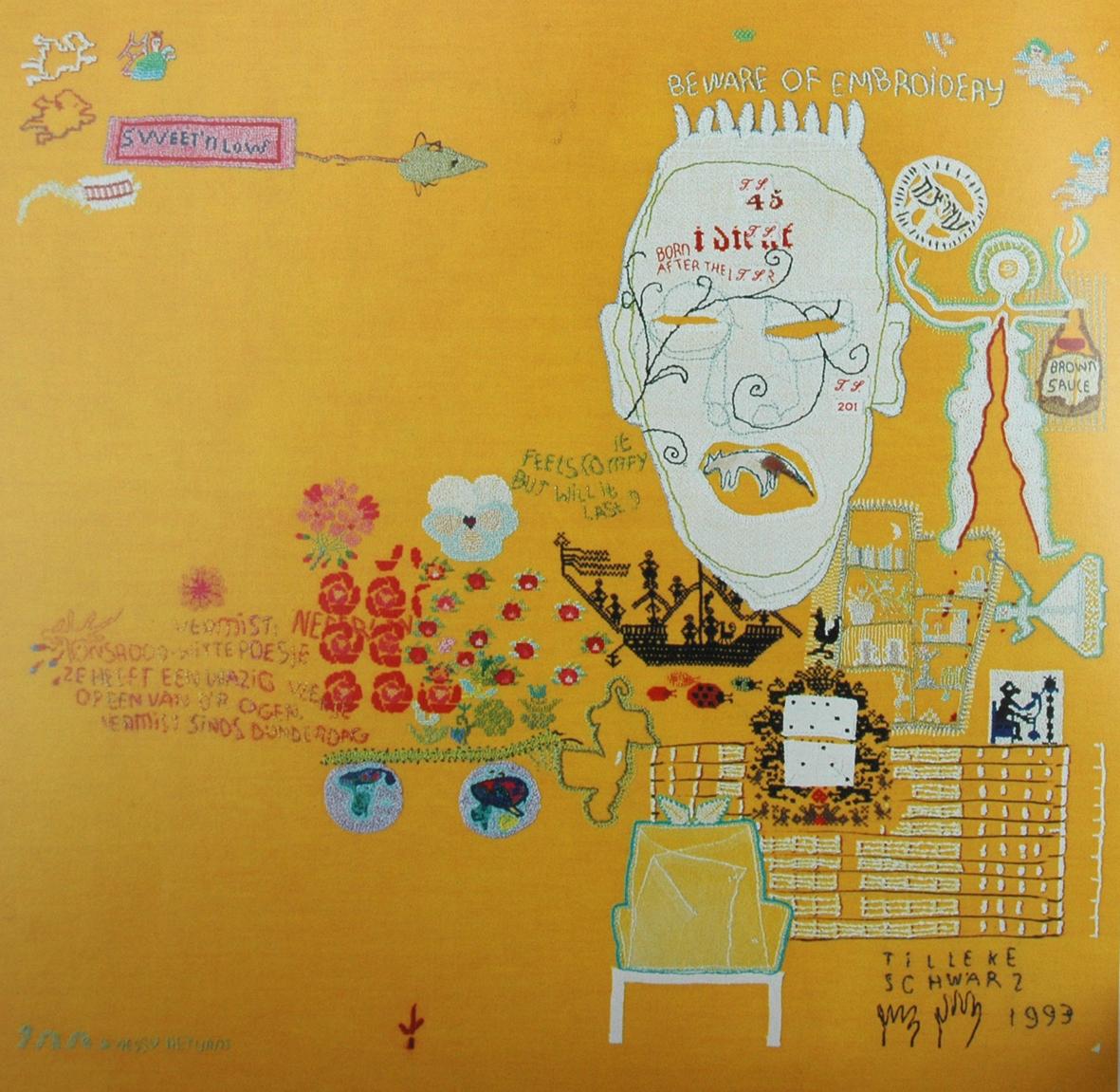
I at once thought this will make a wonderful post because I was so freshly excited by seeing in the flesh – so to speak – work that I was already familiar with and this made me re-think what I was actualy doing within my own practice. So I asked permission to take photographs explaining that I wanted to show and discuss the work in my textile blog. But it was stipulated at the bottom of a sheaf of gallery documents – No Photography – even though I had already seen people taking photographs in the gallery……but in matters of copyright and blogging I really try to get permission were possible. So the work I am showing here is from my much thumbed copy of her excellent book Mark Making, copyright 2007 – ISBN: 978-90-70655-54-9 available from her website.
But this refusal wasn’t the reason I wanted to run – to say I was envious doesn’t quite sum up my feelings sitting outside the gallery later and waiting for my buddies from TFSW to take part in a Tea and Textiles walk round the Stroud exhibitions, what I was feeling was deflated. There was this wonderful set of work in a room full of other interesting works, some of which I know well and I felt dejected; why?
The exhibited works for the most part all had words in them, but some didn’t – more mark making or signs from Clyde Oliver – who showed handsome large lichen covered stones that had been drilled and stitched and I really did want to own one. Jess Turrell ( who I know well and is a member of the Stitching and Thinking group) showed her exquisite etched and enamelled words pieces; they somehow always make my gaze slide over the words when attempting to read them, so the surface of the objects becomes very important – even though I know this isn’t the maker’s intent – or is it? And then I realized that only in Tilleke Schwarz’s work, were you made to stop (even when the words are in her own language) her myriad amount of details make you attend to the work, stay in the moment, see the world from her varied and personal view points – which for the most part are humorous, wry, colourful, hand stitched, multi-layered, and ultimately worthy of prolonged attention.
And what I did discover when looking at this work was that it was the actual stitched surface, the haphazard motifs and slogans made in a whole range of traditional hand embroidered techniques, that make you attend. The sheer variety of stitching techniques means that it is never tedious to try to decipher her images and messages, in fact they just make you smile in recognition as some motifs are from traditional stitching samplers and appear time and again as do the commonplace overheard remarks or slogans.
These are perfect samplers for our times, wonderful regenerated versions of our European embroidery heritage, made in the image of graffiti – the little cross stitched pairs of birds, the signing alphabets, the daisies and carnations, as well as couching, running stitch, back stitch, seed stitch, all subverting the past rigidity of teaching needlework to girls; no wonder our stitching hearts sing when we see them. These seemingly untidy stitches are perfectly controlled, the couched down ravells of thread are meticulously held with the tiniest of single stitches – this isn’t slipshod work. Stitch used in this way seems to me to embody the energy of our increasingly overloaded visual world, and as the stitch changes depending on what is being depicted, the sheer mastery of the maker’s own language of hand stitching is demonstrated. And this is what made me envious and questioning my own way of constantly changing materials and techniques – why haven’t I just stayed with the needle and threads and fabrics? Here the modern, fast- moving, hectic overloaded visual world we live in is illustrated in one of the oldest and most traditional and slowest textile techniques, hand embroidery.
But more than anything else, what completely got to me about these works was their freshly washed, starched, ironed and ultimately immaculately presented surfaces. Here is our domestic heritage for all to admire, here is a woman proud of her work and wanting us to see it at its very best. I could almost smell the clean fabrics and I could imagine the time consuming preparations of the cloths so that the framer had very little to do but simply place each work into position and seal the back.
And now I hear you ask, how come you have been able to use these images from a book which is subject to copyright? Well yesterday morning I emailed Tilleke Schwarz, because on her website she says to contact her for permission to use any images. I really did not expect to hear from her for some time, if at all….but by the afternoon I had a reply saying that due to phone cameras it is virtually impossible to keep track of taking photographs of work any more…..if only I had the time to go back to the exhibition this week armed with this information – but my own Open Studio calls.