Gertie the Sheep just about sums up what the first Bristol Wool Fair held on Durdham Downs (which still has ancient grazing rights for sheep) was all about…amusing, colourful and very woolly in all parts…..The Wool Fair is the brain child of Sarah and David Harris who run a large and fully stocked yarn and fabric supply store called “The Spinning Weal
first day gets underway decorating Gertie.
Second day for Gertie
Gertie was the first neighbour I saw when I arrived to set up the Heart Space exhibition and stand. she was placed on a table with hundreds of lovely crocheted flowers at her feet…her face already made-up and a flower ticked behind her ear. each day she got more a more of the flowers added to her coat, by anyone who cared to assist. She was slowly dressed up each day and by the end of the show she was ready for her progress around the show ground – in a basket on a push trolley.
end of second day
Gertie on her final day
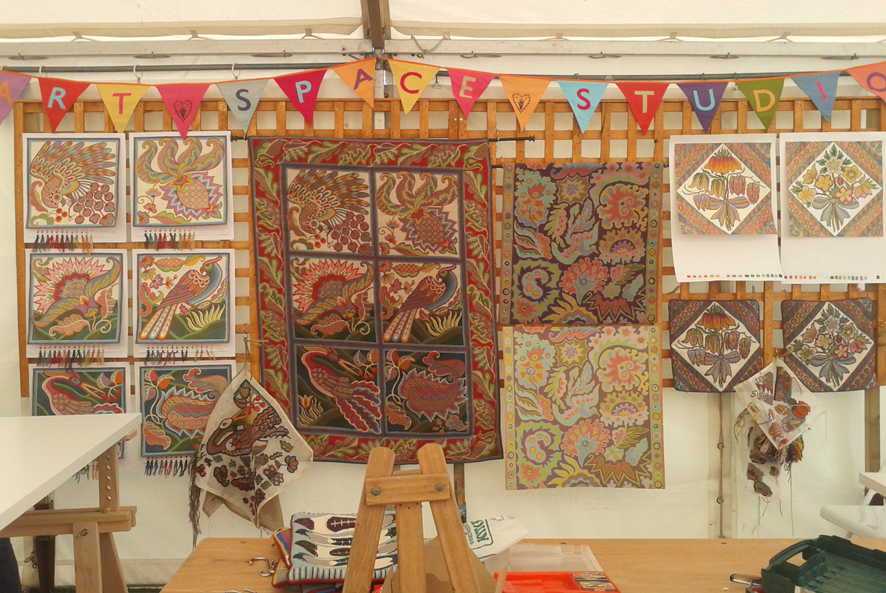
Heart Space Studios was invited to attend as part of the educational content alongside the various fibre and fabric guilds. I decided to mount an exhibition of the only completely woolen embroideries that I work – they are designs for the canvas work kit company Ehrman Tapestry.
The Heart Space Studios’ stand at the Wool Fair – featuring my designs for Ehrman Tapestry Company
we also exhibited any of pur current workshops that feature wool – so knitted lampshades and some lovely beaded knitwear.
detail of art- work and finished canvases in the exhibition with samples from the autumn workshops, knitted lampshades, felt jewellery and beaded knitting
Heart Space also gave demonstrations of various workshops ion offer, Amanda Jones, had a fascinated audience for knitting with beads – the beads are threaded onto the yarn first and then the fun begins…
everyone enjoying the demonstration of beaded kitting by Amanda Jones.
Heart Space also helped with teaching anyone and everyone to learn to knit and crochet, several members of out Knit and Stitch clubs volunteered their services.
Paula New, who runs the Wednesday morning Knit and Stitch club teaches a group of young people to get a grip of those large knitting needles
other demonstrations held by our tutors were also very popular; the children’s activity book made using felt applique got a really attentive crowd.
Iaria Padovani demonstrates the charms of teaching numerals in her felt activity book for younger children.
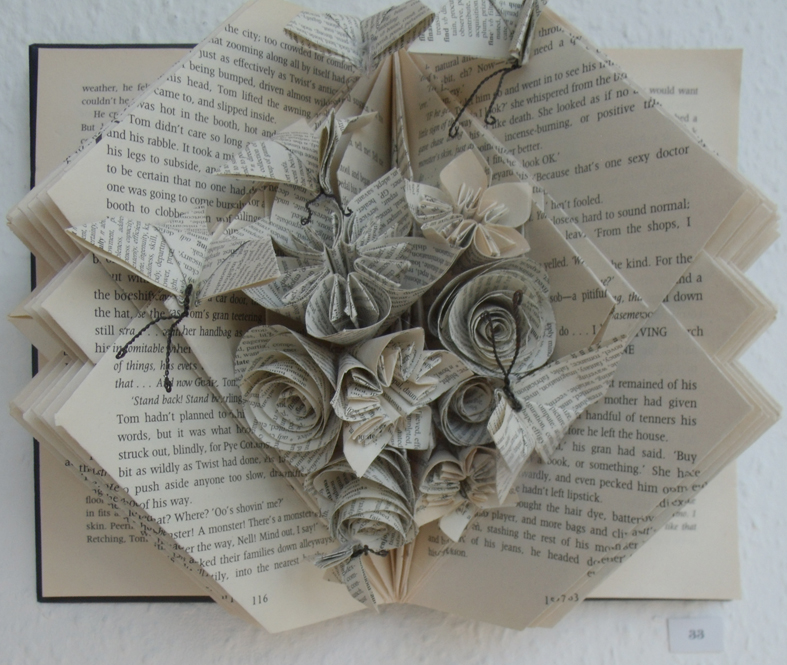
folded book of flowers and butterflies – Ilaria Padovani
The world is full of surprises. You invite a group of people to develop ideas together in a studio in order to make work for a themed exhibition over a period of 6 weeks, then they go away and come back 3 weeks later with something completely different – Hey Ho! BUT sometimes the things they bring back are so different and you realise that they have taken a new direction because of the theme – what could be a better result?
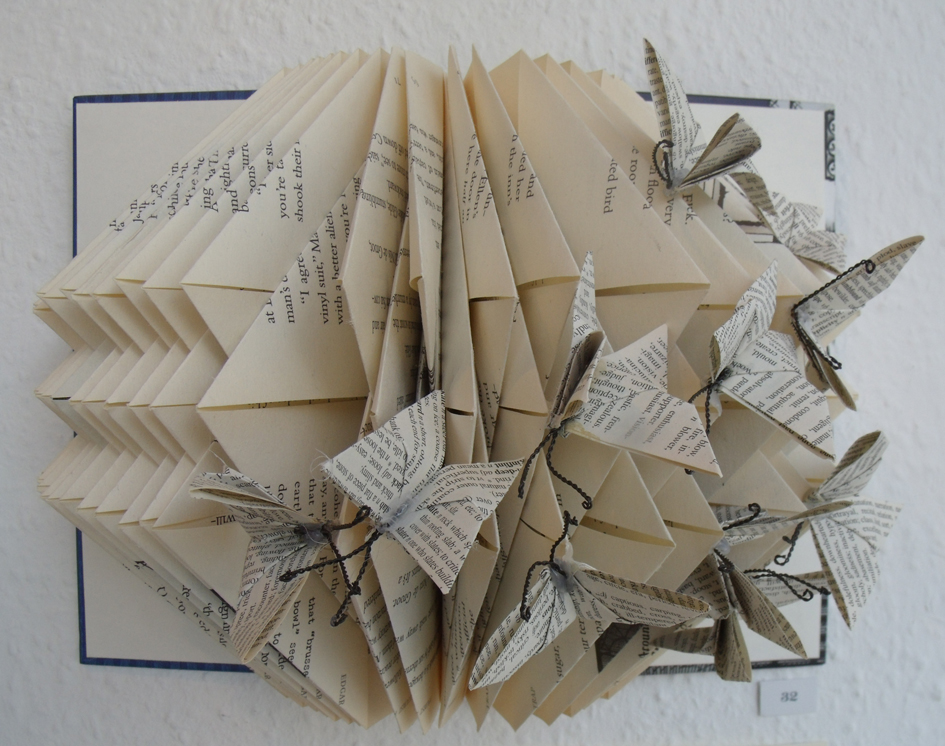
folded book with moths- Ilaria Padovani
So when Ilaria Padovani, who is a volunteer at Heart Space Studios, arrived the day before the deadline with 4 folded and paper sculpted books, I could only gaze in amazement (she was making a flight of patchwork butterflies last time we spoke)! I had asked everyone to write a few sentences about why they had done the work, knowing from experience that most people engage more easily and trust the words they read, rather than the images they view – I have the opposite point of view but that’s anther story!
‘VERBA VOLANT, SCRIPTA MANENT…Spoken words fly away, written words remain…’
“This was my big sister’s reply to a letter I had written to her pontificating on how to raise her child. Although my intentions were good I had been arrogant and hurtful to someone I love dearly.After her phone call, I stayed up all night thinking of a way to show her how deeply sorry I was for my inconsiderate missive. I had wished the words I had written could have flown away from the page like a flutter of butterflies.
I started folding the pages of a book she used to read to me as a child. I folded a kaleidoscope of butterflies and arranged them soaring out of the pages. The making was cathartic to me and so was her forgiveness on receiving the book”.
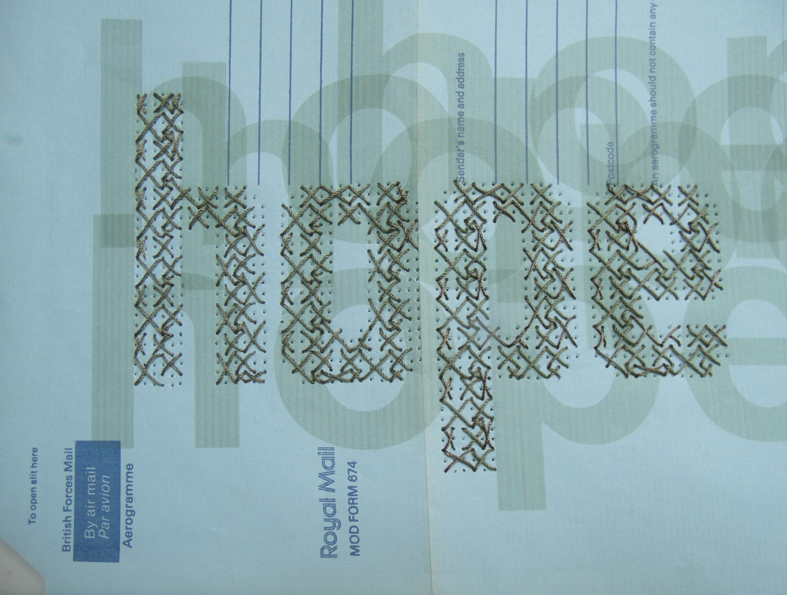
stitched and printed air mail letter – Steph Wooster
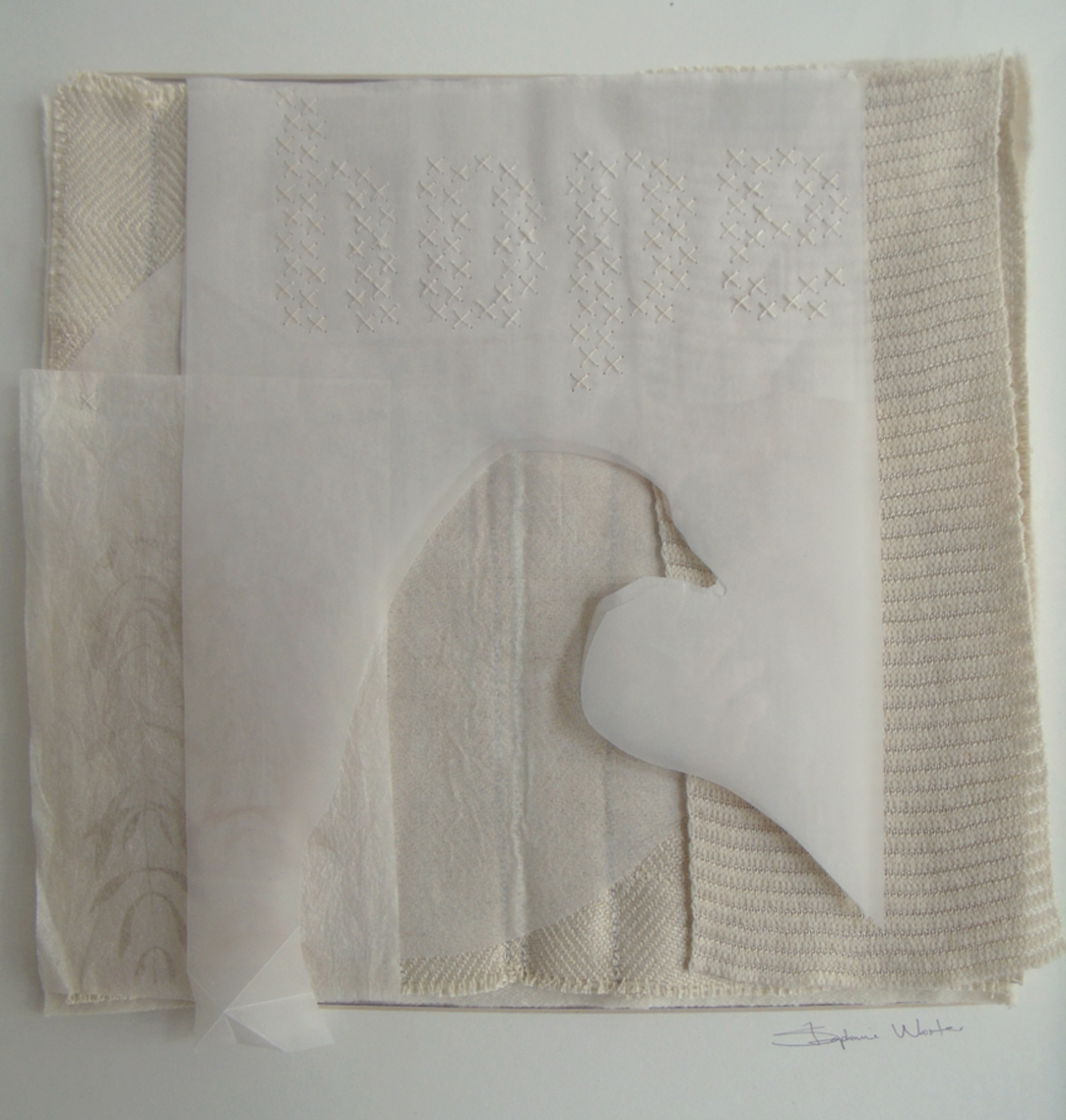
Writing was a theme for many of the pieces in this mixed media exhibition. Steph Wooster, was researching ideas about carrier pigeons, doves and messages of peace, so this old airmail letter has been printed and then embroidered in cross stitch with a the one thing that you can’t give up when waiting for news. Steph’s images are truly mixed media, she prints, knits and embroiders onto papers and fabrics of different densities – layering the multiple sheets of images and text together.
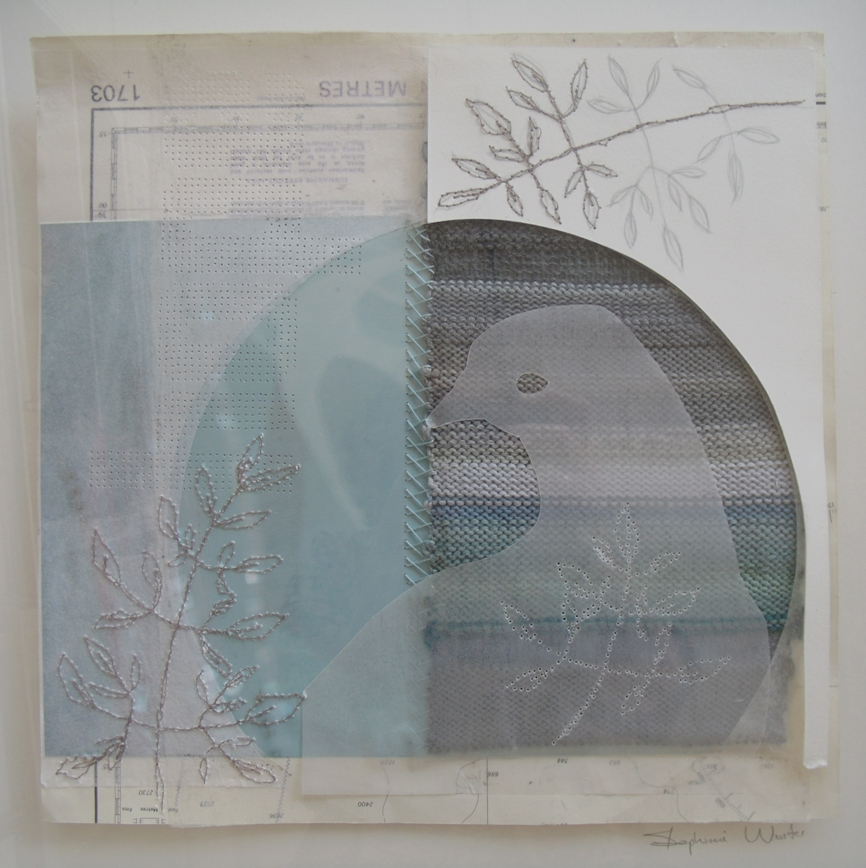
multi-media layered image of pigeons and laurel branches – Steph Wooster
multi-media Hope dove – Steph Wooster
” I have an ongoing interest in mixing media, materials and processes. Attending workshops at Heart Space has introduced me to paper-cutting and patching processes that I have explored further with my knitting, stitching, printing and sketching. Making work for Things with Wings I immediately thought of pigeons. I love pigeons, grey, common, mundane and overlooked. Their invisibility and homing instinct led me to layering maps, graphs, envelopes, knitting, photographs, feathers and tracing paper. I wanted to show the humble pigeon as cousin of the dove who brought Noah the olive branch, embodying hope for the future.”
Mary Bishop has used her own hand-writing to inscribe poems and rhymes that have been illustrated by embroidering into papers and fabrics. I always recite this rhyme when I see any magpies – its an old English saying. Mary has condensed and enriched her first sample idea that she was working on in the studios to make these encrusted applique and collaged pieces.
Magpie’s nest – Mary Bishop
My inspiration for this piece was my workroom which is like a magpie’s nest, full of bits that glitter and are pretty, things that cry out to be reused. I really enjoyed reflecting it in this nest
ladybird, Ladybird – Mary Bishop
I love ladybirds, so pretty and attracted to colour, I was really inspired by my many colours of threads to build up this flower bed and the cobweb to illustrate this lovely poem.
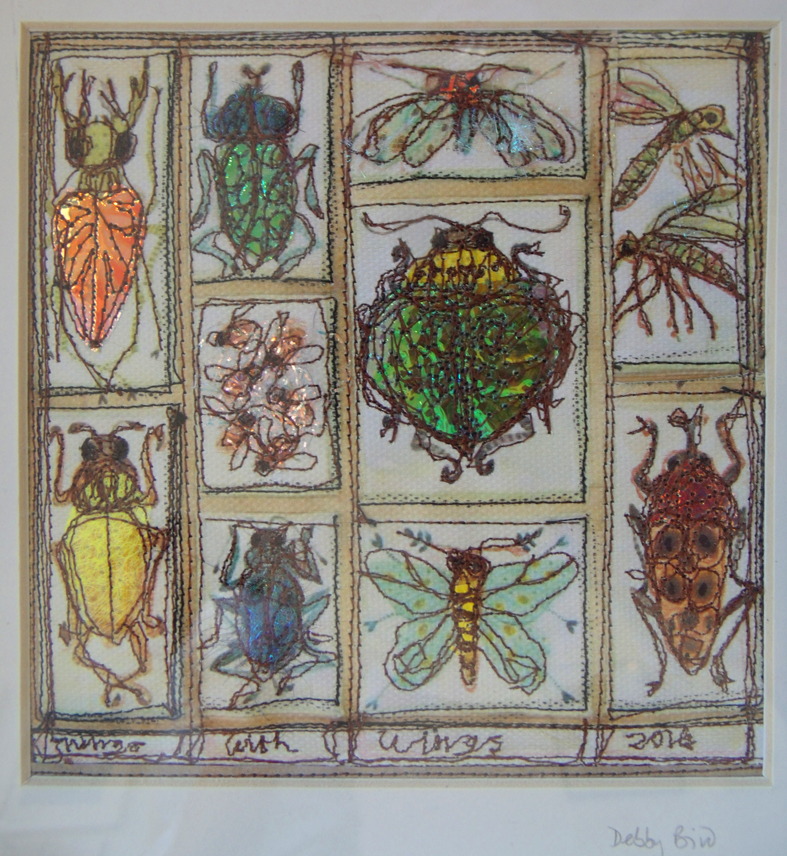
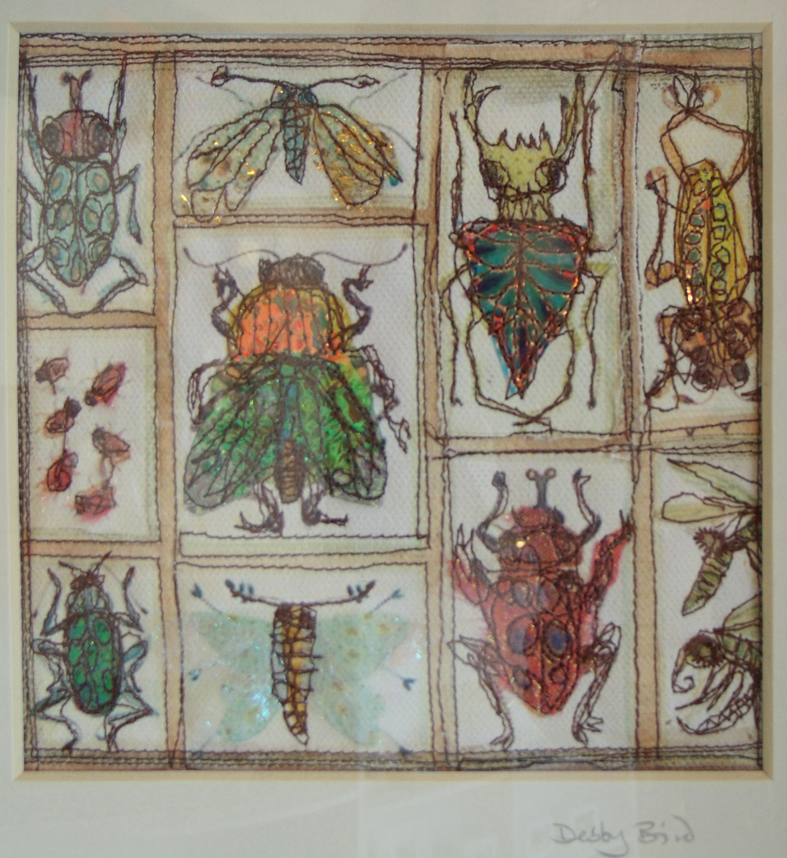
Keeping with framed pictures, Debby Bird made some really popular (and fast selling) beetle things, some with wings but the main interest for all the viewers was the materials she used, interference foil that distorts the light rays into rainbows of different hues being the most fascinating. The free machine-stitched insect boxes illustrate her idea that many insects are as precious and beautiful as jewellry displays.
Things With Wings – Debby Bird
Flying and Crawling Jewels – Debby Bird
“Despite being overlooked and under-loved , Insects are the most successful of the worlds’ species . They are so varied and often more beautiful than the most precious gems, yet they can take off and disappear before you get a proper look.
My free-stitched specimen boxes are representing the energy of live bugs just gathered for a quick inspection before they fly home!
There are classes is this technique by Debby in the new Heart Space Studios Autumn programme of workshops
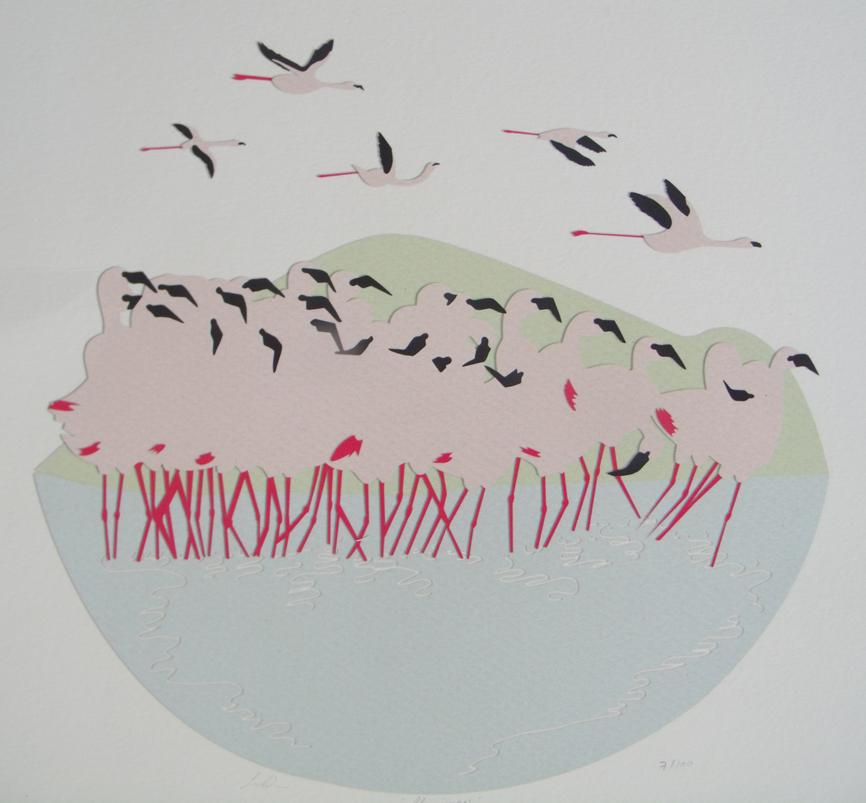
Sarah Dennis cuts paper by hand and the results are stunning, she conducts her very popular workshops, both day and evening sessions, for Heart Space Studios. The 2 large pieces of work attracted a lot of admiration, people can’t believe that they are looking at a hand made piece of such simple means. I like her simple explanation for the genesis of her things with wings…..
Deep Blue – papercut – Sarah Dennis
I love nature; these pieces were inspired by watching a David Attenborough documentary.
Deep Blue was created after watching a scene where the ocean and the sky met together – watching a bird dive from the sky and the whale swam around the surface of the ocean in a circular motion, the fishes sprung out of the waves into the sky. I wanted to capture the movement and life of that moment in paper.
Flamingoes, paper cut – Sarah Dennis
Flamingos is a response to how astounded I always am by the incredible journeys that animals make to survive. I try to exemplify the beauty of nature through the delicate detail of paper.
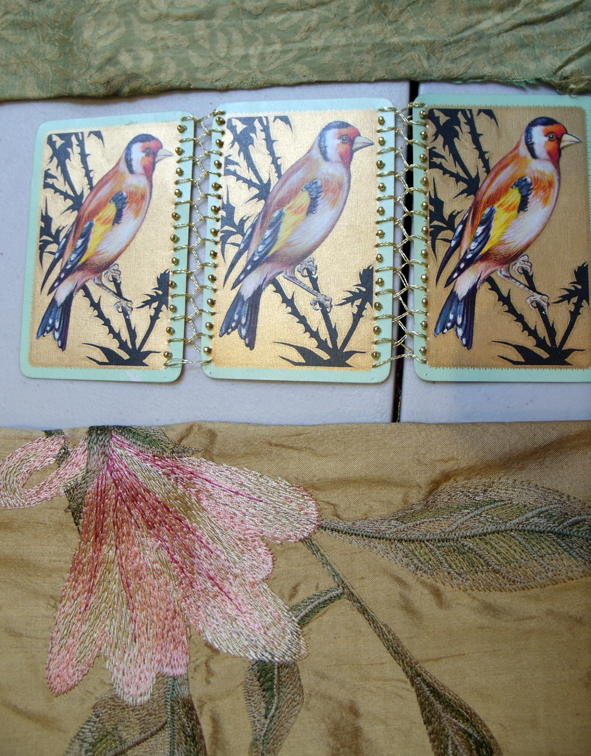
Some people are really good with the words that they use to describe how they developed their imagery – Sophie Bristol, our administrator – studied History of Art for her BA hons. degree at the Courtauld Institute, so I was not surprised by her eloquence when she wrote about the piece that, at first glance, looks to be just a highly decorative triptych.
gilded triptych – Sophie Bristol
One of my greatest past-times is exploring flea markets, making chance discoveries of overlooked gems, which might not be particularly valuable, but are lovely none-the-less.
I recently stumbled across a pack of playing cards at a market, and was drawn to the gilded image of a bird on the reverse. The picture fascinated me because it was both beautiful and slightly sinister. I decided to incorporate the cards into a piece for the Wings and Things exhibition, using hand-embroidery skills, beading, and mixed-media techniques to continue to explore the tension between the beautiful and the macabre.”
Alas, my own framed pieces are very conventional – I had to make them relatively quickly at home in any spare time I could find, so relying heavily on my stitching skills, I made what I hope are amusing images of the ends of things….
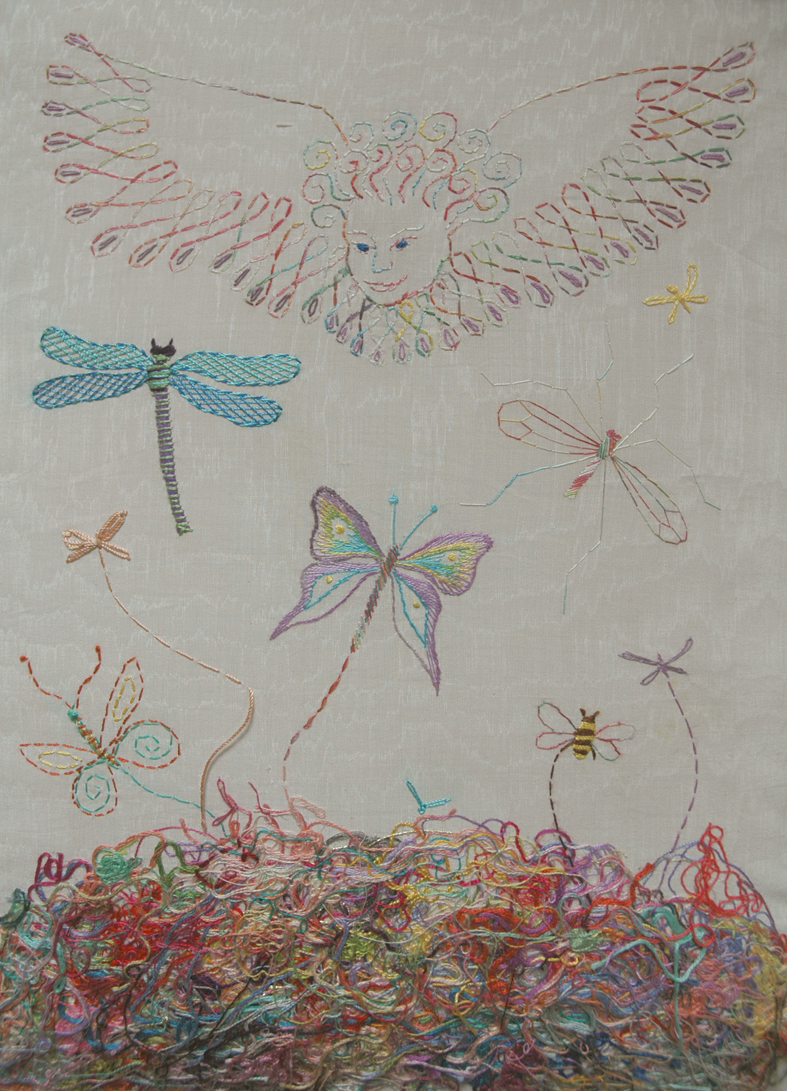
“One of the daily tasks of running Heart Space Studios is sweeping the studio floor. Things found on the floor though, are often lovely – scraps of silk, ravels of multi-coloured threads and scatterings of beads; but as they are so small and dusty they usually get binned.
the Apotheosis of the Embroidery Thread Ends – Janet Haigh silk hand embroidery
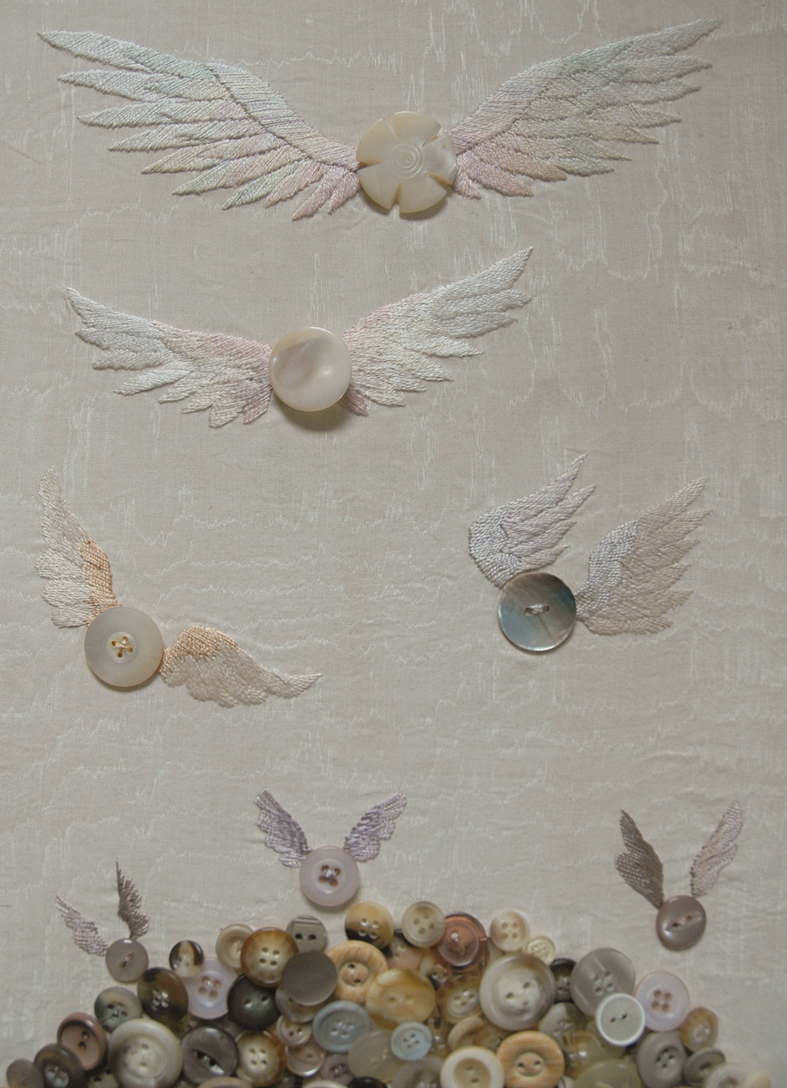
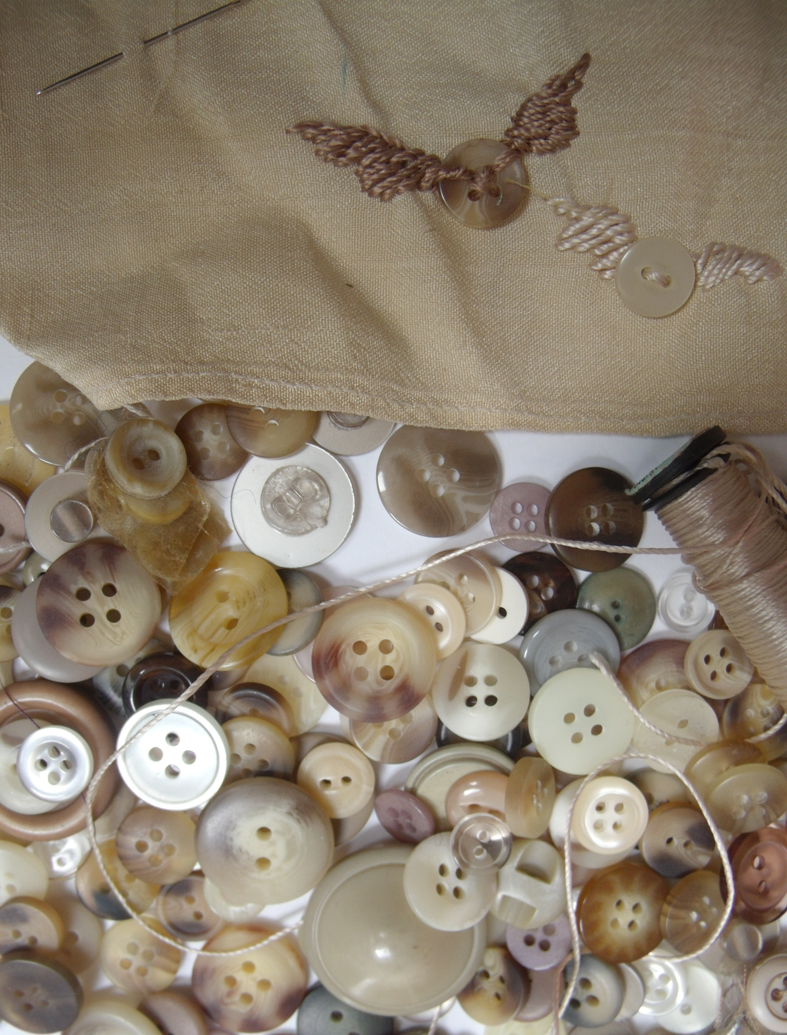
Buttons are another matter, they get used here for eyes and noses for toys made at children’s parties; but after a few months only the brown and beige buttons are left in the tins. I suspect that most homes harbour a tin of odd brown and beige buttons….
the Apotheosis of the Beige Buttons – Janet Haigh, silk hand embroidery
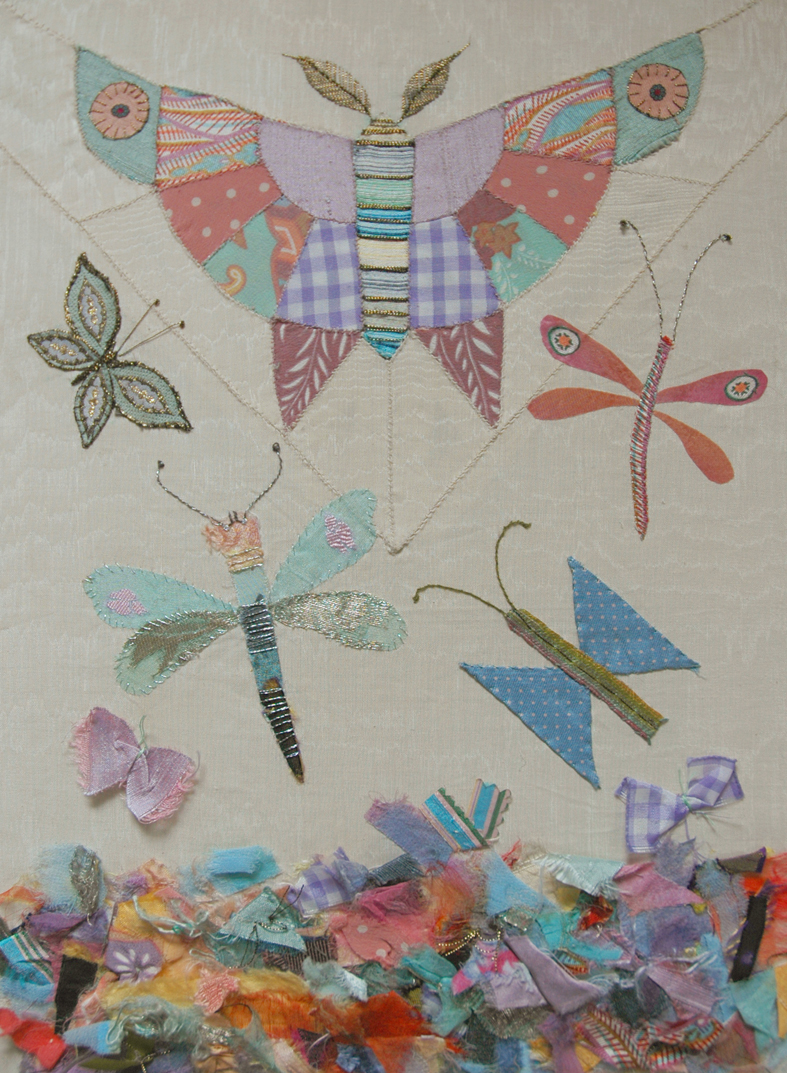
I got to thinking “Ideally, what would happen to the beige buttons that no-one wants, or the teeny scraps of ragged fabric and threads? Where would they go, what would they become”?
the Apotheosis of the Fabric Scraps – janet Haigh, silk applique and patchwork
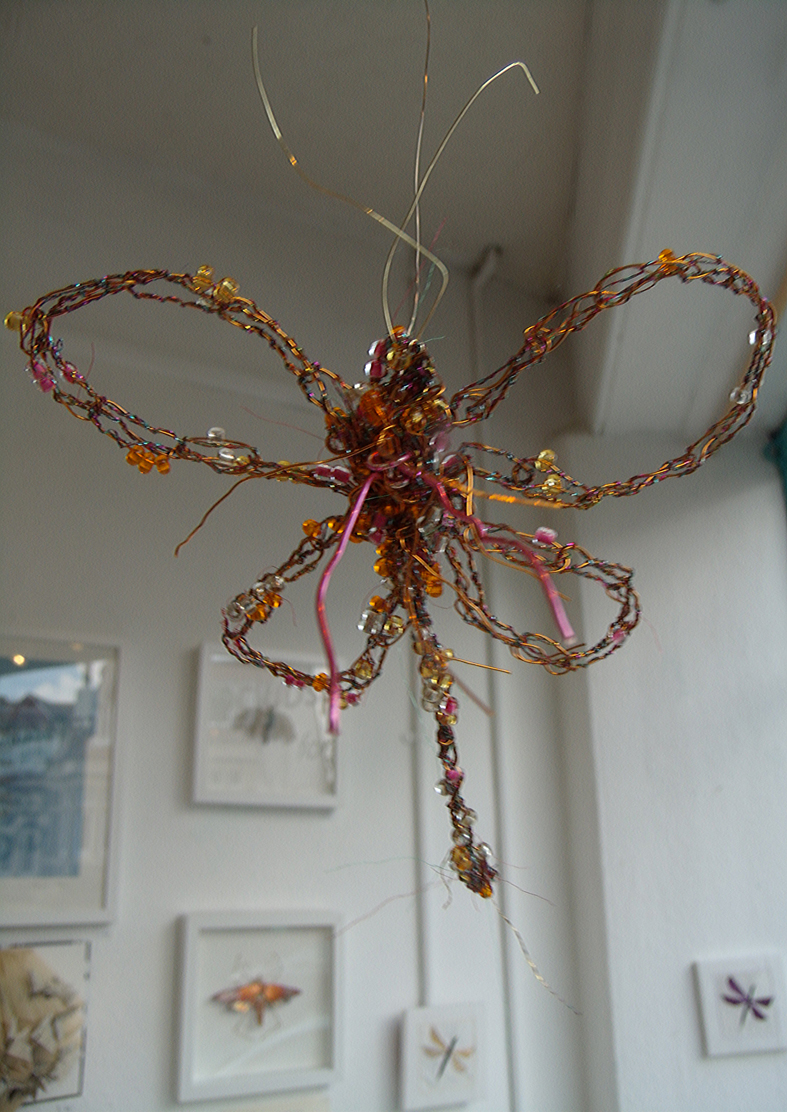
So now we get to the things out of the frames – I feel that out of the frame is perhaps a better way to develop work like this – so we had a flight of dragonflies from Susi Bancroft, rather difficult to photograph, so here is just one; he looks kind of menacing – but as Susi says……
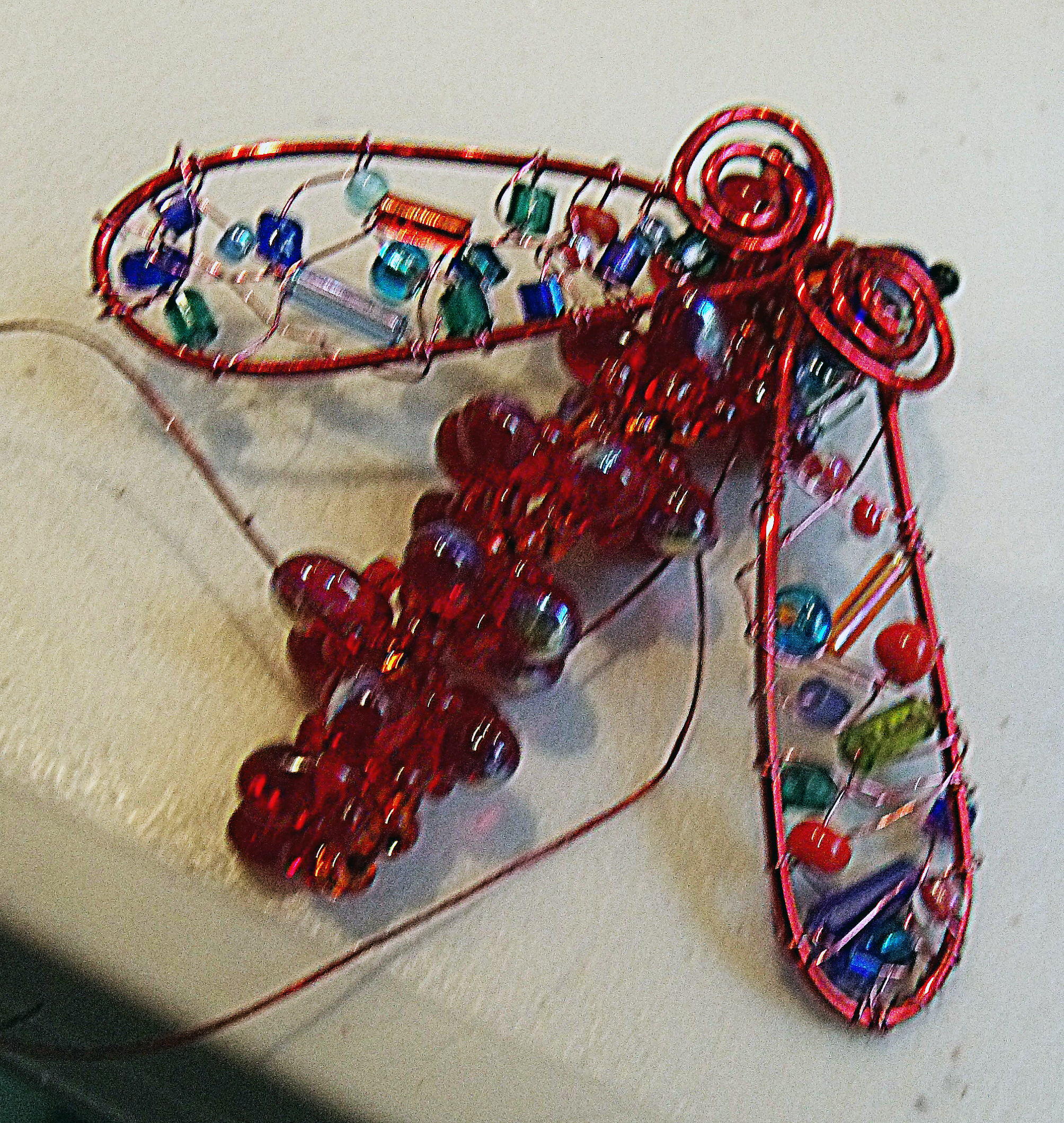
One imaginary winged creature – Susi Bancroft. wire and beads
“ inspired by my delight in watching dragonflies in flight whilst walking by the river. From pale green delicate ethereal things, to flashes of bright iridescent colours skimming the water, I caught my breath watching them. These creatures are an interpretation, a play on ideas. My mind wandered around the real as well as imaginary – the beauty of nature and the fantasy of invented things with wings – from fairies to surreal stinging insects! These may hang indoors or outdoors – catching light and breeze and hopefully raising a smile!
Made on the sewing machine from wire wrapped in glittery metallic thread with seed beads I pre-threaded on the wire – a somewhat exciting technique which requires some nerve!
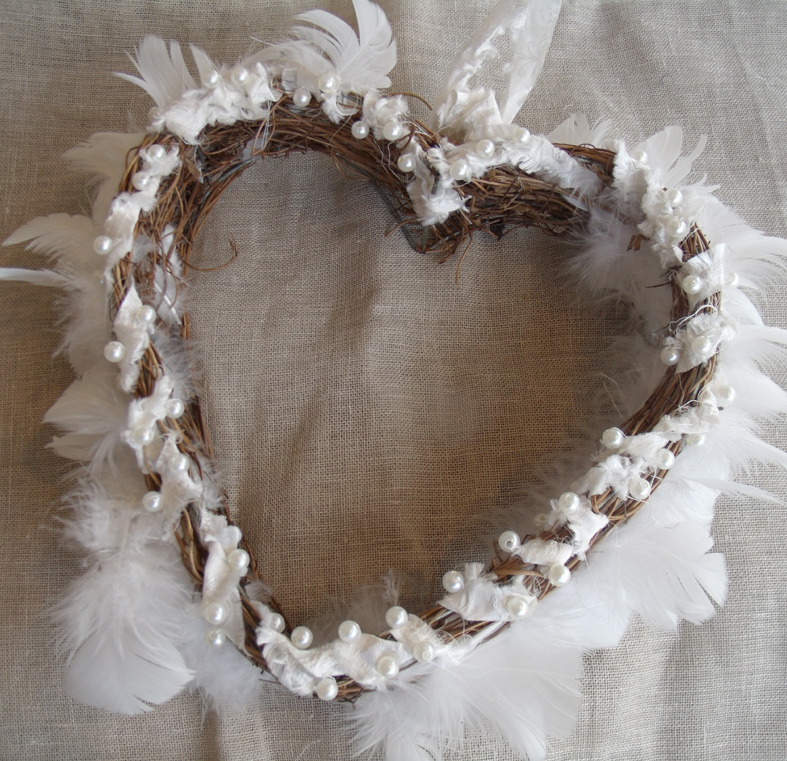
But where are the things without wings? Well for a start there are lovey simple feathered heart shaped hangings form Jane- Marie Mahy, our display manager.
Feathered Beaded Heart – Jane-Marie Mahy
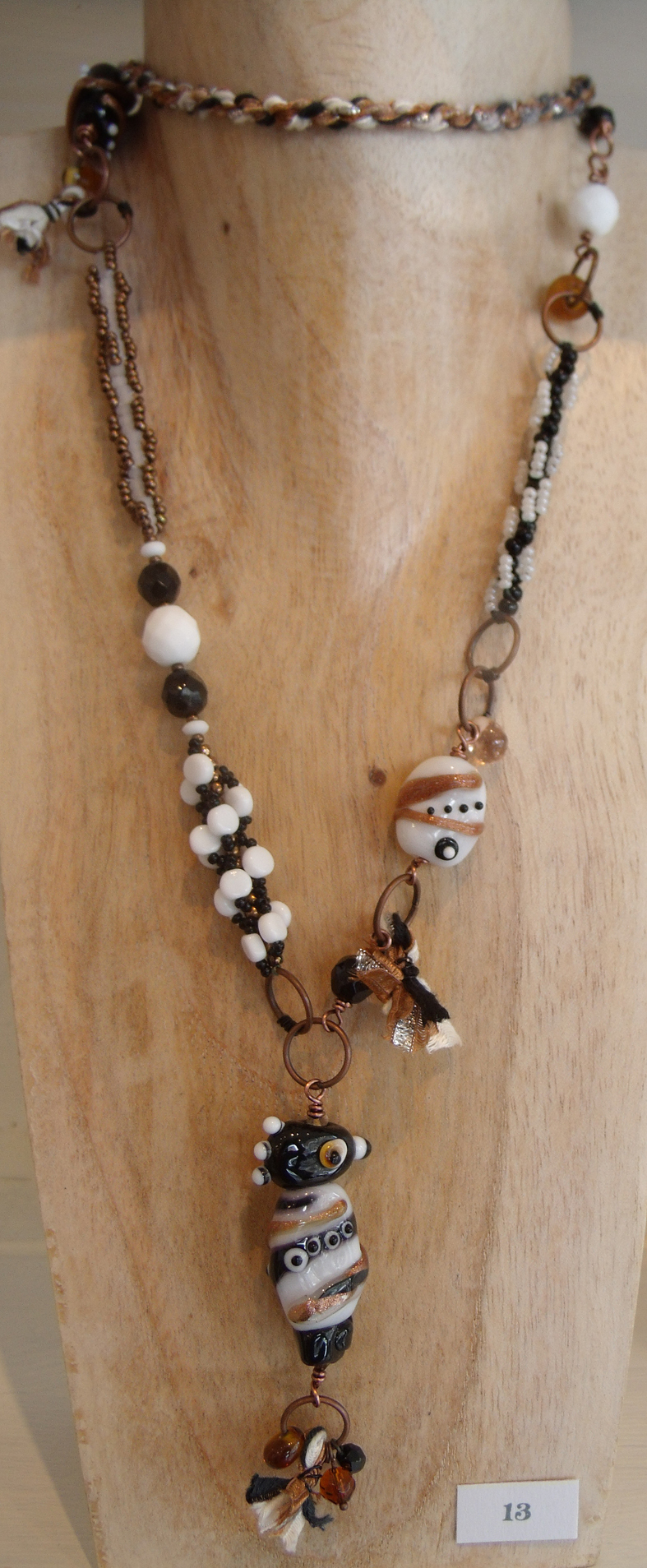
” I was inspired by the work I have done in the past for Heart Space Studios simply decorating willow hearts which are rustic in texture against different found objects – lovely old beads, buttons and lately clock faces. Feathers were the obvious things to add to the hearts for this project and making them into these angelic hearts”.And unusual beaded necklaces made by Ilsa Fatt, who teaches beaded jewellry making and often using her own lamp- worked beads as inspiration..
black and white necklace _ Ilsa Fatt
Re Necklace – Ilsa Fatt
“The seed for the idea of Spirit-Bird necklaces came not from a bird, but a beetle. I was thinking about the sacred Egyptian scarab beetle, which led me to thoughts on the strange Egyptian bird-headed gods. These were in my mind when I first started making glass beads for the Heart Space exhibition.
As I worked, I became more and more drawn to the idea of the bird totems of the Pacific North West coast, such as the thunderbird that can shape-shift into human form. The little glass birds that finally emerged are things-without-wings, but for me they embody the idea of wings, and of the power of imagination’s flight.
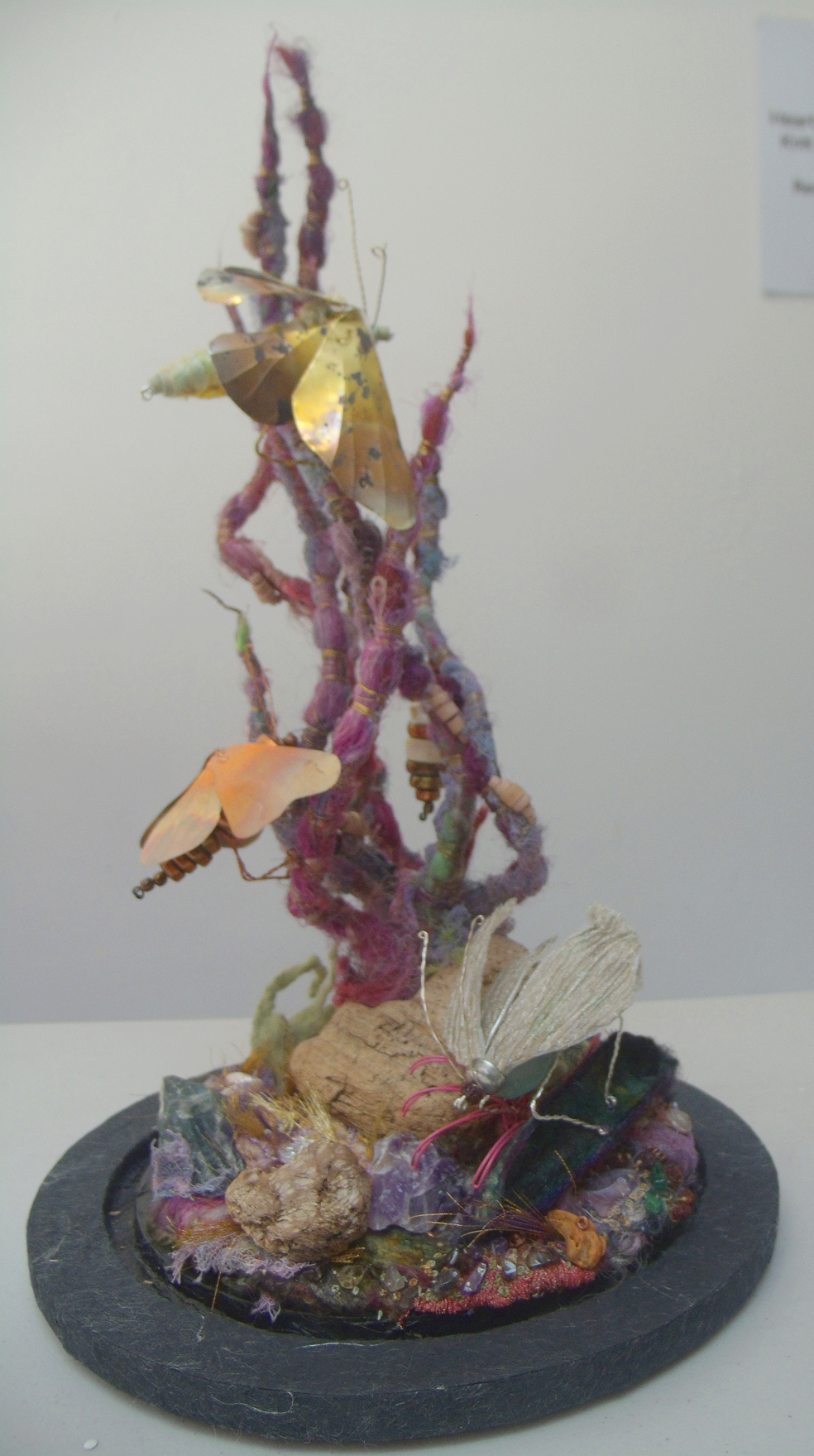
And now for both things with and without wings from Kirsten Hill-Nixon, who works with us teaching felt-making but has many other skills to be developed. she really took flight (sorry) with her imagination for this project.
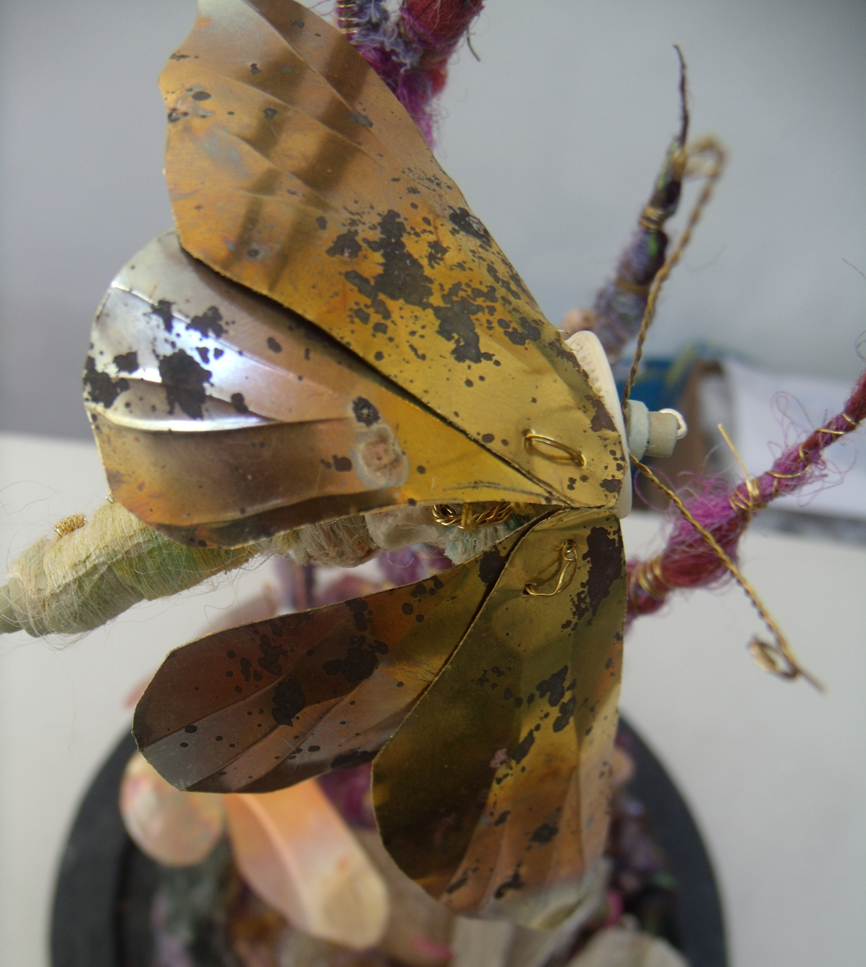
The image below does not do justice to this piece – it lives under a vintage glass dome so is very hard to see with reflections everywhere – It is made up from some dyed and embellished real chrysalis – and the strange beings that have escaped from them…the twig is felted wool but everything else is metal and glass, with found objects like large beads and parts of domestic plumbing as well.
Curious Chrysalis – Kirsten Hill-Nixon
“What a Great Title – ‘Wings and Things’ – ‘Things’ could be literally anything! And with winged shoes, aeroplanes, sycamore seeds and half the animal kingdom to choose from – what should I do? I spread out all my shiny objects, threads and fabrics on a large table, things I have been hoarding for years waiting for an opportunity to use them – and here it is.
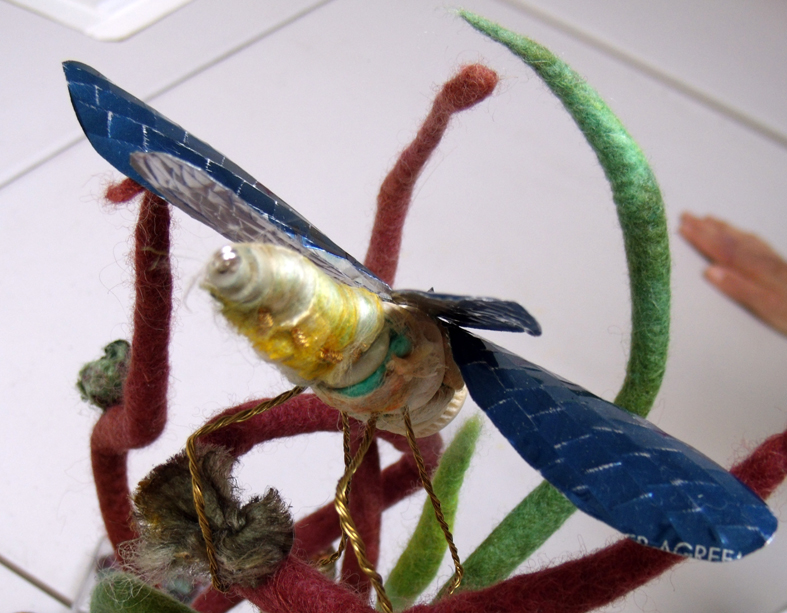
detail – Dragonfly, embellished chrysalis, tin foil, wire and beads – Kirsten Hill Nixon
There is always a moment of great excitement finding a shiny beetle in the garden; that unexpected flash of sparkling wing on the dragonfly – so Bugs it had to be. Small and precious like jewels, my winged things would need the protection of a glass dome just like the exotic specimens in a Victorian museum collection
I spread out all my shiny objects, threads and fabrics on a large table, things I have been hoarding for years waiting for an opportunity to use them – and here it is.
sheer invention – Bugs – Kirsten hill-Nixon
and just one more from this set of Things with Wings
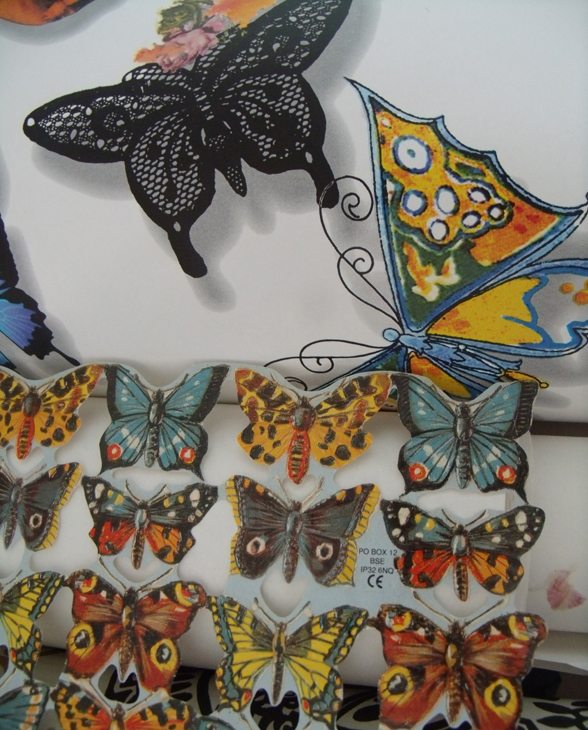
research workshop materials -printed paper butterflies
‘Wings and Things’ is the working title for an exhibition being developed for the local community’s annual “Westbury Park Festival”.…last year we hosted a drop-in making felt flowers – this year we are show-casing the talents of the staff and tutors at Heart Space Studios – so no pressure!
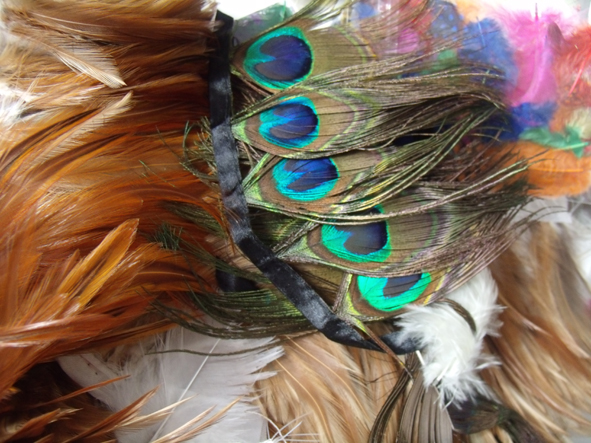
research workshop materials – feathers
Each of the 11 people who opted to work towards the theme have committed themselves to attending up to 3 research sessions when we all work together to make a mixed media exhibition – by mixed media I really mean any materials that can be connected to textiles, either physically or metaphorically. ‘Things with Wings’ was an idea proffered by Debby Bird (who else?) who is a busy tutor at the studios and a major force for developing new ideas for classes. We are working together to make an unusual and hopefully amusing exhibition
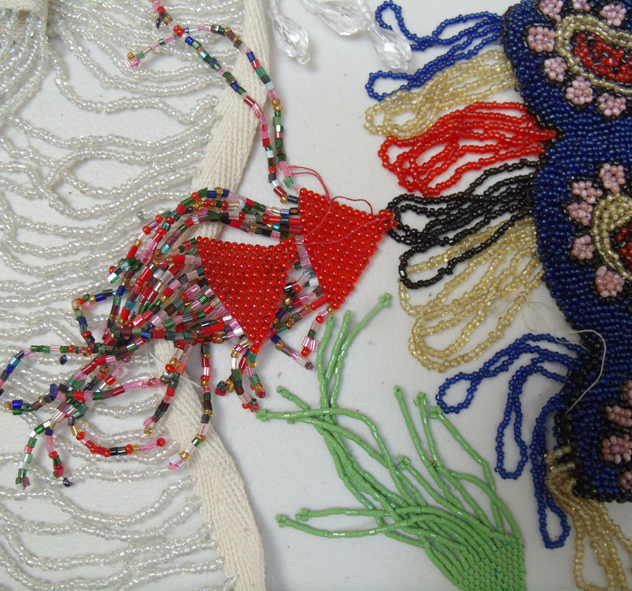
selection of glass beads for workshop materials
It is always fascinating to see how each person responds to any given the brief: we had asked for any ideas and drawings/ samples of work ready to be discussed on the day – we wanted everyone to participate in helping one another develop ideas, otherwise working in a group can be really distracting.
Step Wooster brought the real thing
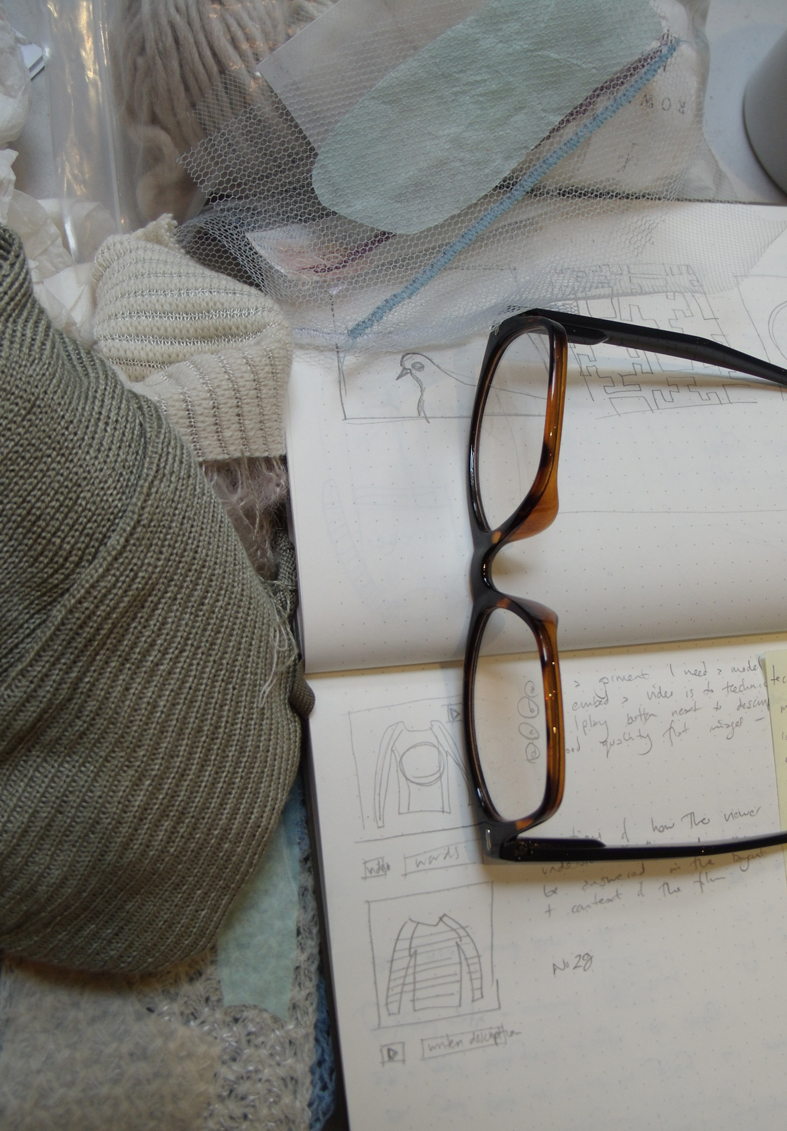
teeny tiny drawing book of ideas with pigeon coloured materials – Steph Wooster
Steph Wooster brought several real birds wings that she had been given by a local game butcher, plus some tiny drawings in the goes-everywhere-with-her-sketchbook. She placed the book open at a pigeon drawing next to a bag of – to my mind – Pigeon Coloured materials….
Ilaria Padovani’s grandmother’s patchwork design re-sampled for the project
Ilaria Padovani, brought a couple of samples specially prepared for the day – one a pair of collaged wings which was bright and busy, but another patchwork made from a pattern that her grandmother had made for her as a child it was her favourite winged thing – the dragonfly – and it is full of flight!
We immediately advised her to just make lots and lots of them in all sorts of different colours and to exhibit them flying randomly across the walls. I had brought in several frames to establish various sizes of each piece – Debby and I needed to have an easy hanging session prior to the exhibition opening. It was decided to wrap the dragonfly patches around small stretched canvasses and so keep them light and airy.
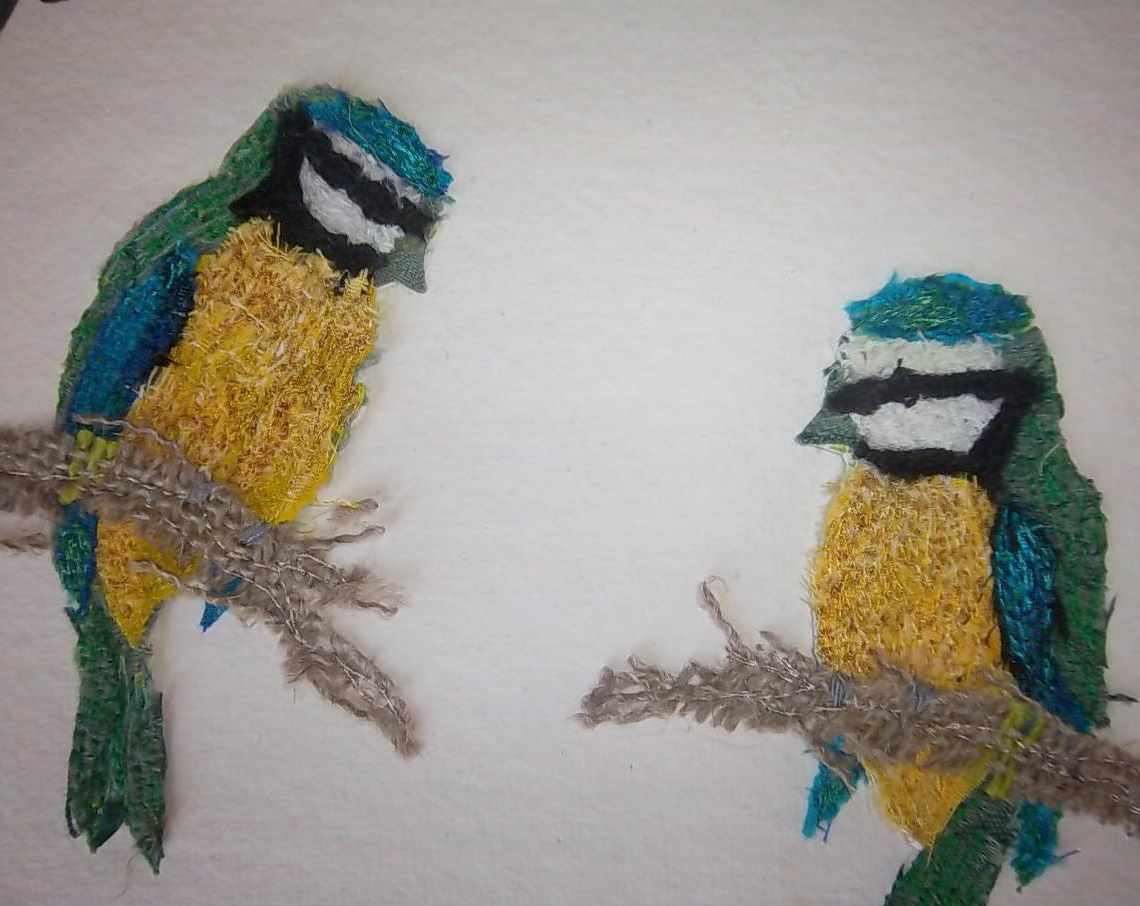
Mary Bishop – appliqued and embroidered birds
Many textile artists, regardless of name, work with bird imagery; Mary Bishop has made several pieces of bird related embroideries and so she brought a few of her early samples and an open mind, as it was her first tutor’s making group attendance. She is really taken with the idea of Magpies – after all they do like bright shiny objects and we always have lost of those at Heart Space.
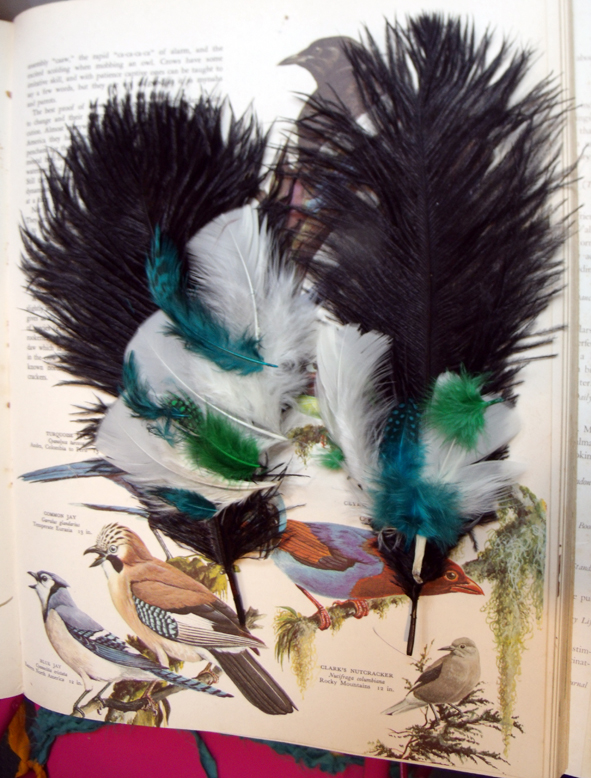
glamorous feathers placed on top of a vintage bird book I had brought to the workshop – a really good idea for further collages here.
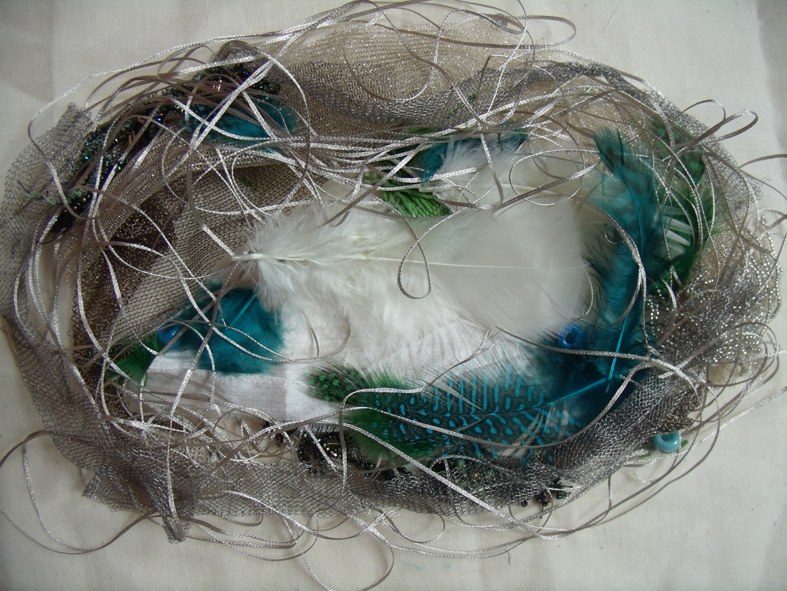
beads and feathers for Magpie’s stash
I thought she should start with the nest – I mean she can easily do the birds at home alone – but the nest and it’s contents could be found in the studio stash….I asked her to just find lovely things a magpie might steal from us and then to make a nest from them, later she can choose to use parts of it as a sort of grounding for the birds or develop other ones from other materials….the ideas are endless here.
starting to make the Magpie’s first nest – Mary Bishop
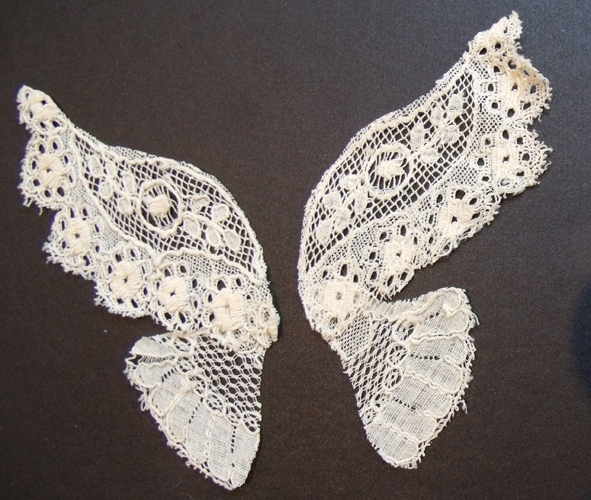
Some people had already started making flying things from textiles, Sophie Bristol has carefully cut wings from a length of vintage lace..the ways ahead were obvious, lots of different wings from different laces just needs to sort out the bodies – rich ground for playing with all sorts of media. However……
beginning of a cut lace butterfly – Sophie Bristol
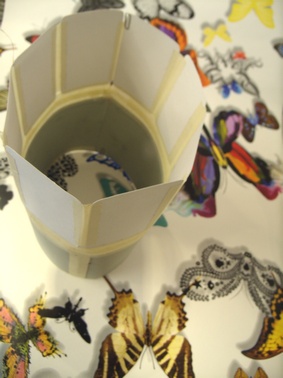
striped of silk fabrics to make into a 3D bird cage….a really innovative idea and a lot of interesting work to develop.
during the introduction when everyone had to show and talk about their own ideas she liked the idea of making a cage from a sample made in an earlier workshop.
She set about making a prototype in card and tape to ascertain the sizes and shapes required – but what will the cage contain?
cylindrical cardboard sample for Sophie Bristol’s birdcage
One way to use a themed exhibition is to try something new or an idea that has been on the’ back-burner’. I think Kirsten Hill-Nixon thought this way. She arrived with lots of well organised materials, books and ideas – lots of drawings in her research book and a firm grasp of what she wanted to achieve…it’s a tall order!
like a cabinet of curiosities – Kirsten Hill-Nixon’s research materials
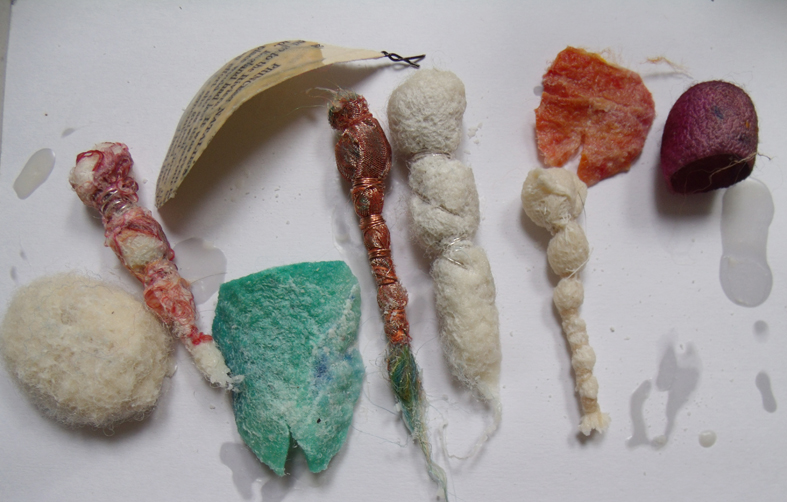
Kirsten wants to make a series of exhibits of ‘natural’ objects trapped under glass domes…she is making different types of what look like fungi and cast off chrysalis shells. She is making them out of all types of fabrics, waxed and “preserved” – I found these curious things near a batik kettle – where are the winged things that maybe emerged form them?
waxed casts and wrapped objects for Kirsten Hill-Nixon’s curious collections of post-flight litter?
Ilsa Fatt had already designed and made several beads that were based on hearts with wings but the general consensus was that she should make bigger beaded wings –
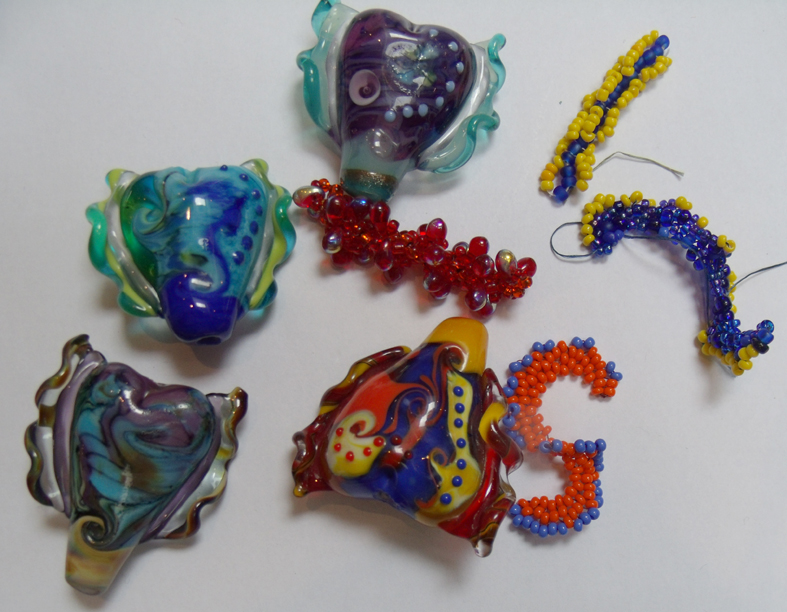
Hearts with Wings glass beads – plus some wriggly beaded ‘things’ – Ilsa Fatt
twisted beaded wire winged thing – Ilsa Fatt
Debby Bird had made lots of tiny wings and insects using twisted silver wire and she suggested Ilsa make some and by the end of the session when the red beaded winged thing emerged we all wanted to wear it, either as a brooch or worked into a necklace.
Silver wire shapes with opalescent threads ready for sampling – Debby Bird
Debby Bird always has lots of different media to develop into new and desirable objects and images…she excels in hunting out amazing new products and manages to incorporate them into her work…unlike the rest of us! She had made several different samples prior to the session but the thing she settled down to was an idea from her paper cutting experiments.
perforated paper dragonfly design – Debby Bird
the results of a long time piercing the paper with a needle was ethereal and beautifully nuanced when see against the skylight. I am looking forward to seeing how this essentially simple idea is developed into further work….all sports of light fitments and holders could be made – I must give her some vellum to sample.
new research tools for our latest volunteer, Ceema McDowell
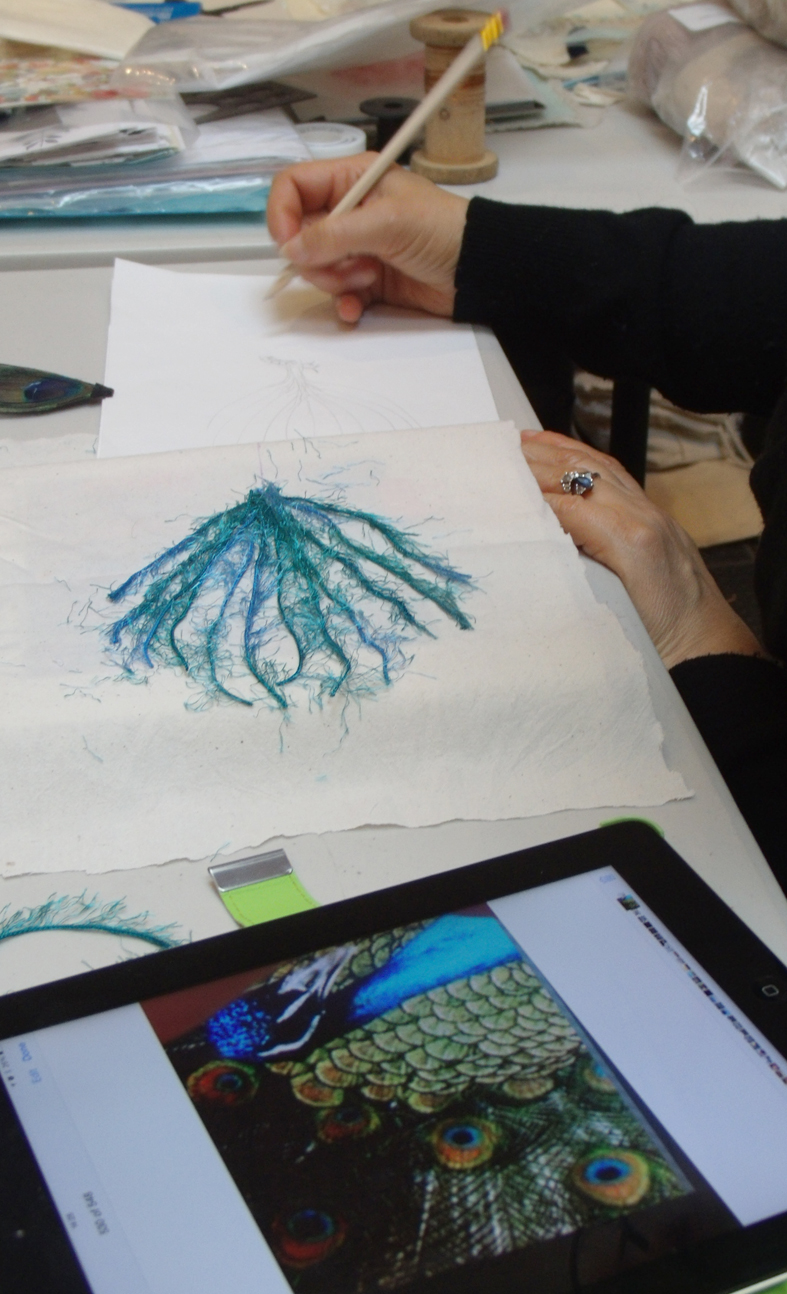
Sitting next to Debby, who by piercing paper was working with one of the most primitive way of making a mark, was Ceema McDowell, busily using the most modern of research tools to develop her peacock design…the strands of random dyed woollen yarn is reassuringly traditional.
Threads found when sweeping Heart Space Studios workshop floor
And to me – what did I get to do? well not a lot on the day but I have had a frivolous idea for this project – it is not at all what I usually concern myself with, but it would not go away….so I told the group to see how they would react – they laughed but said it could be really interesting.
One of the daily chores of running a workshop -based studio is sweeping the floor before and after every workshop – and there always seem to be tumbleweeds of threads and fabrics under the tables and in the corners…
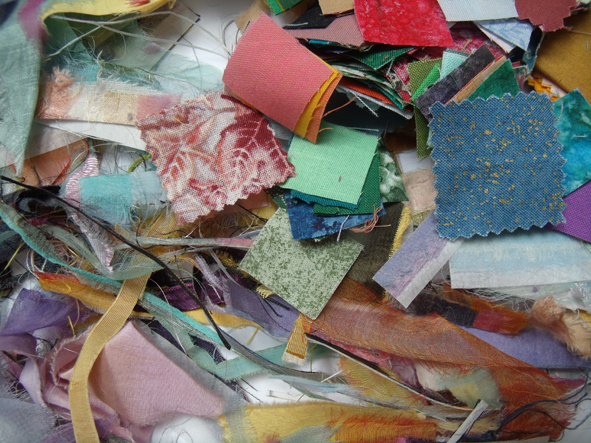
left over fabric scraps from my own studio floor
as well as spilled beads or left over buttons…….it was the buttons that made me ponder: why are there always masses of Beige Buttons left unused in any button collection?
Beige buttons fly to button heaven with silk embroidered wings: sample idea by Janet Haigh
I started to imagine where all the unused beige buttons will eventually go; will they fly off to a beige button heaven? Will they then become pearl buttons when they were beatified? I also thought of the threads and the fabric scraps…what would become of them if they flew to heaven – how would their wings look and what’s more – what would their eventual version of heaven look like?
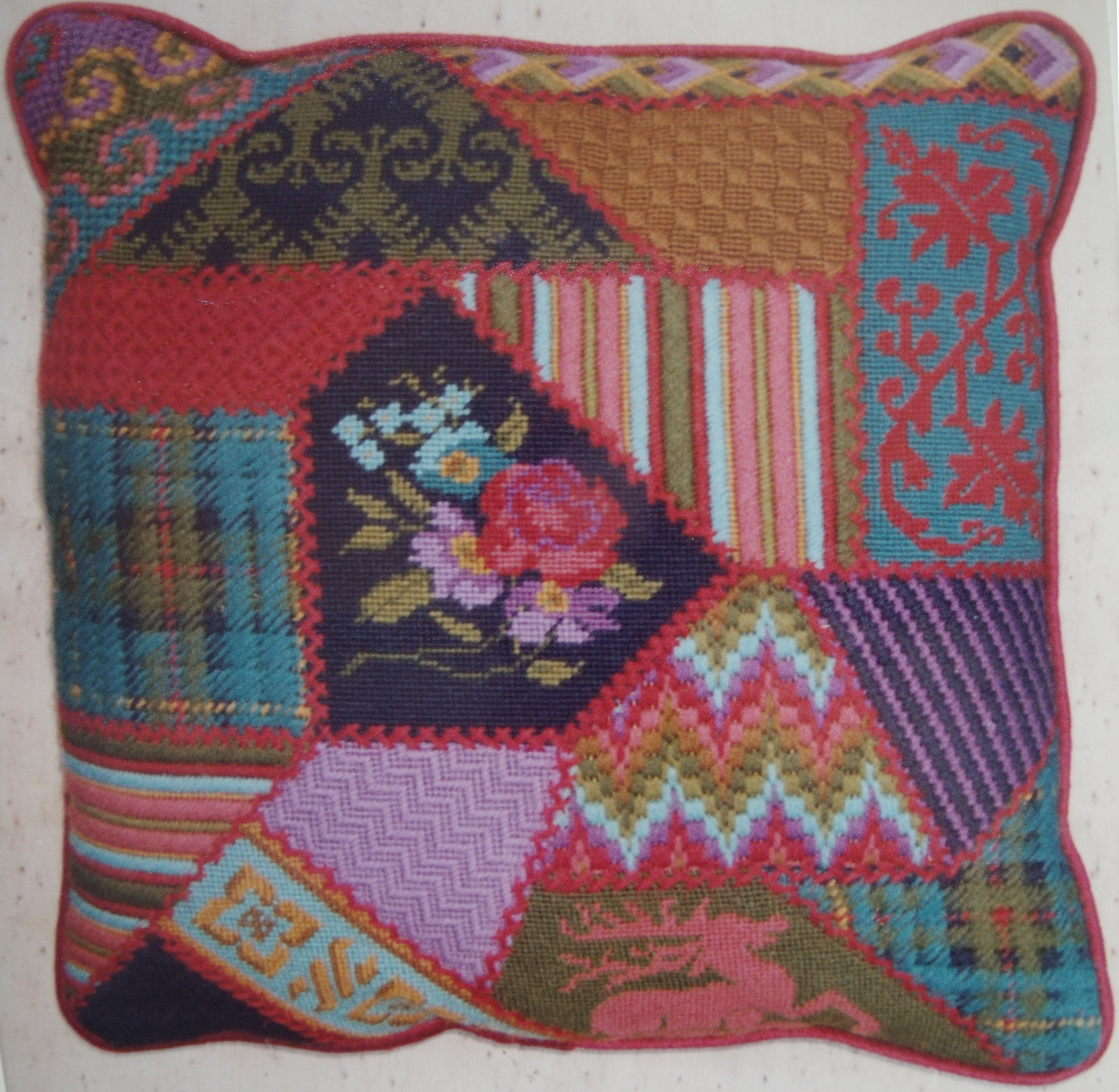
‘Crazy Berlin’ one of my early commercial designs for ‘counted thread’ canvas embroidery
I have had a few problems getting to grips – literally – with hand embroidering again (not to mention eating with fully functioning knife and fork ). So in order to get back to my normal working life of designing, stitching and teaching, and not being given any specific physiotherapy for my now fully mended broken wrist, I decided to return to the very beginning of my stitching career – Canvas Work.
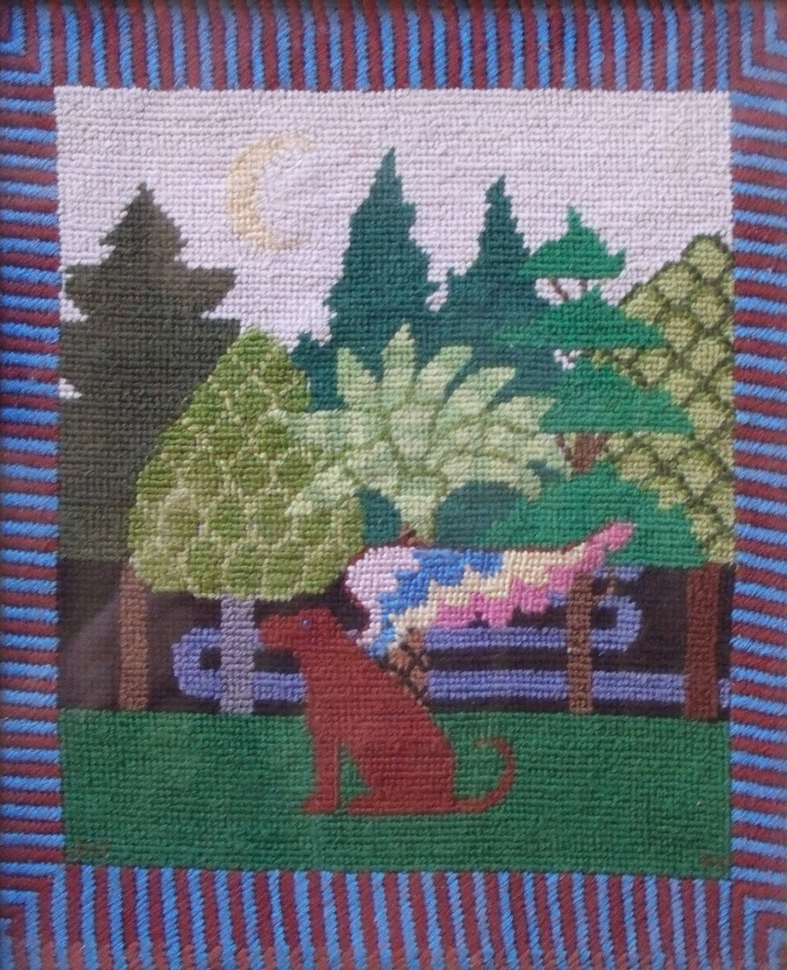
My first embroidered picture – Dog with Wings and Radiator 1971
I had lost almost all of my strength and most of my dexterity when the plaster finally came off my right wrist, and although the drawings were OK the stitching wasn’t. The main thing about canvas work is that it is worked on an open mesh ( that has to be completely covered) so the needle can be easily inserted into the square hole instead of having to push it in and pull it out. It is easy and repetitive move which is what I needed to get some strength back.
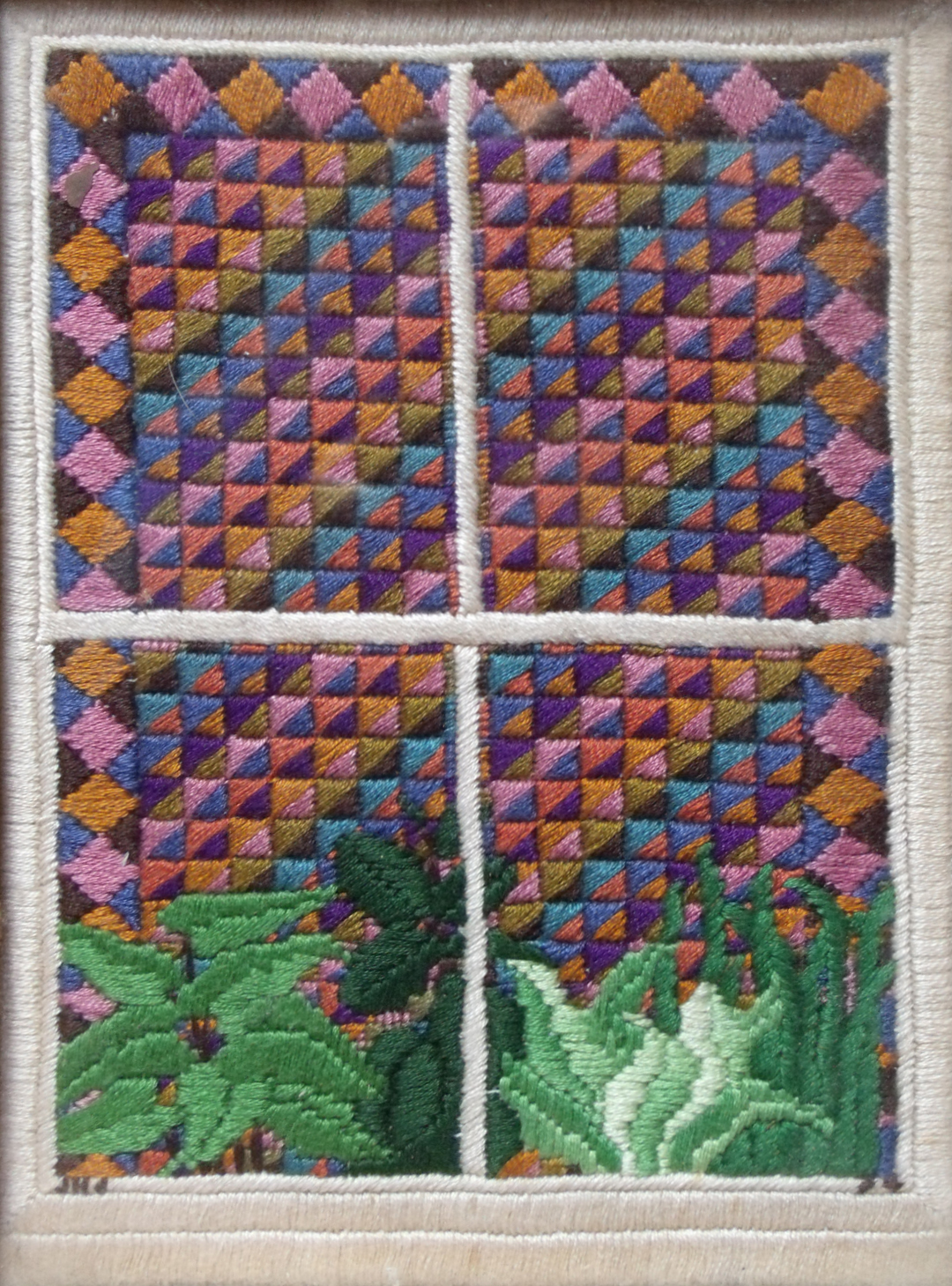
the view through my London flat’s window into a neighbour’s window -1973
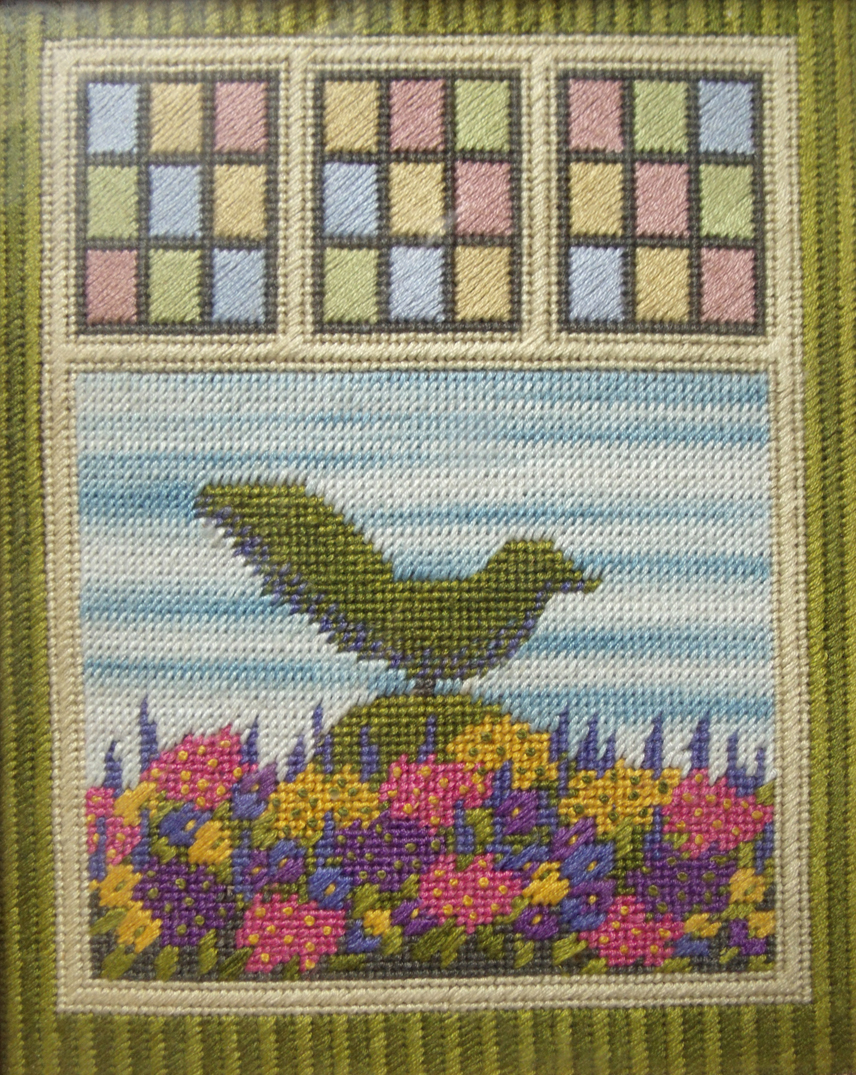
So I got all my old canvas work embroideries off the walls in the house and realised that they were all pictures of things – either real things like the window above (where I could see past the plants to a large American patchwork quilt hung on the wall) or completely imagined scenes like the brown angel dog in a landscape – cruel friends mocked my early design and stitching techniques for the stream, by calling it Dog with Radiator! But mocked or not, I had found a new and exciting way of working – hand embroidery – and one that I intuitively knew was to be a very long-lived fascination.
one of a series of seasonal canvas embroideries with leaded light window
I enjoyed the tension between trying to make things look natural but realising them within a strict structure; window frames were a perfect subject to further “contain” my scenes and formal garden design became a real passion – accessed through old gardening books and visits to some famous English Gardens. Topiary became an enduring passion as it seems almost childish in its simplicity of form but very sophisticated in its visual impact, I find the larger specimens often intimidating – specially the animal and bird forms.
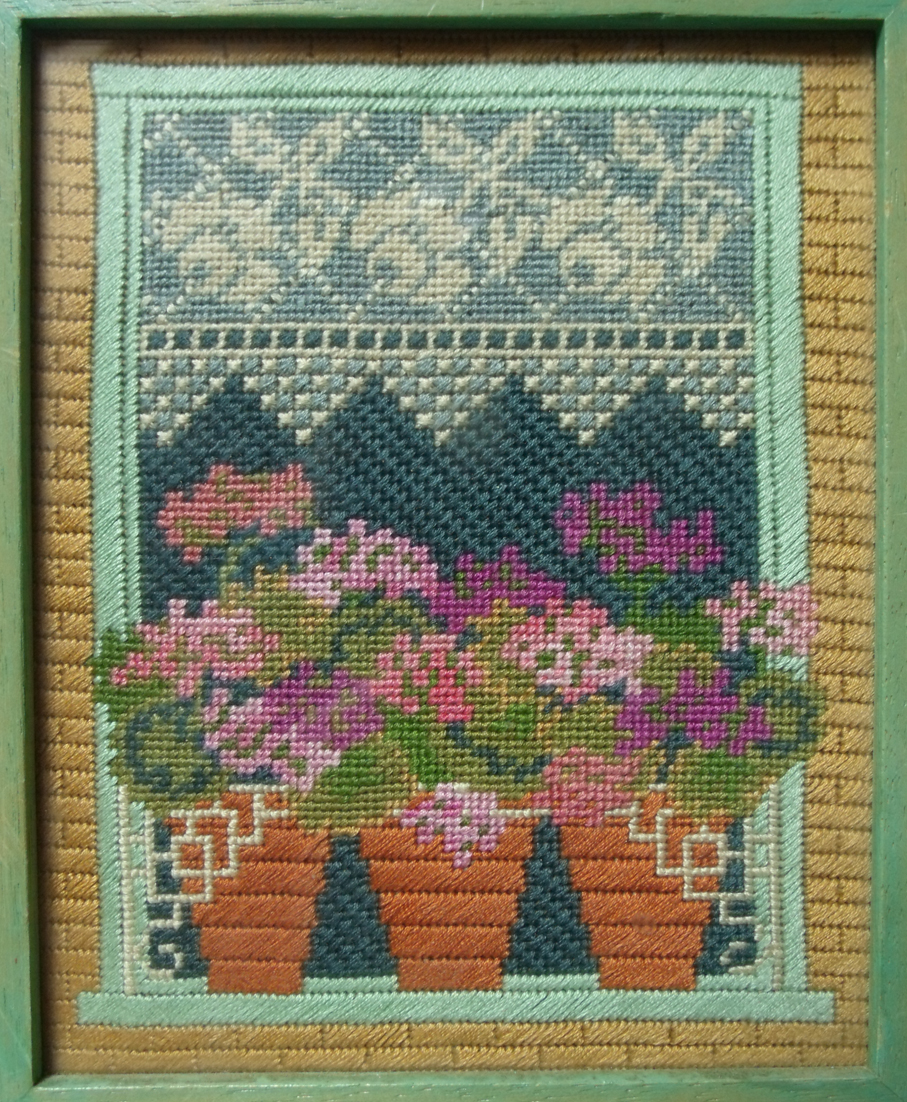
very formal lace curtain and geraniums window, developed from drawing while on holiday in France
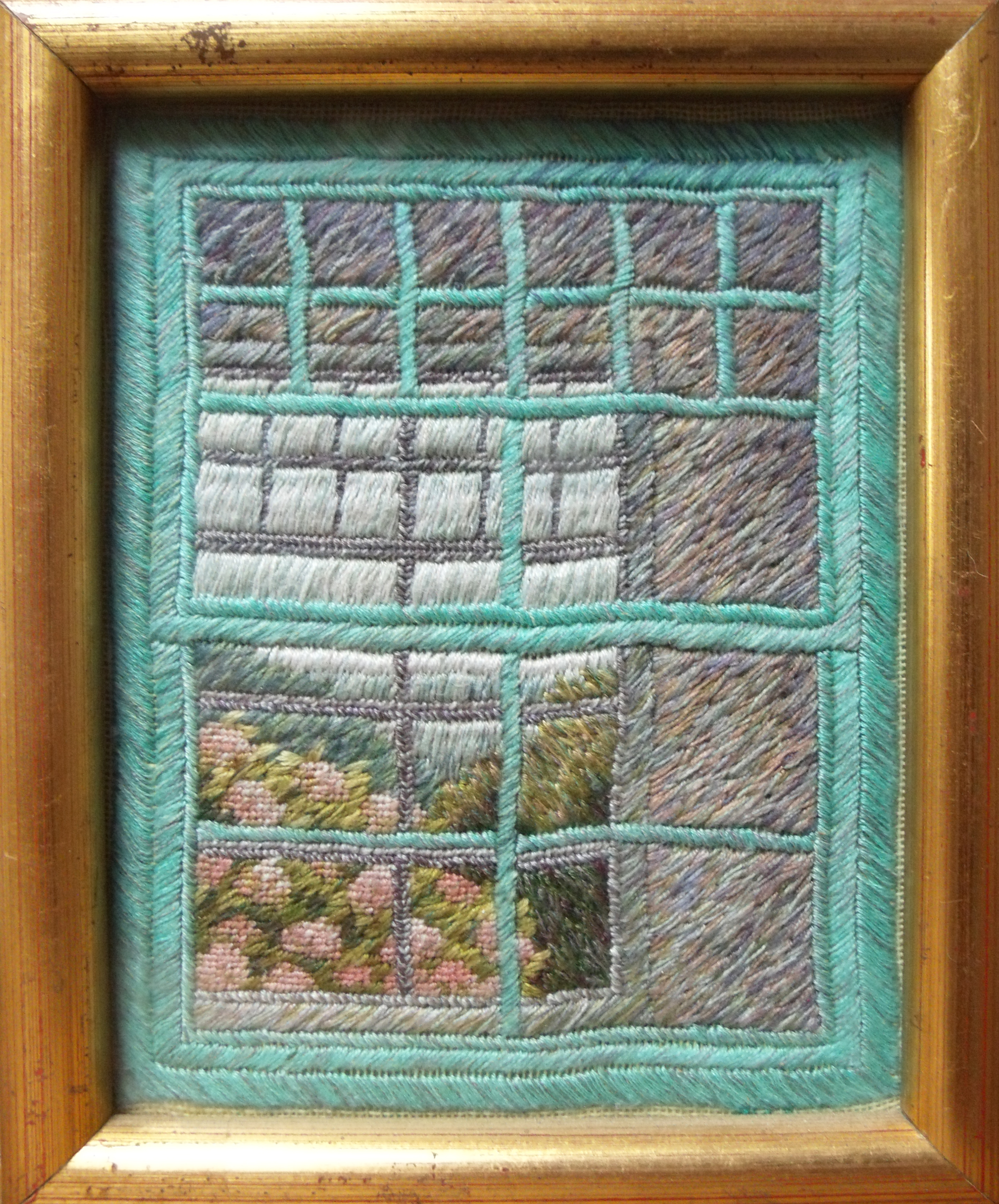
I started to design many of these embroideries and my first exhibition of embroideries was called Canvas Work at The Francis Kyle Gallery in London. Most of the pictures were sold, but I still retain enough to show my progress. In the early pieces there is an interest in the repeating patterns that can be stitched using the regular grids alongside the more descriptive stitching in tent stitch. But eventually the random stitches asserted themselves as I became fascinated by atmospheric colour and started to blend my threads to make new colour combinations.
Cornish window, here the the frame has become a victim of my random stitching which distorts the canvas.
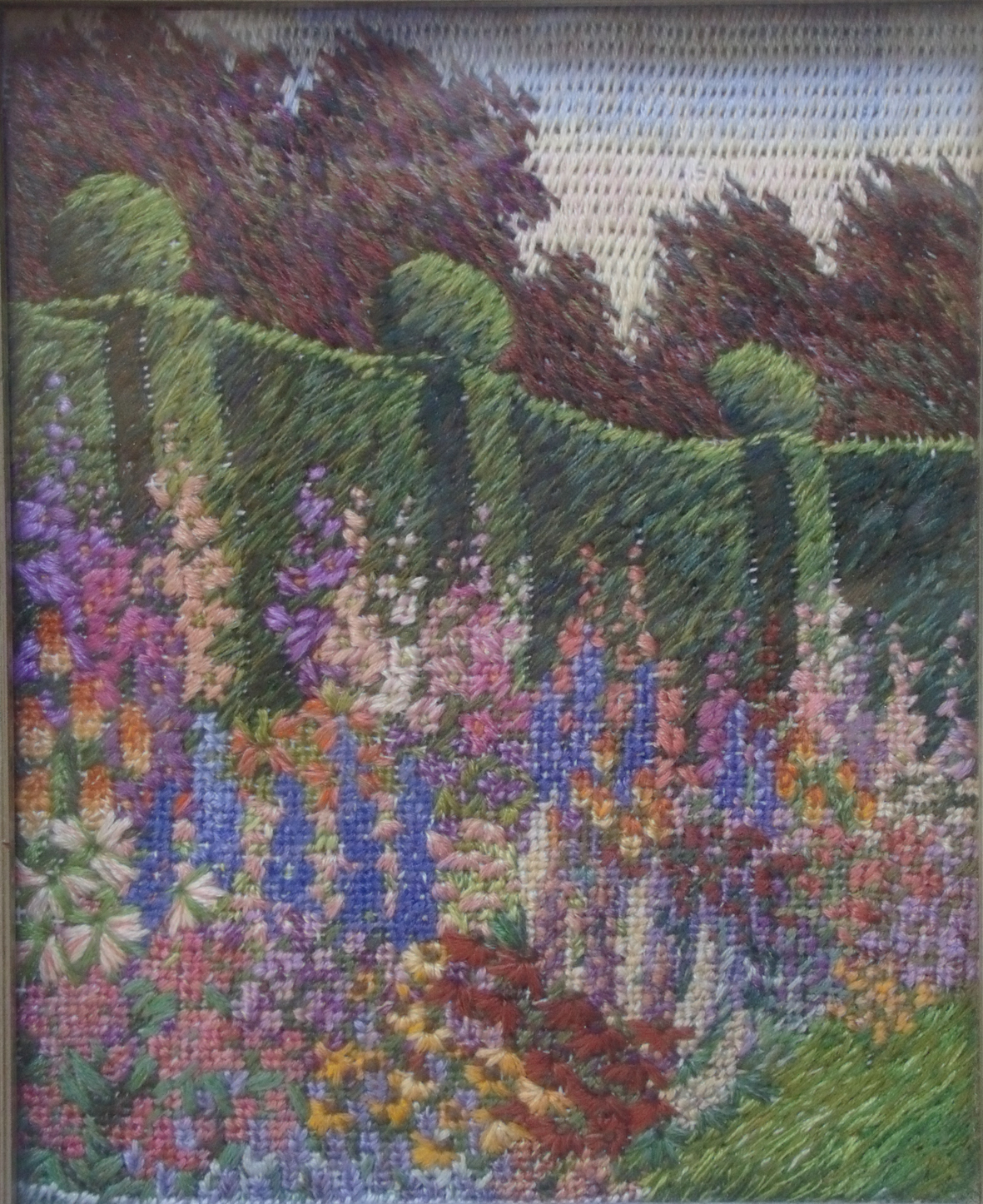
My last canvas embroidery of gardens shows how far I had strayed from the rigours of the canvas weave.
my last canvas work of gardens, an imagined rendition of a Gertrude Jekyll planting plan.
So returning to canvas work gave me a real sense of returning to my embroidery roots. I didn’t want to get involved in designing a scene, I was more interested in just getting the use of a precise stitch and a stronger grip, so I opted to make a counted thread design. I remembered seeing and photographing a tiny wool canvas work purse that belonged to a student at Heart Space Studios.
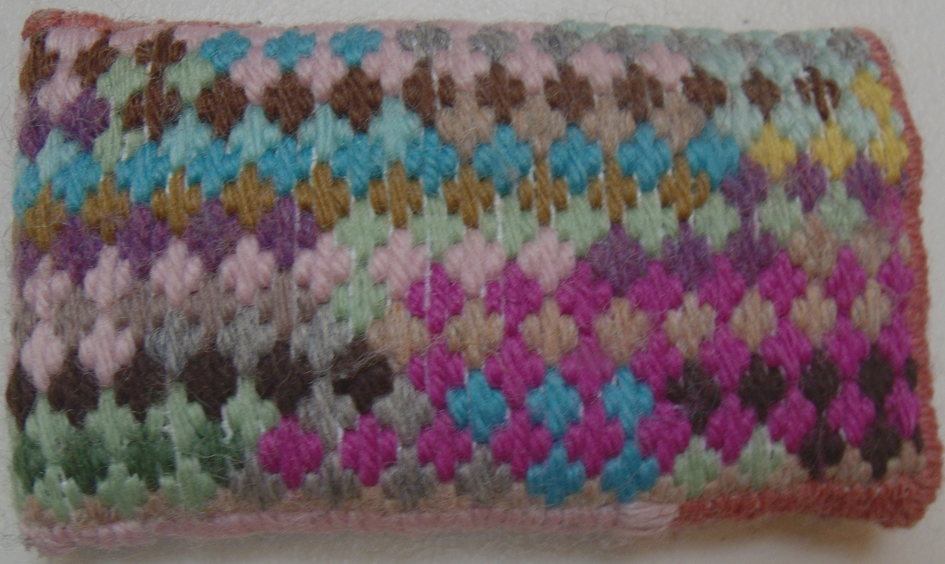
tiny wool counted thread embroidered purse
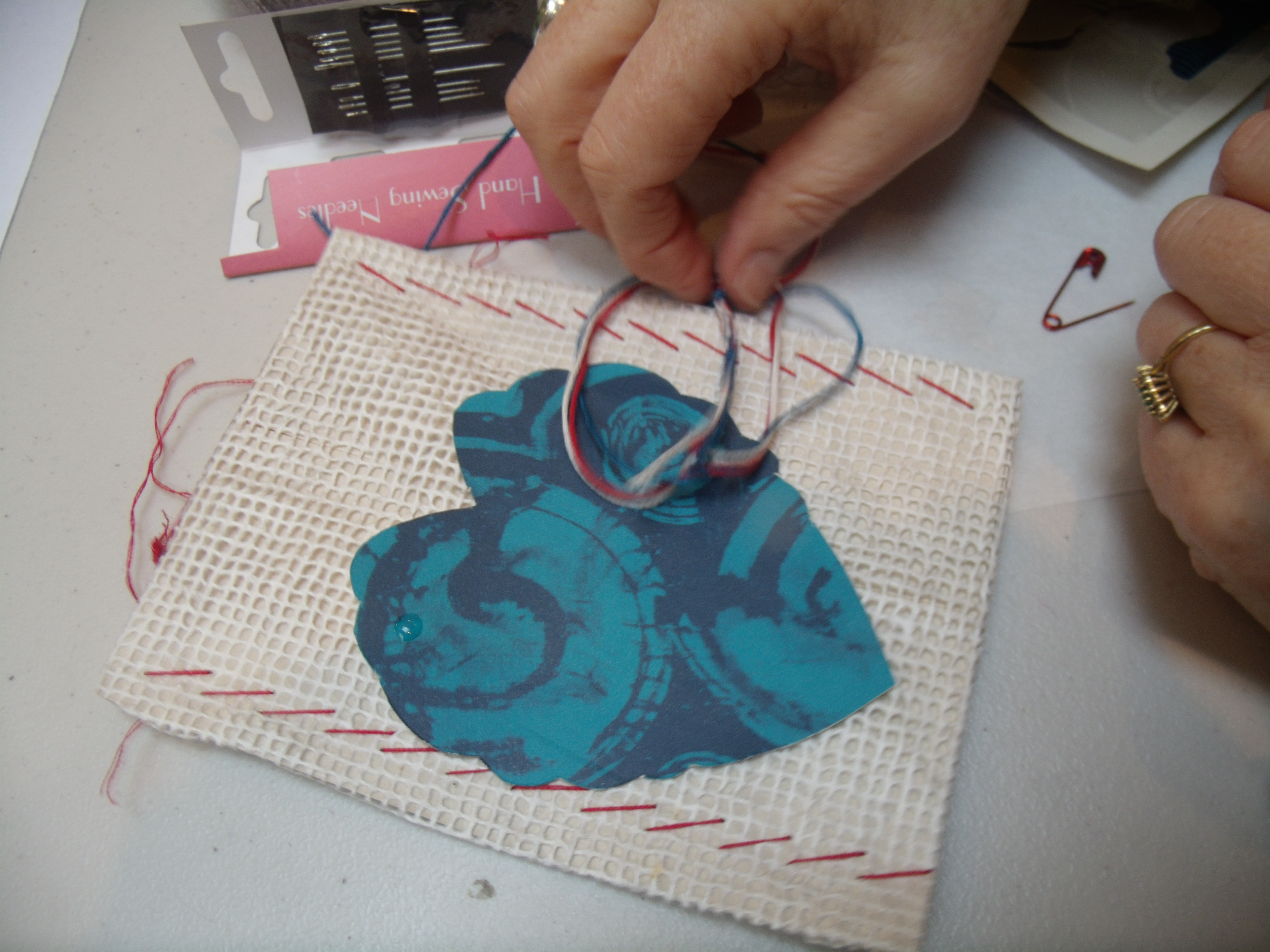
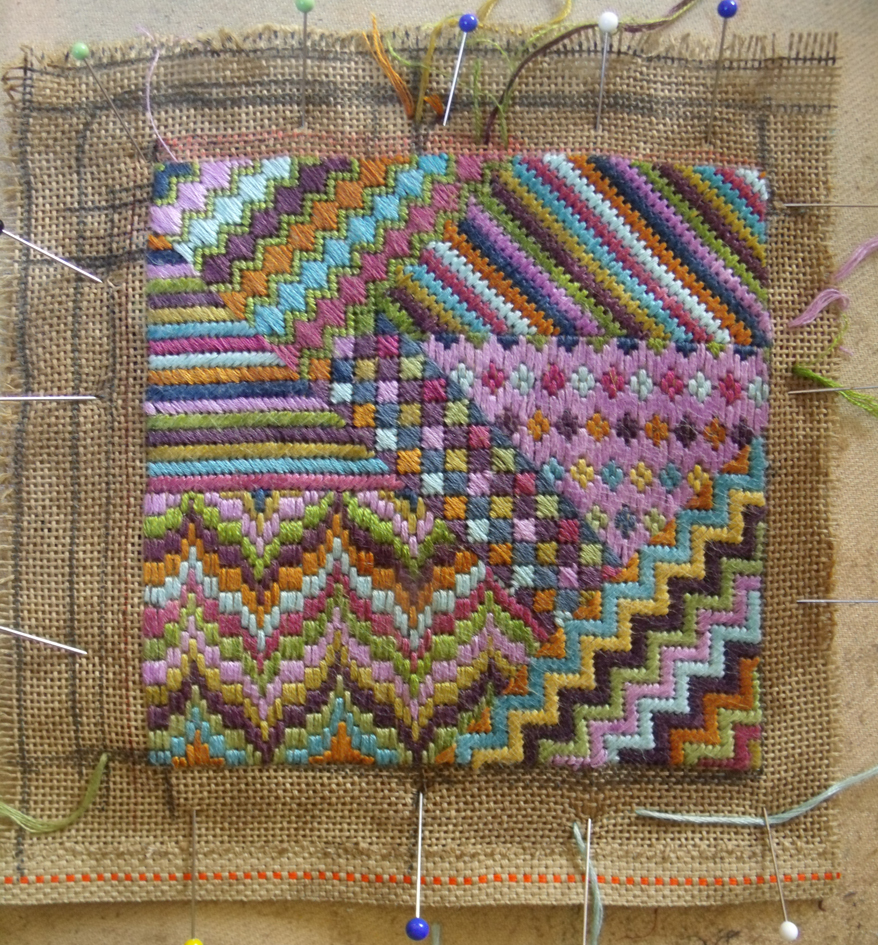
I set about making a small square of canvas embroidery based on Crazy Patchwork – my favourite embroidery design system at the present time. I drew a random set of shapes in waterproof ink onto a 12 holes to the inch canvas – big enough to become either a case for my glasses or mobile phone.
drawing round an old glasses case for a pattern
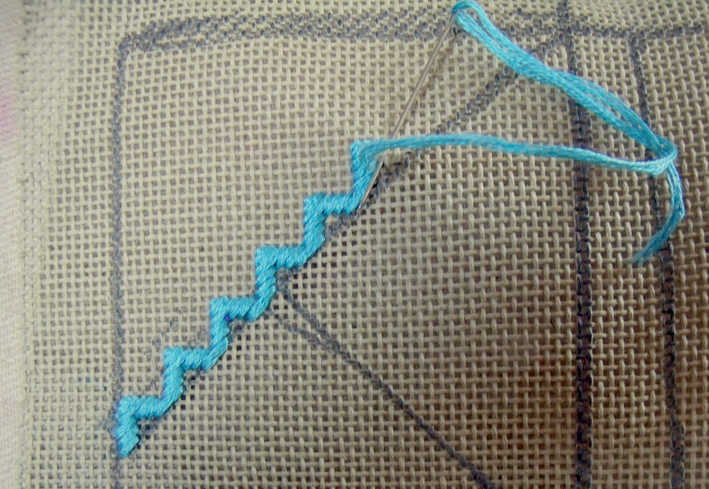
embroidering zig zag stitch onto the canvas
I decided on a colour range and selected stranded cotton threads and stated to stitch working from an old needlework book for all the different patterns. The patterns are lovely and have wonderful names, my favourite name is “Encroaching Gobelin” I can just imagine something out of a fairy tale, I use this stitch for blending colours but didn’t need it for this design.
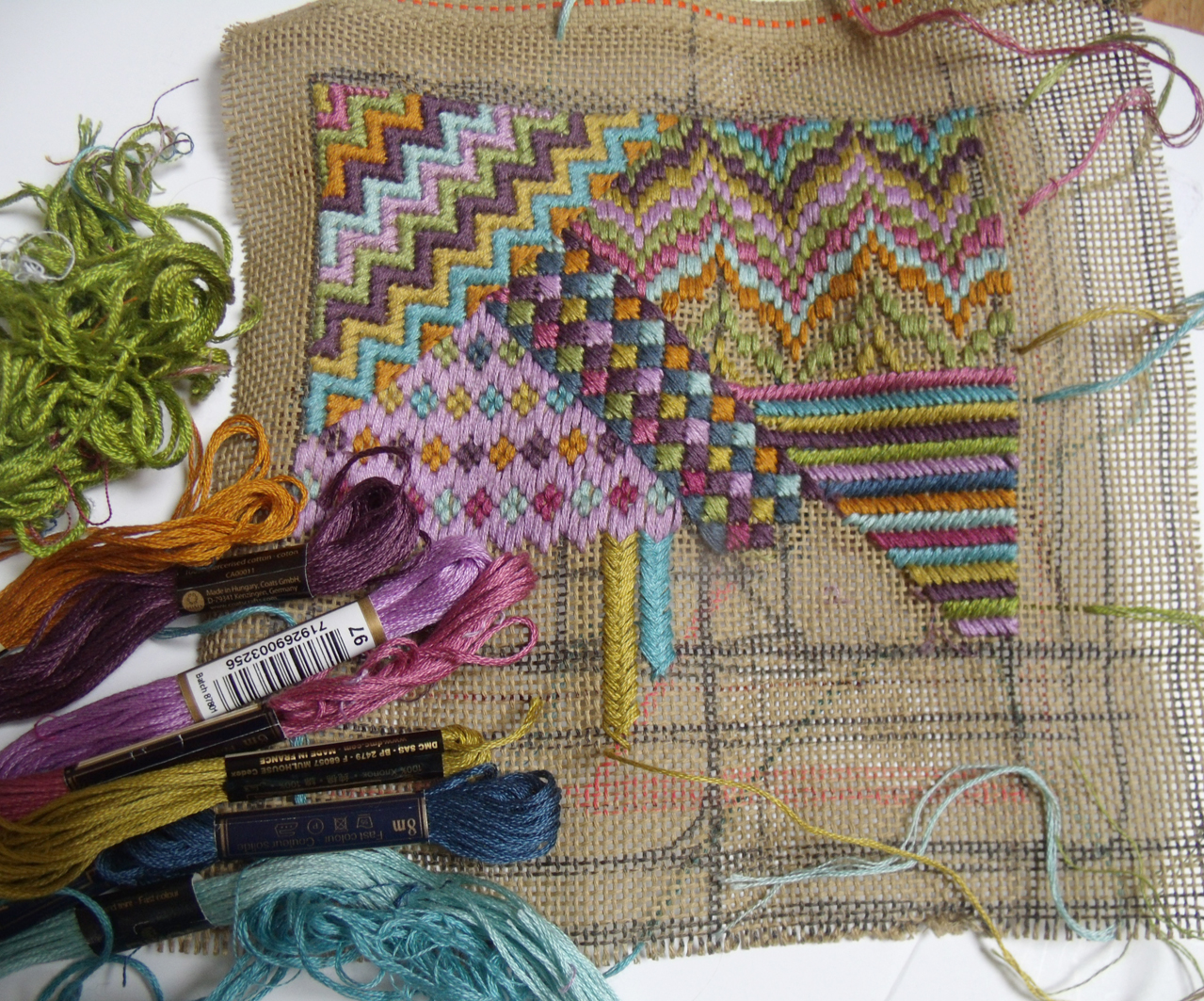
developing the coloured stripes using an old needlework book for reference
I decided to use a series of striped lines of stitches to make up the crazy patch shapes, usually counted canvas is worked in solid colour blocks – like the cushion at the head of the post.
the work progresses – very slowly due to changing my mind on the colour combinations
The work was extremely slow to make – it took me the better part of 2 months to complete, mostly because at first it was very painful and tiring to keep the my hand stitching, but also because I kept changing my mind on the colours. Usually I work to a design or colour swatch that I have designed before I start , but this wasn’t really work, this was therapy!
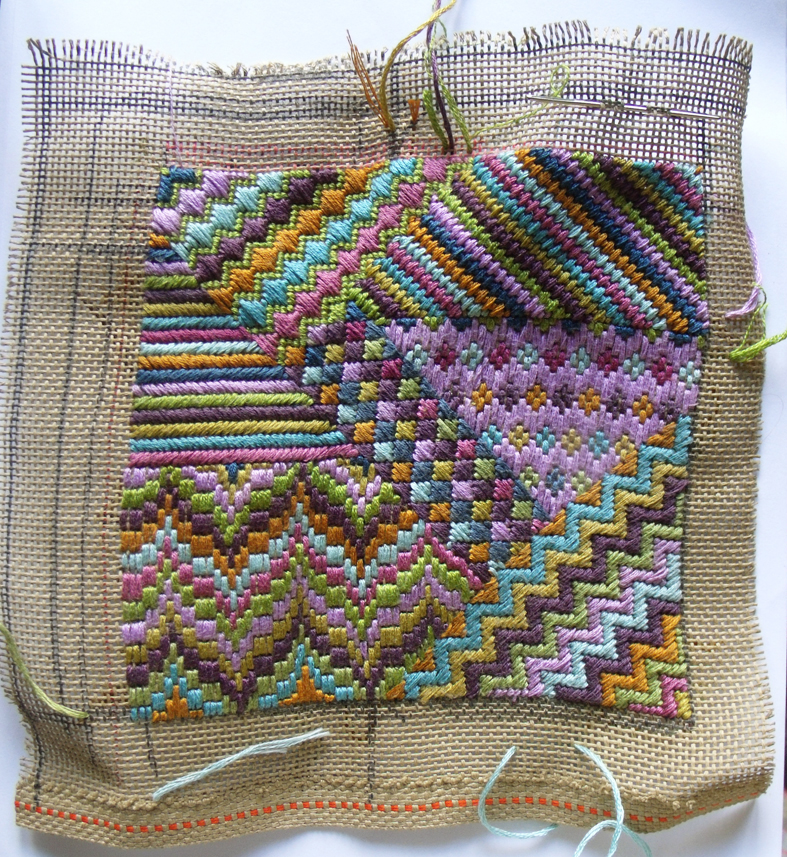
finished canvas work – unstretched
the finished work is often mis-shapen due to the pull of the directional stitching, but this type of canvas is sized, meaning it has a weak glue in it that can be activated by dampening allowing the work to be stretched back into shape,
the dampened canvas is pinned and stretched into a square format and left to dry naturally
I had initially thought to develop a day workshop at Heart Space Studios to make a similar design, this type of embroidery is not often seen these days so it would be good to resurrect it, and the use of the striped and lively colours makes it look very zingy…but I would need to make a series of workshops to develop it – more like 6 sessions… so maybe I will reconsider this at a later date.
Simple sample of machine embroidery by Susi Bancroft
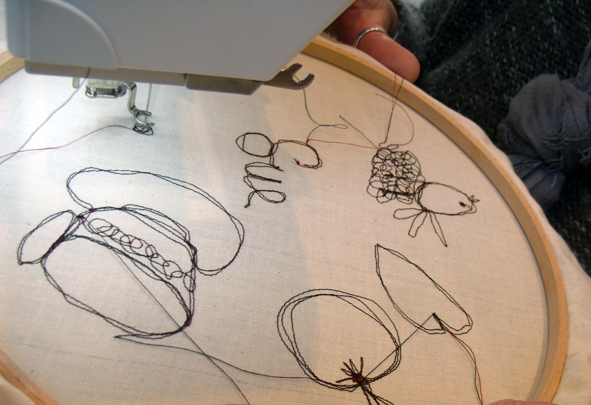
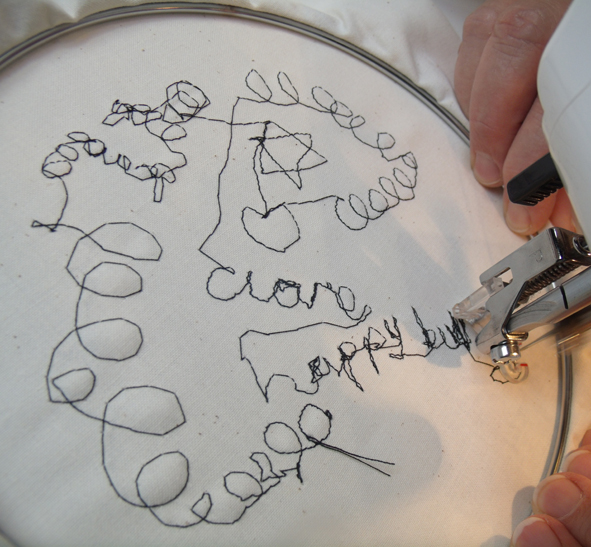
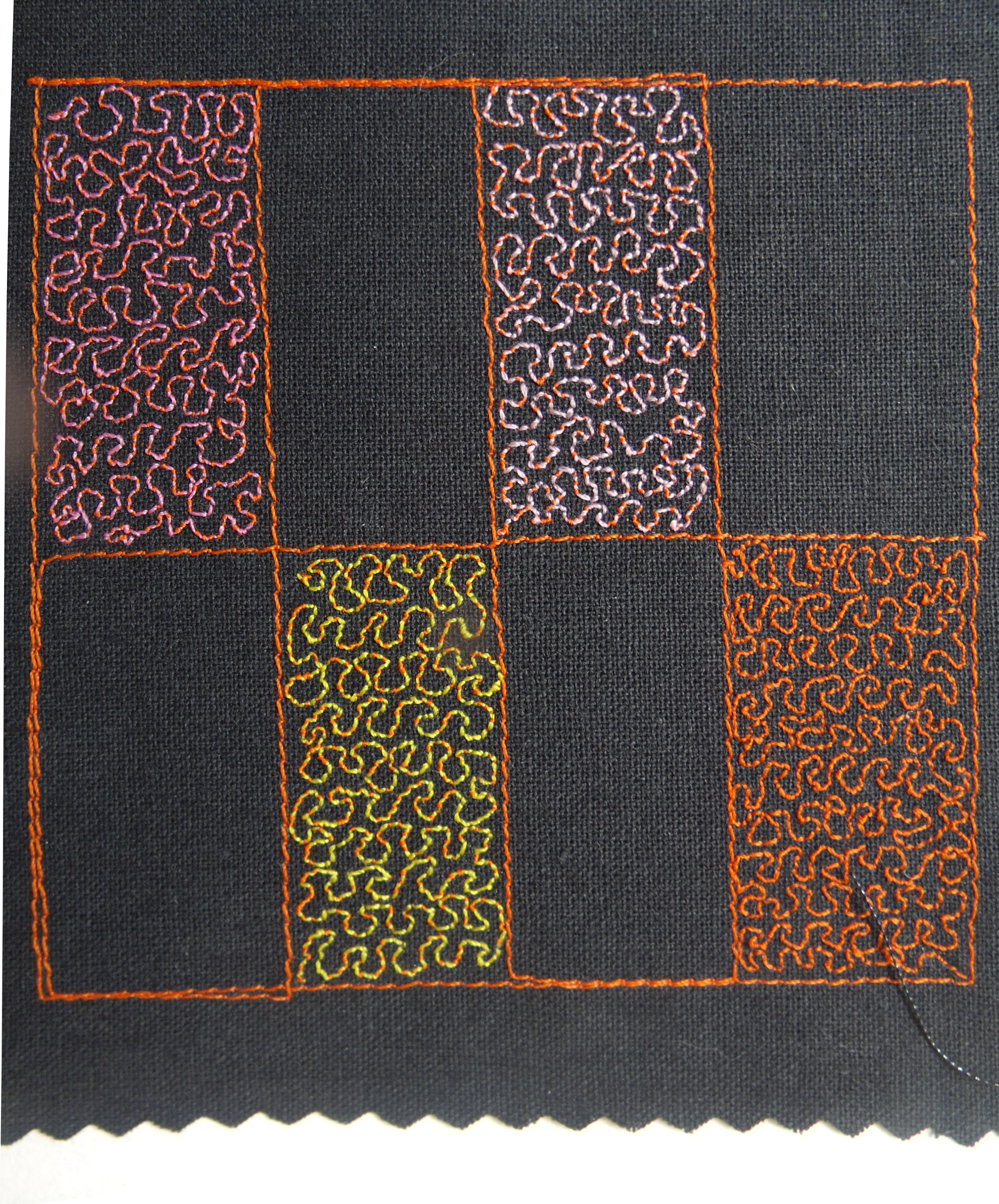
“Taking a line for a dance” is a good way to describe what happens with free machine embroidery…the freedom with which the needle can stitch patterns, images and even writing very fast – is really fascinating to watch. First disengage the feed dog – I just love that name for the row of teeth embedded in the metal plate below the needle….
free machine embroidery using a hoop and the sprung needle
and either using a specially sprung embroidery needle, with or without the old school embroidery hoop to keep the fabric tight, it is possible to move the fabric enabling the still needle to make lines of stitches.
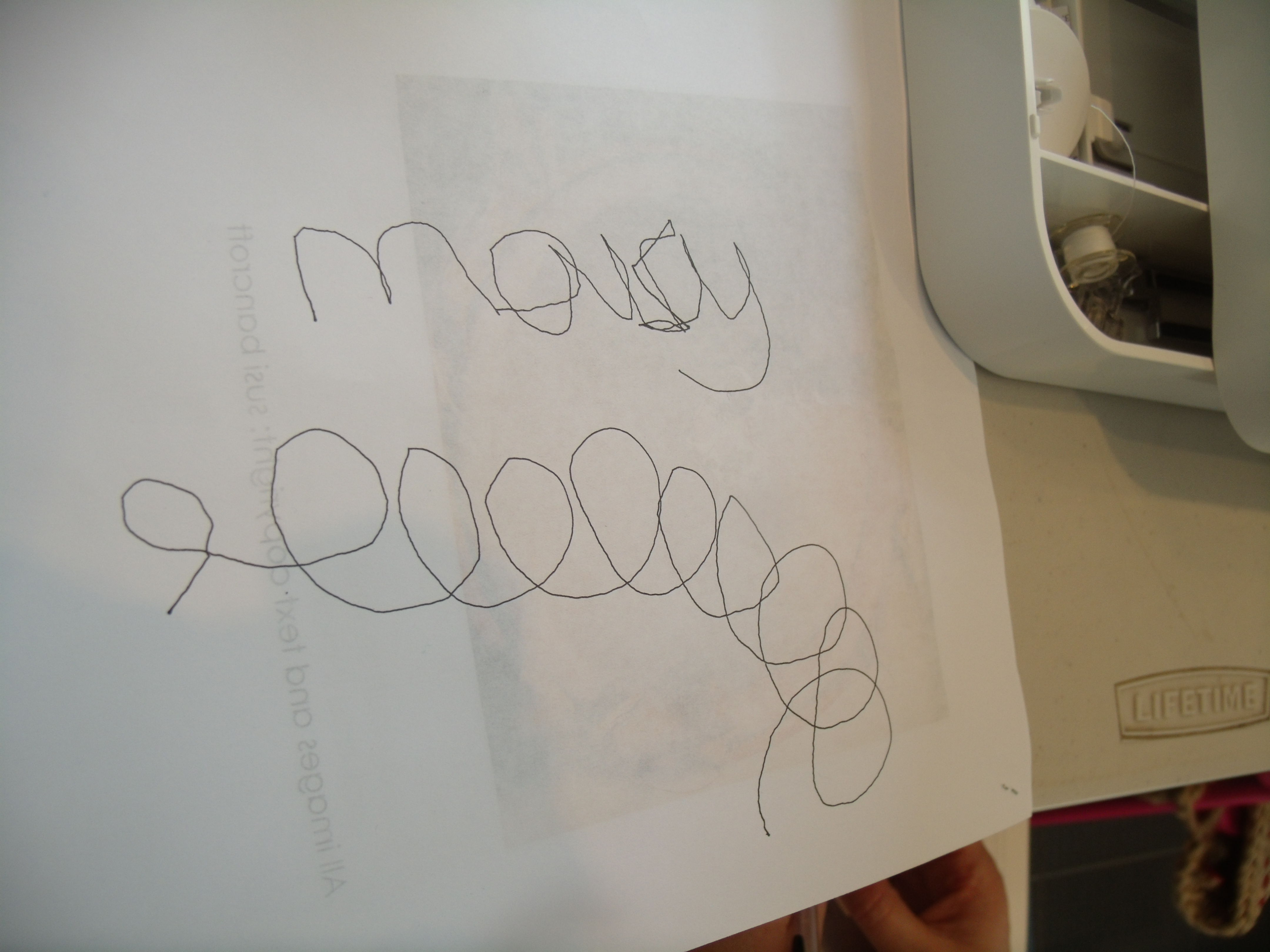
first drawing by moving the paper and not the pencil
moving page animal drawing – dog or cat?
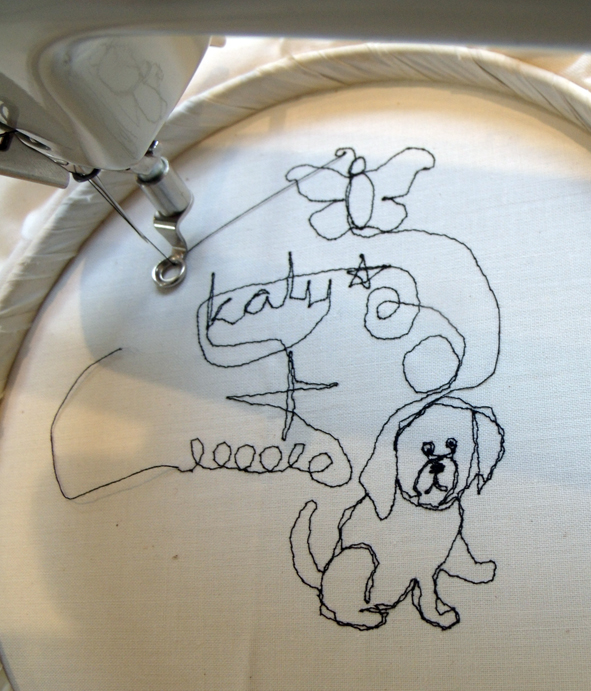
Recently at Heart Space studios, Susi Bancroft taught a group of students how to achieve this technique in just one afternoon. First she got everyone to try to write their names or draw something by moving the paper while someone else held the pencil steady…with very unsteady results…but this is how machine embroidery works. She then got everyone stitching with reference to the drawings and suddenly things started to happen – fast
The first attempts at machining were definitely stronger than the pencil drawings. Susi always gets everyone to stitch in black cotton on white calico first, to gain a strong contrasting line..
first attempt to stitch drawing and writing
writing and dog drawing
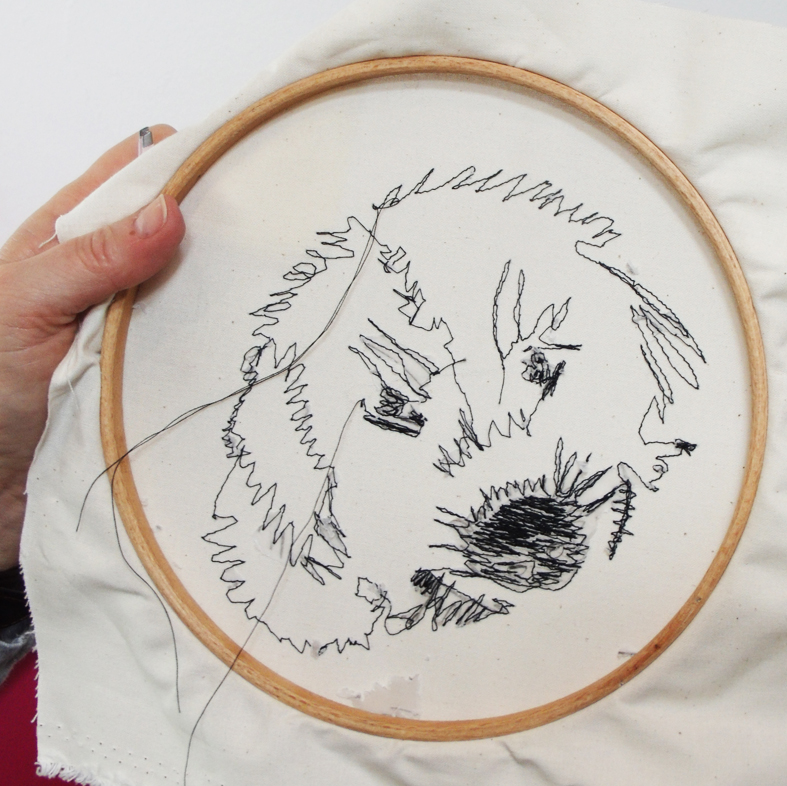
It didn’t take long before everyone was feeling a lot more confident and really getting to grips with larger scale drawings
freely machine stitched dog portrait
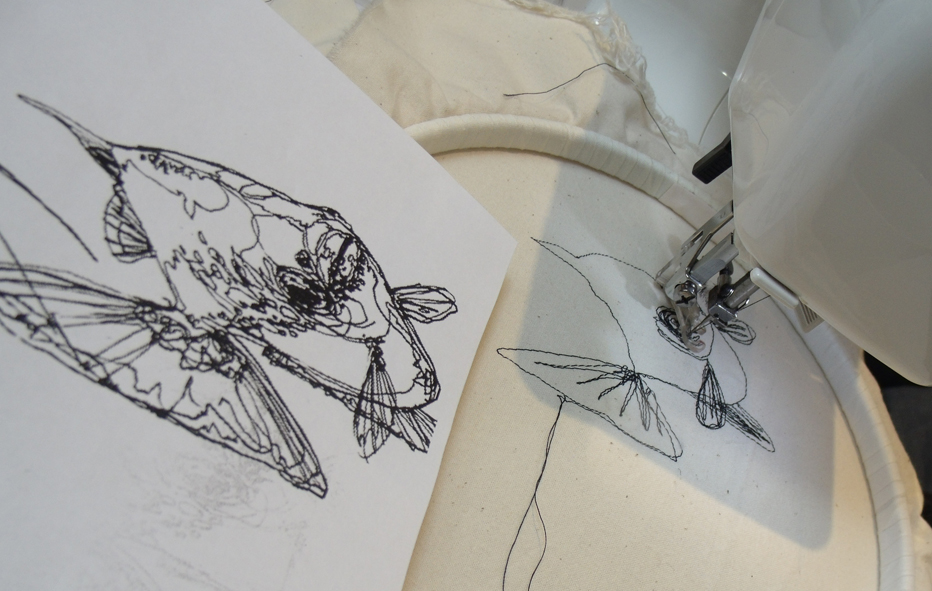
One of the exercises offered was to copy a black and white drawing a drawing – with remarkable results considering no guide lines had been drawn beforehand.
copying a line drawing of a fish – a free embroidery challenge.
Susi had also brought in a book of samples of her own work and showed the students these to demonstrate what else could be achieved now they had the basics…
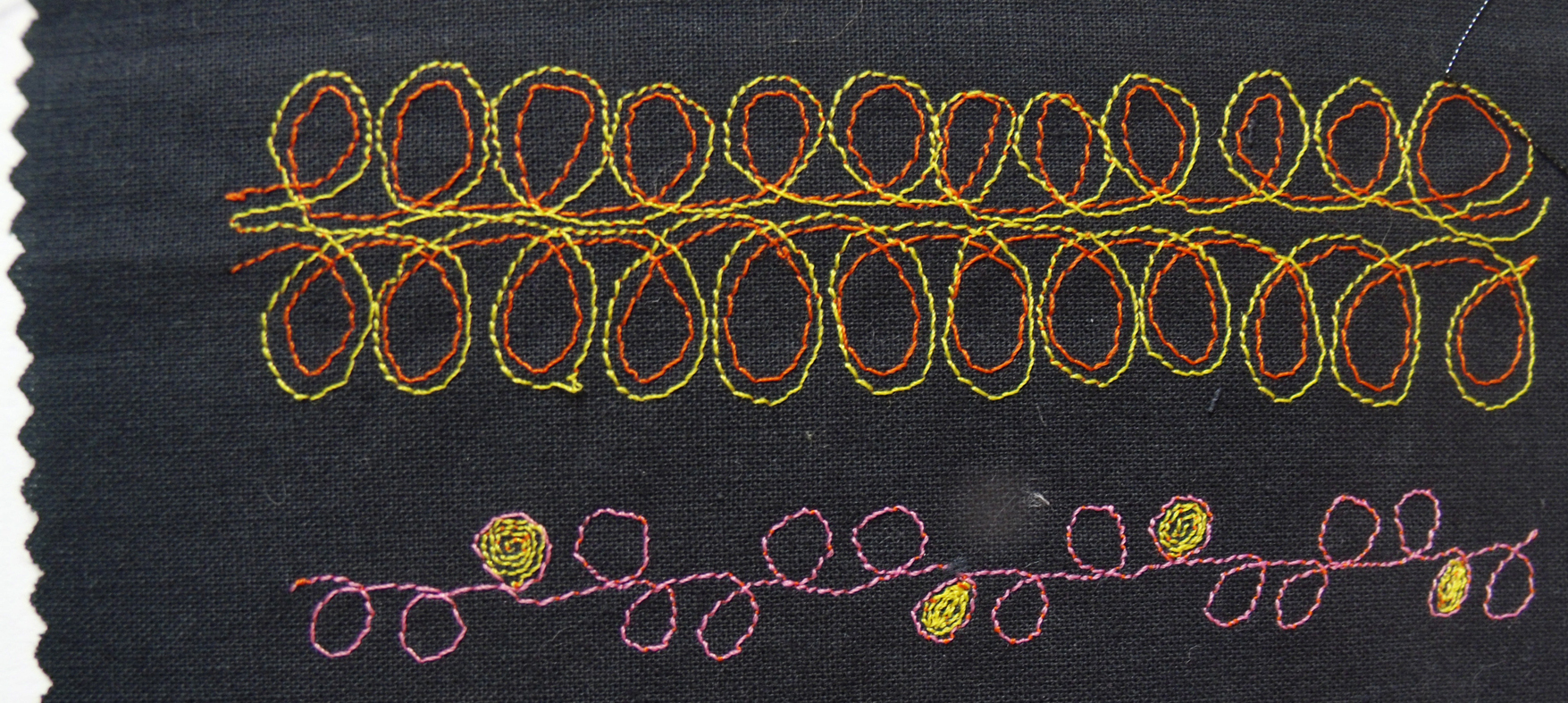
vermicelli linear stitching sample – Susi Bancroft
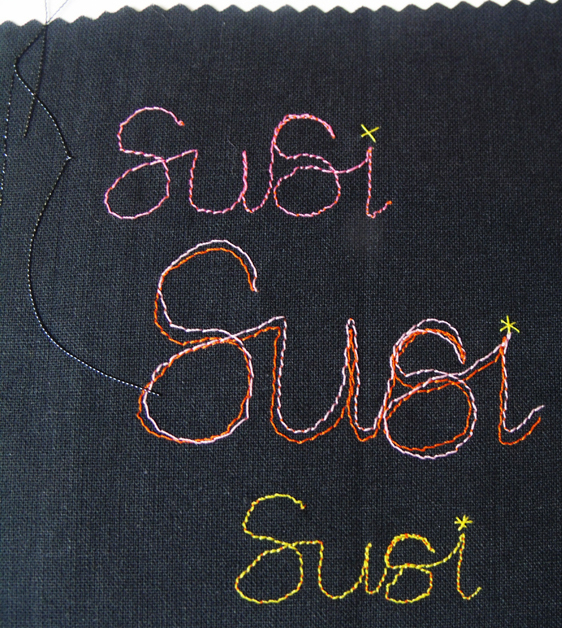
sample machined writing – Susi Bancroft
Now the colour started to be sampled, this is where all textile people get excited – endless possibilities just by changing the thread ….
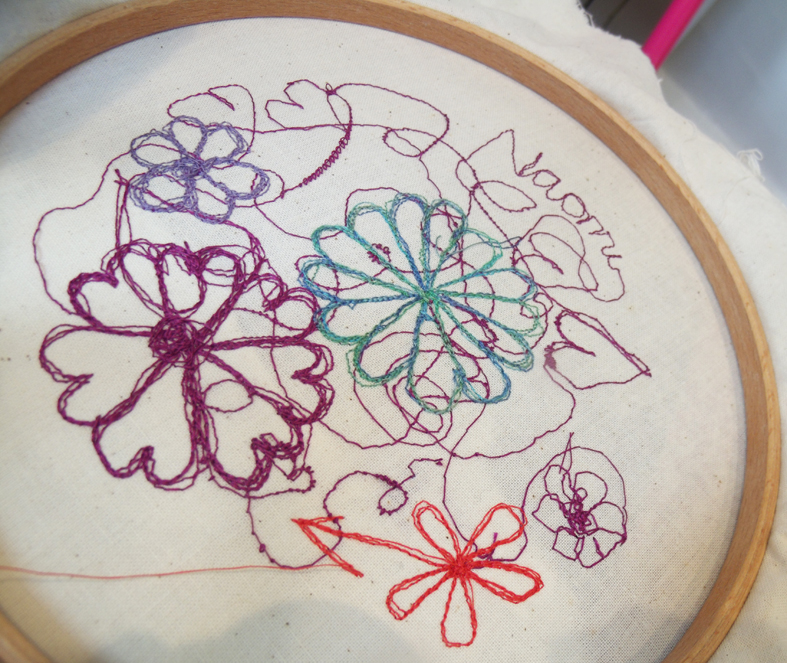
playing with coloured free machine with extra outlines
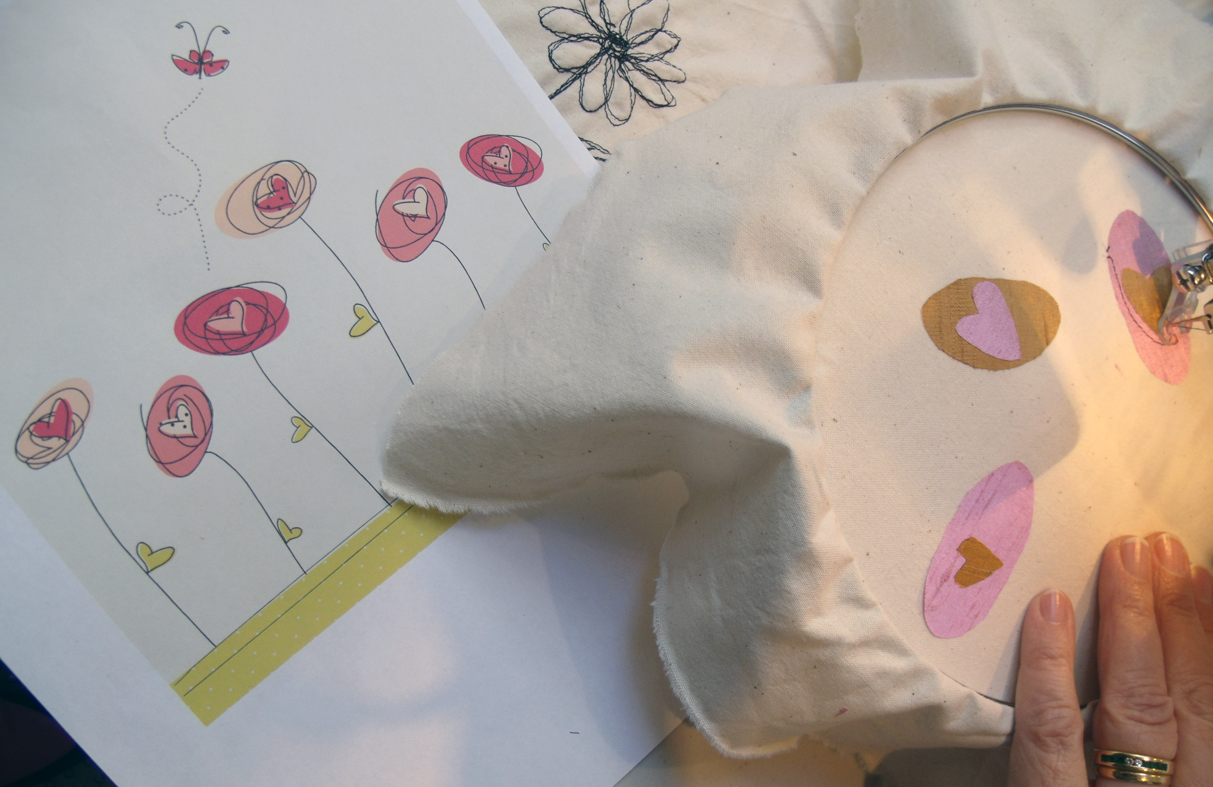
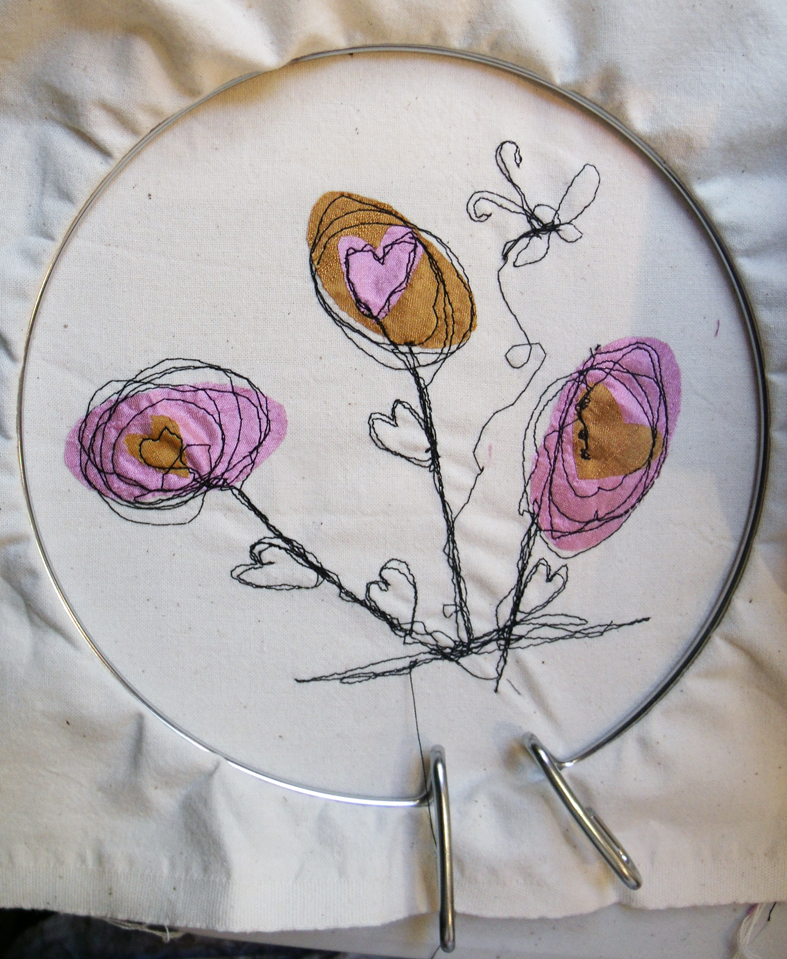
and appliqued fabrics started to appear – each person had brought some form of inspirational work, either an illustrated card or photographs and drawings
working small appliqued motifs from a commercial card design
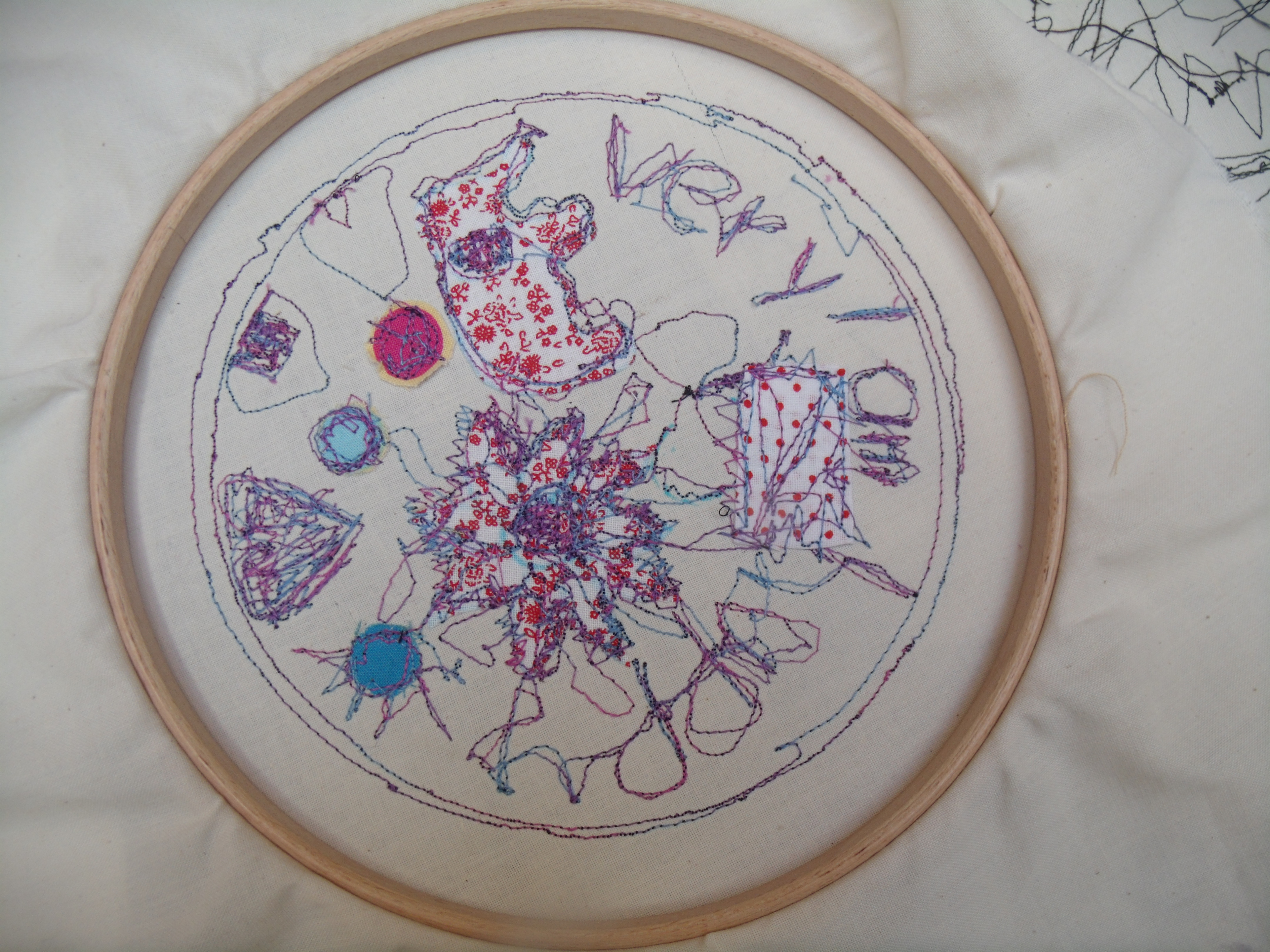
Now I know that working with the sprung embroidery or darning needle means that the hoops aren’t necessary, but Susi feels that for the first attempts everyone should adopt a belt and braces attitude, the fabric needs to be as taut at possible to get the best results. When everyone feels confident of drawing then they can remove the hoop – however most people took advantage of this restriction – this work below is already framed – it actually reads ” I am Very Happy”
circular embroidery made by keeping to frame restrictions.
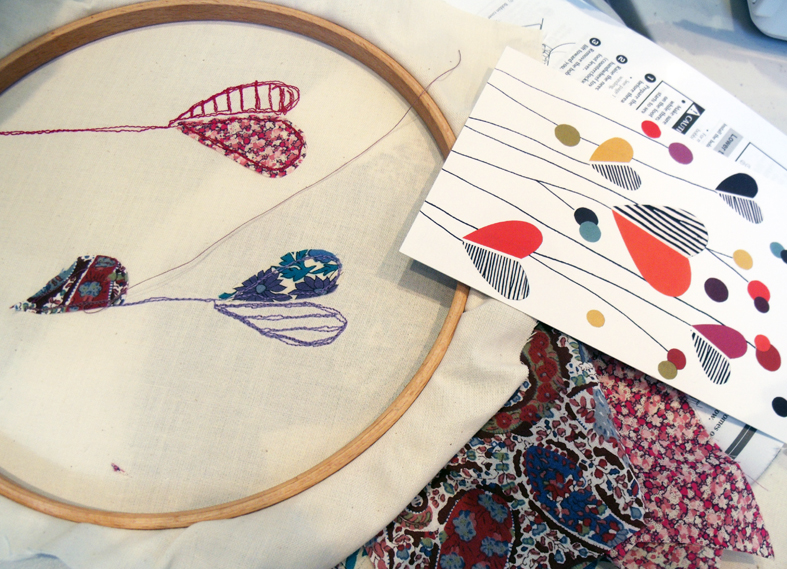
and here the nuisance of not being able to manouvre the stitching past the hoops intrusive clamps has made a new design from the original card – go with the flow…..
design due to the constricting clamps – this is what sampling is all about – work with what you have got.
Some more renditions of photographs and cards start to take on a life of their own – this is why I think that copying something inspirational is a good way to start off any new technique, the worry of design is taken away and suddenly invention takes over..
copying the design in fabrics brings so much more pattern and texture
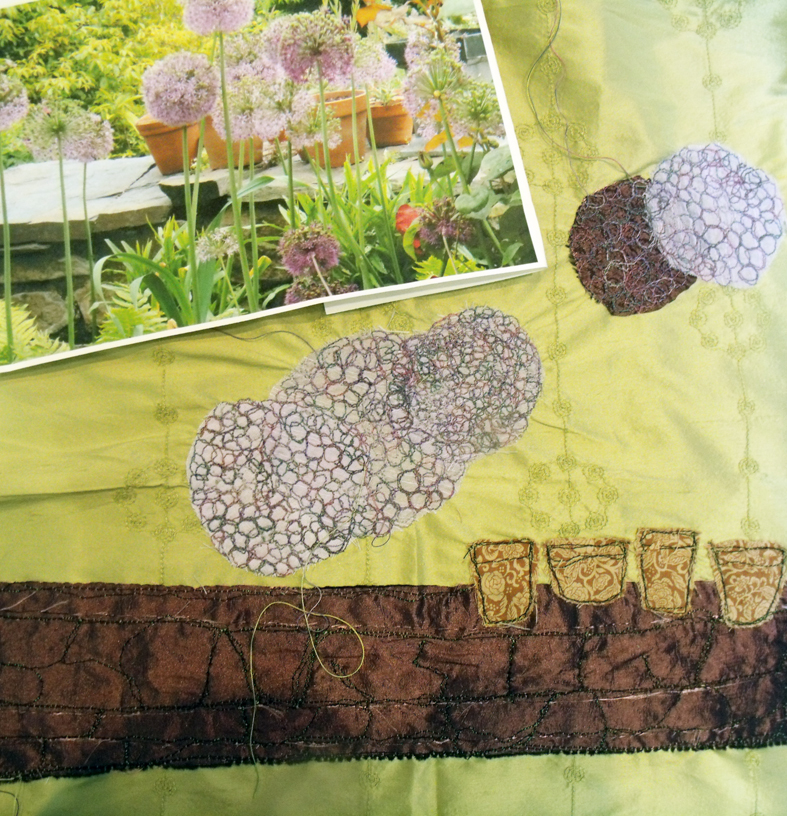
and working from lovely photographs is often a good way to get started – the fabric soon asserts itself.
photographic inspiration works for a colour gamut to get things going.
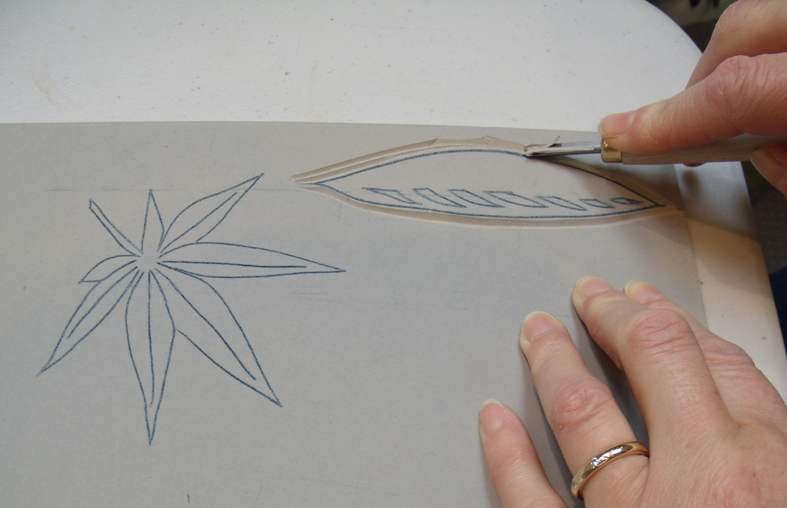
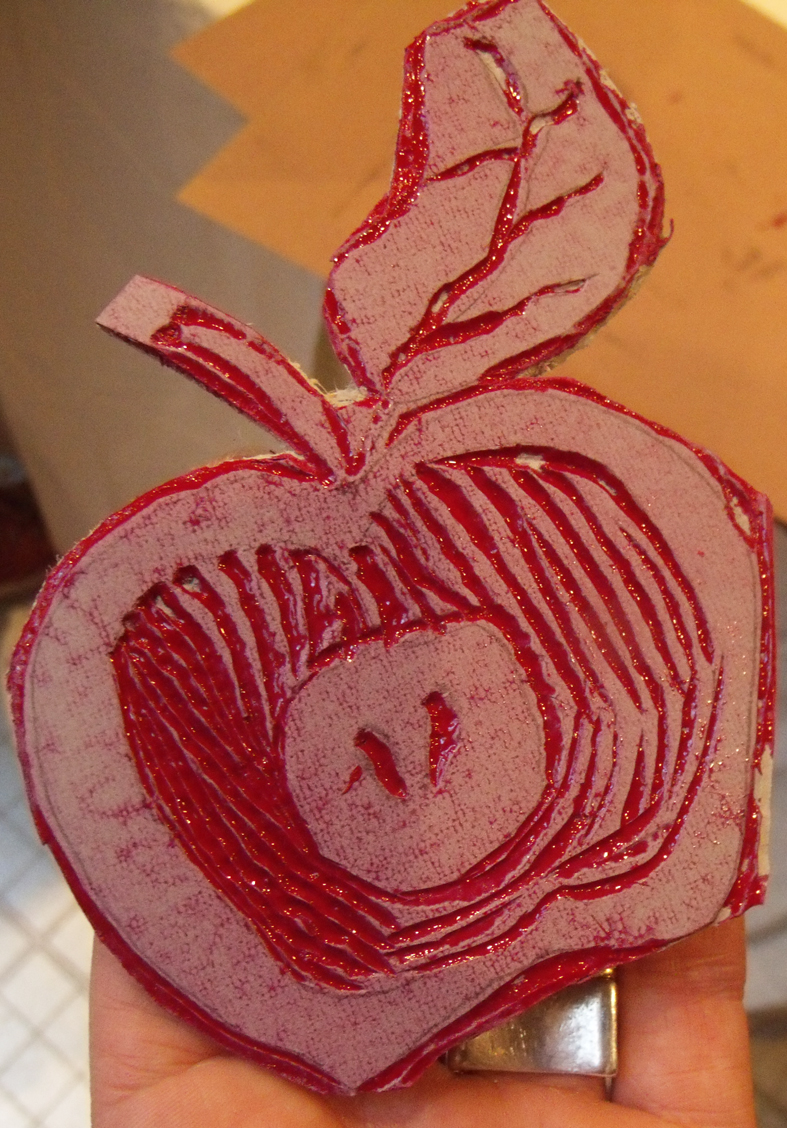
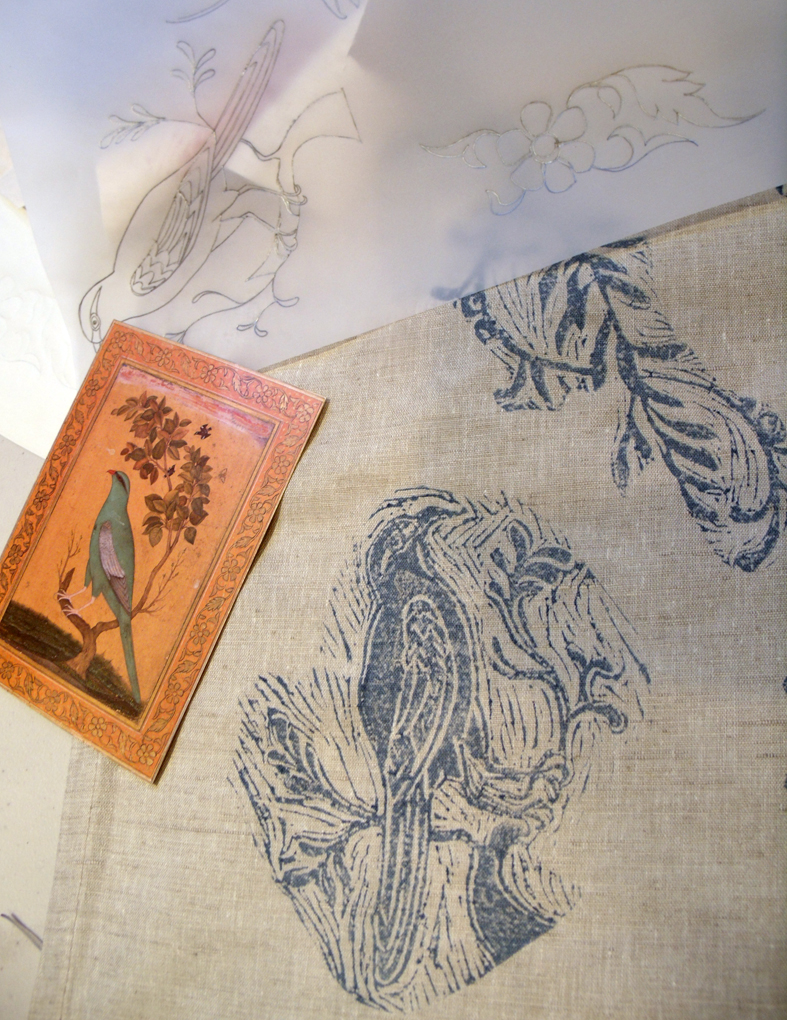
I haven’t cut and printed Lino for oh…..well, since I left art college in the late 1960’s, so that’s almost………. lets’ move on! Checking out our really popular Lino Printing on Linen workshop at Heart Space Studios, run by Jacqui Watkins, I had an overwhelming urge to join in – the sensuous feel of cutting through lino really appeals to me as it is another form of drawing – but the transformation when the block is printed is almost miraculous.
first simple line drawing on sheet of lino
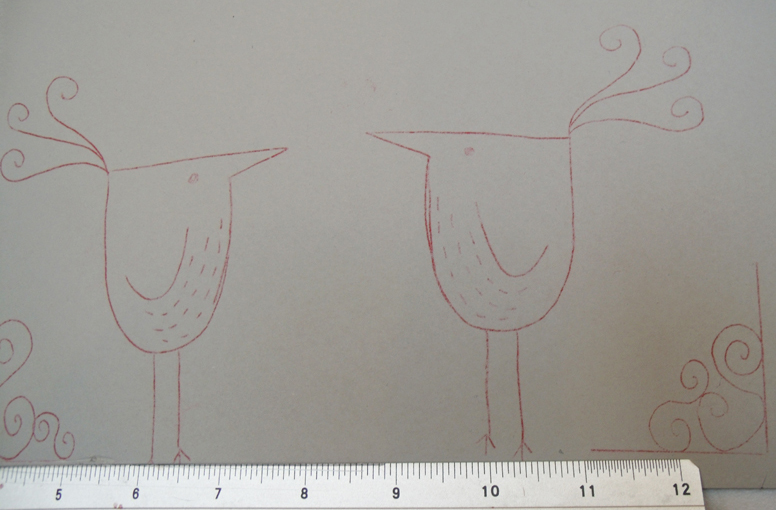
Jackie had asked people to bring in some simple linear images or their own drawings to work with, the first cuts were quickly sampled and assessed..
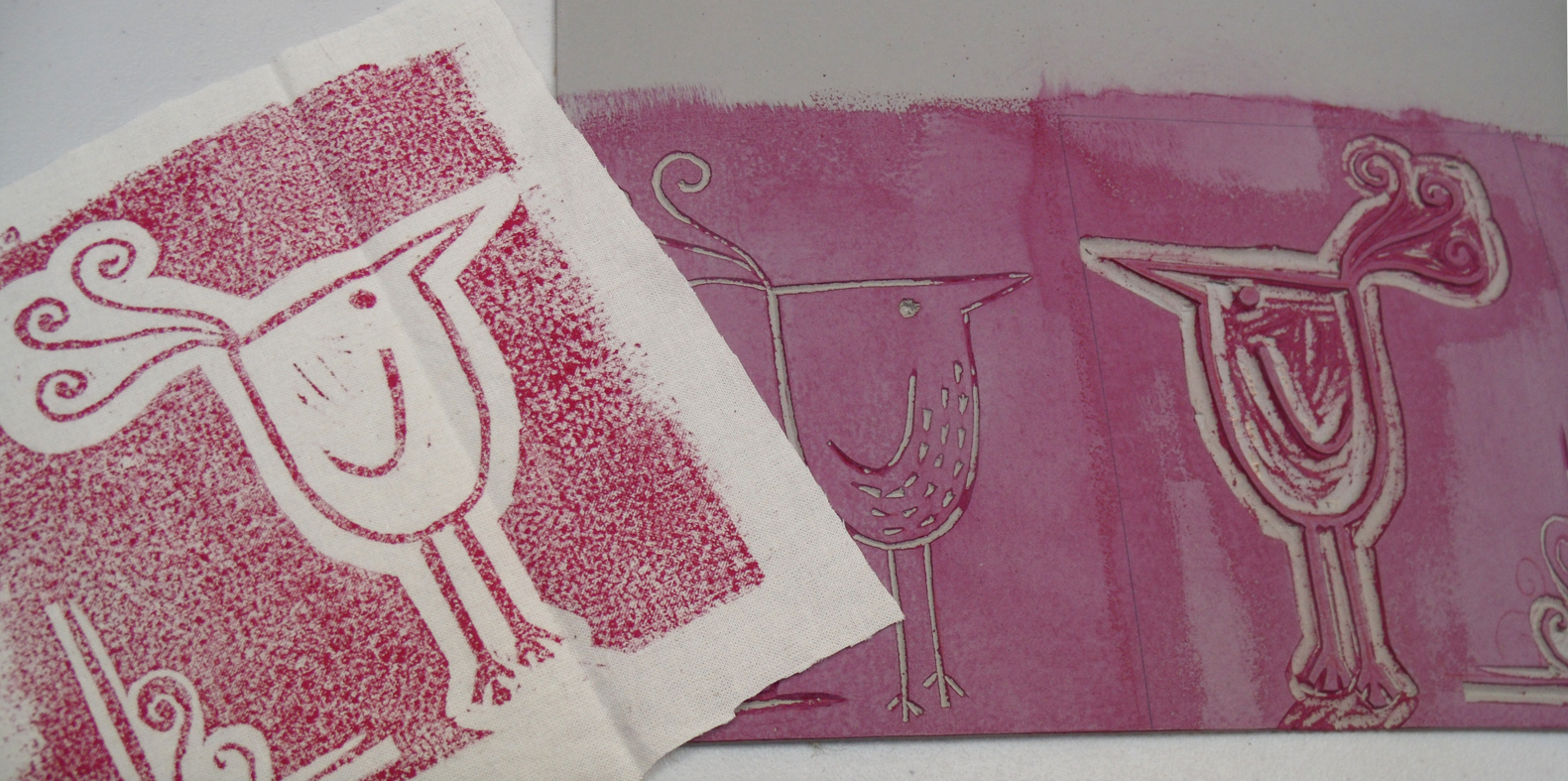
first sample print from the cut lino bird drawing.
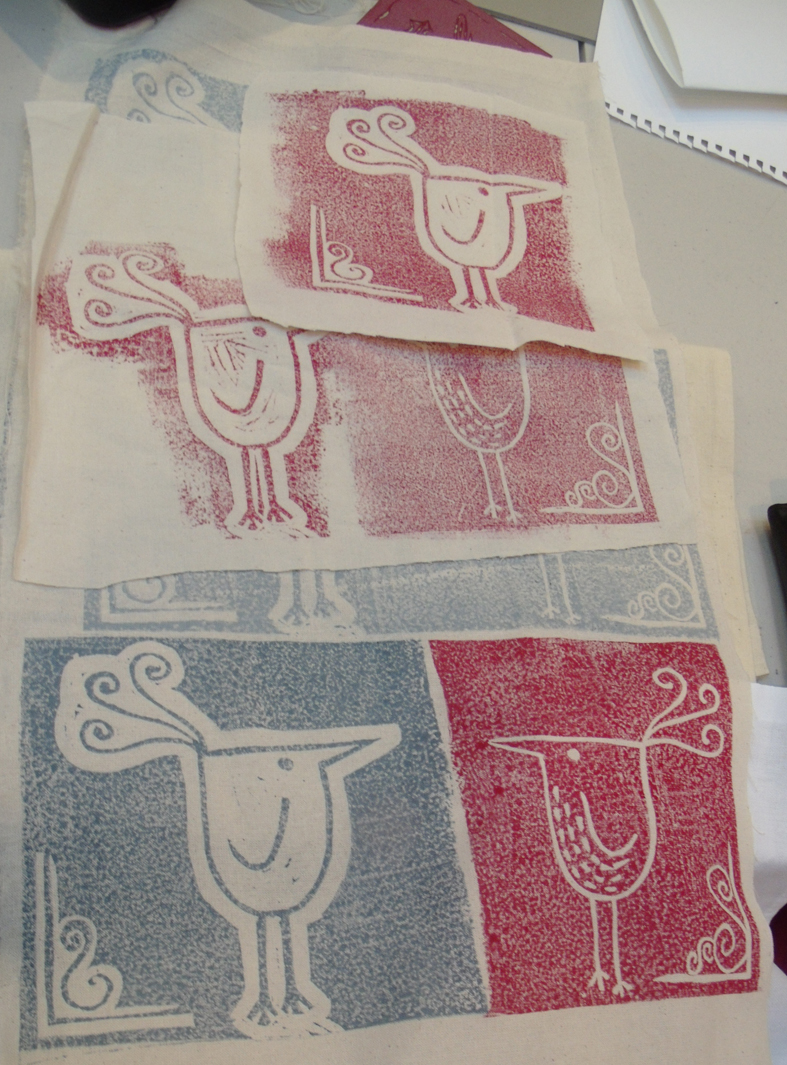
then different colours and fabrics were printed…it is such an immediate technique.
strike-offs of the bird block.
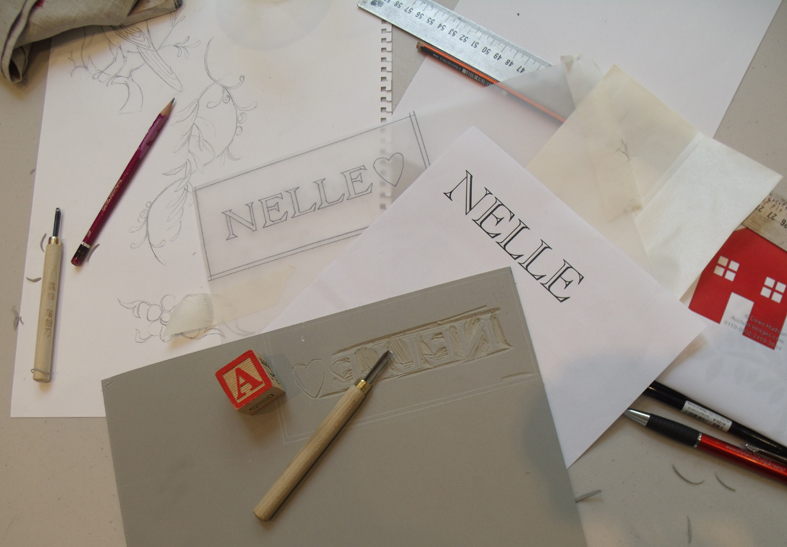
There were many different ideas in the group; lettering traced from a classic alphabet looks very different when cut and printed in this technique
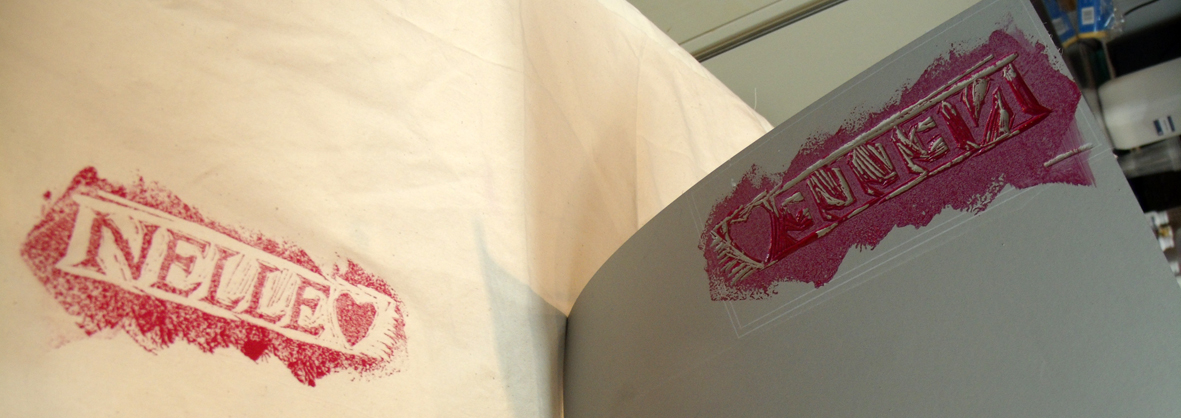
tracing for a child’s name and the resulting cut block – back to front don’t forget!
and the joy of the first sample print – magical….
Da Da….first sample print…easy peasy!
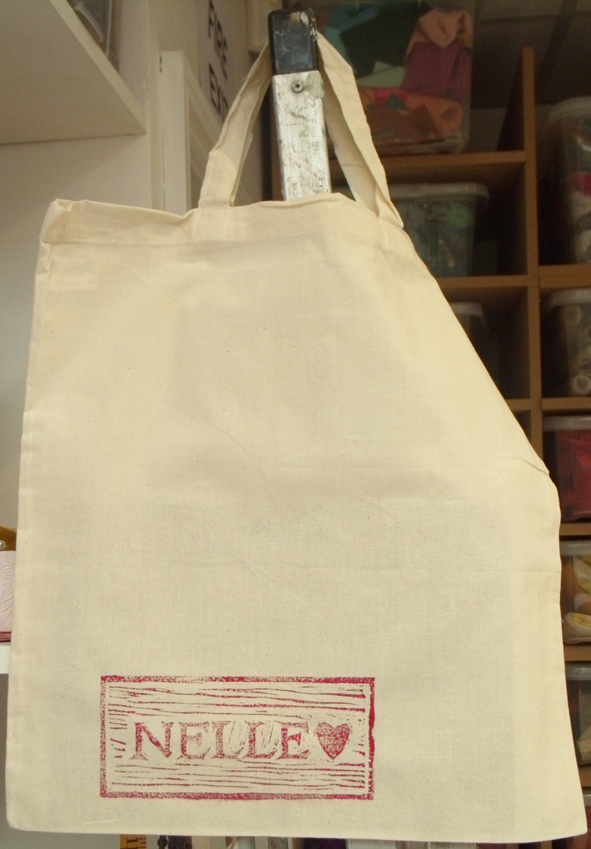
it usually needs a bit of tweaking to arrive at the finished result – to print a personalised kit bag for a daughter to take to school..
finished printed kit bag
Jacqui had brought several samples of her own prints to show that just small simple motifs can be placed together to suggest movement in the birds for example. Brilliant for beginners to just work on a few small images to gain confidence.
sample swatch of small stuff ready to be assembled into different designs.
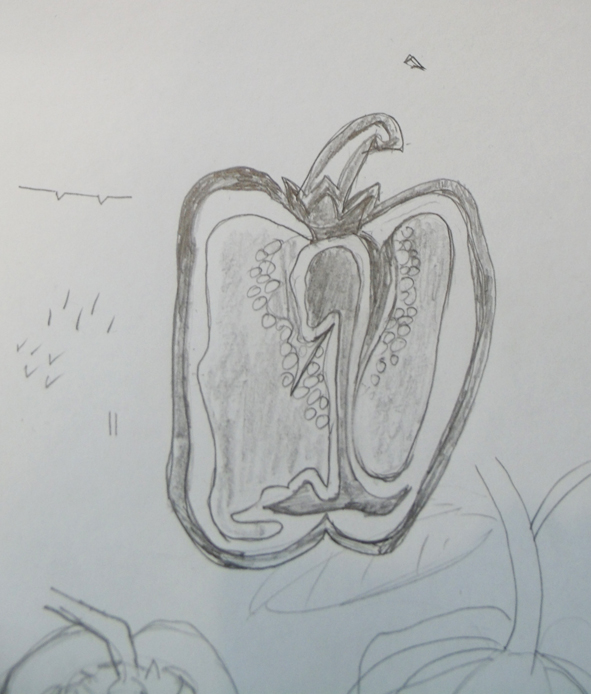
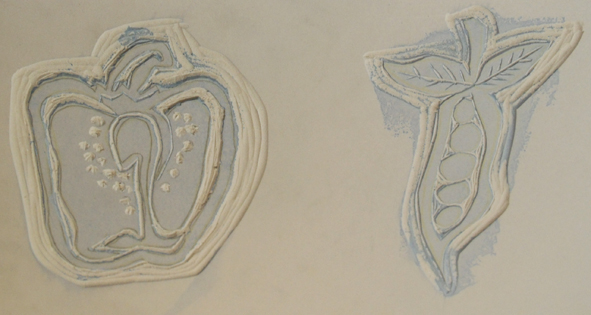
Looking round the I spied a drawing that was a very popular as a textile motif when I was an Art ‘A’ level student…half a pepper…but so retro now!
the pencil drawing of half a green pepper
I did wonder how the student would manage to overcome the solid shape; pepper insides are fascinating and intricate to draw, but a bit of a lumpen shape outside.
side by side half a pepper and pea pod
But seen next to the giant pea pod on the lino block, I was reminded of the vegetable drawings in vintage cook books by authors such as Elizabeth David and Jane Grigson. When printed onto a linen tea towel the vintage look was made even more apparent
looks exactly like a vintage tea towel, but so fresh and modern
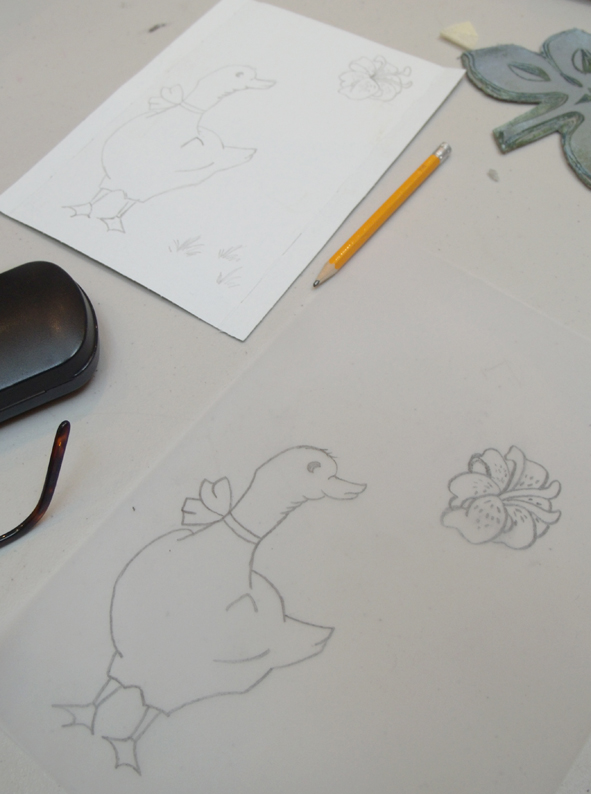
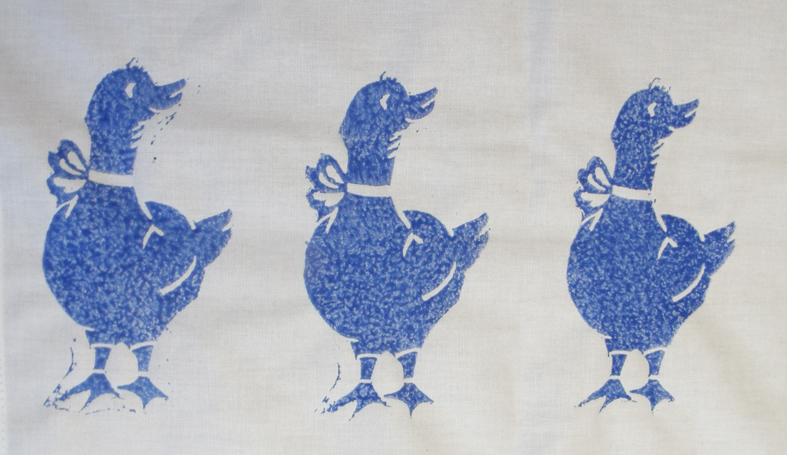
The difference between the initial drawings and the eventual fabric prints was remarkable, even a very commercial tracing of a Jemima Pubbleduck type duck
drawings of a commercial duck design
when translated into a solid shape that carries the texture of the lino surface with the marks left from cutting away the ground, form a lively visual combination .
three bird prints and three slightly different prints…
and this all adds to the attraction of all hand-block print techniques, each print is subtly individual…
just printed lino block with marks made by linen weave on the solid areas.
and looking at the freshly printed surface of the linen weave still apparent on the block above, you can see how this happens. Next time the block is ink rolled and placed on a fresh area of linen the results will be different.
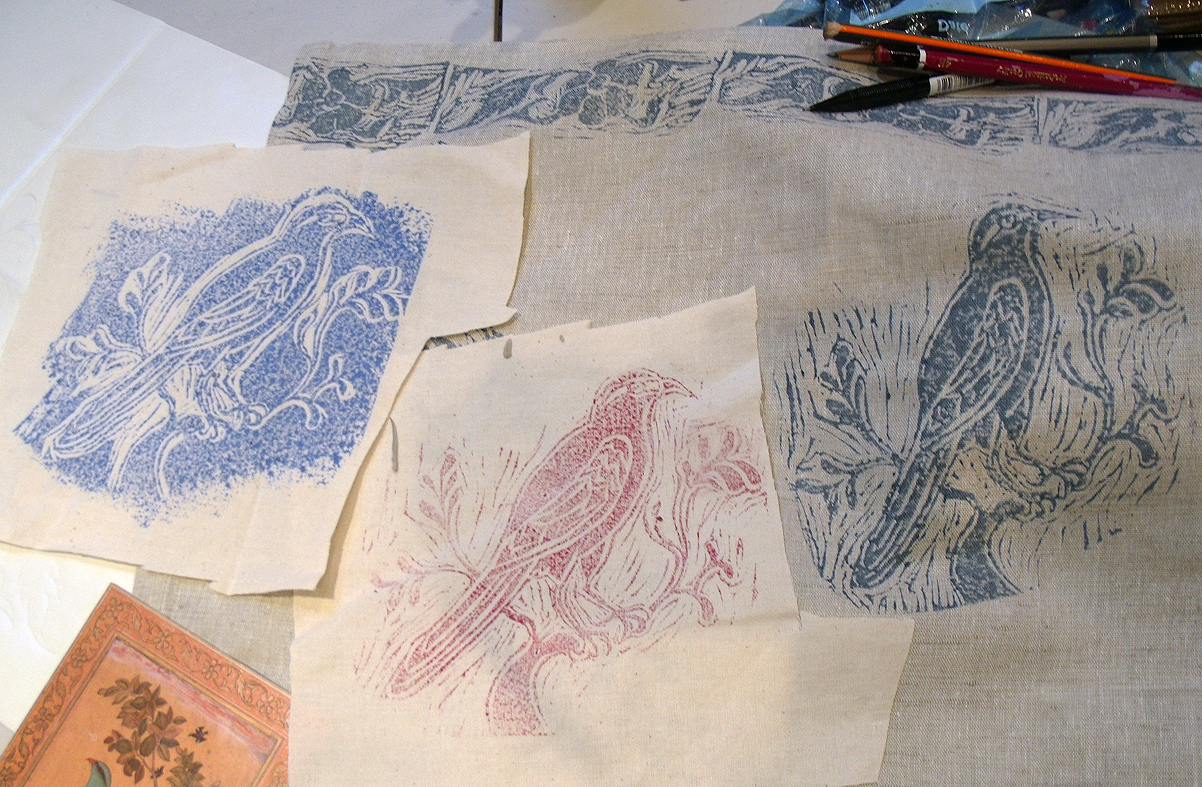
Meanwhile one of the students really took advantage of another result of hand block printing – the intentional inclusion of the cut away surface of the background..
original card of bird image with tracing and eventual print.
as can be seen below, the different stages of printing on different surfaces, on the upper left is the first print with a mottled background, the red and other blue print shows the background cut marks have been rendered in a rhythmical pattern to further enhance the whole image.
various stages of print backgrounds for this bird and branch design.
I am hoping to resurrect my lino printing by making a block of the Heart Hand and Eye symbols that I use for the Heart Space Studio logo, this is from a tiny rubber stamp adapted from a commercial design. I am considering to make products to sell in the our gift shop…so watch this space.
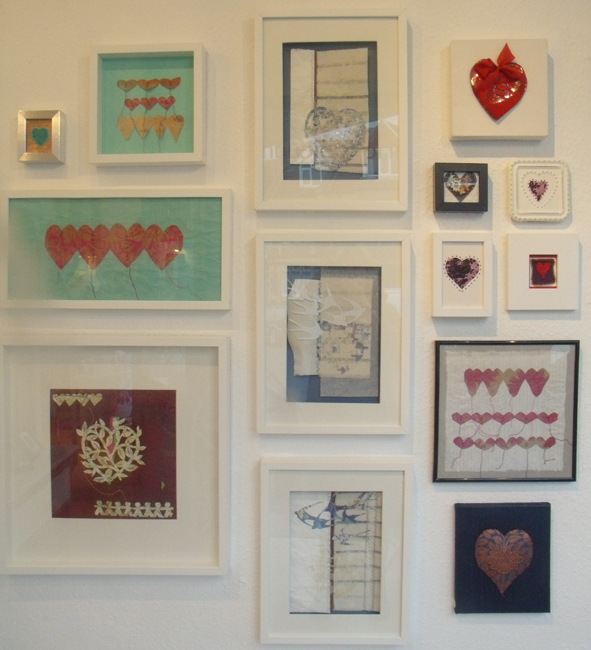
The small but delightful exhibition that the Heart Space Studios staff made in the mixed media session are all framed and ready to go on the wall ….
more stitched paper hearts by Susie Bancroft
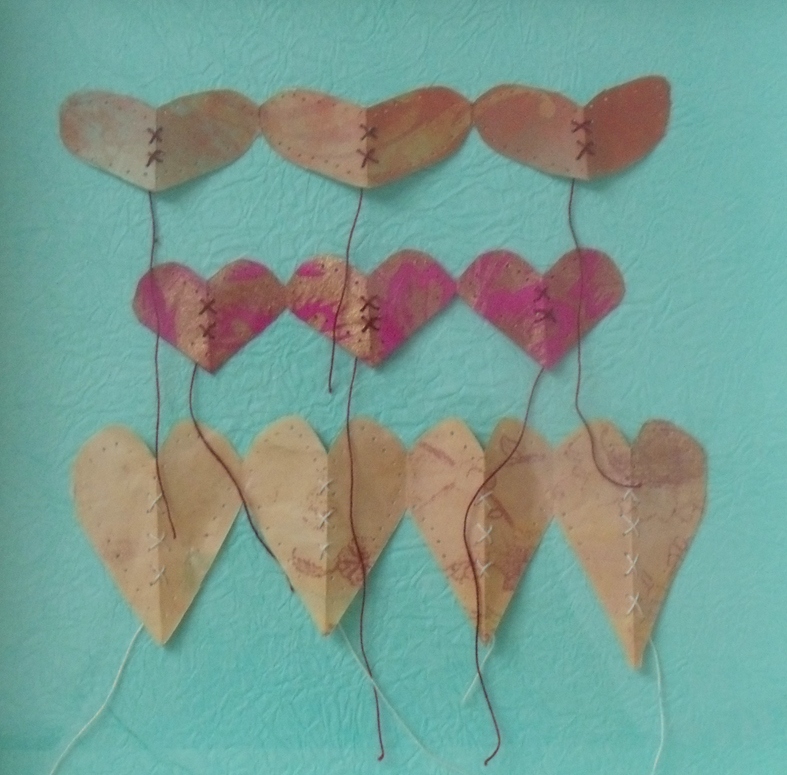
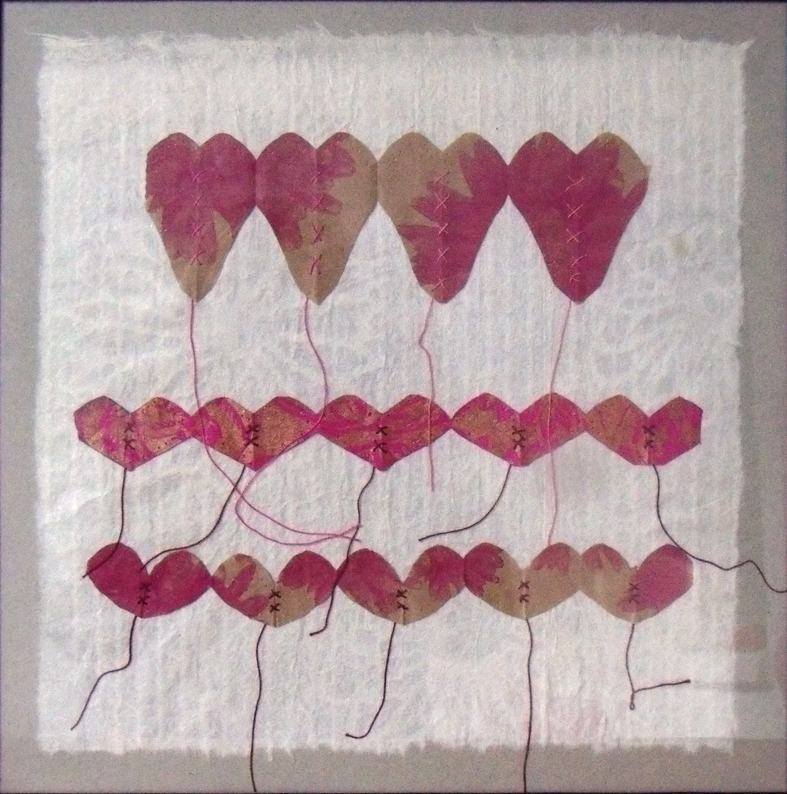
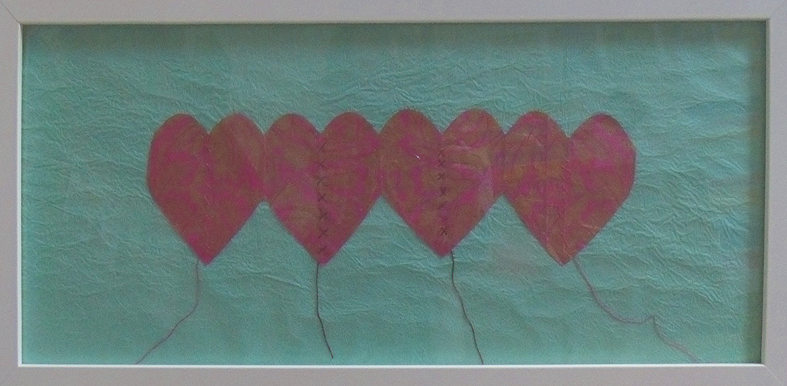
the first to arrive through the post was a box of stitched printed paper hearts from Susie Bancroft – so I set about mounting rows of them on Japanese hand-made paper or crumpled tissue papers ready for framing
row of large printed paper hearts – Susie Bancroft
the cotton threads just going every which way – I think they look like tiny heart shaped kites…….-
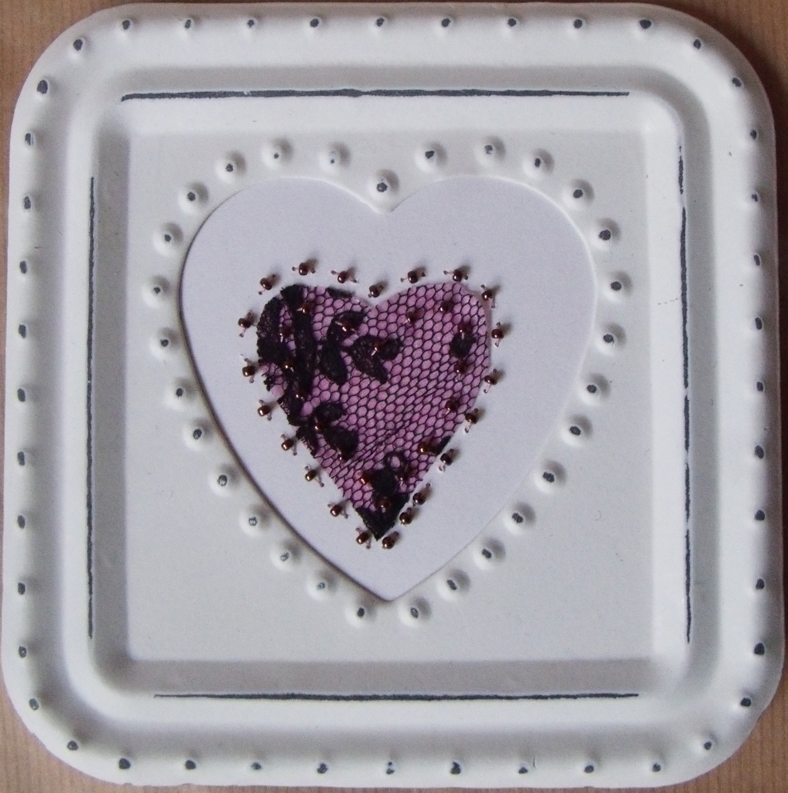
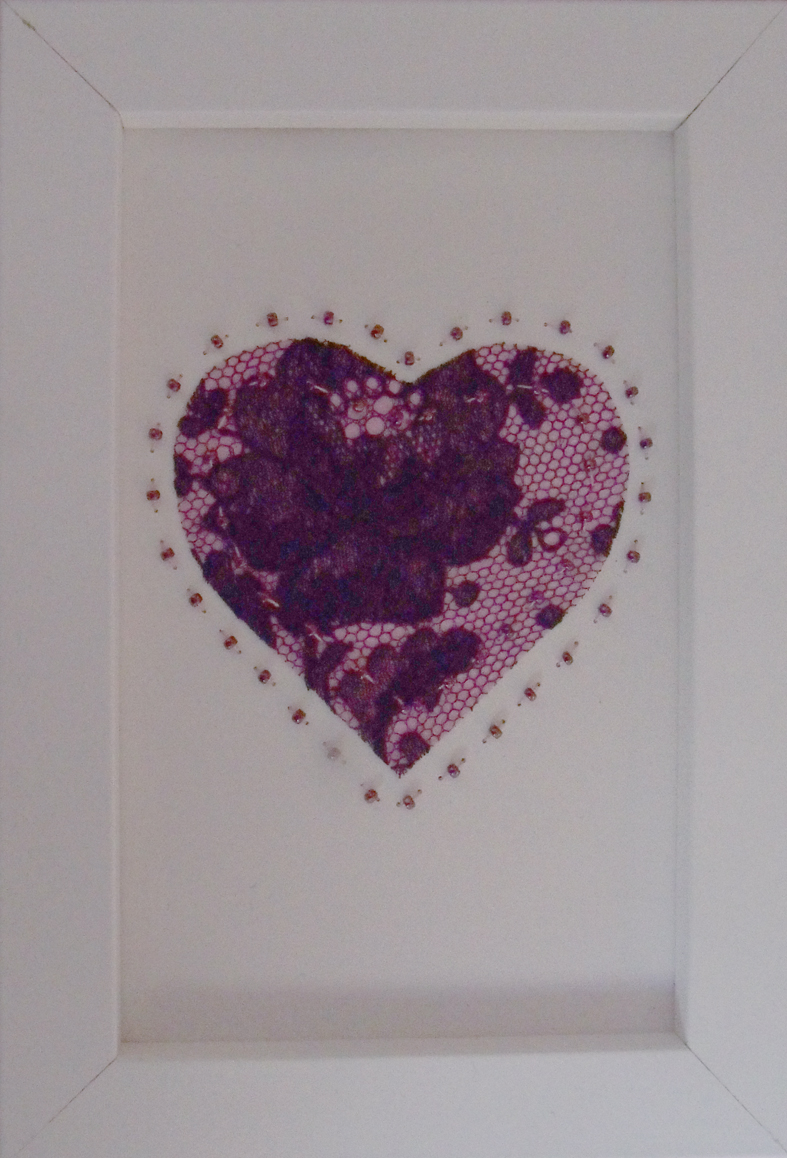
minute beaded black lace heart in tin frame- Jane-Marie Mahy
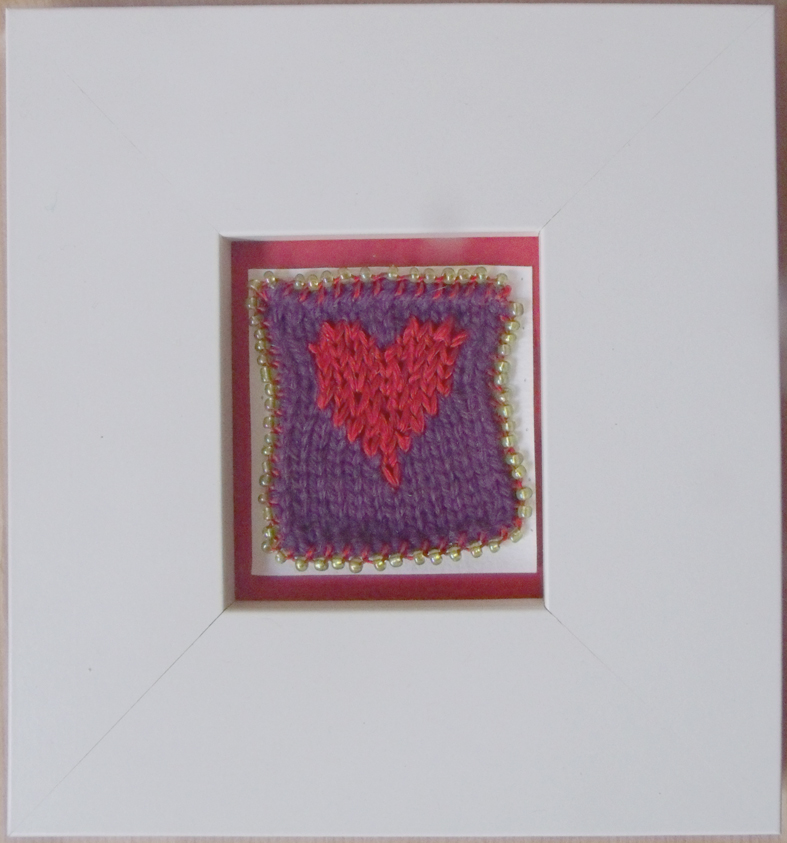
the tiny hearts are somehow the most appealing, they came in all manner of materials and techniques….
hand knitted and beaded heart by Amanda Jones
I must admit that I did take a few liberties with the mounts before framing… the more impact we can give them the better chance to sell them – and this is a selling exhibition
Larger black beaded lace heart by Jane-Marie Mahy
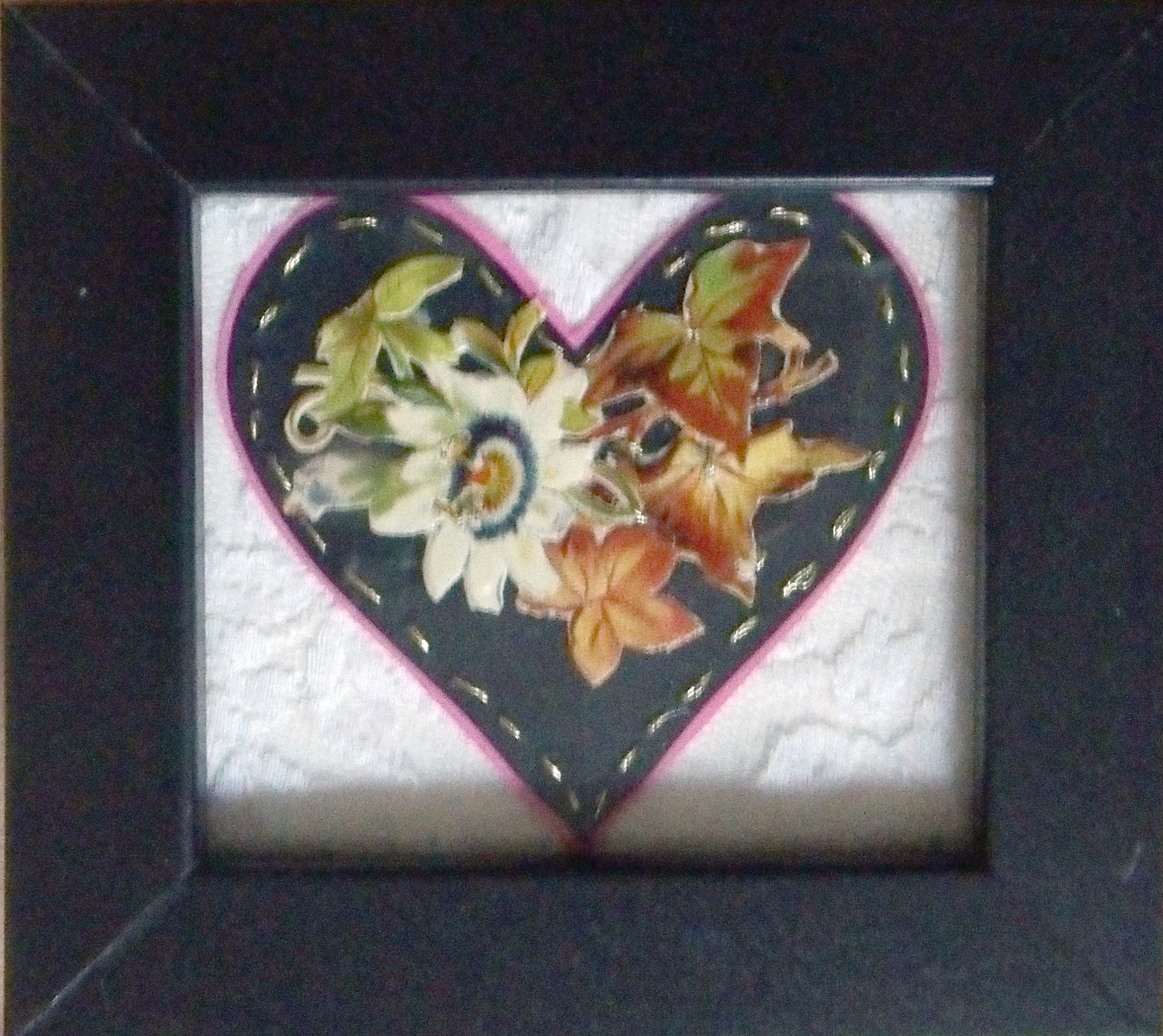
Jane- Marie Mahy Heart Space’s display guru brought hers in already perfectly framed, as did Debbie Bird – her teeny tiny paper printed scraps look very vintage when heavily framed in black
printed scrap paper applique by Debby Bird
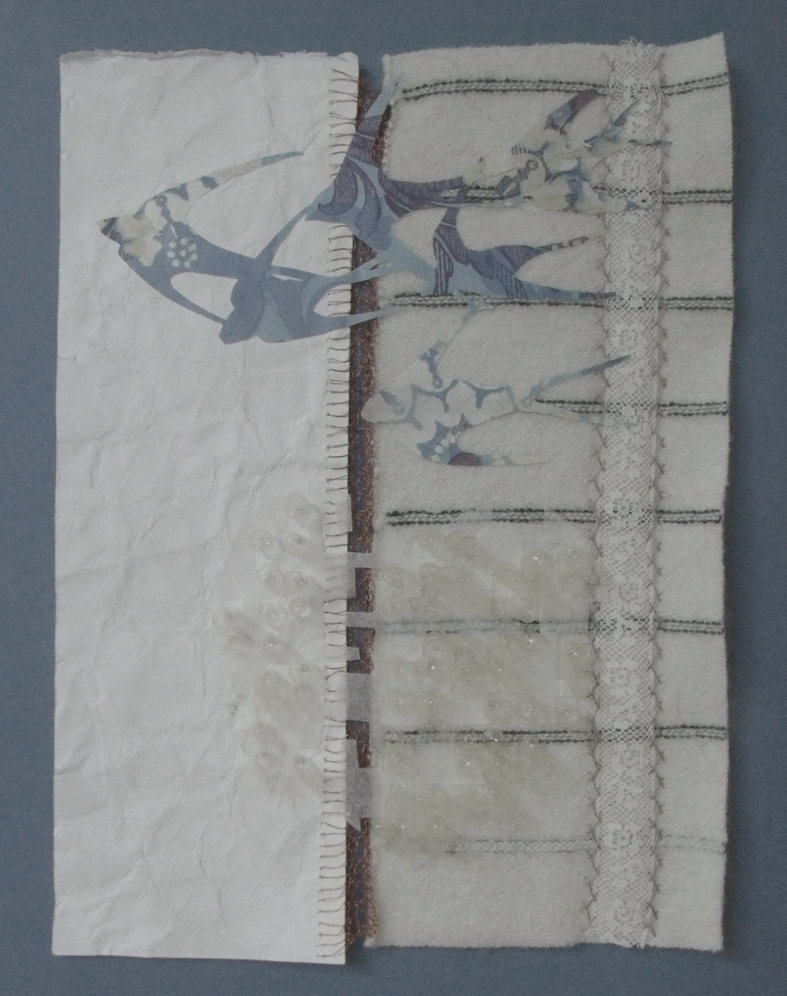
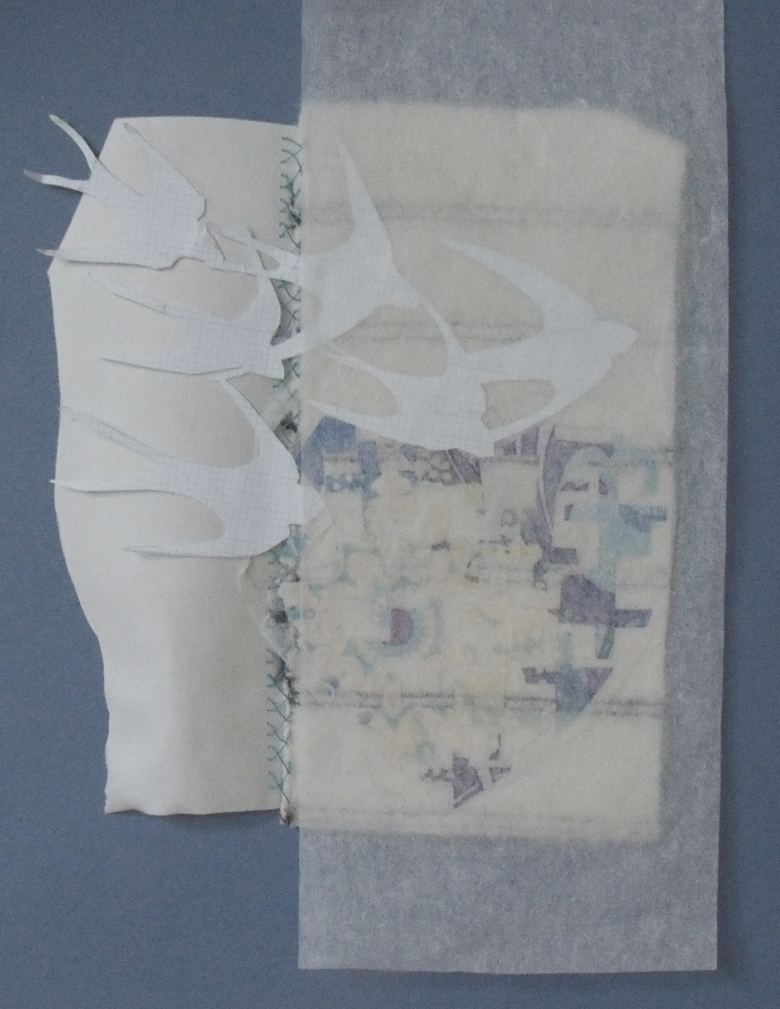
but for something completely different we have knitted copper wires to join paper and fabrics…with a flights of swallows scattered above a nebulous clear pill-case heart
flights of swallows by Steph Wooster
true to her discipline as a designer, Steph sent in 3 variations on her birds and hearts theme,
Steph’s second bird and heart picture
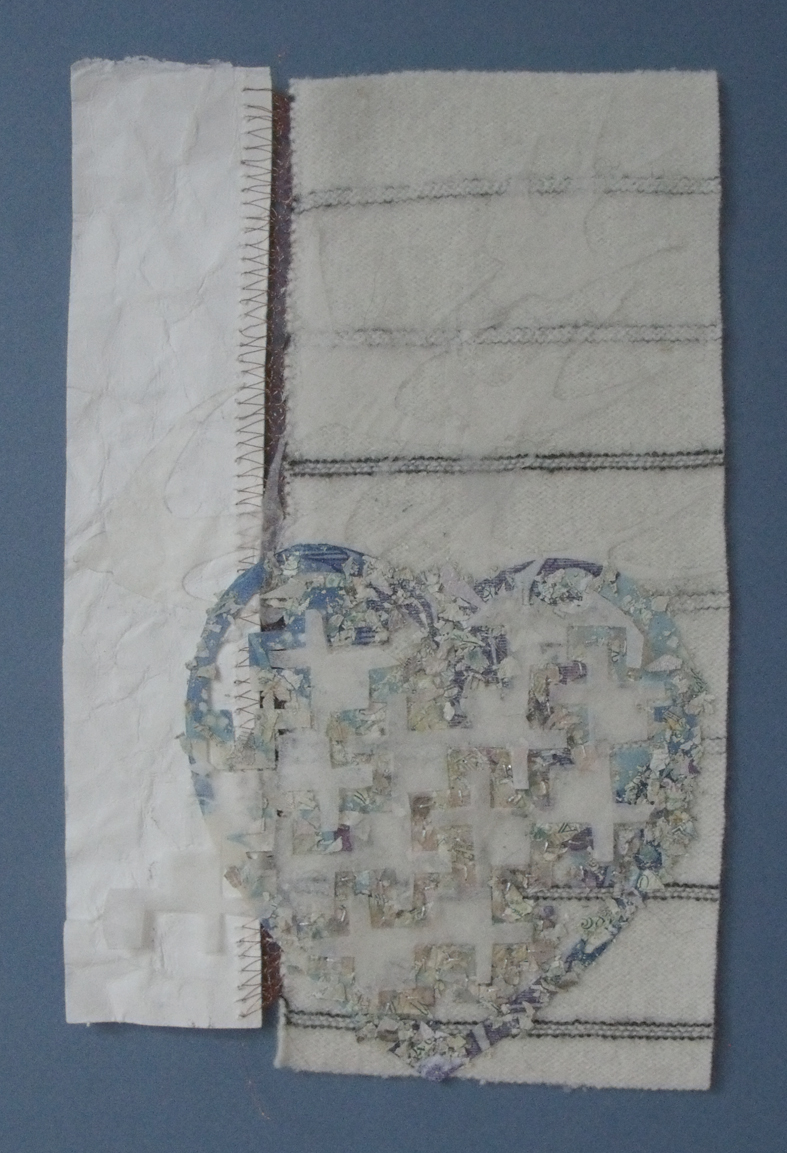
the third piece is an intricately cut applique of shredded bank notes, paper and woolen blanket stitched and knitted with copper wire…now that’s what I call mixed media.
Steph’s totally mixed media heart
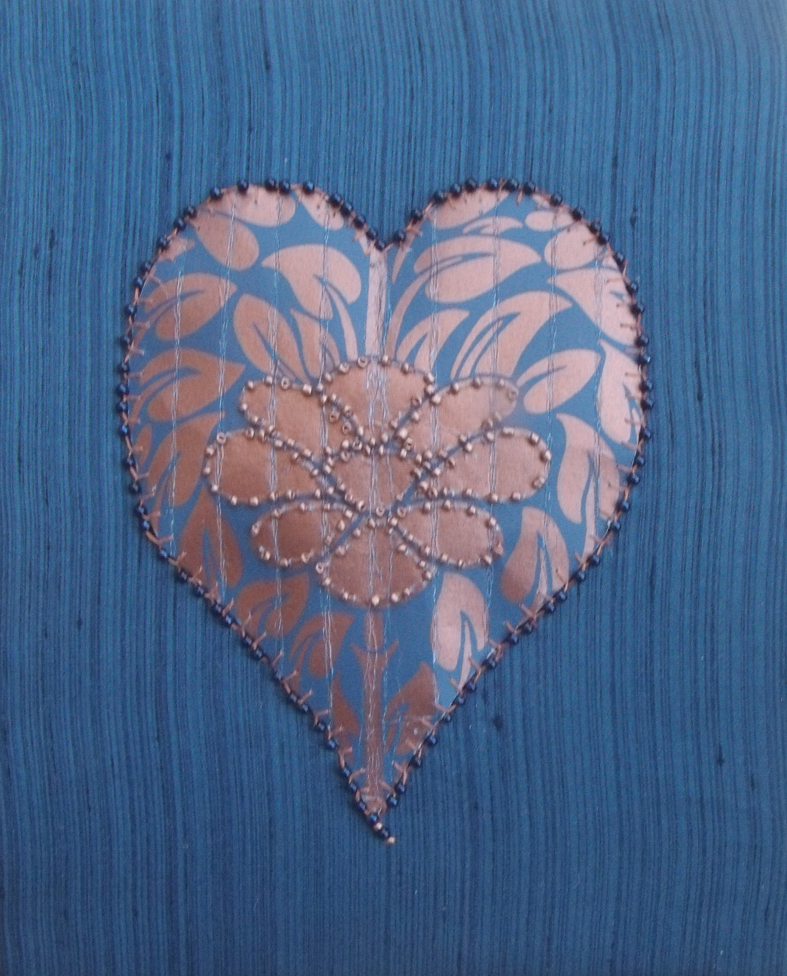
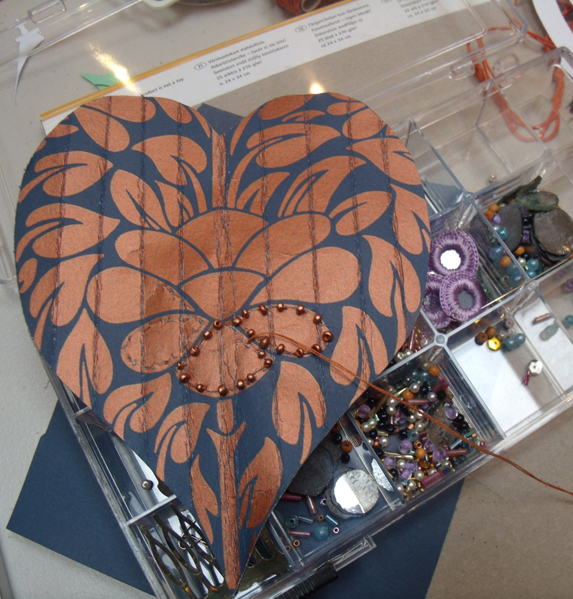
the beaded paper heart by Libby Butler is at last padded and applied to a dark blue fabric ground.
padded beaded paper heart by Libby Butler
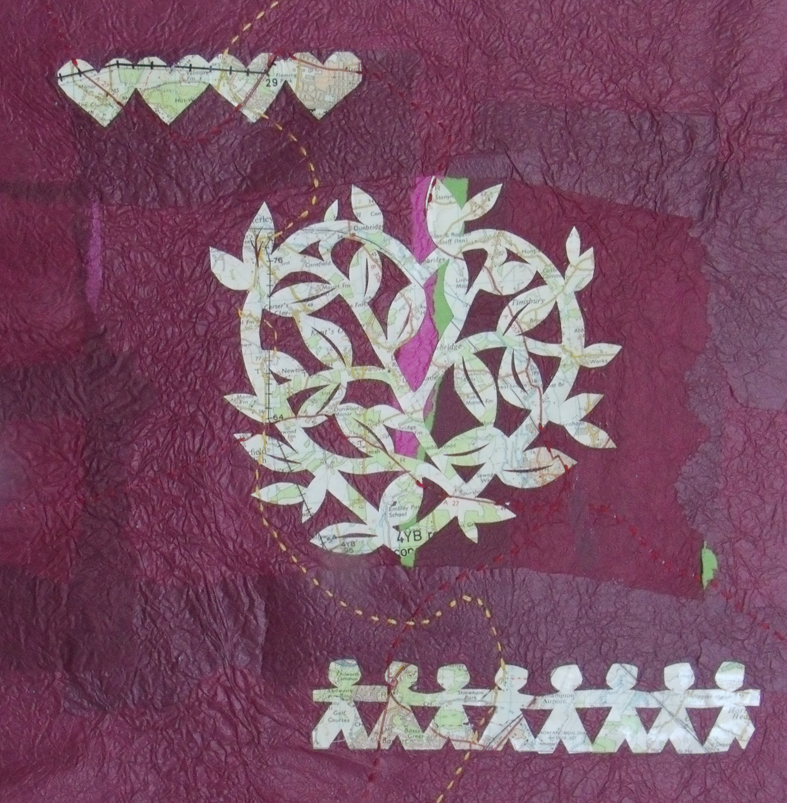
and right at the last minute this evening a lovely folksy map heart came form Kirsten Hill-Nixon…really worth the wait.
crushed paper and cut maps hand stitched applique by Kirsten Hill-Nixon
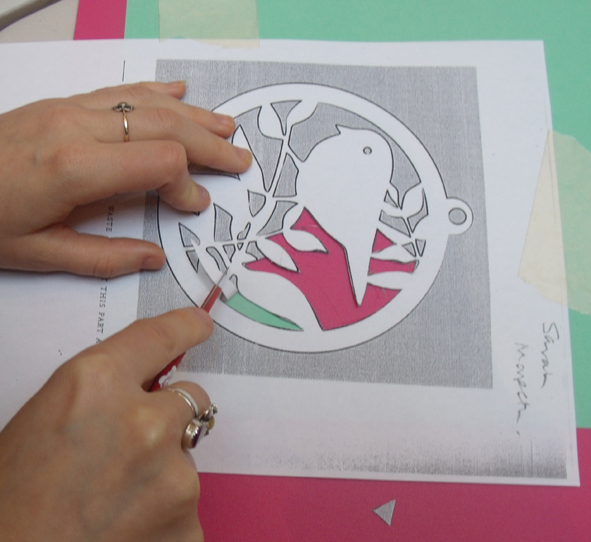
In celebration of Valentin’s day the staff and tutors at Heart Space Studios got together to develop mixed media work based upon Paper Cutting. Debby Bird led the session – a chance for everyone to get to know one another better and swap information, materials and ideas. The project was to make selling exhibition of heart pictures or cards for our gift shop.
bird motif for practicing on
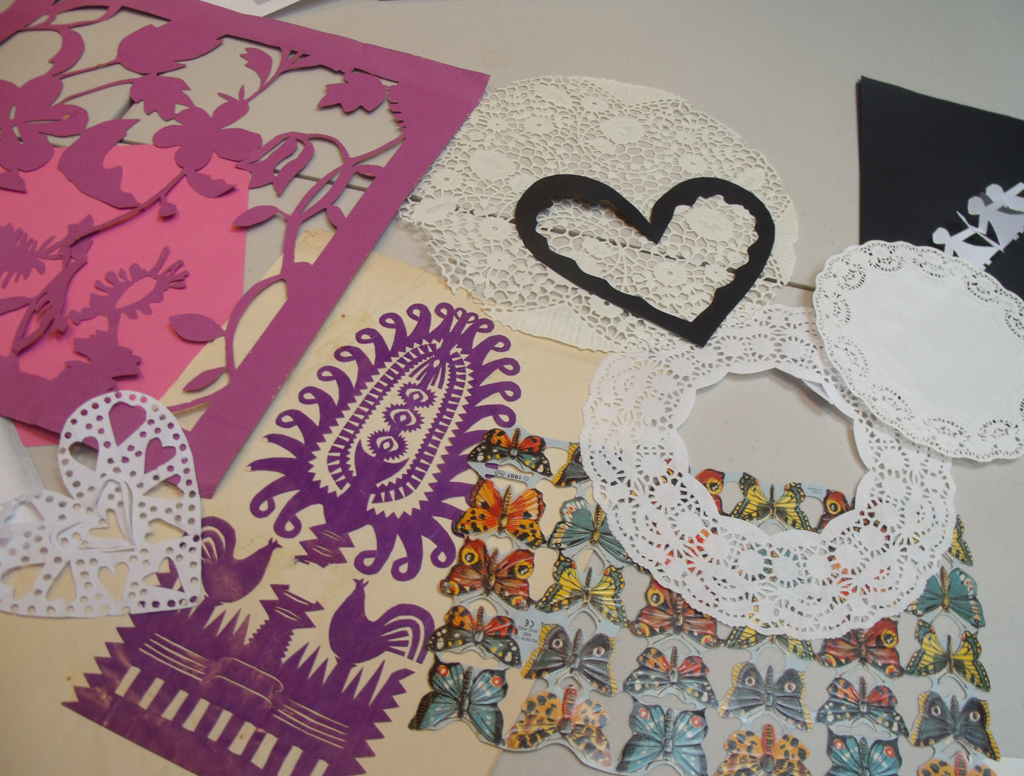
lace bonded onto papers
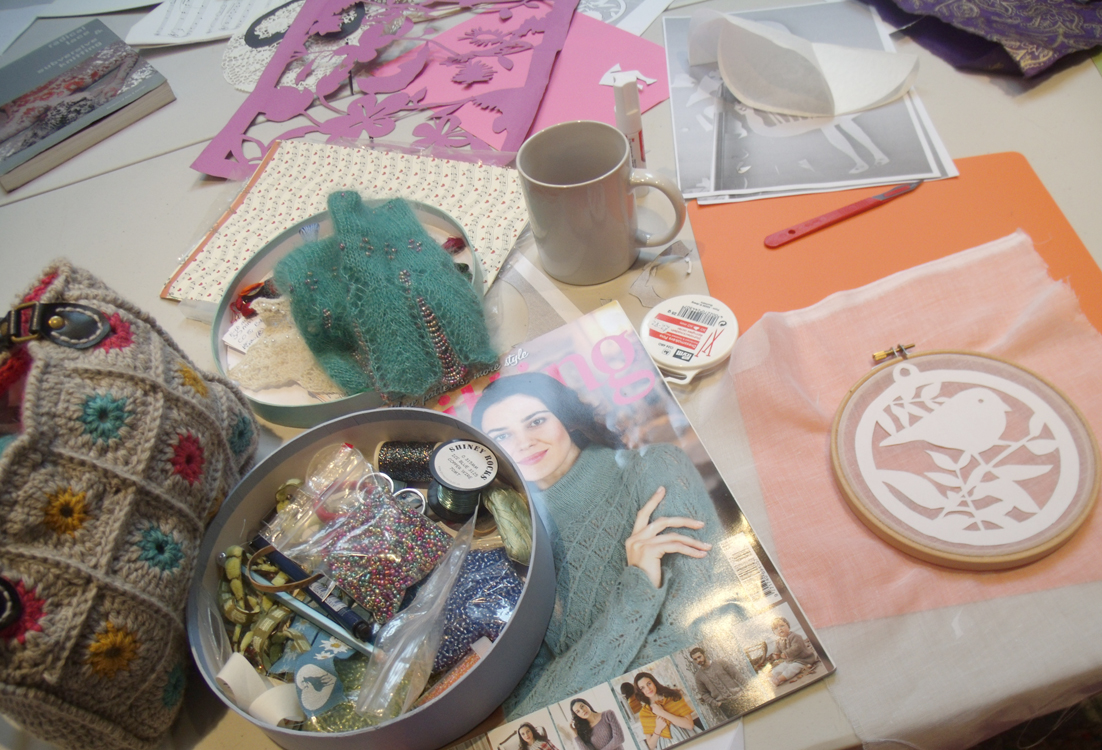
The tutors had been asked to bring in materials and equipment from their own practice, and so when these came out everyone stared to play with different things..
pre-cut papers, from scalpel to laser techniques
everyone had very different pieces of inspirational materials…
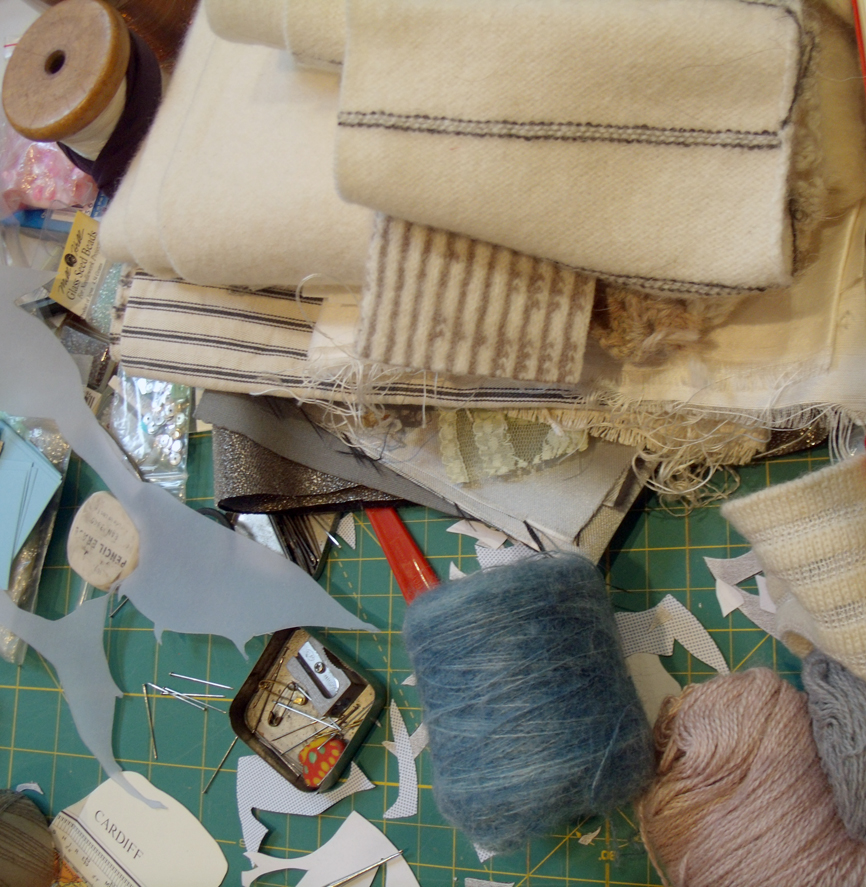
Steph Wooster’s stash of old blankets,woolen yarns, ticking and tracing papers.
the characters of the makers was apparent by the things they chose to bring….
Kirsten Hill-Nixon’s felt tweeds and maps
Each person has developed stashes of very personal things and now they had a good excuse to use them…..
Amanda Jone’s knit and crocheted bead collection
in fact even the boxes and bags the materials had been brought in were inspirational.
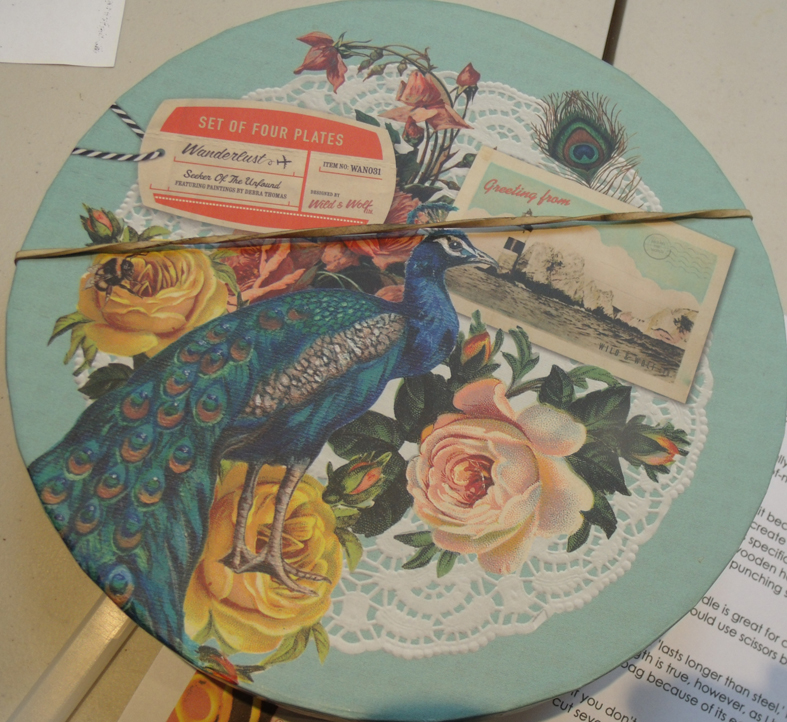
Decoupage cardboard box.
Sophie Bristol’s sewing box of exotic ribbons
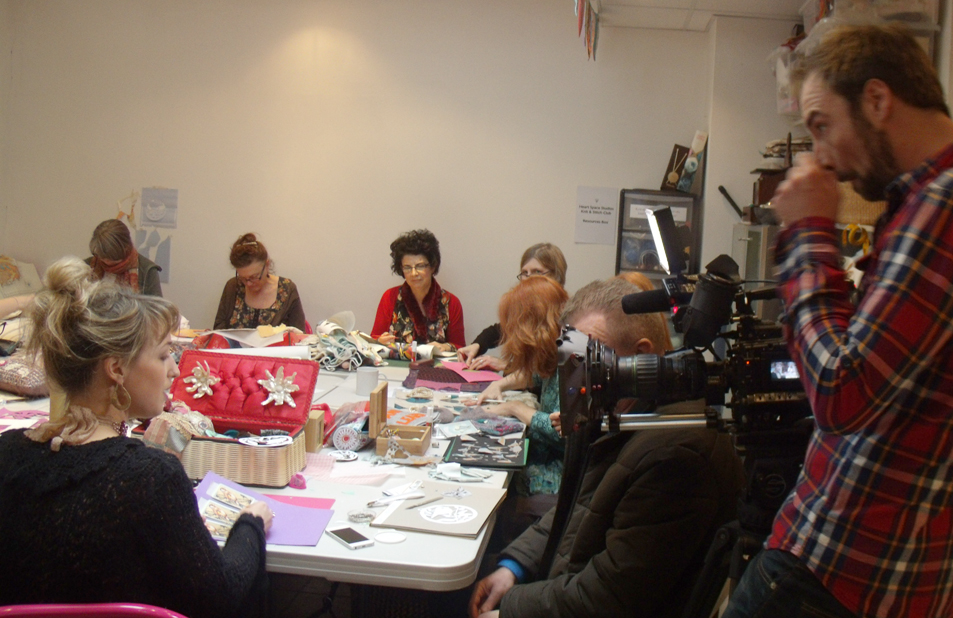
Just as we were getting started we were visited by a camera team to record the workshop for the regional daily news programme on ITV.
Regional news cameraman filming the workshop
Sophie and I were interviewed separately about various aspects of the how Heart Space works, she was fluent and received a round of applause from the group, but I was told by the interviewer that they had lots of ‘sound bites’ from me – I think this is a polite way of saying I didn’t exactly answer the questions.
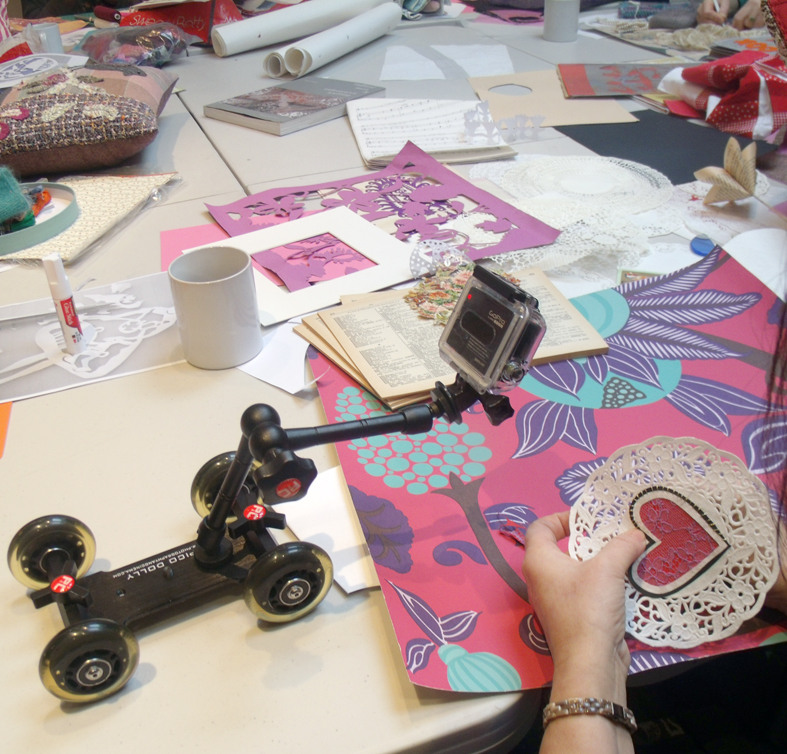
roving close-up camera checking Debby’s work
But we were all intrigued by the roving miniature camera used to get close-ups of the techniques were using. Back to work after the excitement and after we had given 5 top tips for beginners – more of which later…..
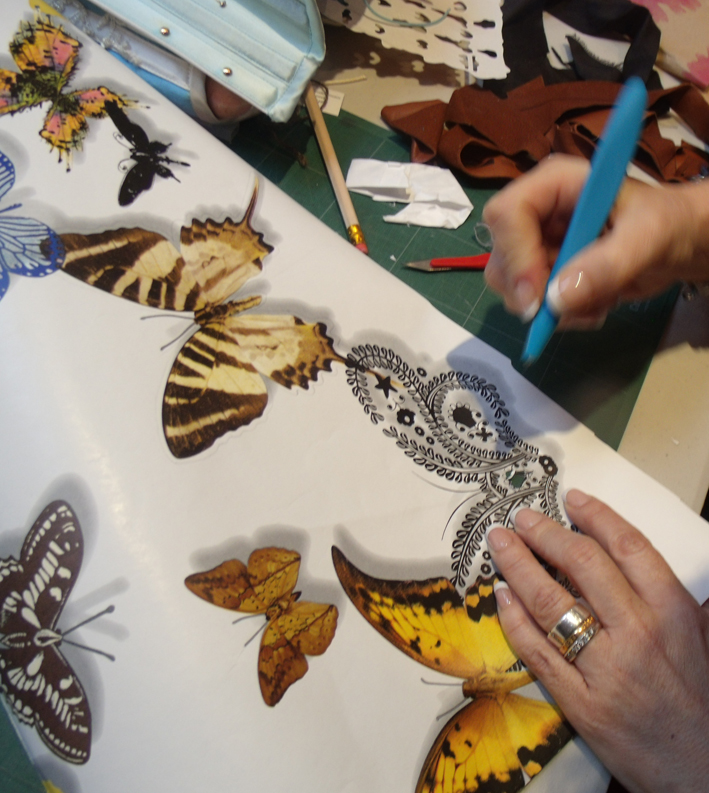
Lisa Keating starts to cut into a butterfly motif out of a modern photographic wallpaper.
Once the filming was over everyone suddenly seemed to be energised by what they could achieve in the day, they each had to make 1 sample heart picture that would ideally lead to a few other versions when they went home, when framed all this work will make up the Valentine’s exhibition for Heart Space Studios
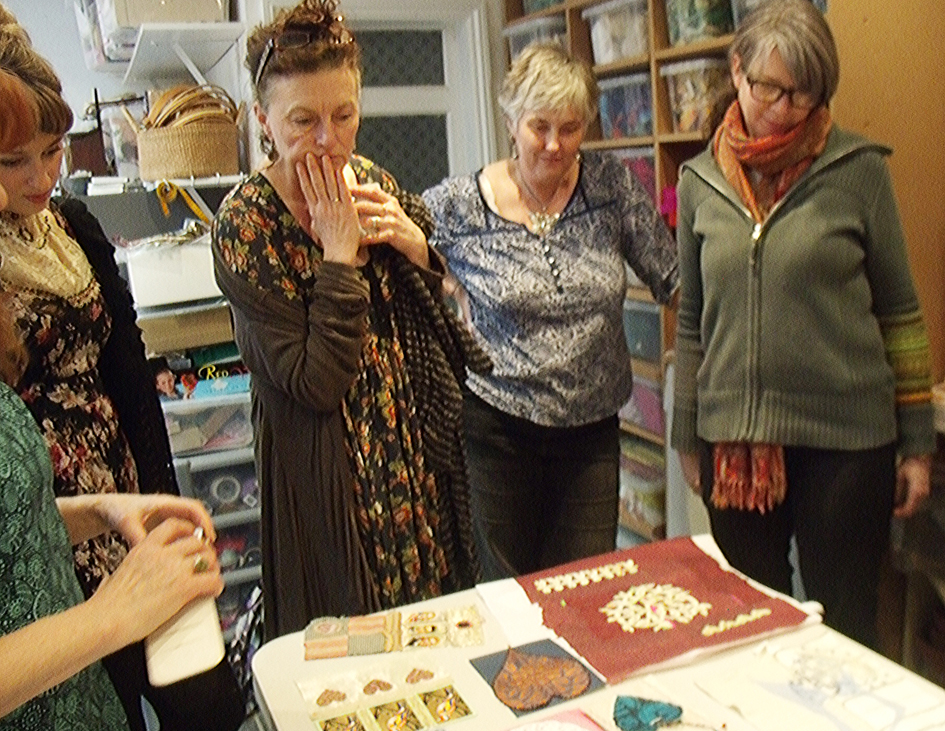
I was really pleased to see that Libby, who volunteers helping to generate our publicity, used the techniques I had taught at the first session of the Crazy Beading course that run on alternate Saturday mornings – really good to see how simple ideas can be adapted to new materials.
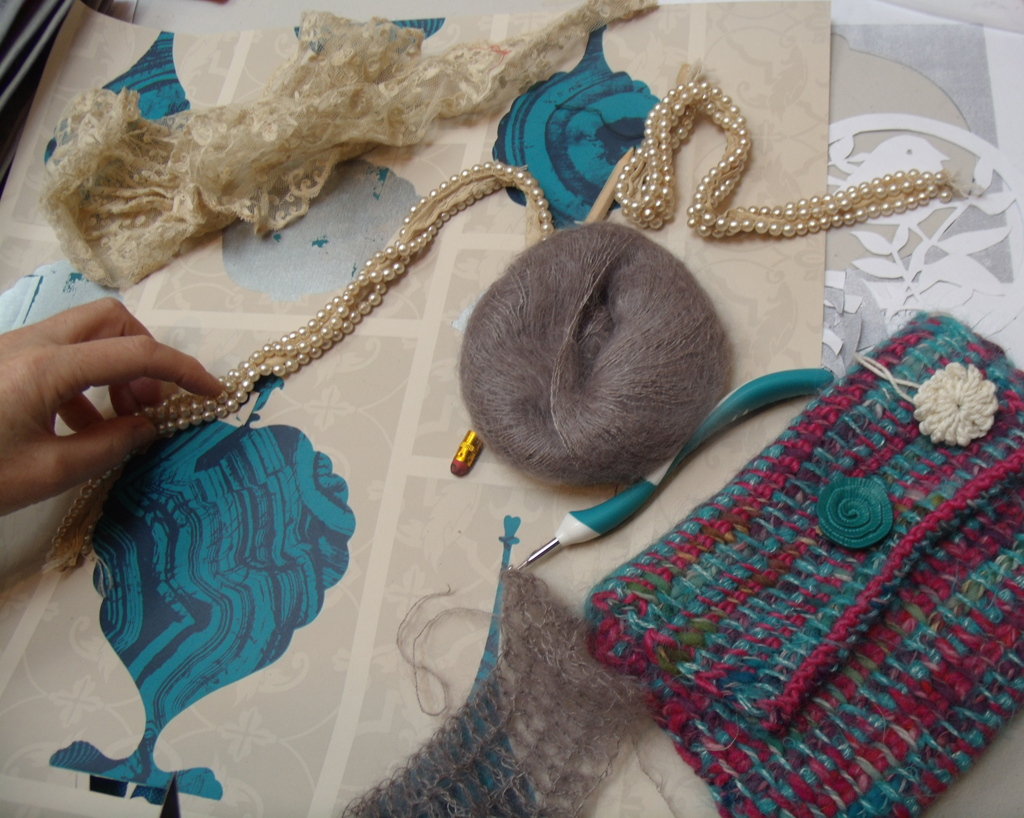
Avril Best’s wallpaper and woollen materials
Avril’s cut paper turquoise heart stitched onto Japanese washi paper
Suddenly hearts started to appear on all the work sites.
Steph Wooster’s seagull legs and heart applique
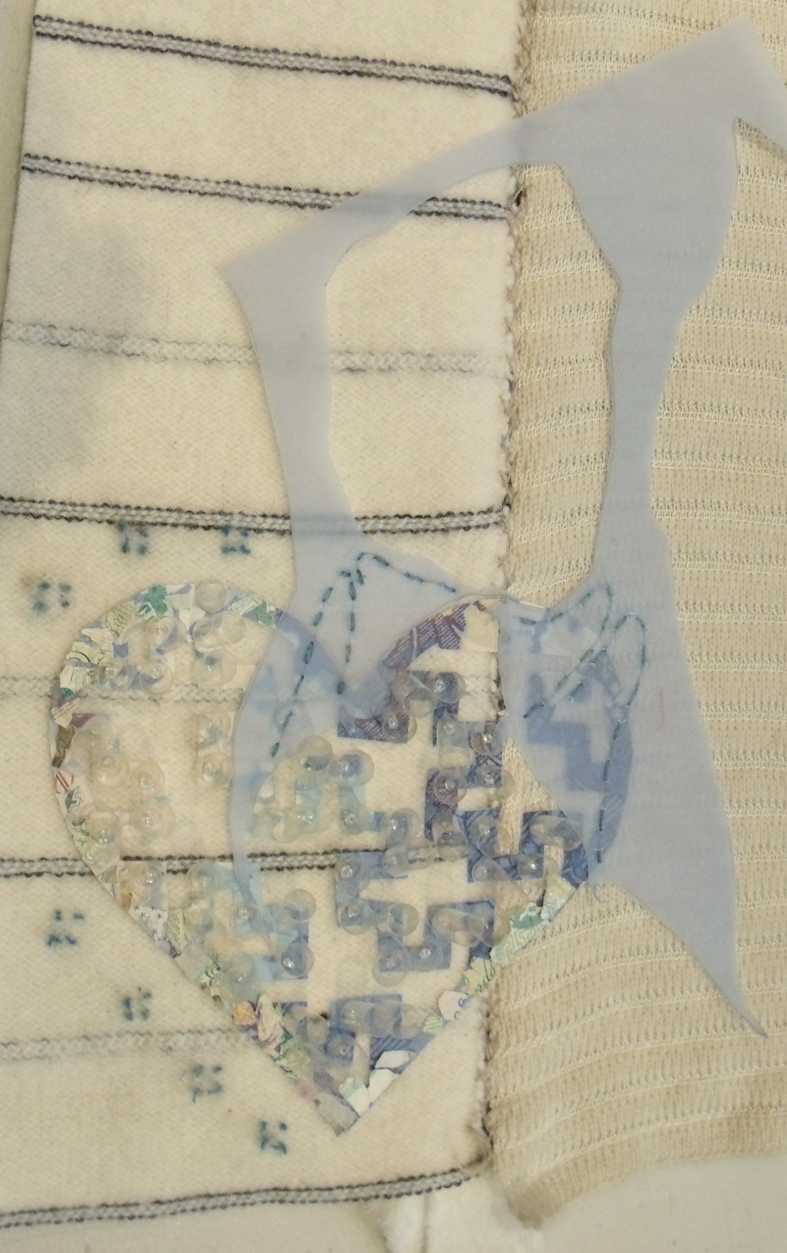
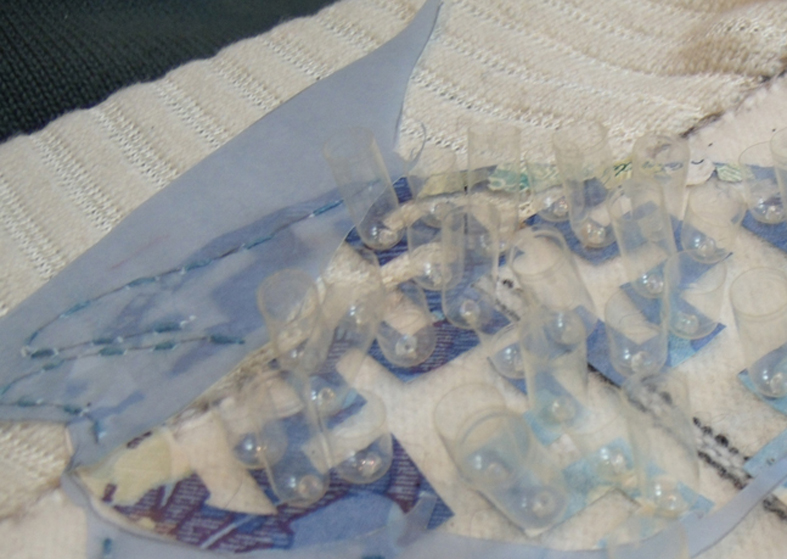
a close – up reveals a really strange use of mixed media – now who would have thought that medicine capsules could look so glamorous?
medicine capsules or new type of sequin?
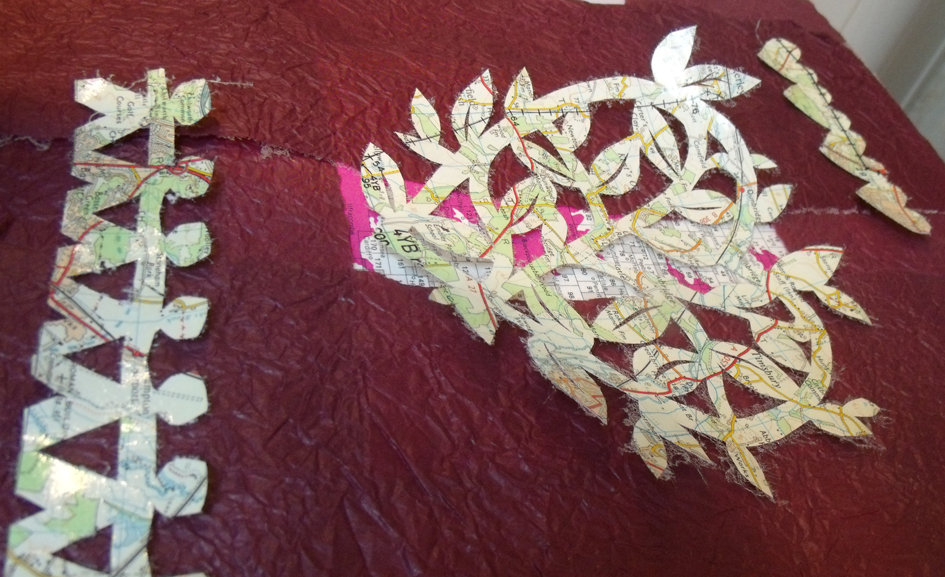
a really interesting idea emerged from Kirsten, she placed hearts and figures either side of a large decorative heart all of which she had cut from maps, I liked the idea that she could make links between the hearts and the figures using the map as a route……..
maps to link hearts and people? Kirsten Hill Nixon
the simplest hearts are often very successful – these stitched, printed, miniature bunting strips are just so desirable.
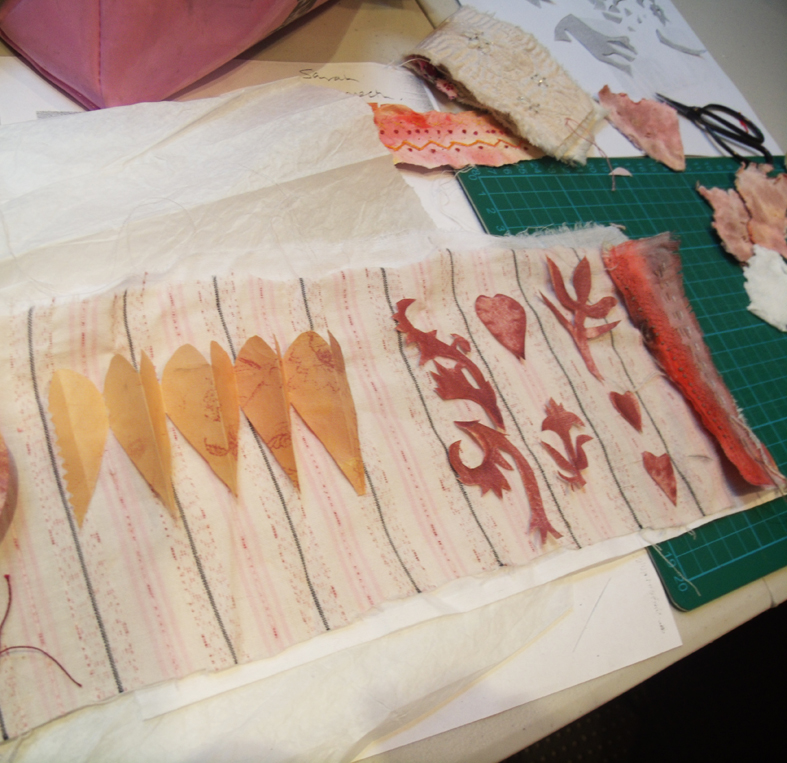
choices to make for developing finished work
When the sampling session was finished everyone set their work out for viewing by everyone – several people were determined to get more work for next week – which apart from St Valentine’s day celebration is the 3rd anniversary of the opening Heart Space Studios.
some of the group assessing the finished samples – where to go next – doesn’t look too hopeful does it?
Well they all promised to send or bring work for exhibition by the end of the week – so the next post will show the results….Oh and the 5 top tips for staring to make with textiles,
1 when threading a needle 1) cut the needle end of the thread at a 45% angle
2 when threading a needle 2) lick both the end of the thread and the eye of the needle
3 use circular needles to knit garments – you only ever have to make the basic knit stitch ( not alternate with rows of purl) and there are fewer seams to stitch up.
4 use the best possible materials you can afford – always.
5 press as you go when making any garments (this is also my own favourite rule)
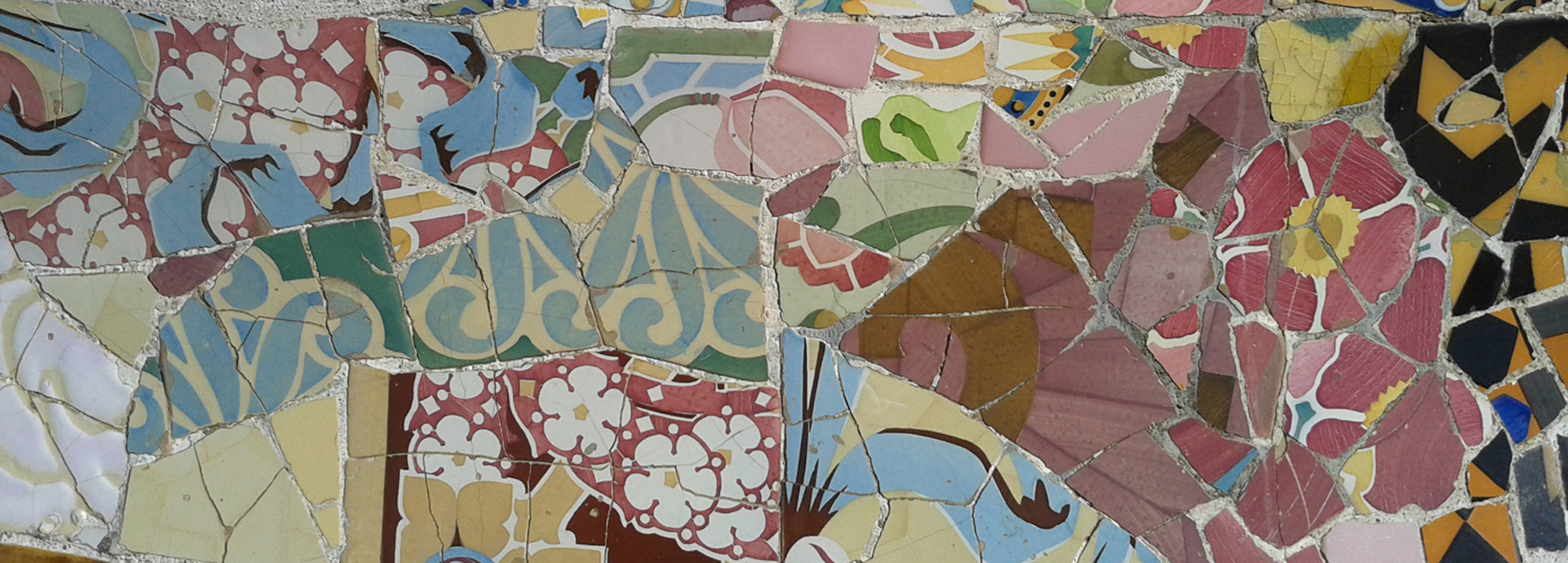
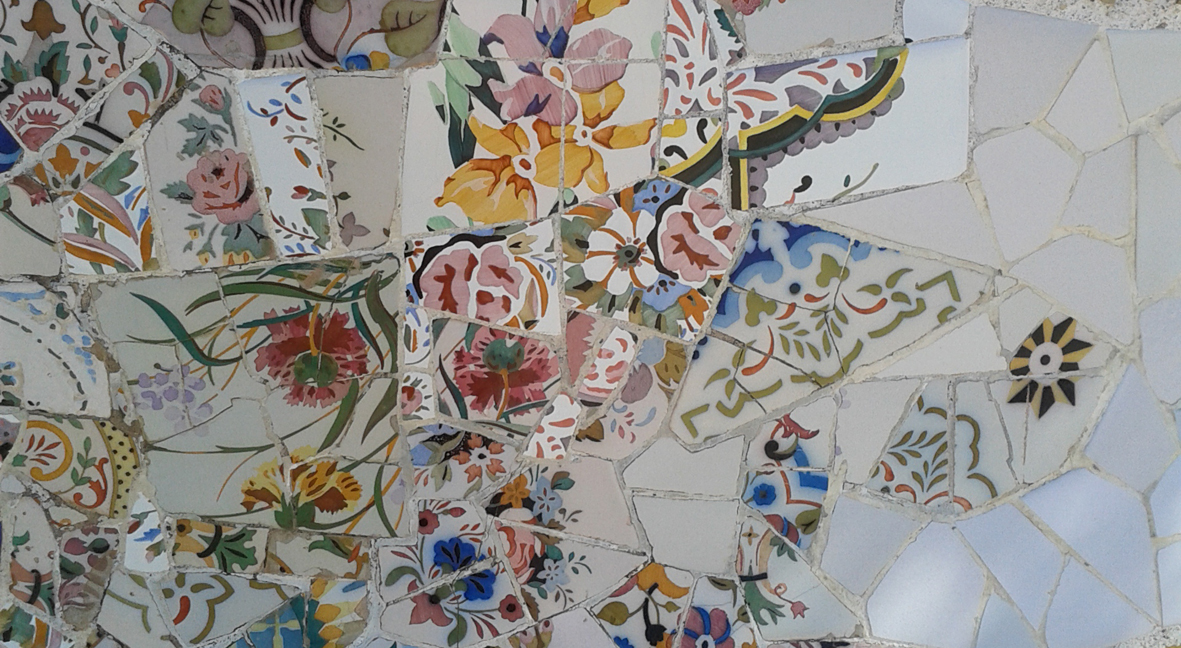
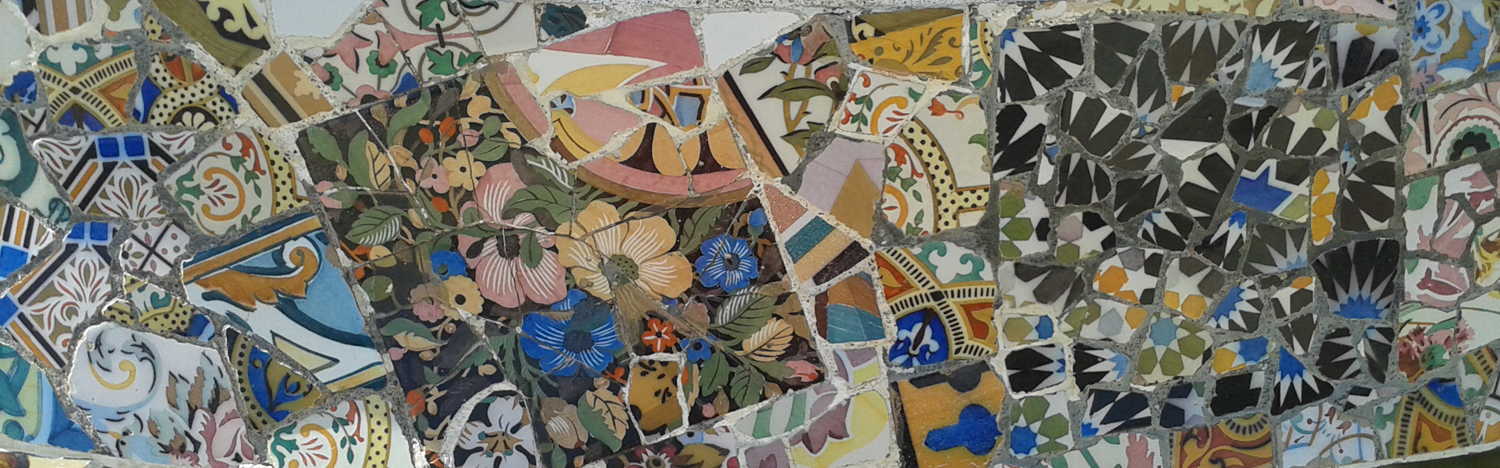
crazy mosaic by Antoni Gaudi at Parc Guell, Barcelona
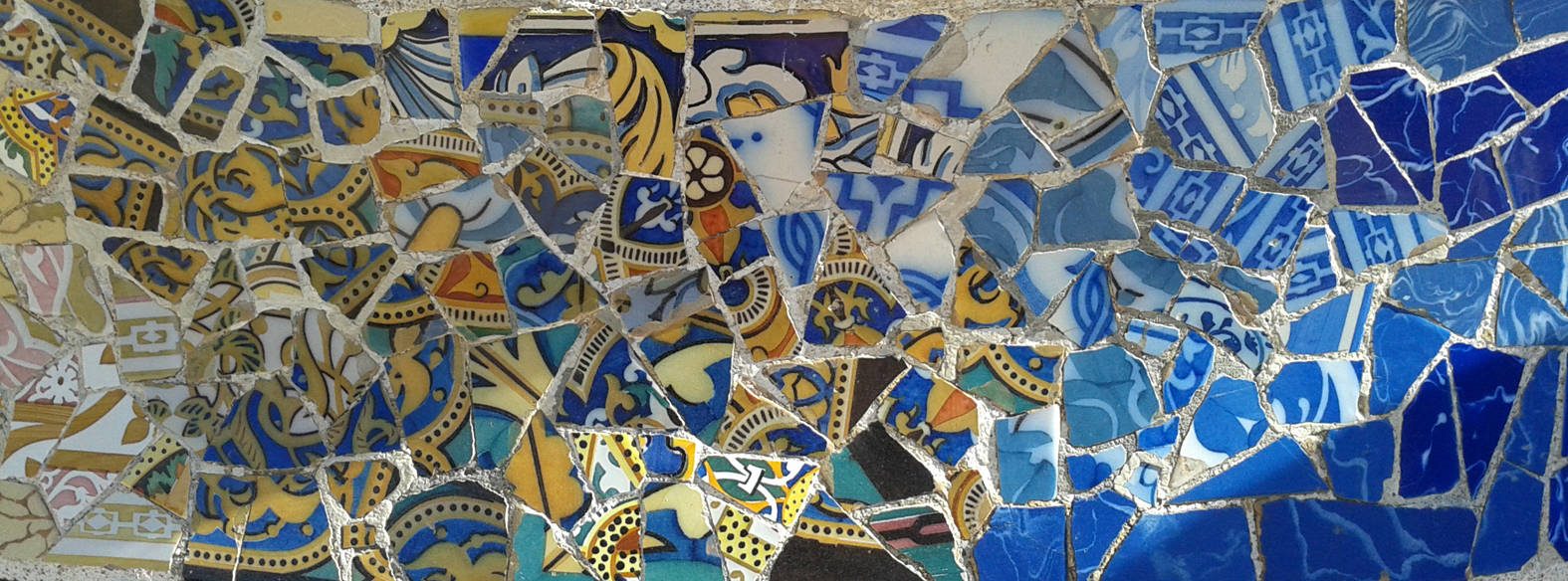
Crazy Barcelona – crazy patchworks everywhere, but not in fabric – in ceramic, stone and marble. OK then, crazy mosaics, but whatever you call them there is no better place to appreciate them than at Parc Geull, designed and built by Antoni Gaudi in the first 14 years of the 19th century. I have seen images of these mosaics before but never appreciated the size and the sheer exuberance of the patterns.
undulating crazy seating on the terrace
view of the entrance to Parc Geull from the crazy mosaic seating
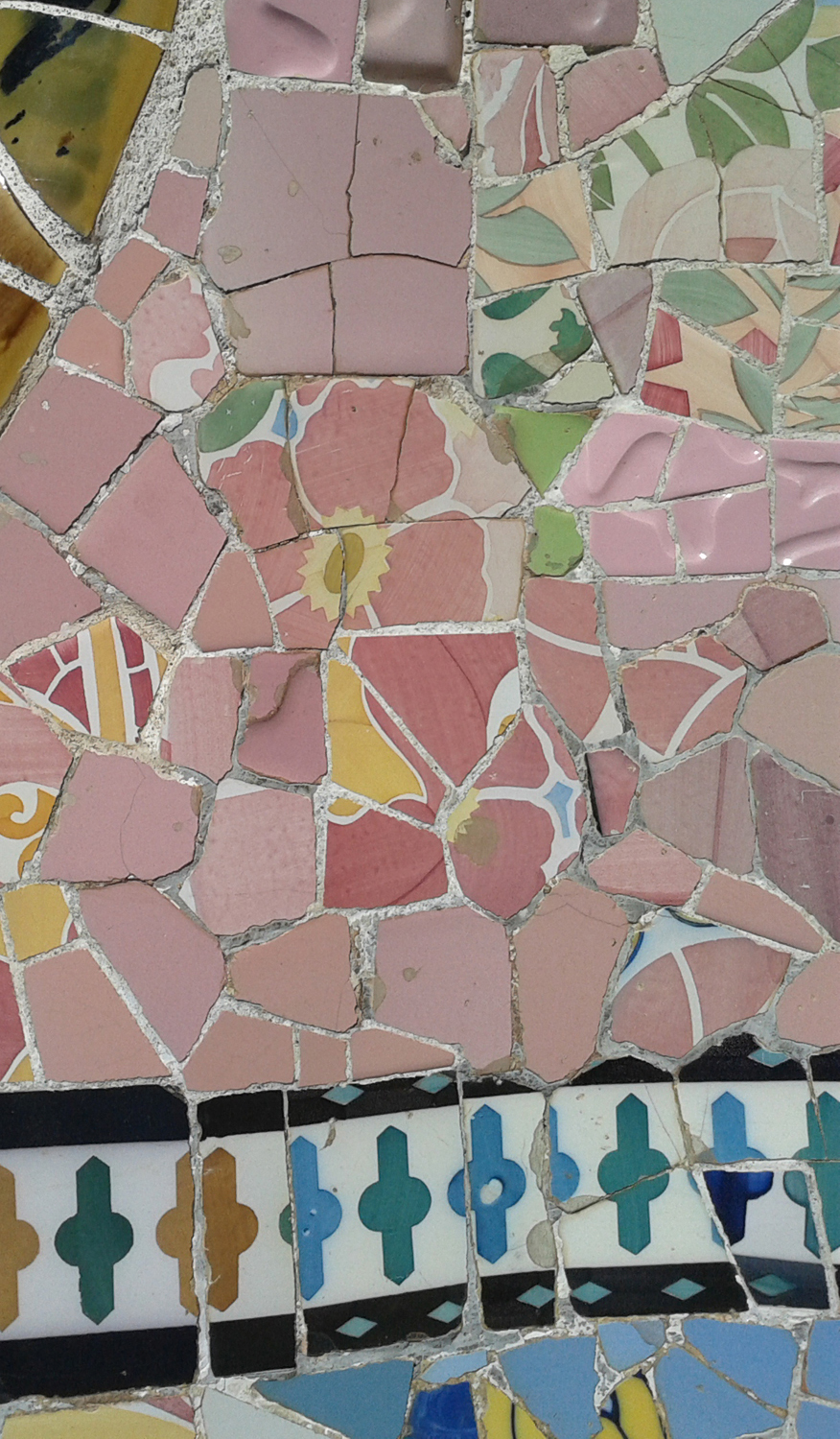
I was delighted to see broken plates, tiles, and rounded roof ridge tiles put together in a myriad of ways, some where just pretty with sections with large flowers that had been broken but kept intact when cemented together and then surrounded by all shades of one background colour. Here is inspiration indeed, but immediately I thought of the Crazy Embroidery classes that I teach at Heart Space Studios, lots of new ideas to create crazy samplers.
broken flowered ceramic tiles and plates with narrow borders
I started to see how the sustained patterning of the whole site didn’t just merge into one long visual porridge; there were sections of patterns with plain areas between them and the way that the patterns started to drift into plain areas was really brilliantly handled…
chintz patterns give way to a plain white area.
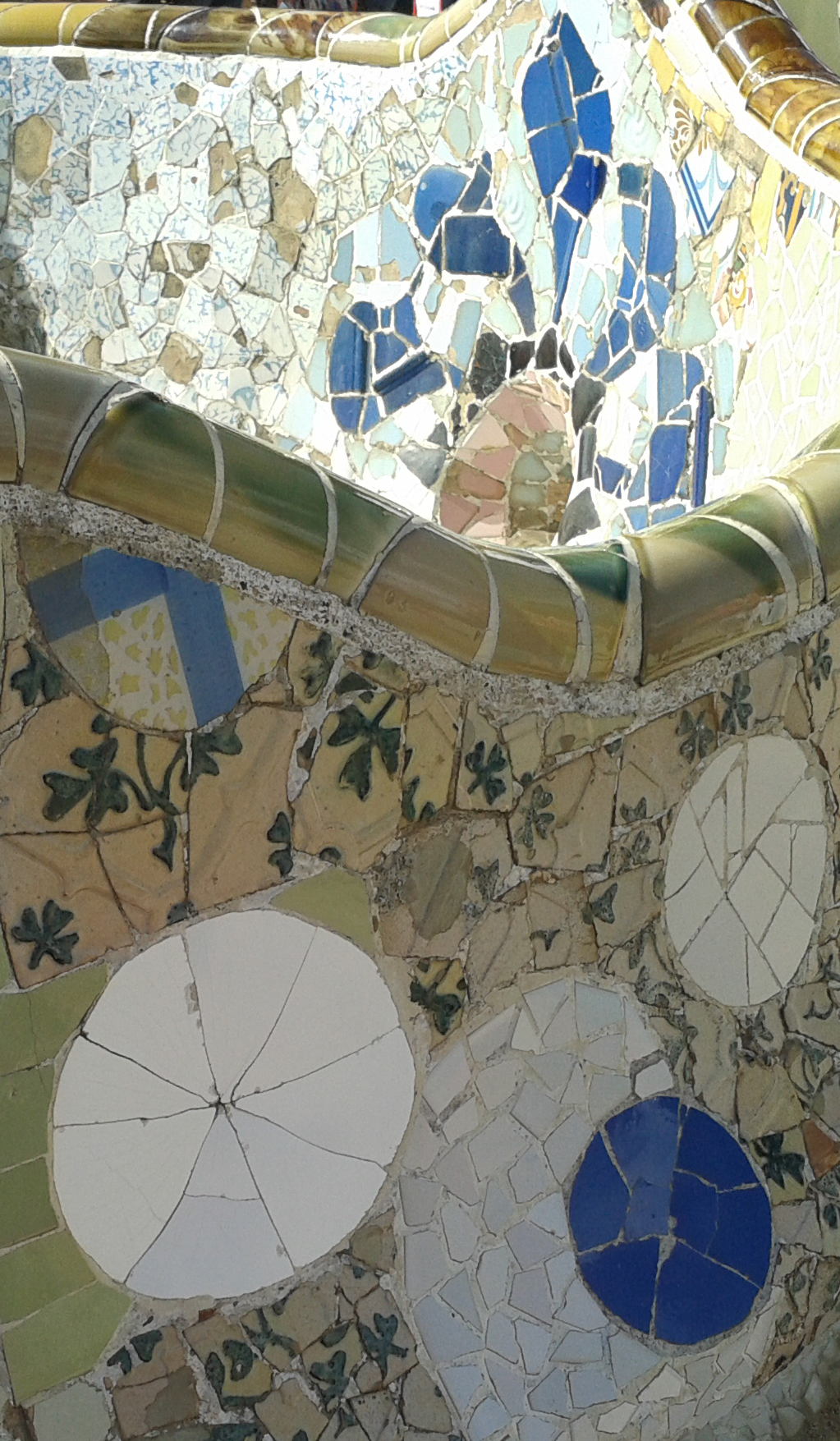
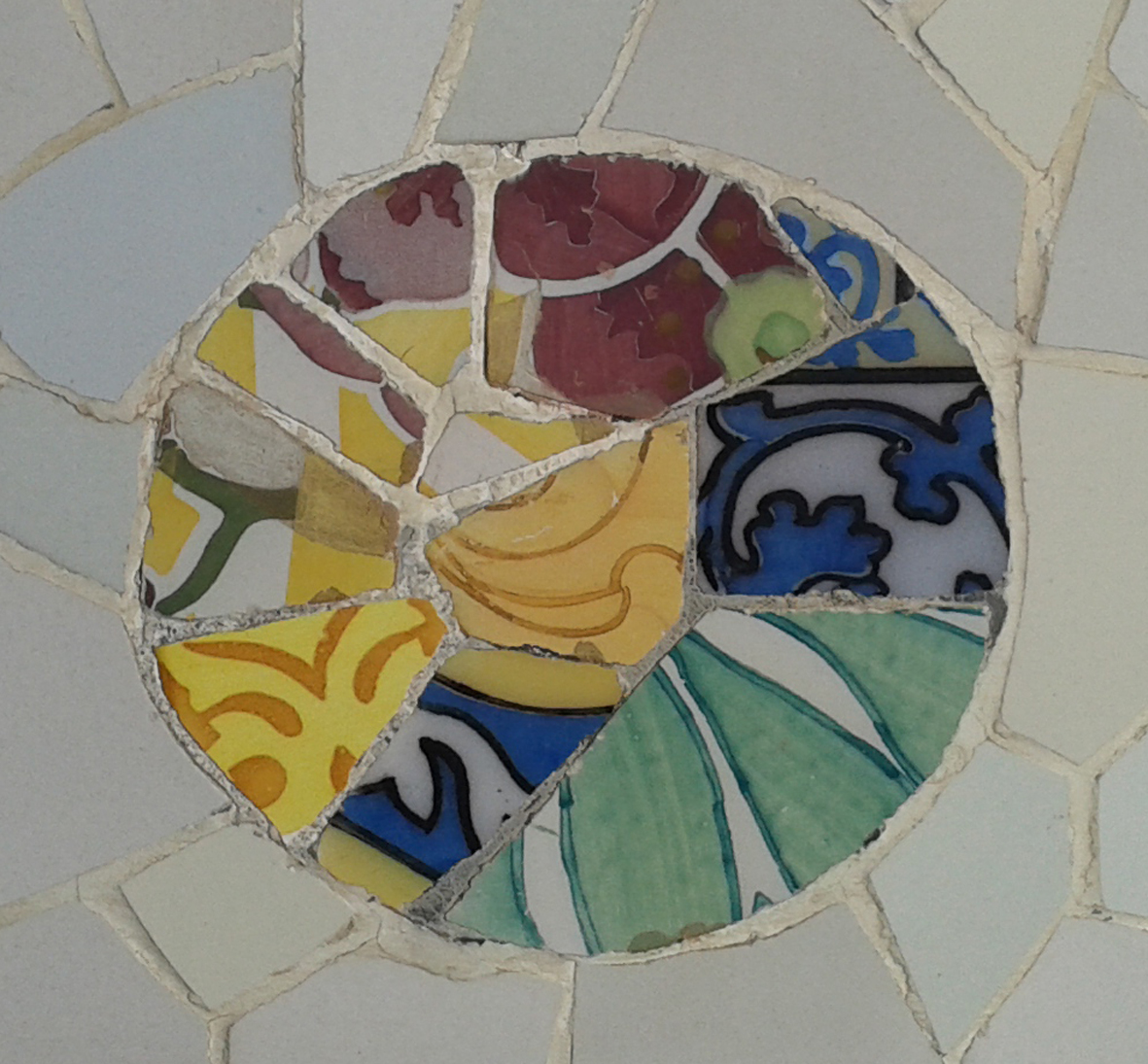
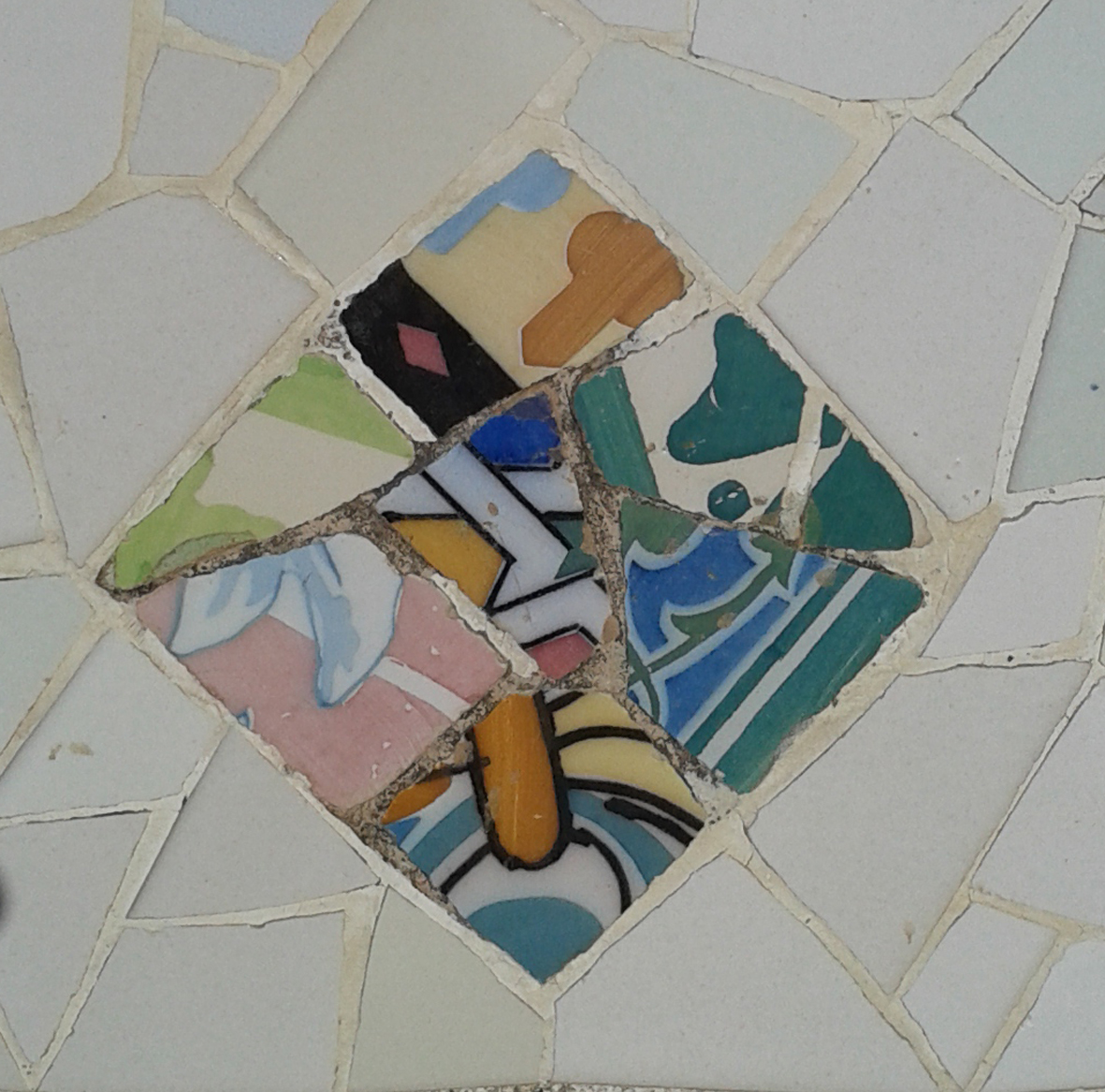
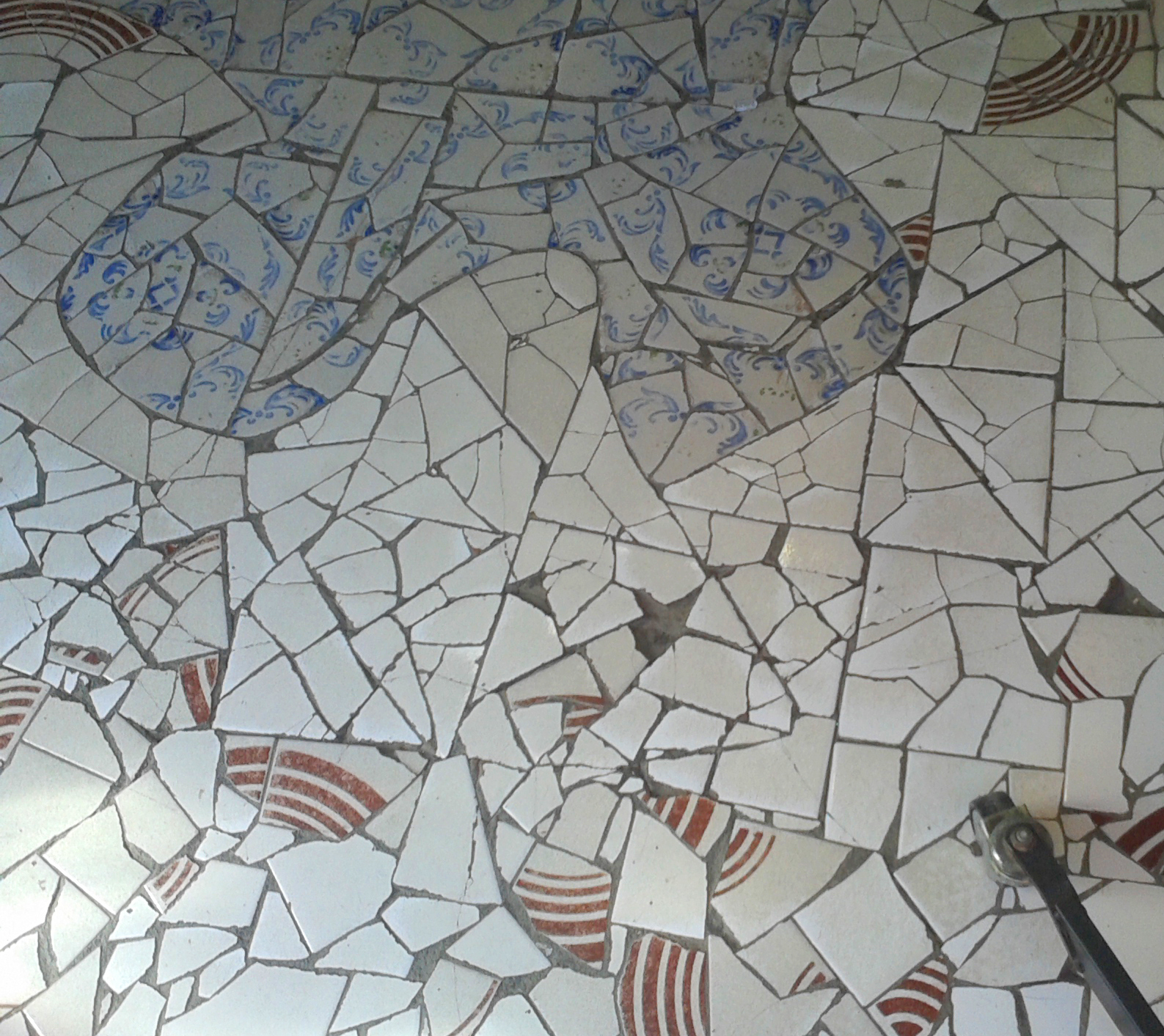
Sometimes the crazy patches were confined to simple shapes and surrounded by a sea of broken ceramics in a wide range of whites, the use of white ceramics when fired and glazed to produce many different variations is a major feature in this garden.
circle of crazy within white surround
diamond of crazy with mixed white surround
many different crazy whites shapes make for gentle and cool seating surfaces
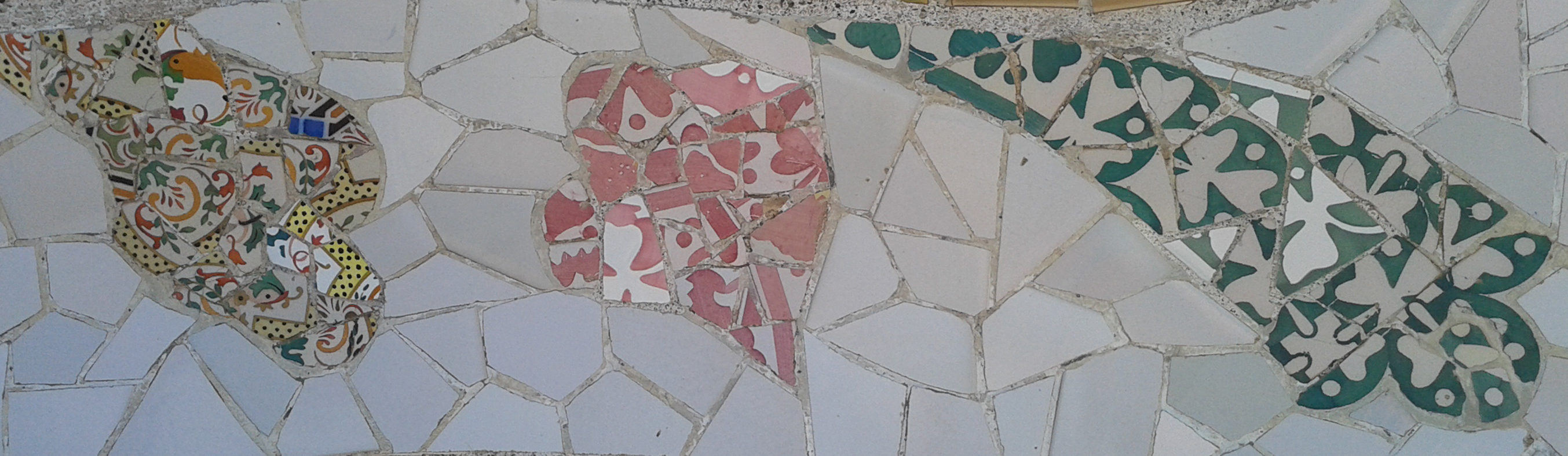
there were other more fluid shapes contained by the white ground….
amorphous paisley shapes
commas placed in a line around the base of a column
I also really enjoyed seeing patterns within patterns,
patterns within patterns
I really like these wonky squares set in a sea of crazy patterns; the makers must have had such a good time doing this work. Transitions from patterns to solid colours was just masterful in places
this transition from rich colour to single coloured patterns is masterful
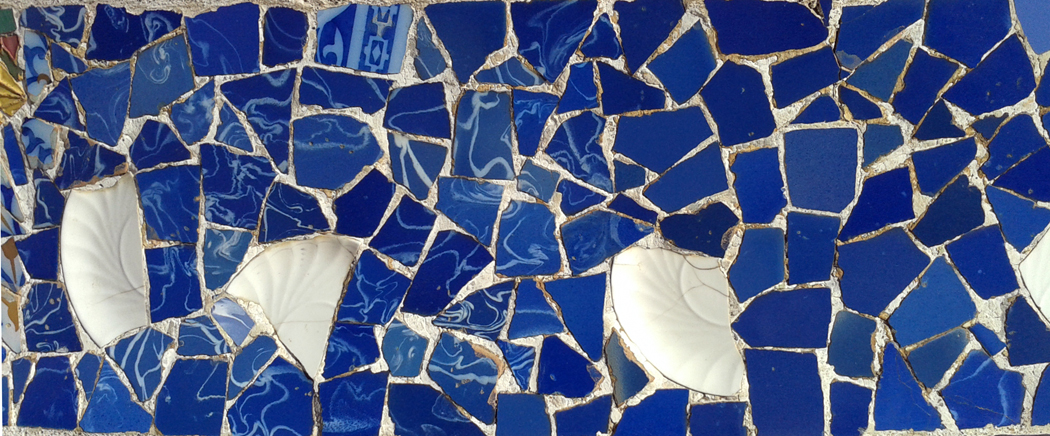
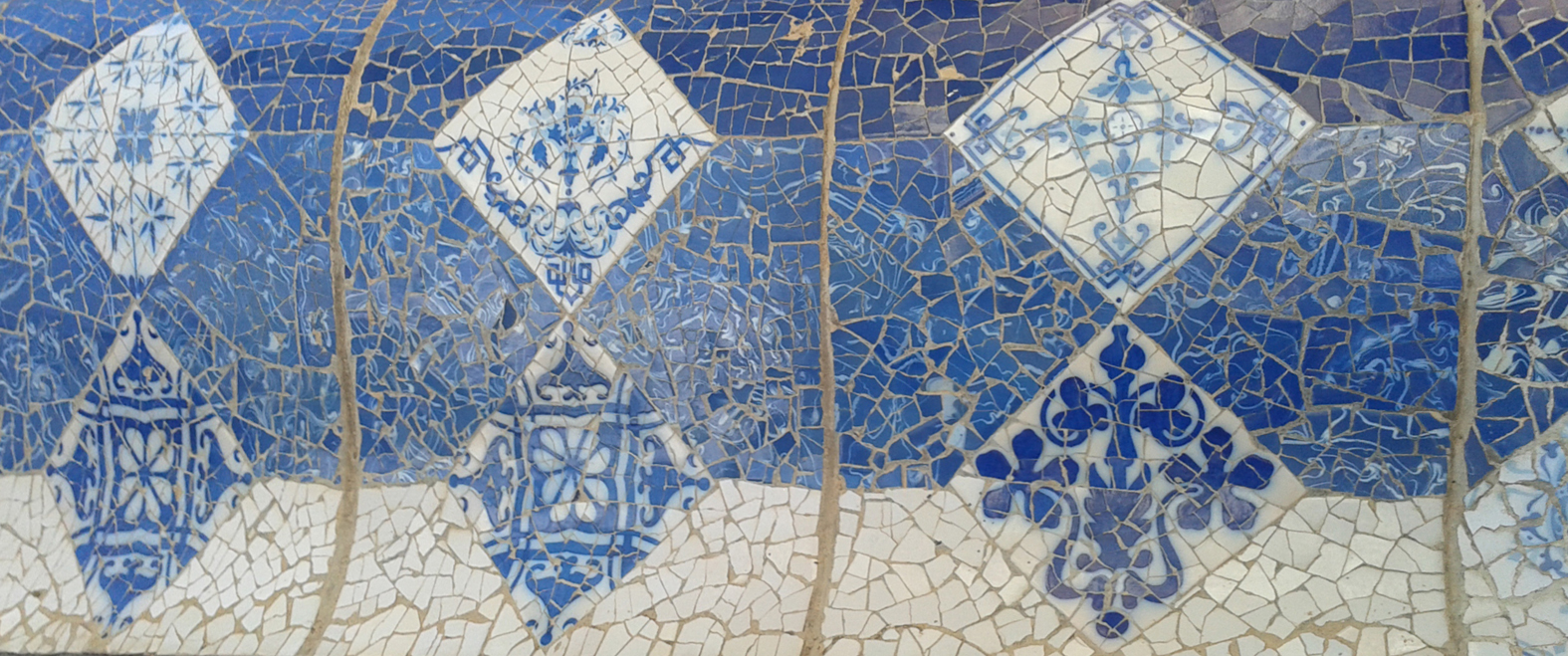
in fact the single coloured sections were simply beautiful – here is a range of crazy blue patterns
broken plates in a sea of blue
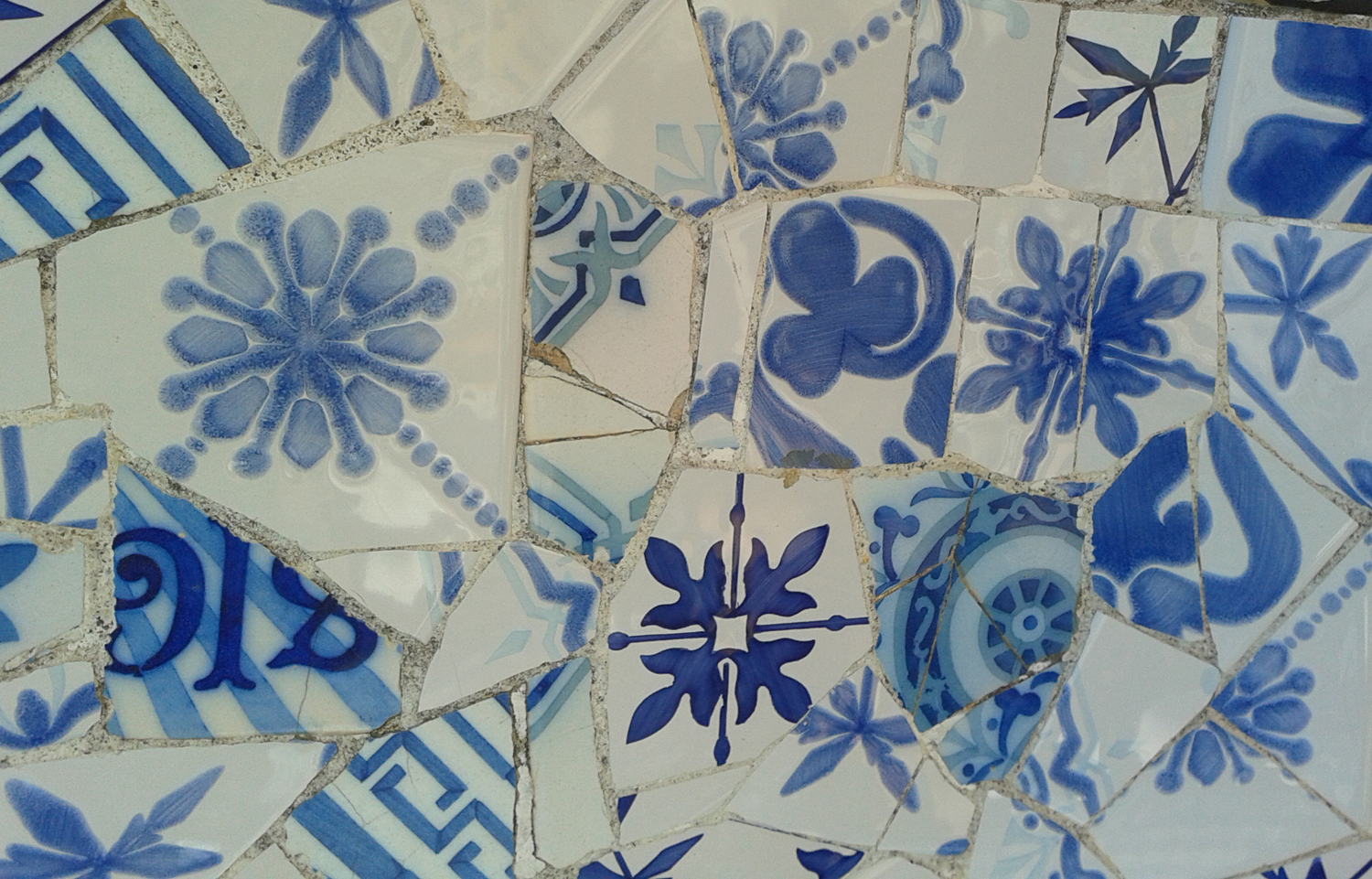
typical Spanish hand painted blue tiles
refined diamond designs on blue and white striped ground
while most of the ceramic patterns are traditional in flavour there were also some more abstract patterning to be found,
abstract patterns must have looked strange in the early 1900’s
but this whole set of designs is made from re-cycled materials, apart from the abundance of beautiful old and broken patterned tiles from the Spanish ceramic factories, I was happy to see this poorly fired plate used to good effect.
poorly fired glazed plate has been put to good use.
After an hour of my visit I started to see evidence of Crazy everywhere..
the sandy ground in the park is impressed with crazy patterns
looking down at the sandy pathways I saw crazy patterns impressed by the soles of many different shoes, and once out of the park, everywhere I looked was Crazy Heaven.
the Crazy cafe floor
and the Crazy marbled walls
So now I have decided to try to develop some of these ideas into new Crazy Patchwork designs for cushion cover designs to show Hugh Ehrman at Ehrman Tapestry company for their future collections.























![HHE1[1]](https://janethaighherwork.com/wp-content/uploads/2025/06/65d7c-hhe11.jpg)